Part 2 / Book 1 — CHAPTER II DEDUCTION OF THE PURE CONCEPTS OF THE UNDERSTANDING (continued 2)
Reading edition
I shall now summarise these introductory discussions in a brief tabulated outline of the main steps in the argument of the two deductions, and shall add a concluding note upon their interconnection.
Subjective Deduction.—1. Consciousness of time is an experience whose actuality cannot be questioned; by its actuality it will therefore establish the reality of everything that can be proved to be its indispensable condition.
2. Among the conditions indispensably necessary to all consciousness of time are synthetic processes whereby the contents of consciousness, occurring in successive moments, are combined and unified. These processes are processes of apprehension, reproduction, and recognition.
3. Recognition, in turn, is conditioned by self-consciousness.
4. As no consciousness is possible without self-consciousness, the synthetic processes must have completed themselves before such self-consciousness is possible, and consequently are not verifiable by introspection but only by hypothetical construction.
[1, 2, 3, and 4 are steps which can be stated independently of the argument of the objective deduction.]
5. Self-consciousness presupposes consciousness of objects, and consciousness of objects presupposes the synthetic activities of productive imagination whereby the matter of sense is organised in accordance with the categories. These productive activities also are verifiable only by conjectural inference, and only upon their completion can consciousness of any kind make its appearance.
6. Consciousness of self and consciousness of objects thus alike rest upon a complexity of non-phenomenal conditions. For anything that critical analysis can prove to the contrary, consciousness and personality may not be ultimates. They may be resultants due to realities fundamentally different from themselves.
[5 is a conclusion obtained only by means of the argument of the objective deduction. 6 is a further conclusion, first explicitly drawn by Kant in the Dialectic.]
Objective Deduction.—1. The starting-point coincides with that of the subjective deduction. Consciousness of time is an experience by whose actuality we can establish the reality of its indispensable conditions.
2. Among the conditions necessary to all consciousness of time is self-consciousness.
3. Self-consciousness, in turn, is itself conditioned by consciousness of objects.
4. Consciousness of objects is possible only if the categories have validity within the sphere of sense-experience.
5. Conclusion.—The empirical validity of the categories, and consequently the empirical validity of our consciousness alike of the self and of objects, must be granted as a conditio sine qua non of our consciousness of time. They are the indispensable conditions of that fundamental experience.
As above stated,[879] the preliminary stages of the subjective deduction prepare the way for the argument of the objective deduction, while the results obtained by the latter render possible the concluding steps of the former. That is to say, the objective deduction has to be intercalated midway between the opening and the concluding stages of the subjective deduction. It may also be observed that whereas the objective deduction embodies the main positive teaching of the Analytic, in that it establishes the possibility of natural science and of a metaphysics of experience, the subjective deduction is more directly concerned with the subject-matter of the Dialectic, reinforcing, as it does, the more negative consequences which follow from the teaching of the objective deduction—the impossibility of transcendent speculation. It stands in peculiarly close connection with the teaching of the section on the Paralogisms. We may now proceed to a detailed statement of the argument of the two deductions.
THE SUBJECTIVE DEDUCTION IN ITS INITIAL EMPIRICAL STAGES
In the opening of the subjective deduction Kant is careful to give due prominence to the temporal aspect of our human experience.
“...all the contents of our knowledge are ultimately subject to the formal condition of inner sense, that is, to time, as that wherein they must all be ordered, connected, and brought into relation to one another. This is a general remark which the reader must bear in mind as being a fundamental presupposition of my entire argument.”[880]
Consciousness of time is thus the starting-point of the deduction. Analysis reveals it as highly complex; and the purpose of the deduction is to discover, and, as far as may be possible, to define its various conditions. The argument can best be expounded by reference to a single concrete example—say, our experience of a series of contents, a, b, c, d, e, f, as in succession to one another and as together making up the total six. In order that such an experience may be possible the successive members of the series must be held together simultaneously before the mind. Obviously, if the earlier members dropped out of consciousness before the mind reached f, f could not be apprehended as having followed upon them. There must be a synthesis of apprehension of the successive items.
Such a synthesis of apprehension is, however, only possible through reproduction of the earlier experiences. If when the mind has passed from a to f, f is apprehended as having followed upon a, b, c, d, e, such consciousness is only possible in so far as these earlier contents are reproduced in image. Synthesis of apprehension is conditioned by synthesis of reproduction in imagination.
“But if the preceding representations (the first parts of [a] line, the earlier moments of time or the units represented in sequent order) were always to drop out of my thought, and were not reproduced when I advance to those that follow, no complete representation, and none of all the aforementioned thoughts, not even the purest and first basal representations of space and time, could ever arise.”[881]
In order, however, that the reproduced images may fulfil their function, they must be recognised as standing for or representing contents which the self has just experienced.
“Without the consciousness that what we are thinking is the same as what we thought a moment before, all reproduction in the series of representations would be in vain.”[882]
Each reproduced image would in its present state be a new experience, and would not help in the least towards gaining consciousness of order or number in the succession of our experiences. Recognition is, therefore, a third form of synthesis, indispensably necessary to consciousness of time. But further, the recognition is recognition of a succession as forming a unity or whole, and that unity is always conceptual.
“The word concept (Begriff) might of itself have suggested this remark. For it is this unitary consciousness which unites into a single representation a manifold that has been successively intuited and then subsequently reproduced.”[883] “If in counting I forgot that the units ... have been added to one another in succession, I should never recognise what the sum-total is that is being produced through the successive addition of unit to unit; and so would remain ignorant of the number. For the concept of this number is nothing but the consciousness of this unity of synthesis.”[884]
The synthesis of recognition is thus a synthesis which takes place in and through empirical concepts. In the instance which we have chosen, the empirical concept is that of the number six.
The analysis, however, is not yet complete. Just as reproduction conditions apprehension and both rest on recognition, so in turn recognition presupposes a still further condition, namely, self-consciousness. For it is obvious, once the fact is pointed out, that the recognition of reproduced images as standing for past experiences can only be possible in so far as there is an abiding self which is conscious of its identity throughout the succession. Such an act of recognition is, indeed, merely one particular form or concrete instance of self-consciousness. The unity of the empirical concept in and through which recognition takes place finds its indispensable correlate in the unity of an empirical self. Thus an analysis of our consciousness, even though conducted wholly on the empirical level, that is, without the least reference to the a priori, leads by simple and cogent argument to the conclusion that it is conditioned by complex synthetic processes, and that these syntheses in turn presuppose a unity which finds twofold expression for itself, objectively through a concept and subjectively in self-consciousness.
So far I have stated the argument solely in reference to serial consciousness. Kant renders his argument needlessly complex and diminishes its force by at once extending it so as to cover the connected problem, how we become aware of objects. This occurs in the section on the synthesis of reproduction. An analysis of our consciousness of objects, as distinct from consciousness of the immediately successive, forces us to postulate further empirical conditions. Since the reproductive imagination, to whose agency the apprehension of complex unitary existences is psychologically due, acts through the machinery of association, it presupposes constancy in the apprehended manifold.
“If cinnabar were sometimes red, sometimes black, sometimes light, sometimes heavy, if a man changed sometimes into this and sometimes into that animal form, if the country on the longest day were sometimes covered with fruits, sometimes with ice and snow, my empirical imagination would never even have occasion when representing red colour to bring to mind heavy cinnabar....”[885]
This passage may be compared with the one which occurs in the section on the synthesis of recognition. Our representations, in order to constitute knowledge, must have the unity of some concept; the manifold cannot be apprehended save in so far as this is possible.
“All knowledge demands a concept, though that concept may be quite imperfect or obscure. But a concept is always, as regards its form, something general which serves as a rule. The concept of body, for instance, as the unity of the manifold which is thought through it, serves as a rule to our knowledge of outer appearances.... It necessitates in the perception of something outside us the representation of extension, and therewith the representations of impenetrability, form, etc.”[886]
So far the deduction still moves on the empirical level. When Kant, however, proceeds to insist[887] that this empirical postulate itself rests upon a transcendental condition, the argument is thrown into complete confusion, and the reader is bewildered by the sudden anticipation of one of the most difficult and subtle conclusions of the objective deduction. The same confusion is also caused throughout these sections as a whole by Kant’s description of the various syntheses as being transcendental.[888] They cannot properly be so described. The concepts referred to as unifying the syntheses, and the self-consciousness which is proved to condition the syntheses, are all empirical. They present themselves in concrete form, and presuppose characteristics due to the special contingent nature of the given manifold; as Kant states in so many words in the second edition.
“Whether I can become empirically conscious of the manifold as simultaneous or as successive depends on circumstances or empirical conditions. The empirical unity of consciousness, through association of representations, therefore itself relates to an appearance, and is wholly contingent.”[889]
The argument in these preliminary stages of the subjective deduction, in so far as it is employed to yield proof that all consciousness involves the unity of concepts and the unity of self-consciousness, is independent of any reference to the categories, and consequently to transcendental conditions. In accordance with the plan of exposition above stated, we may now pass to the objective deduction.
OBJECTIVE DEDUCTION AS GIVEN IN THE FIRST EDITION
The transition from the preliminary stages of the subjective deduction to the objective deduction may be made by further analysis either of the objective unity of empirical concepts or of the subjective unity of empirical self-consciousness. It is the former line which the argument of the first edition follows. Kant is asking what is meant by an object corresponding to our representations,[890] and answers by his objective deduction. He substitutes the empirical for the transcendental object,[891] and in so doing propounds one of the central and most revolutionary tenets of the Critical philosophy. Existence takes a threefold, not a merely dual form. Besides representations and things in themselves, there exist the objects of our representations—the extended world of ordinary experience and of science. Such a threefold distinction is prefigured in the Leibnizian metaphysics, and is more or less native to every philosophy that is genuinely speculative. Kant himself claims Plato as his philosophical progenitor. The originality is not in the bare thesis, but in the fruitful, tenacious, and consistent manner in which it is developed through detailed analysis of our actual experience.
In its first stages the argument largely coincides with the argument of the paragraphs which deal with the transcendental object. When we examine the objective, we find that the primary characteristic distinguishing it from the subjective is that it lays a compulsion upon our minds, constraining us to think about it in a certain way. By an object is meant something which will not allow us to think at haphazard. Cinnabar is an object which constrains us to think it as heavy and red. An object is thus the external source of a necessity to which our thinking has to conform. The two arguments first begin to diverge when Kant sets himself to demonstrate that our consciousness of this external necessity is made possible by categories which originate from within.
For this conclusion Kant prepares the way by an analysis of the second main characteristic constitutive of an object, viz. its unity. This unity is of a twofold nature, involving either the category of substance and attribute or the category of cause and effect. The two categories are ultimately inseparable, but lead us to conceive the object in two distinct modes. When we interpret an object through the a priori concept of substance and attribute, we assert that all the contents of our perceptions of it are capable of being regarded as qualities of one and the same identical substance. No one of its qualities can be incongruent with any other, and all of them together, in their unity, must be expressive of its substantial nature.
The causal interpretation of the object is, however, the more important, and is that which is chiefly emphasised by Kant. It is, indeed, simply a further and more adequate mode of expressing the substantial unity of the object. All the qualities must be causally bound up with one another in such a way that the nature of each is determined by the nature of all the others, and that if any one quality be changed all the others must undergo corresponding alterations. Viewed in this manner, in terms of the category of causality, an object signifies a necessitated combination of interconnected qualities or effects. But since no such form of necessitation can be revealed in the manifold of sense, our consciousness of compulsion cannot originate from without, and must be due to those a priori forms which, though having their source within, control and direct our interpretation of the given. Though the objective compulsion is not itself due to the mind, our consciousness of it has this mental a priori source. The concept of an object consists in the thought of a manifold so determined in its specific order and groupings as to be interpretable in terms of the categories of substance and causality.
But the problem of the deduction proper is not yet raised. On the one hand, Kant has defined what the concept of the objective must be taken as involving, and on the other, has pointed out that since the given as given is an unconnected manifold, any categories through which it may be interpreted must be of independent origin; but it still remains to be proved that the above is a valid as well as a possible mode of construing the given appearances. The categories, as a priori concepts, originate from within. By what right may we assert that they not only relate to an object, but even constitute the very concept of it? Are appearances legitimately interpretable in any such manner? It was, we may believe, in the process of answering this question that Kant came to realise that the objects of our representations must no longer be regarded as things in themselves. For, as he finds, a solution is possible only on the further assumption that the mind is legislating merely for the world of sense-experience, and is making no assertion in regard to the absolutely and independently real. Kant’s method of proof is the transcendental, i.e. he seeks to demonstrate that this interpretation of the given is indispensably necessary as being a sine qua non of its possible apprehension. This is achieved by means of the conclusion already established through the preliminary steps of the subjective deduction, namely, that all consciousness involves self-consciousness. Kant’s proof of the objective validity of the categories consists in showing that only by means of the interpretation of appearances as empirically objective is self-consciousness possible at all.
The self-consciousness of the subjective deduction, in the preliminary form above stated, is, however, itself empirical. Kant, developing on more strictly Critical lines the argument which had accompanied his earlier doctrine of the transcendental object, now proceeds to maintain in what is at once the most fruitful and the most misleading of his tenets, that the ultimate ground of the possibility of consciousness and therefore also of empirical self-consciousness is the transcendental unity of apperception. Such apperception, to use Kant’s ambiguous phraseology, precedes experience as its a priori condition. The interpretation of given appearances through a priori categories is a necessity of consciousness because it is a condition of self-consciousness; and it is a condition of self-consciousness because it alone will account for the transcendental apperception upon which all empirical self-consciousness ultimately depends.
One chief reason why Kant’s deduction is found so baffling and illusive is that it rests upon an interpretation of the unity of apperception which is very definitely drawn, but to which Kant himself gives only the briefest and most condensed expression. I shall therefore take the liberty of restating it in more explicit terms. The true or transcendental self has no content of its own through which it can gain knowledge of itself. It is mere identity, I am I. In other words, self-consciousness is a mere form through which contents that never themselves constitute the self are yet apprehended as being objects to the self. Thus though the self in being conscious of time or duration must be conscious of itself as identical throughout the succession of its experiences, that identity can never be discovered in those experiences; it can only be thought as a condition of them. The continuity of memory, for instance, is not a possible substitute for transcendental apperception. As the subjective deduction demonstrates, self-consciousness conditions memory, and cannot therefore be reduced to or be generated by it.[892] When, however, such considerations are allowed their due weight, the necessity of postulating a transcendental unity becomes only the more evident. Though it can never itself be found among appearances, it is an interpretation which we are none the less compelled to give to appearances.
To summarise before proceeding. We have obtained two important conclusions: first, that all consciousness involves self-consciousness; and secondly, that self-consciousness is a mere form, in terms of which contents that do not constitute the self are apprehended as existing for the self. The first leads up to the second, and the second is equivalent to the assertion that there can be no such thing as a pure self-consciousness, i.e. a consciousness in which the self is aware of itself and of nothing but itself. Self-consciousness, to be possible at all, must at the same time be a consciousness of something that is not-self. Only one further step is now required for the completion of the deduction, namely, proof that this not-self, consciousness of which is necessary to the possibility of self-consciousness, must consist in empirical objects apprehended in terms of the categories. For proof Kant again appeals to the indispensableness of apperception. As no intuitions can enter consciousness which are not capable of being related to the self, they must be so related to one another that, notwithstanding their variety and diversity, the self can still be conscious of itself as identical throughout them all. In other words, no intuition can be related to the self that is incapable of being combined together with all the other intuitions to form a unitary consciousness. I may here quote from the text of the second edition:[893]
“...only in so far as I can grasp the manifold of the representations in one consciousness, do I call them one and all mine. For otherwise I should have as many-coloured and diverse a self as I have representations of which I am conscious to myself.”
Or as it is stated in the first edition:[894]
“We are a priori aware of the complete identity of the self in respect of all representations which belong to our knowledge ... as a necessary condition of the possibility of all representations.”
These are the considerations which lead Kant to entitle the unity of apperception transcendental. He so names it for the reason that, though it is not itself a priori in the manner of the categories, we are yet enabled by its means to demonstrate that the unity which is necessary for possible experience can be securely counted upon in the manifold of all possible representations, and because (as he believed) it also enables us to prove that the forms of such unity are the categories of the understanding.
To the argument supporting this last conclusion Kant does not give the attention which its importance would seem to deserve. He points out that as the given is an unconnected manifold, its unity can be obtained only by synthesis, and that such synthesis must conform to the conditions prescribed by the unity of apperception. That these conditions coincide with the categories he does not, however, attempt to prove. He apparently believes that this has been already established in the metaphysical deduction.[895] The forms of unity demanded by apperception, he feels justified in assuming, are the categories. They may be regarded as expressing the minimum of unity necessary to the possibility of self-consciousness. If sensations cannot be interpreted as the diverse attributes of unitary substances, if events cannot be viewed as arising out of one another, if the entire world in space cannot be conceived as a system of existences reciprocally interdependent, all unity must vanish from experience, and apperception will be utterly impossible.[896]
The successive steps of the total argument of the deduction, as given in the first edition, are therefore as follows: Consciousness of time involves empirical self-consciousness; empirical self-consciousness is conditioned by a transcendental self-consciousness; and such transcendental self-consciousness is itself, in turn, conditioned by consciousness of objects. The argument thus completed becomes the proof of mutual interdependence. Self-consciousness and consciousness of objects, as polar opposites, mutually condition one another. Only through consciousness of both simultaneously can consciousness of either be attained. Only in and through reference to an object can an idea be related to a self, and so be accompanied by that self-consciousness which conditions recognition, and through recognition all the varying forms in which our consciousness can occur. From the point of view, however, of a Critical enquiry apperception is the more important of the two forms of consciousness. For though each is the causa existendi of the other, self-consciousness has the unique distinction of being the causa cognoscendi of the objective and a priori validity of the forms of understanding.
“The synthetic proposition, that all the variety of empirical consciousness must be combined in a single self-consciousness, is the absolutely first and synthetic principle of our thought in general.”[897]
We may at this point consider Kant’s doctrine of “objective affinity.” It excellently enforces the main thesis which he is professing to establish, namely, that the conditions of unitary consciousness are the conditions of all consciousness. The language, however, in which the doctrine is expounded is extremely obscure and difficult; and before commenting upon Kant’s own methods of statement, it seems advisable to paraphrase the argument in a somewhat free manner, and also to defer consideration of the transcendental psychology which Kant has employed in its exposition.[898] Association can subsist only between ideas, both of which have occurred within the same conscious field. Now the fundamental characteristic of consciousness, the very condition of its existing at all, is its unity; and until this has been recognised, there can be no understanding of the associative connection which arises under the conditions which consciousness supplies. To attempt to explain the unity of consciousness through the mechanism of association is to explain an agency in terms of certain of its own effects. It is to explain the fundamental in terms of the derivative, the conditions in terms of what they have themselves made possible. Kant’s argument is therefore as follows. Ideas do not become associated merely by co-existing. They must occur together in a unitary consciousness; and among the conditions necessary to the possibility of association are therefore the conditions of the possibility of experience. Association is transcendentally grounded. So far from accounting for the unity of consciousness, it presupposes the latter as determining the conditions under which alone it can come into play.
“...how, I ask, is association itself possible?... On my principles the thorough-going affinity of appearances is easily explicable. All possible appearances belong as representations to the totality of a possible self-consciousness. But as this self-consciousness is a transcendental representation, numerical identity is inseparable from it and is a priori certain. For nothing can come to our knowledge save in terms of this original apperception. Now, since this identity must necessarily enter into the synthesis of all the manifold of appearances, so far as the synthesis is to yield empirical knowledge, the appearances are subject to a priori conditions, with which the synthesis of their apprehension must be in complete accordance.... Thus all appearances stand in a thorough-going connection according to necessary laws, and therefore in a transcendental affinity of which the empirical is a mere consequence.”[899]
In other words, representations must exist in consciousness before they can become associated; and they can exist in consciousness only if they are consciously apprehended. But in order to be consciously apprehended, they must conform to the transcendental conditions upon which all consciousness rests; and in being thus apprehended they are set in thoroughgoing unity to one another and to the self. They are apprehended as belonging to an objective order or unity which is the correlate of the unity of self-consciousness. This is what Kant entitles their objective affinity; it is what conditions and makes possible their associative or empirical connection.
This main point is very definitely stated in A 101.
“If we can show that even our purest a priori intuitions yield no knowledge, save in so far as they contain such a connection of the manifold as will make possible a thoroughgoing synthesis of reproduction, this synthesis of the imagination” [which acts through the machinery of association] “must be grounded, prior to all experience, on a priori principles, and since experience necessarily presupposes that appearances can be reproduced, we shall have to assume a pure transcendental synthesis of the imagination” [i.e. such synthesis as is involved in the unity of consciousness] “as conditioning even the possibility of all experience.”[900]
In A 121-2 Kant expresses his position in a more ambiguous manner. He may seem to the reader merely to be arguing that a certain minimum of regularity is necessary in order that representations may be associated, and experience may be possible.[901] But the general tenor of the passage as a whole, and especially its concluding sentences, enforce the stronger, more consistent, thesis.
”[The] subjective and empirical ground of reproduction according to rules is named the association of representations. If this unity of association did not also have an objective ground, which makes it impossible that appearances should be apprehended by the imagination except under the condition of a possible synthetic unity of this apprehension, it would be entirely accidental that appearances should fit into a connected whole of human knowledge. For even though we had the power of associating perceptions, it would remain entirely undetermined and accidental whether they would themselves be associable; and should they not be associable, there might exist a multitude of perceptions, and indeed an entire sensibility, in which much empirical consciousness would arise in my mind, but in a state of separation, and without belonging to one consciousness of myself. That, however, is impossible. For only in so far as I ascribe all perceptions to one consciousness (original apperception), can I say in all perceptions that I am conscious of them. There must therefore be an objective ground (that is, one that can be recognised a priori, antecedently to all empirical laws of the imagination) upon which may rest the possibility, nay the necessity, of a law that extends to all appearances....”
Kant is not merely asserting that the associableness of ideas, and the regularity of connection which that implies, must be postulated as a condition of experience. That would be a mere begging of the issue; the correctness of the postulate would not be independently proved. Kant is really maintaining the much more important thesis, that the unity of experience, i.e. of consciousness, is what makes association possible at all. And since consciousness must be unitary in order to exist, there cannot be any empirical consciousness in which the conditions of association, and therefore of reproduction, are not to be found.
A further misunderstanding is apt to be caused by Kant’s statement that associative affinity rests upon objective affinity. This seems to imply, in the same manner as the passage which we have just considered, that instead of proving that appearances are subject to law and order, he is merely postulating that an abiding ground of such regularity must exist in the noumenal conditions of the sense manifold. But he himself again supplies the needful correction.
“This [objective ground of all association of appearances] can nowhere be found, except in the principle of the unity of apperception in respect of all forms of knowledge which can belong to me. In accordance with this principle all appearances must so enter the mind, or be so apprehended, that they fit together to constitute the unity of apperception. This would be impossible without synthetic unity in their connection, and that unity is therefore also objectively necessary. The objective unity of all empirical consciousness in one consciousness, that of original apperception, is therefore the necessary condition of all (even of all possible) perception; and the affinity of all appearances, near or remote, is a necessary consequence of a synthesis in imagination which is grounded a priori on rules.”[902]
The fundamental characteristic of consciousness is the unified form in which alone it can exist; only when this unity is recognised as indispensably necessary, and therefore as invariably present whenever consciousness exists at all, can the inter-relations of the contents of consciousness be properly defined.
If this main contention of the Critical teaching be accepted, Hume’s associationist standpoint is no longer tenable. Association cannot be taken to be an ultimate and inexplicable property of our mental states. Nor is it a property which can be regarded as belonging to presentations viewed as so many independent existences. It is conditioned by the unity of consciousness, and therefore rests upon the “transcendental” conditions which Critical analysis reveals. Since the unity of consciousness conditions association, it cannot be explained as the outcome and product of the mechanism of association.
In restating the objective deduction in the second edition, Kant has omitted all reference to this doctrine of objective affinity. His reasons for this omission were probably twofold. In the first place, it has been expounded in terms of a transcendental psychology, which, as we shall find, is conjectural in character. And secondly, the phrase “objective affinity” is, as I have already pointed out, decidedly misleading. It seems to imply that Kant is postulating, without independent proof, that noumenal conditions must be such as to supply an orderly manifold of sense data. But though the doctrine of objective affinity is eliminated, its place is to some extent taken[903] by the proof that all apprehension is an act of judgment and therefore involves factors which cannot be reduced to, or explained in terms of, association.
There are a number of points in the deduction of the first edition which call for further explanatory and critical comment. The first of these concerns the somewhat misleading character of the term a priori as applied to the categories. It carries with it rationalistic associations to which the Critical standpoint, properly understood, yields no support. The categories are for Kant of merely de facto nature. They have no intrinsic validity. They are proved only as being the indispensable conditions of what is before the mind as brute fact, namely, conscious experience. By the a priori is meant merely those relational factors which are required to supplement the given manifold in order to constitute our actual consciousness. And, as Kant is careful to point out, the experience, as conditions of which their validity is thus established, is of a highly specific character, resting upon synthesis of a manifold given in space and time. That is to say, their indispensableness is proved only for a consciousness which in these fundamental respects is constituted like our own.[904] And secondly, the validity of the a priori categories, even in our human thinking, is established only in reference to that empirical world which is constructed out of the given manifold in terms of the intuitive forms, space and time. Their validity is a merely phenomenal validity. They are valid of appearances, but not of things in themselves. The a priori is thus doubly de facto: first as a condition of brute fact, namely, the actuality of our human consciousness; and secondly, as conditioning a consciousness whose knowledge is limited to appearances. It is a relative, not an absolute a priori. Acceptance of it does not, therefore, commit us to rationalism in the ordinary meaning of that term. Its credentials are conferred upon it by what is mere fact; it does not represent an order superior to the actual and legislative for it. In other words, it is Critical, not Leibnizian in character. No transcendent metaphysics can be based upon it. In formulating this doctrine of the a priori as yielding objective insight and yet as limited in the sphere of its application, the Critique of Pure Reason marks an epoch in the history of scepticism, no less than in the development of Idealist teaching.
There is one important link in the deduction, as above given, which is hardly calculated to support the conclusions that depend upon it. Kant, as we have already noted,[905] asserts that the categories express the minimum of unity necessary for the possibility of apperception. A contention so essential to the argument calls for the most careful scrutiny and a meticulous exactitude of proof. As a matter of fact, such proof is not to be found in any part of the deductions, whether of the first or of the second editions. It is attempted only in the later sections on the Principles of Understanding, and even there it is developed, in any really satisfactory fashion, only in regard to the categories of causality and reciprocity.[906] This proof, however, as there given, is an argument which in originality, subtlety and force goes far to atone for all shortcomings. It completes the objective deduction by developing in masterly fashion (in spite of the diffuse and ill-arranged character of the text) the central contention for which the deduction stands. But in the transcendental deduction itself, we find only such an argument—if it may be called an argument—as follows from the identification of apperception with understanding.
“The unity of apperception, in relation to the synthesis of imagination, is the understanding.... In understanding there are pure a priori forms of knowledge which contain the necessary unity of pure synthesis of imagination in respect of all possible appearances. But these are the categories, i.e. pure concepts of understanding.”[907]
The point is again merely assumed in A 125-6. So also in A 126:
“Although through experience we learn many laws, these are only special determinations of still higher laws, of which the highest, under which all others stand, originate a priori in the understanding itself....”[908]
Again in A 129 it is argued that as we prescribe a priori rules to which all experience must conform, those rules cannot be derived from experience, but must precede and condition it, and can do so only as originating from ourselves (aus uns selbst).
”[They] precede all knowledge of the object as [their] intellectual form, and constitute a formal a priori knowledge of all objects in so far as they are thought (categories).”
But this is only to repeat that such forms of unity as are necessary to self-consciousness must be realised in all synthesis. It is no sufficient proof that those forms of relation coincide with the categories. As we shall find in considering the deduction of the second edition, Kant to some extent came to recognise the existence of this gap in his argument and sought to supply the missing steps. But his method of so doing still ultimately consists in an appeal to the results of the metaphysical deduction, and therefore rests upon his untenable belief in the adequacy of formal logic. It fails to obviate the objection in any satisfactory manner.
As regards the negative aspect of the conclusion reached—that the validity of the categories is established only for appearances—Kant maintains that this is a necessary corollary of their validity being a priori. That things in themselves must conform to the conditions demanded by the nature of our self-consciousness is altogether impossible of proof. Even granting, what is indeed quite possible, that things in themselves embody the pure forms of understanding, we still cannot have any ground for maintaining that they must do so of necessity and will be found to do so universally. For even if we could directly experience things in themselves, and apprehend them as conforming to the categories, such conformity would still be known only as contingent. But when it is recognised that nature consists for us of nothing but appearances, existing only in the mode in which they are experienced, and therefore as necessarily conforming to the conditions under which experience is alone possible, the paradoxical aspect of the apriority ascribed to the categories at once vanishes. Proof of their a priori validity presupposes the phenomenal character of the objects to which they apply. They can be proved to be universal and necessarily valid of objects only in so far as it can be shown that they have antecedently conditioned and constituted them. The sole sufficient reason for asserting them to be universally valid throughout experience is that they are indispensably necessary for rendering it possible.[909] The transcendental method of proof, i.e. proof by reference to the very possibility of experience, is for this reason, as Kant so justly emphasises, the sole type of argument capable of fulfilling the demands which have to be met. It presupposes, and itself enforces, the truth of the fundamental Critical distinction between appearances and things in themselves.
Kant entitles the unity of apperception original (ursprünglich);[910] and we may now consider how far and in what sense this title is applicable.[911] From the point of view of method there is the same justification for employing the term ‘original’ as for entitling the unity of apperception transcendental.[912] Self-consciousness is more fundamental or original than consciousness of objects, in so far as[913] it is only from the subjective standpoint which it represents that the objective deduction can demonstrate the necessity of synthesis, and the empirical validity of the pure forms of understanding. It is as a condition of the possibility of self-consciousness that the objective employment of the categories is proved to be legitimate. In the development of the deduction self-consciousness is, therefore, more original than consciousness of objects. Kant’s employment of the term is, however, extremely misleading. For it would seem to imply that the self has been proved to be original or ultimate in an ontological sense, as if it preceded experience, and through its antecedent reality rendered objective experience possible of achievement. Such a view is undoubtedly reinforced by Kant’s transformation of apperception into a faculty—das Radicalvermögen aller unsrer Erkenntniss[914]—and his consequent identification of it with the understanding.[915] It then seems as if he were maintaining that the transcendental ego is ultimate and is independent of all conditions, and that to its synthetic activities the various forms of objective consciousness are due.[916]
This unfortunate phraseology is directly traceable to the spiritualistic or Leibnizian character of Kant’s earlier standpoint. In the Dissertation the self is viewed as an ultimate and unconditioned existence, antecedent to experience and creatively generative of it. We have already noted that a somewhat similar view is presented in the Critique in those paragraphs which Vaihinger identifies as embodying the earliest stage in the development of the argument of the deduction. The self is there described as coming to consciousness of its permanence through reflection upon the constancy of its own synthetic activities. Our consciousness of a transcendental object, and even the possibility of the empirical concepts through which such consciousness is, in these paragraphs, supposed to be mediated, are traced to this same source. To the last this initial excess of emphasis upon the unity of apperception remained characteristic of Kant’s Critical teaching; and though in the later statements of his theory, its powers and prerogatives were very greatly diminished, it still continued to play a somewhat exaggerated rôle. The early spiritualistic views were embodied in a terminology which he continued to employ; and unless the altered meaning of his terms is recognised and allowed for, misunderstanding is bound to result. The terms, having been forged under the influence of the older views, are but ill adapted to the newer teaching which they are employed to formulate.
There was also a second influence at work. When Kant was constrained in the light of his new and unexpected results to recognise his older views as lacking in theoretical justification, he still held to them in his own personal thinking. For there is ample evidence that they continued to represent his Privatmeinungen.[917]
Only, therefore, when these misleading influences, verbal, expository, and personal, are discounted, do the results of the deduction appear in their true proportions. Kant’s Critical philosophy does not profess to prove that it is self-consciousness, or apperception, or a transcendental ego, or anything describable in kindred terms, which ultimately renders experience possible. The most that we can legitimately postulate, as noumenally conditioning experience, are “syntheses” (themselves, in their generative character, not definable)[918] in accordance with the categories. For only upon the completion of such syntheses do consciousness of self and consciousness of objects come to exist. Consciousness of objects does, indeed, according to the argument of the deduction, involve consciousness of self; self-consciousness is the form of all consciousness. But, by the same argument, it is equally true that only in and through consciousness of objects is any self-consciousness possible at all. Consciousness of self and consciousness of objects mutually condition one another. Only through consciousness of both simultaneously can consciousness of either be attained. Self-consciousness is not demonstrably in itself any more ultimate or original than is consciousness of objects. Both alike are forms of experience which are conditioned in complex ways. Upon the question as to whether or not there is any such thing as abiding personality, the transcendental deduction casts no direct light. Indeed consciousness of self, as the more inclusive and complex form of awareness, may perhaps be regarded as pointing to a greater variety of contributory and generative conditions.
Unfortunately Kant, for the reasons just stated, has not sufficiently emphasised this more negative, or rather noncommittal, aspect of the results of the deduction. But when later in the chapter on the Paralogisms he is brought face to face with the issue, and has occasion to pronounce upon the question, he speaks with no uncertain voice. In the theoretical sphere there is, he declares, no sufficient proof of the spirituality, or unitary and ultimate character, of the self. Like everything else the unity of apperception must be noumenally conditioned, but it cannot be shown that in itself, as self-consciousness or apperception, it represents any noumenal reality. It may be a resultant, resting upon, and due to, a complexity of generative conditions; and these conditions may be fundamentally different in character from itself. They may, for all that we can prove to the contrary, be of a non-conscious and non-personal nature. There is nothing in our cognitive experience, and no result of the Critical analysis of it, which is inconsistent with such a possibility.[919] Those commentators, such as Cohen, Caird, and Watson, who more or less follow Hegel in his criticism of Kant’s procedure, give an interpretation of the transcendental deduction which makes it inconsistent with the sceptical conclusions which the Critique as a whole is made by its author to support. Unbiassed study of the Analytic, even if taken by itself in independence of the Dialectic, does not favour such a view. The argument of the transcendental deduction itself justifies no more than Kant is willing to allow in his discussion of the nature of the self in the section on the Paralogisms. It may, indeed, as Caird has so forcibly shown in his massive work upon the Critical philosophy, be developed upon Hegelian lines, but only through a process of essential reconstruction which departs very far from many of Kant’s most cherished tenets, and which does so in a spirit that radically conflicts with that which dominates the Critique as a whole.
THE LATER STAGES OF THE SUBJECTIVE DEDUCTION
The reader will have noted that several of the factors in Kant’s exposition have so far been entirely ignored. The time has now come for reckoning with them. They constitute, in my view, the later stages of the subjective deduction. That is to say, they refer to the transcendental generative powers which Kant, on the strength of the results obtained in the more objective enquiry, feels justified in postulating. Separate consideration of them tends to clearness of statement. Kant’s constant alternation between the logical and the dynamical standpoints is one of the many causes of the obscurity in his argument. In this connection we shall also find opportunity to discuss the fundamental conflict, to which I have already had occasion to refer, between the subjectivist and the phenomenalist modes of developing the Critical standpoint.
The conclusions arrived at in the objective deduction compelled Kant to revise his previous psychological views. Hitherto he had held to the Leibnizian theory that a priori concepts are obtained by reflection upon the mind’s native and fundamental modes of action. In the Dissertation he carefully distinguishes between the logical and the real employment of the understanding. Through the former empirical concepts are derived from concrete experience. Through the latter pure concepts are creatively generated. Logical and real thinking agree, however, Kant there argues, in being activities of the conscious mind. Both can be apprehended and adequately determined through the revealing power of reflective consciousness. Such a standpoint is no longer tenable for Kant. Now that he has shown that the consciousness of self and the consciousness of objects mutually condition one another, and that until both are attained neither is possible, he can no longer regard the mind as even possibly conscious of the activities whereby experience is brought about. The activities generative of consciousness have to be recognised as themselves falling outside it. Not even in its penumbra, through some vague form of apprehension, can they be detected. Only the finished products of such activities, not the activities themselves, can be presented to consciousness; and only by general reasoning, inferential of agencies that lie outside the conscious field, can we hope to determine them.
Now Kant appears to have been unwilling to regard the ‘understanding’ as ever unconscious of its activities. Why he was unwilling, it does not seem possible to explain; at most his rationalist leanings and Wolffian training may be cited as contributing causes. To the end he continued to speak of the understanding as the faculty whereby the a priori is brought to consciousness. In order to develop the distinctions demanded by the new Critical attitude, he had therefore to introduce a new faculty, capable of taking over the activities which have to be recognised as non-conscious. For this purpose he selected the imagination, giving to it the special title, productive imagination. The empirical reproductive processes hitherto alone recognised by psychologists are not, he declares, exhaustive of the nature of the imagination. It is also capable of transcendental activity, and upon this the “objective affinity” of appearances and the resulting possibility of their empirical apprehension is made to rest. The productive imagination is also viewed as rendering possible the understanding, that is, the conscious apprehension of the a priori as an element embedded in objective experience. Such apprehension is possible because in the pre-conscious elaboration of the given manifold the productive imagination has conformed to those a priori principles which the understanding demands for the possibility of its own exercise in conscious apprehension. Productive imagination acts in the manner required to yield experiences which are capable of relation to the unity of self-consciousness, i.e. of being found to conform to the unity of the categories. Why it should act in this manner cannot be explained; but it is none the less, on Critical principles, a legitimate assumption, since only in so far as it does so can experience, which de facto exists, be possible in any form. As a condition sine qua non of actual and possible experience, the existence of such a faculty is, Kant argues, a legitimate inference from the results of the transcendental deduction.
Though Kant’s insistence upon the conscious character of understanding compels him to distinguish between it and the imagination, he has also to recognise their kinship. If imagination can never act save in conformity with the a priori forms of understanding, some reason must exist for their harmony. This twofold necessity of at once distinguishing and connecting them is the cause of the hesitating and extremely variable account which in both editions of the Critique is given of their relation. In several passages the understanding is spoken of as simply imagination which has attained to consciousness of its activities.[920] Elsewhere he explicitly states that they are distinct and separate. From this second point of view Kant regards imagination as mediating between sense and understanding, and, though reducible to neither, akin to both.
Only on one point is Kant clear and definite, namely, that it is to productive imagination that the generation of unified experience is primarily due. In it something of the fruitful and inexhaustible character of noumenal reality is traceable. Doubtless one chief reason for his choice of the title imagination is the creative character which in popular thought has always been regarded as its essential feature. As Kant, speaking of schematism, which is a process executed by the imagination, states in A 141: “This schematism ... is an art (Kunst) concealed in the depths of the human soul.”[921] This description may perhaps be interpreted in the light of Kant’s account of the creative character of artistic genius in the Critique of Judgment, for there also imagination figures as the truly originative or creative faculty of the human spirit. To its noumenal character we may also trace its capacity of combining those factors of sense and understanding which in the realm of appearance remain persistently opposed.[922] Imagination differs from the understanding chiefly in that it is at once more comprehensive and also more truly creative. It supplements the functional forms with a sensuous content, and applies them dynamically in the generation of experience.
The schemata, which the productive imagination is supposed to construct, are those generalised forms of temporal and spatial existence in which alone the unity of experience necessary to apperception can be realised. They are
“pure (without admixture of anything empirical), and yet are in one aspect intellectual and in another sensuous.”[923]
Or as Kant describes the process in the chapter before us:[924]
“We name the synthesis of the manifold in imagination transcendental, if without distinction of intuitions it is directed exclusively to the a priori combination of the manifold; and the unity of this synthesis is entitled transcendental, if it is represented as a priori necessary in relation to the original unity of apperception. As this unity of apperception conditions the possibility of all knowledge, the transcendental unity of the synthesis of imagination is the pure form of all possible knowledge. Hence, through it all objects of possible experience must be represented a priori.”
The schemata, thus transcendentally generated, are represented by Kant as limiting and controlling the empirical processes of apprehension, reproduction, and recognition. As no experience is attainable save in terms of the schemata, they enable us to determine, on a priori grounds, the degree of constancy and regularity that can be securely counted upon in all experience. This is Kant’s psychological explanation of what he has entitled “objective affinity.”[925] The empirical ground of reproduction is the association of ideas; its transcendental ground is an objective affinity which is “a necessary consequence of a synthesis in imagination, grounded a priori on rules.”[926]
”[The] subjective and empirical ground of reproduction according to rules is named the association of representations. If this unity of association did not also have an objective ground, which makes it impossible that appearances should be apprehended by the imagination except under the condition of a possible synthetic unity of this apprehension, it would be entirely accidental that appearances should fit into a connected whole of human knowledge.... There might exist a multitude of perceptions, and indeed an entire sensibility, in which much empirical consciousness would arise in my mind, but in a state of separation, and without belonging to one consciousness of myself. That, however, is impossible.” [As the subjective and objective deductions have demonstrated, where there is no self-consciousness there is no consciousness of any kind.] “There must therefore be an objective ground (that is, one that can be determined a priori, antecedently to all empirical laws of the imagination) upon which may rest the possibility, nay, the necessity of a law that extends to all appearances—the law, namely, that all appearances must be regarded as data of the senses which are associable in themselves and subject to general rules of universal connection in their reproduction. This objective ground of all association of appearances I entitle their affinity.... The objective unity of all empirical consciousness in one consciousness, that of original apperception, is the necessary condition of all possible perception; and the affinity of all appearances, near or remote, is a necessary consequence of a synthesis in imagination which is grounded a priori on rules.”[927]
This part of Kant’s teaching is apt to seem more obscure than it is. For the reader is not unnaturally disinclined to accept it in the very literal sense in which it is stated. That Kant means, however, exactly what he says, appears from the further consequence which he himself not only recognises as necessary, but insists upon as valid. The doctrine of objective affinity culminates in the conclusion[928] that it is “we ourselves who introduce into the appearances that order and regularity which we name nature.” The “we ourselves” refers to the mind in the transcendental activities of the productive imagination. The conscious processes of apprehension, reproduction, and recognition necessarily conform to schemata, non-consciously generated, which express the combined a priori conditions of intuition and understanding required for unitary consciousness.
Many points in this strange doctrine call for consideration. It rests, in the first place, upon the assumption of a hard and fast distinction, very difficult of acceptance, between transcendental and empirical activities of the mind. Secondly, Kant’s assertion, that the empirical manifolds can be relied upon to supply a satisfactory content for the schemata, calls for more adequate justification than he himself adduces. It is upon independent reality that the fixity of empirical co-existences and sequences depends. Is not Kant practically assuming a pre-established harmony in asserting that as the mind creates the form of nature it can legislate a priori for all possible experience?
As regards the first assumption Kant would seem to have been influenced by the ambiguities of the term transcendental. It means, as we have already noted,[929] either the science of the a priori, or the a priori itself, or the conditions which render experience possible. Even the two latter meanings by no means coincide. The conditions of the possibility of experience are not in all cases a priori. The manifold of outer sense is as indispensable a precondition of experience as are the forms of understanding, and yet is not a priori in any valid sense of that term. It does not, therefore, follow that because the activities of productive imagination “transcendentally” condition experience, they must themselves be a priori, and must, as Kant also maintains,[930] deal with a pure a priori manifold. Further, the separation between transcendental and empirical activities of the mind must defeat the very purpose for which the productive imagination is postulated, namely, in order to account for the generation of a complex consciousness in which no one element can temporally precede any of the others. If the productive imagination generates only schemata, it will not account for that complex experience in which consciousness of self and consciousness of objects are indissolubly united. The introduction of the productive imagination seems at first sight to promise recognition of the dynamical aspect of our temporally sequent experience, and of that aspect in which as appearance it refers us beyond itself to non-experienced conditions. As employed, however, in the doctrines of schematism and of objective affinity, the imagination exhibits a formalism hardly less extreme than that of the understanding whose shortcomings it is supposed to make good.
In his second assumption Kant, as so often in the Critique, is allowing his old-time rationalistic leanings to influence him in underestimating the large part which the purely empirical must always occupy in human experience, and in exaggerating the scope of the inferences which can be drawn from the presence of the formal, relational factors. But this is a point which we are not yet in a position to discuss.[931]
Fortunately, if Vaihinger’s theory be accepted,[932] section A 98-104 enables us to follow the movement of Kant’s mind in the interval between the formulating of the doctrine of productive imagination and the publication of the Critique. He himself would seem to have recognised the unsatisfactoriness of dividing up the total conditions of experience into transcendental activities that issue in schemata, and supplementary empirical processes which transform them into concrete, specific consciousness. The alternative theory which he proceeds to propound is at first sight much more satisfactory. It consists in duplicating each of the various empirical processes with a transcendental faculty. There are, he now declares, three transcendental powers—a transcendental faculty of apprehension, a transcendental faculty of reproduction (=imagination), and a transcendental faculty of recognition. Thus Kant’s previous view that transcendental imagination has a special and unique activity, namely, the productive, altogether different in type from any of its empirical processes, is now allowed to drop; in place of it Kant develops the view that the transcendental functions run exactly parallel with the empirical processes.[933] But though such a position may at first seem more promising than that which it displaces, it soon reveals its unsatisfactoriness. The two types of mental activity, transcendental and empirical, no longer, indeed, fall apart; but the difficulty now arises of distinguishing in apprehension, reproduction, and recognition any genuinely transcendental aspect.[934] Apprehension, reproduction, and recognition are so essentially conscious processes that to view them as also transcendental does not seem helpful. They contain elements that are transcendental in the logical sense, but cannot be shown to presuppose in any analogous fashion mental powers that are transcendental in the dynamical sense. This is especially evident in regard to recognition, which is described as being “the consciousness that what we are thinking is the same as what we thought a moment before.” In dealing with apprehension and reproduction the only real difference which Kant is able to suggest, as existing between their transcendental and their empirical activities, is that the former synthesise the pure a priori manifolds of space and time, and the latter the contingent manifold of sense. But even this unsatisfactory distinction he does not attempt to apply in the case of recognition. Nor can we hold that by the transcendental synthesis of recognition Kant means transcendental apperception. That is, of course, the suggestion which at once occurs to the reader. But however possible it might be to inject such a meaning into kindred passages elsewhere, it cannot be made to fit the context of this particular section.
Vaihinger’s theory seems to be the only thread which will guide us through this labyrinth. Kant, on the eve of the publication of the Critique, recognising the unsatisfactoriness of his hard and fast separation of transcendental from empirical processes, adopted the view that some form of transcendental activity corresponds to every fundamental form of empirical activity and vice versa. Hastily developing this theory, he incorporated it into the Critique alongside his older doctrine. It does not, however, reappear in the Prolegomena, and its teaching is explicitly withdrawn in the second edition of the Critique. Its plausibility had entrapped him into its temporary adoption, but the defects which it very soon revealed speedily led him to reject it.
One feature of great significance calls for special notice. The breakdown of this doctrine of a threefold transcendental synthesis did not, as might naturally have been expected from what is stated in the prefaces to the Critique regarding the unessential and seemingly conjectural character of the subjective deduction, lead Kant to despair of developing a transcendental psychology. Though in the second edition he cuts away the sections containing the earlier stages of the subjective deduction,[935] and in recasting the other sections gives greater prominence to the more purely logical analyses, the older doctrine of productive imagination is reinstated in full force,[936] and is again developed in[937] connection with the doctrine of pure a priori manifolds. Evidently, therefore, Kant was not disheartened by the various difficulties which lie in the path of a transcendental psychology, and it seems reasonable to conclude that there were powerful reasons inclining him to its retention. I shall now attempt, to the best of my powers, to explain—the task is a delicate and difficult one—what we may believe these reasons to have been.[938]
THE DISTINCTION BETWEEN PHENOMENALISM AND SUBJECTIVISM
A wider set of considerations than we have yet taken into account must be borne in mind if certain broader and really vital implications of Kant’s enquiry are to be properly viewed. The self has a twofold aspect. It is at once animal in its conditions and potentially universal in its powers of apprehension. Though man’s natural existence is that of an animal organism, he can have consciousness of the spatial world out of which his organism has arisen, and of the wider periods within which his transitory existence falls. Ultimately such consciousness would seem to connect man cognitively with reality as a whole. Now it is to this universal or absolutist aspect of our consciousness, to its transcendence of the embodied and separate self, that Kant is seeking to do justice in his transcendental deductions, especially in his doctrine of the transcendental unity of apperception. For he views that apperception as conditioned by, and the correlate of, the consciousness of objectivity. It involves the consciousness of a single cosmical time and of a single cosmical space within which all events fall and within which they form a whole of causally interdependent existences. That is why he names it the objective unity of apperception. It is that aspect in which the self correlates with a wider reality, and through which it stands in fundamental contrast to the merely subjective states and to the individual conditions of its animal existence. The transcendental self, so far from being identical with the empirical self, would seem to be of directly opposite nature. The one would seem to point beyond the realm of appearance, the other to be in its existence merely natural. The fact that they are inextricably bound up with one another, and co-operate in rendering experience possible, only makes the more indispensable the duty of recognising their differing characters. Even should they prove to be inseparable aspects of sense-experience, without metaphysical implications, that would not obviate the necessity of clearly distinguishing them. The distinction remains, whatever explanation may be adopted of its speculative or other significance.
Now obviously in so fundamental an enquiry, dealing as it does with the most complicated and difficult problem in the entire field of metaphysics, no brief and compendious answer can cover all the various considerations which are relevant and determining. The problem of the deduction being what it is, the section dealing with it can hardly fail to be the most difficult portion of the whole Critique. The conclusions at which it arrives rest not merely upon the argument which it contains but also upon the results more or less independently reached in the other sections. The doctrine of the empirical object as appearance requires for its development the various discussions contained in the Aesthetic, in the sections on Inner Sense and on the Refutation of Idealism, in the chapters on Phenomena and Noumena and on the Antinomies. The metaphysical consequences and implications of Kant’s teaching in regard to the transcendental unity of apperception are first revealed in the chapter on the Paralogisms. The view taken of productive imagination is expanded in the section on Schematism. In a word, the whole antecedent teaching of the Critique is focussed, and the entire subsequent development of the Critical doctrine is anticipated, in this brief chapter.
But there are, of course, additional causes of the difficulty and obscurity of the argument. One such cause has already been noted, namely, that the Critique is not a unitary work, developed from a previously thought-out standpoint, but in large part consists of manuscripts of very various dates, artificially pieced together by the addition of connecting links. In no part of the Critique is this so obvious as in the Analytic of Concepts. Until this is recognised all attempts to interpret the text in any impersonal fashion are doomed to failure. For this reason I have prefaced our discussion by a statement of Vaihinger’s analysis. No one who can accept it is any longer in danger of underestimating this particular cause of the obscurity of Kant’s deduction.
But the chief reason is one to which I have thus far made only passing reference, and to which we may now give the attention which its importance demands, namely, the tentative and experimental character of Kant’s own final solutions. The arguments of the deduction are only intelligible if viewed as an expression of the conflicting tendencies to which Kant’s thought remained subject. He sought to allow due weight to each of the divergent aspects of the experience which he was analysing, and in so doing proceeded, as it would seem, simultaneously along the parallel lines of what appeared to be the possible, alternative methods of explanation. And to the end these opposing tendencies continued side by side, to the confusion of those readers who seek for a single unified teaching, but to the great illumination of those who are looking to Kant, not for clear-cut or final solutions, but for helpful analysis and for partial disentanglement of the complicated issues which go to constitute these baffling problems.
The two chief tendencies which thus conflicted in Kant’s mind may be named the subjectivist and the phenomenalist respectively. This conflict remained, so to speak, underground, influencing the argument at every point, but seldom itself becoming the subject of direct discussion. As we shall find, it caused Kant to develop a twofold view of inner sense, of causality, of the object of knowledge, and of the unity of apperception. One of the few sections in the Critique where it seems on the point of emerging into clear consciousness is the section, added in the second edition, on the Refutation of Idealism. But this section owes its origin to polemical causes. It represents a position peculiar to the maturer portions of the Analytic; the rest of the Critique is not rewritten so as to harmonise with it, or to develop the consequences which consistent holding to it must involve.
I shall use the term subjectivism (and its equivalent subjective idealism) in the wide sense[939] which makes it applicable to the teaching of Descartes and Locke, of Leibniz and Wolff, no less than to that of Berkeley and Hume. A common element in all these philosophies is the belief that subjective or mental states, “ideas” in the Lockean sense, are the objects of consciousness, and further are the sole possible objects of which it can have any direct or immediate awareness. Knowledge is viewed as a process entirely internal to the individual mind, and as carrying us further only in virtue of some additional supervening process, inferential, conjectural, or instinctive. This subjectivism also tends to combine with a view of consciousness as an ultimate self-revealing property of a merely individual existence.[940] For Descartes consciousness is the very essence, both of the mind and of the self. It is indeed asserted to be exhaustive of the nature of both. Though the self is described as possessing a faculty of will as well as a power of thinking, all its activities are taken as being disclosed to the mind through the revealing power of its fundamental attribute. The individual mind is thus viewed as an existence in which everything takes place in the open light of an all-pervasive consciousness. Leibniz, it is true, taught the existence of subconscious perceptions, and so far may seem to have anticipated Kant’s recognition of non-conscious processes; but as formulated by Leibniz that doctrine has the defect which frequently vitiates its modern counterpart, namely that it represents the subconscious as analogous in nature to the conscious, and as differing from it only in the accidental features of intensity and clearness, or through temporary lack of control over the machinery of reproductive association. The subconscious, as thus represented, merely enlarges the private content of the individual mind; it in no respect transcends it.
The genuinely Critical view of the generative conditions of experience is radically different from this Leibnizian doctrine of petites perceptions. It connects rather with Leibniz’s mode of conceiving the origin of a priori concepts. But even that teaching it restates in such fashion as to free it from subjectivist implications. Leibniz’s contention that the mind is conscious of its fundamental activities, and that it is by reflection upon them that it gains all ultimate a priori concepts, is no longer tenable in view of the conclusions established in the objective deduction. Mental processes, in so far as they are generative of experience, must fall outside the field of consciousness, and as activities dynamically creative cannot be of the nature of ideas or contents. They are not subconscious ideas but non-conscious processes. They are not the submerged content of experience, but its conditioning grounds. Their most significant characteristic has still, however, to be mentioned. They must no longer be interpreted in subjectivist terms, as originating in the separate existence of an individual self. In conditioning experience they generate the only self for which experience can vouch, and consequently, in the absence of full and independent proof, must not be conceived as individually circumscribed. The problem of knowledge, properly conceived, is no longer how consciousness, individually conditioned, can lead us beyond its own bounds, but what a consciousness, which is at once consciousness of objects and also consciousness of a self, must imply for its possibility. Kant thus obtains what is an almost invariable concomitant of scientific and philosophical advance, namely a more correct and scientific formulation of the problem to be solved. The older formulation assumes the truth of the subjectivist standpoint; the Critical problem, when thus stated, is at least free from preconceptions of that particular brand. Assumptions which hitherto had been quite unconsciously held, or else, if reflected upon, had been regarded as axiomatic and self-evident, are now brought within the field of investigation. Kant thereby achieves a veritable revolution; and with it many of the most far-reaching consequences of the Critical teaching are closely bound up.
This new standpoint, in contrast to subjective idealism, may be named Critical, or to employ the term which Kant himself applies both to his transcendental deduction and to the unity of apperception, objective idealism. But as the distinction between appearance and reality is no less fundamental to the Critical attitude, we shall perhaps be less likely to be misunderstood, or to seem to be identifying Kant’s standpoint with the very different teaching of Hegel, if by preference we employ the title phenomenalism.
In the transcendental deduction Kant, as above noted, is seeking to do justice to the universal or absolutist aspect of our consciousness, to its transcendence of the embodied and separate self. The unity of apperception is entitled objective, because it is regarded as the counterpart of a single cosmical time and of a single cosmical space within which all events fall. Its objects are not mental states peculiar to itself, nor even ideal contents numerically distinct from those in other minds. It looks out upon a common world of genuinely independent existence. In developing this position Kant is constrained to revise and indeed completely to recast his previous views both as to the nature of the synthetic processes, through which experience is constructed, and of the given manifold, upon which they are supposed to act. From the subjectivist point of view the synthetic activities consist of the various cognitive processes of the individual mind, and the given manifold consists of the sensations aroused by material bodies acting upon the special senses. From the objective or phenomenalist standpoint the synthetic processes are of a noumenal character, and the given manifold is similarly viewed as being due to noumenal agencies acting, not upon the sense-organs, which as appearances are themselves noumenally conditioned, but upon what may be called “outer sense.” These distinctions may first be made clear.
Sensations, Kant holds, have a twofold origin, noumenal and mechanical. They are due in the first place to the action of things in themselves upon the noumenal conditions of the self, and also in the second place to the action of material bodies upon the sense-organs and the brain. To take the latter first. Light reflected from objects, and acting on the retina, gives rise to sensations of colour. For such causal interrelations there exists, Kant teaches, the same kind of empirical evidence as for the causal interaction of material bodies.[941] Our sensational experiences are as truly events in time as are mechanical happenings in space. In this way, however, we can account only for the existence of our sensations and for the order in which they make their appearance in or to consciousness, not for our awareness of them. To state the point by means of an illustration. The impinging of one billiard ball upon another accounts causally for the motion which then appears in the second ball. But no one would dream of asserting that by itself it accounts for our consciousness of that second motion. We may contend that in an exactly similar manner, to the same extent, no more and no less, the action of an object upon the brain accounts only for the occurrence of a visual sensation as an event in the empirical time sequence. A sensation just as little as a motion can carry its own consciousness with it. To regard that as ever possible is ultimately to endow events in time with the capacity of apprehending objects in space. In dealing with causal connections in space and time we do not require to discuss the problem of knowledge proper, namely, how it is possible to have or acquire knowledge, whether of a motion in space or of a sensation in time. When we raise that further question we have to adopt a very different standpoint, and to take into account a much greater complexity of conditions.
Kant applies this point of view no less rigorously to feelings, emotions, and desires than to the sensations of the special senses. All of them, he teaches, are ‘animal’[942] in character. They are one and all conditioned by, and explicable only in terms of, the particular constitution of the animal organism. They one and all belong to the realm of appearance.[943]
The term ‘sensation’ may also, however, be applied in a wider sense to signify the material of knowledge in so far as it is noumenally conditioned. Thus viewed, sensations are due, not to the action of physical stimuli upon the bodily organs, but to the affection by things in themselves of those factors in the noumenal conditions of the self which correspond to “sensibility.” Kant is culpably careless in failing to distinguish those two very different meanings of the phrase ‘given manifold.’ The language which he employs is thoroughly ambiguous. Just as he frequently speaks as if the synthetic processes were conscious activities exerted by the self, so also he frequently uses language which implies that the manifold upon which these processes act is identical with the sensations of the special senses. But the sensations of the bodily senses, even if reducible to it, can at most form only part of it. The synthetic processes, interpreting the manifold in accordance with the fixed forms, space, time, and the categories, generate the spatial world within which objects are apprehended as causally interacting and as giving rise through their action upon the sense-organs to the various special sensations as events in time. Sensations, as mechanically caused, are thus on the same plane as other appearances. They depend upon the same generating conditions as the motions which produce them. As minor incidents within a more comprehensive totality they cannot possibly represent the material out of which the whole has been constructed. To explain the phenomenal world as constructed out of the sensations of the special senses is virtually to equate it with a small selection of its constituent parts. Such professed explanation also commits the further absurdity of attempting to account for the origin of the phenomenal world by means of events which can exist only under the conditions which it itself supplies. The manifold of the special senses and the primary manifold are radically distinct. The former is due to material bodies acting upon the material sense-organs. The latter is the product of noumenal agencies acting upon “outer sense,” i.e. upon those noumenal conditions of the self which constitute our “sensibility”; it is much more comprehensive than the former; it must contain the material for all modes of objective existence, including many that are usually regarded as purely mental.[944]
To turn, now, to the other aspect of experience. What are the factors which condition its form? What must we postulate in order to account for the existence of consciousness and for the unitary form in which alone it can appear? Kant’s answer is again ambiguous. He fails sufficiently to insist upon distinctions which yet are absolutely vital to any genuine understanding of the new and revolutionary positions towards which he is feeling his way. The synthetic processes which in the subjective and objective deductions are proved to condition all experience may be interpreted either as conscious or as non-conscious activities, and may be ascribed either to the agency of the individual self or to noumenal conditions which fall outside the realm of possible definition. Now, though Kant’s own expositions remain thoroughly ambiguous, the results of the Critical enquiry would seem—at least so long as the fundamental distinction between matter and form is held to and the temporally sequent aspect of experience is kept in view—to be decisive in favour of the latter alternative in each case. The synthetic processes must take place and complete themselves before any consciousness can exist at all. And as they thus precondition consciousness, they cannot themselves be known to be conscious; and not being known to be conscious, it is not even certain that they may legitimately be described as mental. We have, indeed, to conceive them on the analogy of our mental processes, but that may only be because of the limitation of our knowledge to the data of experience. Further, we have no right to conceive them as the activities of a noumenal self. We know the self only as conscious, and the synthetic processes, being the generating conditions of consciousness, are also the generating conditions of the only self for which our experience can vouch. Kant, viewing as he does the temporal aspect of human experience as fundamental, would seem to be justified in naming these processes “synthetic.” For consciousness in its very nature would seem to involve the carrying over of content from one time to other times, and the construction of a more comprehensive total consciousness from the elements thus combined. Kant is here analysing in its simplest and most fundamental form that aspect of consciousness which William James has described in the Principles of Psychology,[945] and which we may entitle the telescoping of earlier mental states into the successive experiences that include them. They telescope in a manner which can never befall the successive events in a causal series, and which is not explicable by any scheme of relations derivable from the physical sphere.
Obviously, what Kant does is to apply to the interpretation of the noumenal conditions of our conscious experience a distinction derived by analogy from conscious experience itself—the distinction, namely, between our mental processes and the sensuous material with which they deal. The application of such a distinction may be inevitable in any attempt to explain human experience; but it can very easily, unless carefully guarded, prove a source of serious misunderstanding. Just as the synthetic processes which generate consciousness are not known to be themselves conscious, so also the manifold cannot be identified with the sensations of the bodily senses. These last are events in time, and are effects not of noumenal but of mechanical causes.
Kant’s conclusion when developed on consistent Critical lines, and therefore in phenomenalist terms, is twofold: positive, to the effect that consciousness, for all that our analysis can prove to the contrary, may be merely a resultant, derivative from and dependent upon a complexity of conditions; and negative, to the effect that though these conditions may by analogy be described as consisting of synthetic processes acting upon a given material, they are in their real nature unknowable by us. Even their bare possibility we cannot profess to comprehend. We postulate them only because given experience is demonstrably not self-explanatory and would seem to refer us for explanation to some such antecedent generative grounds.
Kant, as we have already emphasised, obscures his position by the way in which he frequently speaks of the transcendental unity of apperception as the supreme condition of our experience. At times he even speaks as if it were the source of the synthetic processes. That cannot, however, be regarded as his real teaching. Self-consciousness (and the unity of apperception, in so far as it finds expression through self-consciousness) rests upon the same complexity of conditions as does outer experience, and therefore may be merely a product or resultant. It is, as he insists in the Paralogisms, the emptiest of all our concepts, and can afford no sufficient ground for asserting the self to be an abiding personality. We cannot by theoretical analysis of the facts of experience or of the nature of self-consciousness prove anything whatsoever in regard to the ultimate nature of the self.
Now Kant is here giving a new, and quite revolutionary, interpretation of the distinction between the subjective and the objective. The objective is for the Cartesians the independently real;[946] the subjective is that which has an altogether different kind of existence in what is entitled the field of consciousness. Kant, on the other hand, from his phenomenalist standpoint, views existences as objective when they are determined by purely physical causes, and as subjective when they also depend upon physiological and psychological conditions. On this latter view the difference between the two is no longer a difference of kind; it becomes a difference merely of degree. Objective existences, owing to the simplicity and recurrent character of their conditions, are uniform. Subjective existences resting upon conditions which are too complex to be frequently recurrent, are by contrast extremely variable. But both types of existence are objective in the sense that they are objects, and immediate objects, for consciousness. Subjective states do not run parallel with the objective system of natural existences, nor are they additional to it. For they do not constitute our consciousness of nature; they are themselves part of the natural order which consciousness reveals. That they contrast with physical existences in being unextended and incapable of location in space is what Kant would seem by implication to assert, but he challenges Descartes’ right to infer from this particular difference a complete diversity in their whole nature. Sensations, feelings, emotions, and desires, so far as they are experienced by us, constitute the empirical self which is an objective existence, integrally connected with the material environment, in terms of which alone it can be understood. In other words, the distinction between the subjective and the objective is now made to fall within the system of natural law. The subjective is not opposite in nature to the objective, but is a subspecies within it.
The revolutionary character of this reformulation of Cartesian distinctions may perhaps be expressed by saying that what Kant is really doing is to substitute the distinction between appearance and reality for the Cartesian dualism of the mental and the material. The psychical is a title for a certain class of known existences, i.e. of appearances; and they form together with the physical a single system. But underlying this entire system, conditioning both physical and psychical phenomena, is the realm of noumenal existence; and when the question of the possibility of knowledge, that is, of the experiencing of such a comprehensive natural system, is raised, it is to this noumenal sphere that we are referred. Everything experienced, even a sensation or desire, is an event; but the experiencing of it is an act of awareness, and calls for an explanation of an altogether different kind.
Thus Kant completely restates the problem of knowledge. The problem is not how, starting from the subjective, the individual can come to knowledge of the independently real; but how, if a common world is alone immediately apprehended, the inner private life of the self-conscious being can be possible, and how such inner experience is to be interpreted. How does it come about that though sensations, feelings, etc., are events no less mechanically conditioned than motions in space, and constitute with the latter a single system conformed to natural law, they yet differ from all other classes of natural events in that they can be experienced only by a single consciousness. To this question Kant replies in terms of his fundamental distinction between appearance and reality. Though everything of which we are conscious may legitimately be studied in terms of the natural system to which it belongs, consciousness itself cannot be so regarded. In attempting to define it we are carried beyond the phenomenal to its noumenal conditions. In other words, it constitutes a problem, the complete data of which are not at our disposal. This is by itself a sufficient reason for our incapacity to explain why the states of each empirical self can never be apprehended save by a single consciousness, or otherwise stated, why each consciousness is limited, as regards sensations and feelings, exclusively to those which arise in connection with some one animal organism. It at least precludes us from dogmatically asserting that this is due to their being subjective in the dualistic and Cartesian sense of that term—namely, as constituting, or being states of, the knowing self.
A diagram may serve, though very crudely, to illustrate Kant’s phenomenalist interpretation of the cognitive situation.

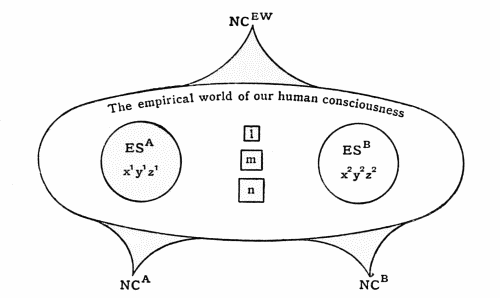
ESA = Empirical self of the conscious Being A. ESA = Empirical self of the conscious Being A. ESB = Empirical self of the conscious Being B. NCA = Noumenal conditions of the conscious Being A. NCB = Noumenal conditions of the conscious Being B. l, m, n = Objects in space. x1, y1, z1 = Sensations caused by objects l, m, n acting on the sense-organs of the empirical self A. x2, y2, z2= Sensations caused by 1, m, n acting on the sense-organs of the empirical self B. NCEW = Noumenal conditions of the empirical world.
Everything in this empirical world is equally open to the consciousness of both A and B, save only certain psychical events that are conditioned by physiological and psychological factors. x1, y1, z1 can be apprehended only by A; x2, y2, z2 can be apprehended only by B. Otherwise A and B experience one and the same world; the body of B is perceived by A in the same manner in which he perceives his own body. This is true a fortiori of all other material existences. Further, these material existences are known with the same immediacy as the subjective states. As regards the relation in which NCA, NCB, and NCEW stand to one another, no assertions can be made, save, as above indicated,[947] such conjectural statements as may precariously be derived through argument by analogy from distinctions that fall within our human experience.[948]
Kant’s phenomenalism thus involves an objectivist view of individual selves and of their interrelations. They fall within the single common world of space. Within this phenomenal world they stand in external, mechanical relations to one another. They are apprehended as embodied, with known contents, sensations, feelings, and desires, composing their inner experience. There is, from this point of view, no problem of knowledge. On this plane we have to deal only with events known, not with any process of apprehension. Even the components of the empirical self, the subject-matter of empirical psychology, are not processes of apprehension, but apprehended existences. It is only when we make a regress beyond the phenomenal as such to the conditions which render it possible, that the problem of knowledge arises at all. And with this regress we are brought to the real crux of the whole question—the reconciliation of this phenomenalism with the conditions of our self-consciousness. For we have then to take into account the fundamental fact that each self is not only an animal existence within the phenomenal world, but also in its powers of apprehension coequal with it. The self known is external to the objects known; the self that knows is conscious of itself as comprehending within the field of its consciousness the wider universe in infinite space.
Such considerations would, at first sight, seem to force us to modify our phenomenalist standpoint in the direction of subjectivism. For in what other manner can we hope to unite the two aspects of the self, the known conditions of its finite existence and the consciousness through which it correlates with the universe as a whole? In the one aspect it is a part of appearance; in the other it connects with that which makes appearance possible at all.
Quite frequently it is the subjectivist solution which Kant seems to adopt. Objects known are “mere representations,” “states of the identical self.” Everything outside the individual mind is real; appearances are purely individual in origin. But such a position is inconsistent with the deeper implications of Kant’s Critical teaching, and would involve the entire ignoring of the many suggestions which point to a fundamentally different and much more adequate standpoint. The individual is himself known only as appearance, and cannot, therefore, be the medium in and through which appearances exist. Though appearances exist only in and through consciousness, they are not due to any causes which can legitimately be described as individual. From this standpoint Kant would seem to distinguish between the grounds and conditions of phenomenal existence and the special determining causes of individual consciousness. Transcendental conditions generate consciousness of the relatively permanent and objective world in space and time; empirical conditions within this space and time world determine the sensuous modes through which special portions of this infinite and uniform world appear diversely to different minds.
This, however, is a point of view which is only suggested, and, as we have already observed,[949] the form in which it is outlined suggests many objections and difficulties. Consciousness of the objective world in space and time does not exist complete with one portion of it more specifically determined in terms of actual sense-perceptions. Rather the consciousness of the single world in space and time is gradually developed through and out of sense experience of limited portions of it. We have still to consider the various sections in the Analytic of Principles (especially the section added in the second edition on the Refutation of Idealism) and in the Dialectic, in which Kant further develops this standpoint. But even after doing so, we shall be forced to recognise that Kant leaves undiscussed many of the most obvious objections to which his phenomenalism lies open. To the very last he fails to state in any really adequate manner how from the phenomenalist standpoint he would regard the world described in mechanical terms by science as being related to the world of ordinary sense-experience,[950] or how different individual consciousnesses are related to one another. The new form, however, in which these old-time problems here emerge is the best possible proof of the revolutionary character of Kant’s Critical enquiries. For these problems are no longer formulated in terms of the individualistic presuppositions which govern the thinking of all Kant’s predecessors, even that of Hume. The concealed presuppositions are now called in question, and are made the subject of explicit discussion. But further comment must meantime be deferred.[951]
TRANSCENDENTAL DEDUCTION OF THE CATEGORIES, IN THE SECOND EDITION
The argument of the second edition transcendental deduction can be reduced to the following eight points:
(1)[952] It opens with the statement of a fundamental assumption which Kant does not dream of questioning and of which he nowhere attempts to offer proof. The representation of combination is the one kind of representation which can never be given through sense. It is not so given even in the pure forms of space and time yielded by outer and inner sense.[953] It is due to an act of spontaneity, which as such must be performed by the understanding. As it is one and the same for every kind of combination, it may be called by the general name of synthesis. And as all combination, without exception, is due to this source, its dissolution, that is, analysis, which seems to be its opposite, always presupposes it.
(2)[954] Besides the manifold and its synthesis a further factor is involved in the conception of combination, namely, the representation of the unity of the manifold. The combination which is necessary to and constitutes knowledge is representation of the synthetical unity of the manifold. This is a factor additional to synthesis and to the manifold synthesised. For such representation cannot arise out of any antecedent consciousness of synthesis. On the contrary, it is only through supervention upon the unitary synthesis that the conception of the combination becomes possible. In other words, the representation of unity conditions consciousness of synthesis, and therefore cannot be the outcome or product of it. This is an application, or rather generalisation, of a position which in the first edition is developed only in reference to the empirical process of recognition. Recognition preconditions consciousness, and therefore cannot be subsequent upon it.