Part 2 / Book 1 — BOOK I THE CONCEPTS OF PURE REASON[1381]
Reading edition
BOOK I THE CONCEPTS OF PURE REASON[1381]
The distinction here drawn between concepts obtained by reflection and concepts gained by inference is a somewhat misleading mode of stating the fact that, whereas the categories of understanding condition experience and so make possible the unity of consciousness necessary to all reflection, or, in other words, are conditions of the material supplied for inference, the concepts of Reason are Ideal constructions which though in a certain sense resting upon experience none the less transcend it. The function of the Ideas is to organise experience in its totality; that of the categories is to render possible the sense-perceptions constitutive of its content. The former refer to the unconditioned, and though that is a conception under which everything experienced is conceived to fall, it represents a type of knowledge to which no actual experience can ever be adequate.
Conceptus ratiocinati—conceptus ratiocinantes. When such transcendent concepts possess “objective validity,” they are correctly inferred, and may be entitled conceptus ratiocinati. If, on the other hand, they are due to merely sophistical[1382] reasoning, they are purely fictitious, conceptus ratiocinantes. This distinction raises many difficulties. Kant’s intention cannot be to deny that the conceptus ratiocinati are “mere Ideas” (entia rationis)[1383]—for such is his avowed and constant contention—or that the inference to them is dialectical and is based upon a transcendental illusion. Two alternatives are open. He may mean that they are only valid when the results of such inference are Critically reinterpreted, and when the function of the Ideas is realised to be merely regulative; or his intention may be to mark off the Ideas, strictly so-called, which are inevitable and beneficial products of Reason, from the many idle and superfluous inventions of speculative thought. Kant’s concluding remark, that the questions at issue can be adequately discussed only at a later stage, may be taken as in the nature of an apology for the looseness of these preliminary statements, and as a warning to the reader not to insist upon them too absolutely. The participles ratiocinati and ratiocinantes[1384] are of doubtful latinity. The distinction of meaning here imposed upon them has not been traced in any other writer, and is perhaps Kant’s own invention.[1385]
SECTION I IDEAS IN GENERAL[1386]
Kant connects his use of the term Idea with the meaning in which it is employed by Plato. He urges upon all true lovers of philosophy the imperative need of rescuing from misuse a term so indispensable to mark a distinction more vital than any other to the very existence of the philosophical disciplines.
”[For Plato] Ideas are the archetypes of the things themselves, and not, like the categories, merely keys to possible experiences. In his view they issued from the Supreme Reason, and from that source have come to be shared in by human Reason.... He very well realised that our faculty of knowledge feels a much higher need than merely to spell out appearances according to a synthetic unity, in order to read them as experience. He knew that our Reason naturally exalts itself to forms of knowledge which so far transcend the bounds of experience that no given empirical object can ever coincide with them, but which must none the less be recognised as having their own reality and which are by no means mere fictions of the brain.”[1387]
Plato found these ideas chiefly, though not exclusively, in the practical sphere. When moral standards are in question, experience is the mother of illusion.
“For nothing can be more injurious or more unworthy of a philosopher than the vulgar appeal to so-called adverse experience. Such experience would never have existed at all, if those institutions had been established at the proper time in accordance with Ideas, and if Ideas had not been displaced by crude conceptions which, just because they have been derived from experience, have nullified all good intentions.”[1388]
Even in the natural sphere Ideas which are never themselves adequately embodied in the actual must be postulated in order to account for the actual. Certain forms of existences “are possible only according to Ideas.”
“A plant, an animal, the orderly arrangement of the cosmos—probably, therefore, the entire natural world—clearly show that they are possible only according to Ideas, and that though no single creature in the conditions of its individual existence coincides with the Idea of what is most perfect in its kind—just as little as does any individual man exactly conform to the Idea of humanity, which he actually carries in his soul as the archetype of his actions—yet these Ideas are none the less completely determined in the Supreme Understanding, each as an individual and each as unchangeable, and are the original causes of things. But only the totality of things, in their interconnection as constituting the universe, is completely adequate to the Idea.”[1389]
Though Kant avows the intention of adapting the term Idea freely to the needs of his more Critical standpoint, all these considerations contribute to the rich and varied meanings in which he employs it.
Reflexionen and passages from the Lectures on Metaphysics may be quoted to show the thoroughly Platonic character of Kant’s early use of the term, and to illustrate its gradual adjustment to Critical demands.
“The Idea is the unity of knowledge, through which the manifold either of knowledge or of the object is possible. In the former, the whole of knowledge precedes its parts, the universal precedes the particular; in the latter, knowledge of the objects precedes their possibility, as e.g. in [objects that possess] order and perfection.”[1390] “That an object is possible only through a form of knowledge is a surprising statement; but all teleological relations are possible only through a form of knowledge [i.e. a concept].”[1391] “The Idea is single (individuum), self-sufficient, and eternal. The divinity of our soul is its capacity to form the Idea. The senses give only copies or rather apparentia.”[1392] “As the Understanding of God is the ground of all possibility, archetypes, Ideas, are in God.... The divine Intuitus contains Ideas according to which we ourselves are possible; cognitio divina est cognitio archetypa, and His Ideas are archetypes of things. The [corresponding] forms of knowledge possessed by the human understanding we may also entitle (in a comparative sense) archetypes or Ideas. They are those representations of our understanding which serve for judgment upon things.”[1393] “Idea is the representation of the whole in so far as it necessarily precedes the determination of the parts. It can never be empirically represented, because in experience we proceed from the parts through successive synthesis to the whole. It is the archetype of things, for certain objects are only possible through an Idea. Transcendental Ideas are those in which the absolute whole determines the parts in an aggregate or as series.”[1394] “The pure concepts of Reason have no exemplaria; they are themselves archetypes. But the concepts of our pure Reason have as their archetypes this Reason itself and are therefore subjective, not objective.”[1395] “The transcendental Ideas serve to limit the principles of experience, forbidding their extension to things in themselves, and showing that what is never an object of possible experience is not therefore a non-entity [Unding], and that experience is not adequate either to itself or to Reason, but always refers us further to what is beyond itself.”[1396] “The employment of the concept of understanding was immanent, that of the Ideas as concepts of objects is transcendent. But as regulative principles alike of the completion and of the limitation of our knowledge, they are Critically immanent.”[1397] “The difficulties of metaphysics all arise in connection with the reconciling of empirical principles with Ideas. The possibility of the latter cannot be denied, but neither can they be made empirically intelligible. The Idea is never a conceptus dabilis; it is not an empirically possible conception.”[1398]
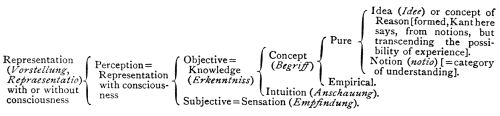
Kant[1399] appends the following ‘Stufenleiter’ (ladder-like) arrangement of titles for the various kinds of representation. Representation (Vorstellung) is the term which he substitutes for the Cartesian and Lockian employment of the term idea, now reserved for use in its true Platonic meaning. To entitle such a representation as that of red colour an idea is, in Kant’s view, an intolerable and barbaric procedure; that representation is not even a concept of the understanding.

SECTION II THE TRANSCENDENTAL IDEAS[1400]
This section completes the metaphysical deduction of the Ideas. In the preceding sections on the logical and on the pure use of Reason, Kant has pointed out that Reason proceeds in accordance with the principle, that for the conditioned knowledge of understanding the unconditioned, in which it finds completion, must be discovered. This principle is synthetic, involving a concept which transcends the understanding; and as Reason in its logical use is merely formal, that concept must be due to Reason in its creative or transcendental activity. In the section before us Kant deduces from the three kinds of syllogism the three possible forms in which such an Idea of Reason can present itself. The deduction is, as already noted, wholly artificial, and masks Kant’s real method of obtaining the Ideas, namely, through combination of the unique concept of the unconditioned with the three categories of relation. The deduction is based upon an extremely ingenious analogy between the logical function of Reason in deductive inference and its transcendental procedure in prescribing the Ideal of unconditioned totality. In the syllogism the predicate of the conclusion is shown to be connected with its subject in accordance with a condition which is stated in its universality in the major premiss. Thus if the conclusion be: Caius is mortal, in constructing the syllogism, required to establish it, we seek for a conception which contains the condition under which the predicate is given—in this case the conception “man”—and we state that condition in its universality: All men are mortal. Under this major premiss is then subsumed Caius, the object dealt with: Caius is a man. And so indirectly, by reference to the universal condition, we obtain the knowledge that Caius is mortal. Universality, antecedently stated, is restricted in the conclusion to a specific object. Now what corresponds in the synthesis of intuition to the universality (universalitas) of a logical premiss is allness (universitas) or totality of conditions. The transcendental concept of Reason, to which the logical procedure is to serve as clue, can therefore be no other than that of the totality of conditions for any given conditioned. And as totality of conditions is equivalent to the unconditioned, this latter must be taken as the fundamental concept of Reason; the unconditioned is conceived as being the ground of the synthesis of everything conditioned. But there are three species of relation, and consequently there are three forms in which the concept of Reason seeks to realise its demand for the unconditioned: (1) through categorical synthesis in one subject, (2) through hypothetical synthesis of the members of a series, and (3) through disjunctive synthesis of the parts in one system. To these three correspond the three species of syllogism, categorical, hypothetical, and disjunctive, in each of which thought passes through a regressive series of prosyllogisms back to an unconditioned: the first to a concept which stands for what is always a subject and never a predicate; the second to a presupposition which itself presupposes nothing further; and the third to such an aggregate of the members of the division as will make that division complete. It may be observed that in this proof the threefold specification of the concept of the unconditioned is really obtained directly from the categories of relation, or at least from the judgments of relation, and not from the corresponding species of syllogism.
Totality and unconditionedness, when taken as equivalent, become synonymous with the absolute.[1401] This last term, however, especially when taken as defining possibility and necessity, is ambiguous. The absolutely possible may signify either that which in itself, i.e. so far as regards its internal content, is possible; or else that which is in every respect and in all relations possible. The two meanings have come to be connected largely owing to the fact that the internally impossible is impossible in every respect. Otherwise, however, the two meanings fall completely apart. Absolute necessity and inner necessity are quite diverse in character. We must not, for instance, argue that the opposite of what is absolutely necessary must be inwardly impossible, nor consequently that absolute necessity must in the end reduce to an inner necessity. Examination will show that, in certain types of cases, not the slightest meaning can be attached to the phrase ‘inner necessity.’ As we possess the terms inner and logical to denote the first form of necessity, there is no excuse for employing the term absolute in any but the wider sense. That, Kant holds, is its original and proper meaning. The absolute totality to which the concept of Reason refers is that form of completeness which is in every respect unconditioned.
In A 326 = B 383 Kant’s mode of statement emphasises the connection of the Ideas with the categories of relation. Reason, he claims, “seeks to extend the synthetic unity, which is thought in the category, to the absolutely unconditioned.” Such positive content as the Ideas can possess lies in the experience which they profess to unify; in so far as they transcend experience and point to an Ideal completion that is not empirically attainable, they refer to things of which the understanding can have no concept. It is necessary, however, that they should present themselves in this absolute and transcendent form, since otherwise the understanding would be without stimulus and without guidance. Though mere Ideas, they are neither arbitrary nor superfluous. They regulate the understanding in its empirical pursuit of that systematic unity which it requires for its own satisfaction.
In A 327-8 = B 383-4 one and the same ground is assigned for entitling the Ideas transcendental and also transcendent, namely, that, as they surpass experience, no object capable of being given through the senses corresponds to them. But a difference would none the less seem to be implied in the connotation of the two terms. In being prescribed by the very nature of Reason, they are transcendental; as overstepping the limits of experience, they are transcendent. Kant’s use of the terms subject and object in this passage is also somewhat puzzling. ‘Object’ is employed in the metaphysical sense proper only from the pre-Critical standpoint of the Dissertation, as meaning an existence apprehended through pure thought. The term ‘subject’ receives a correspondingly un-Critical connotation. The further phrase “the merely speculative use of Reason” is somewhat misleading, even though we recognise that for Kant speculative and theoretical are synonymous terms; we should rather expect “Reason in its legitimate or Critical or directive function.” Kant’s intended meaning, however, is sufficiently clear. When we say that a concept of Reason is an Idea merely, we have in mind the degree to which it can be empirically verified. We are asserting that it prescribes an Ideal to which experience may be made to approach, but which it can never attain. It defines “a problem to which there is no solution.” In the practical sphere of morals, on the other hand, the Ideal of Reason must never be so described. Though only partially realisable, it is genuinely actual. Even those actions which imperfectly embody it none the less presuppose it as their indispensable condition. In two respects, therefore, as Kant points out, the statement that the transcendental concepts of Reason are merely Ideas calls for qualification. In the first place they are by no means “superfluous and void.” They supply a canon for the fruitful employment of understanding. And secondly, they may perhaps be found to make possible a transition from natural to moral concepts, and so to bring the Ideas of practical Reason into connection with the principles of speculative thought. The reader may again note the genuinely Platonic character of Kant’s use of the term Idea.
In A 330-1 = B 386-7 Kant returns to the problem of the metaphysical deduction, and analyses the nature of syllogistic reasoning. The analysis differs from that of A 321 ff. = C 377 ff. only in emphasising that when a conclusion is given as valid the totality of the premisses required for its establishment can be postulated as likewise given, and that when completely stated in the implied prosyllogisms the premisses form a regressive series. In this way Kant contrives to bring the logical process into closer connection with the transcendental principle, which he now definitively formulates as follows: When the conditioned is given, the series of conditions up to the unconditioned is likewise given. The series of antecedent conditions may either have a first term or may be incapable of such. In either case it has to be viewed as unconditioned, in the one case in virtue of its unconditioned beginning, in the other in its character as an unending and therefore unlimited series. In one or other form Reason demands that the unconditioned be recognised as underlying and determining everything conditioned.[1402]
class="chead"SECTION III SYSTEM OF THE TRANSCENDENTAL IDEAS[1403]
The three Ideas of Reason, as derived from the three kinds of syllogism, are now brought into connection with the three possible relations in which representations are found to stand: first, to the thinking subject; secondly, to objects as appearances; thirdly, to objects of thought in general. Kant argues that the completed totalities towards which Reason strives are likewise three in number. Reason seeks: (1) in regard to the subject known, as constituting the fact of inner experience, a representation of the self or soul that will render completely intelligible what is peculiar to the inner life; (2) in regard to the object known, a conception of the completed totality of the world of phenomena, the cosmos; (3) in regard to the ultimate synthesis of the subject known and the object known, such a conception of all existing things as will render intelligible the co-operation of mind and external nature in one experience. In this way Kant professes to obtain transcendental justification for the threefold division of metaphysical science into rational psychology, rational cosmology, and rational theology. The absolute unity of the thinking subject is dealt with by psychology, the totality of all appearances by cosmology, and the Being, which contains the condition of the possibility of all that can be thought, by theology.
In thus proceeding, Kant is assuming that the concepts of unconditioned substance and of unconditioned necessity can be interpreted only in spiritualist and theological terms.[1404] This assumption stands in direct conflict with what the history of philosophy records. The Absolute has frequently been materialistically defined, and, as Kant himself admits, we cannot prove that the thinking subject may not be naturalistically conditioned. Architectonic is again exercising its baleful influence. That the argument is lacking in cogency is indeed so evident that Kant takes notice of the deficiency,[1405] and promises that it will be remedied in the sequel. This promise he is unable to fulfil. Such further reasons as he is able to offer are of the same external character.[1406]
“Of these transcendental Ideas, strictly speaking, no objective deduction, such as we were able to give of the categories, is possible.”[1407] As Kant indicates by use of the phrase ‘strictly speaking,’ this statement is subject to modification. He himself formulates a transcendental deduction of the Ideas, as principles regulative of experience.[1408] The deduction from the three forms of syllogism, which Kant here entitles subjective, ought properly to be named ‘metaphysical.’[1409]