Chapter VII · BON PAPA
Reading edition
My most vivid recollections of Grandfather de Rosval place him at Landerneau, where he would stop with us on his way to Quimper during his tours of inspection. His arrivals in the sleepy little town were great affairs and caused immense excitement: post-chaise, postilion, whips cracking, horns blowing, and a retinue of Parisian servants. We children never had more than a glimpse of him at first, for he withdrew at once to his own rooms to rest and go through his papers. When he made his entry into the salon,—the salon of the slippery parquet and the nodding mandarins,—all the household was ranged on each side, as if for the arrival of a sovereign, and we had all to drop deep curtseys before him.
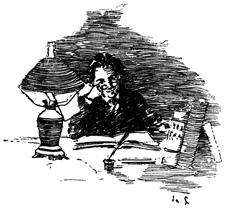
Grandfather de Rosval
He was a rather imposing figure, with splendid clothes, the coat thickly embroidered along the edge with golden oak-leaves, and a fine, handsome head; but he was enormously, even ridiculously, stout. With an often terrifying and even repellent severity he mingled the most engaging playfulness, and our childish feelings toward him were strangely compounded of dislike and admiration.
When he arrived in the salon a lackey came behind him, carrying a large linen bag filled with a sweetmeat bought at Seugnot's, the great Parisian confectioner. I always associate these sweetmeats with bon papa. They were called croquignoles, were small, hard, yet of the consistency of soft chalk when one bit into them, and glazed with pink, white, or yellow. After the salutations, bon papa would take up his position before the mantelpiece and beckon the servant to give him the bag of croquignoles. We children, quivering with excitement, each of us already provided with a small basket, stood ready, and as bon papa, with a noble gesture, scattered the handfuls of croquignoles far and wide, we flung ourselves upon them, scrambling, falling, and filling our baskets, with much laughter and many recriminations. Then, besides the little case for maman, also from Seugnot's, filled with tablets of a delicious sucre-de-pomme in every flavor, were more dignified presents, bracelets and rings for her and for our Tante de Laisieu and boxes of beautiful toys for us. The only cloud cast over these occasions was that after having distributed all his bounties, bon papa sat down, drew a roll of manuscript from his pocket, and composed himself to read in a sonorous voice poems of his own composition. Their theme, invariably, was the delight of reëntering one's family and country, and they were very pompous and very long, sometimes moving bon papa almost to tears. The comic scene of family prayers that followed was pure relief, for even we children felt it comic to see bon papa praying.
"And are they good children?" he would ask. "Have they said their prayers?"
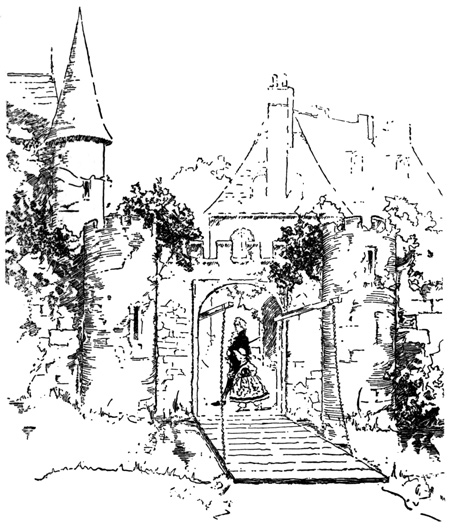
"The château was one of the oldest in Finisterre"
"Not yet, mon père," maman would answer. "They always say their prayers at bedtime." But bon papa was not to be so deterred from yet another ceremony.
"Good, good!" he would reply. "We will all say the evening prayers together, then."
And when we had all obediently knelt down around the room, bon papa recited the prayers in the same complacent, sonorous voice, making magnificent signs of the cross the while. On one of these occasions we were almost convulsed by poor little Ernest, whom bon papa had taken in his arms, and who was so much alarmed by the great gestures going on over his head that he broke at last into a prolonged wail and had to be carried hastily away.
One of bon papa's poetic works I can still remember, of a very different and more endearing character. I was taken ill one morning while we were living with him in Paris and had been given to console me by a cousin of ours staying with us, the Duchesse de M——, a delicious little purse in white, knitted silk, embroidered with pale blue forget-me-nots. I told maman that I wished very much to show this purse to bon papa, and that he should be informed of my illness. So I wrote him a note, and it was taken, with the purse, to his room. Presently the little parcel, much heavier, was brought back to me, and on opening my purse, I found inside it a centime, a liard, a sou—every coin, in fact, up to and including a golden twenty-franc piece. And this is the poem that was sent with the purse:
"Vous voulez jeune Princesse Que je me rends près de vous? Que je baise de votre altesse Les pieds, les mains, et les genoux? Dans un instant je vais me rendre A vos désirs et à vos vœux, Mais vous me permettrez de prendre Deux baisers sur vos beaux yeux bleus."
Such a grandfather, it must be admitted, had advantages as well as charms, yet our memory of him was always clouded by the one or two acts of cruel severity we had witnessed and of which I could not trust myself to speak.