Chapter V · TANTE ROSE
Reading edition
Over the way lived Tante Rose. We children liked best to go to her house by means of the subterranean passage. It was pitch-dark, and we felt a fearful delight as we galloped through it at full speed, and then beat loudly upon the door at the other end, so that old Kerandraon should not keep us waiting for a moment in the blackness. In the salon, between the windows, her tame magpie hopping near her, we would find Tante Rose spinning at her wheel. There were pink ribbons on her distaff, and her beautiful, rounded arms moved gently to and fro drawing out the fine white linen thread. Sitting, as I see her thus, with her back to the light, her white tulle head-dress and the tulle bow beneath her chin surrounded her delicate, rosy face with a sort of aureole. She had a pointed little chin and gay, blue eyes, and though she had snowy hair, she looked so young and was so active that she seemed to have quicksilver in her veins. A tranquil mirth was her distinguishing characteristic, and even when hardly more than a baby I felt that Tante Rose was enchanting. Her first question was sure to be, "Are you hungry?" and even if we had just risen from a meal we were sure to be hungry when we came to see Tante Rose. She would blow into a little silver whistle that hung at her waist, and old Kerandraon (we children pronounced it Ker-le dragon) would appear with his benevolent, smiling face.
"Take Mademoiselle Sophie's orders, Kerandraon," Tante Rose would say; but the dear old man, who was a great friend, did not need to wait for them.
"Demoiselle would like crêpes and fresh cream; and there is the rest of the chocolate paste which Demoiselle likes, too."
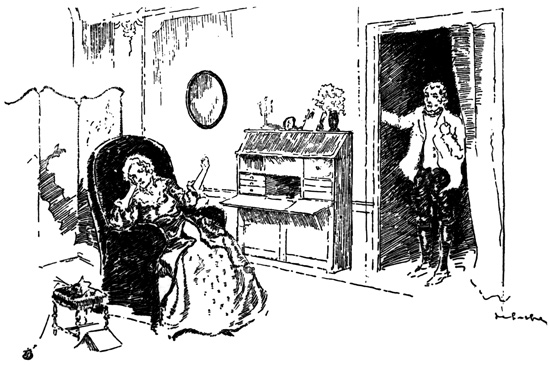
"She did not conceal that she found him a dull companion"
"Bring what pleases you," Tante Rose would say, "and take my key, Kerandraon, and fetch the box of sucre d'orge from the shelf in my wardrobe." When Kerandraon had come ambling back with his laden tray he would stop and talk with us while we ate. He was seventy years old and had a noble air in his long Louis XV jacket. Tante Rose's mother had taken him from the streets when he was a little beggar-boy of twelve. He lived in the family service all his life, and when he died at seventy-five he was buried in the family vault. Jacquette, the magpie, sometimes became very noisy on these festive occasions, and Tante Rose would say: "Go into the garden, Jacquette. Tu m'annuis" (so she pronounced ennuies). And Jacquette, who seemed to understand everything she said, would go obediently hopping off. In the garden, adjoining the salon, was a greenhouse full of grapes and flowers, and that was another haven of delight on our visits to Tante Rose. It was the prettiest sight to see her mounted on a step-ladder cutting the grapes. A servant held the ladder, and another the basket into which the carefully chosen bunches were dropped. Tante Rose's little feet were shod in a sort of high-heeled brown-satin slipper called cothurnes, probably because they tied in classic fashion across the instep, little gold acorns hanging at the ends of the ribbons. I have the most distinct recollection of these exquisite feet as I stood beside the ladder looking up at Tante Rose and waiting for her to drop softly a great bunch of grapes into my hands. The fruit-trees of Tante Rose's garden were famous. A great old fig-tree there was so laden with fruit that supports had to be put under the heavy branches; there were wonderful Smyrna plums, and an apple-tree covered with tiny red apples that were our joy. From a high terrace in the garden one could watch all that went on in the town below. Tante Rose's cream, too, was famous. Great earthenware pans of milk stood on the wide shelves of her dairy, and when maman came to see her she would say, "May I go into the dairy, Rose?" It was always known what this meant. Maman would skim for herself a bowlful of the thick, golden cream.
Even the kitchen had an elegance, a grace, and sparkle all its own, and it is here that I can most characteristically see Tante Rose distributing milk for the poor of Landerneau. Her farmers' wives had brought it in from the country in large, covered pails, and Tante Rose, dressed in a morning-gown of puce-colored silk (like bonne maman in this, she wore no other color), her full sleeves, with their wide lawn cuffs turned back over her arms, ladled it into jars, giving her directions the while to the servants: "This for Yann. This for Hervé [an old cripple]. Did this milk come from the yellow? It is sure, then, to be very good; take it to the hospital and—wait! This little jug of cream to the supérieure; she is so fond of it. And, Laic, this large jar is for the prison," for Tante Rose forgot nobody, and all with such quiet grace and order. The poor of Landerneau adored her. The thread she spun was woven at her country place, La Fontaine Blanche, into linen to make clothes for them, and she knitted socks and waistcoats even as she went about the streets on her errands of mercy. If the poor loved her, it was respect mingled with a little fear that the bourgeoisie felt, for she had no patience with scandal-mongering and sharply checked their gossiping, provincial habits. The chatelaines of the surrounding country sought her out and delighted in her charm, her accomplishments, and her devil-may-care wit. Tante Rose was married to a wealthy and excellent Landernean, Joseph Goury, whom we called Tonton Joson, and his friends, Jason. He had a placid, kindly face, and stout, fine calves incased in silk stockings. Still in love with his wife, he was patiently submissive to her gay sallies; for though very fond of him, she did not conceal that she found him a dull companion. Very drolly, though she tutoyéd him, she used always to address him as "Monsieur Goury." "Tais-toi, Monsieur Goury," she would say; "you are as tiresome as the flies." And after enduring his prosy talk for some time she would say quite calmly: "I am beginning to drink hemlock. Go away, Monsieur Goury—va t'en. You bore me to distraction. You stun and stupefy me. Go away. Je n'en puis plus." And poor Tonton Joson remaining helplessly gazing, she would lift the little trap-door beside her chair, if the scene took place in her room, and call out to the servants below, "Tell Laic to come up and help monsieur on with his coat."
"But, my dear, I was not thinking of going out," Tonton Joson would protest; and Tante Rose would reply:
"Mais tu sors, Monsieur Goury."
Tante Rose was very devout, but after her own fashion. She read the office to herself every day, but had many librepensant friends, with whom she used good-temperedly to argue. Any bishop who came to Landerneau stayed always with Tante Rose.
Her cuisine was the best I have ever eaten; and oh, the incredible abundance of those days! All the courses were served at once upon the immense table. The great silver soup-tureen, big enough for a baby's bath, and so tall that she had to stand up to it, was in front of Tante Rose, and before she began to ladle out the platefuls, with the light, accurate movements of her arms characteristic of her, a servant carefully fastened behind her her long sleeves à la pagode. It was really charming to watch her serving the soup, and I remember one guest asserting that he would eat potage four times if Mme. Goury helped him to it.
An enormous salmon usually occupied the center of the table, and there were six entrées, four rôtis, two hot and two cold, and various entremets and desserts. A favorite entrée was a purée of pistachio nuts, with roasted sheeps' tails on silver spits stuck into it. The hot dishes stood on silver heaters filled with glowing charcoal. Between the courses little pots of cream, chocolate, vanilla, and coffee were actually passed and actually eaten! Chocolate cream to fill the gap between woodcock and foie-gras, for instance! Champagne-bottles stood in silver coolers at each corner of the table. I wonder that we all survived. On the other hand, when Tante Rose or my mother received the visits of their friends, there was no afternoon tea to offer them, as nowadays. The servants merely passed round little glasses of Spanish wines and plates of small biscuits. The good ladies of Landerneau afforded, I imagine, much amusement to my mother and to Tante Rose, who, though a native, was of a very different caliber. One little trait I remember was very illustrative of the bourgeois habit of mind. At that time, as now, lengths of velvet were included in every corbeille offered to a bride by the bridegroom's family, and the velvet dresses made from them were dignified institutions worn year after year. One knows how marked and unsightly velvet soon becomes if sat upon, and it was a wise and crafty fashion to have a breadth of perfectly matching silk introduced between the full folds at the back of these dresses, so that when one sat down it was upon the silk. It was in regard to this sensible contrivance that the ladies of Landerneau were reported to declare that it was strange indeed to see the noblesse so miserly that they could not afford a whole velvet dress, and therefore let silk into the back.
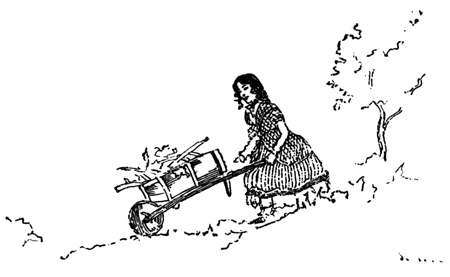
"I had only to sweep up the rubbish ... and carry it out of the wood in my little wheelbarrow"
Some of Tante Rose's children were, like herself, very clever and charming, some very stupid, like Tonton Joson. It can be imagined what games we all had. Once, in the coach-house, my older cousins put young Raoul into a large basket with a number of smooth stones under him and told him that they were eggs and that if he were quiet and patient, they would hatch out. Then by means of a rope and pulley to which the basket was attached (it must have been used for raising and lowering hay and fodder) we pulled poor Raoul up to the rafters, and there we left him and forgot all about him. His desolate cries were heard after a time, and when he was rescued, it was found that the rocking of the basket had made him very seasick.
Of all our games the best were those in the woods of La Fontaine Blanche. This property of Tante Rose's, with its old manor-house dating from the time of Queen Anne of Brittany, was near Landerneau, and since papa went there nearly every day, caring for it as if it were his own, we were able to go with him and take full possession of the beautiful woods. We were given planks and tools, and we built a little hut on the banks of the stream. I was so young that my share of the labors was unexacting, as I had only to sweep up the rubbish left by the builders and carry it out of the wood in my little wheelbarrow; but I remember that pride with which I felt myself associated in any capacity with such marvels of construction. Not only was the hut entirely built by my cousins, but they made an oven inside it and even fabricated a sort of earthenware service with the clay soil found along the banks of the stream. It would never fire properly, however, and therefore our attempts to bake bread were not successful.
But crêpes, as pure-blooded young Bretons, we could make, and our parents were often entertained by us and regaled with them as they sat under the trees. Oh, how happy we were! The woods were full of lilies of the valley, and our hut had been baptized by the curé of Landerneau the château de la Muguetterie, while we were called Robinson Crusoes, and this was to us all our greatest glory.