Front matter
Reading edition
Transcriber’s Notes
About this book: A booke called the Foundacion of Rhetorike was published in 1563. Only five copies of the original are known to exist. This e-book was transcribed from microfiche scans of the original in the Bodleian Library at Oxford University. The scans can be viewed at the Bibliothèque nationale de France website at http://gallica.bnf.fr.
Typography: The original line and paragraph breaks, hyphenation, spelling, capitalization, punctuation, inconsistent use of an acute accent over ee, the use of u for v and vice versa, and the use of i for j and vice versa, have been preserved. All apparent printer errors have also been preserved, and are listed at the end of this document.
The following alterations have been made:
1. Long-s (ſ) is regularized as s.
2. The paragraph symbol, resembling a C in the original, is rendered as ¶.
3. Missing punctuation, hyphens, and paragraph symbols have been added in brackets, e.g. [-].
4. Except for the dedication, which is in modern italics, the majority of the original book is in blackletter font, with some words in a modern non-italic font. All modern-font passages are rendered in italics.
5. Incorrect page numbers are corrected, but are included in the list of printer errors at the end of this e-book.
6. Abbreviations and contractions represented as special characters in the original have been expanded as noted in the table below. “Supralinear” means directly over a letter; “sublinear” means directly under a letter. The y referred to below is an Early Modern English form of the Anglo-Saxon thorn character, representing th, but identical in appearance to the letter y.
OriginalExpansion
y with supralinear eye (i.e., the)
accented q with semicolonq[ue]
w with supralinear curvew[ith]
e with sublinear hook[ae]
A macron over a vowel represents m or n, and is rendered as it appears in the original, e.g., cōprehēded = comprehended.
Pagination: This book was paginated using folio numbers in a recto-verso scheme. The front of each folio is the recto page (the right-hand page); the back of each folio is the verso page (the left-hand page in a book). In the original, folio numbers (beginning after the table of contents) are printed only on the recto side of each leaf. For the reader’s convenience, all folio pages in this e-book, including the verso pages, have been numbered in brackets according to the original format, with the addition of r for recto and v for verso, e.g., Fol. x.r is Folio 10 recto, Fol. x.v is Folio 10 verso.
Sources consulted: The uneven quality of the microfiche scans, as well as the blackletter font and some ink bleed-through and blemishes in the original, made the scans difficult to read in some places. To ensure accuracy, the transcriber has consulted the facsimile reprint edited by Francis R. Johnson (Scholars’ Facsimiles and Reprints, New York, 1945). The 1945 reprint was prepared primarily from the Bodleian copy, with several pages reproduced from the copy in the Chapin Library at Williams College, Williamstown, Massachusetts, where the Bodleian copy was unclear.
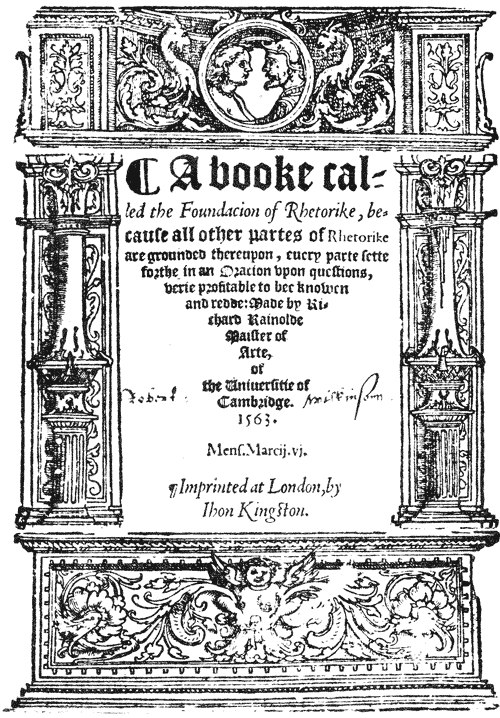
¶ A booke cal- led the Foundacion of Rhetorike, be- cause all other partes of Rhetorike are grounded thereupon, euery parte sette forthe in an Oracion vpon questions, verie profitable to bee knowen and redde: Made by Ri- chard Rainolde Maister of Arte, of the Uniuersitie of Cambridge. 1563.
Mens. Marcij. vj.
¶ Imprinted at London, by Ihon Kingston.
THE EPISTLE DEDICATORIE
¶ To the right honorable and my singuler good Lorde, my Lorde Robert Dudley, Maister of the Queenes Maiesties horse, one of her highes pri- uie Counsaile, and knight of the moste honou- rable order of the Garter: Richard Rai- nolde wisheth longe life, with increase of honour.
RISTOTLE the famous Phi- losopher, writing a boke to king Alexāder, the great and migh- tie conquerour, began the Epi- stle of his Booke in these woor- des. Twoo thynges moued me chieflie, O King, to betake to thy Maiesties handes, this worke of my trauile and labour, thy nobilitie and vertue, of the whiche thy nobilitie encouraged me, thy greate and singuler vertue, indued with all humanitie, forced and draue me thereto. The same twoo in your good Lordshippe, Nobilitie and Vertue, as twoo migh- tie Pillers staied me, in this bolde enterprise, to make your good Lordshippe, beyng a Pere of honour, indued with all nobilitie and vertue: a patrone and possessoure of this my booke. In the whiche although copious and aboundaunte eloquence wanteth, to adorne and beau- tifie thesame, yet I doubte not for the profite, that is in this my trauaile conteined, your honour indued with all singuler humanitie, will vouchsaufe to accepte my willyng harte, my profitable purpose herein. Many fa- mous menne and greate learned, haue in the Greke tongue and otherwise trauailed, to profite all tymes their countrie and common wealthe. This also was my ende and purpose, to plante a worke profitable to all ty- mes, my countrie and common wealthe.

And because your Lordshippe studieth all singula- ritie to vertue, and wholie is incensed thereto: I haue compiled this woorke, and dedicated it to your Lorde- shippe, as vnto whō moste noble and vertuous. Wher- in are set forthe soche Oracions, as are right profitable to bee redde, for knowledge also necessarie. The duetie of a subiecte, the worthie state of nobilitie, the prehe- minent dignitie and Maiestie of a Prince, the office of counsailours, worthie chiefe veneracion, the office of a Iudge or Magestrate are here set foorthe. In moste for- tunate state is the kyngdome and Common wealthe, where the Nobles and Peres, not onelie daiely doe stu- die to vertue, for that is the wisedome, that all the graue and wise Philophers searched to attaine to. For the ende of all artes and sciences, and of all noble actes and enterprises is vertue, but also to fauour and vphold the studentes of learnyng, whiche also is a greate ver- tue. Whoso is adorned with nobilitie and vertue, of necessitie nobilitie and vertue, will moue and allure thē to fauour and support vertue in any other, yea, as Tul- lie the moste famous Oratour dooeth saie, euen to loue those whō we neuer sawe, but by good fame and brute beutified to vs. For the encrease of vertue, God dooeth nobilitate with honour worthie menne, to be aboue other in dignitie and state, thereupon vertue doeth encrease your Lordshipps honor, beyng a louer of vertue and worthie no- bilitie.
Your lordshippes humble ser- uaunt Richard Rainolde.
To the Reader.
PHTHONIVS a famous man, wrote in Greke of soche declamacions, to en- structe the studentes thereof, with all fa- cilitée to grounde in them, a moste plenti- ous and riche vein of eloquence. No man is able to inuente a more profitable waie and order, to instructe any one in the ex- quisite and absolute perfeccion, of wisedome and eloquence, then Aphthonius Quintilianus and Hermogenes. Tullie al- so as a moste excellente Orator, in the like sorte trauailed, whose Eloquence and vertue all tymes extolled, and the of- spryng of all ages worthilie aduaunceth. And because as yet the verie grounde of Rhetorike, is not heretofore intreated of, as concernyng these exercises, though in fewe yeres past, a learned woorke of Rhetorike is compiled and made in the Englishe toungue, of one, who floweth in all excellencie of arte, who in iudgement is profounde, in wisedome and elo- quence moste famous. In these therefore my diligence is em- ploied, to profite many, although not with like Eloquence, beutified and adorned, as the matter requireth. I haue cho- sen out in these Oracions soche questions, as are right ne- cessarie to be knowen and redde of all those, whose cogitaciō pondereth vertue and Godlines. I doubte not, but seyng my trauaile toucheth vertuous preceptes, and vttereth to light, many famous Histories, the order of arte obserued also, but that herein the matter it self, shall defende my purpose aga- inste the enuious, whiche seketh to depraue any good enter- prise, begon of any one persone. The enuious manne though learned, readeth to depraue that, which he readeth, the ignoraunt is no worthie Iudge, the learned and godlie pondereth vp- rightly & sincerely, that which he iudgeth, the order of these Oracions followeth afterward, and the names of thē.
¶ The contentes of this Booke.
N Oracion made, vpon the Fable of the Shepher- des and the Wolues, the Wolues requestyng the Bandogges: wherein is set forthe the state of eue- ry subiecte, the dignitie of a Prince, the honoura- ble office of counsailours.

An Oracion vpon the Fable of the Ante and the Gres- hopper, teachyng prouidence.
An Oracion Historicall, howe Semiramis came to bee Quéene of Babilon.
An Oracion Historicall, vpon Kyng Richard the thirde sometyme Duke of Glocester.
An Oracion Historicall, of the commyng of Iulius Ce- ser into Englande.
An Oracion Ciuill or Iudiciall, vpon Themistocles, of the walle buildyng at Athenes.
An Oracion Poeticall vpon a redde Rose.
A profitable Oracion, shewyng the decaie of kingdomes and nobilitie.
An Oracion vpon a Sentence, preferryng a Monarchie, conteinyng all other states of common wealthe.
The confutacion of the battaile of Troie.
A confirmacion of the noble facte of Zopyrus.
An Oracion called a Common place against Theues.
The praise of Epaminundas Duke of Thebes, wherein the grounde of nobilitée is placed.
The dispraise of Domicius Nero Emperour of Roome.
A comparison betwene Demosthenes and Tullie.
A lamentable Oracion of Hecuba Queene of Troie.
A descripcion vpon Xerxes kyng of Persia.
An Oracion called Thesis, as concerning the goodly state of Mariage.
An Oracion confutyng a certaine lawe of Solon.
The foundacion of Rhetorike.
Ature hath indued euery man, with a certain eloquence, and also subtili- Rhetorike and Logike giuen of na- ture. tée to reason and discusse, of any que- stion or proposicion propounded, as Aristotle the Philosopher, in his Booke of Rhetorike dooeth shewe. These giftes of nature, singuler doe flowe and abounde in vs, accordyng to the greate and ample indumente and plentuousnes of witte and wisedome, lodged in vs, there- fore Nature it self beyng well framed, and afterward by arte Arte furthe- reth nature. and order of science, instructed and adorned, must be singular- lie furthered, helped, and aided to all excellencie, to exquisite Logike. inuencion, and profounde knowledge, bothe in Logike and Rhetorike. Rhetorike. In the one, as a Oratour to pleate with all facili- tee, and copiouslie to dilate any matter or sentence: in the other to grounde profunde and subtill argument, to fortifie & make stronge our assercion or sentence, to proue and defende, by the Logike. force and power of arte, thinges passyng the compasse & reach of our capacitée and witte. Nothyng can bee more excellently Eloquence. giuen of nature then Eloquence, by the which the florishyng state of commonweales doe consiste: kyngdomes vniuersally are gouerned, the state of euery one priuatelie is maintained. The commonwealth also should be maimed, and debilitated, Zeno. except the other parte be associate to it. Zeno the Philosopher comparing Rhetorike and Logike, doeth assimilate and liken Logike. them to the hand of man. Logike is like faith he to the fiste, for euen as the fiste closeth and shutteth into one, the iointes and partes of the hande, & with mightie force and strength, wrap- Similitude[.] Logike. peth and closeth in thynges apprehended: So Logike for the deepe and profounde knowlege, that is reposed and buried in it, in soche sort of municion and strength fortified, in few wor- des taketh soche force and might by argumente, that excepte like equalitée in like art and knowledge doe mate it, in vain the disputacion shalbe, and the repulse of thaduersarie readie. Rhetorike like to the hande. Rhetorike is like to the hand set at large, wherein euery part and ioint is manifeste, and euery vaine as braunches of trées Rhetorike. sette at scope and libertee. So of like sorte, Rhetorike in moste ample and large maner, dilateth and setteth out small thyn- ges or woordes, in soche sorte, with soche aboundaunce and plentuousnes, bothe of woordes and wittie inuencion, with soche goodlie disposicion, in soche a infinite sorte, with soche pleasauntnes of Oracion, that the moste stonie and hard har- tes, can not but bee incensed, inflamed, and moued thereto. Logike and Rhetorike absolute in fewe. These twoo singuler giftes of nature, are absolute and perfect in fewe: for many therebe, whiche are exquisite and profound in argument, by art to reason and discusse, of any question or proposicion propounded, who by nature are disabled, & smal- lie adorned to speake eloquently, in whom neuertheles more aboundaunt knowlege doeth somtymes remaine then in the other, if the cause shalbe in controuersie ioined, and examined to trie a manifeste truthe. But to whom nature hath giuen soche abilitée, and absolute excellencie, as that thei can bothe The vertue of eloquence. copiouslie dilate any matter or sentence, by pleasauntnes and swetenes of their wittie and ingenious oracion, to drawe vn- to theim the hartes of a multitude, to plucke doune and extir- pate affecciōs and perturbacions of people, to moue pitee and compassion, to speake before Princes and rulers, and to per- swade theim in good causes and enterprises, to animate and incense them, to godlie affaires and busines, to alter the coū- saill of kynges, by their wisedome and eloquence, to a better state, and also to be exquisite in thother, is a thing of all most Demosthe- nes. Tisias. Gorgias. Eschines[.] Tullie. Cato. noble and excellent. The eloquence of Demosthenes, Isocra- tes, Tisias, Gorgias, Eschines, were a great bulwarke and staie to Athens and all Grece, Rome also by the like vertue of Eloquence, in famous and wise orators vpholded: the wise and eloquente Oracions of Tullie againste Catiline. The graue and sentencious oracions of Cato in the Senate, haue The Empe- rors of Rome famous in Eloquence. been onelie the meane to vpholde the mightie state of Rome, in his strength and auncient fame and glorie. Also the Chro- nicles of auncient time doe shewe vnto vs, the state of Rome could by no meanes haue growen so meruailous mightie, but that God had indued the whole line of Cesars, with sin- guler vertues, with aboundaunt knowlege & singuler Elo- quence. Thusidides the famous Historiographer sheweth, Thusidides. how moche Eloquence auailed the citees of Grece, fallyng to Corcurians. dissenciō. How did the Corcurians saue them selues from the Pelopone- sians. inuasiō and might, of the Poloponesians, their cause pleated before the Athenians, so moche their eloquence in a truthe Corinthians[.] preuailed. The Ambassadours of Corinth, wanted not their copious, wittie, and ingenious Oracions, but thei pleated before mightie, wise, and graue Senators, whose cause, ac- cordyng to iudgemēt, truthe, and integritée was ended. The Lacedemo- nians. Vituleniās. Athenians. eloquēt Embassages of the Corinthiās, the Lacedemoniās, & the Vituleneans, the Athenians, who so readeth, shall sone sée that of necessitee, a common wealth or kyngdome must be fortefied, with famous, graue, and wise counsailours. How Demosthe- nes. often did Demosthenes saue the cōmon wealthes of Athens, how moche also did that large dominion prospere and florish Socrates. Cato. Crassus. Antonius. Catulus. Cesar. by Isocrates. Tullie also by his Eloquēt please, Cato, Cras- sus, Antonius, Catulus Cesar, with many other, did support and vphold the state of that mightie kyngdō. No doubte, but that Demosthenes made a wittie, copious, and ingenious o- racions, when the Athenians were minded to giue and be- Philippe the kyng of the Macidoniās[.] take to the handes of Philip kyng of the Macedonians, their pestiferous enemie moste vile and subtell, the Orators of A- thens. This Philip forseyng the discorde of Grece, as he by subtill meanes compassed his enterprices, promised by the faithe of a Prince, to be at league with the Athenians, if so be thei would betake to his handes, the eloquente Oratours of The saiyng of Philippe. Athens, for as long saith he, as your Oratours are with you declaryng, so longe your heddes and counsaill are moued to variaunce and dissencion, this voice ones seased emong you, Demosthe- nes. in tranquilitée you shalbee gouerned. Demosthenes beyng eloquente and wise, foresawe the daungers and the mischie- uous intent of him, wherevpon he framed a goodly Oracion vpon a Fable, whereby he altered their counsaile, and repul- sed the enemie. This fable is afterward set forth in an Ora- cion, after the order of these exercises, profitable to Rhetorike.
¶ A Fable.
The ground of al learning[.] Irste it is good that the learner doe vnderstand what is a fable, for in all matters of learnyng, it is the firste grounde, as Tullie doeth saie, to knowe what the thing is, that we may the bet- What is a fable. ter perceiue whervpō we doe intreate. A fable is a forged tale, cōtaining in it by the colour of a lie, a matter Morall. of truthe. The moralle is called that, out of the whiche some godlie precepte, or admonicion to vertue is giuen, to frame and instruct our maners. Now that we knowe what a fable is, it is good to learne also, how manifolde or diuers thei be, Three sortes of fables. i. A fable of reason. I doe finde three maner of fables to be. The first of theim is, wherein a man being a creature of God indued with reason, is onely intreated of, as the Fable of the father and his chil- dren, he willing thē to concorde, and this is called Rationalis fabula, whiche is asmoche to saie, as a Fable of men indued ii. Morall. with reason, or women. The second is called a morall fable, but I sée no cause whie it is so called, but rather as the other is called a fable of reasonable creatures, so this is contrarilie named a fable of beastes, or of other thinges wanting reason or life, wanting reason as of the Ante and the Greshopper, or of this the beame caste doun, and the Frogges chosyng their iii. Mixt. king. The thirde is a mixt Fable so called, bicause in it bothe man hauyng reason, and a beaste wantyng reason, or any o- ther thing wanting life, is ioyned with it, as for the example, of the fable of the woodes and the housebandman, of whom Poetes in- uentours of fables. Oratours vse fables. he desired a helue for his hatchet. Aucthours doe write, that Poetes firste inuented fables, the whiche Oratours also doe vse in their perswasions, and not without greate cause, both Poetes and Oratours doe applie theim to their vse. For, fa- Good doctrin in fables. Hesiodus. bles dooe conteine goodlie admonicion, vertuous preceptes of life. Hesiodus the Poete, intreatyng of the iniurious dea- lyng of Princes and gouernours, against their subiectes, ad- monished them by the fable of the Goshauke, and the Nigh- Ouide. tyngale in his clause. Ouid also the Poete intreated of di- uers fables, wherein he giueth admonicion, and godly coun- Demosthe- nes vsed fa- bles. saile. Demosthenes the famous Oratour of Athens, vsed the fable of the Shepeherdes, and Wolues: how the Wol- ues on a tyme, instauntlie required of the Shepeherdes their bande dogges, and then thei would haue peace and concorde with theim, the Shepeherdes gaue ouer their Dogges, their Dogges deliuered and murdered, the shepe were immediat- ly deuoured: So saieth he, if ye shall ones deliuer to Philip, the king of the Macedonians your Oratours, by whose lear- nyng, knowlege and wisedome, the whole bodie of your do- minions is saued, for thei as Bandogges, doe repell all mis- cheuous enterprises and chaunses, no doubte, but that raue- nyng Wolfe Philip, will eate and consume your people, by this Fable he made an Oracion, he altered their counsailes and heddes of the Athenians, from so foolishe an enterprise. Also thesame Demosthenes, seyng the people careles, sloth- full, and lothsome to heare the Oratours, and all for the flo- rishing state of the kingdome: he ascended to the place or pul- pet, where the Oracions were made, and began with this fa- The fable of Demosthe- nes, of the Asse and the shadowe. ble. Ye men of Athens, saied he, it happened on a tyme, that a certaine man hired an Asse, and did take his iourney from Athens to Megara, as we would saie, frō London to Yorke, the owner also of the Asse, did associate hymself in his iour- ney, to brynge backe the Asse againe, in the voyage the weather was extreame burning hotte, and the waie tedious the place also for barenes and sterilitée of trees, wanted sha- dowe in this long broyle of heate: he that satte one the Asse, lighted and tooke shadowe vnder the bellie of the Asse, and because the shadowe would not suffice bothe, the Asse beyng small, the owner saied, he muste haue the shadowe, because the Asse was his, I deny that saieth the other, the shadowe is myne, because I hired the Asse, thus thei were at greate con- tencion, the fable beyng recited, Demosthenes descended frō his place, the whole multitude were inquisitiue, to knowe The conten- cion vpon the shadowe and the Asse. the ende about the shadowe, Demosthenes notyng their fol- lie, ascended to his place, and saied, O ye foolishe Athenians, whiles I and other, gaue to you counsaill and admoniciō, of graue and profitable matters, your eares wer deafe, and your mindes slombred, but now I tell of a small trifeling matter, you throng to heare the reste of me. By this Fable he nipped their follie, and trapped them manifestlie, in their owne dol- tishenes. Herevpon I doe somwhat long, make copie of wor- Fables well applied bee singuler. des, to shewe the singularitee of fables well applied. In the tyme of Kyng Richard the thirde, Doctour Mourton, beyng Bishop of Elie, and prisoner in the Duke of Buckynghams house in Wales, was often tymes moued of the Duke, to speake his minde frelie, if king Richard wer lawfully king, and said to him of his fidelitée, to kepe close and secret his sen- tence: but the Bishop beyng a godlie man, and no lesse wise, waied the greate frendship, whiche was sometyme betwene the Duke & King Richard, aunswered in effect nothyng, but beyng daily troubled with his mocions & instigacions, spake a fable of Esope: My lorde saied he, I will aunswere you, by The fable of the Bisshop of Elie, to the duke of Buc- kyngham. a Fable of Esope. The Lion on a tyme gaue a commaunde- ment, that all horned beastes should flie from the woode, and none to remain there but vnhorned beastes. The Hare hea- ring of this commaundement, departed with the horned bea- stes from the woodde: The wilie Foxe metyng the Hare, de- maunded the cause of his haste, forthwith the Hare aunswe- red, a commaundemente is come from the Lion, that all hor- ned beastes should bee exiled, vpon paine of death, from the woode: why saied the Foxe, this commaundement toucheth not any sorte of beast as ye are, for thou haste no hornes but knubbes: yea, but said the Hare, what, if thei saie I haue hor- nes, that is an other matter, my lorde I saie no more: what he ment, is euident to all men.

In the time of king Hēry theight (a prince of famous me- morie) at what time as the small houses of religiō, wer giuen ouer to the kinges hand, by the Parliament house: the bishop of Rochester, Doctour Fisher by name stepped forthe, beyng greued with the graunt, recited before them, a fable of Esope to shewe what discommoditee would followe in the Clergie. The fable of the Bisshop of Rochester, againste the graunt of the Chauntries. My lordes and maisters saieth he, Esope recited a fable: how that on a tyme, a housebande manne desired of the woodes, a small helue for his hatchet, all the woodes consented thereto waiyng the graunt to be small, and the thyng lesse, therevpō the woodes consented, in fine the housbande man cut doune a small peece of woodde to make a helue, he framyng a helue to the hatchette, without leaue and graunt, he cut doune the mightie Okes and Cedars, and destroyed the whole woodd, then the woodes repented them to late. So saith he, the gift of these small houses, ar but a small graunt into the kinges hā- des: but this small graunt, will bee a waie and meane to pull doune the greate mightie fatte Abbees, & so it happened. But there is repentaūce to late: & no profite ensued of the graunte.
¶ An Oracion made by a fable, to the first exer- cise to declame by, the other, bee these,
{A Fable, a Narracion. Chria,}
{Sentence. Confutacion,}
An Oracion made by a{Confirmacion. Common place.}
{The praise. The dispraise.}
{The Comparison, Ethopeia.}
{A Discripcion. Thesis, Legislatio}
F euery one of these, a goodlie Oraciō maie be made these excercises are called of the Grekes Progimnas- mata, of the Latines, profitable introduccions, or fore exercises, to attain greater arte and knowlege in Rhetorike, and bicause, for the easie capacitée and facilitée of the learner, to attain greater knowledge in Rhetorike, thei are right pro- fitable and necessarie: Therefore I title this booke, to bee the foundaciō of Rhetorike, the exercises being Progimnasmata.

I haue chosen out the fable of the Shepeherdes, and the Wolues, vpon the whiche fable, Demosthenes made an elo- quente, copious, and wittie Oracion before the Athenians, whiche fable was so well applied, that the citée and common wealth of Athens was saued.
The firste exercise.
¶ A fable.
These notes must be obserued, to make an Oracion by a Fable.
¶ Praise.
1.Firste, ye shall recite the fable, as the aucthour telleth it.
2.There in the seconde place, you shall praise the aucthoure who made the fable, whiche praise maie sone bee gotte of any studious scholer, if he reade the aucthours life and actes ther- in, or the Godlie preceptes in his fables, shall giue abundant praise.
3.Then thirdlie place the morall, whiche is the interpreta- cion annexed to the Fable, for the fable was inuented for the moralles sake.
4.Then orderlie in the fowerth place, declare the nature of thynges, conteined in the Fable, either of man, fishe, foule, beaste, plante, trées, stones, or whatsoeuer it be. There is no man of witte so dulle, or of so grosse capacitée, but either by his naturall witte, or by reading, or sences, he is hable to saie somwhat in the nature of any thyng.
5.In the fifte place, sette forthe the thynges, reasonyng one with an other, as the Ant with the Greshopper, or the Cocke with the precious stone.
6.Thē in the vj. place, make a similitude of the like matter.
7.Then in the seuenth place, induce an exāple for thesame matter to bée proued by.
8.Laste of all make the Epilogus, whiche is called the con- clusion, and herein marke the notes folowyng, how to make an Oracion thereby.
¶ An Oracion made vpon the fable of the Shepeherdes and the wolues. ¶ The fable.
He Wolues on a tyme perswaded the Shepeher- des, that thei would ioyne amitée, and make a league of concord and vnitee: the demaunde plea- sed the Shepeherdes, foorthwith the Wolues re- quested to haue custodie of the bande Dogges, because els thei would be as thei are alwaies, an occasion to breake their league and peace, the Dogges beyng giuen ouer, thei were one by one murthered, and then the Shepe were wearied.

¶ The praise of the aucthour.
He posteritee of tymes and ages, muste needes praise the wisedome and industrie, of all soche as haue lefte in monumentes of writyng, thynges worthie fame, Inuentours of al excellent artes and sci- ences, com- mended to the posteritee. what can bee more excellently set foorthe: or what deserueth chiefer fame and glorie, then the knowledge of artes and sci- ences, inuented by our learned, wise, and graue aūcestours: and so moche the more thei deserue honour, and perpetuall commendacions, because thei haue been the firste aucthours, and beginners to soche excellencies. The posteritée praiseth Apelles. Parthesius. Polucletus. and setteth forth the wittie and ingenious workes of Apelles, Parthesius, and Polucletus, and all soche as haue artificial- ly set forth their excellent giftes of nature. But if their praise for fame florishe perpetuallie, and increaseth for the wor- thines of theim, yet these thynges though moste excellent, are The ende of all artes, is to godlie life. inferiour to vertue: for the ende of artes and sciences, is ver- tue and godlines. Neither yet these thynges dissonaunt from vertue, and not associate, are commendable onely for vertues sake: and to the ende of vertue, the wittes of our auncestours were incensed to inuent these thynges. But herein Polucle- tus, Apelles, and Perthesius maie giue place, when greater Esope wor- thie moche commendaciō[.] vertues come in place, then this my aucthour Esope, for his godly preceptes, wise counsaill and admonicion, is chiefly to bée praised: For, our life maie learne all goodnes, all vertue, Philophie in fables. of his preceptes. The Philosophers did neuer so liuely sette forthe and teache in their scholes and audience, what vertue Realmes maie learne concorde out of Esopes fables. and godlie life were, as Esope did in his Fables, Citees, and common wealthes, maie learne out of his fables, godlie con- corde and vnitee, by the whiche meanes, common wealthes florisheth, and kingdoms are saued. Herein ample matter ri- seth to Princes, and gouernours, to rule their subiectes in all Preceptes to Kynges and Subiectes. Preceptes to parentes and children. godlie lawes, in faithfull obedience: the subiectes also to loue and serue their prince, in al his affaires and busines. The fa- ther maie learne to bring vp, and instructe his childe thereby. The child also to loue and obeie his parentes. The huge and monsterous vices, are by his vertuous doctrine defaced and extirpated: his Fables in effect contain the mightie volumes and bookes of all Philosophers, in morall preceptes, & the in- The content of al Lawes. finite monumētes of lawes stablished. If I should not speake of his commendacion, the fruictes of his vertue would shewe his commendacions: but that praise surmounteth all fame of A true praise commēded by fame it self. glory, that commendeth by fame itself, the fruictes of fame in this one Fable, riseth to my aucthour, whiche he wrote of the Shepeherd, and the Wolues.

¶ The Morall.
Herein Esope wittely admonisheth all menne to be- ware and take heede, of cloked and fained frendship, of the wicked and vngodlie, whiche vnder a pretence and offer of frendship or of benefite, seeke the ruin, dammage, miserie or destruccion of man, toune, citée, region, or countree.

¶ The nature of the thyng.
F all beastes to the quantitée of his bodie, the The Wolue moste raue- ning & cruell. Wolue passeth in crueltee and desire of bloode, alwaies vnsaciable of deuouryng, neuer conten- ted with his pray. The Wolfe deuoureth and ea- teth of his praie all in feare, and therefore oftentymes he ca- steth his looke, to be safe from perill and daunger. And herein his nature is straunge frō all beastes: the iyes of the Wolfe, tourned from his praie immediatlie, the praie prostrate vnder The Wolues of all beastes, moste obliui- ous. his foote is forgotten, and forthwith he seeketh a newe praie, so greate obliuion and debilitée of memorie, is giuen to that beaste, who chieflie seketh to deuoure his praie by night. The The Wolue inferiour to the bandogge[.] Wolues are moche inferior to the banddogges in strength, bi- cause nature hath framed thē in the hinder parts, moche more weaker, and as it were maimed, and therefore the bandogge dooeth ouermatche theim, and ouercome them in fight. The Wolues are not all so mightie of bodie as the Bandogges, of diuers colours, of fight more sharpe, of lesse heddes: but in The Dogge passeth all creatures in smellyng. smellyng, the nature of a Dogge passeth all beastes and creatures, whiche the historie of Plinie dooe shewe, and Ari- stotle in his booke of the historie of beastes, therein you shall knowe their excellente nature. The housholde wanteth not faithfull and trustie watche nor resistaunce, in the cause of the Plinie. maister, the Bandogge not wantyng. Plinie sheweth out of his historie, how Bandogges haue saued their Maister, by their resistaunce. The Dogge of all beastes sheweth moste loue, and neuer leaueth his maister: the worthines of the bā- dogge is soche, that by the lawe in a certaine case, he is coun- ted accessarie of Felonie, who stealeth a Bandogge from his maister, a robberie immediatly folowing in thesame family.

The worthi- nes of Shepe[.] As concernyng the Shepe, for their profite and wealthe, that riseth of theim, are for worthines, waiyng their smalle quantitie of bodie, aboue all beastes. Their fleshe nourisheth purely, beyng swete and pleasaunt: their skinne also serueth The wolle of Shepe, riche and commo- dious. to diuers vses, their Wolles in so large and ample maner, commmodious, seruyng all partes of common wealthes. No state or degrée of persone is, but that thei maie goe cladde and adorned with their wolles. So GOD in his creatures, hath Man a chief creature. created and made man, beyng a chief creatour, and moste ex- cellent of all other, all thinges to serue him: and therefore the Stoike Phi- losophers. Stoicke Philosophers doe herein shewe thexcellencie of man to be greate, when all thinges vpon the yearth, and from the yearth, doe serue the vse of man, yet emong men there is a di- uersitee of states, and a difference of persones, in office and cō- The office of the shepeher- des, are pro- fitable and necessarie. dicion of life. As concernyng the Shepherde, he is in his state and condicion of life, thoughe meane, he is a righte profi- table and necessarie member, to serue all states in the commō wealthe, not onely to his maister whom he serueth: for by his diligence, and warie keping of thē, not onely from rauenyng beastes, but otherwise he is a right profitable member, to all Wealth, pro- fit, and riches riseth of the Wolles of Shepe. partes of the common wealth. For, dailie wée féele the cōmo- ditie, wealth and riches, that riseth of theim, but the losse wée féele not, except flockes perishe. In the body of man God hath created & made diuerse partes, to make vp a whole and abso- lute man, whiche partes in office, qualitée and worthinesse, are moche differing. The bodie of man it self, for the excellent workemanship of God therein, & meruailous giftes of nature Man called of the Philo- sophers, a lit- tle worlde. and vertues, lodged and bestowed in thesame bodie, is called of the Philosophers Microcosmos, a little worlde. The body of man in all partes at cōcord, euery part executing his func- cion & office, florisheth, and in strength prospereth, otherwise The bodie of man without concord of the partes, peri- sheth. The common wealthe like to the bodie of manne. Menenius. thesame bodie in partes disseuered, is feeble and weake, and thereby falleth to ruin, and perisheth. The singuler Fable of Esope, of the belie and handes, manifestlie sheweth thesame and herein a florishing kingdom or common wealth, is com- pared to the body, euery part vsing his pure vertue, strēgth & operacion. Menenius Agrippa, at what time as the Romai- were at diuision against the Senate, he vsed the Fable of E- sope, wherewith thei were perswaded to a concorde, and vni- The baseste parte of the bodie moste necessarie. tée. The vilest parte of the bodie, and baseste is so necessarie, that the whole bodie faileth and perisheth, thesame wantyng although nature remoueth them from our sight, and shame fastnes also hideth theim: take awaie the moste vilest parte of the bodie, either in substaunce, in operacion or function, and forthwith the principall faileth. So likewise in a kyngdome, or common wealth, the moste meane and basest state of man taken awaie, the more principall thereby ceaseth: So God to The amiable parte of the body doe con- siste, by the baseste and moste defor- meste. a mutuall concorde, frendship, and perpetuall societie of life, hath framed his creatures, that the moste principall faileth, it not vnited with partes more base and inferiour, so moche the might and force of thynges excellente, doe consiste by the moste inferiour, other partes of the bodie more amiable and pleasaunt to sight, doe remain by the force, vse and integritée of the simpliest. The Prince and chief peres doe decaie, and al the whole multitude dooe perishe: the baseste kinde of menne The Shepe- herdes state necessarie. wantyng. Remoue the Shepeherdes state, what good follo- weth, yea, what lacke and famine increaseth not: to all states The state of the husbande manne, moste necessarie. the belie ill fedde, our backes worse clad. The toilyng house- bandman is so necessarie, that his office ceasyng vniuersallie the whole bodie perisheth, where eche laboureth to further and aide one an other, this a common wealth, there is pro- sperous state of life. The wisest Prince, the richest, the migh- tiest and moste valianntes, had nede alwaies of the foolishe, the weake, the base and simplest, to vpholde his kingdomes, not onely in the affaires of his kyngdomes, but in his dome- sticall thinges, for prouisiō of victuall, as bread, drinke, meat[,] clothyng, and in all soche other thynges. Therefore, no office or state of life, be it neuer so méete, seruyng in any part of the No meane state, to be contempned. common wealthe, muste bée contemned, mocked, or skorned at, for thei are so necessarie, that the whole frame of the com- mon wealth faileth without theim: some are for their wicked behauiour so detestable, that a common wealthe muste séeke Rotten mem[-] bers of the cō[-] mon wealth. meanes to deface and extirpate theim as wéedes, and rotten members of the bodie. These are thefes, murtherers, and ad- ulterers, and many other mischiuous persones. These godly Lawes, vpright and sincere Magistrates, will extirpate and cutte of, soche the commo wealth lacketh not, but rather ab- horreth as an infectiue plague and Pestilence, who in thende through their owne wickednesse, are brought to mischief.
Plato. Read Plato in his booke, intiteled of the common wealth who sheweth the state of the Prince, and whole Realme, to stande and consiste by the vnitee of partes, all states of the cō- A common wealth doe consiste by vnitie of all states. mon wealth, in office diuers, for dignitée and worthines, bea- ring not equalitée in one consociatée and knit, doe raise a per- fite frame, and bodie of kingdome or common wealthe.
Aristotle. What is a cō- mon wealth. Aristotle the Philosopher doeth saie, that a cōmon welth is a multitude gathered together in one Citée, or Region, in state and condicion of life differing, poore and riche, high and low, wise and foolishe, in inequalitee of minde and bodies dif- feryng, for els it can not bée a common wealthe. There must be nobles and peres, kyng and subiect: a multitude inferiour and more populous, in office, maners, worthines alteryng. A liuely exā- ple of commō wealthe. Manne needeth no better example, or paterne of a common wealthe, to frame hymself, to serue in his state and callyng, then to ponder his owne bodie. There is but one hedde, and many partes, handes, feete, fingers, toes, ioyntes, veines, si- newes, belie, and so forthe: and so likewise in a cōmon welth there muste be a diuersitee of states.
¶ The reasonyng of the thynges conteined in this Fable.
Hus might the Wolues reason with them sel- ues, of their Embassage: The Wolues dailie molested and wearied, with the fearce ragyng Masties, and ouercome in fight, of their power and might: one emong the reste, more politike and wise then the other, called an assemble and counsaill of The counsail of Wolues. Wolues, and thus he beganne his oracion. My felowes and compaignions, sithe nature hath from the beginnyng, made vs vnsaciable, cruell, liuyng alwaies by praies murthered, and bloodie spoiles, yet enemies wée haue, that séeke to kepe vnder, and tame our Woluishe natures, by greate mightie Bandogges, and Shepeherdes Curres. But nature at the firste, did so depely frame and set this his peruerse, cruell, and bloodie moulde in vs, that will thei, nill thei, our nature wil bruste out, and run to his owne course. I muse moche, wai- yng the line of our firste progenitour, from whence we came firste: for of a man wee came, yet men as a pestiferous poison doe exile vs, and abandon vs, and by Dogges and other sub- Lycaon. till meanes doe dailie destroie vs. Lycaon, as the Poetes doe faine, excedyng in all crueltées and murthers horrible, by the murther of straungers, that had accesse to his land: for he was king and gouernor ouer the Molossians, and in this we maie worthilie glorie of our firste blood and long auncientrée, that The firste progenie of Wolues. he was not onelie a man, but a kyng, a chief pere and gouer- nour: by his chaunge and transubstanciacion of bodie, wée loste by him the honour and dignitee due to him, but his ver- tues wée kepe, and daily practise to followe them. The fame The inuen- cion of the Poet Ouide to compare a wicked man, to a Wolue. of Lycaons horrible life, ascended before Iupiter, Iupiter the mightie God, moued with so horrible a facte, left his heauen- lie palace, came doune like an other mortall man, and passed doune by the high mountaine Minalus, by twilighte, and so to Licaons house, our firste auncestoure, to proue, if this Lycaon. thing was true. Lycaon receiued this straunger, as it semed doubtyng whether he were a God, or a manne, forthwith he feasted him with mannes fleshe baked, Iupiter as he can doe Lycaon chaū- ged into a Wolue. what he will, brought a ruine on his house, and transubstan- ciated hym, into this our shape & figure, wherein we are, and so sens that time, Wolues were firste generated, and that of manne, by the chaunge of Lycaon, although our shape is chaunged from the figure of other men, and men knoweth Wolue. Manne. vs not well, yet thesame maners that made Wolues, remai- neth vntill this daie, and perpetuallie in men: for thei robbe, thei steale, and liue by iniurious catching, we also robbe, al- so wée steale, and catche to our praie, what wee maie with murther come to. Thei murther, and wee also murther, and so in all poinctes like vnto wicked menne, doe we imitate the like fashion of life, and rather thei in shape of men, are Wol- ues, and wee in the shape of Wolues menne: Of all these thynges hauyng consideracion, I haue inuented a pollicie, whereby we maie woorke a slauter, and perpetuall ruine on the Shepe, by the murther of the Bandogges. And so wée shall haue free accesse to our bloodie praie, thus we will doe, wee will sende a Embassage to the Shepeherdes for peace, The counsail of Wolues. saiyng, that wee minde to ceasse of all bloodie spoile, so that thei will giue ouer to vs, the custodie of the Bandogges, for otherwise the Embassage sent, is in vaine: for their Dogges being in our handes, and murthered one by one, the daunger and enemie taken awaie, we maie the better obtain and en- ioye our bloodie life. This counsaill pleased well the assem- ble of the Wolues, and the pollicie moche liked theim, and with one voice thei houled thus, thus. Immediatlie cōmuni- cacion was had with the Shepeherdes of peace, and of the gi- uyng ouer of their Bandogges, this offer pleased theim, thei cōcluded the peace, and gaue ouer their Bandogges, as pled- ges of thesame. The dogges one by one murthered, thei dis- solued the peace, and wearied the Shepe, then the Shepeher- des repented them of their rashe graunt, and foly committed: The counsail of wicked mē to mischief. So of like sorte it alwaies chaunceth, tyrauntes and bloodie menne, dooe seke alwaies a meane, and practise pollicies to destroye all soche as are godlie affected, and by wisedome and godlie life, doe seke to subuerte and destroie, the mischeuous The cogita- cions of wic- ked men, and their kyngdō bloodie. enterprise of the wicked. For, by crueltie their Woluishe na- tures are knowen, their glorie, strength, kyngdome and re- nowne, cometh of blood, of murthers, and beastlie dealynges and by might so violent, it continueth not: for by violence and blooddie dealyng, their kyngdome at the last falleth by blood and bloodilie perisheth. The noble, wise, graue, and goodlie counsailes, are with all fidelitée, humblenes and sincere har- The state of counsailours worthie chief honour and veneracion. tes to be obeied, in worthines of their state and wisedome, to be embraced in chief honour and veneracion to bee taken, by whose industrie, knowledge and experience, the whole bodie of the common wealth and kyngdome, is supported and sa- ued. The state of euery one vniuersallie would come to par- dicion, if the inuasion of foraine Princes, by the wisedom and pollicie of counsailers, were not repelled. The horrible actes of wicked men would burste out, and a confusion ensue in al states, if the wisedom of politike gouernors, if good lawes if the power and sword of the magistrate, could uot take place. The peres and nobles, with the chief gouernour, standeth as Plato. Shepherds ouer the people: for so Plato alledgeth that name well and properlie giuen, to Princes and Gouernours, the Homere. which Homere the Poete attributeth, to Agamemnon king of Grece: to Menelaus, Ulisses, Nestor, Achillas, Diomedes, The Shepe- herdes name giuē to the of- fice of kyngs. Aiax, and al other. For, bothe the name and care of that state of office, can be titeled by no better name in all pointes, for di- ligent kepyng, for aide, succoryng, and with all equitie tem- peryng the multitude: thei are as Shepeherdes els the selie poore multitude, would by an oppression of pestiferous men. The commonaltee or base multitude, liueth more quietlie The state or good counsai- lers, trou- blous. then the state of soche as daily seke, to vpholde and maintaine the common wealthe, by counsaill and politike deliberacion, how troublous hath their state alwaies been: how vnquiete from time to time, whose heddes in verie deede, doeth seke for a publike wealth. Therefore, though their honor bée greater, and state aboue the reste, yet what care, what pensiuenesse of minde are thei driuen vnto, on whose heddes aucthoritée and regiment, the sauegard of innumerable people doeth depend. A comparison from a lesse, to a greater. If in our domesticall businesse, of matters pertainyng to our housholde, euery man by nature, for hym and his, is pensiue, moche more in so vaste, and infinite a bodie of cōmon wealth, greater must the care be, and more daungerous deliberacion. We desire peace, we reioyce of a tranquilitée, and quietnesse to ensue, we wishe, to consist in a hauen of securitée: our hou- ses not to be spoiled, our wiues and children, not to bee mur- The worthie state of Prin- ces and coun- sailours. thered. This the Prince and counsailours, by wisedome fore- sée, to kéepe of, all these calamitées, daungers, miseries, the whole multitude, and bodie of the Common wealthe, is without them maimed, weake and feable, a readie confusion to the enemie. Therefore, the state of peeres and nobles, is with all humilitée to be obaied, serued and honored, not with- out greate cause, the Athenians were drawen backe, by the wisedome of Demosthenes, when thei sawe thē selues a slau- ter and praie, to the enemie.

¶ A comparson of thynges.
Hat can bée more rashly and foolishly doen, then the Shepeherdes, to giue ouer their Dogges, by whose might and strength, the Shepe were saued: on the o- ther side, what can be more subtlie doen and craftely, then the Wolues, vnder a colour of frendship and amitee, to séeke the The amitie of wicked menne. blood of the shepe, as all pestiferous men, vnder a fained pro- fer of amitée, profered to seeke their owne profite, commoditee and wealthe, though it be with ruine, calamitie, miserie, de- struccion of one, or many, toune, or citée, region and countree, whiche sort of men, are moste detestable and execrable.
¶ The contrarie.
S to moche simplicitie & lacke of discrecion, is a fur- theraunce to perill and daunger: so oftētimes, he ta- To beleue lightly, afur- theraunce to perill. steth of smarte and woe, who lightly beleueth: so con- trariwise, disimulaciō in mischeuous practises begon w[ith] frēd- ly wordes, in the conclusion doeth frame & ende pernisiouslie.

¶ The Epilogus.
Herefore fained offers of frendship, are to bee taken heede of, and the acte of euery man to bee examined, proued, and tried, for true frendship is a rare thyng, when as Tullie doth saie: in many ages there are fewe cou- ples of friendes to be found, Aristotle also cōcludeth thesame.
¶ The Fable of the Ante, and Greshopper. ¶ The praise of the aucthour.
The praise of Esope. Sope who wrote these Fables, hath chief fame of all learned aucthours, for his Philosophie, and giuyng wisedome in preceptes: his Fables dooe shewe vnto all states moste wholsome doctrine of vertuous life. He who- ly extolleth vertue, and depresseth vice: he correcteth all states and setteth out preceptes to amende them. Although he was deformed and ill shaped, yet Nature wrought in hym soche vertue, that he was in minde moste beautifull: and seing that the giftes of the body, are not equall in dignitie, with the ver- tue of the mynde, then in that Esope chiefly excelled, ha- uyng the moste excellente vertue of the minde. The wisedom Cresus. and witte of Esope semed singuler: for at what tyme as Cre- sus, the kyng of the Lidians, made warre against the Sami- ans, he with his wisedome and pollicie, so pacified the minde of Cresus, that all warre ceased, and the daunger of the coun- Samians. tree was taken awaie, the Samiās deliuered of this destruc- cion and warre, receiued Esope at his retourne with many honours. After that Esope departyng from the Isle Samus, wandered to straunge regions, at the laste his wisedome be- Licerus. yng knowen: Licerus the kyng of that countrée, had hym in soche reuerence and honor, that he caused an Image of gold to be set vp in the honour of Esope. After that, he wanderyng Delphos. ouer Grece, to the citée of Delphos, of whom he beyng mur- thered, a greate plague and Pestilence fell vpon the citee, that reuenged his death: As in all his Fables, he is moche to bee commended, so in this Fable he is moche to be praised, which he wrote of the Ante and the Greshopper.

¶ The Fable.
N a hotte Sommer, the Grashoppers gaue them sel- ues to pleasaunt melodie, whose Musicke and melo- die, was harde from the pleasaunt Busshes: but the Ante in all this pleasaunt tyme, laboured with pain and tra- uaile, she scraped her liuyng, and with fore witte and wise- Winter. dome, preuented the barande and scarce tyme of Winter: for when Winter time aprocheth, the ground ceasseth frō fruict, The Ante. then the Ante by his labour, doeth take the fruicte & enioyeth it: but hunger and miserie fell vpon the Greshoppers, who in the pleasaunt tyme of Sommer, when fruictes were aboun- dauute, ceassed by labour to put of necessitée, with the whiche the long colde and stormie tyme, killed them vp, wantyng al sustinaunce.

¶ The Morall.
Ere in example, all menne maie take to frame their owne life, and also to bryng vp in godlie educacion their children: that while age is tender and young, thei maie learne by example of the Ante, to prouide in their grene and lustie youth, some meane of art and science, wher- by thei maie staie their age and necessitée of life, al soche as do flie labour, and paine in youth, and seeke no waie of Arte and science, in age thei shall fall in extreme miserie and pouertée.

¶ The nature of the thyng.
Ot without a cause, the Philosophers searchyng the nature and qualitee of euery beaste, dooe moche com- The Ante. mende the Ante, for prouidence and diligence, in that not oneie by nature thei excell in forewisedome to thē selues, Manne. but also thei be a example, and mirrour to all menne, in that thei iustlie followe the instincte of Nature: and moche more, where as men indued with reason, and all singulare vertues and excellent qualitées of the minde and body. Yet thei doe so moche leaue reason, vertue, & integritée of minde, as that thei had been framed without reason, indued with no vertue, nor adorned with any excellent qualitée. All creatures as nature hath wrought in them, doe applie them selues to followe na- ture their guide: the Ante is alwaies diligent in his busines, and prouident, and also fore séeth in Sommer, the sharpe sea- son of Winter: thei keepe order, and haue a kyng and a com- mon wealthe as it were, as nature hath taught them. And so haue all other creatures, as nature hath wrought in thē their giftes, man onelie leaueth reason, and neclecteth the chief or- namentes of the minde: and beyng as a God aboue all crea- tures, dooeth leese the excellent giftes. A beaste will not take excesse in feedyng, but man often tymes is without reason, and hauyng a pure mynde and soule giuen of God, and a face to beholde the heauens, yet he doeth abase hymself to yearth- Greshopper. lie thynges, as concernyng the Greshopper: as the Philoso- phers doe saie, is made altogether of dewe, and sone perisheth[.] The Greshopper maie well resemble, slothfull and sluggishe persones, who seke onely after a present pleasure, hauyng no fore witte and wisedom, to foresée tymes and ceasons: for it is A poincte of wisedome. the poinct of wisedō, to iudge thinges present, by thinges past and to take a cōiecture of thinges to come, by thinges present.

¶ The reasonyng of the twoo thynges.
Hus might the Ante reason with her self, althoughe the seasons of the yere doe seme now very hotte, plea- A wise cogi- tacion. saunt and fruictfull: yet so I do not trust time, as that like pleasure should alwaies remaine, or that fruictes should alwaies of like sorte abounde. Nature moueth me to worke, and wisedome herein sheweth me to prouide: for what hur- teth plentie, or aboundaunce of store, though greate plentie commeth thereon, for better it is to bee oppressed with plen- tie, and aboundaunce, then to bee vexed with lacke. For, to whom wealthe and plentie riseth, at their handes many bee releued, and helped, all soche as bee oppressed with necessi- tie and miserie, beyng caste from all helpe, reason and proui- dence maimed in theim: All arte and Science, and meane of life cutte of, to enlarge and maintain better state of life, their Pouertie. miserie, necessitie, and pouertie, shall continuallie encrease, who hopeth at other mennes handes, to craue relief, is decei- ued. Pouertie is so odious a thing, in al places & states reiected for where lacke is, there fanour, frendship, and acquaintance Wisedome. decreaseth, as in all states it is wisedome: so with my self I waie discritlie, to take tyme while tyme is, for this tyme as a Housebande menne. floure will sone fade awaie. The housebande manne, hath he not times diuers, to encrease his wealth, and to fill his barne, at one tyme and ceason: the housebande man doeth not bothe plante, plowe, and gather the fruicte of his labour, but in one tyme and season he ploweth, an other tyme serueth to sowe, and the laste to gather the fruictes of his labour. So then, I must forsee time and seasons, wherin I maie be able to beare of necessitie: for foolishly he hopeth, who of no wealth and no abundaunt store, trusteth to maintain his own state. For, no- Frendship. thyng soner faileth, then frendship, and the soner it faileth, as Homere. fortune is impouerished. Seyng that, as Homere doeth saie, a slothfull man, giuen to no arte or science, to helpe hymself, or an other, is an vnprofitable burdein to the yearth, and God dooeth sore plague, punishe, and ouerthrowe Citees, kyng- domes, and common wealthes, grounded in soche vices: that the wisedome of man maie well iudge, hym to be vnworthie of all helpe, and sustinaunce. He is worse then a beast, that is not able to liue to hymself & other: no man is of witte so vn- Nature. descrite, or of nature so dulle, but that in hym, nature alwa- yes coueteth some enterprise, or worke to frame relife, or help The cause of our bearth. to hymself, for all wée are not borne, onelie to our selues, but many waies to be profitable, as to our owne countrie, and all partes thereof. Especiallie to soche as by sickenes, or infirmi- tie of bodie are oppressed, that arte and Science can not take place to help thē. Soche as do folowe the life of the Greshop- per, are worthie of their miserie, who haue no witte to foresée seasons and tymes, but doe suffer tyme vndescretly to passe, Ianus. whiche fadeth as a floure, thold Romaines do picture Ianus with two faces, a face behind, & an other before, which resem- ble a wiseman, who alwaies ought to knowe thinges paste, thynges presente, and also to be experte, by the experience of many ages and tymes, and knowledge of thynges to come.
¶ The comparison betwene the twoo thynges.
Hat can be more descritlie doen, then the Ante to be so prouident and politike: as that all daunger of life, & necessitie is excluded, the stormie times of Winter ceaseth of might, & honger battereth not his walles, hauyng Prouidence. soche plentie of foode, for vnlooked bitter stormes and seasons, happeneth in life, whiche when thei happen, neither wisedō nor pollicie, is not able to kepe backe. Wisedome therefore, it is so to stande, that these thynges hurte not, the miserable ende of the Greshopper sheweth vnto vs, whiche maie be an example to all menne, of what degree, so euer thei bee, to flie slothe and idelnesse, to be wise and discrite.
¶ Of contraries.
Diligence. S diligence, prouidence, and discrete life is a singu- lare gift, whiche increaseth all vertues, a pillar, staie and a foundacion of all artes and science, of common wealthes, and kyngdomes. So contrarily sloth and sluggish- nesse, in all states and causes, defaseth, destroyeth, and pul- leth doune all vertue, all science and godlines. For, by it, the mightie kyngdome of the Lidiās, was destroied, as it semeth Idelnes. no small vice, when the Lawes of Draco, dooe punishe with death idelnesse.

¶ The ende.
The Ante. Herefore, the diligence of the Ante in this Fable, not onelie is moche to be commended, but also her example is to bee followed in life. Therefore, the wiseman doeth admonishe vs, to go vnto the Ant and learne prouidence: and also by the Greshopper, lette vs learne to auoide idelnes, leste the like miserie and calamitie fall vpon vs.
¶ Narratio.
His place followyng, is placed of Tullie, after the exordium or beginnyng of Oracion, as the seconde parte: whiche parte of Rhetorike, is as it were the light of all the Oracion folowing: conteining the cause, mat- ter, persone, tyme, with all breuitie, bothe of wordes, and in- uencion of matter.

¶ A Narracion.
Narracion is an exposicion, or declaracion of any thyng dooen in deede, or els a settyng forthe, for- ged of any thyng, but so declaimed and declared, as though it were doen.

A narracion is of three sortes, either it is a narracion hi- storicall, of any thyng contained, in any aunciente storie, or true Chronicle.
Or Poeticall, whiche is a exposicion fained, set forthe by inuencion of Poetes, or other.
Or ciuill, otherwise called Iudiciall, whiche is a matter of controuersie in iudgement, to be dooen, or not dooen well or euill.
In euery Narracion, ye must obserue sixe notes.
1. Firste, the persone, or doer of the thing, whereof you intreate. 2. The facte doen. 3. The place wherein it was doen. 4. The tyme in the whiche it was doen. 5. The maner must be shewed, how it was doen. 6. The cause wherevpon it was doen.
There be in this Narracion, iiij. other properties belōging[.]
1. First, it must be plain and euident to the hearer, not obscure, 2. short and in as fewe wordes as it maie be, for soche amatter. 3. Probable, as not vnlike to be true. 4. In wordes fine and elegante.
¶ A narracion historicall, vpon Semiramis Queene of Babilon how and after what sort she obtained the gouernment thereof.
Tyme. Persone. Fter the death of Ninus, somtime kyng of Ba- bilon, his soonne Ninus also by name, was left to succede hym, in all the Assirian Monarchie, Semiramis wife to Ninus the firste, feared the tender age of her sonne, wherupon she thought The cause. The facte. that those mightie nacions and kyngdomes, would not obaie so young and weake a Prince. Wherfore, she kept her sonne from the gouernmente: and moste of all she feared, that thei The waie how. would not obaie a woman, forthwith she fained her self, to be the soonne of Ninus, and bicause she would not be knowen to bee a woman, this Quene inuented a newe kinde of tire, the whiche all the Babilonians that were men, vsed by her commaundement. By this straunge disguised tire and appa- rell, she not knowen to bee a woman, ruled as a man, for the The facte. The place. space of twoo and fourtie yeres: she did marueilous actes, for she enlarged the mightie kyngdome of Babilon, and builded thesame citée. Many other regions subdued, and valiauntlie ouerthrowen, she entered India, to the whiche neuer Prince came, sauing Alexander the greate: she passed not onely men in vertue, counsaill, and valiaunt stomacke, but also the fa- mous counsailours of Assiria, might not contende with her in Maiestie, pollicie, and roialnes. For, at what tyme as thei knewe her a woman, thei enuied not her state, but maruei- led at her wisedome, pollicie, and moderacion of life, at the laste she desiryng the vnnaturall lust, and loue of her soonne Ninus, was murthered of hym.
¶ A narracion historicall vpon kyng Ri- chard the third, the cruell tiraunt[.]
The persone[.] Ichard duke of Glocester, after the death of Ed- ward the fowerth his brother king of England, vsurped the croune, moste traiterouslie and wic- kedlie: this kyng Richard was small of stature, deformed, and ill shaped, his shoulders beared not equalitee, a pulyng face, yet of countenaunce and looke cruell, malicious, deceiptfull, bityng and chawing his nether lippe: of minde vnquiet, pregnaunt of witte, quicke and liue- ly, a worde and a blowe, wilie, deceiptfull, proude, arrogant The tyme. The place. in life and cogitacion bloodie. The fowerth daie of Iulie, he entered the tower of London, with Anne his wife, doughter to Richard Erle of Warwick: and there in created Edward his onely soonne, a child of ten yeres of age, Prince of Wa- les. At thesame tyme, in thesame place, he created many no- ble peres, to high prefermente of honour and estate, and im- mediatly with feare and faint harte, bothe in himself, and his The horrible murther of king Richard[.] nobles and commons, was created king, alwaies a vnfortu- nate and vnluckie creacion, the harts of the nobles and com- mons thereto lackyng or faintyng, and no maruaile, he was a cruell murtherer, a wretched caitiffe, a moste tragicall ty- raunt, and blood succour, bothe of his nephewes, and brother George Duke of Clarence, whom he caused to bee drouned in a Butte of Malmsie, the staires sodainlie remoued, wher- The facte. on he stepped, the death of the lorde Riuers, with many other nobles, compassed and wrought at the young Princes com- myng out of Wales, the .xix. daie of Iuly, in the yere of our lorde .1483. openly he toke vpon him to be king, who sekyng hastely to clime, fell according to his desart, sodainly and in- gloriously, whose Embassage for peace, Lewes the Frenche king, for his mischeuous & bloodie slaughter, so moche abhor- red, that he would neither sée the Embassador, nor heare the Embassage: for he murthered his .ij. nephues, by the handes The tyme. The maner how. of one Iames Tirrell, & .ij. vilaines more associate with him the Lieutenaunt refusyng so horrible a fact. This was doen he takyng his waie & progresse to Glocester, whereof he was before tymes Duke: the murther perpetrated, he doubed the good squire knight. Yet to kepe close this horrible murther, he caused a fame and rumour to be spread abrode, in all par- tes of the realme, that these twoo childrē died sodainly, there- The cause. by thinkyng the hartes of all people, to bee quietlie setteled, no heire male lefte a liue of kyng Edwardes children. His mischief was soche, that God shortened his vsurped raigne: he was al together in feare and dread, for he being feared and dreaded of other, did also feare & dread, neuer quiete of minde faint harted, his bloodie conscience by outward signes, condē- pned hym: his iyes in euery place whirlyng and caste about, The state of a wicked mā. his hand moche on his Dagger, the infernall furies tormen- ted him by night, visions and horrible dreames, drawed him from his bedde, his vnquiet life shewed the state of his consci- ence, his close murther was vttered, frō the hartes of the sub- iectes: thei called hym openlie, with horrible titles and na- mes, a horrible murtherer, and excecrable tiraunt. The peo- A dolefull state of a quene. ple sorowed the death of these twoo babes, the Queene, kyng Edwardes wife, beeyng in Sanctuarie, was bestraught of witte and sences, sounyng and falling doune to the grounde as dedde, the Quéene after reuiued, knéeled doune, and cal- led on God, to take vengaunce on this murtherer. The con- science of the people was so wounded, of the tolleracion of the The wicked facte of kyng Richard, a horror and dread to the commons. facte, that when any blustryng winde, or perilous thonder, or dreadfull tempest happened: with one voice thei cried out and quaked, least God would take vengauce of them, for it is al- waies séen the horrible life of wicked gouernors, bringeth to ruin their kyngdom and people, & also wicked people, the like daungers to the kyngdome and Prince: well he and his sup- porters with the Duke of Buckyngham, died shamefullie. God permit meanes, to pull doune tyrauntes. The knotte of mariage promised, betwene Henrie Erle of Richemonde, and Elizabeth doughter to kyng Edward the fowerth: caused diuerse nobles to aide and associate this erle, fledde out of this lande with all power, to the attainmente of the kyngdome by his wife. At Nottyngham newes came to kyng Richard, that the Erle of Richmonde, with a small cō- paignie of nobles and other, was arriued in Wales, forthe- with exploratours and spies were sent, who shewed the Erle Lichefelde. Leicester. to be encamped, at the toune of Litchfield, forthwith all pre- paracion of warre, was set forthe to Leicester on euery side, the Nobles and commons shranke from kyng Richarde, his Bosworthe[.] power more and more weakened. By a village called Bos- worthe, in a greate plaine, méete for twoo battailes: by Lei- cester this field was pitched, wherin king Richard manfully fightyng hande to hande, with the Erle of Richmonde, was Kyng Ri- chard killed in Bosworth fielde. slaine, his bodie caried shamefullie, to the toune of Leicester naked, without honor, as he deserued, trussed on a horse, be- hinde a Purseuaunte of Armes, like a hogge or a Calfe, his hedde and his armes hangyng on the one side, and his legges on the other side: caried through mire and durte, to the graie Friers churche, to all men a spectacle, and oprobrie of tiran- nie this was the cruell tirauntes ende.

¶ A narracion historicall, of the commyng of Iulius Cesar into Britaine.
The tyme. The persone. Hen Iulius Cesar had ended his mightie and huge battailes, about the flood Rhene, he marched into the regiō of Fraunce: at thesame time repairing with a freshe multitude, his Legiōs, but the chief cause of his warre in Fraunce was, that of long time, he was moued in minde, The cause. The fame and glorie of Britaine. to see this noble Islande of Britain, whose fame for nobilitée was knowen and bruted, not onelie in Rome, but also in the vttermoste lādes. Iulius Cesar was wroth with thē, because in his warre sturred in Fraunce, the fearce Britaines aided the Fenche men, and did mightilie encounter battaill with the Romaines: whose prowes and valiaunt fight, slaked the proude and loftie stomackes of the Romaines, and droue thē The prowes of Iulius Cesar. to diuerse hasardes of battaill. But Cesar as a noble warrier preferryng nobilitee, and worthinesse of fame, before money or cowardly quietnes: ceased not to enter on ye fearce Britai- nes, and thereto prepared his Shippes, the Winter tyme fo- lowyng, that assone as oportunitee of the yere serued, to passe The maner how. Cesars com- municacion with the mar[-] chauntes, as concernyng the lande of Britaine. with all power against them. In the meane tyme, Cesar in- quired of the Marchauntes, who with marchaundise had ac- cesse to the Islande: as concernyng the quātitée and bignes of it, the fashion and maner of the people, their lawes, their or- der, and kinde of gouernmente. As these thynges were in all poinctes, vnknowen to Cesar, so also the Marchaūtes knewe The ware & politike go- uernement of ye Britaines. Aliaunce in tyme traite- rous. no more thā the places bordring on the sea side. For, the Bri- taines fearing the traiterous and dissembled hartes of aliaū- ces, politikelie repelled them: for, no straunger was suffered to enter from his Shippe, on the lande, but their marchaun- dice were sold at the sea side. All nacions sought to this land, the felicitee of it was so greate, whereupon the Grekes kno- wyng and tastyng the commoditée of this Islande, called it by Britain som- tyme called of the Grekes Olbion, not Albion. a Greke name Olbion, whiche signifieth a happie and fortu- nate countrie, though of some called Albion, tyme chaunged the firste letter, as at this daie, London is called for the toune of kyng Lud. Cesar thereupon before he would marche with Caius Uo- lusenus, Em[-] bassadour to Britaine. his armie, to the people of Britain, he sent Caius Uolusenus a noble man of Rome, a valiaunte and hardie Capitaine, as Embassadour to the Britaines, who as he thoughte by his Embassage, should knowe the fashion of the Island, the ma- ner of the people, their gouernemente. But as it seemeth, the Embassadour was not welcome. For, he durste not enter frō his Ship, to dooe his maisters Embassage, Cesar knewe no- Comas A- trebas, secōde Embassador from Cesar. thing by him. Yet Cesar was not so contented, but sent an o- ther Embassadour, a man of more power, stomack, and more hardie, Comas Atrebas by name, who would enter as an Embassadour, to accomplish the will & expectacion of Cesar, Comas Atrebas was so welcome, that the Britains cast him in prison: Embassages was not common emong theim, nor the curteous vsage of Embassadours knowen. Al these thin- Cassibelane king of Lon- don, at the a- riue of Cesar[.] Cassibelane a worthie Prince. ges, made Cesar more wrothe, to assaie the vncourtous Bris[-] taines. In those daies Cassibelan was kyng of London, this Cassibelan was a prince of high wisedom, of manly stomacke and valiaunt in fight: and for power and valiauntnesse, was chosen of the Britaines, chief gouernour and kyng. Dissen- cion and cruell warre was emong thē, through the diuersitie of diuers kinges in the lande. The Troinouaūtes enuied the Imanuēcius[.] state of Cassibelan, bicause Immanuencius, who was kyng of London, before Cassibelan, was put to death, by the coun- sail of Cassibelan. The sonne of Immanuencius, hearing of the commyng of Cesar, did flie traiterouslie to Cesar: The Troinouauntes fauoured Immanuēcius part, & thereupon The Troy- nouauntes by treason let in Cesar. promised, as moste vile traitours to their countrie, an ente- ryng to Cesar, seruice and homage, who through a self will, and priuate fauour of one, sought the ruine of their countrie, and in the ende, their own destruccion. But Cassibelan gaue many ouerthrowes to Cesar, and so mightelie encountred with hym, so inuincible was the parte of Cassibelane: but by treason of the Troinouauntes, not by manhod of Cesars po- wer, enteryng was giuen. What house can stande, where- Treason a confusion to the mightiest dominions. in discord broile? What small power, is not able to enter the mightiest dominions or regions: to ouercome the strongeste fortresse, treason open the gate, treason giuyng passage. Al- though Cesar by treason entered, so Cesar writeth. Yet the fame of Cesar was more commended, for his enterprise into Britain, and victorie: then of all his Conquest, either against A sentēce gra[-] uen of Bri- taine, in the commendaci- on of Cesar. Pompey, or with any other nacion. For in a Piller at Rome this sentence was engrauen: Of all the dominions, Citees, and Regions, subdued by Cesar, his warre attēpted against the fearce Britaines, passeth all other. After this sort Cesar entred our Islande of Britaine by treason.
¶ A narracion iudiciall, out of Theusidides, vpon the facte of Themistocles.
He Athenians brought vnder the thraldome of the Lacedemonians, soughte meanes to growe mightie, and to pull them from the yoke, vnder the Lacedemonians. Lacedemonia was a citee enuironed with walles. Athenes at thesame tyme without walles: whereby their state was more feeble, and power weakened. Themistocles a noble Sage, and a worthie pere of Athens: gaue the Atheniās counsaile to wall their citée strōgly, and so forthwith to be lordes and rulers by them selues, after their owne facion gouerning. In finishing this enterprise, in all poinctes, policie, and wittie conuei- aunce wanted not. The Lacedemonians harde of the pur- pose of the Athenians, & sent Embassadours, to knowe their doynges, and so to hinder them. Themistocles gaue counsaill to the Athenians, to kepe in safe custodie, the Embassadours of Lacedemonia, vntill soche tyme, as he from the Embas- sage was retourned frō Lacedemonia. The Lacedemonians hearyng of the commyng of Themistocles, thought little of the walle buildyng at Athens. Themistocles was long loo- ked for of thē, because Themistocles lingered in his Embas- sage, that or the matter were throughly knowen: the walle of Athens should be builded. The slowe commyng of The- mistocles, was blamed of the Lacedemonians: but Themi- stocles excused hymself, partly infirmitie of bodie, lettyng his commyng, and the expectacion of other, accompaignied with hym in this Embassage. The walle ended, necessitie not artificiall workemanship finishing it, with al hast it was ended: then Themistocles entered the Senate of Lacedemo- nia, and saied: the walle whom ye sought to let, is builded at Athens, ye Lacedemonians, that wee maie be more strong. Then the Lacedemonians could saie nothyng to it, though thei enuied the Athenians state, the walle was builded, and leste thei should shewe violence or crueltie on Themistocles, their Embassabours were at Athens in custodie, whereby Themistocles came safe from his Embassage, and the Athe- nians made strong by their walle: this was politikely dooen of Themistocles.
¶ A narracion Poeticall vpon a Rose.
Ho so doeth maruaile at the beautée and good- ly colour of the redde Rose, he must consider the blood, that came out of Uenus the Goddes foot. The Goddes Uenus, as foolishe Poetes dooe feigne, beyng the aucthour of Loue: loued Ado- nis the soonne of Cynara kyng of Cypres. But Mars called the God of battaile, loued Uenus, beyng nothyng loued of Uenus: but Mars loued Uenus as feruently, as Uenus lo- ued Adonis. Mars beyng a God, loued Uenus a goddes, but Uenus onely was inflamed with the loue of Adonis, a mor- tall man. Their loue was feruent, and exremely set on fire in bothe, but their kinde and nature were contrary, wherev- pon Mars beyng in gelousie, sought meanes to destroie, faire amiable, and beautifull Adonis, thinkyng by his death, the loue of Uenus to be slaked: Adonis and Mars fell to fighting Uenus as a louer, ranne to helpe Adonis her louer, and by chaunce she fell into a Rose bushe, and pricked with it her foote, the blood then ran out of her tender foote, did colour the Rose redde: wherevpon the Rose beyng white before, is v- pon that cause chaunged into redde.

[¶] Chria.
Hria, this profitable exercise of Rhetorike, is for the porfite of it so called: it is a rehersall in fewe wordes, of any ones fact, or of the saiyng of any man, vpō the whiche an oracion maie be made. As for example, Isocrates did say, that the roote of learnng was bitter, but the fruictes pleasaunt: and vpon this one sentence, you maie dilate a am- ple and great oracion, obseruyng these notes folowyng. The saiyng dooeth containe so greate matter, and minister soche plentie of argumente.

Aucthors intreatyng of this exercise, doe note three sortes to bee of theim, one of theim a Chria verball, that is to saie, a profitable exercise, vpon the saiyng of any man, onely con- teinyng the wordes of the aucthour, as the sentence before.
The seconde is, conteinyng the facte or deede of the per- sone: As Diogines beyng asked of Alexander the Greate, if he lacked any thyng, that he was able to giue hym, thinkyng his demaūde vnder his power, for Diogenes was at thesame tyme warmyng hymself in the beames of the Sunne: Dio- genes aunswered, ye take awaie that, that ye are not able to giue, meanyng that Alexander by his bodie, shadowed hym, and tooke awaie that, whiche was not in his power to giue, Alexander tourned hymself to his men, and saied, if I were not Alexander, I would be Diogenes.
The thirde is a Chria mixt, bothe verball and notyng the facte, as Diogenes seyng a boie wanton & dissolute, did strike his teacher with a staffe, vtteryng these woordes: why dooest thou teache thy scholer so dissolutlie.
You shall learne to make this exercise, obseruyng these notes.
Firste, you shall praise the aucthour, who wrote the sen- tence, waighing his life, if his life be vnknowen, and not easie to finde his sentence or sentences: for godlie preceptes will minister matter of praise, as if these saiynges bee recited, thei are sufficient of them selues, to praise the aucthour.
Then in the seconde place, expounde the meanyng of the aucthour in that saiyng.
Then shewe the cause, why he spake this sentence.
Then compare the matter, by a contrary.
Then frame a similitude of thesame.
Shewe the like example of some, that spake the like, or did the like.
Then gather the testimonies of more writers of thesame[.]
Then knit the conclusion.
¶ An Oracion.
ISocrates did saie, that the roote of learnyng is was bit- ter, but the fruictes were pleasaunt.
¶ The praise.
His Oratour Isocrates, was an Athenian borne, Lusimachus[.] who florished in the time of Lusimachus the chief gouernor of Athens: this Isocrates was brought vp in all excellēcie of learning, with the moste fa- Prodicus. Gorgias Le- ontinus. mous and excellent Oratour Prodicus, Gorgias Leontinus indued him with all singularitie of learnyng and eloquence. The eloquēce of Isocrates was so famous, that Aristotle the Demosthe- nes learned eloquence of Isocrates. chief Pholosopher, enuied his vertue & praise therin: Demo- sthenes also, who emong the Grecians chieflie excelled, lear- ned his eloquence, of the Oracions whiche Isocrates wrote, to many mightie and puisaunt princes and kinges, do shewe his wisedome, & copious eloquēce, as to Demonicus the king to Nicocles, Euagoras, against Philip the king of the Mace- doniās, by his wisedome and counsaill, the Senate and vni- uersal state of Athens was ruled, & the commons and multi- tude thereby in euery part florished: chieflie what counsaill, what wisedome, what learnyng might bee required, in any man of high fame and excellencie: that fame was aboundant[-] ly in Isocrates, as in all his Oratiōs he is to be praised, so in this sentence, his fame importeth like commendacion.
¶ The exposicion.
N that he saieth, the roote of learnyng is bitter, and the fruictes pleasaunt: he signifieth no excellent qua- All excellen- cie with labor is attained. litie or gift, vertue, arte or science can bee attained, except paine, labour, diligence, doe plant and sette thesame: but when that noble gift, either learnyng, or any excellente qualitee, is lodged and reposed in vs, then we gather by pain- full labours, greate profite, comforte, delectable pleasures, wealth, glorie, riches, whiche be the fruictes of it.
¶ The cause.
ND seyng that of our owne nature, all men are en- clined from their tender yeres and infancie, to the ex- tirpacion of vertue, folowyng with all earnest studie and gréedie, the free passage to vice, and specially children, whose iudgementes and reason, are not of that strengthe, to rule their weake mindes and bodies, therefore, in them chief- lie, the roote of learning is bitter, because not onely many ye- res thei runne their race, in studie of arte and science. With care and paine also, with greuous chastisment and correcciō, thei are compelled by their teachers and Maisters, to appre- hende thesame: the parentes no lesse dreaded, in the educaciō of their children, in chastisement and correction, so that by all The roote of learnyng bit- ter. meanes, the foundacion and roote of all learnyng, in what sort so euer it is, is at the firste vnpleasaunte, sower, and vn- sauerie. To folowe the times and seasons, appoincted for the same, is moste painfull, and in these painfull yeres: other greate pleasures, as the frailtie of youth, and the imbecilitie of nature iudgeth, dooeth passe by, but in miserable state is Who is a vn- fortunate childe. that childe, and vnfortunate, that passeth the flower of his youth and tender yeres, instructed with no arte or Science, whiche in tyme to come, shalbe the onelie staie, helpe, the pil- ler to beare of the sore brent, necessitie, and calamities of life. Good educa- cion the foun- dacion of the Romaine Empire. Herein the noble Romaines, laied the sure foundacion of their mightie dominion, in the descrite prouidente, and poli- tike educacion of children: to whom the Grecians gaue, that necessarie bulwarke and faundacion, to set vp all vertue, all arte and science. In Grece no man was knowen, to liue in that common wealth, but that his arte and science, gaue ma- nifest probacion and testimonie, how and after what sorte he liued. The Romaines in like sorte, the sworde and aucthori- tie of the Magistrate, executyng thesame, did put forthe, and draw to the attainment of learnyng, art or science, all youth hauyng maturitie and ripenesse to it, and why, because that in a common wealth, where the parentes are vndescrete and foolishe, as in all common wealthes, there are not a fewe, but many, thei not ponderyng the state of the tyme to come, bringing vp their children without all ciuilitie, vnframed to vertue, ignoraunt of all arte and science: the children of their owne nature, vnbrideled, vntaught, wilfull, and heddie, doe run with free passage to all wickednes, thei fall into al kinde of follie, oppressed with all kinde of calamitie, miserie, and Euill educa- cion bringeth to ruine migh[-] tie kingdoms[.] vnfortunate chaunces, whiche happen in this life. Nothyng doeth soner pulle doune a kyngdome, or common wealthe, then the euill and leude educacion of youth, to whom neither substaunce, wealth, riches, nor possessions doe descende, from their auncestours and parentes, who also of them selues wāt all art, science and meanes, to maintain them to liue, who of them selues are not able to get relief, for onely by this mea- nes, life is maintained, wealth and riches ar possessed to ma- ny greate siegniories, landes, and ample possessions, left by their parentes, and line of auncetours, haue by lacke of ver- tuous educacion, been brought to naught, thei fell into ex- treme miserie, pouertie, and wantyng learnyng, or wealth, to maintaine their state and delicate life, thei haue robbed, spoiled, murthered, to liue at their owne will. But then as rotten, dedde, and putride members frō the common wealth thei are cutte of by the sworde, and aucthoritie of the Magi- strate. What kyngdome was more mightie and strong, then Lydia. the kyngdome of Lidia, whiche by no other meanes was brought to ruine and destruccion, but by idlenes: in that thei were kepte from all vertuous exercise, from the studie of ar- tes and sciences, so longe as thei meditated and liued in the schoole of vertuous life: no nacion was hable to ouerthrowe them, of them selues thei were prone and readie, to practise all Cyrus. excellencie. But Cyrus the kyng of Persians, by no other meanes was able to bring them weaker. He toke from thē al furtherance to artes, destroied all occupaciōs of vertue wher- vpon by commaundemēt aud terrour, wer driuen to practise The decay of a kyngdome. the vaine and pestiferous practise, of Cardes and Dice. Har- lottes then schooled them, and all vnhoneste pastyme nurte- red them, Tauernes an quaffyng houses, was their accusto- med and moste frequented vse of occupacion: by this meanes their nobilitie and strengthe was decaied, and kyngdome made thrall. Ill educacion or idlenes, is no small vice or euill when so mightie a prince, hauyng so large dominions, whō all the Easte serued and obaied. Whose regimente and go- uernemente was so infinite, that as Zenophon saieth, tyme The mightie dominions of Cyrus. would rather want, then matter to speake of his mightie and large gouernement, how many nacions, how diuerse people and valiaunte nacions were in subieccion to hym. If this mightie Prince, with all his power and populous nacions, was not hable to giue the ouerthrowe, to the kyngdome of Euill educa- cion. Lidia, but by ill educacion, not by marciall attēptes, sworde or battaill: but by giuyng them scope and libertie, to dooe as he would. No doubt but that Cyrus sawe, by the like exam- ple of other kyngdomes, this onelie pollicie to bee a ruine Pithagoras. of that kyngdome. Pythagoras the famous and godlie Phi- losopher, saued the kyngdome and people of Crotona, thei leauyng all studie of arte, vertue and science. This people of Catona. Crotona, was ouercome of the people of Locrus, thei left all exercise of vertue, neclectyng the feates of chiualrie, whervpō Pythagoras hauyng the profitable and godlie lawes of Ly- curgus, which he brought from Lacedemonia: and the lawes of Minos kyng of Creta, came to the people of Crotona, and by his godlie teachyng and Philosophie, reuoked & brought backe the people, giuen ouer to the neglectyng of all vertue, declaryng to them the nobilitie and excellencie thereof, he li- uely set foorthe the beastlinesse of vice. Pithagoras recited to them, the fall and ruine of many regions, and mightie king- domes, whiche tooke after those vices. Idlenes beyng forsa- ken, vertue embrased, and good occupacions practised, the kyngdome and people grewe mightie.
Lycurgus. Emong the godlie lawes of Lycurgus, Lycurgus omit- ted not to ordaine Lawes, for the educacion of youthe: in the whiche he cutte of all pamperyng of them, because in tender yeres, in whose bodies pleasure harboreth, their vertue, sci- ence, cunnyng rooteth not: labour, diligence, and industrie Uertue. Uice. onelie rooteth vertue, and excellencie. Uices as vnprofitable weedes, without labour, diligence and industrie growe vp, and thereby infecteth the minde and bodie, poisoneth all the mocions, incensed to vertue and singularitie. Who euer at- tained cunnyng, in any excellent arte or science, where idle- nes or pleasure helde the swaie. Philosophie sheweth, plea- Pleasure. Idlenes. Ignoraunce. sure to bée vnmete for any man of singularitie, for pleasure, idlenes, and ignoraunce, are so linked together, that the pos- session of the one, induceth the other. So many godlie monu- mētes of learning, had not remained to this posteritie of ours and of all ages: if famous men in those ages and tymes, had hūted after immoderate pleasure. Thindustrie of soche, who left to the posteritie of all ages, the knowlege of Astronomie is knowen: the monumentes of all learnyng of lawes, and of all other woorkes of antiquitie, by vertue, noble, by indu- strie, labour, and moderacion of life in studie, not by plea- sure and wantones, was celebraied to all ages. The migh- tie volumes of Philosophers, bothe in morall preceptes, and in naturall causes, knewe not the delicate and dissolute life of these our daies. Palingenius enueighyng against the pā- pered, and lasciuious life of man, vttereth a singulare sentēce
Qui facere et qui nosce, cupit quam plurima et altum, In terris virtute aliqua sibi querere nomen: Hunc vigilare opus est, nam non preclara geruntur, Stertendo, et molles detrectat gloria plumas.
Who so coueteth to purchase fame by actes, or whose minde hunteth for aboundaunte knowledge, or by vertue in this life, to purchause good fame. He had not nede to slugge and slepe in his doynges: for good fame is not vpholded by gaie Pecockes feathers. Of this, Demosthenes the famous Oratour of Athens, vttereth a worthie saiyng to the Athe- nians in his Epistle: if any will iudge Alexander the greate, to be famous and happie, in that he had successe in all his do- Alexander the great, cō- mended for diligence. ynges, let this be his cogitacion, that Alexander the greate, alwaies did inure hymself to doe thynges, and manfullie to assaie that he enterprised. The felicitie of his successe came to hym not slepyng, or not cogitatyng thereof: Alexander the greate now dedde, Fortune seketh with whom she maie ac- companie, and associate her self.
Thusidides comparyng the Lacedemonians, and the A- thenians together, shewed a rare moderacion, and tempera- ture of life, to be in the Athenians: wherupon thei are moste commended, and celebrated to the posteritie.
¶ The contrarie.
Uen as idlenes and a sluggishe life, is moste pleasant to all soche, as neglecte vertuous exercises, and god- lie life. So paine, labour, and studie, bestowed and emploied, in the sekyng out of vertue, arte, or science is moste pleasaunt to well affected mindes: for no godlie thyng can be attained to, without diligence and labour.
¶ The similitude.
Uen as housbandmen, with labour and trauaile, dooe labour in plantyng and tillyng the grounde, before thei receiue any fruicte of thesame. Euen so no vertue, arte, or science, or any other thyng of ex- cellencie is attained, without diligence and labour bestowed thereto.

¶ The example.
Et Demosthenes, the famous Oratour of Athenes, bee an example of diligence to vs, who to auoide all let from studie, vsed a meanes to kepe hymself ther- to: preuentyng also the industrie of artificers. Thesame De- mosthenes, wrote seuen tymes out the storie of Thusidides, to learne thereby his eloquence and wisedome.

¶ The testimonie.
Linie, Plato, and Aristotle, with many other mo, are like examples for diligence to vs: who wrote vpon vertue and learnyng like sentences.

¶ The conclusion.
Herefore, Isocrates dooeth pronounce worthelie, the roote of learning and vertue to be bitter, and the fru- tes pleasaunte.
¶ A Sentence.
He Oracion, whiche must be made by a sentēce is in al partes like to Chria, the profitable exer- cise, onelie that the Oracion made vpon a sen- tence, as aucthours do saie: hath not alwaie the name of the aucthour prefixed in the praise, a small matter of difference, who so can make the one, is ex- pert and exquisite in the other, aucthours doe define a sentēce in this maner. A sentence is an Oracion, in fewe woordes, shewyng a godlie precept of life, exhorting or diswadyng: the Gnome. Grekes dooe call godly preceptes, by the name of Gnome, or Gnomon, whiche is asmoche to saie, a rule or square, to direct any thyng by, for by them, the life of manne is framed to all singularitie. Thei are diuers sortes of sentences, one exhor- teth, an other diswadeth, some onely sheweth: there is a sen- tence simple, compounde, profitable, true, & soche like. Frame your Oracion vpon a sentence, as in the Oracion before.
{ 1. The praise of the aucthour. { 2. The exposicion of the sentence. { 3. A confirmacion in the strength of the cause. { 4. A conference, of the contrarie. { 5. A similitude. { 6. The example. { 7. The testimonie of aucthors, shewing ye like. { 8. Then adde the conclusion.
¶ An Oracion vpon a sentence. ¶ The sentence.
In a common wealthe or kyngdome, many kynges to beare rule, is verie euill, let there be but one kyng.
¶ The praise of the aucthour.
Omere, who of all the Poetes chiefly excelled, spake this sentence in the persone of Ulisses, vpon the king Agamemnon, kyng of Grece. This Homere intrea- ting of all princely affaires, and greate enterprices of the Grecians: and of the mightie warre againste the Troians, emong whom soche discorde rose, that not onely the warre, for lacke of vnitie and concorde, continued the space of tenne yeres. But also moche blood shed, hauocke, and destruccion, came vpon the Grecians, vttered this sentēce. This Homere for his learnyng and wisedome remaineth, intteled in many monumentes of learnyng: with greate fame and commen- The praise of Homere. dacion to all ages. What Region, Isle, or nacion is not, by his inuencion set foorthe: who although he were blinde, his minde sawe all wisedome, the states of all good kyngdomes The content of Homers bookes. and common wealthes. The verie liuely Image of a Prince or gouernour, the faithfull and humble obediēce of a subiect, toward the prince, the state of a capitaine, the vertue and no- ble qualities, that are requisite, in soche a personage, be there set forthe. The perfite state of a wiseman, and politike, is in- treated of by hym. The Iustice, and equitie of a Prince, the strength of the bodie, all heroicall vertues: also are set forthe his eloquence and verse, floweth in soche sorte, with soche pleasauntnes: so copious, so aboundaunt, so graue and sen- tencious, that his singularitie therein excelleth, and passeth.