ILLUSTRATIONS (continued 4)
Reading edition
Probably Emmett began early to provide new tunes for them. He was the composer of 'Old Dan Tucker' and the 'Boatman's Dance,' of 'Walk Along, John,' and 'Early in the Morning,' and one walk-around which he devised in the late fifties for Bryant's Minstrels, 'Dixie,' was introduced by Mrs. John Wood into a burlesque, which she was playing in New Orleans, just before the outbreak of the Civil War. The sentiment and the tune took the fancy of the ardent Louisianans, and they carried it with them into the Confederate army, where it soon established itself as the war-song of the South. And then when Richmond had fallen at last, Lincoln ordered the bands of the victorious army to play 'Dixie,' with the wise explanation that as we had captured the Southern capital, we had also captured the Southern song. And 'Dixie,' which had begun life so humbly as a walk-around in a minstrel-show in New York, bids fair to survive indefinitely as the musical testimony to the fact that the cruel war is over, and that these States are now one nation.
II
It was only a year or two after the quartet of Emmett, Brower, Whitlock, and Pelham had shown the possibilities of the new form of amusement that troops of negro minstrels began to supply an entire evening's amusement. The regulation First Part was devised with its curving row of vocalists, instrumentalists, and comedians. The dignified Interlocutor took his place in the middle of the semicircle, and uttered the time-honored phrase: "Gentlemen, be seated. We will commence with the overture." Bones captured the chair at one end, and Tambo pre-empted that on the other; and they began their wordy skirmish with the Middleman, in which that pompous presiding officer always got the worst of it. This device for immediate and boisterous laughter, this putting down of the Middleman by the End-man, the negro minstrels appear to have borrowed from the circus, where the clown is also permitted always to discomfit the stiff and stately ring-master.
But altho the minstrels may have taken over this effective trick from the circus, with which some of the earlier performers had had intimate relations, the trick itself is of remote antiquity. The side-splitting colloquy of the End-man with the Middleman may be exactly like the interchange of merry jests between the clown and the ring-master, yet it is far older than the modern circus. It existed in Paris, for example, in the sixteenth century, when the quack doctor was accompanied by his jack-pudding. Many of the dialogs heard on the Pont-Neuf between Mondor and Tabarin have been preserved, and the method is precisely that of the dialogs between ring-master and clown, Interlocutor and End-man, even to the persistent repetition of the question which contains the catch. "Master," Tabarin would begin, "can you tell me which is the more generous, a man or a woman?" And the quack doctor would solemnly reply: "Ah, Tabarin, that is a question which has been greatly debated by the philosophers of antiquity, and they have been unable to decide which is truly the more generous, a man or a woman." Then Tabarin would briskly retort: "Never mind the old philosophers. I can tell you." And with great contempt the ponderous quack doctor would return: "What, Tabarin, do you mean to say that you can tell us which is the more generous, a man or a woman." Tabarin promptly responded that he could. "Then," asked Mondor, "pray do so. Which is the more generous, a man or a woman?" And thereupon, to the great disgust of Mondor, Tabarin would proffer his ribald explanation. Unfortunately the explanation he gave is frankly too ribald to be given here, for nowadays we are more squeamish than the idlers who gathered around the quack doctor's platform in Paris three or four centuries ago. The dialogs of Mondor and Tabarin were brief enough, but they often made up for their brevity in their breadth.
This kind of catch-question was known in England, under Elizabeth, as "selling a bargain," and it is not infrequent in the plays of the time. It will be found more than once in earlier plays of Shakspere; for example, when his "clowns" (as the low-comedy characters were then called) were allowed to run on at their own sweet will. Not a little of the dialog of the two Dromios is closely akin in its method to the interchange of question and answer between the Interlocutor and the End-man. We may be sure this method of evoking laughter was employed also by the improvising comedians of the Italian comedy-of-masks, with which negro-minstrelsy has other points of resemblance. It must have been popular with the wandering glee-men of the rude Middle Ages; and now that negro-minstrelsy is disappearing and now that our circuses have burgeoned into three rings under a tent too vast for any merely verbal repartees, it has not departed from among us, since it still survives as the staple of the so-called "sidewalk conversationalists" who swap personalities in our superabundant variety-shows.
We do not know with historic certainty how soon the First Part crystallized into the form which has long been traditional—the opening overture, the catch-questioning of End-man and Middleman, the comic songs of Bones and Tambo in turn, the sentimental ballads by the silver-throated vocalists, and the concluding walk-around. The rest of the evening's entertainment never took on any definite framework, altho the final item on the program was likely to be a piece of some length, often a burlesque of a serious drama then popular, and this little play "enlisted the whole strength of the company." Between the stately First Part and the more pretentious terminating sketch, the minstrels presented a variety of acts in which the several members exhibited their specialities. A clog-dance was always in order—altho the mechanical precision of this form of saltatorial exercise was wholly foreign to the characteristics of the actual negroes whom the minstrels were supposed to be representing. A stump-speech was certain of a warm reception—altho this again departed from the true negro tradition, and, in fact, often degenerated into frank burlesque, wholly unrelated to the realities of life. Sketches, like those which Rice had earlier composed for his own acting, were likely to have a little closer relation to the genuine darky.
Yet here again the negro minstrel was not avid of overt originality. He was willing to find his profit in the past and to translate into negro dialect any farce, however ancient, which might contain comic situations or humorous characters that could be twisted to suit his immediate purpose. He seized upon the ingenious plots of certain of the pantomimes brought to America from France half a century ago by the Ravels. And on occasion he went, unwittingly, still further afield for his prey. There is in print, in a collection of so-called Ethiopian drama, an amusing sketch, entitled the 'Great Mutton Trial'; and the remote source of this is to be sought in the oldest and best farce which has survived in French literature. 'Maître Pierre Pathelin' is now acted occasionally by the Comédie-Française in Paris, in a version which preserves its original flavor; but in the eighteenth century an adaptation, made by Brueys and Palaprat, and called the 'Avocat Pathelin,' was popular. It was this later perversion which served as the basis of an English farce, entitled the 'Village Lawyer,' and the 'Great Mutton Trial' is simply the 'Village Lawyer' transmogrified to suit the bolder and more robust methods of the negro minstrels.
III
And here we may discover the real reason why negro-minstrelsy failed to establish itself. It neglected its opportunity to devote itself primarily to its own peculiar field—the humorous reproduction of the sayings and doings of the colored man in the United States. To represent the negro in his comic aspects and in his sentimental moods was what the minstrels pretended to do; but the pretense was often only a hollow mockery. Even the musical instruments they affected, the banjo and the bones, were not as characteristic of the field-hand, or even of the town darky, as the violin. Indeed, the bones cannot be considered as in any way special to the negro; they were familiar to Shakspere's Bottom, who declared: "I have a reasonable good ear in music; let us have the tongs and the bones." And the wise recorder of the words and deeds of Uncle Remus asserted that he had never listened to the staccato picking of a banjo in the negro-quarters of any plantation.
"I have seen the negro at work," so Harris once stated, "and I have seen him at play; I have attended his corn-shuckings, his dances, and his frolics; I have heard him give the wonderful melody of his songs to the winds; I have heard him give barbaric airs to the quills" (that is to say, to the Pan-pipes); "I have heard him scrape jubilantly on the fiddle; I have seen him blow wildly on the bugle, and beat enthusiastically on the triangle; but I have never heard him play on the banjo." Mr. George W. Cable thereupon came forward with his evidence to the effect that, altho the banjo was to be found occasionally on a plantation, it was far less frequently seen than the violin. It will be noted that Harris was speaking of the Georgian negro, and that Mr. Cable was talking about the negro in Louisiana; and perhaps the true habitat of the banjo is to be found farther north and near to the border States. At any rate, there is a footnote to one of Thomas Jefferson's 'Notes on Virginia' (published in 1784), which informs us that the instrument proper to the slaves of the Old Dominion is "the banjar, which they brought hither from Africa, and which is the origin of the guitar, its chords being precisely the four lower chords of the guitar."
Now and again some one negro minstrel did make a serious study of a negro type; such a performer was J. W. McAndrews, the "Watermelon Man." But the most of them were content to be comic without any effort to catch the special comicality of the darky; and sometimes they strayed so completely from the path as to indulge in songs in an alleged Irish brogue or in a dislocated German dialect. Now, nothing could well be conceived more incongruously inartistic than a white man blacked up into the semblance of a negro, and then impertinently caroling an impudent Irish lyric. Yet the general neglect of the opportunities for a more accurate presentation of negro characteristics is to be seen in the strange fact that the minstrels failed to perceive the possible popularity of rag-time tunes, and failed also to put the cake-walk on the stage. Even at the height of its vogue in the mid years of the nineteenth century, negro-minstrelsy did not occupy its own field, and did not try to raise therein the varied flowers of which they had the seed.
Instead of cultivating the tempting possibilities which lay before them, and devoting themselves to a loving delineation of the colored people who make up a tenth of our population, they turned aside to devote themselves to the spectacular elaboration of their original entertainment. The clog-dances became most intricate and more mechanical—and thereby still more remote from the buck-and-wing dancing of the real negro. The First Part was presented with accompaniments of Oriental magnificence and of variegated glitter. The chorus was enlarged; the musicians were multiplied; the End-men operated in relays; and at last the bass-drum which towered aloft over Haverly's Mastodon Minstrels bore the boastful legend: "40. Count Them. 40." And when the suspicious spectator obeyed this command, he discovered to his surprise that the vaunt was more than made good since he had a full view of at least half a dozen performers in addition to the promised twoscore.
At the apex of his inflated prosperity Haverly invaded Germany with his mastodonic organization; and one result of his visit was probably still further to confuse the Teutonic misinformation about the American type, which seems often to be a curious composite photograph of the red men of Cooper, the black men of Mrs. Stowe, and the white men of Mark Twain and Bret Harte. And it was reported at the time that another and more immediate result of this rash foray beyond the boundaries of the English-speaking race was that Haverly was, for a while, in danger of arrest by the police for a fraudulent attempt to deceive the German public, because he was pretending to present a company of negro minstrels, whereas his performers were actually white men!
It should be recorded that while the vogue lasted, there did come into existence sundry troops of minstrels whose members were all of them actually colored men, altho they conformed to the convention set by those whom they were imitating and conscientiously disguised themselves with burnt cork, to achieve the sable uniformity temporarily attained by the ordinary negro minstrels. Perhaps the most obvious parallel of the blacking up of veritable colored men to follow the example of the white men who pretended to imitate the negro is to be found in the original performance of 'As You Like It,' on the Elizabethan stage, when the shaven boy-actor who impersonated Rosalind disguised himself as a lad, and then had to pretend to Orlando that he was a girl.
IV
For the decline and fall of negro-minstrelsy it is easy to find more than one sufficient explanation. First of all, it may have been due to its failure to devote itself lovingly to the representation of the many peculiarities of the negro himself. Second, it is possible that negro-minstrelsy had an inherent and inevitable disqualification for enduring popularity, in that it was exclusively masculine and necessarily deprived of the potent attractiveness exerted by the members of the more fascinating sex. And in the third place, its program was rather limited and monotonous, and therefore negro-minstrelsy could not long withstand the competition of the music-hall, of the variety-show, and of the comic musical pieces, which satisfied more amply the exactly similar taste of the public for broad fun commingled with song and dance.
Whatever the precise cause may be, there is no denying that negro-minstrelsy is on the verge of extinction, however much we may bewail the fact. It failed to accomplish its true purpose, and it is disappearing, leaving behind it little that is worthy of preservation except a few of its songs. This, at least, it has to its credit—that it gave Stephen Collins Foster the chance to produce his simple melodies. Perhaps we might even venture to assert that the existence of negro-minstrelsy is justified by a single one of these songs—by 'Old Folks at Home,' which has a wailing melancholy and an unaffected pathos, lacking in the earlier and more saccharine 'Home, Sweet Home,' which the English composer, Bishop, based on an old Sicilian tune. After Foster came Root and Work, and 'My Old Kentucky Home' was succeeded by 'Tramp, Tramp, Tramp, the Boys Are Marching,' and by 'Marching thru Georgia'—which last lyric now shares its popularity only with 'Dixie' as a musical relic of the Civil War.
It would be pleasant to know whether it was one of Foster's songs, and which one it may have been that once touched the tender heart of Thackeray. "I heard a humorous balladist not long since," the novelist recorded, "a minstrel with wool on his head, and an ultra Ethiopian complexion, who performed a negro ballad that I confess moistened these spectacles in a most unexpected manner. They have gazed at dozens of tragedy-queens dying on the stage and expiring in appropriate blank verse, and I never wanted to wipe them. They have looked up, with deep respect be it said, at many scores of clergymen without being dimmed, and behold! a vagabond with a corked face and a banjo, sings a little song, strikes a wild note, which sets the heart thrilling with happy pity."
(1912.)
XIV THE UTILITY OF THE VARIETY-SHOW
THE UTILITY OF THE VARIETY-SHOW I
In an advertisement issued by one of the huge department stores of New York not long ago, the assertion was made that the house had on sale "all the new novelties." A purist in language might be moved to protest that this proclamation was plainly tautological, because it is the essential quality of every novelty to be new. But even a purist in language, if he happens also to be an honest observer of things as they are, would be forced to admit that his supercilious cavil had only a superficial justification, since, as a matter of fact, there are many novelties which are not new, and which, indeed, are venerably ancient. It was Solomon, superabundantly married, and therefore in an excellent position to acquire wisdom, who declared that there is nothing new under the sun. Wireless telegraphy is only a development of the signaling by beacon-fires, which was practised by the Greeks and which they employed to convey immediately to Greece the glad tidings of the fall of Troy; and moving-pictures are only an ingenious amplification of the zoëtrope of our childhood.
The amusement-parks which sprang up all over the United States in the early part of the twentieth century, in imitation of those at Coney Island, bear an undeniable resemblance to the Foire Saint Laurent and to the other fairs of Paris in the sixteenth and seventeenth centuries, and even the loud-voiced crier who proclaims the merits of the several side-shows, and who is now known as a "barker," bears a name which is only a translation of that given to his forbears two hundred years ago in France—aboyeur.
The so-called cabaret-shows, prevalent in the larger cities of the United States in the winter of 1911-1912, were hailed as the very latest form of amusement, combining as they did the solid pleasures of the table with the ethereal delights of song-and-dance; and yet Froissart is a witness that something very like the cabaret-show was known in the Middle Ages, and Gibbon has recorded its existence nearly a thousand years earlier, at the court of Theodoric. Indeed, the Romans, and the Greeks before them, had employed performers of one sort or another to relieve the monotony of their banquets. Gaditanian dancers were popular thruout the wide realm of Rome, almost two thousand years before Carmencita came from Cadiz to warble and caper at midnight in the studios of American painters, just before and just after the guests had enjoyed the refreshments provided by their artistic hosts.
As the cabaret-show is only another form of the well-known "vaudeville supper," it must be relegated to the class of novelties which are not new. And vaudeville itself is only the long familiar variety-show. It may now be called by a new name, and many of those who do not look behind a label may accept it as a new thing; nevertheless it is very old, indeed. The name "vaudeville" is an absurd misnomer, like so many other terms due to our habit of careless borrowing from other tongues. In French vaudeville originally designated a kind of topical song, bristling with pointed gibes at the follies of the moment; and then in time it took on another meaning, when it was used to describe a light and lively farce interspersed with occasional lyrics set to old-fashioned tunes. It is impossible to say just how and why this French word, which had two distinct meanings in its own language, should have been imported into English to characterize improperly a form of amusement which we had long known by the admirably exact name of variety-show. The French themselves call their own type of variety-show, at which refreshments are served, a café-concert. Their nickname for it is a beuglant, a place where there is "howling"—which seems to imply that they do not expect too much melody from the singers, who appear at these performances. In England an establishment of this kind is called a music-hall; and it was more than half a century ago that Planché described their blatant lyrics set to brazen tunes as "most music-hall, most melancholy."
Whatever its name may be in the different parts of the world, the entertainment is much the same. The most frequent item on the program is the comic song, often accompanied by a rudimentary dance. Sometimes it is in the martial staccato of Paulus's 'En revenant de la révue' which boosted General Boulanger into a furious but fleeting political popularity. Sometimes it is the coonful melody of 'Under the Bamboo Tree' or 'Dinah, the Moon am Shining.' Sometimes it is an almost epileptic lyric, like 'Tarara-boom-de-ay.' Sometimes a singer of a more delicate art, like Yvette Guilbert, ventures upon songs of a more subtly sentimental appeal. There may be a swift succession of solos, male singers and female alternating, those of the most fame appearing latest, as is the practise in the first part of the Parisian open-air café-chantant, the Alcazar or the Ambassadeurs. There may be duets or trios or quartets, serious or comic, decorously unadorned or diversified by dancing. There may be songs to be interpreted by half a dozen performers, accompanied by more or less dramatic action, like the 'Mulligan Guards,' which was the simple germ wherefrom sprouted the long series of more and more elaborate Harrigan and Hart plays, delineating with keen insight and with sympathetic humor the manifold aspects of tenement-house life in New York, and possessing a rich flavor of fun curiously akin to that which amuses us in the plays wherein Plautus had sketched the tenement-house life in Rome two thousand years ago.
While the song and the song-and-dance and the song-and-parade may be the staple of the entertainment, the variety-show justifies its name by the medley of other exhibitions it presents. It delights in the dance unaccompanied by the song; and in some of the English music-halls, the Alhambra and the Empire in London, the ballet is the foremost attraction, providing an opportunity for the display of her dainty art to so exquisite a dancer as Mlle. Genée. In New York it is now a refuge for the waifs and strays of vanishing negro-minstrelsy. It is ready to welcome the wandering conjurer and the strolling juggler. It extends its hospitality to the acrobat, single or in groups, throwing flipflaps on the stage, flying thru the air on a trapeze or diving into the water in a tank. It acts as host to the trainer of performing animals, dogs and cats, seals and elephants. It lends its stage to the puppet-show performer, to the sidewalk conversationalist, and to the ventriloquist, with his pair of stolid figures seemingly seated uncomfortably on his knees and actually supported by his hands, while his adroit fingers manipulate their mechanical mouths.
Of late, the variety-show has accepted the aid of the exhibitors of moving-pictures, just as the exhibitors of moving-pictures have invoked the casual assistance of song-and-dance teams and of other vaudeville performers to relieve the strain on the eyes of their spectators. And the introduction of the cinematograph, or the bioscope, or whatever it may be called, is, perhaps, the only real novelty in our latter-day variety-show. All the other performers are presenting feats of a kind known to our remote ancestors, even if these feats are now more skilfully presented. Animals were put thru their paces hundreds of years ago; and performing dogs and educated bears figure frequently in the illuminations which decorate many a medieval manuscript. There were tight-rope dancers in Alexandria and in Byzantium; there were contortionists in Rome and in Greece, and the flexibility of these latter is preserved for us in the vase-paintings which have been replevined from the ashes of Pompeii and the lava of Herculaneum. Quintillian tells us of the wonderful feats of certain performers on the stage in his day, "with balls, and of other jugglers whose dexterity is such that one might suppose the things which they throw from them to return of their own accord, and to fly wheresoever they are commanded." The art of modern magic has enlarged its boundaries by the aid of the modern sciences of mechanics and physics, but elementary sleights-of-hand were known to a remote antiquity, and savages always had their medicine-men and their marabouts, workers of primitive wonders to strike awe into the souls of their unsophisticated beholders. The variety-show may have the variety it vaunts itself as possessing; but to novelty it can lay little claim.
II
The constituent elements of the variety-show as we know it to-day have existed since a time whereof the memory of man runneth not to the contrary—to use the old legal phrase. The appeal of almost every one of these elements and of the variety-show as a whole is ever to the eye and to the ear, to the senses rather than to the emotions; and to the intellect it appeals even more infrequently. Its primary purpose is to afford a kaleidoscopic succession of contrasted amusements for the benefit of those who are easily satisfied by glitter of spectacle, by incessant movement, and by violent music. It is the ideal entertainment for that redoubtable entity, the Tired Business Man, who checks his brains with his overcoat, and who resents having to witness anything in the theater which might make him think. Not only does the variety-show flourish because it is exactly adjusted to the unintellectual and purely sensational likings of the Tired Business Man and to the similar tastes of his fit mate, who is fatigued because her life is idle and empty, but for his benefit also, and for hers the summer song-show and the alleged "comic opera" and the misnamed "review" have been called into existence. Indeed, it is obvious enough that most of our summer song-shows and many of our "comic operas" and "reviews" are, in reality, only more or less disguised variety-shows.
With facts as they are, there is never any excuse for quarreling. The Tired Business Man is a fact; and it is only fair that what he demands shall be supplied by caterers to the cravings of the populace. But even tho his name is legion, the Tired Business Man is to be accepted only with contemptuous toleration. He is to be endured only so long as he does not insist on imposing his likings upon others who have a more delicate perception, and who are willing to bring their brains with them when they take their places in the theater. Even in the variety-show which seems often to exist only for the pleasure of those who still linger in what one of George Eliot's wise characters aptly called "a puerile state of culture," nevertheless, we can now and again discover signs of a longing for something less void of purpose than mere spectacle. For example, it was in a variety-show that Mr. Belasco's finely imaginative dramatization of Mr. Long's 'Madame Butterfly' was set before the American public several years prior to its being adorned by the pathetic music of Puccini for the benefit of opera-goers.
In fact, it is well to remember that the opéra comique of the French had its humble origin in the theater of the Parisian fairs, where also we can discover the rude beginnings of that crude form of melodrama which Victor Hugo lifted into literature in 'Hernani' and 'Ruy Bias,' casting the cloth-of-gold of his splendid lyricism over the arbitrarily articulated skeleton of his violent action. It was an old negro-minstrel act, representing the rehearsal of an amateur band, that the Hanlon-Lees borrowed to amplify into a rough-and-tumble pantomime for performance in a variety-show in Paris; and this knockabout sketch proved to be the stepping-stone which enabled them soon to achieve the fantastic eccentricity of their 'Voyage en Suisse,' performed in real theaters, first in Paris and then in New York, to the joy of all who could appreciate the perfection of their art as pantomimists. And, once again, it was in a variety-show of the lowest class that Denman Thompson first appeared as 'Josh Whitcomb Among the Female Bathers,' a vulgar episode of indelicate humor, wherein, however, was contained the germ of that perennially popular play, the 'Old Homestead,' which gave a pure pleasure to countless thousands of theater-goers, season after season, for at least a quarter of a century.
When we look back over the long annals of the variety-show we cannot escape the conclusion that here is its real opportunity, its true function, and its necessary justification. For the most part, it supplies a purely sensational amusement for the unthinking; and yet it is continually serving as a nursery for the actual theater. It is thus seen to be a proving ground for the seeds of widely different dramatic species—opéra comique and melodrama in France, the ballet d'action in England, the rural play in the United States. It is not always conscious of its possibilities, nor does it always improve them to best advantage. Normally it provides an entertainment appealing mainly to the senses, often empty, and often unsatisfying because of its monotony. But on occasion it is capable of grasping at higher things, and of encouraging artists who will sooner or later outgrow its limitations and transfer their activities to the theaters wherein audiences are more eager for veracity of character portrayal.
III
On one side the variety-show intersects the ring of the circus and the curving line of the First Part of negro-minstrelsy, while on the other it impinges on the sphere of the more literary drama. Its existence is evidence that the show business is always the show business, no matter how manifold and dissimilar its manifestations may seem to be. The men and women who have grown up in the regular theaters are a little inclined to be scornfully jealous of the less highly esteemed performers in the variety-show, even if they themselves are occasionally tempted by the lure of high pay for hard work to condescend to vaudeville engagements. No doubt, the bill of fare set before us more often than not in the variety-show justifies this attitude on the part of the high priests of the more legitimate drama; yet they ought to be broad-minded enough to recognize merit wherever it may be found. The late John Gilbert, best of Sir Peter Teazles, and of Sir Anthony Absolutes, was not a little provoked by the praise bestowed upon Harrigan and Hart and their associates by Mr. Howells and by other critics of the acted drama, who relished the peculiar flavor of 'Squatter Sovereignty' and its companion plays. Gilbert was puzzled to discover any reason why any criticism whould be wasted on pieces which pretended to be little more than variety-show sketches. But Joseph Jefferson, a far more versatile comedian than John Gilbert, was swift to discern merit, and he was wholly free from toplofty condescension toward other forms of the histrionic art than that in which he was himself pre-eminent—perhaps, because in his youth he had often appeared as a burlesque actor, an experience which he gladly admitted to have been very valuable to him. After Jefferson had gone to see one of the nondescript pieces at Weber and Fields's music-hall, joyous spectacles commingled of song and dance, of eccentric character and of sheer fun, he was loud in his praise of the histrionic art displayed here and there in the course of the performance, declaring without hesitation that one episode, in which the two managers took part, was simply the finest piece of comic acting he had seen that whole winter. Probably the ordinary playgoers, who had flocked to be amused by this loose-jointed piece, took a somewhat apologetic attitude toward the pleasure they had received; and probably they supposed that their pleasure at the entertainment offered to them was due mainly to the pervading bustle and dazzle of the kaleidoscopic show. But Jefferson had a keener insight into the practise of the art he adorned; and he recognized at once the sheer histrionic skill which lent the illusion of life to the fantastic impossibility of the humorous situation.
Jefferson, one may venture to assert, would not have been surprised if he had learned that an American university professor of dramatic literature, whenever he came to discuss the lyrical-burlesques of Aristophanes, was in the habit of sending his whole class to Weber and Fields that his students might see for themselves the nearest modern analog to the robust fantasies of the great Greek humorist. Aristophanes was a many-sided genius; as a lyric poet of ethereal elevation he must be set by the side of Shelley; as a keen satirist of contemporary fads and foibles he must be compared with Rabelais; and as a fun-maker pure and simple, as a comic playwright, willing and able to evoke unexpected laughter by ludicrous antics, he reveals an undeniable likeness to the adroit devisers of the hodgepodge of humorous episodes represented with contagious humor by Weber and Fields. And the heterogeneous pieces which used to be produced by the two performers who devote themselves to the dislocation of the English language were outgrowths of the variety-show, from which, indeed, the two performers themselves were graduates.
It is this aspect of the variety-show, its supplying of opportunities for artistic development to ambitious performers, and its own spontaneous generation of dramatic forms capable of being lifted into literature—it is this aspect of the variety-show which would be emphasized by any competent writer undertaking to narrate its long and involved history. That no one has yet written a history of the variety-show is as surprising as that no one has yet written a history of negro-minstrelsy. The materials for such a book are accessible and abundant, since there are already richly documented accounts of the fairs of Paris and of London, in which the variety-show flourished centuries ago. There are accounts of the English concert-halls as they now exist and of the French café-concerts. The historian will also be aided by the various treatises on the ballet, and on the circus, and on the puppet-show, with all of which forms of entertainment the variety-show has always had intimate relations.
It may be that the future historian will be moved to point out the superficial likeness between the variety-show and the Sunday issues of certain American newspapers. These Sunday newspapers are really magazines—that is to say, they occupy a position midway between journalism and literature, just as the variety-show occupies a position midway between the circus and the theater. The magazine pages of these Sunday newspapers set before their readers a very variegated bill of fare; they provide photographs of recent events—which are the equivalent of the moving-pictures of the variety-show; they contain short-stories—which are, in narrative, what the brief plays of the variety-show are in dialog and action; they abound in anecdotes and in comic sayings—which are closely akin to the utterances of the sidewalk conversationalists of the variety-show. And the variety-show itself is like journalism, in that it is a modern combination of elements of the remotest antiquity, for altho the actual newspaper is only two or three centuries old, there were always channels by which news was conveyed to the eager public. The men of Athens nearly two thousand years ago were glad to hear and to tell some new thing, and their wants were supplied, even if there was in classical antiquity and in the Middle Ages no organization faintly anticipating the marvelous machinery for collecting and distributing information possessed by the newspapers of the twentieth century.
(1912.)
XV THE METHOD OF MODERN MAGIC
THE METHOD OF MODERN MAGIC I
"Autobiography," said Longfellow—altho the remark does not seem especially characteristic of this gentle poet—"is what biography ought to be." And in the long list of alluring autobiographies, from Cellini's and Cibber's, from Franklin's and Goldoni's, there are few more fascinating than the 'Confidences of a Prestidigitator' of Robert-Houdin. A hostile critic of Robert-Houdin's career has recorded the fact—if it is a fact—that Robert-Houdin once confided to a fellow magician that his autobiography had been written for him by a clever Parisian journalist; and it must be admitted that not a few amusing French autobiographies have not been the children of their putative parents—for instance, the memoirs of Vidocq, the detective. Yet this is not as damaging an admission as it may seem at first sight since the clever Parisian journalist may have been little more than the amanuensis of the prestidigitator, hired only to give literary form to the actual recollections of his employer. Such a proceeding would not deprive Robert-Houdin's autobiography by its authenticity. It remains a classic, beloved by all who joy in the delights of conjuring. Unfortunately the hostile critic has gone further in his attack upon Robert-Houdin's reputation, and he has succeeded in showing that the renowned French conjurer claimed as his own invention not a few illusions which had been already exhibited by his predecessors in the art of deception.
Yet this unjustified boasting does not invalidate Robert-Houdin's title to be considered the father of modern magic. Even if he was treading in the path of those who had gone before, he attained at last to a consistent theory of the art, far in advance of that held by earlier magicians. Many of his marvels, and perhaps more than one of the most striking of them, may have been but improvements upon effects originally contrived by others; yet every succeeding generation can rise only by standing upon the shoulders of the generations that went before, and it is justified in availing itself of all that these earlier generations may have discovered and invented. Robert-Houdin tells us himself that he was greatly indebted to the Comte de Grisy, whose stage-name was Torrini. In fact, Robert-Houdin might be called a pupil of Torrini, as Mr. John S. Sargent is a pupil of Carolus Duran. It was upon Torrini's dignified simplicity as a magician that Robert-Houdin modelled his own unpretending presentation of his feats of magic. Apparently it was a famous conjurer named Frikell, who first discarded the cumbersome and glittering array of apparatus which used to be displayed on the stage to dazzle the eyes of the spectators; but this discarding of obtrusive paraphernalia was not deliberate, being due only to the accidental destruction of Frikell's stage-furniture by fire, whereby the performer was suddenly forced to rely upon the less complicated experiments, which could be exhibited without extraneous aid. The abandoning of overt apparatus, which Frikell was forced into by misfortune, Robert-Houdin adopted as an abiding principle. He kept his stage as unencumbered as possible, altho, of course, he brought forward from time to time the special objects necessary for the illusions he was about to exhibit.
Not only did he perform on a stage which was intended to resemble a drawing-room, he also eschewed any other costume than that appropriate to a drawing-room. Earlier performers had not hesitated to deck themselves in Oriental apparel or in the flowing garb of a medieval magician. Robert-Houdin was always modern and never medieval; and he adopted this attitude deliberately. He was the first to formulate the fundamental principle of the modern art of magic—that a conjurer should be "an actor playing the part of a magician." One of the foremost exponents of modern magic, Mr. Maskelyne, notes that many conjurers strive only to play the part of some other conjurer; and it might be added that there are not a few who fail entirely to see the necessity for playing a part and who content themselves with a purposeless display of their misplaced dexterity. But the masters of the art are men like Robert Heller and Buatier da Kolta, who were accomplished comedians, each in his own fashion, and who presented a succession of little plays—for a truly good experiment in magic is really a diminutive drama.
It may be brief and simple—a play in one act; or it may be prolonged and complicated—a play in three or five acts. But like any other play it ought to possess a central idea and to have a definite plot. It should tend straight toward its single conclusion, which must be the logical development of all that has gone before; that is to say, it must possess what the critics of the drama term Unity of Action. It should have a beginning, a middle, and an end, in accord with Aristotle's requirement for a tragedy. It must work up to its culmination with a steadily increasing intensity of interest. It must contain nothing not directly contributory to the startling climax which is its surprising and satisfying conclusion. It must not digress or dally in by-paths, however entertaining these may be in themselves, but push onward to its inevitable finish. It is only by conceiving of every one of his successive experiments as a play, complete in itself and governed by the inexorable laws of the drama, that the magician can rise to the summit of his art. He is a conjurer and a comedian at the same time, making his dexterity the servant of his drama, and never for a single moment allowing this dexterity to force itself upon the attention of the audience. Indeed, the one thing he ought to conceal is his possession of any special gift in manipulation. He should keep his audience ever guessing as to the method of his apparent miracles.
II
It is because Robert-Houdin was seemingly the first conjurer to adopt these principles as his irrefragable code of procedure that he is to be accepted as the father of modern magic. He never allowed himself to parade his skill in manipulating coins and cards at the risk of distracting the attention of the spectators from the central and culminating effect around which he had constructed his plot. No doubt, he possessed dexterity in abundance, but it was subordinate to his dramatic intent. No doubt, again, some of the devices he used had sometimes been employed by a long succession of his predecessors in conjuring. As a matter of course he availed himself of all sorts of mere tricks, of ingenious sleights, and of artful apparatus that the conjurers who went before him had devised for their own use long before he was born. An experiment in magic—to use the term that Mr. Maskelyne prefers, is not a mere trick—or at least it ought not to be. It is not the exhibition of a device or of a sleight or of an adroit mechanical apparatus. Rather is it a coherent whole, direct in its development, no matter how many subtleties of concealment and deception it may employ in the course of its accomplishment.
Most amateurs in the art of magic, and also only too many professional performers, place their reliance mainly upon the trick itself—the deceptive manipulation or the novel apparatus—and are satisfied to get out of it what they can. They invent new methods of changing a card or of making coins pass into a box, overlooking the fact that these inventions are valueless except as they may be utilized to facilitate the execution of one of those larger feats which only are fairly to be entitled experiments in magic, and which are distinguished always by the direct simplicity and the straightforward unity of their plots. In fact, an experiment in magic must aim at that totality of effect, that perfect subordination of the minor means to the major end, which Poe insisted upon as the dominant characteristic of the true short-story. And this totality of effect can be achieved only by the rigorous exclusion of everything which in any way contradicts that central idea out of which the true short-story must always be developed. Unity and totality, and a rigorous obedience to what Herbert Spencer called the Principle of Economy of Attention—these are the essential elements in the presentation of a worthy experiment in magic.
An intimate friend of the late Alexander Hermann, the last of a long line of Hermanns who have been eminent in the history of the art, has asserted that Alexander Hermann was wont to insist that the conjurer must possess three qualifications for the practise of his profession. The first of these is dexterity; the second is dexterity; and the third is also dexterity. Now, there is a sense in which this assertion is true; but it may be easily misapprehended. A conjurer needs to be dexterous, altho more than one master of modern magic, notably Robert Heller, has not been pre-eminent in the possession of this qualification. A moderate degree of dexterity is essential, and perhaps more than a moderate degree; but dexterity is not the prime requisite, which is rather the dramatic instinct, or, perhaps, it had better be called the dramaturgic imagination, that can hit on a new idea and build it up into a plot, and thus devise an experiment in magic completely satisfactory to the artistic sense.
What the master of the magic art never forgets is that dexterity is not an end in itself; it is only one of the means by the aid of which the marvel may be wrought. There are, to-day, performers of a surpassing skill in the manipulation of cards and coins, capable of feats which would have been the despair of Robert-Houdin and of Robert Heller; and some of them are so enamored of their own dexterity that in their eagerness for its exhibition they lose sight of unity and totality. As a result of this lapse from the loftier standards of their art they present a disconcerting huddle of sleights of hand until the amazed spectators lose all sense of progression, as these bewildering effects tumble over one another without any attempt at climax. Such a performance is an empty display of difficulty conquered for its own sake; it is only a sequence of "stunts"; it is mere vanity and vexation of spirit. It is like the favorite Scotch dish, the haggis, which is said to supply only "confused feeding."
It is always interesting to note how the principles of the arts have a certain relation, and how we can constantly discover parallels in two wholly different fields. This abuse of dexterity in the art of modern magic is closely akin to the abuse of toe-dancing in the art of the ballet. As the conjurer ought to have dexterity at his command to serve when it is needed, so the accomplished ballet-dancer ought to be able to walk on her toes, when this feat will fit into the scheme of the special dance she has undertaken to perform. But for a dancer to confine herself to the executing of a series of difficult steps involving nothing more than toe-dancing is to circumscribe the range of her art and to accept as the end what ought to be only the means. Here again, we have a frank substitution of a single "stunt" for the larger liberty accorded by a more intelligent understanding of the true principles of the art. The excessive toe-work of the dancer, like the excessive dexterity of the conjurer, is at bottom only what boys call "showing off"; and in the long run even boys tire of this. To descend to showing off is equivalent to the blunder common in bad architecture, when we cannot help seeing that the artist has gone afield to construct his ornament, instead of concentrating his effort on ornamenting his construction.
So far from permitting himself ever to show off, or to invite attention to his own skill, the master of modern magic is careful always to conceal as far as possible the method by which he accomplishes his wonders. He utilizes at will and in conjunction ingenious apparatus and manual dexterity, without ever calling the attention of the spectators to either. He refrains even from turning up his sleeves or from passing for special examination any of the objects he is employing, while taking care to let it be seen accidentally that these objects are really above suspicion. Like the playwright constructing a play, the composer of an experiment in magic must ever keep in mind his audience; and he must strive always to foresee the exact impression he is making upon the spectators. Like the playwright, the modern magician must so build up each of his experiments that it seizes the attention of the spectators early, that it arouses their interest, that it holds this interest unrelaxed to the end, and that at last it satisfies while it surprises. This can be achieved only when all the elements of the experiment, the idea itself, the plot, the dexterous devices, and the ingenious apparatus which may be necessary, are all so combined and controlled and harmonized as to leave on the memory of the audience a clear and consistent impression—indeed, an impression so sharp that a majority of those who witnessed the experiment could describe it the next day.
It is the disadvantage of the empty display of dexterity for its own sake that fails to leave this definite deposit in the memory; and the spectators are quite unable to recall the central effect. This is generally because there was, in fact, no central effect for them to seize, the performer having scattered his efforts, as tho he were using a shot-gun instead of hitting the bull's-eye with a single rifle-shot. The master of the art is careful to economize the attention of his audience, to focus it, so to speak, and to arrange his sequence of effects so adroitly that, however multifarious and even complicated may be the means whereby he is achieving his object, the result is attained so directly and so simply that it can be apprehended by the spectators readily and instantly. The experiment has been exhibited as tho it were the easiest thing in the world, even if it is at the same time perceived to be the most impossible to account for. To arrive at this result the performer must preserve an absolute simplicity of manner; he presents himself as a gentleman amusing himself by amusing other gentlemen, who have come together at his invitation to be amused.
III
A gentleman amusing other gentlemen—that should be the ideal; and this ideal not only forbids any foolish clowning and any trivial buffoonery on the part of the performer, but it prohibits also any attempt on his part to incite the gentlemen he is amusing to laugh at any one of their own number who may have been kind enough to lend a hat or a watch, or to come up on the stage as a volunteer assistant by request. Nothing is cheaper, and nothing is in worse taste, than for the performer to make personal remarks about any member of his audience or to hold any one of the spectators up to ridicule. The conjurer is a comedian playing the part of a modern magician, but he is not a low-comedian, ready to get a laugh at any price and at the cost of any one else. He may be as pleasant as he can, and even as humorous, but he can preserve his own self-respect only by having due regard to the self-respect of all those who have gathered to enjoy his performance. Readers of Robert-Houdin's memoirs will remember how one of the old-school performers used to advertise that he would Eat a Man Alive, and how he sprinkled flour and pepper and salt all over the hapless creature who volunteered to be devoured, and then proceeded to bite the finger of the disgusted and unfortunate victim. This is "most tolerable and not to be endured."
If a demand were to be made for a list of the books likely to be the most useful to those who desire to master the principles of the art of modern magic, one would have to begin by recommending the preliminary perusal of the autobiography of Robert-Houdin, from which a host of useful hints may be gleaned. The Frenchman tells us, for instance, how he once showed off before Torrini and exhibited his manipulative skill over a pack of cards, making a needless display of dexterity, designed to dazzle the eyes of the spectators; and how Torrini pointed out the futility and the disadvantage of this. Then it would be well to consult the invaluable series of volumes on modern magic by "Professor Hoffman" wherein the various tricks and sleights and apparatus are described and illustrated. These books contain what may be called the raw material of the art, the processes which the magician can employ at will in building up his larger experiments in magic, each of which should be a complete play in itself. Finally, when the student has found out how tricks can be done, he would do well to turn his attention to 'Our Magic,' by Mr. Maskelyne and his associate, Mr. David Devant. And from this logical treatise he can learn how experiments in magic ought to be composed. It is from this admirable discussion of the basic principles of modern magic that several of the points made in this essay have been borrowed.
Mr. Devant calls attention to the fact that new tricks are common, new manipulative devices, new examples of dexterity, and new applications of science, whereas new plots, new ideas for effective presentation, are rare. He describes a series of experiments of his own, some of which utilize again, but in a novel manner, devices long familiar, while others are new both in idea and in many of the subsidiary methods of execution. One of the most hackneyed and yet one of the most effective illusions in the repertory of the conjurer, is that known as the Rising Cards. The performer brings forward a pack of cards, several of which are drawn by members of the audience and returned to the pack, whereupon at the command of the magician they rise out of the pack, one after the other, in the order in which they were drawn. In the oldest form in which this illusion is described in the books on the art of magic, the pack is placed in a case supported by a rod standing on a base; and the secret of the trick lies in this rod and its base. The rod is really a hollow tube, and the base is really an empty box. The tube is filled with sand, on the top of which rests a leaden weight, to which is attached a thread so arranged over and under certain cards as to cause the chosen cards to rise when it descends down the tube; and in putting the cards into the case the conjurer releases a valve at the bottom of the tube, so that the sand might escape into the box, whereby the weight is lowered, the thread then doing its allotted work, and the cards ascending into view, no matter how far distant from them the performer may be standing when he achieves his miracle.
It seems likely that the invention of this primitive apparatus may have been due to the fact that some eighteenth-century conjurer happened to observe the sand running out of an hour-glass, and set about to find some means whereby this escape of sand could be utilized in his art. The hollow rod, the escaping sand, and the descending weight have long since been discarded; but the illusion of the Rising Cards survives and is now performed in an unending variety of ways. The pack may be held in the hand of the performer, without the use of any case; or it may be placed in a glass goblet; or it may be tied together with a ribbon and thus suspended from cords that swing to and fro almost over the heads of the spectators, and however they may be isolated, the chosen cards rise obediently when they are bidden. The original effect subsists, even tho the devices differ.
It was left for Mr. Devant to give a new twist to this old illusion. For a full pack of playing-cards he substituted ten cards two or three times larger than playing-cards, and with the ten numerals printed or painted in bold black. These pasteboards are given for examination, and so is a case into which they fit. After they have been duly inspected they are put into the case which is hung from chains. A clean slate is also shown, and wrapped up and given to a spectator to hold. Then three members of the audience are invited to write each a number composed of three figures, and these three numbers are added by a fourth spectator. The total is found to be written on the slate; and then at the behest of the performer the cards containing the figures of this total rise in proper sequence out of the case. It may be noted that the writing on the slate is also an old and well-worn device, and so is the method of making sure that the total of the three numbers written by different persons shall agree with that already concealed on the slate. Yet these three familiar effects are here united in a refreshingly novel experiment in magic, being now fitted into a new plot. The devices themselves are old enough, but Mr. Devant is entitled to full credit for the new combination.
IV
The fundamental principles which Robert-Houdin accepted and which he seems to have taken over from Torrini, Messrs. Maskelyne and Devant have elucidated in their philosophic disquisition, and yet in one particular their practise is not yet level with their preaching. Before Robert-Houdin and Frikell, or at least before Torrini, and even after these three artists had set a better example, the majority of conjurers filled the stage with gaudy apparatus and insisted on its blazing with an unnecessary prodigality of lights. One magician in the middle of the nineteenth century came forward on a stage absolutely dark, and suddenly fired a pistol, thereby lighting two hundred candles arranged in pyramids behind him. Another hung his stage with black velvet and adorned it with skulls. Torrini and Robert-Houdin made an approach to the unadorned simplicity of an actual drawing-room, altho Robert-Houdin seems to have permitted himself a long shelf at the back of his stage on which his various automatic figures were assembled awaiting their summons to take part in the program. Even Messrs. Maskelyne and Devant are satisfied with a stage-setting which is frankly only a stage-setting—as stagy, in fact, as the ordinary scenery to be seen in a variety-show.
Now, it may be admitted that a nondescript set of this sort, vaguely Oriental, with arches and curtains, and somewhat suggestive of comic opera, may not be inappropriate when any one of the bolder illusions is to be presented—the Box Trick or the Aerial Suspension, the Mystic Cabinet or the Talking Sphinx. Indeed, a special set of scenery is often actually necessary for the presentation of marvels depending mainly on optics or mechanics. But for the first part of the program, when the performer appears in ordinary evening-dress, and when he is presenting himself as a gentleman in a drawing-room, amusing other gentlemen, by means of experiments in magic, every one of which may be likened to a little play, why should not the stage-set be that of a drawing-room, or of a bachelor's study, as accurately reproduced as similar rooms are reproduced in the modern comedies of Mr. Henry Arthur Jones and Mr. Augustus Thomas? The set accepted by Messrs. Maskelyne and Devant is devoid of the actuality of a real room; it is fantastically stagy, and therefore it lacks both veracity and dignity.
Sooner or later some modern magician, in advance over his rivals, will take this final step, and the curtain will rise on a stage with a box-set realistically reproducing a handsome room, with all its decorations and hangings and furniture in harmony, Jacobean in style, or Chippendale, as the performer's preference may be. There will be chairs and tables in their proper places; there will be book-cases, and window-boxes of flowers; and perhaps there will be a cellaret, where the performer may procure any goblet or decanter he needs. There will be a broad desk in the center, with its writing-pad and its book-rack, and possibly its heap of magazines and weekly papers. This set thus furnished will look like a room that has really been lived in; it will have a door in each of the side walls, and when the curtain rises the stage will be empty. Then the doorbell will ring, and the servant will enter at one door, and, going across the stage to the other, he will admit his master—the master at last of the truly modern art of magic. The magician will give his hat and coat to the servant, who will take them out, and who will never appear on the stage again except in response to the master's pressure on the electric button, ordinarily used to summon a servant. And the magician will present his succession of experiments in magic, utilizing only the objects which he may borrow from the spectators, or which would naturally be found in a gentleman's room. The apparent absence of all apparatus, the naturalness of the environment, the easy simplicity and the convincing reality of the back-ground—all these elements will coalesce to heighten the effect of the marvels to be wrought by a comedian playing the part of a magician.
(1912.)
XVI THE LAMENTABLE TRAGEDY OF PUNCH AND JUDY
THE LAMENTABLE TRAGEDY OF PUNCH AND JUDY I
When we consider how cosmopolitan is the population of these United States, and how freely we have drawn upon all the races of Europe, it is very curious that the puppet-show does not flourish in our American cities as it flourishes in many of the towns on the other side of the Western Ocean. The shrill squeak of Punch is not infrequent in the streets of London—altho it may not now be heard as often as it was a score of years ago. In Paris in the gardens of the Tuileries and of the Luxembourg, and again in the Champs-Elysées where the children congregate in the afternoon, there are nearly half a dozen enclosures roped off and provided with cane chairs so that spectators, old and young, may be gladdened by the vision of Polichinelle, and by the pranks of Guignol. Yet even in Paris there are not now as many puppet-shows as there were fifty years ago; and in Italy and in Germany the traveler fails to find as frequent exhibitions of this sort as he used to meet with in the years that are gone. Apparently there is everywhere a waning interest in the plays performed by the little troop of personages animated by the thumb and fingers of the invisible performer. And perhaps the declining vogue of this diminutive drama in old Europe is one reason why it has never achieved a wide popularity in young America.
In France the puppet-show is stationary; it has its fixed habitation and abode; and its lovers can easily discover where to find it when they seek the specific pleasure it alone can provide. In England the spectacle of Punch and Judy is ambulatory; the bloodthirsty hero and the bereaved heroine roam the streets at large, and their arrival in any one avenue of traffic can never be predicted with certainty. In the United States poor Punch has never ventured to show his face in the open street, seeking the suffrages of the casual throng; he is not peripatetic but intermittent, and he makes his appearances only in private houses, and only when he is sent for specially to entertain the children's party. Here in America Punch is still a stranger to the broad public; he has an exotic flavor; he suggests Dickens, somehow; and he must be wholly unknown to countless thousands who would rejoice to make his acquaintance and to laugh at his terrible deeds.
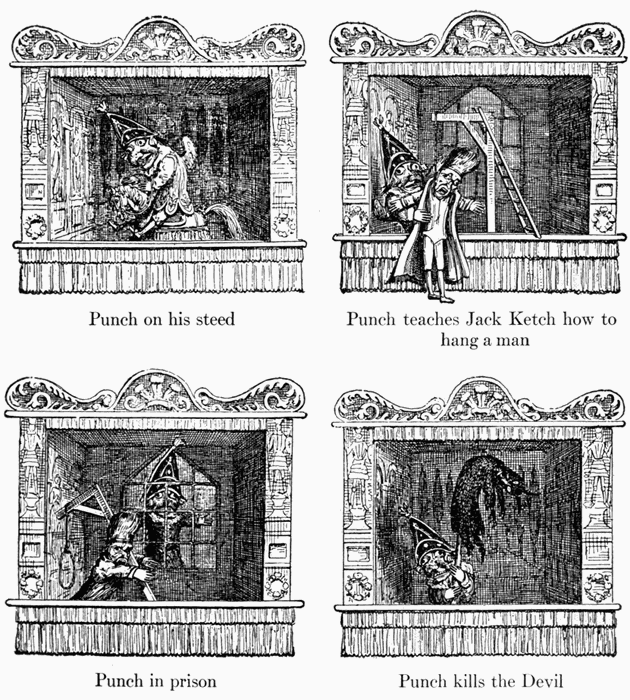
His terrible deeds!—perhaps there is in these words a possible explanation for the failure of Punch to win favor among the descendants of the Puritans, who are always inclined to apply severe moral standards of conduct. Now, if we apply any moral standard at all to the conduct of Mr. Punch, the result is simply appalling, for the customary drama of which he is the sole hero sets before us a story of triumphant villainy, adequately to be compared only with the dastardly history of Richard III in Shakspere's melodramatic tragedy. Mr. Punch is an accessory before the fact in the death of his infant child, and when his devoted wife very naturally remonstrates with him, he turns upon her with invective and violence—a violence which culminates in assassination. Having once seen red and tasted blood, he finds himself swiftly started upon a career of crime. His total depravity tempts him to a startling succession of hideous murders. He slays an inoffensive negro, a harmless clown, and a worthy policeman. Then he succeeds, by a simple trick, in hanging the hangman himself. By his fatal assaults upon these two officers of justice, the necessary policeman and the useful hangman, Mr. Punch exhibits his contempt for the majesty of the law. He stands forth, without a shred of conscience, as a practical anarchist, rejecting all authority. His hand is against every man and every man's hand is against him. And having violated the laws of this world, he finally discloses his callous contempt for the punishment which ought to await him in the next world; he has a hand-to-hand fight with the devil himself—a deadly struggle from which he emerges victorious. And this is the end, which crowns the work.
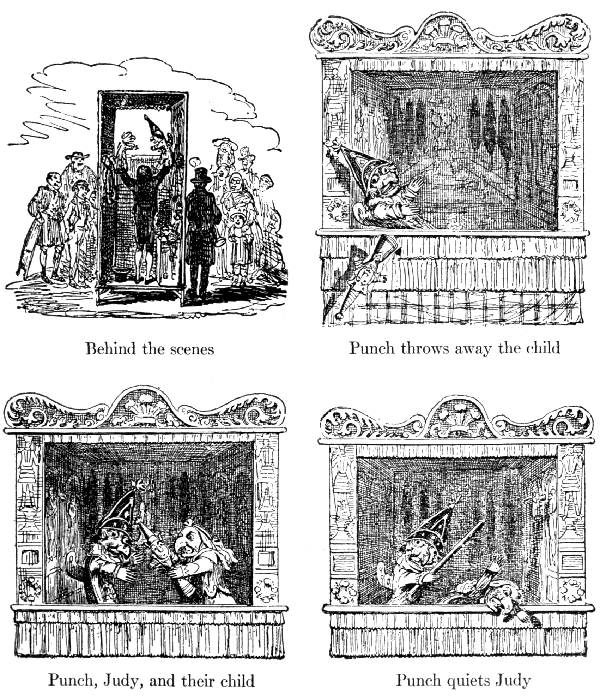
When we consider the several episodes of Mr. Punch's abhorrent history, we are reluctantly forced to the conclusion that his story is even less informed with morality than that of Richard III. The crookbacked king comes to a bad end at last; he meets with the just retribution for his many misdeeds; and he falls before the sword of Richmond. But Mr. Punch comes to a good end, and so far as we may know, he lives happy ever after, like the princes and princesses of the fairytales. He may even marry again and have another child, to be made away with in its turn. The more we consider his misdeeds and his misadventures the more shocking they are to our moral sense. Mr. Punch appears as a monster of such hideous mien that to be hated he needs but to be seen. This is how he must appear to every one of us who applies a moral standard to the drama, and who is willing to hold every character in a play to a strict accountability for his words and deeds. If we apply this moral standard to the play of Punch and Judy, then that play must be dismissed as profoundly and hopelessly immoral, carrying ethical infection to all who are so unfortunate as to be spectators at its performance. And more particularly, it is an absolutely unfit piece for the young, whose immature minds need to be guarded against everything which might tend to confuse the delicate distinctions between right and wrong.
But, of course, we do not apply a moral standard to the sayings and doings of Mr. Punch, for the plain and sufficient reason that he is not a human being. He is not a man and a brother, upon whom we may be tempted to pattern ourselves. He is but a six-inch puppet, a thing of shreds and patches, a wooden-headed doll, vitalized for a moment only by the hand concealed inside his flimsy body with its flaunting colors. He is too fantastic, too impossible, too unreal, too unrelated to any possible world, for us to feel called upon to frown upon his misdeeds or to take them seriously. He is a joke, and we know that he is a joke, and all the children know that he is only a joke. Even the youngest child is never tempted to believe in his existence and to be moved to follow his example or to imitate his dark deeds. The proof of the pudding is in the eating; and the proof of a play is in the effect it produces upon the spectators. We may question whether any one of the millions of performances of the lamentable tragedy of Mr. Punch has suggested to a single father the fatal neglect of his offspring or to a single husband the possibility of wife-murder. And we may doubt whether any child, after witnessing Mr. Punch's murderous combats with the policeman and the devil, has ever felt any lessening of his respect for those two time-honored guardians of law and order.
The plea of confession and avoidance which is here set up for Punch and Judy is much the same as that set up by Charles Lamb for the frolicsome Restoration comedies. Lamb admitted that they were degradingly immoral—if you took them seriously and accepted them as pictures of life. But he insisted that they were not really amenable to this moral standard, since they were plainly impossible in any world known to man. Macaulay had no difficulty in showing that Lamb was judging others by his clever and sophisticated self. To Lamb the creatures of Wycherley and Congreve might reveal manners and customs which removed them from the sphere of recognizable humanity; but the majority of his fellow-spectators were not so nimble-witted; they saw characters on the stage personated by living performers, and they beheld these characters shamelessly doing shameful things. Because the persons in the play were represented by actual human beings they seemed indisputably human; and their deeds could not be considered as outside morality. Yet the plea made by Lamb for the Restoration comedies has a certain validity when it is put forward in behalf of Mr. Punch. He is not personated by an actual human being; and even the least sophisticated of juvenile spectators does not accept him as a fellow-creature strictly amenable to the human code.
II
Historians of the Greek drama have often commented on the fact that the Athenian actors wore towering masks, and that thereby they were deprived of all facial expression. In our snug modern theaters, with their well-lighted stages, we follow with our eyes the shifting emotions as these chase each other across the faces of the actors; and this is one of our keenest pleasures in the playhouse. In the huge theater of Dionysius at Athens, with its ten or twenty thousand spectators, seated tier on tier, along the curving hillside of the Acropolis, the actor was too far removed from most of the playgoers for any play of feature to be visible; and critics have commiserated the Attic dramatists on their deprivation of this element of potent appeal. Yet the question arises whether the Greek playwrights were really the losers by this immobility of the actors' faces; and we may be allowed to doubt that they were when we recall the fact that the faces of Mr. Punch and of Mrs. Judy, of the policeman and of the hangman, are also fixed once for all. The expression that Mr. Punch wears when he is fondling the baby is, perforce, the same which illuminates his face when he is engaged in joyful combat with the devil, a foeman worthy of his stick. Here the imagination of the spectator comes to the rescue. The wooden head of Mr. Punch is unchanging, no doubt; but those who gaze entranced upon his marvelous doings never miss the play of feature which they would expect if they were part of the audience in a playhouse for grown-ups. Quite possibly the Athenian spectators did not mind the immobility of the masks their actors wore; indeed, that very immobility may have been an incentive to their imaginations. When the Greeks went to their open-air theater, as when we gather around the tent-like theater of Mr. Punch, they knew in advance, as we also know, that the faces of the performers would be unchanging; therefore they did not expect any variety of expression; and probably they got along as well without it as we do at a puppet-show.
There is another likeness between Attic tragedy and Punch and Judy; there is a limitation in the number of characters we are allowed to see at the same time. As the hidden performer who operates all the figures has only two hands, he can bring before us at any one moment only Mr. Punch and one other of the several characters. The fingers of the right hand animate Mr. Punch, and the fingers of the left hand animate in turn Mrs. Judy and the negro and the clown. At Athens (for reasons which need not here be discussed) the dramatist had the use of only three actors, even tho these might each of them "double" and appear as two or more of the successive characters of the play. So it was that there were never more than three persons taking part in any given episode of an Attic tragedy as there are never more than two persons taking part in any given episode of Punch and Judy. In the thumb-and-finger plays devised in Paris by M. Lemercier de Neuville, he felt so severely the inconvenience of his limitation to two characters that he devised a kind of spiral-spring arrangement inside the costumes of his little figures to hold up their heads; and he prepared invisible supports jutting out just below the flat ledge which forms the base of the proscenium. Thus he was enabled to leave the figure in sight, while he withdrew his hand to animate another character. His Pupazzi, as he called them, were clever caricatures of contemporary celebrities; and he was ingenious enough sometimes to maneuver half a dozen of them at once with his single pair of hands, four adjusted into the projecting rests, and two on his fingers.
In the sumptuous puppet-show in the gardens of the Tuileries the same result is achieved by the employment of two or three manipulators, so that four or even six figures may appear at once. This has greatly enlarged the scope of the performance; and the manager of this theater has very ambitious aims. He likes to rearrange for his juvenile audience the most appropriate of the pieces which have won favor in the real theaters, and to present these with all sorts of spectacular adornments. He has even ventured to give plays as elaborate as 'Around the World in Eighty Days.' But it may be doubted whether this vaulting ambition has not overleaped itself, and whether a puppet-show does not gain rather than lose by restricting its efforts within narrower limits. After all, nothing so delights us at a puppet-show as the feats which are most characteristic and least difficult of accomplishment. We joy to behold one tiny figure belaboring another with his solid club or to follow the vicissitudes of a bout at single-stick, when both combatants thwack lustily at each other's wooden heads.
III
Yet this mention of M. Lemercier de Neuville's Pupazzi, with their varied repertory of Aristophanic commentaries on current events, and this memory of the spectacular efforts exhibited in the gardens of the Tuileries, suggest a possible explanation for the fact that Punch and Judy have failed to find wide-spread favor here in America and that they seem to be losing their pristine popularity in England. There is a pitiable monotony of program in all English-speaking puppet-shows. They confine their repertory to the single play which sets forth the deeds and misdeeds of Mr. Punch. Now, in the Continent of Europe there is no such monotony. Not only in the gardens of the Tuileries but in the Champs-Elysées a young spectator can sit thru performance after performance without fear of having to witness the same piece. Punch appears in only one drama, whereas his French rival, Guignol, in his time plays many parts, with a host of other characters to be his associates, some in one piece and some in another. And the several plays are adorned with a variety of scenery. Of course, there cannot be a very wide range of subject; and always is the stick a prominent feature in the miniature drama. There are a certain number of traditional Guignol pieces, handed down from generation to generation. Some of these have been printed for the use of devoted students of the drama, and some are to be had in little pamphlets for the benefit of the happy French children who may have had a puppet theater with its dozen or more figures presented to them as a New Year's gift. There is in the Dramatic Museum of Columbia University the manuscript of half a dozen of these little plays, written out (in all the license of his own simplified spelling) by the incomparable performer who was in charge of the leading Guignol in the Champs-Elysées in 1867.
It is rather curious that the English puppet-show should have confined itself for now nearly a hundred years to the unique Punch and Judy, when the puppet-shows of other countries have a changing repertory. It was a puppet performance of a German perversion of Marlowe's 'Doctor Faustus' which first introduced Goethe to the Faust legend. George Sand, unlike the great German poet in most ways, was yet like him in her delight in the puppet-show. In her country place at Nohant, she had a tiny theater of her own for which she dressed all the puppets, while her son Maurice carved the heads, painted the scenery, devised the plays, and improvised the dialog. Maurice Sand it was, sometimes alone, but occasionally with the aid of a friend, who manipulated the little figures and bestowed upon them a momentary vitality. His mother persuaded him to write out a dozen of the more successful of his little plays for puppets and to publish them; and this volume, the 'Théâtre des Marionnettes à Nohant,' appeared in 1876. George Sand herself wrote a delightful account of the humble beginnings of this famous puppet-show, and described how there came in time to be all sorts of ingenious improvements for achieving spectacular effects.
She declared that the puppet-show is not what it is vainly thought, because it demands an art of a special kind, not only in the construction of the little figures themselves, but more especially in the story which these little figures are to interpret. She held that the particular field of the puppet playwright-performer was to be found in the dramatization of protracted fantastic romances, abounding in comic characters and in comic episodes and gratifying the fundamental human liking for long-drawn tales of adventure and for fantastic fairy-stories. She found in her son's acted narratives a rest from reality, a release from the oppression of every-day life, an excursion into a realm of fancy and of legend—even if the legend was itself a fanciful invention of the improvising performer. And she declared that she liked the puppet playhouse in her own home, because it was a domestic and fireside pleasure, which could be enjoyed without the exertion imposed by a visit to a real theater. Obviously she found as much delight in being a spectator—after having been a costumer—as her son did in being the author and operator of the spectacle.
IV
There is one note to be made upon George Sand's account of the slow development of the puppet-show at Nohant, beginning as early as 1847. If you will look at any set of Punch and Judy figures hung up to-day in the toy store to tempt the eye of Young America, you will discover alongside Mr. Punch and Mrs. Judy, Jack Ketch and the Devil, a strange green figure with huge jaws and double rows of white teeth. This verdant beast has a body like all other Punch and Judy figures, a loose cloth funnel to slip over the sleeve of the operator; but its head suggests the head of an alligator, or of a crocodile, or of a dragon. Now, if you will turn to the classic text of the English play of Punch and Judy, edited with a learned introduction and an abundance of scholarly annotation by John Payne Collier—at least, so it is believed, altho the rare little book is anonymous—you will find no mention of any strange beast of this sort. Collier's text of the play is adorned by two dozen illustrations, etched by George Cruikshank, and in no one of these plates will you discover any crocodile, or alligator, or dragon. You will find Toby, the dog, who still survives in most of the few shows to be seen to-day in the streets of London; and you will find Hector, the gallant steed that Mr. Punch mounts with difficulty—and it is sad to have to record that Hector is no longer in the service of Mr. Punch. In fact, one devoted admirer of puppet-shows, whose memory goes back nearly fifty years, is ready to declare that he has never laid eyes on Hector—except in Cruikshank's illustrations. But Mr. Punch, deprived of the privilege of bestriding Hector, now enjoys the fiercer delight of overcoming the green-eyed alligator.
Here we have a question of profound historic interest. Whence came the strange beast with the wide jaws? And here is where George Sand's pleasant paper is a very present help in time of need. She tells us that her son besought her to make a green monster for one of the earliest pieces he devised for her puppet-figures. She did as she was bid, and she sacrificed a pair of blue velvet slippers to provide the marvelous creature with his gently smiling jaws. She draws attention to the fact that the slippers were blue, and to the further fact that nevertheless the strange beast was always called the Green Monster. And here may be the explanation of the historic mystery. The fame of the puppets of Nohant was borne abroad; they were talked about all thru France; and they were discussed again and again in the Parisian newspapers. What more likely than that one of the professional puppet players should have seen the infinite possibilities of the Green Monster, and should have perceived its novel fascination for children? Thereupon he borrowed it for his own performances. Certainly it is that the Green Monster is a character in at least one of the manuscript plays preserved in the Dramatic Museum of Columbia University, and written out half a century ago. Probably the Green Monster strayed from the puppet-show of the Champs-Elysées sooner or later to one of the toy stores of Paris at the request of some boy who desired it for his own. When the Green Monster had elected domicile in the stores of Paris, he was soon appropriated by the toy-makers of Germany for export to Great Britain and the United States.
(1912.)
XVII THE PUPPET-PLAY, PAST AND PRESENT
THE PUPPET-PLAY, PAST AND PRESENT I
In her charming and instructive account of the ingenious puppet-shows with which her son Maurice used to amuse himself and her guests at Nohant half a century ago, George Sand records the fact that the erudite scholar, Magnan, who wrote a learned history of the puppet-show from the remotest antiquity, did not discriminate sharply between the two entirely different kinds of little figures, both of which are carelessly called puppets in English, and marionettes in French. One class comprises these empty and flexible figures which are animated by the thumb and two fingers of the performer who exhibits them by holding his hands above his head, as in the 'Punch and Judy' show. The other contains the larger dolls, suspended on wires (which are supposed to be invisible) and manipulated by one or more performers overhead, who give life to these figures by jerking the various strings as the action of the play may require. These last are the true marionettes; and for the first we have, unfortunately, no distinctive name. It is greatly to be regretted that the two very different types of puppets are not set apart from each other satisfactorily by the contributor of the article on marionettes in the latest edition of the 'Encyclopedia Britannica.'
Each of these two sorts of puppets has an interest of its own; and each of them has its special and peculiar relation to the drama. Both of them have a long and honorable history, and can be traced back in the scanty records of a remote antiquity; altho it seems more likely that the true marionette—the little figure moved by wires from overhead—is the older of the two, antedating by many centuries the Punch and Judy figure, which owes its abrupt and awkward movements to the human thumb and fingers. Both classes are to be found to-day all over the world, not only in the cities of civilization, but in unsuspected nooks and corners on all the shores of all the seven seas. In Turkey, for example, under the name of Karaguez, there is a Punch and Judy of enormous popularity and of doubtful decency, while in Siam there are marionettes which perform religious plays of traditional appeal. Apparently the puppet-show of one type or the other satisfies in its fashion that dramatic instinct which every people possesses in greater or less intensity.
Both kinds of puppet-show flourish in France, and have there been lifted to a more elevated plane of art; and both kinds retain their popularity in Italy, altho in an humbler form. The French are inveterate artists; and they are like the Greeks in desiring to do all things decently and in order. The Italians have, perhaps, a stronger native gift for the drama and they are ready to enjoy a simpler and more primitive puppet-play. It is from Italy that we who speak English have derived our Punch and Judy. Mr. Punch is a direct descendant of that favorite figure of robust Neapolitan farce, Pulcinella; and so is the French Polichinelle. And in Italy to-day the true marionettes have an even broader popularity than the Punch and Judy figures. The Italians who have lately flocked to America in their thousands, until New York now contains more of them than Venice, have imported in the original package the legendary puppet-show setting forth the romantic stories of the Middle Ages and of the early Renascence. We look upon Mr. Punch as comic; but the Italians take their pleasure seriously and the marionettes in their puppet-shows to be seen in New York are truly heroic, and not infrequently highly tragic.
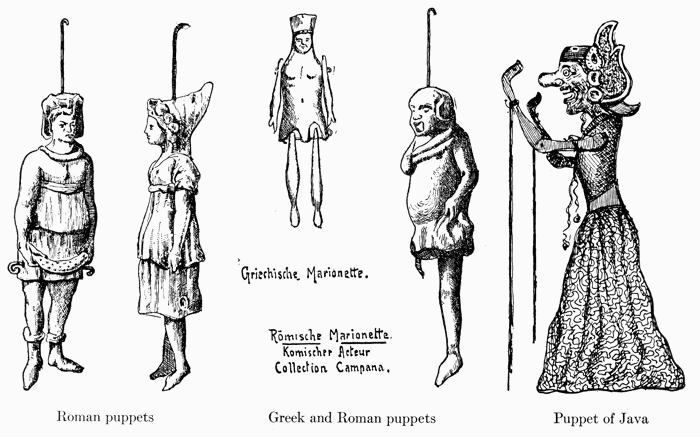
In the interesting discussion of 'Medieval Story,' in which Professor W. W. Lawrence of Columbia University has traced the influence of various ideals of the Middle Ages upon our modern social organization, he has a striking description of the marionette performances which the exiles of Italy have brought with them to America. "Any one who walks thru the Italian quarter of New York City in the evening may notice over a doorway an illuminated sign, 'Theater of Marionettes.' If his curiosity tempts him inside, into the low room crowded with enthusiastic spectators, he will see, on a rude stage, a group of puppets almost as large as life, representing knights and ladies, acting out a little drama in response to the jerking of strings fastened to their arms, and of iron rods firmly fixed in their heads. The warriors are gorgeously attired in shining armor and plumed helmets; and the ladies have wonderful costumes of bright colors, with a great deal of embroidery and decoration. An Italian in shirt-sleeves in the wings at the side of the stage speaks their lines for them, with all the elocutionary flourishes which he can command. Fiercely immobile as to expression, but most active as to arms and legs, these manikins march about, soliloquize, make love, and debate in council. But it is their battles which arouse the greatest enthusiasm among the audience; and, indeed, these are fought in a way that is a joy to see. Then it is that heroic deeds are done—tin swords resound upon tin armor, helmets are battered about and knocked off, dust rises from the field, the valiant dead fall in staring heaps. At such moments the spectators can hardly restrain themselves from emotion, yet the story is well known to them—perhaps some one sitting near by will volunteer to explain it, asserting that he has known it ever since he was a boy and that he has read it all in a book which he has at home, called 'Reali di Franci.' It is a version of the old tale of Charlemagne and his knights, which, after traveling far from its native home in France, was taken up by the Italian people many centuries ago, and made so much their own that few heroes have been closer to their hearts than Roland, or as they call him, Orlando. Even in their homes in the New World they still celebrate him, so that the very newsboys in the streets of modern America are keeping alive the heroic traditions of the age of Charlemagne."
A Sicilian marionette show From "By Italian Seas," by Ernest C. Peixotto
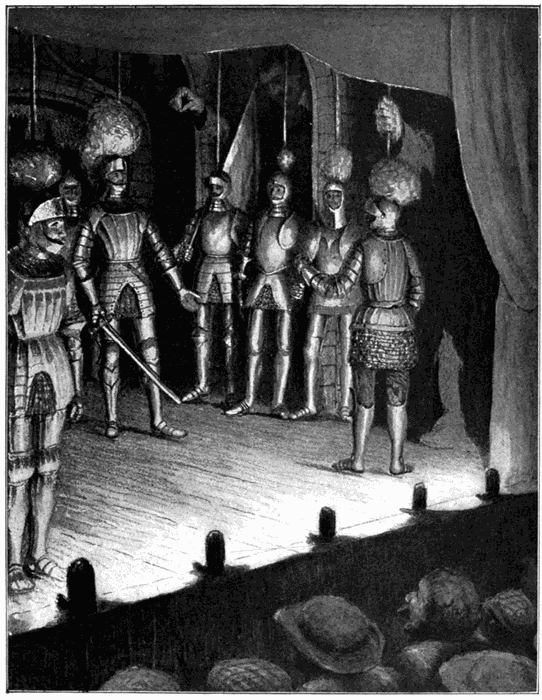
II
When we compare the account which Professor Lawrence has here given of the Italian puppet-shows in New York with the description of these same performances in their native land half a century ago, which we find in the 'Roba di Roma' of W. W. Story, the American sculptor-poet, we perceive that there has been little modification of method in the past threescore years. Story studied all sides of the Roman populace, and he maintained that nothing was more characteristically Italian than the marionette theater. He tells us that the love for the acting of burattini [or puppets] is universal among the lower classes thruout Italy, and in some cities, especially in Genoa, no pains are spared "in their costume, construction, and movement to render them lifelike. They are made of wood, generally from two to three feet in height, with very large heads, and supernatural glaring eyes that never wink, and are clad in all the splendor of tinsel, velvet, and steel. Their joints are so flexible that the least weight or strain upon them effects a dislocation, and they are moved by wires attached to their heads and extremities. The largest are only about half the height of a man, yet as the stage and all the appointments and scenery are upon the same scale of proportion, the eye is soon deceived, and accepts them as of life-size. But if by accident a hand or arm of one of the wire-pullers appears from behind the scenes or descends below the hangings, it startles you by its portentous size; and the audience in the stage-boxes instead of reducing the burattini to Lilliputians by contrast, as they lean forward, become themselves Brobdingnagians, with elephantine hands and heads."
Story insisted that there is nothing ludicrous to an Italian audience in the performances of these diminutive men and women. On the contrary, nothing is more serious both to the spectators and to the unforeseen operators. In fact, he declared, no human being could be so serious as these tiny performers. "Their countenances are as solemn as death, and more unchanging than the face of a clock. Their terrible gravity when, with drooping heads and collapsed arms, they fix on you their great goggle-eyes is at times ghastly. The plays they perform are mostly heroic, romantic, and historical. They stoop to nothing which is not startling in incident, imposing in style, and grandiose in movement. And the Italian audience listens with a grave and profound interest, as tho the performers were not mere puppets, but actually the heroes they are supposed to be. The inflated and extravagant discourse of the characters is accepted at its face value; to the spectators it is grand and noble. And the foreign visitor must control any desire he may feel to smile at the extraordinary spectacle he is witnessing, and at the marvelous rodomontade he is hearing. To laugh out loud at one of these heroic puppet-plays would be as indecorous as to indulge in laughter during a church service."
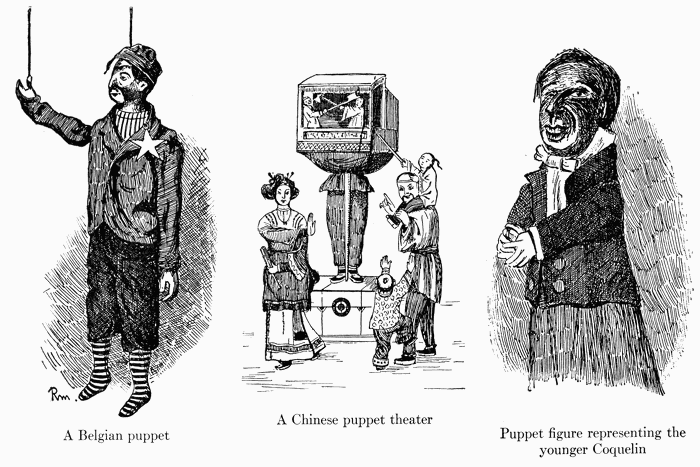
Incidental to the heroic dramas which the puppets play are interludes of ballet-dancing like those which are intercalated, more or less adroitly, into the grand opera performed by full-grown men and women. The Italians are born pantomimists, and they are accomplished dancers. Therefore, there is no reason for surprise that human pantomime and human dancing are imitated in the marionette theaters. There is reason for surprise, however, that Story did not perceive clearly the advantages possessed by the dancing puppets over the dancers of more solid flesh and blood. He found something comic in the pantomime of the puppets, "whose every motion is effected by wires, who imitate the gestures of despair with hands that cannot shut, and, with a wooden gravity of countenance, throw their bodies into terrible contortions to make up for the lack of expression in the face." In mere pantomime it is probable that the puppets would labor under a serious disability, for if a performer cannot use his voice, he needs facial expression to assist the gestures by which only can he then convey his meaning to the other performers and to the spectators. Perhaps it is not too much to assert that the puppet-show is not the proper place for pantomime.
III
We need not wonder that Story admitted their dancing to be superior to their pantomime. Yet he failed to appreciate the true cause of this superiority, and he was inclined to comment upon the dancing of the burattini in a somewhat satiric fashion. He tells us how the principal dancer suddenly appears, "knocks her wooden knees together, and jerking her head about, salutes the audience with a smile quite as artificial as we could see in the best trained of her fleshly rivals." But this artificial smile must have been fixed and permanent on the features of this diminutive dancer—or else the Roman-American essayist merely imagined its presence. "Then, with a masterly ease, after describing air-circles with her toes far higher than her head and poising herself in impossible positions, she bounds or rather flies forward with superhuman lightness, performs feats of choreography to awaken envy in Cerito and drive Elssler to despair, and, poising on her pointed toe that disdains to touch the floor, turns never-ending pirouettes on nothing at all, till at last, throwing both her wooden hands forward, she suddenly comes to a swift stop to receive your applause."
This description is unsympathetic, and it induces the surmise that the operator of the burattini at the performance described was not a master of his art and did not know how to profit by the possibilities of that art. Yet one of Story's phrases serves to explain why the suspended puppet is superbly qualified to excel in ballet-dancing; that phrase is the one which credits the dancing doll with "supernatural lightness." A skilful operator of the wires which bestow life and movement and grace, is able to imitate easily and exquisitely the most difficult feats of the human dancer. If he is sufficiently adroit he robs his suspended figure of all awkwardness, and he dowers her with a floating ethereality surpassing that attainable by any living performer. Now, this floating ethereality is precisely the quality which gives us most pleasure when we are spectators at the performance of a really fine ballet. It is the supreme art of the great dancer to soar lightly aloft, seeming to spurn the stage and to abide in the air. Only very rarely is this illusion possible to the merely human dancer; and when achieved it is but fleeting. Yet this illusion is absolutely within the control of the manipulator of the puppet-dancers. He can make them execute feats of levitation, achievable only by the most marvelously gifted and by the most arduously trained of human dancers.