ILLUSTRATIONS (continued 3)
Reading edition
A well-known British art critic once told me that when the curtain rose at a certain London revival of 'Twelfth Night,' and disclosed Olivia's garden, he sat entranced at the beauty of the spectacle before his eyes, with its subtle harmonies of color, so entranced, indeed, that he found himself distinctly annoyed when the actors came on the stage and began to talk. For the moment, at least, he wished them away, as disturbers of his esthetic delight in the lovely picture on which his eyes were feasting. But even a stage-setting as captivating as this might very well be justified if it had been employed to fill a gap in the action, and to buttress up the interest of an episode where the dramatist had allowed the appeal of his story to relax. Perrin, the manager of the Comédie-Française thirty years ago, declined to produce a French version of 'Othello' because he found a certain dramatic emptiness in the scenes at Cyprus at the opening of the second act, which he felt he would have to mask by the beauty of spectacular decoration, too costly an expedient in his opinion for the finances of the theater just then.
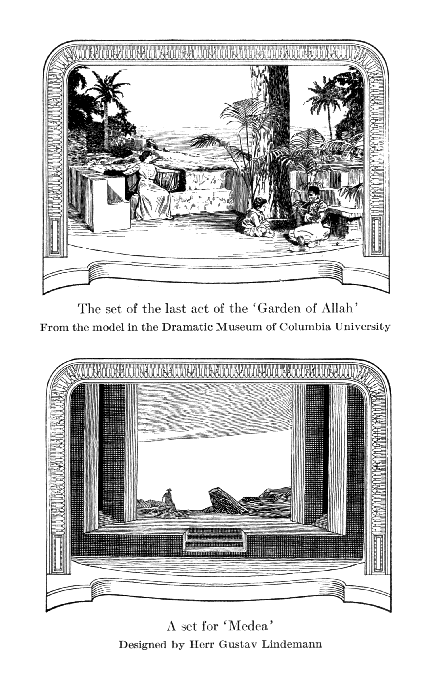
It was Perrin, however, who produced the French version of the 'Œdipus the King' of Sophocles, and who bestowed upon it a single set of wonderful charm and power, at once dignified, appropriate, and beautiful in itself. It represented an open space between a temple and the palace of the ill-fated Œdipus, with an altar in the center, and with the profile of another temple projected against the distant sky and relieved by the tall, thin outline of poplar-trees. The monotony of this rectangular architectural construction was avoided by placing all the buildings on a slant, the whole elevation of the temple being visible on the left of the spectators, whereas only a corner of the colonnade of the palace on the right was displayed. This set at the Théâtre-Français was the absolute antithesis of the original scenic surroundings in the theater of Dionysus more than two thousand years ago, when the masterpiece of Sophocles had been performed in the open-air orchestra, with only a hut of skins or a temporary wooden building to serve as a background for the bas-reliefs of the action.
So elaborate, complicated, and costly have stage-sets become in the past half-century, that there are already signs of the violent reaction that might be expected. Mr. Gordon Craig, an artist of remarkable individuality, has gone so far as to propose what is almost an abolition of scene-painting. He seeks to attain effects of massive simplicity by the use of unadorned hangings and of undecorated screens, thus substituting vast spaces for the realistic details of the modern scene-painter. No doubt, there are a few plays for which this method of mounting would be appropriate enough—M. Maeterlinck's 'Intruder,' for one, and his 'Sightless' for another, plays which are independent of time and space, and in which the action appears to pass in some undiscovered limbo. As yet the advanced and iconoclastic theories of Mr. Craig have made few adherents, the most notable being the German, "Professor" Reinhardt, who lacks Mr. Craig's fine feeling for form and color, and who is continually tempted into rather ugly eccentricities of design, being apparently moved by the desire to be different from his predecessors rather than by the wish to be superior to them.
VI
Interesting as are Mr. Craig's suggestions, and wellfounded as may be his protest against the excessive ornamentation to which we are too prone nowadays, there is no reason to fear that his principles will prevail. The art of the scene-painter is too welcome, it is too plainly in accord with the predilections of the twentieth century, for it to be annihilated by the fiat of a daring and reckless innovator. It will be wise if the producers should harken to Mr. Craig's warnings and curb their tendency to needless extravagance; but we may rest assured that a return to the bareness of the Attic theater or of the English theater in the time of the Tudors is frankly unthinkable now that the art of scene-painting has been developed to its present possibilities. In fact, the probability is rather that the scene-painters will continue to enlarge the boundaries of their territory and to discover new means and new methods of delighting our eyes by their evocations of interesting places.
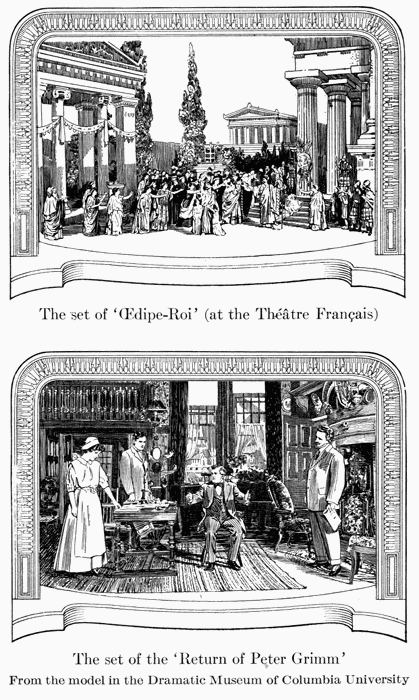
Perhaps they would be more encouraged to go on and conquer new worlds if there was a wider recognition of the artistic value of their work. Altho De Lutherbourg and Clarkson Stanfield won honorable positions in the history of painting by their easel-pictures, the art of scene-painting does not hold the place in the public esteem that many of its practitioners deserve. Théophile Gautier, often negligible as a critic of the acted drama, was always worth listening to when he turned to pictorial art; and he was frequent in praise of the scene-painters of his time and of scene-painting itself as a craft of exceeding difficulty and of inadequate appreciation. Probably one reason why the scene-painter has not received his due meed of praise is because his work is not preserved. It exists only during the run of the play which it decorates. When the piece disappears from the boards, the scenes which adorned it vanish from sight. They linger only in the memory of those who happened to see this one play—and even then, in fact, only in the memory of such spectators as have trained themselves to pay attention to stage-pictures. For the scene-painter there is no Luxembourg; still less is there any Louvre. As Gautier sympathetically declared, "it is sad to think that nothing survives of those masterpieces destined to live a few evenings only, and disappearing from the washed canvas to give place to other marvels, equally fugitive. How much invention, talent, and genius may be lost—and not always leaving even a name!"
It is pleasant to know that at the Opéra in Paris a formal order of the government has for now a half-century prescribed the preservation of the original models—the little miniature sets which the scene-painter submits for the approval of the manager and the dramatist before he begins work upon the actual scene. These models are always upon the same scale, and in the gallery connected with the library of the Opéra a dozen of these models are set up to be viewed by visitors. Of course no tiny model, however cleverly fashioned, can give the full effect of the scene which has been conceived in terms of a huge stage; and yet the miniature reproductions do not betray the scene-painter as much as an engraving or a photograph often betrays the painter. Whatever its limitations, and they are obvious enough, the collection of models at the Opéra is at least an attempt to retard the oblivion that Théophile Gautier deplored, and to provide for the scene-painter a substitute, however inadequate, for the Louvre and the Luxembourg.
(1912.)
IX THE BOOK OF THE OPERA
THE BOOK OF THE OPERA I
A few years ago Punch had a satirical drawing representing a British matron conveying a bevy of youthful daughters to the French play in London. To a friend who called her attention to the rather risky atmosphere of the very Parisian comedy which they were about to behold, the worthy mother promptly explained that she was not bringing her daughters to see the play itself; she was bringing them to see only the acting. Probably a great many opera-goers would make a similar explanation if they were asked whether they were interested in the book of the opera or only in the music. They would be likely to protest that they cared little or nothing for the libretto, and that they were attracted solely by the score. But, as a matter of fact, the opera-goers who might make this reply would be self-deceived. Whether they are aware of it or not, they are unlikely to be attracted to any opera unless it happens to have an interesting story, built up into a coherent and captivating plot. When the libretto is unintelligible or uninteresting, the most delightful music fails to allure them into the opera-house. This is one of the reasons why the 'Magic Flute,' which contains much of Mozart's most beautiful melodic invention, is so rarely heard in our opera-houses, and why it is so sparsely attended when it is presented. The libretto of the 'Magic Flute' is dull and ineffective, and even Mozart's genius proved unable to overcome this initial handicap.
The ordinary opera-goer is likely to treat the libretto with calm contempt. He is prone to assert that nobody cares about the words, and he does not reflect that behind and beneath the words is the supporting structure of the story. After all, an opera is a play, it is a music-drama, and the plot is as important in a play the words of which are to be sung as in a play the words of which are to be spoken. True it is, of course, that in an opera the words may not be heard distinctly, and perhaps they need not be seized with certainty, since the emotion they set forth is more amply conveyed by the music. But the musician cannot express emotion musically, unless there is emotion for him to express, unless he has characters immeshed in a series of situations which evoke vivid and contrasting sentiments for him to translate into music. As the music-drama is a drama, it must obey the laws of the drama; it must represent a conflict of contending desires; it must be carried on by characters firm of purpose and resolute in achieving their several aims. These characters must be sharply individualized and boldly contrasted; and the story in which they take part must be at once strong and simple, calling for no elaborate explanation and moving forward steadily and irresistibly. It must have a lyric aspect, lending itself naturally to song; and it ought also to afford opportunity for the spectacular effects appropriate to the large stage of the opera-house.
So contemptuous of the libretto is the ordinary opera-goer that he rarely inquires as to the name of the author of the book, altho he is generally familiar with the name of the composer of the score. He may or he may not be aware that Wagner was his own librettist, and quite possibly he supposes that it is the ordinary custom of the composers to write the words for their own music. He knows that 'Carmen' was composed by Bizet, and that the 'Huguenots' was composed by Meyerbeer; but he would be greatly puzzled if he was asked to name the librettists of these two operas, the adroit playwrights who devised the skeletons of dramatic action which sustained the composers and provided them with ample opportunities for the exercise of their melodic gift. As a matter of fact, the book of 'Carmen' was written in collaboration by two of the most distinguished French dramatists of the nineteenth century, Meilhac and Halévy, the authors of 'Froufrou' and of the librettos of Offenbach's 'Belle Hélène,' 'Grand Duchess of Gérolstein,' and 'Périchole.' And the book of the 'Huguenots' was the work of the master stage-craftsman, Scribe, the author of 'Adrienne Lecouvreur' and of the 'Ladies' Battle,' and of countless other plays performed in every modern language, and in all the countries of the world.
Bizet wrote other operas besides 'Carmen,' and if these other operas have vanished from the stage, the reason may be that the librettos to which they were composed were not as ingenious and not as interesting as the book of 'Carmen.' One of these forgotten operas of Bizet's was a dramatization of the 'Fair Maid of Perth,' and another was called the 'Pearl Fisher'; but neither of these books was devised by Meilhac and Halévy. And Scribe was not only the librettist of the 'Huguenots' and of the 'Africaine' for Meyerbeer; he also wrote the books of 'Fra Diavolo' and of 'Crown Diamonds' for Auber, the book of the 'Dame Blanche' for Boïeldieu, and the book of the 'Juive' for Halévy. Indeed, it is evident that Wagner himself as a librettist must be considered as a direct disciple of Scribe; certainly his book of the 'Flying Dutchman' has its points of resemblance with the books Scribe invented for 'Robert the Devil,' and for the 'Prophet.' Even the libretto of Wagner's 'Master-Singers of Nuremberg,' altho it is far richer in tone than any of Scribe's librettos for Auber, is constructed in accord with principles already applied by the French playwright. In fact, the influence of Scribe is patent thruout the long history of opera in the nineteenth century; he was not only the most prolific of librettists himself, but the operatic formula he devised was borrowed by the best of the librettists who followed him. Scribe was not the writer of the books of 'Faust,' or of 'Roméo et Juliet,' or of 'Aïda,' but all these librettos were carefully built in accord with the principles that he had practised for half a century.
II
Probably the average opera-goer is contemptuous of the libretto, because he thinks it is an easy task to write the mere words of an opera. To him, no doubt, the opera lives by its music, and by its music alone. But there is really no warrant for this uncomplimentary attitude. An opera is a music-drama, and if it is to achieve success, wide-spread and long-lasting, its drama must be as effective as its music. Experience proves that, so far from being as easy as it seems, the construction of a satisfactory libretto is really a difficult feat, to be achieved only by an expert in stage-craft. It is no task to be confided to an amateur play-maker, to a mere lyrist, ignorant of the art of the theater. First of all, a satisfactory book must contain the skeleton of a good play; and, second, this must be the special kind of play which will not only inspire the musician, but afford him a succession of special opportunities for the exercise of his own art. The book of an opera must be a good play; and more than once have we seen a libretto deprived of its music and written out again in prose for production in non-musical theaters. 'Carmen' is one example of this transformation. The late Sir Henry Irving was so taken with Wagner's 'Flying Dutchman' that he had it made over into a play for his own acting—'Vanderdecken.'
The book of an opera must be a good play, and therefore not a few successful operas have been composed on plots which had already won approval as plays on the stage. Indeed, many modern composers are so convinced of the necessity that librettos shall be attractive in themselves that they are continually borrowing popular plays to deck with melody. 'Salomé' and 'Pelléas et Mélisande,' 'Madam Butterfly' and 'Cavalleria Rusticana,' the 'Bohème' and the 'Tosca' were all successful without music before they were set to music to win a second success. The book of Verdi's 'Rigoletto' is based on Victor Hugo's drama, 'Le Roi s'Amuse'; and oddly enough it was the operatic libretto, rather than the original poetic drama, which suggested the English play on the same theme, Tom Taylor's blank-verse drama, the 'Fool's Revenge.' Another of Verdi's librettos was borrowed from Hugo's 'Hermani', while his 'Traviata,' as we all know, is taken from the play of the younger Dumas, long popular in America as 'Camille.' Two of Verdi's latest operas had Shaksperian themes, 'Otello' and 'Falstaff.'
It is instructive to note, so an American musical critic once asserted, that of all Gounod's dozen operas, "the only two which have survived are the two which are derived from Goethe's 'Faust' and from Shakspere's 'Romeo and Juliet'"; and he added a reminder that in these operas the music owes its success "not only to the aid derived from its associations with a favorite play, but also in part to the fact that the composer's creative imagination was fertilized by the splendid opportunities for dramatic composition offered by these plays. Gounod was moved by the joys and woes of Margaret and of Juliet, and it is only under the influence of deep feeling that such masterworks can be created." When Gounod set to music a poetic play by Goethe, and when Verdi set to music a group of characters created by Shakspere, the composers might well be inspired by the poets; and they were thus aided to attain the utmost of which they are capable as musicians.
But it may be doubted whether any musician could find any really helpful inspiration in dramas of vulgar violence, such as the 'Tosca' of Sardou, and the 'Salomé' of Oscar Wilde; and it is extremely improbable that the operas composed to such unworthy themes will be able to achieve any durable popularity. In plots of so coarse a character there is neither beauty nor poetry, and the vogue of music-dramas having subjects so debased is likely to be fleeting. On the other hand, there was both poetry and beauty in the original plays of 'Madam Butterfly' and 'Cavalleria Rusticana,' and we need not be surprised if the operas composed on these themes prove to have a long life in the musical theaters. We may even go further and suggest that there was a haunting and ethereal grace about Maeterlinck's 'Pelléas et Mélisande' which seemed almost to demand translation into the sister art of music.
The two most effective French comedies of the eighteenth century, the 'Barber of Seville' and the 'Marriage of Figaro,' supplied librettos, one for Rossini and the other for Mozart. We may be sure that sooner or later some other composer, Italian or American or German, will be tempted to undertake an opera based on Fulda's 'Two Sisters,' in which there could not help being a very effective part for the prima donna. And sooner or later again some musician with an appreciation of humor and sentiment will be moved to take for his libretto the comedy of 'Masks and Faces,' by Charles Reade and Tom Taylor, generally known by the name of its fascinating heroine, Peg Woffington. No doubt there are not a few other modern plays in which composers will discover musical possibilities.
III
The key to an understanding of the importance of the libretto lies in the term Wagner used to describe the art-work of the future; he called this a "music-drama." The exclusive lover of music is tempted to look down on opera because its music is contaminated with drama; and for a similar reason, the exclusive lover of the drama is not attracted to opera because the drama is there more or less sacrificed to the music. But there are many opera-goers who best relish music and the drama when they are presented in conjunction. In a music-drama of the highest type, in Wagner's 'Tannhaüser,' for example, the music and the drama are Siamese twins; they were brought forth at a single birth. Each helps the other, and neither calls upon the other for any undue sacrifice. They can be enjoyed together better than they can be enjoyed apart, since each depends upon the other; and united they stand or fall.
Mr. H. T. Finck was not overstating the case when he insisted that the ideal opera is one in which the book and the score are each of them of absorbing interest, "and yet make a doubly deep impression when heard together." The stories of 'Faust' and of 'Carmen' and of 'Lohengrin' are delightful in themselves, merely to read; and a musical expert can find pleasure in playing the music from them on the piano. "Yet how much more effective they are when we hear and see music and play together on the stage." And then the same writer goes on to point out that the best "libretto is one which tells its story to the eye," as in the case of 'Carmen,' for example. "No one with eyes to see can fail, for instance, to follow the career of 'Carmen,' from her flirtation with the young officer to the scene before the bullring where he stabs her."
It was an acute French dramatic critic who once asserted that "the skeleton of every good play is a pantomime," and the assertion is more emphatically true when applied to the skeleton of a libretto. Indeed, as the words are rarely heard distinctly, and as they are often in a foreign language, there is double need of a story so clear and so straightforward that it can be caught by the eye alone from the actions and gestures and facial expressions of the performers without the aid of the actual words. But the inventing and the constructing of a plot of this seemingly simple effectiveness is a task of extraordinary difficulty—if we may judge by the infrequency of its achievement. And undoubtedly it is this difficulty which has led so many musicians to compose their scores to books only slightly altered from plays which had already an attested popularity in the theater. By so doing it has seemed to them that they were minimizing the risk of finding their music handicapped by an ineffective story. The danger in this case lies in the temptation to set to music any play which may chance to be successful without considering sufficiently whether it is really worthy of the composer's labor.
There is another disadvantage also in this snatching at successful plays to serve as opera-librettos. Most successful plays nowadays deal with modern life, and they may owe much of their success to the skill with which the dramatist has been able to seize the external aspects of reality. Now, it is an interesting question whether a realistic piece of this sort can ever supply an entirely satisfactory book for an opera, since music is emotional and idealizing. To many persons the opera seems singularly unreal, strangely remote from actual life. Such persons are shocked that Tristan, for instance, should sing for half an hour when he is dying from physical weakness. Tolstoy sided with those who take this attitude, and he had no difficulty in showing up the absurd unreality of an operatic performance, if one insists upon applying to it the standard of our ordinary existence, since we do not burst into song ordinarily to express our every-day desires. Of course, there would be no great difficulty in showing up the absurd unreality of every other art, if the same standard is insisted upon. No art can justify itself for a moment unless we are willing to admit the essential conventions which alone permit it to exist.
Tolstoy might as well have pointed out that sculpture is ridiculous, since no human being is ever all of one color, body and clothes, as a statue must be, whether it is made of marble or of bronze. He could have declared that painting is equally untrue to the mere facts of life, since it represents nature absolutely without motion, as when it depicts a field of waving corn which does not really wave but stands fixed forever. If Tolstoy or any one else refuses to accept the conventions of any art, there is no possible reply, except to make it clear to him that he is thereby depriving himself of the delight which that art can give. A departure from the mere fact underlies every art; and it is only because of that departure that the art exists. By convention, that is to say, by tacit agreement between the artist and the public, the artist is allowed to deny certain of the facts of life in order to provide the public with the specific pleasure which only his art can afford.
In the Shaksperian drama the underlying convention is that the persons of the play belong to a race of people who always express themselves poetically in English blank verse. In opera this necessary agreement requires us to concede the existence of men and women to whom song is the natural means of communicating all their sentiments and all their thoughts. If we are willing to accept this implied contract, then there is no absurdity in Tristan's singing with his dying breath, since he belongs to a race of creatures who have no other method of speech. If we are unwilling to be parties to this agreement, if we deny the existence of any such creatures, then there is nothing for us to do but to keep out of the opera-house. It was this convention which Tolstoy rejected, and by this rejection he refused the enjoyment which the opera can give to those who are satisfied to accept its conditions.
IV
But there is no denying that the imperative operatic convention requires us to admit a very violent departure from the facts of life as we all know them. We are now so accustomed to blank verse in Shakspere's plays, tragic and comic, that we accept it almost without noticing it. By long habit, we have come to consider blank verse as "natural" in a poetic play, especially when that play sets before us heroic figures of the remote past. And here is the danger in the operas which have been composed on books made out of modern popular pieces, more or less realistic in their atmosphere. The "naturalness" of the men and women in these plays of to-day tends to draw attention to the "unnaturalness" of their customary use of song to express their emotions.
This danger Wagner skilfully avoided in his later music-dramas derived from the Nibelungen myth. He set before us shadowy creatures involved in strange intrigues far back in the legendary past and wholly devoid of any modern or realistic suggestion. As Tristan and Siegfried and Brunhild are all idealized persons, taking part in poetic fictions, we are willing enough to accept their exclusive use of song; and we recognize at once the artistic inconsistency of Tolstoy's protest. To beings so remote from our daily life, from our ordinary experience, the standard of fact cannot fairly be applied. We acknowledge the full right of such creatures to dwell eternally in the land of song alone.
But we are perhaps a little less willing to make this acknowledgment when we find the composer asking us to believe that men and women of our own time and of our own country, the characters of the 'Girl of the Golden West,' for example, or even some of those of 'Madam Butterfly,' should eschew the plain prose of ordinary speech and insist on discussing their love-affairs in the obviously "unnatural" medium of song. That is to say, there is a striking incongruity between musical expression and the realistic characters of most modern plays. We enjoy the opera partly because it is not "natural," not "real," in the ordinary meaning of these words; and if the plot and the people are aggressively modern and matter-of-fact, our attention is necessarily called to the "unnaturalness" of their incessant vocalization. A certain remoteness from real life, even a certain vaporous intangibility as to time and place, seem to be a helpful element in our enjoyment of a music-drama.
Perhaps it is due to this remoteness, to this unreality, that the opera-goer is willing enough to have a story end unhappily, altho the playgoer is now likely to be painfully affected by a tragic ending. Whatever the reason, it is a fact that most of our popular plays end merrily in a church, while most of our popular operas end sadly in a churchyard. The calculation has been made that out of twoscore operas sung in New York at the two opera-houses a season or so ago, only half a dozen ended happily; the large majority of them culminated in the death of the hero or of the heroine or of both together. Music is a sister of poetry, and we need not wonder that the musicians are likely to prefer the opera-book which has a tragic catastrophe.
(1910.)
X THE POETRY OF THE DANCE
THE POETRY OF THE DANCE I
The Greek of old was wise in his generation and poetic as was his habit, when he imagined nine muses and when he feigned that each of them was to watch over a separate art, and to inspire those who might strive to excel in this. It is true that nowadays we cannot help feeling that the sister-muses of Tragedy and of Comedy have been a little derelict to their duty, if they are really responsible for all the plays of our time, not a few of which seem to be sadly lacking in inspiration. But of late another of the sacred nine appears to have aroused herself out of her lethargy and to have awakened to a fuller realization of her opportunity. At least, there are many evidences now visible in the United States that Terpsichore has been attending strictly to business, and sending out travelers with many diverse specimens of her wares. Indeed, there has probably never been a time when so many different varieties of the dance have been on exhibition before the American people. It was once remarked by a shrewd observer that there were only three kinds of dancing, the graceful, the ungraceful, and the disgraceful. And in the United States we have had presented to us in the past few years specimens of all three kinds.
In the middle of September, 1910, the Playground Association of America held an outdoor session in Van Cortlandt Park, in New York, and three hundred persons, mostly children, took part in the exercises. The most interesting feature of the program was a series of national folk-dances executed by boys and girls from the public schools. New York is the huge melting-pot where all nationalities of Europe meet to be fused into Americans; and these children were, most of them, executing the dances of the countries their parents had come from—dances for which they had, therefore, a traditional and hereditary predilection. German girls in the costumes of the Rhine, gave a peasant dance to the simple tune of 'Ach, du lieber Augustin'; and colored children, in perfect rhythm, moved thru a reel to the music of the 'Suwanee River.' The wild Hungarian czardas was carried off with a splendid swing by men and women born on the banks of the Danube; and an Irish quartet displayed their agility and their precision of time-keeping in a four-handed country-dance. And at the end, all the participants in the several national dances took part in a general harvest-dance. This was an effective spectacle, possible only here in America, where representatives of many peoples come to mingle, even tho each of them retains a sentiment of loyalty to the old home it has left forever.
Here in the open air, in a public park, at this meeting of the Playground Association, there was this joyous and wholesome revival of the folk-dances of a dozen different races; and at the same time, in one or another of half a score of the theaters of the great city, ill-trained and half-clothed women were vainly capering about the stage in doubtful efforts to suggest the Oriental contortions of Salomé. These were, most of them, consciously and deliberately inartistic, appealing directly to the baser instincts and to the lower curiosities of man. Nothing could have been in sharper contrast with the folk-dances of the foreign-born children, which were gay and healthy and spontaneous. The exercises in the park were examples of the kind of dancing which cannot help being graceful, while most of the performances in the theaters were specimens of the kind of dancing which can fairly be described as ungraceful, even if they cannot all of them be dismissed as disgraceful. While the folk-dances of the children would fill the heart with a pure delight, the sorry spectacle presented in some of the theaters was not to be witnessed without a certain loss of self-respect; it recalled the gross pantomimes of the later Roman theater, righteously denounced by the Fathers of the Church.
Yet it is only just to record that in other theaters there were then other spectacles to make amends for these sorry exhibitions. There were several interesting attempts to recall the severe beauty of Greek dancing. Lithe figures with free and floating draperies sought to recapture the irreclaimable charm that lives for us in the lovely Tanagra figurines, or that flits elusively around the sides of Attic vases. Ambitious efforts were made by one dancer and by another to translate into step and posture and gesture the intangible poetry of Shelley and the haunting music of Mendelssohn. Unfortunately, the result was rarely commensurate with the effort; and, in fact, a complete success was not possible. The muse of dancing has no right to endeavor to annex the territory of her sisters, who are charged with the care of poetry and music. The several arts are strongest when each remains strictly within its own limitations. For example, program-music is not yet assured of its welcome, and program-dancing is far more difficult to follow with complete comprehension.
And there was a further defect in these efforts to revive the classic dances and to devise more modern interpretations of poetry and music. Success, if possible at all, would be possible only to a highly trained performer, mistress of every device of the terpsichorean art and elaborately schooled in pantomimic expression. Now, it is not unfair to say that no one of the performers of these so-called classic dances had undergone this severe schooling. No one of them had the lightness, the ease, the perfect mastery of method, the floating grace of the true dancer, who has been taught from childhood, until all the tricks of the craft are second nature. Without this arduous training any one who attempts an ambitious display can scarcely fail to reveal instantly the lamentable fact that she is not mistress of the technic of the art she has undertaken to practise. She does not know how to get her effects; she does not even know what effects are possible. She is almost certain to appear amateurish, and she is likely to seem awkward also, not to say ungainly. As Pope put it tersely: "Those move easiest who have learned to dance."
These well-meant attempts to link dancing with poetry and music could be entirely satisfactory only to those who have given little consideration to dancing as an art, or who have small opportunity to see any really beautiful dancing. There is no wonder that any effort to spiritualize dancing, to give it a soul, to elevate it to the lofty level of the lyric, should be welcomed by those who have been disgusted by the ugly and vulgar high-kicking of the so-called pony ballets. The acrobatic contortions of these athletic performers were wholly without charm, as unalluring as they were violent. And equally unacceptable are the frequent exhibitions of toe-dancing, sheer gymnastic feats, difficult, indeed, but essentially uninteresting. Of a truth, these pony ballets on the one hand, and these toe-dancers on the other, are exponents of eccentricity. What they accomplish lies outside the true art of dancing. It is not inspired by Terpsichore, and the saddened muse must veil her face when she is forced to behold these crude exhibitions of misplaced energy.
II
The true art of dancing is entirely free from all apparent effort. No matter how difficult may be the feat that is accomplished, it must seem easy. Every gesture must be expressive, every movement must be beautiful, every step must have ease and lightness and grace. Forty years ago and more, the 'Black Crook' brought to America three or four dancers trained in the best schools of Europe—Bonfanti and Betty Rigl, Rita Sangalli and Morlacchi. One of this quartet, Rita Sangalli, was afterward the chief dancer at the Paris Opéra, where she was followed in time by Rosita Mauri, a dancer who added beauty of face and of form to a masterly accomplishment. They were all gifted pantomimists; they had all of them the perfection of technic; they were all of them capable of the most varied difficulties of the art; and they all of them vanquished these difficulties with unobtrusive ease. They had attained to that perfection of art, when the art itself is hidden, and when only the consummate result is visible. Each of them had absolute certainty of execution, and each of them could float across the stage the embodiment of grace, exquisite in its ethereal delicacy.
For those whose memories cannot recall the haunting remembrance of the days that are gone there is abundant compensation in the opportunity which has been afforded of late to behold the dancing of Mlle. Genée and of Mlle. Pavlova. They are, at least, the equal of any of their predecessors, and it may be doubted whether Taglioni or Fanny Elssler surpassed them in mastery. They are the perfection of effortless ease; altho they suggest only the lightness of the butterfly, they have the steel strength of the gymnast. Behind their marvelous and bewildering accomplishment there is a native gift, rich and full; and there is also the utmost rigor and perseverance in training. What they are able to do with seeming spontaneity and with apparent freedom is the result of indefatigable industry and of merciless labor.
But tho this schooling sustains them, it is never paraded—indeed, it is scarcely perceived. There is not the faintest suggestion of hard work about their performances; there is nothing that hints at effort; their art is able to conceal itself absolutely, and to delight us only with the perfect result of their long apprenticeship. Capable of the most obstinate feats of strength and of agility, Mlle. Genée and Mlle. Pavlova never "show off"; they are never guilty of parading a difficulty for its own sake, and their conquest of technical obstacles serves only to support and intensify the continuous suggestion of aerial elevation and of ineffable lightness. It is to be noted, also, that as they scorn the task of the mere gymnast, they do not wear the scant costume of the acrobat; they are enveloped in ample draperies, which fall into lines of beauty with every movement.
Nothing more exquisite than their dancing has ever been seen on the American stage. Theirs is the dancing which is graceful—which, indeed, is grace itself. Here is the art at its utmost possibility, purged of all its dross. When they are floating effortless thru space we cannot help recalling the possibly apocryphal anecdote which records the visit of Emerson and Margaret Fuller to the theater to see Fanny Elssler. They gazed with increasing delight, until at last Margaret Fuller could not contain her enthusiasm. She turned and said: "Ralph, this is poetry!" To which the philosopher is said to have responded: "Margaret, this is religion!"
Perfection is always rare, and there is now only one Mlle. Genée, and only one Mlle. Pavlova, as there was only one Rosita Mauri a quarter of a century ago. It is a pity that the Danish dancer has had to appear here in an ordinary musical show and not in a framework more worthy of her and of her art, and better fitted to display it. She has revealed herself only in two or three entrées de ballet, as the French term them—incidental dances; and she has not yet been seen here in a ballet d'action, a complete story told in pantomime. It was the poet, François Coppée, who devised the plot of the 'Korrigane' for Rosita Mauri; and he had had Théophile Gautier as a predecessor in the preparation of a ballet-libretto. All those who are interested in every manifestation of the art of the drama, must find pleasure in the ballet d'action, with its adroit commingling of dance and pantomime; it gives a delight possible to no other form of the drama; and at its best it is more closely akin to pure poetry. Being her own manager, Mlle. Pavlova has been seen in a series of ballets more appropriate to her extraordinary gifts than those in which Mlle. Genée has been permitted to appear.
III
There was one scene of the 'Source,' a ballet popular at the Opéra in Paris during the exhibition of 1867, which must linger in the memory of all who had the good fortune to behold it—a scene so beautiful that it was borrowed for the 'White Fawn,' which was the successor of the 'Black Crook' here in the United States. It represented a silvery glade in the lone forest, with a mysterious lake, on the surface of which the spirits of the springtime came forth to disport themselves. It was a vision of airy grace and of haunting legend; and it is only one example of the poetic possibilities of the contribution of dance and pantomime in a coherent story. It may be well to recall the fact that the plots of these ballets d'action are often strong enough to enable them to serve as the basis of a libretto for an opera. It was a ballet of Scribe's, for example, which was taken for the book of the 'Somnambula'; and the book of the favorite opera 'Martha' began its existence as a libretto for a ballet.
While the ballet d'action affords the fullest opportunity for the perfect art of dancers like Rosita Mauri and Adeline Genée and Anna Pavlova, there are other forms not to be despised. Twenty-five years ago the Italian Marenco brought out his stupendous 'Excelsior,' which was taken from Italy to Paris, then to New York, and finally to London. 'Excelsior' was an allegorical ballet; it represented the conflict of light and darkness, of progress and superstition, of invention and reaction. It filled a whole evening with spectacle and glitter and movement. It lacked the poetic simplicity of the 'Source' and of the 'Korrigane'; but it had other qualities of its own. What set it apart from all the ballets that had gone before was the subordination of the individual terpsichorean artist to the main body. Marenco employed the best dancers to be found in Italy, no doubt, but he did not rely on them so much as on the intricate and ingenious handling of the crowds of lesser dancers, by whom they were surrounded.
The novelty of 'Excelsior' and of the two or three gigantic Italian spectacles which were patterned upon it—'Messalina' and 'Sieba'—lay in the maneuvering of the masses, in the extraordinary skill with which squadrons of figures were made to charge across the stage and combine and melt into one another most unexpectedly and most delightfully. The whole stage was a blaze of artfully contrasted colors, and it was filled with a riot of motion and of glitter. And Marenco made use of male dancers far more abundantly than any of his predecessors, utilizing them to wear the more somber colors, to suggest a sterner vigor, and to emphasize a bolder contrast. He was responsible also for another novelty, often employed by others since; he increased the height of his swerving lines of dancers, now and again, by mounting some of the figures on stands, and by putting revolving globes and iridescent banners into the hands of the men in the background.
It is the method of Marenco in 'Excelsior' which has been followed in the often pleasing ballets of the Hippodrome in New York. Really good soloists are now very scarce, even in Milan and in Vienna, long the nurseries of the ballet; and there seem to be none too many even in Petrograd, which has preserved and improved upon the traditions of Paris and Milan. And in the absence of accomplished soloists, the deviser of the ballets at the Hippodrome has been compelled to get along without them as best he could. He has been forced to rely on the maneuvering of masses of girls, possessed of only a rudimentary instruction in the elements of the terpsichorean art. In other words, he has had to make up in quantity for the absence of quality. But he has at his disposition an immense stage, across which he could set his squadrons marching and gliding and glittering. He could not count on the skill of his principals who were not expert enough to demand the attention of the spectators; but he could seek striking effects of light and color in the costumes, as he moved his masses to and fro and as he swung them together. If only there had been a little better training for the more prominent performers, the 'Four Seasons' would have been a most artistic entertainment, in spite of the absence of any single dancer of real distinction.
IV
The dearth of remarkable dancers is due to the inexorable fact that dancing is the most arduous of all the arts; its technic is the most difficult to acquire. Indeed, this technic can be acquired only in early youth, when the muscles are flexible and when they can be supplied at will. It is early in her teens that a dancer must begin her training if she aspires to eminence in the art. This training is very severe, and it must never be relaxed. Rubinstein used to say that if he omitted his practise for a single day he noticed it in his playing; if he omitted it two days his enemies found it out; and if he omitted it three days even his friends discovered it. The apprentice dancer can never omit a single day of hard and uninteresting toil. Incessant application, during all the long years of youth, is the price the ambitious beginner must pay for the mastery of her art. She can have no vacations; she can have few relaxations; she must keep herself constantly in training; she must be prepared to surrender many of the things which make life worth living. And it is no wonder that so few have the courage to persevere, and that there is only one Rosita Mauri, only one Adeline Genée, and only one Anna Pavlova in a quarter of a century. It is no wonder that the inventor of terpsichorean spectacles nowadays finds himself compelled to get along as best he can without a satisfactory soloist and to rely rather on his handling of a mass of inadequately trained dancers.
But even if the highly accomplished soloist, absolute mistress of all the possibilities of the art, is very rare, there are certain forms of dancing which do not demand this ultimate skill and which call for little more than grace and ease and charm, combined with a knowledge of the simpler steps. For example, the Spanish Carmencita, whose portraits by Mr. Sargent and by Mr. Chase now hang in the Luxembourg in Paris and in the Metropolitan Museum in New York—Carmencita was not a skilful dancer; she had undergone no inexorable schooling; she glided thru only a few elementary movements. But she made no effort; she did not pretend to what was not in her power; she was simple and unaffected. Her charm was not in her singing or in her dancing; it was in her personality, in the alluring and exotic suggestion of her individuality.
Nor could anybody venture to assert that Miss Kate Vaughan and Miss Letty Lind were dancers in the same class with Mauri, Genée, and Pavlova; but then they did not pretend to be. They knew only a few steps of obvious simplicity, and they displayed no unexpected dexterity. But the skirt-dance as they performed it was a memory of delight, with its grace and its ease, with its perfect rhythm and with the swish of its clinging draperies. It had a fascination of its own, quite different from the fascination of the more poetic and ethereal ballet-dancing of Rita Sangalli and Rosita Mauri. It was not of the stage exactly, but almost of the drawing-room. It gave the same pleasure which we felt when we were privileged to behold a court minuet led by the late Mrs. G. H. Gilbert, who had been a dancer in the days of her youth. There is one perfect beauty of the best ballet-dancing and there are other beauties of different kinds in the skirt-dancing of the two Englishwomen and in the languorous swaying of the Spanish gipsy.
Beauty of yet another order there was in an exhibition which was called a dance, perhaps because there was no other word for it, but which demanded no skill with the feet and which necessitated rather strength in the arms. This was the luminous dance of Miss Loie Fuller, when she swirled voluminous and prolonged draperies in lights that came from above and from below, and from both sides—lights that changed by exquisite gradations from one tint to another, the figure of the dancer spinning around, now slowly and now swiftly, while her arms weaved fantastic circles in the air, revealing unexpected combinations of color, controlled by perfect taste. This may not have been dancing, by any strict definition of the word, but it was decorative, artistic, imaginative, and inexpressibly beautiful. It supplied a glimpse of unsuspected delight; and probably Terpsichore would not disdain to claim it for her own, however vigorously she might repel the suggestion that she had any responsibility for the violence of the toe-dances, for the vulgarity of the pony ballet, or for the ungainly caperings which pretend to recapture the free movements of the Greeks.
(1910-1915)
XI THE PRINCIPLES OF PANTOMIME
THE PRINCIPLES OF PANTOMIME I
In his suggestive study of ancient and modern drama, M. Émile Faguet dwells on the fact that the drama is the only one of the arts which can employ to advantage the aid of all the other arts. The muses of tragedy and comedy can borrow narrative from the muse of epic poetry and song from the muse of lyric poetry. They can avail themselves of oratory, music, and dancing. They can profit by the assistance of the architect, the sculptor, and the painter. They can draw on the co-operation of all the other arts without ceasing to be themselves and without losing any of their essential qualities. This was seen clearly by Wagner, who insisted that his music-dramas were really the art-work of the future, in that they were the result of a combination of all the arts. Quite possibly the Greeks had the same idea, since Athenian tragedy has many points of similarity to Wagner's music-drama; it had epic passages and a lyric chorus set to music; it called for stately dancing against an architectural background.
But altho the muses of the drama may invoke the help of their seven sisters, they need not make this appeal unless they choose. They can give their performances on a bare platform, or in the open air, and thus get along without painting and architecture. They can disdain the support of song and dance and music. They can concentrate all their effort upon themselves and provide a play which is a play and nothing else. And this is what Ibsen has done in his somber social-dramas. 'Ghosts,' for example, is independent of anything extraneous to the drama. It is a play, only a play, and nothing more than a play.
Yet it is possible to reduce the drama to an even barer state than we find in Ibsen's gloomy tragedy in prose. Ibsen's characters speak; they reveal themselves in speech; and it is by words that they carry on the story. A story can be presented on the stage, however, without the use of words, without the aid of the human voice, by the employment of gesture only, by pure pantomime. No doubt, the drama makes a great sacrifice when it decides to do without that potent instrument of emotional appeal, the human voice; and yet it can find its profit, now and then, in this self-imposed deprivation. Certain stories there are, not many, and all of them necessarily simplified and made very clear, which gain by being bereft of the spoken word and by being presented only in the pantomime. And these stories, simple as they must be, if they are to be apprehended by sight alone without the aid of sound, are, nevertheless, capable of supporting an actual play with all the absolutely necessary elements of a drama.
In his interesting and illuminating volume on the 'Theory of the Theater,' Mr. Clayton Hamilton has a carefully considered definition of a play. He asserts that "a play is a story devised to be presented by actors on a stage before an audience." Perhaps it might be possible to amend this by saying "in a theater," instead of "on a stage," since we are now pretty certain that there was no stage in the Greek theater when Sophocles was writing for it. But this is but a trifling correction, and the definition as a whole is excellent. It includes every possible kind of dramatic entertainment, Greek tragedy and Roman comedy, medieval farce and modern melodrama, the music-drama of Wagner and the problem-play of Ibsen, the summer song-show and the college boy's burlesque. Obviously it includes the wordless play, the story devised to be presented on a stage and before an audience by actors who use gesture only and who do not speak.
In forgoing the aid of words the drama is only reducing itself to its absolutely necessary elements—a story, and a story which can be shown in action. It is not quite true that the skeleton of a good play is always a pantomime, since there are plays the plot of which cannot be conveyed to the audience except by actual speech. Yet some of the greatest plays have plots so transparent that the story is clear, even if we fail to hear what the actors are saying. It has been asserted that if 'Hamlet,' for example, were to be performed in a deaf-and-dumb asylum, the inmates would be able to understand it and to enjoy it. They would be deprived of the wonderful beauty of Shakspere's verse, no doubt, and they would scarcely be able even to guess at the deeper significance of the philosophy which enriches the tragedy; but the story would unroll itself clearly before their eyes so that they could follow the succession of scenes with adequate understanding.
With his customary shrewdness and his usual gift of piercing to the center of what he was engaged in analyzing, Aristotle more than four thousand years ago saw the necessity of a neatly articulated plot. "If you string together a set of speeches," he said, "expressive of character and well finished in point of diction and thought, you will not produce the essential tragic effect nearly so well as with a play, which, however deficient in these respects, yet has a plot and artistically constructed incidents." No broader statement than this could be made as to the all-importance of the story itself—and pantomime is a story and nothing else, a story capable of being translated by the actions of the performers, without the aid of speech. Nor need we suppose that a play without words is necessarily devoid of poetry. There may be poetry in the "set of speeches expressive of character and well finished in point of thought and diction"; but there may be poetry also in the theme itself, in the actual story. 'Romeo and Juliet,' for example, is fundamentally poetic in its theme, and it retains its poetic quality even when it is made to serve as the libretto of an opera, as it would also retain this if it should be stripped bare to be presented in pantomime.
In a recent work on the 'Essentials of Poetry,' Professor William A. Neilson has made this clear: "Many a drama is a genuine poetic creation, altho it may be simple to the point of baldness in diction and exhibit the fundamental qualities of poetry only in the characterization and in the significance, proportion, and verisimilitude of the plot." That is to say, the drama can use two kinds of poetry, that which is internal and contained in the plot, and that which is external and confined to the language. It can employ
jewels five-words long, That on the stretched forefinger of all Time Sparkle forever.
But it can also attain poetry without the use of superb and sonorous phrases and solely by its choice of theme. This is what the poets have often felt, and as a result French lyrists, like Théophile Gautier and François Coppée, have not disdained to compose librettos for pantomimic ballets, 'Giselle' and the 'Korrigane.' One of the most successful of the recent Russian ballets was simply a representation of Gautier's poetic fantasy, 'One of Cleopatra's Nights,'
II
Perhaps because the pantomime contains only the essential element of the drama—action—it has always been a popular form of play; and it appears very early in the history of the theater. Indeed, it seems to be the sole type of play achievable by primitive man—if we may judge from observations made among savages who are still in the earlier periods of social development. Gesture precedes speech, and a pantomime was possible even before a vocabulary was developed. In the Aleutian Islands, for example, the pantomime is the only form of play known. One of the little plays of the islanders has been described. It was acted by two performers only, one representing a hunter, and the other a bird. The hunter hesitates but finally kills the bird with an arrow; then he is seized with regret that he has slain so noble a bird; whereupon the bird revives and turns into a beautiful woman who falls into the hunter's arms. This is the simplest of stories, but it lends itself to effective acting; it is capable of being interpreted adequately by means of gesture alone; and it is just the kind of play which would appeal to an Aleutian audience, being wholly within their experience and their apprehension.
Pantomime flourished in Rome and in Constantinople in the sorry years of the decline and fall of the empire; and it was then low and lascivious. A great part of the fierce hostility to the theater displayed by the Fathers of the Christian Church was due to the fact that the only drama of which they had any knowledge was pantomime of a most objectionable character, offensive in theme and even more offensive in presentation. With the conversion of the empire to Christianity, pantomimes of this type, appealing only to lewd fellows of the baser sort, was very properly prohibited. But pantomime of another type sprang up in the Middle Ages in the Christian churches to exemplify and to make visible to the ignorant congregations, certain episodes of sacred history. In the Renascence dumb-shows were represented before monarchs, at their weddings and at their stately entrances into loyal cities. And dumb-shows were often employed in the Elizabethan stage, sometimes as prologs to the several acts, as in 'Gorboduc,' for example, and sometimes within the play itself, as in 'Hamlet.'
In the eighteenth century pantomime had a double revival, in France and in England. In France, Noverre elevated the ballet d'action, that is to say, the story told in pantomime and adorned with dances. Sometimes these ballets d'action were in several acts, relying for interest on the simple yet ingenious plot, and only decorated, so to speak, with occasional dances. From Noverre and from France the tradition of the pantomime with interludes of dancing, spread at first to Italy and Austria, and later to Russia.
In England the development of pantomime was upon different lines, due to the influence of the Italian comedy-of-masks, with its unchanging figures of Pantaleone, Columbina, and Arlecchino. These figures were still further simplified; and to Pantaloon, Columbine, and Harlequin there was added the characteristically British figure of the Clown. The most famous impersonator of the clown was Grimaldi, whose memoirs were edited by Charles Dickens. The mantle of Grimaldi fell upon an American, G. L. Fox, whose greatest triumph, in the late sixties, was in a pantomime called 'Humpty-Dumpty'—the riming prolog of which was written by A. Oakey Hall (then Tweed's mayor of New York). G. L. Fox and his brother, C. K. Fox (who was the inventor of the comic scenes), had been preceded in America by a family of French pantomimists known as the Ravels; and they were followed by the family known as the Hanlon-Lees, who had originally been acrobats, and who appeared in a French play, in which the other characters spoke while the Hanlon-Lees expressed themselves only in gesture. Here again Scribe had been before them, with his libretto for the opera of 'Masaniello,' in which there is a principal part for a pantomimic actress, Fenella. And when the great French actor, Frédéric Lemaître, had lost his voice by overstrain, Dennery wrote a play for him, the 'Old Corporal,' in which he appeared as a soldier of Napoleon's Old Guard, who had been stricken dumb during the retreat from Russia.
This exploit of Frédéric Lemaître's is not as extraordinary as it seems. A truly accomplished actor ought to be able to forgo the aid of speech. Even in our modern plays gesture is more significant than speech. To place the finger on the lips is more effective than to say "Hush!" The tendency of the modern drama on our amply lighted picture-frame stage is to subordinate the mere words to the expressive action. In Mr. Gillette's 'Secret Service,' for example, the impression is sometimes made rather by gesture than by speech; and a large portion of the most effective scene, that where the hero is wounded while he is sending a telegraph message, is presented in pantomime with little assistance from actual dialog. Similar effects are to be found in many of Mr. Belasco's plays, especially in the 'Darling of the Gods.' In all good acting the gesture precedes the word; and often the gesture makes the word itself unnecessary, because it has succeeded in conveying the impression and in making the full effect by itself, so that the spoken phrase lags superfluous.
III
In France in the final decades of the nineteenth century there was a wide-spread revival of interest in pantomime, where the art had been dormant since the days of Deburau. A society was formed for its encouragement, and a host of little wordless plays was the result. The most ambitious effort was the 'Enfant Prodigue,' a genuine comedy in three acts, by M. Michel Carré, with music by M. Alfred Wormser. This wordless play on the perennially attractive theme of the Prodigal Son proved to be the modern masterpiece of pantomime. It was limpidly clear in its story; it was ingeniously put together in its plot; it combined humor and pathos; and it was devoid of the acrobatic features and of the slap-stick fun which have generally been considered the inevitable accessories of pantomime. We had brought before us the dull and prim home life of old Pierrot and of his wife, and we were made to behold the impatience of young Pierrot with this prim dullness. We saw the Prodigal rob his father and go forth in search of pleasure. In the second act we were witnesses of the sad results of the pleasure young Pierrot had sought superabundantly, and we discovered that he had spent his money and that he was capable of descending to marked cards to win more gold to satisfy the caprices of the woman who had fascinated him. We saw his return with his ill-gotten gains after his charmer had been tempted to go off with a wealthier man. And in the third act we were taken back to the home of his broken-hearted parents; and we witnessed the Prodigal's return, poverty-stricken, disenchanted, and reformed. His mother takes him to her arms; but his father is obdurate. Then we hear the fife and drum afar off, and young Pierrot, if he has lived unworthily for himself, can at least die worthily for his country. So the old father relents and bestows his blessing on the erring son as the boy goes forth to war.
The art of the 'Enfant Prodigue' was at once delicate and firm; and its popularity was not confined to France. Here was a true play, moving to tears as well as to laughter, holding the interest by a human story of universal appeal. It was taken across the Channel from Paris to London, and from London it was taken across the ocean to New York. Augustin Daly, always on the alert for novelty, brought it out at his own theater, first with his own company, and then a little later with a French company. Excellent as was the performance of the French company, two characters were as well sustained by the American company. Charles Leclercq appeared as old Pierrot, and he had had in his youth experience in pantomime in England. Mrs. G. H. Gilbert appeared as Mrs. Pierrot, and in her youth she had been a ballet dancer, and had taken part in pantomimes. To these two performers the principles of the art of gesture were perfectly familiar; and it was a constant delight to follow the dexterity and the adequacy of their gestures. But Miss Rehan, who appeared as the Prodigal Son, had had no pantomimic experience, and she was not able to acquire the art offhand. In dozens of dramas she had revealed herself as an actress, not only of great personal charm, but also of great histrionic skill. Merely as an actress she was incomparably superior to the impersonator of the Prodigal Son in the French company; but merely as a pantomimist she was inferior. More than once she appeared as if she wanted to speak, failing because she was deprived of voice. Her gestures seemed like afterthoughts; they lacked spontaneity and inevitability. She suggested at moments that she was a poor dumb boy gasping for words.
Now, the convention underlying pantomime is that we are beholding a story carried on by a race of beings whose natural method of communicating information and ideas is gesture—just as the convention of opera is that we are beholding a story carried on by a race of beings whose natural method of communicating information and ideas is song. No such races of beings ever existed; but we must admit the existence of such races as a condition precedent to our enjoyment of pantomime and of opera. The spectators must accept the art as it is, and the performers must refrain from any suggestion that they would speak if they could. This underlying convention was viciously violated in "Professor" Reinhardt's overpraised 'Sumurun,' when the Hunchback gives a shriek of horror as he sees the woman he loves in the arms of another man. It is viciously violated again in the same play when Sumurun and two attendants are heard singing. If Sumurun can sing, why can she not speak? If the Hunchback can shriek and sob audibly, why is he ordinarily reduced to mere gesture?
'Sumurun' was provided with a plot devised by Herr Freksa, and with music composed by Herr Hollaender; and it was produced by "Professor" Max Reinhardt. The story was a little complicated, and it lacked the transparent simplicity of the 'Enfant Prodigue,' as it lacked also the broad humanity of the French piece. Its chief claim to attention was that it is an amusing spectacle, sensual as well as sensuous. Its humor had a Teutonic heaviness in marked contrast with the Gallic lightness of the 'Enfant Prodigue.' "Professor" Reinhardt sought eccentricity rather than originality, queerness rather than beauty. His effort was directed to the achieving of something unexpected and something different rather than to the attaining of something good in itself, or of something poetic. Esthetically, musically, dramatically the German pantomime was pitiably inferior to the French; and yet so potent and so permanent is the appeal of the wordless play that 'Sumurun' pleased a host of younger playgoers, not old enough to be able to recall the 'Enfant Prodigue' or 'Humpty-Dumpty,' the Hanlon-Lees, or the Ravels.
IV
'Sumurun,' like the 'Enfant Prodigue,' was supported by its music, which sustained the gestures and which sometimes suggested more than gesture alone can do. In the 'Enfant Prodigue,' for example, one of the most amusing scenes is that in which the elderly rich man tenders his affections to the charmer who has fascinated the Prodigal Son. She insists upon marriage. It would be difficult to convey this idea in pure pantomime. So she points to the fourth finger of the left hand, and the orchestra plays the familiar Wedding March, thus instantly conveying the idea. When she goes off to get her bonnet, the elderly suitor repeats her gesture, and the orchestra repeats the Wedding March, whereupon he winks and shakes his head, giving us clearly to understand that his intentions are strictly dishonorable.
'Sumurun' is rather a spectacle than a play; and therefore it makes comparatively little use of the conventionalized gestures which may be described as the accepted vocabulary of pantomime, and which have been developed by the followers of Noverre in France and in Italy. This vocabulary of gesture is only a codification of the signs which we naturally make—shaking the head for "no," nodding for "yes," and laying a finger on the lips for "hush!" The basis of any such vocabulary must be the series of gestures by the aid of which man has always expressed his emotions. This is why the traditional gestures of theatrical pantomime do not, and indeed cannot, differ greatly from any natural sign language. The universality of this pantomimic vocabulary was curiously evidenced forty years ago when Morlacchi, the Italian dancer, married Texas Jack, the American scout. She had been trained in pantomime at La Scala, in Milan, and he had acquired the sign language of the Plains Indians. And they found that they could hold converse with each other in pantomime, she using the Italian-French gestures and he employing the gestures of the redskins.
(1912.)
XII THE IDEAL OF THE ACROBAT
THE IDEAL OF THE ACROBAT I
When Huckleberry Finn went to the circus he sneaked in under the tent when the watchman was absent. He had money in his pocket, but he feared that he might need this. "I ain't opposed to spending money on circuses," he confessed, "when there ain't no other way, but there ain't no use in wasting it on them." In spite of the fact that he had not paid for his seat, and that he was thereby released from the necessity of getting his money's worth, he declared cheerfully that "it was a real bully circus. It was the splendidest sight that ever was, when they all come riding in, two and two, a gentleman and a lady, side by side, the men just in their drawers and undershirts, and no shoes nor stirrups, and resting their hands on their thighs, easy and comfortable ... and every lady with a lovely complexion, and perfectly beautiful, and looking like a gang of real sure-enough queens.... And then, one by one, they got up and stood, and went a-weaving around the ring so gentle and wavy and graceful, the men looking ever so tall and airy and straight, with their heads bobbing and skimming along, away up there under the tent roof, and every lady's rose-leaf dress flapping soft and silky around her hips, and she looking like the most loveliest parasol."
However much Huck was impressed by the Grand Entry, he seems to have been more pleased by the surprising act, traditionally known as 'Pete Jenkins,' and never better described than by Mark Twain's youthful hero. "And by and by a drunk man tried to get into the ring—said he wanted to ride; said he could ride as well as anybody that ever was. They argued and tried to keep him out, but he wouldn't listen, and the whole show came to a standstill. Then the people began to holler at him and make fun of him.... So then the ring-master he made a little speech, and said he hoped there wouldn't be no disturbance, and if the man would promise he wouldn't make no more trouble, he would let him ride, if he thought he could stay on the horse.... The minute he was on the horse he began to rip and tear and jump and cavort around ... the drunk man hanging onto his neck, and his heels flying in the air every jump.... But pretty soon he struggled up astraddle and grabbed the bridle, a-reeling this way and that; and the next minute he sprung up and stood! and the horse a-going like a house afire, too. He just stood there, a-sailing around as easy and as comfortable as if he warn't ever drunk in his life—and then he begun to pull off his clothes and sling them. He shed them so thick they kind of clogged up the air, and altogether he shed seventeen suits. And then, here he was, slim and handsome, and dressed the grandiest and prettiest you ever saw, and he lit into that horse and made him hum—and finally skipped off and made his bow and danced off to the dressing-room, and everybody just a-howling with pleasure and astonishment. Then the ring-master, he see how he had been fooled, and he was the sickest ring-master you ever see, I reckon. Why, it was one of his own men! He had got up that joke all out of his own head, and never let on to nobody!"
Yet in this enjoyment of a practical joke, dear to every boy's heart, Huck did not fail to note that the skilful rider who had pretended to be intoxicated, stood up at last, "slim and handsome." Even Huck Finn, neglected son of the town-drunkard, was quick to respond to the appeal of the supple and well-proportioned figure of the rider after the superimposed clothing had been discarded, just as he had felt the attraction of the varied colors and the graceful evolutions of the Grand Entry. At bottom, it was the beauty of the display that he appreciated most keenly. By the side of this passage from Mark Twain's masterpiece may be set a passage from Mr. Hamlin Garland's best story, 'Rose of Dutcher's Coolly,' in which we find recorded the impressions of a girl of about the same age, the daughter of a hard-working Wisconsin farmer. Rose had never seen a circus before, and even the morning street parade fired her imagination.
"On they came, a band leading the way. Just behind, with glitter of lance and shine of helmet, came a dozen knights and fair ladies riding spirited chargers. They all looked strange and haughty, and sneeringly indifferent to the cheers of the people. The women seemed small and firm and scornful, and the men rode with lances uplifted, looking down at the crowd with a haughty droop in their eyelids." Rose "did not laugh at the clown jigging by in a pony-cart, for there was a face between her and all that followed—the face of a bare-armed knight, with brown hair and a curling mustache, whose proud neck had a curve in it as he bent his head to speak to his rearing horse.... His face was fine, like pictures she had seen."
In the afternoon Rose attended the performance in the tent and "sat in a dream of delight as the band began to play.... Then the music struck into a splendid gallop and out from the curtained mysteries beyond, the knights and ladies darted, two by two, in glory of crimson and gold, and green and silver. At their head rode the man with the brown mustache." A little later "six men dressed in tights of blue and white and orange ran into the ring, and her hero led them. He wore blue and silver, and on his breast was a rosette. He looked a god to her. His naked limbs, his proud neck, the lofty carriage of his head, made her shiver with emotion. They all came to her, lit by the white radiance; they were not naked, they were beautiful.... They invested their nakedness with something which exalted them. They became objects of luminous beauty to her, tho she knew nothing of art. To see him bow and kiss his fingers to the audience was a revelation of manly grace and courtesy." When at last the show was over and Rose went out into the open air, "it seemed strange to see the same blue sky arching the earth; things seemed exactly the same, and yet Rose had grown older. She had developed immeasurably in those few hours." As they looked back at the tents, Rose knew that "something sweet and splendid and mystical was passing out of her life after a few hours' stay there. Her feeling of loss was none the less real because it was indefinable to her."
She never saw this acrobat again, and after a little while she knew that she did not want to see him. He lingered in her memory, a vision from another world than any she had ever dreamed—a world of heroic romance and of lofty idealism. "She began to live for him, her ideal. She set him on high as a being to be worshiped, as a man fit to be her judge. In the days and weeks which followed she asked herself: 'Would he like me to do this?' When the sunset was very beautiful, she thought of him.... Vast ambitions began in her.... She would do something great for his sake.... In short, she consecrated herself to him as to a king, and seized upon every chance to educate herself to be worthy of him." And while her soul was thus expanding under the influence of this poetic idealization of a manly figure revealed to her only for two or three hours, all unconsciously she patterned her movements upon his. She walked with a free stride, and her body came to have the easy carriage of the athlete. Later, when Rose had matured into a beauty of her own, she confessed to an elder woman this sentimental awakening in her early girlhood; and it became evident to her friend that "the beautiful poise of the head, and supple swing of the girl's body was in part due to the suggestion of the man's perfect grace."
II
To the realistic imagination of the boy, Huck, the circus was a fleeting spectacle of beauty; and to the romantic imagination of the girl, Rose, it lingered long as a dream of poetry. Young Americans, both of them, living in these modern days when the human form, male and female, is decorously dissembled and disguised by ugly and complicated garments, they had been allowed by the exceptional freedom of the circus to recapture something of the frank and innocent delight of the Greeks in the beauty of the body, in its beauty merely as a body, and not as the habitation of the mind and the soul. Alert as the Greeks were to admire the deeds of the mind—no race ever more so—they were no less keen in their appreciation of the things of the body. They were glad to crown the poet for his lyric conquest, but they bestowed the laurel wreath also on the athlete who had won to the front in the race. The lofty nobility of their tragedy testifies to the clarity of their intelligence; and the supreme power of their sculpture is evidence of their loving study of the human body, bearing itself in beauty, clad in few and flowing garments which allowed the eye to follow the free play of the muscles.
It is only in the circus or the gymnasium or the swimming-pool that we moderns are permitted to behold what was a daily spectacle to the Greeks; and it is because the circus preserves for us this occasional privilege that it deserves to survive. The jocularities of the clowns, the intricate evolutions of the trained animals, the golden glitter of the gorgeous cavalcades—all these are but the casual accompaniments of the essential privilege of the circus to present to us a succession of men and women, with their bodies in perfect condition, to exhibit to us that purely physical beauty which we are ever in danger of overlooking or even forgetting. These acrobats, slim and handsome, as Huck Finn found them, in their "shirts and drawers," may display their daring and their grace, standing on a circling steed or swinging from a flying trapeze, revolving on a horizontal bar or building themselves up into human pyramids on the bark of the arena; but, except for the sake of variety, the way in which they may choose to exhibit their skill and to show themselves is unimportant. What is important is that we may have the shifting spectacle of the human body in the highest condition of physical efficiency, delighting our eyes by obedience to the everlasting laws of beauty.
While the Greeks had far more opportunities than are vouchsafed to us moderns to behold the human body exhibiting its strength and its skill in graceful play, we have the advantage that many of the most effective exercises are latter-day inventions. It seems unlikely that the Athenians and the Spartans, even tho they were horsemen, had attained to the art of bareback riding; they may have bestraddled a saddleless steed, but they had not learned how to stand on his back, and to turn somersets in time with the stride of the horse. It is, of course, possible that they were familiar with this, but no sculpture and no vase-painting, no anecdote in the works of the prose-writers, and no line of the lyrists survives to authorize us to believe it. And it is fairly certain, also, that they lacked the horizontal bar, which affords limitless possibilities to the adventurous acrobat of our own times, both when it is erected singly and when it is combined in sets of three, either fixed in the arena or raised aloft in the air to produce the appearance of a remoter ethereality.
The trapeze has a name of Greek origin, and it was possibly known to the Greeks. But the Greeks did not foresee the full possibilities of the trapeze, since its most startling utilization, the feat known as the Flying Trapeze, was invented by the French acrobat, Léotard, only a little later than the middle of the nineteenth century. The Flying Trapeze is the ultimate achievement of acrobatic art, and it demands the utmost combination of skilful strength and of easy grace. It was a feat that the Greeks would have appreciated and enjoyed, since it demanded and disclosed the perfection of physical courage and of physical skill. Of late, the Flying Trapeze has been complicated and doubled in difficulty by the introduction of a second performer, who at first makes the leap simultaneously with his partner, and afterward separates from him and springs thru the air to the trapeze which his associate has just abandoned, the pair thus floating past each other in mid-air. In this more elaborated form the task is more perilous, no doubt, and far less easy of accomplishment; but it cannot be achieved with quite the same graceful mastery as when a single performer seems to glide ethereally from bar to bar, as tho it was impossible for him to fall or to fail to catch his almost invisible support. This graceful mastery was the most marked characteristic of Léotard, the original inventor of the Flying Trapeze; and it may be doubted whether any of those who have followed the path he traced thru the air, and who have vanquished difficulties beyond those which he conquered, have been able to outdo him in the abiding essential of grace.
III
The overcoming of difficulty is one of the elements of the pleasure which we take in any art, and part of our enjoyment of a sonnet, for example, must be ascribed to the apparent ease with which the poet is able to express his thought, amply and completely, within the rigid limitations of his fourteen lines, with their prescribed arrangement of five or six rimes. But our delight is diminished if we are made conscious of the effort it has cost the artist to attain his aim. Many a later performer on the Flying Trapeze let us see that the feats he is attempting are so difficult that they cannot be accomplished without obvious effort. That is to say, we are made aware that the acrobat is exhibiting a "stunt," and this is bad art. Difficulty overcome is worth while only when it is overcome seemingly without any strain, and when art is sufficient to conceal itself. However difficult the artist's achievement may be, its charm is doubled if he can make it appear to be easy.
It happens that I am able to bring his personal testimony to the fact that this was the principle which always governed Léotard himself. When the French gymnast paid his only visit to the United States, more than forty years ago, he used to practise in a gymnasium which I also frequented. He spoke no English, and I had a little school-boy French, so that a certain intimacy sprang up. One day Léotard asked me to swing a trapeze for him, and he sprang off and caught it with a single hand, and then as the second trapeze returned he twisted and grasped the first trapeze again with one hand. This evoked from me an immediate exclamation of astonishment and admiration at the startling conquest of difficulty, and it was followed by the natural question why so extraordinary a feat had never been exhibited in public. Léotard explained that the leaps from trapeze to trapeze with the aid of one hand only must be lopsided, since the body is inevitably more or less twisted, and he added that as there was an unavoidable and ungraceful wrenching of the person, he had determined never to exhibit this feat in public, difficult as it might be.
But altho Léotard was not willing to perform in public with only one hand, it was a most invaluable exercise in private. His ability to accomplish his leaps thus handicapped gave him a redoubled confidence when he was using both of his hands. That he was right in resisting the temptation to startle the spectators by a "stunt" of surprising difficulty is beyond question. It could not be made to seem easy, and it could not be accomplished with grace. Therefore it was not fit for exhibition, even tho Léotard might feel sure that he could do it without risk of failure. Here the French acrobat revealed himself as bound by the eternal principles which underlie all the arts, that of the acrobat no less than those of the painter and the poet. There is lack of art in the performances of many acrobats of remarkable skill, who attempt feats which they are not always certain of achieving. Indeed, they are sometimes willing to profit by this very uncertainty. They fail the first time of trying, and even the second, and these failures serve the purpose of advertising to the spectators the difficulty of the task they have undertaken. Then the third time, or the fourth, they succeed, whereupon they reap the unworthy reward of applause from the unthinking.
The artist should never let us see his failures. If he is not certain that he can perform what he promises, then he had better refrain from the attempt. It was in the same winter that Léotard was in New York, in the late sixties of the nineteenth century, that the Hanlon Brothers paid one of their welcome visits to America. The Hanlons they were then, and they were acrobats pure and simple, altho later, when they called themselves the Hanlon-Lees, they had become pantomimists. As acrobats they held fast to the same principles which governed Léotard in his performances. They insisted upon certainty of execution; they never failed to perform the feat they set out to accomplish, and to perform it successfully the first time they attempted it. And no matter how difficult the feat might be, or how novel or how effective, if they could not attain absolute certainty of execution, they refrained from setting it before the public. I was told at the time that there were two or three surprising and alluring exercises which the Hanlons had invented themselves, which they practised laboriously and faithfully all that winter, and which they wisely refrained from ever putting on their program because they were never able to assure themselves of a uniformly successful result. They could do any one of these feats four times out of five, but the fifth time there would be a miscalculation of energy, and the attempt would have to be repeated. And they were unwilling to let the public witness any performance of theirs which was not perfect in its execution.
IV
Here again the modern acrobat, who is guided by a real feeling for his art, is in accord with the principles which the Greeks obeyed. In Attic tragedy, for example, there are no exhibitions of violence, no scuffles, and no assassinations, and this is not so much because the Greeks shrank from scenes of blood, as some critics have vainly contended, but rather because the actors in the Attic drama were raised on thick boots and were topped by towering masks, which made it almost impossible for them to take part in episodes of vigorous action, in hand-to-hand struggles, in murders before the eyes of the spectators, without danger of displacing the mask, and thereby distracting the attention of the audience from the immediate purpose of the dramatic poet. What could not be done gracefully the Greeks refrained from attempting. The exhibition of difficulty for the sake of difficulty, still more the failure to accomplish a "stunt" for the sake of calling attention to its difficulty—these things the Greeks abhorred. They would as surely have disapproved of the misguided artifices of the acrobats who make a practise of failing once or twice in order to multiply the immediate effect of their ultimate success as they would reprove the exhibition of a difficulty conquered for its own sake. It is only in the best acrobatic performances that we moderns are privileged to perceive what was a constant delight to the Greeks—the beauty of the human form, in its finest physical perfection, certain of its strength and easy in its grace.
(1912.)
XIII THE DECLINE AND FALL OF NEGRO-MINSTRELSY
THE DECLINE AND FALL OF NEGRO-MINSTRELSY I
Of all the varied and manifold kinds of theatrical entertainment negro-minstrelsy is the only one which is absolutely native to these States, and the only one which could not have come into existence anywhere else in the civilized world. Here in America alone has the transplanted African been brought into intimate contact with the transplanted European. Other nations may have disputed our claim to the invention of the steamboat and the telegraph, but negro-minstrelsy is as indisputably due to American inventiveness as the telephone itself. Here in the United States it had its humble beginnings; here it expanded and flourished for many years; from here it was exported to Great Britain, where it established itself for many seasons; from here it has made sporadic excursions into France and into Germany; and here at last it has fallen into a decline and a degeneracy and a decay which seem to doom it to a speedy extinction. Its life was little longer than that vouchsafed to man, threescore years and ten, for it was born in the fifth decade of the nineteenth century, and in the second decade of the twentieth it lingers superfluous on the stage, with none to do it reverence.
Time was when the negro minstrels held possession of three or four theaters in the single city of New York, and when a dozen or more troops were traveling from town to town; and now they have long ago surrendered their last hall in the metropolis, and only a solitary company winds its lonely way from theater to theater thruout the United States. The few surviving practitioners of the art are reduced to the presentation of brief interludes in the all-devouring variety-shows, or to the impersonation of sparse negro characters in occasional comedies. The Skidmore Guards, who paraded so gaily at Harrigan and Hart's, are disbanded now these many years; Johnny Wild of joyous memory is no more, and Sweatnam, bereft of his fellows in sable drollery, is seen only in a chance comedy like 'Excuse Me,' or the 'County Chairman.' George Christy and Dan Emmett and Dan Bryant have gone and left only fading memories of their breezy songs, their nimble dances, and their flippant quips. Edwin Forrest and Edwin Booth blacked up more than once, Joseph Jefferson and Barney Williams besmeared themselves with burnt cork on occasion; but it is not by these darker episodes in their artistic careers that they are now recalled, and the leading actors of to-day think scorn of negro-minstrelsy—whenever they deign to give it a thought. And yet it must be noted frankly that when The Lambs wanted to raise money for their new club-house, they did not disdain the art of the negro minstrel, and more than twoscore of them went forth to conquer, willingly disguised in the uniform blackness assumed long ago by George Christy and Dan Bryant.
It is to be hoped that some devoted historian will come forward before it is too late and tell us the history of this very special form of theatrical art, the only one indigenous to our soil. Indeed, now that our American universities are paying attention to the drama, what more alluring theme for the dissertation demanded of all candidates for the doctorate of philosophy than an inquiry into the rise and fall of negro-minstrelsy? In the late Laurence Hutton's conscientious and entertaining volume on the 'Curiosities of the American Stage,' there is a chapter in which the subject is treated historically, altho the chronicler wasted much of his precious space in considering the succession of sable characters in the regular drama—Shakspere's Othello, Southerne's Oroonoko, Bickerstaff's Mungo, Boucicault's Pete (in the 'Octoroon'), Uncle Tom, Topsy, Eliza, and their companions (in the undying dramatization of Mrs. Stowe's story). These were all parts in plays wherein white characters were prominent. The first performer of a song-and-dance, that is of a sketch in which the darky performer was sufficient unto himself, and was deprived of any support from persons of another complexion, seems to have been "Jim Crow" Rice—the title of whose lively lyric survives in the name bestowed upon the cars reserved for colored folk on certain Southern railroads. Rice found his pattern in an old negro who did a peculiar step after he had sung to a tune of his own contriving:
Wheel about, turn about; Do jus' so: An' ebery time I turn about, I jump Jim Crow.
Rice carried Jim Crow to England, and he made a specialty of dandy darkies. But he was not the discoverer of negro-minstrelsy, as we know it, altho he blazed the trail for it. Indeed, it was quite probably due to the influence of Rice and his darky dandies that the negro minstrels confined their efforts to the imitation of the town negro rather than of the plantation negro, the field-hand of the Uncle Remus type. Rice first impersonated Jim Crow in the late twenties, and it was in the middle of the thirties that he went to England. And it was in the early forties that Dan Emmett, Frank Brower, Billy Whitlock, and Dick Pelham happened to meet by accident in a New York boarding-house, and amused themselves with songs accompanied by the banjo, the tambourine, and the bones. Pleased by the result of their exercises, they appeared together at a benefit, and negro-minstrelsy was born. At first there was no differentiation into Interlocutors and End-men; they all took an equal share in the more or less improvised dialog; they sang, and they played, and they danced the 'Essence of Old Virginny.'