Volume 1 — VOLUME I. (continued 5)
Reading edition
Yesterday M. de Larenaudiere made good his engagement, and dined with me at five, in the salle à manger. This is a large inn; and if good fare depended upon the number and even elegance of female cooks, the traveller ought to expect the very best at the Cheval Blanc. The afternoon was so inviting--and my guest having volunteered his services to conduct me to the most beautiful points of view in the immediate neighbourhood--that we each seemed to vie with the other in quickly dispatching what was placed before us; and within thirty-five minutes, from the moment of sitting down, we were in the outskirts of Vire. Never shall I forget that afternoon's ramble. The sun seemed to become more of a golden hue, and the atmosphere to increase in clearness and serenity. A thousand little songsters were warbling in the full-leaved branches of the trees; while the mingled notes of the blanchisseuses and the milk-maids, near the banks of the rippling stream below, reached us in a sort of wild and joyous harmony--as we gazed down from the overhanging heights. The meadows were spotted with sheep, and the orchards teemed with the coming fruit. You may form some notion of the value of this rich and picturesque scenery, when I tell you that M. de Larenaudiere possesses land, in the immediate vicinity of Vire, which lets per acre at the rate of 6l. 6s. English. My guide was all gaiety of heart, and activity of step. I followed him through winding paths and devious tracks, amidst coppice-wood and fern--not however till I had viewed, from one particular spot upon the heights, a most commanding and interesting panorama of the town of Vire.
In our perambulation, we discoursed of English poetry; and I found that THOMSON was as great a favourite with my guide as with the rest of his countrymen. Indeed he frankly told me that he had translated him into French verse, and intended to publish his translation. I urged him to quote specimens; which he did with a readiness and force, and felicity of version, that quite delighted me. He thoroughly understands the original; and in the description of a cataract, or mountain torrent, from the Summer, he appeared to me almost to surpass it. My guide then proceeded to quote Young and Pope, and delivered his opinion of our two great Whig and Tory Reviews. He said he preferred the politics and vivacity of the Edinburgh, but thought the Quarterly more instructive and more carefully written. "Enfin (he concluded) j'aime infiniment votre gouvernement, et vos écrivains; mais j'aime moins le peuple Anglois." I replied that he had at least very recently shewn an exception to this opinion, in his treatment of one among this very people. "C'est une autre chose"--replied he briskly, and laughingly--"vous allez voir deux de vos compatriotes, qui sont mes intimes, et vous en serez bien content!" So saying, we continued our route through a delightful avenue of beech-trees, upon the most elevated part within the vicinity of the town; and my companion bade me view from thence the surrounding country. It was rich and beautiful in the extreme; and with perfect truth, I must say, resembled much more strongly the generality of our own scenery than what I had hitherto witnessed in Normandy. But the sun was beginning to cast his shadows broader and broader, and where was the residence of Monsieur and Madame S----?
It was almost close at hand. We reached it in a quarter of an hour-- but the inmates were unluckily from home. The house is low and long, but respectable in appearance both within and without. The approach to it is through a pretty copse, terminated by a garden; and the surrounding grounds are rather tastefully laid out. A portion of it indeed had been trained into something in the shape of a labyrinth; in the centre of which was a rocky seat, embedded as it were in moss--and from which some fine glimpses were caught of the surrounding country. The fragrance from the orchard trees, which had not yet quite shed their blossoms, was perfectly delicious; while the stillness of evening added to the peculiar harmony of the whole. We had scarcely sauntered ten minutes before Madame arrived. She had been twelve years in France, and spoke her own language so imperfectly, or rather so unintelligibly, that I begged of her to resume the French. Her reception of us was most hospitable: but we declined cakes and wine, on account of the lateness of the hour. She told us that her husband was in possession of from fourscore to a hundred acres of the most productive land; and regretted that he was from home, on a visit to a neighbouring gentleman; assuring us, if we could stay, that he would be heartily glad to see us--"especially any of his countrymen, when introduced by Monsieur de Larenaudiere." It was difficult to say who smiled and bowed with the greater complacency, at this double-shotted compliment. I now pressed our retreat homewards. We bade this agreeable lady farewell, and returned down the heights, and through the devious paths by which we had ascended,
While talk of various kind deceived the road.
A more active and profitable day has not yet been devoted to Norman objects, whether of art or of nature. Tomorrow I breakfast with my friend and guide, and immediately afterwards push on for FALAISE. A cabriolet is hired, but doubts are entertained respecting the practicability of the route. My next epistle will be therefore from Falaise--where the renowned William the Conqueror was born, whose body we left entombed at Caen. The day is clearing up; and I yet hope for a stroll upon the site of the castle.
LETTER XIX.
DEPARTURE FROM VIRE. CONDÉ. PONT OUILLY. ARRIVAL AT FALAISE. HOTEL OF THE GRAND TURC. THE CASTLE OF FALAISE. BIBLIOMANIACAL INTERVIEW.
Falaise.
Here I am--or rather, here I have been--my most excellent friend, for the last four days--and from hence you will receive probably the last despatch from NORMANDY--from the "land (as I told you in my first epistle) of "castles, churches, and ancient chivalry." An old, well-situated, respectably-inhabited, and even flourishing, town--the birth-place too of our renowned FIRST WILLIAM:--weather, the most serene and inviting--and hospitality, thoroughly hearty, and after the English fashion:--these have all conspired to put me in tolerably good spirits. My health, too, thank God, has been of late a little improved. You wish me to continue the thread of my narrative unbroken; and I take it up therefore from the preparation for my departure from Vire.
I breakfasted, as I told you I was about to do, with my friend and guide Mons. de Larenaudiere; who had prepared quite a sumptuous repast for our participation. Coffee, eggs, sweetmeats, cakes, and all the comfortable paraphernalia of an inviting breakfast-table, convinced us that we were in well-furnished and respectable quarters. Madame did the honours of the meal in perfectly good taste; and one of the loveliest children I ever saw--a lad, of about five or six years of age--with a profusion of hair of the most delicate quality and colour, gave a sort of joyous character to our last meal at Vire. The worthy host told me to forget him, when I reached my own country;166 and that, if ever business or pleasure brought me again into Normandy, to remember that the Maire de Tallevende-le-Petit would-be always happy to renew his assurances of hospitality. At the same time, he entreated me to pay attention to a list of English books which he put into my hands; and of which he stood considerably in need. We bade farewell in the true English fashion, by a hearty shake of the hands; and, mounting our voiture, gave the signal for departure. "Au plaisir de vous revoir!"--'till a turning of the carriage deprived us of the sight of each other. It is not easy--and I trust it is not natural--for me to forget the last forty-eight hours spent in the interesting town of VIRE!
Our route to this place was equally grand and experimental; grand, as to the width of the road, and beauty of the surrounding country--but experimental, inasmuch as a part of the route royale had been broken up, and rendered wholly impassable for carriages of any weight. Our own, of its kind, was sufficiently light; with a covering of close wicker-work, painted after the fashion of some of our bettermost tilted carts. One Norman horse, in full condition of flesh, with an equal portion of bone and muscle, was to convey us to this place, which cannot be less than twenty- two good long English miles from Vire. The carriage had no springs; and our seat was merely suspended by pieces of leather fastened at each end. At Condé, about one-third of the distance, we baited, to let both man and horse breathe over their dinners; while, strolling about that prettily situated little town, we mingled with the inhabitants, and contemplated the various faces (it being market-day) with no ordinary degree of gratification. Amidst the bustle and variety of the scene, our ears were greeted by the air of an itinerant ballad-singer: nor will you be displeased if I send you a copy of it:--since it is gratifying to find any thing like a return to the good old times of the sixteenth century.
VIVE LE ROI, VIVE L'AMOUR.
François Premier, nous dit l'histoire, Etoit la fleur des Chevaliers, Près d'Etampes aux champs de gloire Il recueillit myrtes et lauriers; Sa maîtresse toujours fidèle, Le payant d'un tendre retour, Lui chantant cette ritournelle; Vive le Roi, vive l'Amour.
Henri, des princes le modèle, Ton souvenir est dans nos coeurs, Par la charmante Gabrielle Ton front fut couronné de fleurs; De la Ligue domptant la rage, Tu sus triompher tour-à-tour,v Par la clémence et ton courage: Vive le Roi, vive l'Amour.
Amant chéri de la Vallière, Des ennemis noble vainqueur, LOUIS savoit combattre et plaire, Guidé par l'Amour et l'honneur; A son retour de la Victoire, Entouré d'une aimable cour, Il entendoit ce cri de gloire: Vive le Roi, vive l'Amour.
&c.
There was a freshness of tint, and a comeliness of appearance, among the bourgeoises and common people, which were not to be eclipsed even by the belles of Coutances. Our garçon de poste and his able-bodied quadruped having each properly recruited themselves, we set forward--by preference-- to walk up the very long and somewhat steep hill which rises on the other side of Conde towards Pont Ouilly--in the route hither. Perhaps this was the most considerable ascent we had mounted on foot, since we had left Rouen. The view from the summit richly repaid the toil of using our legs. It was extensive, fruitful, and variegated; but neither rock nor mountain scenery; nor castles, nor country seats; nor cattle, nor the passing traveller--served to mark or to animate it. It was still, pure nature, upon a vast and rich scale: and as the day was fine, and my spirits good, I was resolved to view and to admire.
Pont Ouilly lies in a hollow; with a pretty winding river, which seems to run through its centre. The surrounding hills are gently undulating; and as we descended to the Inn, we observed, over the opposite side of the town, upon the summit of one of the hills, a long procession of men and women--headed by an ecclesiastic, elevating a cross--who were about to celebrate, at some little distance, one of their annual festivals. The effect--as the procession came in contact with a bright blue sky, softened by distance--was uncommonly picturesque ... but the day was getting on fast, and there was yet a considerable distance to perform,--while, in addition, we had to encounter the most impassable part of the road. Besides, I had not yet eaten a morsel since I had left Vire. Upon holding a consultation, therefore, it was resolved to make for the inn, and to dine there. A more sheltered, rural, spot cannot be conceived. It resembled very many of the snug scenes in South Wales. Indeed the whole country was of a character similar to many parts of Monmouthshire; although with a miserable draw-back in respect to the important feature of wood. Through the whole of Normandy, you miss those grand and overshadowing masses of oak, which give to Monmouthshire, and its neighbouring county of Glocester, that rich and majestic appearance which so decidedly marks the character of those counties. However, we are now at the inn at Pont Ouilly. A dish of river fish, gudgeons, dace, and perch, was speedily put in requisition. Good wine, "than which France could boast no better!" and a roast fowl, which the daughter of the hostess "knew how to dress to admiration" ... was all that this humble abode could afford us." "But we were welcome:"--that is, upon condition that we paid our reckoning....
The dinner would be ready in a "short half hour." Mr. Lewis, went to the bridge, to look around, for the purpose of exercising his pencil: while I sauntered more immediately about the house. Within five minutes a well- looking, and even handsome, young woman--of an extremely fair complexion-- her hair cut close behind--her face almost smothered in a white cap which seemed of crape--and habited in a deep black--passed quickly by me, and ascended a flight of steps, leading to the door of a very humble mansion. She smiled graciously at the aubergiste as she passed her, and quickly disappeared. On enquiry, I was told that she was a nun, who, since the suppression of the convent to which she had belonged, earned her livelihood by teaching some of the more respectable children in the village. She had just completed her twentieth year. I was now addressed by a tall, bluff, shabby-looking man--who soon led me to understand that he was master of the inn where my "suite" was putting up;--that I had been egregiously deceived about the nature of the road--for that it was totally impossible for one horse:--even the very best in Normandy--(and where will you find better? added he, parenthetically--as I here give it to you) to perform the journey with such a voiture and such a weight of luggage behind." I was struck equally with amazement and woe at this intelligence. The unpitying landlord saw my consternation. "Hark you, sir ... (rejoined he) if you must reach Falaise this evening, there is only one method of doing it. You must have another horse." "Willingly," I replied. "Yes, sir--but you can have it only upon one condition." "What is that?" "I have some little business at Falaise myself. Allow me to strap about one hundred weight of loaf-sugar at the back of your conveyance, and I myself will be your garçon de poste thither." I own I thought him about the most impudent fellow I had yet seen in Normandy: but there was no time for resistance. Necessity compelled acquiescence. Accordingly, the dinner being dispatched--which, though good, was charged at six francs a-head--we prepared for our departure.
But judge of my surprise and increased consternation, when the fellow ordered forth a little runt of a quadruped--in the shape of a horse--which was hardly higher than the lower part of the chest of the animal which brought us from Vire! I remonstrated. The landlord expostulated. I resisted--but the fellow said it was a bargain; and proceeded quietly to deposit at least two hundred weight of his refined sugar at the back of the carriage. This Lilliputian horse was made the leader. The landlord mounted on the front seat, with our Vire post-boy by the side of him; and sounding his whip, with a most ear-piercing whoop and hollow, we sprung forward for Falaise--which we were told we should reach before sunset. You can hardly conceive the miseries of this cross-road journey. The route royale was, in fact, completely impassable; because they were repairing it. Alarmed at the ruggedness of the cross-road, where one wheel was in a rut of upwards of a foot deep, and the other elevated in proportion--we got out, and resolved to push on a-foot. We walked for nearly two leagues, before our conveyance overtook us--so harassing and so apparently insurmountable seemed to be the road. But the cunning aubergiste had now got rid of his leader. He said that it was only necessary to use it for the first two or three leagues--which was the most difficult part of the route- -and that, for the remainder, about five English miles, our "fine Norman horse" was perfectly sufficient. This fine Norman horse was treated most unmercifully by him. He flogged, he hallooed, he swore ... the animal tript, stumbled, and fell upon his knees--more than once--from sheer fatigue. The charioteer hallooed and flogged again: and I thought we must have taken up our night quarters in the high-way;--when suddenly, to the left, I saw the fine warm glow of the sun, which had set about twenty minutes, lighting up one of the most perfect round towers, of an old castle, that I had yet seen in Normandy. Voilà FALAISE!--exclaimed the ruthless charioteer; ... and in a quarter of an hour we trotted hard down a hill (after the horse had been twice again upon his knees) which terminated in this most interesting place.
It will be difficult for me to forget--after such a long, wearisome, and in part desperate journey--our approach to Falaise:--and more especially the appearance of the castle just mentioned. The stone seemed as fresh, and as perfectly cemented, as if it had been the work of the preceding year. Moreover, the contiguous parts were so fine and so thoroughly picturesque-- and the superadded tradition of its being, according to some, the birth place--and according to others, the usual residence--of WILLIAM THE CONQUEROR ... altogether threw a charm about the first glimpse of this venerable pile, which cannot be easily described. I had received instructions to put up at the "Grand Turc"--as the only hotel worthy an Englishman's notice. At the door of the Grand Turk, therefore, we were safely deposited: after having got rid of our incumbrances of two postilions, and two hundred weight of refined sugar. Our reception was gracious in the extreme. The inn appeared "tout-à-fait à la mode Anglaise"--and no marvel ... for Madame the hostess was an Englishwoman. Her husband's name was David.
Bespeaking a late cup of tea, I strolled through the principal streets,-- delighted with the remarkably clear current of the water, which ran on each side from the numerous overcharged fountains. Day-light had wholly declined; when, sitting down to my souchong, I saw, with astonishment--a pair of sugar-tongs and a salt-spoon--the first of the kind I had beheld since I left England! Madame David enjoyed my surprise; adding, in a very droll phraseology, that she had "not forgotten good English customs." Our beds and bed rooms were perfectly comfortable, and even elegant.
The moat which encircles, not only the castle, but the town--and which must have been once formidable from its depth and breadth, when filled with water--is now most pleasingly metamorphosed. Pasture lands, kitchen gardens, and orchards, occupy it entirely. Here the cattle quietly stray, and luxuriously feed. But the metamorphosis of the castle has been, in an equal degree, unfortunate. The cannon balls, during the wars of the League--and the fury of the populace, with the cupidity or caprice of some individuals, during the late revolution--helped to produce this change. After breakfast, I felt a strong desire to survey carefully the scite and structure of the castle. It was a lovely day; and in five minutes I obtained admission at a temporary outer gate. The first near view within the ramparts perfectly enchanted me. The situation is at once bold, commanding, and picturesque. But as the opposite, and immediately contiguous ground, is perhaps yet a little higher, it should follow that a force, placed upon such eminence--as indeed was that of Henry the Fourth, during the wars of the League--would in the end subdue the garrison, or demolish the castle. I walked here and there amidst briars and brushwood, diversified with lilacs and laburnums; and by the aid of the guide soon got within an old room--of which the outer walls only remained--and which is distinguished by being called the birth-place of WILLIAM THE CONQUEROR.
Between ourselves, the castle appears to be at least a century later than the time of William the Conqueror; and certainly the fine round tower, of which such frequent mention has been made, is rather of the fourteenth, if not of the beginning of the fifteenth century;167 but it is a noble piece of masonry. The stone is of a close grain and beautiful colour, and the component parts are put together with a hard cement, and with the smallest possible interstices. At the top of it, on the left side, facing the high road from Vire,--and constructed within the very walls themselves, is a well--which goes from the top apparently to the very bottom of the foundation, quite to the bed of the moat. It is about three feet in diameter, measuring with the eye; perhaps four: but it is doubtless a very curious piece of workmanship. We viewed with an inquisitive eye what remained of the Donjon: sighed, as we surveyed the ruins of the chapel--a very interesting little piece of ecclesiastical antiquity: and shuddered as we contemplated the enormous and ponderous portcullis-- which had a drop of full twenty feet ... to keep out the invading foe. I was in truth delighted with this first reconnoissance of FALAISE--beneath one of the brightest and bluest skies of Normandy! and--within walls, which were justly considered to be among the most perfect as well as the most ancient of those in Normandy.
Leaving my companion to take a view of the upper part of this venerable building, I retreated towards the town--resolved to leave no church and no street unexplored. On descending, and quitting the gate by which I had entered, a fine, robust, and respectable figure, habited as an Ecclesiastic, met and accosted me. I was most prompt to return the salutation. "We are proud, Sir, of our castle, and I observe you have been visiting it. The English ought to take an interest in it, since it was the birth-place of William the Conqueror." I readily admitted it was well worth a minute examination: but as readily turned the conversation to the subject of LIBRARIES. The amiable stranger (for he was gaining upon me fast, by his unaffected manners and sensible remarks) answered, that "their own public library existed no longer--having been made subservient to the inquisitorial visit of M. Moysant of Caen168: that he had himself procured for the Bishop of Bayeux the Mentz Bible of 1462--and that the Chapter-Library of Bayeux, before the Revolution, could not have contained fewer than 40,000 volumes. "But you are doubtless acquainted, Sir, with the COMTE DE LA FRESNAYE, who resides in yonder large mansion?"-- pointing to a house upon an elevated spot on the other side of the town. I replied that I had not that honour; and was indeed an utter stranger to every inhabitant of Falaise. I then stated, in as few and precise words as possible, the particular object of my visit to the Continent. "Cela suffit"--resumed the unknown--"nous irons faire visite à Monsieur le Comte après le diné; à ce moment il s'occupe avec le pôtage--car c'est un jour maigre. Il sera charmé de vous recevoir. Il aime infiniment les Anglois, et il a resté long-temps chez vous. C'est un brave homme--et même un grand antiquaire."
My pulse and colour increased sensibly as the stranger uttered these latter words: and he concluded by telling me that he was himself the Curé of Ste. Trinité one of the two principal churches of the town--and that his name was MOUTON. Be assured that I shall not lose sight of the Comte de la Fresnaye, and Monsieur Mouton.
LETTER XX.
MONS. MOUTON. CHURCH OF STE. TRINITÉ. COMTE DE LA FRESNAYE. GUIBRAY CHURCH. SUPPOSED HEAD OF WILLIAM THE CONQUEROR. M. LANGEVIN, HISTORIAN OF FALAISE. PRINTING OFFICES.
I lose no time in the fulfilment of my promise. The church of SAINTE TRINITÉ, of which Monsieur Mouton is the Curé, is the second place of worship in rank in the town. During the Revolution, Mons. Mouton was compelled, with too many of his professional brethren, to fly from the general persecution of his order. One solitary and most amiable creature only remained; of the name of LANGEVIN--of whom, by and by, Monsieur Mouton did me the honour of shewing me the interior of his church. His stipend (as he told me) did not exceed 1500 francs per annum; and it is really surprising to observe to what apparent acts of generosity towards his flock, this income is made subservient. You shall hear. The altar consists of two angels of the size of life, kneeling very gracefully, in white glazed plaister: in the centre, somewhat raised above, is a figure of the Virgin, of the same materials; above which again, is a representation of the TRINITY--in a blaze of gilt. The massive circular columns surrounding the choir--probably of the fourteenth century--were just fresh painted, at the expense of the worthy Curé, in alternate colours of blue and yellow-- imitative of marble;--that is to say, each column, alternately, was blue and yellow. It was impossible to behold any thing more glaring and more tasteless. I paid my little tribute of admiration at the simplicity and grace of the kneeling figure of the Virgin--but was stubbornly silent about every thing else. Monsieur Mouton replied that "he intended to grace the brows of the angels by putting a garland round each." I felt a sort of twinge upon receiving this intelligence; but there is no persuading the French to reject, or to qualify, their excessive fondness for flower ornaments.
Projecting from the wall, behind the circular part of the choir, I observed a figure of St. Sebastian--precisely of that character which we remark in the printed missals of the fifteenth century,--and from which the engravers of that period copied them: namely, with the head large, the body meagre, and the limbs loose and muscular. It was plentifully covered, as was the whole surface of the wall, with recent white wash. On observing this, my guide added: "oui, et je veux le faire couvrir d'une teinte encore plus blanche!" Here I felt a second twinge yet more powerful than the first. I noticed, towards the south-side door, a very fine crucifix, cut in wood, about three feet high; and apparently of the time of Goujon. It was by much the finest piece of sculpture, of its kind, which I had seen in Normandy; but it was rather in a decaying state. I wished to know whether such an object of art--apparently of no earthly importance, where it was situated--might be obtained for some honourable and adequate compensation. Monsieur Mouton replied that he desired to part with it--but that it must be replaced by another "full six feet high!" There was no meeting this proposition, and I ceased to say another word upon the subject.
Upon the whole, the church of the Holy Trinity is rather a fine and capacious, than a venerable edifice; and although I cannot conscientiously approve of the beautifying and repairing which are going on therein, yet I will do the planner the justice to say, that a more gentlemanly, liberally-minded, and truly amiable clergyman is perhaps no where to be found,--within or without the diocese to which he belongs. Attached to the north transept or side door, parallel with the street, is a long pole. "What might this mean?" "Sir, this pole was crowned at the top by a garland, and by the white flag of St. Louis,169--which were hoisted to receive me on my return from my long expatriation"--and the eyes of the narrator were suffused with tears, as he made the answer! It is of no consequence how small the income of an unmarried minister, may be, when he thus lives so entirely in the HEARTS OF HIS FLOCK. This church bears abundant evidence, within and without, of what is called the restoration of the Gothic order during the reign of Francis I.: although the most essential and the greater portion is evidently of the latter part of the fourteenth century.170 Having expressed my admiration of the manufacture of wax candles (for religious purposes) which I had frequently observed in the town, Monsieur Mouton, upon taking me into the sacristy (similar to our vestry-room) begged I would do him the honour to accept of any which might be lying upon the table. These candles are made of the purest white wax: of a spiral, or twisted, or square, or circular form; of considerable length and width. They are also decorated with fillagree work, and tinsel of various colours. Upon that which I chose, there were little rosettes made of wax. The moderate sum for which they are obtained, startles an Englishman who thinks of the high price of this article of trade in his own country. You see frequently, against the walls and pillars of the choir, fragments of these larger wax candles, guttering down and begrimed from the uses made of them in time of worship. In this sacristy there were two little boys swinging wooden censers, by way of practice for the more perfect use of them, when charged with frankincense, at the altar. To manage these adroitly--as the traveller is in the constant habit of observing during divine worship--is a matter of no very quick or easy attainment.
From the Curé we proceed to the Comte DE LA FRESNAYE; whose pleasantly situated mansion had been pointed out to me, as you may remember, by the former. Passing over one of the bridges, leading towards Guibray, and ascending a gentle eminence to the left, I approached the outer lodge of this large and respectable-looking mansion. The Count and family were at dinner: but at three they would rise from table. "Meanwhile," said the porter, it might give me pleasure to walk in the garden." It was one of the loveliest days imaginable. Such a sky--blue, bright, and cloudless--I had scarcely before seen. The garden was almost suffocated with lilacs and laburnums, glittering in their respective liveries of white, purple, and yellow. I stepped into a berceau--and sitting upon a bench, bethought me of the strange visit I was about to make--as well as of all the pleasing pastoral poetry and painting which I had read in the pages of De Lille, or viewed upon the canvas of Watteau. The clock of the church of St. Gervais struck three; when, starting from my reverie, I knocked at the hall-door, and was announced to the family, (who had just risen from dinner) above stairs. A circle of five gentlemen would have alarmed a very nervous visitor; but the Count, addressing me in a semi-British and semi- Gallic phraseology, immediately dissipated my fears. In five minutes he was made acquainted with the cause of this apparent intrusion.
Nothing could exceed his amiable frankness. The very choicest wine was circulated at his table; of which I partook in a more decided manner on the following day--when he was so good as to invite me to dine. When I touched upon his favourite theme of Norman Antiquities, he almost shouted aloud the name of INGULPH,--that "cher ami de Guillaume le Conquérant!" I was unwilling to trespass long; but I soon found the advantage of making use of the name of "Monsieur Mouton--l'estimable Curé de la Sainte Trinité."
In a stroll to Guibray, towards sunset the next day, I passed through a considerable portion of the Count's property, about 300 acres, chiefly of pasture land. The evening was really enchanting; and through the branches of the coppice wood the sun seemed to be setting in a bed of molten gold. Our conversation was animated and incessant. In the old and curious church of Guibray, the Count shewed us his family pew with the care and particularity of an old country squire. Meanwhile Mr. Lewis was making a hasty copy of one of the very singular ornaments--representing Christ bearing his cross--which was suspended against the walls of the altar of a side chapel.
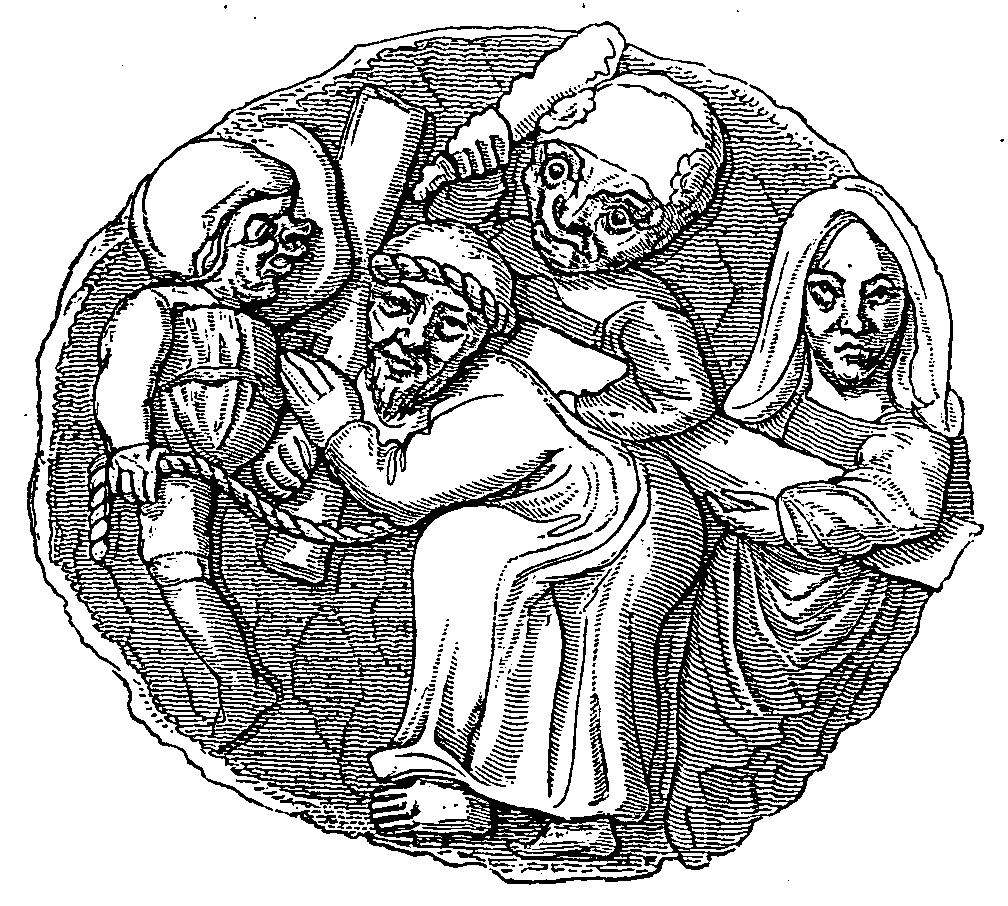
You have it here. It is frightfully barbarous, and characteristic of the capricious style of art which frequently prevailed about the year 1520: but the wonder is, how such a wretched performance could obtain admission into the sanctuary where it was deposited. It was however the pious gift of the vestry woman--who shewed us the interior--and who had religiously rescued it, during the Revolution, from the demolition of a neighbouring abbey. The eastern end of this church is perhaps as old as any ecclesiastical edifice in Normandy;171 and its exterior (to which we could only approach by wading through rank grass as high as our knees) is one of the most interesting of its kind. During our admiration of all that was curious in this venerable edifice, we were struck by our old friends, the penitents,--busy in making confession. In more than one confessional there were two penitents; and towards one of these, thus doubly attended, I saw a very large, athletic, hard-visaged priest hastening, just having slipt on his surplice in the vestry. Indeed I had been cursorily introduced to him by the Count. It was Saturday evening, and the ensuing Sunday was to be marked by some grand procession.
The village-like town of Guibray presents a most singular sight to the eye of a stranger. There are numerous little narrow streets, with every window closed by wooden shutters, and every door fastened. It appears as if the plague had recently raged there, and that the inhabitants had quitted it for ever. Not a creature is visible: not a sound is heard: not a mouse seems to be stirring. And yet Guibray boasts of the LARGEST FAIR in France, save one!172 This, my friend, precisely accounts for the aspect of desolation just described. During the intervals of these triennial fairs, the greater part of the village is uninhabited: venders and purchasers flocking and crowding by hundreds when they take place. In a short, narrow street--where nothing animated was to be seen--the Count assured me that sometimes, in the course of one morning, several millions of francs were spent in the purchase of different wares. We left this very strange place with our minds occupied by a variety of reflections: but at any rate highly pleased and gratified by the agreeable family which had performed the part of guides on the occasion. In the evening, a professor of music treated us with some pleasing tunes upon the guitar--which utterly astonished the Count--and it was quite night-fall when we returned homewards, towards our quarters at the hotel of the Grand Turc.
A memorable incident occurred in our way homewards; which, when made known, will probably agitate the minds and shake the faith of two-thirds of the members of our Society of Antiquaries. You may remember that I told you, when at Caen, that the Abbe De la Rue had notified to me what were the objects more particularly deserving of attention in my further progress through Normandy. Among these, he particularly mentioned a figure or head of William the Conqueror at Falaise. In the Place St. Gervais, this wonderful head was said to exist--and to exist there only. It was at the house of an Innkeeper--certainly not moving in the highest circle of his calling. I lost little time in visiting it; and found it situated at the top of a dark narrow staircase, projecting from the wall, to the right, just before you reach the first floor. Some sensation had been excited by the enquiries, which I had previously set on foot; and on a second visit, several people were collected to receive us. Lights, warm water, towels, soap and brushes, were quickly put in requisition. I commenced operations with a kitchen knife, by carefully scraping away all the layers of hardened white and ochre washes, with which each generation had embedded and almost obliterated every feature. By degrees, the hair became manifest: then followed the operation of soap and water--which brought out the features of the face; and when the eyes fully and distinctly appeared, the exclamation of "Mon Dieu!" by the spectators, was loud and unremitting. The nose had received a serious injury by having its end broken off. Anon, stood forth the mouth; and when the "whiskered majesty" of the beard became evident, it was quite impossible to repress the simultaneous ejaculation of joy and astonishment ... "Voilà le vrai portrait de Guillaume le Conquérant!
The whiskers apparently denote it to be rather Saxon than Norman. The head is nearly eleven inches in length, by seven and a half in width: is cut upon a very coarse, yet hard-grained stone--and rests upon a square, unconnected stone:--embedded within the wall. If it ever had shoulders and body, those shoulders and body were no part of the present appendages of the head. What then, is the Abbé de la Rue in error? The more liberal inference will be, that the Abbé de la Rue had never seen it. As to its antiquity, I am prepared to admit it to be very considerable; and, if you please, even before the period of the loves of the father and mother of the character whom it is supposed to represent. In the morning, Madame Rolle seemed disposed to take ten louis (which I freely offered her) for her precious fragment: but the distinct, collected view of whiskers, mouth, nose, eyes, and hair, instantaneously raised the quicksilver of her expectations to "quinze louis pour le moins!" That was infinitely "trop fort"--and we parted without coming to any terms. Perhaps you will laugh at me for the previous offer.
The church of St. Gervais is called the mother church of the town: and it is right that you should have some notion of it. It stands upon a finely elevated situation. Its interior is rather capacious: but it has no very grand effect-arising from simplicity or breadth of architecture. The pillars to the right of the nave, on entering from the western extremity, are doubtless old; perhaps of the beginning of the thirteenth century. The arches are a flattened semicircle; while those on the opposite side are comparatively sharp, and of a considerably later period. The ornaments of the capitals of these older pillars are, some of them, sufficiently capricious and elaborate; while others are of a more exceptionable character on the score of indelicacy. But this does not surprise a man who has been accustomed to examine ART, of the middle centuries, whether in sculpture or in painting. The side aisles are comparatively modern. The pillars of the choir have scarcely any capitals beyond a simple rim or fillet; and are surmounted by sharp low arches, like what are to be seen at St. Lo and Coutances. The roof of the left side aisle is perfectly green from damp: the result, as at Coutances, of thereof having been stripped for the sake of the lead to make bullets, &c. during the Revolution. I saw this large church completely filled on Sunday, at morning service--about eleven: and, in the congregation, I observed several faces and figures, of both sexes, which indicated great intelligence and respectability. Indeed there was much of the air of a London congregation about the whole.
From the Church, we may fairly make any thing but a digression--in discoursing of one of its brightest ornaments, in the person of Monsieur LANGEVIN:--a simple priest--as he styles himself in an octavo volume, which entitles him to the character of the best living HISTORIAN OF FALAISE. He is a mere officiating minister in the church of Mons. Mouton; and his salary, as he led me to infer, could be scarcely twenty louis per annum. Surely this man is among the most amiable and excellent of God's creatures! But it is right that you should know the origin and progress of our acquaintance. It was after dinner, on one of the most industriously spent of my days here--and the very second of my arrival,--that the waiter announced the arrival of the Abbé Langevin, in the passage, with a copy of his History beneath his arm. The door opened, and in walked the stranger-- habited in his clerical garb--with a physiognomy so benign and expressive, and with manners so gentle and well-bred,--that I rose instinctively from my seat to give him the most cordial reception. He returned my civility in a way which shewed at once that he was a man of the most interesting simplicity of character. "He was aware (he said) that he had intruded; but as he understood "Monsieur was in pursuit of the antiquities of the place, he had presumed to offer for his acceptance a copy of a work upon that subject--of which he was the humble author." This work was a good sized thick crown octavo, filling five hundred closely and well-printed pages; and of which the price was fifty sous! The worthy priest, seeing my surprise on his mentioning the price, supposed that I had considered it as rather extravagant. But this error was rectified in an instant. I ordered three copies of his historical labours, and told him my conscience would not allow me to pay him less than three francs per copy. He seemed to be electrified: rose from his seat:--and lifting up one of the most expressive of countenances, with eyes apparently suffused with tears-- raised both his hands, and exclaimed.... "Que le bon Dieu vous bénisse--les Anglois sont vraiement généreux!"
For several seconds I sat riveted to my seat. Such an unfeigned and warm acknowledgment of what I had considered as a mere matter-of-course proposition, perfectly astounded me: the more so, as it was accompanied by a gesture and articulation which could not fail to move any bosom--not absolutely composed of marble. We each rallied, and resumed the conversation. In few but simple words he told me his history. He had contrived to weather out the Revolution, at Falaise. His former preferment had been wholly taken from him; and he was now a simple assistant in the church of Mons. Mouton. He had yielded without resistance; as even remonstrance would have been probably followed up by the guillotine. To solace himself in his afflictions, he had recourse to his old favourite studies of medicine and music;--and had in fact practised the former. "But come, Sir, (says he) come and do me the honour of a call--when it shall suit you." I settled it for the ensuing day. On breaking up and taking leave, the amiable stranger modestly spoke of his History. It had cost him three years' toil; and he seemed to mention, with an air of triumph, the frequent references in it to the Gallia Christiana, and to Chartularies and Family Records never before examined. On the next day I carried my projected visit into execution--towards seven in the evening. The lodgings of M. Langevin are on the second floor of a house belonging to a carpenter. The worthy priest received me on the landing- place, in the most cheerful and chatty manner. He has three small rooms on the same floor. In the first, his library is deposited. On my asking him to let me see what old books he possessed, he turned gaily round, and replied--"Comment donc, Monsieur, vous aimez les vieux livres? A ça, voyons!" Whereupon he pulled away certain strips or pieces of wainscot, and shewed me his book-treasures within the recesses. On my recognising a Colinæus and Henry Stephen, ere he had read the title of the volumes, he seemed to marvel exceedingly, and to gaze at me as a conjuror. He betrayed more than ordinary satisfaction on shewing his Latin Galen and Hippocrates; and the former, to the best of my recollection, contained Latin notes in the margin, written by himself. These tomes were followed up by a few upon alchymy and astrology; from which, and the consequent conversation, I was led to infer that the amiable possessor entertained due respect for those studies which had ravished our DEES and ASHMOLES of old.
In the second room stood an upright piano forte--the manufacture, as well as the property, of Monsieur Langevin. It bore the date of 1806; and was considered as the first of the kind introduced into Normandy. It was impossible not to be struck with the various rational sources of amusement, by means of which this estimable character had contrived to beguile the hours of his misfortunes. There was a calm, collected, serenity of manner about him--a most unfeigned and unqualified resignation to the divine will--which marked him as an object at once of admiration and esteem. There was no boast--no cant--no formal sermonising. You saw what religion had done for him. Her effects spake in his discourse and in his life.... Over his piano hung a portrait of himself; very indifferently executed--and not strongly resembling the original. "We can do something more faithful than this, sir, if you will allow it"--said I, pointing to Mr. Lewis: and it was agreed that he should give the latter a sitting on the morrow. The next day M. Langevin came punctually to his appointment, for the purpose of having his portrait taken.
On telling this original that the pencil drawing of Mr. Lewis (which by the bye was executed in about an hour and a half) should be engraved-- inasmuch as he was the modern Historian of Falaise--he seemed absolutely astonished. He moved a few paces gently forwards, and turning round, with hands and eyes elevated, exclaimed, in a tremulous and heart- stricken tone of voice, "Ah, mon Dieu!" I will not dissemble that I took leave of him with tears, which were with difficulty concealed. "Adieu, pour toujours!"--were words which he uttered with all the sincerity, and with yet more pathos, than was even shewn by Pierre Aimé Lair at Caen. The landlord and landlady of this hotel are warm in their commendations of him: assuring me that his name is hardly ever pronounced without the mention of his virtues. He has just entered his sixty-second year.173
It remains only to give an account of the progress of Printing and of Literature in this place: although the latter ought to precede the former. As a literary man, our worthy acquaintance the Comte de la Fresnaye takes the lead: yet he is rather an amateur than a professed critic. He has written upon the antiquities of the town; but his work is justly considered inferior to that of Monsieur Langevin. He quotes Wace frequently, and with apparent satisfaction; and he promises a French version of his beloved Ingulph. Falaise is a quiet, dull place of resort, for those who form their notions of retirement as connected with the occasional bustle and animation of Caen and Rouen. But the situation is pleasing. The skies are serene: the temperature is mild, and the fruits of the earth are abundant and nutritious. Many of the more respectable inhabitants expressed their surprise to me that there were so few English resident in its neighbourhood--so much preferable, on many accounts to that of Caen. But our countrymen, you know, are sometimes a little capricious in the objects of their choice. Just now, it is the fashion for the English to reside at Caen; yet when you consider that the major part of our countrymen reside there for the purpose of educating their children--and that Caen, from its numerous seminaries of education, contains masters of every description, whose lessons are sometimes as low as a frank for each--it is not surprising that Falaise is deserted for the former place. For myself-- and for all those who love a select society, a sweet country, and rather a plentiful sprinkle of antiquarian art,--for such, in short, who would read the fabliaux of the old Norman bards in peace, comfort, and silence--there can be no question about the preference to be given to the spot from which I send this my last Norman despatch.
I have before made mention of the fountains in this place. They are equally numerous and clear. The inn in which we reside has not fewer than three fountains--or rather of jets d'eau--constantly playing. Those in the Place St. Trinité Grand Rue, and Place St. Gervais, are the largest; but every gutter trickles with water as if dissolved from the purest crystal. It has been hot weather during the greater part of our stay; and the very sight of these translucent streams seems to refresh one's languid frame. But I proceed chiefly to the productions of the PRESS. They do a good deal of business here in the way of ephemeral publications. Letellier, situated in the Grande Rue, is the chief printer of chap books: and if we judge from the general character of these, the Falaisois seem to be marvellously addicted to the effusions of the muse. Indeed, their ballads, of all kinds, are innumerable. Read a few-- which are to be found in the very commonest publications. There is something rather original, and of a very pleasingly tender cast, in the first two:
LE BAISER D'ADIEUX.
Pres de toi l'heuré du mystère Ne m'appellera plus demain, Vers ta demeure solitaire Mes pas me guideront en vain; J'ai respiré ta douce haleine, Et des pleurs ont mouillé mes yeux,
J'ai tout senti, plaisir et peine, J'ai reçu ton baiser d'adieux. ) bis.
Tu pars, et malgré ta promesse Rien ne m'assure de ta foi, Nul souvenir de ta tendresse Ne vient me dire: Pense à moi. Ton amour qu'envain je réclame Ne me laisse, en quittant ces lieux, Que Phumide et brulante flamme De ton dernier baiser d'adieux.
Puisse au moins ton indifférence Te garder d'un nouvel amour. Et le veuvage de l'absence Hâter ton fortuné retour! Puisse alors l'amant qui t'adore, Te revoyant aux mêmes lieux, Sur tes lèvres vierges encore Retrouver son baiser d'adieux!
L'IMAGE DE LA VIE.
Nous naissons et dans notre coeur, A peine aux portes de la vie, Tout au plaisir, tout au bonheur, Et nous invite et nous convie; D'abord, simples amusements Savent contenter notre enfance; Mais bientòt aux jeux innocens, L'amour nous prend ... sans qu'on y pense.
Fillette à l'âge de quinze ans, Offre l'image de la rose, Qui dès l'approche du printemps, Entr'ouvre sa feuille mi-close; Bientôt l'aiguillon du désir Vient ouvrir fleur d'innocence, Et sous la bouche du plaisir, Elle s'éclôt ... sans qu'elle y pense.
Vous, qui pendant vos jeunes ans, Ne courtisez pas la folie, Songez donc que cet heureux temps Ne dure pas toute la vie, Assez vite il nous faut quitter Tendres ardeurs, vives jouissances; Et dans uu coeur qui sait aimer, La raison vient ... sans qu'on y pense.
Mais enfin, sur l'âile du temps, On arrive au but du voyage, Et l'on voit la glace des ans, Couronner nos fronts à cet âge; S'il fut sensible à la pitié, S'il cultiva la bienfaisance, Entre les bras de l'amitié L'homme finit ... sans qu'il y pense
You must know that they are here great lovers of royalty, and of course great supporters of the Bourbon Family. The King's printer is a Mons. BRÉE l'Ainé. He is a very pleasant, well-bred man, and lives in the Place Trinité. I have paid him more than one visit, and always felt additional pleasure at every repetition of it. My first visit was marked with a somewhat ludicrous circumstance. On entering the compositors' room, I observed, pasted upon the walls, in large capital letters, the following well known words:
GOD SAVE THE KING.
Both Monsieur Brée l'Ainé--and his workmen were equally gratified by my notice and commendation of this sentiment. "It is the favourite sentiment, Sir, of your country,"--remarked the master. To this I readily assented. "It is also, Sir, the favourite one of our own," replied M. Brée l'Ainé-- and his men readily attested their concurrence in the same reply. "Ah, Sir, if you would only favour us by singing the air, to which these words belong, you would infinitely oblige us all" ... said a shrewd and intelligent-looking compositor. "With all my heart"--rejoined I--"but I must frankly tell you, that I shall sing it rather with heart than with voice--being neither a vocal nor an instrumental performer." "No matter: give us only a notion of it." They all stood round in a circle, and I got through two stanzas as gravely and as efficiently as I was able. The usual "charmant!" followed my exertions. It was now my turn to ask a favour. "Sing to me your favourite national air of ROBERT and ARLETTE." "Most willingly, Sir," replied the forementioned "shrewd and intelligent-looking compositor." "Tenez: un petit moment: je vais chercher mon violon. Ca ira mieux."
He left the house in search of his violin. The tune of the National air which he sung was both agreeable and lively: and upon the whole it was difficult to say which seemed to be the better pleased with the respective national airs. M. Brée shewed me his premises in detail. They had been formerly a portion of an old church; and are situated on the edge of the great fosse which encircles the town. A garden, full of sweet blooming flowers, is behind them; and the view backwards is cheerful and picturesque. There are generally five presses at work; which, for a provincial printing office, shews business to be far from slack. Mons. B. sells a great number of almanacks, and prints all the leading publications connected with the town. In fact, his title, as Imprimeur du Roi, supposes him to take the principal lead as a printer. This agreeable man has a brother who is professor of rhetoric in the Collège Royale at Paris.
Of Bouquinistes, or dealers in old books, there are scarcely any. I spent three or four fruitless hours in a search after old chronicles and old poetry: and was compelled, almost from pure civility, to purchase of DUFOURS a Petit's Virgil of 1529, folio--which will be hardly worth the carriage. I tried hard for a fine copy of Fauchet's Origines de la Poésie Françoise, 1581, 4to. with the head of the author, but in vain; yet endeavoured to console myself by an old blue morocco copy of Les regrets et tristes lamentations du Comte de Montgomery, by Demorenne, Rouen, 1574, 8vo. as well as a clean, fresh, and almost crackling copy of Amoureuses occupations de la Taysonniere, Lyon, 1555, 8vo.--for two francs each--and both destined for the rich and choice library of our friend....
Thus much for FALAISE: for a spot, which, from the uniform serenity of the weather since I have been here--from the comfort of the inn--from the extreme civility and attention of the townspeople--and from the yet more interesting society of the Comte de la Fresnaye, the Curés Mouton and Langevin--together with the amenity of the surrounding country, and the interesting and in part magnificent remains of antiquity--can never be erased from my recollection. It is here that the tourist and antiquary may find objects for admiration and materials for recording. I have done both: admired and recorded--happy, if the result of such occupations shall have contributed to the substantial gratification of yourself and of our common friends. And now, farewell; not only to Falaise, but to NORMANDY. I shall leave it, from this delightful spot, in the most thorough good humour, and with more than ordinary regret that my stay has necessarily been short. I have taken my place in the Diligence, direct for PARIS. "Il n'y a qu'un Paris"--said the Comte de la Fresnaye to me the other day, when I told him I had never been there--to which I replied, "Are there then TWO Londons?" Thirty-six hours will settle all this. In the mean time, adieu.
LETTER XXI.
JOURNEY TO PARIS. DREUX. HOUDAN. VERSAILLES. ENTRANCE INTO PARIS.
Paris, Rue Faubourg Poissonière, May 30, 1819.
"Time and the hour runs through the roughest day." They must be protacted miseries indeed which do not, at some period or other, have something like a termination. I am here, then my good friend--safe and sound at last; comfortably situated in a boarding house, of which the mistress is an agreeable Englishwoman and the master an intelligent Swiss. I have sauntered, gazed, and wondered--and exchanged a thousand gracious civilities! I have delivered my epistolary credentials: have shaken hands with Monsieur Van Praet; have paced the suite of rooms in which the renowned BIBLIOTHEQUE DU ROI is deposited: have traversed the Thuileries and the Louvre; repeatedly reconnoitred the Boulevards; viewed the gilt dome of the Hôtel des Invalides, and the white flag upon the bronze-pillar in the Place Vendome; seen crowds of our countrymen at Meurice's and in the hotels about the Rue de la Paix; partaken of the rival ices of Tortoni and the Caffé des Mille Colonnes; bought old French poetry at a Bouquiniste's: and drank Chambertin and Champagne at the richly garnished table of our ----. These are what may be called good foreground objects in the composition of a Parisian picture. Now for the filling up of the canvas with appropriate and harmonizing detail.
A second reflection corrects however the precipitancy of such a proposal; for it cannot be, in this my first despatch, that you are to receive any thing like an adequate notion of the topics thus hastily thrown together on the first impulse of Parisian inspiration. Wait patiently, therefore: and at least admire the methodical precision of my narrative. My last letter left me on the eve of departure from Falaise; and it is precisely from that place that I take up the thread of my journal. We were to leave it, as I told you, in the Diligence--on the evening of the Sunday, immediately following the date of the despatch transmitted. I shall have reason to remember that journey for many a day to come; but, "post varios casus, &c." I am thankful to find myself safely settled in my present comfortable abode. The Sabbath, on the evening of which the Diligence usually starts for Paris, happened to be a festival. Before dawn of day I heard incessant juvenile voices beneath the window of my bedroom at the Grand Turc; What might this mean? Between three and four, as the day began to break, I rose, and approaching the window, saw, from thence, a number of little boys and girls busied in making artificial flower-beds and sand- borders, &c. Their tongues and their bodily movements were equally unintermitting. It was impossible for a stranger to guess at the meaning of such a proceeding; but, opening the window, I thought there could be no harm in asking a very simple question--which I will confess to you was put in rather an irritable manner on my part ... for I had been annoyed by their labours for more than the last hour. "What are you about, there?" I exclaimed --"Ha, is it you Sir?" replied a little arch boy--mistaking me for some one else. "Yes, (resumed I) tell me what you are about there?" "in truth, we are making Réposoirs for the FETE-DIEU: the Host will pass this way by and bye. Is it not a pretty thing, Sir?" exclaimed a sweetly modulated female voice. All my irritability was softened in a moment; and I was instantly convinced that Solomon never delivered a wiser sentiment than when he said--"A soft answer turneth away wrath!" I admitted the prettiness of the thing without comprehending a particle of it: and telling them to speak in a lower key, shut the window, and sought my bed. But sleep had ceased to seek me: and the little urchins, instead of lowering their voices, seemed to break forth in a more general and incessant vociferation. In consequence, I was almost feverish from restlessness--when the fille de chambre announced that "it was eight o'clock, and the morning most beautiful."
These réposoirs are of more importance than you are aware of. They consist of little spots, or spaces in the streets, garnished with flowers, and intersected by walks, marked with fine gravel, in the centre of which the Host rests, on its passing to and fro from the several parishes. When I rose to dress, I observed the work of art--which had been in progress during the night--perfectly complete. Passengers were forbidden to trespass by pieces of string fastened to different parts by way of a fence--or, whoever chose to walk within, considered themselves bound to deposit a sous as the condition of gratifying their curiosity. Upon the whole, this réposoir might be about sixteen feet square. Towards eleven o'clock the different religious ceremonies began. On one side the noise of the drum, and the march of the national guard, indicated that military mass was about to be performed; on the other, the procession of priests, robed and officiating--the elevation of banners--and the sonorous responses of both laity and clergy--put the whole town into agitation, and made every inmate of every mansion thrust his head out of window, to gaze at the passing spectacle. We were among the latter denomination of lookers on, and recognised, with no small gratification, our clerical friends Messieurs Mouton, Langevin, and the huge father confessor at Guibra, followed by a great number of respectable citizens, among whom the Comte de la Fresnaye and his amiable and intelligent son (recently married) made most respectable figures; They approached the réposoir in question. The priests, with the Host, took their station within it; silence followed; one officiating clergyman then knelt down; shut, what seemed to be, the wooden covers of a book,--with, considerable violence--rose--turned round, and the procession being again put in motion--the whole marched away to the church of the Holy Trinity;--whither I followed it; and where I witnessed what I was unable to comprehend, and what I should not feel much disposed to imitate. But let every country be allowed to reverence and respect its own particular religious ceremonies. We may endure what we cannot commend ... and insult and disrespect are among the last actions which a well regulated mind will shew in its treatment of such matters. I should add, that these réposoirs, a few hours after the performance of the ceremony just described, are indiscriminately broken up: the flowers and the little sand banks falling equally a prey to the winds and the feet of the passenger.
Opposite to the inn was an hospital for the female sick. It had been formerly an establishment of very considerable extent and celebrity; but whether it was originally connected with the hospital of the Léproserie de Saint Lasare, (about which the Abbé Langevin's History of Falaise is rather curious) the Hôtel-Dieu, or the Hôpital Général, I cannot take upon me to pronounce. Certain it is, however, that this establishment does great credit to those who have the conduct of it. As foreigners, and particularly as Englishmen, we were permitted to see the whole, without reserve. On my return from witnessing the ceremony at the church of the Trinity, I visited this hospital: my companion having resumed his graphic operations before the Castle. I shall not easily forget the face and figure of the matron. To a countenance of masculine feature, and masculine complexion--including no ordinary growth of beard, of a raven tint--she added a sturdy, squat, muscular figure--which, when put into action, moved in a most decided manner. A large bunch of massive keys was suspended from a girdle at her side; and her dress, which was black, was rendered more characteristic and striking, by the appearance of, what are yet called, bustles above her hips. As she moved, the keys and the floor seemed equally to shake beneath her steps. The elder Smirke would have painted this severe Duenna-like looking matron with inimitable force and truth. But ... she no sooner opened her mouth, than all traits of severity vanished. Her voice was even musical, and her "façon de parler" most gracious. She shewed me the whole establishment with equal good humour and alertness; and I don't know when I ever made such a number of bows (to the several female patients in the wards) within such limited time and space. The whole building has the air of a convent; and there were several architectural relics, perhaps of the end of the fifteenth century, which I only regretted were not of portable dimensions; as, upon making enquiry, little objection seemed to be made to the gratuitous disposal of them.
The hour for departure, after sun-set, having arrived, we were summoned to the Diligence when, bidding adieu to the very worthy host and hostess of the Grand Turc, (whom I strongly recommend all Englishmen to visit) I made up my mind for a thirty-six hour's journey--as I was to reach Paris on Tuesday morning. The day had been excessively hot for the season of the year; and the night air was refreshing. But after a few snatches of sleep-- greatly needed--there appeared manifest symptoms of decay and downfall in the gloomy and comfortless machine in which we took our departure. In other words, towards daylight, and just as we approached L'Aigle, the left braces (which proved to be thoroughly rotted leather) broke in two: and down slid, rather than tumbled, the Falaise Diligence! There were two French gentlemen, and an elderly lady, besides ourselves in the coach. While we halted, in order to repair the machine, the Frenchmen found consolation in their misfortune by running to a caffé, (it was between four and five in the morning), rousing the master and mistress, and as I thought, peremptorily and impertinently asking for coffee: while they amused themselves with billiards during its preparation. I was in no humour for eating, drinking, or playing: for here was a second sleepless night! Having repaired this crazy vehicle, we rumbled on for Verneuil; where it was exchanged for a diligence of more capacious dimensions. Here, about eleven o'clock, we had breakfast; and from henceforth let it not be said that the art of eating and drinking belongs exclusively to our country:--for such manifestations of appetite, and of attack upon substantials as well as fluids, I had scarcely ever before witnessed. I was well contented with coffee, tea, eggs, and bread--as who might not well be?... but my companions, after taking these in flank, cut through the centre of a roast fowl and a dish of stewed veal: making diversions, in the mean while, upon sundry bottles of red and white wine; the fingers, during the meal, being as instrumental as the white metal forks.
We set off at a good round trot for Dreux: and, in the route thither, we ascended a long and steep hill, having Nonancourt to the left. Here we saw some very pretty country houses, and the whole landscape had an air of English comfort and picturesque beauty about it. Here, too, for the first time, I saw a VINEYARD. At this early season of the year it has a most stiff and unseemly look; presenting to the eye scarcely any thing but the brown sticks, obliquely put into the ground, against which the vine is trained. But the sloping banks, on each side of the ascending road, were covered with plantations of this precious tree; and I was told that, if the autumn should prove as auspicious as appeared the spring, there would be a season of equal gaiety and abundance. I wished it with all my heart. Indeed I felt particularly interested in the whole aspect of the country about Nonancourt. The sun was fast descending as we entered the town of Dreux--where I had resolved upon taking leave both of the diligence and of my companions; and of reaching Paris by post. At seven we dined, or rather perhaps made an early supper; when my fellow travellers sustained their reputation for their powers of attack upon fish, flesh, and fowl. Indeed the dinner was equally plentiful and well cooked; and the charge moderate in proportion. But there is nothing, either on the score of provision of reasonableness of cost, like the table d'hôte throughout France; and he who cannot accommodate himself to the hour of dining (usually about one) must make up his mind to worse fare and treble charges.
After dinner we strolled in the town, and upon the heights near the castle. We visited the principal church, St. Jean, which is very spacious, and upon the whole is a fine piece of architecture. I speak more particularly of the interior--where I witnessed, however, some of the most horrible devastations, arising from the Revolution, which I had yet seen. In one of the side chapels, there had been a magnificent monument; perhaps from sixteen to twenty feet in height--crowded with figures as large as life, from the base to the summit. It appeared as if some trenchant instrument of an irresistible force, had shaved away many of the figures; but more especially the heads and the arms. This was only one, but the most striking, specimen of revolutionary Vandalism. There were plenty of similar proofs, on a reduced scale. In the midst of these traces of recent havoc, there was a pleasure mingled with melancholy, in looking up and viewing some exceedingly pretty specimens of old stained glass:--which had escaped the destruction committed in the lower regions, and had preserved all their original freshness. Here and there, in the side chapels, the priests were robing themselves to attend confession; while the suppliants, in kneeling attitudes, were expecting them by the side of the confessionals. From the church I bent my steps to the principal bookseller of the place, whom I found to be an intelligent, civil, and extremely good- natured tradesman. But his stock was too modern. "Donnez vous la peine de monter"--exclaimed he precipitately; begging me to follow him. His up- stairs collection was scarcely of a more ancient character than that below. There were more copies of Voltaire and Rousseau than I should have supposed he could sell in six years--but "on the contrary" (said he) "in six months' time, not a single copy will remain unsold!" I marvelled and grieved at such intelligence; because the poison was not extracted from the nourishment contained in these works. To an enquiry about my old typographical friends, Verard, Pigouchet, and Eustace, the worthy bibliopole replied "qu'il n'avoit jamais entendu parler de ces gens-la!" Again I marvelled; and having no temptation to purchase, civilly wished him good evening.
Meanwhile Mr. L. had attained the castle heights, and was lost in a sort of extacy at the surrounding scene. On entering the outer walls, and directing your steps towards the summit, you are enchanted with a beautiful architectural specimen--in the character of a zigzag early Norman arch-- which had originally belonged to a small church, recently taken down: The arch alone stands insulated ... beyond which, a new, and apparently a very handsome, church is erecting, chiefly under the care and at the expence of the present Duke of Orleans;--as a mausoleum for his family--and in which, not many days before our arrival, the remains of one of his children had been deposited. I wished greatly for a perfect drawing of this arch ... but there was no time ... and my companion was exercising his pencil, on the summit, by a minute, bird's eye of the sweep of country to be seen from this elevated situation--through the greater part of which, indeed, the diligence from Verneuil had recently conducted us. I should add, that not a relic of that CASTLE, which had once kept the town and the adjacent country in awe, is now to be seen: but its outer walls enclose a space hardly less than twenty acres:--the most considerable area which I had yet witnessed. To give a more interesting character to the scenery, the sun, broad and red, was just hiding the lower limb of his disk behind the edge of a purple hill. A quiet, mellow effect reigned throughout the landscape. I gazed on all sides; and (wherefore, I cannot now say) as I sunk upon the grass, overwhelmed with fatigue and the lassitude of two sleepless nights, wished, in my heart, I could have seen the effect of that glorious sun-set from, the heights of Dover. Now and then, as when at school, one feels a little home-sick; but the melancholy mood which then possessed me was purely a physical effect from a physical cause. The shadows of evening began to succeed to the glow of sun-set--when, starting from my recumbent position, (in which sleep was beginning to surprise me) I hastened down the heights, and by a nearer direction sought the town and our hotel. We retired betimes to rest--but not until, from an opposite coach maker, we had secured a phaeton-like carriage to convey us with post horses, the next day, to Paris.
Excellent beds and undisturbed slumber put me in spirits for the grand entrée into the metropolis of France. Breakfasting a little after nine-- before ten, a pair of powerful black horses, one of which was surmounted by a sprucely-attired postilion--with the phaeton in the rear--were at the door of the hotel. Seeing all our baggage properly secured, we sprung into the conveyance and darted forward at a smart gallop. The animals seemed as if they could fly away with us--and the whip of the postilion made innumerable circular flourishes above their heads. The sky was beautifully clear: and a briskly-stirring, but not unpleasantly penetrating, south-east wind, played in our faces as we seemed scarcely to be sensible of the road. What a contrast to the heat, vexation, and general uncomfortableness of the two preceding days of our journey! We felt it sensibly, and enjoyed it in proportion. Our first place of halting, to change horses, was at HOUDAN; which may be about four leagues from Dreux; and I verily believe we reached it in an hour. The route thither is through a flat and uninteresting country; except that every feature of landscape (and more especially in our previous journeys through Normandy) seems to be thrown to a greater distance, than in England. This may account for the flatness of views, and the diminutiveness of objects. Houdan is a village-like town, containing a population of about 2000 inhabitants; but much business is done on market days; and of corn, in particular, I was told that they often sold several thousand sacks in a day. Its contiguity to Paris may account for the quantity of business done. In the outskirts of the town,--and flanked, rather than surrounded, by two or three rows of trees, of scarcely three years growth--stands the "stiff and stower" remains of the Castle of Houdan. It is a very interesting relic, and to our eyes appeared of an unusual construction. The corner towers are small and circular; and the intermediate portion of the outer wall is constructed with a swell, or a small curvature outwards. I paced the outside, but have forgotten the measurement. Certainly, it is not more than forty feet square. I tried to gain admittance into the interior, but without success, as the person possessing the key was not to be found. I saw enough, however, to convince me that the walls could not be less than twelve feet in thickness.
The horses had been some time in readiness, and the fresh postilion seemed to be lost in amazement at the cause of our loitering so long at so insignificant a place. The day warmed as we pushed on for the far-famed "proud Versailles." The approach, from Houdan, is perhaps not the most favourable; although we got peeps of the palace, which gave us rather elevated notions of its enormous extent. We drove to the Hôtel de Bourbon, an excellent, clean mansion, close to the very façade of the palace, after passing the Hôtel de Ville; and from whence you have an undisturbed view of the broad, wide, direct road to Paris. I bespoke dinner, and prepared to lounge. The palace--of which I purposely declined visiting the interior--reserving Versailles for a future and entire day's gratification--is doubtless an immense fabric--of which the façade just mentioned is composed of brick, and assumes any thing but a grand and imposing air: merely because it wants simplicity and uniformity of design. I observed some charming white stone houses, scattered on each side of this widely extended chaussée--or route royale--and, upon the whole, Versailles appeared to us to be a magnificent and rather interesting spot. Two or three rows of trees, some forty or fifty generations more ancient than those constituting the boulevards at Houdan, formed avenues on each side of this noble road; and all appeared life and animation--savouring of the proximity of the metropolis. Carriages without number--chiefly upon hire, were going and returning; and the gaits and dresses of individuals were of a more studied and of a gayer aspect. At length, we became a little impatient for our dinner, and for the moment of our departure. We hired one of these carriages; which for nine francs, would convey us to the place of our destination. This appeared to me very reasonable; and after being extravagant enough to drink Champagne at dinner, to commemorate our near approach to the metropolis, we set forward between five and six o'clock, resolving to strain our eyes to the utmost, and to be astonished at every thing we saw!--especially as this is considered the most favourable approach to the capital.
The Ecole Militaire, to the left, of which Marshal Ney had once the chief command, struck me as a noble establishment. But it was on approaching Sèvre that all the bustle and population, attendant upon the immediate vicinity of a great metropolis, became evident. Single-horsed vehicles--in many of which not fewer than nine persons were pretty closely stowed--three upon a bench, and three benches under the roof--fiacres, barouches, and carriages of every description, among which we discovered a great number from our own country--did not fail to occupy our unremitting attention. Sèvre is a long, rambling, and chiefly single-street town; but picturesquely situated, on a slope, and ornamented to the left by the windings of the Seine. We were downright glad to renew our acquaintance with our old, and long-lost friend, the river Seine; although it appeared to be sadly shorn of its majestic breadth since we had parted with it before the walls of Montmorenci castle, in our route to Havre. The new nine-arch bridge at Sèvre is a sort of Waterloo bridge in miniature. Upon the heights, above it, I learnt that there was a beautiful view of the river in the foreground with Paris in the distance. We passed over the old bridge, and saw St. Cloud to the left: which of course interested us as the late residence of Bonaparte, but which, in truth, has nothing beyond the air of a large respectable country-gentleman's mansion in England. We pushed on, and began to have distinct perceptions of the great city. Of all the desirable places of retreat, whether for its elevated situation, or respectable appearance, or commodious neighbourhood, nothing struck me more forcibly than the village of PASSY, upon a commanding terrace, to the left; some three or four English miles from Paris--and having a noble view both of the river and of the city. It is also considered to be remarkably healthy; and carriages of every description, are constantly passing thither to and from Paris.
The dome of the Pantheon, and the gilded one of the Hôtel des Invalides, together with the stunted towers of Notre Dame, were among the chief objects to the right: while the accompaniment of the Seine, afforded a pleasing foreground to this architectural picture in the distance. But, my friend, I will frankly own to you, that I was disappointed ... upon this first glimpse of the GREAT city. In the first place, the surrounding country is flat; with the exception of Mount Calvary, to the left, which has nothing to do with the metropolitan view from this situation. In the second place, what are the Pantheon and Notre Dame compared with St. Paul's and Westminster Abbey?--to say nothing of the vicinity of London, as is connected with the beautifully undulating ground about Camberwell, Sydenham, Norwood, and. Shooter's Hill--and, on the other side of the water, Hampstead, Highgate and Harrow: again, Wimbledon and Richmond!... What lovely vicinities are these compared with that of Mont Martre? And if you take river scenery into the account, what is the Seine, in the neighbourhood of Paris, compared with the Thames in that of London? If the almost impenetrable smoke and filth from coal-fires were charmed away--shew me, I beseech you, any view of Paris, from this, or from any point of approach, which shall presume to bear the semblance of comparison with that of London, from the descent from Shooter's Hill! The most bewitched Frenchified-Englishman, in the perfect possession of his eye sight, will not have the temerity to institute such a comparison. But as you near the barriers, your admiration increases. Having got rid of all background of country--as you approach the capital--the foregoing objections vanish. Here the officers of police affected to search our luggage. They were heartily welcome, and so I told them. This disarmed all suspicion. Accordingly we entered Paris by one of the noblest and one of the most celebrated of its Boulevards--the Champs Elysées. As we gained the Place Louis Quinze, with the Thuileries in front, with the Hôtel des Invalides (the gilded dome of which latter reflected the strong rays of a setting sun) to the right--we were much struck with this combination of architectural splendour: indisputably much superior to any similar display on the entrance into our own capital.174 Turning to the left, the Place Vendome and the Rue de la Paix, with the extreme height of the houses, and the stone materials of their construction, completed our admiration. But the Boulevards Italiens--after passing the pillars of the proposed church of Ste. Madelaine, and turning to the right-- helped to prolong our extreme gratification, till we reached the spot whence I am addressing you. Doubtless, at first glance, this is a most splendid and enchanting city. A particular detail must be necessarily reserved, for the next despatch. I shall take all possible pains to make you acquainted with the treasures of PAST TIMES--in the shape of Manuscripts and printed Books. THE ROYAL LIBRARY has as much astonished me, as the CURATORS of it have charmed me by their extreme kindness and civility.175
END OF VOL. I.
London: Printed by W. Nicol, Cleveland-row, St. James's.