Volume 1 — VOLUME I. (continued 4)
Reading edition
A word only about COURTS OF JUSTICE. "A smack of the whip" will tingle in my ears through life;133 and I shall always attend "Nisi Prius" exhibitions with more than ordinary curiosity. I strolled one morning to the Place de Justice--which is well situated, in an airy and respectable neighbourhood. I saw two or three barristers, en pleine costume, pretty nearly in the English fashion; walking quickly to and fro with their clients, in the open air before the hall; and could not help contrasting the quick eye and unconcerned expression of countenance of the former, with the simple look and yet earnest action of the latter. I entered the Hall, and, to my astonishment, heard only a low muttering sound. Scarcely fifteen people were present, I approached the bench; and what, think you, were the intellectual objects upon which my eye alighted? Three Judges ... all fast asleep! Five barristers, two of whom were nodding: one was literally addressing the bench ... and the remaining two were talking to their clients in the most unconcerned manner imaginable. The entire effect, on my mind, was ridiculous in the extreme. Far be it from me, however, to designate the foregoing as a generally true picture of the administration of Justice at Caen. I am induced to hope and believe that a place, so long celebrated for the study of the law, yet continues occasionally to exhibit proofs of that logic and eloquence for which it has been renowned of old. I am willing to conclude that all the judges are not alike somniferous; and that if the acuteness of our GIFFORDS, and the rhetoric of our DENMANS, sometimes instruct and enliven the audience, there will be found Judges to argue like GIBBS and to decide like SCOTT.134 Farewell.
LETTER XIV.
BAYEUX. CATHEDRAL. ORDINATION OF PRIESTS AND DEACONS. CRYPT OF THE CATHEDRAL.
Bayeux, May 16, 1818.
Two of the most gratifying days of my Tour have been spent at this place. The Cathedral (one of the most ancient religious places of worship in Normandy)135 has been paced with a reverential step, and surveyed with a careful eye. That which scarcely warmed the blood of Ducarel has made my heart beat with an increased action; and although this town be even dreary, as well as thinly peopled, there is that about it which, from associations of ideas, can never fail to afford a lively interest to a British antiquary.
The Diligence brought me here from Caen in about two hours and a half. The country, during the whole route, is open, well cultivated, occasionally gently undulating, but generally denuded of trees. Many pretty little churches, with delicate spires, peeped out to the right and left during the journey; but the first view of the CATHEDRAL of BAYEUX put all the others out of my recollection. I was conveyed to the Hôtel de Luxembourg, the best inn in the town, and for a wonder rather pleasantly situated. Mine hostess is a smart, lively, and shrewd woman; perfectly mistress of the art and craft of innkeeping, and seems to have never known sorrow or disappointment. Knowing that Mr. Stothard, Jun. had, the preceding year, been occupied in making a fac-simile of the "famous tapestry" for our Society of Antiquaries, I enquired if mine hostess had been acquainted with that gentleman: "Monsieur," "je le connois bien; c'est un brave homme: il demeura tout près: aussi travailla-t-il comme quatre diables!" I will not disguise that this eulogy of our amiable countryman136 pleased me "right well"--though I was pretty sure that such language was the current (and to me somewhat coarse) coin of compliment upon all occasions: and instead of "vin ordinaire" I ordered, rather in a gay and triumphant manner, "une bouteille du vin de Beaune"--"Ah! ça," (replied the lively landlady,) "vous le trouverez excellent, Monsieur, il n'y a pas du vin comme le vin de Beaune." Bespeaking my dinner, I strolled towards the cathedral.
There is, in fact, no proper approach to this interesting edifice. The western end is suffocated with houses. Here stands the post-office; and with the most unsuspecting frankness, on the part of the owner, I had permission to examine, with my own hands, within doors, every letter--under the expectation that there were some for myself. Nor was I disappointed. But you must come with me to the cathedral: and of course we must enter together at the western front. There are five porticos: the central one being rather large, and the two, on either side, comparatively small. Formerly, these were covered with sculptured figures and ornaments; but the Calvinists in the sixteenth, and the Revolutionists in the eighteenth century, have contrived to render their present aspect mutilated and repulsive in the extreme. On entering, I was struck with the two large transverse Norman arches which bestride the area, or square, for the bases of the two towers. It is the boldest and finest piece of masonry in the whole building. The interior disappointed me. It is plain, solid, and divested of ornament. A very large wooden crucifix is placed over the screen of the choir, which has an effect--of its kind: but the monuments, and mural ornaments, scarcely deserve mention. The richly ornamented arches, on each side of the nave, springing from massive single pillars, have rather an imposing effect: above them are Gothic ornaments of a later period, but too thickly and injudiciously applied. Let me now suppose that the dinner is over, and the "vin de Beaune" approved of--and that on a second visit, immediately afterwards, there is both time and inclination for a leisurely survey. On looking up, upon entering, within the side aisle to the left, you observe, with infinite regret, a dark and filthy green tint indicative of premature decay--arising from the lead (of that part of the roof,) having been stript for the purpose of making bullets during the Revolution. The extreme length of the interior is about 320 English feet, by 76 high, and the same number of feet in width. The transepts are about 125 feet long, by 36 wide. The western towers, to the very top of the spires, are about 250 English feet in height.
One of the most curious objects in the Cathedral, is the CRYPT; of which, singularly enough, all knowledge had been long lost till the year 1412. The circumstance of its discovery is told in the following inscription, cut in the Gothic letter, upon a brass plate, and placed just above the southern entrance:
En lan mil quatre cens et douze Tiers iour d'Auril que pluye arrouse Les biens de la terre, la journee Que la Pasques fut celebree Noble homme et Reverend Pere Jehan de Boissey, de'la Mere Eglise de Bayeux Pasteur Rendi l'ame a son Createur Et lors enfoissant la place Devant la grand Autel de grace Trova l'on la basse Chapelle Dont il n'avoit ete nouvelle Ou il est mis en sepulture Dieu ueuille avoir son ame en cure. Amen.
It was my good fortune to visit this crypt at a very particular juncture. The day after my arrival at Bayeux, there was a grand Ordination. Before I had quitted my bed, I heard the mellow and measured notes of human voices; and starting up, I saw an almost interminable procession of priests, deacons, &c., walking singly behind each other, in two lines, leaving a considerable space between them. They walked bareheaded, chanting, with a book in their hands; and bent their course towards the cathedral. I dressed quickly; and, dispatching my breakfast with equal promptitude, pursued the same route. On entering the western doors, thrown wide open, I shall never forget the effect produced by the crimson and blue draperies of the Norman women:--a great number of whom were clustered, in groups, upon the top of the screen, about the huge wooden crucifix;-- witnessing the office of ordination going on below, in the choir. They seemed to be suspended in the air; and considering the piece of sculpture around which they appeared to gather themselves--with the elevation of the screen itself--it was a combination of objects upon which the pencil might have been exercised with the happiest possible result. An ordination in a foreign country, and especially one upon such an apparently extensive scale, was, to a professional man, not to be slighted; and accordingly I determined upon making the most of the spectacle before me. Looking accidentally down my favourite crypt, I observed that some religious ceremony was going on there. The northern grate, or entrance, being open, I descended a flight of steps, and quickly became an inmate of this subterraneous abode. The first object that struck me was, the warm glow of day light which darted upon the broad pink cross of the surplice of an officiating priest: a candle was burning upon the altar, on each side of him: another priest, in a black vesture, officiated as an assistant; and each, in turn, knelt, and bowed, and prayed ... to the admiration of some few half dozen casual yet attentive visitors--while the full sonorous chant, from the voices of upwards of one hundred and fifty priests and deacons, from the choir above, gave a peculiar sort of solemnity to the mysterious gloom below.
I now ascended; and by the help of a chair, took a peep at the ceremony through the intercolumniations of the choir: my diffidence, or rather apprehension of refusal, having withheld me from striving to gain admittance within the body. But my situation was a singularly good one: opposite the altar. I looked, and beheld this vast clerical congregation at times kneeling, or standing, or sitting: partially, or wholly: while the swell of their voices, accompanied by the full intonations of the organ, and the yet more penetrating notes of the serpent, seemed to breathe more than earthly solemnity around. The ceremony had now continued full two hours; when, in the midst of the most impressive part of it, and while the young candidates for ordination were prostrate before the high altar (the diapason stop of the organ, as at Dieppe,137 sending forth the softest notes) the venerable Bishop placed the glittering mitre (apparently covered with gold gauze) upon his head, and with a large gilt crosier in his right hand, descended, with a measured and majestic step, from the floor of the altar, and proceeded to the execution of the more mysterious part of his office. The candidates, with closed eyes, and outstretched hands, were touched with the holy oil--and thus became consecrated. On rising, each received a small piece of bread between the thumb and forefinger, and the middle and third fingers; their hands being pressed together--and, still with closed eyes, they retired behind the high altar, where an officiating priest made use of the bread to rub off the holy oil. The Bishop is an elderly man, about three score and ten; he has the usual sallow tint of his countrymen, but his eye, somewhat sunk or retired, beneath black and overhanging eyebrows, is sharp and expressive. His whole mien has the indication of a well-bred and well-educated gentleman. When he descended with his full robes, crosier, and mitre, from the high altar, me-thought I saw some of the venerable forms of our WYKEHAMS and WAYNEFLETES of old-- commanding the respect, and receiving the homage, of a grateful congregation! At the very moment my mind was deeply occupied by the effects produced from this magnificent spectacle, I strolled into Our Lady's Chapel, behind the choir, and beheld a sight which converted seriousness into surprise--bordering upon mirth. Above the altar of this remotely situated chapel, stands the IMAGE OF THE VIRGIN with the infant Jesus in her arms. This is the usual chief ornament of Our Lady's Chapel. But what drapery for the mother of the sacred child!--stiff, starch, rectangularly-folded, white muslin, stuck about with diverse artificial flowers--like unto a shew figure in Brook Green Fair! This ridiculous and most disgusting costume began more particularly at Caudebec. Why is it persevered in? Why is it endured? The French have a quick sensibility, and a lively apprehension of what is beautiful and brilliant in the arts of sculpture and painting ... but the terms "joli," "gentil," and "propre," are made use of, like charity, to "cover a multitude of sins" ... or aberrations from true taste. I scarcely stopped a minute in this chapel, but proceeded to a side one, to the right, which yet affords proof of its pristine splendour. It is covered with gold and colours. Two or three supplicants were kneeling before the crucifix, and appeared to be so absorbed in their devotions as to be insensible of every surrounding object. To them, the particular saint (I have forgotten the name) to whom the little chapel was dedicated, seemed to be dearer and more interesting than the general voice of "praise and thanksgiving" with which the choir of the cathedral resounded. Before we quit the place you must know that fourscore candidates were ordained: that there are sixty clergy attached to the cathedral;138 and that upwards of four hundred thousand souls are under the spiritual cognizance of the BISHOP OF BAYEUX. The treasures of the Cathedral were once excessive,139 and the episcopal stipend proportionably large: but, of late years, things are sadly changed. The Calvinists, in the sixteenth century, began the work of havoc and destruction; and the Revolutionists in the eighteenth, as usual, put the finish to these devastations. At present, from a very respectable source of information, I learn that the revenues of the Bishop scarcely exceed 700l. per annum of our own money. I cannot take leave of the cathedral without commending, in strong terms of admiration, the lofty flying buttresses of the exterior of the nave. The perpendicular portions are crowned with a sculptured whole length figure, from which the semi-arch takes its spring; and are in much more elegant taste than any other part of the building.
Hard by the cathedral stood formerly a magnificent EPISCOPAL PALACE. Upon this palace the old writers dearly loved to expatiate. There is now however nothing but a good large comfortable family mansion; sufficient for the purposes of such hospitality and entertainment as the episcopal revenues will afford. I have not only seen, but visited, this episcopal residence. In other words, my friend Pierre-Aimé Lair having promised to take his last adieu of me at Bayeux, as he had business with the Bishop, I met him agreeably to appointment at the palace; but his host, with a strong corps of visitors, having just sate down to dinner--it was only one o'clock--I bade him adieu, with the hope of seeing the Bishop on the morrow--to whom he had indeed mentioned my name. Our farewell was undoubtedly warm and sincere. He had volunteered a thousand acts of kindness towards me without any possible motive of self interest; and as he lifted up his right hand, exclaiming "adieu, pour toujours!" I will not dissemble that I was sensibly affected by the touching manner in which it was uttered ... and PIERRE AIMÉ LAIR shall always claim from me the warmest wishes for his prosperity and happiness.140 I hurried back through the court-yard--at the risk of losing a limb from the ferocious spring of a tremendous (chained) mastiff-- and without returning the salute of the porter, shut the gate violently, and departed. For five minutes, pacing the south side of the cathedral, I was lost in a variety of painful sensations. How was I to see the LIBRARY?--where could I obtain a glimpse of the TAPESTRY?--and now, that Pierre Aimé Lair was to be no more seen, (for he told me he should quit the place on that same evening) who was to stand my friend, and smooth my access to the more curious and coveted objects of antiquity?
Thus absorbed in a variety of contending reflections, a tall figure, clad in a loose long great coat, in a very gracious manner approached and addressed me. "Your name, Sir, is D----?" "At your service, Sir, that is my name." "You were yesterday evening at Monsieur Pluquet's, purchasing books?" "I was, Sir." "It seems you are very fond of old books, and especially of those in the French and Latin languages?" "I am fond of old books generally; but I now seek more particularly those in your language-- and have been delighted with an illuminated, and apparently coeval, MS. of the poetry of your famous OLIVIER BASSELIN, which..." "You saw it, Sir, at Monsieur Pluquet's. It belonged to a common friend of us both. He thinks it worth..." "He asks ten louis d'or for it, and he shall have them with all my heart." "Sir, I know he will never part with it even for that large sum." I smiled, as he pronounced the word "large." "Do me the honour, Sir, of visiting my obscure dwelling, in the country--a short league from hence. My abode is humble: in the midst of an orchard, which my father planted: but I possess a few books, some of them curious, and should like to read double the number I possess." I thanked the stranger for his polite attention and gracious offer, which I accepted readily.... "This evening, Sir, if you please." "With all my heart, this very evening. But tell me, Sir, how can I obtain a sight of the CHAPTER LIBRARY, and of the famous TAPESTRY?" "Speak softly, (resumed the unknown) for I am watched in this place. You shall see both--but must not say that Monsieur ---- was your adviser or friend. For the present, farewell. I shall expect you in the evening." We took leave; and I returned hastily to the inn, to tell my adventures to my companion.
There is something so charmingly mysterious in this little anecdote, that I would not for the world add a syllable of explanation. Leaving you, therefore, in full possession of it, to turn and twist it as you please, consider me as usual, Yours.
LETTER XV.
VISIT NEAR ST. LOUP. M. PLUQUET, APOTHECARY AND BOOK-VENDER. VISIT TO THE BISHOP. THE CHAPTER LIBRARY. DESCRIPTION OF THE BAYEUX TAPESTRY. TRADE AND MANUFACTURE.
Well, my good friend! the stranger has been visited: his library inspected: his services accepted: and his character partly unfolded. To this I must add, in the joy of my heart, (as indeed I mentioned slightly in my last) that both the Chapter LIBRARY and the famous TAPESTRY have been explored and examined in a manner, I trust, worthy of British curiosity. I hardly know what sort of order to adopt in this my second and last epistle from Bayeux; which will be semi-bibliomaniacal and semi-archaeological: and sit down, almost at random, to impart such intelligence as my journal and my memory supply.
The last was almost a purely ecclesiastical dispatch: as I generally first take off my cap to the towers and turrets of a cathedral. Now then for THE STRANGER! ... for it would be cruel to prolong the agony of expectation. Mr. Lewis having occupied himself, almost exclusively, with his pencil during the whole morning, I persuaded him to accompany me to St. Loup. After dinner we set out upon our expedition. It had rained in the interim, and every tree was charged with moisture as we passed them ... their blossoms exhaling sweets of the most pungent fragrance. The road ran in a straight line from the west front of the cathedral, which, on turning round, as we saw it irradiated by partial glimpses of sunshine, between masses of dark clouds, assumed a very imposing and venerable aspect. I should tell you, however, that the obliging Monsieur ---- came himself to the Hôtel de Luxembourg, to conduct us to his humble abode: for "humble" it is in every sense of the word. About two-thirds of the way thither, we passed the little church of St. Loup: a perfect Gothic toy of the XIIth century--with the prettiest, best-proportioned tower that can be imagined.141 It has a few slight clustered columns at the four angles, but its height and breadth are truly pigmy. The stone is of a whitish grey. We did not enter; and with difficulty could trace our way to examine the exterior through the high grass of the church yard, yet laid with the heavy rain. What a gem would the pencil of BLORE make of this tiny, ancient, interesting edifice! At length we struck off, down a lane slippery with moisture--when, opening a large swinging gate--"here (exclaimed our guide)--lived and died my father, and here his son hopes to live and die also. Gentlemen, yonder is my hermitage." It was a retirement of the most secluded kind: absolutely surrounded by trees, shrubs, hay- stacks, and corn-stacks--for Monsieur ---- hath a fancy for farming as well as for reading. The stair-case, though constructed of good hard Norman stone, was much worn in the middle from the frequent tread of half a century. It was also fatiguingly steep, but luckily it was short. We followed our guide to the left, where, passing through one boudoir-like apartment, strewn with books and papers, and hung with a parcel of mean ornaments called pictures, we entered a second--of which portions of the wainscoat were taken away, to shew the books which were deposited behind. Row after row, and pile upon pile, struck my wondering eye. Anon, a closet was opened--and there again they were stowed, "thick and threefold." A few small busts, and fractured vases, were meant to grace a table in the centre of the room. Of the books, it is but justice to say that rarity had been sacrificed to utility. There were some excellent, choice, critical works; a good deal of Latin; some Greek, and a sprinkle of Hebrew--for Monsieur ---- is both a general and a sound scholar. On pointing to Houbigant's Hebrew Bible, in four folio volumes, 1753, "do you think this copy dear at fourteen francs?" said he!--"How, Sir," (replied I, in an exstacy of astonishment)--you mean to say fourteen louis?" "Not at all, Sir. I purchased it at the price just mentioned, nor do I think it too dear at that sum"--resumed he, in the most unsuspecting manner. I then told him, as a sort of balsamic consolation, that a late friend (I alluded to poor Mr. Ormerod) rejoiced on giving £12. for a copy by no means superior. "Ah, le bon Dieu!...." was his only observation thereupon.
When about to return to the boudoir, through which we had entered, I observed with mingled surprise and pleasure, the four prettily executed English prints, after the drawings of the present Lady Spencer, called "New Shoes"--"Nice Supper" &c. Monsieur ---- was pleased at my stopping to survey them. "Ce sont là, Monsieur (observed he), les dames qui me font toujours compagnie:"--nor can you conceive the very soft and gentlemanly manner, accompanied by a voice subdued even to sadness of tone, with which he made this, and almost every observation. I found, indeed, from the whole tenor of his discourse, that he had a mind in no ordinary a state of cultivation: and on observing that a great portion of his library was THEOLOGICAL, I asked him respecting the general subjects upon which he thought and wrote. He caught hold of my left arm, and stooping (for he is much taller than myself, ... which he easily may be, methinks I hear you add...) "Sir, said he, I am by profession a clergyman ... although now I am designated as an ex-Curé. I have lived through the Revolution ... and may have partaken of some of its irregularities, rather, I should hope than of its atrocities. In the general hue-and-cry for reform, I thought that our church was capable of very great improvement, and I think so still. The part I took was influenced by conscientious motives, rather than by a blind and vehement love of reform;... but it has never been forgiven or forgotten. The established clergy of the place do not associate with me; but I care not a farthing for that--since I have here (pointing to his books) the very best society in the world. It was from the persuasion of the clergy having a constantly-fixed eye upon me, that I told you I was watched ... when walking near the precincts of the cathedral. I had been seeking you during the whole of the office of ordination." In reply to my question about his archaeological researches, he said he was then occupied in writing a disquisition upon the Bayeux Tapestry, in which he should prove that the Abbé de la Rue was wrong in considering it as a performance of the XIIth century. "He is your great antiquarian oracle"--observed I. "He has an over-rated reputation"--replied he--"and besides, he is too hypothetical." Monsieur ---- promised to send me a copy of his dissertation, when printed; and then let our friend N---- be judge "in the matter of the Bayeux Tapestry." From the open windows of this hermitage, into which the branches absolutely thrust themselves, I essayed, but in vain, to survey the surrounding country; and concluded a visit of nearly two hours, in a manner the most gratifying imaginable to honest feelings. A melancholy, mysterious air, seemed yet, however, to mark this amiable stranger, which had not been quite cleared up by the account he had given of himself. "Be assured (said he, at parting) that I will see you again, and that every facility shall be afforded you in the examination of the Bayeux Tapestry. I have an uncle who is an efficient member of the corporation."
On my way homeward from this ramble, I called again upon M. Pluquet, an apothecary by profession, but a book lover and a book vender142 in his heart. The scene was rather singular. Below, was his Pharmacopeia; above were his bed-room and books; with a broken antique or two, in the court-yard, and in the passage leading to it. My first visit had been hasty, and only as a whetter to the second. Yet I contrived to see from a visitor, who was present, the desirable MS. of the vulgar poetry of OLIVIER BASSELIN, of which I made mention to M.----. The same stranger was again present. We all quietly left the drugs below for drugs of a different description above--books being called by the ancients, you know, the "MEDICINE OF THE SOUL." We mounted into the bed-room. M. Pluquet now opened his bibliomaniacal battery upon us. "Gentlemen you see, in this room, all the treasures in the world I possess: my wife--my child--my books--my antiquities. "Yes, gentlemen, these are my treasures. I am enthusiastic, even to madness, in the respective pursuits into which the latter branch out; but my means are slender--and my aversion to my business is just about in proportion to my fondness for books. Examine, gentlemen, and try your fortunes."
I scarcely needed such a rhetorical incitement: but alas! the treasures of M. Pluquet were not of a nature quite to make one's fortune. I contrived, with great difficulty, to pick out something of a recherché kind; and expended a napoleon upon some scarce little grammatical tracts, chiefly Greek, printed by Stephen at Paris, and by Hervagius at Basil: among the latter was the Bellum grammaticale of E. Hessus. M. Pluquet wondered at my rejecting the folios, and sticking so closely to the duodecimos; but had he shewn me a good Verard Romance or a Eustace Froissart, he would have found me as alert in running away with the one as the other. I think he is really the most enthusiastic book-lover I have ever seen: certainly as a Bibliopolist. We concluded a very animated conversation on all sides: and upon the whole, this was one of the most variously and satisfactorily spent days of my "voyage bibliographique."
On the morrow, the mysterious and amiable M. ---- was with me betimes. He said he had brought a basket of books, from his hermitage, which he had left at a friend's house, and he entreated me to come and examine them. In the mean while, I had had not only a peep at the Tapestry, but an introduction to the mayor, who is chief magistrate for life: a very Cæsar in miniature. He received me stiffly, and appeared at first rather a priggish sort of a gentleman; observing that "my countryman, Mr. STOTHARD,143 had been already there for six months, upon the same errand, and what could I want further?" A short reply served to convince him "that it would be no abuse of an extended indulgence if he would allow another English artist to make a fac-simile of a different description, from a very small portion only."144
I now called upon the Abbé Fétit, with a view to gain admission to the Chapter Library, but he was from home--dining with the Bishop. In consequence, I went to the palace, and wrote a note in pencil to the Bishop at the porter's lodge, mentioning the name of M. Lair, and the object of my visit. The porter observed that they had just sat down to dinner--but would I call at three? It seemed an age to that hour; but at length three o'clock came, and I was punctual to the minute. I was immediately admitted into the premises, and even the large mastiff seemed to know that I was not an unexpected visitor--for he neither growled, nor betrayed any symptoms of uneasiness. In my way to the audience chamber I saw the crosier and robes which the Bishop had worn the preceding day, at the ceremony of ordination, lying picturesquely upon the table. The audience chamber was rather elegant, adorned with Gobeleins tapestry, quite fresh, and tolerably expressive: and while my eyes were fastened upon two figures enacting the parts of an Arcadian shepherd and shepherdess, a servant came in and announced the approach of MONSEIGNEUR l'EVEQUE. I rose in a trice to meet him, between doubt and apprehension as to the result. The Bishop entered with a sort of body-guard; being surrounded by six or seven canons who had been dining with him, and who peeped at me over his shoulder in a very significant manner. The flush of good cheer was visible in their countenances--but for their Diocesan, I must say that he is even more interesting on a familiar view. He wore a close purple dress, buttoned down the middle from top to bottom. A cross hung upon his breast. His countenance had lost nothing of its expression by the absence of the mitre, and he was gracious even to loquacity. I am willing to hope that I was equally prudent and brief in the specification of the object I had in view. My request was as promptly as it was courteously granted. "You will excuse my attending you in person; (said the Bishop) but I will instantly send for the Abbé Fétit, who is our librarian; and who will have nothing to do but to wait upon you, and facilitate your researches." He then dispatched a messenger for the Abbé Fétit, who quickly arrived with two more trotting after him--and enlivened by the jingling music of the library keys, which were dangling from the Abbé's fingers, I quickened my steps towards the Chapter Library.
We were no sooner fairly within the library, than I requested my chief conductor to give me a brief outline of its history. "Willingly" he replied. "This library, the remains of a magnificent collection, of from 30, to 40,000 volumes, was originally placed in the Chapter-house, hard by. Look through the window to your left, and you will observe the ruins of that building. We have here about 5000 volumes: but the original collection consisted of the united libraries of defunct, and even of living, clergymen--for, during the revolution, the clergy, residing both in town and country, conveyed their libraries to the Chapter-house, as a protection against private pillage. Well! in that same Chapter-house, the books, thus collected, were piled one upon another, in layers, flat upon the floor-- reaching absolutely, to the cieling ... and for ten long years not a creature ventured to introduce a key into the library door. The windows also were rigidly kept shut. At length the Revolutionists wanted lead for musket balls, and they unroofed the chapter-house with their usual dexterity. Down came the rain upon the poor books, in consequence; and when M. Moysant received the orders of government to examine this library, and to take away as many books as he wanted for the public library at Caen ... he was absolutely horror-struck by the obstacles which presented themselves. From the close confinement of every door and window, for ten years, the rank and fetid odour which issued, was intolerable. For a full fortnight every door and window was left open for ventilation, ere M. Moysant could begin his work of selection. He selected about 5000 volumes only; but the infuriated Revolutionists, on his departure, wantonly plundered and destroyed a prodigious number of the remainder ... "et enfin (concluded he) vous voyez, Monsieur, ce qu'ils nous out laissé." You will give me credit for having listened to every word of such a tale.
The present library, which is on the first floor, is apparently about twenty-five feet square. The Abbé made me observe the XIIIth. volume of the Gallia Christiana,145 in boards, remarking that "it was of excessive rarity;" but I doubt this. On shewing me the famous volume of Sanctius or Sanches de Matrimonio Sacramentario, 1607, folio, the Abbé observed--"that the author wrote it, standing with his bare feet upon marble." I was well pleased with a pretty illuminated ms. Missal, in a large thick quarto volume, with borders and pictures in good condition; but did not fail to commend right heartily the proper bibliomaniacal spirit of M. Fétit in having kept concealed the second volume of Gering's Latin Bible--being the first impression of the sacred text in France--when M. Moysant came armed with full powers to carry off what treasures he pleased. No one knows what has become of the first volume, but this second is cruelly imperfect--it is otherwise a fair copy. Upon the whole, although it is almost a matter of conscience, as well as of character, with me, to examine every thing in the shape of a library, and especially of a public one, yet it must be admitted that the collection under consideration is hardly worthy of a second visit: and accordingly I took both a first and a final view of it.
From the Chapter I went to the COLLEGE LIBRARY. In other words, there is a fine public school, or Lycée, or college, where a great number of lads and young men are educated "according to art." The building is extensive and well-situated: the play-ground is large and commodious; and there is a well-cultivated garden "tempting with forbidden fruit." Into this garden I strolled in search of the President of the College, who was not within doors. I found him in company with some of the masters, and with several young men either playing, or about to play, at skittles. On communicating the object of my visit, he granted me an immediate passport to the library--"mais, Monsieur, (added he) ce n'est rien: il y avoit autrefois quelque chose: maintenant, ce n'est qu'un amas de livres très communs." I thanked him, and accompanied the librarian to the Library; who absolutely apologized all the way for the little entertainment I should receive. There was indeed little enough. The room may be about eighteen feet square. Of the books, a great portion was in vellum bindings, in wretched condition. Here was Jay's Polyglot, and the matrimonial Sanctius again! There was a very respectable sprinkling of Spanish and French Dictionaries; some few not wholly undesirable Alduses; and the rare Louvain edition of Sir Thomas More's Works, printed in 1566, folio.146 I saw too, with horror-mingled regret, a frightfully imperfect copy of the Service of Bayeux Cathedral, printed in the Gothic letter, UPON VELLUM. But the great curiosity is a small brass or bronze crucifix, about nine inches high, standing upon the mantlepiece; very ancient, from the character of the crown, which savours of the latter period of Roman art--and which is the only crown, bereft of thorns, that I ever saw upon the head of our Saviour so represented. The eyes appear to be formed of a bright brown glass. Upon the whole, as this is not a book, nor a fragment of an old illumination, I will say nothing more about its age. I was scarcely three quarters of an hour in the library; but was fully sensible of the politeness of my attendant, and of the truth of his prediction, that I should receive little entertainment from an examination of the books.
It is high time that you should be introduced in proper form to the famous BAYEUX TAPESTRY. Know then, in as few words as possible, that this celebrated piece of Tapestry represents chiefly the INVASION OF ENGLAND by WILLIAM THE CONQUEROR, and the subsequent death of Harold at the battle of Hastings. It measures about 214 English feet in length, by about nineteen inches in width; and is supposed to have been worked under the particular superintendance and direction of Matilda, the wife of the Conqueror. It was formerly exclusively kept and exhibited in the Cathedral; but it is now justly retained in the Town Hall, and treasured as the most precious relic among the archives of the city. There is indeed every reason to consider it as one of the most valuable historical monuments which France possesses. It has also given rise to a great deal of archaeological discussion. Montfaucon, Ducarel, and De La Rue, have come forward successively--but more especially the first and last: and Montfaucon in particular has favoured the world with copper-plate representations of the whole. Montfaucon's plates are generally much too small: and the more enlarged ones are too ornamental. It is right, first of all, that you should have an idea how this piece of tapestry is preserved, or rolled up. You see it here, therefore, precisely as it appears after the person who shews it, takes off the cloth with which it is usually covered.
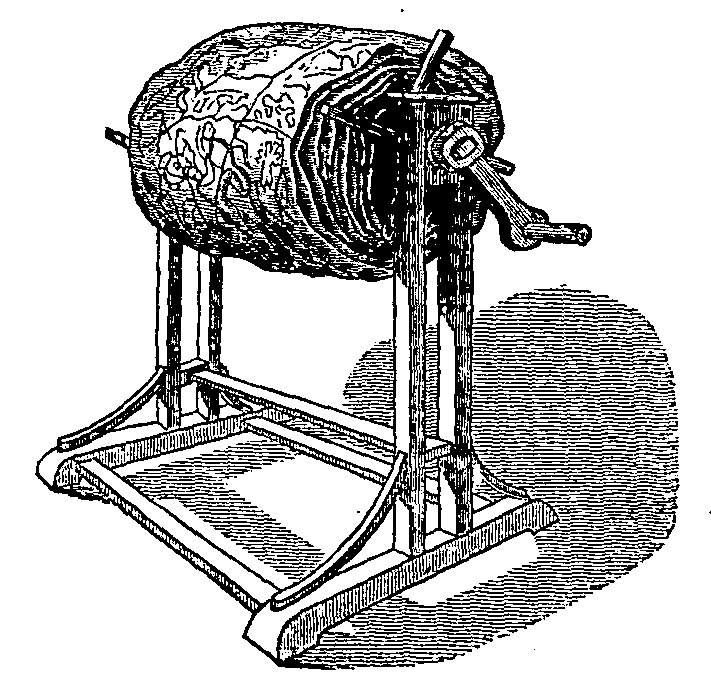
The first portion of the needle-work, representing the embassy of Harold, from Edward the Confessor to William Duke of Normandy, is comparatively much defaced--that is to say, the stitches are worn away, and little more than the ground, or fine close linen cloth, remains. It is not far from the beginning--and where the colour is fresh, and the stitches are, comparatively, preserved--that you observe the PORTRAIT OF HAROLD.147
You are to understand that the stitches, if they may be so called, are threads laid side by side--and bound down at intervals by cross stitches, or fastenings--upon rather a fine linen cloth; and that the parts intended to represent flesh are left untouched by the needle. I obtained a few straggling shreds of the worsted with which it is Worked. The colours are generally a faded or bluish green, crimson, and pink. About the last five feet of this extraordinary roll are in a yet more decayed and imperfect state than the first portion. But the designer of the subject, whoever he was, had an eye throughout to Roman art--as it appeared in its later stages. The folds of the draperies, and the proportions of the figures, are executed with this feeling.
I must observe that, both at top and at bottom of the principal subject, there is a running allegorical ornament;148 of which I will not incur the presumption to suppose myself a successful interpreter. The constellations, and the symbols of agriculture and of rural occupation, form the chief subjects of this running ornament. All the inscriptions are executed in capital letters of about an inch in length; and upon the whole, whether this extraordinary and invaluable relic be of the latter end of the XIth, or of the beginning or middle of the XIIth century149 seems to me a matter of rather a secondary consideration. That it is at once unique and important, must be considered as a position to be neither doubted nor denied, I have learnt, even here, of what importance this tapestry-roll was considered in the time of Bonaparte's threatened invasion of our country: and that, after displaying it at Paris for two or three months, to awaken the curiosity and excite the love of conquest among the citizens, it was conveyed to one or two sea-port towns, and exhibited upon the stage as a most important materiel in dramatic effect.150
I think you have now had a pretty good share of Bayeux intelligence; only that I ought not to close my despatches without a word or two relating to habits, manners, trade, and population. This will scarcely occupy a page. The men and women here are thoroughly Norman. Stout bodies, plump countenances, wooden shoes, and the cauchoise--even to exceedingly tall copies of the latter! The population may run hard upon ten thousand. The chief articles of commerce are butter and lace. Of the former, there are two sorts: one, delicate and well flavoured, is made during winter and spring; put up into small pots, and carried from hence in huge paniers, not only to all the immediately adjacent parts of the country, but even to Paris--and is shipped in large quantities for the colonies. They have made as much as 120,000 lb. weight each season; but Isigny, a neighbouring village, is rather the chief place for its production. The other sort of butter, which is eaten by the common people, and which in fact is made throughout the whole of Lower Normandy, (the very butter, in short, in which the huge alose was floating in the pot of the lively cuisiniere at Duclair151) is also chiefly made at Isigny; but instead of a delicate tint, and a fine flavour, it is very much the contrary: and the mode of making and transporting it accords with its qualities. It is salted, and packed in large pots, and even barrels, for the sake of exportation; and not less than 50,000 lb. weight is made each week. The whole profit arising from butter has been estimated at not less than two millions of francs: add to which, the circulation of specie kept up by the payment of the workmen, and the purchase of salt. As to lace, there are scarcely fewer than three thousand females constantly employed in the manufacture of that article.
The mechanics here, at least some of them, are equally civil and ingenious. In a shop, in the high or principal street, I saw an active carpenter, who had lost the fore finger of his right hand, hard at work--alternately whistling and singing--over a pretty piece of ornamental furniture in wood. It was the full face of a female, with closely curled hair over the forehead, surmounted by a wreath of flowers, having side curls, necklace, and platted hair. The whole was carved in beech, and the form and expression of the countenance were equally correct and pleasing. This merry fellow had a man or two under him, but he worked double tides, compared with his dependants. I interrupted him singing a French air, perfectly characteristic of the taste of his country. The title and song were thus:
TOU JOURS.
TOUJOURS, toujours, je te serai fidèle; Disait Adolphe à chaque instant du jour; Toujours, toujours je t'aimerai, ma belle, Je veux le dire aux échos d'alentour; Je graverai sur l'écorce d'un hètre, Ce doux serment que le dieu des amours, Vient me dieter, en me faisant connaître; Que mon bonheur est de t'aimer toujours. Bis.
Toujours, toujours, lui répondit Adèle, Tu régneras dans le fond de mon coeur; Toujours, toujours, comme une tourterelle, Je promets bien t'aimer avec ardeur; Je pense à toi quand le soleil se lève, J'y pense encore à la tin de son cours; Dans le sommeil si quelquefois je reve, C'est au bonheur de te chérir toujours.
He was a carver on wainscoat wood: and if I would give myself "la peine d'entrer," he would shew me all sorts of curiosities. I secured a favourable reception, by purchasing the little ornament upon which he was at work--for a napoleon. I followed the nimble mechanic (ci-devant a soldier in Bonaparte's campaigns, from whence he dated the loss of his finger) through a variety of intricate passages below and up stairs; and saw, above, several excellently well finished pieces of furniture, for drawers or clothes-presses, in wainscoat wood:--the outsides of which were carved sometimes with clustered roses, surrounding a pair of fond doves; or with representations of Cupids, sheep, bows and arrows, and the various emblemata of the tender passion. They would have reminded you of the old pieces of furniture which you found in your grandfather's mansion, upon taking possession of your estate: and indeed are of themselves no despicable ornaments in their way. I was asked from eight to twelve napoleons for one of these pieces of massive and elaborately carved furniture, some six or seven feet in height.
In all other respects, this is a town deserving of greater antiquarian research than appears to have been bestowed upon it; and I cannot help thinking that its ancient ecclesiastical history is more interesting than is generally imagined. In former days the discipline and influence of its See seem to have been felt and acknowledged throughout nearly the whole of Normandy. Adieu. In imagination, the spires of COUTANCES CATHEDRAL begin to peep in the horizon.
LETTER XVI.
BAYEUX TO COUTANCES. ST. LO. THE CATHEDRAL OF COUTANCES. ENVIRONS. AQUEDUCT. MARKET-DAY. PUBLIC LIBRARY. ESTABLISHMENT FOR THE CLERGY.
I send you this despatch close to the very Cathedral, whose spires, while yet at Bayeux, were already glimmering in the horizon of my imagination. The journey hither has been in every respect the most beautiful and interesting that I have experienced on this side the Seine. I have seen something like undulating pasture-lands, wooded hills, meandering streams, and well-peopled villages; and an air of gaiety and cheerfulness, as well as the charm of picturesque beauty, has accompanied me from one cathedral to the other.
I left the Hôtel de Luxembourg, at Bayeux, in a hired cabriolet with a pair of horses, about five in the afternoon, pushing on, at a smart trot, for ST. LO: which latter place I entered by moon-light. The road, as usual, was broad and bold, and at times undulating; flanked by beech, elm, and fir. As I just observed to you, I entered St. Lo by moon-light: the double towers of the great cathedral-like looking church having a grand and even romantic effect on approaching the town. An old castle, or rather a mere round-tower relic of one, appeared to the left, upon entering it. Passing the porch, or west end of the church, sometimes descending, at others ascending--midst close streets and overhanging roofs of houses, which cast a deep and solemn shadow, so as to shut out the moon beams for several hundred yards--and pursuing a winding route, I at length stopped at the door of the principal hôtel--au Grand Coq! I laughed heartily when I heard its name; for with the strictest adherence to truth the adjective ought to have been petit!
However, the beds seemed to be in good order, and the coffee, with which I was quickly served, proved to be excellent. I strolled out, on a reconnoissance, about half-past nine; but owing to the deep shadows from the moon, arising from the narrowness of the streets, I could make out nothing satisfactory of the locale. The church, however, promised a rich treat on the morrow. As soon as the morrow came, I betook myself to the church. It was Sunday morning. The square, before the west front of the church, was the rendezvous both of townsmen and countryfolks: but what was my astonishment on observing in one corner of it, a quack doctor vending powder for the effectual polishing of metals. He had just beaten his drum, in order to collect his audience; and having got a good assemblage, was full of the virtues of his wares--which were pronounced to be also "equally efficacious for complaints in the stomach!"
This man had been preceded, in the situation which he occupied, by a rival charlatan, on horseback, with powders to kill rats. The latter stood upon the same eminence, wearing a hat, jacket, and trowsers, all white -- upon which were painted black rats of every size and description; and in his harangue to the populace he took care to tell them that the rats, painted upon his dress, were exact portraits of those which had been destroyed by means of his powders! This, too, on a Sunday morning. But remember Dieppe.152
Having despatched my breakfast, I proceeded to survey the church, from which the town takes its name. First, for the exterior. The attached towers demand attention and admiration. They are so slightly attached as to be almost separated from the body or nave; forming something of that particular character which obtains more decidedly at the cathedral of Coutances. I am not sure whether this portion of the church at St. Lo be not preferable, on the score of regularity and delicacy, to the similar portion at this latter place. The west front is indeed its chief beauty of exterior attraction; and it was once rendered doubly interesting by a profusion of alto-rilievo statues, which disappeared during the commotions of the revolution. You ascend rather a lofty flight of steps to this entrance; and into which the whole town seemed to be pouring the full tide of its population. I suffered myself to be carried away along, with the rest, and almost startled as I entered the nave.153 To the left, is a horribly-painted statue of the Virgin, with the child in her arms. The countenance is even as ugly, old, and repulsive, as the colouring is most despicable. I never saw such a daub: and what emotions, connected with tenderness of feeling, or ardour of devotion, can the contemplation of such an object excite? Surely the parish must have lost its wits, as well as its taste, to endure such a monstrous exhibition of art.
As I advanced towards the choir, I took especial notice of the very singular, and in my opinion very ugly, formation both of the pillars and arches which sustain the roof. These pillars have no capitals, and the arch springs from them in the most abrupt manner. The arch itself is also very short and sharp pointed; like the tops of lancet windows. This mode obtains pretty generally here; but it should be noted that, in the right side aisle, the pillars have capitals. There is something unusual also in the row of pillars which spring up, flanking the choir, half way between the walls of the choir and the outward wall of the church. Nor am I sure that, destitute of a graceful, superadded arch, such massive perpendicular lines have either meaning or effect. Whether St. Lo were the first church upon which the architect, who built both that and the cathedral at Coutances, tried his talents--or whether, indeed, both churches be the effort of the same hand--I cannot pretend to determine; but, both outwardly and inwardly, these two churches have a strong resemblance to each other. Like many other similar buildings in France, the church of St. Lo is closely blocked up by surrounding houses.
I prepared to leave St. Lo about mid-day, after agreeing for a large heavy machine, with a stout pair of horses, to conduct me to this place. There are some curious old houses near the inn, with exterior ornaments like those of the XVIth century, in our own country. But on quitting the town, in the road to Coutances,--after you come to what are called the old castle walls, on passing the outer gate--your eye is struck by rather an extraordinary combination of objects. The town itself seems to be built upon a rock. Above, below, every thing appears like huge scales of iron; while, at the bottom, in a serpentine direction, runs the peaceful and fruitful river Aure.154 The country immediately around abounds in verdant pasture, and luxuriantly wooded heights. Upon the whole, our sortie from St. Lo, beneath a bright blue sky and a meridian sun, was extremely cheerful and gratifying.
A hard road (but bold and broad, as usual) soon convinced me of the uncomfortableness of the conveyance; which, though roomy, and of rather respectable appearance, wanted springs: but the increasing beauty of the country, kept my attention perfectly occupied, till the beautiful cathedral, of COUTANCES caught my notice, on an elevated ground, to the left. The situation is truly striking, gaze from what quarter you will. From that of St. Lo, the immediate approach to the town is rendered very interesting from the broad route royale, lined with birch, hazel, and beech. The delicacy, or perhaps the peculiarity of the western towers of the cathedral, struck me as singularly picturesque; while the whole landscape was warmed by the full effulgence of an unclouded sun, and animated by the increasing numbers and activity of the paysannes and bourgeoises mingling in their sabbath-walks. Their bright dark blues and crimsons were put on upon the occasion; and nought but peace, tranquillity, and fruitfulness seemed to prevail on all sides. It was a scene wherein you might have placed Arcadian shepherds--worthy of being copied-by the pencil of Claude.
We entered the town at a sharp trot. The postilion, flourishing his whip, and causing its sound to re-echo through the principal street, upon an ascent, drove to the chief inn, the Hôtel d'Angleterre, within about one hundred yards of the cathedral. Vespers were just over; and I shall not readily forget the rush and swarm of the clergy who were pouring out, from the north door, and covering the street with one extensive black mass. There could not have been fewer than two hundred young Ecclesiastics--thus returning from vespers to their respective homes; or rather to the College, or great clerical establishment, in the neighbourhood. This College, which has suffered from violence and neglect, through the revolution and Bonaparte's dynasty, is now beginning to raise its head in a very distinguished and commanding manner. It was a singular sight--to see such a crowd of young men, wearing cocked hats, black robes, and black bands with white edging! The women were all out in the streets; sitting before their doors, or quietly lounging or walking. The afternoon was indeed unusually serene.
I ordered a late dinner, and set out for the cathedral. It was impossible to visit it at a more favorable moment. The congregation had departed; and a fine warm sun darted its rays in every surrounding direction. As I looked around, I could not fail to be struck with the singular arrangement of the columns round the choir: or rather of the double aisle between the choir and the walls, as at St. Lo; but here yet more distinctly marked. For a wonder, an unpainted Virgin and child in Our Lady's chapel, behind the choir! There is nothing, I think, in the interior of this church that merits particular notice and commendation, except it be some beautifully- stained glass windows; with the arms, however, of certain noble families, and the regal arms (as at Bayeux) obliterated. There is a deep well in the north transept, to supply the town with water in case of fire. The pulpit is large and handsome; but not so magnificent as that at Bayeux. The organ is comparatively small. Perhaps the thirteenth century is a period sufficiently remote to assign for the completion of the interior of this church, for I cannot subscribe to the hypothesis of the Abbé de la Rue, that this edifice was probably erected by Tancred King of Sicily at the end of the eleventh, or at the beginning of the twelfth century.
The exterior of this Church is indeed its chief attraction.155 Unquestionably the style of architecture is very peculiar, and does not, as far as I know, extend beyond St. Lo, in Normandy. My great object was to mount upon the roof of the central tower, which is octagonal, containing fine lofty lancet windows, and commanding from its summit a magnificent panorama. Another story, one half the height of the present erection from the roof of the nave, would put a glorious finish to the central tower of NOTRE DAME at COUTANCES. As I ascended this central tower, I digressed occasionally into the lateral galleries along the aisles. To look down, was somewhat terrific; but who could help bewailing the wretched, rotten, green-tinted appearance of the roof of the north aisle?--which arose here, as at Bayeux, from its being stripped of the lead (during the Revolution) to make bullets--and from the rain's penetrating the interior in consequence. As I continued to ascend, I looked through the apertures to notice the fine formation and almost magical erection of the lancet windows of the western towers: and the higher I mounted, the more beautiful and magical seemed to be that portion of the building. At length I reached the summit; and concentrating myself a little, gazed around.
The view was lovely beyond measure. Coutances lies within four miles of the sea, so that to the west and south there appeared an immense expanse of ocean. On the opposite points was an extensive landscape, well-wooded, undulating, rich, and thickly studded with farm-houses. Jersey appeared to the north-west, quite encircled by the sea; and nearly to the south, stood out the bold insulated little rock of Granville, defying the eternal washing of the wave. Such a view is perhaps no where else to be seen in Normandy; certainly not from any ecclesiastical edifice with which I am acquainted. The sun was now declining apace, which gave a wanner glow to the ocean, and a richer hue to the landscape. It is impossible to particularize. All was exquisitely refreshing and joyous. The heart beats with a fuller pulsation as the eye darts over such an expansive and exhilarating scene! Spring was now clad in her deepest-coloured vesture: and a prospect of a fine summer and an abundant harvest infused additional delight into the beholder. Immediately below, stood the insulated and respectable mansion or Palace of the Bishop; in the midst of a formal garden--begirt with yet more formally clipt hedges. As the Prelate bore a good character, I took a pleasure in gazing upon the roof which contained an inhabitant capable of administering so much good to the community. In short, I shall always remember the view from the top of the central tower of the cathedral of Coutances!
I quitted such a spot with reluctance; but time was flying away, and the patience of the cuisinier at the Hôtel d'Angleterre had already been put somewhat to the test. In twenty minutes I sat down to my dinner, in a bed- room, of which the furniture was chiefly of green silk. The females, even in the humblest walks, have generally fine names; and Victorina was that of the fille de chambre at the Hôtel d'Angleterre. After dinner I walked upon what may be called the heights of Coutances; and a more delightful evening's walk I never enjoyed. The women of every description-- ladies, housekeepers, and servant maids--were all abroad; either sitting upon benches, or standing in gossiping groups, or straying in friendly pairs. The comeliness of the women was remarkable; a certain freshness of tint, and prevalence of the embonpoint, reminded me of those of our own country; and among the latter, I startled--as I gazed upon a countenance which afforded but too vivid a resemblance to that of a deceased relation! Certainly the Norman women are no where more comely and interesting than they are at Coutances.
The immediate environs of this place are beautiful and interesting: visit them in what direction you please. But there is nothing which so immediately strikes you as the remains of an ancient Aqueduct; gothicised at the hither end, but with three or four circular arches at the further extremity, where it springs from the opposite banks. Fine as was yesterday, this day has not been inferior to it. I was of course glad of an opportunity of visiting the market, and of mingling with the country people. The boulevards afforded an opportunity of accomplishing both these objects. Corn is a great article of trade; and they have noble granaries for depositing it. Apparently there is a great conflux of people, and much business stirring. I quickly perceived, in the midst of this ever-moving throng, my old friend the vender of rat-destroying powders--busied in the exercise of his calling, and covered with his usual vestment of white, spotted or painted with black rats. He found plenty of hearers and plenty of purchasers. All was animation and bustle. In the midst of it, a man came forward to the edge of a bank--below which a great concourse was assembled. He beat a drum, to announce that a packet boat, would sail to Jersey in the course of the afternoon; but the people seemed too intent upon their occupations and gambols to attend to him. I sat upon a bench and read one of the little chap books--Richard sans peur--which I had purchased the same morning.
While absorbed in reflections upon the heterogeneous scene before me-- and wishing, for some of my dearest friends in England to be also spectators of it--the notes of an hand-organ more and more distinctly stole upon my ear. They were soft; and even pleasing notes. On looking round, I observed that the musician preceded a person, who carried aloft a Virgin, with the infant Jesus, in wax; and who, under such a sign, exhorted the multitude to approach and buy his book-wares. I trust I was too thorough-bred a Roxburgher to remain quiet on the bench: and accordingly starting up, and extending two sous, I became the fortunate purchaser of a little chap article--of which my friend BERNARDO will for ever, I fear, envy me the possession! The vender of the tome sang through his nose, as the organ warbled the following
Cantique Spirituelle.
EN L'HONNEUR DU TRÈS-SAINT SACREMENT,
Qui est exposé dans la grande Eglise cathédrale de St. Pierre et St. Paul de Rome, pour implorer la miséricorde de Dieu.
Air: du Théodore Français.
APPROCHEZ-VOUS, Chrétiens fidèles, Afin d'entendre réciter: Ecoutez tous avec un grand zèle, Avec ferveur et piété, Le voeu que nous avons fait, D'aller au grand Saint Jacques; Grace à Dieu nous l'avons accompli, Pour l'amour de Jésus Christ.
Dieu créa le ciel et la terre, Les astres et le firmament; Il fit la brillante lumière, Ainsi que tous les autres élémens, Il a tiré tout du néant, Ce qui respire sur la terre: Rendons hommage à la grandeur De notre divin Créateur.
156Tous les jours la malice augmente, Il y a très- peu de religion; La jeunesse est trop petulante, Les enfans jurent le saint Nom. Et comment s'étonneroit-on Si tant de fléaux nous tourmentent? Et si l'on voit tant de malheurs, C'est Dieu qui punit les pécheurs.
Souvent on assiste à l'Office, C'est comme une manière d'acquit, Sans penser au saint Sacrifice; Ou s'est immolé Jesus Christ. On parle avec ses amis, De ses affaires temporelles, Sans faire aucune attention Aux mystères de la religion.
Réfléchissez bien, pères et mères, Sur ces morales et vérités: C'est la loi de Dieu notre Père; C'est lui qui nous les a dictées: Il faut les suivre et les pratiquer, Tant que nous serons sur la terre. N'oublions point qu'après la mort, Nos ames existeront encore.
The day was beginning to wear away fast, and I had not yet accomplished the favourite and indispensable object of visiting the PUBLIC LIBRARY. I made two unsuccessful attempts; but the third was fortunate. I had no letter of introduction, and every body was busied in receiving the visits of their country friends. I was much indebted to the polite attention of a stranger: who accompanied me to the house of the public librarian, his friend, who, not being at home, undertook the office of shewing me the books. The room in which they are contained--wholly detached--and indeed at a considerable distance from the cathedral--is about sixty English feet long, low, and rather narrow. It is absolutely crammed with books, in the most shameful state of confusion. I saw, for the first time in Normandy, and with absolute gladness of heart, a copy of the Complutensian Polyglot Bible; of which the four latter volumes, in vellum binding, were tall and good: the earlier ones, in calf, not so desirable. For the first time too, since treading Norman soil, I saw a tolerably good sprinkle of Italian books. But the collection stands in dreadful need of weeding. Indeed, this observation may apply to the greater number of public collections throughout Normandy. I thanked my attendant for his patient and truly friendly attention, and took my leave.
In my way homewards, I stopped at M. Joubert's, the principal bookseller, and "beat about the bush" for bibliographical game. But my pursuit was not crowned with success. M.J. told me, in reply to black-letter enquiries, that a Monsieur A----, a stout burly man, whom he called "un gros papa"-- was in the habit of paying yearly visits from Jersey, for the acquisition of the same black-letter treasures; and that he swept away every thing in the shape of an ancient and equivocal volume, in his annual rounds. I learnt pretty nearly the same thing from Manoury at Caen. M. Joubert is a very sensible and respectable man; and is not only "Seul Imprimeur de Monseigneur l'Evêque" (PIERRE DUPONT-POURSAT), but is in fact almost the only bookseller worth consulting in the place. I bought of him a copy of the Livre d'Eglise ou Nouveau Paroissien à l'usage du Diocèse de Coutances, or the common prayer book of the diocese. It is a very thick duodecimo, of 700 double columned pages, printed in a clear, new, and extremely legible character, upon paper of sufficiently good texture. It was bound in sheepskin, and I gave only thirty sous for it new. How it can be published at such a price, is beyond my conception. M. Joubert told me that the compositor or workman received 20 francs for setting up 36 pages, and that the paper was 12 francs per ream. In our own country, such prices would be at least doubled.
It is impossible not to be struck here with the great number of YOUNG ECCLESIASTICS. In short, the establishment now erecting for them, will contain, when completed, (according to report) not fewer than four hundred. It is also impossible not to be struck with the extreme simplicity of their manners and deportment. They converse with apparent familiarity with the very humblest of their flock: and seem, from the highest to the lowest, to be cordially received. They are indifferent as to personal appearance. One young man carries a bundle of linen to his laundress, along the streets: another carries a round hat in his hand, having a cocked one upon his head: a kitchen utensil is seen in the hand of a third, and a chair, or small table, in that of a fourth. As these Clergymen pass, they are repeatedly saluted. Till the principal building be finished, many of them are scattered about the town, living quite in the upper stories. In short, it is the profession, rather than the particular candidate, which seems to claim the respectful attention of the townsmen.
LETTER XVII.
JOURNEY TO GRANVILLE. GRANVILLE. VILLE DIEU. ST. SEVER. TOWN AND CASTLE OF VIRE.
Vire.
Since my last, I have been as much gratified by the charms of nature and of art, as during any one period of my tour. Prepare, therefore, for miscellaneous intelligence; but such as, I will make bold to predict, cannot fail to afford you considerable gratification. Normandy is doubtless a glorious country. It is fruitful in its soil, picturesque in the disposition of its land and water, and rich in the architectural relics of "the olden time." It is also more than ordinarily interesting to an Englishman. Here, in the very town whence I transmit this despatch--within two hundred and fifty yards of the hotel of the Cheval Blanc, which just now encloses me within its granite walls--here, I say, lived and revelled the illustrious family of the DE VERES.157 Hence William the Conqueror took the famous AUBREY DE VERE to be a spectator of his prowess, and a sharer of his spoils, in his decisive subjugation of our own country. It is from this place that the De Veres derive their name. Their once-proud castle yet towers above the rushing rivulet below, which turns a hundred mills in its course: but the warder's horn has long ceased to be heard, and the ramparts are levelled with the solid rock with which they were once, as it were, identified.
I left Coutances with something approaching to reluctance; so completely anglicised seemed to be the scenery and inhabitants. The evening was beautiful in the extreme: and upon gaining the height of one of the opposite hills, within about half a league of the town, on the high Granville route, I alighted--walked, stopped, and gazed, alternately, upon the lovely landscape around--the cathedral, in the mean time, becoming of one entire golden tint from the radiance of the setting sun. It was hardly possible to view a more perfect picture of its kind; and it served as a just counterpart to the more expansive scene which I had contemplated, but the preceding evening, from the heights of that same cathedral. The conducteur of the Diligence rousing me from my rapturous abstraction, I remounted, and descended into a valley; and ere the succeeding height was gained, a fainter light floated over the distant landscape ... and every object reminded me of the accuracy of those exquisite lines of Collins-- descriptive of the approach of evening's
... gradual, dusky veil.
For the first time, I had to do with a drunken conducteur. Luckily the road was broad, and in the finest possible condition, and perfectly well known to the horses. Every turning was successfully made; and the fear of upsetting began to give way to the annoyance experienced from the roaring and shouting of the conducteur. It was almost dark when I reached GRANVILLE--about twelve miles from Coutances; when I learnt that the horses had run six miles before they started with us. On entering the town, the road was absolutely solid rock: and considering what a house we carried behind us (for so the body of the diligence seemed) and the uncertain footing of the horses, in consequence of the rocky surface of the road, I apprehended the most sinister result. Luckily it was moon-light; when, approaching one of the sorriest looking inns imaginable, whither our conducteur (in spite of the better instructions of the landlord of the Hôtel d'Angleterre at Coutances) had persuaded us to go, the passengers alighted with thankful hearts, and bespoke supper and beds.
Granville is fortified on the land side by a deep ravine, which renders an approach from thence almost impracticable. On every other side it is defended by the ocean, into which the town seems to have dropt perpendicularly from the clouds. At high water, Granville cannot be approached, even by transports, nearer than within two-thirds of a league; and of course at low water it is surrounded by an extent of sharply pointed rock and chalk: impenetrable--terrific--and presenting both certain failure and destruction to the assailants. It is a GIBRALTAR IN MINIATURE. The English sharply cannonaded it a few years since, but it was only a political diversion. No landing was attempted. In the time of the civil wars, and more particularly in those of the League, Granville, however, had its share of misery. It is now a quiet, dull, dreary, place; to be visited only for the sake of the view from thence, looking towards St. Malo, and Mont St. Michel; the latter of which I give up--as an hopeless object of attainment. Granville is in fact built upon rock;158 and the houses and the only two churches are entirely constructed of granite. The principal church (I think it was the principal) is rather pretty within, as to its construction; but the decidedly gloomy effect given to it by the tint of the granite--the pillars being composed of that substance-- renders it disagreeable to the eye. I saw several confessionals; and in one of them, the office of confession was being performed by a priest, who attended to two penitents at the same time; but whose physiognomy was so repulsively frightful, that I could not help concluding he was listening to a tale which he was by no means prepared to receive.
An hour's examination of the town thoroughly satisfied me. There was no public conveyance to Vire, whither I intended immediately departing, and so I hired a voiture to be drawn by one sturdy Norman horse. To a question about springs, the conducteur replied that I should find every thing "très propre." Having paid the reckoning, I set my face towards VIRE. The day, for the season of the year, turned out to be gloomy and cold beyond measure: and the wind (to the east) was directly in my face. Nevertheless the road was one of the finest that I had seen in France, for breadth and general soundness of condition. It had all the characteristics, in breadth and straitness, of a Roman route; and as it was greatly undulating, I had frequently some gratifying glimpses of its bold direction. The surrounding country was of a quietly picturesque but fruitful aspect; and had my seat been comfortable, or after the fashion of those in my own country, my sensations had been more agreeable. But in truth, instead of springs, or any thing approximating to "très propre," I had to encounter a hard plank, suspended at the extremities, by a piece of leather, to the sides; and as the road was but too well bottomed, and the conveyance was open in front to the bitter blast of the east, I can hardly describe (as I shall never forget) the misery of this conveyance.
Fortunately the first stage was Ville Dieu. Here I ordered a voiture and post horses: but the master of the Poste Royale, or rather of the inn, shook his head--"Pour les chevaux, vous en aurez des meilleurs: mais, pour la voiture il n'y en a pas. Tenez, Monsieur; venez voir." I followed, with miserable forebodings--and entering a shed, where stood an old tumble-down- looking phaeton--"la voilà, c'est la seule que je possède en ce moment"-- exclaimed the landlord. It had never stirred from its position since the fall of last years' leaf. It had been--within and without--the roosting place for fowls and other of the feathered tribe in the farm yard; and although literally covered with the evidences of such long and undisturbed possession, yet, as there was no appearance of rain, and as I discovered the wished for "ressorts" (or springs) I compromised for the repulsiveness of the exterior, and declared my intention of taking it onward. Water, brooms, brushes, and cloths, were quickly put in requisition; and two stately and well fed horses, which threatened to fly away with this slender machine, being fastened on, I absolutely darted forward at a round rattling gallop for St. Sever. Blessings ever wait upon the memory of that artisan who invented ... springs!
The postilion had the perfect command of his horses, and he galloped, or trotted, or ambled, as his fancy--or rather our wishes--directed. The approach to our halting place was rather imposing. What seemed to be a monastery, or church, at St. Sever, had quite the appearance of Moorish architecture; and indeed as I had occasional glimpses of it through the trees, the effect was exceedingly picturesque. This posting town is in truth very delightfully situated. While the horses were being changed, I made our way for the monastery; which I found to be in a state rather of dilapidation than of ruin. It had, indeed, a wretched aspect. I entered the chapel, and saw lying, transversely upon a desk, to the left--a very clean, large paper, and uncut copy of the folio Rouen Missal of 1759. Every thing about this deserted and decaying spot had a melancholy appearance: but the surrounding country was rich, wooded, and picturesque. In former days of prosperity--such as St. Sever had seen before the Revolution--there had been gaiety, abundance, and happiness. It was now a perfect contrast to such a state.
On returning to the "Poste Royale" I found two fresh lusty horses to our voiture--but the postilion had sent a boy into the field to catch a third. Wherefore was this? The tarif exacted it. A third horse "réciproquement pour l'année"--parce qu'il faut traverser une grande montagne avant d'arriver à Vire"--was the explanatory reply. It seemed perfectly ridiculous, as the vehicle was of such slender dimensions and weight. However, I was forced to yield. To scold the postboy was equally absurd and unavailing: "parce que la tarif l'exigea." But the "montagne" was doubtless a reason for this additional horse: and I began to imagine that something magnificently picturesque might be in store. The three horses were put a-breast, and off we started with a phaeton-like velocity! Certainly nothing could have a more ridiculous appearance than my pigmy voiture thus conveyed by three animals--strong enough to have drawn the diligence. I was not long in reaching this "huge mountain," which provoked my unqualified laughter--from its insignificant size--and upon the top of which stands the town of VIRE. It had been a fair-day; and groups of men and women, returning from the town, in their blue and crimson dresses, cheered somewhat the general gloom of the day, and lighted up the features of the landscape. The nearer I approached, the more numerous and incessant were these groups.
Vire is a sort of Rouen in miniature--if bustle and population be only considered. In architectural comparison, it is miserably feeble and inferior. The houses are generally built of granite, and look extremely sombre in consequence. The old castle is yet interesting and commanding. But of this presently. I drove to the "Cheval Blanc," and bespoke, as usual, a late dinner and beds. The first visit was to the castle, but it is right that you should know, before hand, that the town of Vire, which contains a population of about ten thousand souls, stands upon a commanding eminence, in the midst of a very beautiful and picturesque country called the BOCAGE. This country was, in former times, as fruitful in civil wars, horrors, and devastations, as the more celebrated Bocage of the more western part of France during the late Revolution. In short, the Bocage of Normandy was the scene of bloodshed during the Calvinistic or Hugonot persecution. It was in the vicinity of this town, in the parts through which I have travelled--from Caen hitherwards--that the hills and the dales rang with the feats of arms displayed in the alternate discomfiture and success of COLIGNY, CONDÉ, MONTMOGERY, and MATIGNON.159
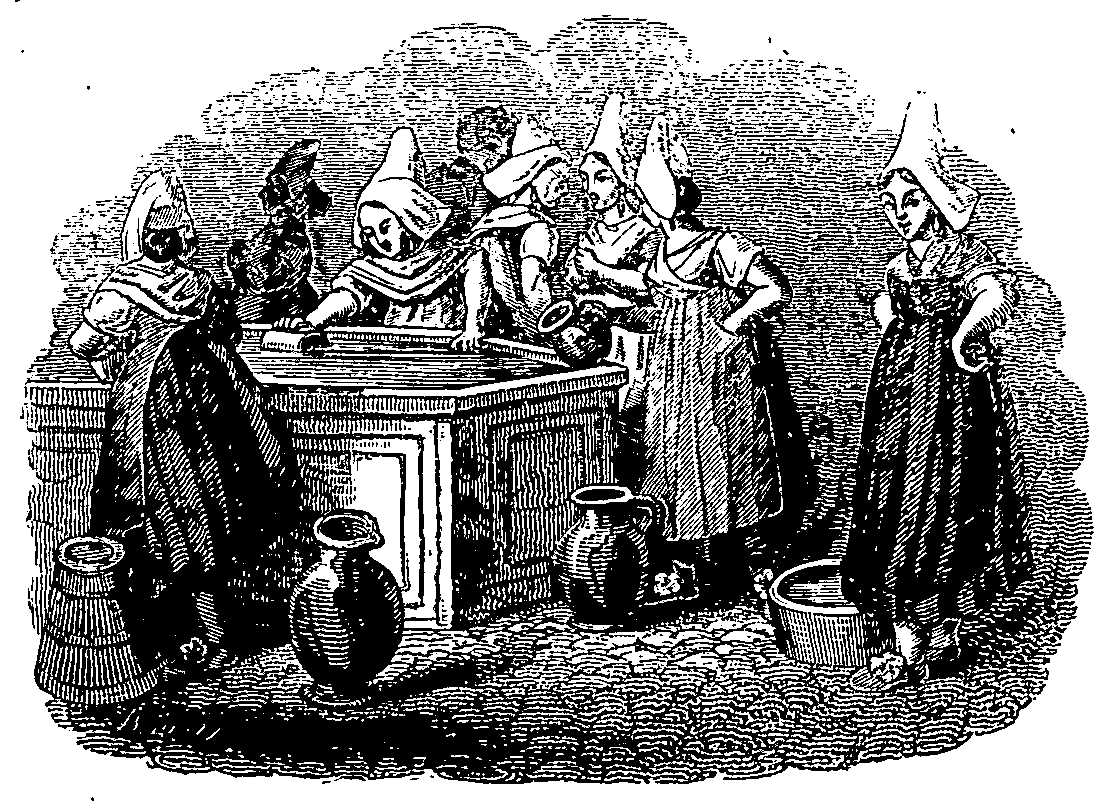
But for the Castle. It is situated at the extremity of an open space, terminated by a portion of the boulevards; having, in the foreground, the public library to the left, and a sort of municipal hall to the right: neither of them objects of much architectural consequence. Still nearer in the foreground, is a fountain; whither men, women, and children--but chiefly the second class, in the character of blanchisseuses-- regularly resort for water; as its bason is usually overflowing. It was in a lucky moment that Mr. Lewis paid a visit to this spot; which his ready pencil transmitted to his sketch-book in a manner too beautiful and faithful not to be followed up by a finished design. I send you a portion of this prettily grouped picture; premising, that the woman to the right, in the foreground, begged leave purposely to sit--or rather stand--for her portrait. The artist, in a short time, was completely surrounded by spectators of his graphic skill.
The "Cheval Blanc"--the name of the hotel at which I reside-- should be rather called the "Cheval Noir;" for a more dark, dingy, and even dirty residence, for a traveller of any nasal or ocular sensibility, can be rarely visited. My bed room is hung with tapestry; which, for aught I know to the contrary, may represent the daring exploits of MONTGOMERY and MATIGNON: but which is so begrimed with filth that there is no decyphering the subjects worked upon it.
On leaving the inn--and making your way to the top of the street--you turn to the left; but on looking down, again to the left, you observe, below you, the great high road leading to Caen, which has a noble appearance. Indeed, the manner in which this part of Normandy is intersected with the "routes royales" cannot fail to strike a stranger; especially as these roads run over hill and dale, amidst meadows, and orchards, equally abundant in their respective harvests. The immediate vicinity of the town is as remarkable for its picturesque objects of scenery as for its high state of cultivation; and a stroll upon the heights, in whatever part visited, will not fail to repay you for the certain disappointment to be experienced within the streets of the town. Portions of the scenery, from these heights, are not unlike those in Derbyshire, about Matlock. There is plenty of rock, of shrubs, and of fern; while another Derwent, less turbid and muddy, meanders below. Thus much for a general, but hasty sketch of the town of Vire. My next shall give you some detail of the interior of a few of the houses, of which I may be said to have hitherto only contemplated the roofs.
And yet I must not close my despatch without performing my promise about the CASTLE; of which indeed (as you will see by the subjoined miniature view) only a sort of ruinous shell remains. Its age may be a little towards the end of the thirteenth century. The stone is of a deep reddish tint: and although what remains is only a portion of the keep, yet I can never suppose it, even in its state of original integrity, to have been of very capacious dimensions. Its site is most commanding.
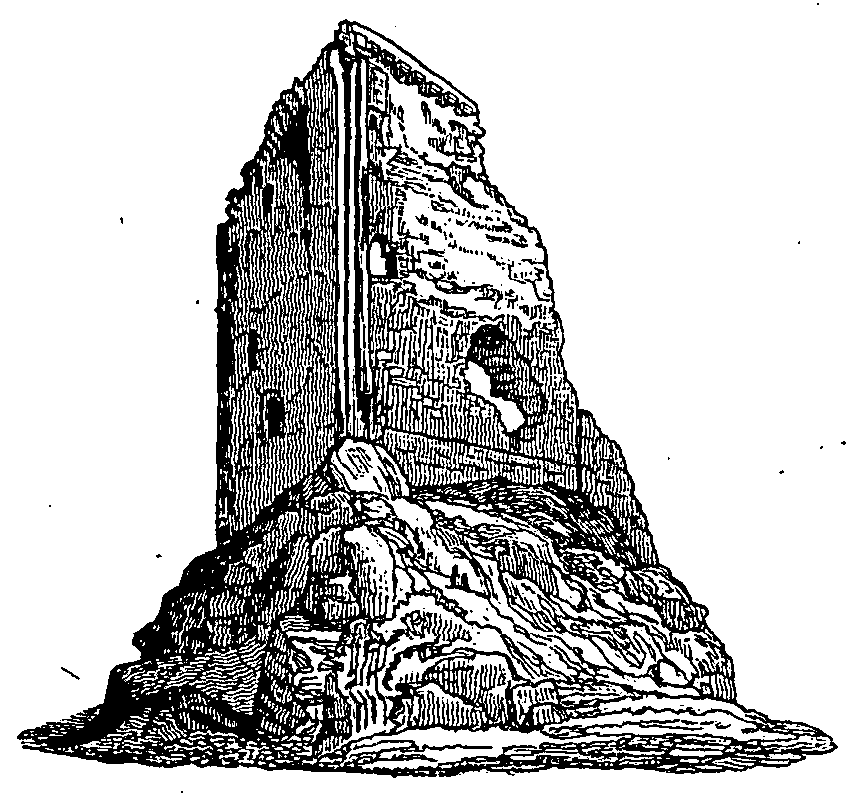
LETTER XVIII.
BIBLIOGRAPHY. MONSIEUR ADAM. MONSIEUR DE LARENAUDIERE. OLIVIER BASSELIN. M. SÉGUIN. THE PUBLIC LIBRARY.
It is a sad rainy day; and having no temptation to stir abroad, I have shut myself up by the side of a huge wood fire--(surrounded by the dingy tapestry, of which my last letter did not make very honourable mention) in a thoroughly communicative mood--to make you acquainted with all that has passed since my previous despatch. Books and the Bibliomania be the chief "burden of my present song!" You may remember, in my account of the public library at Caen, that some mention was made of a certain OLIVIER BASSELIN-- whom I designated as the DRUNKEN BARNABY of Normandy. Well, my friend--I have been at length made happy, and comforted in the extreme, by the possession of a copy of the Vaudevires of that said Olivier Basselin--and from the hands, too, of one of his principal editors ... Monsieur Lanon de Larenaudiere, Avocat, et Maire, de Tallevende-le-Petit. This copy I intend (as indeed I told the donor) for the beloved library at Althorp. But let me tell my tale my own way.
Hard by the hotel of the Cheval Blanc, (the best, bad as it is-- and indeed the only one in the town) lives a printer of the name of ADAM. He is the principal, and the most respectable of his brethren in the same craft. After discoursing upon sundry desultory topics--and particularly examining the books of Education, among which I was both surprised and pleased to find the Distichs of Muretus160--I expressed my regret at having travelled through so many towns of Normandy without meeting with one single copy of the Vaudevires of Olivier Basselin for sale. "It is not very surprising, Sir, since it is a privately printed book, and was never intended for sale. The impression too is very limited. You know, Sir, that the book was published here--and--" "Then I begin to be confident about obtaining it"--replied I. "Gently, Sir;--" resumed Monsieur Adam--"it is not to be bought, even here. But do you know no one...?" "Not a creature." "Well, Sir, take courage. You are an Englishman. One of its principal editors--a very gallant Bibliomaniac--who is a great collector and lover of the literature of your country--(here I picked up courage and gaiety of heart) lives in this town. He is President of the Tribunal. Go to him." Seeing me hesitate, in consequence of not having a letter of introduction--"Ce n'est rien (said he) allez tout-droit. Il aime vos compatriotes; et soyez persuadé de l'accueil le plus favorable." Methought Monsieur Adam spake more eloquently than I had yet heard a Norman speak.161
In two seconds I quitted his shop, (promising to return with an account of my reception) and five minutes brought me into the presence of Monsieur Lanon de Larenaudiere, Président du Tribunal, &c. It is not possible for me to convey to you a notion of the warmth, cordiality, and joyousness of heart, that marked the reception which this gentleman instantly gave me: and I will frankly own that I was as much "abashed" as ever our ancient friend Caxton had been--in the presence of his patroness the Duchess of Burgundy. I followed my new bibliomaniacal acquaintance rapidly up stairs; and witnessed, with extreme pleasure, a few bundles of books (some of them English) lying upon the window seats of the first landing-place; much after the fashion followed in a certain long, rambling, and antique residence, not quite three quarters of a mile from the towers of Westminster Abbey.
On gaining the first floor, mine host turned the keys of the doors of two contiguous rooms, and exclaimed, "VOILA MA BIBLIOTHEQUE!" The air of conscious triumph with which these words were uttered, delighted me infinitely; but my delight was much increased on a leisurely survey of one of the prettiest, most useful, and commendable collections of books, chiefly in the department of the Belles-Lettres, which I had ever witnessed. Monsieur de Larenaudiere has a library of about 9000 volumes, of which eight hundred are English. But the owner is especially fond of poetical archaeology; in other words, of collecting every work which displays the progress of French and English poetry in the middle and immediately following ages; and talks of Trouveurs and Troubadours with an enthusiasm approaching to extacy. Meanwhile he points his finger to our Warton, Ellis, Ritson, and Southey; tells you how dearly he loves them; but yet leads you to conclude that he rather prefers Le Grand, Ginguené, Sismondi, and Raynouard. Of the venerable living oracle in these matters, the Abbé de la Rue, he said he considered him as "un peu trop systématique." In short, M. de Larenaudiere has almost a complete critical collection, in our tongue, upon the subject of old poetry; and was most anxious and inquisitive about the present state of cultivation of that branch of literature in England: adding, that he himself meditated a work upon the French poetry of the XIIth and XIIIth centuries. He said he thought his library might be worth about 25,000 francs: nor did I consider such a valuation overcharged. He talks rapidly, earnestly, and incessantly; but he talks well: and spoke of the renown of a certain library in St. James's Place, in a manner which could not fail to quicken the pulse and warm the blood of its Librarian. I concluded an interview of nearly two hours, by his compliance with my wish to dine with me on the following day: although he was quite urgent in bargaining for the previous measure of my tasting his pôtage and vol au vent. But the shortness and constant occupation of my time would not allow me to accede to it. M. de Larenaudiere then went to a cabinet-like cupboard, drew forth an uncut copy, stitched in blue spotted paper, of his beloved Vaudevires of OLIVIER BASSELIN:162 and presenting it to me, added "Conservez le, pour l'amour de moi." You may be assured that I received such a present in the most gracious manner I was capable of--but instantly and honestly added--"permettez qu'il soit déposé dans la bibliothèque de Milord S...? "C'est la même chose"--rejoined he; and giving me the address of the public librarian, we separated in the most cordial manner till the morrow.
I posted back to Monsieur Adam, the printer and bookseller, and held aloft my blue-covered copy of the Vaudevires as an unquestionable proof of the successful result of my visit to Monsieur La Renaudiere. Leaving the precious cargo with him, and telling him that I purposed immediately visiting the public library, he seemed astonished at my eagerness about books--and asked me if I had ever published any thing bibliographical? "Car enfin, Monsieur, la pluspart des Virois ne savent rien de la litérature angloise"--concluded he ... But I had just witnessed a splendid exception to this sweeping clause of censure. I then sought the residence of the Abbé Du MORTUEUX, the public librarian. That gentleman was from home, at a dinner party. I obtained information of the place where he might be found; and considering two o'clock to be rather too early an hour (even in France) to disturb a gentleman during the exercise of so important a function, I strolled in the neighbourhood of the street, where he was regaling, for a full hour and half: when, at the expiration of that time, I ventured to knock at the door of a very respectable mansion, and to enquire for the bibliographical Abbé. "He is here, Sir, and has just done dinner. May I give him your name?" "I am a stranger: an Englishman; who, on the recommendation of Monsieur Larenaudiere, wishes to see the public library. But I will call again in about an hour." "By no means: by no means: the Abbé will see you immediately." And forthwith appeared a very comely, tall, and respectable- looking gentleman, with his hair en plein costume, both as to form and powder. Indeed I had rarely before witnessed so prepossessing a figure. His salutation and address were most gracious and winning; and he told me that I had nothing to do but to accompany him to the place which I wished to visit. Without even returning to his friends, he took his hat--and in one minute, to my surprise, I found myself in the street with the Abbé de Mortueux, in the high way to the PUBLIC LIBRARY. In our way thither our discourse was constant and unrestrained. "You appear here; Monsieur l'Abbé, to be partial to literature;... but allow me first to congratulate you on the beautiful environs of your town." "For literature in general, we are pretty well disposed. In regard to the beauties of the immediate neighbourhood of Vire, we should be unworthy inhabitants indeed, if we were not sensible of them." In five minutes we reached the Library.
The shutters of the room were fastened, but the worthy Abbé opened them in a trice; when I saw, for the first time in Normandy, what appeared to be a genuine, old, unmutilated, unpillaged library. The room could be scarcely more than twenty-two feet square. I went instantly to work, with eyes and hands, in the ardent hope, and almost full persuasion, of finding something in the shape of a good old Greek or Roman Classic, or French Chronicle, or Romance. But, alas, I looked, and handled the tomes in vain! The history of the library is this:--The founder was a Monsieur PICHON; who, on being taken prisoner by the English, at the capture of Louisburg in 1758, resided a long time in England under the name of TYRREL, and lived in circumstances of respectability and even of opulence. There--whether on the dispersion of the libraries of our Meads, Foulkes', and Rawlinsons, I know not--he made his collection; took his books over with him to Jersey, where he died in 1780: and bequeathed them, about 3000 in number, to his native town of Vire. M. du Mortueux, who gave me these particulars, has drawn up a little memorial about Pichon. His portrait, executed by an English artist, (whilst he lived among us) adorns the library; with which I hope it will go down to a distant and grateful posterity. The colouring of this portrait is faded: but it is evident that Monsieur Pichon had an expressive and sensible physiognomy.
Wonderful to relate, this collection of books was untouched during the Revolution; while the neighbouring library of the Cordeliers was ransacked without mercy. But I regret to say that the books in the cupboards are getting sadly damp. Do not expect any thing very marvellous in the details of this collection; The old-fashioned library doors, of wood, are quite in character with what they protect. Among the earlier printed books, I saw a very bad copy of Sweynheym and Pannartz's edition of the De Civitate Dei of St. Austin, of the date of 1470; and a large folio of Gering's impression of the Sermons of Leonard de Utino printed about the year 1478. This latter was rather a fine book. A little black-letter Latin Bible by Froben, of the date of 1495, somewhat tempted me; but I could not resist asking, in a manner half serious and half jocose, whether a napoleon would not secure me the possession of a piquant little volume of black-letter tracts, printed by my old friend Guido Mercator?163 The Abbé smiled: observing--"mon ami, on fait voir les livres ici; on les lit même: mais on ne les vend pas." I felt the force of this pointed reply: and was resolved never again to ask an Ecclesiastic to part with a black-letter volume, even though it should be printed by "my old friend Guido Mercator."
Seeing there was very little more deserving of investigation, I enquired of my amiable guide about the "LIBRARY OF THE CORDELIERS," of which he had just made mention. He told me that it consisted chiefly of canon and civil law, and had been literally almost destroyed: that he had contrived however to secure a great number of "rubbishing theological books," (so he called them!) which he sold for three sous a piece--and with the produce of which he bought many excellent works for the library. I should like to have had the sifting of this "theological rubbish!" It remained only to thank the Abbé most heartily for his patient endurance of my questions and searches, and particularly to apologise for bringing him from his surrounding friends. He told me, beginning with a "soyez tranquille," that the matter was not worth either a thought or a syllable; and ere we quitted the library, he bade me observe the written entries of the numbers of students who came daily thither to read. There were generally (he told me) from fifteen to twenty "hard at it"--and I saw the names of not fewer than ninety-two who aspired to the honour and privilege of having access to the BIBLIOTHECA PICHONIANA.
For the third time, in the same day, I visited Monsieur Adam; to carry away, like a bibliomaniacal Jason, the fleece I had secured. I saw there a grave, stout gentleman--who saluted me on my entrance, and who was introduced to me by Monsieur A. by the name of SÉGUIN. He had been waiting (he said) full three quarters of an hour to see me, and concluded by observing, that, although a man in business, he had aspired to the honour of authorship. He had written, in fact, two rather interesting--but wretchedly, and incorrectly printed--duodecimo volumes, relating to the BOCAGE,164 in the immediate vicinity of Vire; and was himself the sole vender and distributer of his publications. On my expressing a wish to possess these books, he quitted the premises, and begged I would wait his return with a copy or two of them. While he was gone, M. Adam took the opportunity of telling me that he was a rich, respectable tradesman; but that, having said some severe things of the manufactures of Vire in his first publication,165 relating to the civil history of the Bocains, his townsmen sharply resented what they considered as reflections thrown out against them; and M. Séguin was told that perhaps his personal safety was endangered ... He wanted not a second hint--but fled from home with precipitancy: and in his absence the populace suspended his effigy, and burnt it before the door of his house. This, however, did not cool the ardour of authorship in M. Séguin. He set about publishing his military history of the Bocains; and in the introductory part took occasion to retort upon the violence of his persecutors. To return to M. Séguin. In about ten minutes he appeared, with two copies in his hand-- which I purchased, I thought dearly, at five francs each volume; or a napoleon for the four books. After the adventures of this day, I need hardly tell you that I relished a substantial dinner at a late hour, and that I was well satisfied with Vire.