THE PRESENT EXPERIMENTS. (continued 2)
Reading edition
Cubic centimeters.
Total amount of gas collected 37.7
Carbon dioxide, by absorption with NaOH 6.2
Hydrogen, by difference 31.5
This analysis gives an approximate gas formula of H/CO2= 5/1, which agrees with the gas formula as determined in the small fermentation tubes by Smith’s method.
In hams which had undergone spontaneous souring and in hams which had been artificially soured by inoculation, hydrogen-sulphid was often noted when the sour portions of the meat were tested with lead-acetate paper, but no distinct odor of the gas could be obtained. Hydrogen sulphid was also noted in egg-pork cultures of the bacillus.
ACID PRODUCTION.
In glucose-bouillon, butyric and lactic acids are formed and the reaction of the medium becomes distinctly acid. Butyric and lactic acids were also noted in the egg-pork cultures.
A series of Smith fermentation tubes containing 10 c. c. each of glucose-pork broth medium was inoculated with the bacillus and held at room temperature (20° to 25° C.). These cultures were titrated against [N/40]NaOH, with phenolphthalein as an indicator at intervals of two days up to nineteen days, and then at two-week intervals up to sixty-one days. Three of the cultures were titrated each time so as to give a fair average of the acidity of the cultures, and an uninoculated check tube was also titrated each time to see if there was any change in the reaction of the medium. The results of the titrations are shown in the following table:
Acidity determinations in glucose-pork broth cultures.
Age of culture (days). Culture A. Culture B. Culture C. Average. Medium. Acidity of culture.
Per cent.
2 0.038 0.030 0.040 0.036 0.009 0.027
4 .105 .100 .102 .102 .009 .093
6 .106 .110 .109 .108 .009 .099
8 .124 .115 .117 .119 .009 .110
10 .128 .130 .126 .128 .009 .119
12 .129 .120 .129 .126 .009 .117
19 .126 .125 .125 .125 .009 .116
33 .125 .123 .125 .124 .009 .115
47 .122 .120 .121 .121 .009 .112
61 .121 .116 .119 .118 .009 .109
From the above table it will be seen that the maximum acidity was reached at ten days, after which there was a gradual reduction in the acidity, due probably to the formation of ammonia compounds.
PATHOGENIC PROPERTIES.
Rabbits, guinea pigs, and white mice were inoculated and fed with cultures of the bacillus without effect, from which it would appear that the bacillus possesses no pathogenic or disease-producing properties.
NATURE OF THE BACILLUS.
The bacillus is essentially a saprogenic bacterium with zymogenic properties. A preliminary study of the chemical changes which take place in sour hams shows that these changes are of a putrefactive nature. Hams which had undergone spontaneous souring were compared with hams which had been artificially soured by inoculation, and the chemical changes were found to be identical. A chemical study was also made of the changes taking place in egg-pork cultures of the bacillus at different stages of growth, and these changes were found to be of a putrefactive nature and similar in character to the changes which occur in sour hams. Among the putrefactive products formed by the growth of the bacillus in the egg-pork medium were indol, skatol, volatile fatty acids, skatol-carbonic acid, and hydrogen sulphid.[4]
Bul. 132, Bureau of Animal Industry, U. S. Dept. of Agriculture. Plate IV.
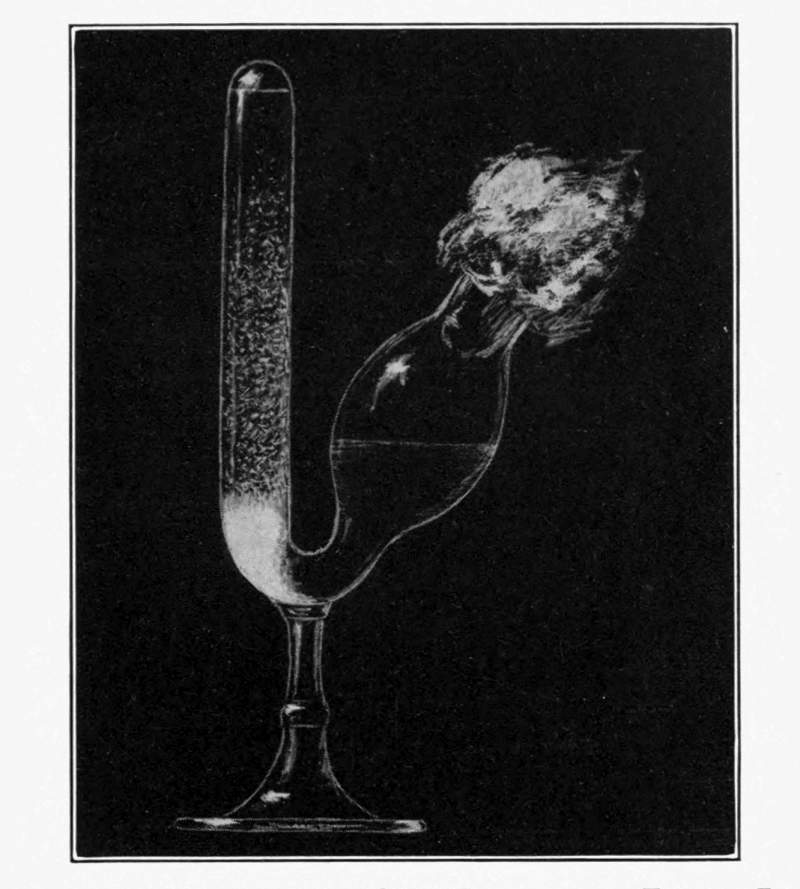
Glucose Bouillon Culture in Smith Fermentation Tube at Four Days. Culture Grown at Room Temperature (20° to 25° C.). Growth Confined Entirely to Closed Arm, with Gas Collecting at Top.
A more extended study is now being carried on in the Biochemic Division of the chemical changes which take place in hams during the process of souring, together with a further study of the chemical changes which result from the growth of the bacillus in the egg-pork medium. The results of this investigation will be given in a later paper.
The bacillus described in this paper belongs to the class of putrefactive anaerobes, which are widely distributed in nature in dust, soil, and excrementitious matters. This group of bacteria contains both pathogenic and nonpathogenic forms. The former have received considerable attention, but the latter have never been thoroughly cleared up. The bacillus isolated from sour hams belongs in the latter category, being possessed of no pathogenic or disease-producing properties. It occurs in the dust and dirt of the packing house and finds its way into the hams in the various manipulations to which the hams are subjected.
The bacillus described in this paper does not seem to correspond with any forms heretofore described. It differs from Klei bacillus (Bacillus fœdans) in the following important particulars:(1) It forms large terminal spores, whereas Klein’s bacillus formed no spores;(2) it will grow at a temperature of 34° F., while Klei bacillus did not grow below 50° F.;(3) it produces an acid reaction in culture media, while Klei bacillus gave a distinctly alkaline reaction;(4) it will grow on the ordinary nutrient media—gelatin, agar, and broth—without the addition of glucose, while Klein’s bacillus did not;(5) it peptonizes the casein in milk, whereas Klein’s bacillus had no action on milk; (6) it liquefies gelatin more rapidly, causing complete liquefaction after three weeks at 8° to 10° C., whereas Klein’s bacillus caused only partial liquefaction after eight weeks at 20° C.;(7) it can be conveyed
from turbid broth cultures to new culture material by means of the platinum loop, whereas Klein’s bacillus could not be thus conveyed.
For the bacillus described in the present paper the following name is proposed:Bacillus putrefaciens.