PERMISSION TO RESUME.
Reading edition
It having been decided by the conference of building trades that work might be resumed by any contractor on or before June 1st, and the Master Masons' association having approved of the platform of principles and adopted rules for the government of its members, the executive committee of the Master Masons' association adopted the following form of notification for its members of their readiness to resume work and their willingness to adhere to the principles approved by the association at its last meeting:
Joseph Downey, President Master Masons' Association—Sir: We are ready to start work, and hereby agree on our honor to abide by the rules and platform adopted by the Master Masons' association.
____________________________
In pursuance of this action a number of contracting masons notified President Downey of their readiness to resume work, and they were given permits for the purchase of building material, the following form being used:
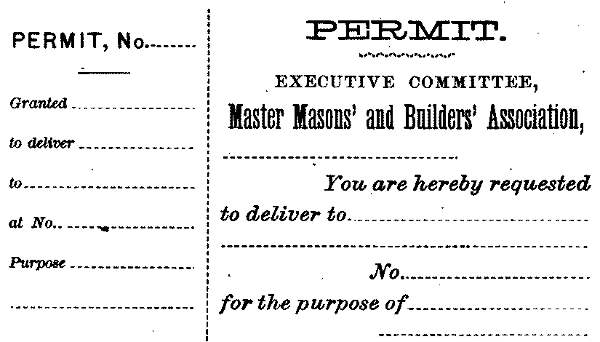
This form of permit was continued in use to contractors who were not members of the Master Masons' association. A different course was pursued with members, who were required to sign a request for a general permit, the form of the request being as follows:
Chicago, May 24th, 1887.
Executive Committee Master Masons' Association.
Gents:—I hereby make application for permit to resume work, and I agree on my honor to adopt the rules and platform as passed by the Master Masons' and Builders' Association, May 23d, 1887.
Hermann Mueller.
Upon the presentation of such an application to the executive committee a general permit was issued, which was in form as follows:
Master Masons' and Builders' Association.
Chicago, May 24th, 1887.
Hermann Mueller.—In consideration of your signing an agreement to adhere to the Platform and Code of Working Principles adopted by the Master Masons' and Builders' Association May 23d, 1887, you are hereby granted a permit to resume work.
Joseph Downey, President.
In attempting to resume work the mason contractors were disposed to give preference to such bricklayers and stonemasons as had been working in Chicago, and who evinced a willingness to return to work under the code of principles and the rules of the association which had been adopted. A few workmen took advantage of the proposition at once, and went to work, but fear of fines by the union and assaults from the members of the union, deterred a great many from going to work who were perfectly willing to subscribe to the principles enunciated. The leaders of the strikers announced that under no conditions would the union accept the offer of 45 cents an hour and nine hours a day.
By May 25th more than one thousand of the union bricklayers had left the city and were working in outside towns ten hours a day for $2.50 to $3 pay, rather than accept the offer of the Master Masons.
Not being able to secure a large number of the home workmen the Master Masons' caused to be published in important towns in Illinois, Indiana, Wisconsin, Michigan, Ohio and Missouri, a notice that there were wanted in Chicago one thousand bricklayers who would be given steady work at 45 cents an hour and would be guaranteed protection. They did not expect that the whole number would be secured, as it was the busy season for building everywhere, but they looked for a sufficient number of responses to meet the immediate demand.
In this they were disappointed. The experience of outside bricklayers in Chicago had been of an unsavory character, and they respectfully declined to advance upon the city in a body. A few bold fellows made their appearance, but they numbered less than one hundred. Many of those who went to work were put under police protection in order to keep the strikers from committing depredations.