I NAPOLEON (continued 3)
Reading edition
While endeavouring in this way to hoodwink Chichagof, they made all necessary preparations for the passage of the river at Studyanka. The presence, however, of a division of the enemy on the far side of the river caused them to doubt seriously whether the Russians would fall into the trap. They expected every minute that the Russian guns would open fire on the workmen engaged in building the 162bridge. Even if the enemy had delayed until dawn the work would not have been sufficiently far advanced, and the opposite bank, which was low and marshy, was only too well adapted for opposing the passage.
Napoleon was aware of this, and when he left Borisof at ten o’clock in the evening he prepared for the last desperate stroke. He halted with the 6000 Guards which remained to him at Staro-Borisof in a house belonging to Radziwill. He did not go to bed that night, but was continuously on the alert, listening and making inquiries as to the movements of the enemy. In his anxiety he was haunted by the idea that the night was drawing to a close and dawn about to break. His attendants had great difficulty in assuring him that this was not the case. He went out to wait in a little hut on the banks of the river.
“Well, Berthier, how shall we get out of this?” he said to the Chief of the Staff, who was continually with him. In a quiet moment, when Napoleon was sitting in a room of the hut, they saw the tears rise to his eyes and course down his pale cheeks, paler now than ever.
The King of Naples openly expressed his doubts as to the possibility of effecting a crossing, and in the name of the army begged the Emperor to think of his own safety.
“There are brave Poles ready to escort the Emperor; they will take him up along the banks of the Beresina and will get him to Vilna within five days.” Napoleon hung his head in sign of refusal, but said nothing.
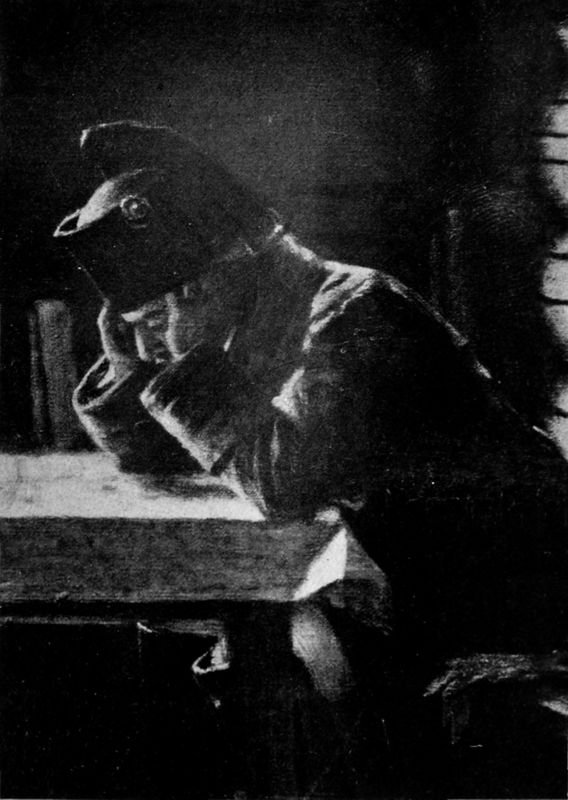
Despair.
Hardly had the first piles of the bridge been driven when Marshal Ney and the King of Naples came running out of breath to the Emperor, crying that the enemy had abandoned their position on the other bank. Napoleon, beside himself with delight, and unable to believe his ears, ran to the river—it was indeed true! In an ecstasy of joy, he 163cried breathlessly, “Then I have deceived the Admiral!” And the Russians were indeed in the fullest sense of the word deceived. Their officers did not consider the work that had been going on at Studyanka for forty-eight hours as worthy of any attention. The carelessness and incautiousness of the French served to convince Admiral Chichagof that they meant to cross lower down the river, and he accordingly moved the whole of Chapletz’s corps, which was stationed opposite the bridge then in course of construction at Studyanka, and which could of course see and hear the work that was proceeding.
Admiral Chichagof was an excellent type of the crafty courtier. He had gained his promotion by the accident of interest and favour; he was proud, bold, and overbearing. Most aptly did Krylof characterize him in the fable of the pike that went mouse-hunting. The Jews sent out by the French, and the demonstration at Ukholda, firmly convinced him that the crossing was to be effected below Studyanka, and in spite of all reports of the progress of the works at that point, he drew off the whole division to the very last man.
Napoleon, however firmly he might believe in his lucky star, could scarcely have counted on such simplicity, and the French are right in saying that the historian will have to solve an interesting problem; how was it that a demoralized and exhausted army, hemmed in on every side by an enemy incomparably superior in numbers, who literally had only to put out their hand to seize their prey, found the way left open before them? The Russians retired—there were no obstacles, and the French army was allowed to retreat in peace along a route that was neither burnt nor devastated. Whatever the cause may have been—whether carelessness, misunderstanding, or indolence—the 164retreating army owed thanks to Heaven that among its enemies there was at least one stupendous fool.
Ségur graphically describes his own impressions and Napoleon’s feelings at this time. “Every stroke of our sappers’ axes which had been ringing in the adjacent woods for a whole day must have been heard by the enemy. We expected that at the first rays of dawn we should see the Russian battalions and guns drawn up before the frail construction which General Ebler had erected, while eight hours’ work were still wanting to complete the bridge. No doubt, we thought, the enemy is waiting for daylight in order to train his guns with more effect. Day broke, and our eyes beheld the camp-fires abandoned, the river-bank deserted, and in the distance, on the heights, thirty guns—moving away.
“A single cannon-ball would have sufficed to demolish our only hope of safety. But their artillery was retiring before our very eyes, moving further and further into the distance, while ours was at the same time being brought into position.
“Far away we could see the end of the long Russian column retiring to Borisof—they had but to look round. An infantry regiment of twelve guns remained, but scattered about, and evidently with no intention of interfering with us; while at the edge of the forest we could see a detachment of Cossacks—the rear-guard of Chapletz’s division, 6000 strong—withdrawing so as to leave the road open to us.
“The French simply could not believe their eyes. At last, delirious with joy, they began cheering and clapping their hands. Rapp and Oudinot ran in to the Emperor—‘Your Majesty, the enemy have struck their tents and abandoned the position!’—‘Impossible!’ answered the 165Emperor; but Ney and Murat in their turn came running up to confirm the news. Napoleon rushed out of his hut, looked, and saw the extreme end of Chapletz’s column in full retreat just disappearing into the woods.”
By one o’clock the Cossacks had completely abandoned the bank, and the bridge for the passage of the infantry was finished. Legrand’s division immediately crossed with its artillery before Napoleon’s eyes, to loud cries of “Vive l’Empereur!” Napoleon had been hurrying on the work, and he now assisted the passage of the artillery by his encouraging words and example of cheerfulness. When the foremost troops at last reached the further bank, he could not forbear from crying out—“My lucky star, again my star!”
Chichagof to his first mistake added yet another, into which no intelligent sergeant-major would have fallen, and which is really beyond forgiveness. Zemlin lies on the far side of the river in the middle of an extensive marsh, over which passes the Vilna road. The latter is constructed on a causeway of twenty-two wooden bridges, which the Russian general could and ought to have burnt before he retired. Combustible materials had indeed been put under them for this very purpose, but no one took the trouble to set fire to them. If Chichagof had been less self-confident he would at least, in withdrawing to Ukholda, have ensured the impossibility of the passage of the river at Studyanka by ordering the Vilna road to be destroyed. The French army would have been irretrievably lost, and all their labours and sacrifices at the passage of the Beresina would have availed them nothing, for the deep marshes which surround Zemlin would inevitably have stopped them.
The crowding, jostling, confusion, fighting, and killing which took place at the passage of the Beresina, according 166to the testimony of those who witnessed the scene, defy description. All rushed like madmen for the bridges; no one was master of himself, a universal frenzy possessed the whole army. They hewed a passage with their swords or whatever weapon they possessed, and hurled down every obstacle in their way. The word “Emperor,” which a month before had been one to conjure with, had lost its magic. Caulaincourt, the great Master of the Horse, was hustled and jostled, almost knocked from the saddle, before he managed with infinite difficulty to get the Emperor’s horses and carriages over.
By the evening the Russian guns (of Witgenstein’s army) were in position, and opened fire on the masses of soldiers who covered the banks and the bridges. It is difficult, nay impossible, to paint the scenes of horror, of butchery, which were enacted under the fire of the Russian batteries. The terrified troops were so closely huddled and packed together that every shot told with fearful effect. With the cries of despair which rang out on every side, with the groans of men and the neighing of horses as they fell and were trampled under-foot, mingled the ceaseless shrieking of the cannon-balls, the booming of the guns, the rain of lead upon wagons, carriages and caissons, broken, shattered and dispersed, their flying splinters still further adding to the slaughter. It was a scene of horror beyond the power of words to paint.
At last night put an end to the massacre. Some portion of the 9th Army Corps managed to cross the river, but the greater part was destroyed. The whole of General Portuneau’s division laid down its arms; it had lost its way, blundered among the Russians, and been surrounded. Marbot declares, but it seems improbable, that the general was accompanied by a guide from Borisof, who 167endeavoured to explain with all the expressiveness at his command that the camp in front of them was a Russian camp; but, having no interpreter, they did not understand him. The result was that the French lost from 7000 to 8000 men. There is no proof of Napoleon’s grave accusation that, to judge by report, “the commander lost his division because he took an independent line.”
By eight o’clock the next morning the bridge destined for the horses and wagons was broken, and the baggage and artillery proceeded to occupy the other bridge. This was the signal for a regular battle, in the truest sense of the word, between the infantry and cavalry. Many fell in this struggle, and still more at the beginning of the bridge, where the path was so blocked with the bodies of men and horses that the troops had literally to pass over heaps of dead.
“The last to cross was Gérard’s division, who made their way at the point of the sword, after clambering over the pile of corpses which cumbered the road. They had hardly reached the further shore when the Russians charged down after them; and the French immediately set the bridge on fire, thus sacrificing all that remained on the left bank, in order to prevent the Russians from crossing.”
Those who had not succeeded in getting across were mad with terror. Many endeavoured to dash over the burning bridge, and to avoid being roasted alive were forced to leap into the river, where they were drowned.
Thousands of fires lined the heights occupied by the Russians, while in the valley beneath, by the bank of the river, tens of thousands of wretched men were dying or preparing to die, without food or shelter. There was nothing but the sound of their moaning to tell that these hosts of men lay there, still breathing, in the darkness.
168“Much has been said,” writes Marbot, “of the disasters of the Beresina; but no one has yet said that most of them might have been avoided if the staff had better understood its duties and availed itself of the night of the 27th and 28th for the transport of the baggage and of all those thousands of men who next day blocked the way across the river. That night the bridges were empty; not a soul crossed them, though within a hundred paces one might have seen by the light of the moon a rabble of more than 50,000 men of all sorts, stragglers from their own regiments, who went by the name of ‘broilers.’ These men sat calmly by their enormous fires cooking their supper of horse-flesh, unconscious that the passage of the river must cost many of them their lives on the following day, while at that very moment they might be crossing at their leisure and could cook their supper in safety on the other side. Their conduct is not to be wondered at, for no officer came from the Emperor, no aide-de-camp from the staff, nor from any one of the marshals, to warn these poor wretches, or, if necessary, to drive them by force to the bridges.
“Had the authorities borrowed a few battalions from Oudinot’s corps, or from the Guards, who still maintained discipline, they might easily have forced all these masses to cross the bridge. In vain did I urge, as I passed the Head-quarters Staff and that of Marshal Oudinot, that the bridges were lying idle, and that all these unarmed troops should be made to cross while the enemy remained quiet. I received only evasive replies, and found myself referred from one to another.”
The battle of the Beresina may be regarded as having decided the fate of the Grande Armée—the magnificent force that had once caused Europe to tremble.
It has often been said that the destruction of the French 169army was due to the cold; but, as we have seen, many other causes were at work. The 2nd and 9th Army Corps kept perfect order, though they had to endure much the same cold as the main army. The chief cause of the débâcle was hunger, followed by rapid and ceaseless marches and bivouacs without sleep or rest; and lastly, the cold when it became very intense. We must not, however, forget the steadiness and endurance of the Russian troops. Napoleon and the whole of the French army were astonished by the fact that at “the great battle,” though there were hosts of Russians slain there were no prisoners. As for the horses, they sustained the cold very well so long as they were fed; and they too perished chiefly of hunger and fatigue.
Kutuzof, as has been said, was not alone responsible for Napoleon’s escape from Russia. The Russian Commander-in-Chief took a thoroughly sound view of the position of the French Emperor; and in this connection his conversations with one of his prisoners, a man occupying a high rank in the administrative branch of the French army, are full of interest. Kutuzof told him that he had thoroughly studied Napoleon’s character, and was sure that when once he had crossed the Niemen he would be tempted to extend his conquests indefinitely. “We have given him plenty of space to exhaust and dissipate his army, to give strategy, famine, and frost free play. What blindness is it that has prevented Napoleon alone from recognizing the trap that was so evident to everybody else?”
The Field-Marshal expressed astonishment at the ease with which Napoleon had been induced to stay in Moscow and encouraged in his absurd hopes of concluding an honourable peace, when he was helplessly caught in the toils.
170“Napoleon’s intelligence,” he remarked, “has deteriorated—the whole campaign shows that. It is a pity he did not think of going further than Moscow, we would have given him another 5000 versts to conquer.”
He admitted that it would have been hard to imagine anything more dangerous for Russia than Napoleon’s original plan of remaining in Smolensk, covering Poland, and renewing the war in the spring. But he was convinced that the plan did not originate with Napoleon himself, for he was too much accustomed to short campaigns to devote two whole years to the conquest of a single empire. “One must know but little of Napoleon,” said Kutuzof, “to imagine him capable of the patient execution of an enterprise demanding time, caution, and tedious elaboration of detail.”
“When I left the Field-Marshal,” says this French officer, “he expressed the conviction that Bonaparte would inevitably be crushed at the passage of the Beresina.”
Beyond the Beresina, the retreat became more disastrous than ever. It was a headlong flight in which there was no longer any pretence of order. The fugitives behaved, in the most literal sense, like wild beasts. Muravyof, Fenschaw, Chichagof, and many others affirm that they saw the French devouring their dead comrades. They often found them in outhouses seated round a fire on the bodies of the dead, cutting out the best portions to roast and eat. When, on one occasion, a Russian officer expressed his horror and disgust, one of these cannibals replied with perfect equanimity, “Of course this stuff isn’t very nice, but at any rate it’s better than beastly horse-flesh.”
In the hospital at Minsk the French convalescents, for want of tables, played cards on the dead and stiffened 171bodies of their comrades, and the walls of the room were ornamented with the bodies of the dead dressed in fantastic costumes and with their faces daubed, by way of jest, with coal and brick-dust.
Fuel was so scarce that even the Viceroy Eugène, for instance, had to make shift without a fire. It is said that on one occasion, in order to scrape together a few billets of wood, his attendants had to remind the Bavarians that Prince Eugène was married to their king’s daughter, and consequently had a right to command them!
To make matters worse, on the far side of the Beresina, and during the first stages of the retreat, the arrival of the fugitives came as a complete surprise to the towns and halting-places along the road. At Vilna, for instance, there was a supply of flour for 100,000 men for forty days, exclusive of the corn in the granaries; there was meat for 100,000 men for thirty-six days, unkilled; beer and brandy in still larger proportions; 30,000 pairs of boots; 27,000 rifles, and an immense quantity of clothing, ammunition, saddlery, harness, and equipments of every kind. The officials, however, having received no instructions, did not dare to make an immediate distribution of these stores. They waited so long that the greater part of the supplies fell into the hands of the Russians, who followed close upon the heels of the French.
Vilna was, like Smolensk, a sort of Promised Land in the eyes of the soldiers. Here, they thought, they would be able to eat their fill at last and enjoy at least some rest from their flight. But they were disappointed in their hopes, and forced to continue their flight without a pause. The town was nothing but a plague-stricken cesspool. Thousands of corpses lay unburied, simply flung out of the 172houses into the yards, where the invalids also lay, forming a confused mass of sick and dead.
Most of the houses in the town were turned into hospitals, crammed full of sick and wounded. As soon as the French left Vilna the house-owners, who were Jews, stripped the sick of all their money and clothes and turned them, stark naked, into the streets. The Russian authorities, including the Emperor Alexander himself, were obliged to take stern and vigorous measures for housing the wounded and relieving their sufferings.
A few miles beyond Vilna is a steep hill, which was at that time covered with ice. It gave the French baggage as much trouble as the Beresina. In vain did the horses put forth every effort to surmount it—the French saved hardly a gun or private carriage. At the foot of the hill they were forced to abandon the whole of the artillery of the Guard, the Emperor’s baggage, and the army treasure-chest.
As the troops went by they smashed open the carriages and took the most valuable of their contents—clothes, furs, and money. Many poor wretches dying of hunger were to be seen covered with gold; articles of luxury of all kinds were strewn upon the snow. The plundering was only stopped by the appearance of the Cossacks, who swooped down and seized all the booty that remained. One of the officers gives us an account of the retreat from Vilna and of this last disaster—which, if we may trust eye-witnesses of the scene, might have been avoided, inasmuch as there was an easy road round the hill. “We passed out in silence, leaving the streets covered from end to end with soldiers, some asleep, some dead. The courtyards, the galleries, and the steps of the buildings 173were covered with them, but none were willing to rise and follow us, nor even to stir at the summons of their officers.
“We arrived at the foot of a hill, the ascent of which was rendered quite impracticable by reason of its steepness and the ice with which it was covered. All around lay Napoleon’s carriages and baggage, which were abandoned at Vilna, together with the army treasure-chest.
“It was decided to entrust the salvage of the Imperial treasure to the escort. As there was about five million francs, principally in silver écus, they had to distribute them at random among the soldiers. Many, seeing that they could not possibly keep up with us, made free with what had been entrusted to them. The flags which had been taken from the enemy, and which had no further interest for the troops, were shamefully thrown away at the bottom of the hill, as well as the famous cross of Ivan the Great—a trophy which we had set our hearts upon carrying away! The Russians, who are generally regarded as barbarians, subsequently afforded a most noble example of moderation such as is rarely displayed after victory.
“New-comers kept increasing the number of the plunderers, and it was indeed an edifying spectacle to see these men dying of hunger, and at the same time loaded with such quantities of treasure that they could move only with difficulty. On every side lay open trunks and broken chests. Gorgeous gold-embroidered court dresses and rich furs were donned by persons of the most repulsive exterior. Sixty francs were offered for a Napoleon d’or, and ten crowns was the price of a glass of brandy. One of the Grenadiers in my presence offered a cask of silver coin for sale; it was finally bought by one of the principal officers, who took it away in his sledge.
174“All the soldiers, turned second-hand dealers, were selling their plunder to those who had looted the treasure-chests. Their conversation turned exclusively on bullion and jewellery; every one had plenty of silver, and no one a rifle. Is it surprising that the mere appearance of the Cossacks was enough to inspire the fugitives with terror? Nor were they long in coming upon the scene.” An eye-witness tells us that on this occasion the lust for gold abolished all distinction between the bold and the timorous, between friend and foe, and that the Cossacks set to plundering side by side with the French!
At this point the most terrible frosts overtook the fugitives. Even the discipline of the Guards was destroyed; and when the drum summoned them to march, this brave army of tried veterans, the last hope of the army, refused to leave the camp-fires and fall in. Reproaches, entreaties, and menaces sufficed to persuade some; others did not stir—they were frost-bitten, for even the fires were not enough to save them from the cold.
Even for so high an officer as Murat the Grenadiers refused to fetch firewood or snow for water, lest, as they expressed it, they should be “nipped on the way.”
On one occasion the whole of the 4th Army Corps refused to move, and it was only by the most vigorous persuasion that the Duke of Neufchâtel induced them to stir out of the room,—for one roomful constituted the whole of this corps of the Grande Armée!
As for the rear-guard, it was no longer in existence. The result of the campaign was the complete annihilation of an army of nearly half a million men. The whole of the artillery, consisting of 1200 guns and caissons, fell into the hands of the enemy, together with many thousands of wagons and officers’ carriages, and an enormous quantity 175of warlike stores and provisions. According to official accounts, 253,000 bodies were burnt in the provinces of Moscow, Vitebsk, and Mohilef, and 53,000 in Vilna and its immediate neighbourhood. More than 100,000 men were taken prisoners. Within historical memory, from the time of Cambyses to the present day, there is no parallel to such a disaster affecting so great a host.
To return once more to Napoleon—it should be said that after the passage of the Beresina he had but one thought—how best to return to France, collect a fresh army, and if he could not induce his allies to keep faith with him, at any rate prevent them from immediately joining forces against him. His intention of leaving the army and proceeding direct to Paris was kept a profound secret, although some of those nearest to him knew, and for the most part approved, the plan. They saw, in fact, no hope of rescue except in the organization of a new army of half a million men.
For some time previous to the Emperor’s departure from the army he, too, suffered extreme discomfort and even privation. The soldiers occupied filthy, foul-smelling huts close to his head-quarters, and it was necessary to use force to repel them. The bread baked for Napoleon at this time consisted of black rye loaves; the meal was badly ground, the dough had hardly risen, in addition to which it had a disagreeable musty smell.
In the little town of Zanifka the head-quarters were established in a small, two-roomed hut. The back room was occupied by Napoleon, the front apartment by his suite, who disposed themselves for sleep packed side by side so closely that the Emperor’s valet could not avoid treading on their legs and arms. At Smorgoni the Emperor was stationed at head-quarters for the last time. 176He there made his final arrangements, and wrote his last bulletin, No. XXIX., filled, as usual, with half-truths and glaring falsehoods. In this bulletin he attributed his disasters to fortuitous circumstances, explaining that they might soon be repaired by vigorous action.
“More than 30,000 horses,” he says, “fell within a few days. Our cavalry had no mounts, our artillery and transport had no beasts of draught. We had to abandon or destroy a large number of our guns with their appurtenances. The enemy, coming upon these traces of the French army, were encouraged to surround our columns with Cossacks, who cut off all straggling baggage and wagons like Arabs in the desert. This wretched (méprisable) cavalry, whose strength lies in noise alone, and which could not seriously attack a company of riflemen, was rendered formidable by circumstances. However, we caused the enemy to regret every serious attempt they made against us.”... “Horses and necessaries of every sort,” he continues, “are beginning to pour in. General Boursier has more than 20,000 horses in various depôts. The artillery has already repaired all its losses.”
Every precaution was taken to prevent any knowledge of Napoleon’s intention of leaving the army from leaking out until the last moment. But the presentiment of the coming disaster was in the minds of every member of his suite—every one wished to accompany him and escape from this living hell as quickly as possible.
“In the evening the chief officers of the army were summoned together,” says Ségur. “The marshals appeared. As they entered Napoleon took each of them aside and revealed his project, sparing neither arguments nor expressions of confidence and affection.
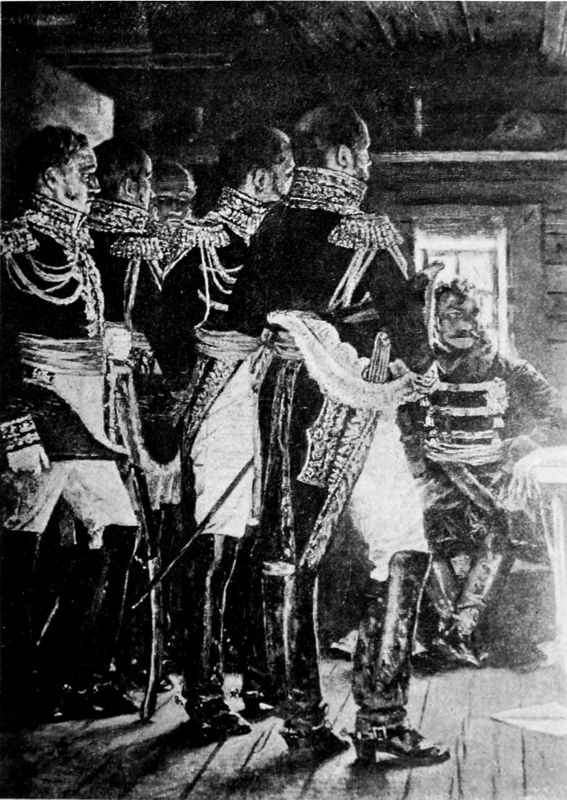
At a Council of War.
“When he caught sight of Davout he went to meet 177him, and asked whether he was vexed with him. Why did he not see more of him? To the Marshal’s reply that he seemed to have fallen under his displeasure, Napoleon, accepting all his explanations, expounded in detail his intention of departing, and indicated the direction of his route. He was genial and affectionate to all. At table he praised all for their admirable conduct in the course of the campaign. ‘As for himself,’ he said, ‘it would have been easier, no doubt, to avoid mistakes, had I been a Bourbon.’
“When dinner was over Napoleon told Prince Eugène to read out Despatch XXIX., and explained publicly what he had before spoken of in confidence. That night he would leave with Duroc, Caulaincourt, and Lobau for Paris, where his presence was essential both for France and for the remains of the army. Only from Paris could he keep his thumb on the Austrians and Prussians, who would no doubt hesitate to declare war against him if they saw that he was once more at the head of the French nation, and an army of a million soldiers!
“He stated that he was handing over the chief command to the King of Naples. ‘I hope,’ he added, ‘that you will obey him as myself, and that there will be no differences among you.’”
Nobody, of course, raised any opposition. Marshal Berthier, without endeavouring to dissuade Napoleon, merely announced that he must be included in the number of those who were going. This request drew upon him a very severe rebuke. Napoleon loaded him with reproaches for preferring such a claim; reminded him of all the kindnesses and benefits he had received at his hands, and finally called upon him to change his mind and submit, or return at once to his estate in France and await the announcement 178of his punishment for rebelling against the will of the Emperor.
At ten o’clock that evening he shook hands with them, kissed them all in turn, and issued at the front door between two lines formed by the officers of his suite, smiling pitiful forced smiles to the right and left.
Napoleon and Caulaincourt got into a covered sledge, on the box of which sat Roustan, the Mameluke, and a Polish officer, who was to be his driver. Duroc and Lobau followed in open sledges.
As soon as the news of the Emperor’s departure spread through the army, the last traces of discipline disappeared. Groups of armed soldiers had till now been gathered round the colours; but even they dispersed at last, hiding the eagles in their valises. Napoleon alone was able to maintain any semblance of order; with his disappearance, Murat and the other officers lost all authority.
“An hour after the Emperor’s departure,” says an eye-witness, “one of the senior officers turned to another with the words, ‘Well, has the ruffian gone?’
“‘Yes,’ replied the other; ‘he has played us the same trick as in Egypt.’”
Napoleon, after barely escaping capture at the hands of the free-lance Seslavin’s Cossacks, and that only by the most remarkable good fortune, arrived at Warsaw. When he had somewhat recovered from the fatigues of his journey, he gave the following explanation of the disastrous issue of the campaign—“When I left Paris it was my intention,” he said, “to carry the war no further than the former confines of Poland. Circumstances drew me on. Perhaps I was guilty of an error in going so far as Moscow, perhaps I was wrong in staying there so long as I did; but from the sublime to the ridiculous is but a step, and posterity shall 179be my judge! My French soldiers,” he added, “are worthless in the frost, the cold turns them into mere dummies.”
“During the retreat I had no cavalry, and I must admit that when the Cossacks attacked my column I found myself in a dilemma. It was impossible to mass the army together, for that would have retarded the retreat; it was equally impossible to deploy it, for the Cossacks would have broken through our line. We were obliged to continue our retreat, to fill up the gaps, and deceive the enemy. I confess that I needed all my skill and experience to escape.”
He did indeed escape, but with this campaign began the decline of his power.
180