I NAPOLEON (continued 2)
Reading edition
“On the 1st, at ten o’clock in the morning, he proceeded towards Moscow with his huge army, which had passed the night camped round the country-house he had occupied. In the evening he halted at Viazum, a village some twenty-two miles from Moscow, belonging to Prince Galitzyn, and spent the night in the manor-house. That day Napoleon drove the first eight miles in his carriage, with the Prince of Neufchâtel (Berthier). Then, as he could no longer use the carriage, for the bridge on the high-road was burned, and the road that led round by the ravine was impassable, he mounted a horse and rode the rest of the way. On September 2 Napoleon left Viazum at daybreak, and at ten o’clock in the morning he reached a manor-house which lies on the right of the high-road to Smolensk, eight miles from Moscow. There he was met by the King of Naples. He did not enter the house with him, but turned to the left into a close near the church, and there they walked alone for more than an hour, discussing the steps that must be taken for the capture of Moscow.
“Murat then, without taking his dinner, proceeded towards Moscow, and the whole of the French army with its numerous artillery followed him without a halt. Napoleon made a hasty dinner in the house, and with his attendant generals—who took their dinner outside—and a special 108body-guard, consisting of a squadron of Chasseurs and another of Polish Uhlans, under the guidance of the Russian prisoners, set off post-haste after Murat.
“Napoleon arrived at two o’clock in the afternoon at the Pilgrim’s Hill—Poklonnaya Gorà—distant some two miles from Moscow. He found the vanguard already drawn up in battle array at the foot of the hill by order of the King of Naples. The Emperor, holding in his hand a plan which was given to him, dismounted, and some of the generals who accompanied him did the same. The army was preparing for battle.
“After waiting half-an-hour without any challenge from Moscow, Napoleon gave orders to fire a gun as a signal; then, when five more minutes had elapsed, he and his staff mounted their horses and galloped at full speed towards the city. At the same moment the vanguard and the division which was posted in the rear of the centre advanced with indescribable impetuosity; the cavalry and artillery galloped at full speed, keeping step together, and the infantry charged along as fast as they could double. The thud of horses’ hoofs, the creaking of wheels, and the rattling of guns, added to the noise of running men, made a remarkable uproar. The daylight was dimmed by the dense cloud of dust which they raised! Within twelve minutes they had reached the Dorogomilof gate.
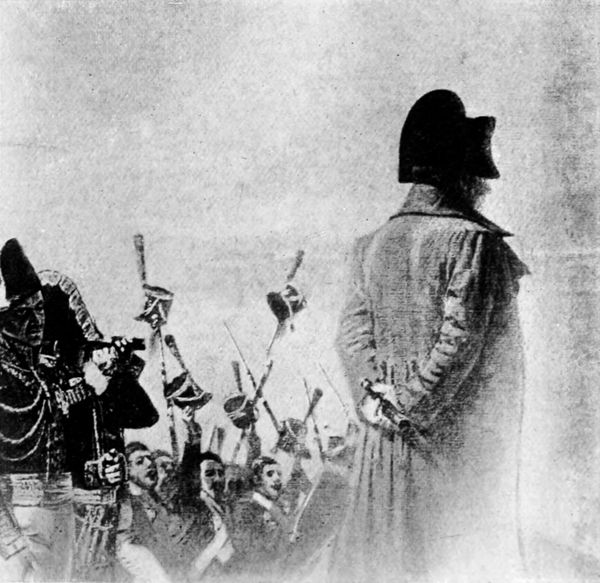
Looking Towards Moscow.
“The unexpected news that Moscow was deserted both by the Russian army and by the inhabitants seemed to astound Napoleon. He was seized with the profoundest amazement, which for the moment wrought in him a kind of ecstasy or self-forgetfulness. His tranquil and measured step at once became quick and feverish. He looked all round and about him, recovered himself, stopped in his walk, shivered, fell into a stupor, scratched 109his nose, pulled off his glove, and pulled it on again; drew out his handkerchief from his pocket, crumpled it between his hands and put it in another pocket as though by mistake, then took it out again and put it back; then he pulled off his glove once more and pulled it on again, repeating this action many times. He continued thus for a whole hour, and during that time the generals surrounding him stood motionless, like lifeless images of men, not one of them daring to stir. Then Napoleon recovered himself a little, mounted his horse and rode into Moscow, followed by the cavalry, which had hitherto stood without the gates. When he had passed through Dorogomilof Post-boy Ward and come to the edge of the river Moskva, he stopped on the right side of the street on the slope of the bank, dismounted, and began once more to pace up and down; but this time he was more tranquil.
“Napoleon and his escort lay that night in the Dorogomilof suburb in private dwellings. Of the inhabitants of Moscow none were to be seen except four stable-boys.”
The night which Napoleon passed in the suburb was a sad and dreary one. To say nothing of the bugs—and perhaps also other parasites by no means rare in Russia—he was kept awake by the gloomy reports that were continually brought in, warning him, among other things, that the city was about to be burnt. “The Emperor was uneasy and could not lie still; he kept calling his attendants and making them repeat the rumours. Apparently he could not quite bring himself to believe them, but about two o’clock in the morning he received word that the fires had begun.
“He entered Moscow on Tuesday, September 3, at half-past ten in the morning. The Arbat Ward was absolutely empty. He mounted his little Arab, dressed in his grey 110overcoat and an ordinary cocked hat, without any sign of distinction. He was surrounded by a very large suite of marshals and other officials. The various colours and the richness of their uniforms, and the many-tinted ribbons of the orders which they wore, made a most brilliant picture, and gave a certain distinction to the simplicity of Napoleon’s attire. The conqueror of Moscow rode as far as the Borovitzky gate without seeing a single inhabitant. His wrath was visible in every line of his face. He was not, indeed, at any pains to conceal what was passing in his mind.”
It was at this time that new fires broke out in many parts of the Arbat Ward, and after Napoleon had entered the Palace of the Kremlin, the Bazaar and the so-called Carriage Mart, together with a number of dwelling-houses round the Kremlin, burst into flames. Napoleon hurried to the scene, issuing orders interspersed with curses and threats against the troops and Marshal Mortier.
“The sight of the Kremlin, however,” says Ségur, “the majestic dwelling of the line of Rurik and the Romanofs, the throne still standing in its accustomed place, the Cross of Ivan the Great, and the beautiful part of the city commanded by the Palace, restored, in some degree, his peace of mind. His hopes revived; the conquest was at least flattering to his pride, and he said with some complacency, “Me voilà, enfin! Here am I at last in Moscow, in the ancient palace of the Tsars! in the Kremlin itself!” He examined everything with mingled pride, curiosity, and pleasure; made inquiries as to the resources of the town, and began to consider the possibility of making peace.”
The enthusiasm in Paris on receipt of the news that Napoleon had entered Moscow was indescribable. The only anxiety was lest he should rest satisfied with his 111laurels and not march triumphantly into India! Innumerable sonnets, epistles, odes, and eulogistic rhymes of all kinds were published in honour of the occasion.
Here are a few specimens in the original, for they would suffer by translation; we have merely left out a few descriptive passages of a purely imaginary character—
ODE À SA MAJESTÉ L’EMPEREUR ET ROI, SUR LA PRISE DE MOSCOU, PAR M. QUAYNAT.
“Elevons nos chants d’allégresse!
Vantons nos triomphes heureux!
Jadis l’Italie et la Grèce
Eurent des soutiens valeureux;
Jusqu’à nos jours, Athène et Rome
Doutaient de voir paraître un homme
Qui pût égaler leurs succès.
Maintenant, elles sont moins fières,
En trouvant les preuves contraires
Dans le monarque des Français.
* * * * * *
Ton vainqueur, témoin de ces crimes,
Moscou, déplore tes malheurs,
Et par des secours magnanimes
S’efforce d’essuyer tes pleurs;
Mais tes maux sont trop innombrables,
Sur ces pertes irréparables,
Moscou, tu gémiras longtemps.
Pleure, vingt siècles sans orages
N’effaceraient pas les ravages
Des brandons de monstres sanglans.”
Another lyric poet, Paul Chanin, anathematizes Russia in a ‘Poem on the Campaign of Russia by the United Armies of France and Germany.’
“Une nation factieuse
S’oppose au bien que nous voulons;
Son influence désastreuse
Corrompt l’air que nous respirons.
112Une île de nous se sépare!
C’est du Scythe, c’est du Tartare
Qu’elle ose appeler le secours!
Le crime de ce pacte impie,
Aux yeux de l’Europe trahie,
La déshonore pour toujours.”
And now M. A. J. B. Barjaud rises to the epic strain, in a poem entitled ‘Conquest of Moscow.’
“Le Russe espère, en vain, par un excès d’audace,
Se soustraire au péril dont ton bras le menace;
Sa bouche ose indiquer le prix du déshonneur
A ce perfide appel, la voix de la Patrie
Répond: qu’il soit marqué du sceau de l’infamie,
Le front du suborneur!
* * * * * *
Tremblant à ton aspect, contre l’airain qui gronde
Il se fait un rempart de la flamme et de l’onde,
De ses propres foyers il est le destructeur;
Mais loin de retarder ta marche triomphale,
C’est la sombre clarté de sa torche fatale
Qui guide son vainqueur.”
Next comes an ‘Ode to His Majesty the Emperor on his Entry into Moscow,’ by A. de la Garancière.
“En vain tes ennemis se flattent dans leur rage
Que leurs climats glacés dompteront ton courage;
Tu dis en contemplant tes valeureux soldats:
‘Si jamais la victoire, en caprices féconde,
Fuyait, pour m’échapper, dans un troisième monde
J’y guiderais leurs pas!’”
And M. Mazarie, in his turn, celebrates ‘The Taking of Moscow’ in “fiery stanzas.”
“Les fils aînés de la Victoire
Suivent ce héros que la gloire
A ceint du laurier des Césars;
Par lui les destins s’accomplissent,
Et dans la tombe, au loin gémissent
Les mânes effrayés des Tzars.”
113I bring these citations to a close with a verse from an anonymous ode on ‘The Campaign of His Imperial and Royal Majesty in Russia and his Entry into Moscow.’
“Lâches, où courez-vous? Quels seront vos asiles?
Ne lancez-vous les feux que sur vos propres villes?
Ah! tournez contre nous ce salpêtre éclatant.
Des coups de vos ayeux, élancés du Bosphore,
L’Europe fume encore;
Et les Parthes, du moins, fuyaient en combattant!”
“Let us see what the Russians mean to do now,” said the Emperor. “If they still refuse to enter into negotiations, we shall have to take our own course. We are provided with winter quarters now. We will show the world that our army can winter comfortably in the midst of a hostile nation—like an ice-bound ship in Arctic seas. In the spring we can continue the war—though Alexander will not compel me to do that—we shall come to terms and peace will be signed.”
Apparently Napoleon had provided for almost every contingency. One thing, however, he had not foreseen—the terrible fires that spread so rapidly in the gusty wind that prevailed on the night of his entry into the Kremlin. There was nothing to be seen on any side of the fortress but flames rising high into the air, almost, as it seemed, into the clouds.
Numbers of the inhabitants who had remained in Moscow, and who now fled from house to house in terror of the fire and of marauding soldiers, were arrested and shot, under suspicion of incendiarism.
Napoleon spent his first night in the Kremlin in a state of great excitement; abusing his soldiers, his officers, and Marshal Mortier, stamping his feet, and demanding that the fires should be stopped.
114When he was told that the Kremlin was surrounded with flames, he sent Berthier on to an elevated terrace of the Palace to see if this was really the case, but the force of the wind and the draught created by the fires was so great that the Prince and his officers had considerable difficulty in preventing themselves from being carried away.
The Emperor was stupefied at times by the strength of his emotions; his face was red and streaming with perspiration. The King of Naples, Prince Eugène, and the Prince of Neufchâtel begged him to leave the Palace, but he could not make up his mind to retreat. “These ruffians,” he said to his servant Constant, in his indignation against the incendiaries, “will not leave one stone upon another in Moscow.”
Fire broke out at last within the very walls of the Kremlin; the arsenal was found to be in flames. They found a Russian in the fortress. He was brought before Napoleon, who questioned him narrowly and ordered the soldiers to despatch him with their bayonets. He was the custodian of the arsenal!
“There is no such word as cannot in my dictionary,” was one of Napoleon’s favourite sayings. But the time had apparently arrived for incorporating the unwelcome expression, especially when Berthier represented that if he did not leave the Kremlin and Kutuzof delivered an attack, he would find himself cut off from his troops.
Napoleon resolved to abandon the Kremlin and remove to Peter’s Palace—Petrofsky Dvoretz—but the change of quarters was by no means an easy undertaking. Around the fortress swirled an eddying sea of fire closing every exit. At last the fugitives discovered a path to the river Moskva; and the Emperor with his suite and his guards 115sallied forth across the stream, only to find themselves in a veritable inferno. The officers of Napoleon’s suite wished to wrap him in a cloak and carry him through the flames in their arms; but he refused, and solved the question of the means of escape by dashing boldly forward. They had to fight their way through an avenue of fire, scorching their faces and burning their hands, which they put up to ward off the sparks and cinders that fell in a shower around them. It was fortunate for the Emperor that some soldiers, who were marauding in the vicinity, recognized him and showed him a way of escape. His hair was singed, his clothes were burnt into holes, his hands blistered, and his boots scorched.
The Prince of Eckmühl, it is said, though still suffering from the wound he had received at Borodino, as soon as he heard of the danger to which Napoleon was exposed, hurried to meet him, intending to rescue him or perish in the attempt. It is said that when Napoleon and the Marshal met they fell into each other’s arms.
The principal officers accompanied Napoleon to the Petrofsky Palace. Dumas, the Intendant-General, gives the following account of his escape—“It was night when I left the house I was proceeding to occupy. We issued from Moscow under a perfect hail of fire; the wind was so strong that it tore the red-hot iron from the roofs and hurled it down into the streets. All our horses had their legs burnt. It is impossible to describe the confusion of our headlong flight. The roar of the flames can be likened to nothing but the noise of the waves of the ocean—it was indeed a storm raging over a sea of fire. The whole length of the road to the Petrofsky Palace was littered with odds and ends of all kinds, especially with broken bottles thrown away by the soldiers. We 116bivouacked at the edge of the forest in full view of this image of the infernal regions. The whole of the huge city was a vast sheet of flame, and the heavens themselves seemed to be on fire. At a distance of two miles from the conflagration I was able to read the orders which were brought to me from the major-general.”
After a five days’ stay in the Petrofsky Palace, a period of the most intense anxiety, Napoleon returned to Moscow. It should be mentioned that from the time he entered the Kremlin, and throughout his stay at the Petrofsky Palace, he made no military arrangements of any kind. It is evident that he was so overwhelmed by the fire that he was unable to determine upon any course of action.
When Napoleon re-entered Moscow a fearful sight met his eyes. Of all the huge city there remained nothing but heaps of ruins surmounted at intervals with stacks of chimneys. A heavy stifling atmosphere hung over the fallen Colossus. Heaps of cinders and ashes, with here and there the fragments of half-ruined walls or pillars, alone marked the course of the streets.
The Emperor saw his troops scattered over all parts of the town. His own progress was hindered by the multitude of plunderers, searching for booty or dragging it away in noisy crowds. Soldiers were grouped at the entrance of every cellar, before every large house, and before the shops and churches towards which the fire was making its way. Before the flames reached these buildings the doors were broken open by impatient pillagers. The Emperor’s path was impeded at every turn by remnants of broken furniture flung from windows, and various articles thrown away by the plunderers to make room for more delicate or costly booty. Napoleon rode on in silence.
117But disorder soon reached a climax. Even the Old Guard joined in the pillage, and Napoleon resolved upon stern measures, which had a certain good effect. After returning to Moscow, the Emperor’s mood became somewhat more cheerful, and the change was reflected in his entourage. When, however, he looked out of the window upon the scene of desolation that met his view on every side, he was once more oppressed with gloomy thoughts, and his bitterness was vented on those who had the ill-fortune to present themselves at such moments. But he no longer displayed such constant signs of impatience, nor did he give rein to such furious outbursts of anger, as had marked his previous demeanour. It need scarcely be said that Rostopchin—who was, fortunately for himself, at a safe distance—and the incendiaries were the principal objects of his wrath.
Napoleon was very satirical in chronicling the fact that the Russians had celebrated Borodino as the first victorious encounter of their forces with the invader. He says in one of his despatches—“The Russians have offered up a Te Deum in thanksgiving for the battles of Ostrovnaya and Smolensk—and of course the army entered Moscow to the strains of hymns of thanksgiving.”
“At the ruffian Rostopchin’s house,” he continues, “they found rifles, papers, and a letter which he had begun—he ran away without having time to finish it. Moscow, one of the wealthiest cities in the world, is no more. This is an incalculable misfortune for the Russians, both for their merchants and for their nobility; the loss must amount to milliards. Some hundred incendiaries have been taken and shot. Thirty thousand Russian sick and wounded were burnt alive. The richest commercial houses of Russia are ruined. They were unable to take anything 118away with them; and when they saw that everything had fallen into the hands of the French, they set fire to their own ancient capital, their holy city, the centre of the empire. Rostopchin is the author of this crime. We did what we could to subdue the fire, but the ruffianly Governor had taken his precautions only too well—he had carried off or destroyed all the fire-engines and apparatus.”
As an answer to this bulletin he learned that the surprise, terror, and indignation produced in Paris by the news of the burning of Moscow defied description. It was easy to see that a despatch announcing that the soldiers were provided with shelter, food, and clothing would have reassured the Parisians far more than any news of victories.
Napoleon, however, after bewailing the treacherous welcome he had received from the city, declared—“The army is doing well; there is plenty of corn, potatoes, cabbages, and other vegetables, beef, salt meat, wine, brandy, sugar, coffee, etc., etc. The men have secured a quantity of furs and coats for the winter. One advance-guard is posted on the road to Kazan, the other on the road to St. Petersburg.”
He referred in carefully-chosen terms to the Emperor Alexander, who, in his opinion, would not have hesitated to make peace if he had but received any one of the letters sent to him—letters, by the way, of a most gloomy, melancholy character.
Napoleon expounded his magnanimous intentions to Yakovlef, a Russian nobleman who was captured when about to leave Moscow, robbed by the soldiers, and brought to the Emperor dressed in the coat of his valet. After various complaints and reproaches, Napoleon, adopting a 119much gentler tone, asked—“If I write a letter, will you consent to deliver it? Will you promise that it shall come into Alexander’s own hands? If you can promise me this, I will let you go—but are you certain that you have access to your Emperor, and can you assure me that he will get my letter?”
Yakovlef of course promised.
Napoleon got up at night on purpose to write the letter—“I have fought your Majesty without ill-feeling. A word from you before or after the last battle, and I would have stopped, and abandoned my right to enter Moscow. If your Majesty yet cherishes any kind feeling towards me, you will consider my appeal to you. Common humanity, your Majesty’s own interest and the interests of this great city, should have induced you to trust to my hands the capital which your troops had left.”
At three o’clock in the morning he despatched the letter to his prisoner, who passed with it through the French lines, delighted that his carelessness in allowing himself to be taken prisoner had had no graver consequences.
Tutolmin, the Governor of the Foundling Hospital, also had the honour of a conversation with Napoleon, of hearing from his own Imperial lips of the respect and brotherly tenderness with which he regarded the Emperor Alexander, and of his readiness to make peace. “I have never adopted this method of warfare,” said Napoleon to Tutolmin; “my troops can fight, but not burn. All the way from Smolensk I have seen nothing but ashes. Some limit must be put to this bloodshed; it is time for peace. I have no business here in Russia.”
As Tutolmin’s official duties prevented him from leaving Moscow, Napoleon begged him in his next report to the Empress—to be sent through the outposts—not to omit to 120mention Napoleon’s peaceful inclinations and his readiness to enter into negotiations.
Napoleon was very uneasy during the first few days after his entry into Moscow regarding the movements of the Russian army, which had been completely lost sight of in the confusion of the fire, the looting, and all his other troubles. He spoke very sharply to General Sebastiani, losing his temper and abusing him roundly, for not keeping an eye on Kutuzof. Imagining that frequent communication with the Russian outposts was the cause of the disorders that had occurred, he ordered Marshal Berthier to instruct Murat to forbid all communication with the enemy on pain of death. “It is his Majesty’s wish,” said Berthier, “that the only communication with the enemy should be through the medium of powder and ball.” Napoleon, however, was not the only person who was uneasy at the disappearance of the Russians. The marshals were apprehensive at one time lest Kutuzof should cut their communications.
“On the 11th September,” according to Kerbeletzky, “Napoleon, preceded by two pages and accompanied by his generals, Court officials, three Russian prisoners and a body-guard consisting of a squadron of Chasseurs and some Polish Uhlans, left the Kremlin for the first time to gaze upon the ruins of Moscow, and, also for the first time, doffed his light-grey overcoat and appeared in uniform. It might have been expected that, as his marshals and all his generals were in uniforms, richly embroidered back and front with gold, the Emperor would be distinguished by the peculiar brilliance of his attire. On the contrary, he was dressed in a plain military uniform of dark-green cloth, with a red collar, without embroidery, but with epaulettes, the star of the Legion of Honour on the left 121breast, and a crimson ribbon round the tunic. He wore a low cocked hat and a small cockade. His charger was an ordinary Polish horse, while his generals and Court officials had English horses, in a very famished condition. When Napoleon came out, many of the inhabitants of Moscow, who had drunk deep of the cup of suffering, ran away as soon as they caught sight of his numerous suite. Others, of a more daring disposition, ventured to peep stealthily from behind ruined walls. And lastly, in a street near the poultry market, a group of small burgesses, numbering about forty, whose clothes were in tatters, and whose faces, through the combined effects of fear, hunger, and cold, retained scarcely any semblance of humanity, waited till the suite approached the end of the street, then fell on their knees, stretching out their arms to the Emperor, bewailing what they had suffered, lamenting their utter ruin, and begging for mercy and bread!
“But this inhuman creature turned his horse away to the right, and merely bade his secretary learn what they wanted.
“From end to end Moscow was a scene of indescribable horror and utter desolation. The houses which had survived the fire were plundered, and the churches looted. All the pavements and side-walks were littered with fragments of chandeliers, mirrors, furniture, pictures, books, church-plate, and even the sacred ikons of the saints.”
As we have already said, when the plundering began, even the severest prohibitions scarcely availed to check the reign of lawlessness. Sebastiani, for instance, when complaints were made, was obliged to declare that he was unable to restrain his men. In the orders of September 22, Napoleon says—“In spite of all orders, the patrols neglect their duty; at night the sentinels fail to challenge 122those who pass.” On September 24 he says—“To-day the officers omitted to salute the Emperor with their swords on parade.”
“At the Kremlin,” says Constant, “the days were long and tedious.” Napoleon was waiting for the answer from Alexander that never came. Among other things his spirits were depressed by the flocks of crows and jackdaws that appeared in the city. “Mon Dieu!” he cried, “do they mean to follow us everywhere?”
Napoleon rode daily through the city, mounted on a little white Arab, and accompanied by a few generals and aides-de-camp and fifty Uhlans. He spoke to nobody while in the street. A theatre was opened for the men and officers of the army in one of the houses which were still left, but Napoleon did not visit it himself. Sometimes in the evening he would play a game of cards with Duroc. A few concerts were given at the Palace; the Italian Tarquinio, who had lately come from Milan, sang, and Martini played the piano; but the Emperor listened with a heavy heart. “Music,” observes Constant, “had lost its power over his disordered spirit.” Evidently these distractions and the rides through the streets were insufficient to counteract his gloomy meditations on the solution of the insoluble problem, how to present the utter failure of the campaign to Europe as a gigantic success, and by what stratagem to evade the inevitable.
Napoleon paraded and reviewed the Guards and the garrison in all weathers, distributing rewards and crosses of the Legion of Honour. The latter ceremony is described as follows by an eye-witness—“A fat little man marched down the steps of the Palace, surrounded by a numerous suite of marshals and generals. The band struck up, and he advanced to within some fifty paces of the front of 123the line. He wore a green uniform, and his hat was pulled right down over his evil, penetrating eyes. The ribbon of the Legion of Honour which he wore was so hidden under his uniform that it was not always visible. He sometimes made speeches on these occasions. At the announcement of the names of the newly-appointed chevaliers the band gave a flourish. To judge by Napoleon’s haughty look, he was quite conscious of his own power.”
It had meanwhile become plain that Alexander would not condescend to reply. This was a terrible insult, and Napoleon was correspondingly enraged.
“On October 3,” says Constant, “after passing a sleepless night, he summoned his marshals. As soon as they appeared, he said—‘Come in! Come in! Listen to the new plan I have thought of. Prince Eugène, read it! Burn the remains of Moscow; and march through Tver to St. Petersburg, where Macdonald is to join us, Murat and Davout to command the rear-guard.’ He gazed at his generals in a state of great excitement; but they remained impassive and silent, apparently only surprised. He tried to kindle some enthusiasm in them, and cried out—‘What! Are you not delighted at the notion? Was there ever a more glorious feat of arms? What glory we shall reap! What will the world say when it hears that we have subdued the two great capitals of the North in three months?’”
Davout and Daru tried to damp his enthusiasm by pointing out the lateness of the season, the scarcity of provisions, the bare and exposed nature of the road from Tver to St. Petersburg, a track through marshes which three hundred peasants could render impassable within a few hours! Why, they urged, go north to meet the winter so eagerly, when it was even then at their very doors? And what of the 6000 wounded in Moscow? Must they be given up to 124Kutuzof? The latter would certainly pursue, and the army would then have to act simultaneously on the offensive and defensive. The time, they added, had come to end the campaign, not to prolong it. The question was not that of securing a superfluous victory, but of getting as quickly as possible into winter quarters. They must abandon all thoughts of Kutuzof and of fighting, and retire.
Napoleon had not only to listen to this advice, he had to follow it. The time had passed when he could say of his marshals—“These people think that they are indispensable; they do not understand that I have a hundred brigade-commanders who could amply fill their places.”
The marshals clearly saw not merely the dangers of the approach of winter, but also the precarious condition of the army. From the moment of Napoleon’s arrival at Moscow, his pride kept him in a state of absolute ignorance upon this subject. He always took the army to be in the condition in which he wished to see it, and he boldly adapted his orders to this view, refusing to listen to his generals when they endeavoured to disabuse him of his error. He was resolved, indeed, to make no serious arrangements until their absolute necessity became apparent; until, in fact, it was too late.
Seeing the stubbornness of his marshals, and Russia’s unwillingness to take the hand which he had proffered too late, Napoleon showed remarkable consideration for the happiness of the two contending nations, and resolved to secure peace at any price. In vain did Caulaincourt, whom he wished at first to send as an envoy to St. Petersburg, represent that at this season of the year Russia must feel her own strength and superiority, and that any such attempt would do more harm than good, inasmuch as it would betray the difficulty of his position. Napoleon, whose chief 125fear was lest he should have to utter the word “Retreat,” resolved once more to try the charm of his own personality. He could not admit, with Tilsit and Erfurt in his mind, that this charm would be less effective in Moscow than in Paris, and resolved to send General Lauriston to Kutuzof’s head-quarters. Lauriston also ventured to submit that at this season of the year it was time, not to be negotiating from Moscow, but to be retiring to Kaluga, and that as quickly as might be. Napoleon answered bitterly that he himself was in favour of the simplest plan, and the straightest road—the high-road—and in the present case the road by which they had come; but he would not travel along it until peace had been concluded. He then showed to Lauriston, as he had showed to Caulaincourt, his letter to Alexander, bade him approach Kutuzof and request a pass to St. Petersburg. The hopelessness of Napoleon’s position was expressed at this interview in his last words to Lauriston—“I desire peace; you hear my words. Get me peace, coûte que coûte! But save my honour by any means you can!”
The “old fox,” Kutuzof, fully appreciated the necessity of keeping Napoleon in Moscow, and humoured Lauriston so cleverly that the poor envoy flattered himself with the most extravagant hopes of a speedy peace, and, what is more, inspired his Emperor with the same delusion.
The position of the French army, however, began in the meanwhile to assume a critical aspect. A desultory guerilla warfare broke out, and in order to procure forage it was necessary to send large detachments with a powerful escort of cavalry and artillery. Every measure of oats and every truss of hay was obtained by hard fighting. Then the peasants began to take part in the war. These men 126whom Napoleon had taught his troops to look upon as hereditary helots and barbarians, exhibited an unlooked-for independence, and refused to accept the favours which the foreigner endeavoured to foist upon them.
Recognizing the danger of his position, and feeling that he was being hoodwinked, yet not daring to break off his overtures to the Russian Government, Napoleon cast around for some means of making peace necessary to his adversary. He began to collect information regarding Pugachof’s rebellion, and endeavoured to procure a copy of one of the Pretender’s latest manifestoes, expecting to find in it a guide to the families that could lay claim to the Russian throne. In the course of his inquiry he was ready to turn for advice to any one whom he chanced to meet. He soon saw, however, that it would be difficult to effect anything by this means, and abandoned the idea of using Pugachof.
The Tartars were invited to go to Kazan and summon their brethren to declare their independence. They were promised support as soon as they should rise; but nothing came of this proposal. False reports of all kinds were then circulated. It was pretended that Riga had been taken by assault, that the whole length of the road from Vilna to Smolensk was covered with a train of wagons bearing winter clothing to the army, that Marshal Victor was bringing up large reinforcements, that next spring the army would be as strong and well-equipped as when it crossed the frontier; in short, that if the Russians did not make peace that winter the Emperor would adopt stern measures.
None of these reports and projects, however, came to anything. No reply was received from St. Petersburg, and the war assumed a more and more serious aspect. An 127armed band, with a priest at its head, captured the town of Vereya, near Moscow, under the very nose of the Grande Armée. Others seized two immense convoys on the high-road to Smolensk, the only route by which Napoleon was able to communicate with Europe, and with France. It was becoming clear that the great invasion was a fiasco, and Napoleon was obliged to reconsider his opinion as to the system by which the Russians should defend their country. When they were attacked in the centre they directed all their forces on the flanks, and seemed almost as if they would overpower them.
Worst of all, winter was now approaching. Napoleon at last realized the fact. He grew uneasy, and began to make unobtrusive preparations for departure.
Poor Moscow bore the brunt of his resentment. He gave orders to strip the covers from the ikons and fling them, with the censers, crosses, and plates, into the melting-pot. Two and a quarter hundred-weight of gold and six tons of silver were converted into bullion for transmission to France. In addition to this Napoleon took a number of so-called “trophies”—the arms of Moscow from the Senate House, the eagle from the gates of St. Nicholas, the cross from the belfry of John the Great. The removal of this gigantic cross cost no little time and labour. The Emperor wished to use it as an adornment for the Church of the Hôtel des Invalides. While personally superintending its removal he lost all patience with the clouds of “accursed jackdaws which hovered over the belfry as if they had a mind to defend the cross!” It is said that Berthier, the Duke of Wagram, who was standing with General Dumas on a balcony outside the Empress’ apartments while the work of removing the cross was in progress, unable to restrain his anger, exclaimed—“To think of a man doing a 128thing like this when he as good as has peace in his pocket!”[7]
Shortly before the departure from Moscow a very curious order was issued. The Commanders of Army Corps were directed to present tables showing the number of sick who could recover, (1) within a week; (2) within a fortnight; (3) within a month; and secondly, the number who would probably die, (1) within a fortnight; (2) within three weeks. Provision was to be made only for the departure of Class 1—all the rest were to be left behind. Not less extraordinary, considering the depopulated and devastated state of the country, was the order to purchase exactly 20,000 horses, neither more nor less; and to procure fodder for two months—and that in a position where even the most distant and dangerous expeditions were insufficient to procure enough forage for daily needs.
During the latter half of his stay in Moscow Napoleon’s anxieties once more gave rise to constant outbursts of temper. At his morning levées, for instance, when he was surrounded by his chief officers, he would challenge their inquiring looks, which seemed to him to be full of reproach, with his stern impassive glance; but his hard abrupt way of speaking and the pallor of his countenance showed that he knew the truth, and that it gave him no peace. He would vent his wrath at times in harsh, even cruel, reproaches, which afforded him no relief, but rather added to the tension of his feelings by the consciousness of his injustice.
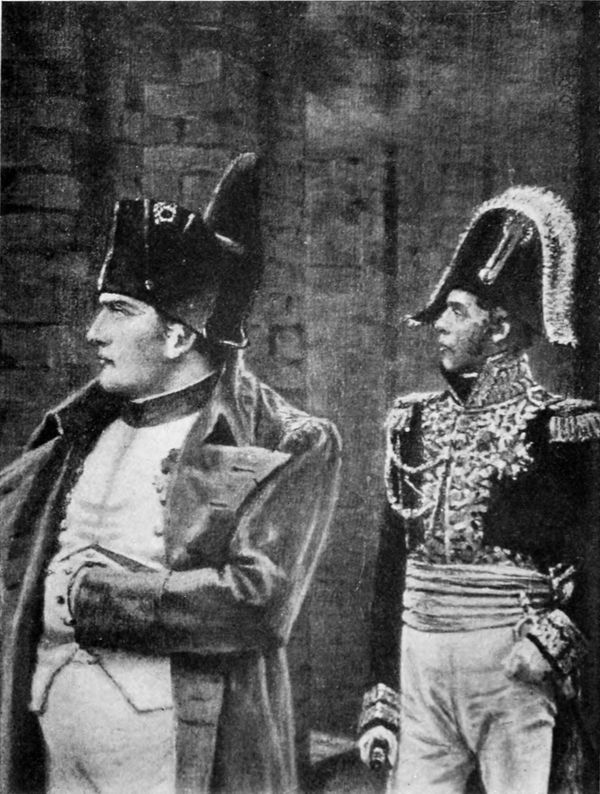
Disillusion.
It was only, according to Ségur, in his conversations with 129Count Daru during his sleepless nights, that he entirely unburdened his mind. “He wished,” he said, “to attack Kutuzof and either annihilate or drive him from before him, and then to fall rapidly back upon Smolensk.” But Daru answered that though this might have been done before, it was now no longer feasible. The Russian army, he pointed out, was stronger than ever, and his own weaker; the victory of Mozjaisk was already forgotten; and as soon as his army turned back towards France it would slip like water through his fingers, for every soldier was loaded with booty, and would hurry forward into France to dispose of it.
“Then what am I to do?”
“Stay here,” said Daru; “turn Moscow into a great fortified camp, and so pass the winter. There is plenty of ‘bread and salt’—I can answer for that. For all else, great foraging expeditions can provide. I will salt down all the horses for which there is no forage. As for quarters, if there are not houses enough, there are plenty of cellars. This will help us to last out till the spring, when our reinforcements, backed by all Lithuania in arms, will come to the rescue and help us to complete our conquest.”
At this suggestion, the Emperor was silent a while, evidently buried in thought; then he answered, “Conseil de lion! but what will Paris say? What will they do? What have they been doing these past three weeks? No one can foresee the impression which six months of uncertainty may have upon the Parisians. No; France is not accustomed to my absence. Prussia and Austria will take advantage of it.”
Napoleon was already engaged in imparting an artificial warmth to the zeal of his allies. In confirming the instructions he had before given to Schwarzenberg, and adding new ones, he did not forget to allow him “12,000 130francs per month for secret expenses; and ordered 500,000 to be paid to the account of the future;” nor did he refuse any of the rewards solicited by Schwarzenberg for his nominees. He even begged the Emperor of Austria to confer upon him the dignity of Field-Marshal, and suggested various distinctions for his army.
Schwarzenberg, requiting one good turn with another, secretly informed Berthier that the Emperor could count on him personally, but that he must not rely upon Austria.
Napoleon, however, was still reluctant to announce his intention of retreating. Already half defeated, he deferred from day to day a public avowal of the disaster that had overtaken his arms. Amid the gathering clouds of military and political disaster, Napoleon, who had always shown a morbid activity, was absolutely inert. He spent his days in discussing the merits of various odes and sonnets that had lately arrived from France, specimens of which we have given above, or in revising the regulations for the Comédie Française—a task on which he spent three evenings.
It was generally remarked that his dinners and suppers, usually simple and short, were now prolonged, and that he began to sustain his flagging energies with spirits. He grew heavy and sluggish, and would pass whole hours half-sitting, half-lying, with a novel in his hand, his eyes fixed upon vacancy, awaiting the dénouement of this terrible drama. The letter to Alexander at St. Petersburg, which he sent by Lauriston under the escort of Volkonsky, should have arrived on September 24. A reply could not be expected until October 20, and Napoleon was evidently awaiting that date. According to Constant, “the last days spent at Moscow, preceding October 18, were terribly gloomy; his Majesty seemed deliberately cold and 131uncommunicative; for whole hours together no one who was with him would dare to begin a conversation.”
Throughout this period the official sources of information, the despatches and the Moniteur, carefully concealed the truth. Thus we read—“On October 3 winter began to make itself felt in Moscow. Our troops are in quarters, and preserve the most excellent discipline. We found in Moscow all the Turkish standards taken during the last hundred years and more.”
Murat at this time sent a despairing report from the advance-guard regarding the scarcity from which they were suffering and the rapid disappearance of the remains of the cavalry. Berthier was alarmed at this information. Napoleon summoned the officer who brought the report, and so questioned and cross-questioned him that in the end he began to doubt his own information. Napoleon at once availed himself of this hesitation to support Berthier’s flagging hopes, and assure him that they were still in a position to wait, and finally sent the officer back to Murat with the full conviction that he would spread the notion in the advance-guard that the Emperor had his plans fully thought out and decided upon.
It is impossible to believe that Napoleon had entire confidence in his own optimism, for his every action was stamped with the mark of indecision. All who came into contact with him were astounded by the entire absence of his former promptitude and audacity, which had always been equal to the necessities of the moment. They recognized that his genius was no longer able to adapt itself to circumstances, as in the days when his star was in the ascendant. He was now obstinate and rebellious, and could not reconcile himself to the shipwreck of his plans. Not only his military projects, but all his other schemes—which 132the world regards as strokes of genius if they are sanctified by success, and dishonourable cunning if they fail—missed their aim and vanished in smoke. To the list of these abortive plans—besides the endeavours of which we have spoken to raise the peasants and the Tartars—we must add the miserable fiasco of the bank-notes, which he had forged to the extent of 100,000,000 roubles. It is impossible to refuse to credit the existence of these hundred-rouble notes of Parisian manufacture. Berthier, in one of his letters, laments the loss of his last carriage which contained “the most secret papers.” In this carriage was found a pièce de conviction of the most damning character—a plate for printing Russian hundred-rouble notes.
Every precaution was taken before the war to prevent the Parisian artists, who were engaged to engrave the plates, from learning the true character of the nefarious task upon which they were employed. The forgery was carried on very slowly, to Napoleon’s great annoyance; he more than once insisted upon the work being advanced more quickly. The campaign had already begun when they brought him twenty-eight cases of forged notes, and if he did not succeed in uttering them, it was only because there were no inhabitants on his road—there was no one to pay and no one to reward.
In the spring of 1812 the Duke of Bassano handed over to Frenckel, a banker of Warsaw, forged notes to the amount of 20,000,000 roubles, with instructions to circulate them beyond the Russian frontier as the French advanced. In order to facilitate this operation, a rumour was spread that when the French occupied Vilna they seized notes to the amount of many millions, but the report proved ineffectual. The merchant Nakhodkin, who was acting as Mayor of Moscow, received 100,000 roubles for his services. 133Pozdnykof, Kolchúgin, and others were rewarded in the same way, but they could not bring themselves to put the notes into circulation. Tutolmin, the honourable director of the Foundling, refused outright to accept any bribe. “It was mere maliciousness on their part,” he wrote in his report to the Emperor, “that led them to offer me forged notes, of which they had brought a great quantity, and with which they even paid the troops at Napoleon’s own order.” It was with great reluctance that the Guards accepted these notes in payment, though the forgeries were cleverly executed, and afterwards accepted in error even by the Russian banks.
Napoleon’s inactivity was infectious. It was not until October 7 that leather was distributed, by the orders of Berthier, the head of the staff, to repair the soldiers’ boots, and then it was too late. It was also too late when the slightly wounded and the convalescent, together with the trophies that had been captured, were despatched to Mozjaisk. The rest of the sick and wounded were moved into the Foundling, and French doctors were told off to attend them, in the hope that the Russian wounded who were among them would serve as a kind of protection.
Napoleon concentrated the various army corps that were stationed outside the city on the Moskva, and reviewed them even more frequently than before. The obvious weakness of the battalions was a constant source of annoyance to him, and he ordered the troops to be drawn up two instead of three deep. It is difficult to find a reason for this change, unless we assume that Napoleon was endeavouring to deceive himself and others by lengthening the lines.
During one of these reviews in the courtyard of the Kremlin, a rumour was circulated among his suite that artillery fire was to be heard in the direction of the advance-guard. 134At first no one dared to call Napoleon’s attention to the fact; but Duroc summoned up courage to inform him of the news, and all observed that the Emperor was seriously disturbed. He soon recovered himself and was about to continue the review, when an aide-de-camp from Murat came galloping up with the information that the King’s first line had been taken by surprise and routed; that his left flank had been surrounded under cover of the woods, his right attacked, and his communications cut. Twelve guns, twenty caissons, and a number of baggage-wagons had been captured, two generals killed, and three to four thousand men lost. He added that the King himself had been wounded, but he had saved the remnants of his command by means of repeated attacks on the overwhelming forces of the enemy, who had just begun to occupy the only road by which he could retreat. Murat’s report was that “the advance-guard no longer exists, for the exhausted remnant of it could certainly not survive more than one more battle with the enemy, who have become bolder than ever.”
This was on October 18. The war was being renewed, said the French—it was just beginning, said Kutuzof.
At the news of this attack, Napoleon recovered all his former energy. He issued a thousand orders, embracing the most important movements and the most trivial details, and before nightfall the whole army was in motion. At dawn on the 19th, the Emperor himself left Moscow, with a bold declaration that he was moving on Kaluga—“And woe to him who tries to bar my way.”
He left Moscow by the old Kaluga road, meaning to reach the frontier of Poland by way of Kaluga, Medyn, Yelnya, and Smolensk. Rapp, who accompanied him, observed that it was getting late in the year and winter would overtake them on the way; but the Emperor replied 135that the soldiers must be given time to rest and recover, and the sick must be moved from Mozjaisk, Moscow, and the Kolotzky monastery to Smolensk. Then he pointed to the clear blue sky, and asked if they did not see the star of his fortune in the sun above them and in the continued fine weather. “The sinister expression of his countenance,” says an eye-witness, “gave the lie direct to these words of hope and simulated confidence.”
In this instance, as in every other, it was hard even for those who were brought most closely into contact with him to decide whether he spoke from conviction or not. Considering the explicit nature of the reports that were sent in to him, it is impossible to suppose, for instance, that it was through ignorance that he so entirely misrepresented the truth as to the engagement of the advance-guard under Murat. This was the celebrated battle of Tarutina, the real beginning of the débâcle of the French army. About 50,000 were engaged and utterly routed, losing some 4000 killed and wounded, thirty-eight guns, one flag, and the whole of the baggage.[8]
Napoleon in his despatches gives the following account of the engagement—“A number of Cossacks have begun 136to make their appearance, and given our cavalry some trouble. The cavalry advance-guard, which was stationed by Vinkovo, was surprised by a mob of these Cossacks, who made their way into the camp before our men had time to mount, captured General Sebastiani’s baggage, consisting of 100 wagons, and made about 100 prisoners. The King of Naples placed himself at the head of his Cuirassiers and Carabineers and attacked a column of the enemy’s light infantry, consisting of four battalions, which had been sent to support the Cossacks, with such success that he routed and annihilated it. General Desi, the King’s adjutant, and a brave officer, was killed in this skirmish. The Carabineers distinguished themselves.”
When Napoleon learned from a new envoy to the Russian camp that Kutuzof had made no forward movement, he started for Kaluga, making a circuit round the Russian troops with the object of avoiding an engagement. We are forced to the conclusion that he only spoke of dashing Kutuzof to pieces, and opening the road before his troops, with a view to rousing the drooping spirits of his men, and distracting the attention of Europe. He must have seen that though his troops could fight in defence of the enormous booty they had taken, they could no longer win victories.[9]
137The retreating French army covered a vast extent of ground. Of the column—which consisted of nearly 150,000 men, with 50,000 horses—the 100,000 who formed the vanguard, with haversacks and rifles, 550 guns, and 2000 artillery-wagons, still recalled the warriors who had conquered Europe. The rest resembled a Tartar horde returning from a successful raid. Along three or four endless lines of march there was a hopeless tangle of carriages and caissons, of smart barouches mixed up with wagons of every description. In one place were trophies of Russian, Turkish, and Persian flags, and the huge cross of Ivan the Great; in another were bearded Russian peasants dragging along French booty of which they themselves formed part. Others were drawing wagons laden with everything on which they had been able to lay hands. They had no chance of reaching even the first étape, but their greed made nothing of 2000 miles or more. Elegant carriages passed along drawn by undersized horses harnessed with ropes. These carriages were filled with plunder and with French women, former inhabitants of Moscow, flying before the anticipated vengeance of the Muscovites. Many Russian women were also to be seen, some following the army of necessity, and some of their own free will. One might have fancied, say those who witnessed the scene, that this was some caravan of nomads, or some army of early days returning from a foray with women, slaves, and all kinds of spoil.
In spite of the breadth of the road and the cries of his body-guard, Napoleon could scarcely manage to make his way through this endless host—they no longer paid much attention to him. He pushed forward in silence, and proceeded along the old Kaluga road. For some hours he pursued this direction, but at mid-day, on the heights 138of Krasnaya Pakhra, he turned the line of march suddenly to the right and reached the new road to Kaluga in three marches across country, the movement being covered by Ney’s corps and the remains of Murat’s cavalry. Berthier’s letter to Kutuzof, received on the day of the evacuation of Moscow, descanting upon the theme of humanity and love of one’s fellows, was a military stratagem intended to throw dust in the eyes of the Russians and gain a day of undisturbed retreat.
This ruse very nearly achieved its end; but it so happened that the Russian free-lance, Figner, detected the retreat of the army and carried the news to Kutuzof, who was lying without precaution at Letashefka. The Russian general immediately moved parallel to Napoleon upon Kaluga.
There can be no doubt that if Napoleon had cared less for the preservation of his plunder and more for speed he would have arrived before the Russians; but moving as he did without haste, no faster than circumstances conveniently permitted, he made the irretrievable mistake of arriving too late.
“Never,” says Fezensac, “did the French army carry such a quantity of baggage. Every squadron was provided with a wagon for its provisions, and burnt what it could not carry without the formality of asking permission from the battalion commander.”
“The troops,” says René Bourgeois, “and especially the Guards, were laden with gold, silver, and precious things, stuffed into every possible place, regardless of the provisions. The result was that they had not got far from Moscow before the army began to want for the first necessaries of life. There were few of the officers who were not provided with furs, but the majority of the soldiers had no clothing beyond their uniforms and great-coats, 139while their boots were in a most lamentable plight.”
The French army slowly made its way to Malo Jaroslavetz. The advance-guard had already occupied the town, and the principal obstacle to their progress seemed to be successfully surmounted. Napoleon was taking his déjeuner in the open with Murat, Berthier, and General Lariboisière, when he suddenly heard artillery fire from the direction of the advance-guard. Fighting had begun at Malo Jaroslavetz. The Emperor mounted and galloped in the direction of the cannonade. The Viceroy’s aide-de-camp, who brought news that all the available forces had gone into action, received the answer—“Ride back to the Viceroy and tell him that now he has begun he must drink the cup to the dregs. I have ordered Davout to support him!”
The battle was a sharp one. Malo Jaroslavetz was captured and re-captured eleven times. The town was utterly destroyed, and the course of the streets was indicated only by the piles of corpses with which they were strewn. The houses were mere heaps of ruins, among which might be seen the limbs of charred corpses. When the Emperor reached the scene of action, he was shown redoubts which the Russians, when repulsed, had hastily constructed. The general opinion of the French was that Kutuzof would not retire, and that the action would end in a general engagement, to which the vigour of the French troops and the ammunition of their artillery were alike unequal.
“At Malo Jaroslavetz,” says Fezensac, “the advantage of the day rested with the French, but Kutuzof fell back upon a new position and strengthened it with redoubts. One of his divisions actually began to make its way round our right along the Medyn road. We were obliged either to retreat or engage in a serious battle.”
140
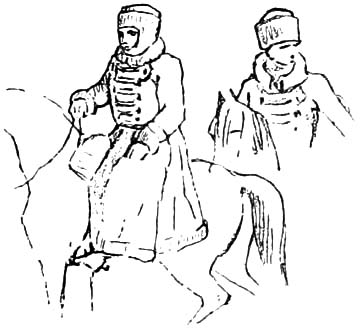
The position was extremely grave. In the village of Goròdnya, on the road to Malo Jaroslavetz, a Council of War was summoned to consider the question. Marshal Bessières and the other generals were of opinion that they must retreat—not that they were doubtful of victory, but they dreaded the losses that must ensue, and the probable demoralization and disorganization of the army. The cavalry and the artillery horses were worn out with work and want of food, and it was impossible to replace those that were lost. How were they to transport their artillery, their ammunition, and the wounded, of whom there would certainly be a large number? Under these circumstances the march to Kaluga seemed a very risky enterprise, and prudence counselled retreat through Mozjaisk to Smolensk. Bessières was the first to suggest retreat, and the others followed suit. Napoleon hesitated for a long time, but at last, after passing the whole day in inspecting and studying the locality and in hearing the opinion and advice of his generals, he resolved to retire to Mozjaisk, and thence to retreat along the devastated route of his advance.
In Bulletin XXII. Napoleon gave the following account of the important battle of Malo Jaroslavetz and the subsequent decision to retire—
“At Malo Jaroslavetz the Russians brought two or three armies into action, but without effect. The enemy retired in such disorder that they were obliged to throw twenty guns into the river. The Emperor rode into Malo Jaroslavetz and inspected the enemy’s position. He ordered an attack, but the enemy escaped in the night. The Emperor then returned by way of Vereya to Smolensk, 141i.e. to the road on which he had previously travelled.... The weather is brilliant and the roads are excellent. The Italian Guards have distinguished themselves. General Baron Delsome, a first-rate officer, received three bullet wounds and was killed. The old Russian infantry was annihilated. It is stated upon good authority that only the front ranks of the Russians consist of soldiers. The rest are made up of recruits and militiamen, with whom the Government has broken faith in keeping them under arms.” And so forth.
Napoleon now increased the rate of march, and reprimanded Davout continually for the slowness of the rear-guard. What this slowness really amounted to may be gathered from the report given by Platof, Hetman of the Cossacks, who followed Davout from Mozjaisk. He stated that the enemy was in flight—“no army can be said to retire under such circumstances—they abandon their wounded, their sick, and their heavy baggage by the way.”
After leaving Mozjaisk the French army passed by the plain of Borodino, on which more than 30,000 corpses had been left. At the approach of the troops, flocks of carrion-crows rose with hideous cries from the torn and mangled bodies of the dead. In spite of the cold, the latter emitted a most nauseating odour. Napoleon neither turned his head nor uttered a word, he merely quickened his step—for he was on foot.
It is said that when the Emperor’s column approached Gzhatsk they found the road strewn with freshly-slain Russians, all with their heads blown open in the same manner, by a point-blank shot, and their blood and brains scattered around. They knew that 2000 Russian prisoners had gone on in front under escort, and they understood that these were the bodies of those who could not keep 142up with the rest, and who had been shot to save further trouble. Some of the suite were filled with indignation, others held their peace, while yet others justified this cold-blooded butchery. None of those who were with the Emperor dared to express their feelings, except Caulaincourt, who exclaimed—“This is the foulest brutality! And this is the civilization which we have imported into Russia! The enemy will requite our barbarity; there are numbers of wounded and captive Frenchmen in their hands, and there is nothing to prevent them revenging themselves on us.” Napoleon was stern and silent, but next day the butchery ceased—no doubt he had taken measures to stop it.
With regard to these prisoners, the testimony of eye-witnesses at head-quarters is all to the same effect. “There was a column of Russian prisoners marching in front of us,” says Fain, “guarded by soldiers of the Rhine Federation. They flung them fragments of horse-flesh for their food, and their guards had orders to kill those who fainted by the way and could not proceed. The road was scattered with their dead bodies, their brains blown out.”
“The Baden Grenadiers,” says Rooss, “who escorted Napoleon’s baggage, had orders, if any of the Russian prisoners succumbed and were unable to proceed, to shoot them on the spot. Two of these Grenadiers informed me that it was Napoleon himself who gave the order.”
“My pen positively refuses,” says M. de B., “to describe our treatment of the Russian prisoners during the retreat, the cruelty and savagery of which it has in vain been sought to excuse by the law of necessity, and by the exceptional circumstances in which the French troops were placed.”
Labaume describes what he himself saw. “On the road 143they had no means of feeding the 3000 Russian prisoners taken in Moscow. They drove them along like so many cattle, and would not allow them to leave the narrow space allotted to them under any pretext. Fireless and frozen, they lay upon snow and ice, and in their unwillingness to die, longing to stay the pangs of hunger with any nourishment, they ate the bodies of such of their comrades as succumbed. It must be added that these were not captives taken with arms in their hands, but a rabble composed of men of every class who were found in the streets of Moscow.”
Petrofsky, an officer of noble birth, who was kept prisoner in spite of all the rules of war, gives the following account of this butchery. “Suddenly, a few paces in our rear we heard a rifle-shot, to which I at first paid no attention. A non-commissioned officer came and reported to the officer in command that he had shot one of the prisoners. I could not believe my ears, and I asked the officer to explain the statement. ‘I have written instructions,’ he replied politely, ‘to shoot all prisoners who, from fatigue or any other cause, fall more than fifty paces behind the rear of the column. The escort has received decisive orders to that effect.’ In the course of the day some six or seven men were shot, and among them was one of the civil officials. Sometimes we heard as many as fifteen shots in a day. I once saw a veteran sink upon the road from fatigue; three times the Frenchman who stopped to shoot him put the muzzle of his gun to the Russian’s head, three times did he pull the trigger—the rifle missed fire! At last he left him, and sent a comrade whose musket proved more effective. Some of the prisoners, when they saw that their end was approaching, espied a church ahead in the distance. They strove to drag themselves to the 144porch, and were there shot dead with prayers upon their lips.”
The author of this last statement, who afterwards became a count, would doubtless have shared their fate but for his deliverance by a band of free-lances under the command of Cheznyshof.
On October 31, Napoleon reached Vyazma. For the first time since leaving Moscow he wore a sable cap, a green pelisse edged with sable, and slashed with gold frogs, and fur-lined boots. He continued to wear this costume during the rest of the retreat, and when the severe frosts began, and it was impossible to sit in the saddle, he either drove in a carriage or went on foot. The infantry of the Old Guard camped round his head-quarters as before in a square, finding shelter, as far as possible, in such houses as were still standing.
The troops, who had orders to burn everything, smashed in the doors and windows of the houses and set fire to them with torches, cartridges, and even ammunition-boxes. The towns and villages were filled with the smoke of burning houses and the stench of decomposing corpses. Davout, who despaired of preserving his men under such circumstances, wrote to Napoleon saying—“It should be left for the rear-guard to fire such villages as remain.” The daily losses of the army in men and horses were greatly increased by this destruction of every dwelling on the road.
The battle of Vyazma was most disastrous to the French. Dorogomilovsky took a number of prisoners, artillery, and baggage. Napoleon, however, only informed France of the loss of a few individuals who had been captured by the Cossacks,—some engineers and topographers who were taking plans, and a few wounded officers who were marching 145without sufficient caution, running into danger instead of marching in their place with the baggage.
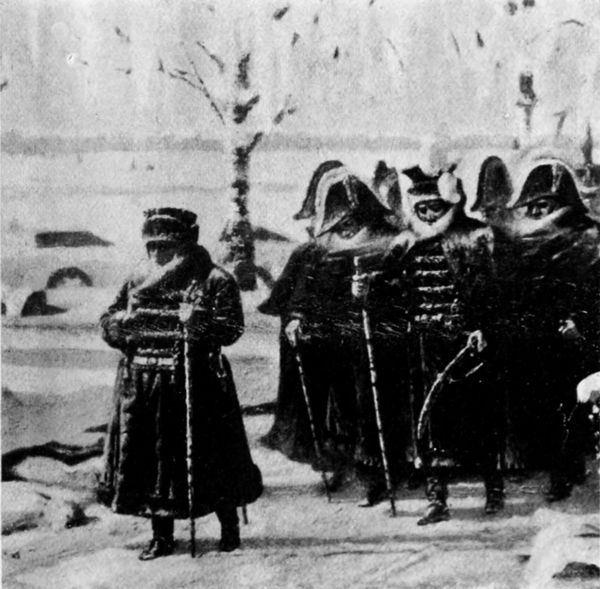
On the way Home.
“On November 6,” says Ségur, “there was a complete change in the weather, and the blue sky entirely disappeared. The French army had for some time past been moving through a frosty mist which grew constantly thicker and thicker; but on that day the mist turned into flakes of snow—it seemed as if the icy sky had united with the frozen earth. Everything took on a new and unknown form. The troops marched without knowing where they were or where they were going to, meeting obstacles at every step. While the soldiers were struggling forward against the icy hurricane, the snow, whirled up by the wind, drifted over the hollows and concealed their depth; the soldiers fell into them and were buried in the drifts, and many who were already enfeebled lay where they fell. Those who came behind them tried in vain to turn aside; the wind blinded their eyes with falling and drifting snow, buffeted and confused them, and prevented them from advancing. Their wet clothing froze upon them, and a garment of ice clung to their bodies and numbed their limbs. The strong bitterly cold wind caught their breath as it issued from their mouths and turned it into icicles on their beards and coats. Trembling in every limb they would plod on until the snow, forming balls under their feet, absolutely prevented all progress; then, stumbling over a piece of wood or the dead body of a comrade, they would fall and lie groaning and lamenting while the snow covered them up, leaving on the surface nothing but an almost invisible hillock—a soldier’s grave. The whole road was scattered with these tiny eminences, like a churchyard. There was snow, snow everywhere, as far as the eye could see nothing but a melancholy vista of snow. The effect on 146the imagination was profound; it seemed to be a winding-sheet which Nature was wrapping around the unfortunate French army! The only objects that stood out were the fir-trees with their funereal green, standing motionless and huge, their black boughs outspread, filling the heart with sadness and foreboding.
“Everything, even their weapons which had been serviceable at Malo Jaroslavetz, but were now only contemptible, hindered the wretched soldiers in their progress. They seemed insufferably heavy; when the miserable men stumbled, their muskets would fall and break or become buried in the snow. They would rise to their feet without them—not that they lost them intentionally—hunger and cold had snatched them from their grasp. Many had their hands frost-bitten, while their fingers clung stiff and numbed to their muskets.
“Then came the sixteen-hour nights. With the snow everywhere, covering everything, there was no place to lean against, to stop at, to sit or rest upon, there was no spot in which they could dig for roots to stay the pangs of hunger or obtain fuel for fires. The troops did their best to form a camp, but the wind cared for nobody, and rudely scattered all their preparations. The fir-wood was covered with hoar-frost and would not take fire, fresh snow fell from the sky, the old snow melted beneath, and even when, at infinite pains, the fire was kindled, it could not be kept alight. At last something like a fire might be obtained, and officers and soldiers began to prepare their wretched supper of scraps of lean meat from horses slaughtered or dead of fatigue, with perhaps a few spoonfuls of oatmeal soaked in melting snow. Next day a heap of frozen soldiers marked the position of the camp-fires, and all around lay thousands of dead horses!”
147On the day on which winter broke in all its horror on the unfortunate French army, Count Daru stopped the head-quarters staff on the march and made a secret communication to the Emperor. It appeared that an estafette, the first that had arrived for a whole week, had reached the army with news of Malet’s conspiracy. On the march, under the public gaze, Napoleon received the news with the utmost sang-froid, but afterwards in camp he expressed the greatest wrath.
He was still more angry at Smolensk, where the army, after all its expectations of rest, found an insufficiency both of quarters and provisions. The Emperor was simply furious. “I never saw him,” says his servant Constant, “forget himself to such an extent. He sent for the Intendant; I could hear his cries from the adjoining room. Napoleon gave orders that this officer should be shot, and it was only by grovelling at the Emperor’s feet that the wretched man managed to get off.”
The calamities of this stage of the retreat were accentuated by the fact that no notice had been received of the return of the army, and officials at Smolensk and elsewhere, taken by surprise, completely lost their heads when they saw these crowds of ravenous fugitives storming and plundering their stores without much advantage to themselves, but to the ruin of all who came after them.
The army not only obtained no respite in Smolensk, it proceeded on its march in a worse condition than ever. There is no doubt that the Emperor hoped to give his disordered flight the air of a dignified and regular retreat, for, among other things, he directed that the walls of Smolensk should be razed to the ground, in order, to use his own expression, “that they might not stand in his way 148another time;” as if, at this moment of disaster, he could have dreamt of a new invasion.
As we have already said, Napoleon rode the first part of the way in a carriage. In this vehicle, which was closed and contained an abundant supply of furs, the Emperor, who was warmly clad, did not of course feel the cold himself. Moreover, shut up with Murat in his carriage, he ran less risk of being subjected to insults from his angry soldiery, nor was he haunted by the spectacle of their famine and despair, or the sound of their clamour for bread, bread, bread!
After Smolensk he covered a great part of the distance on foot, and in the course of the march he of course had ample opportunity of assuring himself of the terrible plight of his troops, who were suffering unspeakable hardships.
The Emperor gave orders that the greater part of the ill-starred trophies, as well as a quantity of cannon and weapons of every description, should be sunk in the Dnieper and in the Semlefsky Lake. But, come what might, he wished to convey the cross of Ivan the Great to Paris, and he seems to have brought it as far as Vilna.
We have already given some description of the sufferings which the army underwent on its retreat, but the details furnished by eye-witnesses are so full of character, interest, and instruction, that I may add a few more extracts.
At every step were to be seen gallant officers, dressed in tatters, and leaning on sticks of pinewood, with their hair and beards covered with icicles. Again and again one might hear them imploring assistance. “Comrades,” cried one in piteous tones, “help me to rise, give me a hand; I cannot be left behind!” Every one passed on without even glancing at him. Misery levelled all ranks and abolished 149all distinctions. In vain did many of the officers insist upon their right to command—no one paid any attention to their orders; the starving colonel had to beg for a scrap of biscuit from the common soldier; he who had a store of provisions, were he merely a simple officer’s orderly, was surrounded by a little court of sycophants, who laid aside rank and distinction, and flattered and fawned upon their more fortunate comrade. Officers accustomed to command, and unacquainted with want, were in the most grievous plight of all—every one shunned them to avoid rendering them any service.
“À moi, mes amis! help me to rise, I am a Captain of Engineers,” cried an officer piteously. A passing grenadier stopped, “What, you are a Captain of Engineers?”—“Yes, dear friend, I am!”—“Work away at your plans then!” The road was covered with soldiers who no longer bore the semblance of humanity, and whom the enemy would not even trouble to take prisoners. Many were reduced by cold and hunger to idiocy; they cooked and ate the dead bodies of their fellow-soldiers or gnawed their own arms. Others were so weak that they could not fetch a log of wood nor carry a stone to sit upon; they seated themselves on the bodies of their comrades and turned a dull fixed stare upon the burning embers. Soon the fire would die out, and these living skeletons, having no strength to rise, would fall dead beside the bodies on which they sat. Many tried to warm themselves by thrusting their naked feet into the midst of the fire.
All the corps were mixed up: the remnants formed a number of little detachments, or rather groups, of eight or ten men, who kept together and had everything in common. Each group had a Russian horse—a conya as they called it, under the impression they were speaking Russian—for 150their baggage, their cooking apparatus, and provisions; and every member of the group had also a sack for provisions. Each of these little communities lived apart from all the rest, repulsing every one who did not belong to them. The members kept close together and did their utmost not to get separated in the crowd, and woe betide him who lost sight of his mates—he would certainly find no one else to take the least interest in him or give him any assistance.
“We were a gang of ruffians,” says Labaume, “respecting neither person nor property. Necessity made thieves and rogues of us. Without the slightest feeling of shame we stole from one another whatever we wanted. Arson, murder, and destruction of every kind were incidents of everyday life, and crime became second nature. With the same indifference with which the soldiers set houses on fire for the sake of a moment’s warmth, they would deprive a weaker comrade of all his little store for their own maintenance.”
In spite of the fearful condition of the troops, Napoleon ordered occasional manœuvres—with what result may be imagined. Such divisions as could still be made to perform any evolutions, after wandering about over snow-blocked roads, would end the day by retiring without their artillery and baggage, which had been abandoned in the ditches.
The staff encampment, according to the testimony of an eye-witness, presented a sad and pitiable spectacle. “In a wretched outhouse, with a crazy roof, some twenty officers, sandwiched with as many servants, were gathered round a little fire. Behind them stood their horses, ranged in a circle to keep off the wind. The smoke was so thick that one could hardly discern the forms even of those who were sitting close to the fire blowing up a flame under the 151cauldron in which their food was simmering. The rest, wrapped in cloaks and fur-coats, were lying side by side almost on the top of one another for the sake of warmth. They did not stir a limb, but every now and then one might hear the voice of a man abusing his comrades for moving about and treading on him, or cursing the neighing of the horses, or the sparks from the fire that burnt his coat.”
Napoleon, who now travelled for the most part on foot, clearly recognized the condition of the army, but he saw no need for giving Europe any inkling of the truth in his bulletins. “The roads are very slippery,” he says in Bulletin XXVIII., “and are difficult travelling for the draught-horses—we have lost a considerable number through cold and fatigue.” From Vyazma he wrote—“Twelve thousand Russian infantry, under cover of swarms of Cossacks, cut the road between the Duke of Eckmühl and the Viceroy. The Duke and the Viceroy attacked them, drove them from the line of march, pursued them into the forest, and took a number of prisoners, including a general and six guns. Since then we have heard no more of the Russian infantry; only the Cossacks are to be seen moving about in the distance.”
Not a word about the number of prisoners, guns, and baggage taken by Dorogomilovsky in this battle, which proved so disastrous to the French army, or of the fact that the French had by this time lost some 40,000 prisoners, about 25 generals, 500 guns, 30 flags, and, in addition to a stupendous quantity of other baggage, all the trophies from Moscow which they had not yet burnt or destroyed! If to this total we add some 50,000 who had died of their sufferings, or been killed in different engagements since they left Moscow, we may calculate that the army 152contained not more than 70,000 men, and of these, inclusive of the Imperial Guard, there were only about 10,000 able to carry arms.
Kutuzof strictly enjoined his generals not to drive the enemy to despair, and for Napoleon and the Old Guard in particular, from which he expected a most desperate resistance, he ordered them to faire des ponts d’or, reckoning that even if they survived cold and hunger they would be unable to pass the Beresina, where they would have to deal with three armies at once. This is the only supposition upon which it is possible to explain the unnecessary caution displayed by the Russian Commander-in-Chief whenever his generals showed any intention of attacking their enfeebled adversary, and making an end of him and the war at a blow. The French army—or rather the remains of it—was indebted for its escape, not so much to its prestige, as to Kutuzof and Chichagof, and especially to the latter.
In consequence of Kutuzof’s plan, the Emperor and his picked troops were not harassed on the road to Krasnoye, while Marshals Davout and Ney, who brought up the rear, were exposed to the most determined attacks.
At Krasnoye, Napoleon, after a series of vacillating and contradictory movements, once more displayed his characteristic skill and audacity. By a bold manœuvre he held the Russians in check, and gave the remains of his two divisions an opportunity of escaping.
While he was manœvring with the Guards, an indescribable mass of broken-down fugitives absolutely incapable of defence filed past him. In spite of his self-command it was evident that the sight of these destitute remnants of his once invincible troops affected him deeply. Throughout the night that followed he was unable to sleep, and 153complained that he could not bear to think of the condition of his troops. “The very sight of them,” he said, “fills my soul with horror.”
“Imagine, if possible,” says René Bourgeois, “60,000 destitutes with sacks over their shoulders and long sticks in their hands, covered with rags of the filthiest description stuck together anyhow, swarming with vermin, and absolutely starving! Add to this picture pale, cadaverous faces covered with the dirt of camps and blackened by the smoke of fires, glazed and sunken eyes, dishevelled hair, long filthy beards—and you will still have but a faint notion of the appearance presented by the army! No men had brothers, friends, countrymen, or officers. Sauve qui peut was the order of the day. We were waging a desperate warfare, each man against his neighbour; and it may truthfully be said, both in the literal and the figurative sense, that the strong devoured the weak. Wherever one turned one’s eyes they fell upon scenes of horror and barbarity. If a man was suspected of concealing provisions his comrades attacked him furiously, and snatched them from him in spite of all his struggles and curses. All day and every day one might hear the sound of dead men’s bones crunching beneath the feet of horses and the wheels of the wagons, as they were crushed into the ruts.”
In the face of these horrors one cannot but be surprised that any fraction, however small, of the Grande Armée ever managed to reach the frontier and the long-wished-for winter quarters, and it will therefore not be without interest to see how the fugitives lived their daily life.
“Whenever we halted,” says Bourgogne, “to take a mouthful of food, the soldiers laid eager hands on the horses that had been abandoned, or on those which were not guarded, cut them up, collected their blood in saucepans, 154boiled and ate it.... If it happened that the order to advance was given before they had time to finish, or the Russians were seen approaching and they had to make off, they carried their saucepans with them, and ate the contents on the march. Their hands of course became smeared with blood.
“They fought on the slightest provocation, and the air was filled with evil words. The foulest abuse and the vilest epithets were bandied about on the most frivolous occasion. Every quarrel ended, as a rule, in the disputants falling upon one another with fists and sticks; the troops had in fact arrived at such a condition of savagery that they were ready to tear one another in pieces.
“At the halting-places they rushed like madmen into the houses, sheds, outhouses, and buildings of whatever kind that were to be found, and in a few moments packed them so full that it was impossible either to leave or enter. Those who could not get in settled down outside, as near as possible to the walls. The first task was to get firewood and straw for the bivouac, and for this purpose they would climb on to the neighbouring houses and carry off roofs, rafters, partitions, and everything combustible, reducing the whole building to ruins, despite the cries, threats, and resistance of those who were within. The inmates had to stand a regular siege and drive away their assailants by a sortie, or rather by a series of sorties, for the place of those who were repulsed would be taken by other besiegers stronger and more resolute. They had to yield at last to superior force and escape in order to avoid being buried in the ruins. When it was impossible to effect a forcible entry the assailants would fire the building from outside in order to expel those who were warming themselves within. This happened as a rule when a building was tenanted by 155generals who had expelled its first occupants. The latter would then threaten to set the house on fire, and actually put their threat into execution. The unfortunate officers would rush for the door with execrations on their lips, falling and crushing one another in their eagerness to escape.”
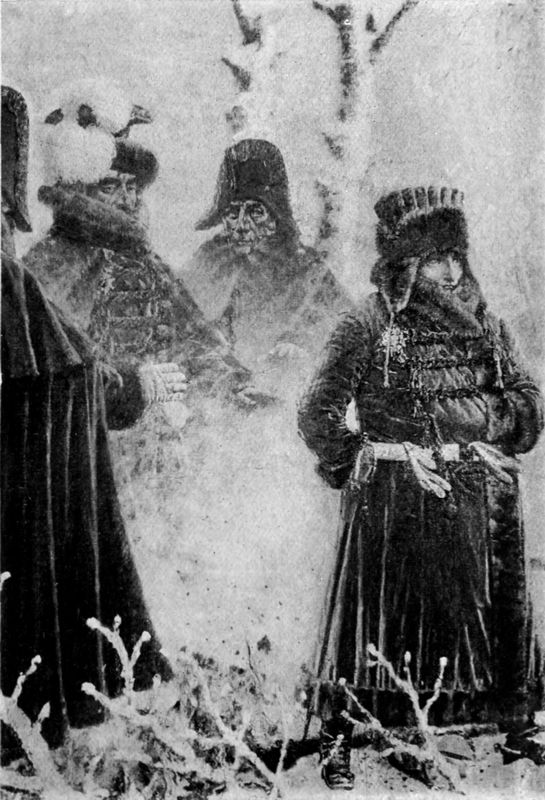
Napoleon. Berthier. Murat. Rapp. Bivouac.
Even those highest in command now admitted that Napoleon in leading his army to Moscow had made the same error as Charles XII. when he invaded the Ukraine; that from a military point of view the campaign was lost by irresolution during the critical battle, and from a political point of view by the burning of Moscow; and that if the army had returned in time it might have retired in good order. After its entry into Moscow the Russian Commander-in-Chief and the Russian winter both gave the French ample grace; the former forty days, the latter fifty, to rest and retreat. And while they lamented the time wasted in Moscow and the indecision shown at Malo Jaroslavetz they reviewed the long catalogue of their own misfortunes. Since leaving Moscow they had lost all their baggage, half their artillery, thirty flags, some thirty generals, 40,000 prisoners, 60,000 dead. There remained some 50,000 helpless vagrants, and perhaps 10,000 who were still in a condition to defend themselves! It was, moreover, a grave mistake to entrust the task of covering the retreat of the army and all its stores to the Austrians without leaving some one in authority at Vilna or Minsk to correct their errors and omissions. The French were unanimous in charging Schwarzenberg with treachery, though Napoleon himself held his peace—perhaps out of policy, perhaps because he had not looked for any greater degree of zeal from his Austrian ally.
Napoleon endeavoured to check the general demoralization 156and despondency. In private, as we have already said, he bitterly bewailed the sufferings of his troops, but in public he assumed a tranquil air, and gave orders that every one should keep his proper place in the ranks. Failing obedience, he ordered that “officers be reduced to the ranks, and soldiers shot.” But this threat proved entirely ineffectual, for the soldiers were naturally less afraid of death than of the prolongation of such a state of misery.
At Orcha Napoleon burned his baggage with his own hands in order to prevent it from falling into the clutches of the enemy. Thus perished the documents which he had collected for the history of his own life, with the composition of which he had intended to occupy himself when he started on this campaign. He then counted upon establishing himself in a threatening position on the banks of the Dvina or Beresina, and during the six tedious months of winter devoting his leisure hours to writing his reminiscences. All these plans and hopes were now scattered to the winds.
A rumour gained currency that Chichagof had occupied Minsk, and that the line of retreat was therefore endangered. The Emperor, however, attached little importance to the report, for he was convinced that he commanded the passage of the Beresina at Borisof. The bridge at Borisof was protected by a strong fortress occupied by a Polish regiment. Napoleon was so confident upon this point that in order to relieve the burdens of the army, he gave orders at Orcha to burn all his pontoons. It must indeed have been a blow to learn after this that Chichagof had taken the town of Borisof, which commanded the passage of the river.
There is an interesting description of the arrival of an officer of the Young Guard who brought this unwelcome 157news—“On November 26 we were marching along the high-road in the direction of Borisof. The town was not far off. Bonaparte was walking, like the rest of us, with a stick in his hand. He was dressed in a fur-coat and hat, and was walking along the middle of the road a few paces from me, behind the Prince of Neufchâtel (Berthier). On every side reigned a melancholy silence. Suddenly we saw an officer riding to meet us. It was Colonel de F., attached to the staff. He halted in front of the Prince and made a report of something to him—I only heard the words ‘Beresina’ and ‘Russians.’ We all stopped. Bonaparte also halted; he was about six paces from the Chief of the Staff and the colonel. I moved a little closer in order to learn what it was all about. I could hear Bonaparte asking angrily, ‘What is he talking about? eh? What is he talking about? What is he talking about?’
“The Prince ordered the colonel to repeat his message to Bonaparte. I seem to hear them even now.
“De F.—‘Monsieur le Maréchal has sent me to inform you that the Russian army of Moldavia has reached the Beresina and occupied all the crossings.’
“Bonaparte.—‘It’s not true, it’s not true, it’s not true!’
“De F.—‘That two divisions of the enemy have captured the bridge and occupied the left bank; also that the river is not frozen sufficiently to cross on the ice.’
“Bonaparte (angrily).—‘You lie, you lie! It’s not true.’
“De F. (coldly, in a louder tone).— I was not sent to ascertain the position of the enemy. Monsieur le Maréchal sent me to bring this report, and I am performing my duty.’
“Seeing Napoleon beginning to brandish his stick, I thought he meant to strike the colonel with it; but at 158that moment he stepped back with his legs spread wide apart. Leaning his left hand on his stick and grinding his teeth together, he cast a furious glance at the heavens and shook his fist! A cry of passionate anger broke from his lips; he repeated his menacing gesture, and added one short expressive word—a word blasphemous enough by itself. I assure you that in all my life I never saw a more fearful expression of face and figure! He was evidently quite forgetful of the care with which he had striven till then to hide his feelings from us, and his endeavours to appear cheerful—though, of course, no one was deceived. We were so attentively engaged in watching his movements, and were so much surprised at the scene, that we only recollected ourselves at last when he gave orders to continue the advance.”
“That night,” says Ségur, “Napoleon had no sleep. Duroc and Daru, thinking he was asleep, began to talk of the desperate position in which the French were placed, unaware that he could hear all they said. When they uttered the words ‘royal prisoner’ he could keep silence no longer, but broke in, ‘Do you think that they would dare?’ Daru, after the first moment of surprise, replied that if the Emperor was obliged to yield at last he must be prepared for the worst; that he must not count on the magnanimity of his adversary, for politics, in the widest sense of the word, knew nothing of the ethics of everyday life, they have their own code.”
“‘And France?’ asked Napoleon. ‘What will France say?’
“‘Oh! as for France—one may fit one’s conjectures to one’s fancy, for it would be hard to say what the result will really be in France. The best thing,’ added Daru, ‘both for us and for your Majesty, would be if you could somehow 159get back into France, through the air, if it may not be along the road; for you would be more likely to save us by being there, than by staying here.’
“‘In fact, I am in the way?’ asked Napoleon.
“‘Yes, your Majesty.’
“‘And would not you like to be a royal prisoner?’
“Daru answered in the same jesting strain that ‘he would be satisfied to be an ordinary prisoner of war.’
“To this the Emperor made no reply; but after a long pause he asked if all the despatches had been burnt.
“‘Your Majesty did not wish that to be done?’
“‘Go at once and burn everything—our position, to be frank, is not one to boast of.’”
Marshal St. Cyr received strict orders to drive the Russians over the river. He performed this task; but the problem how the French army was to cross under the enemy’s fire without any pontoons still remained unsolved, and troubled the minds of every soldier from the highest to the lowest.
There was no longer any hope that the fugitives would be able to slip through between the Russian armies. Driven on by Kutuzof and Vittgenstein to the Beresina, they must cross the river without delay in spite of the threatening position occupied by Chichagof on the further bank.
On November 23 Napoleon began his preparations for this desperate step. The remains of the cavalry, under the command of Latour-Maubourg, were rapidly dwindling in number, and there were now only 150 left. The Emperor collected all the officers who could still sit in the saddle and formed them into a body of some 500, which he called his “Holy Squadron.” Divisional commanders acted in this squadron as captains; Grouchy and Sebastiani were 160appointed commanders. Napoleon further ordered that all superfluous vehicles should be burnt, and that no officer should have more than one; so that half the vans and wagons in the various corps were destroyed, and the horses distributed among the Horse Guards.
The retreating host soon came up with Marshal Victor’s army, which was awaiting Napoleon’s arrival.
“Still in good condition, having suffered but little, it welcomed the Emperor with the usual enthusiastic cries, which had long been unheard among the fugitives from Moscow,” says Ségur. “These troops knew nothing of the sufferings of the main army, so that they were perfectly astounded when, in the place of the well-appointed columns of the victors of Moscow, they saw Napoleon followed by this rabble of skeletons, clad in tatters, in women’s jackets, in fragments of old carpets or filthy remnants of rusty cloaks, burnt into holes, with their legs wrapped in all manner of scraps and rags. The real soldiers gazed in horror on these unfortunate warriors, their sunken cheeks, the earthy colour of their countenances, their straggling beards; defenceless, weaponless, jostling one another like a herd of cattle, their heads hanging down and their eyes cast upon the ground. What astonished them more than anything was the number of generals and colonels, marching by themselves, in solitary dejection, with no soldiers to command. Busied only with themselves, their persons, or their goods, they marched unnoticed and uncared for among the common soldiers—soldiers from whom they no longer looked for obedience, for every tie was broken and every rank levelled by misfortune. Victor’s and Oudinot’s troops could not believe their eyes. The impression produced by this fearful débâcle had an immediate effect upon the discipline of the 2nd and 9th 161corps—disorder soon showed itself in their ranks; the soldiers threw away their muskets and laid hands on valuable walking-sticks.”
The Grande Armée reached the river, and it was decided to make the crossing at Studyanka. The only chance of success lay in deceiving the Russians as to the place in which the passage was to be attempted, for it was evidently impossible to effect a crossing by force. On the 24th, therefore, three hundred soldiers and a few hundred fugitives were sent down the river to Ukholda with orders to prepare materials for the construction of a bridge, and to make as much noise as possible over it. The remains of the Cuirassiers were sent to the same place by a road that was well within sight of the Russians. In addition—and this was the most cunning stroke of all—the Chief of the Staff summoned some Jews of the neighbourhood and questioned them with the greatest show of secrecy as to the fords and roads leading to Minsk. Then, as if delighted with the result of his examination, and allowing them to imagine that in his opinion this was the only way out of his difficulties, he retained some of the rogues as guides and dismissed the rest beyond his outposts. In order to make certain that they would repeat all they knew, the general forced them to take an oath that they would meet the French lower down the Beresina and inform them of the enemy’s movements.