Front matter (continued 2)
Reading edition
Pl. 42.
CHÆTURA macroptera Longwinged Swift
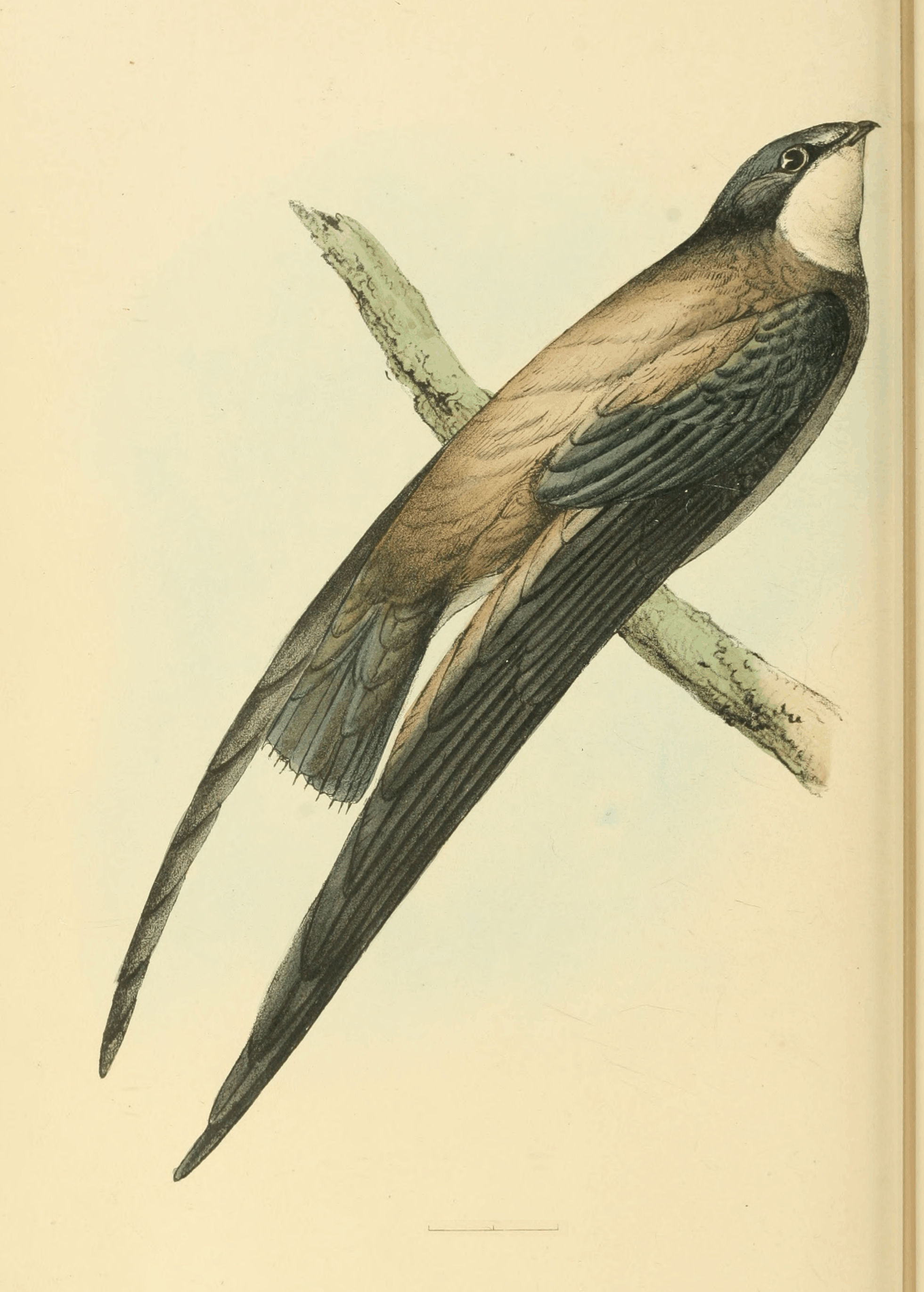
CHÆTURA macroptera.
Long-winged Swift.

Family Hirundinidæ.
Generic Character.
Bill entire, the sides much compressed, the culmen arched. The lower mandible recurved at the tip. Wings very long. Tail scansorial, the extremity of the shafts naked, and acute. Tarsi naked, the three anterior toes and claws nearly equal; hind toe not versatile. Nob.
Type. Chætura pelasgia. Stevens.
Specific Character.
Brown: wings and tail glossed with greenish blue; back grey-white: chin and under tail covers snowy; tail even.
Ob. Tail 3½ in. longer than the wings, the two first quills longest and equal.
For an inspection of this new and imposing species, we have to thank Mr. Ward, an Animal preserver of considerable talent. We do not find it mentioned in any Ornithological work we possess, and our library is not small: but with so many publications continually issuing from the continental press, we shall feel no surprise at discovering it has already been published.
This and the Hirundo albicollis, (first named by M. Vieillot) are two of the largest species yet discovered, of a very singular group of Swifts; wherein the tail feathers are spined, and even more rigid than those of the Woodpeckers: by this structure the birds can remain for a considerable time in the most perpendicular situations. The expanded tail thus acts as a powerful support, which is further increased by the size and strength of the claws, much larger than those of ordinary Swallows. There are several species, most of which are natives of America.
The direct analogy which this group bears to the typical scansorial Birds, joined to the general superiority of flight which the Swift possesses over the Swallow, leads us to suspect this may prove to be the typical group of the Fissirostres; an order in which Nature, in her wish to develope the greatest powers of flight, appears to neglect all those laws which she afterwards so rigidly adheres to: We intend in another work, to enter on this interesting subject more fully.
Our figure is in strict conformity with the scale on the plate, which is that of an inch.
Pl. 43.
PETROICA bicolor. Black & white Robin.
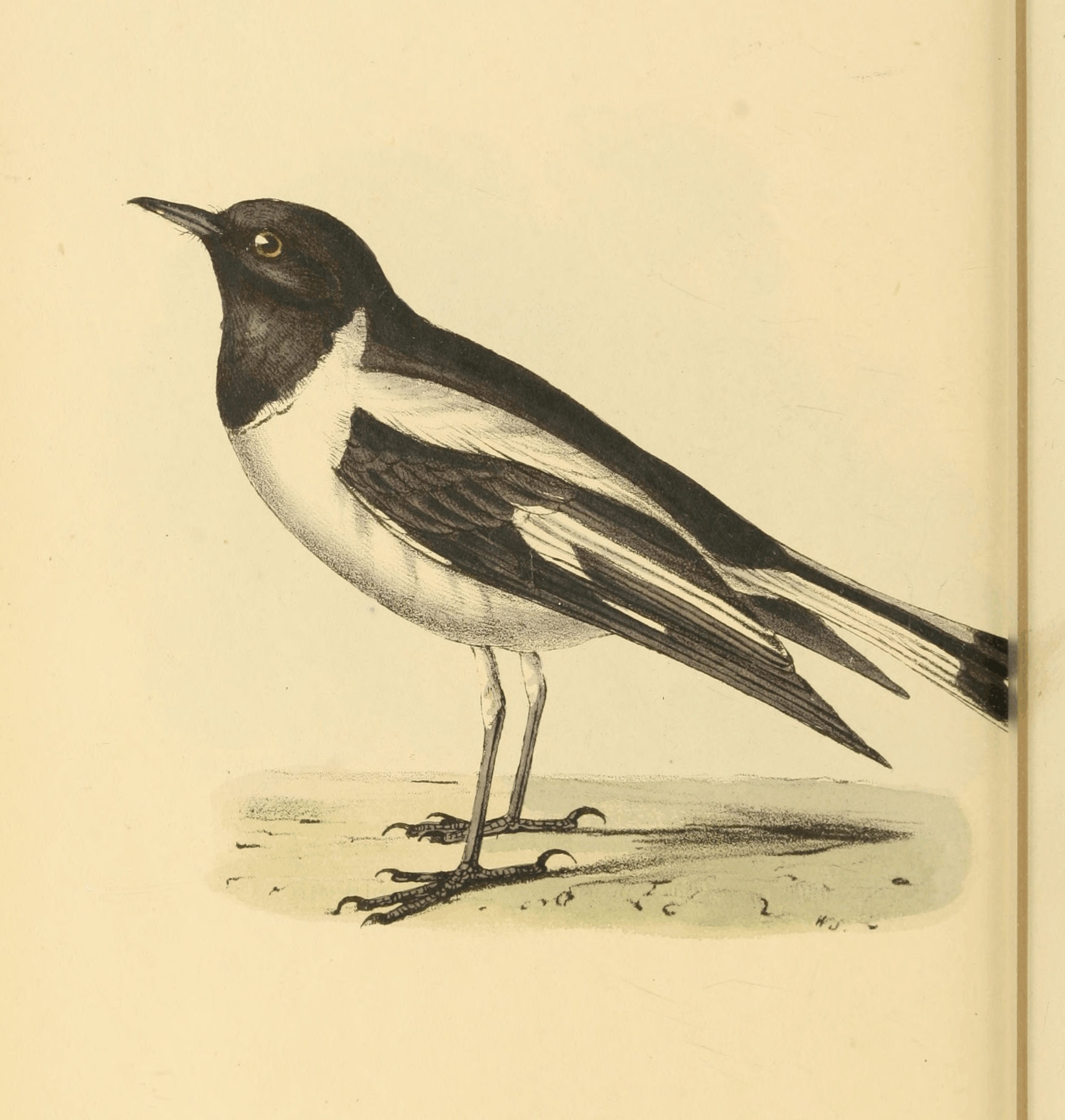
PETROICA bicolor.
Black and White Robin.
Family Sylviadæ. Sub-family Saxicolinæ. (See Northern Zoology, Vol. 2.)
Generic Character. See No. 8, pl. 36.
Specific Character.
Black and white. Head, throat, back, and tips of the tail glossy raven black: breast, scapular covers, stripe on the wings, and plumage beneath, white: tail slightly forked.
In giving publicity to this new and interesting bird, we feel particular pleasure in expressing our thanks to Allen Cunningham, Esq., His Majesty's Botanist, in New South Wales, by whom it was there discovered. Although devoted to a science already so much benefited by his researches, this enthusiastic Traveller found some leasure for Ornithology, and has lately favoured us with a large collection of skins, prepared during one of his inland journeys; with a request that they may be made public: among other highly curious forms, the present bird is conspicuous. It was found in the open forest country, North of Liverpool Plains.
When once we are so fortunate as to discover the natural station of any being, we may be convinced that every circumstance regarding its structure, habits, or even colour, are employed by Nature to typify its relations to other beings; and that until most of these can be explained, there is good reason to suspect the accuracy of our views on its true affinities. Possessing all the essential characteristics of Petroica, our bird exhibits in the bill, feet, and tail, an immediate affinity to Sialia arctica: while it is clothed in the pure white, and glossy black plumage, which nature afterwards employs to designate the typical group of Gryllivora, (North. Zool.) at the opposite point of the circle of Saxicolinæ. This remarkable analogy is extended to the bill, the point of which is longer and more incurved, than in any of the immediate affinities of our bird: its close relation to the old world Saxicolæ, is too obvious to need explanation.
Pl. 44.
MARGINELLA Pl. 1 1. oblonga. 2. guttata.
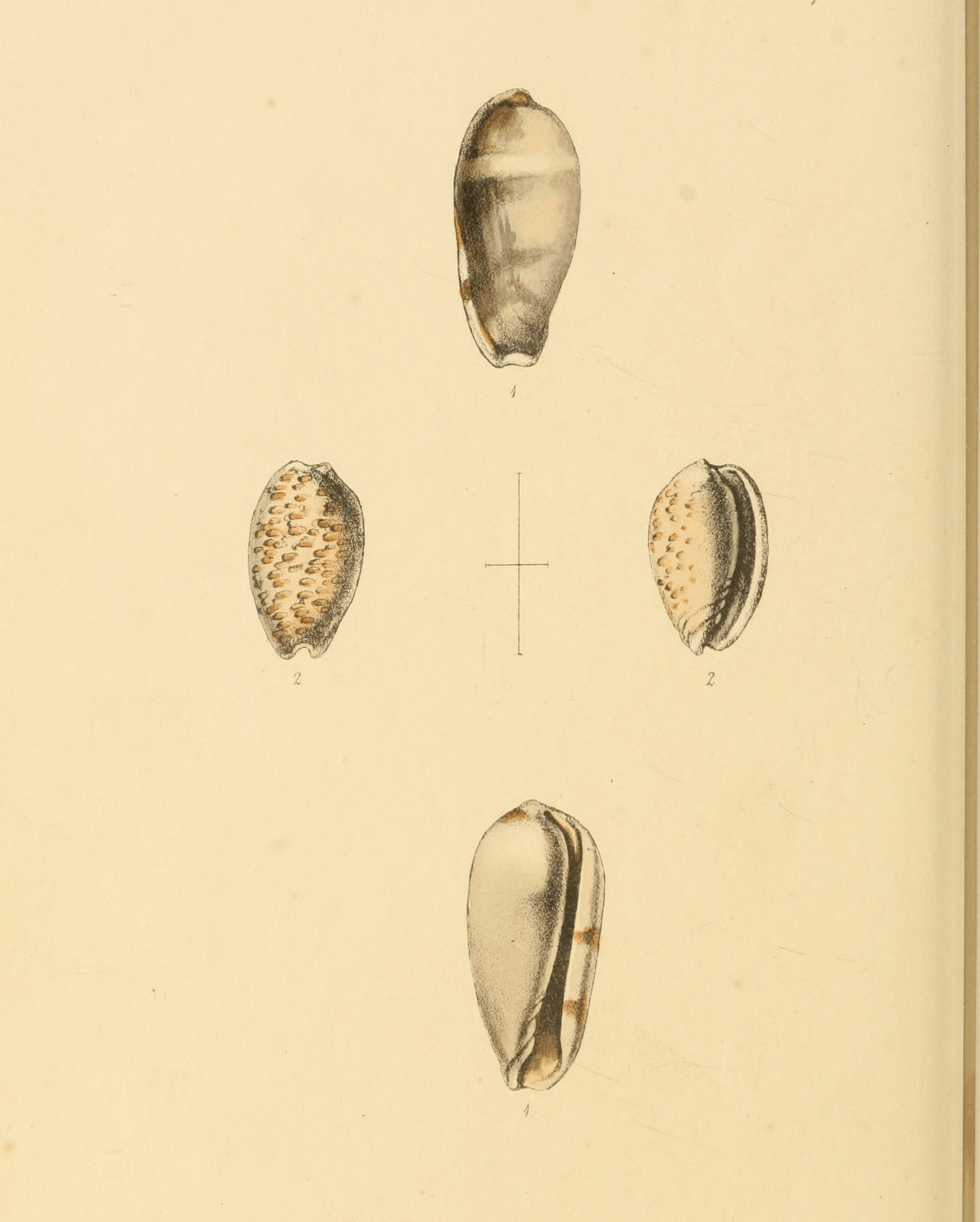
MARGINELLA oblonga.
Family Volutidæ. Genus Marginella. Lam. Sys. 7. p. 354.
Sub-Genus Volutella. Nob.
Shell oval-ventricose: Spire concealed: outer lip generally smooth; base of the pillar with four to five oblique plaits: aperture smooth within.
Type, Marginella bullata. Lam.
Specific Character.
Shell oblong, rather gibbous round the middle, fawn coloured, with two obsolete bands: spire concealed: outer lip and summit marked by orange spots: pillar 4 plaited.
A species not hitherto described; its shape is unusually oblong, and the spire is quite concealed: We are unacquainted with its locality. The perpendicular line expresses the natural size.
In Voluta and Mitra, the two typical groups of this family, the variations of form are so striking, and the species so numerous, that we readily assent to the plan, proposed by others, of further dividing them into genera: but in the aberrant group, containing Oliva, Ancillaria, and Marginella, the forms are less diversified, and the species fewer; the minor divisions may therefore, for the present, be termed sub-genera. The approximation of Marginella to Voluta has frequently been stated. In M. bullata we have a miniature melon Volute, while M. faba is a no less obvious representation of V. magnifica. Hence these forms appear typical. Yet M. persicula and lineata cannot well be placed with either, as their characters seem to indicate a direct analogy to Conohelix among the Mitres. As to Volvaria, we concur with other writers, in thinking that the French Conchologists have erroniously blended that genus with Marginella.
MARGINELLA guttata.
Oval, spire concealed, covered with transverse oval spots margined with white, somewhat ocellate, and disposed longitudinally; pillar 4 plaited.
We could give no correct idea of this very pretty shell, without enlarging the figures; the natural size is indicated by the horizontal line. Our specimen is the only one we have yet seen, nor do we know its habitat.
Pl. 45.
MARIUS Cinna
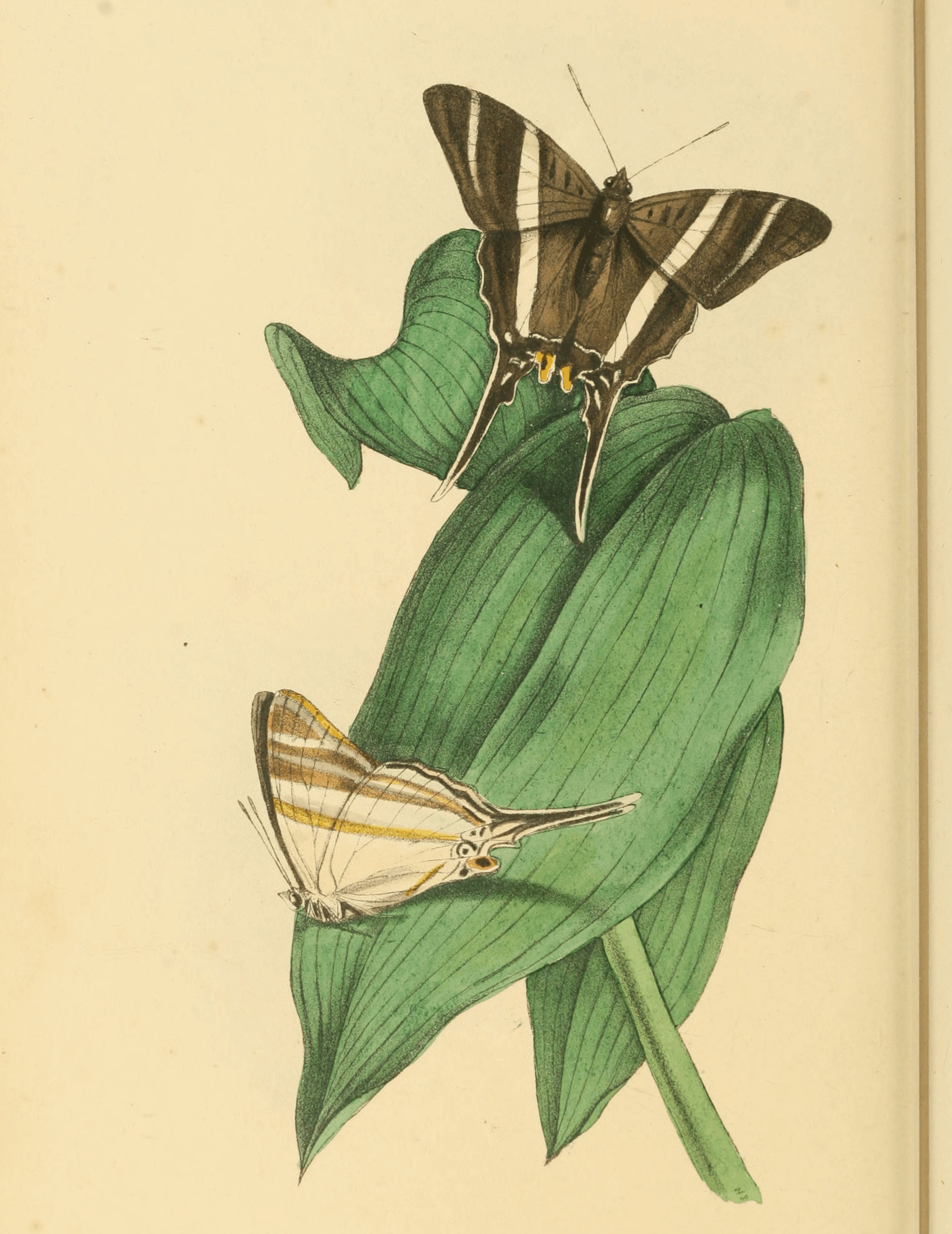
MARIUS Cinna.
Family Nymphalidæ. (Stirps. 3? Horsf.)
Generic Character.
Larva and pupa unknown.
Perfect insect. Wings Papilioniform, caudal appendages long, acute. Palpi porrect, approximating, and meeting at their tips so as to form an acute cone: the whole covered with compact scales. Anterior feet small, slender, imperfect, the tarsal joints? concealed by long hairs: club of the antennæ terminal, sub-fuciform and cylindric. Body short, thick, robust.
Type, Papilio Marius. Auct.
Specific Character.
Wings above brown, with two unequal white bands; beneath white, with narrow fulvous bands; basal angle of the posterior wings with an orange spot, ocellated with black.
Papilio Cinna. Cramer Vol. I. pl. 100. f. 8.
Cramer describes this elegant Butterfly as a native of Surinam, and our own specimens were received from the same country. All the species of this group that have yet fallen under our inspection, are natives of South America. Their flight is high, powerful and rapid: the predominating colour on the upper surface of their wings is brown, and on the under white.
It is the misfortune of not understanding the typical structure, and the principles which regulate its variation, in higher groups, that in defining the characters of a lesser, we can form no just idea of its relative value: whether, in short, we should consider it a genus or a sub genus, or whether it is typical, aberrant, or osculent. This, however, is but a temporary evil; and will only continue until an insight is gained into higher combinations, by first placing together kindred species under one common name. If this be done heedfully, such a group must be natural, whatever opinions may be entertained in the first instance, as to its proper denomination.
GENERAL INDEX
OF THE PLATES TO
VOL. 1.
IN THE ORDER OF PUBLICATION.
N.B. The number here affixed to the Plates, for convenience of reference, had better be marked in pencil upon the Plates themselves.
No. 1.
Psittaculus vernalis, 1
Polyborus Braziliensis, 2
Setophaga picta, 3
Ancillaria (Pl. 1.) rubiginosa, 4
Mitra (Pl. 1.) melaniana, 5
—— tessellata
No. 2.
Parra Africana, 6
Cuculus nigricans, 7
Lorius Isidorii, 8
Ampullaria Pl. 1.
—— carinata, 9
Unio (Pl. 1.) truncatus, 10
No. 3.
Thriothorus mexicanus, 11
Lorius garrulus, 12
Coccyzus Levaillantii, 13
Marmarostoma (Pl. 1.)
—— undulata, 14
Voluta (Pl. 1)
—— bullata, 15
No. 4.
Paleornis Pondicerianus, 16
Hirundo fasciata, 17
Anodon (Pl. 1.)
—— areolatus, 18
Mitra (Pl. 2.) bicolor, 19
—— carinata
—— strigata
Tellina (Pl. 1.), 20
—— latirostra
No. 5.
Nanodes venustus, 21
Icterus Cayanensis, 22
Drymophyla longipes, 23
Lingula anatina, 24
—— hians, 25
No. 6.
Platycercus scapularis, 26
Drymophila fasciata, 27
Aglaïa gyrola, 28
Melania (Pl. 1.) amarula, 29
—— setosa
Mitra (Pl. 3.) fulva, 30
—— ambigua
—— punctata
No. 7.
Aglaïa flava, 31
Papilio Niamus, 32
Rhetus Cramerii, 33
Rostellaria (Pl. 1.) curvirostris, 34
Psaris Jardinii, 35
No. 8.
Petroica multicolor, 36
Ploceus textor, 37
Ampullaria (Pl. 2.) Nilotica, 38
—— subcarinata
Strombus (Pl. 1.) Peruvianus, 39
Oliva (Pl. 1.) volutella, 40
—— striata
No. 9.
Psaris cristatus, 41
Chætura macroptera, 42
Petroica bicolor, 43
Marginella (Pl. 1.) oblonga, 44
—— guttata
Marius Cinna, 45
GENERAL ALPHABETIC INDEX
OF
LATIN AND ENGLISH NAMES, &c.,
TO
VOL. 1.
Aglaïa, Generic Character, 27
—— flava, 31
—— gyrola, 28
Alasmodon, Generic Character, 10
Ampullaria carinata, 9
—— canaliculata, 38
—— nilotica, 38
—— subcarinata, 38
—— virens, 38
Ancillaria rubiginosa, 4
Ant-thrush, long legged, 24
—— White shouldered, 26
Anodon, Generic Character, 10
—— areolatus, 17
Apple Snail, carinated, 9
Caraca Eagle, 1
Chætura, Characters of, 42
—— macroptera, 42
Coccyzus Vaillantii, 13
Cuculus nigricans, 7
Cuckow, African black, 7
Cuckow, black and white, 13
Drymophila fasciata, 27
—— longipes, 23
Eagle, Brazilian crested, 1
Euplectes, characters of, 37
Flycatcher, painted, 3
Hangnest, Cayenne, 22
Hirundo fasciata, 17
Hyria, Generic Character, 10
Icterina, characters of, 22
Icterus, Generic Character, 22
Icterus, Cayanensis, 22
Iridina, Gen. Characte, 10
Jacama, African, 6
—— Habits of the, 6
Lingula anatina, 24
—— hians, 25
Lorius garrulus, 12
Lorius Isidorii, 8
Lory, Blue necked, 8
Lory, Ceram, 12
Malimbus, characters of, 37
Marmarostoma, Gen. Character, 14
—— undulata, 14
Marginella oblonga, 44
—— guttata, 44
Marius, characters of, 45
—— cinna, 45
Melania amarula, 29
—— setosa, 29
Mitra ambiguua, 30
—— bicolor, 19
—— carinata, 19
—— fulva, 30
—— melaniana, 15
—— punctata, 30
—— strigata, 19
—— tessellata, 5
Mussel-horse, areolated, 18
Myotherinæ, characters of, 23
Nanodes, characters of, 21
—— venustus, 21
Oliva, affinities of, 40
—— volutella, 40
—— striata, 40
Pachyrhynchus, Gen. Ch., 41
Pachystoma, Gen. Character, 9
Paleornis Pondicerianus, 16
Papilio Niamus, 32
Parra africana, 6
Parrakeet, blue-fronted, 21
—— mustachoe, 16
—— Tabuan, or King, 28
—— vernal, 2
Petroica, Generic Character, 36
—— bicolor, 43
—— multicolor, 36
Phytophagous Molluscæ, 30
Platycercus scapularis, 26
Ploceus, Generic Character, 37
—— the sub-genera, 37
Ploceus textor, 37
Polyborus Braziliensis, 1
Psariana, characters of, 41
Psaris cristatus, 41
—— Jardinii, 35
Psittacidæ, Divisions of, 28
Psittaculus vernalis, 2
Rhetus Cramerii, 33
Robin, black and white, 43
—— scarlet breasted, 36
Rostellaria curvirostris, 34
Saris, crested, 41
—— Jardines, 35
Saxicolinæ, Bill of, 36
Setophaga picta, 3
Strombus Peruvianus, 39
Strombii, Genera of, 35
Snail, Waved, Pearl, 14
Swallow, white-banded, 17
Swift, long-winged, 42
Tanager, red-headed, 27
—— yellow, 31
Tellen, wide-beaked, 20
Tellina latirostra, 20
Thriothorus mexicanus, 11
Voluta bullata, 15
Volutella, sub-genus of, 44
Volute, Bulla-shaped, 15
Unionidæ, Family of, 10
Unio, Generic Character, 10
—— truncatus, 10
Weaver, rufous necked, 37
Wren, mexican, 11
Zoophagous Molluscæ, 35
Notes.
[1]
Zool. Journal, Vol. 4. p. 405.
[2]
Ill. of Brit. Ent. 1. p. 70.