Volume 1 / Part 1 — CHAPTER V. GEOGRAPHICAL AND PHYSIOLOGICAL.
Reading edition
‘To my surprise, the information concerning Zanzibar and the N. E. coast of Africa ... scarcely contains meagre phrases destitute of precision.’—(Col. Sykes’ Journal, R. G. S., vol. xxiii. 1853.) He forgets that entering from the coast is like jumping from the street into the window.—(R. F. B.)
Section 1.
Africa, East and West—‘Zanzibar’ explained—Menouthias—Position and Formation—The East African Current—Navigation—Aspect of the Island.
It is an old remark that Africa, the continent which became an island by the union of the twin seas in the year of grace 1869, despite her exuberant wealth and her wonderful powers of reproduction, is badly made—a trunk without limbs, a monotonous mass of painful symmetry, wanting opposition and contrast, like the uniform dark complexion of her sons and of her fauna—a solid body, like her own cocoa-nut, 117hard to penetrate from without, and soft within; an ‘individual of the earth,’ self-isolated by its savagery from the rest of the world. This is especially true of intertropical Africa.
The western coast was, until the last four centuries, cut off from intercourse with mankind by the storm-lashed waters of the northern approach; and to the present day the unbroken seaboard, so scanty in good harbours, and the dangerous bars and bores which defend the deadly river mouths, render it the least progressive part of the old world.
The more fortunate north-eastern and subtropical shores were enabled by their vast crévasse, the Red and riverless Sea, to communicate with Western Asia, whilst the rich productions, gold and ivory, tortoise-shell and ambergris, the hot sensuous climate—which even now induces the northern sailor to ship in the fatal West African squadron—and the amene scenery of the equatorial regions, invited, during pre-historic ages, merchants, and even immigrants, from rugged Persia and sterile Arabia.
Between the two upper coasts, eastern and western, there is, as might be expected, great similarity of grim aspect. The northern seaboards offer, for the space of a thousand miles, 118the same horrid aspect; deceitful roadsteads and dangerous anchorages, forbidding lines of chalky cliff and barren brown sandstone bluff; flat strands and white downs, hazed over by the spray of desert sand; and lowlands backed by maritime sub-ranges, masses of bald hill and naked mountains, streaked with dry wadis and water-courses, that bear scatters of dates and thorns, and which support miserable villages of tents or huts. The fierce and wandering tribes, Berber, Arab, and Arabo-African—an especially ‘crooked and perverse generation,’—are equally dangerous to the land traveller and to the shipwrecked mariner.
As sterile and unlovely for the same cause—the absence of tropical rains—are the southern regions of the great Nineteenth Century Island. Good harbours are even rarer than in the north, and the seas about the Cape of Hope, sweeping up unbroken from the South Pole, are yet more perilous. The highlands fringing the southern and eastern coasts arrest the humid winds, and are capable of supporting an extensive population; but the interior and the western coast, being lowlands, are wild and barren. The South African or Kafir family, which has overrun this soil, is still for the most part in the nomade 119state, and its ‘evident destiny’ is to disappear before the European colonist.
The central and equatorial land, 34° deep, including and bordering upon the zone of almost constant rain, is distinguished by the oppressive exuberance of its vegetation and by the consequent insalubrity of its climate. The drainage of the interior, pouring with discoloured efflux to the ocean, in large and often navigable channels, subject to violent freshes, taints the water-lines with deadly malaria. The false coasts of coralline or of alluvial deposits—a modern formation, and still forming—fringed with green-capped islets, and broken by sandy bays and by projecting capes, are exposed to swells and rollers, to surf and surge, to numbing torrents and chilling tornadoes, whilst muddy backwaters and stagnant islets disclose lagoon-valves or vistas through tangled morass, jungle, and hardly penetrable mangrove-swamp. This maremma, the home of fever, is also the seat of trade, but the tribes which occupy it soon die out.
The true coast has already risen high enough above the waters to maintain its level; and the vegetation—calabashes, palms, and tamarinds—offers a contrast to the swampy growth below. Inland of the raised seaboard are high and 120jungly mountains and coast-range or ghaut, in many parts yet unvisited by Europeans. Beyond these sierras begins the basin-shaped plateau of Central Equatorial Africa. The inhabitants are mostly inland tribes, ever gravitating towards the coast. They occupy stockaded and barricaded clumps of pent-houses or circular tents, smothered by thicket and veiled, especially after the heavy annual rains, with the ‘smokes,’ a dense white vapour, moisture made visible by the earth being cooler than the saturated air.[26]
I have elsewhere remarked (The Lake Regions of Central Intertropical Africa; Abeokuta and the Camaroons Mountains, &c.) the striking geological contrast between the two equatorial coasts, eastern and western. The former, south of the Guardafui granites, offers to one proceeding inland from the ocean a succession of corallines, of sandstone and of calcaires, which appear to be an offset from the section of that great zone forming the Somali country. The western coasts, after quitting the basalts and lavas 121of the Camaroons, are composed chiefly of the granites and syenites with their degradations of schiste, gneiss, and sandstone. Similarly, in the great Austro-American continent, one shore, that of the Brazil, is granitic, whilst the other, Chili, mainly consists of the various porphyries.
The negroes and negroids of both these inhospitable coasts, an undeveloped and not to be developed race—in this point agreeing with the fauna and flora around them—are the chief obstacles to exploration, and remarkably resemble each other. The productions of the east and west are similar. The voracious shark swims the seas, turtles bask upon the strands and islets, and the crocodile and hippopotamus haunt the rivers. The forests abound in apes and monkeys, and the open plains support the giraffe, the antelope, and the zebra, hog and wild kine (Bos Caffir and B. Brachyceros), herds of elephants and scatters of rhinoceros. The villagers breed goats and poultry. In the healthier regions they have black cattle and sheep, whilst one tribe has acclimatized the ass. The exceeding fertility of the rain-drenched plains gives an amazing luxuriance to cassava and rice, maize, and holcus, cotton, sugar-cane, and wild indigo, banana, 122lime and orange, ground-nuts and coffee. The hills and torrent-beds yield gold and copper, antimony, and abundance of iron. On both sides of the continent there are rich deposits of the semi-mineral copal. Coal was found by the Portuguese at Tête and in the Zambeze Valley, as related in Dr Livingstone’s First Expedition (Missionary Travels, &c., xxxi. 633-4). His second prolonged the coal-field to beyond the Valley of the Rufuma (Rovuma) river (xxi. 440), and it will probably be found to extend still further.
Dr Krapf declares (Travels, &c., p. 465) that he discovered coal, ‘the use of which is still unknown to the Abessinians,’ on the banks of the Kuang, a river said to rise in the Dembea Province, near Lake Tsana (Coloë Palus). Finally, to judge from the analogy of the South American continent, the valuable mineral will yet be struck near the western coast, south of the equator.
From time immemorial, on both sides of Africa, the continental Islands, like Aradus and Sidon, Tyre and Alexandria, have been favourite places with stranger settlers. They have proved equally useful as forts, impregnable to the wild aborigines, and as depôts for exports and imports. 123Second to none in importance is Zanzibar, and the future promises it a still higher destiny.
And first, of the name, which does not occur in Strabo, Pliny, or the Periplus. The log-book attributed to Arrian, of Nicomedia, calls the whole shore, ‘Continent of Azania;’ probably an adaptation, like Azan, and even Ajan, of the Arabic, Barr el Khazáin, or the Land of Tanks,[27] the coast between Ra’as Hafun and Ra’as el Khayl. So Pliny (vi. 28 and 34) speaks of the ‘Azanian Sea’ as communicating with the ‘Arabian Gulf.’ Ptolemy, however (I. 17, sec. iv. 7), has the following important passage: ‘immediately following this mart (Opone) is another bay, where Azania begins. At its beginning are the promontory Zingis (ζίγγις, Zingina promontorium), and the tree-topped Mount Phalangis.’ The name may have extended from the promontory to the coast, and from the coast to the island. Dr Krapf speaks of a tribe of the ‘Zendj’ near the Rufiji river, but I could not hear of it. It is easy to show that the Pelusian geographer’s Opone is the bay south of Ra’as, or Jurd Hafun. Like Pomponius 124Mela, Ptolemy evidently made his great point de départ the Aromata Promontorium et emporium in Barbarico sinu (Cape Guardafui), and he placed it N. lat. 6° 0′ 0″, instead of N. lat. 11° 50′. This error threw the whole coast 6° (in round numbers, more exactly 5° 50′) too far south, and made the world doubt the accurate position of the Nile lakes. Thus, to his latitude of Opone N. 4° add 5° 50′, and we have N. lat. 9° 50′, the true parallel of Hafun being N. lat. 10° 26′.
Amongst late authors we find the word Zanzibar creeping into use. The Adulis inscription (4th century) gives ‘Zingabene’; and its copier, the Greek monk Cosmas Indicopleustes, who proved the globe flat (6th century), calls the ‘unnavigable’ ocean beyond Berberia, the ‘Sea of Zenj,’ and the lands which it bathes ‘Zingium.’ It is found in Abu Zayd Hasan, generally known as Hunayn bin Ishak (died A.D. 873); in El Mas’udi, who describes it at some length (died A.D. 957); in El Bayruni (11th century), and in the learned ‘Nubian Geographer,’ the Sherif El Idrisi (A.D. 1153). Marco Polo (A.D. 1290), who evidently wrote his 37th chapter from hearsay, makes Zanzibar a land of blacks; and, confounding insula with peninsula (in Arabic both being Jezireh), supplies it with a 125circumference of 2000 miles, and vast numbers of elephants. The India Minor, India Major, and India Tertia of the mediæval Latin travellers are the Sind, Hind, and Zinj of the Arabs. Ibn Batuta (A.D. 1330, 1331), the first Arab traveller who wrote a realistic description of his voyage, has accurately placed Kilwa, which he calls ‘Kulua,’ in the ‘land of the Zunúj.’ Finally, we meet with it in El Nowayri, and in Abulfeda, the ‘Prince of Arab Geographers,’ who both died in the same year, A.D. 1331.
The word Zanj (زنج), corrupted to Zinj, whence the plural ‘Zunúj,’ is evidently the Persian Zang or Zangi (زنگ), a black, altered by the Arabs, who ignore the hard Aryan ‘Gaf’ (گ), the ‘G’ in our gulf. In the same tongue bár means land or region—not sea or sea-coast—and the compounded term would signify Nigritia or Blackland. In modern Persian Zangi still means a negro, and D’Herbelot says of the ‘Zenghis’ that ‘they are properly those called Zingari,[28] and, by some, Egyptians and Bohemians.’ 126Scholars have not yet shown why the Arab, so rich in nomenclature, borrowed the purely Persian word from his complement the ‘Ajam.’ They have forgotten that the Persians, who of late years have been credited with the unconquerable aversion to the sea which belongs to the Gallas and the Kafirs, were once a maritime people. ‘The indifference or rather the aversion of Persians to navigation’ (M. Guillain, i. 34, 35) must not be charged to the ancient ‘Furs.’ Between A.D. 531–579, when Sayf bin Dhu Yezin, one of the latest Himyarite rulers, wanted aid against the Christian Abyssinians, who had held southern Arabia for 72 years, he applied to Khusrau I., better known as Anushirawán, the 23rd king of the Sassanian dynasty, which began with Ardashir Babegan (A.D. 226), and which ended with Yezdegird III. (A.D. 641), thus lasting 415 years. The ‘Just Monarch’ sent his fleet to the Roman Port’Roman Port’ (Aden), and slew Masruk. In his day the Persians engrossed, by means of Hira, Obollah, and Sohar, the rich tracts of Yemen and Hindostan; while Basrah (Bassorah) was founded by the Caliph Omar, in order to divert the stream of wealth from the Red Sea, a diversion which will probably soon be repeated. In A.D. 758 the Persians, together 127with the Arabs, mastered, pillaged, and burn Canton. Much later (17th century) Shah Abbas claimed Zanzibar Island and coast as an appanage of the suzerainty of Oman.
East Africa still preserves traditions of two distinct colonizations from Persia. The first is that of the ‘Emozaydiys,’ or ‘Emozeides’ (Amm Zayd), who conquered and colonized the sea-board of East Africa, from Berberah of the Somal to Comoro and Madagascar, both included. A second and later emigration (about A.D. 1000) occupied the south Zanzibarian coast, and ruins built by the ShirazíanShirazían dynasty which still lingers, are shown on various parts of the sea-board. Of these Persian occupations more will be found in the following pages. (Part 1, Chap. I, and Part 2, Chap. 2.)
Persia has left nothing of her widely extended African conquests but a name. In modern days she has become more and more a non-maritime power. She has wholly retired from the coast; and Time, who in these lands works with a will, presently obliterated almost every trace of the stranger. A few ruins at Aden and Berberah, and the white and black sheep of Ormania (Galla-land) and of Somali land, are almost the only vestiges of Persian presence 128north of the Equator. On the Zangian mainland wells sunk in the rock, monuments of a form now obsolete; mosques with elaborate minarets and pillars of well-cut coralline; fortified positions, loopholed enclosures, and ruined cities whose names have almost been forgotten, are the results of the civilization which they brought with them southwards.
The limits assigned by the Arab geographers to the ‘Land of the Zinj’ are elastic. While some, as Yakut, make it extend from the mouths of the Jub River (S. lat. 0° 14 30″) to Cape Corrientes (S. lat. 24° 7′ 5″) and thus include Sofala; others, with El Idrisi, separate from it the latter district, and unjustly make its southern limit the Rufiji River (S. lat. 7° 38′), thus excluding Kilwa. It should evidently extend to Mozambique Island (S. lat. 15° 2′ 2″), where the Wasawahíli meet the ‘Kafir’ races. The length would thus be, in round numbers, 15° = 900 geographical miles, whilst the breadth, which is everywhere insignificant, can hardly be estimated.
The Arabs, who love to mingle etymology with legend and fable, derive the word ‘Zanzibar’ from the exclamation of its pleased explorers, ‘Zayn za’l barr!’ (fair is this land!). Similar stories concerning Brazilian Olinda and 129Argentine Buenos Aíres are well known. ‘El Sawáhil,’ the shores, evidently the plural of Sáhil, is still applied to the 600 miles of maritime region whose geographical limits are the Jub River and Cape Delgado (S. lat. 10° 41′ 2”2”), and whose ethnographic boundaries are the Somal and the ‘Kafir’ tribes. Others derive it from El Suhayl, the beautiful Canopus which, surrounded by a halo of Arab myth, ever attracts the eye of the southing mariner. The Wasawahíli,’[29] or slave tribes, are fancifully explained by 130‘Sawwá hílah,’ he ‘played tricks,’—rascals all.
The coast races who, like their neighbours the Somal, have their own African names for places, call Zanzibar Island by the generic term Kisíwa—insula. It is thus opposed to Mpoa-ni, the coast, and to Mrímá, the mainland.[30] The latter, 131however, is properly speaking limited to the maritime uplands between Tanga and the Pangani 132river. Zanzibar city is Unguja (pronounced Ungudya, not Anggouya). The word appears in an ancient settlement on the eastern coast of the island, and the place is still called Unguja Mku, Old Unguja. Some still call it Lunguja, apparently an older form. We find ‘Lendgouya’ in the Commercial Traveller Yakut (early thirteenth century); but ‘Bandgouia’ (Abd el Rashid bin Salih el Bakui, A.D. 1403) is clearly a corruption.
Finally, Zanzibar has been identified by palæogeographers with the Ptolemean Μενουθιὰς or Μενουθεσίας (iv. 9), and with the Μενουθιὰς of the Periplus (Geog. Græci Minores of R. Muller, Paris, 1855), in some copies of which Menouthesías also occurs. Its rivals, however, for this honour are Pemba, Mafiyah (the Monfia of our maps) and Bukini, the northern and north-western parts of Malagash or Madagascar.[31] Ptolemy, it may be observed, places the two important sites, Menouthias and Prasum (or Prassum) in a separate chapter (iv. 9), whereas his principal list of stations is in Book iv. chapter 7. He lays down the site of Menouthias in S. lat. 13312°, and nearly opposite the Lunar Mountain, and the Lakes whence the Nile arises (S. lat. 12° 30′). The mouth of the Rhapta river and Rhapta, the metropolis of Barbaria, are in S. lat. 7°, the Rhapta promontory is in S. lat. 8° 20′ 5″, and the Prasum promontory in S. lat. 15°. By applying the correction as before, we have for Menouthias S. lat. 6° (the capital of Zanzibar being in S. lat. 6° 9′ 6″); for the Lakes, 6° 30′, which would nearly bisect Tanganyika; for Rhapta river and city, S. lat. 1° (or more exactly, S. lat. 1° 10′); the mouth of the Jub river being in S. lat. 0° 14′ 30″; the Rhapta promontory in S. lat. 2° 30′, corresponding with the coast about Patta; and finally, for Prasum S. lat. 9° 10′—Cape Delgado being in S. lat. 10° 41′ 12″.
The account given of Menouthias in the Periplus (written between A.D. 64, Vincent, and A.D. 210, Letronne[32]) is that of an eyewitness: ‘After two nychthemeral days (each of 100 miles) towards the west [here the text is evidently corrupt] comes Menouthias, altogether insulated, distant from the land about 300 stadia (30 geographical 134miles), low and tree-clad. In it are many kinds of birds and mountain tortoises (land turtle?). It has no other wild beasts but crocodiles (iguanas), and these do not injure man. There are in it sewn boats and monoxyles (canoes), which they use for salt-pans [here the text is defective] and for catching turtle. In this island they trap them after a peculiar fashion with baskets (the modern wigo) instead of nets, letting them down at the mouth of stony inlets’ (chap. i. 15).
The next chapter informs us: ‘From which (island) after two runs (each 50 miles)[33] lies the last emporium of the continent of Azania, called Tà Rhaptà, thus named from the before-mentioned sewn-together vessels. In it are much ivory and tortoise-shell. The men, who in this country are of the largest size, live scattered (in 135the mountains?), and each tribe in its own place is subject to tyrants’ (‘tyranneaulx’ or petty chiefs).
Here, then, we have Rhapta 33 leagues (100 miles = 1° 40′) beyond Menouthias. Captain Guillain (Prem. Partie, p. 115) would make the former correspond with the debouchure of the Oufidji river (Rufiji or Lufiji), in S. lat. 7° 50′. But the Periplus, unlike Ptolemy, alludes only to a port, not to a river mouth, nor does the coast-line here show any promontory. Others have proposed Point Puna (S. lat. 7° 2′ 42″), the south-western portal of the Zanzibar manche, near the modern trading port of Mbuamáji, which in former ages may have been more important. D’Anville, Vincent, and De Froberville boldly prefer Kilwa (in round numbers S. lat. 9°), which is distant 157 geographical miles from the southernmost point of Zanzibar, and I think they are right. It is safer in such matters to suspect an error of figures and of distances than of topography, especially where the geographical features are so well marked and cannot be found in other places. Computations of ancient courses and log-books can have little value except when they serve to confirm commonly topographical positions. Kilwa has 136ever been a central station on the Zanzibar coast, and the slaves brought from the interior are still remarkable for size. Moreover, as Dr Beke well observes (Sources of the Nile, p. 69), ‘In attempting to fix in the map of Africa the true position of Ptolemy’s lakes and sources of the Nile, we must discard all notions of their having been determined absolutely by means of astronomical observations, special maps of particular localities, or otherwise, and regard them simply as derived from oral information, and as laid down relatively to some well-known point or points on the coast.’[34]
Zanzibar, the principal link in the chain of islets which extends from Makdishu (Magadoxo), in the Barr el Benadir or Haven-land, to Cape Corrientes, is a long narrow reef, with the major axis disposed from N. N. W. to S. S. E., and subtending a deep bight or bend in the coast, justly enough called the Barbaric Gulf. The length is 48·25 geographical miles from Ra’as Nunguwi, the northern (S. lat. 5° 42′ 8″ Raper), to Ra’as Kizimkaz, the southern, extremity (S. lat. 6° 27′ 7″ Raper). The breadth is 18 miles from the Fort in E. long. 39° 14′ 5″ Raper’s correction, to the continental coast in E. long. (G.) 13739° 32′ 5″. French travellers assume a max. length of 83 kilomètres, and a max. breadth of 33. The capital (S. lat. 6° 9′ 6″) corresponds in parallel with the Pernambucan province to the west and with Java and central New Guinea to the east. The corrected longitude (laid down by Captain Smee in 1811 as E. lat. 39° 15′) gives a difference of Greenwich time 2h. 36m. and 56s.. From Southampton round the Cape the run is usually laid down at 8500 miles, viâ Suez 6200. The Lesseps Canal has shortened the distance from Marseille by 2000 leagues, and thus has placed Zanzibar within 1600 leagues of the great port—in fact, about the distance of the Gaboon ex-colony.
The formation of the island is madrepore, resting upon a core or base of stratified sand-stone grit, disposed in beds varying from 1·5 to 3 feet thick. The surface gently inclines towards the sea, and the lines of fracture run parallel with the shores. Three distinct formations occur to one crossing the breadth.[35] The first is a 138band of grit-based coralline, which runs meridionally, and is most remarkable on the eastern side. This portion, featureless and thinly inhabited, is protected from the dangerous swell and the fury of the Indian Ocean by a broad reef and scattered rocks of polypidoms. The band thins out to the north and south: in the centre, where it is widest, the breadth may be three to four miles, and the greatest height 400 feet. The coral-rag is mostly white and of many shapes, like fans, plants, and trees: the most usual form is the mushroom, with a broad domed head rising from a narrow stem. The texture is exceedingly reticulated and elastic; solid masses, however, occur where neighbouring rocks meet and bind—hence the labyrinth of caverns, raised by secular upgrowth and preserving the original formation. The ground echoes, as in volcanic countries, hollow and vault-like to the tread; the tunnels are frequently without issue for drainage, and when the rain drips in, the usual calcareous phenomena, stalactites and stalagmites, appear. Many of these caves are found on the coast as well as on the island. The carbonate of lime is very pure, and contains brown or yellow-white crystals.
A stony valley, sunk below the level of both flanks, is said to bisect the island from north 139to south. Into this basin fall sundry small streams, the Mohayra and others, which are lost through the crevices and caverns, and in the cracks and fissures of the grit. There are other drains, forming, after heavy downfalls, swamps and marshes, whence partly the great insalubrity of the interior. The western part of Zanzibar, with its wealth of evergreen vegetation, appears by far the most fertile. It is a meridional band of red clay and sandy hills, running parallel with the corallines of the eastern coast. Here are the most elevated grounds. I found the royal plantation Sebbé or Izimbane, 400 feet (B.P.) above sea-level, or a little higher than the Bermudas. The least productive parts are those covered with dark clay. Heavy rains deposit arenaceous matter upon the surface, and the black humus disappears. On this side of the island also many streamlets discharge into the sea, bearing at their mouths mangrove beds, whose miasmas cause agues, dysenteries, diarrhœas, and deadly fevers.
The rule established by Dampier and quoted by Humboldt directs us to expect great depth near a coast formed by high perpendicular mountains. Here, as in the rest of the Zanzibarian archipelago, the maritime line, unlike the west 140Atlantic islands Tenerife and Madeira, is composed of gently rolling hills. Yet seven fathoms are often found within a stone-throw of the land, whilst the encircling ledges are steep-to, marked in the charts 1/100 and 1/140. Evidently, then, the corallines are perched upon the summits of a submarine range which rises sharp and abrupt from abysmal hollows and depressions. As usual too in such formations, the leeward shore line of the island, where occur the lagoon entrances, is more varied and accidented than the eastern. At Pemba this feature will be even more remarkable.
The windward coast, in common with many parts of the continental seaboard, suffers especially from June to August from the Ras de Marée (Manuel de la Navigation et la Côte occidentale de l’Afrique), a tide race, supposed to result from the meeting of currents. It is a line of rollers neither far from nor very near the shore. The hurling and sagging surf is described to resemble the surge of a submarine earthquake; and the strongest craft, once entangled in the send, cannot escape. It would be useful to note, as at West African Lagos, the greater or less atmospheric pressure accompanying the phenomenon, and to seek a connection between it 141and the paroxysms of the neighbouring cyclone region. At all times sailors remark the ‘shortness’ of the waves and the scanty intervals between their succession. This peculiarity cannot be explained in the usual way by shoals and shallow water causing a ground-swell.
With respect to the great East African ocean-current, which has given rise to so many fables gravely recorded by the Arab geographers,[36] the best authorities at Zanzibar are convinced, and their log-books prove, that both its set and drift, like the Brazilian coast-stream, are in the present state of our knowledge subject to the extremes of variation. The charts and Horsburgh lay it down as a regular S.W. current; and so it is in the southern, whilst in the northern part it is hardly perceptible. Between Capes Guardafui and Delgado it flows now up then down the coast; here it trends inland, there it sets out to sea. Dr Ruschenberger relates that on Sept. 1, 1421835, his ship, when south of Zanzibar, was carried 50 miles in 15 hours, and was obliged to double the northern cape. The same happened to Captain Guillain in August 1846, when he lost five days. This resulted from the superior force of the S.W. monsoon, which often drives vessels to the north 30 to 40 miles during the day and night. Lieut. Christopher (Journal, Jan. 5, 1843) reported it to be variable and violent, especially close in shore, and observed that it frequently trends against the wind. It is usually made to run to the S.W. between December and April, at the rate of 1·3 miles per hour, from Ra’as Hafun to Ra’as Aswad, and two to three miles per hour between Capes Aswad and Delgado. Shipmasters at Zanzibar have assured me that when this coastal current covers three knots an hour there is a strong backwater or counter-flow, which, like the Gulf-stream, trends to the north, and against which, with light winds, native vessels cannot make way. This counter-current has extensive limits; usually it is considered strongest between Mafiyah and Pomba. The ship St Abbs, concerning which so much has been said and written of late years, was wrecked in 1855 off St Juan de Nova of the Comoro group (S. lat. 14317° 3′ 5″), and pieces of it were swept up to Brava (N. lat. 1° 6′ 8″), upwards of 1000 miles. The crew is supposed still to be in captivity amongst the Abghal tribe; and in 1865 an Arab merchant brought to Zanzibar a hide marked with letters which resembled N F B N. A writer in the Pall Mall opined the letters to be ‘Wasm’ or tribal brands, justly observing that ‘all the Bedawin have these distinguishing marks,’ but forgetting that he was speaking of the analphabetic Somal, to whom such knowledge does not extend. As we might expect, the Mozambique stream, south of Cape Delgado, always flows southerly with more or less westing. The rate is said to vary from 20 to 80 miles a day.
Our hydrographical charts are correct enough to guide safely into and out of port any shipmaster who will sound, and can take an angle. As, however, the navigation is easy, so accidents are common. Any land-lubber could steer a ship from Bombay to Karachi (Kurrachee), and yet how many have been lost! Often, too, it is in seamanship as in horsemanship, when the best receive the most and the heaviest falls. In May 1857 the Jonas, belonging to Messrs Vidal, was sunk by mistaking Chumbi Island for its neighbour Bawi. Three or four days afterwards the 144Storm King of Salem, Messrs Bertram, ran aground whilst hugging Chumbi in order to distance a rival. The number of reefs and shoals render it always unadvisable to enter the port at night, and in the heaviest weather safe riding-ground is found between Zanzibar Island and the continent.
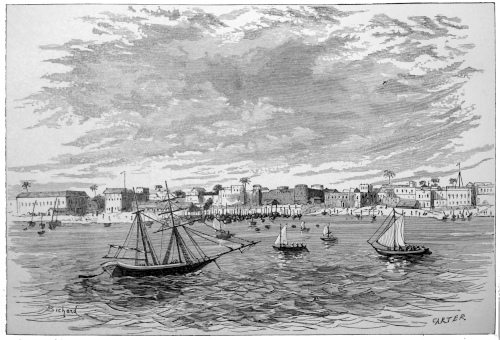
ZANZIBAR FROM THE SEA.
Vessels from the south making Zanzibar in the N.E. monsoon, the trade-wind of December to March, leave Europa Island to the west, and the Comoro group and S. Juan de Nova on the east. Keeping well in mid-channel, they head straight for Mafiyah. They hug Point Puna, avoiding Latham’s Bank,[37] and they work up by Kwale and the Chumbi Island. Ships from the north have only to run down the mid-channel, between Pemba and the continent, and then to pass west of Tumbatu. Those sailing southward from Zanzibar at this season pass along-shore, down the Mozambique Channel. Vessels from the south making Zanzibar in May to September, the height of the S.W. monsoon—the anti-N.E. trade—sail up the same passage. They must beware of falling to leeward; and those that neglect 145‘lead and look-out’ are ever liable to be carried northwards to Pemba by the counter-current before mentioned, which may, however, now be a wind-current. At this season ship-masters missing the mark have sometimes made 3° to 4° of easting, and have preferred beating down to Mafiyah and running up again, rather than face the ridicule of appearing viâ the northern passage. Those leaving the Island in the S.W. monsoon stand north up channel, well out in E. lon. 9° 42′ to 43′, beat south of Cape Delgado, pass between the Comoro group and the mainland, and thus catch the Mozambique gulfstream. The brises solaires blow strongest off Madagascar in June and July. They fall light in August and September.
The aspect of Zanzibar from the sea is that of coralline islands generally—a graceful, wavy outline of softly rounded ground, and a surface of ochre-coloured soil, thickly clothed with foliage alternating between the liveliest leek-green and the sombrest laurel, the only variety that vegetation knows in this land of eternal verdure. Everywhere the scenery is similar; each mile of it is a copy of its neighbour; and the want of variety, of irregularity, of excitement, so to speak, soon makes itself felt. Zanzibar ignores 146the exhilaration of pure desert air, and the exaltation produced by the stern aspect of mountain regions or by a boundless expanse of Pampa and Sahara. Without a single element of sublimity, soft and smiling, its sensuous and sequestered scenery has no power to spur the thought, to breed an idea within the brain. The oppressive luxuriance of its growth combined with the excess of damp heat, and possibly the abnormal proportion of ozone, are the most unfavourable conditions for the masculine. The same is the case in Mazanderan, Malabar, Egypt, Phœnicia, California, and other Phre-kah—lands of the sun. And the aspect of that everlasting, beginning-less, endless verdure tends, as on the sea-board of the Brazil, to produce sensations of melancholy and depression. We learn at last to loathe thee,
‘gay green,
Thou smiling Nature’s universal robe!’
Landing upon the island, you find a thin strip of bright yellow sand separating the sea from a curtain of vegetation, which forms a continuous wall. In some parts madrepore rock, looped and caverned by the tide, and covered with weeds and testaceæ, whose congeners are fossilized in the stone, rises abruptly a few feet above the wave. At other places a dense growth 147of tangled mangrove jungle exposes during the ebb a sheet of black and sticky mire, into which man sinks knee-deep. The regularity of the outline is broken by low projecting spits and by lagoons and backwaters, which bite deep into the land. Their pestilential, fatal exhalations veil the low grounds with a perpetual haze, and the excess of carbon is favourable to vegetable as it is deleterious to animal life.
Passing over the modern sea-beach, with its coarse grasses, creepers, and wild flowers—mostly the Ipomæa—and backed by towering trees, cocoas, mangos, and figs, we often observe in the interior distinct traces of an old elevation, marked by lines of water-worn pebbles and by coarse gravels overlying greasy blue clay. This is the home of the copal. Beyond it the land rises imperceptibly, and breaks into curves, swells, and small ravines, rain-cut and bush-grown, sometimes 40 feet deep. The soil is now a retentive red or yellow argile, based upon a detritus of coralline, hardened, where pressed, into the semblance of limestone, or upon a friable sand-stone-grit of quartz and silex. The humus of the richest vegetable substance, and excited by the excess of humidity and heat, produces in abundance maize, millet, and various panicums; 148tomatoes and naturalized vegetables, muhogo (the cassava), and Palma Christi; coffee, cotton, and sugar-cane; clove, nutmeg, and cinnamon trees; foreign fruits, like the Brazilian Cajú, the passion-flower and the pine-apple; the Chinese Leechi; bananas and guavas, the Raphia and the cocoa, twin queens of the palms; limes and lemons, oranges and shaddocks, the tall tamarind, the graceful Areca, the grotesque calabash and Jack-tree, colossal sycamores and mangos, whose domes of densest verdure, often 60 feet high and bending, fruit-laden, to the earth, make our chesnuts, when in fullest dress, look half-naked and in rags.
The uplands, especially in the western part of the island, are laid out in Máshámha or plantations, whose regular lines of untrimmed clove-trees are divided by broad sunny avenues. Here and there are depressions in the soil, where heavy rains slowly sinking have nursed a tangled growth of reeds and rushes, sedge and water-grass. About the Mohayra and the Búbúbú—the principal of the ποταμοι πλειστοι of the Periplus—mere surface-drains, choked with fat juncaceæ and with sugar-cane growing wild, there is a black soil of prodigious fertility, whose produce may, so to speak, be seen to grow. This sounds 149like exaggeration; but I well remember, at Hyderabad, in Sind, that during the inundation of the Indus we could perceive in the morning that the maize had lengthened during the night, and the same is the case with certain ‘toadstools’ and fungi in the Brazil.
Upon this waste of rank vegetation the sun darts an oppressive and malignant beam. In the driest season the ‘mangrove heaviness’ of the western coast and the cadaverous fœtor announce miasma; after the rains the landscape is redolent of disease and death.
The cottages of small proprietors and slaves strew the farms. They are huts of wattle and rufous loamy dab, to which large unbaked bricks of red clay are sometimes preferred. The usual cajan pent-roof forms deep dark eaves, propped by untrimmed palm-boles. These dwellings are unwholesome, because none boast of a second storey; they are not even built upon piles, and thus their sole defence against the surrounding malaria is the shrubbery planted by nature’s hand. Sickness seems generally, both in the island and on the continent, to follow turning up fresh soil, and the highlands are often more subject to miasma than the lowlands.
The lines of communication consist of mere 150footpaths, instead of the broad roads required for the ventilation of the country. When the produce of the land is valuable the lanes are lined with cactus, milk-bush (euphorbia), and succulent plants, whose foliage shines with metallic lustre. Set in little ridges, the hedge-rows of pine-apple, with its large pink and crimson fruit, passing, when ripe, into a reddish-yellow, form a picturesque and pleasant fence. At a distance from the town the paths become rough and solitary. Nearer, they are well beaten by negroes of both sexes and all ages, carrying fuel or baskets of fruit upon their heads, or bringing water from the wells, or loitering under shady trees to cheapen the cocoa-nut, manioc, and broiled fish, offered by squatting negresses for their refection.
Section 2.
Meteorological Notes—The Double Seasons, &c.
The characteristic of meteorology at Zanzibar, as generally the case in the narrow equatorial 151zone, is the extreme irregularity of its phenomena. Here weather seems to be all in confusion; hardly two consequent years resemble each other. In 1853-4, for instance, the seasons, if they may so be called, were apparently inverted; heavy showers fell during the dries, and a drought occupied the place of the wet monsoon. Sometimes the rains will begin with, this year (1857) they ended with, a heavy burst. Now April is a fine month, then the downfall will last through June.
I may also remark one great difference of climate between the eastern and western coasts of intertropical Africa. Whilst Zanzibar is supersatured with moisture, Angola, on the same parallel, is a comparatively dry, sandy, and sunburnt region. Kilwa, upon the eastern coast, and in S. lat. 8° 57′, is damp and steamy. S. Paulo de Loanda, upon the opposite shore (S. lat. 8° 48′), suffers from want of water. We find the same contrast in the South American continent. The middle Brazil is emphatically a land of rains, whilst Peru and Chili require artificial irrigation supplied by melted snow. Evidently the winds charged with moisture, the N. E. and S. E. trades and their modifications, discharge themselves upon the windward sides of continents, 152especially when these are fringed with cold sierras, which condense the vapour and render the interior a lee land.
In 1847 the Geographical Society of Bombay sent a barometer to Zanzibar, and requested that a meteorological register might be kept. Their wishes were not immediately carried into effect; but after a time the Eurasian apothecary in charge of the Consulate filled up in a rude way during nine months a weather-book, with observations of the barometer, of two thermometers attached and unattached, of wet and dry bulbs, of evaporation and of rainfall. In the Journal of the Royal Geographical Society (xxiii. of 1853), Colonel Sykes published a ‘record, kept during eleven months in 1850, of the indications of several intertropical instruments at Zanzibar,’ unhappily without those of pressure.[38]
The result of nine months’ observations is that 153the thermometer shows a remarkably limited range of temperature and an extreme variation of only 18°-19°. A storm, however, will make the mercury fall rapidly through 6°-7°. The climate is far more temperate than the inexperienced expect to find so near the equator. It is within the limits of the true Trades. The land and sea breezes laden with cool moisture blow regularly, and the excessive humidity spreads a heat-absorbing steam-cloud between sun and earth. The medium temperature of January is 83° 30′; of February, the hottest month, 85° 86′ (according to Colonel Sykes 83° 40′); and of March, 82° 50′. This high and little-varying mean then gradually declines till July, the coolest month (77° 10′). The mean average of the year is 79° 15′-90′. In September and October the climate has been compared with that of southern Europe. On the other hand, the atmosphere supports an amount of moisture unknown to the dampest parts of India.
The barometer, so near the equator, is almost uniformly sluggish and quiescent. Its range diurnal and annual is here at a min. It seldom, except under varying pressure of storms or tornadoes, rises or falls above or below 30 inches at sea level, and a few tenths represent the max. 154variation. It must be observed, however, on both coasts of Africa, within 6°-7° of the Line, this instrument requires especial study for nautical purposes. Here it is an imperfect indicator, because, affected from great distances, it rises without fine weather and it falls without foul. At Zanzibar the case of a whaling captain is quoted for wasting in vain precautions nearly two months. Moreover, sufficient observations have not yet been accumulated in the southern hemisphere. Where there is so little expansion in the mercurial column the convexity and concavity of the column-head must be carefully examined with a magnifying-glass, and by a reflecting instrument the smallest change could be correctly measured. The trembling of the aneroid needle, sometimes ranging through a whole inch during the gusts of the highly electrical tornado, also calls for observation. The sympiesometer is held to be even more sensitive than the mercurial barometer, especially before storms, and ignorance of its peculiarity has often ‘frightened a reef in’ at unseasonable times. The same was found to be the case, in high latitudes, by Lieut. Robertson, R.N., when sailing under Captain Ross (1818), between N. lat. 51° 39′ and 76° 50′.
155Observations with the altitude and azimuth determined the variation of the needle in 1857 to be between 9°-10° (W.). If this be correct, it is gradually easting. In 1823 Captain Owen found it to be 11° 7′ (W.).[39] So, upon the opposite coast, the variation laid down in our charts of 1846 as 20° (W.) has gradually declined to between 18° 30′ and 19° (W.).
Of exceptional meteoric phenomena I can speak only from hearsay, no written records existing upon the island. A single earthquake is remembered. In the early rains of 1846, at about 4 P.M., a shock, accompanied by a loud rumbling sound, ran along the city sea-front, splitting the Sayyid’s palace, the adjacent mosque, and the side-walls of the British Consulate, in. a direction perpendicular to the town. It was probably the result of igneous disturbance below the coralline, and it tends to prove that the island was originally an atoll: some, however, have explained it by a land-slip. Three meteors are known since 1843. In December of that year a ball of fire was visible from windows facing the north; it disappeared without a report. The most remarkable was a bolis, which, about 1566 P.M. on October 25, 1855, took a N.W. by W. path, burned during ten or eleven minutes, and frightened the superstitious burghers into fits. Water-spouts commonly appear during the month of April, and in the direction of the mainland: the people disperse them by firing guns.
Frost and snow are of course unheard of at Zanzibar, and hail, not uncommon in the interior, never (?) falls upon the island or the coast. During the wet season generally, especially when the heats are greatest, the hills of Terrafirma are veiled with clouds, and sheet-lightning plays over the horizon. The islanders assure the stranger that storms of thunder and lightning are rare, and that few accidents happen from the electric fluid. M. Alfred May, for instance, declares that thunder is heard only three or four times a year. The same is said in West African Yoruba, in parts of the Brazil, and even in Northern Syria—Damascus, for instance. It would be curious to inquire what produces this uniform immunity under climatic conditions so different. At Zanzibar, however, the phenomenon is irregular as the seasons. I was told of several deaths by the ‘thunderbolt,’ and in the year 1857 the S.W. monsoon was ushered in almost daily by a tempest. Lieutenant-Colonel 157Hamerton, when sailing about the island, lost by lightning his Baloch Sarhang (boatswain); he himself felt a blow upon the shoulder like that of a falling block. No blood appeared upon the side, but it was livid to the hip, and for some days the patient was decidedly ‘shaky.’ Some explained his escape by his wearing flannel; others by his standing near the davits of a longboat, which were twisted like wax by the electric fluid.
The mainlands of Zanzibar and of Mozambique are subject, as might be expected, to tornados, which much resemble those of the West African coast. Accompanying the formation and the dispersion of the nimbus, they are often violent enough to wreck small craft. Caught in a fine specimen, I was able to observe all the normal phenomena,—the building up of the warning arch, the white eye or gleam under the soffit, the wind blowing off shore, the apparent periodicity of throbs, and the frantic rage of the short-lived squall. The cyclones and hurricanes of the East Indian Islands rarely extend to Zanzibar. During 14 years there was but one tourbillon strong enough to uproot a cocoa-tree. It passed over the city about midnight, overthrowing the Mábandani or roof-sheds, and it was 158followed by a burst of rain. Colonel Sykes (loco cit.) remarks, philosophically explaining the why, ‘Another peculiar feature in the climatology of Zanzibar is that there is seldom any dew experienced.’ The reverse is the case, as might be known by the strength of the nightly radiation. Captain Guillain (i. 2, 72) declares that the rosées which accompany the rains are sufficient for watering the ground, and observes (p. 94), I presume concerning those who remain in the open air, ‘Rester à terre entre huit heurs du soir et le lever du soleil c’est s’exposer à une mort très probable, sinon certaine.’ The sunset, never followed by twilight, is accompanied by a sudden coolness which, as in equatorial, and even sub-tropical regions generally, causes a rapid precipitation of vapour. The dews are cold and clammy, and the morning shows large beads in horizontal streaks of moisture on perpendicular surfaces. I often remarked the deposition of dew when light winds were blowing; of course it did not stand in drops, but it wetted the clothing. This I believe is an exception to the general rule. At sunset the old stager will not sit or walk in the open air, although, as in Syria, he will expose himself to it at nine or ten p. m., when the night has acquired its normal temperature. 159As in the west coast squadron, so here, there is an order that all men on deck after sunset must wear their blanket-coats and trowsers, and many an unfortunate sailor has lost his life by sleeping in the streets, thus allowing the dew to condense upon his body while under the influence of liquor. Experienced travellers have taught themselves, even in the hottest seasons of the hottest equinoctial regions, to air the hut with a ‘bit of fire’ before sundown and sunrise, and it is doubtless an excellent precaution against ‘chills.’
Zanzibar Island, lying in S. lat. 6°, has the sun in zenith twice a year: the epochs being early March and October; more exactly, March 4 and October 9. Hence it has two distinct summers; the first in February, the second in September. It has double rains; the ‘Great Masika’ in April to June, and the ‘Little Masika’ in October to November. It has two winters; the shorter in December, and in July the longer, which is much more marked than the former. There are only three months of N.E. trade (Azyab)[40] to nine of S.E. and S.W. (Kausi). 160The regularity of these seasons is broken by a variety of local causes, and there is ever, I repeat, the normal instability of equinoctial climates. Theory appears often at fault upon these matters. A fair instance is Mr Cooley’s assertion, that about Kilima-njaro the ‘rainy season is also the hot season.’ Theoretically, of course, the period of the sun’s northing and of the great rains should be, north of the equator, the hot season; but where tropical downfalls are heavy, the excessive humidity intercepting the solar rays, and the valleys and swamps refrigerated by the torrents, make the rainy season the cold weather. From June to September the natives of Fernando Po (N. lat. 4°) die, like those of eastern intertropical Africa, of catarrh, quinsey, and rheumatism. Even in India the Goanese call the rains ‘o inverno,’ and Abba Gregorius makes the wet weather the winter of Abyssinia. About Kilima-njaro the hot and dry season opens with the end and closes with the beginning of the hot monsoon.
The natives of Zanzibar distribute the year 161into five seasons. A far simpler division here applicable, as in Western India, is made by those local trades the monsoons, between whose two unequal lengths are long intervals of calms and of variable winds. These are the Mausim or N.E. monsoon, and the Hippalus or S.W.
1. The Kaskazi or Kazkazi (vulgarly Kizkazi), to which the Arabs limit the term El Mausim (Monsoon), is the season during which the Azyab (ازيب) or N.E. trade blows. The wind begins about mid-November; from mid-December to mid-February its strength is greatest, and it usually ends about mid-March. In 1857, however, the Kaskazi opened with light showers, and continued in full force till March 24; usually the last vessels from Cutch and Bombay enter port about March 10. This is the first of the two hot seasons, and midsummer may be placed in February and March. A fine, cool sea-breeze from the N.E. usually prevails between 8 a.m. and late in the afternoon. When it is absent the weather is sultry and oppressive, the northerner feels suffocated; the least exertion brings on profuse perspiration, and the cuticular irritation produces boils and ‘prickly heat.’ The nights are close and stifling enough to banish rest and sleep. As has been shown, the thermometer 162does not stand high, but the frequent flashes of sheet-lightning playing over the northern and western sky show a surcharge of electricity. The public health would suffer severely but for the frequent cooling showers which, especially at the end of the Kaskazi, are succeeded by several days of pleasant weather. This is the agriculturist’s spring. Sesamum, holcus, rice, and other cereals, are sown upon lands previously burned for manure. It is the traveller’s opportunity for visiting the interior of the island and the worst parts of the coast, but—‘bad is the best.’
2. The Msika (or Másika) Mku, Greater rain or rains. About the end of March the change of monsoon is ushered in by heavy squalls from the S.E. and by tornados blowing off land. Presently the Hippalus breaks, and extends from early May into October. In May native craft make India after a run of 20 to 25 days; after the end of August they rarely attempt the voyage. This Kausi or Hippalus is usually called S.W. monsoon, but it has mostly an eastern deflection, possibly modified by the westerly land-breezes. The Arabs divide it, as will be seen, into three portions. First, the Kaus proper,[41] in Kisawahili 163Kausi (قوسی), from mid-April to early August, the period of the greatest strength. Second, Kipupwe or first winter—July and early August; and third, the Dayman, which ends the Kausi.
Presently appear the rains which have followed the northing sun. The same observation was made by the Austrian mission on the White River in N. lat. 4° 30′. On the coast we can distinctly trace their progress. In 1857 the downfall began in Feb. 15, at Usumbara (S. lat. 5°), where the clouds are massed and condensed by a high plateau, leading to lofty, snow-capped mountains. In 1854 I found that the rainy season opened at Berberah of the Somal (N. lat. 10° 25′) on April 15; and in early June they reach Bombay (N. lat. 18° 53′). Concerning the movement of the wet season in inner intertropical Africa I have already written in the Journal of the Royal Geographical Society (xxix. 207).
The heaviest rains at Zanzibar Island begin the wet season about mid-April, and last 30 to 40 days; they do not end, however, till early June. Some observers remark that the fall is greatest at low water and during the ebb-tides of the Syzygies. It is, however, rare to have a week of uninterrupted rain, as in eastern India and sometimes in the Brazil. The discharge is 164exceedingly uncertain. Some years number 85 inches, others 108. During the first eight months of 1857 and the last four months of 1858, we find a total of 120·21 inches. In 1859 it reached 167, doubling the average of Bombay (76·55), and nearly trebling that of Calcutta (56·83). We may compare these figures with those of Europe and the United States. England has 31·97 inches; France, 25·00; Central Germany, 20·00; Hungary, 16·93; Boston, 38·19 (about the same at Beyrut in Syria); Philadelphia, 45·00; and St Louis, Mo., 31·97. Of these 167 inches (1859), 104·25 fell during the Msika Mku. The number of wet days ranges from 100 to 130 per annum. According to the people, rain has diminished of late years; perhaps it is the result of felling cocoas, and of disforesting the land for cloves. In 1857, the Great Msika was preceded by a few days of oppressive heat, which ended (March 24) in a highly electrical storm, like those which usher in the rains of western India, and suddenly the cool S.W. began to blow. For some time we had daily showers, now from the N.E., then from the S.W., with high winds and loud thunderings; the rains, however, did not show in earnest before April 10.
The islanders like the Msika to open with 165showers strong enough to bind the land, but not so violent as to carry off the manure deposited by the year’s decayed vegetation. After this the water should fall in heavy ropy torrents, with occasional breaks of sunshine and fine weather; when this lasts thirty days, and is succeeded by frequent showers, good crops are expected. The downfall is heavier in the interior of the island than about the city, which, situated upon a point, escapes many a drenching. It must, however, be borne in mind that the phenomena of the rains, like those of the sea and air, are essentially irregular. In some seasons there will be only half-a-dozen rainy afternoons; in others as many rainy mornings. There are years of great drought, and there are seasons when the sun does not appear for six weeks in succession. Usually heavy rain is not expected after 11 A.M., and showers are rare after 2 P.M. As I subsequently remarked in the east African interior—the Fluminenses of the Brazil still preserve the tradition—there is a curious regularity and periodicity in the hours of downfall, often extending over many days. This phenomenon may have done much towards creating the ‘rain-doctor.’
During the Msika the horizon is obscured, 166dangerously indeed for ships: the wind veers round to every point of the compass; the sky is murky and overcast; huge purple nimbi, like moving mountains, float majestically against the wind, showing strong counter-currents in the upper aërial regions. From afar the island appears smothered in blue mist, and often the cloudrock splits into two portions, one of which makes for the coast. Even during the rare days of sunshine the distances, owing to the continuous humidity, are rarely clear, and the exhalations make refraction extensive. A high tension of vapour is the rule. For the first three hours after sunrise the land is often obscured by ‘smokes,’ a white misty fog, often deepening to a drizzling rain; this lasts until 10 A.M., about which time the sea-breeze begins to blow.
The Msika is much feared by the native population, and the interior of the island becomes a hot-bed of disease. The animal creation seems to breathe as much water as air. The want of atmospheric weight, and consequently of pressure upon the surface of the body, renders the circulation sluggish, robs man of energy, and makes him feel how much better is sleep than waking. Europeans, speaking from effect, complain that the ‘heavy’ air produces an unnatural 167drowsiness—it is curious to see how many of our popular books make humidity increase the weight of the atmospheric column. During this season the dews of sunset are deemed especially fatal to foreigners. At times the body feels cold and clammy when the thermometer suggests that it should be perspiring: super-saturation is drawing off the vital heat. The lungs are imperfectly oxygenized, and, in general belief, positive is exchanged for negative electricity. The hair and skin are dank and sodden; indeed, a dry cutis is an unattainable luxury. Iron oxydizes with astonishing rapidity; shoes exposed to the air soon fall to pieces; mirrors are clouded with steam; paper runs and furniture sweats; the houses leak; books and papers are pasted together; ink is covered with green fur; linens and cottons grow mouldy, and broadcloths stiffen and become boardy.
This excess of damp is occasionally varied by the extreme of dryness. The hot wind represents the Khamasin of Egypt, the Sharki (or Sh’luk) of Syria, the Harmattan of west Africa, and the Norte of the southern Brazil, Paraguay, and the Argentine Confederation. At such times the air apparently abounds in oxygen and in ozone. Cotton cloth feels hard and crisp; even 168the water is cooled by the prodigious evaporation. Books and papers curl up and crack, and strangers are apt to suffer from nausea and fainting fits.
3. The Kipupwe, first winter or cold season—July and early August. The bright azure of the sky, the surpassing clearness of the water, and the lively green colours of the land, are not what we associate with the idea of the ‘disease of the year.’ The Kausi or S.W. monsoon still blows, but in this second or post-pluvial phase its strength is diminished. As on the western coast the mornings are misty, the effect of condensation and of excessive evaporation, the sun pumping up vapour from the rapidly desiccating ground; but about four hours after sunrise a strong sea-breeze sets in, giving a little life and elasticity to the exhausted frame. When the ‘doctor’ fails the heat is oppressive, and the sunsets are often accompanied by an unpleasant closeness. The beginning of the Kipupwe is held to be universally sickly. The Hindus, who declare that all cold coming from the south is bad, suffer from attacks of rheumatism and pneumonia. The charms of the season induce Europeans to despise the insidious attacks of malaria: they 169commit imprudences and pay for them in severe fevers. The rare but heavy showers that now fall are termed ‘Mcho;’ they separate the greater from the lesser Msika.
4. Daymán (in Kisawahili Daymáni) ends the Kausi or S. W. monsoon, and extends through August and part of October. Though the sun is nearly perpendicular the air is cooled by strong south-westerly breezes. At this time yams, manioc, and sweet potatoes grow, making it a second spring, whilst the harvest of rice and holcus assimilates it to the temperate autumn.
5. The Vuli (Fuli)[42] or Msika Mdogo, second rains or Little Msika. This season lasts but three weeks, beginning shortly after the sun has crossed the zenith of Zanzibar in the southern declination, and embracing part of October and November. It is not considered a healthy time by the islanders. The autumnal rains are sometimes wanting upon the continent, and the land then suffers as severely from drought as northern Syria does when the ‘former rain’ fails. After the Vuli recommences the Kaskazi, and the 170N. E. trade again blows. The sun is distant, the thermometer does not range high, yet the temperature of houses sheltered from the breeze becomes overpowering, and without the ‘doctor’ the city would hardly be habitable. At times the Trade freshens to a gale that blows through the day. The Hindus suffer severely from this ‘Báorá’ (blast), and declare that it brings on fits of ‘Mridi’ (refroidissement), here held dangerous. During the whole of the Azyab monsoon the people prefer hot sun and a clear, which is always a slightly hazy-blue, sky. They dislike the clouds and heavy showers called Mvua[43] ya ku pandia, or harvest rains, which are brought up at times by the N. N. West wind. On the other hand, when the Kausi or S. West monsoon blows, they hold an overcast sky the best for health, and they dread greatly the ‘rain-sun.’ The peasants take advantage of the dryness, and prepare, by burning, the land for maize, sesamum, and rice.
The Wasawahili, like the Somal and many other races, have attempted to conform the lunar with the solar year, a practice which may 171date from the days when the Persians were rulers of the Zanzibar coast. They also give their own names to the lunar months of the Moslem; and, curiously enough, they begin the year, not with Muharram, but with the ninth month (Shaw wal), which they call ‘Mfunguo Mosi,’ or First Month. The next, Zu’l Ka’adeh, is Mfunguo Mbili, Second Month, and so on till Rajah, Shaa’-ban (or Mlisho) and Ramazan, which retain their Arab names.[44] Amongst the Somal, five months, namely, from the second to the fifth, are known by the old Semitic terms. The month, as amongst all savage and semi-civilized tribes, begins with sighting the moon; and the Wasawahili reckon like the Jews, the modern Moslems, and the Chinese, 12 of 29 and 30 days alternately. ‘The complete number of months with God’ being, says the Koran, ‘twelve months,’ good followers of the Prophet ignore the Ve-adar, second or embolical Adar, which the Hebrews inserted after every third year, and retain their silly cycle of 354 days. The Wasawahili add 10 to 12 days to the Moslem year, and thus preserve the orderly recurrence of the seasons. The sage in 172charge of the local almanac is said to live at Tumbatu: he finds his New Year’s Day by looking at the sun, by tracing figures upon the ground, and by comparing the results with Arabic calendars. Their weeks begin, as usual with Moslems, on Friday (Ejúmá for Juma), the Saturday being Juma Mosi, or one day after Friday, and so forth. Thursday, however, is Khamisi. This subdivision of time, though suggested by the quarters of the earth’s satellite, is known only to societies which have advanced toward civilization. Thus in Dahome we find a week of four days; and even China ignores the seven-day week.
‘The universal festivals,’ says the late Professor H. H. Wilson (Essays on the Religion of the Hindus, ii. 155), ‘are manifestly astronomical, and are intended to commemorate the revolutions of the planets, the alternations of the seasons, and the recurrence of cyclical intervals of longer or shorter duration.’ The Nau-roz (نوروز) or New Year’s Day, here, as in Syria, locally pronounced Nay-roz, was established in ancient Ariana, according to Persian tradition, by Jamshid, King of Kings, in order to fix the vernal equinox.[45] It is the Holi of the Hindus, 173and after the East has kept this most venerable festival for 3000 years, we still unconsciously celebrate the death and resurrection of the eternal sun-god. The Beal-tinne is not yet forgotten in Leinster, nor is the maypole wholly obsolete in England. As early as the days of the Kuraysh, there was an attempt to reconcile the lunar with the solar year, and the Nau-roz, though palpably of Pagan origin, has been adopted by all the maritime peoples professing El Islam. Even the heathen-hating Arab borrowed it for his convenience from the Dualists and Trinitarians of Fars and Hindustan. Hence the æras called Kadmi and Jelali. In this second solar æra the Nau-roz was transferred by the new calendar from the vernal equinox to Sept. 14, A.D. 1079, and was called Nau-roz i Mízán (نوروز مِنران). Amongst the Wasawahili it is known as Siku Khu ya Mwáká, the Great Day of the year.
For the purpose of a stable date, necessary both to agriculture and to navigation, and also for the determination of the monsoons, the people who ignore the embolismal month, and who have no months for the solar year, add, I have said, 10 to 12 days to each lunar year, the true difference being 16 days 9 hrs. 0 min. and 17411·7 secs. Thus the contrivance is itself rude; moreover the Wasawahili often miscalculate it. Between A.D. 1829 and A.D. 1879, it would fall on 28-29 August. In 1844 they made it commence at 6 p. m., August 28, immediately after full moon: in 1850-2 they began it on August 27, and in 1856 onon August 26.[46]
Sundry quasi superstitious uses are made of the 10 embolismal days following the Nau-roz. Should rains—locally called Miongo—fall on the first day, showers are prognosticated for the tenth; if on the second, the twentieth will be wet; and so forth till the tenth, which if rainy suggests that the Kausi or S.W. monsoon will set in early. The seasons of navigation are thus reckoned. The Vuli rains are supposed to begin 30 days, counting from the twentieth, after Nauroz. 175On the eightieth (some say the ninetieth) day are expected thunder, lightning, and heavy rains at the meeting of the monsoons (mid-November), and so forth. Possibly this may be a reflection of the Hindu idea which represents the Garbhas to be the fetuses of the clouds, and born 195 days after conception. With us the people mark the periods by saints’ days. The Bernais say—
Après le jour de la Sainte Luce,
Les jours s’allongent le saut d’une puce.
The Escuara proverb declares—
Sanct Seimon etu Juda,
Negua eldu da.
(‘At St Simon and St Jude, water may be viewed.’)
The basis of the following calculation is thoroughly Kisawahili—
S’el pleut le jour de Saint Médard, (June 8)
Il pleut quarante jours plus tard.
Nor is our popular doggrel less so—
Saint Swithin’s Day, if thou dost rain,
For forty days it will remain.
Saint Swithin’s Day, if thou be fair,
For forty days ’twill rain nae mair.
The Wasawahili also calculate their agricultural seasons from the stars called Kilímia, a name probably derived from Ku lima, to plough. 176I believe them to be Pleiades, but my sudden departure from the coast prevented my making especial inquiries. When this constellation is in the west at night the peasants say, ‘Kilímia, if it sets during the rains, rises in fair weather,’ and vice versâ. Also Kilímia appearing in the east is a signal for the agriculturist to prepare his land.
Section 3.
Climate continued—Notes on the Nosology of Zanzibar—Effects on Strangers.
The climate of Zanzibar Island is better than that of the adjacent continent. Here many white residents have escaped severe fever; but upon the coast the disastrous fate of Captain Owen’s surveyors, the loss of life on board our cruisers, and the many deaths of the ‘Mombas Mission,’ even though, finding the sea-board dangerous, they built houses on the hills which lead to the mountain region of Usumbara, prove that malaria is as active in eastern as in western Africa. Colonel Hamerton once visited the 177Pangani river during the month of August: of his 19 men, three died, and all but one suffered severely. Perhaps we should not find a similar mortality in the present day, when the lancet has been laid aside for the preventive treatment by quinine and tonics. It has, however, been asserted that the prophylactic use of the alkaloid, which was such a success in western Africa, did not prove equally valuable on the eastern coast.
Yet Zanzibar, with its double seasons and its uniformly heated and humid atmosphere, accords ill, even where healthiest, with the irritable temperament of northern races. Here, contrary to the rule of Madagascar, the lowlands over which the fresh sea-breeze plays are the only parts where the white stranger can land and live; the interior is non habitabilis æstu. Lieut.-Colonel Hamerton, called upon in March, 1844, by Sir George Arthur, governor of Bombay, to report upon the island, wrote in September of the same year, ‘The climate of the [insular] coast is not unhealthy for Europeans, but it is impossible for white men to live in the interior of the island, the vegetation being rank and appearing always to be going on; and generally fever contracted in the interior is fatal to Europeans.’ Colonel Sykes (loco cit.) questions this assertion as being 178‘contrary to all other testimony.’ Every traveller, however, knows it to be correct. As in the lovely climates of the Congo River and the South Sea Islands, corporal lassitude leads to indolence, languor, and decline of mental energy, which can be recovered only by the bracing influence of the northern winter. Many new arrivals complain of depressing insomnia, with alternations of lethargic sleep: I never enjoyed at Zanzibar the light refreshing rest of the desert. Yet the island is a favourable place for the young African traveller to undergo the inevitable ‘seasoning fever’fever’, which upon the coast or in the interior might prove fatal. The highlands, or the borders of the great central basin, are tolerably healthy, but an invalid would find no comforts there—hardly a waterproof roof. He should not, however, risk after recovery a second attack, but at once push on to his goal; otherwise he will expend in preparation the strength and bottom required to carry out his explorations. With a fresh, sound constitution, he may work hard for three years, and even if driven home by ill health he may return in comparative safety within a reasonable time.
No European, unless thoroughly free from organic disease, should venture to remain longer 179than three or four years at Zanzibar: the same has been observed of Baghdad, and of the Euphrates valley generally. Lurking maladies will be brought to a crisis, and severe functional derangements are liable to return. The stranger is compelled to take troublesome precautions. He may bathe in cold water, sweet or salt, but he must eschew the refreshment of the morning walk: during the rains, when noxious mists overhang the land, the unpleasant afternoon is the only safe time for exercise. Flannel must always be worn despite the irritability of the ever-perspiring skin: even in the hottest weather the white cotton jackets and overalls of British India are discarded for tweeds, and for an American stuff of mixed cotton and wool. Extra warm clothing is considered necessary as long as the ‘mugginess’ of ‘msika-weather’ lasts. Sudden exposure to the sun is considered dangerous, and the carotid, jugular, and temporal arteries must be carefully protected from cold as well as from heat. Hard work, either of mind or body, is said to produce fever as surely as sitting in draughts or as wearing insufficient clothing. The charming half-hour following sunset is held dangerous, especially in hot weather; yet most tantalizing is the cool delicious 180interval between the burning day and the breathless night. Natives of the country rarely venture out after dark: a man found in the streets may safely be determined to be either a slave or a thief—probably both.
Directions for diet are minute and vexatious. The stranger is popularly condemned to ‘lodging-house hours’—breakfast at 9 A.M., dinner at 3 P.M., tea at 8 P.M., bed at 10 P.M. He is told also to live temperately but not abstemiously, and never to leave the stomach too long empty. I should prescribe for him, contrary to the usual plan, an abnormal amount of stimulants, port and porter, not claret nor Rhine-wine. It is evident that where appetite is wanting, and where nourishing food is not to be obtained, the ‘patient’ must imbibe as much nutriment as he safely can. In these lands a drunkard outlives a water-drinker, despite Theodoret, ‘vinum bibere non est malum, sed intemperanter bibere perniciosum est’; and here Bacchus, even ‘Bacchus uncivil,’ is still ‘Bacchus the healer.’ As usual old stagers will advise a stranger recovering from fever to strengthen himself with sundry bottles of port, and yet they do not adopt it as a preventive—‘experto crede Ricardo.’ The said port may be Lisbon wine fortified with cheap 181spirits, liquorice, and logwood—in fact, what is regimentally called ‘strong military ditto;’ yet I have seen wonders worked by the much-debased mixture. Again, Europeans are told to use purgatives, especially after sudden and strong exercise, when the ‘bile is stirred up.’ As an amateur chronothermalist—thanks to my kind old master, the late Dr Dickson—I should suggest tonics and bitters, which often bring relief when the nauseous salts and senna aggravate the evil. Also, in all debilitating countries, when the blood is ‘thin,’ laxatives must be mild, otherwise they cause instead of curing fever; in fact, double tonics and half purgatives should be the rule. Above all things convalescents should be aided by change of air, if only from the house of sickness to that of a neighbour, or to a ship in port. The most long-lived of white races are the citizens of the United States: they are superior to others in mental (or cerebral) energy; they are men of spare, compact fibre, and of regular habits; they also rarely reside more than two or three years at a time on the island. On the other hand, the small French colony has lost in 15 years 26 men: they lived imprudently, they drank sour Bordeaux, and when attacked with fever they killed themselves by the abuse of 182quinine. Swallowing large doses upon an empty stomach, they irritated the digestive organs, and they brought on cerebral congestion by ‘heroic practice’ when constipated.
According to the Arabs and Hindus of Zanzibar, ague and fever are to be avoided only by perspiring during sleep under a blanket in a closed room—a purgatory for a healthy hot-blooded man in this damp tepid region. I found the cure-almost-as-bad-as-the-disease precaution adopted by the Spanish colonists at my salubrious residence—Fernando Po, West Africa. Only two officers escaped ‘chills,’ and they both courageously carried out the preventive system: on the other hand, it was remarked that they looked more aged, and they appeared to have suffered more from the climate, than those who shook once a month with ‘rigors.’ There is certainly no better prescription for catching ague than a coolth of skin during sleep: having purchased experience at a heavy price, it is my invariable practice when awaking with a chilly epiderm to drink a glass of water ‘cold without,’ and to bury myself for an hour under a pile of blankets. Every slave-hut has a cartel or cot, and the savages of the coast, like those of the Upper Nile, carry about wooden stools for 183fear of dysentery. I have mentioned how our sailors dig their graves.
So much for the male sex. European women here, as in the Gulf of Guinea, rarely resist the melancholy isolation, the want of society, and the Nostalgia—Heimweh or Home-sickness—so common, yet so little regarded in tropical countries. Under normal circumstances Equatorial Africa is certain death to the Engländerin. I am surprised at the combined folly and brutality of civilized husbands who, anxious to be widowers, poison, cut the throats, or smash the skulls of their better-halves. The thing can be as neatly and quietly, safely and respectably, effected by a few months of African air at Zanzibar or Fernando Po, as by the climate of the Maremma to which the enlightened Italian noble condemned his spouse.
The nosology of Zanzibar is remarkable for the prevalence of urinary and genital diseases; these have been roughly estimated at 75 per cent. Syphilis spreads wide, and where promiscuous intercourse is permitted to the slaves it presents formidable symptoms. The ‘black lion,’ as it is popularly called—in Arabic El Tayr or El Faranj; in Kisawahili, Bubeh, Kiswendi, or T’hego—will destroy the part affected in three 184weeks: secondaries are to be feared; noses disappear, the hair falls off, and rheumatism and spreading ulcers result. Gonorrhœa is so common that it is hardly considered a disease. Few strangers live long here without suffering from irritation of the bladder, the result, it is said, of hard lime-water: and the common effect of a cold or of stricture is severe vesical catarrh. Sarcocele and hydrocele, especially of the left testis, according to the Arabs, attack all classes, and are attributed to the relaxing climate, to unrestrained sexual indulgence, and sometimes to external injury. These diseases do not always induce impotence or impede procreation. The tunica vaginalis is believed to fill three times: as in elephantiasis the member is but a mass of flesh, a small meatus only remaining. The deposition of serum is enormous; I have heard of six quarts being drawn off. The natives punctuate with a heated copper needle, and sometimes thus induce tetanus: Europeans add injections of red wine and iodine. The latter is also applied with benefit in the early stage to sarcocele; and both complaints have yielded, it is said, to the galvanic current. Strangers are advised at all times to wear suspensory bandages.
185Elephantiasis of the legs and arms, and especially of the scrotum, afflicts, it is calculated, 20 per cent. of the inhabitants: Arabs and Hindus, Indian Moslems and Africans, however dissimilar in their habits and diet, all suffer alike. It is remarked that the malady has never attacked a pure white, European or American: perhaps the short residence of the small number accounts for the apparent immunity. Similarly, in the Brazil I have never seen a European stranger subject to the leprosy, or to the goître, so prevalent in the great provinces of São Paulo and Minas Geraes. The Banyans declare that a journey home removes the incipient disease, or at least retards its progress: it recurs, however, on return to Zanzibar. The scrotum will often reach the knees; I heard of one case measuring in circumference 41 inches, more than the patient’s body, whilst its length (33 inches) touched the ground. There is no cure, and the cause is unknown. The people attribute it to the water, and possibly it may spring from the same source which produces goître and bronchocele.
Syphilitic and scorbutic taints appear in ulcers and abscesses. The helcoma resembles that of Aden: it generally attacks the legs and 186feet, the parts most distant from the centre of circulation; the toes fall of, and the limb becomes distorted. Phagædenic sores are most common amongst the poor and the slaves, who live on manioc, fruit, and salt shark often putrid. Large and painful phlegemonous abscesses, attacking the muscular tissue, occasion great constitutional disturbance: they heal, however, readily after suppuration. Scabies, yaws (Frambæsia), psoriasis, and ‘craw-craw,’ inveterate as that of Malabar or the Congo River, commonly result from personal uncleanliness, unwholesome food, and insufficient shelter and clothing. That frightful malady Lupus presents pitiable objects.
The indigenous diseases which require mention are fevers, bowel-complaints, and pulmonary affections.
Fevers at Zanzibar have been compared with Aaron’s rod; at times they seem to swallow up every other disease, and generally they cause the greatest amount of mortality. As at Muhamreh, and on the swampy margins of the Shat el Arab (Persian Gulf), the constitution worn out, and the equilibrium of the functions deranged by moist heat and sleeplessness, especially during and after the heavy rains of the S. West monsoon, 187thus relieve themselves. Persians and northern Asiatics are even more liable to attacks than Europeans; and, as in Egypt, rude health is rare. Some Indian Moslems have fled the country, believing themselves bewitched. Arabs born on the island, and the Banyans, who seldom suffer much from the fever, greatly dread its secondary symptoms. The ‘hummeh,’ or intermittent type, is remarkable for the virulence and persistency of the sequelæ, which the Arabs call ‘Nazlah’ (metastasis), or defluxion of humours—‘dropping into the hoofs’ as the grooms say. Cerebral and visceral complications, with derangements of the liver and spleen, produce obstinate diarrhœas, dysenteries, and a long dire cohort of diseases. Men of strong nervous diathesis escape with slight consequences in the shape of white hair, boils, bad toothaches, neuralgias, and sore tongues. The weak lose memory, or virility, or the use of a limb, the finger-joints especially being liable to stiffen; many become deaf or dim-sighted, not a few are subject to paralysis in its various forms, whilst others, tormented by hepatitis, constipation, and disorders of the bowels and of the digestive organs, never completely recover health. In this country all attribute to the moon at the 188‘springs’ what we explain by coincidence and by the periodicity of disease. For months, and possibly for years, the symptoms recur so regularly that even Europeans will use evacuants and quinine two or three days before the new and full moons. In such cases, I repeat, change of climate is the best aid to natura curatrix.
The malignant typhus is rare at Zanzibar: it raged, however, amongst the crew of a French ship wrecked on the northern end of the island, when the men were long exposed to privations and over-fatigue. Intermittents (ague and fever) are common as colds in England. They are mild and easily treated;[47] but they leave behind during convalescence a dejection and a debility wholly incommensurate with the apparent insignificance of the attack, and often a 189periodical neuralgia, which must be treated with tonics, quinine, and chiretta.
The bilious remittent is, par excellence, the fever of the country, and every stranger must expect a ‘seasoning’ attack. It was inordinately fatal in the days when, the lancet being used to combat inflammation, the action of the heart was never restored. Our grandfathers, however, bled every one for everything, and for nothing: there were old ladies who showed great skill in ‘blooding’ cats. In 1857 men had escaped this scientific form of sudden death, but the preventive treatment so ably used on the West coast of Africa had not been tried. The cure at Zanzibar was an aperient of calomel and jalap. Castor oil was avoided as apt to cause nausea. Quinine was administered, but often in quantities not sufficient to induce the necessary chinchonization, and the inexperienced awaited too long the period of remission, administering the drug only during the intervals. Diaphoretics of nitrate of potash, camphor mixture, and the liquor acet. ammon. were used to reduce the temperature of the skin. The most distressing symptom, ejection of bile, was opposed by saline drinks, effervescing draughts, diluted prussic acid, a mustard plaister, or a blister. 190The hair was shaved or closely cut, and evaporating lotions were applied to the head. The extreme restlessness of the patient often called for a timid narcotic; in these days, however, the invaluable hydrate of chloral, Sumbul and chlorodyne were unknown, and soporifics were used, as it were under protest, being believed to cause constipation. Extreme exhaustion was not vigorously attacked with medical and other stimulants; and thus many sank under the want of ammonia and wine. I have since remarked the same errors of treatment in the West African coast; the patient was often restricted to the acidity-breeding rice water, arrowroot, and similar ‘slops.’ When he pined for brandy and beef-tea, the safe plan of consulting his instincts was carefully ignored.
In strong constitutions the initiatory attack of remittents is followed after a time by the normal intermittent, and the traveller may then consider himself tolerably safe. In some Indian cases ague and fever have recurred regularly for a whole year after the bilious remittent.
The bilious remittent of Zanzibar is preceded by general languor and listlessness, with lassitude of limbs and heaviness of head, with chills and dull pains in the body and extremities, and 191with a frigid sensation creeping up the spine. Then comes a mild cold fit, succeeded by flushed face, full veins, an extensive thirst, dry, burning heat of skin, a splitting headache, and nausea, and by unusual restlessness, or by remarkable torpor and drowsiness. The patient is unable to stand; the pulse is generally full and frequent, sometimes thready, small, and quick; the bowels are constipated, and the tongue is furred and discoloured; appetite is wholly wanting. During my first attack, I ate nothing for seven days; and despite the perpetual craving thirst, no liquid will remain upon the stomach. Throughout the day extreme weakness causes anxiety and depression; the nights are worse, for restlessness is aggravated by want of sleep. Delirium is common in the nervous-bilious temperament. These symptoms are sometimes present several days before the attack, which is in fact their exacerbation. A slight but distinctly marked remission often occurs after the 4th or 5th hour—in my own case they recurred regularly between 2 and 3 A.M. and P.M.—followed by a corresponding reaction. When an unfavourable phase sets in, all the evils are aggravated; great anxiety, restlessness, and delirium wear out the patient; the mind wanders, the body loses all 192power, the ejecta become offensive; the pulse is almost imperceptible; the skin changes its dry heat for a clammy cold; the respiration grows loaded, the evacuations pass involuntarily; and after perhaps a short apparent improvement, stupor, insensibility, and sinking usher in death. On the other hand, if the fever intends yielding to treatment, it presents after the 7th day marked signs of abatement; the tongue is clearer, pain leaves the head and eyes, the face is no longer flushed; nausea ceases after profuse emesis of bile, and a faint appetite returns.
After the mildest attacks of the Zanzibar remittent, the liver acts with excessive energy: sudden exercise causes a gush or overflow of bile, which is sufficient to bring on a second attack. The debility, which is inordinate, may last for months. It is often increased by boils, which follow one another in rapid succession, and which sometimes may be counted by scores. Besides the wet cloth, the usual remedy to cause granulation, and to prevent the sore leaving a head, is to stuff it with camphor and Peruvian bark. When boils appear behind the head, the brain is sometimes affected by them, and patients have even sunk under their sufferings. The recovery, indeed, as in the case of the intermittent type, 193is always slow and dubious, relapses are feared, and for six weeks there is little change for the better; the stomach is liable to severe indigestion; the body is emaciated, and the appetite is excessive, or sickly and uncertain. The patient suffers from toothaches and swelled face, catarrh, hepatitis, emesis, and vertigo, with alternations of costiveness and the reverse. As I have already said, change of air and scene is at this stage more beneficial than all the tonics and preventives in the pharmacopœia. Often a patient lying apparently on his death-bed recovers on hearing that a ship has arrived, and after a few days on board he feels well.
Diarrhœa and dysentery are mostly sporadic; the former, however, has at times attacked simultaneously almost every European on the Island. It is generally the result of drinking bad water or sour wine, of eating acescent or unripe fruit, and of imprudent exposure. Dysentery is especially fatal during the damp and rainy weather. It was often imprudently treated with mere astringents, and without due regard to the periods of remission, and to the low form which inevitably accompanies it. As in remittents, the patient was weakened, and his stomach was deranged, with ‘slops,’ when essence of 194meat was required. The anti-diarrhœa or anti-cholera pill of opium, chalk, and catechu has been fatal wherever English medicine has extended; witness the Crimean campaign, where the bolus killed many more than did the bullet. A complication, rarely sufficiently considered, is the hepatic derangement, from which almost all strangers must suffer after a long residence in the Tropics. At Zanzibar some Europeans were compelled to give up breakfasting, to the manifest loss of bulk, stamina, and muscular strength—vomiting after the early meal, especially when eaten with a good appetite, was the cause. Yet it was a mere momentary nausea, and when the mouth had been washed no inconvenience was felt.
Catarrh and bronchitis are common in February and in the colder months of July and August. Of endemic pulmonary diseases, pneumonia, asthma, and consumption—the latter aggravated by the humid atmosphere—are frequent amongst the higher classes, especially the Arab women debilitated by over-seclusion. The incidental maladies are tropical rheumatisms, colics, hæmorrhoids, and rare attacks of ophthalmia, simple, acute, and purulent. Hæmorrhoids are very common both on the Island and the 195coast; the people suffer as much as the Turks in Egypt without wearing the enormous bag-trowsers which have been so severely blamed.
Of the epidemics, the small-pox, a gift of Inner Africa to the world, is fatal as at Goa or Madagascar. Apparently propagated without contact or fomites, it disfigures half the population, and it is especially dangerous to full-blooded Africans. About three years ago (1857) a Maskat vessel imported a more virulent type. Shortly before my arrival, numbers had died of the confluent and common forms, and isolated cases were reported till we left the Island. All classes were equally prejudiced against vaccination. The lymph sent from Aden and the Mauritius was so deteriorated by the journey that it probably never produced a single vesicle (1857).
Until 1859 cholera was unknown even by name. Col. Hamerton, however, declared that in 1835 hundreds were swept off by an epidemic, whose principal symptoms were giddiness, vomiting and purging, the peculiar anxious look, collapse, and death. It did not re-appear for some years; but in a future chapter I shall notice the frightful ravages which it made on the East African coast at the time of my return from the interior.
196Hard water charged with lime and various salts, combined with want of vegetables, renders constipation a common ailment at Zanzibar. Amongst the rich it mostly arises from indolence, and from the fact that all are greatly addicted to aphrodisiacs. The favourite is a pill composed of 3 grains of ambergris, and 1 grain of opium, the latter ingredient in the case of an ‘Afímí’ (opium-eater) must be proportioned to his wants.
‘Doctors’ in my day were unknown at Zanzibar. Formerly, two Indians practised; since their departure the people killed and cured themselves. Amongst Arabs, and indeed Moslems generally, every educated man has a smattering of the healing art. H. H. the late Sayyid was a ‘hakím’ of great celebrity. A physician is valuable on the Island; throughout the African interior he is valueless in a pecuniary sense, as every patient expects to be kept and fed. The midwives are usually from Cutch; Arabs, however, rarely consent to professional assistance. The Prince kept in his establishment two sages femmes from Maskat.
197Section 4.
Notes on the Fauna of Zanzibar.
The list of Zanzibarian Fauna and Flora is not extensive. In the plantations the Komba or Galago abounds, and there is a small and pretty long-tailed monkey (cercopithecus griseo-viridis) with black face, green back, and grey belly: it is playful and easily tamed. This, as well as a large species of bat, is pronounced delicious by curious gourmands. The French ‘tigre’ and the English ‘panther’ (Felis Serval) is a leopard about 18 inches high, and of disproportionate length, with a strong large arm; the upper part of the skull vanishes as in the cheeta, and the throat is so thick that no collar will keep its place. This felis is destructive in the interior of the Island; and in parts of the Continent the people fear it more than they do the lion: it is trapped in the normal cage, and is speared without mercy. Two kinds of civets (Viverra civetta, and V. genetta),[genetta),[ one small, the other bigger 198than a Persian (Angora) cat, are kept confined, and are scraped once a week for their produce. As in all Arab towns, the common cat abounds; it has a long tail and ears, a wild look, and a savage temper. This Asiatic importation is never thoroughly domesticated in Africa, and seems always aspiring to become a ‘cat o’ mountain’: on the West coast it is difficult to keep cats in the house after kittening. The feline preserves its fur in Zanzibar Island: at Mombasah there is or was a breed more grotesque than the Manx, and completely bald like the Chinese dog. The so-called ‘Indian badger’ (Arctonyx collaris, Cuv.) digs into the graves and devours the dead. The rodents are grey squirrels, small rabbits (?), large rats, some of peculiar but not of unknown species, and mice, probably imported by the shipping. The ‘wild boars’ are pigs left by the Portuguese: strangers mistaking the tusks often describe them as ‘horned’ (chœropotamus). The Saltiana antelope is common: it smells strongly of musk, and its flesh resembles the rat’s.
A fine large fish-hawk, with gold-fringed eye and yellow legs, bluish-black plume, and grey neck-feathers, haunts the Island and the coast: the other raptores are the brown kites (F. 199chilla), the scavengers of Asia and Africa. As at Aden, so here, there are no common crows or sparrows; the place of the former is taken by the African species (corvus scapulatus), with white waistcoat, popularly called the ‘parson crow,’ and the latter appears in the shape of the Java variety, which, introduced about thirty years ago (1857) by Captain Ward, a Salem ship-captain, has multiplied prodigiously. Green birds, like Amedavats, muscicapæ of sorts, especially the ‘king-crow’ of India, here called ‘Drongo,’ abound; and visitors, like the French savant on the Dead Sea, speak of a humming-bird, a purely New World genus, probably mistaking for it a large hawk-moth. The parroquet resembles the small green species of India: it is tamed and taught to talk. Zanzibar cannot boast of the Madagascar parrot, a plain, brown, thick-bodied bird, celebrated for distinct articulation.[48] Martens do not build at Zanzibar (?): they halt at the Island in their migrations; and one kind, it has been remarked, never remains longer than four to five days. After the rains the lagoons are covered with wild-duck, mallard, and widgeon. The snipe (jack, common, and solitary), 200a bird which everywhere preserves its fine game flavour, is found on the Island and in the central Continent. Sandpipers (charadrius hiaticula) run on the beach, and the waters support various kinds of cranes, gulls, and terns.
When fewer ships visited the port, the sand-spit projecting from ‘Frenchman’s Island’ was covered with bay-turtle[49] (chelone esculenta or Midas), which the negroes were too indolent or ignorant to catch. The iguanas or harmless crocodiles (οὐδένα δὲ ἀνθρώπων ἀδικοῦσιν) of the Periplus, have not yet been killed out of Zanzibar—and there are several species.[50] Until lately the true crocodile was found in a small sweet stream about eight miles south of the town, and the monsters swarm in every river of the mainland.
Snakes are neither numerous nor deadly: possibly the climate, as in Ireland and Bermuda, is too damp for them. I heard of a python[51] resembling that of Madagascar and 201India; it is 13 feet long, and thick as a man’s thigh. Its favourite habitat is in sugar-cane patches near water, and it is occasionally fatal to a dog. There are water-snakes in the harbour, like those once supposed to be peculiar to Western India. The people speak of a green ‘whip-snake’—vaguest of terms—whose vertebræ appear through the skin, and there are the usual legends of a venomous tree-serpent which can shoot itself like an arrow. The pagan Mganga or Medicine-man ties above the snake-wound a circle of wire with two small bits of wood strung upon it. This, he says, prevents the venom ascending; and doubtless the ligature is for half an hour or so effective. The people have ‘Fiss’ or serpent-stones, which suggest the Irish murrain-stones. Englishmen of undoubted character have recounted cures effected by this remedy, which was so mysterious before capillary attraction robbed it of its marvel.