"HARI RĀM, THE DACOIT"
Reading edition
By E. F. POLLARD
Author of "Roger the Ranger," "A New England Raid," &c. &c.
CHAPTER I
"H urrah! you are a brick, Frank!" and Gilbert Lindsay sprang across the room and came down with an energetic thud on his brother's shoulder. "Gently," said the young man, "no need to damage me by way of gratitude. I'm just as pleased as you are, lad."
"When shall we start?" asked Gilbert cheerily.
"As soon as we can get our outfit," said Frank, "and we will set about that to-day. I'm off to the city; you had better come with me."
So the two brothers started together in good spirits. Frank Lindsay was considerably relieved by the fact that he was not to be separated from Gilbert, his mother's last charge to him. He was himself only five-and-twenty, had been educated as an engineer, and was already noted as a man of promise. This had resulted in an offer of an appointment as chief engineer to the Ganges Coal mine, in the Damuda district of Bengal. He had, however, hesitated to accept what most men would have jumped at, as it meant separation from Gilbert, who was at an age when a boy needs either a father or brother's control. Gilbert was sixteen, still at school, with no home where he could spend his vacations, for the two brothers were virtually alone in the world. Frank had therefore almost decided to make the sacrifice and throw the appointment over, when Gilbert said carelessly—
"Why not take me with you? I mean to be an engineer like yourself, and I might just as well begin my apprenticeship with you as go on grinding at school."
Frank said nothing at the time, but the next day he spoke to Mr. Jacob, one of the managers of the Company, who, having boys of his own, understood Frank's scruples. He therefore facilitated matters, and it was settled that Gilbert should accompany his brother to India as an articled pupil, and, as soon as he was of definite use, to receive suitable remuneration.
It was with a certain sense of elation that Gilbert bade his masters and schoolfellows farewell. Going to India was a step in life; he felt no longer a schoolboy, but a man.
"You'll be tiger and leopard hunting whilst we're grinding away at Homer and Virgil, scanning verses and all that rot," said his especial chum Harry Marsden, as they strolled round the old playground together for the last time.
"You shall have my first skin, Harry," answered Gilbert with magnanimous generosity.
"Thanks," answered Harry; but the prospect did not console him for the loss of his friend.
Both Frank and Gilbert soon found their sea-legs, and after the first few days thoroughly enjoyed the voyage.
On reaching Calcutta Frank found a telegram awaiting him, requesting him to use all possible despatch to reach the mines.
Upon inquiry he found there was a train leaving Calcutta at nine o'clock for Giridhi, the terminus of the East Indian Railway branch line running up to the Ganges Coal-mines. He decided, therefore, to start that same night, by which means they would reach their destination the following morning about six o'clock, and arrive at the mines a couple of hours later.
"We've the whole day before us," said Frank, "so I think I'll hunt up my old friend Fergusson; he's in the police; and I'm pretty sure he's in Calcutta at the present time. I've got his address somewhere."
He looked in his pocket-book, where he found it, and calling a ghari, drove to Circular Road. Fergusson was delighted to see them; but when he heard where they were bound for, he burst out laughing and exclaimed: "Well, you're going into a nice hornet's nest, a district which is giving Government at this moment more trouble than any in the Presidency!"
"Indeed," said Frank, "and why?"
"It's overrun with Dacoits," answered Fergusson. "At their head they have a notorious rascal, named Hari Rām. Rumour runs that he is a sort of Robin Hood. He plunders the rich, and shares his booty with the poor, who consequently protect him in such a fashion that we cannot lay our hands on him; he just slips through our fingers. He politely declares he will do the English no harm, and so far he has kept his word. I have not heard of a single case of an Englishman being attacked; but the native merchants are having a bad time of it. He waylays their carts, carries off their bullocks, and robs them of their cotton, or cocoons, as the case may be. Not a day passes but what we have reports of Hari Rām's misdoings."
"Rather a bad look-out," said Frank. "It seems absurd that the Government cannot lay hands on him."
"It won't seem so absurd to you when you know the country better," answered Fergusson, "especially the native class; but, of course, it must be put a stop to. Caught he must be, and punished pretty severely, or the country won't long be habitable; in its present state it's wholly unsafe."
Gilbert had listened to this conversation with considerable zest. He had not imagined there could be anything so delightful as Robin Hoods in India. Tigers and leopards he was prepared for, but to chase a real live robber was an adventure beyond his wildest imaginings.
"What do you call these robbers, sir?" he asked.
"Dacoits," answered Fergusson. "Are you inclined to give this one a chase?" he said with a smile. "I think you'll find him too tough for you. He's up, they say, to every imaginable dodge; no one can get near his hiding-place. Government is thinking of offering a reward for his capture; but I doubt if even that will have the least effect in his case. If he makes a haul he shares it with his fellows, so they have nothing to gain, indeed much to lose, by his capture."
"It would be decidedly mean of them," exclaimed Gilbert indignantly.
"That's of no account," said Fergusson, laughing. "An Indian's standard is considerably below par; as a rule, he will do anything for money. But now I must show you Calcutta."
It was already late in the afternoon and the heat had somewhat subsided, so ordering his ghari, he drove them to Garden Reach, and altogether entertained them with Anglo-Indian hospitality. In due time he accompanied them to the station at Hooghly to meet the nine o'clock express. So they parted with mutual satisfaction, and the hope of meeting at some future time. It was scarcely six o'clock when the Lindsays reached Giridhi, a most desolate sort of terminus. Frank was beginning to wonder how he should get to his destination, when a native came up and salaamed to him, talking rapidly. Being perfectly unacquainted with Hindustanee, Frank failed to understand a word he said, and only caught the repeated title "Sahib."
"What does the fellow want?" he asked, turning to one of the railway officials for explanation.
"He says he has been sent to meet you, sir, with a shari and ponies, and they are waiting outside the station; the ponies are very impatient."
"What about our luggage?" asked Frank.
"Coolies will carry it for you. You had better start without delay."
Following this advice, the two brothers signed to the chaprassi, and pointed out the different packages on the platform as being their possessions, to all of which the man acquiesced by salaaming, which amused Gilbert considerably.
On leaving the station they saw a small vehicle on high wheels, which rolled from side to side according as the prancing and kicking of the ponies jerked it first one way, then the other. The two young men looked at it curiously, questioning in their own minds how they were even so much as to get into it.
"Well!" said Gilbert, "if we're not thrown out of this concern before we've travelled a quarter of a mile we may think ourselves lucky."
"It does seem risky," said Frank; "but I suppose it's all right."
The syce had already sprung into his seat. There was much noise and screaming, and tramping of ponies' feet, but somehow Frank and Gilbert, being agile, managed to scramble into the vehicle. Then the ponies' heads were let loose and the animals dashed off, obliging the occupants to hold tight to the sides for fear of being thrown out. After a short time, however, they settled down, and became aware that though the mode of locomotion was intensely uncomfortable, it was by no means so dangerous as it seemed.
The country through which they passed was perfectly wild; there was indeed no main road, only what the natives call a chachha road, which means a rough, unmade path.
After a short time the conveyance drew up before a bungalow, and the syce sprang to the ground.
"I suppose this is our destination," said Frank, and forthwith he and Gilbert swung themselves out of their rickety chariot with a certain thankful feeling at finding themselves once more on terra firma.
"Mr. Lindsay," said an English voice, and looking round, Frank recognised a fellow-countryman.
"I'm afraid you've had rather a bad time of it," the speaker continued.
"Oh! not at all," answered Frank, "it is a mere matter of habit; after the first we stuck on pretty firmly and felt no further alarm."
"Wretched concern," said their new acquaintance, "but I thought it better than a palki; at least it was quicker, and we want you badly. I must introduce myself—James Dickson, overseer," and he held out his hand, which both Frank and Gilbert shook heartily.
"I got a fright yesterday," continued Dickson; "we had a sort of slip in the mine and the machinery seemed to give way. But it's a shame to talk business after your journey, before you have had a bath and got some refreshment. Here, you fellows, show the sahibs to their rooms and see that the baths are ready, then we'll breakfast."
"We shall certainly be glad of both," said Frank; "but at the same time, if you consider my presence at the mine necessary, I'm quite ready to accompany you there at once."
"When you have had your baths and changed your clothes you will find me on the verandah," said Dickson. "We will breakfast and talk business at the same time; there are a few things I should like to explain to you before you go to the mines."
"Very good," said Frank, "we will not keep you waiting long."
CHAPTER II
The next few days Gilbert found himself cast on his own resources, for the condition of the mine was such as to require Frank's uninterrupted attention, and the lad, of course, could be of no use; the mere fact of seeing after him would have been a hindrance. The exploits of Hari Rām still retained their charm for him; he was never tired of talking of him, and he went about with the police officer gathering information as to the man's doings, to the great amusement of the station.
Scarcely a day passed but complaints were brought of robberies committed in the district by Hari Rām's gang. The authorities seemed perfectly incapable of tackling these men. They were utterly fearless, and roved about with impunity. In appearance and dress—if a dhoti[8] can be dignified by that name—they were just like the ordinary native, so it was difficult to identify them....
"Gilbert Lindsay!"
The lad started up in bed, and by the light of the moon saw Jenkins, the police superintendent, standing in the doorway.
"We've had a notice," he said, "and we're off, if you like to come with us."
"Rather!" answered Gilbert.
"Then hurry up," said Jenkins, "there's no time to be lost."
Gilbert needed no second bidding, slipped into his clothes, saying as he passed Frank's door—
"I'm off with Jenkins, Frank."
"Keep out of mischief," called out the elder brother.
"All right," answered Gilbert, and he joined the officer on the verandah.
A tumtum was waiting to take them to the neighbouring station some miles off, from whence news had been received that a native merchant's house had been despoiled; it was believed the robbers were still lurking about in hiding. Superintendent Jenkins was in high spirits, for a runner had brought the news, so no time had been lost.
"We must nab some of them this time!" he said cheerily. "I wanted a clue to their whereabouts; now I've got it, and need only follow it up."
It was midnight when they started, and they were more than half-way to their destination, driving at a good pace through the jungle, when suddenly two naked figures leaped out from behind a group of trees, and springing at the horse's head, caused it to rear and prance, so as to endanger the safety of the occupants of the tumtum.
The superintendent stood up, pistol in hand, shouting—
"Let go, you rascals, or I'll fire!" and suiting the action to the word, he cocked his pistol and fired at the foremost figure. The shot missed, and almost instantaneously he perceived that the horse was loose—he guessed at once that the traces must have been cut; the tumtum swerved and turned on its side, depositing the superintendent on the road.
Like lightning the thought crossed Gilbert's mind—
"They want to prevent our reaching the village. If only I could checkmate them!"
With that he started at a quick run, trusting that in the still dim light he might escape observation. He had often won pretty stiff races at school, but he was out of training now, and had hardly covered half a mile when he heard the swift sound of naked feet gaining upon him. Still he would not give in. He knew, from having driven over the ground before, that he was on the road to a tea-planter's bungalow. If he could only reach that he could give the alarm; but the hope was soon squashed. He felt himself caught in a vigorous pair of arms.
"Now, young sahib, lie still; no harm happen to you. Hari Rām never hurt sahibs, only they must not stop his way or hinder his work."
"So you are Hari Rām, the great Dacoit?" said Gilbert. "I'm delighted to see you; at the same time I would rather you hadn't upset the tumtum and perhaps killed my friend. What are you going to do with me, may I ask?"
"Keep you quiet till evening; it is not good for sahibs to be out in the heat; then I'll put you on your way back to the mines. I mean you no harm. You wanted to catch the men who took some of the mahajan's[9] money, only a little, and they gave half to the poor; now I have stopped you doing so. These mahajans are bigger thieves than we are, and make the poor suffer; it is the will of Eshwar that they should be punished." Gilbert could just see that he was a tall muscular man with handsome features, the bold black eyes shining under his white turban; he was quite naked save for the dhoti, and his dark mahogany skin shone, from the frequent application of oil, like a well-polished piece of furniture. He stood Gilbert's scrutinising examination with perfect good-humour.
"You'll know me when you next see me," he said.
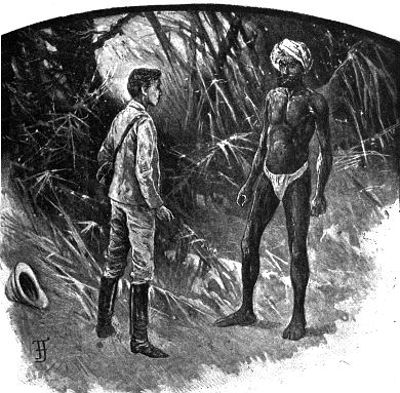
"You'll know me when you next see me."
"Yes, I should know you anywhere," answered Gilbert.
Just at that moment they heard the clatter of horses' feet.
"It's the Miss Sahiba!" said Hari Rām, and instantly bolted. Turning round, Gilbert saw a girl coming quickly over the brushwood, mounted on a splendid horse and followed by a syce.
"This is luck!" thought Gilbert. The rider saw him, and checked her horse, asking—
"Has anything happened? It's unusual for an Englishman to be alone in the jungle at this time in the morning."
Rapidly Gilbert recounted what had taken place. The girl listened attentively.
"Then you don't know what has become of your friend?" she said.
"Only that he was knocked over," said Gilbert.
"And you have been quietly entertaining Hari Rām?" she continued with a smile.
"Yes," said Gilbert; "but I am sorry to say he has escaped. He was going to take me with him, but you startled the hare, and he was off like a shot."
"Oh! he always is," answered the girl. "But now we had better see after your friend. How far do you suppose he is from here?"
"Not half a mile," answered Gilbert. "If you will ride forward I will follow."
All this has been long to tell, but had really occupied but a short time. When Gilbert and the girl reached the spot where the attack had been made, they found the driver had secured the horse, but could not proceed because of the damage the tumtum had sustained; also Superintendent Jenkins had been considerably injured. He had fallen on his head and his face was badly cut about, but he was conscious.
When Jenkins saw Gilbert returning with a companion he was greatly relieved, and called out—
"Well, youngster, you've managed at least to fall on your feet."
"By a mere fluke," said Gilbert. "What shall we do now?"
"Do!" exclaimed the superintendent. "We're within a few miles of Pokharia, and if you hurry up you'll be there in no time. Let the police know what's happened, and that the rascal is on the loose somewhere in the neighbourhood; tell them to turn out as many men as they can and beat the jungle. Off with you, there's no time to lose!"
"All right," said Gilbert, and he prepared to go.
"I'll turn back with you to my father's house," said the girl; "it lies on your way." Then bending down to Jenkins she added, "We will send a palki as quickly as possible for you; it will not be long;" and therewith she and Gilbert went off.
"It's just as well you're not alone," she said, "as Hari Rām might pounce on you again to prevent your getting on; he may be watching us now, so we'll take a cross road. I always ride the first thing in the morning," she continued, "the earlier the better; it's fortunate for you I started to-day even earlier than usual."
"It most certainly is," said Gilbert. "A minute later and I should have been far away in the jungle. I wonder where Hari Rām puts up."
"Anywhere and everywhere," answered his companion. "You're lucky to have seen him. I wish I had. He's an awfully fine fellow, you know, if he weren't a Dacoit. Other people may hear of his misdoings, but there's not a day passes but I hear of his kindnesses to his fellow-countrymen, and the natives worship the ground he treads on. We shall never catch him, and if the truth's told, I don't want him to be caught."
"Rank treason," said Gilbert laughing.
"There's our bungalow," said the girl, pointing to an unusually large thatched building, just distinguishable through the trees.
The syce had run all the way back, and told his master that some Englishmen had been attacked by the Dacoits, and that a young sahib had only just escaped being carried away by Hari Rām himself. Mr. Macgregor was on the point of starting to see what had happened when the two young people entered the compound.
"Hullo, Vansie, what's up?" he called out. "Is this the young man who was beset by the Dacoits?"
"Yes, father," said Vansie, springing lightly to the ground. "He's all right, but there's a smashed-up tumtum, and the police superintendent badly hurt. You must send for him at once."
The Scotchman whistled.
"I wonder what the Government is about, to let this thing go on?"
"It's a shameful state of affairs! a perfect disgrace!" said Mr. Macgregor indignantly. "Walk in, sir," and he was leading the way into the bungalow, when his daughter interfered, saying—
"Father, you must send a palki off at once."
"Allah Baksh," called out Mr. Macgregor, "see that two palkis and bearers are got ready sharp. Tell Miss Sahiba's syce to go with you, he knows the place."
"If you will excuse me," said Gilbert, "I'll go on to Pokharia without delay. It is important that the people there should know we were coming with help, and how we have been stopped."
"Of course it is," said Mr. Macgregor, "but you cannot go alone. As soon as we've had breakfast, I'll go with you."
Though loth to delay, Gilbert could not very well refuse. It was still quite early, and it would not take more than half-an-hour to reach Pokharia. The khansamah was already laying the table on the verandah, and preparing chottâ hazari.[10] Mr. Macgregor was impatient, for he was very angry. These continual raids of the Dacoits, though they did not personally attack him, kept the whole country in a state of turmoil. He was a large tea-planter, a widower, and Vansie, the girl we have just introduced to our readers, was his only child. She was tall and lithe, only sixteen years of age, and yet she was a perfect woman, with a delicate olive complexion, of that peculiar whiteness consequent upon the climate. Her features were straight and delicate, the lips well cut and marvellously red; her eyes were dark, with a certain languor in them, made more so by the long curled eyelashes, and delicately-pencilled eyebrows. Gilbert thought he had never seen anything so beautiful.
"Why do you go to Pokharia; the men are sure to have escaped, and we know Hari Rām is far away by this time," she said to her father.
"That's not so certain," he answered; "he's pretty daring, and is as likely as not to remain in the neighbourhood out of bravado."
Vansie pouted.
"Well, I think it's a horrid thing to be chasing a man who, after all, does us no harm."
"Do you call it doing no harm attacking the superintendent?" said her father. "Nonsense, Vansie; it's ridiculous for you to stand up for a thief and a robber!"
The girl moved away from the table, with a smile on her lips.
"Well, one thing is certain: you're not likely to catch him," she said. "I'll go and order the rooms to be got ready for the gentleman," and nodding to Gilbert as if they were old friends, she entered the house.
At that moment the horses came round.
"If you're ready we'll start at once," said Mr. Macgregor. "But you have not yet told me your name."
"Gilbert Lindsay. I'm brother to the new engineer of the Ganges mines."
"I've heard of him," said Macgregor, "I shall be glad to make his acquaintance."
"I'll tell him so," said Gilbert. "He has been much occupied since we came, but I'm sure he'll be delighted to know you."
When they mounted to ride away; Gilbert turned to look back at the bungalow, and saw Vansie standing on the steps. She waved her hands and called out mockingly—
"Good sport! good sport!"
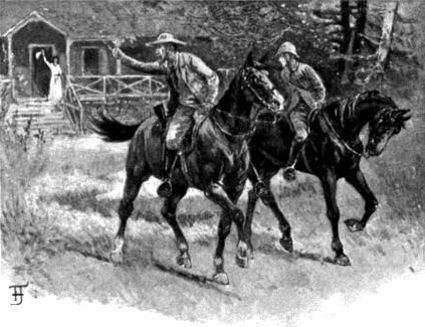
"Good sport! good sport!"
Her father shook his fist at her, and said laughingly, "The misdeeds of this Hari Rām have fascinated her. I believe she would be quite angry if he were caught."
"He's a very handsome fellow," said Gilbert, "if he were only clothed like a Christian. He was by no means discourteous to me. I almost wish he had carried me off. I should like to have seen a little more of him."
"Well, I'd like to see him before a magistrate," said Macgregor, "hear him sentenced to a good term of imprisonment, and sent to the Andaman Islands; that's the only way we shall be rid of him and his whole gang; they would never hold together without him."
They were not long reaching Pokharia, and rode straight to the missionary's house.
"You are too late," said Mr. M'Call. "The rascals have got off again. The robbery took place early last evening just after sunset. Pooran was the man robbed. He happened to be out, and when he came back he found his house regularly looted. I sent a runner straight off to Damūdá for the police, but this delay has given the Dacoits time to betake themselves to the hills or the jungle."
"Well, I propose we telegraph straight to head-quarters," said Macgregor. "I'm quite willing myself to ride to the first telegraphic station to send the message. Something must be done without delay."
Two or three of the principal natives of the village dropped in—one man who owned several carts, and who did a large business in raw cocoons, complained bitterly of the difficulty of transport. "The natives are half-hearted," he said. "Hari Rām is so open-handed amongst the poor that they think there is more to be lost than gained if he were apprehended. We, the mahajans, are obedient servants to Government, therefore Government ought to protect us."
"Of course it ought," said Macgregor; "but it's no use sending a couple of men; we must have a score, and that soon. I think the fact of the agent being injured in this last fray will have some effect. I'm willing to take the responsibility myself and ride at once to the telegraphic station if some of you will accompany me. I hardly think it safe for me to go alone."
"We will go with you, only don't let the servants hear," said Pooran. "They make a perfect idol of Hari Rām; he has spies all over the place."
The heat was too great to think of starting before evening, so they remained at the mission station. Then Mr. Macgregor, accompanied by two native merchants and their servants, set out. Gilbert with the missionary, who was also somewhat of a doctor, went to Macgregor's place to see after the wounded man. As they approached the house they saw an Indian woman crossing the compound, carrying a child on her hip. The missionary turned and looked at her.
"I know that woman," he said; "she was at Pokharia last week."
They found Jenkins the superintendent in a great measure recovered from his accident.
"I shall be all right to-morrow, and able to return to Damūdá," he said.
"Who was that handsome Indian woman we met as we came into the compound?" asked Gilbert of Vansie as they sat together on the verandah.
"She's Rajhani, my foster-sister; her mother was my dhai. She married and left the district, and I had not seen her for the last three or four years, when suddenly one day not long ago she appeared bringing me her baby, who was ill. I gave it some simple remedy, at least my ayah did, but to-day she came for her husband, who, she said, was down with fever. I asked her where she came from, and who her husband was, but she gave me no answer, and went off with barely a thank you."
"She is splendidly handsome," said Gilbert, "but has an evil face for all that."
"I think not," replied Vansie. "She rather looks as if she had some trouble. She seems to have heard of last night's attack, for she asked me how the sahibs were. I told her they were not much injured, but that I was afraid the Government would take active measures for finding Hari Rām.
"'They'll not get him, they'll never get him!' she said passionately, and I thought I saw tears in her eyes.
"'Do you know him, Rajhani?' I asked.
"'I've seen him,' she answered sullenly. Her manner was so strange that it struck me as just possible her husband might belong to the gang.
"'Well,' I said, 'perhaps you might warn him that he is going a little too far, and that he'll be caught some day unless he mends his ways.
"'He'll never do that as long as he is free,' she exclaimed, and went off."...
"You'll come out soon and see us again," Vansie said to Gilbert the following morning before he left, "and bring your brother with you. Father will give you both some good shooting in the jungle."
"Certainly I will," said Gilbert, with a sense of pleasure at having found a place which was so homelike.
A week later, Superintendent Jenkins came into Frank's bungalow in a very irate state of mind.
"There," he said, throwing down a letter, "that's all the reward a man gets for doing his duty. The Commissioner declares we must be shilly-shallying with the natives, and he will himself come down and see whether he can't catch this Hari Rām."
"Let him; he'll soon find out his mistake," said Frank. "I was up with Gilbert at Macgregor's the day before yesterday, and he says it will be tremendous work to nab him. He's protected by all the natives, and can pass from one village to the other without fear of being betrayed."
"Well, that remains to be proved," said Jenkins. "At all events the Commissioner is coming in full force with a whole army of police."
"Ah! well, you must put the best face on it you can," said Frank. "If Hari Rām is caught it will be a good thing for the country. My opinion is that he's hovering somewhere about here. Let who will catch him, I'm glad it's not my business. I much prefer the prospect of a shooting party with Macgregor next week. He is really a nice fellow. Came over and asked Gilbert and me to go there. Of course we have accepted."
"I can understand it is preferable. Hunting Dacoits is not in your line of business," said Jenkins, and with that they parted.
CHAPTER III
On the day fixed Frank and Gilbert rode to Mr. Macgregor's place in the cool of the evening, arriving in time for dinner. The tiger hunt had been arranged for the following morning; there was known to be an almost impenetrable covert of vines and creepers in the thickest part of the jungle, and several natives affirmed that it was the lair of a tiger of unusual size and ferocity. He had been very destructive and had done considerable mischief in the neighbouring villages, so that the killing of him excited much interest.
Mr. Macgregor had invited two or three other gentlemen, planters like himself, to join the party; thus making up half-a-dozen Englishmen with breech-loaders and pistols; a dozen natives were told off to accompany them, so that it was a fairly large party.
The following morning when they started, Frank Lindsay and Mr. Macgregor rode foremost, a syce running before them. By degrees they found themselves some distance in advance of their party, and wishing to keep together, Mr. Macgregor rode back to tell the others to hurry up; thus Frank and the syce were, so to speak, isolated. At that very moment a tiger sprang upon the syce. Frank instantaneously flung himself off his horse and struck the animal across the loins with the butt of his heavy riding-whip. Dropping his prey, the tiger turned on his assailant, seized him by the thigh and hurled him to the ground. Instinctively Frank threw his arms round the head of the enraged animal, but in a second he would have been torn to pieces, had not a man leaped out of the jungle and fired at the tiger, who once more dropped his prey and retreated with an ominous growl into the thick jungle.
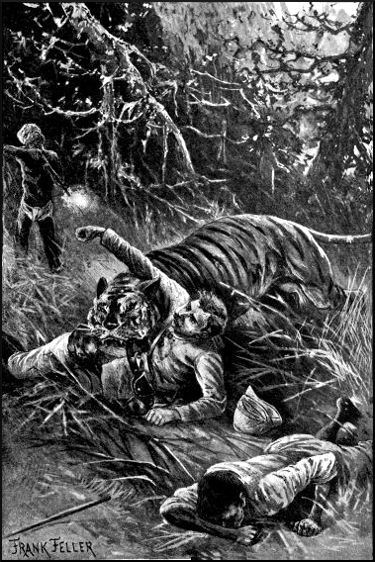
"In a second he would have torn Lindsay to pieces."
The man who did this deed of daring courage stood for a second over Frank and just asked—
"Are you all right, sahib?" to which Frank answered, "I'm alive, but desperately hurt, I'm afraid."
Then his rescuer drew himself up, waved his hand, and threw himself back into the thick jungle. Frank was quickly surrounded by his friends; he was in great agony, his leg was fearfully mauled and was bleeding profusely. The syce he had risked his life to save was dead. Macgregor, with the help of his friends, did his utmost to stop the bleeding, and ordered some of the natives to make a sort of stretcher with the branches of the trees; others he sent back to the bungalow to warn Vansie, and to get a doctor.
Gilbert was in despair; it was piteous to see his white agonised face as he held his brother in his arms.
"Will the brute come back?" he asked.
"Not likely," answered Macgregor. "I should think he was mortally wounded; the man took good aim."
"Do you know who he was?" asked Gilbert.
"No, but now I come to think of it, being a native he had no right to firearms; he must have been one of those outlaws."
"Pray don't quarrel with him. It's a mercy he was armed," said Frank with a groan.
"No, indeed we won't," answered Mr. Macgregor, "even if we came across him, we should have to let him go scot free, I think. There, are you easier now?"
With infinite care they slipped Frank on to the stretcher, but nevertheless the agony was so great that he lost consciousness. Gilbert thought he was dead; Macgregor laid his hand on his shoulder and said kindly—
"Steady, lad, he's only fainted."
"Oh!" said Gilbert with a short gasp, as he rose and stood on one side to let the bearers lift their burden.
Of course the hunt was over for that day. Two or three of the party went into the jungle with some of the natives and found the tiger had fallen dead a couple of hundred yards from where he had been shot. He was a huge creature, and other men had to be fetched to enable them to skin him and take the trophy home.
The young native doctor, called in the emergency to attend Frank, assured Gilbert that though the wound was severe and likely to lay his brother up for some time, it was not mortal. As he could not be moved, Mr. Macgregor begged the brothers to consider his house their home; a chaprassi was therefore despatched to fetch clothes, &c., from their own bungalow and to notify Frank's accident to the authorities.
"Do you know who saved my brother's life?" Gilbert asked Vansie, the first time they found themselves alone.
"No, how should I?" she answered; "do you know?"
"It was Hari Rām himself," answered Gilbert. "I recognised him as he stood over my brother and then rushed back into the jungle. I was close to him, I think he saw me, for he smiled and waved his hand to me."
Vansie's eyes shone.
"I'm not surprised; it was exactly the sort of thing he'd do," she said.
"I was just going to call out 'Hari Rām' when I remembered he was an outlaw, and that every man's hand was against him, so I checked myself," continued Gilbert; "and now, whatever happens, I'll never run that man down or put any one on his track."
"Hari Rām does not understand he is doing wrong by taking the law into his own hands, and I do not suppose he ever will," said Vansie. "He knows the native merchants are liars and greedy after gain, and that Government winks at their extortions, so he settles the matter according to his own ideas. I'm glad you have made up your mind not to meddle in the matter; let them catch him if they can."
Gilbert agreed with her, and so the matter dropped.
"Frank, has Miss Vansie told you the news?" and Gilbert threw himself into a chair beside his brother's invalid couch on the verandah.
"No, what news?" he said.
"The Commissioner arrived yesterday at Damūdá, his camp was pitched, and there was a great display of police about the place. He was questioning everybody, he even rode to Pokharia and interviewed the people there. He says he expects to catch his man and clear the country in a fortnight."
"I hope he may not be disappointed," said Frank dryly. "What does Jenkins say?"
He had hardly put the question when they saw the superintendent enter the compound. A syce ran to hold his horse from which he flung himself, and then the brothers saw he had a broad grin on his face and seemed immensely amused.
"What's up?" said Gilbert.
"The Commissioner's in a fine rage," he said. "Hari Rām has just done him in the neatest possible manner," and sitting down he burst out laughing.
The sound of merriment brought Vansie out.
"What is it?" she asked.
"A new exploit of Hari Rām's," said Frank; "come and hear it." She looked unusually serious.
"I wish he would stop or go away," said Gilbert; "he'll get himself hanged. What has he done now?"
"A perfect Robin Hood's exploit," said the superintendent. "It must have got to his ears that the Commissioner scoffed at him, and he determined he would give him a taste of his prowess, and he just has! Last night, notwithstanding the cordon of police, he managed to wriggle himself into the Commissioner's tent, to carry off his watch, shirt studs, and all his money; not satisfied with this, he tickled the Commissioner's feet without awaking him, but he succeeded in making him wriggle his legs apart in such a fashion that Hari Rām drew his sword and stuck it up to the hilt through the mattress; this feat accomplished, he went off as silently as he came. Imagine the Commissioner's feelings when he awoke and saw the position he was in! He was in a white rage, I promise you, and to make matters worse, before he had recovered himself, a native policeman rode up and presented him with a small parcel which had been just left at the office, to be delivered immediately. Upon opening it he found his watch, chain, studs, and money, and on a slip of paper was written: 'With Hari Rām's humblest salutations to his High Mightiness Commissioner Gibson.' You should have seen his face, it was as good as a play!"
"It was cheek!" said Gilbert, rubbing his hands in a state of high delight. "What's the Commissioner going to do?"
"Move heaven and earth to catch his man," answered Jenkins. "It's already posted up at the mines: '500 rupees reward for whoever unearths Hari Rām, or gives information as to his whereabouts.'"
"It won't do," said Vansie. "The natives will never betray him."
"Well, they are not doing him really any kindness," said Jenkins, "for he'll only get a heavier punishment in the long run. At present he might escape with imprisonment, but presently it will mean hanging."
"He'd rather run the risk, I expect," said Frank.
After six weeks Frank was still invalided, so Gilbert went every day down to the mines, brought messages and queries in the evening, carrying back his orders the following morning.
He and Vansie grew to be great friends; they quarrelled and they made it up like girl and boy as they were.
Great excitement ensued when the reward was offered for the apprehension of Hari Rām; the subject caused endless discussion. Days and even weeks went by without producing any result; whether the warning had driven Hari Rām out of the district, or caused him to take extra precautions, the result was the same, nothing was heard of him. The Commissioner fumed and fretted.
"The man must be taken," he declared.
"My Lord, you will not do this thing; if you do, you will be caught and hung up like a dog."
So spake Rajhani, lying prostrate at the feet of her lord and husband, Hari Rām. He looked down upon her, frowning.
"Go hence!" he said; "who art thou to speak thus?"
"The Miss Sahiba told me yesterday that the Commissioner was like a raging lion, his men are everywhere; she bade me tell you so, if you are caught you will be hanged," said Rajhani.
In a fit of blind anger, Hari Rām stretched out his foot and kicked the woman.
"Dost think I will suffer that thief of a mahajan to go on draining the people? He is rich and he will not pay his drivers the price other merchants do. I will therefore stop his well-laden carts and pay them for him. Get thee gone!" and with another kick he turned away.
With a mingled expression of sorrow and anger in her face, Rajhani rose. She was not quite like other Indian women. Till her mother died she had been brought up with Vansie, then her father married her to Hari Rām and she left the district. Her nature was gentle and she had imbibed a certain amount of religious knowledge, but an Eastern woman is a thing with no personality, a creature to be driven to and fro like the leaves in autumn. So she had suffered and her soul was ofttimes angry within her. Her love for Hari Rām was so strong and of so jealous a nature that she could not endure to be parted from him, but would follow him from place to place though the journeys were long and difficult. But for her cunning and great care it is doubtful whether he would so long have escaped detection.
Now she rose from the ground, and her large eyes were full of fierce passion and determination. She picked the little naked baby up from the floor of the mud hut, bound it on to her hip, muttering—
"He shall not be hanged," and went forth.
"Of course, if there is any fear of the man being attacked we must send him protection. You had better tell off a dozen men. At the same time I should keep the matter quiet. Let the mahajan start as if he knew nothing; but be in the neighbourhood, and if he is attacked show yourselves," the Commissioner spoke thus in answer to a report Superintendent Jenkins had just brought in.
At that very moment the tent curtain was pushed on one side and a chaprassi entered, followed by an Indian woman.
"Sahib," he said, salaaming, "this woman says she must speak with your Mightiness, so I have brought her to you."
The Commissioner looked up, and for a second examined the woman, who had stepped forward, and with outstretched hands, salaaming to the ground, said—
"I have news for you, my lord."
"Who is she? Do you know her, Jenkins?" asked the Commissioner.
"No, sir; and yet I have seen her somewhere more than once," he answered.
"I will tell the sahibs my name when I have made known my business," she said, speaking in English, and she drew forth a paper. "I come for that," she continued, laying on the table before the Commissioner a large sheet, advertising the Government reward for the apprehension of Hari Rām.
"Well, have you come to inform upon the man?" said the Commissioner.
"If you take him, will you hang him?" she asked sullenly.
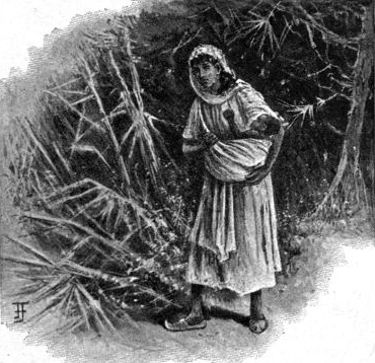
"He shall not be hanged."
"We certainly shall if we take him red-handed, unless we shoot him first; but we should prefer getting hold of him and sending him out of the country. A man like Hari Rām does not care when death overtakes him; the galleys are a worse punishment."
"But they come back from there," said the woman.
"Oh yes," answered the Commissioner with a smile. "Are you thinking of saving his life?"
"I am Hari Rām's wife," she answered, drawing herself up proudly and looking the Commissioner in the face.
The two officials glanced at each other in astonishment.
"And you have come to tell us where we can find your husband? You're a nice young woman," said Jenkins.
Under the dark skin the woman's face blushed.
"You will give me money and you will not kill him?" she said.
"Yes, we will give you the reward promised here," said the Commissioner; "and if we can take him quietly we will not hurt him."
"You speak truly, the Sahib Log do not lie. Weigh me out the five hundred rupees and I will take you to his hiding-place."
The Commissioner did as she asked; the money was weighed out, Rajhani watching the silver with a stern face as it was poured into a bag she had evidently brought with her for the purpose.
"She might be Judas," said Jenkins, turning away with disgust.
She heard him, and lifted her beautiful pathetic eyes for a second, then lowered them quickly, as the last rupee joined its fellows.
"I am ready," she said.
"I should like to see the end of this affair," said the Commissioner. "Tell off a squad, Jenkins; you had better come too."
He was in high spirits at the prospect before him.
"Just keep your eye on the woman," he said in a low voice to a subaltern; but Rajhani heard, and called out—
"You need have no fear, my lord sahib; life is better than death. What I have said I will do."
"There, you have but to go and take him," and Rajhani pointed to a mud hut, hidden in the very thickest part of the jungle.
"Let me not see my lord," she cried bitterly, and threw herself face downwards on the earth.
It was early morning, the Commissioner and his party had encamped for a few hours, to start again before dawn.
"Two of you stay behind and guard the woman in case she has played us false," commanded Superintendent Jenkins.
Through the long jungle grass the party advanced till within a few yards of the Dacoit's retreat, then they made a rush towards a narrow passage leading to the hut, and were met by a man, stark naked, brandishing a sword in his hand.
"Hari Rām, if you make one step forward I will shoot you like a dog," shouted the Commissioner, whilst two of his men sprang upon the Dacoit, seized him by the throat, tore the sword out of his hand, and tripped him to the ground. Where he fell he lay, a vanquished lion.
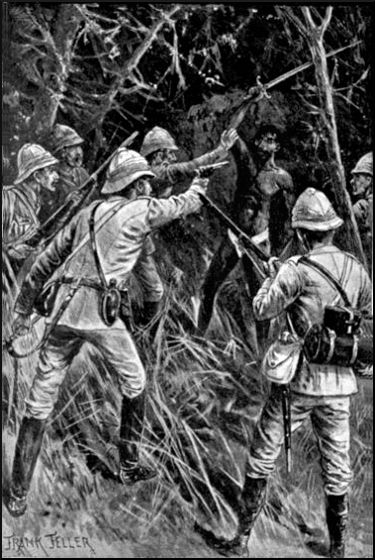
"Hari Rām, if you make one step forward, I will shoot you like a dog."
Whilst they were pinioning him he just asked—
"A woman betrayed me; is it not so?"
"Your own wife; none other. She preferred five hundred rupees to a husband who beats her," said one of the men laughing.
"You lie! I did not beat, I only kicked her," said Hari Rām. "Well, she has had her revenge; surely I shall have mine."
He was standing up now, his hands and feet manacled; looking round, as if he thought to see her, but he was disappointed. Just as his captors were marching him off, a child crept out of the hut and raised a piteous wail.
"The cub," said one of the men; "must we take him too?"
"No need," whispered another, "the tigress is not far off."
Hari Rām heard, and, lifting up his voice, shouted something in Hindustanee which made Rajhani shiver as she lay on the ground; but she rose boldly and called back—
"Be of good courage, Hari Rām, my beloved, life is better than death. In captivity thou wilt learn wisdom."
"Five years at the penal settlement in the Andaman Island; that's the sentence, and every one says it's far more lenient than he deserves. Perhaps it is, but I'm awfully sorry for him. After the trial I went to see him in prison, and told him so. He thanked me in his courteous way, saying, 'I shall not die, I am strong. When I come out Rajhani may not perhaps think life is better than death,' and he smiled grimly."
Such was Gilbert's tale. He had just returned with Mr. Macgregor from attending Hari Rām's trial, the result of which both Vansie and Frank had anxiously awaited all day.
"What could possess her to do it?" Vansie repeated for the twentieth time.
"I have told you before," said Frank, "the Commissioner was spreading a net to catch him, and sooner or later, unless he desisted from his predatory habits, he would have fallen into his enemies' hands. If he were taken in the act of robbery, and may be of murder, his wife knew he would be hanged. From this she determined to save him, and she certainly has done so. She acted according to her lights; what more could be expected of her?"
"I said as much to Hari Rām," put in Gilbert; "but he answered—
"'A woman cannot think—a woman has no soul.'"
"What a shame!" said Vansie.
Frank turned and looked at her, and their eyes met.
"Yes, it is a shame," he said, smiling.
Gilbert saw the look.
"Oh, that's it," he thought. "Well, it will be pleasant to have her for my sister at least."
In due time this very thing came to pass. Frank's long convalescence threw him and Vansie so much together that it was not difficult to foresee the result. Frank fell desperately in love with the planter's daughter, and though socially he might have aimed higher if he had bided his time, he nevertheless considered himself the most fortunate of men when Vansie consented to be his wife. A few days before the marriage, Gilbert came to him and said—
"I don't think I will be an engineer, Frank; one in the family is enough. Mr. Macgregor has offered to take me on his estate, initiate me into the secrets of tea and coffee growing, and in time make me a partner. You know I have a few hundreds of my own when I come of age, so, if you'll consent, I should like to accept his offer. I'm sure the life will suit me better."
Frank hesitated; he would have preferred Gilbert following a profession, but he saw he was set upon the new plan, so he consented; and when Vansie came to live at Frank's bungalow, Gilbert took up his residence with Mr. Macgregor. But long before this happened, Hari Rām had been sent off to the Andaman Island to work out his sentence; and then a strange thing happened. Rajhani purchased carts and bullocks, and hired men to load them at the mines and transport the coal to the terminus at Giridhi. By degrees the business grew, and she managed it with such energy that the company decided to employ no one else for the conveyance of coal, and every one said she would soon be a rich woman, that the 500 rupees for which she had sold her husband were daily multiplying by her wise administration. But her existence was a hard one; she was hated and despised by her own people. More than once her life was threatened, but the order had gone forth among the natives—
"Let her alone; Hari Rām will be his own avenger."
A few months after her husband's banishment she suddenly appeared before Vansie leading her eldest boy by the hand and with a new-born babe slung at her side.
"See," she said proudly, "I have given him life and two sons, and now I will make him so rich that when he comes back he can give of his own to the poor, and need be no longer a Dacoit."
And so her motive became clear to Vansie. She laboured by night and by day to increase her store, living meanwhile poorly, denying herself all save the very necessaries of existence. A hunted look came into her eyes, and as time went on she faded into a mere shadow of her former self; but the wealth increased, and her boys grew, and were finer and handsomer than their fellows.
"My lord, thy servant craves forgiveness; behold, I received 500 rupees for selling thee into captivity. I bring thee 5000 rupees, with bullocks and carts; thou left me with but one son, I bring thee two."
So spake Rajhani, lying prostrate at Hari Rām's feet, as he landed after his long exile. The remembrance of those five years of misery was fresh upon him, the iron had entered into his soul, and he spurned her from him; but a young man touched his arm and called him by his name—
"Are you blind, Hari Rām?" he said; "surely she has done wisely. She has laboured for you in love and patience; you must see she betrayed you for very love, to save your life."
The Hindu stood as one dazed; through the mist of superstition and anger a faint gleam of something better crept into his soul. He had himself thought to redress wrongs, had failed, and had suffered. He turned and looked fixedly first at the woman still lying prostrate before him, then at Gilbert Lindsay, who had spoken.
"Sahib," he said, and his voice trembled.
"You are too brave a man to despise her for what she has done, Hari Rām," Gilbert continued. "See, she has come to you in all humility, with children and wealth, so that from henceforth you may live prosperously. Five years is but a little span in a man's life. Lift her up and go home with her and your children; let this hour be as the rising of the sun at the dawn of a new day."
Slowly, as a man feeling his way, Hari Rām stretched out his hand, and lo! it rested on the head of his eldest born. A smile crept over the stern features.
"You speak as a god, sahib," he said. "The evil day has surely passed away; she was right, it is good to live."