Chapter XV · HADLEY IS CAST OFF BY UNCLE EPHRAIM
Reading edition
THE army of occupation brought in its train plenty of Tories and hangers-on besides the men named, though none who had been quite so prominent in affairs or were so greatly detested. It now behooved the good folk of pronounced Whig tendencies to walk circumspectly, for enemies lay in wait at every corner to hale them before the British commander and accuse them of traitorous conduct. Hadley Morris, therefore, although he did not expect to be recognized by anybody in the town, resolved to get away as soon as his wound would allow.
He could not resist, however, going out at sunset to observe the evening parade of the conquerors. There was something very fascinating for him in the long lines of brilliant uniforms and the glittering accoutrements. The British looked as though they had been simply marching through the country on a continual dress parade. How much different was the condition of even the uniformed Continentals!
To the strains of martial music the sun sank to rest, and as the streets grew dark the boisterous mirth of the soldiery disturbed those of the inhabitants who, fearful still of some untoward act upon the part of the invaders, had retired behind the barred doors of their homes. In High Street and on the commons camp fires were burning, and Hadley wandered among them, watching the soldiers cooking their evening meal. Most of the houses he passed were shut; but here and there was one wide open and brilliantly lighted. These were the domiciles where the officers were quartered, or else, being the abode of “faithful” Tories, the proprietors were celebrating the coming of the king’s troops. Laughter and music came from these, and the Old Coffee House and the Indian Queen were riotous with parties of congratulation upon the occupation by the redcoats.
As Hadley hobbled back to Master Pye’s past the tavern, he suddenly observed a familiar face in the crowd. A number of country bumpkins were mixing with the soldiery before the entrance to the Indian Queen, and Hadley was positive he saw Lon Alwood. Whether the Tory youth had observed him or not, Hadley did not know; but the fact of Lon’s presence in the city caused him no little anxiety and he hurried on to the Quaker’s abode. He wondered what had brought Lon up to Philadelphia—and just at this time of all others?
“The best thing I can do is to get out of town as quick as circumstances will permit,” thought Hadley, and upon reaching Friend Pye’s he told the old Quaker how he had seen somebody who knew him in the city—a person who would leave no stone unturned to injure him if possible.
“We must send thee away, then, Hadley,” declared the Quaker. “Where wilt thou go with thy wounded leg?”
“I’ll go home. There isn’t anything for a wounded man to do about here, I reckon. But the leg won’t hobble me for long.”
“Nay, I hope not. I will see what can be done for thee in the morning.”
Friend Jothan Pye was considered, even by his Tory neighbors, to be too close a man and too sharp a trader to have any real interest in the patriot cause. He had even borne patiently from the Whigs much calumny that he might, by so doing, be the better able to help the colonies. Now that the British occupied the town, he might work secretly for the betterment of the Americans and none be the wiser. He had already gone to the British officers and obtained a contract for the cartage of grain into the city for the army, and in two days it was arranged that Hadley should go out of town in one of Friend Pye’s empty wagons, and he did so safely, hidden under a great heap of empty grain sacks. In this way he traveled beyond Germantown and outside the British lines altogether.
Then he found another teamster going across the river, and with him he journeyed until he was at the Mills, only six miles from the Three Oaks Inn. Those last six miles he managed to hobble with only the assistance of his crutch, arriving at the hostelry just at evening. Jonas Benson had returned from Trenton and the boy was warmly welcomed by him. Indeed, that night in the public room, Hadley was the most important person present. The neighbors flocked in to hear him tell of the Paoli attack and of the occupation of Philadelphia, and he felt like a veteran.
But he could not help seeing that Mistress Benson was much put out with him. As time passed the innkeeper’s wife grew more and more bitter against the colonists. She had been born in England, and the presence of Colonel Knowles and his daughter at the inn seemed to have fired her smoldering belief in the “divine right,” and had particularly stirred her bile against the Americans.
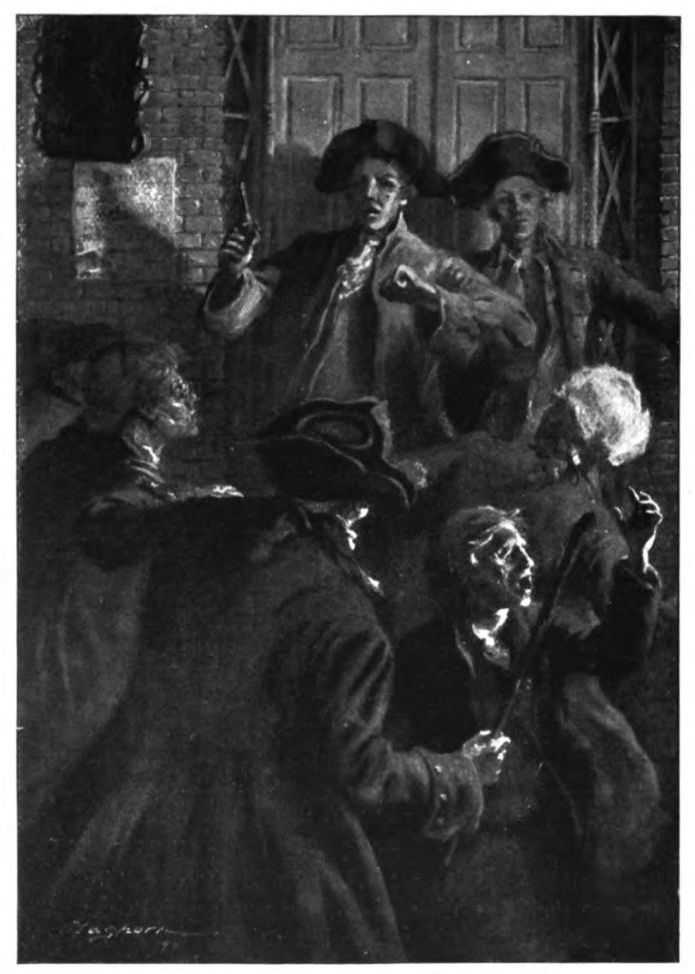
THERE WAS AN OCCASIONAL OUTBREAK IN THE QUIET TOWN
“I’m sleepin’ in the garret, myself, Had,” groaned Jonas, in an aside to the boy. “I can’t stand her tongue when she gets abed o’ nights. I’m hopin’ this war’ll end before long, for it’s a severin’ man and wife—an’ sp’ilin’ business, into the bargain. She’s complainin’ about me keepin’ your place for ye, Had, so I’ve got Anson Driggs for stable boy. And, of course, she won’t let me pay Miser Morris your wage no more. I didn’t know but she’d come down from her high hosses when them Knowlses went away, but she’s worse ’n ever!”
“Have the Colonel and Mistress Lillian gone?”
“They have, indeed—bad luck to them!—though I’ve no fault to find with the girl: she was prettily spoken enough. But the Colonel had been recalled to his command, I understand. His business with your uncle came to naught, I reckon. D’ye know what it was, Had?”
Hadley shook his head gloomily. “No. Uncle would tell me nothing. But the Colonel seemed very bitter against him.”
“And what d’ye think of doing?”
“I’m not fit for anything until this wound heals completely. I can’t walk much for some time yet. But I’ll go over and see Uncle in the morning.”
“Ride Molly over. There’s no need o’ your walking about here. And come back here to sleep. Likely Miser Morris will be none too glad to see ye. Your bed’s in the loft same’s us’al. Anson goes home at night. The place is dead, anyway. If this war doesn’t end soon I might as well burn the old house down—there’s no money to be got by keeping it open.”
On the morrow Hadley climbed upon Black Molly and rode over to the Morris homestead. Most of the farmers in the neighborhood had harvested their grain by this time. The corn was shocked and the pumpkins gleamed in golden contrast to the brown earth and stubble. In some fields he saw women and children at work, the men being away with the army. The sight was an encouraging one. Despite the misfortunes and reverses of General Washington’s army, this showed that the common people were still faithful to the cause of liberty.
News, too, of an encouraging nature had come from the north. The battle of Bennington and the first battle of Stillwater had been fought. The army of Burgoyne, which was supposed to be unconquerable, had been halted and, even with the aid of Indians and Tories, the British commander could not have got past General Gates. News traveled slowly in those days, but a pretty correct account had dribbled through the country sections; and there was still some hope of Washington striking a decisive blow himself before winter set in.
The signs of plenty in the fields as he rode on encouraged Hadley Morris, who had seen, of late, so many things to discourage his hope in the ultimate success of the American arms. When he reached his uncle’s grain fields he found that they, too, had been reaped, and so clean that there was not a beggar’s gleaning left among the stubble. He rode on to the house, thinking how much good the store of grain Ephraim Morris had gathered might do the patriot troops, were Uncle Ephraim only of his way of thinking.
As he approached the house the watch dog began barking violently, and not until he had laboriously dismounted before the stable door did the brute recognize him. Then it ran up to the boy whining and licked his hand; but as Uncle Ephraim appeared the dog backed off and began to bark again as though it were not, after all, quite sure whether to greet the boy as a friend or an enemy. Evidently the old farmer had been in like quandary, for he bore a long squirrel rifle in the hollow of his arm, and his brows met in a black scowl when his gaze rested on his nephew’s face.
“Well, what want ye here?” he demanded.
“Why, Uncle, I have come to see you—”
“I’m no uncle of yours—ye runaway rebel!” exclaimed the old man, harshly. “What’s this I hear from Jonas Benson? He says ye are not at his inn and that he’ll no longer pay me the wages he promised. If that doesn’t make you out a runaway ’prentice, then what does it mean?”
“Why, you know, Mistress Benson is very violent for the king just now—”
“Ha!” exclaimed the farmer. “I didn’t know she had the sense to be. It’s too bad she doesn’t get a little of it into Jonas.”
“Well, she doesn’t want me around. And Jonas can’t pay two of us.”
“She wouldn’t have turned ye off if ye’d stayed where ye belonged, Hadley Morris. Oh, I know ye—and I know what ye’ve been doing of late,” cried the farmer. “Ha! lame air ye? What’s that from?”
“I got a ball in my leg—”
“I warrant. Crippling yourself, too. Been fighting with the ‘ragamuffin reg’lars,’ hey? An’ sarve ye right—sarve ye right, I say!” The old man scowled still more fiercely. “And now that you’ve got licked, ye come back home like a cur with its tail ’twixt its legs, arskin’ ter be taken in—hey? I know your breed.”
“If you don’t want me here I can go away again,” Hadley said, quietly.
“What would I want ye for? You’re a lazy, good-for-nothing—that’s what ye air! There’s naught for ye to do about the farm this time o’ year—an’ crippled, too. Ye’d never come back to me if that ball hadn’t hit ye. Ye’d stayed on with that Mr. Washington ye’re so fond of talking about. Ha! I’m done with ye! Ye’ve been naught but an expense and a trouble since your mother brought ye here—and she was an expense, too. I’m a poor man; I can’t have folks hangin’ ter the tail o’ my coat. Your mother—”
“Suppose we let that drop, sir,” interrupted Hadley, firmly, and his eyes flashed. “Everybody in this neighborhood knows what my mother was. They know that she worked herself into her grave in this house. And if she hadn’t begged me to stay here as long as I could be of any use to you, I’d never stood your ill treatment as long as I did. And now,” cried the youth, growing angrier as he thought of the slurring tone his uncle had used in speaking of the dead woman, “it lies with you whether you break with your last relative on earth or not. I will stand abuse myself, and hard work; but you shan’t speak one word against mother!”
“Hoity, toity!” exclaimed the old man. “The young cock is crowing, heh? Who are you that tells me what I should do, or shouldn’t do?” Hadley was silent. He was sorry now that he had spoken so warmly. “Seems to me, Master Hadley, for a beggar, ye talk pretty uppishly—that’s it, uppishly! And you are a beggar—ye’ve got nothing and ye never will have anything. I’ll find some other disposal to make of my farm here—”
“I’m not looking for dead men’s shoes!” flashed out the boy again. “You’ve had my time, and you’ve a right to it for three years longer. If you want to hire me out as soon as my wound is well, you can do so. I haven’t refused to work for you.”
“Yah!” snarled the old man. “Who wants to hire a boy at this time of the year? The country’s ruined as it is—jest ruined. There’s no business. I tell you that you’re an expense, and I’d ruther have your room than your company.”
Hadley turned swiftly. He had clung to Black Molly’s bridle. Now he climbed upon the horse block and, in spite of his wound, fairly flung himself into the saddle. “You’ve told me to go, Uncle Ephraim!” he exclaimed, with flaming cheeks. “You don’t have to tell me twice,” and, pounding his heels into the mare’s sides, he set off at a gallop along the path, and in a moment was out of sight of the angry farmer.
There was bitterness in the boy’s heart and angry tears in his eyes as Black Molly fled across the pastures and out upon the highway. Hadley Morris did not really love his uncle. There was nothing lovable about Miser Morris. The boy had been misjudged and his mother spoken ill of—and that fact he could not forget. He had tried for a year and a half to keep from a final disagreement with Uncle Ephraim; but to no avail. The old man did not consider Hadley old enough to judge for himself, or to have any opinions of his own. The times were such that children grew to youth and young men to manhood very rapidly. When the fathers went to the war the sons became the providers and defenders of the household; if the fathers did not go, the sons were in the ranks themselves. Questions were not asked regarding age by the recruiting officers, providing a youth looked hearty and was able to carry a musket. And Hadley felt himself a man grown in experience, if not in years, after the exciting incidents of the past few weeks.
“I am able to judge for myself in some things,” he told himself, pulling Molly down to a walk, so as to ease his leg. “If Uncle would accept the fact that I have a right to my own opinion, as he has a right to his, we never would have quarreled. I’d never gone over to the Three Oaks to work. And then I’d never seen any active service, I s’pose. He’s got only himself to thank for it, if he did not want me to join the army.
“But now, I reckon, there isn’t anything left for me to do but that. Jonas can’t have me and keep peace in the family; and I wouldn’t stay after the way Mistress Benson talked last night—no, indeed. I’ll go to some of the neighbors. They’ll give me a bite to eat and a place to sleep till my leg gets well enough for me to walk. Then I’ll go back to the army.”
He so decided; but when Jonas heard his plan he vetoed it at once. “What, Had!” cried the old innkeeper, “d’ye think I’ll let a nagging woman drive you away from here to the neighbors? Nay, nay! I’m master here yet, and she is not really so bad, Had. She doesn’t begrudge ye the bite and sup. Stay till your leg is well.”
“But I shall not feel comfortable as long as I stay, Jonas,” declared the boy.
“And how long will that be? Your leg is mending famously. If you could but ride ye’d be fit to go into battle again now. Ah, lad, I’m proud of you—and glad that it was part through me ye went to the wars. I can’t go myself; but I can give of what I have, and if the mistress does not like it she can scold—’twill make her feel better, I vum.” Then he looked at Hadley curiously. “You’re anxious to get back to General Washington again, eh, lad?”
“I wish I had hunted up Captain Prentice, or Colonel Cadwalader, when I got out of Philadelphia, instead of coming over here,” admitted the youth.
“Then start back now,” Jonas said. “Ride Molly—she knows ye, and ye’ll get back in time to be of some use, mayhap, for I heard this morning that there’s a chance of another battle in a day or two.”
“Take Molly, sir?” cried the astonished boy.
“Yes. Most of my horses have already gone to the cause. I’ve got a packet of scrip, as they call it, for ’em, but it’s little worth the stuff is now, and perhaps it will never be redeemed. But I’m a poor sort of a fellow if I mind that. You take Molly. I know if you both live you’ll come back here. And if she is killed—”
The innkeeper stopped, for his voice had broken. He was looking hard at the boy’s flushed face, and now he reached up and gripped Hadley’s hand with sudden warmth. The youth knew that it was not the thought of the possible loss of Black Molly that had choked the worthy innkeeper, but the fear that, perhaps, her rider would never come back again.
“I’ll take her, Jonas—and thank you. I’ll be happier—better content, at least—away from here. Uncle doesn’t want me, nor does he need me; and certainly Mistress Benson doesn’t wish me about the inn. So I’ll take Molly, and if all comes well you shall have her back safe and sound.”
“That’s all right—that’s all right, Had!” exclaimed the other, quickly. “Look out when them army smiths shoe her. She’s got just the suspicion of a corn on that nigh fore foot, ye know. And take care of yourself, Had.”
He wrung Hadley’s hand again and the boy pulled the little mare around. There was nothing more to be said; there was nothing to keep him back. So Hadley Morris rode away to join Washington’s forces, which then lay idle near the beleaguered city.
[TO BE CONTINUED]