Chapter II · RELATING A WILD NIGHT RIDE
Reading edition
IT did not take a very sharp eye to observe that the horse which the messenger bestrode was laboring sorely, while his pursuers were blessed with comparatively fresh mounts. The American had ridden long and hard, and his steed was in no shape for such a spurt of speed as it was put to now. The British had kept clear of this road for weeks, because of the foraging parties from Philadelphia, and, doubtless, the dispatch-bearer hoped to find at the Three Oaks those who would stand him well in this emergency.
At least, there would be a fresh horse there, and perhaps a faithful man or two to help beat off the dragoons until he could escape with his precious charge. He had no thought that there was a still greater danger ahead of him. The dragoons were lashing and spurring their horses to the utmost; and now and again one took a potshot at him; but there on the porch of the old inn stood Colonel Knowles, waiting with all the calmness of a sportsman to bring the fleeing man to earth.
Young Hadley Morris did not notice the colonel; he had forgotten his presence in his interest in the flight and pursuit. But Jonas Benson saw his guest’s big pistol and realized the danger to the approaching fugitive. Yet there seemed nothing he could do to avert the calamity. He dared not openly attack the colonel, for whether the dispatch-bearer escaped or no, the dragoons would be at the inn in a few moments, and, there being no such force of Americans in the neighborhood, they might wreak vengeance on him and his family. The old man was hard put to it, indeed, in this emergency.
Not so Hadley, however. He was quick of thought and quite as brisk of action. The charge of galloping horse was but a short distance away, the American still a little in the lead, when the boy darted back to the heavy barred gate which shut the yard from the road. The barrier had been swung wide open and fastened with a loop of rope to a hook in the side of the house. He slipped this fastening and stood ready to shut the gate between the fugitive and his pursuers, and thus delay the latter for a possible few moments.
If the dispatch-bearer got into the yard safely he could leap upon the back of the black mare now standing impatiently on the barn floor, and escape his pursuers through the fields and orchard back of the outbuildings. No ordinary horse would be able to leap the high gate, and Hadley did not believe the dragoons were overly well mounted. As the dispatch-bearer dashed up, foam flying from his horse’s mouth and the blood dripping from its flanks where the cruel spurs had done their work, it looked to Colonel Knowles as though the American would ride right by, and he raised his pistol in a deliberate intention of bringing the man to earth.
But as he pulled the trigger old Jonas stumbled against him and the ball went wide of its mark. The shot did much harm, however, for it frightened the already maddened horse, which leaped to one side, pitching the man completely over its head upon the paving of the yard. The horse fell, too, but outside the gate, and Hadley was able to slam the barrier and drop the bar into place before the dragoons arrived.
The explosion of the colonel’s pistol and that officer’s angry shout warned Hadley of the added and closer danger. He darted to the side of the fallen messenger. The poor fellow had struggled partly up and was tearing at his coat. His face was covered with blood, for he was badly injured by his fall; but one thought kept him conscious.
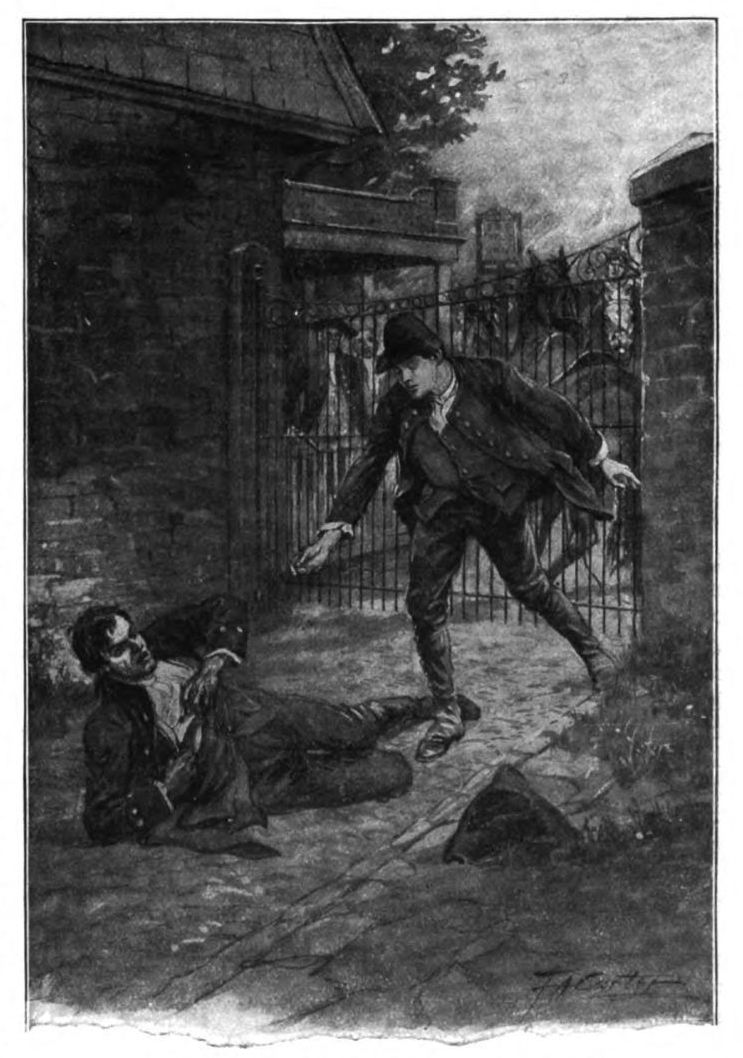
HE DARTED TOWARD THE FALLEN MESSENGER
“The papers—the papers, lad!” he gasped. “For General Washington—quick!”
But he had only half pulled the packet from his inner pocket when he dropped back upon the flagstones, and, with a groan, lay still.
Hadley seized the precious packet and leaped to his feet. With a clatter of hoofs and amid a cloud of dust the dragoons arrived at the yard gate.
“There he is! He’s down—down!” shouted the leader. “We’ve got him safe! Hi, there landlord! open your gate or we’ll batter it in!”
“They’ve got him safe, that’s a fact,” muttered Hadley, in distress. “But—but they haven’t got the papers!”
He turned swiftly and ran toward the barn.
“There goes one of them running!” shouted a voice behind. Then a pistol exploded and Hadley leaped forward as though the ball had stung him, although it whistled far above his head.
“Look out for that boy!” he heard Colonel Knowles say, and, glancing back, Hadley saw the officer leaning out of one of the windows which overlooked the yard. At a neighboring casement the fleeing youth saw Miss Lillian. Even at that distance, and in so perilous a moment, Hadley noted that the girl’s face was very pale and that she watched him with clasped hands and anxious countenance.
One of the dragoons had dismounted and now unbarred the gate. Before Hadley reached the wide doorway of the great barn the soldiers were trooping through into the yard.
“The boy has the papers—look after him, I tell you!” he heard the colonel shout. Then Hadley pulled the great door shut and fastened it securely on the inside. For an instant he could breathe.
But only for an instant. The dragoons were at the door then, beating upon it with the hilts of their sabres and pistol-butts, demanding entrance. Hadley had no weapon had he desired to defend the barn from attack. And that would be a foolish attempt, indeed. It would be an easy matter for the dragoons to break down the fences and surround the barn so that he could not escape, and then beat in the door and capture him—and with him the papers. He did not know how valuable those documents might be; but the man now lying senseless in the inn yard had saved them at the risk of his life; the boy felt it his duty to do as much.
Colonel Knowles had now come out into the yard and taken command of the attack. Evidently he was recognized by the British soldiers, despite his civilian’s dress. He gave orders for a timber to be brought to beat in the door, and Hadley likewise heard him send two of the soldiers around the barn to watch the rear. If the boy would escape it must be within the next few seconds.
He ran back to the rear of the building. Here was another wide door and he flung it open. The soldiers had not appeared; but the doorsill was a good eight feet and more from the ground. The barn had been built on a hillside. Directly below the door was a pen in which hogs were kept. Eight feet was a good drop, and besides it would be impossible to escape the soldiers on foot.
A crash sounded at the front of the building. The men had brought up the timber for a battering ram. The door would certainly be burst inward before many moments. Hadley ran back to the waiting mare that already seemed to share his own excitement. He freed her from the halter and sprang into the saddle. He dared not try getting past his enemies when the door fell and with a quick jerk of the rein he pulled the mare around. She trotted swiftly to the rear door which the boy had flung open; but when she saw the distance to the ground below, her ears went back and she crouched.
“You’ve got to do it, Molly!” exclaimed the boy, desperately. He reached to the stanchion at his right hand and seized a riding-whip hanging there. As the mare continued to back, Hadley brought the lash down again and again upon her quivering flank. The poor beast was not used to such treatment, and in her rage and fright she forgot the danger ahead and leaped straight out from the open stable door.
Hadley stood up in the stirrups when he felt her go. He knew where she would land, and he believed the feat would be without danger; but he was ready to kick out of the stirrups and save himself if the little mare missed her footing.
Fortunately she landed just where her rider had planned. There was a pile of straw and barn scrapings below the door, and from this Black Molly rebounded as though from a mattress. She was not an instant in recovering herself, and, still frightened by the sting of the whip-lash, darted out through the orchard. Hadley flung away the whip, and, leaning forward, hugged her neck so as not to be swept off by the low branches of the apple trees.
There was a wild halloa behind him. The dragoons sent to cut off his escape had arrived too late; but they emptied their pistols at the black mare and her young rider.
“They won’t give up so easily,” Hadley muttered, not daring to look around while still in the orchard. “That Colonel Knowles would rather die than be outwitted by a boy. I’ll make right for the ferry, and perhaps I may meet Holdness somewhere on the road. I can give the papers up to him, and I know he’ll find some way of getting them to General Washington.”
He pulled Black Molly’s head around and took a nearer slant for the road. The mare was more easily managed now, and when he reached the rail fence which divided the orchard from the highway his mount had forgotten her fright and allowed him to stop and fling down a part of the fence so that they could get through and down the bank into the road. Looking back before descending the bank, Hadley saw several horsemen streaming through the orchard behind him, and, more to be feared than these, was the party leaving the inn yard and taking to the very road out upon which he had come. At the head of this second cavalcade rode Colonel Knowles himself on his great charger, and Hadley’s heart sank. Black Molly was famed throughout the countryside for her speed; but that great beast of the colonel’s—evidently brought from across the sea, and a thoroughbred hunter—would be more than a match for the little mare in a long chase.
“We must do our best, Molly,” cried the boy, slapping her side with his palm and riding down into the dusty road. “You can keep ahead of them, I know, for a short distance, and you must do your best now. It will soon be too dark for them to see us—that’s a blessing.”
The little mare needed no spur or urging. She clattered along the darkening road with head down and neck outstretched, Hadley riding with a loose rein and letting her pick her own way over the track. He could trust to her instinct more safely than to his own sight. The oaks cast thick shadows across his path, and now the whole sky was turning a deep indigo, dotted here and there with star points. There was no moon until later, and he believed the darkness was more favorable to him than to his pursuers.
He could hear the thunder of the hoofs behind him, however, and he patted Molly’s neck encouragingly and talked to her as she ran. “Go it, girl! you’ve got to go!” he said. “Just make your little feet fly. Remember the times I’ve rubbed you down, and fed you, and taken you to water. Just do your very prettiest, my girl, for it’s more than my life you’ve got to save—it’s these papers, whatever they be.”
And the little mare seemed to understand what he said, for she strained every effort for speed. She fairly skimmed over the ground, and for the first mile or more the hoof-beats gained not at all upon them. Then, to Hadley’s straining ears, it seemed as though the pursuit grew closer. It was not a mob of hoof-beats which he heard, but the steady, unbroken gallop of one horse. And it took little intuition for the boy to know which this leading pursuer was. The great black charger, the colonel’s mount, had left the dragoons behind, and its stride was now shortening the distance rapidly between its master and himself.
“Oh, Molly, run—run!” gasped the boy, digging his heels into the mare’s sides.
Molly was doing her best, but the sound of the black horse’s hoofs grew louder. The road was not straight or Hadley might have looked back and seen the colonel bearing down upon him. But the officer could doubtless follow his prey by the sound of Molly’s feet, quite as accurately as Hadley could estimate his speed. At this thought, and hoping to put his pursuer at a disadvantage for the moment, the boy pulled the mare out upon the level sward beside the road. There Black Molly pattered along silently: but the boy could hear the thunder of pursuit growing louder and louder.
Now that the clatter of his own mount’s hoofs were not in his ears, Hadley was suddenly aware of a new sound cutting the night air. And it was not from the rear, but from ahead—the loud complaint of ungreased axles: a low, heavy wagon was coming slowly along the road.
“If it should be Holdness!” gasped the boy. “It sounds like his wagon.”
Around another turn in the crooked road they flashed and then the creaking of the wheels was quite near. A great covered wagon loomed up in the dusk, and Hadley uttered a cry of joy.
“Lafe! Lafe Holdness!” he shouted, while yet the wagon was some rods away.
But the driver of the squeaking vehicle heard him, and there was a flash of light as he rose up on the footboard and held the lantern above his head.
“Hi, there! slow down or ye’ll run over me!” drawled a nasal voice.
“The British are after me—I’ve got dispatches!” shouted the boy, reining in the mare beside the wagon.
“Had Morris, as I’m a livin’ sinner! What ye doin’ here?” Then the driver cocked his head and listened to the thud of hoofs behind the flying boy. “They’re arter ye close, lad—an’ Molly’s winded. Quick! there’s naught but straw in here. It’s your best chance.”
The wagon was still creaking slowly along and Holdness did not stop his team. He dropped the lantern and dodged back to the rear of the wagon. There he quickly flung aside the end curtain and then returned to the driver’s seat.
Hadley had ridden by, but the instant he saw the curtain raised he wheeled Molly about and aimed her for the end of the huge wagon. “Quick, girl! You’ve done it before,” muttered the boy, and the little mare obeyed. The driver did not bring his wagon to a stop, but it was moving very slowly. Molly had long since learned the trick expected of her, and she trotted up to the rear of the vehicle, rose in the air, and landed firmly on the straw-covered bottom.
“Draw the curtain, Had, ’n’ keep yer hand on her nose,” commanded Holdness, the teamster, without turning his head.
Already the boy had ordered the little mare to lie down and she had sunk upon the straw. He whipped down the curtain, fastened it, and then lay down beside the mare with his hand upon her velvety nose, ready to stifle any desire on her part to whinny when the pursuing horses should arrive.
And they were here in a moment now. Colonel Knowles, on his great charger, ahead, and the company of dragoons not many rods behind.
[TO BE CONTINUED]