I (continued 2)
Reading edition
We had got some pigs from our old Virginian predecessors, and these kept, as far as they could, the domestic habits in which that affectionate couple had indulged them. They would willingly have shared our fireside with us, humble as it was, but, being repelled, they took up their quarters on cold nights at the warm base of the chimney without, where we could hear them, as long as we kept awake, disputing the places next to the stones. All this was horrible to my mother, whose housewifely instincts were perpetually offended by the rude conditions of our life, and who justly regarded it as a return to a state which, if poetic, was also not far from barbaric. But boys take every natural thing as naturally as savages, and we never thought our pigs were other than amusing. In that country pigs were called to their feed with long cries of “Pig, pig, pooee, poe-e-e!” but ours were taught to come at a whistle, and, on hearing it, would single themselves out from the neighbors’ pigs, and come rushing from all quarters to the scattered corn with an intelligence we were proud of.
IX
As long as the fall weather lasted, and well through the mild winter of that latitude, our chief recreation, where all our novel duties were delightful, was hunting with the long, smooth-bore shot-gun which had descended laterally from one of our uncles, and supplied the needs of the whole family of boys in the chase. Never less than two of us went out with it at once, and generally there were three. This enabled us to beat up the game over a wide extent of country, and while the eldest did the shooting, left the others to rush upon him as soon as he fired, with tumultuous cries of, “Did you hit it? Did you hit it?” We fell upon the wounded squirrels which we brought down on rare occasions, and put them to death with what I must now call a sickening ferocity. If sometimes the fool dog, the weak-minded Newfoundland pup we were rearing, rushed upon the game first, and the squirrel avenged his death upon the dog’s nose, that was pure gain, and the squirrel had the applause of his other enemies. Yet we were none of us cruel; we never wantonly killed things that could not be eaten; we should have thought it sacrilege to shoot a robin or a turtledove, but we were willing to be amused, and these were the chances of war.
The woods were full of squirrels, which especially abounded in the woods-pastures, as we called the lovely dells where the greater part of the timber was thinned out to let the cattle range and graze. They were of all sorts—gray, and black, and even big red fox squirrels, a variety I now suppose extinct. When the spring opened we hunted them in the poplar woods, whither they resorted in countless numbers for the sweetness in the cups of the tulip-tree blossoms. I recall with a thrill one memorable morning in such woods—early, after an overnight rain, when the vistas hung full of a delicate mist that the sun pierced to kindle a million fires in the drops still pendulous from leaf and twig. I can smell the tulip-blossoms and the odor of the tree-bark yet, and the fresh, strong fragrance of the leafy mold under my bare feet; and I can hear the rush of the squirrels on the bark of the trunks, or the swish of their long, plunging leaps from bough to bough in the air-tops.
In a region where the corn-fields and wheat-fields were often fifty and sixty acres in extent there was a plenty of quail, but I remember only one victim to my gun. We set figure-four traps to catch them; but they were shrewder arithmeticians than we, and solved these problems without harm to themselves. When they began to mate, and the air was full of their soft, amorous whistling, we searched for their nests, and had better luck, though we were forbidden to rob the nests when we found them; and in June, when a pretty little mother strutted across the lanes at the head of her tiny brood, we had to content ourselves with the near spectacle of her cunning counterfeit of disability at sight of us, fluttering and tumbling in the dust till her chicks could hide themselves. We had read of that trick, and were not deceived; but we were charmed the same.
It is a trick that all birds know, and I had it played upon me by the mother snipe and mother wild duck that haunted our dam, as well as by the quail. With the snipe, once, I had a fancy to see how far the mother would carry the ruse, and so ran after her; but in doing this I trod on one of her young—a soft, gray mite, not distinguishable from the gray pebbles where it ran. I took it tenderly up in my hand, and it is a pang to me yet to think how it gasped once and died. A boy is a strange mixture—as the man who comes after him is. I should not have minded knocking over that whole brood of snipes with my gun, if I could; but this poor little death was somehow very personal in its appeal.
I had no such regrets concerning the young wild ducks, which, indeed, I had no such grievous accident with. I left their mother to flounder and flutter away as she would, and took to the swamp where her young sought refuge from me. There I spent half a day wading about in waters that were often up to my waist and full of ugly possibilities of mud-turtles and water-snakes, trying to put my hand on one of the ducklings. They rose everywhere else, and dived again after a breath of air; but at last one of them came up in my very grasp. It did not struggle, but how its wild heart bounded against my hand! I carried it home to show it and boast of my capture, and then I took it back to its native swamp. It dived instantly, and I hope it found its bereaved family somewhere under the water.
The center of our life in the cabin was, of course, the fireplace, whose hugeness and whose mighty fires remained a wonder with us. There was a crane in the chimney and dangling pothooks, and until the cooking stove could be set up in an adjoining shed the cooking had to be done on the hearth, and the bread baked in a Dutch oven in the hot ashes. We had always heard of this operation, which was a necessity of early days; and nothing else, perhaps, realized them so vividly for us as the loaf laid in the iron-lidded skillet, which was then covered with ashes and heaped with coals.
I am not certain that the bread tasted any better for the historical romance of its experience, or that the corn-meal, mixed warm from the mill and baked on an oak plank set up before the fire, had merits beyond the hoecake of art; but I think there can be no doubt that new corn grated from the cob while still in the milk, and then molded and put in like manner to brown in the glow of such embers, would still have the sweetness that was incomparable then. When the maple sap started in February, we tried the scheme we had cherished all winter of making with it tea which should be in a manner self-sugared. But the scheme was a failure—we spoiled the sap without sweetening the tea.
We sat up late before the big fire at night, our faces burning in the glow, and our backs and feet freezing in the draught that swept in from the imperfectly closing door, and then we boys climbed to our bed in the loft. We reached it by a ladder, which we should have been glad to pull up after us as a protection against Indians in the pioneer fashion; but, with the advancement of modern luxury, the ladder had been nailed to the floor. When we were once aloft, however, we were in a domain sacred to the past. The rude floor rattled and wavered loosely under our tread, and the window in the gable stood open or shut at its own will. There were cracks in the shingles, through which we could see the stars, when there were stars, and which, when the first snow came, let the flakes sift in upon the floor.
Our barrels of paper-covered books were stowed away in that loft, and, overhauling them one day, I found a paper copy of the poems of a certain Henry W. Longfellow, then wholly unknown to me; and while the old grist-mill, whistling and wheezing to itself, made a vague music in my ears, my soul was filled with this new, strange sweetness. I read the “Spanish Student” there, and the “Coplas de Manrique,” and the solemn and ever-beautiful “Voices of the Night.” There were other books in those barrels, but these spirited me again to Spain, where I had already been with Irving, and led me to attack fitfully the old Spanish grammar which had been knocking about our house ever since my father bought it from a soldier of the Mexican War.
But neither these nor any other books made me discontented with the boy’s world about me. They made it a little more populous with visionary shapes, but that was well, and there was room for them all. It was not darkened with cares, and the duties of it were not many. By this time we older boys had our axes, and believed ourselves to be clearing a piece of woods which covered a hill belonging to the milling property. The timber was black-walnut and oak and hickory, and I cannot think we made much inroad in it; but we must have felled some of the trees, for I remember helping to cut them into saw-logs with the cross-cut saw, and the rapture we had in starting our logs from the brow of the hill and watching their whirling rush to the bottom. We experimented, as boys will, and we felled one large hickory with the saw instead of the axe, and scarcely escaped with our lives when it suddenly split near the bark, and the butt shot out between us. I preferred buckeye and sycamore trees for my own axe; they were of no use when felled, but they chopped so easily.
They grew abundantly on the island which formed another feature of our oddly distributed property. This island was by far its most fascinating feature, and for us boys it had the charm and mystery which have in every land and age endeared islands to the heart of man. It was not naturally an island, but had been made so by the mill-races bringing the water from the dam, and emptying into the river again below the mills. It was flat, and half under water in every spring freshet, but it had precious areas grown up to tall ironweeds, which, withering and hardening in the frost, supplied us with the darts for our Indian fights. The island was always our battle-ground, and it resounded in the long afternoons with the war-cries of the encountering tribes. We had a book in those days called Western Adventure, which was made up of tales of pioneer and frontier life, and we were constantly reading ourselves back into that life. This book, and Howe’s Collections for the History of Ohio, were full of stories of the backwoodsmen and warriors who had made
Overlooking the island which the Howells family cultivated

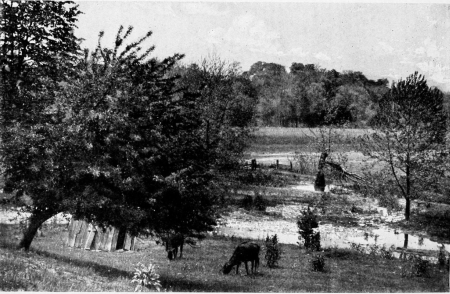
our state a battle-ground for nearly fifty years, and our life in the log cabin gave new zest to the tales of “Simon Kenton, the Pioneer,” and “Simon Girty, the Renegade”; of the captivity of Crawford, and his death at the stake; of the massacre of the Moravian Indians at Gnadenhütten; of the defeat of St. Clair and the victory of Wayne; of a hundred other wild and bloody incidents of our annals. We read of them at night till we were afraid to go up the ladder to the ambuscade of savages in our loft, but we fought them over by day with undaunted spirit. With our native romance I sometimes mingled from my own reading a strain of Old World poetry, and “Hamet el Zegri” and the “Unknown Spanish Knight,” encountered in the Vega before Granada on our island, while Adam Poe and the Indian chief Bigfoot were taking breath from their deadly struggle in the waters of the Ohio.
X
When the spring opened we broke up the sod on a more fertile part of the island, and planted a garden there beside our field of corn. We planted long rows of sweet-potatoes, and a splendid profusion of melons, which duly came up with their empty seed-shells fitted like helmets over their heads, and were mostly laid low the next day by the cutworms which swarmed in the upturned sod. But the sweet-potatoes had better luck. Better luck I did not think it then; their rows seemed interminable to a boy set to clear them of purslane with his hoe; though I do not now imagine they were necessarily a day’s journey in length. Neither could the corn-field beside them have been very vast; but again reluctant boyhood has a different scale for the measurement of such things, and perhaps if I were now set to hill it up I might think differently about its size.
I dare say it was not well cared for, but an inexhaustible wealth of ears came into the milk just at the right moment for our enjoyment. We had then begun to build our new house, and for this we were now kiln-drying the green oak flooring-boards. We had built a long skeleton hut, and had set the boards upright all around it and roofed it with them, and in the middle of it we had set a huge old cast-iron stove, in which we kept a roaring fire. The fire had to be watched night and day, and it often took all the boys of the neighborhood to watch it, and to turn the boards. It must have been cruelly hot in that kiln; but I remember nothing of that; I remember only the luxury of the green corn, spitted on the points of long sticks and roasted in the red-hot stove; we must almost have roasted our own heads at the same time. But I suppose that if the heat within the kiln or without ever became intolerable, we escaped from it and from our light summer clothing, reduced to a Greek simplicity, in a delicious plunge in the river. We had our choice of the shallows, where the long ripple was warmed through and through by the sun in which it sparkled, or the swimming-hole, whose depths were almost as tepid, but were here and there interwoven with mysterious cool under-currents.
We believed that there were snapping-turtles and water-snakes in our swimming-holes, though we never saw any. There were some fish in the river, chiefly suckers and catfish in the spring, when the water was high and turbid, and in summer the bream that we call sunfish in the West, and there was a superstition, never verified by us, of bass. We did not care much for fishing, though of course that had its turn in the pleasures of our rolling year. There were crawfish, both hard-shell and soft, to be had at small risk, and mussels in plenty. Their shells furnished us the material for many rings zealously begun and never finished; we did not see why they did not produce pearls; but perhaps they were all eaten up, before the pearl disease could attack them, by the muskrats, before whose holes their shells were heaped.
Of skating on the river I think we had none. The winter often passed in our latitude without making ice enough for that sport, and there could not have been much sledding, either. We read, enviously enough, in Peter Parley’s First Book of History, of the coasting on Boston Common, and we made some weak-kneed sleds (whose imbecile runners flattened helplessly under them) when the light snows began to come; but we never had any real coasting, as our elders never had any real sleighing in the jumpers they made by splitting a hickory sapling for runners, and mounting any sort of rude box upon them. They might have used sleighs in the mud, however; that was a foot deep on most of the roads, and lasted all winter. For a little while some of us went two miles away through the woods to school; but there was not much to be taught a reading family like ours in that log hut, and I suppose it was not thought worth while to keep us at it. No impression of it remains to me, except the wild, lonesome cooing of the turtle-doves when they began to nest in the neighboring oaks.
Our new house got on slowly. The log cabin had not become pleasanter with the advance of the summer, and we looked forward to our occupation of the new house with an eagerness which even in us boys must have had some sense of present discomfort at the bottom of it. The frame was of oak, and my father decided to have the house weather-boarded and shingled with black-walnut, which was so much cheaper than pine, and which, left in its natural state, he thought would be agreeable in color. It appeared to me a palace. I spent all the leisure I had from swimming and Indian-fighting and reading in watching the carpenter work, and hearing him talk; his talk was not the wisest, but he thought very well of it himself, and I had so far lapsed from civilization that I stood in secret awe of him, because he came from town—from the little village, namely, two miles away.
I try to give merely a child’s memories of our life, which were nearly all delightful; but it must have been hard for my elders, and for my mother especially, who could get no help, or only briefly and fitfully, in the work that fell to her. Now and then a New Church minister, of those who used to visit us in town, passed a Sunday with us in the cabin, and that was a rare time of mental and spiritual refreshment for her. Otherwise, my father read us a service out of the Book of Worship, or a chapter from the Heavenly Arcana; and week-day nights, while the long evenings lasted, he read poetry to us—Scott, or Moore, or Thomson, or some of the more didactic poets.
In the summer evenings, after her long hard day’s work was done, my mother sometimes strolled out upon the island with my father, and loitered on the bank to look at her boys in the river; one such evening I recall, and how sad our gay voices were in the dim, dewy air. My father had built a flatboat, which we kept on the smooth waters of our dam, and on Sunday afternoons the whole family went out in it. We rowed far up, till we struck a current from the mill above us, and then let the boat drift slowly down again. It does not now seem very exciting, but then to a boy whose sense was open to every intimation of beauty, the silence that sang in our ears, the stillness of the dam where the low uplands and the fringing sycamores and every rush and grass-blade by the brink perfectly glassed themselves with the vast blue sky overhead, were full of mystery, of divine promise, and holy awe.
I recollect the complex effort of these Sunday afternoons as if they were all one sharp event; I recall in like manner the starry summer nights, and there is one of these nights that remains single and peerless in my memory. My brother and I had been sent on an errand to some neighbor’s—for a bag of potatoes or a joint of meat; it does not matter—and we had been somehow belated, so that it was well after twilight when we started home, and the round moon was high when we stopped to rest in a piece of the lovely open woodland of that region, where the trees stood in a parklike freedom from underbrush, and the grass grew dense and rich among them. We took the pole, on which we had slung the bag, from our shoulders, and sat down on an old long-fallen log, and listened to the densely interwoven monotonies of the innumerable katydids, in which the air seemed clothed as with a mesh of sound. The shadows fell black from the trees upon the smooth sward, but every other place was full of the tender light in which all forms were rounded and softened; the moon hung tranced in the sky. We scarcely spoke in the shining solitude, the solitude which for once had no terrors for the childish fancy, but was only beautiful. This perfect beauty seemed not only to liberate me from the fear which is the prevailing mood of childhood, but to lift my soul nearer and nearer to the soul of all things in an exquisite sympathy. Such moments never pass; they are ineffaceable; their rapture immortalizes; from them we know that, whatever perishes, there is something in us that cannot die, that divinely regrets, divinely hopes.
XI
Our log cabin stood only a stone’s-cast from the gray old weather-tinted grist-mill, whose voice was music for us by night and by day, so that on Sundays, when the water was shut off from the great tub-wheels in its basement, it was as if the world had gone deaf and dumb. A soft sibilance prevailed by day over the dull, hoarse murmur of the machinery; but late at night, when the water gathered that mysterious force which the darkness gives it, the voice of the mill had something weird in it like a human moan.
It was in all ways a place which I did not care to explore alone. It was very well, with a company of boys, to tumble and wrestle in the vast bins full of tawny wheat, or to climb the slippery stairs to the cooling-floor in the loft, whither the little pockets of the elevators carried the meal warm from the burrs, and the blades of the wheel up there, worn smooth by years of use, spread it out in an ever-widening circle, and caressed it with a thousand repetitions of their revolution. But the heavy rush of the water upon the wheels in the dim, humid basement, the angry whirr of the millstones under the hoppers, the high windows, powdered and darkened with the floating meal, the vague corners festooned with flour-laden cobwebs, the jolting and shaking of the bolting-cloths, had all a potentiality of terror in them that was not a pleasure to the boy’s sensitive nerves. Ghosts, against all reason and experience, were but too probably waiting their chance to waylay unwary steps there whenever two feet ventured alone into the mill, and Indians, of course, made it their ambush.
With the sawmill it was another matter. That was always an affair of the broad day. It began work and quitted work like a Christian, and did not keep the grist-mill’s unnatural hours. Yet it had its fine moments, when the upright saw lunged through the heavy oak log and gave out the sweet smell of the bruised woody fibers, or then when the circular saw wailed through the length of the lath we were making for the new house, and freed itself with a sharp cry, and purred softly till the wood
The vicinity where Mr. Howells lived his “Year in a Log Cabin.” The cabin stood near the two pines
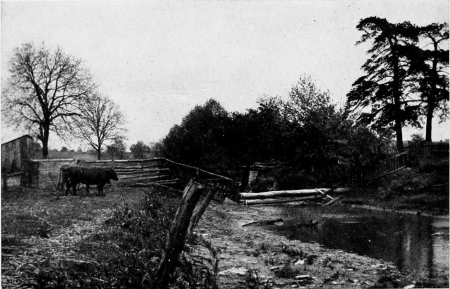
touched it again, and it broke again into its shrill lament. The warm sawdust in the pit below was almost as friendly to bare feet as the warm meal; and it was splendid to rush down the ways on the cars that brought up the logs or carried away the lumber.
It was in the early part of the second winter that it was justly thought fit I should leave these delights and go to earn some money in a printing-office in X——, when the foreman of the printing-office appeared one day at our cabin and asked if I could come to take the place of a delinquent hand. There was no question with any one but myself but I must go. For me, a terrible homesickness fell instantly upon me—a homesickness that already, in the mere prospect of absence, pierced my heart and filled my throat.
The foreman wanted me to go back with him in his buggy, but a day’s grace was granted me, and then my elder brother took me to X——, where he was to meet my father at the railroad station on his return from Cincinnati. It had been snowing, in the soft Southern Ohio fashion, but the clouds had broken away, and the evening fell in a clear sky, apple-green along the horizon as we drove on. This color of the sky must always be associated for me with the despair which then filled my soul and which I was constantly swallowing down with great gulps. We joked, and got some miserable laughter out of the efforts of the horse to free himself from the snow that balled in his hoofs, but I suffered all the time an anguish of homesickness that now seems incredible. I had every fact of the cabin life before me; what each of the children was doing, especially the younger ones, and what, above all, my mother was doing, and how she was looking; and I saw the wretched little phantasm of myself moving about among them.
The editor to whom my brother delivered me over could not conceive of me as tragedy; he received me as if I were the merest commonplace, and delivered me in turn to the good man with whom I was to board. There were half a dozen school-girls boarding there, too, and their gaiety, when they came in, added to my desolation. The man said supper was about ready, and he reckoned I would get something to eat if I looked out for myself. Upon reflection I answered that I thought I did not want any supper, and that I must go to find my brother, whom I had to tell something. I found him at the station and told him I was going home with him. He tried to reason with me, or rather with my frenzy of homesickness; and I agreed to leave the question open till my father came; but in my own mind it was closed.
My father suggested, however, something that had not occurred to either of us: we should both stay. This seemed possible for me; but not at that boarding-house, not within the sound of the laughter of those girls! We went to the hotel, where we had beefsteak and ham and eggs and hot biscuit every morning for breakfast, and where we paid two dollars apiece for the week we stayed. At the end of this time the editor had found another hand, and we went home, where I was welcomed as from a year’s absence.
Again I was called to suffer a like trial, the chief trial of my boyhood, but it came in a milder form, and was lightened to me not only by the experience of survival from it, but by kindly circumstance. This time I went to Dayton, where my young uncle somehow learned the misery I was in, and bade me come and stay with him while I remained in the town. I was very fond of him, and of the gentle creature, his wife, but for all that, I was homesick still. I fell asleep with the radiant image of our log cabin before my eyes, and I woke with my heart like lead in my breast.
I did not see how I could get through the day, and I began it with miserable tears. I had found that by drinking a great deal of water at my meals I could keep down the sobs for the time being, and I practised this device to the surprise and alarm of my relatives, who were troubled at the spectacle of my unnatural thirst. But I could not wholly hide my suffering, and I suppose that after a while the sight of it became intolerable. At any rate, a blessed evening came when I returned from my work and found my brother waiting for me at my uncle’s house; and the next morning we set out for home in the keen, silent dark before the November dawn.
We were both mounted on the italic-footed mare, I behind my brother, with my arms round him to keep on better; and so we rode out of the sleeping town, and into the lifting shadow of the woods. They might have swarmed with ghosts or Indians; I should not have cared; I was going home. By and by, as we rode on, the birds began to call one another from their dreams, the quails whistled from the stubble fields, and the crows clamored from the decaying tops of the girdled trees in the deadening; the squirrels raced along the fence-rails, and, in the woods, they stopped half-way up the boles to bark at us; the jays strutted down the shelving branches to offer us a passing insult and defiance.
Sometimes, at a little clearing, we came to a log cabin; the blue smoke curled from its chimney, and through the closed door came the low hum of a spinning-wheel. The red and yellow leaves, heavy with the cold dew, dripped round us; I was profoundly at peace, and the homesick will understand how it was that I was as if saved from death. At last we crossed the tail-race from the island, and turned up, not at the old log cabin, but at the front door of the new house. The family had flitted during my absence, and now they all burst out upon me in exultant welcome, and my mother caught me to her heart. Doubtless she knew that it would have been better for me to have conquered myself; but my defeat was dearer to her than my triumph could have been. She made me her honored guest; I had the best place at the table, the tenderest bit of steak, the richest cup of her golden coffee; and all that day I was “company.”
It was a great day, which I must have spent chiefly in admiring the new house. It was so very new yet as not to be plastered; they had not been able to wait for that; but it was beautifully lathed in all its partitions, and the closely fitted floors were a marvel of carpentering. I roamed through the rooms, and up and down the stairs, and freshly admired the familiar outside of the house as if it were as novel as the interior, where open wood fires blazed upon the hearths and threw a pleasant light of home upon the latticed walls.
I must have gone through the old log cabin to see how it looked without us, but I have no recollection of ever entering its door again, so soon had it ceased to be part of my life. We remained in the new house, as we continued to call it, for two or three months, and then the changes of business which had been taking place without the knowledge of us children called us away from that roof, too, and we left the mills and the pleasant country that had grown so dear, to take up our abode in city streets again. We went to live in the ordinary brick house of our civilization, but we had grown so accustomed, with the quick and facile adaptation of children, to living in a house which was merely lathed, that we distinguished this last dwelling from the new house as a “plastered house.”
Some of our playmates of the neighborhood walked part of the way to X—— with us boys, the snowy morning when we turned our backs on the new house to take the train in that town. A shadow of the gloom in which our spirits were steeped passes over me again, but chiefly I remember our difficulties in getting our young Newfoundland dog away with us; and our subsequent embarrassments with him on the train, where he sat up and barked out of the window at the passing objects and finally became seasick, blot all other memories of that journey from my mind.