Part 2 — APPENDIX IV. ANALYSES OF JAPANESE MIRRORS.
Reading edition
MM. CHAMPION AND PELLET (Industries de l’empire Chinois, p. 64) give the following composition for Chinese mirrors:
Copper50·8
Tin16·5
Zinc30·5
Lead2·2
———
100·0
———
Dr. Geerts gives (Trans. Asiatic Soc. of Japan, vol. iv., p. 40), for the alloy used in one of the largest mirror-foundries in Kioto:
Copper80
Tin15
Lead5
——
100
——
And for mirrors of inferior quality:
Copper80
Lead10
Shirome10
——
100
——
Shirome is a natural sulphide of lead and antimony from Choshiu or Iyo.
Professors Ayrton and Perry (Proc. Roy. Soc., 1878) give:
For mirrors of first quality:
Copper75·2
Tin22·6
Iyo Shirome2·2
———
100·0
———
For mirrors of second quality:
Copper81·3
Tin16·3
Iyo Shirome2·4
———
100·0
———
For mirrors of third quality:
Copper87·0
Tin8·7
Iyo Shirome4·3
———
100·0
———
For mirrors of fourth quality:
Copper81·3
Tori Shirome16·3
Iyo Shirome2·4
———
100·0
———
For mirrors of fifth quality:
Copper71·5
Tori Shirome28·5
———
100·0
———
The mercurial amalgam used in polishing the mirrors consists, according to Dr. Geerts (op. cit.), of quicksilver, tin, and a little lead. Ayrton gives it as one of tin to one of quicksilver. Champion and Pellet (op. cit.) give the composition as:
Tin69·36
Mercury30·0
Lead0·64
———
100·00
———
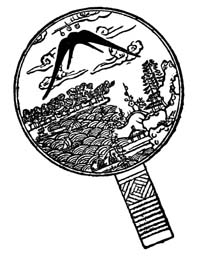
On the occasion of the delivery of this discourse the Author exhibited a collection of thirty-four Japanese mirrors, and by the aid of a lime-light lantern displayed their magic properties upon a translucent screen. He also exhibited sundry experiments with Laurent’s apparatus, and showed the effect of heating mirrors.