Louise Vescelius-Sheldon (continued 2)
Reading edition
Just calling in on our kind hostess, Mrs Jenkinson, in Potchefstrom, and taking a last look at the beautiful orchard-like village, so soon to become a terrible scene of bloodshed and slaughter, we continued on our way without incident other than the usual discomforts attendant on a South African coach ride. At several points in the roads we passed groups of Kafirs going to the diamond fields, and other groups returning from them, and it was amusing to note the prosperous appearance of the latter compared with the half-naked, destitute condition of their brethren going in the opposite direction. Most of them carried huge bundles on their heads, and it was funny to see the strange medley of articles some were carrying home as curiosities. Two of them carried ragged umbrellas, with scarcely a shred of material on their skeleton frames. They seemed to fancy bright tin pails and pannikins; and a new white flannel blanket, with several bright-coloured stripes decorating the ends, was an indispensable article in the kit of every one of them.
We passed through Clerksdorp and Bloemhof, as on our journey up, arriving in Kimberley on the fourth morning, travel-stained and weary, and most heartily sick of Messrs Cobb and Co’s coaches. Apart from the travelling we had enjoyed our trip very much, having seen the most interesting country in South Africa. Although the poor Transvaal seems to be doomed to years of political trouble before it can become truly prosperous, it is undoubtedly, with its undeveloped mineral wealth, its rich soil, the game which abounds there for the hunter, and, above all, with its glorious climate, the country of the future of South Africa. The farmers seem to want rousing; they lack ambition. Large tracts of country, capable of producing almost anything, lie dormant, waiting for employment. The best thing that can happen to the country is the successful opening up of some paying gold fields. This would bring many men of the right sort to the country, men with energy and determination, and above all, some healthy ambition. To the stranger newly arrived in the country the people seem lazy and listless, but after a year’s residence there this same listlessness gradually begins to steal over the newcomer. He then greets the latest comer, who is energetic and indifferent to heat, with the remark: “Wait till you have been out here as long as I, and see how you will like it then.”
Experts believe the mineral wealth of the Transvaal to be enormous. The diversity and variety of the minerals found there is unsurpassed. It has lead, cobalt, silver, plumbago, saltpetre, sulphur, iron, the best coal, and above all, gold! Echoes reach the ear of a story that there are signs on the western coasts, and not far distant, of the mines of Ophir. One also hears of an impregnable country beyond, and of a tribe kindred to the Basutos, ruled by the great chief “Sekukuni.” Everything one hears in Africa that is weird and strange one easily believes.
As a grazing country the Transvaal is by far the best in South Africa. Sheep, cattle and horses thrive there, and certain districts are especially suited to one or another class of live-stock. It is in some parts well wooded, particularly in the north, while its producing capabilities are practically unlimited. When traffic can be easily extended to Delagoa Bay, it is confidently expected great changes will take place.
It remains to be seen whether the Boer, left to himself, is capable of self-government with progress. Will he utilise the advantages of his country, or will he rest from generation to generation in stagnant content, comforting himself with the maxim: “What was good enough for my father is good enough for me.”
Chapter Fifteen.
We found our motherly old housekeeper awaiting our arrival with everything fresh and clean throughout the house, and we were glad once more to be “at home.” The ten months of our life in “the camp” had been full of interest and pleasure, and its sun’s rays had given health to the invalid. But such a desert region of country could have no attraction for any one but the speculator. After a thoroughly good rest we turned our thoughts toward the first stage of our return.
Frank had gained so wonderfully in health that we thought a change to the coast would do no harm. If harm did come, however, we could return, for we were decided to remain in the country until she had regained her health. It seems that human beings belong more to the vegetable than to the animal kingdom. They are like plants that flourish if they are put in the right soil, and grow in the climate best suited to them. The damp, heavy air of London, that necessitated exercise and food, was delightful to Eva and me, whilst Frank pined away under it as if she were breathing a deadly poison.
At the beginning of the new year we prepared to go by coach the usual way to Grahamstown, the principal town in the eastern province of the Cape Colony, and the point of our destination. In a few days our furniture was disposed of, our housekeeper dismissed, and we took our places in the coach to leave, and bade good-by to Kimberley and many kind friends we had made. For seven months it had not rained, but rumours of heavy rains had reached us a few weeks before our departure, and we feared we should find impassable the river we should have to cross on our way to Fauresmith, near which “Jagersfontein” (the new diamond fields) is situated. The roads we found in no better condition than those in the colony, and the coach threw us about and jolted us against one another and the sides in the old familiar way.
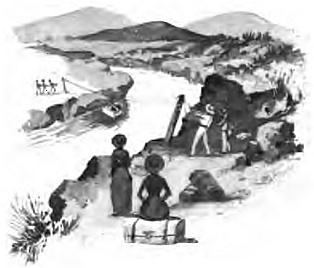
On arriving at the bank of the river, we found it was rushing down like a torrent, and almost level with the top of the precipitous banks, some sixty feet high. At another time we should have found the river at the foot of these banks, meandering along in an easily forded stream. The only contrivance for crossing, provided for such an emergency as the rising of the river, was a stout wire rope stretched from bank to bank, upon which was swung a common pine box of fair dimensions, but full of gaping holes, and looking, in itself, by no means capable of sustaining the weight of a healthy body. But it was the only possible mode of transit, so, screwing our courage to the sticking point, we prepared to cross. The box could only accommodate one individual at a time. So Eva stepped in to face the danger of the passage alone. One portmanteau was carried over with each passenger. How the heart beat as the Kafirs on the other side commenced to haul on the pulley lines attached to the frail machine.
We watched Eva with breathless interest as she was slowly pulled along in jerks, now and then coming to a dead standstill and dangling over that swollen stream, whilst the haulers rested before taking a fresh grasp of the lines; pulling a few seconds, then resting a few seconds, leaving the subject to dangle over the torrent with the heart thumping wildly. The rest of us followed in due course. As the opposite bank was reached, and we were lifted on to terra firma, the hand of that black man was clutched with as much fervency as we had ever grasped the hand of our dearest friend.
Having landed, we got into a coach which was waiting, to receive us. By night we reached Koffyfontein, a small village which had sprung up around what was supposed to be another diamond mine. Although a good deal of money had been invested in the neighbourhood, we did not hear of any fortunes having been made. We travelled all the next day, traversing a level plain well covered with grass and swarming with game. We often passed large herds of spring-bok, which started off with their graceful, springing gallop at sight of the coach. When we arrived at Fauresmith late in the afternoon we were tired indeed! The town has become prominent since the diamond mine at Jagersfontein (distant about four miles) has been opened. It is a long, straggling village with an unpronounceable Dutch name. Soon after our arrival the town was visited by a thunderstorm, which broke upon the hills round about us with terrific force, preceded by that deathly stillness and darkness which is so very ominous. Africa can deal out wonderful thunder and lightning. The lightning flashes incessantly, and seems to strike something every time it descends, the air quivers with electricity, and the atmosphere constantly changes from purple to gold. For any one who enjoys seeing a thunderstorm, Africa meets all requirements. The rain fell in torrents, but in an hour passed away, leaving the early evening cool and delightful.
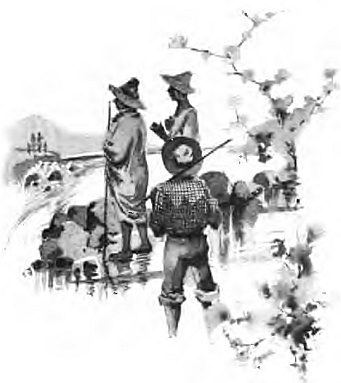
We took a stroll to the banks of the river, which had swollen into a torrent, and was sweeping down over rocks and boulders. A number of Kafirs, who had been working in the town, stood gazing dismally at it, whilst their wives and children looked on from across the stream. Several diggers from Jagersfontein, formerly of Kimberley, were stopping at the wretched hotel we were obliged to stop at. The mine is in a more workable condition than that at Kimberley, but not so large, and with ground not so rich, but the stones found there are said by the miners of Jagersfontein to be whiter and purer than any others. The mine produces about 250,000 dollars worth annually. The diggers complain as bitterly against their foe, the I.D.B., as their Kimberley brothers. The penalty attached to the crime in the Orange Free State, where the mine is situated, is greater than in Kimberley, but the detective system is not as complete. There is less risk of conviction, therefore, but the diggers have formed a detective system amongst themselves, and woe to the man who falls into their clutches! It is estimated that from one-fourth to one-fifth of the diamonds found in the mines never reach their rightful owners.
At dawn of the next day we continued on our journey, passing through the village of Phillopolis, once the principal place of the native tribe of the Griquas. It is a typical Dutch village, ill built, and in every way insignificant and uninviting. Close by the village is a very large Kafir kraal. As we passed it many came out to see the coach go by. A few hours later we crossed one of the bridges which span the Orange River, and were again in the Cape Colony. We passed through Colesberg, a village of considerable size, and the centre of a large sheep and ostrich-farming country. A thriving wool-washing establishment is situated there. Wool is the most important production of the farming industry of Cape Colony, but the best farmers in sheep-raising are not among the native Dutch, but among the English, German, and Scotch emigrants. I never saw Boer women knitting; the Boer women, in fact, seem to have little capacity for the kind of work peculiar to women in other civilised countries. From Colesberg we travelled through an uninviting country, usually a plain, studded, here and there with isolated hills, and having very little timber. We reached Grahamstown in the cool of the evening of the next day, alighting at the Masonic Hotel.
Chapter Sixteen.
On the day following our arrival at Grahamstown the thermometer stood at one hundred and thirty degrees. The air fairly quivered with the intensity of the heat, and although nowhere in South Africa can the song of birds be heard, our ears were tired with the sound of busy insect life. The continuous hum made by the myriads of locusts and other insects in the trees sounded like the buzzing of a saw-mill with twenty or thirty great circular saws in full swing. The climate of Grahamstown is considered almost perfect for the English invalid. Frequent rains in summer make the heat endurable; the winter is drier than at Port Elizabeth.
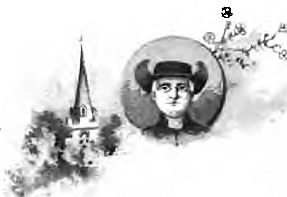
It is called the “City of Churches,” for many fine churches and a cathedral make the town interesting. The houses are in the midst of beautiful grounds filled with trees of dense foliage and with rare plants. The people are very social, and a fine class of English the descendants of the early settlers are to be met with here. They are very kind, and make the life of the invalid endurable, if not pleasant. To be ill and alone in the midst of unsympathetic neighbours is certainly worse than to linger a hopeless invalid amongst loving friends. The society of Grahamstown tries to welcome the stranger; and male visitors find amusement in hunting in the surrounding district, where game is plentiful. It is a fact that many English youths who have been threatened with hereditary consumption have gone to Grahamstown and made it their home for several years, and then returned to their island home, a wonder to all their friends.
British settlers of 1820 took root in this district around Grahamstown. This settlement is one of the most important events that ever happened in the history of the colony, and is a standing example of the utility of intelligently assisted emigration. The whole country at that time was in great trouble on account of a series of terrible Kafir wars, and, just before the importation of the new blood, the district in and around Grahamstown, which was then a military post, named in honour of its commander, had been swept by a marauding tribe of Griquas.
The town is the seat of an episcopate, and has numerous churches, banks and public buildings. It has also a large military barracks, now no longer occupied. It is a great place for church controversy. The portly figure and priestly countenance of the “Dean of Grahamstown” belongs as much to the history of the place as his own cathedral spire. We were invited after service one Sunday evening to supper at the Deanery, where we met the Dean’s wife, and some pleasant people. The house was a large, one-storey building, comfortably furnished. As we all sat around the well-provided table, chatting merrily, we noticed the Dean did not talk much, but was listening with a very interested countenance. Sitting in his big chair, his feet stretched under the table, and the tips of his fingers in his trousers pockets, he looked with his round face, round features, and rotund figure, and his half-shut but sharp eyes peering out through his gold-rimmed spectacles, a picture of contentment. At last, with a little sniff peculiar to him, he said: “Now let me hear you talk American.” Imagine our astonishment at his request, to which we replied with a merry peal of laughter. Because we were not speaking with a rasping Yankee twang, and “guessing,” and “reckoning,” he began to doubt whether we were Americans. No man could enjoy a joke or anything funny more than the good-natured Dean, but I don’t think he was convinced that we were speaking our native language during our visit to him.
The “twang” of the Yankee girl, though frequently a matter of jest, is, I notice, when connected with the Yankee dollar, very much sought after by many of the world’s so-called great ones, who are very ready to exchange old family plate, ruined castles, and historical deeds of valour, and thus become easily reconciled to the “twang” once so laughed at.
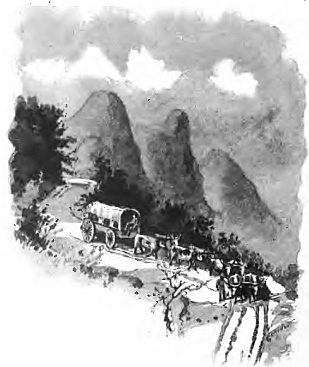
At the hotel we met a gentleman and his wife, whose acquaintance we had made on our arrival in the country. They had recently bought an ostrich farm, some thirty miles from the town, and pressed us warmly to pay them a visit, which invitation we were delighted to accept. They proposed bringing the ox-wagon from the farm to take us out. The wagon arrived, and our friends had prepared it for our use, neglecting nothing to make our ride as easy and comfortable as possible. The coloured boy, with a tremendous crack of the long whip and shouting “T-r-ek,” started the long train of sixteen oxen into a slow walk along, the town road. When we got into the country on the hilly road, where ruts were many, we all got out and walked. Our road lay through a thick, thorny wood, and along by steep, rocky cliffs, upon which we could see and hear hundreds of monkeys leaping from rock to rock, chattering and screaming. They seemed greatly frightened at us, and yet fascinated, for they would run along the face of the cliff ahead of the slowly toiling oxen, keeping up a startled clatter, and peering at us from behind stones or branches of trees. We had started late in the afternoon, and before we reached the farmhouse at which we were to stop for the night the moon had risen, and dense black shadows and silvery streaks of light were thrown ghost-like before our path. After reaching the house we sat up till late, watching the beauty of the moonlit scene.
Chapter Seventeen.
Next morning we resumed our journey, and after five hours’ trek, made most enjoyable by the mode of travelling and the rugged beauty of the scenery, we arrived at “Grasslands,” the home of our friends. The house was of one-storey, well built and roomy, and being on a rise, commanded a fine view of the wild, uninhabited surrounding country. Our host was a handsome, high-spirited Englishman, with a little English child-wife, a dainty little piece of humanity.
As the young wife leaned against the veranda talking to us in her pink calico dress, broad-brimmed straw hat trimmed with a bit of lace, and a spray of jessamine she had pulled from the vine covering the front of the house, she did not look much like one to live where wild monkeys chatter in the trees, and savage beasts come within rifle range of the front door.
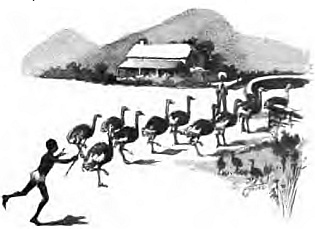
Our friend was engaged in ostrich-farming, and many of these queer-looking bipeds, with their long necks and floating feathers, the beauty of which is certainly wasted on their own backs, were wandering around the house. It had been an addition to our stock of information to learn in the Cape Colony that ostrich feathers were as much the product of regulated human labour as wool, mohair, or silk. We had always supposed ostrich feathers to be procured by hunters, and had in mind stories of their tactics in the chase of the fleet-footed bird. We learned that Cape farmers buy and sell ostriches as they do sheep, and fence their flock in, stable them, and grow crops for them. The eggs are not yet considered as belonging to the Cape dairy, and are not sent to market with bread and cheese. They are too precious for consumption, and too valuable even to be left for hatching to the rude methods of nature. The act of laying has not yet been dispensed with, but as soon as the eggs have been laid the nest is discarded, the parents are “locked out,” and the mechanical certainties of the incubator are substituted for parental instinct and affection. We were glad to learn, for the sake of our cherished traditions, that this farming was only of comparatively recent date, a domesticated ostrich being fifteen or twenty years ago unknown. There are now 150,000 of these domesticated birds in the Cape Colony, giving employment to not less than 8,000,000 dollars capital.
Our host informed us that the rearing of ostriches was an extremely difficult operation, as the bird itself, although devouring everything that comes in its way, from a steel fork to a lemon, is very delicate, and liable to injury in all sorts of ways. They are housed at night in circular kraals, surrounded by a low rush fence, the ostrich, despite his fleetness and strength of legs, being unable to mount or jump over any obstacle, and turned out during the day into the veldt in charge of a herd.
An ostrich can give a mighty kick, sufficient to break a man’s leg, but you may easily choke him by throwing your arms around his neck. The bird can then do nothing, for he has no strength in his wings to beat his enemy off, and is only able to use his formidable legs, like a horse, backward. Still, he is an awkward enemy to engage, for it requires some courage to rush up to a bird and embrace him until help arrives, or until you succeed in choking him. Despite the strength of his legs they are easily broken if the bird accidentally strikes them against any obstruction, such as a hanging bramble or a wire fence. He must be carefully watched to prevent such accidents, and it is also necessary to drive him away from any food likely to disagree with him. The feathers are sometimes plucked, and sometimes separated from the body by a sharp curved knife, each feather being taken separately. To do this the fanner drives them into a small inclosure, where there is little room to move about, and insinuates himself in among them, selecting such feathers as have arrived at maturity, and leaving the others to grow. The bird has a fresh crop of feathers every year, and as the prime feathers are very valuable, it may easily be believed that a lucky breeder finds the occupation a very profitable one.
The prettiest sight to see on an ostrich farm is the nursery, where, in a large room, in inclement weather, a score or more of little chicks are attended by a black boy, whom they follow everywhere.
Many farmers are unfortunate and meet with accidents, and thus lose heavily. Sometimes the soil is unfitted to grow the herbage necessary for the ostriches’ food, and there are many accidents they are liable to, such as dangers from prowling jackals or from severe storms. Then there are tigers and vultures to be guarded against. It will thus be seen that the ostrich farmer’s life is not necessarily a happy one. Our stay at Grasslands was made very pleasant by Mr M— and his wife. What with picnics in the wild surrounding country day after day, musical evenings on the moonlit lawn, a week passed away before we knew it.
It was here we noticed Frank had something on her mind which she wished to communicate to us. We said nothing to assist her, although we had a strong suspicion of what was coming. One morning she began: “Well, I want to tell you something.” She didn’t get any further, for we interrupted with “Oh, we know; you are going to marry Mr A—, whom you met on the diamond fields last year, and we are to dance at the wedding. Didn’t you think any one suspected? Why, my dear, it was very plain to us that he was to be your future husband long before you thought so yourself!” After we had congratulated her, we inquired how soon the event was to take place. She proposed having the wedding from the cathedral at Grahamstown, as we had many warm friends living there. So the matter was settled for the time being.
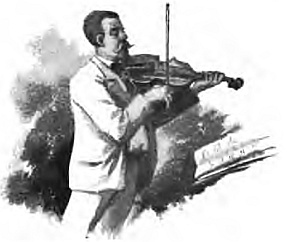
One evening a musical friend of our host, a gentleman from Port Elizabeth, and a violinist of no mean order, joined our circle, and we sat for hours listening to his music. After treating us to some choice selections, he began to play some of the songs of the farm Kafirs, who were listening about in numbers. They had learned to sing at their Sunday-schools in the town such hymns as “Hold the Fort,” etc, and took up the airs and began to sing, after their manner, in a chanting drone. Soon the sound of their own voices and the strains of the violin wrought them up to a high pitch of excitement, and they began to walk around us in a circle, keeping time with their hands, feet and head. Before long the musician, who had a touch of the grotesque in his humour, placed himself at the head of the procession. The music grew faster and faster, and the monotonous tramp of the Kafirs quickened gradually into a wild war dance. The scene which followed baffles description; there was the musician scraping away like an infernal Paganini, producing tones from his fiddle that seemed to excite the Kafirs to a pitch of frenzy. We joined in the singing, and sang at the top of our voices, while the black men, dancing, whirling, shouting, and gesticulating, grew wilder and wilder in their antics. The music suddenly ceasing, they sank exhausted to the ground. It was a weird scene in the moonlight, and one we shall long remember.
Our stay at Grasslands came to an end all too soon, and we looked long and lingeringly at familiar objects as we were driven back to town in Mr M—’s handsome Cape cart behind a dashing span of horses.
Chapter Eighteen.
Soon after our return to Grahamstown we put the finishing touches to everything we had left undone toward making the wedding a joyous occasion. The bride’s white satin dress and veil were made by the hands of a competent dressmaker. There was a dress for Eva, as chief bridesmaid, which consisted of soft trailing drapery, and one for me, who was to take a place in the organ loft, and sing on the occasion. The day arrived, bright and smiling. The wedding bells pealed from the tower of the cathedral. The “sympathising” and well-wishing friends were gathered within when the bridal party arrived. The knot was tied, and as the bells pealed forth the bride passed out on her husband’s arm; an old crone stood in the door and showered blessings on her.
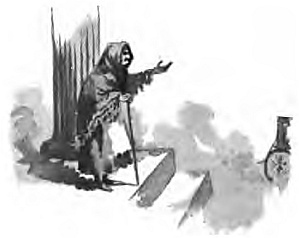
As soon as congratulations were over, the wedding breakfast eaten, and the usual rice and lucky slipper flung after them, they took the train for a short vacation in a mountain hotel on the Zuurberg, whilst we bade good-by to friends around us, and flew away the same night to the sea at Port Elizabeth, five hours distant by rail.
Our rooms in the Hotel Palmerston overlooked the open bay and the long pier or jetty, which runs out some two hundred yards into the sea, and is a favourite promenade for the townspeople. This made an ever-changing picture before us, and our hearts were stirred by the sight of our Stars and Stripes floating at the peak of two barks lying at anchor in Algoa Bay. Port Elizabeth, with its twenty-five thousand inhabitants, seemed different in many respects from any of the towns we had visited. It is a thriving, active, bustling town, with many handsome stores and buildings, three or four banks, a public library, which is in the Town Hall, a building that would grace any metropolis, and several churches of various denominations.
A public park, built on the hill, is one of the especial prides of the place, the original site having been a stony waste, and all the soil having been brought from the valley back of the town. In fact, the whole city stands on a barren, sandy cliff, the business portions lying along the beach, and the residences stretching away up the face of the cliff to “the hill.” There is a strong rivalry existing between Port Elizabeth and Cape Town as to which shall have the lion’s share of the importing trade of the colony. The former is more advantageously situated for the interior trade, but unfortunately has no docks for shipping, and is exposed to the prevailing southeast gales.
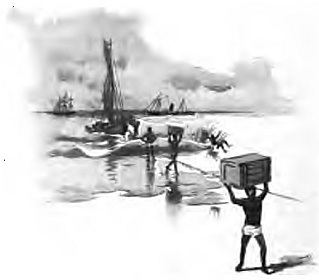
Great sums of money have been spent in the construction of a breakwater, which it was fondly hoped would form a refuge for ships during the heavy storms. But before it could be finished it proved itself useless, for the sand would “silt up” on the lee side, until it threatened to form a wide strip of beach between the landing place and the sea. All goods are landed by means of lighters, which are either unloaded at the jetty, or are driven on shore as near as practicable, and moored head and stern, when their contents are taken out by Kafirs, who, stripped almost naked, wade out in twos and threes, and carry the bales and cases on their heads. Sometimes a heavy wave comes in, throwing them off their feet, and causing precious freight to fall into the water and be broken to fragments. The merchant who deals in perishable articles thus runs great risks.
A number of large warehouses lie close to the water’s edge, where all goods, as soon as landed, are received, to be sent up the country by ox-wagon or mule train. This will be done by the railway on its completion. A sea wall has been built a mile along the shore southwest of the jetty, and forms, in fine weather, a most delightful promenade, but, being away from the fashionable quarter of the town, is seldom patronised by the swells.
There are a large number of German residents representing foreign houses in Port Elizabeth, who form a society of their own. They have built for themselves a fine club-house in grey stone, costing many thousands of dollars, which would do honour to any Continental city, and have some handsome residences.
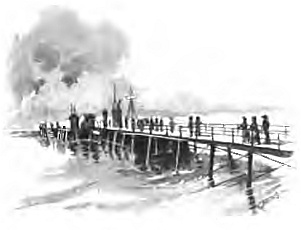
“Society” in Port Elizabeth endeavours to be very select. We attended several social gatherings, and found the citizens, as a rule, large-hearted, hospitable people, always glad to give a hearty and warm reception to the stranger within their gates.
Chapter Nineteen.
One of the most interesting objects in Port E— is the Donkin Memorial, a pyramidal monument erected on the first ledge of the hill by Sir Thomas Donkin to the memory of his wife Elizabeth, who died off this point on ship-board while on her way from India, and after whom the town is named.
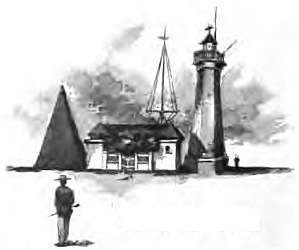
A signal station is built by the side of the brick pyramid, and the fine open stretch of green turf which surrounds it and overlooks the sea forms a pleasant promenade at all seasons of the year. There are several well-edited newspapers, the Herald being the most enterprising and the leading one, excelling in matter and printing any of the Cape Town journals, excepting the Cape Times, edited by the genial and popular Mr Murray. Although Port Elizabeth has not the fine harbour and docks of Cape Town or the beautiful suburban surroundings, still a more energetic spirit exists in the business community, and the style of entertaining is on a far more liberal scale than in the latter place.
As in most South African towns, a place is set aside for the black people at the upper end of the town.
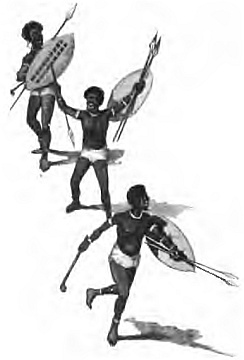
There they live, coming down to the stores and beach in the morning, and returning to their respective kraals at night. Several tribes are represented among them, and they form separate kraals, keeping themselves as distinct as though they were of a different species, although it would trouble most people to tell the difference between a Gaika and a Fingo, or a Zulu.
The Fingoes, who have in all the Kafir wars been the white man’s ally, are cordially hated by the other Kafirs, who fight with them continually. The quarrel on one occasion during the latter part of our stay assumed such a threatening aspect that the town was alarmed for the consequences. For nearly a week not a Kafir came to the town, and it was rumoured that the Gaikas had grievously routed the Fingoes and were preparing to make a night raid on the town to massacre the inhabitants. It was at a time when the whole country was disturbed, there being two or three tribes at war with the colonists on the eastern borders. The report was then easily credited, and every available measure was taken for the protection of the inhabitants and to prevent surprise, the local volunteer corps being under arms for several days.
One Sunday night we in the town could hear them singing their peculiar war chant, and such wonderful precision have they in time that the mighty chorus from the thousands of voices came down to us like the beating of a great heart. The effect of their deep melodious voices, as they rolled out on the moonlit midnight air in a great wave of sound, was weird and fearsome to a degree. We could not tell whether their fury might not rise to such a pitch as to send them rushing down upon us like naked fiends, yelling, stabbing, and spearing. But they seemed to be satisfied with a little bloodshed among themselves, and the Gaikas and Fingoes, after a few days, resumed their work on the beach and in the store side by side.
But the alarm brought home to the colonists the danger existing in their midst. The black population outnumbers the white throughout the colony by almost six to one. In the town it is quite three to one, and a general uprising under an intelligent head could not but result in the total annihilation of every white face in the country. The colonists never seem to think such a contingency likely, relying on the internal dissensions between the different tribes and the moral force the white man seems to possess over the untutored black man.
After remaining in Port Elizabeth seven months, we held a family conclave and came to the conclusion that we did not wish to leave the country until we had tried the climate of the Orange Free State, which we had heard lauded to the skies. So we bade adieu to Port Elizabeth, thinking it a very pleasant place to visit, and taking a parting look at the sea, we were whirled away to Grahamstown. From here we left by railroad for Cradock, a town some sixty miles east. Like Grahamstown, Cradock is the centre of a large wool-gathering district, and is laid out in boulevards and watered streets. It is situated on the Great Fish River, over which there is a fine stone bridge. It is at least forty feet above the surface of the water, which, at the time of our visit, flowed slowly between its arches in a sluggish stream, some fifty feet wide. Several years ago, after heavy rains up country, the river became suddenly so fierce, rapid, and swollen that the whole structure, solid as it was, was swept away by the first wave, which is described as advancing, with little or no warning, like a solid wall of water, fifty feet high. There is a Dutch Reformed Church, a well-built Town Hall, and a few houses and stores, with a population of three to four thousand inhabitants.
We had experienced so many discomforts in our previous journeys by coach that we resolved here to have no more of it. So we provided ourselves with a comfortable and roomy Cape cart and four strong horses to make the journey up country, and we were prepared for once to take things easy. When travelling by coach one has no alternative between pressing right on, or waiting over in a dreary village for a week, until the next coach passes through. But with your own cart you can do as you like, going or staying, as pleases the fancy.
Passing some of the villages we had been through by coach, in a few days we had reached the Orange Free State, more frequently called simply “Free State.” Our introduction to this thinly populated upland region was not calculated to put us in the best of humours, either with the country or our tired selves. We remained long enough to find out there were many things of interest about it. The Free State is embraced within the boundaries of the Vaal and Orange Rivers, and was first settled by the Dutch farmers, who had emigrated from the Cape Colony; the farms are very large, and by no means all occupied.
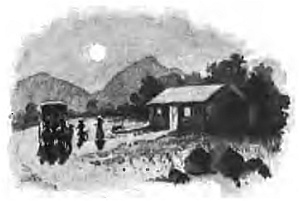
About nine o’clock one night we stopped to give our horses a rest at a miserable house built of mud bricks. On either side of the door was a small window, in one of which was a sputtering candle. The house was occupied by Dutch people, but as it did not look sufficiently inviting to tempt me out of my seat even for a change, some coffee was brought out by a daughter of the family; a girl of sixteen. In the moonlight her face was very pleasing, and on asking her a question she answered in such pure English that we asked where she learned to speak so correctly. She replied that she had learned at the English school in Bloemfontein, called the “Home,” belonging to the Church of England. She was so bright and chatty, yet modest withal, and her surroundings so wretched and uninviting, that I thought the educational institutions of B— must be something superior to those usually found in the colony, which, on further knowledge, proved to be true.
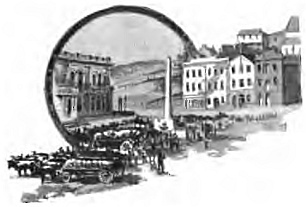
When we reached the brow of the hill overlooking the town of Bloemfontein, we saw with pleasure, under the bright moonlight, the town filled with fine trees and gardens. As we drove through we passed large buildings of both church and state which would not be excelled in any town of the United States of double the size.
Chapter Twenty.
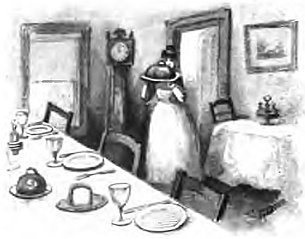
We at last reached a cool, inviting-looking hotel, and we thoroughly enjoyed that well-served dinner laid before us on clean linen and bright silver, the delicious viands seeming all the better for our temporary deprivation. If any one troubled with dyspepsia should travel for three months through Africa, and live as the people do, never hurrying, and occasionally getting a jolting in a long coach ride, his would soon be a forgotten malady.
Bloemfontein, being the seat of government, is by far the largest, best, and most important town in the Free State. It is a very pretty town, well planted with trees, the streets wide, the houses well built, and an air of cleanliness pervading everything. It nestles at the base of a long, low mountain, one of a range of hills that fade away in the distance and form a pretty picture in the red and golden tints thrown by the rays of the setting sun. It looks like a pretty toy town.
Many of the leading men both here and elsewhere through the country are Germans, and excellent colonists they make. To be sure, we found a number of adventurers of the same nationality of a totally different sort, agitators and demagogues. There are, indeed, many who say that it is owing to the German element in the Transvaal that the dissensions existing in the country are directly owing. But the greater number are good citizens, readily adopting the country and state in which they live as their own, and training up their children to protect its interests. An enterprising German is the leading dry goods merchant in this upper country. His storerooms were stocked with merchandise, from hardware to the finest laces. His home was in the midst of well-kept grounds, laid out like a park, in which were planted many Australian gum trees. These are trees which, with a little care, grow thriftily and to a great height wherever they are planted in Africa.
On one of our drives in the neighbouring country we drove to the farm of the merchant, and chanced to meet him there. He had planted hundreds of young trees on his large farm, mere saplings. We remarked, “Why do you pay so much attention to the planting of these slips of trees? They grow so slowly they will never give much shade during the lifetime of any of us.”
“Well, well,” he replied, “the children of the next generation may come out here from B— and enjoy their picnics under the trees I have planted for them.” We found the same spirit among most of the German land-owners. They propose for the sake of their children to make no mistakes.
Among the first settlers were German missionaries, who have in time amassed wealth and founded schools, built churches, and assisted in making the laws of this successful little republic. The town is largely given over to educational and religious establishments. The English Episcopal and Roman Catholic churches have each a bishopric and a cathedral. The former is very active, particular attention being paid to the college and schools attached to it. One of the institutions connected with the English church is the “Home,” carried on by the sisters of the church, who come from England to assist in the schools and hospitals, most of them being ladies of fortune and culture. The good that has been effected through them and their institutions cannot be computed by figures. They dress like the French sisters of the Roman Catholic Church. Although every now and then one of them marries, as a rule they do not marry. They live lives of strict self-denial.
The Roman Catholic Church is a large structure, with a convent and school attached. We listened to an excellent sermon here during the visit of the Bishop, and heard some good music, as the tenor brother had a fine voice, and travelled, it was said, with the Bishop. The nuns’ voices were very sweet, one especially having such a sad, plaintive tone that it made the listener wish to see the face hidden behind the grating.
Many English visitors go to Bloemfontein for the benefit of their health, but they do not look so robust nor gain strength as quickly as persons who have been six months in the Transvaal. The fine climate of that country, if sought in time, is almost a certain cure for any lung disease or asthmatic trouble. The dry climate of this upland region cannot be too highly extolled, and the best way to gain the full benefit of it is to try the primitive mode of travelling by ox-wagon. This, however, should be done as comfortably as possible, and during the dry season. The hotels in Bloemfontein and the Transvaal are so superior in point of comfort and table to those in the colony that they are greatly appreciated by the tired invalid. Our hotel parlour had a fine Brussels carpet on the floor, tinted walls, comfortable and handsome furniture, a Bimsmead piano, and lace curtains.
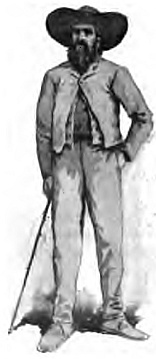
During the several hot months we were there we had an opportunity of studying the characteristics of the Dutch Boer, who is met with in this part of the country in his primitive state. The Africander Boer is usually a tall, lanky, narrow-chested individual, with black hair, straggling beard and whiskers, cautious, suspicious, and undemonstrative, his countenance expressing little imagination and his body great physical endurance. He is never quarrelsome if it can be avoided; he is as shrewd at a bargain as any Scotchman, and in all his dealings displays an odd mixture of cunning and credulity. His contradictory history, however, makes it difficult to determine whether he is a brave man or the reverse.
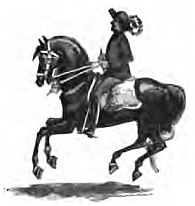
He is usually dressed in a yellow cord jacket, vest and trousers, with a flannel shirt, and veldt schoen (low shoes of untanned leather with no heels), the whole surmounted by a broad-brimmed slouch hat with a green lining. When he wishes to be particularly fine, as, for instance, when he goes a-courting, he sticks an ostrich feather in his hat, squeezes his long feet into a pair of patent leather congress gaiters, and encases his legs in showy leather leggings. He then mounts a horse that “kop-spiels,” gets into a new saddle with a sheepskin saddle cloth, and imagines himself just lovely!
Chapter Twenty One.
The language is the queerest jumble of Dutch, Kafir, and colonial war shouts, which, when spoken by a fluent Dutchman, sounds more like the tearing of strong linen than anything else. It certainly is a fine language with which to urge on the drooping spirits of a tired team of oxen. As a class the Boers are extremely strict in religious observances. The periodical “Nachtmaal,” literally “night meal” or “sacrament,” held every three months at the large and fine Dutch church, they attend faithfully.
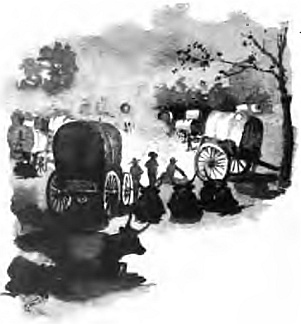
The farmers will pack their whole families into a wagon, and leaving the homestead to take care of itself, will “trek” into town, where some of them will occupy little clay houses of two rooms, or camp outside until the services are over, when they will “in-span” and return home. They always take advantage of these visits to do their shopping. At such times the stores wake up and put out their smartest calicoes and their yellowest saddles with which to tempt the wary Boer and Boeress. It is interesting to enter the village at night where a Nachtmaal is to be held next day. There is almost a second village of tent-covered wagons all around it. The various fires have each a group of men and women sitting round it, while in the shadows lie the slumbering oxen and chattering “boys.”
After remaining at the hotel until we were tired of hotel life, we secured board at a farmhouse about two hours’ ride from Bloemfontein.
The owner of this farm worked incessantly to improve his several thousand acres, which included some very fine land. The land showed what industry can do by simply keeping on day after day. The farmer had no white help which could be depended on; there were many Kafirs, but none he could rely on.
Water is the great need, and although, by digging deep enough anywhere through the country, water is reached, not a single windmill did we see in factory or on farm to aid in pumping water. For months the dry season prevails, and our farmer, in order to be independent in his water supply for his many cattle, sheep, and Angora goats and ostriches, had thrown up banks of earth around three large dams.
The wife was a large, comfortable woman, the mother of six children, the eldest thirteen years of age; when she sat down to rest they seemed to swarm over her, but they did not ruffle her temper any more than so many flies. She superintended and sometimes cooked all the meals; fourteen people often sat down to dinner, and three courses were served, usually by hideous Hottentot girls, dressed in bright calico dresses, coloured beads, and ribbons. These girls, dressed thus, consider themselves irresistible. The Kafir servants have to be told each day what to do; they have no memory for the simplest household duties. Their huts are some distance from the house, and if a notion seizes them to go to a wedding or a funeral, or to have a gossip with some stray Kafir, they will not come near the house, and the wife does the work alone. It was a wonder how she got through her work so easily, for she supplied a hotel in B—, which had thirty boarders, with butter, made the children’s every-day clothes, besides attending to many other household duties. Yet she was no light-footed woman, but had an avoirdupois of two hundred and fifty pounds, which is not an unusual weight for an Africander woman of thirty years.
When coming into the house on a visit, whether one is acquainted or not, it is the custom to shake hands with every white person present. An English acquaintance drove to the farm to call upon us, and in thoughtlessness left without walking to the barn to shake hands with the farmer. The farmer was so indignant at this affront that nothing would make him overlook it. We shook many a hard and horny hand of traders who passed that way and remained to a meal. Some of these never looked up from their food or made a remark until they took their departure, when they shook hands again and uttered some unintelligible Dutch word.
By living with such thrifty and pleasant people as this farmer and wife one learns what patience means with dumb, lazy servants, and how much can be accomplished by keeping steadily at work, doing little at a time. That is the way in which the Dutch people have made a success of their little republic. They are satisfied with small things, and move slowly. It thus happens that few mistakes occur in their governmental affairs, and that there are few bank failures and consequent suicides.
Their ancestors must have been splendid fellows, for their deeds proclaim it. But long years of inactivity and the habits of intermarriage have weakened the race sadly. The descendants of the men who were foremost in every land are now content to sit on the same farm from generation to generation, caring for nothing, and having no ambition beyond raising a larger family than their neighbour.
The “vrouws,” or wives, are either very thin and bony, or tall and “massive.” They dress in black, full skirts that skip the ground when they walk, and black poke bonnets with thick veils, which preserve the complexion from tan and freckle. They have really fine complexions. One farmer near Bloemfontein boasts of a family of twenty-three children, all by one wife. Fancy all the cousins and the aunts in the next generation! There will certainly be many marriages among these cousins. So much has there been of this habit of marrying in families that one frequently, especially in the older parts of the Cape Colony, finds whole districts where every farmer has the same surname, and is only distinguished by his given name. These so quickly give out that the good people are forced to adopt the old-fashioned way of coining surnames, and a man is known as Hans Meyer, C’s son, or Pieter Van Dyk, Karl’s son, and so on.
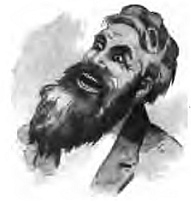
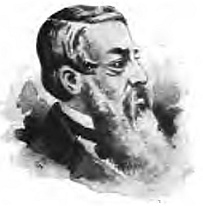
But there is a reverse side to the picture. We meet some fine men among the Boers, President John Brand being as fine a specimen of a pioneer statesman as any one would wish to find. The government of the republic consists of the President and the Legislature, called the Volksraad, elected every four years.
Chapter Twenty Two.
The President, who had been elected so often that the office promised, so far as he was concerned, to be a perpetual one, is a hearty, genial gentleman, beloved by all who know him. He is a native of Cape Town, and received his education in England. The welfare of the little republic, over which he has so long and so wisely ruled, is the dearest object of his heart.
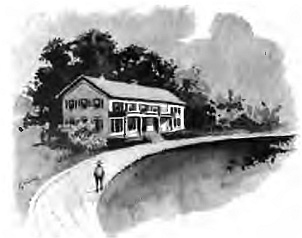
We met the President and his wife, who invited us to call at their residence, a large, two-storey “White House,” as it is called, surrounded by extensive grounds in the prettiest spot on the outskirts of the town. We were told by residents that our visit would be very formal, but it did not prove to be so. We found them both most charming and affable people. A luncheon of delicacies and choice fruits from their own orchard was laid for us, and Mrs Brand, or “Lady Brand,” as she is more generally called, was so bright and witty that an hour passed away very pleasantly. She is a large, striking-looking woman of noble features, and with a mind capable of assisting her husband in matters of state. Her best sympathies are with her people, and no one deplores more than she the lamentable ignorance to be found in the remote districts. It rests with the people themselves to remove this ignorance; excellent boarding-schools, both government and private, are established in every village throughout the country. She has unbounded confidence in the capabilities of the Dutch to govern themselves. Certainly, if the country can produce more such people as her noble husband and herself, they will have no difficulty in finding a leader.
The President seemed greatly interested in us as being Americans, and asked us question after question about our customs and form of government. A special session of the Volksraad was called while we were in the town, to discuss the condition of the Transvaal, which was now in open revolt, and we had an opportunity of seeing the representative men of the country. They came to town in all sorts of vehicles, European and American carriages, Cape carts and ox-wagons. The many vehicles, all drawn by handsomely matched horses, made the town very bright and gay.
The men who gathered together were, many of them, aliens by birth, but all showed signs of more than average intelligence. The question they had come to discuss, viz, what should be the attitude of their country in the present state of affairs in the Transvaal, was important, for the people of that territory were united to them by many ties. News was brought by post cart that the Boers in the Transvaal, who had long wished to govern themselves, had risen up against English rule, had come riding into Potchefstrom from all the country around, and had taken possession of the town. There we were in the midst of people closely related to the Transvaal, which was but a few days’ ride from us.
As news came that Pretoria, so isolated, was in a state of siege, and that English troops were coming out as fast as the steamers could bring them to put down the Boer rebellion, things began to look interesting. In addition to the troubles in the Transvaal, the Cape Colony was also embroiled in a war with the Basutos, a warlike tribe occupying a large tract of country east of the Free State. What with war with the Basutos on the one side of us, and the Boers on the other, South Africa was not precisely a country to which one felt the Millennium would soon come.
Fighting against the natives, either Zulu or Basuto, is an entirely different kind of warfare from meeting the deadly aim of the Boer on his own soil. In this dry, cruel country, with its natural fastnesses and dry river beds, the Boer from his boyhood wanders, gun in hand, trained to handle it as easily as the English soldier handles his cane when not on duty. When news came in that every officer of a fine English company of brave fellows had been shot, picked off like birds on a fence, a wave of horror swept over the hearts of those friendly to the British flag. The English troops went on nothing daunted, and when fighting on one of the heights were beating their foe, who was turning to flee. At this critical moment they discovered that their leader had neglected to bring sufficient ammunition up the mountain-side. When the Boers saw the situation, and rushed back upon them, the brave English fellows, in their desperation, picked up stones and threw them at their foe, and then, rather than be taken prisoners, jumped down a declivity of a hundred feet to effect their escape.
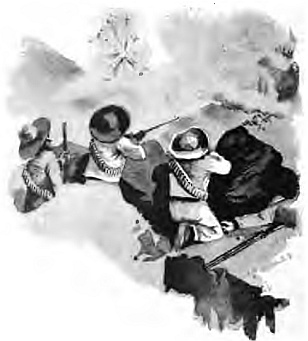
I quote a descriptive account of the engagement at “Lange’s Nek” from the special war correspondent of the Natal Witness:—
“No unfair means were taken by the Boers yesterday. We attempted to take the hill, and in our endeavours to reach the summit they repulsed us. This is the whole thing in a nutshell; men who were in the engagement stated that the Boers had entrenched themselves, and this is more than probable when it is considered that natural trenches must abound in the positions they occupied. It was also represented that they had numbers of Kafir allies to assist them. This may or may not be true. I was posted near the cannon, and although I had a magnificent view from that point, I observed no Kafir force whatever. It is perfectly true that many of the Boers used fowling-pieces loaded with buckshot, and they did fearful damage in wounding men, but whether this can be regarded as unfair when rockets are used on our side, I leave any one to decide. Mere words are tame to express the manner in which the gallant 58th behaved on this occasion. Their conduct throughout, even against overwhelming odds, and the knowledge acquired too late of the enemy’s position being impregnable, left nothing to be desired.
“The attempt to eulogise these men seems like mockery; their deeds speak for them far more eloquently than words can. So true and deadly was the Boer aim that Colonel Deane, in command of the 58th, fell almost immediately upon fire being opened. Officers and men were shot down in every direction. Every volley of the Boers carried its fearful freight too true, and thinned our already meagre force. Still they held on to the last, hoping against hope, and dying martyrs. Every man on the field yesterday was more than a soldier—he was a hero. The word ‘Retreat!’ was at last given, but oh, what a retreat! Men walking over their dead comrades’ bodies, ever and anon another addition being made to those already down—wounded men imploring that their rifles should not be thrown into the enemy’s hands.
“The sight was grand, but awful, and those who witnessed the engagement at Lange’s Nek yesterday are likely to carry the impression to their graves. Had it not been for the shells, which unquestionably created great havoc among the Boer ranks at this period, few, very few, of the 58th would have survived that day. On reaching the foot of the hill the 60th Rifles were drawn up to protect their retreat, and, if possible, induce the enemy to follow up. The Boers, however, retired to their position under cover of a ravine.”
This was what the fighting was like; it seemed more like a massacre of the gallant Englishmen than a battle. But what seemed most astonishing to the English population was that these quiet, peaceful people, who nobody thought would fight, rose up in a day as one man, without any such purpose being known to the English!
The colony of South Africa is always in a flourishing condition when war breaks out. Then English gold and foreign speculators come to its shores; everything is at fever heat; towns are built and beautified. Afterward comes the reaction; the breath of life and vigour dies out, leaving the colony hopelessly in debt. The colony then remains a drain upon the exchequer of England, which pays out thousands of pounds for the war “epidemics” that every few years break out between the native and the English, or the Boer and the English.
These wars yield nothing in return to England but mourning hearts at home for brave sons who lie buried under African soil.
Chapter Twenty Three.
Before leaving Bloemfontein we met two fellow passengers of ours on the Trojan. They were brothers, and one was so ill that we never expected to see him again in this life, when lo! here he was the picture of health, entirely owing, he said, to the wonderful effects of the climate. By living and travelling for over six months in an ox-wagon, he declared, he had taken a new lease of life. Despite the fact of our lives having been insured in America, we thought that a new lease would be a comfortable thing to have by us. So we made up our minds to try the experiment.
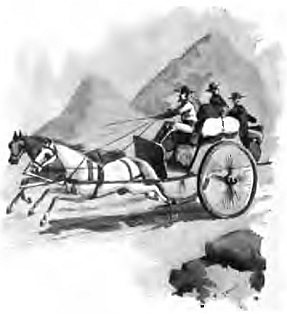
It was not an easy thing to find a wagon which we could hire for the trip, but fortune favoured us. Mr A— met an English friend, Mr Heeler, from Pretoria, who had, like many others, managed to escape with his portable property and his wagon before the Boers beleaguered the town. He was undecided what to do until the difficulties were over, and soon consented, in consideration of a fair daily hire, to place his wagon and span of sixteen oxen at our disposal.
We provided ourselves with serviceable clothing, and were each measured by the local cobbler for a pair of strong, thick, laced shoes. But when the boy brought them in, we gazed at them for a moment, and then politely told him that some mistake must have been made, for none of our family wore number eight! They were monstrous.
But we were to leave the following day, and had to take them. We stuffed the toes and overlapped the leather when tying them up. We found, before we had been many days on the road, that our cowhide boots could brave anything, and were infinitely better for what we wanted than a stylish, neatly fitting shoe.
Laying in provisions for the wagon was like victualling a ship for a voyage. We laughed at the formidable list of canned goods that Mr A— had provided for our journey. “Good gracious!” we cried, “we can never eat all that;” but he assured us we should, and added that he expected to keep us provided with fresh meat with his gun and an occasional sheep bought from some Boer farmer. He had, however, to provide against failure in both expectations. Game might be scarce, and there are some Boers who will not sell anything to an Englishman.
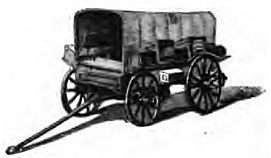
Our wagon was twenty-three feet from end to end, and four feet and a half wide. With some willow wands and heavy wagon sail an excellent tent was made, thoroughly waterproof, and divided with a canvas partition into two compartments. Our trunks were packed on the floor, over which the beds were suspended on a cartel formed from laced strips of raw ox-hide.
Our stores were packed in boxes, which were securely fastened around and under the wagon, together with kettles, pans, and dishes of enamelled iron. A folding-table, several camp-stools and chairs completed our equipments, and on a muddy but sunshiny day we left our hotel, bidding good-by to our friends, and climbed on to our perches on the cartel. Four black boys, a maid, and two dogs formed our establishment. One of the large boys took the trek tow, a loose rein on the horns of the two leading oxen, and another the long-handled, long-thonged whip. There was a wild yell and a screech from them all, and the oxen started forward with a lurch that threatened to dislodge every article we had taken such pains to secure. The wagon slowly rose out of the muddy bed into which it had sunk during the past week’s rain, and getting into the road, moved at a brisk pace along.
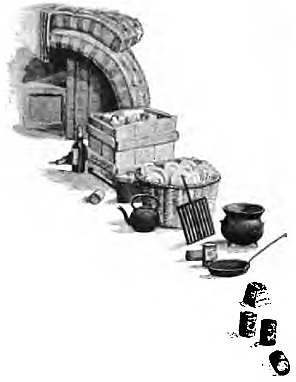
Still brisk as it was the pace was only a walk. We thought we should never make the two or three hundred miles to Queenstown, at that pace, by the route we should take. We learned, however, that though slow it was sure. A team of oxen intelligently driven, and rested at proper intervals, will make thirty miles a day, week after week, over any sort of country, a rate of travelling that horses cannot exceed when the distance is long. At the end of three hours the oxen were outspanned to graze and the boys prepared our midday meal. The tablecloth was laid, and that tablecloth was the chief source of our solicitude throughout the trip. Oh the delight of that first meal! everything tasted so sweet. Were we not free, free as air, the sky and limitless veldt the ceiling, walls, and floor of our dining-room, with not a creature in sight? Our caterer had forgotten nothing that was necessary to make our meals model entertainments.
After an hour and a half the oxen were slowly driven up to the wagon and each one took his own proper place, seeming to know his own yoke. We trekked on over the same level plain, but as evening drew near the sky assumed a threatening aspect, and it was thought prudent to outspan and tie up in order to prepare for the reception of the impending storm. Before the yokes were removed the rain came pouring down in torrents. The boys dug a trench around the wagon under which they got for shelter, while we, safe under our waterproof tent, peered out from time to time at the storm raging around us.
Presently lightning began to flash and the thunder to roar, while the rain came down in sheets, seeming to transform the open country into a vast lake. Oh, those dreadful African thunderstorms! We thought We should never see worse storms than those of our Western prairies, but they were infants in strength compared to those in Africa.
The storm grew fiercer and fiercer, and the lightning seemed to come from the heavens in all directions in molten streams of fire. The road was full of ironstone, a peculiarity of the uplands of Africa; this seemed to attract the lightning, and the air appeared to be full of fire, accompanied by an ear-piercing crackling and booming that shook the earth. The atmosphere was black, and the darkness was intensified by the continual flashes, when suddenly there was a crash and a deafening roar that made us think the heavens had fallen. Stunned for a moment we each looked at the other, expecting that the wagon had been struck, and a great stir and lowing among the trembling oxen increased our fears.
We sat for half an hour listening to the thunder muttering fainter and fainter as it rolled away in the distance. The voice of A— summoned us from the tent. To our surprise we found the sky clear and no trace of the storm in the heavens, but an inky cloud disappearing far away on the horizon. About fifty yards ahead of the wagon was a large hole in the road that had been torn up by the fury of that thunderbolt which had so terrified us.
Chapter Twenty Four.
These African thunderstorms occur at different seasons in different localities, and everywhere they are terrible. They do more harm by their violence than the rain which accompanies them does good. During their continuance (fortunately they never last long) the water comes down in veritable sheets, rushing down slopes and mountain-sides in a resistless flood, swelling rivers in a few moments from ditches into torrents.
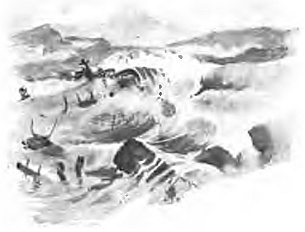
A storm in the mountains at times fills the streams leading out from them to such an extent that with scarcely any warning the waters come tumbling down in cataracts, the rivers rising to a height of forty feet in as many minutes. A friend of ours with his partner had been trading for years in the Zambesi country, and was bringing down a large quantity of furs, feathers, and ivory to the colonial market. On reaching the banks of a little river, remarking that it was running somewhat swifter than usual, they entered it with their wagon, without any thought of danger.
Suddenly, as they reached the middle, the waters came rolling down with a roar like Niagara, sweeping away the results of two years’ labour in a moment; they barely escaped with their lives. We asked our friend what he did at the time. “Why,” said he, “we tried to express the situation in words, but we could not do it justice, so we just sat down on two ant-hills, laughing at one another and our luck.” Several similar cases occurred during our stay in the upland country. A coach with four passengers was swept away in a moment while fording a swelling river at night, the driver only escaping.
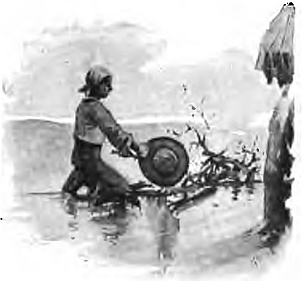
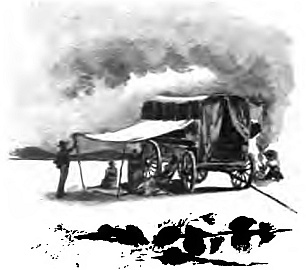
The boys were soon at work coaxing up a fire, with the help of some dry wood we had in the wagon, and coffee was made. The meal was rather dismal, for night had fallen, and the boys were looking anxiously at the condition of the road, and the hopeless state of the wagon wheels, which had sunk into the sloppy turf almost up to the hubs. There was no use trying to go on that night, so putting out our swinging lantern, we lay down to sleep.
At daylight we were awakened by the jolting of the wagon, and found that our bodyguard had inspanned, and, having dug us out of the muddy prison, had succeeded in getting us under way. Hastily making our toilets with difficulty, we were thrown from side to side of the wagon at every lurch; we jumped out and walked, finding the exercise preferable to the jarring of the vehicle. Indeed, we walked most of the journey, and were better for it. Enjoying an excellent breakfast, which again put us in good spirits, we were beginning to think we should have a clear day, but another spell of rain at ten o’clock came on. It continued raining all day, with short intervals of sunshine. These were taken advantage of to make short treks.
At four o’clock, as we were sitting in the fore part of our chariot looking out at the drizzling rain, the front wheels slowly sank and nearly disappeared in a deep mud hole, bringing the steaming oxen to a full stop. In vain the driver cracked his long whip and yelled; we were hopelessly stuck. I was sitting in front when the accident occurred, and jumped out, landing in a deep mud hole. We slept that night at an angle of nearly forty-five degrees, and when morning broke it was welcome, as it brought with it some bright sunshine and prospect of clearing weather.
It took five hours and the effort of the combined lungs of the party upon the oxen, together with the inventive genius and experience of all the members of our staff, to get us out of that mud hole. They outspanned and inspanned three times before the wagon stirred, and a hole had been dug big enough to bury us all in before the wheels were released. At last, with a whoop and a yell and a groan, it was hoisted out of its oozy prison and drawn onto the veldt, when the oxen were outspanned and breakfast was eaten.
During several successive days, while travelling in the Orange Free State, we passed hundreds of huge ant-hills. One might say there are villages of these; they are formed together in thousands, they disappear for a space, and are again met with. Some of them measure ten feet and more in circumference, and are between three and four feet high, and are filled with black and yellow ants. The clay becomes hard from the sun’s rays. An ox-wagon driver hews out an ant-hill forming an oven, in which he cooks his bread, the clay burning like a slow fire, and with an intense heat.
From this time on the weather was delightful; with the exception of one thunderstorm it continued so during the six weeks we remained in the wagon. We soon forgot the unpleasant experiences of the first few days. In forty-eight hours the sun had dried the road, so that travelling was comparatively easy, and we passed over the level plain, arriving in Smithfield on the fifth morning after leaving Bloemfontein, where we outspanned on a plateau adjoining the village. We here met with a lady friend from the diamond fields, who invited us to visit her for a few days; but we had now become attached to our gypsy life, and preferred our own fireside.
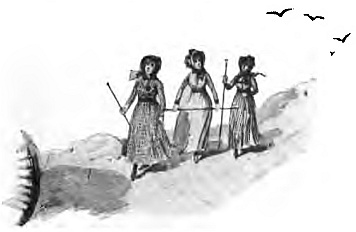
Smithfield is a fair-sized village of the usual Free State kind, possessing a few fine churches, a few streets of one-storey roomy houses, and several stores. When our tented home began to move along the road away from the village we trudged alongside of it as happy and healthy as school-girls, and feeling as free from restraint as the birds.
Chapter Twenty Five.
Three miles from Smithfield we came to the banks of the Caledon River, which we found greatly swollen by the rains, and did not consider prudent to cross until two of the boys had waded through. The water came up above their waists, and we climbed into our places, and descended the steep bank leading to the drift (or ford). It requires management and considerable shouting and activity on the part of the wagon drivers to cross a river. The bank is always precipitous, and the break has to be screwed up hard to make the descent, and released immediately the water is reached. At times the oxen stick in the middle of the drift, which is often rocky and full of great boulders, and it is difficult to get them on.
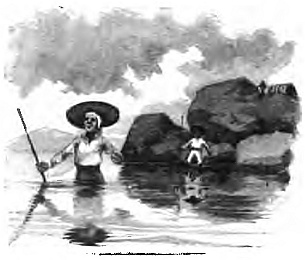
When we reached the bottom of the slope, the leading oxen were already in the middle of the stream, with the water nearly over their backs. With a plunge the wagon took the water, and we were glad to find that the drift had a tolerably firm, sandy foundation, so that we were not tumbled about much. The leaders were now half-way up the opposite bank, and the driver, mounting the footboard in front of the wagon, gave one of his banshee howls and a simultaneous crack of his whip over the heads of the team. This started them into a trot, and the impetus was not lost until we were all high and dry on the farther bank.
The water had come up to the floor of the wagon, but for only a moment, so that nothing was injured. The only casualty sustained was the loss of a bright tin pail which had been floated off its hook, and went sailing down with a jaunty air to the tune, “Won’t have to work any more.”
After crossing the river we branched off considerably to the right. Our way lay for some distance along the banks of the river, and the country was thickly studded with stunted thorn and furze bushes. Some doves, which always abound in these thorn bushes, were shot, and they formed a most welcome addition to our dinner that day. Outspanning nearly all the hot afternoon, we made a long trek in the lovely moonlight until nearly twelve o’clock before “tying up.” This is a plan always adopted by transport riders, the wagon drivers who make it their business to carry goods from town to town. They lie to nearly all day, and travel late in the afternoon and night, finding, by following this plan, that their oxen can get through more work and keep in better condition.
The Hottentot and Kafir boys who lead them seem to be able to see in the dark. They will lead the oxen, without stopping, over dangerous roads where it is pitch dark. The wagon was often in motion before we awoke, but so accustomed had we become to the jolting of our bed that it did not wake us from our deep sleep. When we awoke we would find breakfast prepared in a pleasant, grassy country, and the fire blazing merrily.
It is not to be wondered at that the Kafirs are such happy, contented mortals, for the sun, of which they get so much, gives more life and vitality than any medicine. One afternoon the boys sighted a herd of spring-bok some distance away in the veldt. They were feeding in a depression in the plain about seven hundred yards away, and our hunter, sighting his rifle, carefully rested it on an ant-hill. At the sound of the rifle the whole troop started away with a bound, breaking into a gallop and disappearing in a cloud of dust far off in the veldt, leaving one of them lying on the ground with his feet in the air. But he was only wounded, and before the boys reached him he struggled to his feet and tried to limp off. Down went the rifleman on his knee, there was a moment of suspense and another report, and the buck was bowled over with a bullet in his neck. He was brought to the wagon in triumph, and slung by his feet underneath, we girls being as much excited as if a tiger had been slain.
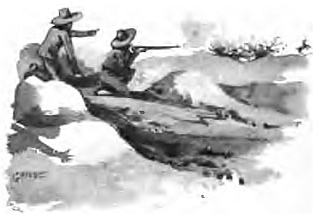
Moving on one morning before daylight, and crossing a fine bridge over the Orange River, our oxen were unyoked hard by a number of transport wagons. When we arrived the transport riders and their boys were all asleep, but as day wore on they began to get about, and came over to our wagon, mightily curious to know who we were, where we were going, where we lived, and highly amused at the idea of any one travelling in an ox-wagon for pleasure.
Chapter Twenty Six.
We soon settled down to the routine of our ox-wagon life, and very pleasant we found it. When the boys would outspan and get things in readiness for meals, our hunger from the open-air life would be so great that we could scarcely wait while they made the fire for coffee. Like all South African travellers, we consumed a prodigious quantity of coffee. Besides drinking it at every meal, it would be prepared several times during the day, as we wanted it.
The Dutch people drink it morning, noon, and night, keeping it always on the fire for their Dutch friends who pass near them. The manner in which coffee is made in the veldt is: first to boil the water in the kettle, then pour it on the coffee ready in another kettle; it is then passed back and forth a few times and the coffee is made; a few drops of cold water poured into the kettle will soon settle the grounds. We found the Dutch coffee very good.
Our meals consisted of buck meat, cooked in all sorts of ways, and sometimes a pair of doves or partridges; we had our canned goods to fall back upon, and we had also the vegetables of the country, which were carried in the wagon. We lived most contentedly. One day we suffered greatly from want of water. We travelled many hours, hoping to find a stream and fill the water-cans.
A Kafir will find a spring of water in places where a white man would never think of looking for it, but that day there was no water to be found, and we positively suffered from thirst. The sun beat down on us all fiercer than ever, it seemed, and it was not till late in the afternoon that we came to a small muddy stream. The mud did not frighten us, and we hurried the boys into making the coffee.
One of our boys had been in the jail at Smithfield, for some petty misdemeanour, and was discharged in order that he might come with our staff. He was a raw Kafir about fourteen years of age, with a comical, laughing face, which peered up at us oddly as he sat on the footboard of the wagon. He had a funny little squeaking voice which at times would play him tricks; when apparently about to come forth in a manly roar, it would suddenly result in a shrill, piping sound, which would throw all the servants into fits of laughter. He used to perch himself surreptitiously on the disselboem, against the orders of “the baas,” in the cool of the evening, as we jolted along in the moonlight, and croon out in Kafir, awfully out of tune, “Sweet bye and bye,” a favourite song of the Sunday-school Kafirs. The missionaries’ service with the Kafir, it may be said, is mostly a service of song. We soon became tired of his one tune, and sang it for him correctly; but he evidently considered that our musical education had been neglected, for directly we had finished he started again, singing it in his own way.
On very hot days we used to contrive an awning on the shady side of the wagon, under which we would sit and read or make lazy attempts at sewing. But the silence of the stilly veldt, broken only by the hum of some buzzing insect, would more often put us to sleep. If our existence was not one of contentment, then there is no such thing. We became enamoured of the life and had no desire to hasten on our journey. Some of the happiest days of our lives were spent during this trip, free from society, anxiety, and propriety. There was no one to dress for, nor to come suddenly upon us and disturb our calm existence. When three girls make up their minds to be contented under all difficulties, difficulties disappear. They can make their surroundings pretty and can make the rough fare attractive. If they have been blessed with a good mother, who has trained them for domestic life, they know how to contrive little accessories which will give a relish to the plainest fare.
Little trouble was experienced with our servants. They were always laughing and looking at our mode of life with the interest of a big dog; they were ludicrously stupid, but they were never sulky or impudent. Our wagon owner and servants slept on the ground wrapped in blankets or “karosses,” infinitely preferring that to sleeping on a cartel under the wagon. When we suggested snakes, they only laughed. These fur robes or “karosses” are light, and when thrown on the ground prevent the ants from reaching those asleep on them. They are brought from the interior, beyond the Zambesi River, by the traders. They are beautifully sewed together by the natives, with thread made from the sinews of wild animals. These furs are beautiful, being the skins of leopard, silver fox, jackal, and wolf, and many other animals. They are very comfortable for travelling on cool nights.
This peaceful region is filled with reptiles and wild animals, but we saw very few of them.
Our boys would often hold wayside receptions for natives in twos and threes, coming from goodness knows where, and others, appearing from the shadows beyond, would surround them, talking rapidly in vowels and strange sounds, and looking on hungrily at the meals being prepared.
As we outspanned near by a farm during the journey, a farm Kafir, with a look and bearing of a prince of the soil, dressed to the knees in a coffee sack, with holes made for arms and head, approached. He stood talking to the boys in an attitude of utter grace. His calm scrutiny of us all was very amusing; just as observing and curious as any city-bred man. He went over to the cactus hedge and cut a pailful of cactus apples. We could not handle one without having our hands pierced with hundreds of the little briers found on them. This Kafir sharpened the end of a long stick, and then stuck it into an apple, and after dexterously peeling it with a sharp knife, he offered it to us, as if it had been a bonbon. We were very thirsty, and we found these cactus apples delicious.
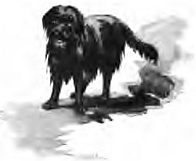
The boys had two dogs with them. One, “Satan,” a forbidding-looking brute, was the remains of what had been a fine Russian water dog, but life in Africa had not agreed with either his appearance or temper. He was a disagreeable brute, but after a time got amiable enough to approach the wagon. Poor little “Stumpy,” the other dog, was the queerest, quaintest little mongrel that ever lived. He would wriggle his little body most absurdly in vain attempts to wag the apology for a tail which had given him his name. If we took any notice of him, he would go mad with delight. He did not know whether to bark, or jump, or gallop, or dance, or stand on his head, and he would try to do them all at once.
One lazy, hot afternoon Eva and I made a wager as to which of us could coax Stumpy to come to her; we went in opposite directions and called him. The poor little dog’s pitiable embarrassment as to which he should follow, his evident dread of losing either or both his friends by favouring one or neither, was very funny. He would go a little way to Eva, then back to me, then stop, then to Eva, then to me, until finally, after attempting to split himself into halves and go to both, he gave it up in despair, and just lay down midway between us and howled, refusing at last to attempt, what so many men have failed to do, to please two women at the same time.
Chapter Twenty Seven.
Leaving the Orange River at Bethulie Bridge, we continued on the main road till the morning, when we struck off in a northeasterly direction for Ahival North, which was reached in a few days. The town is built close to the Orange River, and promises to be a place of much importance, being on the high road between all eastern ports of the Free State, the diamond fields, and the interior. It is a pretty town, a great number of the houses having gardens around them filled with trees.
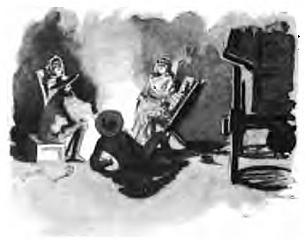
We stayed here for a few days, and recommenced our journey down the country, soon exchanging the plains of the Free State and northern districts for the alternate mountain passes and stretches of open karoo of the middle veldt. Passing through the hamlet of Jamestown, with its one store and few straggling houses, we entered the mountain passes which cross the Stromberg range. Soon after entering the first rocky defile we encountered another violent thunderstorm, which, though unattended by the disagreeable features of our first one, delayed us over a day. We travelled on through the hills, passing through Dordrecht, a place which bears the reputation of being the coldest place in the country.
It is a straggling village of about eight hundred inhabitants, with a few stores and two or three churches. A resident remarked to us, as he pointed with pride to the village, “I have lived here for seventeen years, and seen this place grow up around me,” in a similar tone of voice to that in which we had heard old Chicagoans say the same thing. But there was a difference in the size of the villages!
The town lies on the northern slope of the Stromberg, and we had several days’ mountain travelling after we left it.
An impression the traveller receives in South Africa, more especially in the mountain regions, is one of ghostly stillness. The wild, rocky hills rear themselves up all around, and often there is not a breath of wind stirring to break the awful quiet. Sometimes this silence is oppressive, and it is a relief to hear even the hideous chattering of a monkey or the unmusical cackle of a Kafir’s laugh. The giant mountains in the background seem to look down reproachfully at the traveller for invading their solitudes, while the dark ravines and deep clefts, in their rocky sides, suggest all sorts of nameless horrors.
Tigers, or rather leopards, abound in these mountains, but are seldom seen except by the solitary farmers living in the hills, who are in perpetual warfare with these savage destroyers of their flocks. One morning we found a romantic glen on the side of the mountain, full of rare ferns, and with a beautiful stream of water dripping and echoing as it gushed out from the rocks. It was a lovely day, and we took our karosses and rugs to the spot, and picnicked there. We carried along “Nicholas Nickleby” to read aloud. Since that day I always associate the Cheeryble Brothers with ferns, and think of Do-the-boys Hall as built on top of a precipitous mountain, with a smiling, sunshiny valley lying at its feet.
The nights were very cold in the Stromberg, and we required all the rugs and karosses we had to keep us warm at night, sunrise nearly always showing everything around us, from the tent of the wagon to the blankets of the slumbering boys, covered with a white hoar frost.
Our wagoner told us an experience of a cold night in the Free State. He said: “In the middle of June, two years ago, my partner Jim and myself started from Bloemfontein for Pretoria. As the shooting was good on that road and walking cheap, we decided to go on foot, taking with us a couple of boys to carry our traps, which were not very extensive, consisting, in fact, of a change of linen, or rather flannels, a pair of blankets each, the cooking utensils, and a spare gun. We had for our companion a young man whom we had met in Bloemfontein a few days previous to our departure, a young Scotchman but lately arrived in the country. As he wanted to go to Pretoria he proposed to join us. The nights during the winter are very cold on the elevated plateaus of the Free State and the Transvaal.
“Though the midday sun is almost as warm as in summer, one needs to be well provided with covering if they propose passing the night on the veldt. To give some idea of the cold of the plains at night, I may tell you that a few winters ago several natives, members of a tribe called the Knob Noses, who were on their way to the fields, were frozen stiff and stark on the road from Pretoria to Potchefstrom. The road we followed was a fair sample of most of the Free State roads, a tolerably straight path across an uninteresting, unwooded, undulating plain. Starting about two o’clock in the afternoon, we walked briskly with occasional halts for coffee until about ten o’clock at night, when the moon shone at its full, and we decided to turn in for the night. The wind was already blowing pretty fresh, and we looked about for the place in the veldt where the ant-hills were thickest so we might set fire to two of them to heat our kettles, and to keep us warm during the night. After having had a cup of coffee, and sat round the fire until we were all thoroughly warmed, Jim and I slipped off our boots, and putting them under our heads for pillows, pulled our blankets over our heads and feet, and were soon fast asleep, of course imagining that Mac would do the same. About two o’clock, when the night was at its coldest, we were awakened by a dreadful groaning, and emerging from our coverings were astonished to see Mac huddled upon the ground with nothing over him but a rubber overcoat, shivering, chattering, and moaning piteously. The fire was out, an icy wind was sweeping around the veldt. ‘Good gracious, Mac, what is the matter; where are your blankets?’ ‘I d-d-didn’t bring any,’ chattered the unfortunate youth. ‘Didn’t bring any; then what on earth was that big bundle the Kafir was carrying?’ ‘That is my b-best clothes,’ moaned the sufferer.
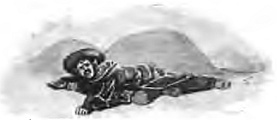
“We were soon up and bundled the poor fellow into our blankets, and waking the boys we made up a roaring fire, and thawed him back to life. The next day, on arriving at Wynberg, you should have seen Mac rushing into the first store, and regardless of ‘siller,’ buy two of the thickest blankets to be had. This man had never before slept outside four walls in his life, and had imagined that any place in Africa must needs be suffocatingly hot at all times.
“I don’t think he made the same mistake again.”
Chapter Twenty Eight.
While making some purchases at a wayside store, we had an insight into the life of a wayside storekeeper. We found it, instead of monotonous, full of interest. The business requires technical knowledge enough to run a block of stores in a city.
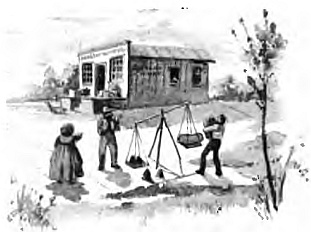
He must be prepared to supply his customers with anything and everything they may ask for; he must be at home in extolling the best points of a plough, a gun, or a piece of calico; must know the market price of every sort of produce the farmer is likely to bring in for sale or barter, and be well informed in the current news of the day. He must possess an unlimited knowledge, as well as stock of liquors; for the Boer, who is abstemious, as a rule, always expects the man who supplies him with his “voerchitz” and his coffee to provide him also with plenty of stimulants. He must know where to place his hands on any article wanted, and be as ready to buy your cart and horses, or span of oxen, as to sell you a can of sardines or a yard of tape.
When a Boer comes into town, or visits the wayside “Negotic Winkel” (store), he usually makes a day of it, sometimes accompanied by his wife and daughters, who assume, in honour of the occasion, their purple and fine linen in the shape of a “kappie” (sunbonnet), and the newest print gown. They will come in at six in the morning and remain till dusk, pricing articles whose value they always depreciate, now and then buying, but more often not, eating the while a prodigious quantity of candy “Lakkers,” and assuming for the time an air of proprietorship in the establishment. This is intensely annoying to the shopkeeper, who, however, always seems to be possessed of an inexhaustible fund of good humour, and to be ready at any time to exchange elephantine witticisms with his Boer customers. In their wordy conflicts they are politic enough to allow their opponent to get the best of it.
At dusk Dom Piet and Taute Meitje (every one is uncle or aunt) prepare to leave.
There is much hand-shaking with everybody, acquaintance or stranger, who are standing about at the time. The worthy couple then climb into their Cape cart, or spring wagon, and drive off home, where they vegetate until the low condition of the domestic stores compels them again to visit the store, or until a Nachtmaal is announced at the nearest church. The profits of such a store are very large, and, as a rule, amply sufficient to compensate the proprietor, often a man who has received his business training in a large wholesale house in England or Germany, for his eight or nine years of exile. He has the opportunity, living as he does in the midst of the farmers, of taking advantage of the many speculations which the fluctuations in the market prices of wool, skins, feathers, etc, offer.
The most successful of these shopkeepers are Jews; they seem to have a happy knack of acquiring the jaw-breaking patois of the country, an indispensable accomplishment to any one wishing to have successful dealing with the Boers.
We were now nearing the end of our ox-wagon journey, but were not at all glad it was so.
We had got fond of this careless, lazy life we had been leading so many weeks; the very oxen we had come to know by their names of “Blesbok,” “Witful,” “Kafir,” etc. As we neared Queenstown we found ourselves getting anxious about their welfare, trekking slowly, and making frequent and long outspans. When at last we found ourselves on a common, close to Queenstown, it was with regret we said good-by to our six weeks’ life in an ox-wagon.
Chapter Twenty Nine.
We went to the Central Hotel. On the second day after our arrival, the wife of a physician of the town called and invited us to dine with them on the following day, Sunday. We did so and made the acquaintance of the excellent Doctor and his little family of interesting children. She then invited us to make her house our home during our stay, and overwhelmed us with kindness.