Chapter IV · THE THAMES CLUBS AND WINDERMERE
Reading edition
THE ROYAL THAMES YACHT CLUB By Edward Walter Castle and Robert Castle
In the year 1775 was founded the 'Cumberland Fleet,' and as the Royal Thames Yacht Club is its lineal descendant, the latter may with all justice claim the title of the 'Mother of Yacht-racing,' at least in Great Britain.
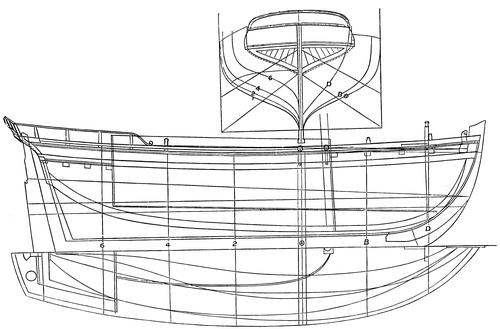
The year 1770 was a most important epoch in Thames yachting, and we think the lines and drawing of our first cup-winning yacht should be given here. The 'King's Fisher,' as the sketch shows, was clinker built. Her owner, Commodore Thomas Taylor of the Cumberland Fleet, was so thoroughly the practical founder of yacht racing on the Thames that his statue should be placed on the Thames Embankment—with a bronze plaque of his yacht and the cups he won—and if times are too bad to go that length, a medallion portrait plaque could go on the Temple Embankment Arch, for the 'King's Fisher' was built close by. Her dimensions, as shown in her lines, were, length 20 ft., beam 7 ft.
The Cumberland Fleet, or, as it is often called, the Cumberland Sailing Society, was founded under the following circumstances.
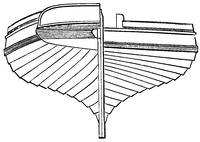
The 'King's Fisher,' 1776, midship section.
A Silver Cup, the gift of His Royal Highness the Duke of Cumberland, is to be sailed for on Tuesday, the 11th instant, from Westminster Bridge to Putney Bridge and back, by Pleasure Sailing Boats, from two to five tons burthen, and constantly lying above London Bridge. Any gentleman inclined to enter his Boat may be informed of particulars by applying to Mr. Roberts, Boat-builder, Lambeth, any time before Saturday Noon next.
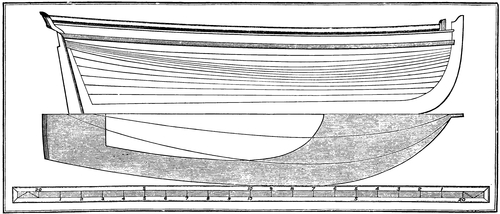
Lines of the 'King's Fisher,' of the Cumberland Fleet, 1776. Commodore Thomas Taylor's yacht. Winner of Silver Cup, 1776.

Button, 1776.
The fleet evidently used to sail together and manœuvre as well as race, for in 1776, in honour of His Majesty's birthday, 'they went up the river with colours flying and music playing'; and in 1793 a set of signals were printed (a copy of which may be seen framed at the Royal Thames Club House) whereby the commodore could manœuvre the sailing boats like a fleet of men-o' war; indeed there is a print extant, dated 1778, wherein the fleet are being so manœuvred off Sheerness.
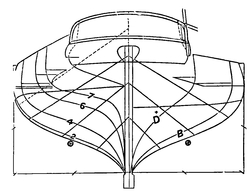
First 'Cumberland,' 1780, midship section.
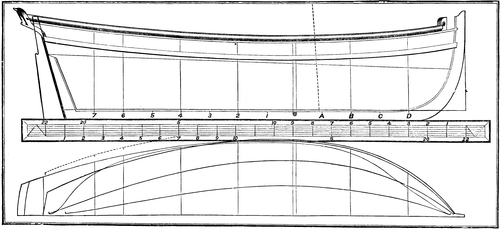
Lines of Commodore Taylor's yacht, first 'Cumberland,' of Cumberland Fleet (Thames), 1780. Winner of Gold Cup, 1780.
Lines of Commodore Taylor's yacht, second 'Cumberland,' launched February 14, 1790.
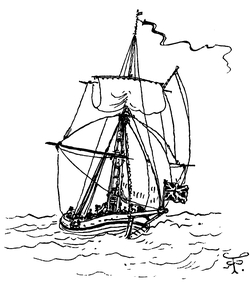
Yacht of Cumberland Fleet, 1781.
The one thing curious about this match is that the 'Prince of Wales' sailing boat was advertised for sale, and it goes on to say, 'which no doubt will have the best chance to win the Jubilee Silver Cup which will be sailed for on the 17th inst.' She won that cup!
The proprietors of Vauxhall Gardens continued giving an annual cup to the club until the year 1810, when the last prize offered by them was sailed for on August 6, and won by the 'St. George,' 7 tons, Captain James Gunston. The ceremonies attached to the giving of the Vauxhall Cup differed but slightly from those attending the Duke of Cumberland's prize. The race started, as before, from Blackfriars Bridge and sailed round a boat stationed near Putney Bridge and back past a boat moored off Vauxhall Stairs, next door to Cumberland Gardens.
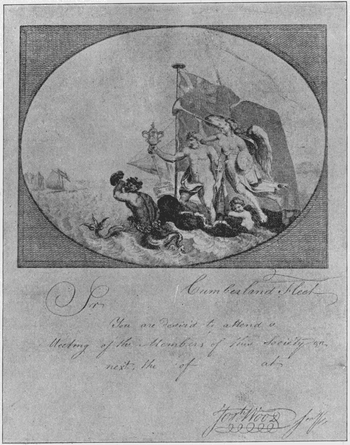
Circular of Cumberland Fleet, 1775.
On July 27, 1793, the 'Cumberland,' Commodore Taylor, and the 'Eclipse,' Captain Astley, had a match for a turtle, which the commodore won, and the members of the Club had a turtle feast on the strength of it. In 1794 the proprietors of Vauxhall put a wonderful car upon the river, on the match day. It was drawn by tritons and was moved by invisible oars. It contained, besides bands of music, Father Thames attended by his river gods; and for several years this appeared, but with different devices.
The year 1800 was again kept as a septennial one, or, as the papers prefer to call it, a 'Jubilee,' and there is in existence a print of the 'Cumberland,' Captain Byrne, winning the cup. Mr. E. Smith, owner of the 'Atalanta,' which won the Vauxhall Cup in 1801, presented the same year a cup to be raced for, and it was won by the 'Mercury,' Captain Astley. Another septennial (or Jubilee) cup was given by the proprietors of Vauxhall Gardens in 1807, and this fell to the 'Bellissima,' owned by Captain Farebrother. This year the contractors for the State Lottery gave a cup to be raced for on the Thames, and all the boats entered for it belonged to the Cumberland Fleet. A new public Garden was started in 1809, called the Minor Vauxhall, and Mr. Sheppard, its proprietor, gave a silver cup to be sailed for on the river. The first two attempts failed to come off, but at the third and final one the 'St. George,' Captain Gunston, won the prize. The last cup given by the proprietors of Vauxhall Gardens, in 1810, was won by the 'St. George,' and the same year Mr. Sheppard (who had changed the name of his Gardens to 'The New Ranelagh') again gave a cup, which was won by the 'Sally,' belonging to Captain Hammond. The proprietor of the New Ranelagh Gardens also gave cups in the years 1811 and 1812, and although the club is not mentioned in connection with them, none but vessels belonging to the Cumberland Fleet were entered. On July 16, 1812, the club gave two cups, by subscription, to be raced for from Blackwall to Gravesend and back, which were won respectively by the 'Mercury' and the 'Vixen.' As the years roll on the newspapers get rather confused about the sailing matches, and the name of the old club very rarely occurs, although we have seen an account book where the subscription of one guinea is mentioned as having been paid to the secretary of the Cumberland Fleet, in the year 1818.
The years 1814, 1821, and 1822 have no sailing matches recorded against them, but these, with 1783 to 1785, are the only ones in which we have failed to find a race of some sort or other. After Commodore Taylor's retirement it is believed that Mr. Edward Nettlefold was elected in his place, but there is, great confusion on the subject, for in 1817 he is called commodore of the 'London Yacht Club,' which in another number of the same paper is called the 'New Cumberland Fleet.' Most probably there had been some dissensions among the members of the club, but whatever had happened, there is no getting over the fact that in the year 1823 the Cumberland Fleet had a below-bridge race, and that it was under the direction of Commodore Edward Nettlefold.
The 'Favourite' steam packet, soon after ten o'clock, came down from the Tower. This boat was elegantly decorated, and was crowded with ladies. The gentlemen of the 'Old Cumberland Fleet' were on board, under the direction of their respected Commodore, Edward Nettlefold, Esquire, under whose direction the match took place.
The cup was won by the 'Venus,' belonging to Captain George Keen. In the 'Public Ledger' of July 17, 1823, is the following advertisement:—
HIS MAJESTY'S CORONATION
The Subscribers and Members of the Old Cumberland Fleet will dine together at the Ship Tavern, Water Lane, Tower Street, this day at four o'clock precisely to celebrate the coronation of His Most Gracious Majesty King George IV.; when the superb silver cup, sailed for in honour of that event, on Thursday last, from Blackwall to Coal House Point, below Gravesend and back, by gentlemen's pleasure vessels, will be presented to Captain George Keen, the winner of the prize; and to arrange the articles for the sailing match to take place on Wednesday afternoon, the 30th instant, and to start at three o'clock from Blackfriars Bridge, and sail to Putney and back to Cumberland Gardens, under the especial patronage of the proprietors of the Royal Gardens, Vauxhall.'
At this dinner the club must have decided to change their name, as appears from the following extract from a Vauxhall programme of July 30, 1823, announcing the match 'given by His Majesty's Coronation Sailing Society, entered into for celebrating annually the Coronation, and formed by new subscribers and members of the old Cumberland Fleet'; the last three words being printed right across the page in large type. They also changed their flag, adopting a white one with a crown in the upper corner next the staff, with the letters 'G.R. IV.' underneath, and the words 'Coronation Fleet' in the fly. This flag had a crimson border all round, with lettering of the same colour.
Officers' badge, R.T.Y.C.
Now toast the Don Giovanni's crew, who bear the prize away, And may they always sail as well as they have sail'd to-day! Then fill each glass with sparkling wine, and bumpers let them be, And drink to Captain Davey's health—his health with three times three:
For the cup is won, the match is done, And settl'd is the rub; Let mirth abound, and glee go round. In this—the Thames Yacht Club.
In 1827 a 50-guinea cup was given to be raced for, from Blackwall to Gravesend and back, to celebrate the event of His Royal Highness the Duke of Clarence becoming patron of the Thames Yacht Club. This was won by the 'Lady Louisa,' belonging to Mr. T. Smith.
The following year there was a split off from the club, caused by their refusal to give prizes for very small boats, so the seceders formed the Clarence Yacht Club, which existed for several years. On August 28, 1830, two cups were given to be raced for below bridge, in honour of the Duke of Clarence coming to the throne as William IV. The yachts sailed in two classes, the first of which was won by the 'Matchless,' 19 tons, Mr. J. Hyatt; and the second by the 'Brilliant,' 8 tons, Mr. W. Bucknall. On October 7 of the same year, at a meeting of the club, it was resolved 'that the uniform button should be altered from T.Y.C. to R.T.Y.C.'; in other words, they had become the 'Royal Thames Yacht Club.' This year the fleet of the club consisted of forty-three vessels.
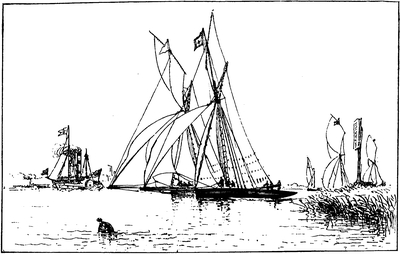
Lord Alfred Paget's 'Mystery' passing 'Blue Belle' May 23, 1843.
The burgee of the Thames Yacht Club was probably a red one, with the letters T.Y.C., as we find that on February 3, 1831, a red burgee was agreed to having the letters R.T.Y.C. under a crown. There were two cups given by the club, on September 15, 1831, to celebrate the coronation of their Majesties William IV. and his Queen. The first was won by the 'Lady Louisa,' and the second by the 'Water Witch.' In December 1834 a white burgee was adopted with a crown and the letters R.T.Y.C. in red; and on February 19, 1835, an Admiralty warrant was granted to the club authorising their vessels to carry a white ensign without a red cross, but with the union-jack in the upper corner, and bearing in the fly a crown over the letters R.T.Y.C. in red. William IV. died on June 20, 1837, and on July 27 of the same year Her Majesty Queen Victoria became patroness of the club. The following year special prizes were given in honour of the Queen's coronation, and there is in possession of the club a portrait of Commodore Harrison holding the cup in his hand. In 1840 a challenge cup of the value of 100 guineas was given, to be won twice consecutively by the same yacht, without reference to ownership. It was eventually secured by the 'Secret,' Mr. J. W. Smith, on June 8, 1847. The Admiralty took away the white ensign from the Royal Thames Yacht Club in 1842 (as well as from several other clubs that had the right of flying it), and only allowed the Royal Yacht Squadron to continue its use. In July of the same year, however, the Admiralty granted to the Royal Thames a blue ensign with a crown in the fly. On June 30, 1845, a cup of the value of 60l. was presented by Earl Fitzhardinge, and the yachts had to be manned, steered, and handled by members of the club only. The 'Belvidere,' 25 tons; the 'Prima Donna,' 25 tons; the 'Phantom,' 20 tons; and the 'Widgeon,' 24 tons, were entered, the cup being won by the 'Belvidere,' belonging to Vice-Commodore Lord Alfred Paget. In the year 1848 the Admiralty granted to the club a further warrant, dated July 24, giving them the plain 'blue ensign of Her Majesty's Fleet,' and of this they still enjoy the use. Time allowance first appears in the matches of the Royal Thames on June 29, 1849, in a race from Erith to the Nore and back, when half a minute per ton for difference of tonnage was allowed. July 8, 1851, the Queen for the first time gave a cup to be raced for by the club, the course being from Erith, round the Nore and back; it was won by the 'Cygnet,' 35 tons, owned by Mr. H. Lambton, M.P. The club established an annual schooner match, which was held regularly for several years, the first having been on June 1, 1853. In 1855 the club had 170 yachts in its fleet, but in 1861 they had reached to 241 vessels; at the present date they are some 350 strong. In 1862 the 'Marina,' on rounding the Nore lightship, ran into the club steamer, the 'Prince of Wales,' damaging herself considerably, and had to be towed back. As she was leading vessel at the time, and it was the fault of the steamer getting in the way, she received a special prize. On May 21, 1866, the first Nore to Dover race of the club took place, although they had one or two matches to Harwich and the Isle of Wight before that date. At the beginning of 1868 there was another split in the Royal Thames, and those who left established the 'New Thames Yacht Club,' which is still in existence. The same year the club was again honoured by the presentation of a Queen's Cup, which was raced for from Gravesend to the Mouse and back. In 1874 His Royal Highness the Prince of Wales became commodore, and for the first time in the history of the club a rear-commodore was elected, Mr. Thomas Brassey. Queen's Cups have also been given to the club in 1874, 1880, and 1885; but in the year 1887, on the occasion of Her Majesty's Jubilee, the club, to mark that event, gave a special prize of 1,000 guineas in an ocean match round Great Britain, the winning-post being at Dover. This was won by the 'Genesta,' belonging to Sir Richard Sutton, Bart.
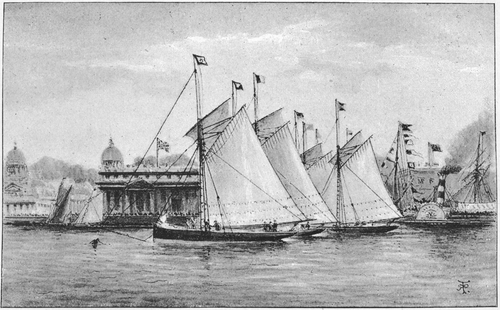
START OF 25-TONNERS, ROYAL THAMES YACHT CLUB, FROM GREENWICH, 1848.
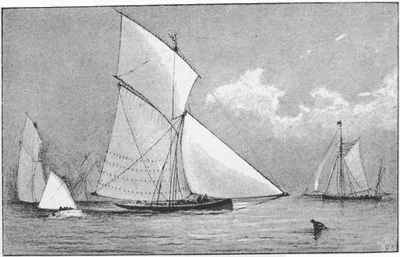
'Phantom,' 25 tons, R.T.Y.C., 1853.
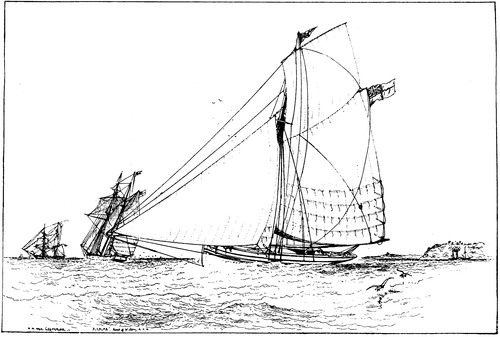
'Cygnet,' 35 tons, built by Wanhill, 1846. Winner of Queen's Cup, R.Y.S., 1849; of Queen's Cup, R.T.Y.C., 1851.
Such, in bare outline, is a rough history of the oldest yacht racing club in existence. It is epitomised from a larger work on the same subject, which has been our labour of love for some years, and we hope that the book will be published to the world at some future time.
ROYAL CORINTHIAN YACHT CLUB, ERITH By R. T. Pritchett
Perhaps one of the most sporting clubs on the Thames or elsewhere is the Royal Corinthian Yacht Club, which has its headquarters at Erith. This, the original Corinthian Club, was formed in May 1872; but several other clubs have since been started at various ports, and have copied the title with the affix of the place to which they belong.
During the first year some 200 members were enrolled, but the number rapidly increased, and the club has now close upon 500 members, and possesses a valuable freehold club-house standing in an acre of ground on the banks of the Thames at Erith. The house includes a large club-room, nearly 70 feet long, a committee room, and a bunk-room for the use of members wishing to sleep there. Underneath are extensive stores, with twenty large sail lockers, each capable of holding the gear of a 20-tonner. These are let to members at 30s. per annum. There is room in the grounds for any number of the smaller fry which are not too heavy to be hauled over the wall, and they have a good snug berth here for the winter.
The classification of the yachts for racing purposes does not extend to anything exceeding 20-rating, and for this size of vessel only one paid hand is allowed. The remainder of the crew, including the helmsman, must be members of the club.
In the first year or so of the club's existence the racing was mostly confined to the smaller classes, and the 5-ton 'Arrow,' at that time head of her class, was a frequent competitor. About this period the 'Adèle' and the 'Ada' were in the Thames. These gave way in turn to the 'Virago,' 6 tons, 'May,' 6 tons, and the 'Alouette' and 'Freda,' each 5 tons. The 10-ton 'Zephyr' then came up into the river, and had some hard tussles to save her time from the smaller vessels; and Major Lenon's 'L'Erie,' 10 tons, also competed occasionally with success. In the larger class 'Dudu,' 'Torch,' 'Ildegonda,' 'Surge,' 'Aveyron,' 'Sweetheart,' 'Dione,' and 'Nadejda,' gave some good racing, and one memorable day, when all the above but 'Ildegonda' and 'Torch' sailed a race in a gale of wind, in company with the yawl 'Dryad,' nearly every yacht in the race had some mishap to gear, 'Dryad' and 'Dione' being dismasted.
From 1875 to 1880 the racing was kept alive by the 10-ton class, the meeting of the 'Lily,' 'Florence,' 'Merle,' 'Mildred,' 'Chip,' 'Preciosa,' 'Juliet,' 'Elaine,' and 'Robinson' being looked forward to with eagerness by the amateur crews. 'Florence' was the pick of this bunch, but the arrival of the 'Maharanee,' and then of the celebrated 'Buttercup,' soon altered the state of affairs. 'Buttercup' swept the board for some time until Mr. W. Cory brought 'Ulidia' into the club, and she in turn scored off 'Buttercup.' This virtually closed the 10-ton racing in the Thames.
In 1881 some excitement was caused by the starting of the 3-ton class on the Thames, and as no paid hands were allowed in these little vessels, the Corinthians were in request in club matches. The 'Muriel' was brought over from Ireland by the Messrs. Fox, and had for competitors the 'Maramah,' 'Mascotte,' 'Naida,' 'Primrose,' 'Venilia,' and 'Snarley Yow,' of which the latter was probably the fastest. The excitement culminated in a race for a 50l. cup, subscribed for by several enthusiastic members, and sailed for under the auspices of the Corinthian Yachting Club on June 13, 1882, 'Muriel' winning the cup after a splendid finish with 'Snarley Yow.' The next year saw the advent of 'Chittywee,' who spread-eagled the old fleet, and was in turn knocked out by the redoubtable 'Currytush.' This killed the 3-ton class in the Thames, and for some time class racing was at a discount. The Corinthian Yacht Club, however, by arranging a system of handicaps and other races to suit the vessels belonging to the club, nearly always succeeded in getting good entries for its matches, an annual handicap race from Erith to Ramsgate, open to all yachts in the club, being still one of the most popular events of the season.
The 20-rating class has not been patronised for some time in the Thames, but 'Decima,' 'Fan Tan,' 'Dis,' and 'Corona' have had some good racing between 1890 and 1892 in the 10-rating matches. The entries in the numerous handicap matches have included the above four yachts and such vessels as 'Gardenia,' 'Neaira,' 'Terpsichore,' 'Norman,' 'Mimosa,' 'Wenonah,' 'Cyclone,' 'Ildegonda,' 'Œnanthe,' 'Nadejda,' 'Alpha Beta.'
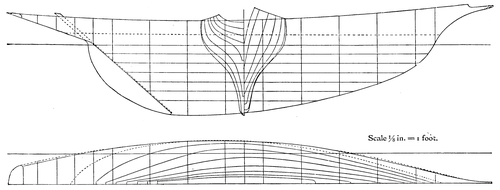
Lines and midship section of the 'Dis,' 10-rater, built for A. D. Clarke, Esq., 1888. Designed by J. M. Soper.
In 1888 an attempt was made by the club to encourage a class of small cruising yachts by limiting the length and sail-area, and seven or eight were built from the designs of Messrs. G. L. Watson, Fife, Dixon Kemp, J. T. Howard, Douglas Stone, A. E. Payne, A. Watkins, and others. This class, known as the Thames 21-foot class, has since then furnished extremely close racing, and it is worthy of note that the first boat built, the 'Tottie,' designed by Mr. Watson, successfully held her own for five seasons. The season of 1892, however, showed that the 'Eva,' designed and built by Mr. Stone, of Erith, was quite as good as, if not better than, 'Tottie,' her new owner, Mr. Wyllie, sailing her in first-class form. Much of the 'Tottie's' success must be put down to her extremely skilful handling by the brothers Simpson, who rank among the best amateurs of the day. While the 21-foot class has undoubtedly been a most popular one in the Thames, it is unfortunately the fact that the original idea of encouraging a good useful cruising boat was not fulfilled, the ingenuity of the designers being too much for the few restrictions imposed. We believe that three of the original boats which were not so successful in racing are now being used as cruisers, but the faster or deep-keeled boats are hardly of the type that would be chosen for this purpose.
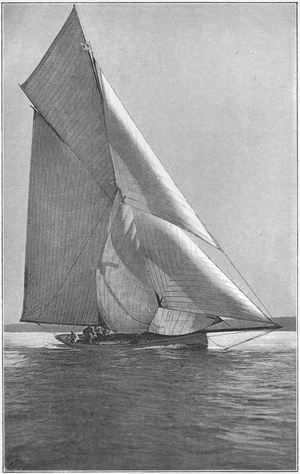
'DECIMA' A. E. Payne, 1889.
The names of the 21-footers are 'Tottie,' 'Eva,' 'Diskos,' 'Haze,' 'Dorothy,' 'Fancy,' 'Mehalah,' 'Genie,' 'Magnolia,' 'Saivnara,' 'March Hare,' 'Narwhal,' 'Nyleptha,' and 'Macnab.'
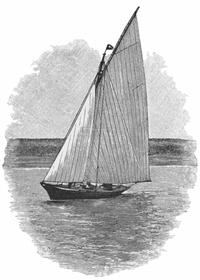
'Tottie,' Royal Corinthian Yacht Club, 21-ft. class.
During the last two or three years prizes have been offered for 2½-raters, but the class has not as yet taken any hold on the Thames men, the only entries having been 'Camilla' and 'Cock-a-whoop.' This club now offers a challenge cup for 1-raters, viz. the cup won by the 3-ton 'Muriel,' and presented to the club by Captain H. C. Fox.
The Club received the Admiralty warrant to fly the Blue Ensign in 1884, and in 1893 Her Majesty the Queen was graciously pleased to command that the club should be called the Royal Corinthian Yacht Club.
The present officers of the club are: Robert Hewett, Esq., Commodore, and Rear-Commodore of Royal Thames, and of 'Buttercup' celebrity; J. Weston Clayton, Esq., Vice-Commodore; Frank C. Capel, Esq., Rear-Commodore; H. Neville Custance, Esq., Hon. Treasurer; and T. G. F. Winser, Esq., Secretary.
In order to extend the usefulness of the club to its members, the committee last year secured a club-room at Burnham on the Crouch, a most charming piece of water for small craft. With the greatly improved state of the Thames at Erith, however, it is probable that most of the yachts will come back to the headquarters of the club as of old. It is many years since fish were caught at Erith, but of late they have returned, and the Thames is now in as good condition as could be desired. This river and its estuary form a perfect cruising ground for the amateur yachtsman, and with a snug anchorage and comfortable quarters at the end of a cruise, such as the Royal Corinthian Yacht Club affords, he must be a glutton who is not satisfied.
The number of yachts belonging to the club is 220, ranging from 1 to 500 tons.
ROYAL LONDON YACHT CLUB
The Royal London was established in 1838, and takes the lead in the Victorian period. It began its career in May 1838 as the Arundel Yacht Club, when the majority of the yachts were probably kept on the foreshore at the foot of Arundel Street, Strand. Its flag at that time was a red field, white border, and white letters.
In 1845 the name was changed to the London Yacht Club, and the flag adopted was a white field with a blue cross, the union in the upper corner, a gold star in the lower. In 1846 the star was changed for the City arms, on receipt of a grant of this privilege from the Corporation of the City of London. 1849 was an important year in its history. The club received the patronage of Queen Adelaide, whereby it became Royal (a privilege not so easily obtained in those days), and also the recognition of the Admiralty by which the possession of an Admiralty warrant was secured to its members.
In early days the races were sailed above bridge, with an occasional bold venture as far down the river as Erith or Gravesend; but, finding by experience that no serious dangers existed in such then comparatively unknown waters, the above-bridge races were in a few years abandoned, and the time-honoured course from Erith round the Nore and back adopted. After many years, owing to the increase in the size of the yachts, and in both the number and size of the vessels navigating the Thames, another change was made. The Royal London always showed energy where yachting progress was concerned, and was the first to adopt flying starts on the Thames. A small class raced thus May 14, 1878, and it may be noted that the club was one of the first clubs in the United Kingdom, if not actually the first, to adopt the Y.R.A. rules, October 20, 1892. The office of Admiral was filled by the election of H.R.H. the Duke of York to that post. A striking illustration, not only of the progress of the club, but also of the development of yachting, is shown in the following table:—
Year Number of Yachts Aggregate Tonnage Average Tonnage
1848 15 161 11
1892 248 17,000 69
On the social side its advance has been equally striking. After wandering about for many years, in 1857 rooms were engaged at the Caledonian Hotel, Adelphi. In 1882 the prosperity of the club justified the opening of a branch club-house at Cowes, and three years later the London headquarters were moved to their present position in Savile Row. These changes were attended by the most satisfactory results. The numbers, instead of fluctuating between 200 and 300 as they had done for a series of years, at once began to increase, and now there are over 700 names on the books. The yachts have increased correspondingly.
THE LONDON SAILING CLUB, HAMMERSMITH
The London Sailing Club is a vigorous and practical association which has to be specially commended for two features lately introduced. The first of these was an exhibition in its rooms of 1-rater half-models, scale 1 inch to the foot, each to carry a centre-plate—the design to show shear plan, body plan, and half-breadth plan. Each design was accompanied by a sealed envelope containing the designer's name. These envelopes were not opened until after the designs and models had been judged, and the prizes, three in number, awarded by Mr. Dixon Kemp. The whole arrangements were most satisfactorily carried out. The exhibition opened February 21, 1893, the models remaining on view until March 6. These models, from the hands of professionals as well as amateurs, were in some cases very beautiful. The first prize was awarded to Mr. David Weir, of Partick. The second ran Mr. Weir very close indeed, and when the envelope was opened the name of J. M. Soper was discovered, a name associated with many leading Solent small raters. The awarding of prizes is always a responsibility, but with Mr. Dixon Kemp's experience and scientific knowledge he had little difficulty.
The second feature referred to was the reading of papers by leading authorities on practical subjects connected with construction and sailing. The first paper, on centreboards, was read by Mr. Dixon Kemp, and illustrated with diagrams on the blackboard, and a discussion opened by Mr. Warrington Baden-Powell, of canoe fame, followed. The reading of these papers has a good influence in bringing members and their friends together. For special subjects experts and specialists are invited, and much valuable information is often afforded. About it as a club there is nothing very particular to be said. It is popular with its members, and very successfully carries out the objects of the foundation.
THE UPPER THAMES SAILING CLUBS
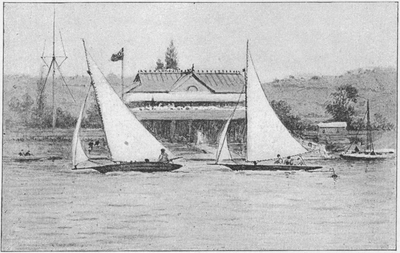
Upper Thames Sailing Club and Club-house, Bourne End, Bucks, 1893.
In the year 1893 the Queen graciously extended her patronage to the small raters, now so much in vogue, inland and on the coast, by presenting a 50-guinea Challenge Cup, to be annually sailed for by the Upper Thames Sailing Clubs during the Bourne End week, when the Upper Thames Club hold their fresh-water festival opposite the club-house which was constructed in 1889 at Bourne End, Bucks. The spot is well selected, and affords a commanding view of the long clear reach in which the matches are sailed over a course of nine miles. The Duke of Connaught is their President, the commodore, Colonel FitzRoy Clayton, a practical enthusiast of great experience, one day thrashing a 1-rater through bad weather inland, and the day after perhaps hauling on to the mainsheet of one of our big racers out in the open, equally enjoying both. The secretary is most practical and does much to assist the club with his large fleet of divers kind, from Norwegian punt and American sneakie built by himself, to his steam launch 'Leopard.' He has yet another craft of considerable interest, a Dutch yacht, a perfect marvel of the Hollander's handicraft and beauty of finish; she was built in Friesland about 1830, and is as sound now as when first launched. The Challenge Cup, which is in the form of a bold flagon, pilgrim bottle shape, height 17 in., weight 99 oz., was first sailed for at Bourne End on Jubilee Day, June 21, 1893, by the following clubs, Thames, Thames Valley, Upper Thames, Tamesis, Thames United, and Oxford University. The morning of the 21st was bright with a strong sailing breeze. The race was set for 1.30, and soon after noon all the crews were carefully overhauling their gear and studying the barometer. The weather suggested then having to reef down at the last minute. It must be remembered that the river is not wide at Bourne End, and that it was a flying start. Ten boats were under weigh, all trying and manœuvring for position, and yet all was done without a foul or a protest; the handling was admirable, it was really a sight to see. A little water might have been shipped, but that was soon baled out, and the curious acrobatic performances of the shifting ballast, stretching out to windward, was also a prominent feature.
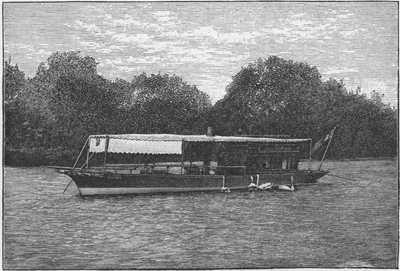
Upper Thames steam yacht 'Cintra.'
The 'Challenge,' 1.1-rater, O.U.S.C., led at first for three or four rounds, 'Mona,' .85, close up, 'Mirage,' 1.0, going well and looking very handsome. At the finish there was capital racing. In the last round but one 'Mona,' .85, leading, caught a hard gust and took in a reef in a very workmanlike way to make sure of saving her mast. It was admirably done and elicited great praise, as she came in running neck and neck with 'Challenge,' 1.1-rater, both on different gybes, 'Challenge' with her little spinnaker on the port hand and 'Mona,' .85, on the starboard. The spinnaker must be the same size as the jibs in these races. The secretary had handed over his steam launch 'Leopard' to Captain Bell of the Thames Conservancy, whilst he and the commodore sailed the 'Kitten,' which came in fourth. The six-day festival of the six Thames Sailing Clubs, so happily and pleasantly blended, promises well for small-rater sport in the future.
THE ROYAL WINDERMERE YACHT CLUB
The beautiful Lake district is provided with an excellent yacht club, well organised, with workmanlike system and detail; and, as a fresh-water club, it is here described after the Thames associations. It was founded in 1860 and possesses a Royal Warrant dated 1887. The headquarters are at Bowness, adjoining the Old England Hotel, and consist of club-house, reading-rooms, billiard and committee room, and boat landings; and the club has a very hospitable arrangement, like the Bombay Club, by which gentlemen not residing within ten miles of Bowness, on being proposed and seconded by two members, can be admitted as temporary members, for a week, fortnight, or month, for a moderate fee. The sailing committee request owners to see that professional crews of yachts engaged in races wear white or blue jerseys, yachting or man-of-war caps, or straw hats. The ensign is red with crown in fly.
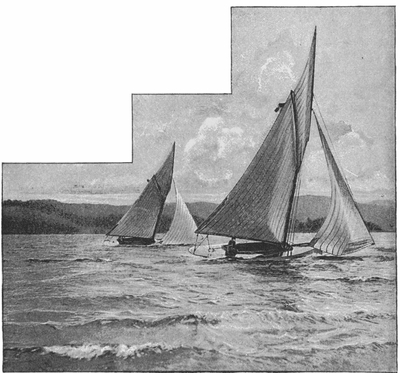
The leading feature of the Royal Windermere Lake Yacht Club is well shown in the illustration on p. 185, as, out of comparatively few members, fourteen are at the starting line, a proportion very seldom met with in any club, and certainly suggesting great unanimity and good feeling. The beautiful surroundings of the lake constitute a great charm, though crews in racing craft have not much time to admire picturesque landscape.
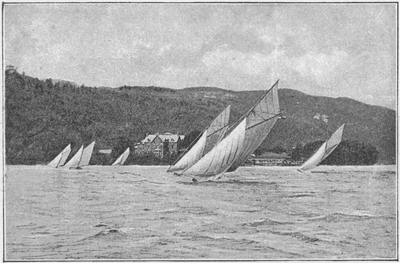
'Feeling it' off the Ferry.
The Windermere Club takes precautions to ensure as much as possible real, well-contested races, and like the 'Water Wags' at Dublin has definite club measurements, thus:—
(a) Length of yacht on load-water-line, from fore side of stern to after side of rudder post, shall not exceed 20 ft., and the total length from fore side of stern to extreme end of counter shall not exceed 25 ft. 6 in., and no part of stern above or below water shall or sternpost below water shall project beyond the 20-ft. gauge. A yacht shall be considered to be on her load-line when she lies adrift from her moorings in smooth water, without crew, with all sails set and racing gear on board.
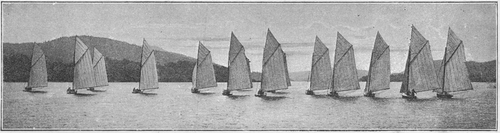
Royal Windermere Yacht Club. A fair start.
(b) Beam (extreme outside measurement) shall not be less than 6 ft. 6 in. without beading or moulding.
(c) The draught of water shall not exceed 5 ft. 6 in. when the yacht is on her load-water-line.
(d) The yacht shall show at least one-quarter of an inch of her rudder-post clear of the water when on her load-water-line.
(e) No part of the counter shall intersect a triangle or the produced perpendicular thereof shown on p. 186. Base 5 ft. 6 in. on load-water-line produced perpendicular 1 ft. 4 in. from water.
(f) The length of mast from deck to trunk or end of pole shall not exceed 26 ft. 8 in. Bowsprit from fore side of mast to extreme end shall not exceed 19 ft. in length. The boom from aft side of mast to the end shall not exceed 18 ft. 6 in. and the gaff (measured parallel to the boom) shall not exceed 16 ft. 8 in. in length. It shall, however, be optional to have a boom 22 feet in length from aft side of mast to the end, provided that the gaff does not exceed 15 ft. in length. Topsail yard shall not exceed 18 ft. 9 in. in length.
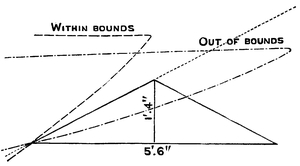
Limit angle of counter.
(g) Hoist of mainsail from thimble to thimble 16 feet.
(h) From deck to pin of jib halliard sheave or pin of block shall not exceed 23 ft. 9 in.
(i) Mast from deck to pin of topsail sheave shall not exceed 25 feet 9 inches.
Smart breeze for racing, Windermere.
(j) No yacht shall have less than 32 cwt. of ballast, and no ballast shall be carried inside of yacht.
ROYAL WINDERMERE YACHT CLUB, BOWNESS.
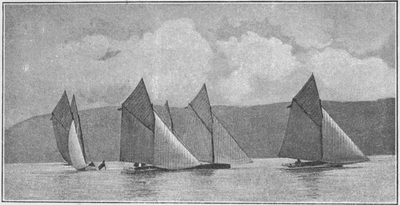
Fair wind round the buoy.
These restrictions certainly tend to uniformity and good sport. The yachts have to be constructed with natural frames, spaced not more than two feet apart with steamed timbers, between with single pine, larch, oak, pitch pine, American elm, English elm, bay wood or teak planking, and decks. Iron floors are allowed, but no iron or steel frames.
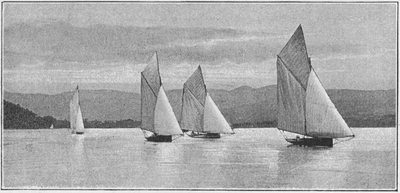
Calm weather.
The size of racing flag at the main peak during a match to be 2 ft. 6 in. by 1 ft. 6 in.
Fore and aft sails—namely, mainsail jib and topsail only, and no square sails or other sails set as square sails—must be used at Club matches. No footsticks or jackyards are allowed to gaff topsails; no booming out of the sails is permitted even by hand, except by sheets hauled aft of the fairleader. Every yacht sailing in a race must carry at least two life buoys ready for immediate use.
The general and sailing rules published by the Royal Windermere Yacht Club are practical and ably drawn up.
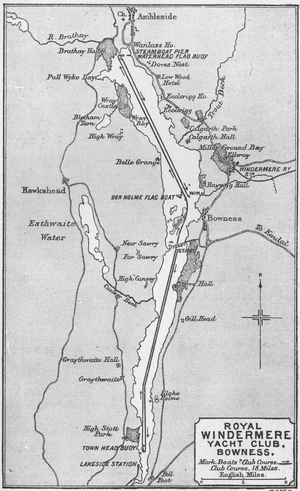
As will be seen by the chart, Bowness is situated about a little north of the half length of the Lake. The Ben Holme flag boat opposite, at the north end, is the Waterhead flag buoy, and at the south end of the lake is the Town Head buoy.
The club course is from the ferry round a flag buoy off Town Head at the south extremity of the Lake and back to the Ben Holme flag boat, opposite Bowness. The distance is 18 miles.
The Waterhead course is from Waterhead, N. extremity of the Lake, round flag buoy, off Ben Holme (Bowness), thence round flag buoy in Lowood Bay, thence round flag buoy in Pull Wyke Bay, thence round Waterhead flag buoy, sailing the same course again and turning off Waterhead. The natural formation of the surrounding district explains the special necessity for the two life buoys ready for immediate use, as squalls and stormy weather are characteristics of the Lake district, although the regattas are sailed in the finest season, during the month of July. The secretary, Lieut.-Col. Arthur L. Reade, has courteously furnished details of this interesting inland club. The photographs of the 'Beauties of the Lake' of Windermere are by Mr. Bronskill, of Bowness.