Part 2 — CHAPTER XII
Reading edition
FIVE-TONNERS AND FIVE-RATERS IN THE NORTH By G. L. Blake
A few years ago a great sportsman, whose privilege it had been to take an active part in nearly every form of sport known to the British Isles, was asked which of them all he thought should be placed at the head of the list as being most conducive to make its follower manly, and at the same time least open to the criticism of those who are always inclined to find fault with their neighbours' methods of employing their spare time. There was some little hesitation before he gave an answer, but at length he expressed an opinion that yachting excelled all others. To enumerate a few of his reasons will not be out of place here.
The first and foremost was the utter absence of any possibility of cruelty, as calls could only be made on inanimate materials and the yachtsmen themselves. Then it was quite out of the question for a man to be a thorough yachtsman without courage and endurance being brought into play. Quickness of action, or the ability to think and act at the same time, was also a necessity in yachting, as it was in most other sports; but it was an absolute one here, because the elements were an unknown force, and sudden contingencies, not to be equalled in intensity or severity by any possible emergency ashore, had frequently to be faced. This quality—quickness of resource—was, of all others, the characteristic of the sailor.
Two more points were added, which certainly tend to place yachting, and yacht racing especially, in the fore rank of sports. The first was that yacht racing and cruising are carried on by those who enter upon them, not in any way as a business, but solely for the love of the sea. The prizes, such as they are, when bestowed in money are so small in comparison with the outlay and cost in building and sailing a racing crack, that in most of the recognised classes they only go a very little way towards lessening the general expenditure, whilst as for betting on the races, such a thing was rare in the extreme.
The last argument was that 'unfair sailing' was a thing almost, if not quite, unknown, and if there was an argument in favour of extra money for yachts' crews on racing days, it was that it helped to encourage all hands to do their utmost to make their vessels, let the look-out be ever so bad, come in and win.
To one desirous not only of enjoying the sport, but also of really understanding every detail connected with it, from splicing, knotting, sail-making, varnishing, painting, cleaning brasswork, setting, taking in, reefing or shifting sail, to steering a clean full-and-bye against a head-sea, or learning to make himself comfortable on the smallest possible fit-out, an old yachtsman's advice is, the smaller the boat chosen to begin with the better; and after a quarter of a century's experience of small yachts in all weathers, seas, and climates, he believes the vessel of about 30 feet in length, with a moderate beam and draught of water, is the smallest capable of keeping the sea with any degree of comfort and safety. There are no more suitable yachts of the size referred to than those built under the old Thames Rule of Measurement, or the late Rule of the Yacht Racing Association, to sail in the class for yachts of 5 tons and under. A restriction might be added to the exclusion of such yachts as were the extreme outcome of the rule; but as only three were built—one designed by Mr. G. L. Watson and the late Mr. Payton's two vessels, both of which were lost—there is no need for the limitation; and on looking back into the eighties it will be found that the 3-ton class in the South and the 3½-ton class in the North altogether monopolised the true plank-on-edge model entirely for themselves. Though the extreme types under the old rule were long, narrow, and deep, they were fine weatherly little sea-boats to the practised hand, but as a school for the tiro, except in racing, too heavily sparred and too narrow.
The main point in favour of the 5-ton yacht built under the old rule—for the 5-rater of to-day is almost as large as the former 10-tonner, and requires quite as many, if not more, hands to work her on a racing day with her present lugsail rig—is that she is easily worked with one good hand, can be raced with three, or easily with four; and those whose early practical yachting experience was gained as small yacht sailors and yacht-owners will agree in this, that their happiest hours were spent in the boat that required fewest paid hands, or when their ship was of such a size that they were able to put to sea single-handed, or perhaps in company with a friend who could make himself useful. There are many who will say that a 10-ton or even a 20-ton yacht is too small to stand out to sea in; but when a yacht is of such a size that she requires more hands than one to work her there will be little or nothing learned, whereas, if the yacht is just a little too much for one man to handle, the owner is bound to do his portion of work each day, and what he does not know will soon be taught him by his man, so that he may enjoy his fair share of rest and not have to be called up in the middle of his watch below. Besides, if the cost is a consideration, a 5-ton yacht can be built for just half the price of a 10-tonner, and the keeping it up is very much smaller in proportion.
It is not quite twenty years since the racing yachts of 5 tons were formed into a class, and prizes awarded them. The Clyde yachtsmen were the first to appreciate the value and capabilities of the little ships for affording good all-round sport, and the small expenditure entailed at that date in building them was a consideration in their favour. It has been a favourite class ever since.
In Dublin Bay small yacht racing is far from a novelty, but it is only within the last few years that boats have been built to the class adopted in the seventies, viz., for 'yachts of 6 tons and under,' time allowance having previously been used to bring the small fry together. At that time Liverpool had two pet classes, the 20-ton and 10-ton, and such small yachts as were located on the Sloyne entered in the latter class.
It was about the middle of the summer of 1873 that the writer's attention was first drawn to small racing yachts under 7 tons, and the way in which they could face almost all weathers. It had been, as it is at the present day, the custom to decry and run down racing yachts as unfit to be made into cruisers. 'The scantlings were light,' 'the framework was weak,' 'the plank, especially at the garboards and towards the run under the counter, may have been dubbed down to almost the thickness of brown paper.' This latter process was often resorted to some twenty-five years ago, so that ballast in the form of lead sheeting might be padded on to the keel and garboards. More than one large yacht at that period had been so treated that she was supposed to have not much more than half-an-inch planking at her two lowest strakes. 'I would not buy an old racing yacht if I were you.' Such were the comments and never-ceasing advice dinned into the ear; 'besides, they are fearfully wet in a sea-way, and most uncomfortable,' and, therefore, at that time the writer's vessel was a strong, able, high free-boarded schooner of 11 tons. In that year there could not have been a dozen yachts, taking our coasts round, which were being raced as 5-tonners, but there were classes made up of yachts of 7 tons and under, which took in some stray 3- and 4-tonners, and here and there a casual 5- or 6-tonner. One of the best of these 6-ton yachts (and this is including all the Scotch and South-country boats) was a little vessel built in 1871 for Mr. W. A. Tomlinson, by Mr. Dickenson, of Birkenhead, the well-known builder and designer of the principal pioneer Liverpool 10-tonners. Unfortunately her dimensions cannot be correctly stated, but she was about 32 feet between stem and sternpost on deck, some 6 ft. 6 in. in beam, and had a draught of 5 feet or a little more—that is, she was as nearly as possible the size of the 5-tonner of a five or six years' later date.
The occasion on which the 'Wyvern' came under the writer's special notice was one long to be remembered on account of the anxiety created among the little yacht's admirers at Kingstown, owing to the severity of the gale that blew after she had left that port for Liverpool. There had been a regatta in Dublin Bay, where, as is usual, all the small boats of the St. George's Channel had collected to do battle. The 'Wyvern' had come over from the Mersey, and having won, her owner (at that time Mr. Colin Napier, of Liverpool) had left her in the hands of his two men, that he might hurry back to his business by steamer. The men were ordered to make the best of their way to Birkenhead, as the yacht had been entered for a local regatta the same week.
They started early on a Wednesday, but unfortunately ran aground on the rocks at the end of the eastern breakwater on which the lighthouse is built. For the greater part of the day the boat was standing high and dry some feet above the low-water mark, but she sustained no damage, was floated off at the return of the tide, and left at once for her destination. The hour of her departure was about three or four o'clock in the afternoon. Three yachts left the harbour in company with her, bound for the same port, all three being at least 25-tonners.
As the barometer had been falling ever since the morning, and there was every indication of bad weather, the skipper in charge of the 'Wyvern' was repeatedly advised to postpone his start till the following day, or till a change in the weather should take place; but it was to no purpose, since he was very anxious to reach the Mersey as soon as possible.
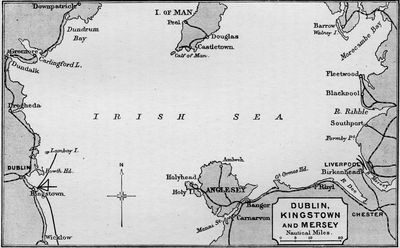
DUBLIN, KINGSTOWN AND MERSEY F. S. Weller.
Towards 6 p.m. the north-westerly breeze, which had been blowing since noon, increased considerably, so much so, that first one and then the other of the larger yachts gave up and turned tail before it might become too late, the last to say good-bye being the largest of the three. This yacht, a well-known hard-weather vessel of over 40 tons measurement, after trying to signal a last advice to the little 'Wyvern' to return, put her helm down (though she was well past the Kish Lightship), and made herself snug for the dusting she was in for on the journey back to Kingstown.
On shore, at both club-houses, the greatest alarm was being felt not only for the 'Wyvern's' safety, but also for the welfare of her three larger sisters, and the anxiety on the 'Wyvern's' account increased still more when her three companions put in their appearance again at their moorings. During the evening and through the night the wind increased to a whole gale, and the meteorological report next morning proved anything but pleasant reading, whilst among the old salts and those best acquainted with the capabilities of small yachts little hope was felt of ever seeing the 'Wyvern' again.
On the evening of the next day the writer left Kingstown for Liverpool in his yacht, and fell in with the Mersey 10-tonners making the best of their way down river. The nearest yacht hailed informed him that the 'Wyvern' had arrived all safe, and had made a very fast passage across to the Sloyne. A few days after, meeting the skipper, a full account of the trip was given, and there was no limit to the eulogies he had to bestow on the yacht. During the night the sea had increased the further they sailed from under the lee of the land, but for all that the only time any seas were shipped was when off Holyhead. Twice only had they to free the yacht of water, and on those occasions very little had gone into the cabin.
The 'Wyvern' was not a yacht of large displacement; she inclined, indeed, rather the other way. Those who have seen the 'Naiad' or 'Pastime' hauled up out of water (two of Dickenson's old crack 10-tonners which now frequent the South Coast ports) will have a better idea than any words can give of the 'Wyvern's' style of model and midship section. Built for length on deck, there was no necessity for shortening up the water-line, and her sternpost had no very great rake. Her buttock lines were as easy and fair as could be, giving her a slightly hollowed entrance with a nice clean run aft. Her extreme draught was not much over 5 feet, and her keel ran almost straight from the heel of the sternpost to the foot of the stem—that is, with very little if any rocker (or rounding) to it. Dickenson had a very admirable method of finishing off the after end of his yachts, and their counters were all light, and neatly put on. The 'Wyvern's' counter was particularly so. She was flush-decked save a large cockpit, which opened into the cabin, and which was surrounded by a 5-inch combing. This was the only weak or vulnerable part about her; for if a really heavy lump of water had filled it, there was nothing to prevent the cabin being swamped. Her fittings below were of the simplest description, though very comfortable. The sofas on each side of the saloon formed lockers and berths, and beyond these a pantry and a fitting for a lavatory, which was forward on the starboard side, with the usual two square lockers at the after ends of the sofas, were all the furniture of any consequence she contained. She had wood floors, iron not having come into fashion at that time, and carried the greater part of her ballast inside to the tune of 3 tons of lead and 10 cwt. of iron. Her outside ballast consisted of a 14-cwt. lead keel, which was considered in those days a very heavy keel for so small a yacht. She was one of the first small yachts of 6 tons or under that was fitted with a flush deck and ordinary skylight, and in every way she looked the picture of smartness. When she was first built her principal antagonists about her own size were the 'Adèle,' a small 5-ton yacht also by Dickenson, the 'Pet,' 5 tons, built at Douglas, Isle of Man, in 1871, and a very fast 3-tonner, the 'Barracouta,' built by Bishop in 1860, for Mr. J. M. Hannay. She was altered in 1874 into a yawl in order to race in the 5-ton class, which was at that time just beginning to be popular.
Among the most celebrated of the early 5-tonners were three yachts, the 'Pearl,' 'Torment,' and 'Arrow.' Of the three, the 'Pearl' and 'Torment' were the best known, and are still held in loving memory by many a yachting enthusiast. The 'Torment,' owned by that well-known yachtsman the late Secretary to the Royal Irish Yacht Club, was raced from the day of her birth, some time about the year 1850, and was always a leader of the van. Her racing career lasted not much less than twenty years, and it was only the lead keels and the deep bodies given to the later yachts that brought it to a close. It is when looking back on such good old warriors as the 'Torment' and the 'Mosquito,' among the larger racers, that lovers of the sport whose incomes are limited must agree that the old days were good indeed. It was not necessary then to be the fortunate possessor of a new vessel each season to enable the lover of yacht racing to win prizes and keep well in with the flyers of the year. When an old boat appeared to be not quite up to the mark, or lacking in the requisite turn of speed, little was done to make her beat some new comer beyond a few alterations, which as a rule took the form of doctoring up one or other of her ends, or, perhaps, lengthening her out amidships. The most remarkable example of how a yacht's racing life could be made to outlive many competitors and leave her a winner to the last, by effecting alteration after alteration on her hull, was that of the old 'Arrow,' which belonged to Mr. Tankerville Chamberlayne. Alas! the days when an alteration was quite sufficient to keep a yacht successful have long since passed away, and from the present outlook seem as if they will never again return.
The 'Pearl,' like the 'Torment,' was a hard nut to crack for all the new aspirants to fame which were built to beat her, and she kept her position as the fastest of the 'Mosquito' fleet for an untold number of years. She hailed from Fairlie, that birthplace of hundreds of fast, powerful winners, so dear to the hearts of all Scotch yachtsmen, and so well known in almost, every corner of the globe. She was owned and built by Mr. Fife early in the sixties, and after ending her racing career in the Clyde has found her way over to France, where she is as much appreciated as she was in the height of her day in Scotch waters, and has kept up her reputation of being a difficult boat to beat. Her dimensions were: length, 25 feet; beam, 7 feet; and draught, 4 feet. There were many yachts built to beat her, among them being the 5-tonners 'Hilda' and 'Viola,' designed, owned, and built by Mr. Inglis. This well-known yachtsman also launched a very pretty schooner of 8 tons called the 'Cordelia,' now, unhappily, lying at the bottom of the sea. She, like his other two ventures, was designed to race in the 5-ton class, and also to put the wee 'Pearl's' nose out of joint. They were all three big boats, fully decked, and veritable ships when compared with the 'Pearl.' They drew a foot or two more water, had big midship sections, and were in every way larger and more powerful yachts. Their success, however, was only partial, and it was a question whether, after all, the old boat did not in the long run hold her own.
The 'Arrow's' reputation was only of short duration in comparison with the 'Torment' and 'Pearl,' but she was a remarkably small boat, and very like them in the main features of her design. She was got out originally to play a part very different from that in which she proved herself so successful, having been built and launched for a fishing-boat to trawl in the Thames; but her speed, like that of the Liverpool 10-tonner 'Wonderful,' showed up so conspicuously when sailing in company with other fast boats that she was forthwith bought, turned into a yacht, and made to fly a racing burgee. As may be supposed, both the 'Torment' and 'Arrow,' as well as the 'Pearl,' were only half-decked boats with waterways round them.
In the year 1873, Mr. Stowe, of Shoreham, built the 'Diamond' to the design of her owner, Mr. W. Baden-Powell. She won some few races under his flag, but the chief reason of her name appearing in these pages is that she was, if the writer is not very much mistaken, the first of all the yachts of 5 tons and under in the south of England to go from port to port and race, her owner and his friends living on board. The 'Diamond' was a decided advance on the boats of her tonnage stationed between the Thames and Southampton; yet she looked small indeed when moored alongside the yachts of a year or two later date. Her length was 26 feet, with a beam of 7 feet, and an extreme draught of 4 ft. 6 in. She ran her fore and aft lines right fair to her taffrail, and had a long counter, part of which was submerged when she was down to her load-water-line. With such a small draught of water her height under the deck was necessarily low; she had however a high fixed coach roof, which helped her out of that difficulty to a certain extent. The cabin was roomy and made up four berths, but her weak point, like that of the 'Wyvern,' was her immense cockpit, which was almost as capacious as her cabin.
In 1874 the late Mr. Charles Weguelin illustrated in a prophetical manner what were to be the dimensions and proportion of length to beam of the yacht of the future. The 'Alouette' was a 5-tonner, 33 ft. 7 in. in length from stem to sternpost on deck, 5 ft. 9 in. in beam, and with an extreme draught of 6 feet. She was built from Mr. Weguelin's design by Robertson, of Ipswich, but was not a great beauty to look at out of the water. Her body was long and full, and her displacement naturally large, though nothing like that given to vessels constructed on similar dimensions during the ensuing decade. Her chief antagonists were yachts of quite an opposite design, beamy, and of no great draught, besides being of a greater tonnage, such as the 'Virago,' 6 tons, 'Rayonette,' 8 tons, and 'Zephyr,' 9 tons. Against these the 'Alouette' was very successful, but her course was run as a successful racer when the season of 1876 ushered in one of the late Mr. Dan Hatcher's most triumphant achievements. Mr. Weguelin was so satisfied with what his 5-tonner had done that he set to work, and in 1875 placed the design of a 40-tonner in the late Mr. Ratsey's hands, who launched from his yard the 'Christine,' the counterpart of the 'Alouette,' only twice her size; that is, by doubling all the dimensions of the 5-tonner, the 'Christine,' a 40-tonner, was the result. The 'Christine,' however, did not fulfil the expectations of her designer, and though her length approached as nearly as possible to that of the 60-tonners of her date, still she could do nothing with them.
Before saying farewell to the 'Alouette,' it is as well to remember that, notwithstanding her small amount of beam, she was a grand sea-boat. On one occasion she sailed from Southampton to Algiers and made a very good passage, considering that she had to face some very heavy weather on her journey. It has become the custom to run down the seaworthiness of the yachts built under the old rule, but the number of examples that could be produced, if time and space permitted, of what the old 5-tonner would go through, and that at her ease and without any fuss, would more than astonish many who now, in the faith they bestow on the boat with three beams to her length, forget the comfort and safety in which they were carried about by the old boats of five to six beams to their length. The 'Alouette' was wrecked at Algiers in 1890. She broke adrift from her moorings during a gale of wind, and was smashed up into matchwood. Nothing was saved from her.
The season of 1876 was one especially to be remembered among those interested in the now established 5-ton class, as it witnessed the advent of three grand additions to the greatly increased fleet sailing in that class. Each yacht was from the well-thought-out drawing of a master-hand, and each was the representative of the three several schools of yacht-design, the 'Freda' being the work of the late Mr. Dan Hatcher of Belvidere, Northam, near Southampton; the 'Camellia' the offspring of Mr. William Fife, jun., of Fairlie, on the Clyde; while the 'Vril' was built from the design of Mr. G. L. Watson, of Glasgow.
The 'Vril' holds the right of precedence in that she was not only designed, but built and sailed, by her three owners, Messrs. G. L. Watson, John Lawrence and J. B. Hilliard, who, assisted by two carpenters, put her together in the Messrs. Henderson's yard at Partick, Glasgow. She was a fine, round-bodied little vessel, with a large sectional area and great sail-carrying powers. She had less waste surface for friction and skin resistance in proportion to her size than many a yacht of a much smaller tonnage. In several ways she might be said to have been a novelty, as she was the first yacht that was fitted with a heavy lead keel consisting of the whole of her ballast. Her counter was short and tucked up with a knuckle on the quarter. She had no bulkheads, and her fittings were only such as were absolutely necessary; still very little goes a long way towards making a small yacht comfortable, and her head-room under her deck made her 'tween decks look like a palace. She was about the last yacht that was supplied with the fore and aft studding-sail (or stu'n's'l, as it is called) known as the 'ringtail'; but it was seldom, if ever, called into use. For small yachts such wind scrapers are more trouble than they are worth, to say nothing of the room the extra spars take up. The 'Vril's' record was remarkably good, and though the three friends, assisted by an amateur or two, were her only crew during her first season—for her owners would not have a paid hand on board—she won a full quantum of first prizes, and with the clever boats she had for rivals praise must be meted out not only to the little yacht herself, but to those who sailed her for the smart manner in which she was handled.
The 'Camellia' and 'Vril' were, with the exception of their draught, almost identical in their dimensions, the 'Vril' being 28 ft. 3 in. long and the 'Camellia' 28 feet. Their respective beams were the same, 6 ft. 6 in., and they drew, the 'Vril' 6 feet and 'Camellia' about 5 feet of water. The 'Vril' at the end of her third season was sold and turned into a fast cruiser. Her fittings, as they are now, are very elaborate and are well illustrated and explained in the seventh edition of that handy and serviceable book, 'A Manual of Yacht- and Boat-Sailing.' She has been laid up for some time at Mr. Robertson's yard at Sandbank in the Holy Loch, where her proximity to many new yachts makes the signs of the sere and yellow-leaf stage of her existence, which is creeping upon her, very apparent. But there is life in the old boat yet, and her owner has in the 'Vril' a fine, able, comfortable little cruiser.
It is now some six years since the writer had the pleasure of seeing the 'Camellia.' She had just been sold to a gentleman to go to Stranraer, where she is at the present time. She was hauled up on Fairlie beach in charge of the late Mr. Boag, and was awaiting a suitable tide for being launched. The 'Camellia,' though of like dimensions to the 'Vril,' was altogether different in form, and to those acquainted with the Fairlie type was as pretty an example of what the Messrs. Fife were in the habit of turning out at that period as it was possible to select. She and her sister ship the 'Clio' were both built from the same drawing, and were the first boats in which Mr. William Fife, jun., whose name is now a household word among men interested in yachting matters, played the conspicuous part of designer. The 'Camellia' was a smaller-bodied boat altogether, more compact than either the 'Vril' or 'Freda,' with a powerful entrance and fine run, and ribbands as fair as they could be. Messrs. Craig and Lawson, for whom she was built, possessed in her a little sea-boat capable of being driven in all weathers, and the harder it blew the more she seemed to like it. With less bilge and somewhat higher floor than 'Vril,' she was fitted, like her predecessor the 'Pearl,' with simply a half-deck and waterways, and was strengthened by a strong beam running across her to which the pump was attached. Of course in smooth water it was a great advantage being able to work the yacht from below, but in anything like very heavy weather she carried hatches for covering in the open space. Both the 'Vril' and 'Freda' were fitted with topmasts, but giving the 'Camellia' the same fitting was only an afterthought, for when she was launched, like the 'Clio,' she was supplied with a polemast. Three or four years after her appearance she was decked in and provided with a very neat coach roof, or booby hatch, but her head-room below in her cabin could not have been more than 4 feet. She makes a very good cruiser now, and from the grand work put into her, as into all yachts which hail from the great Fairlie yard, her sides looked when last seen as fresh and as smooth as on the day when she first saw the water.
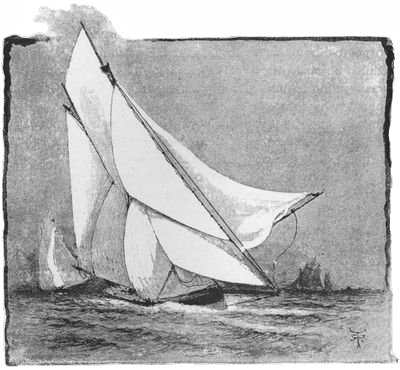
'Freda.'
The 'Freda' is (for she is still hale, strong, and fit to show her tail to many a vessel of her size on cruising terms) a fine able boat, some 30 ft. 4 in. on the L.W.L., with a beam of 6 ft. 1-¼ in. and draught of water 6 ft. 6 in. She is, like all the Belvidere yachts of those days, a boat of large displacement with a grand midship section, with Hatcher's well-known entrance, and a rather lighter quarter than usual. Her sternpost has very little rake in it; in fact, excessive rake of sternpost was a rarity during the seventies, and her keel was only slightly rockered. Most of her ballast, about 2 tons 14 cwt., was carried inside, and the lead on her keel was under 2 tons. She was built for Mr. Freake, her planking being altogether of mahogany. All the wood, dead woods, ribs, and planking were got out in Mr. Hatcher's yard and then taken to Mr. Freake's estate, where she was put together and finished off. As a model yacht she is a perfect picture both above and below water, as well as on deck and in the cabin. With a flush deck and a small water-tight cockpit, after the fashion of the 10-tonners, and a neat skylight, the 'Freda' looks all over fit to go, and equal to all emergencies. She has proved herself quite as much at home when cutting her way through a head sea as when smooth water and dry decks have been the rule. She was the home of her racing crew, and Mr. Beavor Webb, who sailed her during her racing career, and afterwards bought her from Mr. Freake, could spin many a yarn of the little boat's great weatherly capabilities.
No three yachts were more unlike each other, and after all the 'Freda' had done down South, and the 'Vril' and 'Camellia's' successes in the Clyde, so much attention was attracted to them that at last a series of matches was arranged to take place between them off Holyhead the following season of 1877. The place was well chosen, as in bringing the several matches off on the coast of Holyhead Island there was no chance of favouritism, since the locality was strange to all concerned, and the yachts had to prove their worth in a sea quite different from that to which any of them had been accustomed. It is not too much to say that, owing to the distance that had to be covered before the three yachts could reach Holyhead, and the fame of their doings in the yacht-racing world, no more interesting racing has since taken place, either in America or in our own home waters, than the matches that were sailed off by these little opponents.
The arrangement was that 'Freda' should sail 'Camellia' and 'Vril' separately, and the yacht that pulled off two out of each three races was to be declared the winner. The weather for some days prior to and during the race week was anything but inviting, and the manner in which the yachts worked their way to their port showed at once what kind of stuff they were. The 'Vril' was unfortunate, for owing to some gross carelessness the men who brought the yacht round from the Clyde allowed her mainsail to get damaged to such an extent that during the trials it could scarcely be made to stand. The stakes were for 100l. a side. The first match between 'Freda' and 'Vril' took place on May 14, 1877. The courses on each occasion were arranged by Messrs. G. L. Watson and Dixon Kemp. On the first day the course lay from the New Harbour across a line between the 20-ton yacht 'Challenge' and a buoy, round the end of the breakwater westward, rounding a flag-boat outside the inner end of the breakwater, thence eastward three miles round the Bolivar buoy; thence to a mark-boat off the old pier, twice round, finishing between the 'Challenge' and the starting buoy, 14 miles. There could not have been a finer trial than these three matches afforded. The wind on the 14th was light from E.S.E., shifting to the eastward, accompanied by rain, whilst on the second day it veered round between S.W. and N.W., and brought up with it the usual sea that most yachtsmen frequenting St. George's Channel know so well and hate so cordially. Space will not permit a full account of the races to be given here, but should details be required, they will be found most faithfully recorded in an article in 'Hunt's Magazine' for the year 1877, which has greatly assisted the writer in refreshing his memory, or in the 'Field' newspaper that was published on the Saturday following the races.
The first match was the 'Vril's.' She was the first over the line, and though the 'Freda' very soon after passed her to leeward, she soon regained her original position, and gradually so increased her lead that at the end of the first round she was 1 min. 30 secs. ahead of her rival. The two little flyers had donned for the occasion all plain lower sail with working topsails aloft. On the run out for the breakwater the second time spinnakers were set, when the 'Vril' was unfortunate enough to carry away the goose-neck of her spinnaker boom. This was followed by the boom slipping into the water and at once snapping in two. Her crew smartly cleared the wreck, the outer end of the boom was lashed to the weather rigging, and the spinnaker set once more. Those familiar with such matters will readily understand how well things must have been done on board the Scotch yacht, when it is said that 50 seconds were all that the 'Freda' made out of the mishap. Before reaching the Bolivar buoy, the 'Vril' had more than made up her lost ground; and though on the journey home the 'Freda' gained a little, she was decidedly beaten, as she came in nearly 6 minutes astern of the 'Vril,' the times being—'Vril,' 3 hrs. 40 mins. 40 secs., and 'Freda,' 3 hrs. 46 mins. 10 secs.
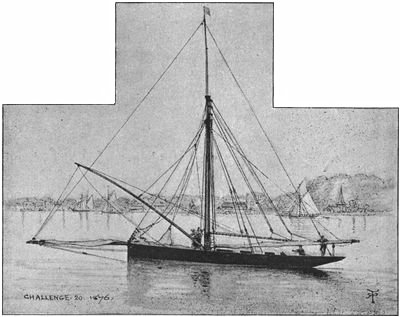
'Challenge,' 20 tons, 1876.
The second match on the following day was sailed in about as dirty weather as it was possible for the concentrated energy of the elements to provide, and the result was that 'Freda' turned the tables on 'Vril' and beat her by about the same amount of time. The start was made at 10.20 a.m., and this time the 'Freda' got away first. Both yachts were reefed down, the 'Freda' showing a single-reefed mainsail and foresail with the third jib, while the 'Vril' carried a whole foresail with a double-reefed mainsail and second jib. The 'Vril' also started with her topmast housed. Outside the breakwater the little boats had to face a bad wind-against-tide sea, and quite a third part of the trip was made under water. For the run to the Bolivar buoy the 'Freda' set her spinnaker with a Paddy's reef in it, which gave her a tremendous lead, because, though her extra length told, still the 'Vril' had no spinnaker boom on board, having left it ashore, and could therefore only boom out her balloon foresail. On the thrash to windward, however, the 'Vril' gained twelve seconds on her antagonist, so that the first round finished 'Freda,' 1 hr. 49 mins. 2 secs.; 'Vril,' 1 hr. 54 mins. For the second round, the 'Vril' sent her topmast on end and set a topsail, but her mainsail had been so badly treated before the races began that it was found impossible to make it stand properly, and the remarkable thing is that the little yacht worked as well as she did under the trying circumstances. The 'Freda' kept to the sail she started with. The sea smoothed down considerably during the second round, which made the sailing somewhat easier. With the exception of a slight miscalculation in distance on the part of the 'Vril,' and a consequent extra board on the beat up for the harbour buoy, nothing of any importance took place, and the two yachts came in, 'Freda' first at 2 hrs. 44 mins. 40 secs., followed by 'Vril,' 5 mins. 15 secs. after her.
The interest occasioned by the third day's sailing was extraordinary. All over the country an eagerness was displayed for news of the match almost equal to that seen on a Derby day. The wind was at about the same force, and blowing from the same quarter as on the previous day, with the addition of a harder feel in it. Both yachts, therefore, set the same amount of sail and had their topmasts housed. At the time of the start, which was made at 11 a.m., the sea was breaking over the lighthouse, and made the journey look anything but inviting.
Both yachts, keeping a sharp look out on each other, were too keen on crossing the line, and had to return and make a fresh start, which they did side by side. There were not 10 seconds between them when they jibbed round the first mark, the 'Vril' leading, and the difference was further shortened by 5 seconds at the Bolivar buoy, this run having been made under boomed-out balloon foresails. The time between the yachts might have been lessened still more had not the 'Freda' been obliged to busy herself about her boom, which came adrift. From the Bolivar buoy home the little vessels danced it merrily to the tune of 'Blow, breezes blow.'
The 'Freda,' before she made a fresh start, had placed herself 30 seconds ahead of her rival, but going out again, the 'Vril,' owing to the 'Freda's' not being able to make use of her balloon foresail, passed her before they had rounded the first mark-boat, only to be repassed on the running-reach to the Bolivar. The 'Freda's' best point of sailing brought her to the Bolivar 1 min. 30 secs. ahead, and though for the last time the 'Vril' showed her superior power in beating to windward, the 'Freda' had made up her mind to walk off with the dollars, and win she did by a few seconds over the minute. Considering the sea that was running, and the amount of broken water that was throwing itself about, this last race is one to be long remembered and handed down in the annals of small-yacht racing; and now and hereafter, when racing and cruising men feel a tendency arising in them to croak and speak ill of the little yachts that were built under the old rule of measurement, let them call to mind their mighty deeds, their racing and their voyages under circumstances and in weather that would frighten many a 50-tonner into harbour and to her moorings.
The fourth day ushered in a new competitor, and the 'Freda' had to cross the line with the 'Camellia,' which she did five minutes after the second gun. The wind and weather had changed during the night, an unfortunate circumstance for the 'Camellia,' a hard-weather boat. The wind was unsettled, hung about between N. and N.E., and was at times very shy. The 'Freda' at first, not being able to hold the wind that the 'Camellia' did, lost ground considerably in the beat up to the Bolivar buoy, and the latter had reached on her so cleverly that the 'Freda' was fully a minute astern on rounding for the run into the harbour. The 'Freda' here had the pull over the Fairlie clipper, for she was provided with two spinnakers, while the 'Camellia' had but one, and as a shift had to be made (since they had left the Bolivar with spinnakers set on the bowsprit end) before setting off for the second round, the 'Camellia' was left in the lurch, her one spinnaker having to be taken in and boomed out. Standing out again, the 'Camellia' tried her best to pass the 'Freda' to windward, but to no purpose, as the 'Freda' was always ready for her each time the attempt was made, and at the Bolivar the 'Freda' was first round by 30 seconds. Coming into the harbour, the 'Freda,' again at her best, kept increasing her lead, and finally won by 1 min. 40 secs. Hunt's correspondent writes: 'This was a closely sailed race, in which the English boat owed much of, if not all, her success to smart handling.'
The fifth day's race was sailed under something like the 'Vril' and 'Freda' weather. The wind had hardened up and freshened during the early morning, and kept increasing as the day went on. Both yachts started with housed topmasts, single-reefed mainsails, and No. 2 jibs, the 'Freda' running up and booming out her balloon foresail as she crossed the line. During the first round the 'Freda' showed herself the better boat when on a reach as well as in beating to windward in the teeth of the heavy, solid sea which was running. She, however, was only 1 min. 30 secs. ahead at the mark-boat. On the second round the boats were literally more under water than above; they were simply smothered in their efforts to windward, and had the 'Camellia' not been so persistently squeezed in order to make her look up closer to the wind than her rival, she might have gained more than she did. As it was, what she gained on one point she lost on the other, and allowed the 'Freda' to come in a winner by 1 min. 45 secs.
On the sixth and last day the umpires were obliged to alter the course owing to the heavy sea running outside the breakwater. There had been no lull during the night, and with the northerly gale blowing it was thought too dangerous a matter to allow the small yachts to face the hazards of a lee shore. The mark-boat outside was therefore brought within the breakwater, the other was left in its place off the Old Harbour, and the course made nine miles, or three times round the two marks, which lay now in more or less smooth water. The start was made at 11.50 a.m. under double-reefed mainsails and small jibs, 'Freda' having sent her topmast on deck. The 'Camellia' got away 45 seconds ahead of the 'Freda' owing to the latter not having heard the gun, and increased her lead till she came to the mark-boat. Her lead, however, did not last long, for in the beat to the next mark she missed stays and allowed the 'Freda' so to gain upon her that by the time the mark was rounded the 'Freda' had put herself 1 min. 5 secs. ahead. The yachts had quite as much as they could do, the next time they had to haul their wind, to stagger under their small canvas, as the wind blew harder than ever and with more real venom in it. The 'Freda' finished the nine miles in 1 hr. 30 mins.—quick work taking everything into consideration—but the 'Camellia,' having again missed stays, up helm and made for her anchorage. This last match exhibited the powers of the two yachts in a different way, perhaps, and under conditions other than any met with in the previous races. If the third and fifth matches showed what fine sea-boats these small 5-tonners were, and how capable, handy, and powerful, when driven in a big, broken, heavy sea, the sixth day's racing proved that they could stand up to their canvas and bear pressing when many a much larger yacht would have had to be close-reefed. No apology need be offered for introducing these six matches into this work, because not only do they form a good precedent in the manner in which all the arrangements and the choice of fighting ground were made, but it is impossible in any other way to discover how one stay-at-home small yacht compares with another at a distance, unless they are brought right away from their respective localities and allowed to fight it out in open water unfamiliar to both. Before bidding adieu to the above three little beauties, it may not be amiss to add that the 'Freda' was sailed on all six occasions by Mr. Beavor Webb with a professional crew, the 'Camellia' was in the hands of Tom Dudley, of Southampton fame, and the 'Vril' piloted by one of her owners, Mr. Hilliard.
Each year now introduces new aspirants to the Blue Ribbon fame of the well-established 5-ton class, and though few methods, if any, had been resorted to up to this time for the purpose of cheating the tonnage rule, which then took the length on deck between stem and sternpost as its measure, instead of the length along the L.W.L., still the year 1878 saw a notable tonnage-cheater launched from the Cheshire side of the Mersey in the formidable 5-tonner 'Lorelei,' designed by Mr. Wynne Eyton, her owner, and built by Messrs. Buckley & Sherlock. The 'Lorelei' was a yacht worked out purely and simply on the wave-line theory, as defined by Mr. Colin Archer, of Christiania, and her counter was partly submerged, not only to enable the lines of her after body to be carried out fair, but at the same time, without adding to her tonnage, to give her a foot and a half more length on the L.W.L., since she was 31 ft. 6 in., whether the measurement was taken on deck or along the L.W.L. Her beam was 6 feet, and she drew 5 ft. 6 in. Like the 'Vril,' her ballast, 4 tons in all, was on her keel, and her sail area 770 square feet, or 30 square feet less than that of the 'Freda.' The displacement of both these yachts was almost identically the same; yet the 'Freda' would have had a very hard struggle to keep within sight of the 'Lorelei' on an ordinary 5-ton yacht course. Frequently the 'Lorelei' very nearly beat her 10-tonner competitors on even terms, and was always fit and ready to save her time. In the smaller class, such as she would race in at Kingstown or Liverpool, there was not one boat that she could not beat. Mr. Richardson designed for the Messrs. Anderson, who used to own Hatcher's old crack the 'Queen,' 15-tonner, a 5-tonner called the 'Urchin.' She was intended to beat the 'Lorelei,' but she never could do anything when sailing against her. The 'Lorelei' carried rather a deep bilge, and her keel was well rockered. After Mr. Wynne Eyton parted with her, she went up to the Clyde, where she has done little or no racing, but has proved herself a first-class little cruiser. Her fittings below, when she was in the height of her racing career, were very good and rather unique. She had no bulkhead, but was entirely open fore and aft. She was flush-decked, and her main cabin was partly divided off by a double set of rails made of 3-inch planks, which formed an open, but double, partition to hold all her kites and other sails. This open sail locker or pen stretched right across from side to side, and was about 2 feet deep. It formed a good roomy receptacle for the sails, kept the weight amidships, and sails well aired. Something of the same kind of fitting has been applied to one or two 10-tonners, the open gratings in their case being carried right up to the deck on the starboard side, leaving the door and pantry in its usual place. The upper half of the grating facing the main cabin was on hinges, and could be removed altogether to allow of sails being taken out or replaced quickly, as, for instance, on a racing day.
As regards tonnage cheaters, the chief method employed for walking through the 'length on deck' rule was that of bending up the sternpost. The first yacht built with a knuckle in her sternpost came from Messrs. Buckley & Sherlock's yard at Tranmere, on the Mersey, and belonged to the Sloyne. She was a 10-tonner, and with the others, which followed after her, very soon brought the authorities' attention to the rule, which was promptly altered to the L.W.L. measurement. Those who wish to know more about the 'Lorelei' will find a very good description of her, with drawings, as they will also of the 'Freda,' in the third edition of Mr. Dixon Kemp's work on 'Yacht and Boat Sailing.'
In 1879 and 1880 two yachts were turned out which perhaps did more fighting as first-class 5-ton racers, and lasted throughout a greater number of seasons at the top of the tree, than any others had done since the days of the 'Torment' and 'Pearl.' The 'Cyprus' and 'Nora,' the one designed and built by Mr. William Fife, jun., the other parented on Mr. George Watson, were as distinct types in their way as were the 'Vril' and the 'Camellia' three years before. They were, besides, equally interesting, if not more so, since in them the practised eye could see how wonderfully the Fife and Watson designs had respectively developed and improved. The 'Nora,' built in 1880 for those keen racing yachtsmen of the Clyde, the Messrs. Allan, with 32 ft. 4 in. length on deck, 6 ft. 2 in. beam, and a rather deeper draught, was a veritable ship in comparison with her predecessor. More cut away forward and with greater rake of sternpost, big body and large sail-area, long counter and straight stem, nothing could touch her in light winds. The only antagonist that gave her any trouble was the 'Cyprus,' built the previous year.
This yacht, designed to sail under either measurement, length on deck, or L.W.L., was exactly 30 feet when measured along the one, and 29.5 when measured along the other. Her beam was 6 ft. 4 in., draught 5 ft 4 in., with a displacement barely equal to that of the 3-tonners, which between the years 1880 and 1884 gave so much sport and became so popular. She was one of the smartest of the small fry Fairlie had ever turned out. Certainly few would gainsay the fact that the 'Cyprus' was by far the prettiest of her class at that date afloat, and at the same time looked a racer all over. Out of the water she was a perfect study to the lover of gentle curves and fine lines, and as sweet a model as any connoisseur would wish to feast his eye on. Without a straight line up or down, diagonal or horizontal, to be found about her, to all appearance, looking at her from a beam view, she presented a longer and finer entrance than had up to that time been given to any of the Fairlie small yachts. Such an increase had been meted out to her that at first sight it was difficult to free the mind of the impression that she must be a regular diver. An end-on view, however, soon dispelled all misgivings on that score, for her vertical sections showed a round floaty bow of extraordinary power. With a low freeboard of 1 ft. 9 in. at the waist, and a grand midship section, there was no wall-sidedness about the 'Cyprus,' whilst her run was fine and clean, and her buttock lines beautifully easy. Perhaps the prettiest features about the little yacht were her shear and the sit of her counter. This latter was light and long, and had a spring upwards towards the taffrail, rather after the fashion of a duck desirous of keeping her tail dry, though the yacht was a little more moderate as regards the height necessary for so carrying her appendage.
The 'Cyprus' was kept in the family during her career in the Clyde, and was very successful during those seasons that her racing flag was seen at her topmast head, being always piloted by that prince of helmsmen, her designer and owner. In the winter of 1884 this yacht became the property of the writer, when she began a most successful career of a more all-round character than she had up to that time undergone, and it is principally from the practical experience derived from racing and cruising in her that he has been enabled to form his ideas and recommend the 5-ton yacht of ordinary dimensions as the best size and class of vessel for an inexperienced yachtsman to ship himself aboard as owner, captain, and hand.
When the 'Cyprus' came into his possession her fittings below were practically nil. Like the 'Vril' in her early days, she had only such contrivances as were absolutely essential for one living on board during a time bounded by hours rather than weeks or months. He was therefore obliged to make a few alterations below, such as turning her sofas into lockers, having iron bed-frames fitted in the cabin on hooks so as to be easily removable, and a box made to stand in between the after-provision sideboards and under the ladder to hold a bucket, washing basin, and lavatory conveniences. On deck the fittings were almost perfect. The jib, throat, and peak halliards led below through brass fairleads let into the deck a few inches on either side of the mast.
The forestay, instead of coming down through the stem-head along the deck, and being purchased up to the bits, was led through the stem close under the deck and set up by tackles to the mast. In place of the regular tackles to the bowsprit shrouds, two sets of selvagee strops were used, the one short and the other long. The long strops were doubled round the forearm of the belaying rail on each side, abreast of the rigging, and the standing part of the bowsprit shroud shackled on and set up with galvanised rigging screws. The short strop was employed whenever the bowsprit was reefed in. It was found strong and neat, and much better altogether than the old plan of tackles, which formed the original fitting. The 'Cyprus' was not entirely flush-decked—that is, she had a low very neat-looking 'booby hatch,' which fitted on a combing some three inches high. The combing ran from about two feet abaft the mast to within a couple of feet of the rudder-head. The after part enclosed a small water-tight lead-lined cockpit, then a foot of deck, ahead of which came the hatch, containing the after sliding hatch into the cabin and a low skylight. The width between the combings was 2 ft. 4 in. A transparent compass and binnacle fitted into the deck space ahead of the cockpit, and this was lighted by a lamp below in the cabin. This arrangement was excellent, as it prevented any of the troubles which so often arise in small yachts from the lights being washed out. At sea the boat was stowed below in the cabin, and as the hatch was very simple and easy to adjust, it was always taken off for the boat to be lowered down into its place. Another point in favour of this hatch was that on fine sunny days it could be removed and the yacht kept well-aired and sweet. A narrow strip of india-rubber, doubled, was nailed round, close up to the combing, and this proved a thoroughly effective method for keeping the hatch tight and preventing any water from coming into the cabin.
The 'Cyprus' was a particularly handy boat. As the writer had to take her round to Plymouth from Scotland, he invited an old friend, and with the help of a boy of seventeen years of age out of one of the Plymouth trawlers, left the Clyde for Kingstown, the port of call, after enjoying a few days' cruising about by way of letting everything shake into its place. It was a Tuesday morning when the start was made from Lamlash, in Arran, and the 'Camellia,' which was on her way to Stranraer, left about half an hour before. The wind was N.W. and came down off the hills in strong squalls; but the water was smooth, and under all plain sail the little vessel simply flew along.
After leaving Ailsa Craig astern, the sea began to show signs of getting up, and about 5 p.m., before reaching Corsewall Point, it had begun to take such liberties, and make such encroachments on deck whenever a big curler chose to break over aft, sometimes to the depth of three inches to four inches, that it was thought advisable to heave her to and shorten sail. About 6 p.m. the helm was put down and the foresail hauled to windward, whilst a reef was taken in the mainsail, No. 3 jib set, and our ship made snug.
It was a treat to see how well the yacht lay to, and it is impossible to describe the feeling of confidence it inspired, for not a drop of water was shipped, and she rode like a duck the whole time, coming up and falling off as each sea passed under her. From the time the foresheet was let draw to the time she dropped anchor in Kingstown Harbour all went well, the only incident being the writer's coming on deck at 6 a.m. to find that the boy, who was on watch, had mistaken the Morne Mountains to the north of Dundalk Bay for the south of Ireland, on the strength of which he had given up steering by compass, and was taking a course into Dundalk, which would have soon led to a disastrous end. The compass, though a spirit one, was rather sluggish, and his idea of safety was steering by the land. Wednesday night was spent at Kingstown, and with the first of the ebb the 'Cyprus' was again on her way with gaff-topsail set over all. Light flukey airs from the southward and westward helped the yacht along during the greater part of the forenoon, but these were eaten up by the sun as the day wore on, and gradually died out altogether, leaving us to drift along till the tide began to make, when, being in easy soundings on the edge of the Arklow Bank, the anchor was let go, and the yacht brought up to await the beginning of the ebb or the wooing of a breeze. The next morning—Friday—there was no wind of any kind; but the tides run strong on the east coast of Ireland, and a whole ebb meant many miles to the good. The time during this drifting was well employed in having a thorough clean down, in opening up the cabin, airing the bedding, and improving the stowage of the general cargo shipped on board, consisting of sails, luggage, provisions, and numerous other necessary items. In the afternoon the yacht was again brought to an anchor, and remained so till Saturday, about 4 a.m., when a breeze springing up from the southward, her head was pointed towards the Welsh coast. Travelling was very slow, for the wind was very light, and not at all true. Two short boards were made on reaching the other side, and about 8 a.m. on Sunday the yacht was laying up on the port tack for the Smalls. The wind had now some westing in it, but not sufficient to let a course be laid for the Longships; and as long rollers were coming in from the south-west, it was settled to go well away to windward in order to make Land's End in one tack and obtain a clear offing.
The Smalls was left behind about 3 p.m., and at 5 p.m. the whole face of the sky was beginning to look so threatening, and the clouds to drive past at such a rate from the southward, while the quiet rollers had already begun to break up and require such extra attention, that at 6 p.m. the 'Cyprus' was hove to, and made ready for a dirty night. The mainsail was taken off her and trysail set, the topmast housed and bowsprit reefed in, the second jib shifted for a spitfire, and the foresail double-reefed. Two hours later, the wind having sprung up into something near akin to a gale, and the yacht dancing with a light heart and by no means wet deck away out to sea, everyone on board was glad that she was under snug canvas and that time had been taken by the forelock. She could not have been more comfortable or cozy had she been a sea-going rocking-chair. On going about, the first land sighted was Cape Cornwall, but the wind, having had its say, again went down, till the yacht was left with just sufficient to keep her going, but not enough to make her steady, or prevent her knocking about in the choppy sea that remained. About noon, however, a breeze sprang up, and the Seven Stones Lightship was passed close to about 3 o'clock on Tuesday morning. Towards 8 a.m. the wind had veered round to the N.W., coming off the land in strong puffs; sail was made once more, and with fairly smooth water all the way the yacht lay herself down to her work, and finally brought to off the Hoe at 10 p.m. the same night. The lesson learnt during this cruise was a useful one—viz. that if sail is attended to in time, a 5-ton yacht is fit to face almost any weather, provided she has sea-room. During the whole trip round the crew were never without hot water when they required it, so easy was the yacht's motion to those below, even during the most disagreeable part of the journey; and no water went below even when it lay thick on deck, as, for instance, off Stranraer, and once or twice before sail was taken off her when near the Smalls.
The 'Cyprus' was raced, whenever an opportunity presented itself, in the then A, B, and C classes, and in every case the racing was against yachts larger than herself. Any amount of Channel groping had to be undertaken, both from one English port to another, as well as between the French coast and England, ocean racing being quite as much in her line as the 'Meteor's.' Her best performances took place in strong breezes, and it was a sight worth seeing to watch the wonderful manner in which she could drive through a head-sea. At Bembridge Regatta the 'Cyprus' sailed the course round the Nab on a day when the 30-ft. class of yachts (15-tonners in reality) begged to have their course, which was identically the same, altered. No matter on what point of sailing she was engaged (and she is only given in these pages as a very fair type of the 5-tonner built to sail under the old Y.R.A. Rule), blow high or blow low, a lady might have handled her tiller without experiencing any of that muscular arm exercise so common in boats built under the length and sail-area rule, or even the slightest inconvenience. The 'Cyprus' was sent out to Toronto on board an Allan Liner from London, and became an ornament to Lake Ontario, where she is at the present time.
Between the years 1880 and 1886 four 5-tonners were built from the designs of one of the most rising young naval architects the Clyde has ever produced—Mr. Payton. The first of this team was the 'Trident,' which, though not by any means a successful racer, was a fine able boat and moderately fast. She is mentioned here on account of her having made a long ocean voyage to the South of France. She was altogether bigger and a much heavier boat than the 'Nora' or 'Cyprus,' but could be worked just as easily. Five Frenchmen, however, were employed to take her South. Her behaviour under a very trying state of the weather, while crossing the Bay of Biscay, was highly spoken of, and the men who went in her declared their faith in her to such an extent as to be quite willing to take her out to the Cape.
The 'Olga' was Mr. Payton's next attempt at a flyer. She was 32 feet long, with a beam of 5.73 feet, and had a great draught of water. She was a very large-bodied boat, was built on the most advanced scientific principles, and, what is more to the point, was a complete success; but she was a most unfortunate yacht. With a very wide keel her midships section was anything but shapely, and ran down almost in a straight line from her bilge, which was very low and square, to the bottom of the lead. At the Royal Irish Yacht Club Regatta, Mr. Power's steam yacht ran into her and sank her in Kingstown Harbour, but she was brought up and floated again, Mr. Power having bought her as she lay under water. The 'Olga' after this mishap won her full share of races, and ended her first season flying 18 winning flags, of which 15 were firsts. Mr. G. B. Thompson bought her during the winter, and the following season won four first prizes with her; but before the season was half over she was again unlucky, and on June 22 was once more run into and sent to the bottom, whilst in the Mersey. She was fished out, and put up for auction, but who bought her or what became of her is not generally known.
The third yacht of 5 tons was the 'Luath.' She, however, was not such a phenomenon as the 'Olga,' and after the 'Olga's' short but brilliant existence, what was expected of her did not come off. She was, as may be supposed, very much like the 'Olga' in looks and of about the same dimensions, though of rather larger displacement. The last of the four was the 'Oona.' Her melancholy end is still fresh in the memory of many a small-yacht sailor. She was built in 1886 at Wivenhoe, in Messrs. Harvey & Co.'s yard, for Mr. Plunket, of Belfast, and was an extreme example of what could be designed under the old Y.R.A. Rule. Her length was 33 ft. 10 in. on the L.W.L., her beam 5 ft. 6 in., and draught 8 feet, but her chief characteristic was her marvellous body, which displaced 12 tons, both displacement and sail-area of 2,000 square feet and more being greater than many racing 10-tonners, and the latter over 1,300 square feet more than 'Freda' or 'Nora's' sail-spread. What she might have done as a prize-winner it is impossible to say, for she never reached her station. Coming from the eastward, she put into Southampton to effect some small repairs, and after remaining there a few days, on May 4, with her owner Mr. Payton, her designer, and a crew of three men on board, left for Belfast. It appeared that shortly after passing Dublin Bay—for she did not put into Kingstown, as might have been expected—her owner must have intended to make the best of his way up Channel, but, unhappily, terrible weather set in about the night of the 12th, and the general opinion was that, from some weakness in or lack of roping, the trysail was burst up, and that becoming unmanageable, or through her crew having been swept overboard, the yacht was driven on to the sands off Malahide and so became a wreck. Her hull was washed up without its lead keel and its fastenings or the iron floors; in fact, the whole of her keel and lower garboards had gone.
Mr. Payton's name will always be associated more especially with the 3-tonner 'Currytush.' She was a more brilliant success than even the 'Olga'; but the old 3-tonners do not come within the scope of this paper.
The last of the race of 5-tonners, if the 'Oona' be left out, is the 'Doris,' one of Mr. Watson's greatest successes in small-yacht design. She was built in 1885 for the Messrs. Allan, who had owned and sailed the little 'Nora' so pluckily and so well. Her length is 33.6 feet on the load-water-line, beam 5.6 feet, and draught about 7 feet, or a little more. The 'Doris,' like the 'Oona,' is an extreme representative of the old rule. Her displacement is very large, but there is far more shape and comeliness about her body plan than was to be found in any of Mr. Payton's designs. She has proved herself a clever boat in all weathers, and in light winds particularly so. Her chief rival, had she not been lost, would have been the 'Oona,' for there was no other 5-tonner afloat capable of tackling her, and her principal racing was against boats of a larger tonnage. She could always save her time on the crack 10-tonners of her day, such as the 'Uleerin,' 'Queen Mab,' and 'Malissa,' and the only matches of any interest that she was mixed up in were three that came off between her and Mr. Froude's 5-tonner 'Jenny Wren.' This yacht, designed by her owner, and built at Messrs. Simpson & Dennison's yard at Dartmouth, was made double-skinned for the sake of lightness. She, like the 'Doris,' was a large, big-bodied boat, but her form did not give that idea of power with which a look at the 'Doris' at once inspired the observer. Both the 'Doris' and 'Jenny Wren' are cut away forward, and carry the curve of the keel up to the water-line, finishing at the deck-line in a fiddle-head. The 'Jenny Wren' had shown herself remarkably fast in light winds and smooth water, and on certain days could leave the length classes to follow her up. Bad weather, however, was her weak point, and even in strong breezes and smooth water she did not always appear to be sailing at her best. At Plymouth, then, when the 'Doris' and 'Jenny Wren' met, everything depended on certain conditions what kind of a fight the latter would make. As the 'Doris' beat her, there is every reason to believe that it was either blowing hard or that the wind was shy and there was a certain amount of roll outside the breakwater.
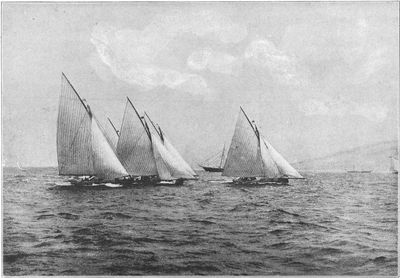
GOOD START OF SMALL RATERS IN THE CLYDE.
Since the measurement rule was altered, the 'Doris' has been improved by being spread out and given more beam. She still races, but cannot do much against the 10-raters, the class to which she now belongs, and has lately been sold to spend the rest of her days as a cruiser. Should she race in the future, it will be in the many Clyde handicap cruising races. With such bodies and draught there was no lack of head-room in the cabins of the latter day 'plank on edge' 'lead mines,' but the want of beam made the accommodation not exactly as grateful as it might have been had there been a little more elbow-room. The alteration in the 'Doris' has given her the requisite amount of beam, and she ought to make a very comfortable fast and able boat for cruising purposes.
THE Y.R.A. RULE AND ITS 5-RATERS
In the year 1886 the Yacht Racing Association brought in a new rule for yacht measurement, or, more properly speaking, for rating yachts to be used in racing. There is no other reason why a rule for rating should be required at all, as under the old rule, or any true capacity measurement, a naval architect or yacht designer would be sure to produce a good, serviceable vessel for cruising purposes, and according as the owner's requirements might be speed, accommodation, or light draught, so the several dimensions and design would be arranged to suit.
With regard to this rule of rating by 'length and sail-area,' and the boats which are the result of it, there appear to be many and diverse opinions; and prior to noticing any particular yacht built under it, it will be as well to look at all its points before declaring for or against it. Experience declares them to be good sea-boats, in that they rarely ship solid water, and they are very fast when sailing on a wind. Their spoon and fiddle-headed bows would help to throw the water off, while their mast being stepped almost in the eyes of the yacht, would make them eat up into the wind, because it permits of most of the driving power being concentrated in one big sail.
Their sailmaker's bill is a small item, on account of the tendency to keep the sail-area down. For instance, the 'Archee,' Mr. Lepper's 5-rater, of Belfast, with a length of 30.4 feet, a beam of 9.2 feet, and a draught of nearly 5 ft. 6 in., a length on deck of 39.5 feet, the tonnage of which, by the last rule, would have been a little over 6½ tons, has a sail-area of 979 square feet against the 1,680 square feet of the 'Doris' 5-tonner.
They are bigger boats than the old 5-tonners, but then they have so much more beam. The 'Cyprus' was the same length as two-thirds of the 5-raters that have been built, but she had only 6 ft. 4 in. beam against the raters' 8 feet to 9 feet. They have very little gear with the lugsail rig, and the decks are always clear.
They can lay to, but it is on the same principle as that of a Una boat, and they would not remain on one tack all the time but for the little jib they carry, while they forge ahead at a great speed, and cannot be stopped unless a man is left at the helm to look after it.
If properly trimmed the rater can be steered by the lightest hand when beating to windward and close hauled, and she is remarkably quick in stays.
Experience, however, shows that, though the rater rarely ships a sea, still, when she does put her nose in the water, it becomes a general question on board her whether she will ever bring it out again. This is not altogether enjoyable, and such sensations were never experienced in boats built under the old rule. The one large lugsail, too, and little jib form a most unhandy rig.
Experience has also proved that, with regard to the two factors, sail-area and length, the tendency is to make the body of as small displacement as possible, taking the length into account, so that with the small area of canvas employed there may be very little weight to propel. Thus, though the early raters were big-bodied and roomy boats, with good head-room below, the boats built lately are inferior in those qualities, and those which will be put on the stocks in the future will be merely big canoes with bulb-keels.
Experience prefers for Channel seas a boat that can be driven through the water when necessity compels without any sense of danger, and that, if allowed to do so, will ride over the waves when no object is to be gained by making a short cut through. A yacht of four beams to her length or more will do this far more comfortably and with less commotion and fuss than one of three beams or less to her length.
Experience furthermore says that, though the lugsail requires very little gear, and can be hoisted with a certain amount of ease, yet if sail has to be shortened, or the lugsail to be taken in hurriedly, it requires more than three men to do it smartly; at no time is the job an easy one, but if any sea is running, or the weather squally, three men have as much as they can do to handle it. This is never the case with the gaff-mainsail. In a 5-tonner a man and a boy could have shortened sail easily, and though the sail-area was great, one man and the owner could always sail her from port to port.
Money may be saved through a small sailmaker's bill, but it must go out in wages to the crew and extra hands.
It is a good point to have very little gear about, but the 'Wenonah' and 'Wee Winn' both prove that a gaff-mainsail is quite as suitable as the lug and a better all-round sail.
Experientia docet that the rater, though she can lay to, cannot be hove to and have her way stopped. And the risk with her is, that in a sudden rush, caused by her aftersail filling, she may bury herself by jumping right into a head-sea—a most dangerous performance when the weather is so bad and the seas so high that travelling can only be carried on at peril.
Again, experience tells a tale that raters are not all so very tender on the helm even when sailing on their best point, and are what would be called in horsey phraseology very hard-mouthed; and that whilst off the wind they are like star-gazers, all over the place, and ready to rush anywhere and everywhere rather than straight ahead or where the helmsmen want them to go. Some of the small yachts built latterly under the old rule had a similar inclination, but it was generally at a time when they were being very heavily pressed, carrying too much sail, or when badly trimmed.
Of the two kinds of overhang forward, the spoon-shaped bow, which Mr. G. L. Watson has given his new boats, is the best, because it adds flotation as well as length on the L.W.L. when the yacht is sailing down to her bearings, and fairs all her longitudinal curves. The fiddle-headed bow may be thought by some to look prettier, but it is not so effective, unless it helps by its flam, or flare out (which some new yachts with this kind of bow do not have), to keep the decks clear of water. The overhang bow means an extra top weight, which has to be provided for and counteracted when the calculation is being made for the ballasting; but, on the other hand, it gives enlarged deck-room. It also saves having a long outboard spar in the shape of a bowsprit, and so does away with any need of reefing. This is really only a small matter after all, since even with a rough sea there is never very much difficulty in reefing in the bowsprit providing it is properly fitted. Years ago in American waters there was scarcely a sloop built that had not an Aberdeen stem or fiddle-headed bow, but for some years they were discarded, and it is only lately they have been brought into fashion again. No American would give up anything that he had pinned his faith to unless he saw some real advantage to be gained by so doing. It is quite easy to understand why Americans should come back to the old stem now, for their waters like it, and it helps to cheat the rating for length.
The main design so common in the rating classes is perfect when regarded from two points of view only. The long, very gentle curve that runs up from the heel of the sternpost to the stem-head, and the excessive rake of the sternpost itself, allow of no more outside deadwood than is absolutely necessary to keep the yacht together, hang the rudder, and fix the lead keel on, so that whatever surface there may be to cause friction is doing its duty—that is, is caused by the skin or planking. The form thus given has its drawbacks; this experience has shown us and they are far more prominent and, therefore, serious when met with in the smaller raters than when seen in a 40- or 100-rater.
The second point is the quickness with which yachts of this new design 'stay' and 'get away.' This is a more practical benefit to large yachts than to small ones; for vessels like the 'Doris' or the old 'Solent,' 30-ft. and 25-ft. classes, could all stay and move off quite quickly enough, although they might not have manifested a desire to spin round twice when not stopped on their wild career, which is a marked peculiarity with the modern mosquitos. In the large classes a few years ago it was a common thing to make use of the time occupied in going about to take in or shake out a reef when circumstances demanded it; at the present day the skipper or sailing-master has to keep his wits about him, otherwise he may find his beauty turning round and looking him in the face; for the large rater can whip round like a top.
Now, in regard to the courses round Great Britain, two-thirds are what may be called reaching courses—that is, there is more running and reaching to be done than there is beating to windward—and though the distance to be sailed over in tacks may be only a third of the whole course, still the tacks that have to be taken will make the distance almost as long as two-thirds of the whole course itself; hence comes the advantage of having a yacht that will travel the distance quickly on a wind. Nevertheless it seems foolish to place the eggs all in one basket, and as it is an absolutely useless accomplishment for a yacht to be able to go round two or three times to the once putting down of the helm, the question may be asked whether she would not be equally quick and a better racing, to say nothing of a cruising, yacht if she were not quite so much cut away forward, or, better still, if her sternpost were not quite so much raked; and could not this be done without materially affecting the speed? If the idea is to give the yacht a great hold of the water by a deep draught, then it is easy to understand that the present fin-shaped keel is necessary; but Mr. Herreshoff has given practical proof that such a shaped keel or such excessive draught is by no means necessary to make a boat weatherly or a successful prize-winner. With a straighter sternpost a certain length of horizontal keel might be required to keep the centre of lateral resistance in the best place, but that again would only be following Mr. Herreshoff at a near distance, and would make the boats run and reach better and under a steadier helm, whilst a very imperceptible difference would be found in their rate of travelling to windward.
The two Herreshoff boats that have been sent over to England have certainly shown their tails to our smartest raters in the two rating classes, viz. the 2½ and ½. Both the 'Wenonah' and 'Wee Winn' are fitted with bulb-keels, which run their length horizontally to their L.W.L., and they are good on all points of sailing as well as remarkably quick in stays. These two boats are rigged with regular gaff-mainsails too, so that notwithstanding the craze for lugsails, they are not essential to make a boat sail past the winning marks first. To the cruising yachtsman who lives on board his little vessel, with such an alteration or improvement as the one referred to above there would be the comfort and satisfaction, when hauled alongside the pier of a tidal harbour, of knowing, after the yacht had begun to take the ground, that he had not to sit up all night watching her, or waiting till her bow started to lift before he could turn in to his bunk, because his yacht would take the ground on a more even keel. It is no child's play looking after a fin-keeled yacht taking the ground, and the very greatest of care and most subtle precautions have to be used to avoid a fall over on the side.
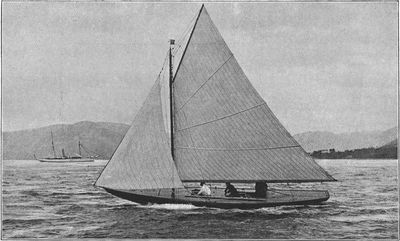
'WENONAH' 2½-rater (Mr. H. Allen). Designed by Nat. Herreshoff, 1893.
In designing a small yacht there are matters that have to be considered which scarcely affect larger vessels except when comparing them, again, with larger vessels still. One of these points almost makes it worth while looking back at the reasons why certain types of small yachts have become so prominent and so much sought after and believed in. The great American designer, Mr. Herreshoff, and our own clever yacht architects here, are taking the canoe of the savage as their model; and as this is the case, it may be interesting to see how, starting from the canoe, all yachts have taken their form (no matter how deep or beamy they may have been), and perhaps, too, by so doing, it will be easier to discern and arrive at the kind of form best suited to meet special requirements, apart from the trammels of the rules, measurements, or ratings such as are or have been laid down for yachtsmen and yacht-owners by the Royal Thames, the Yacht Racing Association, the American and French yacht clubs, or other societies and authorities.
The canoe of the South Seas or the kyak of the Greenlander could not have been better chosen, had they been worked out on the most scientific principles, for the work they have to do. The shape is that best adapted for speed, lightness (which means light displacement), and, under certain conditions, for sea-going qualities. Those conditions are, of course, smooth water or big ocean rollers, which seldom if ever break, and a propulsion easy, strong, and yet not exaggerated, longitudinal and not transverse in its tendency (as in propulsion by sail). Now if this model be taken, which invariably possesses a U-shaped section, there will be no great difficulty in understanding the whys and wherefores of the several transformations it has undergone.
If it is desired that a small boat should keep the sea, the nearer she approaches to the canoe form, as far as is compatible with the limited requirements, the better able will she be to cope with the difficulties which she ought, under the circumstances, to be ready to encounter. Hence it is that those men who make great ocean voyages, as, for instance, across the Atlantic, in boats about 15 feet or thereabouts, always have their boats built as round and floaty in form as it is possible to design them, taking into account that they must be decked, have sufficient depth of hold to allow of stowage for provision and water, which act as the greater part of the ballast, with the addition of just sufficient room for lying down at full length under deck covering: 2 ft. 6 in. to 3 feet is the outside depth under the deck of any of these diminutive ocean cruisers. The entrance given to such boats is always full and buoyant, though not bluff. Rarely do they have a vertical stem, but one rather rounded up, with a slight overhang. The after-body is generally whale-shaped, with the sternpost at a somewhat less angle than the stem. Both stem and stern-posts have this inclination given them, not with the idea of making them quick in stays, but rather for the purpose of meeting and throwing off head or following seas, and adding buoyancy to both ends. The main principle in these boats is to obtain buoyancy and speed, while great sail-carrying power for driving at abnormal speeds does not so much as receive a thought. This is why it so seldom occurs that any of these little vessels fail in reaching their destination. They go over the seas and not through them, owing to lack of weight and want of power. Their worst experiences during their long, uninteresting, and perilous voyages generally begin on nearing our shores and the chops of the Channel, where the seas begin to assume a broken, short, uneven, or at the best a deep ridge and furrow, shape. These boats may be considered the first remove from the early canoe form.
The general requirements, however, in a yacht are speed, accommodation, sail-carrying power, and weight. This latter property means, in other words, the ability to drive through a sea which, from its wall-sidedness, makes it an impracticable barrier to get over. When a vessel has not the weight or power to meet such a sea, as a rule, it spells disaster, or, to say the least, very disagreeable consequences; whereas if she can climb a part of the way up and then send her nose through the top, all is sure to end well.
Accommodation is very near akin to weight, for it is impossible to have a roomy boat without weight being concerned in it as a factor of some consequence. Accommodation in a yacht of 30 feet length and 6 feet to 7 feet beam means that there should be a height between the cabin floor and the deck beams of 4 ft. 6 in. to 5 ft. 6 in. at least, and this will demand a big-bodied boat of rather large displacement, otherwise the deepening in the water of the original U shape. Such a boat will require a large sail-spread to propel her. Supposing, however, that such height between decks is not required—that is to say, the boat is to be only partially decked with a large open cockpit—in that case the designer can, if he chooses, give the boat very much less displacement, which, in its turn, will require less driving power. The tendency, as it has been shown, of the Length and Sail-Area Rule is to provide just such a small displacement yacht, and accordingly a large yacht will some day be launched without any accommodation whatever.
Sail-carrying power is almost entirely a matter of displacement, for it is only a large-bodied boat that will have buoyancy sufficient to carry a great weight of ballast, and the deeper that ballast is placed, the more leverage will there be to counter-balance the sail, and hence the greater may be the sail-spread. Under the new system of deep plates, with the whole of the ballast bolted on at the bottom of the plate in the shape of a cigar or Whitehead torpedo, it is impossible to say how much area of sail could not be given to a boat of a certain length, beam, and depth of hull, and the only questionable difficulty that would come in the way would be the weight of the mast and spars necessary to carry the sail. For instance, take the three principal methods of stowing ballast, inboard, outboard, as in the ordinary keel, and the plate with a bulb. The dimensions of the boat to be supplied with sails are, length 30 feet, beam 7 feet, draught to bottom of wooden keel 4 feet. If the ballast is stowed inboard (lead ballast is presumed in all the cases), and the displacement permits, the sail-area may be 800 square feet. If the ballast is taken out and moulded in a keel, the sail-area may be increased to close upon 900 square feet. Should the lead be taken out and a plate some 2 feet or 3 feet deep be fitted, with the lead in the form of a bulb fixed at the bottom, the weight of the spars and the sails would be the only obstacle to the great increase of canvas that might be spread. Suppose, again, another hull be employed for experiments, having the length the same, but the beam increased to make up for the smaller depth of body below L.W.L. of 3 feet, the new hull may have the same displacement, and therefore the power to support the same weight of ballast as the last example. If this hull were supplied with a plate 4 feet or 5 feet deep, with the same bulb of lead, she would carry a still greater amount of sail; but with such a shallow boat there would be no accommodation.
Speed, that element in design which everybody cries after, whether they be practical scientific yachting men (and there is one thing Great Britain can boast of in her yacht designers, professional or amateur, and that is, they are all, without exception, first-rate helmsmen and seamen), or only graduating in the first principles of yacht-racing, is dependent on many conditions. In the first place, it forbids the presence of all superfluous deadwood, so that the outside surface presented to the water may be all of a useful description (that is, by being part of the planking or skin, or only as much deadwood as is necessary for the strength of the vessel), and the friction caused thereby may be reduced to a minimum. With a hull of large displacement there must naturally be very much greater surface friction than in one of smaller body, and therefore the question will arise—Will not the smaller yacht be the faster of the two? This involves still deeper sifting, because sometimes the smaller yacht will beat the one built on the same length and beam, though she may be very much larger. Before we can choose which of the two kinds of boat will be the better to have for a successful racer, a second great condition has to be looked into and satisfactorily settled. This is nothing less than what kind of waters the yacht will have to race or cruise in. The question of the element water is one very frequently forgotten and lost sight of by those buying yachts, especially second-hand ones; and the purchaser, who perhaps buys a most successful small vessel in the South, is astonished to find that when he has tried her against the local Scotch cracks, her performances prove of a very poor description in comparison, and disappointment is the consequence. Water may be in the eyes of some all the same, wherever it may be, and so it is round our coasts in its smooth state; but when it is set in motion there are scarcely two of our great yachting stations alike, while the seas in our three Channels all vary in form. At the mouth of the English Channel the seas, as soon as the 'chops' are left astern, become regular, are long and deep, and more or less easy for a small yacht to negotiate; that is, she has room to work in and out of them, and at the same time avoid receiving a comber aboard as passenger. As she sails farther up and the channel narrows, the seas become more of the deep ridge and furrow order, steep, narrow, and difficult to sail over, whilst each sea will contain its full weight of water. On nearing Calais the seas have less water in them, but are very short and steep; the consequence is they are more inclined to break. In the North Sea the sea disturbance takes another and larger form, and sailing North becomes still larger, and, of course, wider and deeper, till the Northern Ocean is opened out. St. George's Channel is very much like the English Channel, except that between Port Patrick in Scotland and the Irish coast the waves are more regular than between Calais and Dover, where currents and banks tend to make dangerous cross seas. So it is found that off Plymouth and Falmouth and outside Dartmouth there is often an ocean swell running, especially after there has been a south-westerly gale. The Solent, again, is different from the Clyde in its sea disturbance, and when acted upon by a south-easterly gale the seas off Spithead, owing to the shallowness of its water, have not nearly so much weight of water in them as those of the Scotch estuary when worked up by a northerly or southerly breeze. The Liverpool and London rivers are very much alike, though perhaps of the two the Liverpool has the greater sea disturbance, owing to the strength of its tides, which at some seasons are very rapid.