Volume 21 — OREGON EXPEDITION (continued 2)
Reading edition
On this subject we ought not to omit mentioning that the Indians on all sides of the Rocky mountains have several customs both among men and the women, which might lead some to conclude that our Northern and Western Indians descended from the Israelites; and this similarity is certainly very remarkable; yet there is one very strong fact against that hypothesis, namely, there is not the least trace amongst our Indians of the eight-day rite of the Jewish males, which sore, and, to us, strange ceremony would hardly have been forgotten, had it been practiced by our Indians. If our idea be well-founded on this subject, the custom could have originated only in warm and redundant climates, so that had Moses marched first from the shores of the Baltic, as did the Goths, instead of the shores of the Red sea, the Jews never would have been subjected to the operation of circumcision.
After all, it is very likely that the Persians came from a different stock from that which peopled the Western and Northern parts of America,—I mean from the warmer regions of Asia. They seem possessed of more delicate marks of person and of mind {57} than the fighting savages of the North. There appears to be a strong line of separation between them, as far as our information goes.
To return to our own story. After the battle at Pierre's Valley, I had an opportunity of seeing a specimen of Indian surgery in treating a wound. An Indian squaw first sucked the wound perfectly dry, so that it appeared white as chalk; and then she bound it up with a piece of dry buck-skin as soft as woollen cloth, and by this treatment the wound began to heal, and soon closed up, and the part became sound again. The sucking of it so effectually may have been from an apprehension of a poisoned arrow. But who taught the savage Indian that a person may take poison into his mouth without any risk, as the poison of a rattlesnake without harm, provided there be no scratch or wound in the mouth, so as to admit it into the blood?
Three of the men that left Captain Wyeth when I did, enlisted with Captain Sublet to follow the trapping business for the period of one year, namely, Wakefield, Nud, and Lane, leaving Dr. Jacob Wyeth, H. Law, T. Beach, W. Palmer, and myself. We accordingly set out on the twenty-eighth day of July, 1832, with Captain William Sublet, for home; and thus ended all my fine prospects and flattering expectations of acquiring fortune, independence, and ease, and all my hopes that the time had now come in the order of Providence, when that uncultivated tract, denominated the Oregon Territory, was to be changed into a fruitful field, and the haunt of savages and wild beasts made the happy abode of refined and dignified man.—Mr. Hall J. Kelly published about two {58} years since a most inflated and extravagant account of that western tract which extends from the Rocky Mountains to the shore of the Pacific Ocean.[57] He says of it that no portion of the globe presents a more fruitful soil, or a milder climate, or equal facilities for carrying into effect the great purposes of a free and enlightened nation;—that a country so full of those natural means which best contribute to the comforts and conveniences of life, is worthy the occupancy of a people disposed to support a free representative government, and to establish civil, scientific, and religious institutions,—and all this and much more to the same effect after Lewis and Clarke's history of their expedition had been published, and very generally read;[58] yet this extravagant and fallacious account of the Oregon was read and believed by some people not destitute of a general information of things, nor unused to reading; but there were circles of people, chiefly among young farmers and journeymen mechanics, who were so thoroughly imbued with these extravagant notions of making a fortune by only going over land to the other side of the globe, to the Pacific Ocean, that a person who expressed a doubt of it was in danger of being either affronted, or, at least, accused of being moved by envious feelings. After a score of people had been enlisted in this Oregon expedition, they met together to feed and to magnify each other's hopes and visionary notions, which were wrought up to a high degree of extravagance, so that it was hardly safe to advise or give an opinion adverse to the scheme. When young people are so affected, it is in vain to reason with them; and when such sanguine persons are determined to fight, or to marry, it is dangerous to {59} attempt to part them; and when they have their own way and get their belly full of fight, and of matrimony, there comes a time of cool reflection. The first stage of our reflection began at St. Louis, when we parted with our amphibious wagons, in which we all more or less took a pride. Every one there praised the ingenuity of the contrivance and construction of them for roads and rivers such as at Cambridge, and other places near to Boston; but we were assured at St. Louis, that they were by no means calculated for our far distant journey. We were reminded that Lewis and Clarke carried canoes almost to the foot of the Rocky Mountains, by the route of Missouri river, but were obliged to leave them there, and ascend mountains so very steep, that sometimes their loaded horses slipped and rolled over and over, down into lower ground sixty or seventy feet. This may serve to show, among other things, how ill-informed Captain Wyeth and his company were of the true condition of the country through which they had to pass. We expected to support ourselves with game by our firearms, and therefore powder and shot were the articles we took the most care to be provided with. Nor were we followers undeceived before we were informed at St. Louis, that it would be necessary to take oxen and sheep to be slaughtered on the route for our support. We also found it advisable to sell at that place the large number of axes, great and small, with which we had encumbered our wagons. All these occurrences, following close after one another, operated to damp our ardor; and it was this probably that operated so powerfully on W. Bell, Livermore, and Griswold, that they cut {60} and ran away before we entered upon the difficulties and hardships of our expedition.
Nothing of importance occurred for the first ten days after we left Pierre's Valley. Our huntsmen were abroad in pursuit of buffaloes, when they were alarmed at the sight of a large body of the Black-foot tribe who had been watching our movements. Captain Sublet was not a little alarmed, for he had with him his whole stock of furs, very large in quantity and valuable in quality, which we were told would be worth eighty thousand dollars in St. Louis. But all the world exaggerates; nor even were we of the Oregon expedition entirely free from it, although not to be compared with Hall Jackson Kelly, who never stops short of superlatives, if we may judge by his publications. But he says, by way of apology, that it is needful that the friends of the contemplated Oregon colony should possess a little of the active and vital principle of enthusiasm, that shields against disappointments, and against the presumptious opinions and insults of others. Now the fact is, the sanguine and enthusiastic Mr. Kelly was never in that country, nor nearer to it than Boston; and his zeal in the colonization of that dreary territory led him to believe what he wished, and to disbelieve every thing adverse to his favorite enterprise. He had a right to enjoy his opinion; but when he took unweary pains to make ignorant people believe as he did, he was the remote cause of much misery and lasting regret in more than half the adventurers from Cambridge. If the blind lead the blind, we know what will be the consequence. But our business is not to censure from a disposition to find fault, {61} but to warn others from falling into the errors and difficulties which attended me and my companions, and chiefly through the misinformation of persons who never saw the country.
Each man, when he left St. Louis, was allowed to carry but ten pounds' weight of his own private baggage, and not every one to encumber his march with whatever he chose; and we adhered to that order on our return. We were ten days in passing over the Rocky Mountains in going, and nine in returning; and I repeat it as my fixed opinion, that we never should have reached the western foot of the mountains had we not been under the guard and guidance of Captain Sublet, and his experienced company. He was acquainted with the best way, and the best mode of travelling. He knew the Indian chiefs and they knew him, and each confided in the other. An anecdote will illustrate this. There was a hunters' fort or temporary place of defence occupied by about a dozen white beaver-trappers from St. Louis, where were deposited furs, and goods belonging to the troop of trappers, and that to a considerable amount. One day this small garrison was alarmed at the sight of about six hundred warriors approaching on horseback. Upon this they barred their gate, and closed every door and window against the Indians, but with faint hopes of repelling such a powerful host of well-armed savages; for they had no other idea but that they had come for their destruction. But when the Indians saw them shutting themselves up, they displayed the white flag, and made signs to the white men to open their fort, for they came to trade and not to fight. And the little garrison thought it better to trust to Indian honor {62} than risk savage slaughter or captivity; and accordingly they unbarred their doors and let the chiefs in with every expression of cordiality and confidence. After remaining nine days, they departed in peace. And what ought to be recorded to their honor, the white people did not miss a single article, although axes, and utensils, and many other things were lying about, desirable to Indians. The savages did not consider, as white men too often do,—that "might is right." When I expressed my surprise at it, one of the white trappers replied, "Why, the word of these trading Indians is as good as the Bible."
We were surprised to find the Indians in the vicinity of the mountains, and all round Pierre's Valley, and the Black-foot tribe, and the Shoshonees, or Snake-tribe, so well provided with muskets, powder and ball, woollen cloth, and many other articles, until we were informed that Mr. Mackenzie, an established and wealthy Indian trader, had long supplied them with every article they desired. Had the Captain of our band been acquainted with this fact, and also been informed of the trading connexion between the Indians and the two brothers, William and Milton Sublet, before he started from home, we should have avoided a great deal of trouble, and he escaped a great deal of expense, and for aught I know, suffering; for the last we heard of him, he was to pass the winter at the Salmon river.
From all I could learn, St. Louis was the depot, or headquarters of the commerce with the Indians. Mackenzie, I was informed has a steam-boat called the Yellow-stone, by which he keeps up a trade with the natives inhabiting the region watered by {63} the river of that name. The Yellow-stone is a noble river, being eight hundred and thirty-seven miles from the point where Captain Clarke reached it to the Missouri, and is so far navigable for batteaux; and eight hundred and fifty feet wide at its confluence with the river just named. By all accounts, the superiority of the Yellow-stone river over the Columbia, or Oregon, for a settlement of New-England adventurers, in point of fertility, climate, and pleasantness, is such as to impress one with regret that ever we extended our views beyond it; for the lamentable fact is, that the trade with the Indians all round the Rocky Mountains, and beyond it to the Oregon territory and Columbia river, is actually forestalled, or pre-occupied by wealthy, established, and experienced traders residing at, or near St. Louis, while we are more than twelve hundred miles in their rear, and very far behind them in time. Besides all these considerations, we may add another of great importance; I mean the fact, that Mackenzie's and Sublet's white trappers, or hunters, are a sort of half Indians in their manners and habits, and could assimilate with them, while we are strangers to the savages, and they to us, with all the dislikes natural to both sides. Captain Sublet, who appears to be a worthy character, and of sound judgment, perceived this, and must have seen, at once, that he had nothing to fear from us, and therefore he paid us great attention, conciliated and made use of us, and while he aided us, he benefited his own concern, and all without the least spice of jealousy, well knowing the impossibility, under existing circumstances, that we could supplant him in the affection of the red men of Missouri and Oregon.
{64} The white traders, and the Indians have, if we may so term it, an annual Fair, that has been found by experience profitable to both sides.[59] It is true the white trader barters a tawdry bauble of a few cents' value, for a skin worth fifty of it. And so have we in our India shawls, and, a few years since, in Leghorn hats, in which we were taxed as high as the white merchant taxes the equally silly Indian. Coffee was sold at two dollars a pound, and so was tobacco. Indeed some of us gave that price to Mr. Nathaniel J. Wyeth for the latter article, a luxury more coveted by men in our situation, anxious and fatigued as we were, than whisky or brandy. This was the case under Lewis and Clarke. When deprived of tobacco, they cut up the old handles of tomahawks, which had been used as pipes, and chewed the wood for the sake of its smell and smack. It is not a singular case. It has been experienced among sailors at sea. They have pined more for the lulling effects of that nauseous weed than for ardent spirits; and it has been known that men will mutiny sooner when deprived of their tobacco, than when deprived of their usual food and rum. There was no small grumbling on being obliged to buy tobacco out of what we thought common stock, at the rate above mentioned, being, as we thought, all members of a commonwealth.
The following may serve to show the knowledge or instinct of horses.
When marching on our return home in the troop of Captain Sublet, not far from the eastern declivity of the Rocky Mountains, we were met by a large body of Indians on horseback. Sublet generally kept seven videts about two miles ahead {65} of his main body. The horses of this advance guard suddenly refused to go on, and turned round, and appeared alarmed, but the riders knew not the cause of it. Captain Sublet rode up, and said, that he knew by the behaviour of the horses that there was an enemy ahead. He said there was a valley several miles off where he apprehended we might be attacked. He therefore ordered every man to examine his arms, and be ready for action. After riding a few miles we discovered a large moving body of a living something. Some of us thought it was a drove of buffaloes; but the Captain said no, because they were of different colors, whereas bisons, or buffaloes appear all of one color. After viewing them through his glass, he said they were a body of the Black-foot tribe, who had on their war dresses, with their faces painted, bare heads, and other signs of hostility.
Their appearance was very singular, and, to some of us, terrible. There was a pretty fresh breeze of wind, so as to blow the long manes and tails of their horses out straight. Nor was this all: the wind had the same effect on the long black hair of the warriors, which gave them not only a grotesque but a terrific appearance. Added to all this, they kept up a most horrid yell or war-hoop. They rode up and completely surrounded us; and then all was silent. Captain Sublet rode up to the chief, and expressed his hope that all was peace. The savage replied that there should be peace on their part, on condition that Sublet should give them twenty-five pounds of tobacco, which was soon complied with, when the Indian army remounted their horses, and rode off at full speed as they came on: and we {66} pushed off with like speed, lest they should repent their bargain and return upon us to mend it.
Who will say that this gallant body of cavalry were not wiser than the common run of white soldiers, to make peace for a quid? and thereby save their horses and their own skins? Out of what book did this corps of savage dragoons learn that discretion was the better part of valor?—We answer, From out of that book of Nature which taught the videts' horses that an enemy was in the wind. The horse is the dumbest of all beasts. He is silent under torture. He never groans but once, and that is his last. Did they roar like bulls, or squeal like hogs, they would be useless in an army. That noble animal suffers from man a shameful weight of cruel usage in town and country.
The wild horses are a great curiosity. They traverse the country, and stroll about in droves from a dozen to twenty or thirty; and always appear to have a leader, like a gander to a flock of geese. When our own horses were feeding fettered around our encampments, the wild horses would come down to them, and seem to examine them, as if counting them; and would sometimes come quite up to them if we kept out of sight; but when they discovered us, they would one and all give a jump off and fly like the wind.
There is a method of catching a wild horse, that may appear to many "a traveller's story." It is called creasing a horse. The meaning of the term is unknown to me.[60] It consists in shooting a {67} horse in the neck with a single ball so as to graze his neck bone, and not to cut the pith of it. This stuns the horse and he falls to the ground, but he recovers again, and is as well as ever, all but a little soreness in the neck, which soon gets well. But in his short state of stupefaction, the hunter runs up, and twists a noose around the skin of his nose, and then secures him with a thong of buffalo-hide. I do not give it merely as a story related; but I believe it, however improbable it may appear, because I saw it done. I saw an admirable marksman, young Andrew Sublet,[61] fire at a fine horse, and after he fell, treat him in the way I have mentioned; and he brought the horse into camp, and it turned out to be a very fine one. The marvel of the story is, that the dextrous marksman shall shoot so precisely as only to graze the vital part; and yet those who know these matters better than I do, say, that they conceive it possible.
After we had made peace with the large body of the Black-foot Indians, for, as we may say, a quid of tobacco, nothing occurred worth relating until we arrived at the town of Independence, being the first white settlement in our way homewards. I would, however, here remark, that the warlike body just mentioned, though of the fierce Black-foot tribe, hunted and fought independently of that troop with which we had a battle in the Rocky Mountains; and were most probably ignorant of that affair, in which a chief was treacherously shot by one Antoine, who was half Indian and half French, when bearing a white flag, and with which {68} nefarious deed I believe Captain Sublet had no concern. But of all this I cannot speak with certainty, as I myself was half a mile distant, when the Black-foot chief was shot, and his scarlet robe torn off of him by the mongrel Indian, as a trophy instead of his scalp; for the Indians returned their fire so promptly, and continued fighting so long, even after dark, that there was no time nor opportunity of his securing that evidence of his savage blood and mode of warfare.
When we arrived at the town of Independence, Dr. Jacob Wyeth, Palmer, Styles, and myself bought a canoe, being tired of travelling by land, and impatient to get on, and this was the last of my money except a single six-cent piece. A thick fog prevented our early departure, as it would be dangerous to proceed on account of the snags and sawyers in the river. To pass away the tedious time, I strolled out around the town, and lost my direct way back. At length the fog cleared off, and after my companions had waited for me an hour, they pushed off and left me behind! They, be sure, left word that they would wait for me at the next town, Boonsville,[62] twenty miles' distance. I hurried, however, as fast I could five miles down the banks of the river; when, finding that I could not overtake them, and being fatigued by running, I gave over the chase in despair. I was sadly perplexed, and vexed, at what I conceived worse than savage usage. In this state of mind, I saw a small skiff, with a pair of oars, when an heroic idea came into my half-crazed brain, and feeling my absolute necessities, I acted like certain ancient and some modern heroes, and jumped into the boat, cast off her painter, and pulled away for dear life down the stream. {69} The owner of the boat discovered me when not much more than a quarter of a mile on my way. He and another man got into a canoe and rowed after me, and gained upon me; on perceiving which, I laid out all my strength, and although two to one, I distanced them, and they soon saw they could not overtake me. When I started it was twelve o'clock, and I got to the next town, Boonsville, the sun half an hour high,—the distance about twenty miles. When my skiff struck the shore my pursuers were about twenty rods behind me. I ran into the first barn of a tavern I could reach. They soon raised the neighbors, and placed a watch around the barn, one side of which opened into a cornfield. In searching for me they more than once trod over me, but the thickness of the hay prevented them from feeling me. I knew the severe effects of their laws, by which those who were too poor to pay the fine were to atone for their poverty by stripes, which were reckoned to be worth a dollar a stripe in that cheap country; and hence I lay snug in the hay two nights and one day without any thing to eat. Hunger at length forced me from my hiding-place, when I went into the tavern, where I found Dr. Jacob Wyeth, Walter Palmer, and Styles. I told the landlord I was starving for want of food, and he gave me supper; and then I went back into the barn again, where I slept that night.
The next morning I went into the tavern again, and there I found my pursuers, and they found their prisoner, whom they soon put under the custody of two constables, who ordered me breakfast, which having eaten with a good relish, I watched my opportunity, while they were standing thick {70} around the bar, and crept unobserved out of the back-door into the extensive cornfield, and thence into the barn window out of which they threw manure, and regained my snug hiding-hole, where I remained one day and one night more. I now and then could see the constables and their posse prowling about the barn, through a crevice in the boards. In the midst of my fears, I was amused with the solemn, and concernful phizes of the two constables, and one or two others. In the morning very early, I ventured out again, and ran down to the river; and there spying a boat, and feeling heroic, I jumped into her and pushed across the river, and landed on the opposite bank, so as to elude the pursuit of the authorities, who I knew would be after me on the right bank of the river, while I marched on the left. When I came to the ferry near St. Louis, I had only a six-cent piece, which the ferryman took for his full fare which was twelve cents, and so I got safe to St. Louis, but with scarcely clothing enough for decency, not to mention comfort: and yet I kept up a good heart, and never once despaired. My companions arrived a day before me; they on Thursday, I on Friday, at four o'clock in the afternoon; they in the steam-boat, like gentlemen, while I, the youngest in the whole Oregon company, like a runaway. But I do not regret the difference, seeing I have a story worth telling, and worth hearing.
Where to get a lodging that night I did not know, nor where to obtain a morsel of bread. I went up to a large tavern, and asked permission of the keeper to lodge in his barn that night, but he sternly refused. I then went to the other tavern, and made the like request, when the landlord {71} granted it, saying that he never refused a man sleeping in his barn who was too poor to pay for a lodging in his house. I wish I knew his name. I turned in and had a very good night's rest. Should any one enquire how I came to leave my old companions, and they me, I need only say that I had a very serious quarrel with one of them, even to blows; and with that one too who ought to have been the last to treat me with neglect; "and further the deponent saith not."
The next morning I went round in search of work, but no one seemed disposed to hire me; nor do I much wonder at it; for in truth I was so ragged and dirty, that I had nothing to recommend me; and I suffered more depression of spirits during the following six days of my sojourn at St. Louis, than in any part of my route. The steam-boats refused me and Dr. Wyeth started off for New Orleans before I could see him. Palmer let himself by the month on board a steam-boat running between St. Louis and Independence, while I was left alone at the former place six days without employ, victuals, or decent clothing. I could not bear to go to people's doors to beg; but I went on board steam-boats and begged for food. I was such a picture of wretchedness that I did not wonder they refused to hire me. My dress was buck-skin moccasins, and pantaloons; the remains of a shirt I put on in the Rocky Mountains, the remnants of a kersey waistcoat which I had worn ever since I left Cambridge, and a hat I had worn all the time from Boston, but without any coat whatever, or socks, or stockings; and to add to the wretchedness of my appearance, I was very dirty, and I could not help it. My looks drew the attention of a great many spectators. I thought {72} very hard of it then, but I have since reflected, and must say that when people saw a strong young man of eighteen in high health, and yet so miserable in appearance, it was natural in them to conclude that he must be some criminal escaped from justice, or some vagabond suffering under the just effects of his own crimes.
At length, wearied out by my ill fortune, I plucked up courage, and went to the Constitution steam-boat, Captain Tufts, of Charlestown, near Boston, and told him my name and family; and detailed to him my sufferings, and said that he must give me a passage, and I would work for it. To my great joy he consented, and he gave me shirt, pantaloons, &c.; and I acted at a fireman, or one who feeds the fire with pine wood under the steam-boilers. I forbear narrating the particulars of my sufferings for want of food during the six days I tarried at St. Louis. Suffice it to say, that I was in a condition of starvation, and all owing to my wretched appearance. When I at times went on board the steam-boats, I was glad to scrape up any thing after the sailors and firemen had done eating. At length I obtained employ in the steam-boat Constitution, and a passage to New-Orleans, on the condition of acting as one of the firemen, there being twelve in all, with five men as sailors, and two hundred and forty passengers, party emigrants, but chiefly men belonging to the settlements on the Mississippi, going down to Natchez, and to New-Orleans to work. We tarried one night at the Natchez; but soon after we left it the cholera broke out among the passengers, eighty of whom died before we reached New-Orleans, and two of our own firemen. A most shocking scene followed.
{73} I felt discouraged. My miseries seemed endless. After trying day after day in vain to get a passage in a steam-boat, I was made happy in procuring one, though I paid for it, by working as a fireman, the hardest and most disagreeable occupation on board; still I was contented, as I had victuals enough to eat; and yet, after all, I saw men perishing every minute about me, and thrown into the river like so many dead hogs. It is an unexaggerated fact that I witnessed more misery in the space of eight months than most old men experience in a long life.
On arriving at New-Orleans, Captain Tufts sent off every man of the passengers, leaving those only who belonged to the boat. He gave me shirts and other clothing, and offered me twenty dollars a month, if I would go back to St. Louis with him. I remained on board about a week; and so desirous was I to get home, that I preferred going ashore, although I knew that the yellow fever and black vomit, as well as cholera were committing great havoc in the city. The shops, stores, taverns, and even the gambling-houses, were shut up, and people were dying in-doors, and out of doors, much faster than they could be buried. More white people were seized with it than black; but when the latter were attacked, more died than the former. The negroes sunk under the disorder at once. When a negro gets very sick, he loses all his spirits, and refuses all remedies. He wishes to die, and it is no wonder, if he believes that he shall go into a pleasant country where there are no white men or women.
I soon got full employ as a grave-digger, at two dollars a day, and could have got twice that sum had I been informed of the true state of things. In {74} the first three days we dug a separate grave for each person; but we soon found that we could not clear the hearses and carts. I counted eighty-seven dead bodies uninterred on the ground. Yet where I worked, was only one of the three grave-yards belonging to the city, and the other two were larger. We therefore began on a new plan. There were twenty-five of us grave-diggers. We dug a trench fifty-seven feet long, eight feet wide, and four feet deep, and laid them as compactly as we could, and filled up the vacant spaces with children. It was an awful piece of business. In this large trench we buried about, perhaps, three hundred; and this business we carried on about a month. During this time, you might traverse the streets of New-Orleans, without meeting a single person, except those belonging to the hearses, and carts, loaded with the dead. Men were picked up in the morning who died after dark before they could reach their own houses. If you ask me if they died with yellow fever, or cholera, I must answer that I cannot tell. Some said the one, and some the other. Every thing was confusion. If a negro was sent by his master to a carpenter, for what they called a coffin, which was only a rough board box, he was commonly robbed of it before he got home. I myself saw an assault of this kind, when the poor black slave was knocked down and the rude coffin taken from him. New-Orleans is a dreadful place in the eyes of a New-England man. They keep Sunday as we in Boston keep the 4th of July, or any other day of merriment and frolic. It is also a training day every other Sunday for their military companies.
I was in part witness to a shocking sight at the marine hospital, where had been many patients {75} with the yellow fever. When the doctors, and those who had the care of that establishment had deserted the house, between twenty-five and thirty dead bodies were left in it; and these were so offensive from putrefaction, that when the city corporation heard of it, they ordered the house, together with the bodies to be burnt up; but this was not strictly complied with. A number of negro slaves were employed to remove the bodies, which being covered with wood and other combustibles, were all consumed together.
At length I was attacked myself with symptoms of the yellow fever,—violent pain in my head, back, and stomach. I lived at that time in the family of a Frenchman, who, among his various occupations, pretended to skill in physic. He fed me on castor oil. I took in one day four wineglasses of it, which required as much resolution as I was master of: but my doctor assured me that he had repeatedly scared away the yellow fever at the beginning of it, by large and often repeated doses of that medicine. Its operation was not one way, but every way. I thought I should have no insides left to go home with. Yet it is a fact, and I record it with pleasure, that it carried off all my dreadful symptoms, and in a very few days, I had nothing to complain of but weakness, which a good appetite soon cured. I therefore recommend a man in the first stage of yellow fever to take down a gill of castor oil, made as hot as he can swallow it; and repeat the dose in eight hours.
I remained nine weeks in New-Orleans, a city so unlike Boston, in point of neatness, order, and good government, that I do not wonder at its character for unhealthiness. Stagnant water remains in the streets as {76} green as grass, with a steam rising out of it that may be smelt at the distance of half a mile. Besides this, their population is so mixed, that they appear running against each other in the streets, every one having a different object and a different complexion. In one thing they seem to be agreed, and to concur in the same object, namely, gaming. In that delirous pursuit, they all speak the same language, and appear to run down the same road to ruin.
I am glad that it is in my power to support what I have said respecting the Marine Hospital, by the following public testimony, published by authority, taken from one of their newspapers.
"NEW-ORLEANS.—The following report from a committee appointed to examine one of the hospitals, will account, in some degree, for the unprecedented mortality which has afflicted New-Orleans. The report is addressed to the mayor.
"The undersigned, standing committee named by the city council during the prevalence of the epidemic now desolating the city, have the honor to report, that, in consequence of information given by sundry respectable persons, relative to the condition of the hospital kept by Dr. M'Farlane, they repaired to-day, at half-past one o'clock, to said hospital; that in all the apartments they found the most disgusting filth; that all the night vessels were full, and that the patients have all declared that for a long time they had received no kind of succour; that in many of the apartments of the building they found corpses, several of which had been a number of days in putrefaction; that thence they repaired to a chamber adjoining the kitchen, where they found the body of a negro, which had been a long time dead, in a most offensive state. They finally went to another apartment opposite the kitchen, {77} which was equally filthy with the other rooms, and that they there found many corpses of persons a long time dead; that in a bed, between others, they found a man dying, stretched upon the body of a man many days dead.
"Finally, they declare that it is impossible for one to form an idea of what they have witnessed, without he had himself seen it; that it is indispensably necessary for the patients to evacuate this hospital, and above all, to watch lest the corpses in a state of putrefaction occasion pestilence in that quarter, and perhaps in the whole city.
"November 7. The standing committee has the honor to present the following additional report.
"In one of the apartments where were many living and dead bodies, they found under a bed a dead body partly eaten, whose belly and entrails lay upon the floor. It exhaled a most pestiferous odor. In a little closet upon the gallery there were two dead bodies, one of which lay flat upon the floor, and the other had his feet upon the floor and his back upon the bed forming a curve; the belly prodigiously swelled and the thighs green. Under a shed in the yard was the dead body of a negro, off which a fowl was picking worms. The number of corpses amounted to twelve or fourteen.
"Signed,
E. A. CANNON, Chairman. FELIX LABATUT, Alderman, Second Ward. CHARLES LEE, Alderman, First Ward."
I took passage in the ship Henry Thomson, Captain Williams, and arrived in Boston, January 2d, 1833, after an absence of ten months, having experienced in that time a variety of hardships.
{78} CONCLUDING REFLECTIONS
The lesson to be collected from this short history is the great danger in making haste to be rich, instead of relying upon patient industry, which never fails to give a man his just deserts. Making haste to become rich is the most fruitful source of the calamities of life; for here cunning, contrivance, and circumvention, take the place of diligence. After the schemer's plans have all failed, there seems only one tempting means left to obtain riches in a hurry, and that is by gaming, the most prosperous invention ever devised by the arch enemy of mankind; and when that fails, the next downward step to destruction, excepting drunkenness, is robbery, many instances of which we find recorded in the annals of Newgate and the records of the Old Bailey in London. Such atrocities have never, or very rarely, occurred in our own country, and never will so long as we are wisely contented with the fruits of patient industry, and so long as we believe that the diligent hand maketh rich. These reflections refer to extreme cases, and are not applicable, or meant to be personally applicable, to the unfortunate expedition in which we have been concerned. It is not meant to reprehend those enormous vices and crimes which are known in the old countries, but only to correct a spirit of discontent in men well situated and circumstanced. "If you stand well, stand still," says the Italian proverb.
Some may say this doctrine, if put in practice, would check all enterprise. Not entirely so, provided the means and the end were cautiously adjusted. Christopher Columbus ran a great risk; {79} yet he knew, from the reasonings of his capacious mind, that there must be "another and a better world" than that he was born in; and under that strong and irrestistible impression he tempted the trackless ocean and found it. But what shall we say of our Oregon adventurers, who set out to pass over the Rocky Mountains, and thence down the Columbia river to the Pacific ocean, in boats upon wheels? and that too with a heavy load of goods, and those chiefly of iron. What renders the project more surprising is, that they should take with them the most ponderous articles of a blacksmith's shop,—anvils, and a large vice. It is more than probable that the old and long established wholesale Indian traders at St. Louis laughed in their sleeves, when they saw such a cargo fresh from the city of "notions," paraded with all the characteristic confidence of the unwavering Yankee spirit. After assuring them that their ingenious and well-constructed amphibious vehicles would not answer for travelling in such a rough country as they must go through, they purchased all three of them, and advised our leader to buy sheep and oxen to live on between the white settlements and the country of the savages, and not to trust to their guns for food. This turned out very wholesome advice, as they must have starved without that provision.
The party under Captains Lewis and Clarke, sent out by the government of the United States, consisted of nine young men from Kentucky, fourteen soldiers of the United States army who volunteered their services, two French watermen,—an interpreter and hunter,—and a black servant belonging to Captain Clarke. All these, except the last, were enlisted to serve as privates during the expedition, {80} and three sergeants were appointed from amongst them by the captains. In addition to these, were engaged a corporal and six soldiers, and nine watermen, to accompany the expedition as far as the Mandan nation, in order to assist in carrying the stores, or repelling an attack, which was most to be apprehended between Wood river and that tribe. This select party embarked on board three boats. One was a keel-boat fifty-five feet long, drawing three feet of water, with a large square sail, and twenty-two oars, with a forecastle and cabin, while the middle was covered by lockers, which might be raised so as to form a breast-work. There were beside two periogues, or open boats of seven oars each. They had two horses, for any purpose, which they led along the banks; and fourteen bales of goods, with a variety of clothing, working utensils, locks, flints, ammunition, and richly-laced coats, and other gay dresses, and a variety of ornaments suited to the taste of the Indians, together with knives, flags, tomahawks, and medals.[63] Yet all these articles were exhausted, without any accident or particular loss. The party was led by two experienced military officers, and the men were under military regulations; which was not the case with the Cambridge adventurers, who were upon shares, and all on a level.
We are unwilling that our readers should rely entirely on our opinion of the inadequacy of the outfits for such a formidable undertaking as that of going from the Atlantic shore of New-England to the shore of the Pacific by land. We shall therefore subjoin the opinion of a sensible gentleman, who had spent some time in the Missouri territory, and traversed its dreary prairies, where no tree {81} appears, and where there is, during the greater part of the year, no fuel for cooking, nor water fit to drink. He says: "Do the Oregon emigrants seek a fine country on the Oregon river? They will pass through lands [to get to it] of which they may buy two hundred acres for less than the farther expenses of their journey."[64] He tells us that a gentleman (Mr. Kelly) has been employing his leisure in advising schemes to better the condition of his fellow countrymen, and has issued advertisements, inviting the good people of New-England to leave their homes, their connexions, and the comforts of civilized society, and follow him across the continent to the shores of the Pacific. He tells those who may reach St. Louis, that they will find there many who have been to Oregon, and found no temptation to remain there;—that they may possibly charter a steamboat from St. Louis to the mouth of the river Platte, but no farther, as that stream is not navigable for steamboats unless during freshets. And after they reach the mouth of the Platte, they will have a thousand miles to go before they reach the Rocky Mountains; and the country through which the adventurers must pass is a level plain, where the eye seeks in vain for a tree or a shrub,—that in some places they must travel days and nights without finding wood or water, for that the streams only are scantily fringed with wood. Our Cambridge emigrants actually found this to be the case, as they had no other fuel for cooking their live stock than buffalo-dung. The writer says, (and he had been there), that the ground is covered with {82} herbage for a few weeks in the year only, and that this is owing to the Indians burning the Prairies regularly twice a year, which occasions them to be as bare of vegetation as the deserts of Arabia. The same experienced traveller assures them that they could not take provisions with them sufficient for their wants, and that a dependence on their guns for support was fallacious, and the same uncertainty as to the buffaloes;—that sometimes those animals were plenty enough, and sometimes more than enough, so as to be dangerous. When they trot smartly off, ten thousand and more in a drove, they are as irresistible as a mountain-torrent, and would tread into nothing a larger body than the Cambridge fortune-hunters. Their flesh is coarse beef, and the grisly bear's, coarse pork; but this kind of bear, called the horrible from his strength and ferocity, is a most terrific beast, and more disposed and able to feed on the hunter than the huntsman upon him. We can assure the emigrants, says the writer already quoted, from our own experience, that not one horse in five can perform a journey of a thousand miles, without a constant supply of something better than prairie-grass.
The journal of Lewis and Clarke to the Pacific ocean, over the Rocky Mountains, was a popular book in the hands of every body; and the Expedition of Major Long and company was as much read; and both of these works detail events and facts enough, one would suppose, to deter men from such an arduous enterprise; not to mention the hostile tribes of Indians through which they must pass. It seems strange, but it is true, that a theoretical man need not despair of making the multitude believe any thing but truth. They believed the enthusiastic {83} Mr. Hall J. Kelley, who had never been in the Oregon territory, or seen the Rocky Mountains, or a prairie-dog, or a drove of buffaloes, and who in fact knew nothing of the country beyond some guess-work maps; yet they would not read, consider, or trust to the faithful records of those officers who had been sent by the government to explore the country and make report of it.
There is a passage in the essay written by W. J. S. which we shall insert here on his authority, as it cannot be supposed that we, at this distance, should be so well acquainted with the affairs in Missouri, as one who had resided on the spot. We assume not to keep pace with the professed eulogist of Oregon, of its river, and its territory, its mild climate, its exuberant soil, and its boisterous Pacific, so inviting to the distressed poor in the neighbourhood of Boston; who are exhorted by him to pluck up stakes and courage, and march over the Rocky Mountains to wealth, ease, and independence. The passage we allude to reads thus:—"About twelve years since, it was discovered by a public-spirited citizen of St. Louis, that the supply of furs was not equal to the demand. To remedy this evil, he raised a corps of sharp-shooters, equipped them with guns, ammunition, steel-traps, and horses, and sent them into the wilderness to teach the Indians that their right was only a right of occupancy. They did the savages irreparable injury. They frightened the buffaloes from their usual haunts,—destroyed the fur-clad animals, and did more mischief than we have room to relate." He adds, sarcastically, that "the Indians were wont to hunt in a slovenly manner, leaving a few animals yearly for breeding. But that the white hunters were more thorough-spirited, {84} and made root-and-branch work of it. When they settled on a district, they destroyed the old and young alike; and when they left it, they left no living thing behind them. The first party proving successful, more were fitted out, and every successive year has seen several armed and mounted bands of hunters, from twenty to a hundred men and more in each, pouring into the Indian hunting grounds; and all this has been done in open and direct violation of a law of the United States, which expressly forbids trapping and hunting on Indian lands. The consequence has been that there are now few fur-clad animals this side the mountains."
Lewis and Clarke, and some other travellers, speak of friendly Indians,—of their kindness and hospitality, and expatiate on their amiable disposition, and relate instances of it. Yet after all, this Indian friendship is very like the affection of the negroes in the Southern States for their masters and mistresses, and for their children,—the offspring merely of fear. There can be no friendship where there is such a disparity of condition. As to their presents, an Indian gift is proverbial. They never give without expecting double in return.
What right have we to fit out armed expeditions, and enter the long occupied country of the natives, to destroy their game, not for subsistence, but for their skins? They are a contented people, and do not want our aid to make them happier. We prate of civilizing and Christianizing the savages. What have we done for their benefit? We have carried among them rum, powder and ball, small-pox, starvation, and misery. What is the reason that Congress,—the great council of the nation,—the collected wisdom of these United States, has turned a deaf {85} ear to all applications for establishing a colony on the Oregon river? Some of the members of that honorable house of legislation know that the district in question is a boisterous and inclement region, with less to eat, less to warm the traveller, and to cook with, than at the mouth of any other known river in the United States. We deem the mouth of the river St. Lawrence as eligible a spot for a settlement of peltry merchants as the mouth of the Columbia. When Lewis and Clarke were on that river, they had not a single fair day in two months. They were drenched with rain day and night; and what added to their comfortless condition was the incessant high winds, which drove the waves furiously into the Columbia river with the tide; and on its ebb, raised such commotion, and such a chopping sea, that the travellers dared not venture upon it in their boats; yet the Indians did, and managed their canoes with a dexterity which the explorers greatly admired, but could not imitate. The boisterous Pacific was among the new discoveries of our American adventurers. Had their expedition been to the warm climate of Africa, or to South America, they would have been sure of plenty to eat; but in the western region, between the Rocky Mountains and the great river of the West, the case is far otherwise.
It is devoutly to be wished that truth may prevail respecting those distant regions. Indeed the sacred cause of humanity calls loudly on its votaries to disabuse the people dwelling on these Atlantic shores respecting the Oregon paradise, lest our farmers' sons and young mechanics should, in every sense of the phrase, stray from home, and go they know not whither,—to seek they know not what. {86} Or must Truth wait on the Rocky Mountains until some Indian historian,—some future Clavigero[65] shall publish his annals, and separate facts from fiction? We esteem the "History of the Expedition under the command of Captains Lewis and Clarke to the Sources of the Missouri, thence across the Rocky Mountains, and down to the Pacific Ocean," substantially correct. Their conduct towards the Indians was marked throughout with justice and humanity; and the journal of that expedition will be a lasting monument of their judicious perseverance, and of the wisdom of the government of the United States.
Reader! The book you have in your hands is not written for your amusement merely, or to fill up an idle hour, but for your instruction,—particularly to warn young farmers and mechanics not to leave a certainty for an uncertainty, and straggle away over a sixth part of the globe in search of what they leave behind them at home. It is hoped that it may correct that too common opinion that the farther you go from home the surer you are of making your fortune. Agriculture gives to the industrious farmer the riches which he can call his own; while the indefatigable mechanic is sure to acquire a sufficiency, provided he "build not his house too high."
Industry conducted by Prudence is a virtue of so diffusive a nature that it mixes with all our concerns. No business can be managed and accomplished without it. Whatever be a man's calling or way of life, he must, to be happy, be actuated by {87} a spirit of industry, and that will keep him from want, from dishonesty, and from the vice of gambling and lottery-dealing, and its long train of miseries.
The first and most common deviation from sober industry is a desire to roam abroad, or in one word, a feeling of discontent,—a making haste to be rich, without the patient means of it. These are reflections general and not particular, as it regards all such high hopes and expectations, as lead to our Oregon expedition and to its disappointments. The most that we shall say of it is,—that it was an injudicious scheme arising from want of due information, and the whole conducted by means inadequate to the end in view.
Oh happy—if he knew his happy state, The man, who, free from turmoil and debate, Receives his wholesome food from Nature's hand, The just return of cultivated land.
THE END
Townsend's Narrative of a Journey Across the Rocky Mountains, to the Columbia River ———— Reprint of pp. 1-186, 217-264, of original edition: Philadelphia, 1839. "A Visit to the Sandwich Islands, Chili, &c., with a Scientific Appendix," also contained in this edition, is here omitted as irrelevant to the scope of the present series.
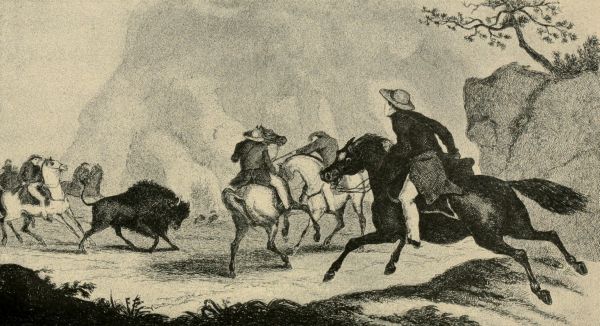
Hunting the Buffalo
NARRATIVE OF A JOURNEY ACROSS THE ROCKY MOUNTAINS, TO THE COLUMBIA RIVER, AND A VISIT TO THE SANDWICH ISLANDS, CHILI, &c. WITH A SCIENTIFIC APPENDIX.
BY JOHN K. TOWNSEND, Member of the Academy of Natural Sciences of Philadelphia.
PHILADELPHIA: HENRY PERKINS, 134 CHESTNUT STREET. BOSTON: PERKINS & MARVIN. —— 1839.
Entered according to Act of Congress, in the year 1839, by John K. Townsend, in the Office of the Clerk of the District Court of the Eastern District of Pennsylvania.