Volume 3 — NUCLEAR FUSION
Reading edition
The Energy of the Sun
As it happens, though, nuclear fission is not the only route to useful nuclear energy.
Aston’s studies in the 1920s had shown that it was the middle-sized nuclei that were most tightly packed. Energy would be given off if middle-sized nuclei were produced from either extreme. Not only would energy be formed by the breakup of particularly massive nuclei through fission, but also through the combination of small nuclei to form larger ones (“nuclear fusion”).
In fact, from Aston’s studies it could be seen that, mass for mass, nuclear fusion would produce far more energy than nuclear fission. This was particularly true in the conversion of hydrogen to helium; that is, the conversion of the individual protons of 4 separate hydrogen nuclei into the 2-proton—2-neutron structure of the helium nucleus. A gram of hydrogen, undergoing fusion to helium, would deliver some fifteen times as much energy as a gram of uranium undergoing fission.
As early as 1920, the English astronomer Arthur Stanley Eddington (1882-1944) had speculated that the sun’s energy might be derived from the interaction of subatomic particles. Some sort of nuclear reaction seemed, by then, to be the most reasonable way of accounting for the vast energies constantly being produced by the sun.
The speculation became more plausible with each year. Eddington himself studied the structure of stars, and by 1926 had produced convincing theoretical reasons for supposing that the center of the sun was at enormous densities and temperatures. A temperature of some 15,000,000 to 20,000,000°C seemed to characterize the sun’s center.
At such temperatures, atoms could not exist in earthly fashion. Held together by the sun’s strong gravitational field, 147 they collided with such energy that all or almost all their electrons were stripped off, and little more than bare nuclei were left. These bare nuclei could approach each other much more closely than whole atoms could (which was why the center of the sun was so much more dense than earthly matter could be). The bare nuclei, smashing together at central-sun temperatures, could cling together and form more complex nuclei. Nuclear reactions brought about by such intense heat (millions of degrees) are called “thermonuclear reactions”.
As the 1920s progressed further studies of the chemical structure of the sun showed it to be even richer in hydrogen than had been thought. In 1929 the American astronomer Henry Norris Russell (1877-1957) reported evidence that the sun was 60% hydrogen in volume. (Even this was too conservative; 80% is considered more nearly correct now.) If the sun’s energy were based on nuclear reactions at all, then it had to be the result of hydrogen fusion. Nothing else was present in sufficient quantity to be useful as a fuel.
More and more was learned about the exact manner in which nuclei interacted and about the quantity of energy given off in particular nuclear reactions. It became possible to calculate what might be going on inside the sun by considering the densities and temperatures present, the kind and number of different nuclei available, and the quantity of energy that must be produced. In 1938 the German-American physicist Hans Albrecht Bethe (1906- ) and the German astronomer Carl Friedrich von Weizsäcker (1912- ) independently worked out the possible reactions, and hydrogen fusion was shown to be a thoroughly practical way of keeping the sun going.
Thanks to the high rate of energy production by thermonuclear reactions and to the vast quantity of hydrogen in the sun, not only has it been possible for the sun to have been radiating energy for the last 5,000,000,000 years or so, 148 but it will continue to radiate energy in the present fashion for at least 5,000,000,000 years into the future.
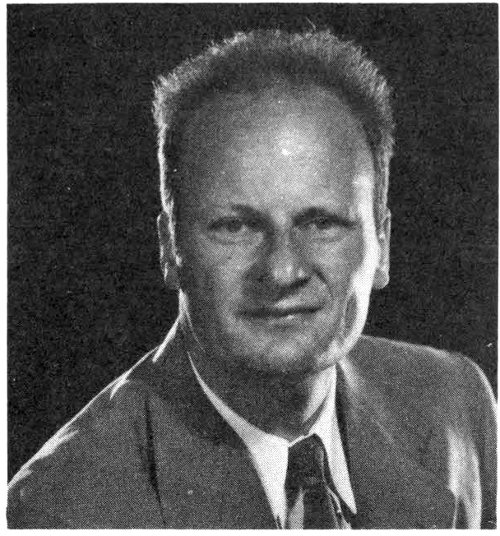
Hans Bethe
Even so, the sheer quantity of what is going on in the sun is staggering in earthly terms. In the sun 650,000,000 tons of hydrogen are converted into helium every second, and in the process each second sees the disappearance of 4,600,000 tons of mass.
Thermonuclear Bombs
Could thermonuclear reactions be made to take place on earth? The conditions that exist in the center of the sun would be extremely difficult to duplicate on the earth, so there was a natural search for any kind of nuclear fusion that would produce similar energies to those going on in the sun but which would be easier to bring about.
There are 3 hydrogen isotopes known to exist. Ordinary hydrogen is almost entirely hydrogen-1, with a nucleus made up of a single proton. Small quantities of hydrogen-2 (deuterium) with a nucleus made up of a proton plus a neutron also exist and such atoms are perfectly stable.
In 1934 Rutherford, along with the Australian physicist Marcus Laurence Elwin Oliphant (1901- ) and the Austrian chemist Paul Harteck (1902- ) sent hydrogen-2 149 nuclei flying into hydrogen-2 targets and formed hydrogen-3 (also called “tritium” from the Greek word for “third”) with a nucleus made up of a proton plus 2 neutrons. Hydrogen-3 is mildly radioactive.
Hydrogen-2 fuses to helium more easily than hydrogen-1 does and, all things being equal, hydrogen-2 will do so at lower temperatures than hydrogen-1. Hydrogen-3 requires lower temperatures still. But even for hydrogen-3 it still takes millions of degrees.
Hydrogen-3, although the easiest to be forced to undergo fusion, exists only in tiny quantities.
Hydrogen-2, therefore, is the one to pin hopes on especially in conjunction with hydrogen-3. Only 1 atom out of every 6000 hydrogen atoms is hydrogen-2, but that is enough. There exists a vast ocean on earth that is made up almost entirely of water molecules and in each water molecule 2 hydrogen atoms are present. Even if only 1 in 6000 of these hydrogen atoms is deuterium that still means there are about 35,000 billion tons of deuterium in the ocean.
What’s more, it isn’t necessary to dig for that deuterium or to drill for it. If ocean water is allowed to run through separation plants, the deuterium can be extracted without very much trouble. In fact, for the energy you could get out of it, deuterium from the oceans, extracted by present methods and without allowing for future improvement, would be only one-hundredth as expensive as coal.
The deuterium in the world’s ocean, if allowed to undergo fusion little by little, would supply mankind with enough energy to keep us going at the present rate for 500,000,000,000 years. To be sure, to make deuterium fusion practical, it may be necessary to make use of rarer substances such as the light metal lithium. This will place a sharper limit on the energy supply but even if we are careful, fusion would probably supply mankind with energy for as long as mankind will exist.
150
Then, too, there would seem to be no danger of hydrogen fusion plants running out of control. Only small quantities of deuterium would be in the process of fusion at any one time. If anything at all went wrong, the deuterium supply could be automatically cut off and the fusion process, with so little involved, would then stop instantly. Moreover, there would be less reason to worry about atomic wastes, for the most dangerous products—hydrogen-3 and neutrons—could be easily taken care of.
It seems ideal, but there is a catch. However clear the theory, before a fusion power station can be established some practical method must be found to start the fusion process, which means finding some way for attaining temperatures in the millions of degrees.
One method for obtaining the necessary temperature was known by 1945. An exploding fission bomb would do it. If, somehow, the necessary hydrogen-2 was combined with a fission bomb, the explosion would set off a fusion reaction that would greatly multiply the energy released. You would have in effect a “thermonuclear bomb”. (To the general public, this was commonly known as a “hydrogen bomb” or an “H-bomb”.)
In 1952 the first fusion device was exploded by the United States in the Marshall Islands. Within months, the Soviet Union had exploded one of its own and in time thermonuclear bombs thousands of times as powerful as the first fission bomb over Hiroshima were built and exploded.
All thermonuclear bombs have been exploded only for test purposes. Even testing seems to be dangerous, however, at least if it is carried on in the open atmosphere. The radioactivity liberated spreads over the world and may do slow but cumulative damage.
Controlled Fusion
However effective a fusion bomb may be in liberating vast quantities of energy, it is not what one has in mind when 151 speaking of a fusion power station. The energy of a fusion bomb is released all at once and its only function is that of utter destruction. What is wanted is the production of fusion energy at a low and steady rate—a rate that is under the control of human operators.
The sun, for instance, is a vast fusion furnace 866,000 miles across, but it is a controlled one—even though that control is exerted by the impersonal laws of nature. It releases energy at a very steady and very slow rate. (The rate is not slow in human terms, of course, but stars sometimes do release their energy in a much more cataclysmic fashion. The result is a “supernova” in which for a short time a single star will increase its radiation to as much as a trillion times its normal level.)
The sun (or any star) going at its normal rate is controlled and steady in its output because of the advantage of huge mass. An enormous mass, composed mainly of hydrogen, compresses itself, through its equally enormous gravitational field, into huge densities and temperatures at its center, thus igniting the fusion reaction—while the same gravitational field keeps the sun together against its tendency to expand.
There is, as far as scientists know, no conceivable way of concentrating a high gravitational field in the absence of the required mass, and the creation of controlled fusion on earth must therefore be done without the aid of gravity. Without a huge gravitational force we cannot simultaneously bring about sun-center densities and sun-center temperatures; one or the other must go.
On the whole, it would take much less energy to aim at the temperatures than at the densities and would be much more feasible. For this reason, physicists have been attempting, all through the nuclear age, to heat thin wisps of hydrogen to enormous temperature. Since the gas is thin, the nuclei are farther apart and collide with each other far fewer times per second. To achieve fusion ignition, therefore, temperatures must be considerably higher than those at the center of the sun. In 1944 Fermi calculated that it might take a temperature of 50,000,000° to ignite a hydrogen-3 fusion with hydrogen-2 under earthly conditions, and 400,000,000° to ignite hydrogen-2 fusion alone. To ignite hydrogen-1 fusion, which is what goes on in the sun (at a mere 15,000,000°), physicists would have to raise their sights to beyond the billion-degree mark.
152
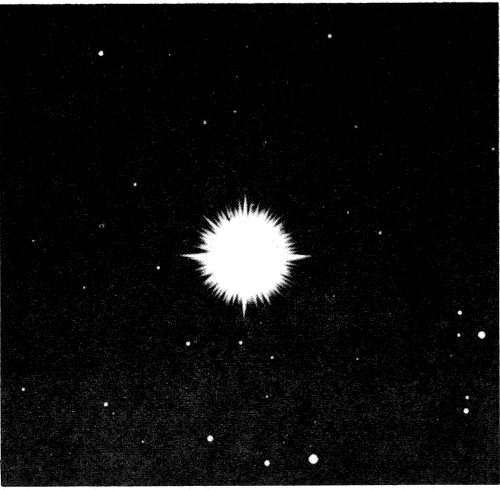
A supernova photographed on March 10, 1935.
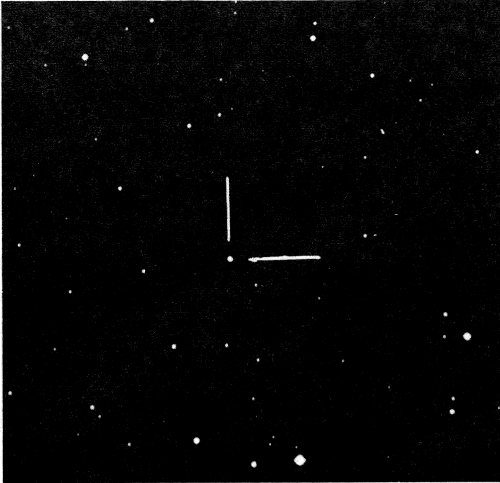
The same star on May 6.
153
This would make it seem almost essential to use hydrogen-3 in one fashion or another. Even if it can’t be prepared in quantity to begin with, it might be formed by neutron bombardment of lithium, with the neutrons being formed by the fusion reaction. In this way, you would start with lithium and hydrogen-2 plus a little hydrogen-3. The hydrogen-3 is formed as fast as it is used up. Although in the end hydrogen is converted to helium in a controlled fusion reaction as in the sun, the individual steps in the reaction under human control are quite different from those in the sun.
Still, even the temperatures required for hydrogen-3 represent an enormous problem, particularly since the temperature must not only be reached, but must be held for a period of time. (You can pass a piece of paper rapidly through a candle flame without lighting it. It must be held in the flame for a short period to give it a chance to heat and ignite.)
The English physicist John David Lawson (1923- ) worked out the requirements in 1957. The time depended on the density of the gas. The denser the gas, the shorter the period over which the temperature had to be maintained. If the gas is about one hundred-thousand times as dense as air, the proper temperature must be held, under the most favorable conditions, for about one thousandth of a second.
There are a number of different ways in which a quantity of hydrogen can be heated to very high temperatures—through electric currents, through magnetic fields, through 154 laser beams and so on. As the temperature goes up into the tens of thousands of degrees, the hydrogen atoms (or any atoms) are broken up into free electrons and bare nuclei. Such a mixture of charged particles is called a “plasma”. Ever since physicists have begun to try to work with very hot gases, with fusion energy in mind, they have had to study the properties of such “plasma”, and a whole new science of “plasma physics” has come into existence.
But if you do heat a gas to very high temperatures, it will tend to expand and thin out to uselessness. How can such a super-hot gas be confined in a fixed volume without an enormous gravitational field to hold it together?
An obvious answer would be to place it in a container, but no ordinary container of matter will serve to hold the hot gas. You may think this is because the temperature of the gas will simply melt or vaporize whatever matter encloses it. This is not so. Although the gas is at a very high temperature, it is so thin that it has very little total heat. It does not have enough heat to melt the solid walls of a container. What happens instead is that the hot plasma cools down the moment it touches the solid walls and the entire attempt to heat it is ruined.
What’s more, if you try to invest the enormous energies required to keep the plasma hot despite the cooling effect of the container walls, then the walls will gradually heat and melt. Nor must one wait for the walls to melt and the plasma to escape before finding the attempt at fusion ruined. Even as the walls heat up they liberate some of their own atoms into the plasma and introduce impurities that will prevent the fusion reaction.
Any material container is therefore out of the question.
Fortunately, there is a nonmaterial way of confining plasma. Since plasma consists of a mixture of electrically charged particles, it can experience electromagnetic interactions. Instead of keeping the plasma in a material container, you can surround it by a magnetic field that is designed to 155 keep it in place. Such a magnetic field is not affected by any heat, however great, and cannot be a source of material impurity.
In 1934, the American physicist Willard Harrison Bennett (1903- ) had worked out a theory dealing with the behavior of magnetic fields enclosing plasma. It came to be called the “pinch effect” because the magnetic field pinched the gas together and held it in place.
The first attempt to make use of the pinch effect for confining plasma, with eventual ignition of fusion in mind, was in 1951 by the English physicist Alan Alfred Ware (1924- ). Other physicists followed, not only in Great Britain, but in the United States and the Soviet Union as well.
The first use of the pinch effect was to confine the plasma in a cylinder. This, however, could not be made to work. The situation was too unstable. The plasma was held momentarily, then writhed and broke up.
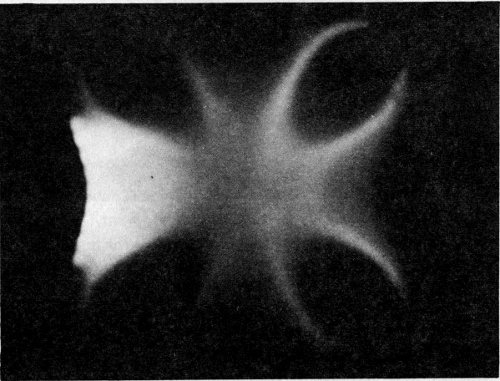
Plasma in a magnetic field.
156
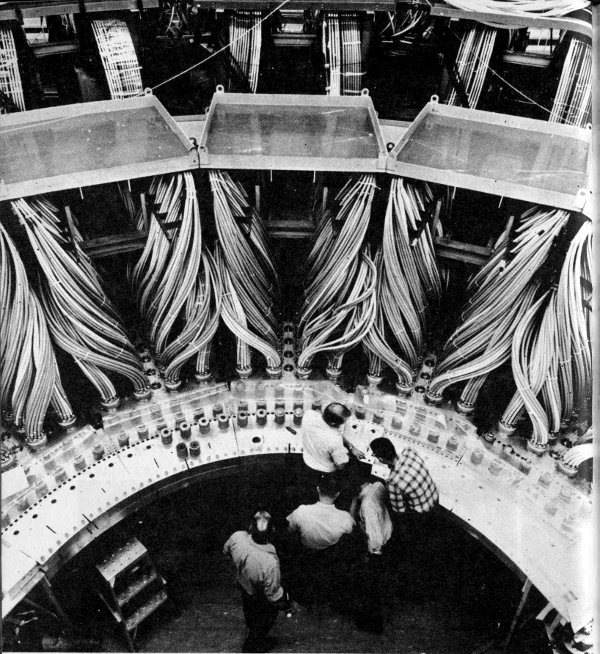
Enormous machines and complex equipment, such as the Scyllac machine shown above, are required for nuclear fusion research.
Attempts were made to remove the instability. The field was so designed as to be stronger at the ends of the cylinder than elsewhere. The particles in the plasma would stream toward one end or another and would then bounce back producing a so-called “magnetic mirror”.
157
In 1951 the American physicist Lyman Spitzer, Jr. (1914- ) had worked out the theoretical benefits to be derived from a container twisted into a figure-eight shape. Eventually, such devices were built and called “stellarators” from the Latin word for “star”, because it was hoped that it would produce the conditions that would allow the sort of fusion reactions that went on in stars.
All through the 1950s and 1960s, physicists have been slowly inching toward their goal, reaching higher and higher temperatures and holding them for longer and longer periods in denser and denser gases.
In 1969 the Soviet Union used a device called “Tokamak-3” (a Russian abbreviation for their phrase for “electric-magnetic”) to keep a supply of hydrogen-2, a millionth as dense as air, in place while heating it to tens of millions of degrees for a hundredth of a second.
A little denser, a little hotter, a little longer—and controlled fusion might become possible.[5]
158