Volume 2 — THE STRUCTURE OF THE NUCLEUS
Reading edition
The Proton
As early as 1886 Eugen Goldstein, who was working with cathode rays, also studied rays that moved in the opposite direction. Since the cathode rays (electrons) were negatively charged, rays moving in the opposite direction would have to be positively charged. In 1907 J. J. Thomson called them “positive rays”.
Once Rutherford worked out the nuclear structure of the atom, it seemed clear that the positive rays were atomic nuclei from which a number of electrons had been knocked away. These nuclei came in different sizes.
Were the nuclei single particles—a different one for every isotope of every element? Or were they all built up out of numbers of still smaller particles of a very limited number of varieties? Might it be that the nuclei owed their positive electrical charge to the fact that they contained particles just like the electron, but ones that carried a positive charge rather than a negative one?
All attempts to discover this “positive electron” in the nuclei failed, however. The smallest nucleus found was that produced by knocking the single electron off a hydrogen atom in one way or another. This hydrogen nucleus had a single positive charge, one that was exactly equal in size to the negative charge on the electron. The hydrogen nucleus, however, was much more massive than an electron. The hydrogen nucleus with its single positive charge was approximately 1837 times as massive as the electron with its single negative charge.
Was it possible to knock the positive charge loose from the mass of the hydrogen nucleus? Nothing physicists did could manage to do that. In 1914 Rutherford decided the attempt should be given up. He suggested that the hydrogen nucleus, for all its high mass, should be considered the unit of 76 positive electrical charge, just as the electron was the unit of negative electrical charge. He called the hydrogen nucleus a “proton” from the Greek word for “first” because it was the nucleus of the first element.
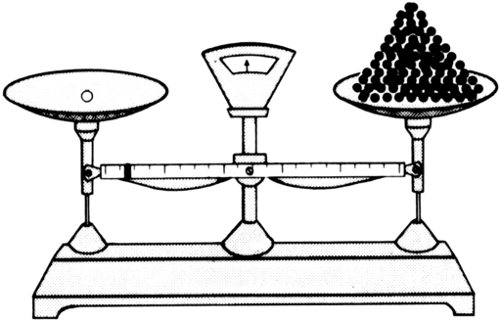
One proton balances 1837 electrons.
Why the proton should be so much more massive than the electron is still one of the unanswered mysteries of physics.
The Proton-Electron Theory
What about the nuclei of elements other than hydrogen?
All the other elements had nuclei more massive than that of hydrogen and the natural first guess was that these were made up of some appropriate number of protons closely packed together. The helium nucleus, which had a mass four times as great as that of hydrogen, might be made up of 4 protons; the oxygen nucleus with a mass number of 16 might be made up of 16 protons and so on.
This guess, however, ran into immediate difficulties. A helium nucleus might have a mass number of 4 but it had an electric charge of +2. If it were made up of 4 protons, it ought to have an electric charge of +4. In the same way, an 77 oxygen nucleus made up of 16 protons ought to have a charge of +16, but in actual fact it had one of +8.
Could it be that something was cancelling part of the positive electric charge? The only thing that could do so would be a negative electric charge[1] and these were to be found only on electrons as far as anyone knew in 1914. It seemed reasonable, then, to suppose that a nucleus would contain about half as many electrons in addition to the protons. The electrons were so light, they wouldn’t affect the mass much, and they would succeed in cancelling some of the positive charge.
Thus, according to this early theory, now known to be incorrect, the helium nucleus contained not only 4 protons, but 2 electrons in addition. The helium nucleus would then have a mass number of 4 and an electric charge (atomic number) of 4 - 2, or 2. This was in accordance with observation.
This “proton-electron theory” of nuclear structure accounted for isotopes very nicely. While oxygen-16 had a nucleus made up of 16 protons and 8 electrons, oxygen-17 had one of 17 protons and 9 electrons, and oxygen-18 had one of 18 protons and 10 electrons. The mass numbers were 16, 17, and 18, respectively, but the atomic number was 16 - 8, 17 - 9, and 18 - 10, or 8 in each case.
Again, uranium-238 has a nucleus built up, according to this theory, of 238 protons and 146 electrons, while uranium-235 has one built up of 235 protons and 143 electrons. In these cases the atomic number is, respectively, 238 - 146 and 235 - 143, or 92 in each case. The nucleus of the 2 isotopes is, however, of different structure and it is not surprising therefore that the radioactive properties of the 78 two—properties that involve the nucleus—should be different and that the half-life of uranium-238 should be six times as long as that of uranium-235.
The presence of electrons in the nucleus not only explained the existence of isotopes, but seemed justified by two further considerations.
First, it is well known that similar charges repel each other and that the repulsion is stronger the closer together the similar charges are forced. Dozens of positively charged particles squeezed into the tiny volume of an atomic nucleus couldn’t possibly remain together for more than a tiny fraction of a second. Electrical repulsion would send them flying apart at once.
On the other hand, opposite charges attract, and a proton and an electron would attract each other as strongly as 2 protons (or 2 electrons) would repel each other. It was thought possible that the presence of electrons in a collection of protons might somehow limit the repulsive force and stabilize the nucleus.
Second, there are radioactive decays in which beta particles are sent flying out of the atom. From the energy involved they could come only out of the nucleus. Since beta particles are electrons and since they come from the nucleus, it seemed to follow that there must be electrons within the nucleus to begin with.
The proton-electron theory of nuclear structure also seemed to account neatly for many of the facts of radioactivity.
Why radioactivity at all, for instance? The more complex a nucleus is, the more protons must be squeezed together and the harder, it would seem, it must be to keep them together. More and more electrons seemed to be required. Finally, when the total number of protons was 84 or more, no amount of electrons seemed sufficient to stabilize the nucleus.
79
The manner of breakup fits the theory, too. Suppose a nucleus gives off an alpha particle. The alpha particle is a helium nucleus made up, by this theory, of 4 protons and 2 electrons. If a nucleus loses an alpha particle, its mass number should decline by 4 and its atomic number by 4 - 2, or 2. And, indeed, when uranium-238 (atomic number 92) gives off an alpha particle, it becomes thorium-234 (atomic number 90).
Suppose a beta particle is emitted. A beta particle is an electron and if a nucleus loses an electron, its mass number is almost unchanged. (An electron is so light that in comparison with the nucleus, we can ignore its mass.) On the other hand, a unit negative charge is gone. One of the protons in the nucleus, which had previously been masked by an electron, is now unmasked. Its positive charge is added to the rest and the atomic number goes up by one. Thus, thorium-234 (atomic number 90) gives up a beta particle and becomes protactinium-234 (atomic number 91).
If a gamma ray is given off, that gamma ray has no charge and the equivalent of very little mass. That means that neither the mass number nor the atomic number of the nucleus is changed, although its energy content is altered.
Even more elaborate changes can be taken into account. In the long run, uranium-238, having gone through many changes, becomes lead-206. Those changes include the emission of 8 alpha particles and 6 beta particles. The 8 alpha particles involve a loss of 8 × 4, or 32 in mass number, while the 6 beta particles contribute nothing in this respect. And, indeed, the mass number of uranium-238 declines by 32 in reaching lead-206. On the other hand the 8 alpha particles involve a decrease in atomic number of 8 × 2, or 16, while the 6 beta particles involve an increase in atomic number of 6 × 1, or 6. The total change is a decrease of 16 - 6, or 10. And indeed, uranium (atomic number 92) changes to lead (atomic number 82).
80
It is useful to go into such detail concerning the proton-electron theory of nuclear structure and to describe how attractive it seemed. The theory appeared solid and unshakable and, indeed, physicists used it with considerable satisfaction for 15 years.
—And yet, as we shall see, it was wrong; and that should point a moral. Even the best seeming of theories may be wrong in some details and require an overhaul.
Protons in Nuclei
Let us, nevertheless, go on to describe some of the progress made in the 1920s in terms of the proton-electron theory that was then accepted.
Since a nucleus is made up of a whole number of protons, its mass ought to be a whole number if the mass of a single proton is considered 1. (The presence of electrons would add some mass but in order to simplify matters, let us ignore that.)
When isotopes were first discovered this indeed seemed to be so. However, Aston and his mass spectrometer kept measuring the mass of different nuclei more and more closely during the 1920s and found that they differed very slightly from whole numbers. Yet a fixed number of protons turned out to have different masses if they were first considered separately and then as part of a nucleus.
Using modern standards, the mass of a proton is 1.007825. Twelve separate protons would have a total mass of twelve times that, or 12.0939. On the other hand, if the 12 protons are packed together into a carbon-12 nucleus, the mass is 12 so that the mass of the individual protons is 1.000000 apiece. What happens to this difference of 0.007825 between the proton in isolation and the proton as part of a carbon-12 nucleus?
According to Einstein’s special theory of relativity, the missing mass would have to appear in the form of energy. If 12 hydrogen nuclei (protons) plus 6 electrons are packed 81 together to form a carbon nucleus, a considerable quantity of energy would have to be given off.
In general, Aston found that as one went on to more and more complicated nuclei, a larger fraction of the mass would have to appear as energy (though not in a perfectly regular way) until it reached a maximum in the neighborhood of iron.
Iron-56, the most common of the iron isotopes, has a mass number of 55.9349. Each of its 56 protons, therefore, has a mass of 0.9988.
For nuclei more complicated than those of iron, the protons in the nucleus begin to grow more massive again. Uranium-238 nuclei, for instance, have a mass of 238.0506, so that each of the 238 protons they contain has a mass of 1.0002.
By 1927 Aston had made it clear that it is the middle elements in the neighborhood of iron that are most closely and economically packed. If a very massive nucleus is broken up into somewhat lighter nuclei, the proton packing would be tighter and some mass would be converted into energy. Similarly, if very light nuclei were joined together into somewhat more massive nuclei, some mass would be converted into energy.
This demonstration that energy was released in any shift away from either extreme of the list of atoms according to atomic number fits the case of radioactivity, where very massive nuclei break down to somewhat less massive ones.
Consider that uranium-238 gives up 8 alpha particles and 6 beta particles to become lead-206. The uranium-238 nucleus has a mass of 238.0506; each alpha particle has one of 4.0026 for a total of 32.0208; each beta particle has a mass of 0.00154 for a total of 0.00924; and the lead-206 nucleus has one of 205.9745.
This means that the uranium-238 nucleus (mass: 238.0506) changes into 8 alpha particles, 6 beta particles, and a lead-206 nucleus (total mass: 238.0045). The starting 82 mass is 0.0461 greater than the final mass and it is this missing mass that has been converted into energy and is responsible for the gamma rays and for the velocity with which alpha particles and beta particles are discharged.
Nuclear Bombardment
Once scientists realized that there was energy which became available when one kind of nucleus was changed into another, an important question arose as to whether such a change could be brought about and regulated by man and whether this might not be made the source of useful power of a kind and amount undreamed of earlier.
Chemical energy was easy to initiate and control, since that involved the shifts of electrons on the outskirts of the atoms. Raising the temperature of a system, for instance, caused atoms to move more quickly and smash against each other harder, and that in itself was sufficient to force electrons to shift and to initiate a chemical reaction that would not take place at lower temperatures.
To shift the protons within the nucleus (“nuclear reactions”) and make nuclear energy available was a harder problem by far. The particles involved were much more massive than electrons and correspondingly harder to move. What’s more, they were buried deep within the atom. No temperatures available to the physicists of the 1920s could force atoms to smash together hard enough to reach and shake the nucleus.
In fact, the only objects that were known to reach the nucleus were speeding subatomic particles. As early as 1906, for instance, Rutherford had used the speeding alpha particles given off by a radioactive substance to bombard matter and to show that sometimes these alpha particles were deflected by atomic nuclei. It was, in fact, by such an experiment that he first demonstrated the existence of such nuclei.
83
Rutherford had continued his experiments with bombardment. An alpha particle striking a nucleus would knock it free of the atom to which it belonged and send it shooting forward (like one billiard ball hitting another). The nucleus that shot ahead would strike a film of chemical that scintillated (sparkled) under the impact. In a rough way, one could tell the kind of nucleus that struck from the nature of the sparkling.
In 1919 Rutherford bombarded nitrogen gas with alpha particles and found that he obtained the kind of sparkling he associated with the bombardment of hydrogen gas. When he bombarded hydrogen, the alpha particles struck hydrogen nuclei (protons) and shot them forward. To get hydrogen-sparkling out of the bombardment of nitrogen, Rutherford felt, he must have knocked protons out of the nitrogen nuclei. Indeed, as was later found, he had converted nitrogen nuclei into oxygen nuclei.
This was the first time in history that the atomic nucleus was altered by deliberate human act.
Rutherford continued his experiments and by 1924 had shown that alpha particles could be used to knock protons out of the nuclei of almost all elements up to potassium (atomic number 19).
There were, however, limitations to the use of natural alpha particles as the bombarding agent.
First, the alpha particles used in bombardment were positively charged and so were the atomic nuclei. This meant that the alpha particles and the atomic nuclei repelled each other and much of the energy of the alpha particles was used in overcoming the repulsion. For more and more massive nuclei, the positive charge grew higher and the repulsion stronger until for elements beyond potassium, no collision could be forced, even with the most energetic naturally occurring alpha particles.
84
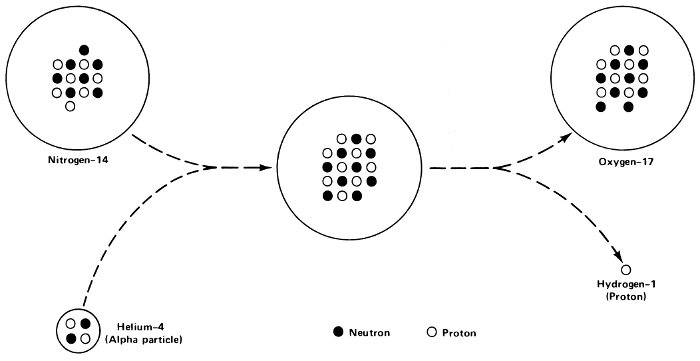
Man-made transmutation.
85
Second, the alpha particles that are sprayed toward the target cannot be aimed directly at the nuclei. An alpha particle strikes a nucleus only if, by chance, they come together. The nuclei that serve as their targets are so unimaginably small that most of the bombarding particles are sure to miss. In Rutherford’s first bombardment of nitrogen, it was calculated that only 1 alpha particle out of 300,000 managed to strike a nitrogen nucleus.
The result of these considerations is clear. There is energy to be gained out of nuclear reactions, but there is also energy that must be expended to cause these nuclear reactions. In the case of nuclear bombardment by subatomic particles (the only way, apparently, in which nuclear reactions can be brought about), the energy expended seems to be many times the energy to be extracted. This is because so many subatomic particles use up their energy in ionizing atoms, knocking electrons away, and never initiate nuclear reactions at all.
It was as though the only way you could light a candle would be to strike 300,000 matches, one after the other. If that were so, candles would be impractical.
In fact, the most dramatic result of alpha particle bombardment had nothing to do with energy production, but rather the reverse. New nuclei were produced that had more energy than the starting nuclei, so that energy was absorbed by the nuclear reaction rather than given off.
This came about first in 1934, when a French husband-and-wife team of physicists, Frédéric Joliot-Curie (1900-1958) and Irène Joliot-Curie (1897-1956) were bombarding aluminum-27 (atomic number 13) with alpha particles. The result was to combine part of the alpha particle with the aluminum-27 nucleus to form a new nucleus with an atomic number two units higher—15—and a mass number three units higher—30.
The element with atomic number 15 is phosphorus so that phosphorus-30 was formed. The only isotope of phosphorus 86 that occurs in nature, however, is phosphorus-31. Phosphorus-30 was the first man-made nucleus—the first to be manufactured by nuclear reactions in the laboratory.
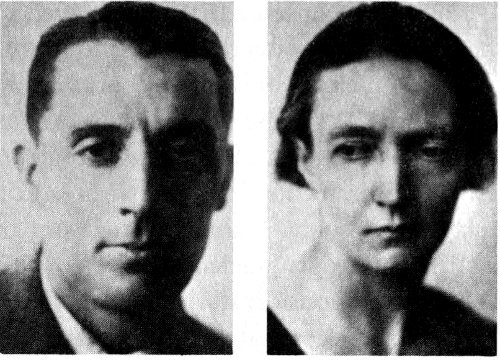
Frédéric and Irène Joliot-Curie
The reason phosphorus-30 did not occur in nature was that its energy content was too high to allow it to be stable. Its energy content drained away through the emission of particles that allowed the nucleus to change over into a stable one, silicon-30 (atomic number 14). This was an example of “artificial radioactivity”.
Since 1934, over a thousand kinds of nuclei that do not occur in nature have been formed in the laboratory through various kinds of bombardment-induced nuclear reactions. Every single one of them proved to be radioactive.
Particle Accelerators
Was there nothing that could be done to make nuclear bombardment more efficient and increase the chance of obtaining useful energy out of nuclear reactions?
In 1928 the Russian-American physicist George Gamow (1904-1968) suggested that protons might be used as bombarding agents in place of alpha particles. Protons were only one-fourth as massive as alpha particles and the collision might be correspondingly less effective; on the other hand, protons had only half the positive charge of alpha particles and would not be as strongly repelled by the nuclei. Then, too, protons were much more easily available than alpha particles. To get a supply of protons one only had to ionize the very common hydrogen atoms, i.e., get rid of the single electron of the hydrogen atom, and a single proton is left.
87
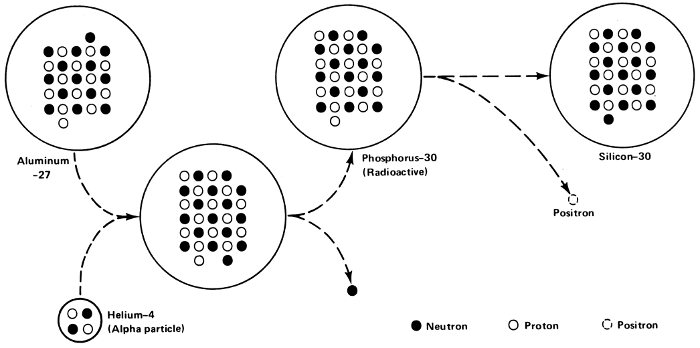
Artificial radioactivity.
88
Of course, protons obtained by the ionization of hydrogen atoms have very little energy, but could energy be imparted to them? Protons carry a positive charge and a force can therefore be exerted upon them by an electric or magnetic field. In a device that makes use of such fields, protons can be accelerated (made to go faster and faster), and thus gain more and more energy. In the end, if enough energy is gained, the proton could do more damage than the alpha particle, despite the former’s smaller mass. Combine that with the smaller repulsion involved and the greater ease of obtaining protons—and the weight of convenience and usefulness would swing far in the direction of the proton.
Physicists began to try to design “particle accelerators” and the first practical device of this sort was produced in 1929 by the two British physicists John Douglas Cockcroft (1897-1967) and Ernest Thomas Sinton Walton (1903- ). Their device, called an “electrostatic accelerator”, produced protons that were sufficiently energetic to initiate nuclear reactions. In 1931 they used their accelerated protons to disrupt the nucleus of lithium-7. It was the first nuclear reaction to be brought about by man-made bombarding particles.
Other types of particle accelerators were also being developed at this time. The most famous was the one built in 1930 by the American physicist Ernest Orlando Lawrence (1901-1958). In this device a magnet was used to make the protons move in gradually expanding circles, gaining energy with each lap until they finally moved out beyond the influence of the magnet and then hurtled out of the instrument in a straight line at maximum energy. This instrument was called a “cyclotron”.
89
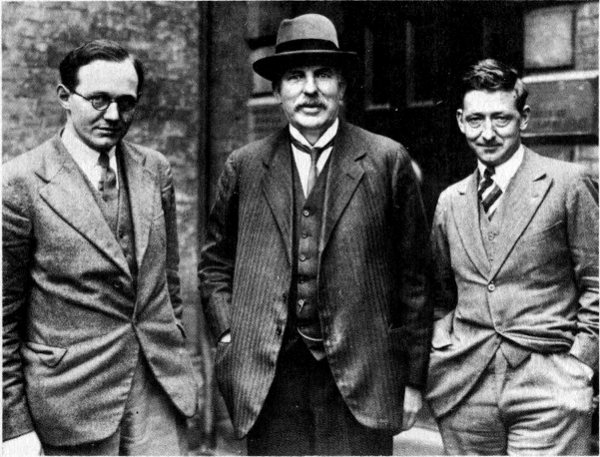
Inventors of one of the first accelerators, Ernest T. S. Walton, left, and John D. Cockcroft, right, with Lord Ernest Rutherford at Cambridge University in the early 1930s.
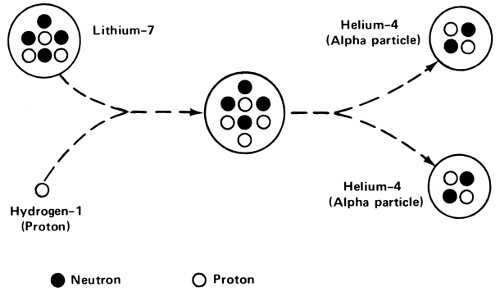
The bombardment of lithium-7 with protons was the first nuclear reaction caused by man-made particles.
90
The cyclotron was rapidly improved, using larger magnets and increasingly sophisticated design. There are now, at this time of writing, “proton synchrotrons” (descendants of that first cyclotron) that produce particles with over a million times the energy of those produced by Lawrence’s first cyclotron. Of course, the first cyclotron was only a quarter of a meter wide, while the largest today has a diameter of some 2000 meters.
As particle accelerators grew larger, more efficient, and more powerful, they became ever more useful in studying the structure of the nucleus and the nature of the subatomic particles themselves. They did not serve, however, to bring the dream of useful nuclear energy any closer. Though they brought about the liberation of vastly more nuclear energy than Rutherford’s initial bombardments could, they also consumed a great deal more energy in the process.
It is not surprising that Rutherford, the pioneer in nuclear bombardment, was pessimistic. To the end of his days (he died in 1937) he maintained that it would be forever impossible to tap the energy of the nucleus for use by man. Hopes that “nuclear power” might some day run the world’s industries were, in his view, an idle dream.
91
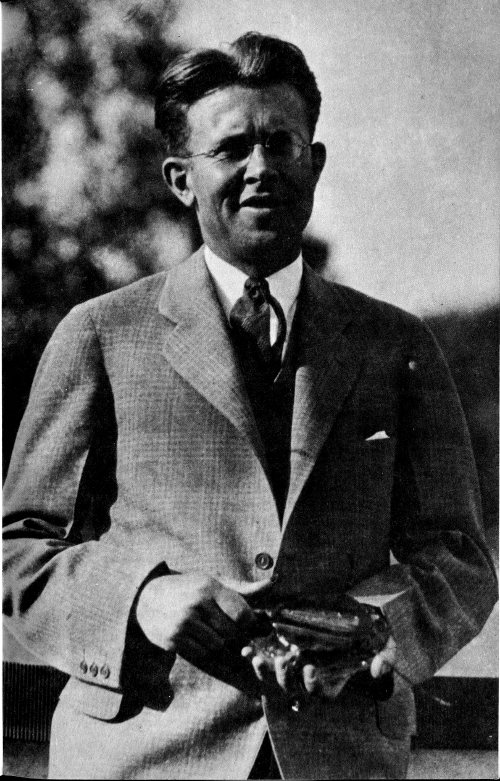
Ernest O. Lawrence holds a model of the first cyclotron in 1930, a year after its conception.
92