Volume 3 — OFFICIAL SUMMARY OF THE TREATY OF PEACE
Reading edition
GERMANY
The Allied and Associated Powers.
The preamble names as parties of the one part the United States, the British Empire, France, Italy, and Japan, described as the Five Allied and Associated Powers, and Belgium, Bolivia, Brazil, China, Cuba, Ecuador, Greece, Guatemala, Haiti, the Hedjaz, Honduras, Liberia, Nicaragua, Panama, Peru, Poland, Portugal, Roumania, Serbia, Siam, Czecho-Slovakia, and Uruguay, who with the five above are described as the allied and associated powers, and on the other part, Germany.
Desire for a firm, just and durable peace.
It states that: bearing in mind that on the request of the then Imperial German Government an armistice was granted on November 11, 1918, by the principal allied and associated powers in order that a treaty of peace might be concluded with her, and whereas the allied and associated powers, being equally desirous that the war in which they were successively involved directly or indirectly and which originated in the declaration of war by Austria-Hungary on July 28, 1914, against Serbia, the declaration of war by Germany against Russia on August 1, 1914, and against France on August 3, 1914, and in the invasion of Belgium, should be replaced by a firm, just, and durable peace, the plenipotentiaries, (having communicated their full powers found in good and due form) have agreed as follows:
From the coming into force of the present treaty the state of war will terminate. From the moment and subject to the provisions of this treaty, official relations with Germany, and with each of the German States, will be resumed by the allied and associated Powers.
SECTION I
LEAGUE OF NATIONS
Specific duties of the League of Nations.
The covenant of the League of Nations constitutes Section I of the peace treaty, which places upon the League many specific, in addition to its general, duties. It may question Germany at any time for a violation of a neutralized zone east of the Rhine as a threat against the world's peace. It will appoint three of the five members of the Sarre Commission, oversee its rêgime, and carry out the plebiscite. It will appoint the High Commissioner of Danzig, guarantee the independence of the free city, and arrange for treaties between Danzig and Germany and Poland. It will work out the mandatory system to be applied to the former German colonies, and act as a final court in part of the plebiscites of the Belgian-German frontier, and in disputes as to the Kiel Canal, and decide certain of the economic and financial problems. An International Conference on Labor is to be held in October under its direction, and another on the international control of ports, waterways, and railways is foreshadowed.
MEMBERSHIP
How states may become members or withdraw.
The members of the League will be the signatories of the covenant and other States invited to accede who must lodge a declaration of accession without reservation within two months. A new State, dominion, or colony may be admitted, provided its admission is agreed to by two-thirds of the assembly. A State may withdraw upon giving two years' notice, if it has fulfilled all its international obligations.
SECRETARIAT
Permanent secretariat at Geneva.
A permanent secretariat will be established at the seat of the League, which will be at Geneva.
ASSEMBLY
Voting by States.
The Assembly will consist of representatives of the members of the League, and will meet at stated intervals. Voting will be by States. Each member will have one vote and not more than three representatives.
COUNCIL
Meetings at least once a year.
The Council will consist of representatives of the Five Great Allied Powers, together with representatives of four members selected by the Assembly from time to time; it may co-opt additional States and will meet at least once a year.
Members not represented will be invited to send a representative when questions affecting their interests are discussed. Voting will be by States. Each State will have one vote and not more than one representative. A decision taken by the Assembly and Council must be unanimous except in regard to procedure and in certain cases specified in the covenant and in the treaty, where decisions will be by a majority.
ARMAMENTS
Permanent commission on military and naval questions.
The Council will formulate plans for a reduction of armaments for consideration and adoption. These plans will be revised every ten years. Once they are adopted, no member must exceed the armaments fixed without the concurrence of the Council. All members will exchange full information as to armaments and programs, and a permanent commission will advise the Council on military and naval questions.
PREVENTING OF WAR
Members to submit disputes to arbitration.
Council to consider means to protect covenants.
Upon any war, or threat of war, the Council will meet to consider what common action shall be taken. Members are pledged to submit matters of dispute to arbitration or inquiry and not to resort to war until three months after the award. Members agree to carry out an arbitral award and not to go to war with any party to the dispute which complies with it. If a member fails to carry out the award, the Council will propose the necessary measures. The Council will formulate plans for the establishment of a permanent court of international justice to determine international disputes or to give advisory opinions. Members who do not submit their case to arbitration must accept the jurisdiction of the Assembly. If the Council, less the parties to the dispute, is unanimously agreed upon the rights of it, the members agree that they will not go to war with any party to the dispute which complies with its recommendations. In this case, a recommendation, by the Assembly, concurred in by all its members represented on the Council and a simple majority of the rest, less the parties to the dispute, will have the force of a unanimous recommendation by the Council. In either case, if the necessary agreement cannot be secured, the members reserve the right to take such [action?] as may be necessary for the maintenance of right and justice. Members resorting to war in disregard of the covenant will immediately be debarred from all intercourse with other members. The Council will in such cases consider what military or naval action can be taken by the League collectively for the protection of the covenants and will afford facilities to members cooperating in this enterprise.
VALIDITY OF TREATIES
All treaties or international engagements concluded after the institution of the League will be registered with the secretariat and published. The Assembly may from time to time advise members to reconsider treaties which have become inapplicable or involve danger to peace.
Monroe Doctrine not to be invalidated.
The covenant abrogates all obligations between members inconsistent with its terms, but nothing in it shall affect the validity of international engagements such as treaties of arbitration or regional understandings like the Monroe Doctrine for securing the maintenance of peace.
THE MANDATORY SYSTEM
For nations not able to stand alone.
The tutelage of nations not yet able to stand by themselves will be intrusted to advanced nations who are best fitted to undertake it. The covenant recognizes three different stages of development requiring different kinds of mandatories:
Provisional independence.
(a) Communities like those belonging to the Turkish Empire, which can be provisionally recognized as independent, subject to advice and assistance from mandatary in whose selection they would be allowed a voice.
Abuses to be prohibited.
(b) Communities like those of Central Africa, to be administered by the mandatary under conditions generally approved by the members of the League, where equal opportunities for trade will be allowed to all members; certain abuses, such as trade in slaves, arms, and liquor will be prohibited, and the construction of military and naval bases and the introduction of compulsory military training will be disallowed.
League to determine degree of mandatary's authority.
(c) Other communities, such as Southwest Africa and the South Pacific Islands, but administered under the laws of the mandatary as integral portions of its territory. In every case the mandatary will render an annual report, and the degree of its authority will be defined.
GENERAL INTERNATIONAL PROVISIONS
To maintain fair conditions of labor.
Steps for prevention and control of disease.
Subject to and in accordance with the provisions of international convention, existing or hereafter to be agreed upon, the members of the League will in general endeavor, through the international organization established by the Labor Convention, to secure and maintain fair conditions of labor for men, women and children in their own countries and other countries, and undertake to secure just treatment of the native inhabitants of territories under their control; they will entrust the League with the general supervision over the execution of agreements for the suppression of traffic in women and children, &c.; and the control of the trade in arms and ammunition with countries in which control is necessary; they will make provision for freedom of communication and transit and equitable treatment for commerce of all members of the League, with special reference to the necessities of regions devastated during the war; and they will endeavor to take steps for international prevention and control of disease. International bureaus and commissions already established will be placed under the League, as well as those to be established in the future.
AMENDMENTS TO THE COVENANT
Amendments to the covenant will take effect when ratified by the Council and by a majority of the Assembly.
SECTION II
BOUNDARIES OF GERMANY
Germany to cede to France and Poland.
Germany cedes to France Alsace-Lorraine, 5,600 square miles to the southwest, and to Belgium two small districts between Luxemburg and Holland, totaling 382 square miles. She also cedes to Poland the southeastern tip of Silesia beyond and including Oppeln, most of Posen, and West Prussia, 27,686 square miles, East Prussia being isolated from the main body by a part of Poland. She loses sovereignty over the northeastern tip of East Prussia, 40 square miles north of the river Memel, and the internationalized areas about Danzig, 729 square miles, and the Basin of the Sarre, 738 square miles, between the western border of the Rhenish Palatinate of Bavaria and the southeast corner of Luxemburg. The Danzig area consists of the V between the Nogat and Vistula Rivers made a W by the addition of a similar V on the west, including the city of Danzig. The southeastern third of East Prussia and the area between East Prussia and the Vistula north of latitude 53 degrees 3 minutes is to have its nationality determined by popular vote, 5,785 square miles, as is to be the case in part of Schleswig, 2,787 square miles.
SECTION III
BELGIUM
Frontier changes.
Germany is to consent to the abrogation of the treaties of 1839, by which Belgium was established as a neutral State, and to agree in advance to any convention with which the allied and associated Powers may determine to replace them. She is to recognize the full sovereignty of Belgium over the contested territory of Moresnet and over part of Prussian Moresnet, and to renounce in favor of Belgium all rights over the circles of Eupen and Malmedy, the inhabitants of which are to be entitled within six months to protest against this change of sovereignty either in whole or in part, the final decision to be reserved to the League of Nations. A commission is to settle the details of the frontier, and various regulations for change of nationality are laid down.
LUXEMBURG
Germany to renounce rights of exploitation.
Germany renounces her various treaties and conventions with the Grand Duchy of Luxemburg, recognizes that it ceased to be a part of the German Zollverein from January first, last, renounces all right of exploitation of the railroads, adheres to the abrogation of its neutrality, and accepts in advance any international agreement as to it reached by the allied and associated powers.
LEFT BANK OF THE RHINE
No German fortifications or armed forces.
As provided in the military clauses, Germany will not maintain any fortifications or armed forces less than fifty kilometers to the east of the Rhine, hold any manœuvres, nor maintain any works to facilitate mobilization. In case of violation, "she shall be regarded as committing a hostile act against the Powers who sign the present treaty and as intending to disturb the peace of the world." "By virtue of the present treaty, Germany shall be bound to respond to any request for an explanation which the Council of the League of Nations may think it necessary to address to her."
ALSACE-LORRAINE
Territories restored to France.
After recognition of the moral obligation to repair the wrong done in 1871 by Germany to France and the people of Alsace-Lorraine, the territories ceded to Germany by the Treaty of Frankfort are restored to France with their frontiers as before 1871, to date from the signing of the armistice, and to be free of all public debts.
How French citizenship may be acquired.
Citizenship is regulated by detailed provisions distinguishing those who are immediately restored to full French citizenship, those who have to make formal applications therefor, and those for whom naturalization is open after three years. The last named class includes German residents in Alsace-Lorraine, as distinguished from those who acquire the position of Alsace-Lorrainers as defined in the treaty. All public property and all private property of German ex-sovereigns passes to France without payment or credit. France is substituted for Germany as regards ownership of the railroads and rights over concessions of tramways. The Rhine bridges pass to France with the obligation for their upkeep.
Manufactured products to be admitted to Germany.
Administration of Kehl and Strassbourg.
For five years manufactured products of Alsace-Lorraine will be admitted to Germany free of duty to a total amount not exceeding in any year the average of the three years preceding the war and textile materials may be imported from Germany to Alsace-Lorraine and re-exported free of duty. Contracts for electric power from the right bank must be continued for ten years. For seven years, with possible extension to ten, the ports of Kehl and Strassbourg shall be administered as a single unit by a French administrator appointed and supervised by the Central Rhine Commission. Property rights will be safeguarded in both ports and equality of treatment as respects traffic assured the nationals, vessels, and goods of every country.
Contracts, judgments of courts, political condemnations.
Contracts between Alsace-Lorraine and Germany are maintained save for France's right to annul on grounds of public interest. Judgments of courts hold in certain classes of cases while in others a judicial exequatur is first required. Political condemnations during the war are null and void and the obligation to repay war fines is established as in other parts of allied territory.
Various clauses adjust the general provisions of the treaty to the special conditions of Alsace-Lorraine, certain matters of execution being left to conventions to be made between France and Germany.
THE SARRE
To compensate for destruction of mines in France.
In compensation for the destruction of coal mines in Northern France and as payment on account of reparation, Germany cedes to France full ownership of the coal mines of the Sarre Basin with their subsidiaries, accessories and facilities. Their value will be estimated by the Separation Commission and credited against that account. The French rights will be governed by German law in force at the armistice excepting war legislation, France replacing the present owners, whom Germany undertakes to indemnify. France will continue to furnish the present proportion of coal for local needs and contribute in just proportion to local taxes. The basin extends from the frontier of Lorraine as re-annexed to France north as far as St. Wendel including on the west the valley of the Sarre as far as Sarre Holzbach and on the east the town of Homburg.
To be governed by a commission.
A local representative assembly to be organized.
In order to secure the rights and welfare of the population and guarantee to France entire freedom in working the mines the territory will be governed by a commission appointed by the League of Nations and consisting of five members, one French, one a native inhabitant of the Sarre, and three representing three different countries other than France and Germany. The League will appoint a member of the Commission as Chairman to act as executive of the Commission. The Commission will have all powers of government formerly belonging to the German Empire, Prussia and Bavaria, will administer the railroads and other public services and have full power to interpret the treaty clauses. The local courts will continue, but subject to the Commission. Existing German legislation will remain the basis of the law, but the Commission may make modification after consulting a local representative assembly which it will organize. It will have the taxing power but for local purposes only. New taxes must be approved by this assembly. Labor legislation will consider the wishes of the local labor organizations and the labor program of the League. French and other labor may be freely utilized, the former being free to belong to French unions. All rights acquired as to pensions and social insurance will be maintained by Germany and the Sarre Commission.
Liberty of religion and language.
There will be no military service but only a local gendarmerie to preserve order. The people will preserve their local assemblies, religious liberties, schools, and language, but may vote only for local assemblies. They will keep their present nationality except so far as individuals may change it. Those wishing to leave will have every facility with respect to their property. The territory will form part of the French customs system, with no export tax on coal and metallurgical products going to Germany nor on German products entering the basin and for five years no import duties on products of the basin going to Germany or German products coming into the basin. For local consumption French money may circulate without restriction.
Plebiscite to be held after fifteen years.
After fifteen years a plebiscite will be held by communes to ascertain the desires of the population as to continuance of the existing régime under the League of Nations, union with France or union with Germany. The right to vote will belong to all inhabitants over twenty resident therein at the signature. Taking into account the opinions thus expressed the League will decide the ultimate sovereignty. In any portion restored to Germany the German Government must buy out the French mines at an appraised valuation. If the price is not paid within six months thereafter this portion passes finally to France. If Germany buys back the mines the League will determine how much of the coal shall be annually sold to France.
SECTION IV
GERMAN AUSTRIA
Independence to be recognized.
"Germany recognizes the total independence of German Austria in the boundaries traced."
CZECHO-SLOVAKIA
Frontiers of the new State.
Germany recognizes the entire independence of the Czecho-Slovak State, including the autonomous territory of the Ruthenians south of the Carpathians, and accepts the frontiers of this State as to be determined, which in the case of the German frontier shall follow the frontier of Bohemia in 1914. The usual stipulations as to acquisition and change of nationality follow.
POLAND
A Boundary Commission to be constituted.
Minorities to be protected.
Germany cedes to Poland the greater part of Upper Silesia, Posen and the province of West Prussia on the left bank of the Vistula. A Field Boundary Commission of seven, five representing the allied and associated powers and one each representing Poland and Germany, shall be constituted within fifteen days of the peace to delimit this boundary. Such special provisions as are necessary to protect racial, linguistic or religious minorities and to protect freedom of transit and equitable treatment of commerce of other nations shall be laid down in a subsequent treaty between the principal allied and associated powers and Poland.
EAST PRUSSIA
Frontiers of East Prussia and Poland.
The southern and the eastern frontier of East Prussia as touching Poland is to be fixed by plebiscites, the first in the regency of Allenstein between the southern frontier of East Prussia and the northern frontier, or Regierungsbezirk Allenstein from where it meets the boundary between East and West Prussia to its junction with the boundary between the circles of Oletsko and Angersburg, thence the northern boundary of Oletsko to its junction with the present frontier, and the second in the area comprising the circles of Stuhm and Rosenberg and the parts of the circles of Marienburg and Marienwerder east of the Vistula.
German troops and officials to leave.
In each case German troops and authorities will move out within fifteen days of the peace, and the territories be placed under an international commission of five members appointed by the principal allied and associated powers, with the particular duty of arranging for a free, fair and secret vote. The commission will report the results of the plebiscites to the powers with a recommendation for the boundary, and will terminate its work as soon as the boundary has been laid down and the new authorities set up.
Access to the Vistula.
The principal allied and associated powers will draw up regulations assuring East Prussia full and equitable access to and use of the Vistula. A subsequent convention, of which the terms will be fixed by the principal allied and associated powers, will be entered into between Poland, Germany and Danzig, to assure suitable railroad communication across German territory on the right bank of the Vistula between Poland and Danzig, while Poland shall grant free passage from East Prussia to Germany.
The northeastern corner of East Prussia about Memel is to be ceded by Germany to the associated powers, the former agreeing to accept the settlement made, especially as regards the nationality of the inhabitants.
DANZIG
Danzig to be under League of Nations.
Danzig and the district immediately about it is to be constituted into the "free city of Danzig" under the guarantee of the League of Nations. A high commissioner appointed by the League and President of Danzig shall draw up a constitution in agreement with the duly appointed representatives of the city, and shall deal in the first instance with all differences arising between the city and Poland. The actual boundaries of the city shall be delimited by a commission appointed within six months from the peace and to include three representatives chosen by the allied and associated powers, and one each by Germany and Poland.
Convention between Danzig and Poland.
A convention, the terms of which shall be fixed by the principal allied and associated powers, shall be concluded between Poland and Danzig, which shall include Danzig within the Polish customs frontiers, though a free area in the port; insure to Poland the free use of all the city's waterways, docks and other port facilities, the control and administration of the Vistula and the whole through railway system within the city, and postal, telegraphic and telephonic communication between Poland and Danzig; provide against discrimination against Poles within the city, and place its foreign relations and the diplomatic protection of its citizens abroad in charge of Poland.
DENMARK
Frontier to be fixed by self-determination.
The frontier between Germany and Denmark will be fixed by the self-determination of the population. Ten days from the peace German troops and authorities shall evacuate the region north of the line running from the mouth of the Schlei, south of Kappel, Schleswig, and Friedrichstadt along the Eider to the North Sea south of Tonning; the Workmen's and Soldiers' Councils shall be dissolved, and the territory administered by an international commission of five, of whom Norway and Sweden shall be invited to name two.
Voting to be in zones.
The commission shall insure a free and secret vote in three zones. That between the German-Danish frontier and a line running south of the Island of Alsen, north of Flensburg, and south of Tondern to the North Sea, north of the Island of Sylt, will vote as a unit within three weeks after the evacuation. Within five weeks after this vote the second zone, whose southern boundary runs from the North Sea south of the Island of Fehr to the Baltic south of Sygum, will vote by communes. Two weeks after that vote the third zone running to the limit of evacuation will also vote by communes. The international commission will then draw a new frontier on the basis of these plebiscites and with due regard for geographical and economic conditions. Germany will renounce all sovereignty over territories north of this line in favor of the Associated Governments, who will hand them over to Denmark.
HELIGOLAND
Fortifications to be destroyed.
The fortifications, military establishments, and harbors of the Islands of Heligoland and Dune are to be destroyed under the supervision of the Allies by German labor and at Germany's expense. They may not be reconstructed, nor any similar fortifications built in the future.
RUSSIA
Brest-Litovsk treaty to be abrogated.
Germany agrees to respect as permanent and inalienable the independency of all territories which were part of the former Russian Empire, to accept the abrogation of the Brest-Litovsk and other treaties entered into with the Maximalist Government of Russia, to recognize the full force of all treaties entered into by the allied and associated powers with States which were a part of the former Russian Empire, and to recognize the frontiers as determined thereon. The allied and associated powers formally reserve the right of Russia to obtain restitution and reparation on the principles of the present treaty.
SECTION V
GERMAN RIGHTS OUTSIDE EUROPE
Germany to renounce rights.
Outside Europe, Germany renounces all rights, titles, and privileges as to her own or her allies' territories to all the allied and associated powers, and undertakes to accept whatever measures are taken by the five allied powers in relation thereto.
COLONIES AND OVERSEAS POSSESSIONS
Property of German Empire to be transferred to new governments.
Germany renounces in favor of the allied and associated powers her overseas possessions with all rights and titles therein. All movable and immovable property belonging to the German Empire, or to any German State, shall pass to the Government exercising authority therein. These Governments may make whatever provisions seem suitable for the repatriation of German nationals and as to the conditions on which German subjects of European origin shall reside, hold property, or carry on business. Germany undertakes to pay reparation for damage suffered by French nationals in the Cameroons or its frontier zone through the acts of German civil and military authorities and of individual Germans from the 1st of January, 1900, to the 1st of August, 1914. Germany renounces all rights under the convention of the 4th of November, 1911, and the 29th of September, 1912, and undertakes to pay to France in accordance with an estimate presented and approved by the Repatriation Commission all deposits, credits, advances, &c., thereby secured. Germany undertakes to accept and observe any provisions by the allied and associated powers as to the trade in arms and spirits in Africa as well as to the General Act of Berlin of 1885 and the General Act of Brussels of 1890. Diplomatic protection to inhabitants of former German colonies is to be given by the Governments exercising authority.
Diplomatic protection for inhabitants.
CHINA
Germany to renounce Boxer indemnities.
Germany renounces in favor of China all privileges and indemnities resulting from the Boxer Protocol of 1901, and all buildings, wharves, barracks for munitions of warships, wireless plants, and other public property except diplomatic or consular establishments in the German concessions of Tientsin and Hankow and in other Chinese territory except Kiao-Chau and agrees to return to China at her own expense all the astronomical instruments seized in 1900 and 1901. China will, however, take no measures for disposal of German property in the legation quarter at Peking without the consent of the Powers signatory to the Boxer Protocol.
Abrogation of concession.
Germany accepts the abrogation of the concessions at Hankow and Tientsin, China agreeing to open them to international use. Germany renounces all claims against China or any allied and associated Government for the internment or repatriation of her citizens in China and for the seizure or liquidation of German interests there since August 14, 1917. She renounces in favor of Great Britain her State property in the British concession at Canton and of France and China jointly of the property of the German school in the French concession at Shanghai.
SIAM
Rights of extra territoriality to cease.
Germany recognizes that all agreements between herself and Siam, including the right of extra-territoriality, ceased July 22, 1917. All German public property, except consular and diplomatic premises, passes without compensation to Siam, German private property to be dealt with in accordance with the economic clauses. Germany waives all claims against Siam for the seizure and condemnation of her ships, liquidation of her property, or internment of her nationals.
LIBERIA
Commercial treaties and agreements to be abrogated.
Germany renounces all rights under the international arrangements of 1911 and 1912 regarding Liberia, more particularly the right to nominate a receiver of the customs, and disinterests herself in any further negotiations for the rehabilitation of Liberia. She regards as abrogated all commercial treaties and agreements between herself and Liberia and recognizes Liberia's right to determine the status and condition of the re-establishment of Germans in Liberia.
MOROCCO
Germany to renounce rights in Morocco.
Germany renounces all her rights, titles, and privileges under the Act of Algeciras and the Franco-German agreements of 1909 and 1911, and under all treaties and arrangements with the Sherifian Empire. She undertakes not to intervene in any negotiations as to Morocco between France and other Powers, accepts all the consequences of the French protectorate and renounces the capitulations; the Sherifian Government shall have complete liberty of action in regard to German nationals, and all German protected persons shall be subject to the common law. All movable and immovable German property, including mining rights, may be sold at public auction, the proceeds to be paid to the Sherifian Government and deducted from the reparation account. Germany is also required to relinquish her interests in the State Bank of Morocco. All Moroccan goods entering Germany shall have the same privilege as French goods.
EGYPT
To recognize British Protectorate over Egypt.
Germany recognizes the British Protectorate over Egypt declared on December 18, 1914, and renounces as from August 4, 1914, the capitulation and all the treaties, agreements, etc., concluded by her with Egypt. She undertakes not to intervene in any negotiations about Egypt between Great Britain and other Powers. There are provisions for jurisdiction over German nationals and property and for German consent to any changes which may be made in relation to the Commission of Public Debt. Germany consents to the transfer to Great Britain of the powers given to the late Sultan of Turkey for securing the free navigation of the Suez Canal. Arrangements for property belonging to German nationals in Egypt are made similar to those in the case of Morocco and other countries. Anglo-Egyptian goods entering Germany shall enjoy the same treatment as British goods.
TURKEY AND BULGARIA
Arrangements with Turkey and Bulgaria.
Germany accepts all arrangements which the Allied and Associated Powers made with Turkey and Bulgaria with reference to any rights, privileges or interests claimed in those countries by Germany or her nationals and not dealt with elsewhere.
SHANTUNG
To cede Kiao-Chau rights to Japan.
Germany cedes to Japan all rights, titles, and privileges, notably as to Kiao-Chau, and the railroads, mines, and cables acquired by her treaty with China of March 6, 1897, by and other agreements as to Shantung. All German rights to the railroad from Tsing-tao to Tsinan-fu, including all facilities and mining rights and rights of exploitation, pass equally to Japan, and the cables from Tsing-tao to Shanghai and Che-foo, the cables free of all charges. All German State property, movable and immovable, in Kiao-Chau is acquired by Japan free of all charges.
SECTION VI
MILITARY, NAVAL AND AIR
In order to render possible the initiation of a general limitation of the armaments of all nations, Germany undertakes directly to observe the military, naval, and air clauses which follow.
MILITARY FORCES
German Army to be demobilized.
The demobilization of the German Army must take place within two months of the peace. Its strength may not exceed 100,000, including 4,000 officers, with not over seven divisions of infantry and three of cavalry, and to be devoted exclusively to maintenance of internal order and control of frontiers. Divisions may not be grouped under more than two army corps headquarters staffs. The great German General Staff is abolished. The army administrative service, consisting of civilian personnel not included in the number of effectives, is reduced to one-tenth the total in the 1913 budget. Employees of the German States, such as customs officers, first guards, and coast guards, may not exceed the number in 1913. Gendarmes and local police may be increased only in accordance with the growth of population. None of these may be assembled for military training.
ARMAMENTS
Munition works to be closed.
All establishments for the manufacturing, preparation, storage, or design of arms and munitions of war, except those specifically excepted, must be closed within three months of the peace, and their personnel dismissed. The exact amount of armament and munitions allowed Germany is laid down in detail tables, all in excess to be surrendered or rendered useless. The manufacture or importation of asphyxiating, poisonous, or other gases and all analogous liquids is forbidden as well as the importation of arms, munitions, and war materials. Germany may not manufacture such materials for foreign governments.
CONSCRIPTION
Conscription to be abolished in Germany.
Conscription is abolished in Germany. The enlisted personnel must be maintained by voluntary enlistments for terms of twelve consecutive years, the number of discharges before the expiration of that term not in any year to exceed 5 per cent of the total effectives. Officers remaining in the service must agree to serve to the age of 45 years, and newly appointed officers must agree to serve actively for twenty-five years.
No military schools except those absolutely indispensable for the units allowed shall exist in Germany two months after the peace. No associations such as societies of discharged soldiers, shooting or touring clubs, educational establishments or universities may occupy themselves with military matters. All measures of mobilization are forbidden.
FORTRESSES
Fortifications in Rhine to be dismantled.
All fortified works, fortresses, and field works situated in German territory within a zone of fifty kilometers east of the Rhine will be dismantled within three months. The construction of any new fortifications there is forbidden. The fortified works on the southern and eastern frontiers, however, may remain.
CONTROL
Interallied commissions of control.
Interallied commissions of control will see to the execution of the provisions for which a time limit is set, the maximum named being three months. They may establish headquarters at the German seat of Government and go to any part of Germany desired. Germany must give them complete facilities, pay their expenses, and also the expenses of execution of the treaty, including the labor and material necessary in demolition, destruction or surrender of war equipment.
NAVAL
German navy to be demobilized.
The German navy must be demobilized within a period of two months after the peace. She will be allowed 6 small battleships, 6 light cruisers, 12 destroyers, 12 torpedo boats, and no submarines, either military or commercial, with a personnel of 15,000 men, including officers, and no reserve force of any character. Conscription is abolished, only voluntary service being permitted, with a minimum period of 25 years service for officers and 12 for men. No member of the German mercantile marine will be permitted any naval training.
German war vessels that must be surrendered.
All German vessels of war in foreign ports and the German high sea fleet interned at Scapa Flow will be surrendered, the final disposition of these ships to be decided upon by the allied and associated powers. Germany must surrender 42 modern destroyers, 50 modern torpedo boats, and all submarines, with their salvage vessels. All war vessels under construction, including submarines, must be broken up. War vessels not otherwise provided for are to be placed in reserve, or used for commercial purposes. Replacement of ships except those lost can take place only at the end of 20 years for battleships and 15 years for destroyers. The largest armored ship Germany will be permitted will be 10,000 tons.
To sweep up mines.
Germany is required to sweep up the mines in the North Sea and the Baltic Sea, as decided upon by the Allies. All German fortifications in the Baltic, defending the passages through the belts, must be demolished. Other coast defenses are permitted, but the number and caliber of the guns must not be increased.
WIRELESS
German wireless messages only for commercial purposes.
During a period of three months after the peace German high power wireless stations at Nauen, Hanover, and Berlin will not be permitted to send any messages except for commercial purposes, and under supervision of the allied and associated Governments, nor may any more be constructed.
CABLES
To renounce title to cables.
Germany renounces all title to specified cables, the value of such as were privately owned being credited to her against reparation indebtedness.
Germany will be allowed to repair German submarine cables which have been cut but are not being utilized by the allied powers, and also portions of cables which, after having been cut, have been removed, or are at any rate not being utilized by any one of the allied and associated powers. In such cases the cables, or portions of cables, removed or utilized remain the property of the allied and associated powers, and accordingly fourteen cables or parts of cables are specified which will not be restored to Germany.
AIR
Air personnel to be demobilized.
The armed forces of Germany must not include any military or naval air forces except for not over 100 unarmed seaplanes to be retained till October 1 to search for submarine mines. No dirigible shall be kept. The entire air personnel is to be demobilized within two months, except for 1,000 officers and men retained till October. No aviation grounds or dirigible sheds are to be allowed within 150 kilometers of the Rhine, or the eastern or southern frontiers, existing installations within these limits to be destroyed. The manufacture of aircraft and parts of aircraft is forbidden for six months. All military and naval aeronautical material under a most exhaustive definition must be surrendered within three months, except for the 100 seaplanes already specified.
PRISONERS OF WAR
Repatriation of German prisoners and interned civilians.
The repatriation of German prisoners and interned civilians is to be carried out without delay and at Germany's expense by a commission composed of representatives of the Allies and Germany. Those under sentence for offenses against discipline are to be repatriated without regard to the completion of their sentences. Until Germany has surrendered persons guilty of offenses against the laws and customs of war, the Allies have the right to retain selected German officers. The Allies may deal at their own discretion with German nationals who do not desire to be repatriated, all repatriation being conditional on the immediate release of any allied subjects still in Germany. Germany is to accord facilities to commissions of inquiry in collecting information in regard to missing prisoners of war and of imposing penalties on German officials who have concealed allied nationals. Germany is to restore all property belonging to allied prisoners. There is to be a reciprocal exchange of information as to dead prisoners and their graves.
GRAVES
Graves to be respected and maintained.
Both parties will respect and maintain the graves of soldiers and sailors buried on their territories, agree to recognize and assist any commission charged by any allied or associate Government with identifying, registering, maintaining or erecting suitable monuments over the graves, and to afford to each other all facilities for the repatriation of the remains of their soldiers.
SECTION VII
RESPONSIBILITIES
William II charged with responsibility for war.
"The allied and associated powers publicly arraign William II. of Hohenzollern, formerly German Emperor, not for an offense against criminal law, but for a supreme offense against international morality and the sanctity of treaties."
The ex-Emperor's surrender is to be requested of Holland and a special tribunal set up, composed of one judge from each of the five great powers, with full guarantees of the right of defense. It is to be guided "by the highest motives of international policy with a view of vindicating the solemn obligations of international undertakings and the validity of international morality," and will fix the punishment it feels should be imposed.
Persons who violated laws of war to be tried.
Persons accused of having committed acts in violation of the laws and customs of war are to be tried and punished by military tribunals under military law. If the charges affect nationals of only one State, they will be tried before a tribunal of that State; if they affect nationals of several States, they will be tried before joint tribunals of the States concerned. Germany shall hand over to the associated Governments, either jointly or severally, all persons so accused and all documents and information necessary to insure full knowledge of the incriminating acts, the discovery of the offenders, and the just appreciation of the responsibility. The Judge [garbled in cabling] will be entitled to name his own counsel.
SECTION VIII
REPARATION AND RESTITUTION
Germany's responsibility for loss and damage.
"The allied and associated Governments affirm, and Germany accepts, the responsibility of herself and her allies, for causing all the loss and damage to which the allied and associated Governments and their nationals have been subjected as a consequence of the war imposed upon them by the aggression of Germany and her allies."
The total obligation of Germany to pay as defined in the category of damages is to be determined and notified to her after a fair hearing, and not later than May 1, 1921, by an interallied Reparation Commission.
At the same time a schedule of payments to discharge the obligation within thirty years shall be presented. These payments are subject to postponement in certain contingencies. Germany irrevocably recognizes the full authority of this commission, agrees to supply it with all the necessary information and to pass legislation to effectuate its findings. She further agrees to restore to the Allies cash and certain articles which can be identified.
Schedule of payments to be presented.
One thousand million pounds in two years.
As an immediate step toward restoration Germany shall pay within two years one thousand million pounds sterling in either gold, goods, ships, or other specific forms of payment.
This sum being included in, and not additional to, the first thousand million bond issue referred to below, with the understanding that certain expenses, such as those of the armies of occupation and payments for food and raw materials, may be deducted at the discretion of the Allies.
Belgium to be repaid.
Germany further binds herself to repay all sums borrowed by Belgium from her allies as a result of Germany's violation of the treaty of 1839 up to November 11, 1918, and for this purpose will issue at once and hand over to the Reparation Commission 5 per cent gold bonds falling due in 1926.
While the allied and associated Governments recognize that the resources of Germany are not adequate, after taking into account permanent diminution of such resources which will result from other treaty claims, to make complete reparation for all such loss and damage, they require her to make compensation for all damage caused to civilians under seven main categories:
Damage to civilians to be compensated.
(a) Damages by personal injury to civilians caused by acts of war, directly or indirectly, including bombardments from the air.
(b) Damages caused to civilians, including exposure at sea, resulting from acts of cruelty ordered by the enemy, and to civilians in the occupied territories.
(c) Damages caused by maltreatment of prisoners.
(d) Damages to the Allied peoples represented by pensions and separation allowances, capitalized at the signature of this treaty.
(e) Damages to property other than naval or military materials.
(f) Damages to civilians by being forced to labor.
(g) Damages in the form of levies or fines imposed by the enemy.
Work of Reparation Commission.
In periodically estimating Germany's capacity to pay, the Reparation Commission shall examine the German system of taxation, first to the end that the sums for reparation which Germany is required to pay shall become a charge upon all her revenues prior to that for the service or discharge of any domestic loan; and secondly, so as to satisfy itself that in general the German scheme of taxation is fully as heavy proportionately as that of any of the powers represented on the commission.
Refusals in case of default.
The measures which the allied and associated powers shall have the right to take, in case of voluntary default by Germany, and which Germany agrees not to regard as acts of war, may include economic and financial prohibitions and reprisals and in general such other measures as the respective Governments may determine to be necessary in the circumstances.
Germany's capacity to pay.
The commission shall consist of one representative each of the United States, Great Britain, France, Italy, and Belgium, a representative of Serbia or Japan taking the place of the Belgian representative, when the interests of either country are particularly affected, with all other allied powers entitled, when their claims are under consideration, to the right of representation without voting power. It shall permit Germany to give evidence regarding her capacity to pay, and shall assure her a just opportunity to be heard. It shall make its permanent headquarters at Paris, establish its own procedure and personnel; have general control of the whole reparation problem; and become the exclusive agency of the Allies for receiving, holding, selling, and distributing reparation payments. Majority vote shall prevail, except that unanimity is required on questions involving the sovereignty of any of the Allies, the cancellation of all or part of Germany's obligations, the time and manner of selling, distributing, and negotiating bonds issued by Germany, any postponement between 1921 and 1926 of annual payments beyond 1930 and any postponement after 1926 for a period of more than three years of the application of a different method of measuring damage than in a similar former case, and the interpretation of provisions. Withdrawal from representation is permitted on twelve months' notice.
Guarantees to cover claims.
The Commission may require Germany to give from time to time by way of guarantee, issues of bonds or other obligations to cover such claims as are not otherwise satisfied. In this connection and on account of the total amount of claims, bond issues are presently to be required of Germany in acknowledgment of its debt as follows: 20,000,000,000 marks gold, payable not later than May 1, 1921, without interest; 40,000,000,000 marks gold bearing 2-1/2 per cent interest between 1921 and 1926, and thereafter 5 per cent, with a 1 per cent sinking fund payment beginning 1926; and an undertaking to deliver 40,000,000,000 marks gold bonds bearing interest at 5 per cent, under terms to be fixed by the Commission.
Interest on Germany's debt.
Certificates to represent bonds or goods.
Interest on Germany's debt will be 5 per cent unless otherwise determined by the Commission in the future, and payments that are not made in gold may "be accepted by the Commission in the form of properties, commodities, businesses, rights, concessions, &c." Certificates of beneficial interest, representing either bonds or goods delivered by Germany, may be issued by the Commission to the interested powers, no power being entitled, however, to have its certificates divided into more than five pieces. As bonds are distributed and pass from the control of the Commission, an amount of Germany's debt equivalent to their par value is to be considered as liquidated.
SHIPPING
Right to Allies to have merchant shipping replaced.
The German Government recognizes the right of the Allies to the replacement, ton for ton and class for class, of all merchant ships and fishing boats lost or damaged owing to the war, and agrees to cede to the Allies all German merchant ships of 1,600 tons gross and upward; one-half of her ships between 1,600 and 1,000 tons gross, and one-quarter of her steam trawlers and other fishing boats. These ships are to be delivered within two months to the Separation Committee, together with documents of title evidencing the transfer of the ships free from encumbrance.
"As an additional part of reparation," the German Government further agrees to build merchant ships for the account of the Allies to the amount of not exceeding 200,000 tons gross annually during the next five years.
All ships used for inland navigation taken by Germany from the Allies are to be restored within two months, the amount of loss not covered by such restitution to be made up by the cession of the German river fleet up to 20 per cent thereof.
DYESTUFFS AND CHEMICAL DRUGS
Material to be delivered to Reparations Commission.
In order to effect payment by deliveries in kind, Germany is required, for a limited number of years, varying in the case of each, to deliver coal, coal-tar products, dyestuffs and chemical drugs, in specific amounts to the Reparations Commission. The Commission may so modify the conditions of delivery as not to interfere unduly with Germany's industrial requirements. The deliveries of coal are based largely upon the principle of making good diminutions in the production of the allied countries resulting from the war.
Germany accords option to the commission on dyestuffs and chemical drugs, including quinine, up to 50 per cent of the total stock in Germany at the time the treaty comes into force, and similar option during each six months to the end of 1924 up to 25 per cent of the previous six months' output.
DEVASTATED AREAS
Machinery and animals to be replaced.
Germany undertakes to devote her economic resources directly to the physical restoration of the invaded areas. The Reparations Commission is authorized to require Germany to replace the destroyed articles by the delivery of animals, machinery, &c., existing in Germany, and to manufacture materials required for reconstruction purposes; all with due consideration for Germany's essential domestic requirements.
French damages in coal and fuel to be made good.
Germany is to deliver annually for ten years to France coal equivalent to the difference between the annual pre-war output of Nord and Pas de Calais mines and the annual production during the above ten-year period. Germany further gives options over ten years for delivery of 7,000,000 tons of coal per year to France in addition to the above, of 8,000,000 tons to Belgium and of an amount rising from 4,500,000 tons in 1919 to 1920 to 8,500,000 in 1923 to 1924 to Italy at prices to be fixed as prescribed in the treaty. Coke may be taken in place of coal in the ratio of three tons to four. Provision is also made for delivery to France over three years of benzol, coal tar, and of ammonia. The Commission has powers to postpone or annul the above deliveries should they interfere unduly with the industrial requirements of Germany.
Koran of Caliph Othman and skull of Okwawa.
Germany is to restore within six months the Koran of the Caliph Othman, formerly at Medina, to the King of the Hedjaz, and the skull of the Sultan Okwawa, formerly in German East Africa, to his Britannic Majesty's Government.
Papers taken in 1870.
The German Government is also to restore to the French Government certain papers taken by the German authorities in 1870, belonging then to M. Reuher, and to restore the French flags taken during the war of 1870 and 1871.
Reparations to the Louvain Library.
As reparation for the destruction of the Library of Louvain Germany is to hand over manuscripts, early printed books, prints, &c., to the equivalent of those destroyed.
Belgian works of art.
In addition to the above Germany is to hand over to Belgium wings, now in Berlin, belonging to the altar piece of "The Adoration of the Lamb," by Hubert and Jan van Eyck, the center of which is now in the Church of St. Bavon at Ghent, and the wings, now in Berlin and Munich, of the altar piece of "The Last Supper," by Dirk Bouts, the center of which belongs to the Church of St. Peter at Louvain.
FINANCE
The pre-war debts of Alsace.
German debts not to be assumed by mandatory powers.
Powers to which German territory is ceded will assume a certain portion of the German pre-war debt, the amount to be fixed by the Reparations Commission on the basis of the ratio between the revenue and of the ceded territory and Germany's total revenues for the three years preceding the war. In view, however, of the special circumstances under which Alsace-Lorraine was separated from France in 1871, when Germany refused to accept any part of the French public debt, France will not assume any part of Germany's pre-war debt there, nor will Poland share in certain German debts incurred for the oppression of Poland. If the value of the German public property in ceded territory exceeds the amount of debt assumed, the States to which property is ceded will give credit on reparation for the excess, with the exception of Alsace-Lorraine. Mandatory powers will not assume any German debts or give any credit for German Government property. Germany renounces all right of representation on, or control of, State banks, commissions, or other similar international financial and economic organizations.
Germany to pay cost of armies of occupation.
Germany is required to pay the total cost of the armies of occupation from the date of the armistice as long as they are maintained in German territory, this cost to be a first charge on her resources. The cost of reparation is the next charge, after making such provisions for payments for imports as the Allies may deem necessary.
Funds deposited by Turkey and Austria-Hungary.
Germany is to deliver to the allied and associated powers all sums deposited in Germany by Turkey and Austria-Hungary in connection with the financial support extended by her to them during the war, and to transfer to the Allies all claims against Austria-Hungary, Bulgaria, or Turkey in connection with agreements made during the war. Germany confirms the renunciation of the Treaties of Bucharest and Brest-Litovsk.
Public utilities in ceded territories.
Brazilian coffee to be paid for.
On the request of the Reparations Commission, Germany will expropriate any rights or interests of her nationals in public utilities in ceded territories or those administered by mandatories, and in Turkey, China, Russia, Austria-Hungary, and Bulgaria, and transfer them to the Reparations Commission, which will credit her with their value. Germany guarantees to repay to Brazil the fund arising from the sale of Sao Paulo coffee which she refused to allow Brazil to withdraw from Germany.
SECTION IX
OPIUM
Convention on opium to be brought into force.
The contracting powers agree, whether or not they have signed and ratified the opium convention of January 23, 1912, or signed the special protocol opened at The Hague in accordance with resolutions adopted by the third opium conference in 1914, to bring the said convention into force by enacting within twelve months of the peace the necessary legislation.
RELIGIOUS MISSIONS
To continue their work.
The allied and associated powers agree the properties of religious missions in territories belonging or ceded to them shall continue in their work under the control of the powers, Germany renouncing all claims in their behalf.
SECTION X—ECONOMIC CLAUSES
CUSTOMS
German tariff to be regulated for five years.
For a period of six months Germany shall impose no tariff duties higher than the lowest in force in 1914, and for certain agricultural products, wines, vegetable oils, artificial silk, and washed or scoured wool this restriction obtains for two and a half years more. For five years, unless further extended by the League of Nations, Germany must give most favored nation treatment to the allied and associated powers. She shall impose no customs tariff for five years on goods originating in Alsace-Lorraine, and for three years on goods originating in former German territory ceded to Poland with the right of observation of a similar exception for Luxemburg.
SHIPPING
Rights of ships of the Allies.
Ships of the allied and associated powers shall for five years and thereafter under condition of reciprocity, unless the League of Nations otherwise decides, enjoy the same rights in German ports as German vessels, and have most favored nation treatment in fishing, coasting trade, and towage even in territorial waters. Ships of a country having no seacoast may be registered at some one place within its territory.
UNFAIR COMPETITION
Safeguards against unfair competition.
Germany undertakes to give the trade of the allied and associated powers adequate safeguards against unfair competition, and in particular to suppress the use of false wrappings and markings, and on condition of reciprocity to respect the laws and judicial decisions of allied and associated States in respect of regional appellations of wines and spirits.
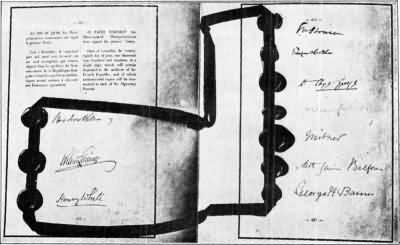
CLOSING WORDS OF THE PEACE TREATY, WITH THE SIGNATURES AND SEALS OF THE AMERICAN DELEGATES, HEADED BY THE BRITISH PRIME MINISTER, LLOYD GEORGE.
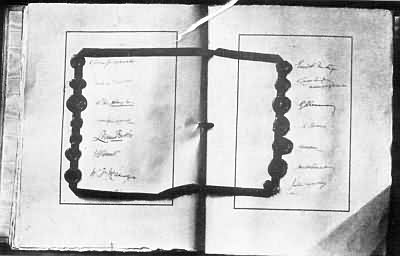
SIGNATURES AND SEALS OF CANADIAN, AUSTRALIAN, SOUTH AFRICAN, NEW ZEALAND, AND INDIAN DELEGATES. THEN THE FRENCH, HEADED BY PREMIER CLEMENCEAU.
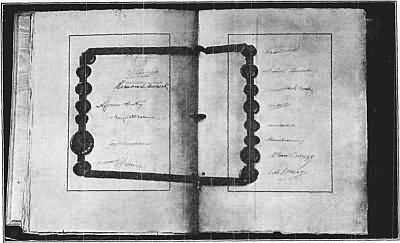
SIGNATURES AND SEALS OF THE DELEGATIONS FROM PERU, POLAND (HEADED BY PREMIER PADEREWSKI), PORTUGAL, RUMANIA, SERBIA, CZECHO-SLOVAKIA, AND URUGUAY.
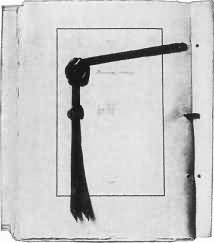
SIGNATURES AND SEALS OF THE GERMAN DELEGATES, DR. HERMANN MULLER AND DR. BELL, ON THE LAST PAGE OF THE TREATY.
The signatures of the American delegates—President Wilson, Secretary of State Lansing, Mr. Henry White, Colonel House, and General Bliss—come first after the closing words of the Treaty of Peace (pages 213 and 214); then the names of the British delegates—Prime Minister Lloyd George, Mr. Bonar Law, Lord Milner, Mr. Balfour, and Mr. Barnes (page 214); the Canadians, Minister of Justice Doherty and Minister of Customs Sifton; the Australians, Premier Hughes and Mr. Cook; the South Africans, Premier Botha and General Smuts; Premier Massey of New Zealand; Mr. Montagu, Secretary of State for India, and Maharajah Ganga Singh for India (pages 215 and 216). Then come the French—Premier Clemenceau, whose signature is third from the top on page 216, M. Pichon, M. Klotz, M. Tardieu, and M. Cambon (page 216). The name of Premier Paderewski of Poland is the second from the top on page 221.
TREATMENT OF NATIONALS
German nationality.
Germany shall impose no exceptional taxes or restriction upon the nationals of allied and associated States for a period of five years and, unless the League of Nations acts, for an additional five years German nationality shall not continue to attach to a person who has become a national of an allied or associated State.
MULTILATERAL CONVENTIONS
Postal and telegraphic conventions.
North Sea conventions.
Arrangements with various nations.
Some forty multilateral conventions are renewed between Germany and the allied and associated powers, but special conditions are attached to Germany's readmission to several. As to postal and telegraphic conventions Germany must not refuse to make reciprocal agreements with the new States. She must agree as respects the radio-telegraphic convention to provisional rules to be communicated to her, and adhere to the new convention when formulated. In the North Sea fisheries and North Sea liquor traffic convention, rights of inspection and police over associated fishing boats shall be exercised for at least five years only by vessels of these powers. As to the international railway union she shall adhere to the new convention when formulated. China, as to the Chinese customs tariff arrangement of 1905 regarding Whangpoo, and the Boxer indemnity of 1901; France, Portugal, and Rumania, as to The Hague Convention of 1903, relating to civil procedure, and Great Britain and the United States as to Article III. or the Samoan Treaty of 1899, are relieved of all obligations toward Germany.
BILATERAL TREATIES
Renewal of treaties.
Each allied and associated State may renew any treaty with Germany in so far as consistent with the peace treaty by giving notice within six months. Treaties entered into by Germany since August 1, 1914, with other enemy States, and before or since that date with Rumania, Russia, and governments representing parts of Russia are abrogated, and concessions granted under pressure by Russia to German subjects are annulled. The allied and associated States are to enjoy most favored nation treatment under treaties entered into by Germany and other enemy States before August 1, 1914, and under treaties entered into by Germany and neutral States during the war.
PRE-WAR DEBTS
Clearing houses for pre-war debts.
A system of clearing houses is to be created within three months, one in Germany and one in each allied and associated State which adopts the plan for the payment of pre-war debts, including those arising from contracts suspended by the war. For the adjustment of the proceeds of the liquidation of enemy property and the settlement of other obligations each participating State assumes responsibility for the payment of all debts owing by its nationals to nationals of the enemy States, except in case of pre-war insolvency of the debtor. The proceeds of the sale of private enemy property in each participating State may be used to pay the debts owed to the nationals of that State, direct payment from debtor to creditor and all communications relating thereto being prohibited. Disputes may be settled by arbitration by the courts of the debtor country, or by the mixed arbitral tribunal. Any ally or associated power may, however, decline to participate in this system by giving six months' notice.
ENEMY PROPERTY
Damages for private property seized or injured.
Germany shall restore or pay for all private enemy property seized or damaged by her, the amount of damages to be fixed by the mixed arbitral tribunal. The allied and associated States may liquidate German private property within their territories as compensation for property of their nationals not restored or paid for by Germany. For debts owed to their nationals by German nationals and for other claims against Germany, Germany is to compensate its nationals for such losses and to deliver within six months all documents relating to property held by its nationals in allied and associated States. All war legislation as to enemy property rights and interests is confirmed and all claims by Germany against the allied or associated Governments for acts under exceptional war measures abandoned.
Pre-war contracts.
Pre-war contracts between allied and associated nationals excepting the United States, Japan, and Brazil and German nationals are cancelled except for debts for accounts already performed.
AGREEMENTS
Disputes as to transfers of property already made.
For the transfer of property where the property had already passed, leases of land and houses, contracts of mortgages, pledge or lien, mining concessions, contracts with governments and insurance contracts, mixed arbitral tribunals shall be established of three members, one chosen by Germany, one by the associated States and the third by agreement, or, failing which, by the President of Switzerland. They shall have jurisdiction over all disputes as to contracts concluded before the present peace treaty.
Insurance contracts.
Fire insurance contracts are not considered dissolved by the war, even if premiums have not been paid, but lapse at the date of the first annual premium falling due three months after the peace. Life insurance contracts may be restored by payments of accumulated premiums with interest, sums falling due on such contracts during the war to be recoverable with interest. Marine insurance contracts are dissolved by the outbreak of war except where the risk insured against had already been incurred. Where the risk had not attached, premiums paid are recoverable, otherwise premiums due and sums due on losses are recoverable. Reinsurance treaties are abrogated unless invasion has made it impossible for the reinsured to find another reinsurer. Any allied or associated power, however, may cancel all the contracts running between its nationals and a German life insurance company, the latter being obligated to hand over the proportion of its assets attributable to such policies.
INDUSTRIAL PROPERTY
Conditions on use of German patents and copyrights.
Rights as to industrial, literary, and artistic property are re-established. The special war measures of the allied and associated powers are ratified and the right reserved to impose conditions on the use of German patents and copyrights when in the public interest. Except as between the United States and Germany, pre-war licenses and rights to sue for infringements committed during the war are cancelled.
SECTION XI
AERIAL NAVIGATION
Allied aircraft in German territory.
Aircraft of the allied and associated powers shall have full liberty of passage and landing over and in German territory, equal treatment with German planes as to use of German airdromes, and with most favored nation planes as to internal commercial traffic in Germany. Germany agrees to accept allied certificates of nationality, airworthiness, or competency or licenses and to apply the convention relative to aerial navigation concluded between the allied and associated powers to her own aircraft over her own territory. These rules apply until 1923, unless Germany has since been admitted to the League of Nations or to the above convention.
SECTION XII.
FREEDOM OF TRANSIT.
Germany may not discriminate against allied or associated powers.
Germany must grant freedom of transit through her territories by mail or water to persons, goods, ships, carriages, and mails from or to any of the allied or associated powers, without customs or transit duties, undue delays, restrictions, or discriminations based on nationality, means of transport, or place of entry or departure. Goods in transit shall be assured all possible speed of journey, especially perishable goods. Germany may not divert traffic from its normal course in favor of her own transport routes or maintain "control stations" in connection with transmigration traffic. She may not establish any tax discrimination against the ports of allied or associated powers; must grant the latter's seaports all factors and reduced tariffs granted her own or other nationals, and afford the allied and associated powers equal rights with those of her own nationals in her ports and waterways, save that she is free to open or close her maritime coasting trade.
FREE ZONES IN PORTS
Existing free zones to be maintained.
Free zones existing in German ports on August 1, 1914, must be maintained with due facilities as to warehouses, packing, and shipping, without discrimination, and without charges except for expenses of administration and use. Goods leaving the free zones for consumption in Germany and goods brought into the free zones from Germany shall be subject to the ordinary import and export taxes.
INTERNATIONAL RIVERS.
The Elbe from the junction of the Ultava, the Ultava from Prague, the Oder from Oppa, the Niemen from Grodno, and the Danube from Ulm are declared International, together with their connections.
Appeal to a special tribunal under international commissions.
The riparian states must ensure good conditions of navigation within their territories unless a special organization exists therefor. Otherwise appeal may be had to a special tribunal of the League of Nations, which also may arrange for a general international waterways convention.
The Elbe and the Oder are to be placed under international commissions to meet within three months, that for the Elbe composed of four representatives of Germany, two from Czecho-Slovakia, and one each from Great Britain, France, Italy, and Belgium; and that for the Oder composed of one each from Poland, Russia, Czecho-Slovakia, Great Britain, France, Denmark, and Sweden. If any riparian state on the Niemen should so request of the League of Nations, a similar commission shall be established there. These commissions shall upon request of any riparian state meet within three months to revise existing international agreement.
THE DANUBE.
Representatives in European Danube Commission.
The European Danube Commission reassumes its pre-war powers, but for the time being with representatives of only Great Britain, France, Italy, and Rumania. The upper Danube is to be administered by a new international commission until a definitive statute be drawn up at a conference of the powers nominated by the allied and associated governments within one year after the peace.
The enemy governments shall make full reparations for all war damages caused to the European Commission; shall cede their river facilities in surrendered territory, and give Czecho-Slovakia, Serbia, and Rumania any rights necessary on their shores for carrying on improvements in navigation.
THE RHINE AND THE MOSELLE
The Rhine is under the Central Commission.
The Rhine is placed under the Central Commission to meet at Strassbourg within six months after the peace, and to be composed of four representatives of France, which shall in addition select the President, four of Germany, and two each of Great Britain, Italy, Belgium, Switzerland, and the Netherlands. Germany must give France on the course of the Rhine included between the two extreme points of her frontiers all rights to take water to feed canals, while herself agreeing not to make canals on the right bank opposite France. She must also hand over to France all her drafts and designs for this part of the river.
RHINE-MEUSE CANAL
Plan for a Rhine-Meuse Canal.
Belgium is to be permitted to build a deep draft Rhine-Meuse canal if she so desires within twenty-five years, in which case Germany must construct the part within her territory on plans drawn by Belgium, similarly the interested allied governments may construct a Rhine-Meuse canal, both, if constructed, to come under the competent international commission. Germany may not object if the Central Rhine Commission desires to extend its jurisdiction over the lower Moselle, the upper Rhine, or lateral canals.
Facilities for navigation to be ceded.
Germany must cede to the allied and associated governments certain tugs, vessels, and facilities for navigation on all these rivers, the specific details to be established by an arbiter named by the United States. Decision will be based on the legitimate needs of the parties concerned and on the shipping traffic during the five years before the war. The value will be included in the regular reparation account. In the case of the Rhine shares in the German navigation companies and property such as wharves and warehouses held by Germany in Rotterdam at the outbreak of the war must be handed over.
RAILWAYS.
Communication by rail to be assured.
Germany, in addition to most favored nation treatment on her railways, agrees to cooperate in the establishment of through ticket services for passengers and baggage; to ensure communication by rail between the allied, associated, and other States; to allow the construction or improvement within twenty-five years of such lines as necessary; and to conform her rolling stock to enable its incorporation in trains of the allied or associated powers. She also agrees to accept the denunciation of the St. Gothard convention if Switzerland and Italy so request, and temporarily to execute instructions as to the transport of troops and supplies and the establishment of postal and telegraphic service, as provided.
CZECHO-SLOVAKIA
Access to the sea on north and south.
To assure Czecho-Slovakia access to the sea, special rights are given her both north and south. Toward the Adriatic she is permitted to run her own through trains to Fiume and Trieste. To the north, Germany is to lease her for ninety-nine years spaces in Hamburg and Stettin, the details to be worked out by a commission of three representing Czecho-Slovakia, Germany, and Great Britain.
THE KIEL CANAL.
Open to ships of all nations at peace with Germany.
The Kiel Canal is to remain free and open to war and merchant ships of all nations at peace with Germany, subjects, goods and ships of all States are to be treated on terms of absolute equality, and no taxes to be imposed beyond those necessary for upkeep and improvement for which Germany is to be responsible. In case of violation of or disagreement as to those provisions, any State may appeal to the League of Nations, and may demand the appointment of an international commission. For preliminary hearing of complaints Germany shall establish a local authority at Kiel.
SECTION XIII.
INTERNATIONAL LABOR ORGANIZATION.
Permanent organization to be established.
Members of the League of Nations agree to establish a permanent organization to promote international adjustment of labor conditions, to consist of an annual international labor conference and an international labor office.
The former is composed of four representatives of each State, two from the Government, and one each from the employers and the employed, each of them may vote individually. It will be a deliberative legislative body, its measures taking the form of draft conventions or recommendations for legislation, which, if passed by two-thirds vote, must be submitted to the lawmaking authority in every State participating. Each Government may either enact the terms into law; approve the principles, but modify them to local needs; leave the actual legislation in case of a Federal State to local legislatures; or reject the convention altogether without further obligation.
An international labor office.
The international labor office is established at the seat of the League of Nations as part of its organization. It is to collect and distribute information on labor throughout the world and prepare agenda for the conference. It will publish a periodical in French and English, and possibly other languages. Each State agrees to make to it for presentation to the conference an annual report of measures taken to execute accepted conventions. The governing body, in its Executive, consists of twenty-four members, twelve representing the Governments, six the employers, and six the employes to serve for three years.
Court of international justice.
On complaint that any Government has failed to carry out a convention to which it is a party, the governing body may make inquiries directly to that Government, and in case the reply is unsatisfactory, may publish the complaint with comment. A complaint by one Government against another may be referred by the governing body to a commission of inquiry nominated by the Secretary General of the League. If the commission report fails to bring satisfactory action the matter may be taken to a permanent court of international justice for final decision. The chief reliance for securing enforcement of the law will be publicity with a possibility of economic action in the background.
Labor conferences.
The first meeting of the conference will take place in October, 1919, at Washington, to discuss the eight-hour day or forty-eight-hour week; prevention of unemployment; extension and application of the international conventions adopted at Berne in 1906, prohibiting night work for women, and the use of white phosphorus in the manufacture of matches; and employment of women and children at night or in unhealthy work, of women before and after childbirth, including maternity benefit, and of children as regards minimum age.
LABOR CLAUSES.
Of supreme national importance.
Nine principles of labor conditions were recognized on the ground that "the well-being, physical and moral, of the industrial wage earners is of supreme International importance." With exceptions necessitated by differences of climate, habits and economic development. They include: the guiding principle that labor should not be regarded merely as a commodity or article of commerce; the right of association of employers and employes; a wage adequate to maintain a reasonable standard of life; the eight-hour day or forty-eight-hour week; a weekly rest of at least twenty-four hours; which should include Sunday wherever practicable; abolition of child labor and assurance of the continuation of the education and proper physical development of children; equal pay for equal work as between men and women; equitable treatment of all workers lawfully resident therein, including foreigners; and a system of inspection in which women should take part.
SECTION XIV—GUARANTEES
The bridgehead of Cologne.
As a guarantee for the execution of the treaty German territory to the west of the Rhine, together with the bridgeheads, will be occupied by allied and associated troops for a fifteen years' period. If the conditions are faithfully carried out by Germany, certain districts, including the bridgehead of Cologne, will be evacuated at the expiration of five years; certain other districts including the bridgehead of Coblenz, and the territories nearest the Belgian frontier will be evacuated after ten years, and the remainder, including the bridgehead of Mainz, will be evacuated after fifteen years. In case the Interallied Reparation Commission finds that Germany has failed to observe the whole or part of her obligations, either during the occupation or after the fifteen years have expired, the whole or part of the areas specified will be reoccupied immediately. If before the expiration of the fifteen years Germany complies with all the treaty undertakings, the occupying forces will be withdrawn.
German troops.
All German troops at present in territories to the east of the new frontier shall return as soon as the allied and associated governments deem wise. They are to abstain from all requisitions and are in no way to interfere with measures for national defense taken by the Government concerned.
All questions regarding occupation not provided for by the treaty will be regulated by a subsequent convention or conventions which will have similar force and effect.
SECTION XV.
MISCELLANEOUS.
To recognize treaties made by allies.
Germany agrees to recognize the full validity of the treaties of peace and additional conventions to be concluded by the allied and associated powers with the powers allied with Germany, to agree to the decisions to be taken as to the territories of Austria-Hungary, Bulgaria, and Turkey, and to recognize the new States in the frontiers to be fixed.
Germany agrees not to put forward any pecuniary claims against any allied or associated power signing the present treaty based on events previous to the coming into force of the treaty.
Decision of German prize courts.
Effective on ratification.
Germany accepts all decrees as to German ships and goods made by any allied or associated prize court. The Allies reserve the right to examine all decisions of German prize courts. The present treaty, of which the French and British texts are both authentic, shall be ratified and the depositions of ratifications made in Paris as soon as possible. The treaty is to become effective in all respects for each power on the date of deposition of its ratification.