Front matter (continued 2)
Reading edition
Space fails to tell of many noble examples of eighteenth century stallwork.[46] In spite of an enormous amount of destruction, e.g., by the vandals in charge of Canterbury cathedral, much still remains and awaits the historian. A fine drawing of the stallwork put up in 1704 in Canterbury choir will be found in Dart's Canterbury. The throne, carved by Grinling Gibbons, was given by Archbishop Tenison; the pulpit, two of the stalls and other fittings by Queen Mary II.;[47] all this has been swept away, except some pieces worked into the return stalls, to make way for stalls of the usual brand of Victorian Gothic.
CHAPTER VI
STALLS IN PARISH CHURCHES
Sall Trunch
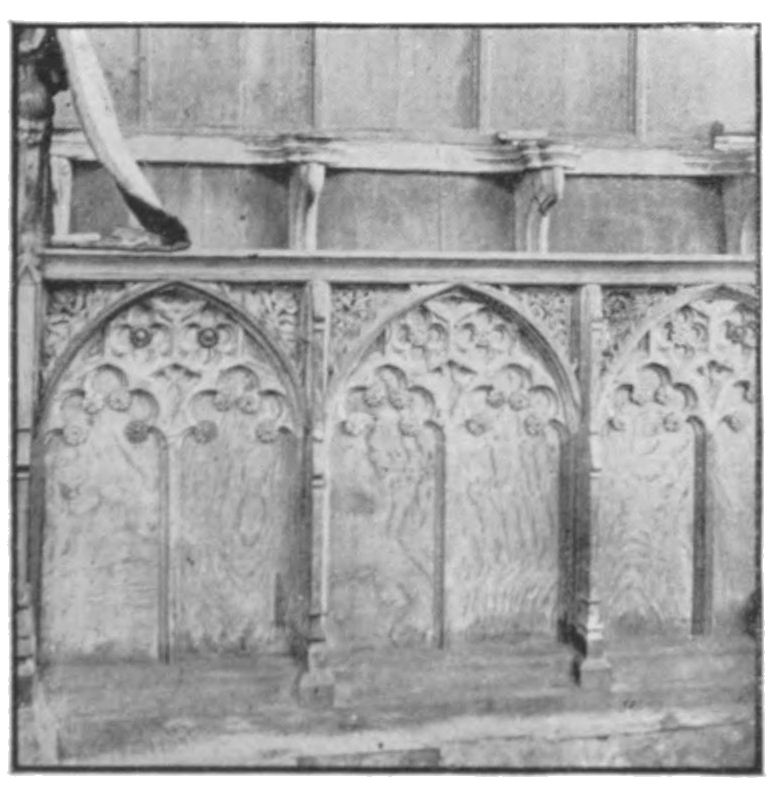
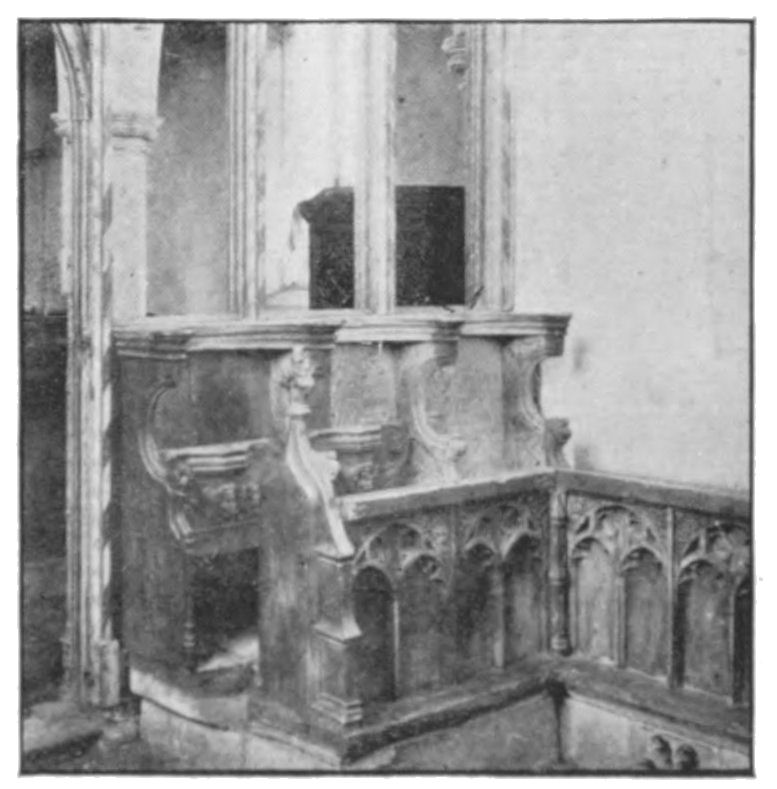
Stalls are found, but rarely with canopies, in many parochial, as well as in monastic, collegiate and cathedral churches. In the latter of course the object of them is obvious; they were intended to accommodate a large body of monks or canons with their vicars and the choristers. But they are found sometimes in the churches of quite small parishes, e.g., Sall, Trunch, Ludham, Burlingham St Edmund's in Norfolk, Weston-in-Gordano, Somerset, Norton in Suffolk, Ivychurch[48] in Romney Marsh, where it is pretty certain that in most cases the church was served by a single parish priest merely. At Ingham, a parish in the Norfolk Broads, there are ten stalls in the chancel; at Stowlangtoft, Suffolk, there are six stalls; and so with numerous others. How early parochial chancels had stalls is difficult to say. No existing examples are earlier than the thirteenth century. But a curious fact about the growth of our parish churches, to which attention has not hitherto been directed, may throw some light on the subject. In early Anglo-Saxon days the normal and most common type of parish church was one which had an aisleless nave and chancel. In early Norman days also this was the most common type. In all the above churches, whether Anglo-Saxon or Norman, the chancel, whether rectangular or apsidal, was quite small. Comparatively few, however, of these chancels remain small. In the vast majority of cases they have been enlarged. Either the old chancel has been retained but has been lengthened, or it has been broadened as well as lengthened, thus producing an entirely new chancel. In most cases it happened that, in the long history of the church, aisles were thrown out afterwards, or transepts, that later the nave was lengthened westwards and was heightened to accommodate clerestory windows, and still later a western tower was added and perhaps a spire. But the enlargement of the chancel sometimes took place without any of the other alterations, and where that is so, i.e., where the church retains a comparatively small nave, the enlarged chancel bulks up very lofty and spacious, seemingly quite out of scale to the rest of the church: in some examples the chancel is actually loftier than the nave. A church with a chancel so disproportionate strikes the attention at once as one demanding explanation. Large numbers of such abnormally big chancels survive. In Kent and Sussex many of them are of the thirteenth century; e.g., Littlebourne; while over England one is struck with the very large number of lofty and spacious chancels of the fourteenth century; e.g., Norbury, Derbyshire; Oulton, Suffolk. In numerous cases the enlargements of the chancel took place more than once. At Boston the church was rebuilt with a fine chancel c. 1330; but by the end of the century even this vast chancel was judged inadequate, and it was extended still further to the east.
Hemingborough Church
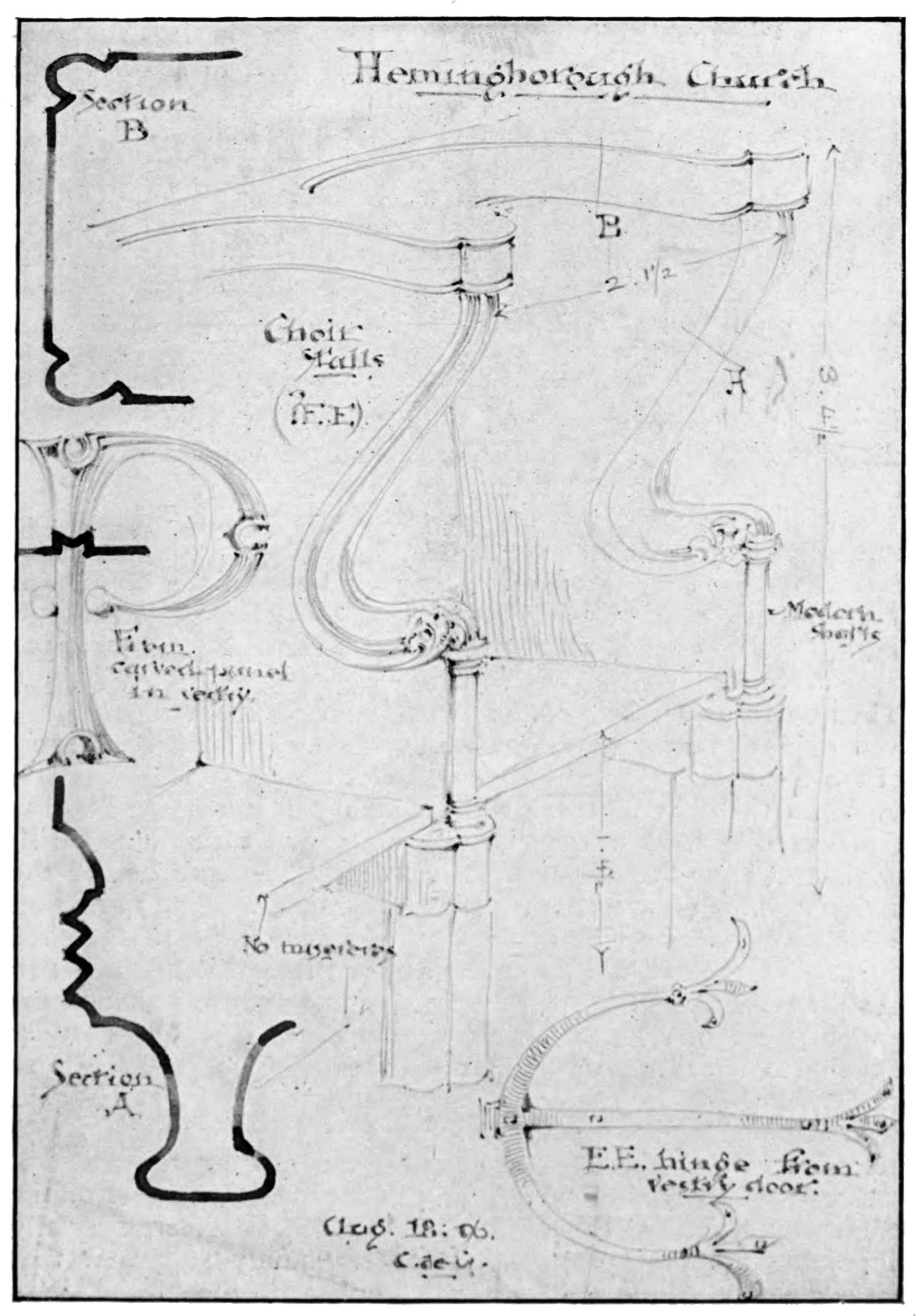
What then is the explanation of this furore for enlargement of chancels? In considering the answer, it must be borne in mind that, ritualistically, the English parish church was always tripartite; consisting of nave, choir and chancel. In churches of the Iffley type, i.e., with a central tower, it was also architecturally tripartite. But even in churches which architecturally were bipartite, i.e., which consisted merely of a nave and chancel, the chancel was divided into two parts, choir and sanctuary, the distinction between them being marked by a change of level. Which part then was it that was found inadequate, the sanctuary or the choir? Not the former; it was not then cumbered with altar rails; the purpose they serve nowadays was served by the screen which every church possessed, guarding the entrance to the chancel; and the sanctuary was quite large enough for the celebrant at the Mass, with as a rule a solitary assistant, the parish clerk. It must have been the choir that was too small for the seats which it was desired to place in it. We conclude therefore that seats were common even in small village churches as early as the thirteenth century, if not before. Documentary evidence to that effect we have not. But in later days there is definite evidence as to the practice of putting stalls in the chancels of parish churches. In Hemingborough church, Yorkshire, there remain stalls of graceful thirteenth century design (87). Now this church in the thirteenth century was parochial; it did not become collegiate till 1426. A series of entries of the cost of choir stalls is preserved for the parish church of St Mary at Hill in the City of London. In the year 1426 there was "paid to three carpenters for the stalls of the quire, 20d." In the following year there was paid "for the stalls of the quire" the large sum of £12 (= £150); it would seem that it was about this time that a complete new set of stalls was put into the choir. In the same year, 1427, there was "paid for stalls in the quire, 16s. 6d."; and "for a quire stool, 7s. 10d." In 1501 a payment was made "for mending of desks in the quire"; in 1509 "for nails and mending of a bench in the quire, 1d." In 1523 there was "paid for a long desk for the quire, 3s."; in 1526 "for the stuff and making of a double desk in the quire, 5s." Then, in Protestant days, there was "paid for mending the desk and settles in the chancel, 2s." At this church the lower part of the bench was made to form a box or chest.
Hereford St Peter's
Who then sat in these stalls? The common theory is that they were intended for the use of the rector or vicar and the parish clerk, and of any chantry priests who might be attached to the church. This no doubt is true as far as it goes. At St Maurice, York, a complaint was made at the visitation in 1416 to the effect that the desks in the choir, viz., those where the parish chaplain and the parish clerk were wont to sit, are unhandsome and in need of repair: "Dicunt quod deski in choro, tam ex una parte quam ex alia, ubi saltem capellanus parochialis et clericus parochialis sedere usi sunt, nimis deformes et indigent reparacione."[49] To many churches also, but by no means to all, chantry endowments were made; i.e., money was left that masses might be said for ever for the repose of the soul of the donor by a priest, other than the rector or vicar, specially appointed for that purpose. It is commonly supposed that these chantry priests were concerned only with the special altars at which they ministered. But that this was not the case, at any rate universally, is apparent from the terms of the institution of the Willeby chantry in Halifax parish church. The deed is dated 10th June 1494. Amongst other regulations it contains the provision that the chaplain is to attend in person in the choir of the church on every Sunday and Holy Day in his surplice, at matins, mass and vespers, and to take his part in the reading and chanting, as directed by the vicar, and in accordance with the constitutions of the Metropolitan Church. "Item volo et ordino quod predictus Tho. Gledhill, Capellanus modernus, et omnes alii Capellani, ... temporibus futuris nominandi, singulis diebus dominicis et festivis personaliter sint presentes in choro ejusdem Ecclesie temporibus matutinarum missarum et vesperarum, suis suppeliciis induti, et legant et psallent, prout Vicario ejusdem Ecclesie pro tempore existenti decenter et congrue videbitur expedire, ut in constitutionibus Ecclesie Metropolitane proinde constitutis plenius liquet." Assuming then that the same rule applied also to the incumbents of the other chantries, there would be a regular body of clergy to take part in the choir offices.[50]
Instances might be multiplied to any extent of the obligation laid on chantry priests to attend and assist the rector or vicar in the services. Thus at Rothwell in 1494 the chantry priest attached to the altar of Our Lady was not only required by the foundation deed to celebrate Mass and other service daily at this altar, but was directed to be in the high choir all festival days at matins, Mass, and evensong. In 1505 Margaret Blade, widow, endowed a chantry of Our Lady in Kildewick parish for a priest who, in addition to his special duties, was to help Divine service in the choir and to help the curate in time of necessity.[51] Sometimes quite a considerable number of chantry priests were attached to a parish church. When all chantry endowments were confiscated by Edward VI., the loss of the services of the chantry priests was in many cases severely felt. At Nottingham indeed the parishioners of St Mary's made formal protest; stating that in their parish there were "1,400 houseling people and that the vicar there had no other priest to help but the two chantry priests."[52] We may take it therefore that seats in the chancel were required not only for the parish priest and the parish clerk, but in some cases for chantry priests as well.
But the above explanation does not cover the whole ground. There are often many more stalls than could be used as above. And in some churches there were no chantry priests at all, and yet there are stalls. Who else then occupied seats in the chancel? Some of the stalls probably, usually but a few, may have been occupied by laymen even so early as the thirteenth century.
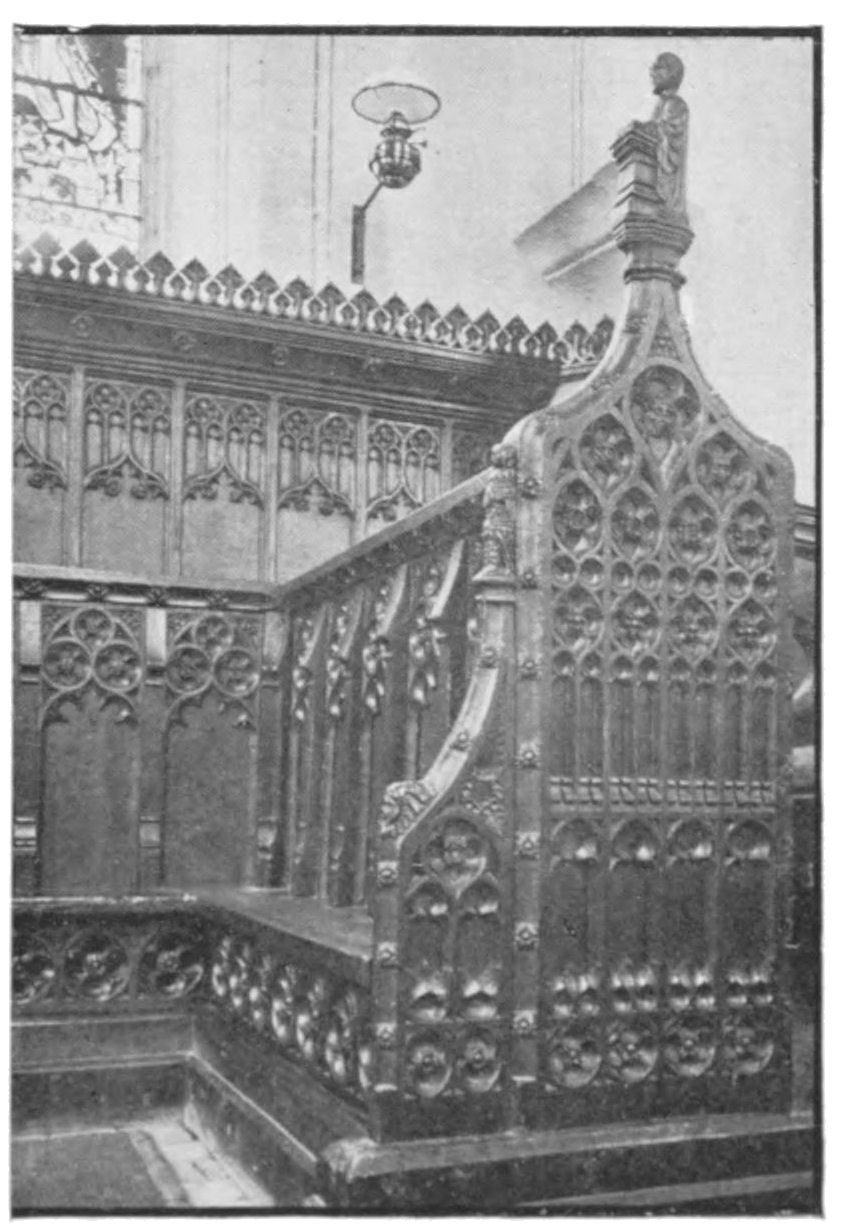
Stowlangtoft
As regards the occupancy of seats in the chancel it is quite clear that it has always been the wish of the Church that they should be reserved for the clergy and that no laymen should be admitted. It is equally clear that the Church has never been able to carry out the injunction. In the Trullan Council of 683 or 692 it was laid down, "Nulli omnium liceat, qui quidem sit in laicorum numero, intra septa sacri altaris ingredi, nequaquam tamen ab eo prohibita potestate et auctoritate imperiali, quandoquidem voluerit Creatori dona offerre, ex antiquissima traditione"; i.e., "No layman may enter the chancel, except the Emperor, who by venerable tradition is allowed to do so when he wishes to present offerings to his Maker." But this does not explicitly allow the Emperor to sit down in the chancel. And even this much was objected to by many; for a gloss follows: "Nemo liceat laico intra, &c." ... "Adulatione et timore victi, per gravem errorem concedunt imperatori, quod magna cum laude sanctorum patrum Ambrosius Theodosio negavit"; i.e., "The permission given to the Emperor was given under the influence of adulation and timidity, and the action of St Ambrose in refusing it to the Emperor Theodosius was greatly applauded by the Fathers." But it was a perilous thing to exclude emperors, and what was conceded to emperors was claimed by princes, and what was conceded to princes was claimed by and had to be conceded to the nobility generally. So in Scotland in 1225 by an episcopal order the King and his nobles also were allowed to stand and to sit in the chancel: "Ne laici secus altare, quum sacra mysteria celebrantur, stare vel sedere inter clericos presumant, excepto domino rege et majoribus regni, quibus propter suam excellentiam in hac parte duximus referendum." And if the nobles, then certainly the patron of the living could not be excluded from a parochial chancel. So in the diocese of Worcester in 1240 a canon was agreed to that patrons as well as high personages might stand in the chancel: "nec laici stent in Cancellis dum celebrantur divina; salva tamen reverentia patronorum et sublimium personarum"; in Lincoln diocese also Bishop Grosstête in 1240 restricts the permission to the patron. Again in 1255 in Lincoln diocese the patron or any other "venerable" person was allowed to sit and stand in the chancel. Archbishop Greenfield of York (1304-1315) found it necessary to make a rule against laymen intruding into the choir during service. So also at Ely, Simon Langham in 1364 wrote: "Lay people are not to stand or sit amongst the clerks in the chancel during the celebration of divine service, unless it be done to shew respect or for some other reasonable and obvious reason; but this is allowed for the patrons of churches only."[53] Then what had been claimed successfully by those of noble birth, and by patrons in particular, was claimed with equal success by any good Churchman of consideration and wealth, especially if he were a benefactor of the church. For in the fourteenth century Alan de Alnewyk of York, goldsmith, wills that his body be buried in the quire of St Michael Belfry near the place where I used to sit ("ubi sedere solebam"). Another century later, Robert Constable of Bossall, leaves this direction in 1454: "First, I devise my soul to God Almighty and his mother Blessed Saint Mary and to Saint Botolph and to the holy court of heaven; and my body to be buried in the quire afore the place where my seat is."[54] In 1511 Robert Fabyan, the chronicler, citizen and draper of London, devises as follows: "I will that my corps be buried between my pew and the high altar, within the quire of the church of Allhallows, Theydon Gardon, Essex." Finally, at Yatton, Somerset, in 1529, 2s. was "paid for a sege in ye chaunsell."[55] It is to be remembered moreover that though it may have been unusual for laymen to have seats in the chancel, yet it was by no means uncommon for them to stand or kneel there; there are enough representations of laymen so standing to establish that point satisfactorily: they are shewn standing or kneeling, sometimes with lighted tapers in their hands. At a St Martin's mass in France in the fourteenth century,[56] two women are shewn near the altar steps, one standing and attending to her duties, the other inattentive and seriously distracting the attention of an acolyte kneeling near. We know definitely that in Salisbury cathedral laymen were allowed to be present in the sanctuary before the Sunday procession; for after the hallowing of the water it was ordered that the priest should asperge the laity in the presbytery as well as the clergy in the choir. "Post aspersionem clericorum laicos in presbiterio hinc inde stantes aspergat."[57] At Salisbury the Sunday procession was marshalled in the ample space between the choir and the high altar, which space the laity entered in order to follow the clerks in the procession.
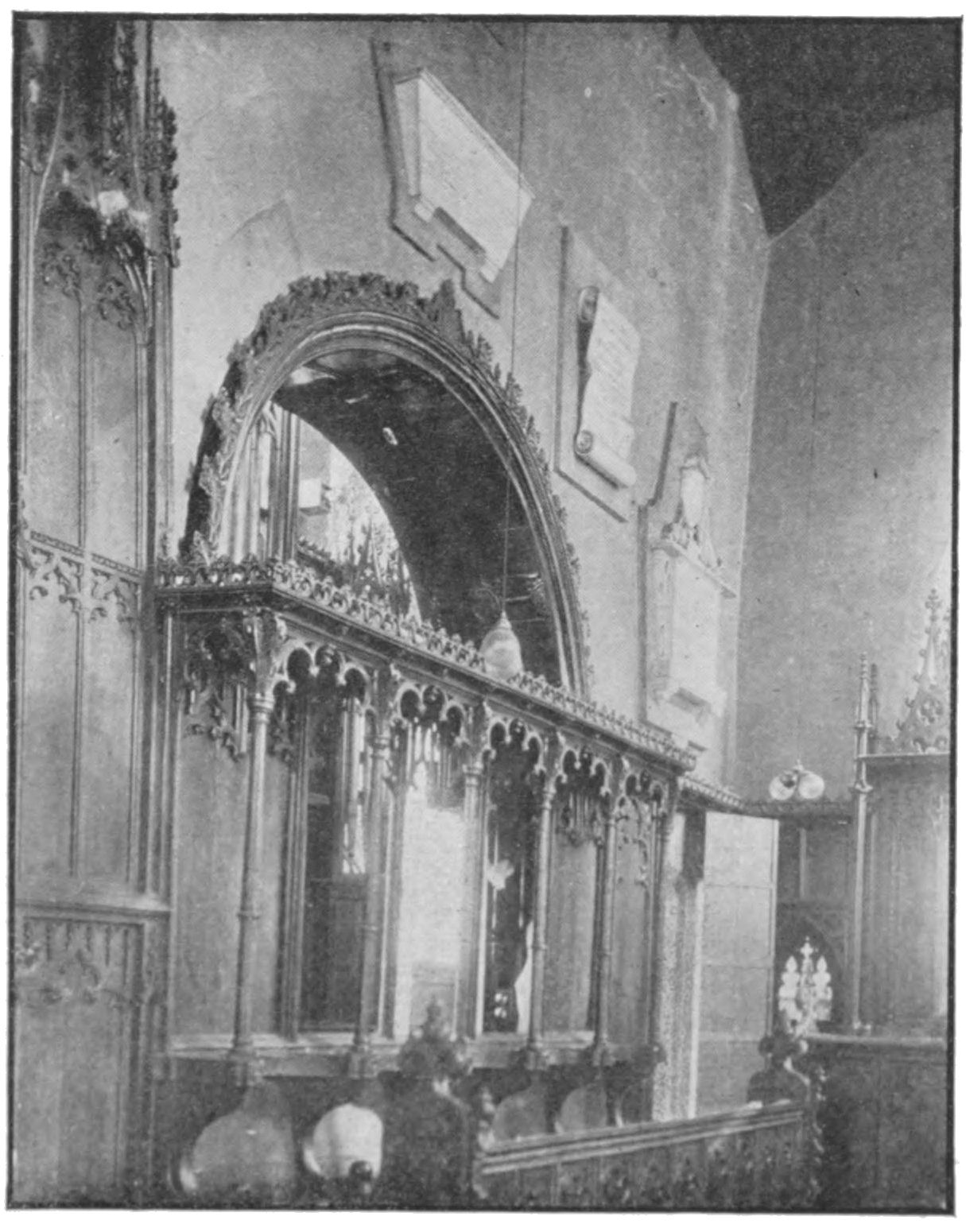
Brancepeth
For women it was more difficult to get admission to the chancel. Tradition and usage were against them. As early as A.D. 367 the Council of Laodicea passed a canon that women ought not to come near the altar or enter the apartment where the altar stands. In the ninth century a canon was passed at Mantes that women must not approach the altar or act as "server" to the celebrant or stand in the chancel. Among the canons of the time of King Edgar is one: "Docemus ut altari mulier non appropinquet dum Missa celebratur"; "a woman must not come near the altar at Mass." In laying down regulations for the services in Ripon Minster Archbishop Greenfield says, "We permit no women at all, religious or secular, unless great ladies or ladies of high rank or others of approved honour and piety, to sit or stand in a stall or elsewhere in the choir while the divine offices are being celebrated." "Nullas omnino mulieres, religiosas vel seculares, nec laicos nisi magnas aut nobiles personas aut alias quarum sit honestas et devocio satis nota, in stallo vel alibi in choro inter ministros ecclesiae stare vel sedere dum divina celebrantur officia permittimus."[58] The story told about Sir Thomas More shews that while he himself sat in the chancel, Lady More sat in the nave. "During his high Chancellorship one of his gentlemen, when service at the church was done, ordinarily used to come to my Lady his wife's pew-door and say unto her 'Madame, my Lord is gone.' But the next holy day after the surrender of his office of Lord Chancellor, and the departure of his gentlemen from him, he came unto my Lady his wife's pew himself, and, making a low courtesy, said unto her, 'Madam, my Lord is gone.' But she, thinking this at first to be but one of his jokes, was little moved, till he told her sadly he had given up the Great Seal." And many other good Churchmen at all times have retained the ancient usage of the exclusion of women from the stalls in the chancel. At Great Burstead, in Essex, in 1661, an applicant was authorised to build a pew at the entrance to the chancel for the use of himself and sons and companions and friends of the male sex; but to build another in the nave for his wife and her daughters and companions and friends of the female sex. King Charles I. in 1625 wrote, "For mine own particular opinion I do not think ... that Women should be allowed to sit in the chancel, which was instituted for Clerks"; and in 1633, when he visited Durham cathedral, the choir was cleared of all the seats occupied by the Mayor and Corporation and the wives of the Dean and Prebendaries and other "women of quality," and his Majesty gave orders that they should never again be erected, "that so the Quire may ever remain in its ancient beauty." Even to this day in some cathedrals it is the usage to allow women to sit only in the lower desks of the choir and not in the stalls above. Nevertheless in plenty of instances the pertinacity of women prevailed; and where the husband sat in the chancel, there the wife insisted on sitting beside him. Thus in a suit instituted by Lady Wyche in 1468, the lady put it on record that she had a seat in the chancel: "jeo aye un lieu de seer en le chauncel." In 1468 two ladies had seats in the chancel of Rotherham church; for the master of the grammar school willed that he be buried in south chancel[59] near the stall in which the wife of the Bailiff of Rotherham and the testator's wife sit. In 1553 a new pew was made for Sir Arthur D'Arcy and his wife at St Botolph, Aldgate: "Paid to Mattram, carpenter, for three elm boards for the two new pews in the quire where Sir Arthur Darsey and his wife are set ... ijs. viijd." The same parish in 1587 gave Master Dove permission to "build a pew for himself, another for his wife to sit in, being in the chancel." Therefore we come to the conclusion that at any rate from the thirteenth century onward more and more seats were provided in the chancel for lay folk. Where, as in the parish church of Boston, the stalls are very numerous—at Boston there are sixty-four—it is likely that a considerable number of them were appropriated to various important gilds connected with the church.
But there is another purpose which parochial stalls subserved, and that is the most important of all: viz., to accommodate a surpliced choir. The introduction of surpliced choirs into chancels in modern days was an innovation at first deeply resented, and seems to have been usually made in ignorance of the existence of mediæval precedent. Precedent there is, however, in abundance. England was a merry, tuneful land before the Reformation, and nowhere more than in the churches. The musical part of the service grew more and more ornate, especially in the last years immediately preceding the Dissolution; the parishes—village and town parishes alike—delighted in "the cheerful noise of organs and fiddles and anthems," and spent on music a very large part of the church income. The early years of the sixteenth century were a glorious time for church music; the parishioners loved it and would have it, and were willing to pay for it; it was not forced on them from above; it was the people and the people's churchwardens who would have it. What a joyful sound we should hear from the church doors if we could enter once more an English church of the sixteenth century and hear the surpliced men and boys a singing in the choir, accompanied by organs and citterns and fiddles and crowdes and dulcimers and all instruments of music in the rood loft, with perhaps an anthem or a solo on high festival days from distinguished vocalists of the neighbouring villages; those were happy times. Take the churchwardens' accounts of St Mary at Hill, London.[60] In this church in 1523 there was "paid 15d. for 6 round mats of wicker for the clerks." If we assume six more for the boys, we get a regular choir of six men and six boys. But besides these an extra choir of choirmen and boys was engaged for special days. In 1527 there was "paid 9d. at the Sun tavern for the drinking of Mr Colmas and others of the King's chapel that had sung in the church of St Mary at Hill." In 1553 there was "paid 16d. to the gentlemen of the Queen's chapel for singing a mass at St Mary at Hill." Again, in 1527 there was "paid 7s. for bread, ale and wine for the quire, and for strangers at divers feasts in the year past"; these "strangers" would probably be singers hired from other churches. The above entry shews that the choir was paid in kind as well as in money. The choirmen received quite handsome salaries. In 1524 Morres, the bass, was receiving from the parish 20 nobles a year. John Hobbes was the most expensive member of the choir. In 1556 there was paid to John Hobbes 56s. 8d., being one quarter's wages, for his services in the choir. This choirman therefore had a salary of £11. 6s. 8d. per annum, which would be equivalent to about £113 of our money. Sir John Parkyns, a bass, received a quarterly salary of 15s. 8d. "for the help the quire when Hobbes was dead, and to have 8d. a day every holy day and Sunday." On the other hand there was "paid 12s. to Mr Hilton, priest, for three quarters of a year, for keeping daily service in the quire in 1528"; this was at the rate of 16s. per annum; this compares remarkably with John Hobbes' salary of £11. 6s. 8d. per annum; even allowing for the fact that Mr Hilton had other sources of revenue, we cannot but infer that priests were cheap and good singers dear in the sixteenth century. The parishes were quite willing to pay for good music. At Braunton, Devon, c. 1580, i.e., after the Reformation, the churchwardens were still paying four or five expensive choirmen, as well as singing boys; the highest salary for a choirman was 26s. 8d.; say £13. 6s. 8d. per annum; the choir in this village church could not have cost the parish less than £100 per annum of our money. In all the choirs there seem to have been "singing boys" as well as men. We hear in 1477 of four choristers being brought over to St Mary at Hill for a special service, for which they received the modest sum of 1d. each. At this church it was finally arranged to have a permanent choir, and what we should call a choir school was established, with John Norfolk, the organist, at the head of it to train the boys: for there "was paid for making clean of a chamber in the Abbot's Inn to be a school for Norfolk's children." The same year "Mr parson gave the boys a playing week to make merry," and the churchwardens kindly presented the boys and choirmen with 3s. 4d. to spend on their holiday. Next year there was again a payment of 3s. 4d. "in the playing week after Christmas to disport them." Both the boys and the men wore surplices, bought at the expense of the parish. In 1496 there were at St Mary at Hill "8 surplices for the quire, of which 2 have no sleeves; and 7 rochets for children, and 6 albs for children." In 1499 there was "paid 12d. for the making of 6 rochets for children that were in the quire." At St Nicholas', Bristol, in 1521 there was paid "1d. for making a child's surplice belonging to the quire"; and in 1542 iiis. viid. for material "to make 2 lads' surplices." An inventory of Huntingfield church, Suffolk, shews that the church possessed "vii rochettys ffor men and vii for chyldern," and that the material of the rochets cost 6d. each; it would seem that this Suffolk village had seven men and seven boys in the church choir. At St Mary at Hill there was paid in 1523 "for making 12 surplices for men at 6d. each, 6s.; and for 12 surplices for children at 5d. each, 5s."; this was a rich city parish, and could afford to have a pair for each choir man and boy, one to be in use, the other at the wash. Then music had to be paid for. In the same church in 1523 there was paid "for 4 hymnals and a processioner, noted, for the clerks in the quire, 6s. 8d."; in the same year there was paid "for two quires of paper to prick songs in, 8d." In 1555 at St Mary the Great, Cambridge, there was "paid 3s. 4d. for the copy of the service in English set out by note; and 1s. 4d. for writing and noting part of it to sing on both sides of the quire"; i.e., they sang antiphonally. There are numerous entries as to the cost of the organ and of the constant repairs which it required. Lastly, there was the organist's salary, which if it was anything like the sum received by John Hobbes, would be a heavy item. An eminent organist like John Norfolk, who was in charge of a choir school, would expect and no doubt get a large salary. In village churches, however, the boys would be trained, sometimes by a chantry priest if he was under statutory obligation to do so, more often by the parish clerk. The latter was a permanent official with a freehold, as he is still, and a person of much importance and dignity. Before the Reformation, in addition to serving at the daily Mass in a village church, carrying holy water and "blessed bread" round the parish, and many other functions, he was more especially in charge of the musical part of the services. He was expected to sing or chant himself, especially the psalms; he had to read the epistles; and, at any rate in the sixteenth century, he had to train the choir boys. It was ordered at Faversham in 1506 that "the clerks, or one of them, so much as in them is, shall endeavour themselves to teach children to read and sing in the quire." And at St Giles', Reading, in 1544 there was a payment of 12s. "to Whitborne the clerk towards his wages, and he to be bound to teach 2 children for the quire."
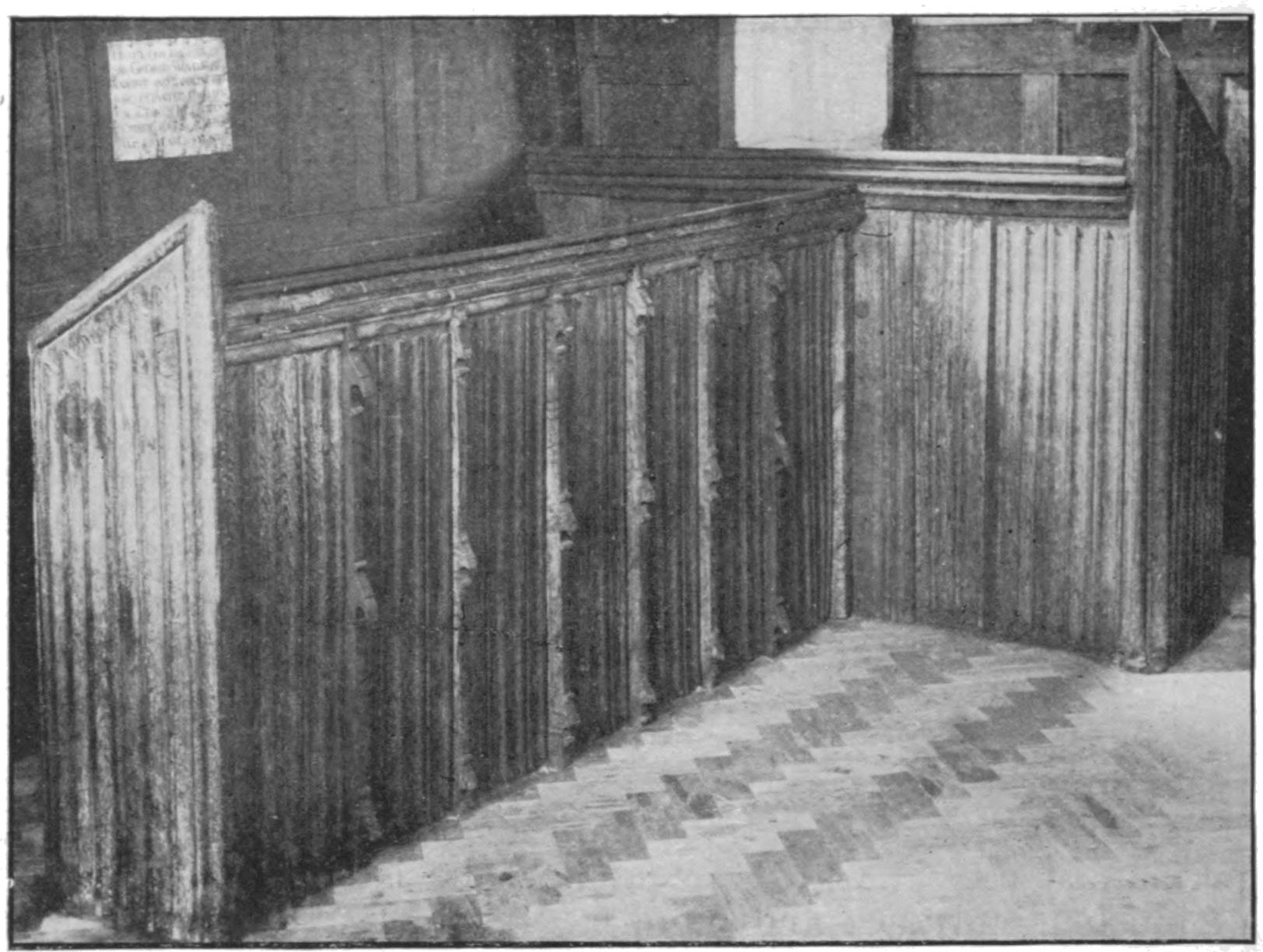
Hambleton
Beside the professional choirmen and the parish clerks there were sometimes amateurs also giving help. Sir Thomas More used to sing in Chelsea church like any parish clerk. "God's body," said the Duke of Norfolk, coming on a time to Chelsea and finding him in Chelsea church, singing at Mass in the choir, "God's body, my Lord Chancellor, what turned parish clerk?" Put these items together—the wages of choirmen and boys, and now and then of extra help, the making, mending and washing of surplices, the cost of music, the salaries of the organist and parish clerk and the cost of the choir school, and it will be seen that the services of a large town church must have been, musically, on quite a grand scale; it is equally plain that the love of church music and the willingness to pay for it were equally great in the villages. It is not possible here to go further into this matter of the church music. It may be said briefly, however, that the plain chant of the Divine Office and of the Mass would be sung in the chancel, and that for this the permanent village choir of men and boys would suffice. Every parish that could afford it seems to have had a rood loft and an organ in it. But the organ would not be used to accompany the plain song, but for what we call "voluntaries" in the various intervals of the Mass and other services. The organ again would be employed when there was singing of "motets," i.e., anthems, whether the singers were in the choir or the rood loft. On great days when minstrels playing all manner of instruments were got together to help out the organ, they would no doubt be placed in the rood loft, with any extra vocalists for whom place could not be found in the choir below.
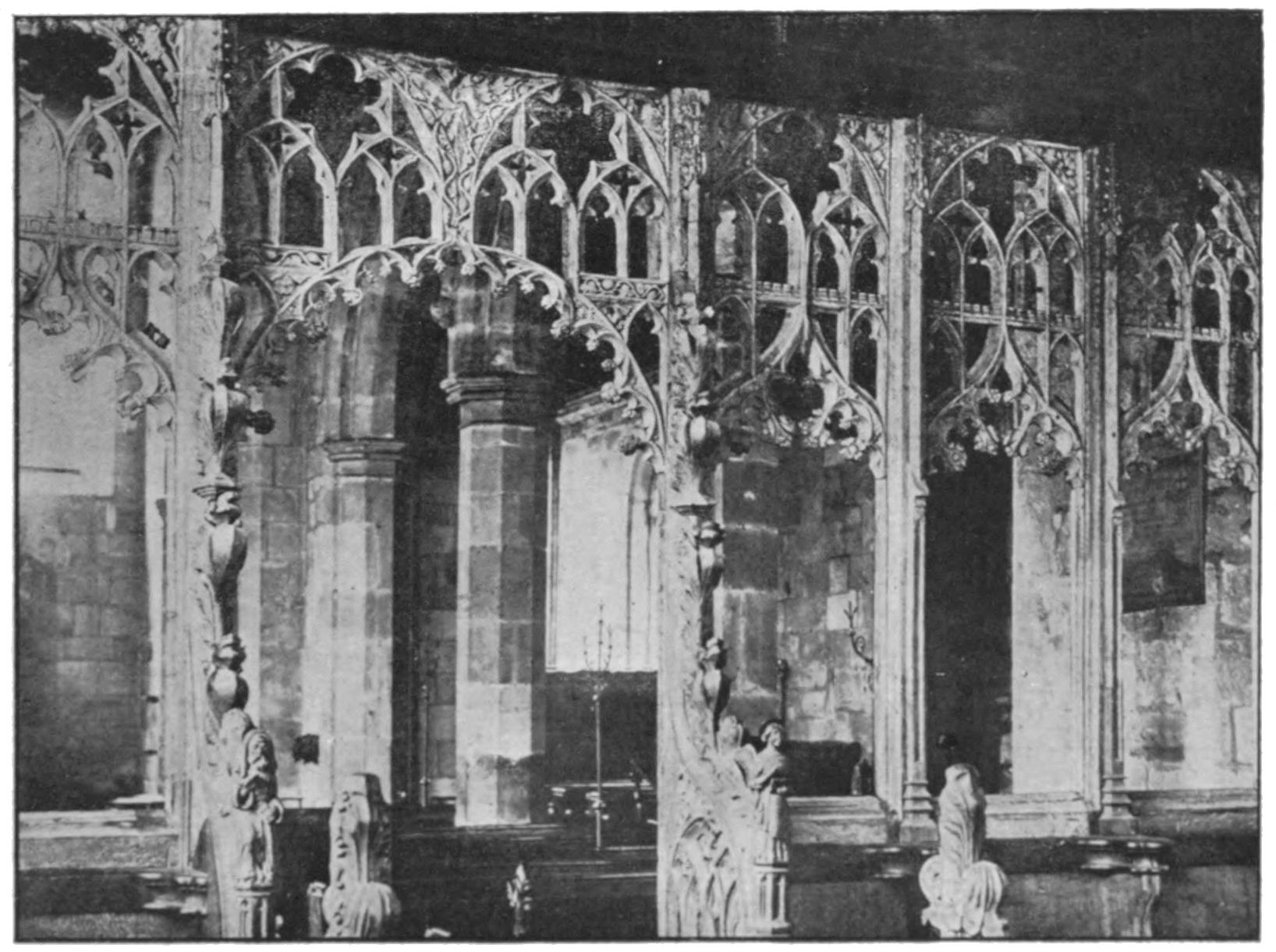
Chaddesden
Summing up, we may say that in a parochial chancel seats were required (1) for the parish priest, the parish clerk and any chaplains or chantry priests; (2) for the patron and a few of the leading churchfolk of the village; (3) for a choir of men and boys which was occasionally enlarged by choirmen and choristers borrowed from neighbouring churches. Altogether quite a considerable number of seats would be required; and we need not be surprised that there are so many stalls in small village churches, but rather that they are not more; no doubt, however, additional forms or benches would be introduced on days of great festival.
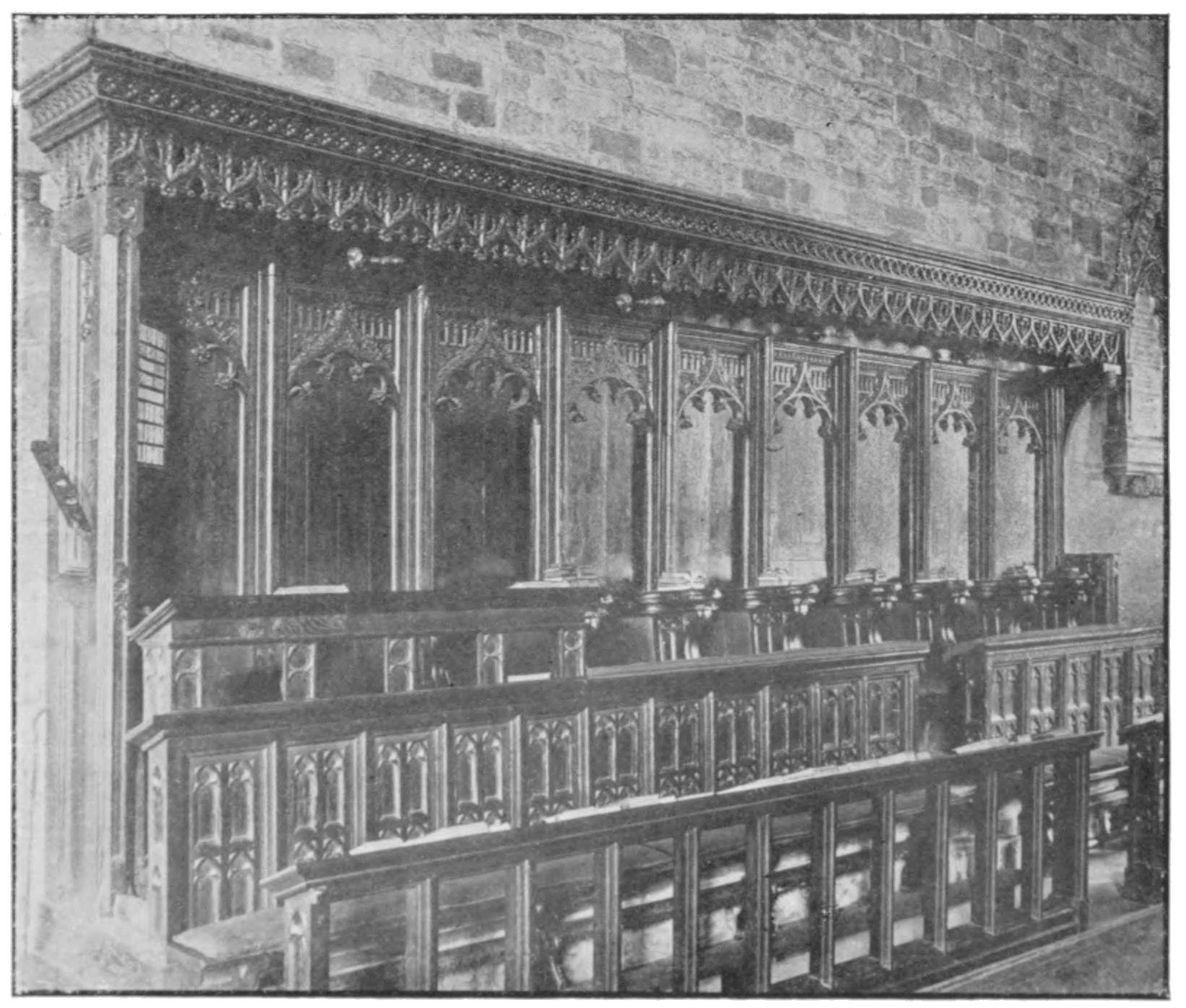
Not every parish church could afford to have a set of stalls made, cathedral fashion, for its chancel. In many cases probably the seats were but benches or settles; and the naked, desolate look of many spacious chancels is no doubt due to the removal of these seats. Desks, or as they were Latinised "deski," there must have been, at least one at each side, on which to place the anthem book, processioner and other music. We hear of a double desk at St Mary at Hill; but only the richest parishes seem to have provided desks for the choir boys as well as for the men. In poor parishes the men had not armed stalls, but merely a bench to sit on.[61] The boys sometimes had a bench; sometimes, as at Stowlangtoft, Suffolk (91), the bench was framed into the desk behind. At the back of the choirmen's seats, there might be bare wall; or it might be panelled, as at Sall, Norfolk (85), or arcaded, as at Chichester Cathedral (36). In richer examples there might be above the panelling a coved cornice, as at Stowlangtoft and Balsham, Cambridge (3). A still more sumptuous design was to erect a horizontal canopy above the stalls, as at St Peter's (89) and All Saints' (45), Hereford, and Brancepeth, John Cosin's church, Durham (93). The return stalls, facing east, would be those of the parish priest and his clerical helpers, and were often more spacious and lofty than the rest, and backed on to the screen, as at Chaddesden, Derbyshire (99), and Trunch, Norfolk (85).
The workmanship of the best stalls is quite first rate. At All Saints', Hereford, the timber of the stalls is "good sound English oak, all either cleft or cut in the quarter, proving that the trees were converted into the smallest possible sizes before being sawn from either end, the very rough saw-kerfs meeting at an angle in the centre of the board."[62] The stalls frequently stand on stone plinths, pierced for ventilation; e.g., at Sall and Trunch (85).
PART II
———
CHAPTER VII
BISHOPS' THRONES
In the next chapter we deal with movable chairs and thrones, descendants more or less of the "sella curulis" and the "sella gestatoria." More important still are the fixed thrones of Early Christian days. These were not of wood or ivory, but of masonry, usually marble. In shape they were just high-backed chairs of marble. Now countless numbers of such marble chairs or stalls were in use in the theatres, thermæ and amphitheatres of Pagan Rome; the thermæ of Caracalla alone possessed 600 such marble stalls. Doubtless many a bishop's throne, like those at St John Lateran, St Clement and Cosmedin, Rome, was actually taken from one of the Roman thermæ. Similar bishops' chairs, cut out of the solid rock, occur in the catacombs of Rome.
The position of the fixed marble throne of an Early Christian bishop was high up in the centre of the back wall of the apse of the church.
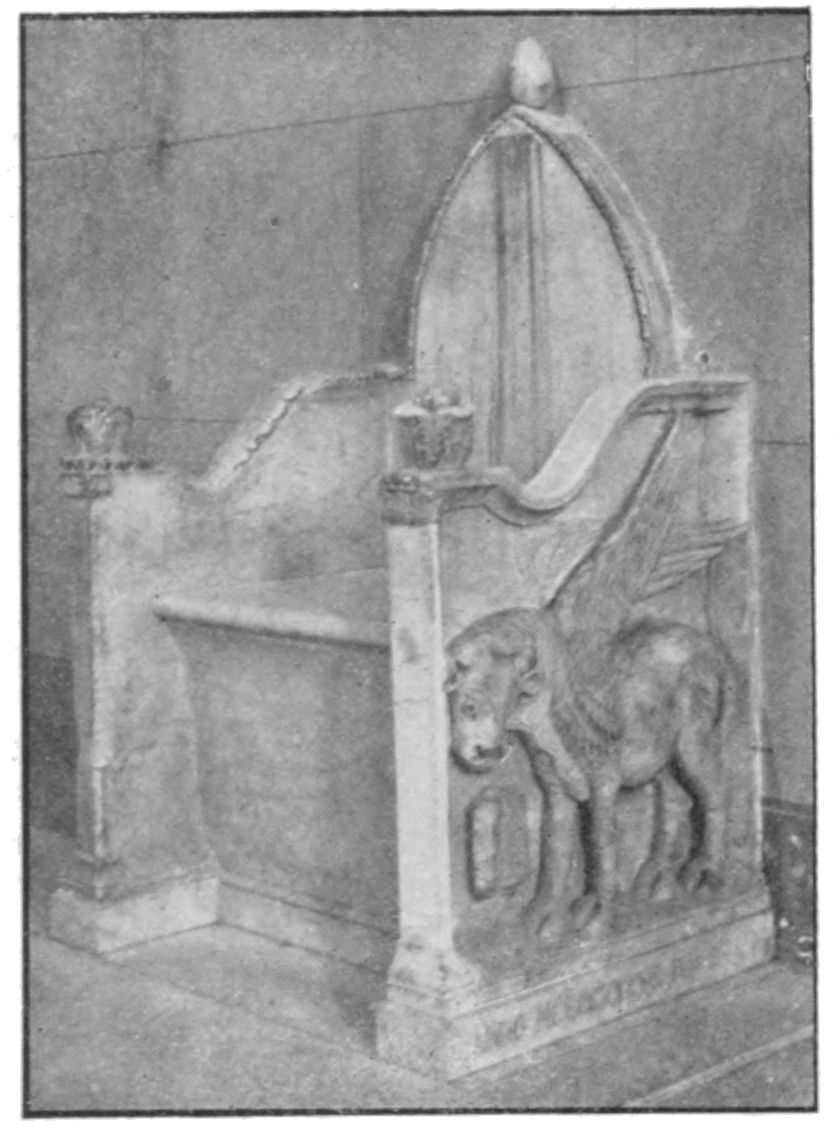
In Dalmatia and Istria several thrones retain their original position. At Parenzo there remains the semicircle of marble seats for the clergy with the episcopal throne in the centre; a work of the first half of the sixth century. At Aquileia, in the centre of the east end, is the Patriarch's throne of veined white marble, inlaid with serpentine; it is made up of portions of an older throne of genuine Byzantine work. At Grado the marble throne at the east end of the church seems to have been made up in the ninth century; it is surmounted by a stone tester. At Zara in the same position is another marble chair, raised on five steps. At Trau the bench of the clergy remains, but the bishop's throne has been destroyed. At Ossero also is a marble throne made up of fragments of older work.[63] In the apse of the twelfth century church of S. Stefano, Bologna, is a bishop's throne ten steps above the choir. Another remains in situ in Vaison cathedral, Provence. Another episcopal chair of marble is now placed on the north side of the sanctuary of Avignon cathedral; on it are carved the emblems of the Evangelists (104).
Exeter
Exeter
In the Victoria and Albert Museum is a throne, painted and gilded, dated 1779, from a church in Cyprus. In Norwich cathedral in the centre of the apse wall of the presbytery there are the fragments of the original stone seat built for the use of the bishop, and on the pavement and adjoining piers there are traces of the steps by which his throne was reached. When Blomfield wrote his History of Norfolk, 1739-1775, the steps of the throne had not been disturbed; "the ancient bishop's throne ascended by three steps," and when built, before a rood screen was erected, the bishop had an uninterrupted view down the whole church to the west end of the nave.[64]
Avignon
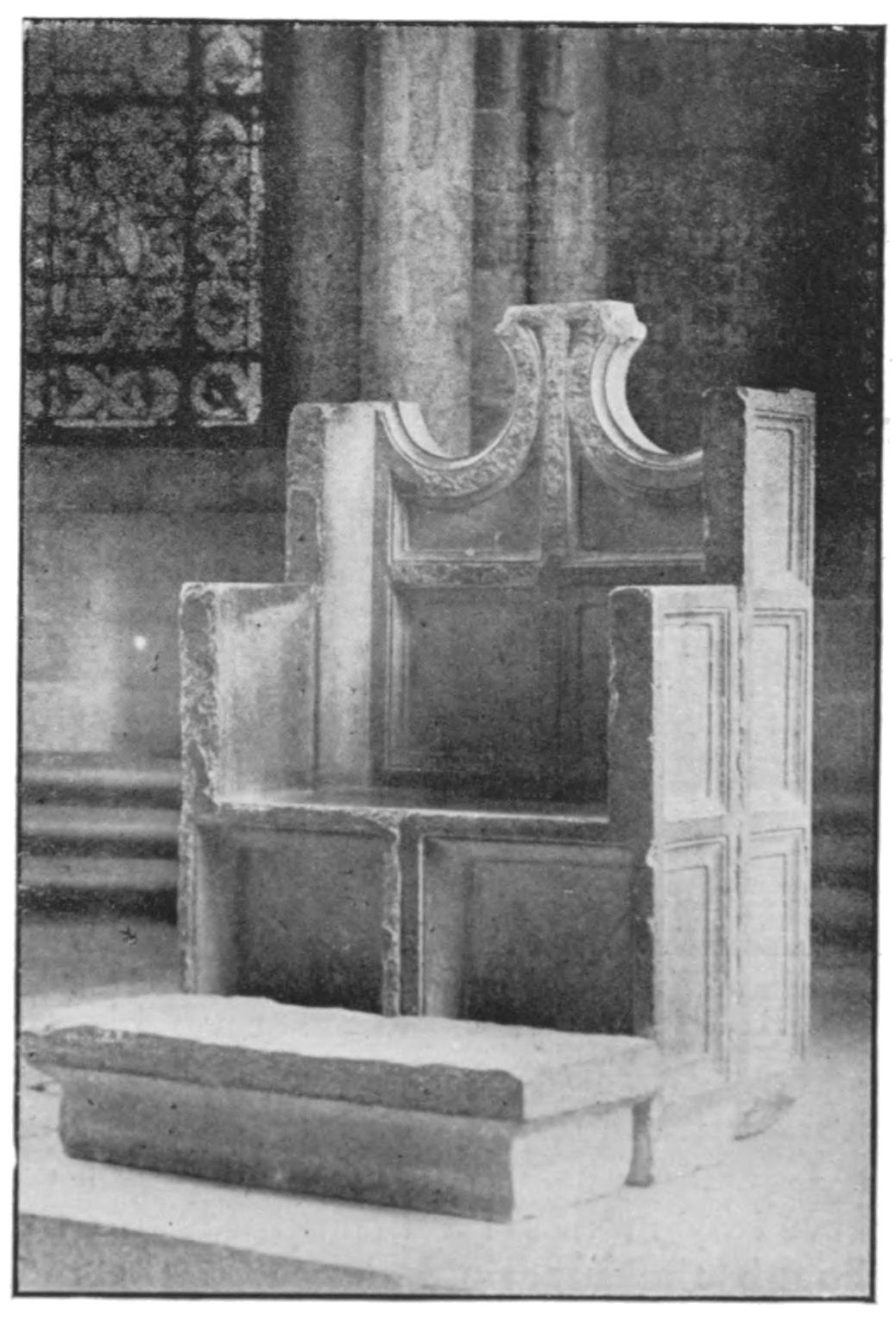
In Canterbury cathedral is a stone chair, which as at Norwich was originally at the back of the High altar; it was removed from that position by Archbishop Howley c. 1840, but has recently been replaced; it consists of three blocks of Purbeck marble (105). The chronicler Eadmer, writing of the Pre-Conquest cathedral burnt down in 1067, says that "the pontifical chair in it was constructed with handsome workmanship and of large stones and cement." The description would apply very well to the present chair: but the monk Gervase states that in Lanfranc's cathedral, finished in 1077, "the patriarchal seat, on which the archbishops were wont to sit during the solemnities of the Mass, until the consecration of the Sacrament, was of a single stone." It would seem therefore that the Anglo-Saxon chair perished in the fire of 1067, and that its successor experienced the same fate in 1174. The probability is therefore that the present chair was made between the fire of 1174 and the consecration of 1184. A decisive argument against a Pre-Conquest date is the fact that the throne is made of Purbeck marble—for this material seems not to have come into use till after the middle of the twelfth century in the Norman house at Christchurch on the Avon, in St Cross', Winchester, and in William of Sens' work at Canterbury.
Canterbury
The position of the pontifical throne at Canterbury has varied at different periods. Eadmer states that the cathedral burnt down in 1067 was orientated to the east, where was the presbytery containing the High altar. But at the west end of the church was the altar of Our Lady, and behind this altar was the throne adjoining the west wall. This unusual position is only explicable by the assumption that the first cathedral at Canterbury was orientated to the west, and that the site occupied in 1067 by the altar of Our Lady was originally that of the High altar. The western position so postulated for the High altar and the throne was originally that of most of the Early Christian basilicas at Rome, in particular the ancient basilica of St Peter. At a later period the orientation was often reversed, e.g., in St Paul extra muros, Rome; what happened in this latter church seems also to have happened in Anglo-Saxon times at Canterbury. A similar change has occurred in the French cathedral of Nevers; where, however, though in Gothic days a presbytery and High altar were constructed at the east end of the church, the early Romanesque presbytery, crypt, and two bays of the nave have been allowed to remain to this day.
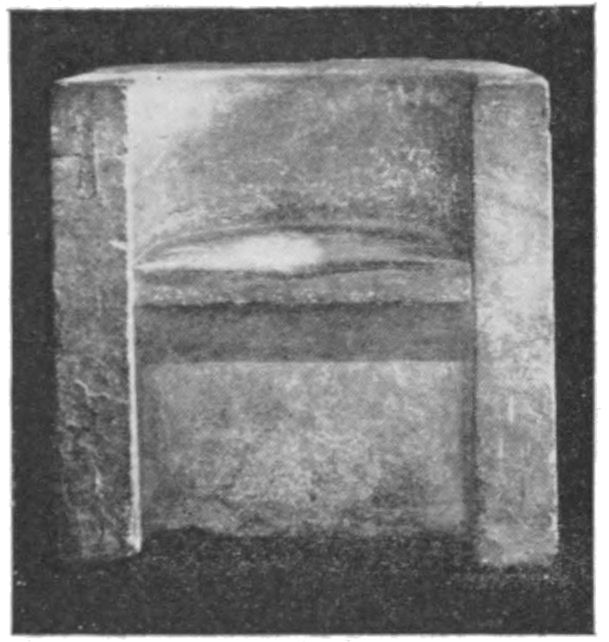
Beverley Minster
What looks like a survival of the marble chair of the bishop is to be seen in the frithstols of Hexham and Beverley (106). These also are of masonry, and are so similar in design to the ancient marble thrones that one is tempted to speculate that the original usage of sanctuary was for the offender to fly to and occupy the actual throne of the bishop or archbishop.
As has been said, in the Early Christian churches both the altar and the seats of the bishop and his clergy were usually at the west end of the church to the west of the High altar, so that the clergy faced towards the east, while the congregation faced towards the west. But early examples occur of churches with the modern orientation. When this was the case, the congregation faced east; and where the ancient position of the throne and benches was retained, the clergy were left in an anomalous position facing west. This led, first to the clergy, then the bishop, migrating elsewhere. The higher clergy took up their position in the return stalls of the choir, facing east; the lower clergy occupied stalls north and south of the choir. As for the bishop, he could not seat himself as before, facing the altar, for his throne would have blocked the entrance into the presbytery. He therefore set up his throne on the south side of the choir, at the eastern end of the southern range of stalls. And this is where we find him in Gothic days. There is one chief exception. In cathedrals served by monks, the bishop was the titular abbot of the house, though the superintendence of the monastery had necessarily to be left mainly in the hands of the prior; and so to this day in some churches the bishop has no throne, but occupies the ancient abbot's stall—at Ely the stall of the Benedictine abbot, at Carlisle the stall of the Augustinian abbot.
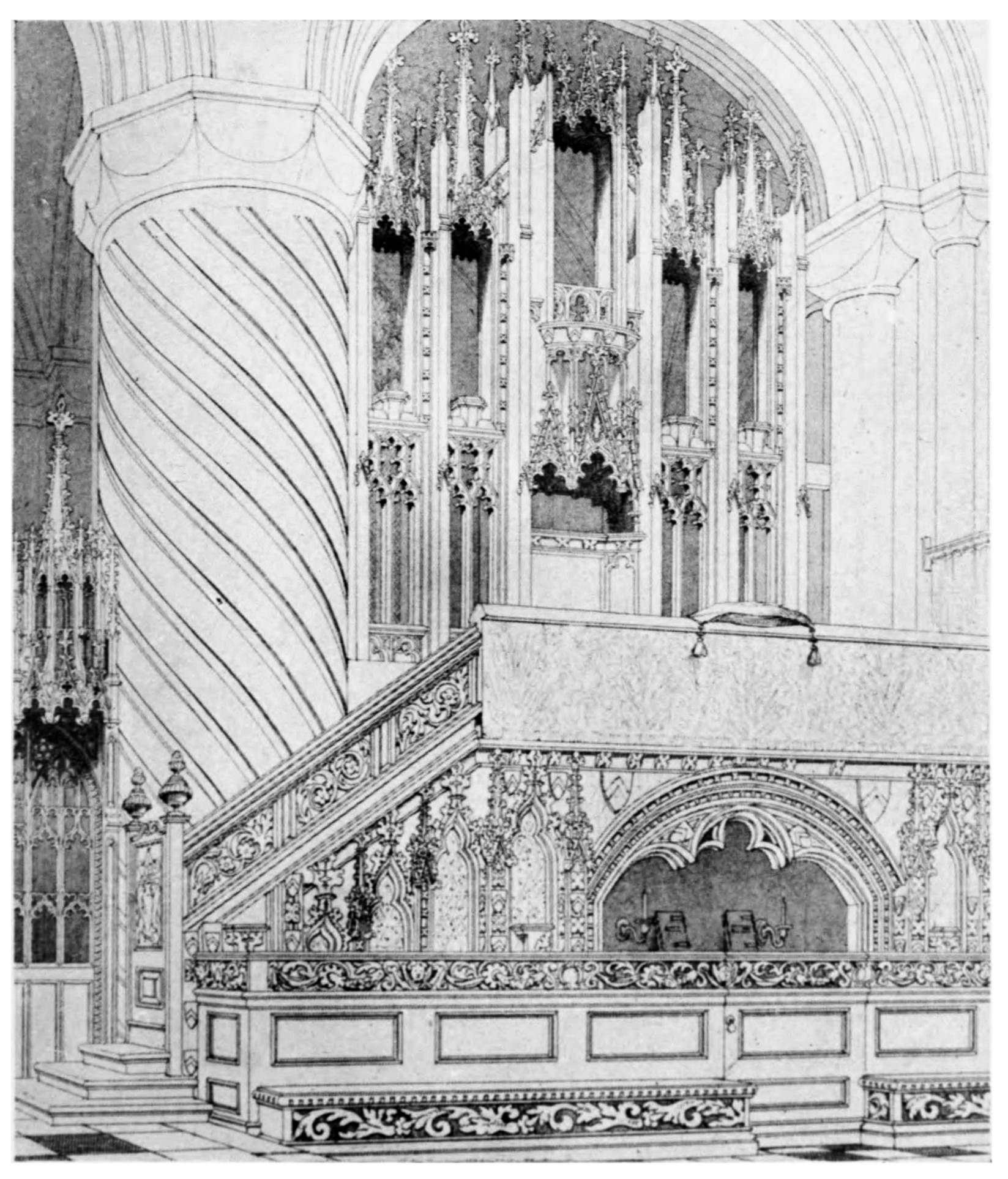
Durham
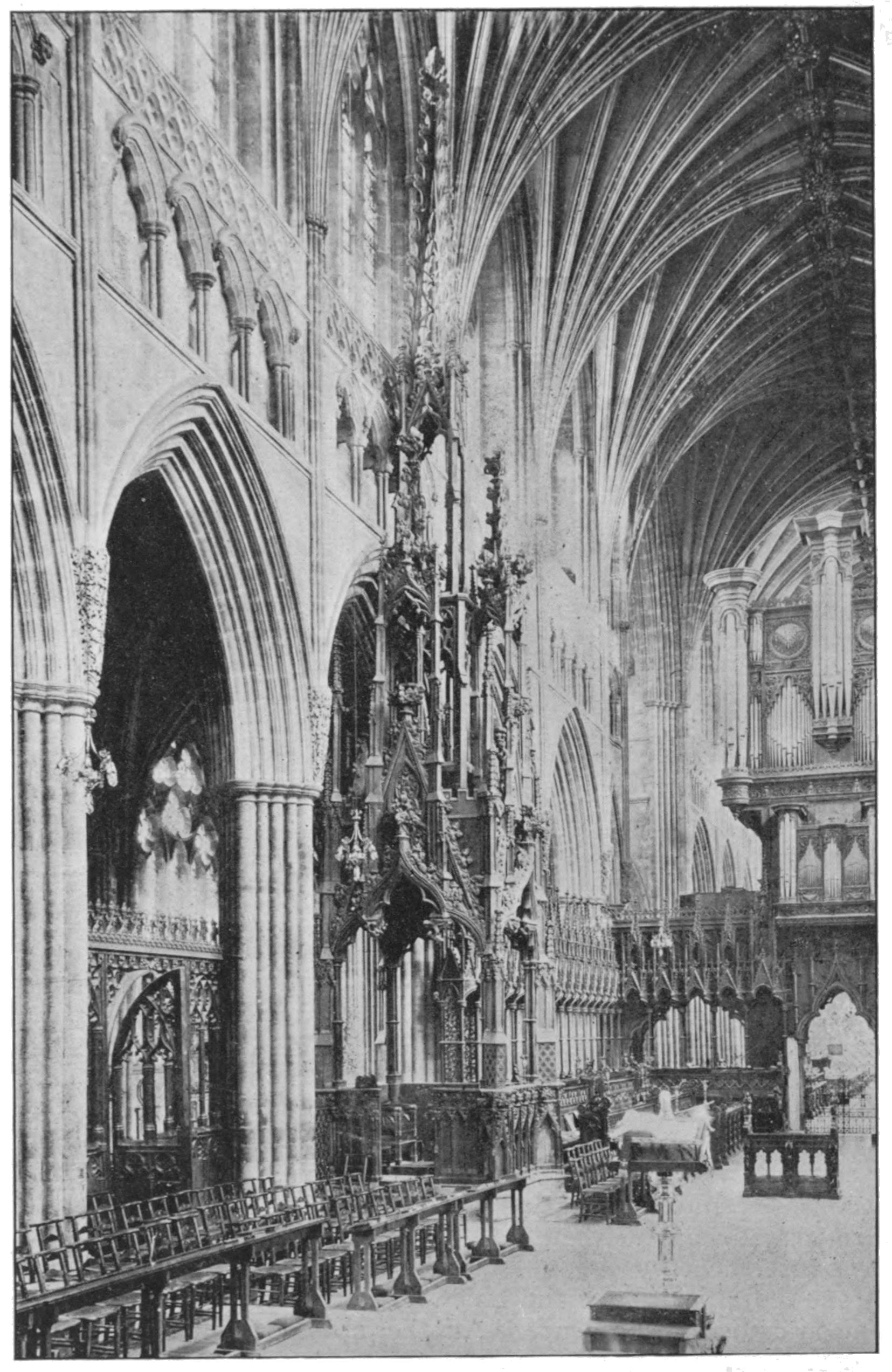
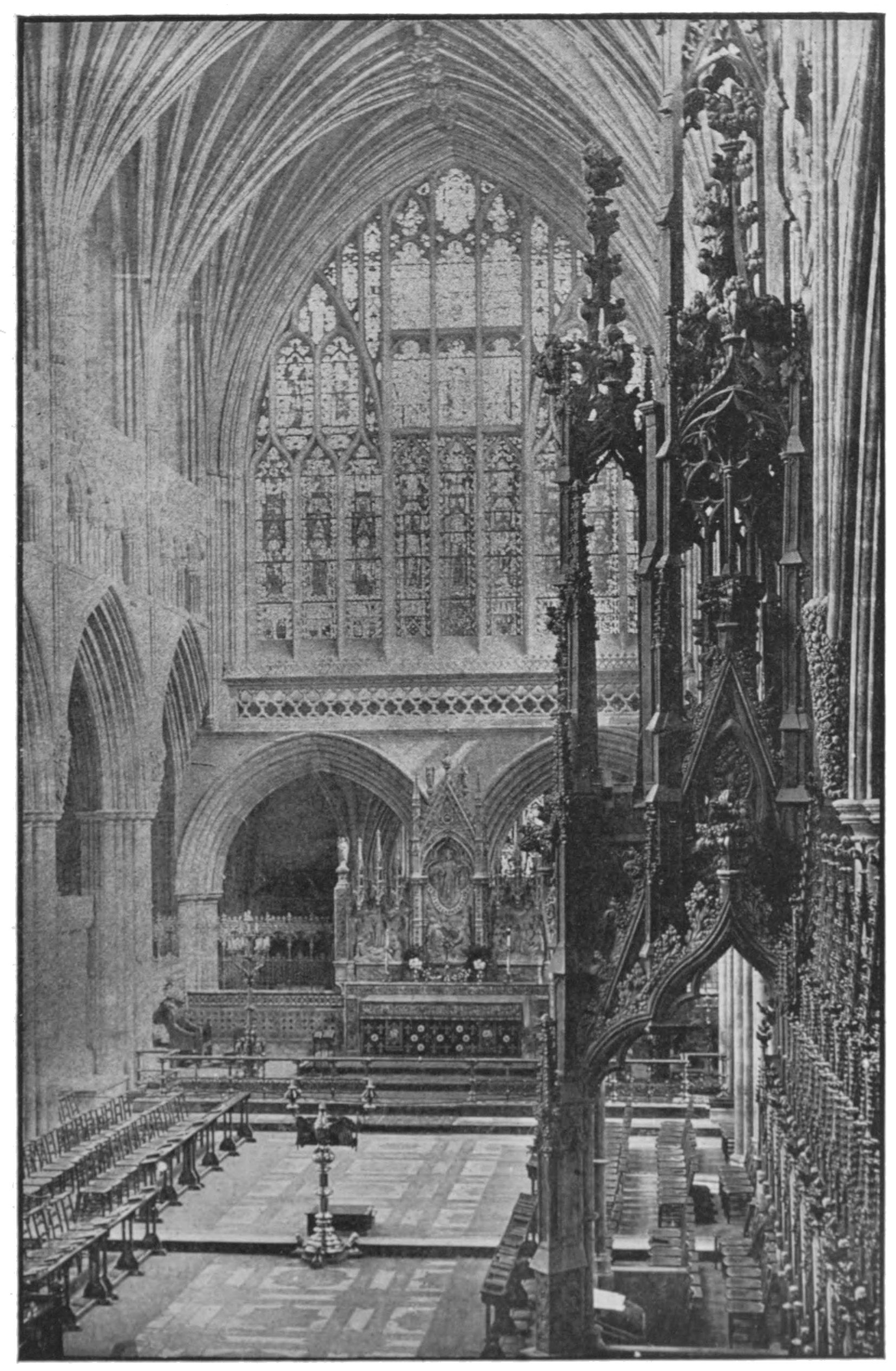
The change of position from the back of the High altar to the front of it was a complete break with tradition. Equally complete was the break in design. In the design of the Gothic throne there is no reminiscence whatever of the marble chairs of the Early Christian basilicas and the Pagan Thermæ. The Gothic thrones are but glorified versions of such stalls and spirelet-tabernacles as those of Lincoln; they are spacious stalls, sometimes, as at St David's, big enough to hold a bishop and two chaplains, and crowned with a spire of open woodwork. The earliest and grandest is that of Exeter cathedral; the Fabric Rolls shew that in 1312 during the episcopate of Bishop Stapledon there was paid "for timber for the bishop's seat £6. 12s. 8½d." The oak was kept four years before it was used. Then £4 was paid to Robert de Galmeton "for making the bishop's seat by contract." There was also a charge of 30s. for painting, and there must have been one for carving the statues in the canopy. The whole cost would be about £13; say £200 in our money; a sum surprisingly small for work of such magnitude and delicate detail. The throne was evidently intended to have a chair placed under it, and probably seats for the bishop's chaplains to the right and left. It is 57 feet high; at present its niches look somewhat unsubstantial and meagre; but that is because all the niches were tenanted with statues, and all have disappeared. The carved foliage is of exceptional excellence, and the corners of the pinnacles are occupied with small heads of oxen, sheep, dogs, pigs, monkeys and other animals (102).
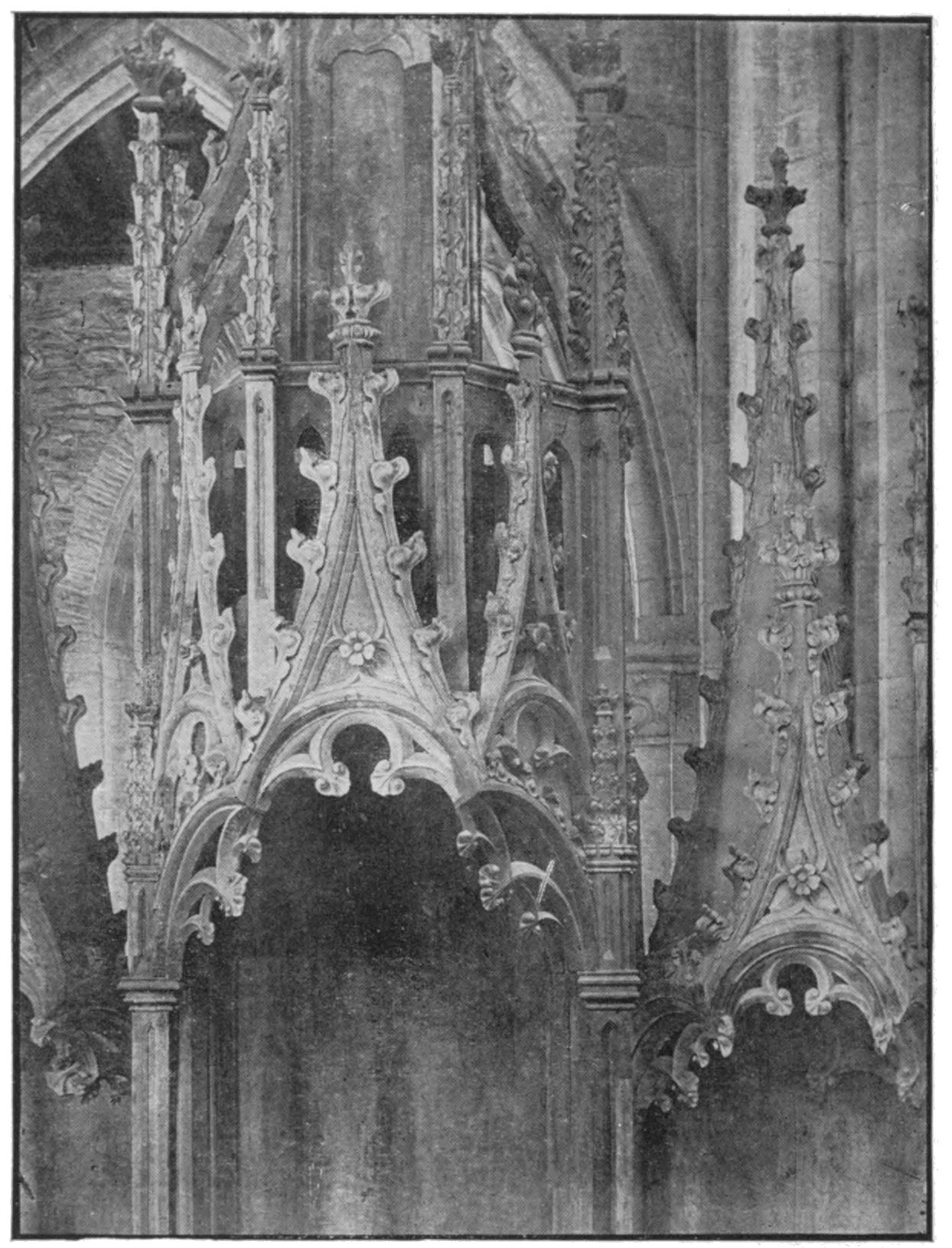
St David's
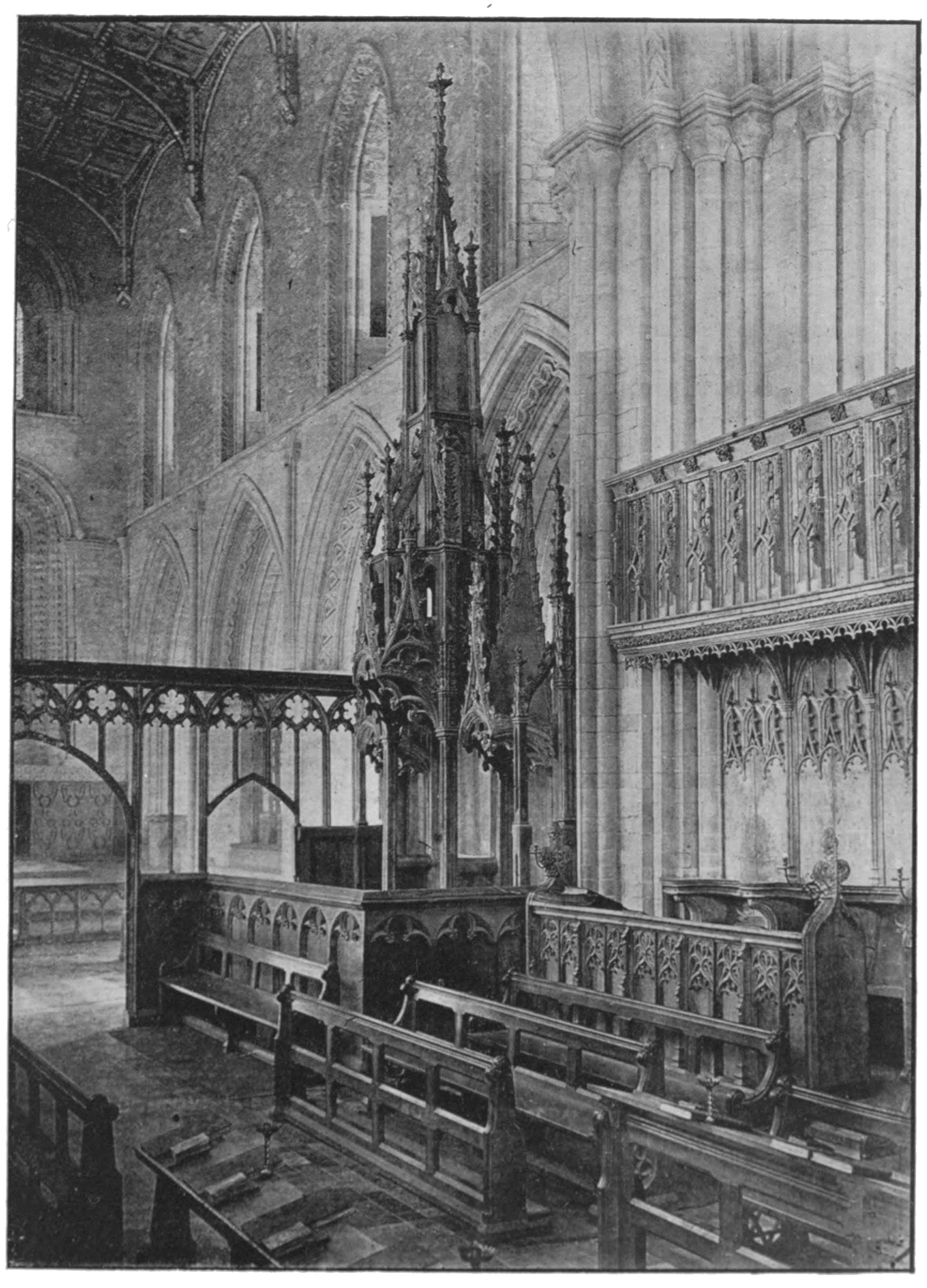
St David's
Not much later is the throne in Hereford cathedral. That at Wells is fifteenth century work, and by a pretty fancy of the "restorers" its tracery is filled with modern plate glass, and the door is a solid swinging stone! That at St David's is nearly 30 feet high. Of the throne erected by Bishop Gower c. 1342 there remains in situ only the low partition surrounding it; the present throne was probably put up by Bishop Morgan between 1496 and 1504 (109).[65]
The throne at Durham is of masonry, and in two parts of different dates. The lower portion contains an altar tomb surmounted by a recumbent effigy of the bishop in richly worked robes beneath a rich lierne vault. No doubt Bishop Hatfield as usual put this up during his lifetime; he was bishop from 1345 to 1381. This lower part is an exquisite example of the design in vogue before the advent of the Black Death of 1349-50. On the tomb is the pulpit, which bears unmistakable marks of the change of style which became general after 1350. The drawing shews the throne as it was in 1843 (107).
CHAPTER VIII
CHAIRS IN CHURCHES
Hardly anything in a cathedral has so venerable a history as the throne and chair of the Bishop, of wood or ivory. The origin of this type of Bishop's chair goes back to Pagan Rome. There the greater officials had two official chairs, both portable; one, the "sella curulis" in which they sat while administering justice; the other, the "sella gestatoria" in which they were carried in procession. The "sella curulis" was a folding chair with crossed legs like the chair of Dagobert in the Hotel Cluny, Paris: chairs of this form are still in use in many Continental cathedrals.
The "sella gestatoria" was a kind of sedan chair, shaped like a settle; with high back and usually without arms; it was provided with rings through which were passed staves when it was borne in procession. Similar is the Pope's chair in St Peter's, Rome, last shewn in 1867 (112). It is said to have belonged to the Senator Pudens and to have been used by St Peter. Whether that be so or not, it is undoubtedly very ancient, and its legs may be of the Apostolic age; they are of yellow oak, worm-eaten, and chipped by pilgrims who carried away bits as relics; the seat and back are of acacia wood and are of a later period. This back is ornamented with ivory panels carved to represent the Labours of Hercules; the panels are probably of the ninth century, for among the decorations is a bust with a crown bearing fleurs de lis, and what seems to be a portrait of Charles the Bald.[66] Very similar is the chair in which St Silvester is represented as seated in the dome of the apse of St John Lateran, where the mosaics are those of 1291, copied probably from the original ones executed in 428. Similar chairs also appear in the mosaics of Sta. Pudentiana and other Roman basilicas, and in those of Santa Sophia, Constantinople.
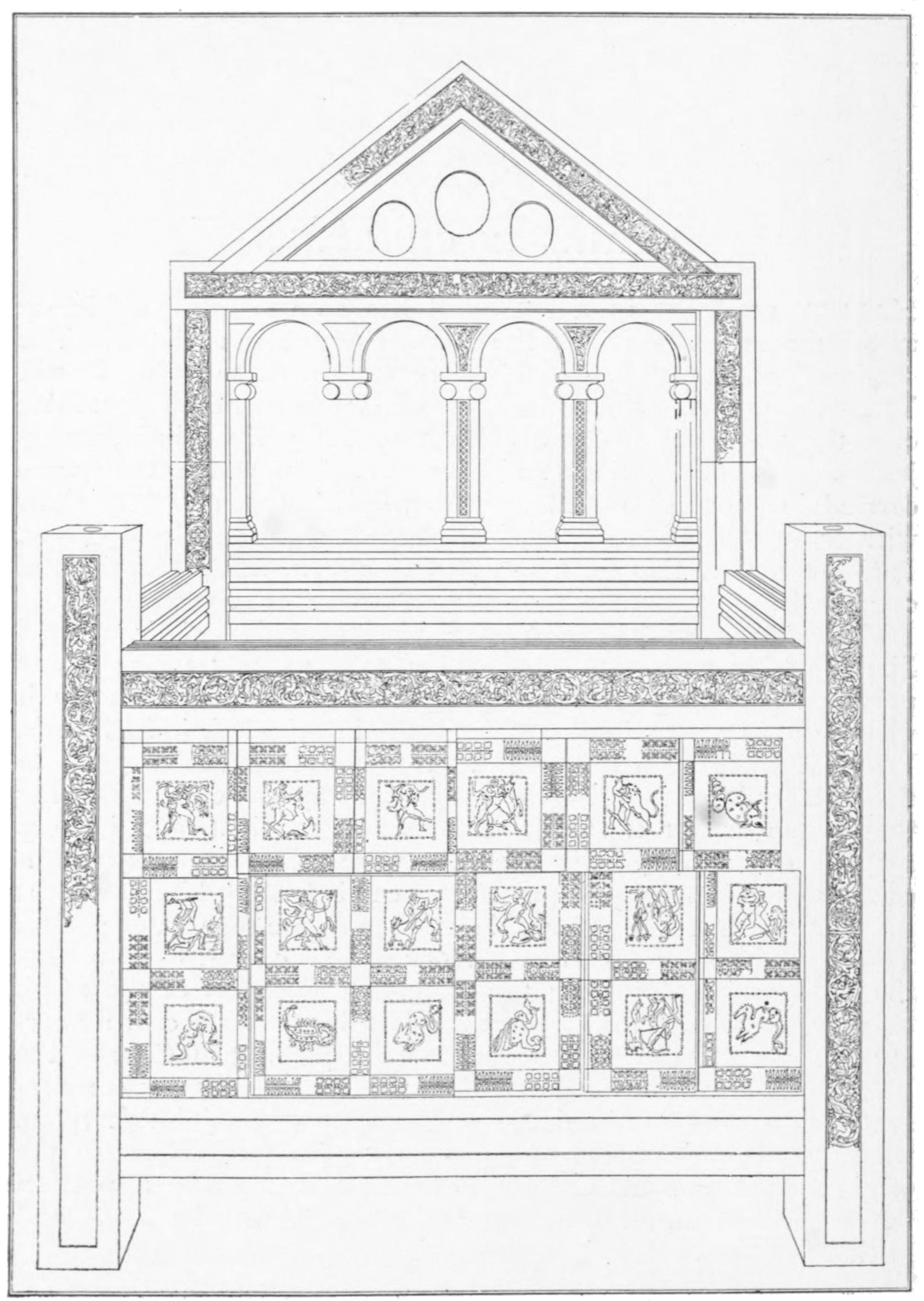
Pope's Chair
In the Archbishop's chapel at Ravenna is preserved a chair made for Maximian who was Archbishop of Ravenna from 546 to 556. It is in wood entirely covered with plaques of ivory, arranged in panels, with Scriptural subjects—among others the story of Joseph—and figures of saints richly carved in high relief. The plaques have borders with foliated ornaments, birds and animals, flowers and fruit, filling the spandrels.
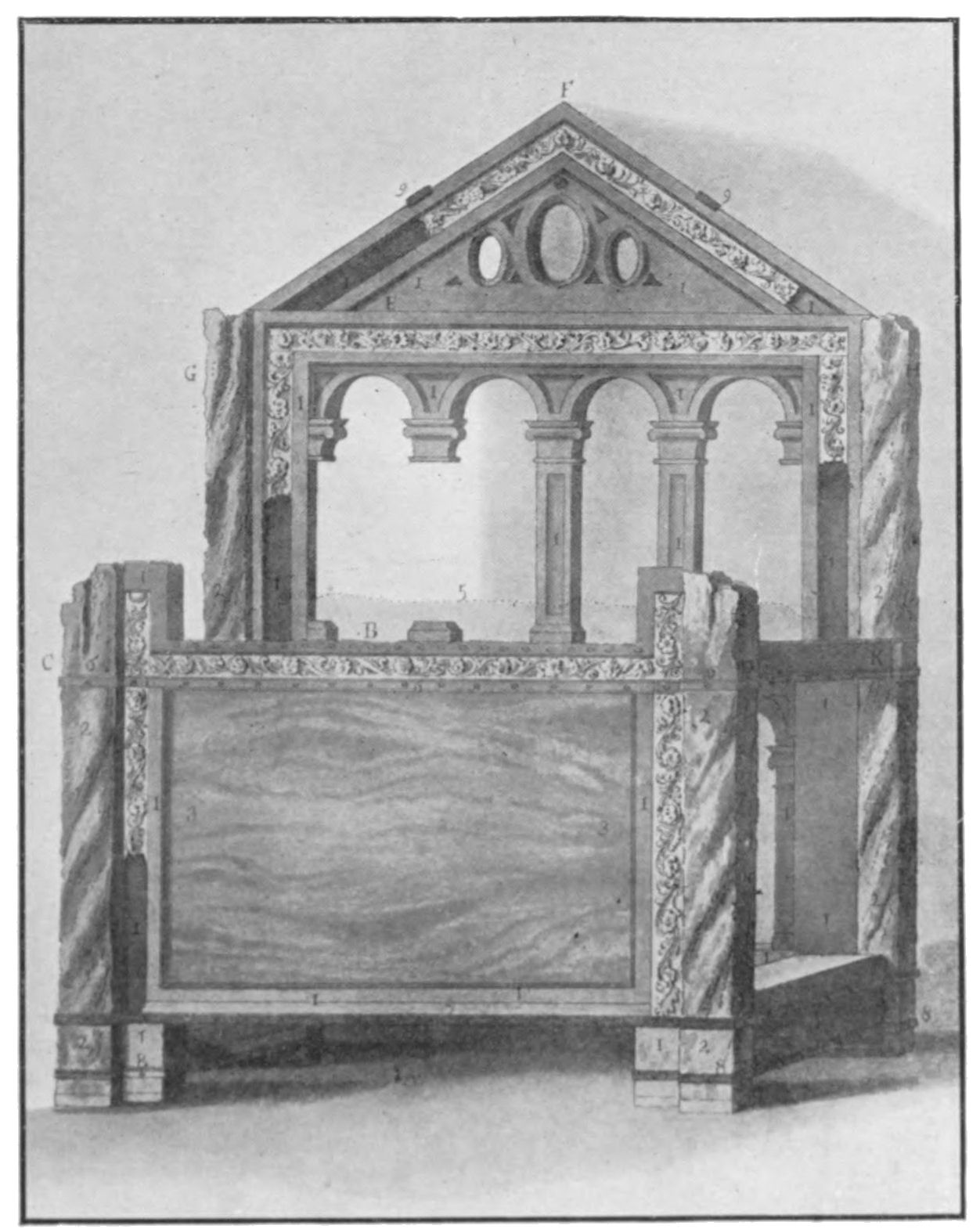
Pope's Chair
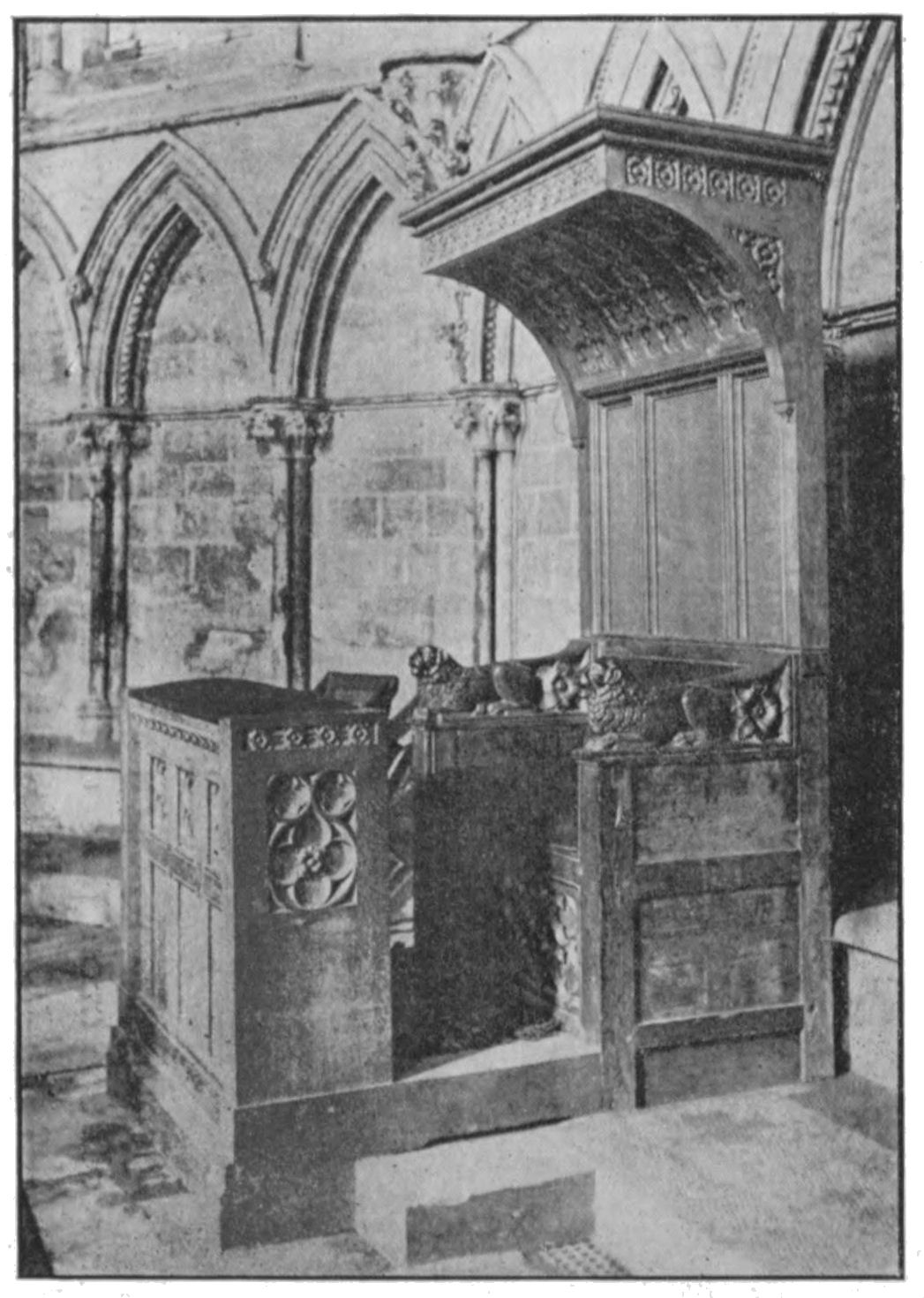
At Lincoln is a wooden chair, which appears to be c. 1300; it has recently been placed in the Chapter House and is now used by the bishop at diocesan synods (114). It is possible that since several Parliaments met at Lincoln, between 1265 and 1327, that this may be the royal chair: it may well have been used also at the great trial of the Knights Templars, which was held in the Chapter House in 1310. It is only original up to the level of the arms; the lions, the back and the canopy are modern.
Lincoln Hereford Cathedral
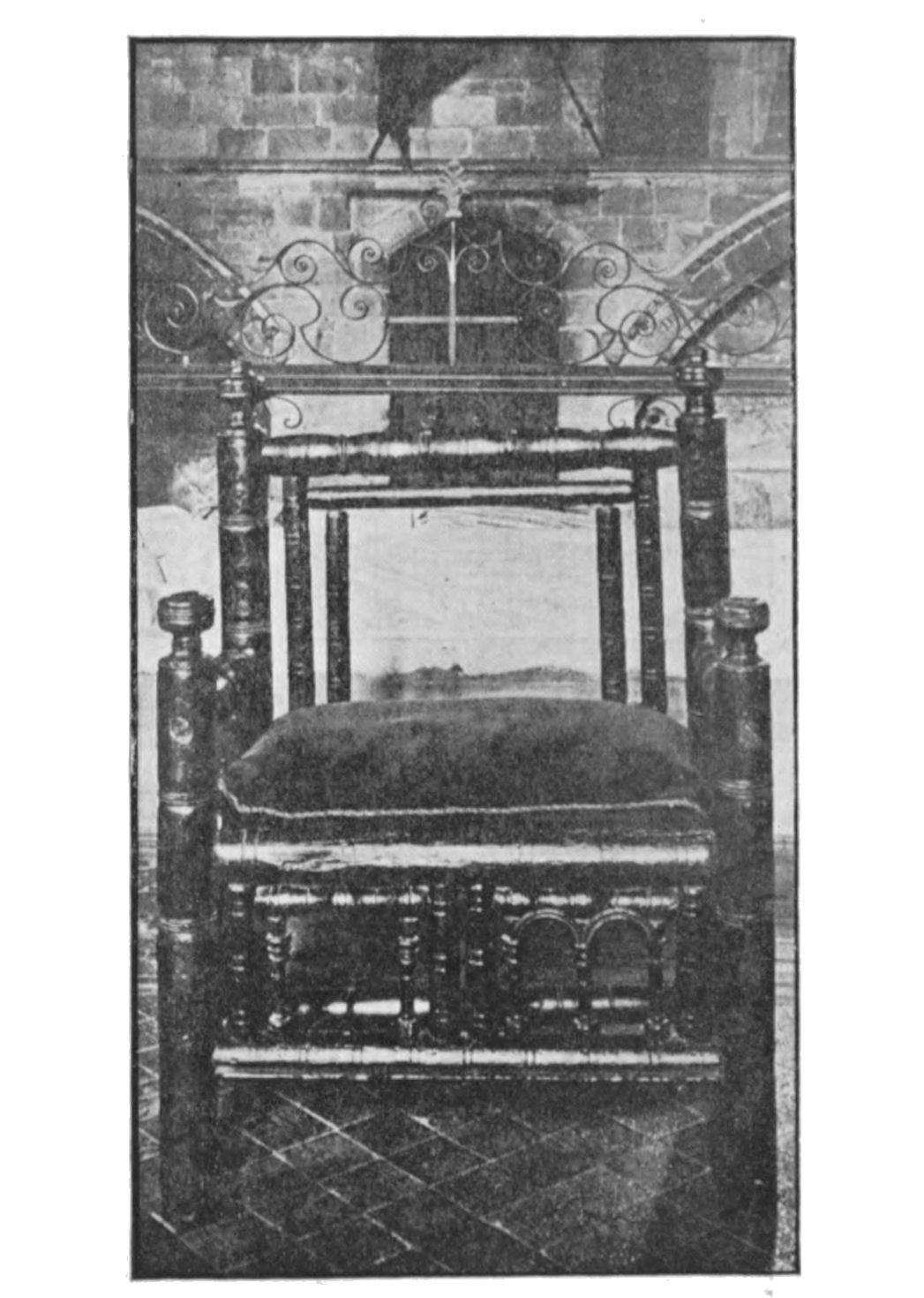
In Hereford cathedral is an ancient wooden chair, once coloured in red and gold; it is composed of fifty-three pieces; not counting the seat of two boards and the two circular heads in front; it has been variously ascribed to the twelfth or fourteenth century; but no doubt is Jacobean, belonging to the same class of chairs as those enumerated in the following paragraph (114).[67] At Stanford Bishop church, Hereford, is a rude chair or settle, of oak without nails. It is said to have been traditionally called "Old Horstin's chair," and therefore has been supposed, very improbably, to be the identical chair seated on which St Augustine received the British bishops in Herefordshire c. 600 A.D., greatly exciting the ire of the irascible Celts by not rising from his seat to receive them. In the Canterbury Museum Dr Cox has recently deposited a mediæval chair believed to be of great antiquity.[68]
Wells Wells
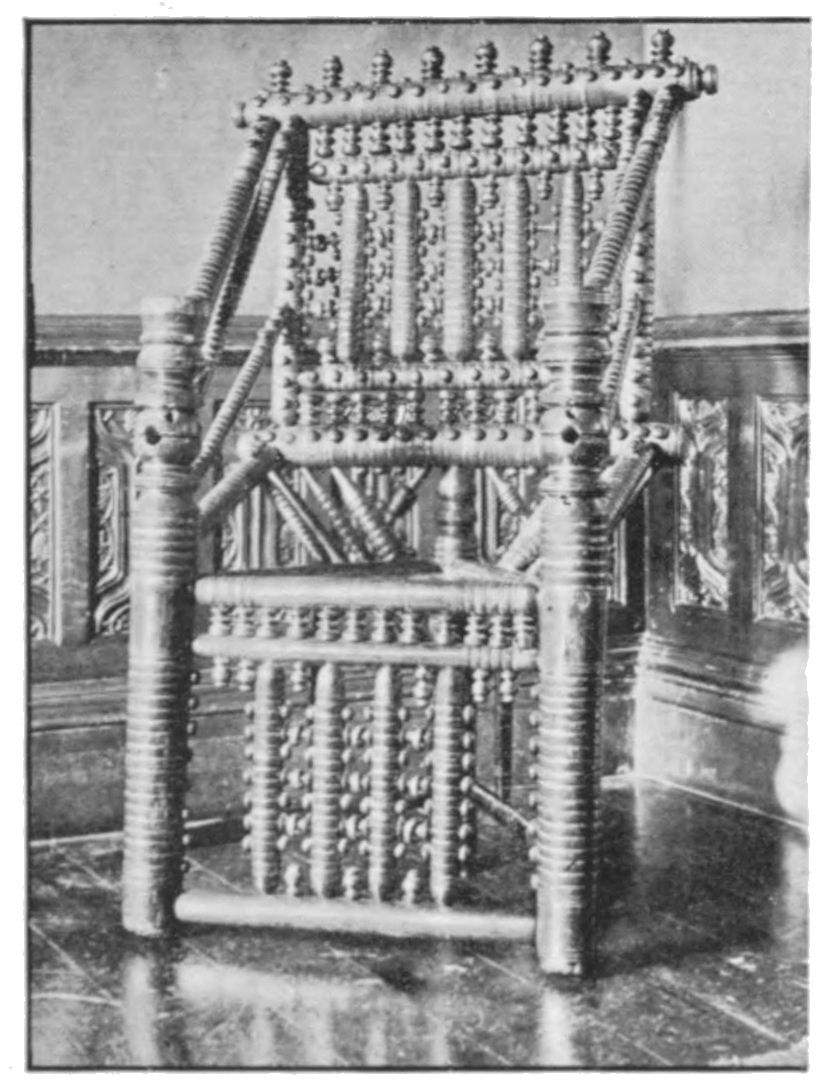
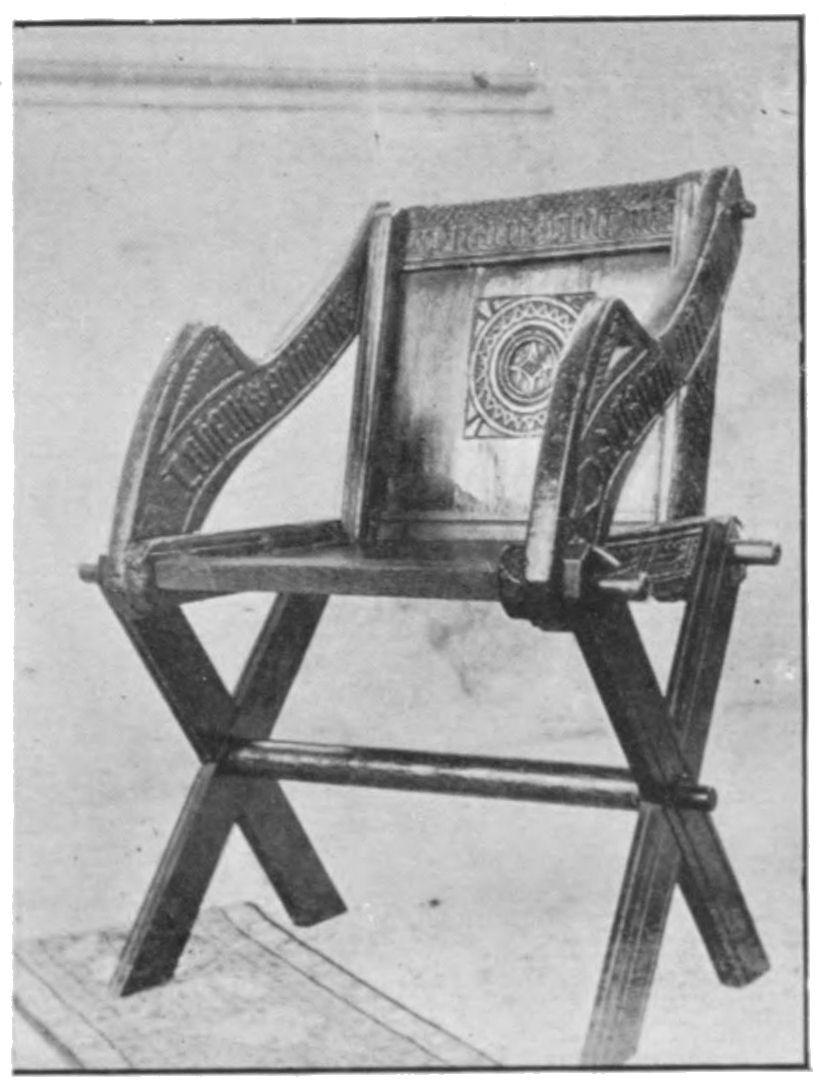
A few examples remain of what are supposed to have been abbots' chairs. In the Bishop's Palace at Wells is preserved a chair of remarkable type, said to have been used by the Abbot of Glastonbury. In the College, Manchester, is or was an ancient chair of the same baluster shape; and a very similar one formerly was to be seen in Agecroft Hall, Manchester. In the cottage at Zaandam, Holland, is a baluster chair, formerly used by Peter the Great. Another chair of this type, but of simpler form, is that once used by John Bunyan, and now preserved, together with his pulpit, in the meeting house of the Independent Congregation at Bedford. In the Victoria and Albert Museum is an arm-chair with balusters of turned ash. All these chairs are of seventeenth century date; no abbot of Glastonbury can have sat in the chair in the Bishop's Palace at Wells (115, on the left).
Dunmow Winchfield
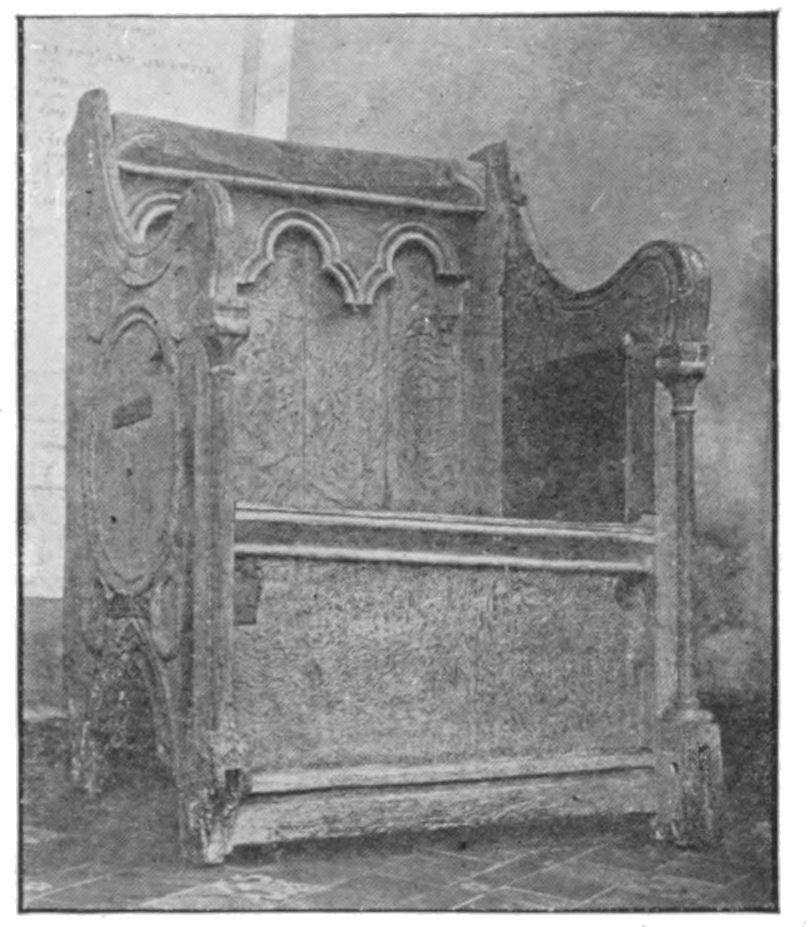
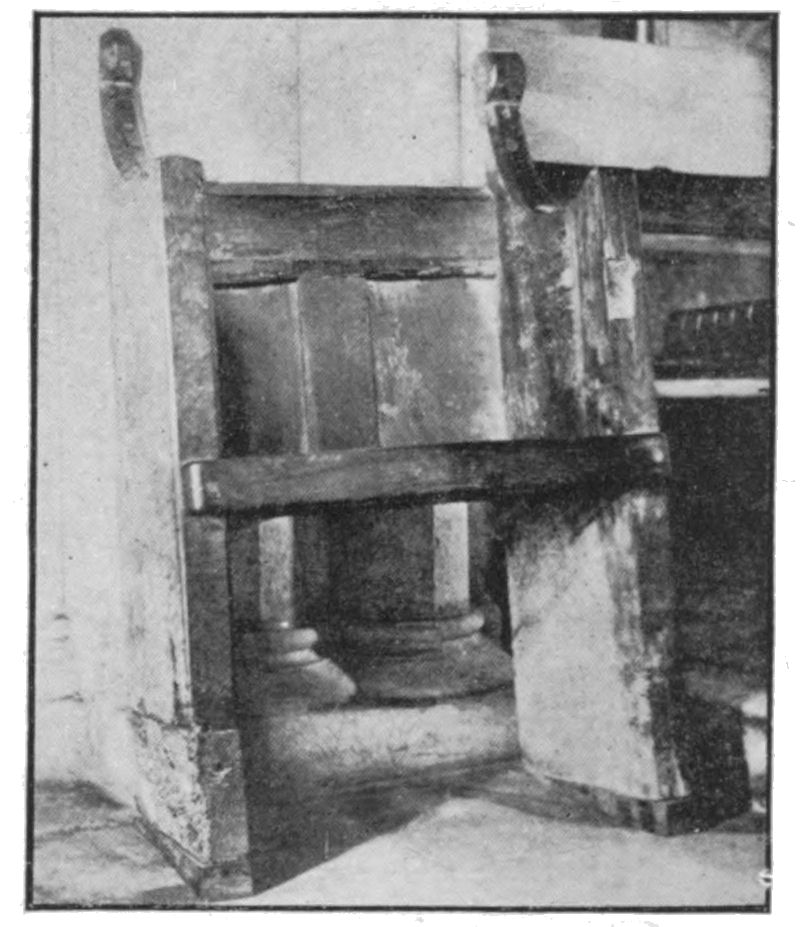
A chair from Glastonbury, bearing an inscription, and in date c. 1530, is now in the chapel of the Bishop's Palace at Wells; modern copies of it may be seen in hundreds of churches. It is inscribed Monachus Glastonie and Johannes Arthurus; a similar chair was formerly in Southwick Priory, Hampshire (115). An abbot's chair, reputed to have belonged originally to Peterborough cathedral, stands in the south chapel of Connington church, Hunts, where it is said to have been brought from the collegiate church of Fotheringhay, and is said to have been the last chair in which Mary, Queen of Scots, sat previous to her execution. From Little Dunmow priory came the chair now in Great Dunmow church, Essex; its trefoiled arcading shews that it was made in the thirteenth century. In it, up to 1907, were chaired the married couple "who had not repented them, sleeping or waking, of their marriage in a year and a day." The first recorded claim for the happy-marriage prize was made at the Priory in 1445 (116).
Coventry
Bishop's Cannings
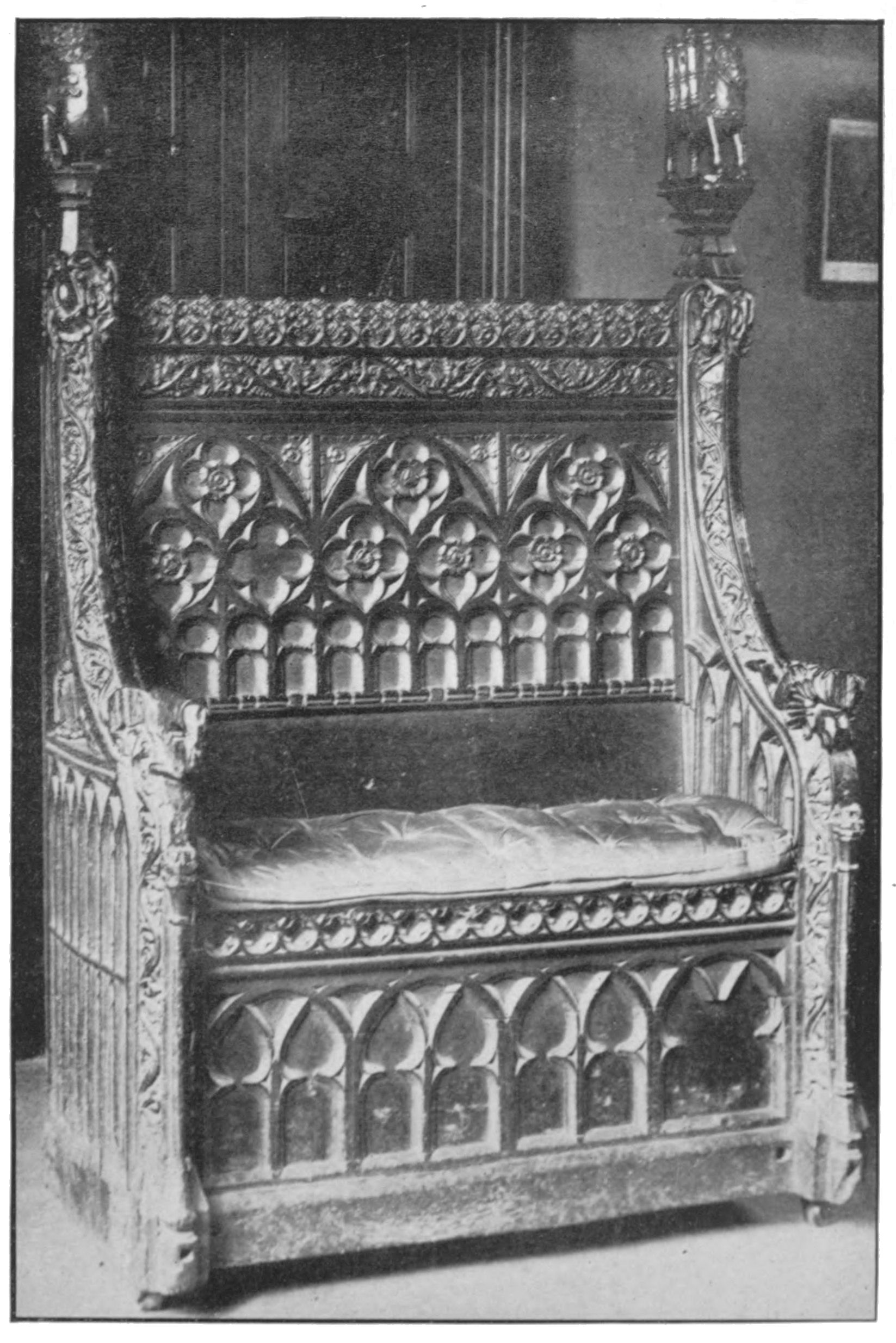
A magnificent and well-preserved seat is to be seen in St Mary's Hall, Coventry, and is assigned to the middle of the fifteenth century: it is of oak. From the mortices at one end and the discontinuance of the lower pattern it would seem to have been attached to a set of stalls, and to have belonged therefore originally to some church or chapel (117).[69]
Jarrow Beeston Regis
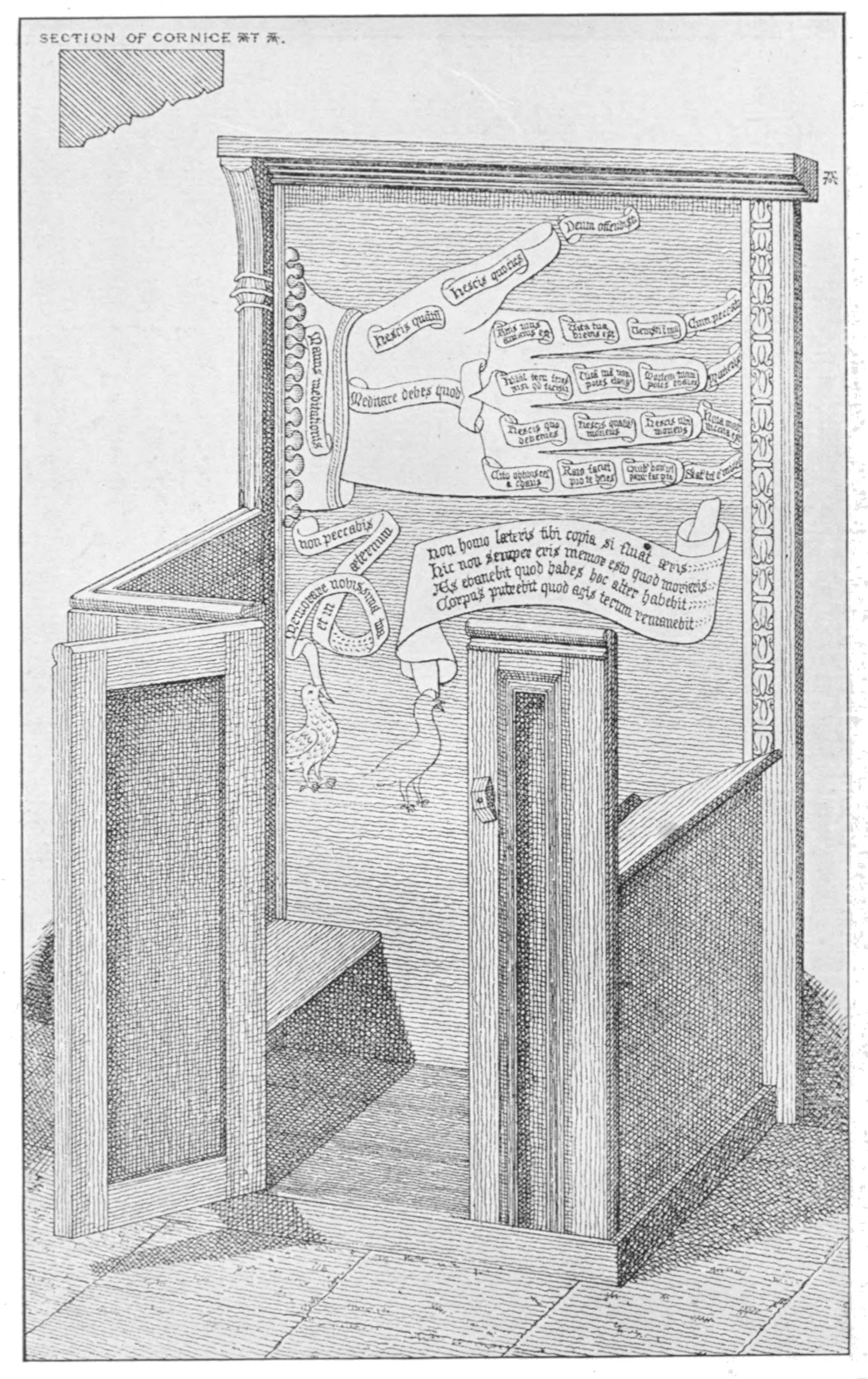
In Bishop's Cannings church, Wiltshire, is a remarkable seat believed to be a "carrel," or desk and seat, such as used to be employed by monks when at study in their cloister; it may have been brought from some monastic house. "It consists of an upright panel, with some fifteenth century moldings at the top and sides; against this panel is constructed a seat, facing sideways, with a flooring, a back the ordinary height of a pew, a door facing the panel, and a sloping desk facing the seat." With this description may be compared that of the monastic carrels given in the Rites of Durham;
"In the north side of the cloister from the Corner over against the Church Door to the corner over against the Dorter door was all finely glazed from the height to the sole within a little of the ground into the cloister garth, and in every window three pews or carrels where every one of the old monks had his Carrel, several by himself, that when they had dined they did resort to that place of cloister, and there studied upon their books, every one in his carrel, all the afternoon unto evensong time; this was their exercise every day. All their pews or Carrels was all finely wainscotted and very close, all but the forepart, which had carved work that gave light in at the carrel doors of wain scot. And in every Carrel was a desk to lie their books on; and the Carrels was no greater than from one stanchion of the window to another."
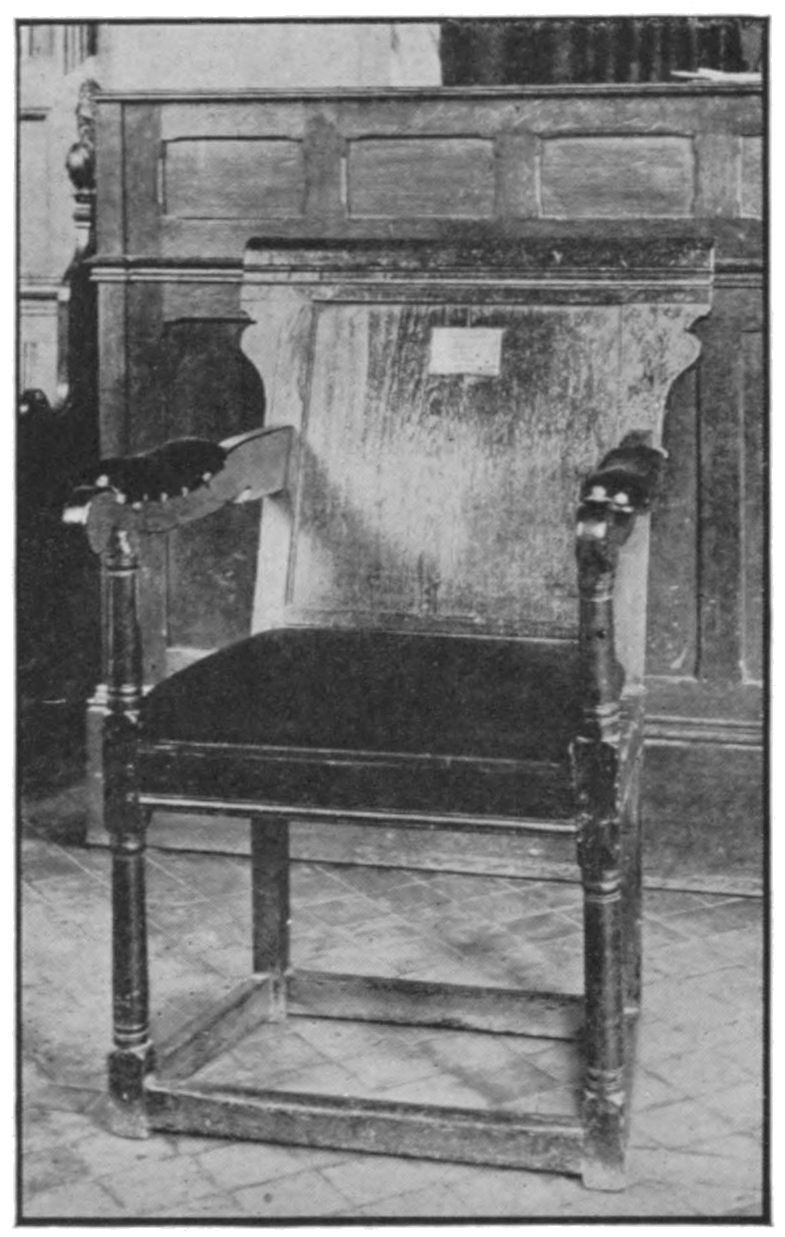
Lutterworth
On the inner side of the large panel are a variety of brief admonitory sentences, painted in Latin black letter on the thumb and four fingers of a rudely outlined hand, inscribed at the cuff Manus meditationis; beginning on the thumb with Nescis quantum, Nescis quoties, Deum offendisit. Below the hand with its pious sentences on the respective points of each finger, two cocks are painted, the one white and the other black; from their beaks proceed two labels, bearing further ejaculations (118).[70]
Westminster Abbey
Winchester Cathedral
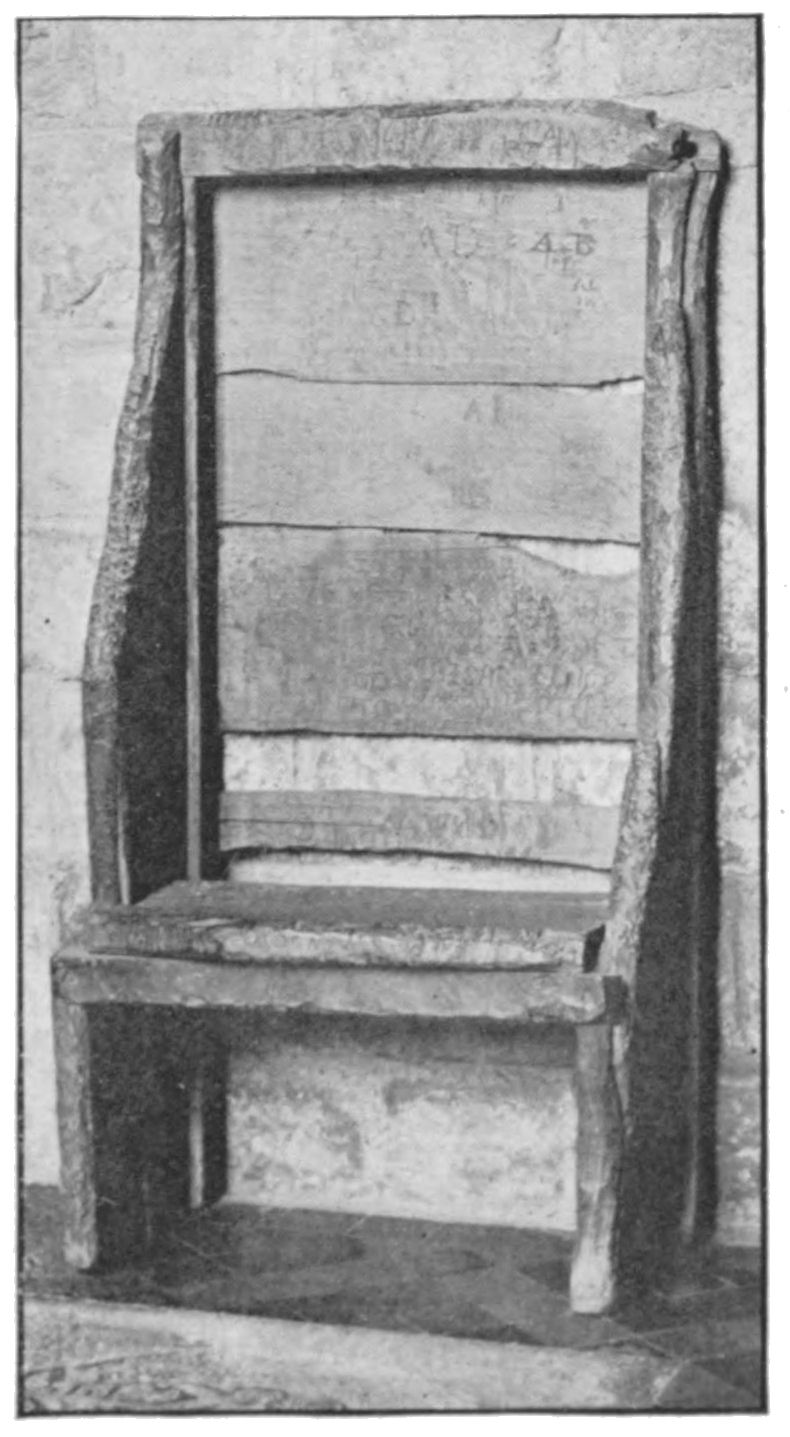
In St Paul's church, Jarrow, is a very rude seat known as the chair of the Venerable Bede; he was a monk of Jarrow, and died in 742; only the sides and seat and the crossbar at the top are original. Mr Mickethwaite was of opinion that it was originally a settle; and it seems hardly likely that the chair can have survived from the eighth century, especially as the monastery of Jarrow was repeatedly burnt by the Danes; but it is of an exceptionally hard oak, and bears marks of fire, and has had its present designation for several centuries.[71] It will be noticed that the standards have been whittled away by relic hunters (119). At Lutterworth is a well-known chair; the tradition is that it was used by John Wyclif, and that he was smitten with paralysis while sitting in it hearing mass, on Holy Innocents' day, 1384, and was carried in it to the rectory hard by, where he died on the last day of that year. A brass plate on it records the tradition; but the chair is plainly Jacobean and of domestic origin; there is another chair in the chancel of exactly the same shape and pattern (120).
Mainwaring Chapel Higher Peover
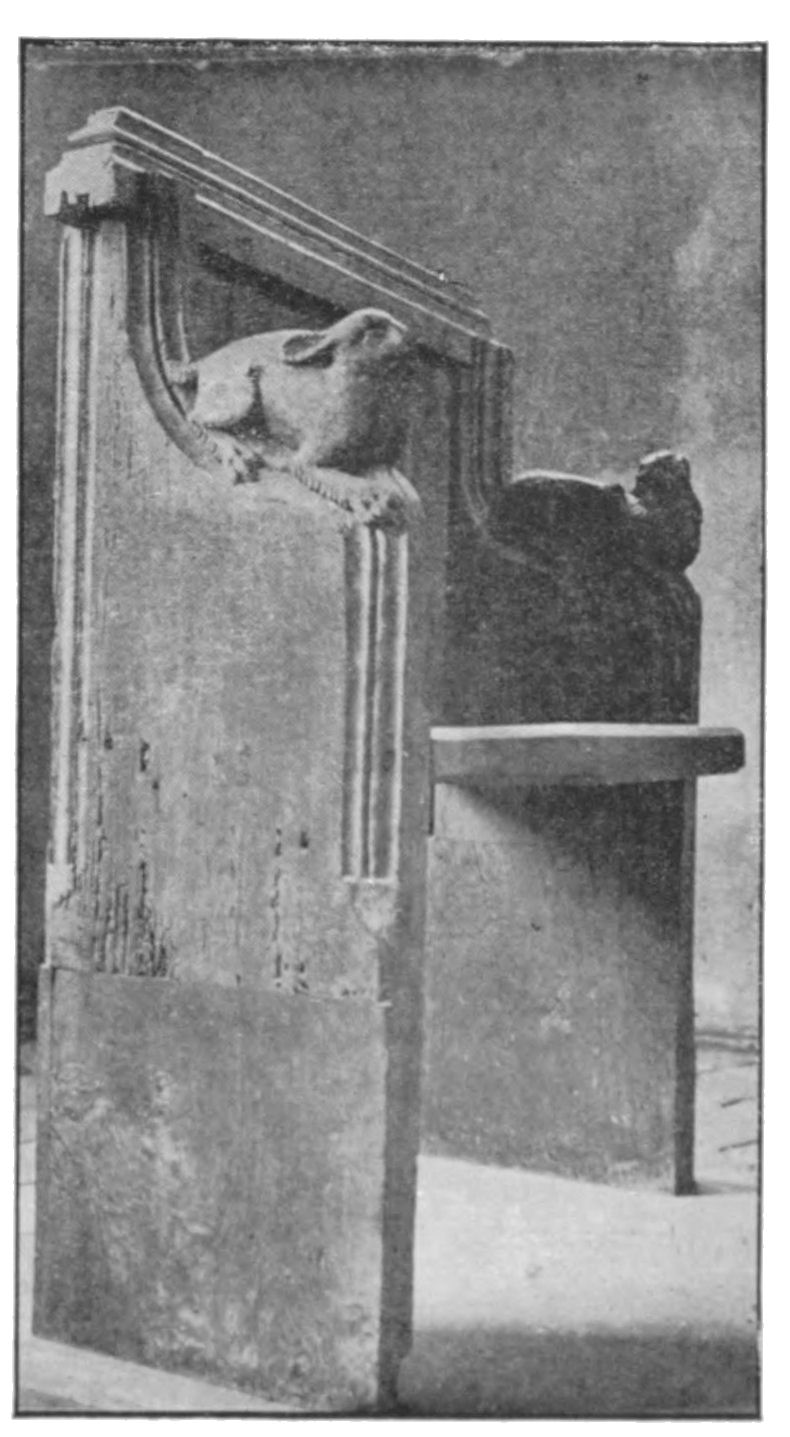
At Kidderminster Baxter's chair is preserved; on it is the following inscription:—"Rev. Rd Baxter born nr Shrewsbury in 1615 and died at London in 1691. Chaplain to King Charles II. Rev. T. Doolittle, M.A. Sr H. Ashurst Bt, Kidderminster, A. 1650 D." Baxter speaks of Mr Thomas Doolittle, born in Kidderminster, as "a good schollar, a godly man, of an upright life and moderate Principles, and a very profitable serious Preacher." To Sir Henry Ashurst, Bart., Sylvester dedicated his Reliquiae Baxterianae, 1696. He also stood by Baxter in the day of his trial and distress, paid the fees for his six counsel, and when the trial before Judge Jeffries was over, led Baxter through the crowd, and conveyed him away in his coach. He was also Baxter's executor, and it is possible the chair may originally have belonged to him. At Beeston Regis, Norfolk, is a fine old seat, now used by the parish clerk (119); it would seem to be of the period of the work at Balsham and elsewhere (3). At Winchfield, Hampshire, is another old seat of rude and early design (116).
Puddletown
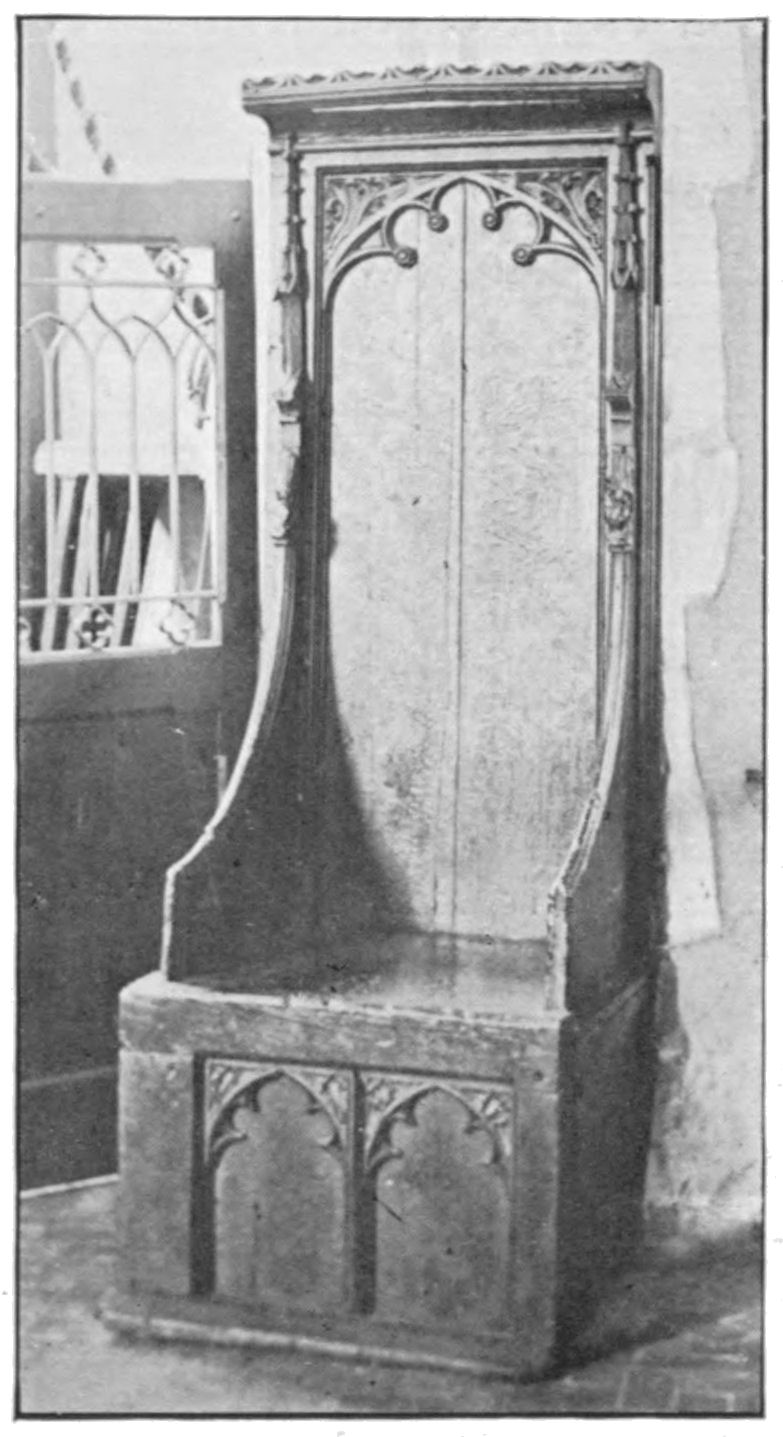
Stone seats are occasionally found. Where they are placed south of the altar, they are probably sedilia; but not when they are placed in the western bay or bays of the chancel or in the nave. At Barnack the remains of a stone seat were found on the west wall of the Pre-Conquest tower; it had formerly an oak seat and oak slabs on either side: a stone seat occurs also in the west wall of the nave of Old Radnor church. A stone seat is not uncommon in the western bays on the south side of chancels; the object of this is not clear; perhaps it was to provide a seat for the priest while reading his office; in later days, as we have seen, oak stalls were common in parish chancels, and the priest would read his office in one of these. Several examples occur. There is a rude example in the Pre-Conquest church of Corhampton, Hampshire. Others, probably of thirteenth century date, occur at Warlingham, Surrey, and Halsham and Sprotborough, Yorkshire. At Lenham, Kent, is one with solid stone arms, and with a cinquefoiled canopy of later date.
Redenhall Redenhall
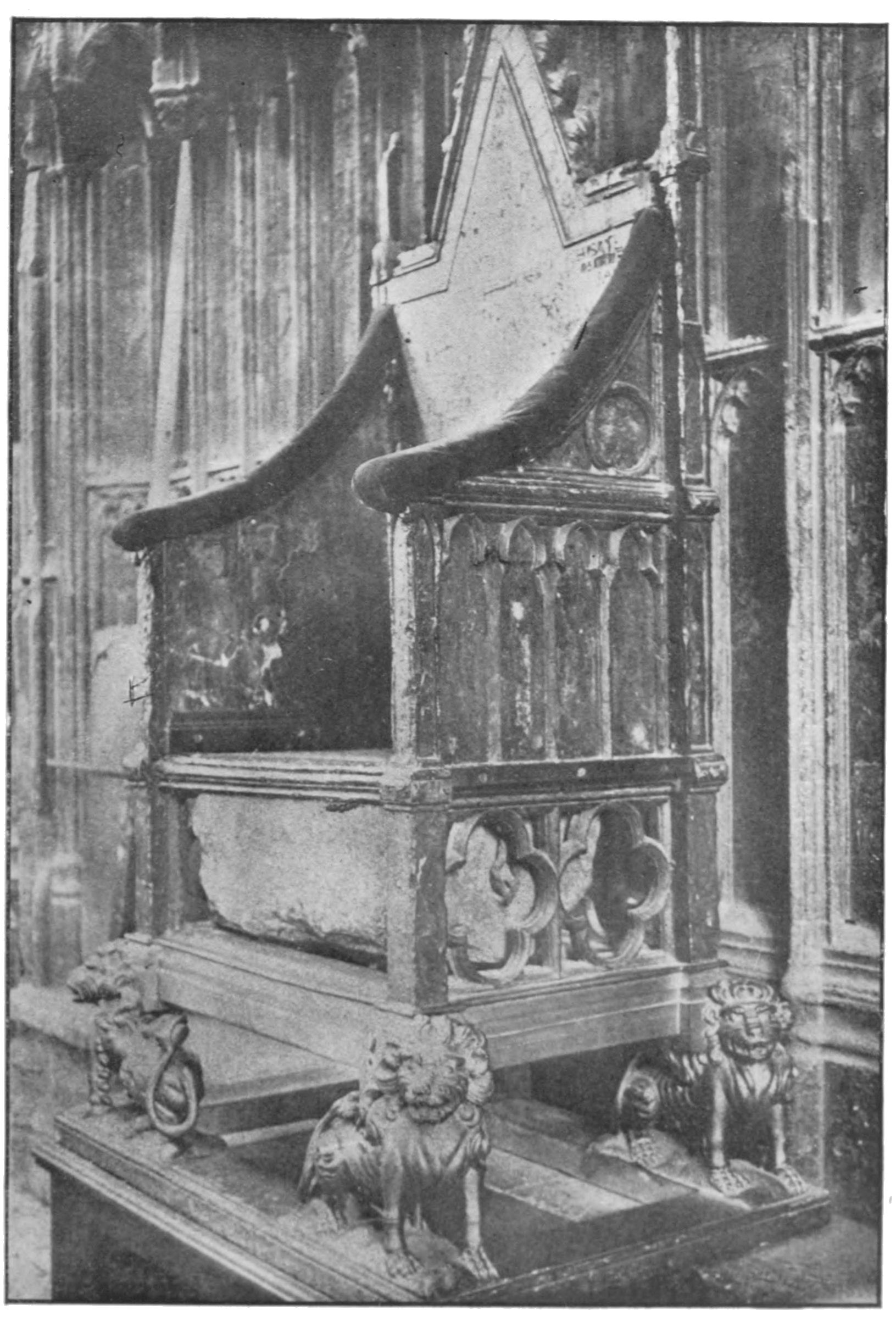
Last, we have the Coronation chair at Westminster,[72] which has a long, if somewhat unreliable history behind it. The stone beneath it is said to have been the one on which Jacob's head rested at Bethel; from whence it travelled to Egypt, and thence to Spain, Ireland and lastly Scotland. King Kenneth of Scotland had the following inscription engraved on it in Latin verse:—
"Ni fallat fatum, Scoti quocunque locatum Invenient lapidem regnare tenentur ibidem";
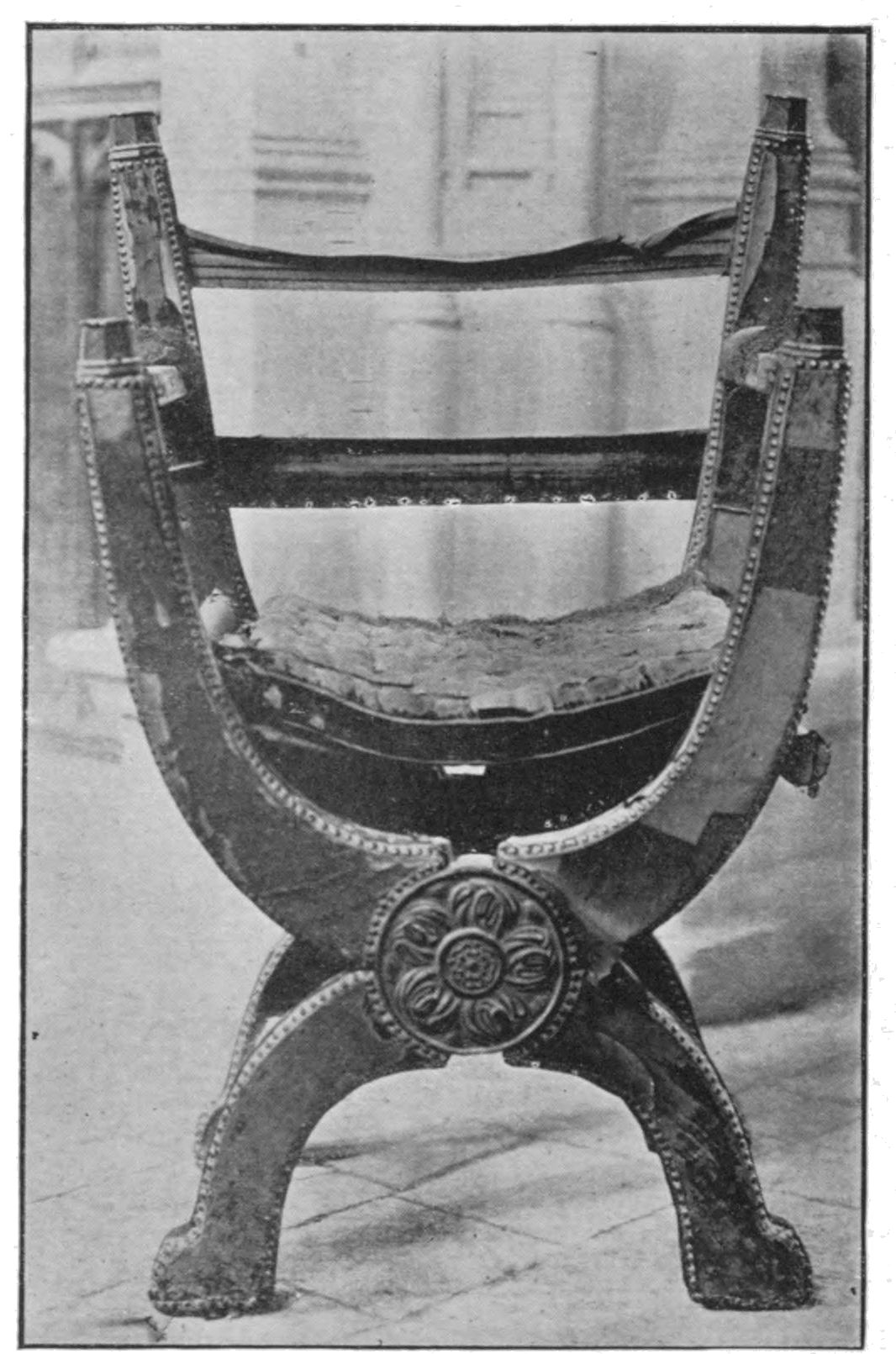
a prophecy curiously fulfilled on the accession of James I. to the English throne (121). On the upper surface of the stone is a rectangular groove large enough to receive an inscribed plate. Edward I. found the stone in 1296 at Scone abbey, where the Scotch kings had always been crowned on it. He carried it to London, and in 1300 Master Adam, the king's goldsmith, was working at a bronze chair to hold it. But when this was nearly finished, the king altered his mind and had a copy of it made in wood—the present chair—which cost 100s., by Master Walter, the king's painter. The chair has lost the quatrefoils in front, and the lions are of recent date. It originally stood in the same position as a bishop's chair, i.e., at the back of the High altar and in front of the shrine of Edward the Confessor, and facing to the west. It is made of oak, fastened together with pins; the surface was first covered over with the usual gesso; then gold was applied by means of white of egg, and burnished; then minute dots, forming diapers of foliage, beasts, birds, &c., were pricked on the surface of the gold, taking care not to penetrate it, with a blunt instrument before the ground and gilding had lost their elasticity; a most tedious and delicate process. A second chair, modelled on the older one, was made on her coronation for Mary II., Queen of William III. It used to stand by the side of the king's chair, but has been moved to the easternmost recess of Henry VII.'s chapel. In Winchester cathedral is the chair which was used by Mary I. on her marriage with Philip of Spain, which was solemnised in the Lady chapel: it is now placed in Bishop Langton's chapel (122). Very similar is a chair preserved in York Minster, which, owing to the shield attached in front, is probably not older than the time of Richard II.:[73] the cushion is stuffed, and covered with green velvet; the shield also is covered with leather, the upper part of which has been torn away, and the lines upon it are but slightly stamped. At Constance is shewn a similar chair of Martin V., who was elected Pope there in 1417.
Much Hadham
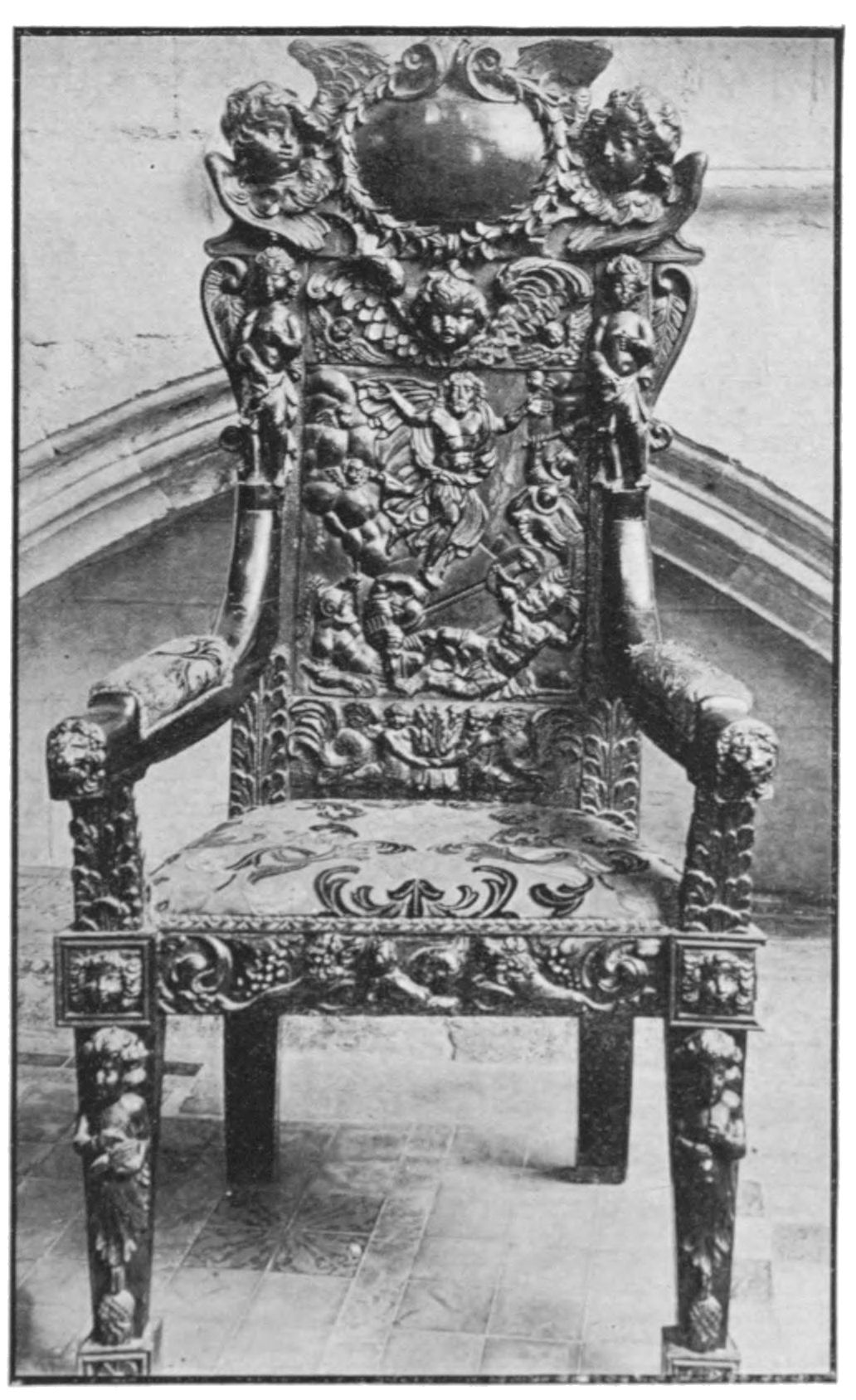
Cartmel
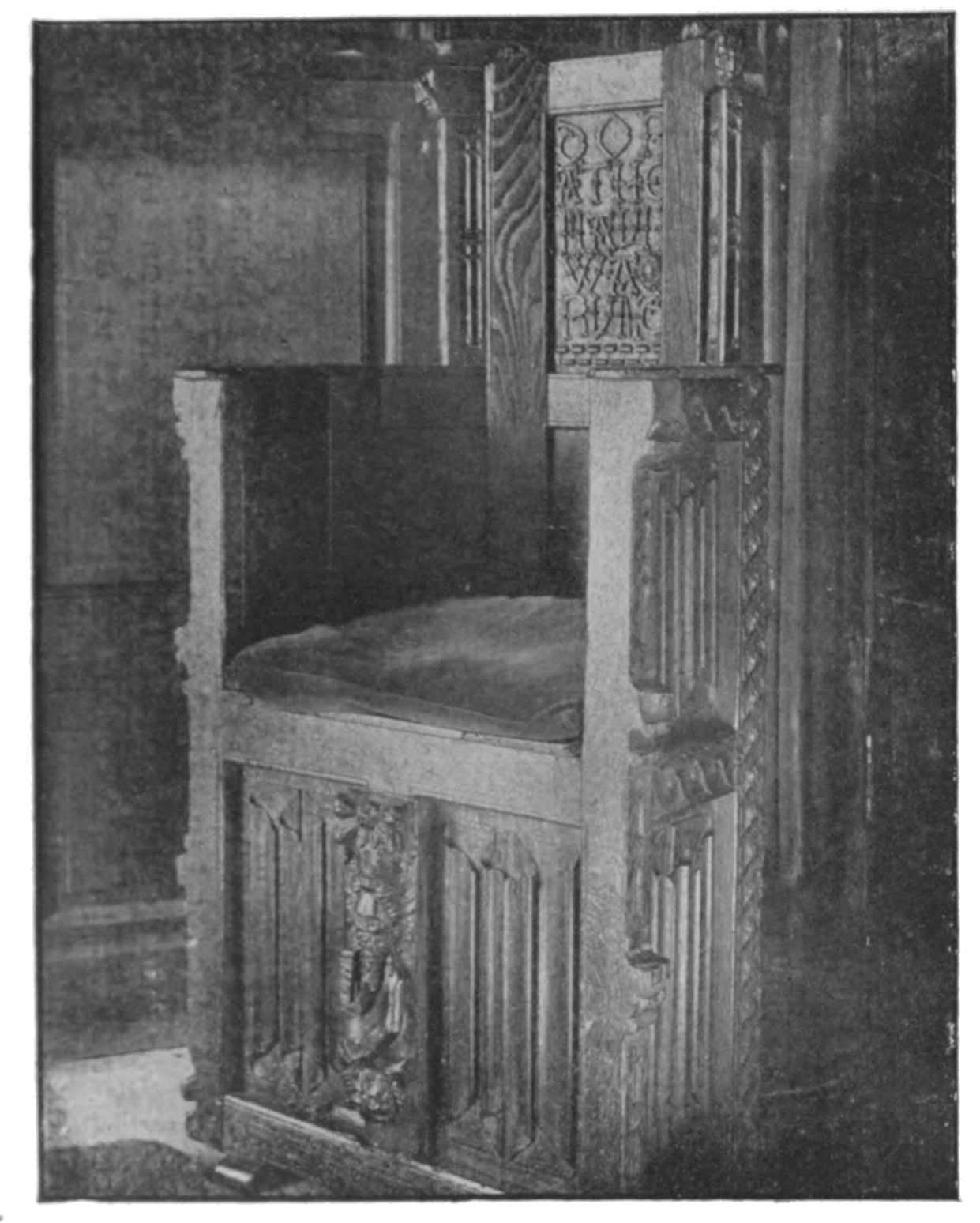
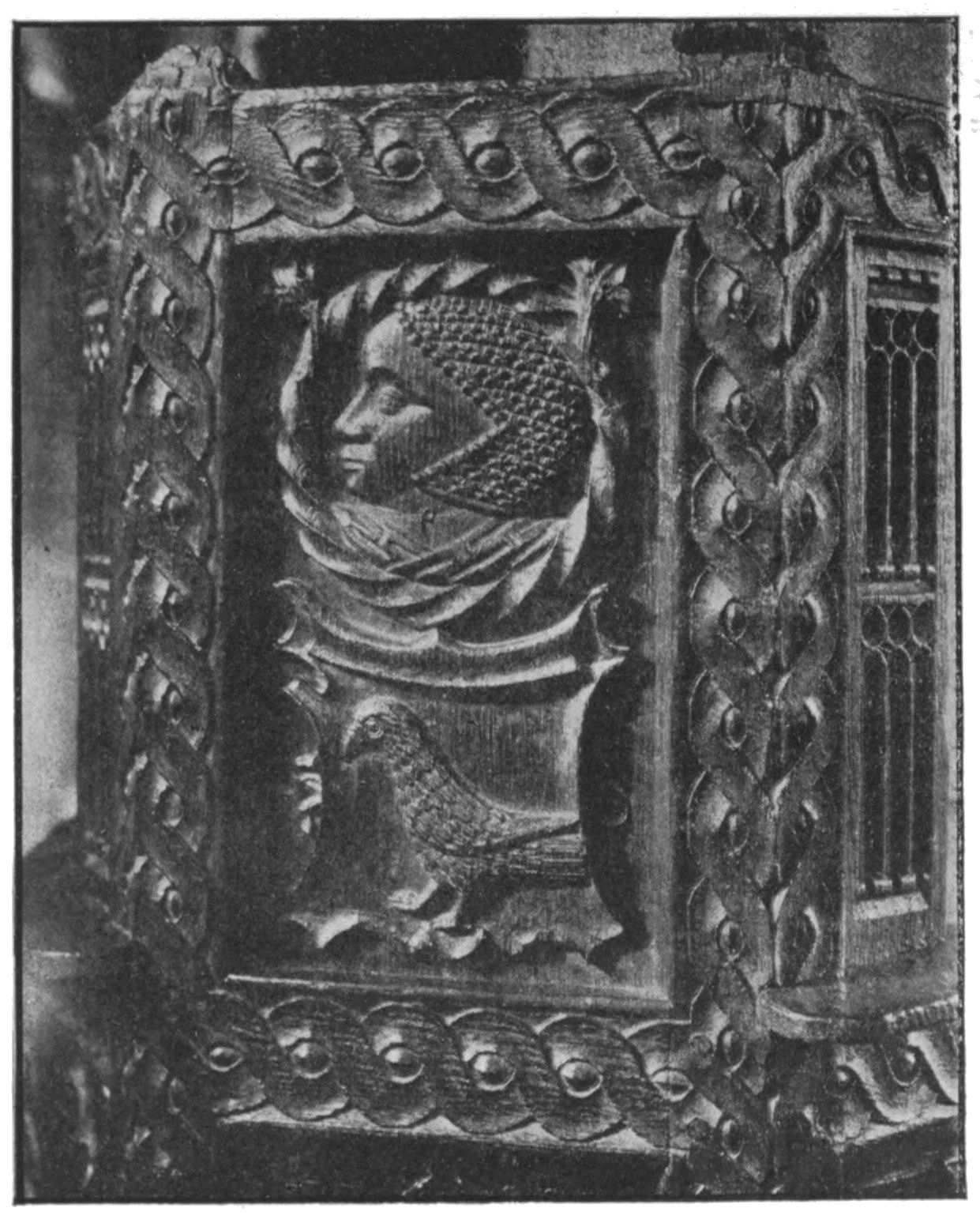
In addition to the above, chairs are often placed in the presbytery to the north of the altar. These were occupied by the preacher during morning or evening service, till his turn came to ascend the pulpit and deliver the sermon. Of these the greater number no doubt have been presented by the owner of some manor house or parsonage, or have been picked up in recent years in some second-hand furniture shop. This is probably the case with the interesting chair which is known to have been for nearly a century in the Mainwaring chapel of Higher Peover church, Cheshire; it bears not only the name, but the portrait and initials of the owner. The inscription is DORATHY MAYNWARING; she married Sir Richard Mainwaring of Ightfield, Salop, High Sheriff of that county in 1545. Most of the chair is older than her time; Dorothy seems to have had it put together of old bits of carving, adding her name and portrait, and the raven, the crest of her father, Sir Robert Corbet. She lived at Ightfield, and it was probably when that branch of the family became extinct that the chair was brought to Higher Peover church, and placed in the Mainwaring chapel. At the top are holes for holding sconces in which tapers would be placed (123).
Suffolk Halsall
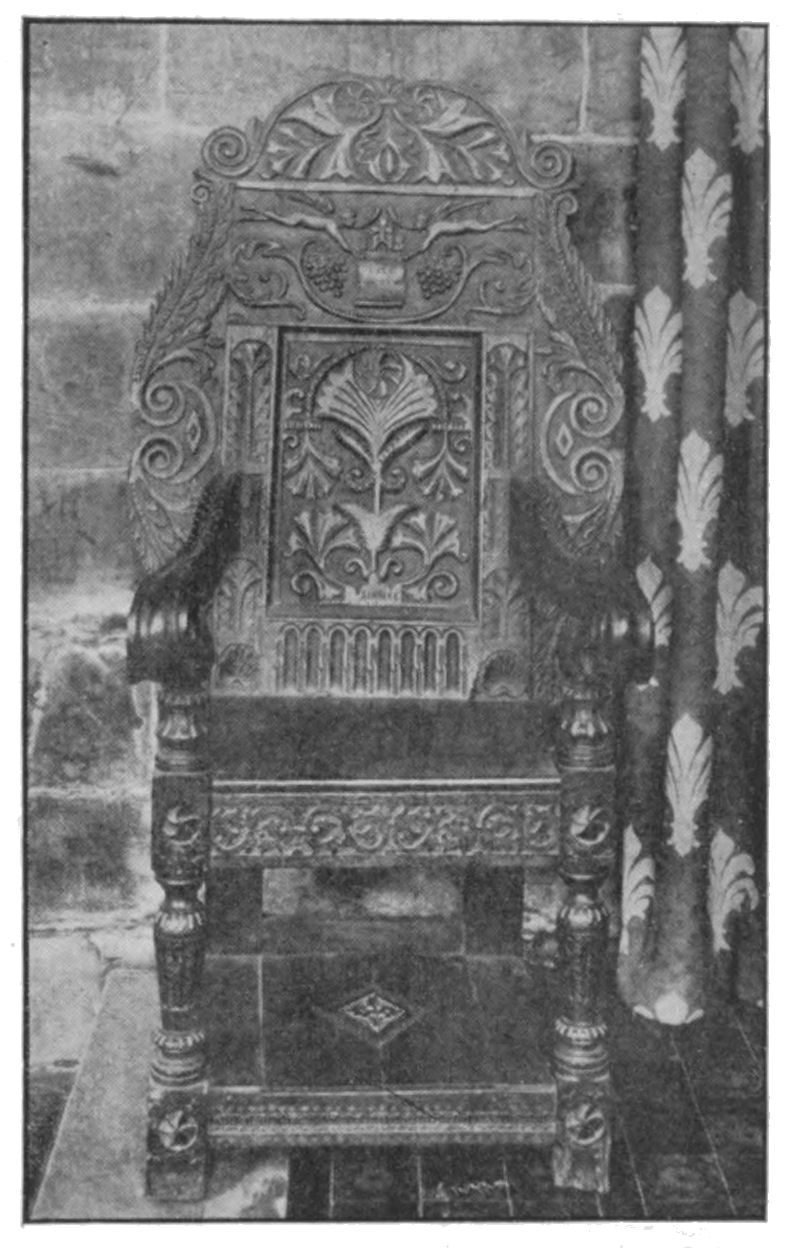
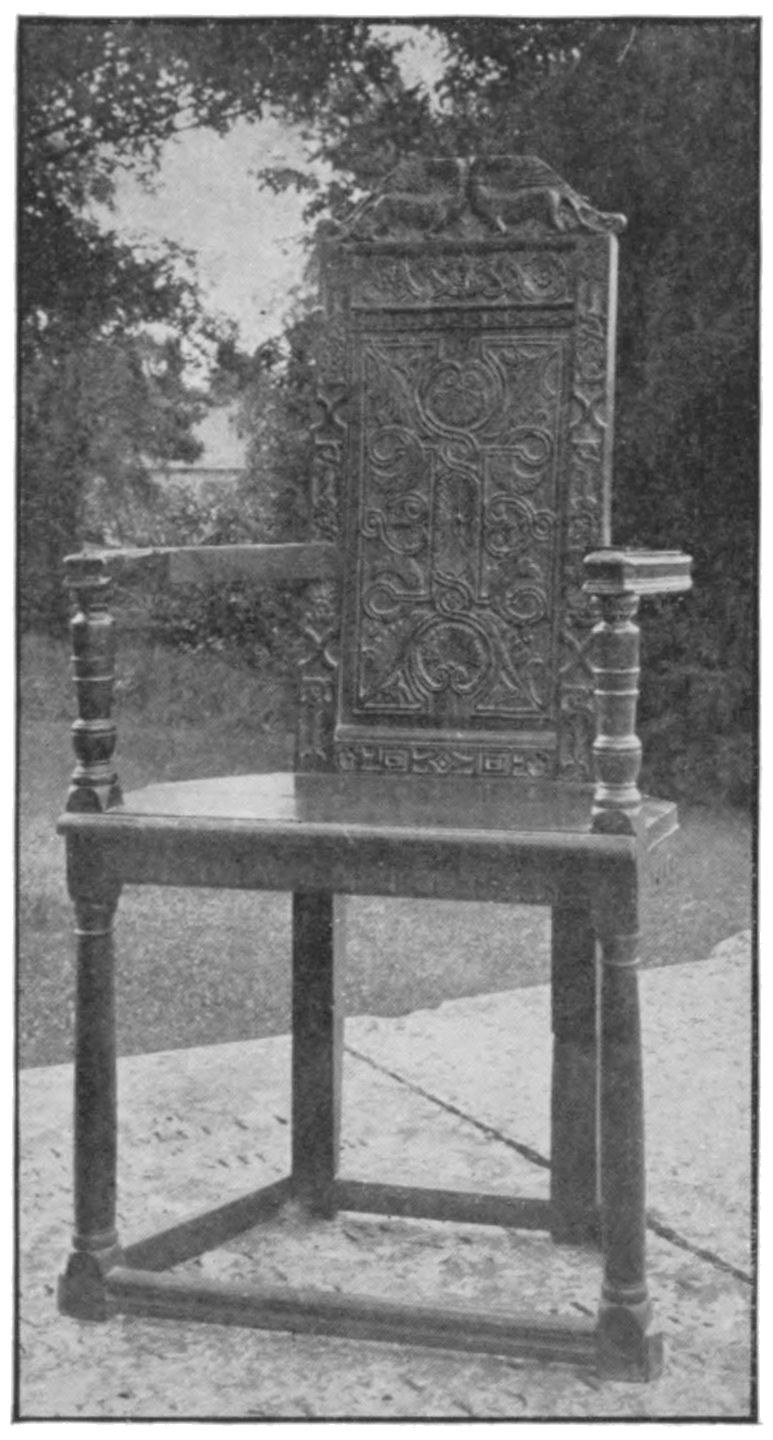
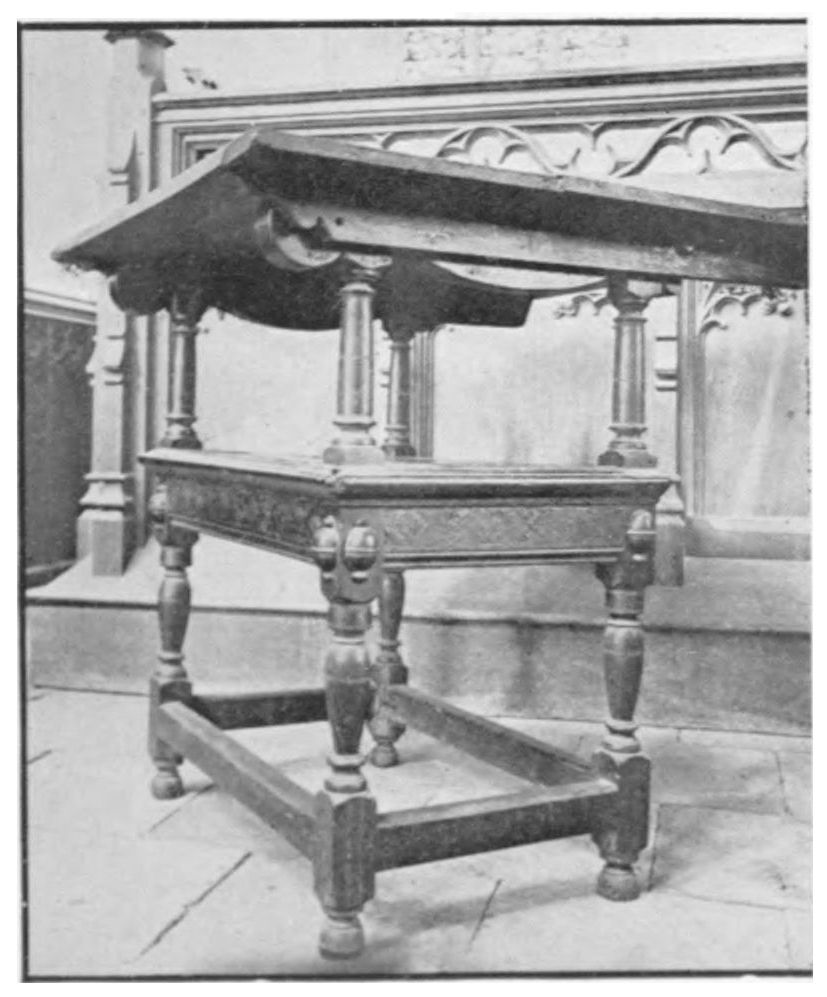
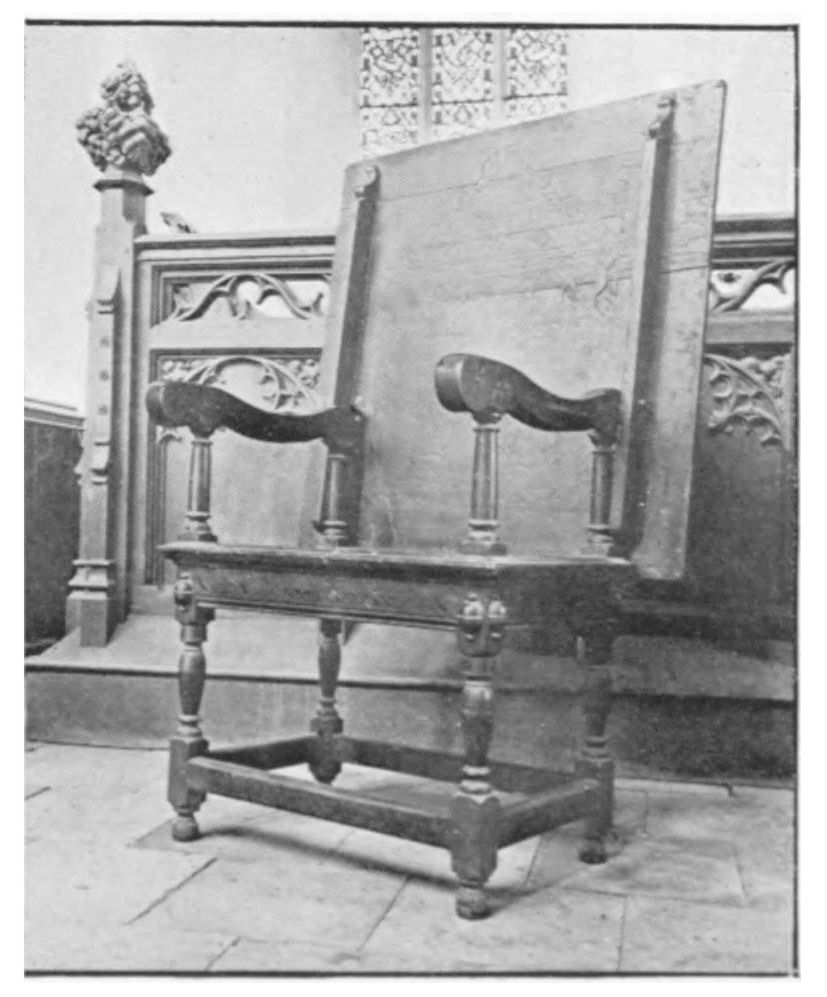
At Penshurst there used to be a chair with a bust on the inner panel of the back; the tradition was that it belonged to Sir Philip Sidney.[74] At Puddletown, Dorset, a chair has been in the chancel for very many years; it is of Elizabethan date, and was probably brought from some hall or manor house. "The tall narrow back, the broadening seat, the vertically straight, but horizontally angled arms are those of the French caqueteure type rarely seen in England. The strap carving of the back is of the best; while the twin greyhounds with averted heads that fit the curved top of the chair no doubt have reference to the original owner" (124).[75] At Upton, near Castor, there are two chairs in the chancel; on one of which is inscribed "A.D. 1700—Joane Browne—Want Not." The other has the initials J. D.; the Doves were Lords of the Manor at that time (130).[76] In Redenhall church, Norfolk, is one of two chairs brought there from Canterbury cathedral by Archbishop Sancroft on his expulsion from the see in 1615; it is of a curious pattern common in the latter part of the seventeenth century, in which the back is hinged and can be turned over to convert the chair into a table. Archbishop Sancroft is buried at Redenhall, which, by the way, possesses perhaps the finest church tower of any village in England and an exceptionally fine ring of ancient bells. The other chair is kept at Gawdy Hall, the seat of the Sancrofts (125).
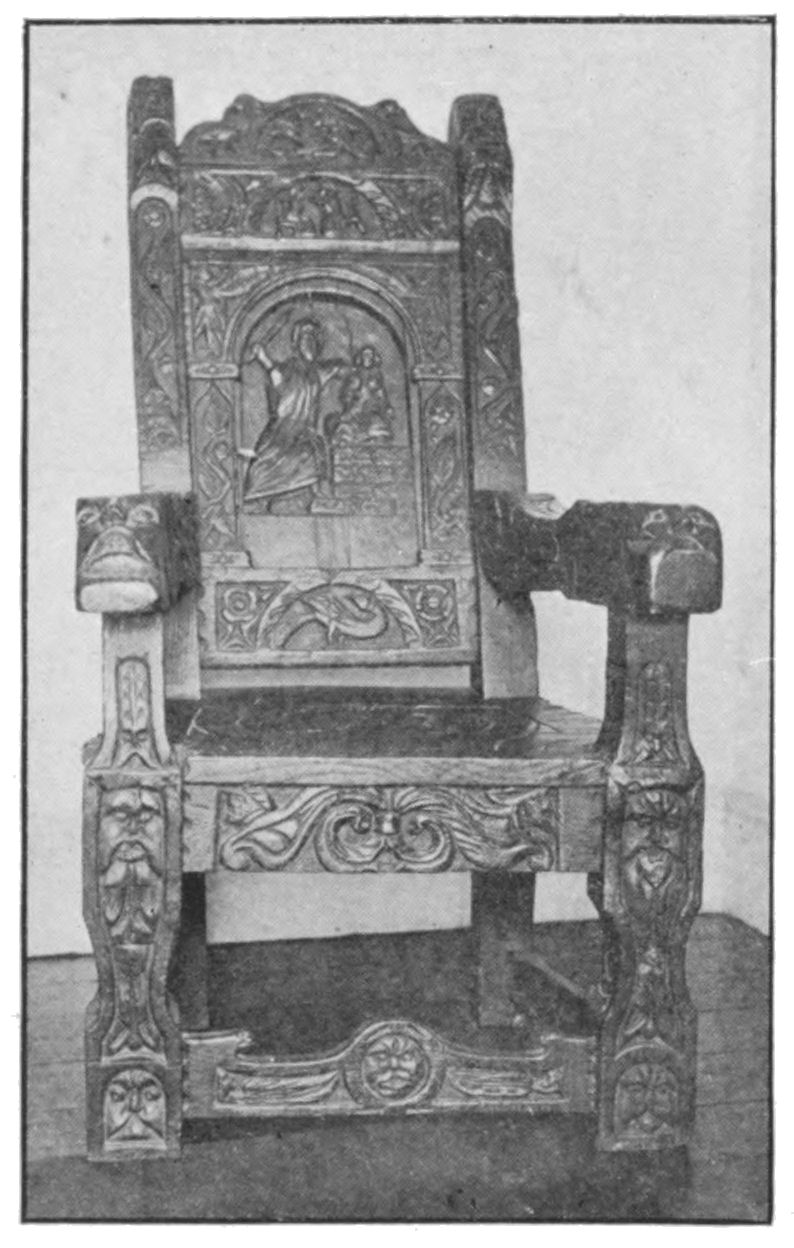
In many cases the chair is a composite product, made up of fragments of screens, bench ends and the like; this seems to be the case with the chairs in the churches of Bridford, Devon, and Othery, Somerset; that at Much Hadham, Hertfordshire, appears to be put together out of the fragments of a screen (126). In the Chapter House of Gloucester cathedral are two chairs, on the inner panels of the back of which are carved "The Last Supper" and "The Ascension" respectively; the panels were presented in the time of Dean Law, and, provided with a framework, now form part of two chairs.
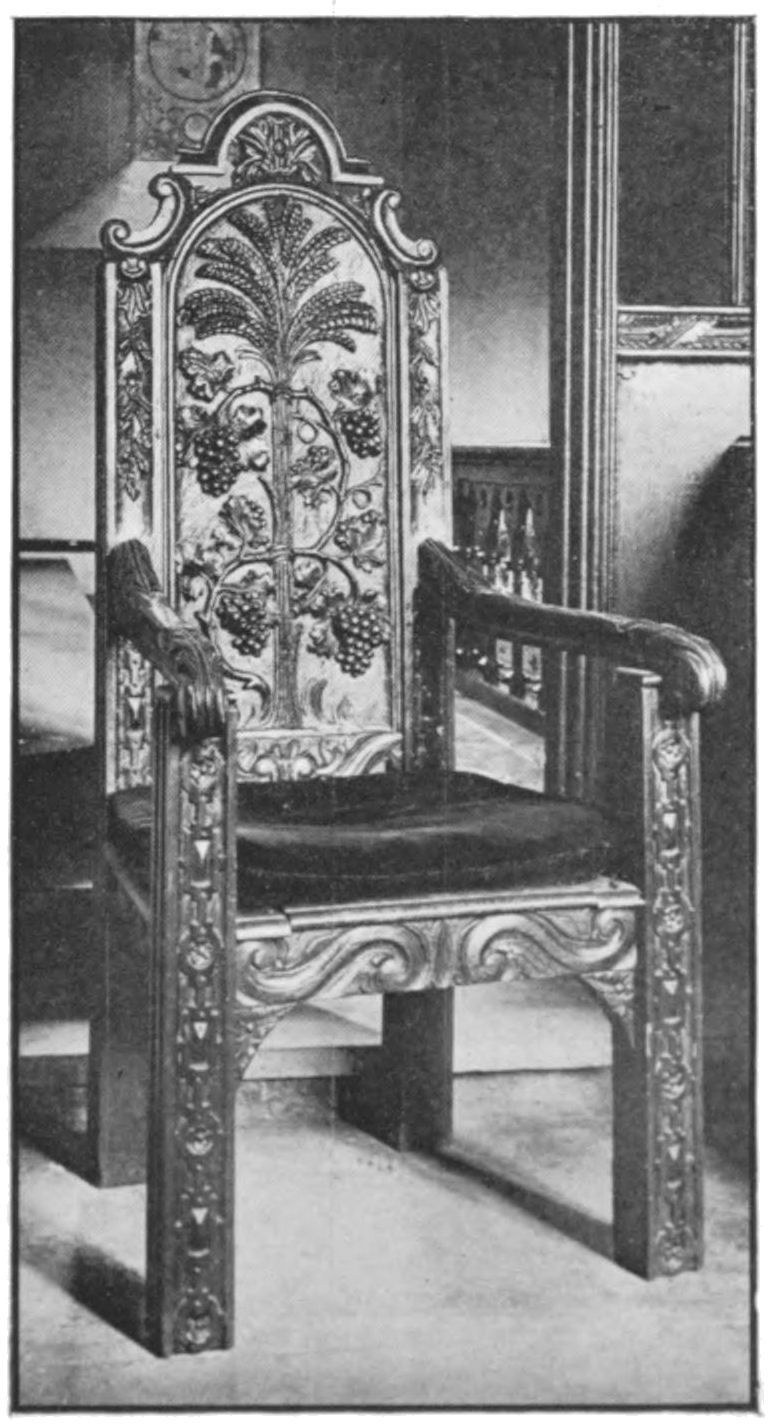
Combmartin
Where, however, the chair has a representation of some ecclesiastical subject, the presumption is that it was made for the church in which it is placed. In Cartmel Priory church is a fine chair on the back of which is represented the Resurrection; below are seen the Roman soldiers; above, Christ shews the wounds in His hands (127). At Sanderstead, Surrey, Abraham with uplifted sword is about to slay Isaac; on the right is shewn the ram, on the left an angel. The same subject appears, better carved, on the back of one of two chairs brought from a church in Suffolk, now pulled down; on the other chair is a representation of what looks like the Temptation (128). In Halsall church, Lancashire, are two beautiful chairs with the initials IHS; beneath them is a scroll on which is inscribed Ecce quomodo amabat (128). In the Victoria and Albert Museum is a similar "winged" chair, which bears the initials IPI and the date 1670. In the chancel of Combmartin church, Devon, is a mahogany chair with wheat and grapes, apparently referring to the sacramental bread and wine; it had been for many years in the family of the present incumbent, Rev. F. W. Jones, and was presented by him to the church; it is possible that it was originally made for a church (129).
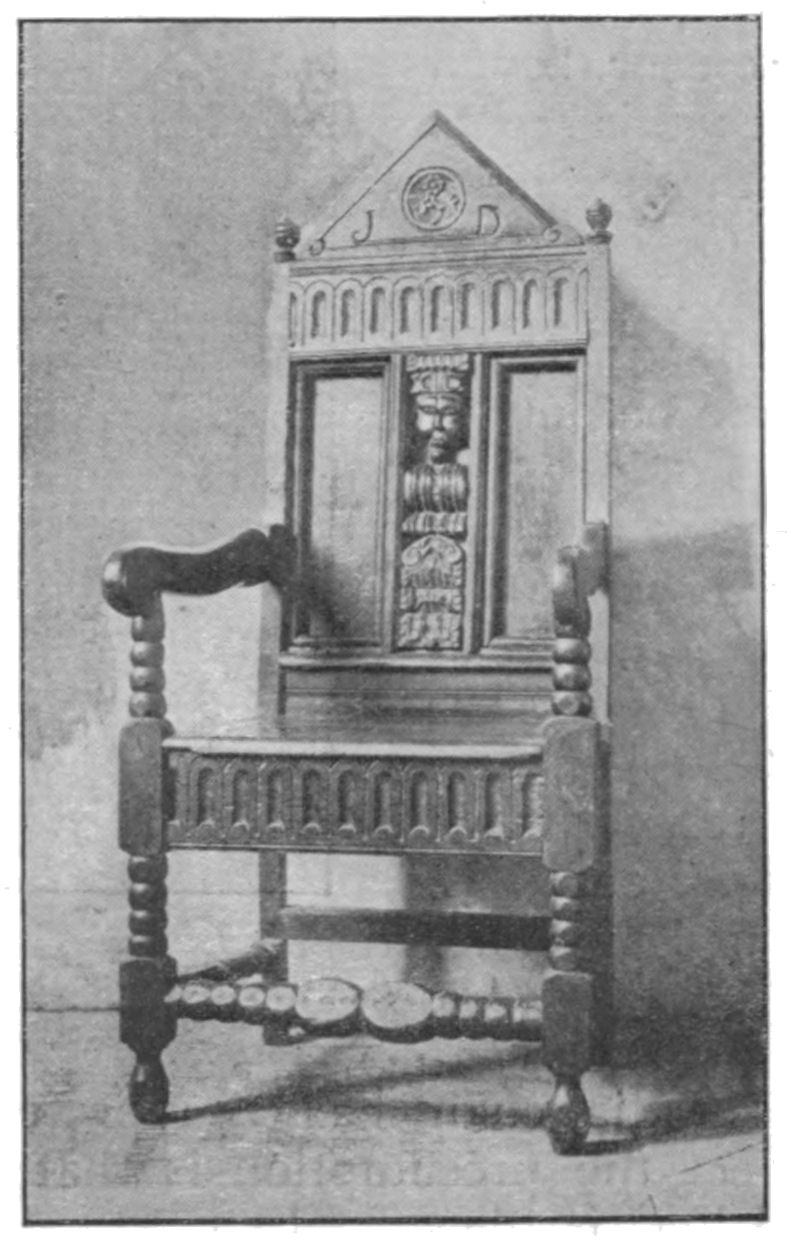
Upton
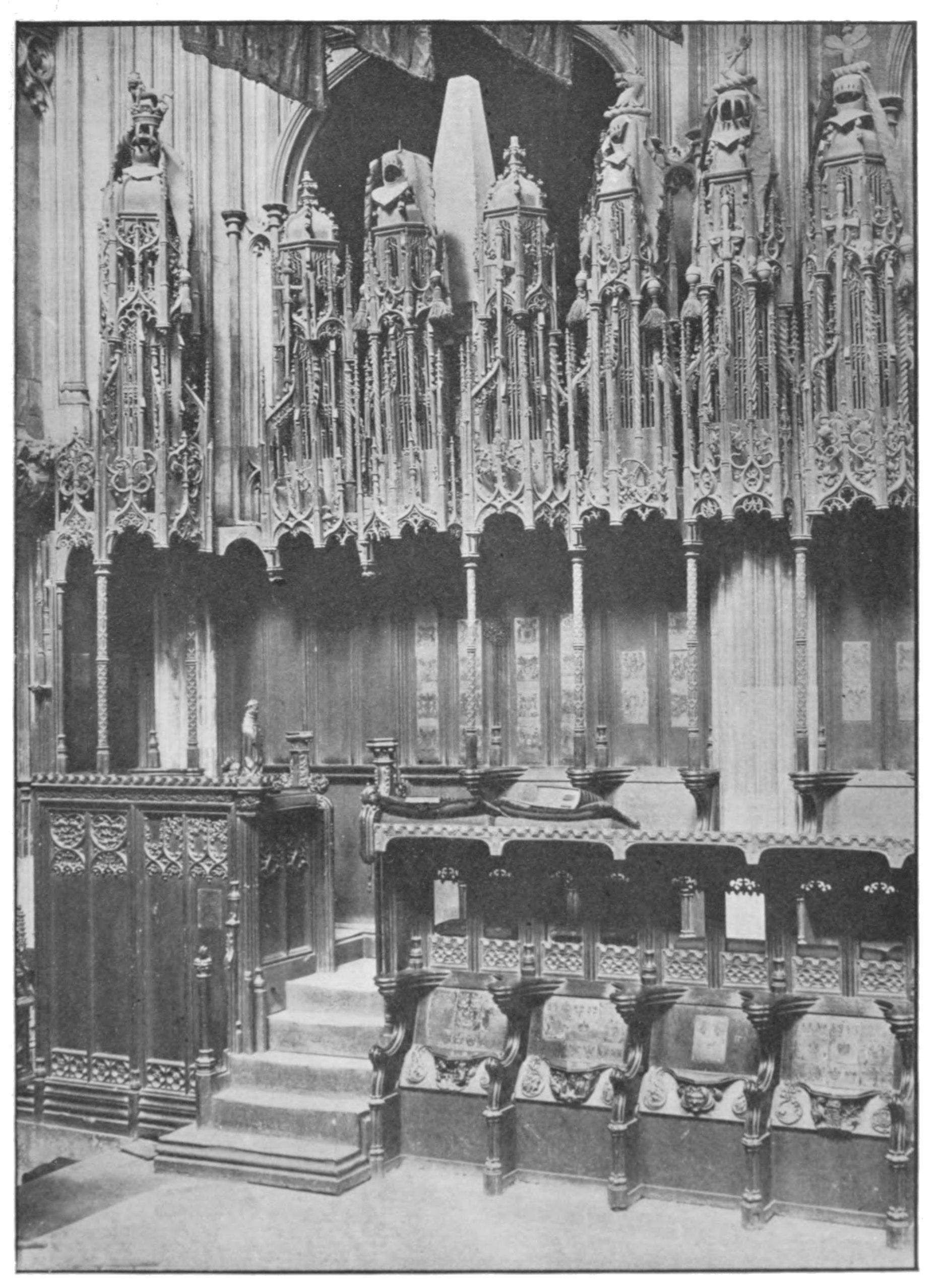
Henry the Seventh's Chapel, Westminster
INDEX TO PLACES AND ILLUSTRATIONS
———
Numbers followed by the name of the Photographer or the Draughtsman refer to Illustrations
———
Aberdeen, King's College, 29, 68 Abergavenny Priory, Monmouth, 46, G. G. Buckley. 29, 40, 47 Amiens, 11 Aquileia, 101 Avignon, 104, F. Bond. 104 Balsham, Cambs., 3, G. G. Buckley. 1, 5, 100, 124 Barnack, Northants, 124 Basing, Hants, 79 Bedford, 116 Beeston Regis, Norfolk, 119, C. F. Nunneley. 124 Belgium, 29, 31 Beverley Minster, Yorks., 3, 14, 14; C. Goulding. 7, Alan Potter. 27, 63, 64, and frontispiece; W. E. Wigfall. 64, 65, 106; F. H. Crossley. 5, 7, 26, 29, 40, 51, 65, 66, 68, 74, 106 Beverley St Mary, 2, F. H. Crossley. 1, 5 Bishop Auckland, Durham, 31, 67 Bishop Cannings, Wilts., 118, Wilts. Archæological Society. 119 Blythburgh, Suffolk, 11, S. Gardner. 7 Bologna, St Stefano, 101 Bossal, Yorks., 92 Boston, Lincs., 86, 95 Brancepeth, Durham, 93, F. Bond. 31, 67, 100 Braunton, Devon, 96 Brescia, Sta. Maria dei Miracoli, 82 Bristol Cathedral, 29, 50. St Nicholas, 97 Bruges, 68, 70 Burlingham St Edmund, Norfolk, 85 Cambridge, Great St Mary, 97. King's College Chapel, 78, F. R. Taylor. 5, 29, 75, 77, 79, 82 Canterbury Cathedral, 105, S. Gardner. 23, 31, 36, 53, 84, 104, 115 Carlisle Cathedral, 21, R. Billings. 59, F. Bond. 23, 29, 51, 58, 61, 66, 68, 70, 82, 106 Cartmel, Lancashire, 80, 81, 127; F. H. Crossley. 5, 31, 75, 79, 129 Chaddesden, Derbyshire, 99, G. H. Widdows. 12, 100 Chelsea, 94, 98 Chester Cathedral, 9, W. M. Dodson. 10, 24, 53, 55, 56; F. H. Crossley. 5, 6, 7, 10, 12, 23, 26, 29, 51, 54, 58, 61, 66, 68, 70 Chichester Cathedral, 36, P. M. Johnston. 5, 26, 29, 36, 38, 47, 100 Christchurch, Hants, 2, G. F. Gillham. 76, 77; F. H. Crossley. 1, 5, 29, 75, 77, 79, 82, 105 Cockersand Abbey, Lancs., 43 Combmartin, Devon, 129, W. M. Dodson. 130 Connington, Hunts., 116 Constance, 126 Constantinople, Santa Sophia, 111 Corhampton, Hants, 124 Coventry, St Mary's Hall, 117, Anon. 119 Cyprus, 104 Dalmatia, 16, 101 Dinant, 31 Dunblane, Scotland, 67, W. Maitland. 5, 29, 67 Dunis, Flanders, 68 Dunmow, Essex, 116, F. R. Taylor. 116 Durham Cathedral, 22, 107; R. Billings. 66, F. Bond. 15, 31, 51, 66, 68, 94, 110. Castle, 5 Ely Cathedral, 37, G. H. Tyndall. 13, 20, 29, 36, 37, 38, 40, 43, 47, 49, 51, 61, 66, 68, 91, 106 Etwall, Derbyshire, 13, G. H. Widdows. 8 Exeter, 102, E. K. Prideaux. 103, G. H. Widdows. 12, 15, 23, 107 Faversham, Kent, 97 Flanders, West, 68, 70 Fotheringhay, Northants, 116 France, 31, 67, 68, 92, 105 Fressingfield, Suffolk, 8 Gawdy Hall, Norfolk, 129 Gendron-Celles, 31 Glastonbury, Somerset, 115, 116 Gloucester Cathedral, 38, Oscar Clark. 23, 29, 33, 38, 40, 129 Grado, 101 Great Burstead, Essex, 94 Halifax, 89 Halsall, Lancashire, 128, G. G. Buckley. 130 Halsham, Yorkshire, 125 Hambleton, Worcester, 98, G. H. Poole. 100 Hampton Court, Middlesex, 75, 77 Hastières, 31 Hemingborough, Yorks., 87, C. de Gruchy. 33, 77, 88 Hereford Cathedral, 43, G. B. Atkinson. 114, A. J. Wilson. 13, 20, 26, 29, 40, 44, 108, 115. All Saints', 44, G. G. Buckley. 45, W. M. Dodson. 5, 29, 40, 47, 100. St Peter, 89, G. G. Buckley. 29, 49, 100 Hexham, Northumberland, 23, 29, 106 Higham Ferrers, Northants, 29 Higher Peover, Cheshire, 123, F. H. Crossley. 127 Huntingfield, Suffolk, 97 Iffley, Oxon., 86 Ightfield, Salop, 128 Ingham, Norfolk, 85 Istria, 16, 101 Ivychurch, Kent, 85 Jarrow, Durham, 119, W. Maitland. 120 Kidderminster, 122 Kildwick, 90 Kilpeck, Herefordshire, 122 Kirkstall, Yorks., 20, 23 Lacock, Wilts., 82 Lancaster, 39, 41, 42; F. H. Crossley. 29, 40, 54 Lapford, Devon, 77 Layer Marney, Essex, 75, 79 Lenham, Kent, 125 Lincoln Minster, 5, 52, 114; S. Smith. 17, Hugh M‘Lachlan. 5, 10, 13, 23, 25, 26, 28, 29, 51, 54, 58, 59, 61, 66, 68, 91, 106, 113 Littlebourne, Kent, 86 London, 70, 79. Christ Church, Newgate Street, 4, F. R. Taylor. 5. Hampton Court, 75, 77. Rolls Chapel, 75. St Botolph, Aldgate, 94. St Mary-at-Hill, 88, 95, 96, 97, 100. St Paul's, 83, F. J. Hall. 28, 31, 82. Old St Paul's, 23. Victoria and Albert Museum, 104, 116, 130. See Westminster Abbey Louth, Lincs., 75 Ludham, Norfolk, 85 Lutterworth, Leicester, 120, E. H. Day. 122 Manchester Cathedral, 6, 62; F. H. Crossley. 5, 7, 29, 51, 61, 65, 66, 68, 70, 74. Agecroft Hall, 116. College, 116 Mantes, 93 Melrose, 68 Milan, St Ambrogio, 16 Much Hadham, Herts., 126, A. W. Anderson. 129 Nantwich, Cheshire, 57, F. H. Crossley. 29, 51, 58, 59, 61, 68 Nevers, 105 Newark, 29 Norbury, Derbyshire, 86 North Cadbury, Somerset, 77 Norton, Suffolk, 85 Norwich, 48, S. Gardner. 13, 19, 25, 26, 29, 40, 43, 47, 104 Notre Dame de la Roche, 31 Nottingham, 90 Old Radnor, Radnorshire, 124 Ossero, 101 Othery, Somerset, 129 Oulton, Suffolk, 86 Oxford, 29, 79 Parenzo, 101 Paris, Hotel Cluny, 111 Penshurst, Kent, 128 Peterborough, 32, H. Plowman. 15, 33, 116 Poitiers, 31 Puddletown, Dorset, 124, W. Wonnacott. 128 Ratzburg, 31 Ravenna, 113 Reading, St Giles', 97 Redenhall, Norfolk, 125, C. F. Nunneley. 129 Ripon Minster, 8, W. Maitland. 60, J. H. Bayley. 5, 6, 7, 15, 23, 26, 29, 51, 61, 65, 66, 68, 70, 93 Rochester Cathedral, 30, P. M. Johnston. 23, 29, 31 Rome, 16, 19, 23, 101, 105, 111. Baths of Caracalla, 101. S. Clemente, 19, 101. St John Lateran, 101, 111. S. Maria in Cosmedin, 19, 101. St Paul extra Muros, 19. St Peter's, 111. Old, 105. Sta. Pudentiana, 111 Rotherham, Yorks., 94 Rothwell, Northants, 90 St Asaph, 51, 61 St David's, 108, 109; W. M. Dodson. 15, 29, 50, 107, 110 St Gall, 20, 23 St Paul's, 83, F. J. Hall. 28, 31, 82 Salisbury, 92 Sall, Norfolk, 85, F. Bond. 85, 100 Sanderstead, Surrey, 129 Saulieu, 31 Scotland, 67, 68, 91 Sedgefield, Durham, 31, 67 Sees, St Martin, Normandy, 43 Sherborne, Dorset, 49, G. G. Buckley. 29, 49 Sherburn Hospital, Durham, 31, 67 Sion Abbey, Middlesex, 43 Sluys, 70 Snettisham, Norfolk, 40 Southampton, 79 Southwell, Notts., 25, 26, 50 Southwick Priory, Hants, 116 Sprotborough, Yorks., 125 Stanford Bishop, Herefordshire, 115 Stirling, 68 Stowlangtoft, Suffolk, 91, C. F. Nunneley. 5, 7, 29, 49, 85, 100 Suffolk, 128, J. C. Stenning. 49, 85, 130 Sutton Coldfield, Warwickshire, 84 Swine, Yorks., 77 Talland, Cornwall, 77 Theydon Gardon, Essex, 92 Trau, 101 Trunch, Norfolk, 85, F. Bond. 5, 85, 100 Upton, Northants, 130, G. C. Druce. 128 Vaison, Provence, 101 Venice, St Mark's, 16. Sta. Maria dei Miracoli, 82 Walpole St Peter, Norfolk, 12, S. Gardner. 7 Warlingham, Surrey, 125 Wells Cathedral, 115, G. W. Saunders. 7, 11, 13, 20, 26, 28, 29, 110. Bishop's Palace, 115, 116 Westminster Abbey, 31, Sandford. 121, A. Gardner. 21, 23, 25, 29, 31, 33, 51, 77, 125, 73; Henry VII.'s Chapel, A. W. Pugin, 73; D. Weller, 131. 10, 25, 70, 74, 75. Weston in Gordano, Somerset, 85 Winchelsea, Sussex, 36 Winchester Cathedral, 34, 122; C. E. S. Beloe. 35, S. Gardner. 72, J. F. Hamilton. 73, J. Britton. 5, 13, 23, 29, 33, 40, 43, 72, 75, 79, 126. St Cross, 75, 105 Winchfield, Hants, 116, G. C. Druce. 124 Windsor, St George's Chapel, 69, Lysons' Magna Britannia. 71, Alan Potter. 12, 29, 51, 70 Wingfield, Suffolk, 46, C. F. Nunneley. 29, 47 Worcester, 23, 84, 91 Yatton, Somerset, 92 York Minster, 18, 58; J. Britton. 23, 58, 126. St Maurice, 88. St Michael Belfry, 92 Zara, 101 Zaandam, Holland, 116
INDEX RERUM
Abbot, place in choir, 13, 106 Accounts (see also Cost), 95 Arcading, 40, 54, 100 Arms and armour, 36, 48, 54 (see also Heraldry) Arrangements of stalls, 12, 16, 26 Back of Stalls, 5, 10, 15, 26, 28 (see Panelling) Badges, 47 Baluster chairs, 115, 116 Bath, order of the, 74 Battlements, 36, 38, 47, 51, 54, 61 Baxter's chair, 124 Benches, 49, 99 Benefactors, 92 Bishop's chair, 13, 19 —— throne, 101 Black Death, 40, 47, 58, 110 Boys, 96 (see "Children of the Choir") Brattishing, 47, 63 Busts, 70, 77 Buttresses, 54 Canons, resident and non-resident, 11, 25, 28 Canopies, construction of, 1, 10, 33, 54 —— ogee, 10, 33, 36, 43, 45, 47, 50, 53, 54, 59, 65, 68 —— bowing ogee, 10, 38, 45, 47, 51 —— compound ogee, 54 —— "Lincoln" ogee, 54 —— tiers or stories of, 38 —— varieties of, 1, 29, 51, 74, 100 Capitals, 10, 61, 82 Capping, 10 Carrel, 119 Carvers, 68, 70, 74, 77 Carving, 5, 33, 38, 53, 54, 61, 68, 70, 77, 79, 82, 108 Centaurs, 68 Chairs, abbots', 115 —— bishops', 13, 111 —— church, 111 —— marble, 101 —— popes', 111 —— stone, 101, 124 —— winged, 130 Chancels, 16, 20 —— enlargement of, 86 Chantries and Chantry priests, 8 "Children of the Choir," 25, 96 Choir, 13, 16, 20 Choristers, 1, 25, 26, 85, 95 Chronological order of stalls, 29 Churchwardens' accounts, 95 (see Cost) Classical design, 67, 79 Clerk, parish, 97, 124 Construction of stalls and canopies, 1, 8, 10, 33, 54 (see also Canopies) Cornice, 1, 40, 47, 49, 50, 63, 100 Coronation chair, 125 Cost, 11, 79, 84, 88, 107 Costume, 36 Cresting, 29, 36, 45, 65, 72, 79 Crockets, 10, 33, 44, 47, 51 Crossing, 20, 23 Crypts, 23 Cusps, 33, 36, 43, 47, 49, 61 Dagobert, chair of, 111 Dates of stalls, 5, 29 Dean's stall, 13, 50, 54 Design, 10, 38, 68, 70, 74 Desks, 1, 5, 7, 47, 88, 100, 119 Dorothy Mainwaring, 79, 127 Dove, 95, 129 —— of St Botolph's, Aldgate, 95 —— of Upton, 129 Dutch carvers, 70 Edmund Crouchback, 33 Edmund, Saint, 7 Elbows of stalls, 1, 5, 10, 77 Ends of stalls, 5, 8 Entablature, 79, 82 Epistle, place of reading, 13 Finials, 33, 51 Flamboyant, 40 Flemish work, 68, 70 Fleur de lis, 68 Flying buttresses, 10, 54 Foreign design and workmen, 68, 77, 79, 82 Frithstols, 106 Gables, 10, 33, 54, 61, 65 (see Canopies) Galleries, 29 Garter, Knights of Order of, 72 Gilds, 8, 95 Glastonbury chairs, 116 Gospel, desks, and place of reading, 13 Grinling Gibbons, 84 Hawks, 47 Heraldry, 5, 6, 47, 48, 50, 79 Hipknobs, 10 Honeycomb, 77 Honour, place of, 13 Inscriptions, 26, 28, 82 Italian workers, 77, 79, 82 Jacobean chairs, 115, 122 Kemp, Archbishop, 53 Knights of the Bath, 74 Knights of the Garter, 72 Laity, 1, 16, 19, 90 "Lincoln ogee," 54 Mainwaring, Dorothy, 79, 127 Marble chairs, 101, 106 Masks, 5, 44 Mayor's stall, 6, 15, 82, 94 Maximian, chair of, 113 Minstrels, 99 Misericords, 1, 48, 50, 53, 54, 61, 65, 74, 75 Moldings, 40 More, Sir Thomas, 94, 98 Music in churches, 95 Niches, 10, 38, 51, 54, 58, 59, 61, 63, 65 Nobility in chancel, 91 North side, 13, 15 Number of stalls, 25, 26, 50, 75 Oak, 68 Occupants of stalls, 1, 88 Ogee, 10, 33, 36, 43, 45, 47, 51, 53, 54, 59, 65, 68 Orientation, 16, 105 Organs and Organists, 96, 98 Panelling, 5, 50, 68, 74, 100 Parish churches, planning, growth of, 16, 23, 25, 85, 86 (see Chancel) —— stalls in, 49, 85 Parish clerk, 97, 124 Passion, emblems of, 82 Patrons, in chancels, 91 Pediment, 33, 43, 51 Pews in chancels, 95 Pinnacles, 10, 38, 51, 53, 54, 58, 59, 61, 66, 74, 108 Place of honour, 13 Planning, 16, 20, 23, 25, 85 Plinth, 100 Poppyheads, 6, 7 Portrait busts, 77 —— panels, 75 Position of stalls, 1, 16 Prebendaries, 25, 28 Processions, 13, 25, 92 Projection of canopies, 47 Psalter, recitation of, 26, 28 Purbeck marble, 105 Removals from other churches, 43 Renaissance, 66, 75 Restorers and restorations, 20, 29, 38, 84 Return stalls, 12, 13, 25, 100, 106 Rochets, 97 Rood loft, 95, 98 Rows of stalls, 25 Sancroft, Archbishop, 129 Screens, 10, 12, 19, 20, 50, 75, 79, 100 Scrollwork, 5, 82 Seats, 1, 10, 48, 77 —— marble and stone, 111, 124 Sedilia, 124 Sella curulis and gestatoria, 101, 111 Shafts, 10, 33, 51, 59, 77, 82 Shields, 5, 6 Shoulders of stalls, 1, 5, 59 Singers, 1, 16, 95 (see also Boys, "Children of the Choir," Choristers) South side, 13, 15 Spires and spirelets, 1, 11, 38, 40, 49, 51, 53, 54, 58, 61, 63, 66, 72, 106 Stalls in greater churches, 1, 13 —— in parish churches, 49, 85, 90 —— object of, 85 Stall-wages, 26 —— work, earliest, 31 —— thirteenth century, 31, 88, 90 —— fourteenth century, 33, 50, 51, 53, 58 —— fifteenth century, 48, 50 —— sixteenth century, 79 —— Renaissance, 66, 75 —— eighteenth century, 84 Standards, 8 Stanley legend, 61 Statues, 10, 51, 61 Stone chairs and seats, 101, 124 —— versus wood, 51 Stories of stalls, one, 38, 43, 44, 51, 59, 72, 74 —— two, 10, 38, 47, 51, 53, 58, 61, 65, 72 String-course, 58, 59, 61, 65, 66 Sudbury hutch, 75 Sunday and other processions, 25, 92 Supermullions, 40, 47 Supports, 5, 77 Surplices, 89, 96 Tabernacled spires and canopies, 1, 10, 51, 53, 66, 106 Tester, coved, 47, 63 Thirteenth century work, 31, 88, 90, 116, 125 Thistle, Scottish, 68 Three-gabled canopies, 38, 51, 54, 59 Throne, bishop's, 13, 16, 19, 101, 105 Tiers of canopies, 38 Tracery, 33, 36, 40, 43, 45, 51, 54, 58, 59, 61, 63, 65, 68, 82 Vicars choral, 26 Ventilation, 100 Vine, 68 Winged chairs, 130 Women in stalls, 92 Wood versus stone, 51 Workmanship, 100 Wyche, Lady, 94 Wiclif, 122
———
Printed at The Darien Press, Edinburgh.
BY THE SAME AUTHOR
SCREENS AND GALLERIES IN ENGLISH CHURCHES
A handsome volume, containing 204 pp., with 152 Illustrations, reproduced from Photographs and Measured Drawings. Octavo, strongly bound in cloth. Price 6s. net.
LONDON: HENRY FROWDE, Oxford University Press
—————
SOME PRESS NOTICES
Builder.—"When we look at the detailed photographs we realise the richness of the field which Mr Bond has traversed, and congratulate him on the choice of his subject. His method is one of singular thoroughness from the ecclesiological standpoint."
Journal of the Architectural Association.—"As a record of the screens remaining in our churches it cannot be valued too highly. No book till now has brought such a number together, or traced their development in so full and interesting a manner.... A most delightful book."
Builders' Journal.—"The author may be congratulated on the production of a book which, in text as well as in illustrations, is of striking and inexhaustible interest; it is the kind of book to which one returns again and again, in the assurance of renewed and increased pleasure at each reperusal."
Tablet.—"The numerous excellent illustrations are of the greatest interest, and form a veritable surprise as to the beauty and variety of the treatment which our forefathers lavished upon the rood screen."
British Weekly.—"The book abounds with admirable illustrations of these beautiful works of art, so perfect even in the minute details that any one interested in the art of woodcarving could reproduce the designs with ease from the excellent photographs which occur on almost every page. There is also a series of 'measured drawings' of great beauty and interest."
New York Nation.—"It is not easy to praise too highly the simple and effective presentation of the subject and the interest of the book to all persons who care for ecclesiology or for decorative art."
Bibliophile.—"This excellent book is a sign of the times; of the reawakened interest in the beautiful and historic.... A model of scholarly compression. Of the finely produced illustrations it is difficult to speak in too high terms of praise."
Daily Graphic.—"Mr Bond has produced a work on our ecclesiastical screens and galleries which, like his larger work on the 'Gothic Architecture of England,' is in the first degree masterly. His knowledge of his subject, exact and comprehensive, is compressed into a minimum amount of space, and illustrated by a series of photographs and measured drawings which render the work of permanent value."
Bulletin Monumental.—"Après avoir analysé, aussi exactement que possible, l'intéressant étude de M. Bond, nous devons le féliciter de nous avoir donné ce complément si utile à son grand ouvrage."
BY THE SAME AUTHOR
FONTS & FONT COVERS
A handsome volume containing 364 pages, with 426 Illustrations reproduced from Photographs and Measured Drawings. Octavo, strongly bound in cloth. Price 12s. net.
LONDON: HENRY FROWDE, Oxford University Press
—————
SOME PRESS NOTICES
Guardian.—"Mr Bond is so well known by his monumental work on 'Gothic Architecture in England,' and by his beautiful book on 'Screens and Galleries,' that his name alone is a sufficient guarantee for this new volume on 'Fonts and Font Covers,' the most complete and thorough that has yet appeared."
Church Times.—"The finest collection of illustrations of fonts and font covers yet attempted.... A real delight to the ecclesiologist."
Commonwealth.—"A sumptuous monograph on a very interesting subject; complete and thorough."
Church Quarterly Review.—"It is most delightful, not only to indulge in a serious perusal of this volume, but to turn over its pages again and again, always sure to find within half a minute some beautiful illustration or some illuminating remark."
Irish Builder.—"This book on 'Fonts and Font Covers' is a most valuable contribution to mediæval study, put together in masterly fashion, with deep knowledge and love of the subject."
Westminster Gazette.—"Every one interested in church architecture and sculpture will feel almost as much surprise as delight in Mr Bond's attractive volume on 'Fonts and Font Covers.' The wealth of illustrations and variety of interest are truly astonishing."
Journal of the Society of Architects.—"The book is a monument of painstaking labour and monumental research; its classification is most admirable. The whole subject is treated in a masterly way with perfect sequence and a thorough appreciation of the many sources of development; the illustrations, too, are thoroughly representative. To many the book will come as a revelation. We all recognise that the fonts are essential, and in many cases beautiful and interesting features in our ancient churches, but few can have anticipated the extraordinary wealth of detail which they exhibit when the photographs of all the best of them are collected together in a single volume."
Outlook.—"Mr Francis Bond's book carefully included in one's luggage enables one, with no specialist's knowledge postulated, to pursue to a most profitable end one of the most interesting, almost, we could say, romantic, branches of ecclesiastical architecture.... This book, owing to its scholarship and thoroughness in letterpress and illustrations, will doubtless be classic; in all its methods it strikes us as admirable. The bibliography and the indexes are beyond praise."
BY THE SAME AUTHOR
VISITORS' GUIDE TO WESTMINSTER ABBEY
93 pages of text, abridged from the eighteenth and nineteenth chapters of the author's larger work on "Westminster Abbey," consisting chiefly of description of the Tombs, Monuments, and Cloisters, with 15 Plans and Drawings and 32 Photographic Illustrations. Price 1s. net.
LONDON: HENRY FROWDE, Oxford University Press
—————
SOME PRESS NOTICES
Guardian.—"There is probably no better brief handbook. Mr Bond's qualifications for the task are beyond question. By the use of varied type, ingenious arrangement, and excellent tone-blocks and plans, the book attains a high standard of lucidity as well as of accuracy."
Building News.—"This little work is characterised by its terseness, directness, and practical treatment. A carefully compiled and scholarly guide-book."
Architect.—"This book will excellently and admirably fulfil its purpose.... A splendid itinerary, in which almost every inch of the way is made to speak of its historical connections."
Birmingham Daily Post.—"Concise, informative, reliable, and admirably illustrated."
Western Morning News.—"By his key plan and very clear directions as to where to find the numerous side chapels, historic monuments, and other objects of interest, Mr Bond makes it possible for a visitor to find his way round the building at his leisure. It refreshes one's knowledge of English history, and is supplemented by thirty-two excellent plates, which by themselves are worth the shilling charged for it."
Scotsman.—"A more complete and dependable guide to the National Pantheon could not be desired."
Architectural Review.—"This is an excellent little text-book. Mr Bond is to be congratulated in having introduced into it an interesting element of history. The notes in small print should make the visit to the Abbey both more profitable and more interesting. The key plan and the numerous small plans are extremely clear and easily read. The information given is concise and to the point, and a word of special praise must be given to the plates at the end; the subjects of these are well chosen and are illustrated by very good photographs."
Antiquary.—"This little book, strongly bound in linen boards, gives concisely and clearly all the information the ordinary visitor is likely to require. Cheap, well arranged, well printed, abundantly illustrated and well indexed, this handy book, which is light and 'pocketable,' is the best possible companion for which a visitor to our noble Abbey can wish; it is an ideal guide."
BY THE SAME AUTHOR
WESTMINSTER ABBEY
A handsome volume, containing 348 pages, with 270 Photographs, Plans, Sections, Sketches, and Measured Drawings. Octavo, strongly bound in cloth. Price 10s. net.
LONDON: HENRY FROWDE, Oxford University Press
—————
SOME PRESS NOTICES
Oxford Magazine.—"All who love the Abbey will be grateful for the skill and affection bestowed on this admirable work."
Birmingham Post.—"With the history of the Abbey the author interweaves the life of the Benedictines, peopling the building with its occupants in the centuries when England was a Catholic country, and does it with such skill than one can almost imagine oneself at the services."
Englishman.—"The writer handles his subject with consummate skill, and his reward will lie in the unmeasured praise of his many readers."
Guardian.—"A book which brings fresh enthusiasm, and will impart a new impetus to the study of the Abbey and its history."
Scotsman.—"At once instructive and delightful, it more than justifies its existence by its historical and architectural learning."
Liverpool Daily Courier.—"We found the earlier parts of the book most fascinating, and have read them over and over again."
Architectural Association Journal.—"Bright and interesting; evincing the author's invariable enthusiasm and characteristic industry."
Western Morning News.—"To say that the book is interesting is to say little; it is a monument of patient and loving industry and extreme thoroughness, an inexhaustible mine of delight to the reader, general or technical."
Outlook.—"The author discusses the architecture with a minuteness that might terrify the inexpert if it were not for the sustained ease and interest of his style; great is the fascination of the expert hand when its touch is light."
Saturday Review.—"Mr Bond leaves us more than ever proud of what is left to us of the stately Benedictine house of God, which is to the entire English-speaking world a common bond and home."
Antiquary.—"It has a wealth of capital illustrations, is preceded by a bibliography, and is supplied with good indexes to both illustrations and text."
Journal des Savants.—"Certains clichés, comme ceux des voûtes, des tombeaux et de quelques détails de sculpture sont de véritables tours de force. Le choix des illustrations est très heureux, comme d'ailleurs dans les autres ouvrages de M. Bond."
BY THE SAME AUTHOR
Wood Carvings in English Churches
I. MISERICORDS
A Handsome Volume, containing 257 pages, with 241 Illustrations. Octavo, strongly bound in cloth. Price 7s. 6d. net.
LONDON: HENRY FROWDE, Oxford University Press
—————
SOME PRESS NOTICES
Morning Post.—"The subject is one of the first importance to mediæval popular history, and we welcome this very admirable and thorough monograph with special gratitude."
Athenæum.—"Mr Bond has put his rare industry in all that pertains to ecclesiology to excellent service in his latest book on Misericords."
Antiquary.—"An authoritative and, at the same time, delightful and instructive volume. Really the first attempt to deal comprehensively with the great variety of carvings on misericords."
New York Herald.—"One of the quaintest, most fascinating, and at the same time most learned volumes that a reader would happen upon in a lifetime."
Church Times.—"An indispensable guide to the subject. The illustrations are worthy of all praise."
Architectural Association Journal.—"The blocks, taken from photographs, are of an excellence really amazing, when the difficulties such subjects present to the camera are considered. A most delightful book."
Yorkshire Post.—"Another of the valuable series of monographs on Church Art in England, and the most entertaining of all."
Architects' and Builders' Journal.—"An exceedingly interesting volume both in illustrations and subject-matter, and full of curious information."
Glasgow Herald.—"Mr Bond's scholarly and most interesting book brings us very near to popular life in the Middle Ages."
Liverpool Courier.—"Another of the admirably written and illustrated art handbooks for which the author is famous."
Birmingham Post.—"This well illustrated volume is not only a valuable technical monograph, but also an important contribution to the history of social life and thought in the Middle Ages. Mr Bond's treatment of the subject is exceptionally charming and successful. The general excellence of the book is great."
Outlook.—"Many there must be to whom Mr Bond's new book will be welcome. Into all the details of this varied and most puzzling subject he goes with thoroughness and a pleasant humour. The bibliography and indexes, as usual in Mr Bond's work, are admirable."
Notes
[1] Harry Sirr in Art Journal, 1883, 329.
[2] Wickenden, Archæological Journal, 1881, pp. 43-61.
[3] Canon Church in Archæologia, lv. 326.
[4] Dictionnaire raisonné, viii. 464.
[5] C. R. Peers in Victoria County History of Northants, ii. 445.
[6] Illustrated in the writer's Screens and Galleries, 2.
[7] Faber's Poems, pp. 227-229.
[8] See the writer's Westminster Abbey, 48.
[9] For plans of St Gall, Kirkstall, Westminster, Canterbury, Exeter, York, see the writer's Gothic Architecture in England.
[10] For an account of the working of the system of Secular Canons in the English cathedrals see Canon Church's paper in Archæologia, lv.; Professor Freeman's Cathedral Church of Wells; Mr A. F. Leach on Beverley Minster in vols. 98 and 100 of the Surtees Society, and on Southwell Minster in the 1891 volume of the Camden Society; and Rev. J. T. Fowler, D.C.L., on Ripon Minster in vols. 64, 74, 78, 81 of the Surtees Society.
[11] See Mr A. F. Leach's Memorials of Beverley Minster, Surtees Society, vols. 98 and 108.
[12] Views of galleried choirs may be seen in Britton's Cathedral Antiquities; Norwich, ii. 13, Oxford, ii. 10.
[13] Illustrated in Maeterlinck, La genre satirique dans la sculpture flamande et wallonne, page 12.
[14] See Viollet-le-Duc's Dictionnaire, viii. 464.
[15] See C. R. B. King in Index to Spring Gardens Sketch Book, ii. 46, and Plate XLVI.
[16] Hope's Rochester Cathedral, pp. 110, 111.
[17] It is illustrated in Professor Lethaby's Westminster Abbey, p. 23, from Sandford's Coronation of James II., and is reproduced above.
[18] Illustrated in Gothic Architecture in England, 481.
[19] See John O'Gaunt's Sketch Book, vol. i.
[20] Here, as always, one has to recognise the technical and artistic excellence of Mr Crossley's photography; he has even reproduced the cobwebs.
[21] They are ascribed to the fourteenth century by Mr Octavius Morgan in Monuments of Abergavenny Church.
[22] My attention was directed to these arms by Mr W. H. St John Hope.
[23] Jones and Freeman's St David's, pp. 87 and 91.
[24] Illustrated in Dart's Canterbury Cathedral, 145 and 160.
[25] E. Mansel Sympson's Lincoln, 277.
[26] Illustrated in the writer's Gothic Architecture in England, p. 269.
[27] A photograph of the north range of the Chester stalls forms the frontispiece of the writer's Misericords.
[28] Mr C. H. Purday.
[29] Illustrated in Murray's Welsh Cathedrals, page 267.
[30] Illustrated in the writer's Fonts and Font Covers, 296.
[31] Ecclesiastical Architecture of Scotland, ii. 105. Drawings by Mr J. B. Fulton appeared in the Builder, 1st Oct. 1898 and 2nd Dec. 1893; and by Mr A. S. Robertson in the Builders' Journal, 14th Jan. 1903.
[32] Macgibbon and Ross. Castellated and Domestic Architecture of Scotland, v. 543; and Builder, lxxv. 293, in which are measured drawings by Mr J. B. Fulton.
[33] Proceedings of the Society of Antiquaries, i. 112.
[34] For information relating to the Windsor stalls I am indebted to Mr W. H. St John Hope: see his paper "On a remarkable series of Wooden Busts surmounting the stall-canopies in St George's chapel, Windsor," in Archæologia, liv. 115, and the building accounts to be published in his forthcoming work on Windsor Castle.
[35] See the writer's Westminster Abbey, 146.
[36] Sacristy, i. 266.
[37] The Hampton Court busts are by Giovanni de Majano, who in 1521 demanded payment for ten "medallions of terra cotta." They cost £2. 6s. 8d. each. R. Blomfield's History of Renaissance Architecture in England, 3.
[38] Illustrated in the writer's Westminster Abbey, 197.
[39] See also the illustration of the chair made c. 1545 for Dorothy Mainwaring, page 123.
[40] See Willis and Clark, i. 516-522.
[41] Gotch's Early English Renaissance, 29, 254.
[42] Annales Caermoclenses, by James Stockdale; Ulverston, 1872, p. 76.
[43] Early Renaissance Architecture in England, 38.
[44] Annals of St Paul's, 447.
[45] Measured drawings of the stalls of St Paul's by Mr C. W. Baker appeared in the Building News, 1891, pages 108 and 358.
[46] The Renaissance woodwork ousted from Worcester cathedral by Sir Gilbert Scott found a resting-place in the church of Sutton Coldfield (R. A. D.).
[47] Willis' Canterbury Cathedral, 107.
[48] These are illustrated in Archæologia Cantiana, vol. xiii.
[49] York Fabric Rolls, 35, 248.
[50] Canon Savage's pamphlet, 369.
[51] Cutts' Parish Priests, 466.
[52] Gasquet's Parish Life in Mediæval England, 96.
[53] Gasquet, Parish Life in Mediæval England, 45.
[54] It is of course possible that both Alan de Alnewyk and Robert Constable sat in the chancel in surplice either as a member of a gild or of the choir.
[55] This, however, may have been for one of the choirmen or choristers.
[56] Reproduced in Gasquet, ibid., 47, from Didron.
[57] Wordsworth's Salisbury Ceremonies and Processions, 20.
[58] Inhibitions of Archbishop William of York in 1308 and 1312 in Rev. Dr Fowler's Memorials of Ripon Minster, Surtees Society, vol. 78.
[59] "South chancel" may mean "the chapel south of the chancel."
[60] Admirably edited by Mr Littlehales for the Early English Text Society; vols. 20 and 24.
[61] At Hambleton (98) the chancel was remodelled, and the simple desks with linen pattern may be of that date. But the seats behind were never more than rough movable benches.—G. H. P.
[62] R. H. Murray on Ancient Church Fittings, 12.
[63] Mr T. Graham Jackson's Dalmatia: iii. 319, 427, 105: i. 272 and ii. 123.
[64] Stewart in Archæological Journal, xxxii. 18.
[65] Jones and Freeman's St David's, 90-93.
[66] Padre Garrucci in Proceedings of Society of Antiquaries, iv. 40, and illustrations in Vetusta Monumenta, vol. vi. The perspective sketch is by Carlo Fontana and is in the Royal Library at Windsor; the measured drawing is by Signor S. A. Scardonelli, and was made in 1784.
[67] Measured drawings of the Hereford chair by Mr W. H. Brierley appeared in the British Architect, xxiii. 114.
[68] Described by Dr Cox in English Church Furniture, p. 250.
[69] Shaw's Ancient Furniture, 31.
[70] Wiltshire Archæological Society's Magazine, vi. 147-149, quoted in English Church Furniture, 253.
[71] Archæologia Æliana, xvii. 47, and Proceedings of the Society of Antiquaries, xvii. 238. There are four similar chairs at Kilpeck.
[72] For descriptions and illustrations see Mr J. Hunter's "Edward the First's Spoliations in Scotland, A.D. 1296" in Arch. Journal, vol. xiii.; Mr W. Burges' paper in "Gleanings from Westminster Abbey," p. 121; and Mr Lethaby's Westminster, pp. 18, 265, 297.
[73] Henry Shaw's Ancient Furniture, Plate VI.
[74] Illustrated in Hone's Year Book, 143.
[75] Rev. Arthur Helps from Country Life, 12th March 1910.
[76] Communicated by Rev. R. M. Serjeantson