THE KING OF THE BUFFALOES AN AMERICAN INDIAN TALE
Reading edition
A LAME Indian and his daughter once lived on the edge of a lonely forest, apart from any tribe or village. The Indian, whose name was Agodaguada, was a great hunter and fisher in spite of his lameness. Every day he went off into the forest, and while he was away his daughter, Iola, took care of the lodge and did the cooking.
They would have been very contented there if it had not been for a herd of buffaloes that lived on the other side of the forest. The king of this herd was a magician. He had seen Iola once as she was gathering wood in the forest, and had fallen in love with her, for she was very beautiful. Agodaguada often came upon him hiding in the bushes near the hut, or heard him bellowing down at a stream near by. Agodaguada cautioned his daughter never to leave the lodge while he was away, for he feared the buffalo might seize her and carry her off.
He himself was tormented by the ungainly beasts. They muddied the streams where he fished and drove away the game by their bellowing. Gradually he was obliged to go farther and farther from the lodge to find deer or fish. Often as he sat quietly watching for game a hoarse voice would begin to sing at him from behind the bushes or rocks:
“You lame mannikin, Don’t you think it a sin To pen up your daughter? —Say, Agodaguada— To shut up your daughter, Don’t you think it a sin?”
Sometimes he aimed an arrow or a stone at the place from which the voice sounded, and then a great dark body would go lumbering and crashing away through the forest, and Agodaguada would know that it was one of the buffaloes that had followed him.
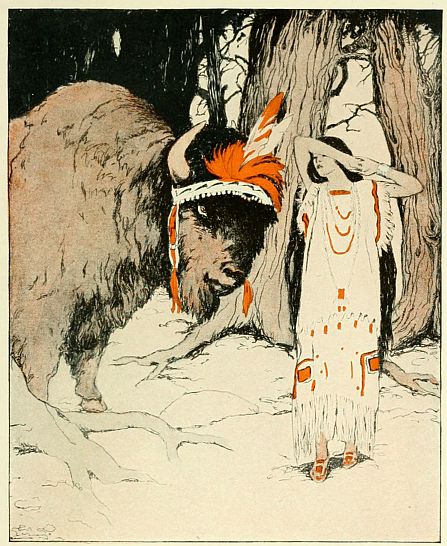
HE SPOKE TO HER IN THE SOFTEST VOICE HE COULD MANAGE
One day, when Agodaguada was far from home, his daughter climbed up on top of the lodge, and sat there to comb her hair, for it was very long. Every now and then she stopped to listen and look about her, to make sure there was no danger.
For a long time all was silent except for the singing of the birds. She finished combing her hair, and was just about to go down into the lodge when suddenly a great noise arose, a crashing of underbrush and thundering of hoofs. The herd of buffaloes, with the king at their head, was charging down upon the hut. Iola had no time to move before she felt the logs breaking away beneath her. They were scattered this way and that like straws. In another moment Iola found herself seated on the back of the king of buffaloes. She was being carried swiftly away through the forest, while the lodge lay in ruins behind them.
On and on went the buffalo, until at last, in the deepest and darkest part of the forest, he paused and allowed Iola to slip from his back.
This was the spot where he and his followers had their camp, and it was here he intended to keep Iola until she consented to become his wife. He spoke to her in the softest voice he could manage, telling her that this was to be her home, but Iola would not look at him, nor answer. She only turned away, wringing her hands and weeping bitterly.
But the buffalo king was not discouraged. He had the power to take the shape of a man when he chose, and it was in this shape that he meant to woo her and win her to be his wife. And this he had no doubt of being able to do before long.
Meanwhile Agodaguada had been trying to fish, but he found his enemies more tormenting than ever. Their hoarse voices sang after him wherever he went:
“You lame mannikin, Don’t you think it a sin To shut up your daughter? —Say, Agodaguada— To shut up your daughter? Do you think she is in? Are you sure she is in?”
As Agodaguada listened, he became thoughtful. He rolled up his line and started back through the forest toward the lodge. As he came near his home he quickened his steps. He noticed that the small trees and underbrush had been trampled down as though a great herd had passed that way. Presently he began to run, and he was still running when he broke into the open where his lodge had stood. But the lodge was there no longer. Instead, he saw only the ruins that the buffaloes had left behind them. Iola was gone.
Agodaguada did not at once follow the enemy, however. He ran to the ruins and began tearing the logs aside and burrowing under them. Presently he gave a cry of joy and drew out from beneath them an old worn pouch of deerskin. From this pouch he took a pair of moccasins and put them on his feet. They were magic moccasins and were Agodaguada’s greatest treasure. And now he was ready to follow Iola and save her from the buffaloes.
It was not hard to trace the way they had gone. The herd had left a broad track of broken trees and branches through the dark forest.
The magic moccasins leaped a hundred yards at each step. They carried Agodaguada along faster than a bird can fly. The buffaloes had gone at full speed, and had had the start of him by several hours, but so swiftly he went that by twilight he found himself close to their camp.
Here he slipped the moccasins from his feet. As silently as a snake he crawled past the other wigwams toward the lodge of the king.
As he came near it he heard the sound of a flute, and soon he was close enough to look inside and see who was playing. It was the king himself. He had taken his human form and was playing upon his flute a love song to Iola, but as a man he was even more hideous than he was as a buffalo.
Iola sat with her back turned toward him. She looked very sad. Her head was sunk on her breast, and she took no notice of his love song or of his languishing glances.
Suddenly Iola started. From the thicket outside had sounded the whistle of a partridge. It was the whistle her father always gave as he came near home after a day of hunting. The buffalo, playing on his flute, had heard nothing.
Iola sat still a few moments longer, and then she rose. “I will go down to the spring,” she said, “and fetch the water for the cooking.”
When the buffalo heard her say this he was filled with joy. He took it as a sign that she was now ready to live with him in his wigwam and be his wife. Believing this, he was quite willing to allow her to go down to the spring by herself.
Iola stepped outside, and as soon as her father saw her alone there he rose up from among the bushes. His magic moccasins were once more upon his feet. He motioned her to follow. “Quick!” he whispered. As soon as they were clear of the bushes Agodaguada lifted his daughter in his arms and leaped away with her through the forest.
In the lodge the buffalo waited for Iola a long time. Sometimes he listened for her footsteps, and sometimes he played upon his flute. At last he began to grow suspicious and went out to look for her. Everywhere he looked and hunted, and at last he came to where her father had hidden in the bushes, and there he saw the marks Agodaguada had made as he had leaped away with Iola in his arms.
Then the buffalo knew he had been tricked. With a bellow of rage he called his herd together and started after Iola and her father.
Agodaguada had already gone some distance, but his daughter weighed him down, and the moccasins could not move as swiftly as when they had only himself to carry. He had only just reached the edge of the forest when he heard the buffaloes behind him. They had caught sight of him. The king gave a bellow of triumph. But now Agodaguada was out of the forest and leaping swiftly over an open plain. The whole herd were thundering after him at full speed, but just as the leader reached him Agodaguada leaped aside. Before the buffaloes could stop themselves they had charged on past him.
They turned and again rushed at him. But suddenly a flight of arrows darkened the air. Several buffaloes fell dead upon the plain, and the king was wounded. These arrows were shot by a band of hunters who had come to this plain in search of game, and had hidden themselves in a thicket. From there they had seen Agodaguada race with the buffaloes.
Though the king was wounded, he would still have pursued Agodaguada, but his followers had turned tail and were fleeing back into the forest. He stood pawing the earth and frothing until another arrow struck him, and then, bellowing with rage, he turned and followed his herd.
He did not stop at the camp, however. He was so full of anger and chagrin that he went on and on until he reached the wide plains of the West, where he had never been seen or heard of before.
But Agodaguada joined the band of hunters who had saved him, and Iola was married to their young chief and lived happily with him in his lodge for ever after.