W.H.G. Kingston (continued 8)
Reading edition
He at length had passed the most dangerous portion. Three men had at first only been seen near the fire, a fourth now appeared, it was Jacob. A loud cheer showed him that his shipmates were aware of his success.
A hawser with another smaller line was then made fast to it, and taxing to the utmost the strength of the four men, hauled at length on shore.
A cradle was next rapidly constructed and fitted with ropes for hauling it backwards and forwards along the hawser. The desired means for conveying all on shore was obtained.
This task had occupied a considerable time, and the rising wind and increased violence of the sea made all on board anxious to gain the shore.
Harry’s men wished him to go first.
“No, my lads,” he answered firmly. “I will see all in safety before I leave the ship.”
The passengers and the greater number of the crew had reached the shore in safety, when Harry recollected that the invalid passenger had not made his appearance.
Having ordered the two men who remained, to secure a large block, and to reeve a rope through it, by which means, when on shore, they could still communicate with the wreck, he hurried into the cabin, where he found the gentleman seated at the table, with a book in his hand, endeavouring to read by the light of the cuddy lamp.
“I was waiting till I was summoned,” he said calmly. “Trusting to your assurance, that there was no danger, I was unwilling to expose myself to the wetting spray longer than was necessary.”
“I was mistaken, there is no time to be lost,” exclaimed Harry. “I must beg you to come without delay,” he exclaimed. “At any moment this part of the ship may break up, as the bows have already begun to do.”
The gentleman leaning on Harry’s arm, proceeded with him on deck. Even in those few minutes the danger had increased. Only one man remained.
As Harry with his charge reached the side, he was surprised to hear Jacob’s voice.
“I came back by the last trip, to lend you a hand, sir,” he said. “If you will take charge of the gentleman, I will wait on board till you are safe on shore; he cannot go by himself, that’s certain.”
There was no time for expostulating, Harry, therefore, securing the gentleman in the cradle, placed himself by his side, and those on shore began hauling away on the line.
Scarcely had he left the wreck, than a heavy sea washed over it. He still, however, could distinguish Jacob clinging to the bulwarks.
The cradle seemed now to taughten, now to be lowered so much, that he and his charge were nearly submerged by the foaming water. He dreaded every moment that the wreck would part, and his faithful follower be washed away.
At length the rock was reached, and his companion was lifted out of the cradle. The cradle was quickly run back to the wreck. The darkness prevented them seeing whether Jacob was still there. A minute of intense anxiety elapsed. At length a tug at the rope was given, the signal to haul in. His shipmates gave a loud cheer when Jacob, by the light of the fire, was seen in the cradle as they dragged it to the shore.
“All right, Mr Castleton,” he exclaimed, “though I did think, as I was stepping into this basket, that I might have had to take a longer cruise than I bargained for.”
“Castleton,” exclaimed the invalid gentleman. Harry, however, did not hear him speak, as at that moment the three strangers introduced themselves.
They had been long living on the island, they said, having been wrecked some years before, since when no ship had come near the spot. There was water and wood in abundance, and fish and birds could be caught. This was satisfactory news.
“Well, my friends,” said Harry, “the first thing we have to do is to get up shelter, and in the morning, if the ship holds together, we must try and obtain provisions. In the meantime, if you will take the gentleman I brought on shore, with some of the other passengers, who can least stand exposure, to your hut, I shall be obliged to you.”
“It is some way off, sir,” answered the man who had spoken, “but we will do our best to look after the gentleman.”
Though the invalid expressed his readiness to walk, Harry believing that he was ill able to do so, had a litter constructed with two light spars and a piece of a sail which had been washed on shore; and Jacob and three of the other men carried it. Most of the passengers accompanied them.
The daylight soon afterwards broke and Harry set the men to work to collect whatever was washed up by the sea. He was chiefly anxious to obtain provisions, the bales of rich silks and other manufactures of the east were of little value to men in their situation.
The wind had again increased, and sea upon sea dashing with terrific violence against the wreck, she in a short time broke up, her rich cargo being scattered far and wide over the waters and cast upon the beach.
A number of casks of provisions, bags of rice and other grain, and a few cases of wine, some chests of tea and other articles, were however saved.
The islanders, as the men found on the island may be called, now returned and advised that the stores should be removed from the bleak and rocky bay, in which the ship had gone on shore, to the more genial situation, where they had formed their settlement.
Harry shouldering a heavy load, the men followed his example, and the stores were soon conveyed to the settlement.
It was a picturesque spot at the head of a valley extending down to the sea, with a stream of water running through it, descending from a high hill which rose in the centre of the island. On one side was a grove of trees, and on the other where the ground was level, the men had cultivated a garden of considerable size with a field of Indian corn.
A suitable spot was selected on which the party set to work, to put up huts formed partly of pieces of the wreck and some sails which had been washed up; and partly of the branches of trees which were cut down for the purpose.
Harry had been struck by the superior intelligence and activity of one of the islanders. He showed from the first especial skill in erecting huts and the other men soon learned to follow his directions. Harry enquired of Jacob if he had heard anything about the man.
“Not much, sir, except that he is a man of war’s man. His mates call him Jack and that’s all I know, except that he is a right sort of fellow.”
Harry had had as comfortable a hut as could be erected arranged for the invalid gentleman who had hitherto remained in that of the islanders. He had also designed a larger hut for the other passengers; he himself having slept under such temporary covering as the canvas which had been saved afforded. He found however on his return from an excursion to the scene of the wreck that Jacob and Jack had erected another hut.
“You have been only thinking of us sir,” said Jacob, “but Jack and I thought of how you ought to have a house to yourself, so we took the liberty of putting it up, and we hope you will find it comfortable. The Lascars and Frenchmen have been building others for themselves, and as soon as we have finished this we are going to turn to and get one up for ourselves, and then we shall all have palaces like kings.”
With the aid of some mattresses and the bales of cotton and silk which had been saved sufficiently comfortable bedding was arranged for the invalid gentleman as well as for the other passengers. He seemed grateful, and appeared mostly to mourn the loss of his books.
At length the first arrangements for their residence on the island were completed. A flagstaff was put up on a neighbouring height, and an English flag was hoisted as a signal to passing vessels.
Harry had now to consider the means for obtaining food for the settlement and for giving occupation to the inhabitants.
Chapter Forty Nine.
Sailor Jack.
Harry had gone to his hut after the labours of the day were over,—and was about to lie down and rest when Jacob appeared at the entrance.
“Beg pardon, sir,” he said, “may I speak a few words with you.”
“Yes,” answered Harry, “what are they about?”
“Why, sir, I have been having a talk with Jack, and he has been asking me questions which I can’t answer, but which I’ve a notion you can; and if you’ll let him he’d like to see you, sir.”
“What is it about, Jacob?” asked Harry.
“Why, sir, he was telling me how he was serving on board a man-of-war, how the boat he belonged to was cut off by the savages and every soul on board killed except himself; and how after he had been for several years made to work like a slave he escaped and got on board a Dutch merchantman. He was working his passage home in her when she was cast away on this island, and only he and two other Englishmen were saved. But that’s not what I was coming to. When I happened to be talking of Captain Headland he seemed wonderfully interested. ‘Why Jacob,’ he said, ‘that’s my name.’ I then told him that he and you, sir, were old shipmates, and that you knew much more about him than I did, sir. Jack asked me if I would come and speak to you, for he is just like a man out of his mind, he is so eager to know who the captain is.”
“Tell him I shall be glad to speak to him at once,” said Harry, much interested in what he had heard, and Jacob hurried off to call Jack.
Jack soon reached the hut, showing his man-of-war’s-man manners by doffing his hat and pulling one of his long locks. His countenance, though burned and bronzed almost to blackness, and somewhat frizzled by age and exposure, wore the same honest, kind expression which Headland had described.
“Sit down, my friend,” said Harry, giving him one of a couple of stools he had manufactured. “Halliburt has been telling me that you wish to hear about Captain Headland.”
“Ay, that I do, sir, and if you knew how my heart is set on him, for I am sure it must be him, you would not wonder that I make bold to axe you. I never had a son, but if I had, I could not love him better than I did that lad, whom I watched over ever since he was a small child just able to toddle about the decks by himself. I took charge of him when there was no one else to see that he did not come to harm, and I may say, though there is nothing to boast of in it, I saved his life more than once when he would have been drowned or burned to death, or carried away by the savages. It was a proud day when I saw him placed on the quarter-deck with a fair chance of becoming an admiral, as I am very sure he will be, and there was nothing so much went to my heart when I was made a prisoner by the rascally Malays as the thought that I could no longer have an eye on him, and maybe help him a bit with my cutlass in boarding an enemy or in such like work. And then, when I at last got away from the Malays and was coming home to hear about him again, as I hoped, it was just the bitterest thing that could have happened to me to find myself wrecked on this desolate island without the chance that I could see of getting off again. And then, after all, to have some of his ship’s company and his greatest friend, as Jacob tells me you are, sir, cast ashore here to tell me about him, almost surpasses my belief and makes my heart jump into my mouth for joy.”
“I will not ask if you are Jack Headland of whom my friend has spoken, and for whose faithful care he has expressed the warmest gratitude, for I am very sure you must be,” exclaimed Harry. “He has told me all the circumstances you have described and nothing will give him greater satisfaction than to find that you are alive and well. He is more than ever anxious to discover his parents, and you are the only person alive that he knows of who is able to help him to do so.”
Harry then gave a brief account of Captain Headland’s career from the time since his faithful friend had been parted from him.
“Thank you, sir, for telling me all this,” exclaimed Jack. “I have often and often puzzled my head to call to mind the name of the craft aboard which I first saw him, and the place she sailed from; do you see, sir, I had no learning and was a thoughtless lad at the time, and I never asked questions about the place we had come to, and all I remember is that the name of the craft seemed pretty nigh to break the jaws of all who attempted to speak it. Still, where there’s a will there’s a way, maybe somehow or other it will come back to me.”
“At all events I am sure you will do your best if we can manage to get away from this place; and Captain Headland will certainly not leave these seas without looking for us,” answered Harry.
The conversation was so interesting that it was not till a late hour that Jack returned to his hut in which Jacob had been invited to take up his quarters. The two warm-hearted sailors had so many qualities in common that they had been especially drawn to each other, though they probably were not aware of the cause. Utter freedom from selfishness was the chief characteristic of them both. No sooner had Jacob Halliburt discovered Harry’s love for May than he was ready to sacrifice even his own life if it were necessary for May’s sake, to preserve that of his lieutenant, without a thought about the destruction of his own vain hopes, while honest Jack’s whole soul was wrapped up in the boy he had preserved from so many dangers.
The invalid gentleman had recognised Jacob as the seaman who had returned on board the wreck, and had assisted in his escape by placing him in the cradle. Jacob had since then been attending to him and looked in every now and then to enquire if he wanted anything: he had besides helped to fit up his hut. He had not from the first associated with the rest of the passengers who professed not even to know his name. Some pronounced him proud and haughty, and others expressed their opinion that he was not right in his mind; although, except that he had kept himself aloof from them, he had done nothing which would warrant such an assertion.
Jacob was attending on him the first day he had occupied his hut.
“Is there anything more I can do for you, sir?” asked Jacob, who had brought him his share of the evening meal cooked at the general fire, for Harry had established a system by which all shared alike.
“Thank you, my man, there is nothing more I require; but as your appetite is probably better than mine, if you will wait a few minutes you can carry off some of my rations,” answered the gentleman, looking at the mess with the eye of an invalid, as if it was not especially to his taste, “I fear I have no other means of repaying you for the trouble you are taking on my account.”
Chapter Fifty.
Mr Hastings.
Jacob had from the first constituted himself the attendant of the invalid gentleman, and daily brought him his food from the common stock.
“By-the-bye, my man,” he said, looking up at Jacob, “I heard your officer spoken of as Lieutenant Castleton, do you know to what Castletons he belongs?”
“I don’t know exactly what you mean, sir, but I know that his father is Sir Ralph Castleton of Texford, because I come from Hurlston, which is hard by there; and mother lived in the family of Mr Herbert Castleton near Morbury, so you see, sir, I know all about the family.”
“Ah, that is remarkable,” observed the gentleman, as if to himself. “Has Sir Ralph Castleton been long at Texford?” he asked.
“Let me see, it’s about a matter of three or four years since he came there, when his uncle Sir Reginald Castleton died. There was an elder brother, I have heard mother say, Mr Ranald Castleton, who was lost at sea, so Mr Ralph became to be Sir Ralph and got the estate.”
“Has Sir Ralph many children?” enquired the gentleman, who appeared much interested in Jacob’s account.
“Yes, sir; besides Mr Harry there is his eldest son Mr Algernon, and their sister Miss Julia, a young lady who, I have heard mother say, is liked by everyone in those parts.”
The gentleman asked whether Lady Castleton was alive, and made many other enquiries about Texford, and its neighbourhood.
“If you will give me your name, sir, I will let Lieutenant Castleton know what you have been asking, as he can tell you more about the family than I can.”
The gentleman made no reply and for some minutes appeared lost in thought.
“Yes,” he said at length, “you may inform him that my name is Hastings—that having once known some members of his family, on hearing his name, I was curious to learn whether he was related to them, and that I shall be happy to see him at any time he has leisure to look in on me.”
Jacob delivered the message, and next day Harry paid Mr Hastings a visit. He found him, as his appearance betokened a man of education and refinement, but his spirits appeared greatly depressed. He received Harry in a friendly way, and soon threw off the formal manners he had at first exhibited.
Harry, though naturally somewhat curious to know more about him, afraid of appearing inquisitive did not venture to question him in the way he might otherwise have done.
“I fear, sir, you feel greatly the misfortune that has happened to us,” observed Harry, “it must have been a bitter disappointment indeed, when you had every reason to hope that you would, after we had retaken the ship, been able to proceed on your voyage to England.”
“My young friend, I am inured to misfortunes and disappointments,” answered Mr Hastings. “For years past I have been accustomed to them. I have been deprived of all I held dear in life. I had resolved long ago to return to Europe, soon after the last war with France broke out. I was on my way to England, when the ship in which I had taken my passage, was captured by the French and carried into an island in the Indian Ocean, with which no English seaman was acquainted. Here I with many others was detained a prisoner. Some were liberated, every means being taken to prevent them from becoming acquainted with its position. I unfortunately was known to have ascertained it from some observation I had been seen taking, and I was therefore detained till the termination of the war. My health gave way and I had given up all hopes of recovery, when I was taken to Batavia. Here I remained till long after the commencement of the present war, but was at length, however, allowed to sail for Bencoolen. I was again detained till the arrival of the Culloden, on board which I embarked, and she, as you know, was captured by a French frigate, and it seems to me that my prospect of reaching England is as far off as ever.”
Harry endeavoured to cheer the unfortunate man, assuring him that he felt certain Captain Headland would, as soon as he possibly could, come to look for the Culloden, and that he would without fail visit their island.
“I wish that I possessed your hopefulness, my young friend,” answered Mr Hastings, with a look of melancholy.
Harry after this conversation with Mr Hastings often visited him, and was always received with a warm welcome. Instead of having suffered from the exposure to which he had been subject on the night of the wreck, he, from that day, appeared to gain strength, and was soon able to walk about, and to visit different parts of the little island. Whatever he might have appeared to the passengers he showed no haughtiness when, as was frequently the case, he entered into conversation with the men. He never failed, when he met Jacob, to have a talk with him, and make more enquiries about Texford and Hurlston. At last one day Jacob said:—
“I think, sir, you must know the place.”
“You forget, my friend, that you have already told me so much about it, that I might easily describe it as well as if I had been there,” was the answer.
By Harry’s judicious arrangement, good discipline was maintained among the community over whom he was called to govern, while he induced them to add to their stock of provisions by fishing and snaring birds, and by collecting eggs among the cliffs, and shell-fish from the rocks. Fortunately a cask of hooks had been saved from the Dutch ship, as also a box of seeds. The islanders had cultivated a considerable plot of ground which produced vegetables of all sorts, and this was now much increased by the new comers.
Every evening after their return from fishing and bird catching, the men collected round the common fire which had by general consent been lighted in the middle of the village. Here they employed themselves in cooking and eating the fish and birds they had caught. It soon became the general meeting place of the whole community. At first the passengers had kept aloof, but by degrees they were induced to come and listen to the seamen’s yarns, and to join in the conversation.
Harry and Mr Hastings sometimes came near to the fire and joined in the conversation, though they more frequently sat at a little distance, listening to what was going forward, and often not a little amused by the remarks of their companions.
They were thus seated when the evening meal having been served out, the men as usual amused each other by narrating their adventures. Jack was appealed to, to give his, for he was supposed to have gone through more than the rest.
“Do you mean, mates, how I got away from the Malays, and was wrecked on this island?” he asked.
“No, no, Jacob has been telling us that you were wrecked long before that time, and had to live among savages ever so long,” answered one of the men. “Can’t you begin at the beginning; let us hear all about yourself since you first came to sea.”
Jack at first modestly apologised for talking about himself, but in a short time Harry heard him giving an account of his early days when he first found himself on board a ship, knowing no more about the sea than did one of the sheep of the flock he had been wont to attend. He went on exciting the interest of his hearers till he arrived at that part of his history which he had already given to Harry.
“You see, mates, as I wanted to part from the skipper, and the skipper wanted to part from me, I was not sorry to ship on board another craft, little thinking what was about to happen to her. She had a strange name, had that craft, so strange that neither I nor any one else, I should think, could manage to speak it.”
Jack then went on to describe how the little boy had been brought on board, how the mate seemed to have especial dislike to the child, and then how the vessel was wrecked.
Mr Hastings who had before been lying down, sat up, and bending forward, listened with the greatest attention to what Jack was saying.
Suddenly he exclaimed in a tone of the deepest interest, rising and coming up to Jack, “Was the name of the craft you sailed in the Bomanjee Horrmarjee?”
“That was the name, sir,” exclaimed Jack, “and if you are not the gentleman who brought the little boy aboard, you are just like him, though to be sure as a good many years have passed since then, that would make the difference.”
“I am the person you suppose, and the father of the little boy; and tell me, my friend, was he saved from the wreck? Is he still alive? What has become of him?”
“This is indeed wonderful,” exclaimed Harry, who had accompanied Mr Hastings. “I can answer your questions. Your son has long been my most intimate friend, and is now my captain. He commands the Thisbe, and I trust before many weeks are over that the earnest desire of his heart will be fulfilled, that he will have the happiness of meeting the father he has so long desired to find. When I discovered Jack Headland, the faithful guardian of his early days, I congratulated myself that the only existing clue, as I supposed, on which my friend could depend for tracing his parents had been found, though I little thought that it would be so rapidly followed up. I can assure you, sir, that you will have every reason to be proud of your son, for a more noble and gallant fellow does not exist; and that he is your son I have not the shadow of a doubt.”
Mr Hastings, begging Jack to follow, retired to his hut accompanied by Harry, that he might learn from the honest seaman fuller particulars of everything relating to the boy he had brought up.
Jack seemed to rejoice as much as he did, and to be fully convinced that he was right in his conjectures. Jack at length retired, leaving the two gentlemen alone.
“It is, indeed, wonderful, Mr Castleton, that you and my son should thus have been brought together, and I trust that whatever may occur, your friendship will continue as warm as ever.”
“There is little doubt about that, sir;” answered Harry, “especially as I hope we shall some day become nearly related, as my friend is engaged to marry my only sister, though my father objects to the match on grounds which I consider very insufficient—his ignorance of his parentage; but now I trust that will no longer be an impediment.”
“If my son is really attached to your sister, I have very little doubt when I plead his cause that your father will give his consent,” said Mr Hastings, in a tone which somewhat puzzled Harry. “It maybe a satisfaction for you to know that my family is in no way inferior to yours. More I need not say, as I have reasons for not entering into particulars.”
As may be supposed, Harry was now doubly anxious for the arrival of Headland, contemplating the joy and satisfaction the discovery of his father would give him, and he longed also to be able to write to Julia to tell her the news which would, he knew, tend so much to banish her anxieties for the future.
Still day after day went by, and no sail appeared to cheer the sight of the shipwrecked party.
Chapter Fifty One.
First Greetings.
Day after day passed by, and Harry and his shipwrecked companions began to despair of escaping from the island. If Jack Headland had lived there so many years without seeing a ship, it was possible that they might have to continue an equal length of time unless they could build a vessel in which to make their escape; but no wood was procurable, nor did they possess tools fit for the purpose.
A gale of almost equal violence to that which wrecked their ship was blowing, when Jacob, who had been on watch at the hill, rushed into the camp with the intelligence that a sail was visible in the offing. Most of the party hurried up to have a look at her. The general opinion was that she had made out the island, and was endeavouring to give it a wide berth.
“I am afraid that is more than she will do,” observed Jack. “She is fast driving towards the shore.”
“Can she be the Thisbe?” exclaimed Jacob.
“I think not,” observed Harry, “her canvas has not to my eye the spread of a man-of-war.”
As the stranger drew nearer, most of the party agreed that Lieutenant Castleton was right, she was certainly not a man-of-war.
Their flag blew out distinctly in the gale.
Their anxiety for the ship’s safety were at length set at rest. She weathered the outermost point of the reef, but now they began to fear that she would pass by and leave them to their fate.
Scarcely had she cleared the reef, however, than the sound of a gun gladdened their ears: their flag was seen, and the ship hauling her wind stood along the shore till she gained a shelter under the lee side of the island.
The gale had by this time considerably abated, and it was hoped that a boat might be sent on shore. They hurried across the island.
Just as the beach was reached a boat was seen leaving the ship. She soon landed with the first officer, who no sooner heard Lieutenant Castleton’s name than he greeted him with a hearty welcome. It had been feared, he said, that he and his boat’s crew had been lost, for that the Thisbe had herself been in great danger, and had with difficulty, after suffering much damage, got back to Calcutta. He added that his ship was the Montrose, homeward-bound, and that after touching at Bencoolen, she had been driven by the hurricane out of her course, when the island had been sighted in time to weather it, though no one on board was before aware of its existence.
As the wind might change, the captain was anxious to be away as soon as possible, and the whole party therefore hurried on board.
Fortunately, soon after the Montrose got into her proper course, she fell in with an outward-bound fleet, and by one of the ships Harry sent a despatch to Captain Headland, which he hoped might prevent the Thisbe from sailing in search of him and his companions. In it he also communicated the important information of his discovery of his friend’s old protector Jack Headland, and of his wonderful meeting with Mr Hastings on board the Culloden. Mr Hastings also wrote a private letter to Captain Headland, the contents of which he did not allow Harry to see.
“From the high character you give of your friend, I have spoken to him of matters in a way I should not otherwise have ventured to do, and which I do not wish to make known to any one but my son,” he observed to Harry. “That he is my son I have not the slightest doubt, and I feel confident that I can convince your father of the fact.”
The Montrose continued her homeward voyage. She was fortunately a good sailer, and a bright look-out being kept she escaped the enemy’s cruisers, and arrived safely in the Downs. Here Harry and Mr Hastings with Jack Headland and Jacob, landed and proceeded at once to London.
Harry knowing how anxious Adam and the dame would be to see their son, sent Jacob off immediately by the coach expecting that he would reach Hurlston soon after the ladies at Downside had received a letter he had written from Deal.
The captain and passengers of the Montrose had pressed on Harry and Mr Hastings the loan of as much money as they would accept, so that they had no difficulty about their expenses.
It was late in the evening, when after rattling through the ill-lighted streets they drove up to the Golden Cross, then the principal inn in the West end of London.
“I will remain here while you go and announce your arrival to your father, Mr Castleton,” said Mr Hastings. “As many years have passed since I travelled by land, I am weary with my journey, though I shall be happy to accompany you to-morrow, to renew the acquaintance which existed between us long ago, and for my son’s sake I am anxious to do so. I must beg you however not to mention my name, or if you do you can tell your father that you have reasons to believe it is an assumed one and that with my real name he is well acquainted.”
Harry had gone into the coffee-room while waiting for a coach which he had directed the porter to call for him. He was walking through the centre when a person started up from one of the stalls and grasping his hand exclaimed.
“What, Harry my boy, is it you, sound in limb and present in body instead of being buried fathoms deep beneath the ocean wave? I said so, I was sure of it, I knew we should see you again. I am heartily delighted, my dear boy.”
Harry having recognised in the speaker his old friend General Sampson, briefly explained what had happened and said that he was on the point of starting to see his father.
“I will save you the trouble then; he left town this morning for Texford, where he has invited me to join a party of friends—three or four marrying men high born and wealthy; but between ourselves I suspect that their visit will be in vain as far as the object the baronet may have in view is concerned.
“Well, it is fortunate I fell in with you, as I have saved you a long drive and a visit to an empty house. I was just taking a chop before going to see the great stars of the theatrical world John Kemble and Mrs Siddons act Macbeth and his wife; but I will give up my intention for the pleasure of passing the evening with you unless you will accompany me.”
Harry confessed that even those great performers could not attract him, and begged the general to come to his private room, being assured that his friend Mr Hastings would be happy to make his acquaintance.
“I left him about to retire to his chamber to rest, but I daresay he will join us during the evening. In the meantime I have a matter of much interest to talk to you about,” he added as he led the way upstairs.
“I never believed that you were lost, though your father and all the family went into mourning for you,” said the general, as they proceeded. “Your sister never gave up hopes of seeing you again, nor from what she wrote me, did another young lady who is interested in your welfare. Mr Shallard as in duty bound proved your will, but I understand she would not consent to touch a penny of the fortune you left her. If however you have a fancy for making her take it, all you have to do is to go to sea again and get killed or drowned in reality.”
“Thank you for your advice, general,” answered Harry laughing. “I trust that I may find a more satisfactory mode of settling the question.”
“I hope so, my boy, and I promise you I will lay siege to your father, and it will not be my fault if I do not compel him to surrender at discretion should he refuse to capitulate on honourable terms.”
As soon as they were seated, Harry told his old friend of the various occurrences with which the reader is acquainted.
The general was delighted.
“For my part I believe that any man would be glad to claim your friend as his son. But I am doubly pleased at the thought that your father will no longer object to Headlands marrying your sister.”
The general was still rattling on asking Harry questions and describing late public events when Mr Hastings entered the room. Harry introduced the general as a friend of his and Captain Headlands.
“I am happy on that account to make General Sampson’s acquaintance;” said Mr Hastings, “perhaps indeed we may have met in our younger days.”
“Very likely we have,” said the general. “Your features and figure are familiar to me. In fact, I could almost swear that I knew you, though upon my life I cannot tell where it was.”
“Perhaps you may have met me in company with Sir Ralph Castleton; indeed I am sure of it, as I confess that I recollect you. I say this as you are his friend, and, that should you have a suspicion who I am you may be careful not to express it to others.” While Mr Hastings was speaking, the general was scanning his countenance with a look of the greatest surprise. The former continued, “As Lieutenant Castleton has begged me to come to Texford, perhaps if you are going there you will favour us with your company on the road. I should wish to set off to-morrow, but as I require longer rest and have some matters to settle in London, I must defer starting till the following day, if that will suit you.”
“It will exactly do, sir,” answered the general. “I promised Sir Ralph to go down on that day, and will join you here in the morning. At what hour do you propose leaving London?”
“We must not start later than six, and shall then scarcely reach Texford till some time after nightfall,” answered Harry.
“No indeed,” observed the general, “I always take two days, for I have no fancy to travel in the dark, and run the risk of being ordered to ‘halt and deliver.’”
The general at a late hour wished his friends good-night, and returned to his lodgings.
Mr Hastings drove out the next morning alone, and was absent for most of the day. He also paid a visit accompanied by Harry to Captain Headland’s agent, who, without hesitation shewed the locket and other articles which had been deposited with him. Mr Hastings at once recognised them. “Had I entertained any doubts, these would have convinced me that their owner is my boy,” he said turning to Harry. “And I am convinced from what I know of you, that you will assist him in obtaining his inheritance.”
“That I will most gladly,” exclaimed Harry, “though I do not see how I can help him except with my purse.”
“More than you may suppose,” answered Mr Hastings significantly.
Harry had during the day called at the Admiralty, to report his return to England. He heard that the Thisbe’s arrival was every day looked for. He left a letter for Headland, urging him to ask for leave, and to come directly to Texford. “Mr Hastings would wait for you,” he wrote, “but he seems anxious on your account to see my father without delay, and as you may not arrive for some weeks he does not wish to defer his visit.”
At the appointed hour the general appeared at the inn, and the three gentlemen set off on their journey, in a coach and four, with Jack Headland on the coach box, not omitting to provide themselves with firearms.
Chapter Fifty Two.
Visitors.
Sir Ralph Castleton arrived at Texford in the middle of the next day after he left London. He was surprised to see his servants in their usual liveries, and still more so when Lady Castleton and Julia came out to greet him in coloured costume, instead of the black dresses they had lately worn.
“What means this?” he exclaimed. “You show but little respect to the memory of our boy by so soon discarding your mourning.”
“We have no reason to mourn for him,” said Lady Castleton, “he is alive and well, and will be here in a day or two at farthest.”
She then briefly gave the account Harry had written from Deal. Sir Ralph expressed his satisfaction, though his words sounded cold to the ears of his wife and daughter.
“Let me see the letter,” he said, “I can scarcely even now believe what you tell me.”
Lady Castleton very unwillingly produced Harry’s letter. A frown gathered on Sir Ralph’s brow as he read it.
“I thought a few months would have cured him of his infatuation; but he still speaks of that girl as if I were of so yielding a character that I should ever consent to his committing so egregious a folly. And I see, Julia, that he alludes to Captain Headland. Clearly understand me that if he returns to England I must prohibit his appearance at Texford. I have every reason to believe that you may become a duchess if you act wisely; and I cannot allow a penniless adventurer to stand in the way.”
Julia had learned that ‘a soft answer turneth away wrath,’ or, that if that cannot be uttered, ‘silence is the best.’ She adopted the last resource, and left her father and mother alone.
“I am thankful our boy has escaped, and I can only hope that he will be induced to act with wisdom and discretion. I am placed in rather an awkward position with regard to the Duke of Oldfield. Under the belief of Harry’s death, I have arranged to forward a match between the Marquis of Underdown and Julia. The duke assured me that he admired her greatly when they last met in London, and believing her to be my heiress, he was ready to sanction his son’s offer, because he frankly told me that the Marquis must marry a girl of fortune, though he should object unless she was of good family. Underdown will arrive here to-day, and Sir John and Lord Frederick, and the other men I asked, were merely to act as foils, though I should not object to either of them, should the Marquis fail; but I believe that a ducal coronet will carry the day with any girl not excluding our daughter Julia.”
“I never venture to oppose your wishes, Sir Ralph, and my earnest endeavour has been to secure Julia’s happiness,” said Lady Castleton humbly. “I fear, however, that her affection for Captain Headland is too deeply rooted to allow even the Marquis any prospect of success.”
“But when the marquis finds that Harry is alive, his prudence will probably make him beat a rapid retreat, or at all events the duke will recall him,” remarked Sir Ralph, with a sneer. “You will thus see my wisdom in asking the other gentlemen, and I must insist that you use every effort to induce our daughter to give up this naval officer, and accept either of them who comes forward. We must at all events manage her, though we may find Harry more obstinate than his sister.”
“I can only do my best,” said Lady Castleton, endeavouring to suppress a sigh.
Sir Ralph enquired about the Misses Pemberton, and hearing that they were at Downside, remarked—
“I wish they with their ward could be induced to go away again, they have been thorns in my side since I came to Texford. It would have been wiser had we at once ignored their existence, and Harry would have had no excuse for visiting them.”
The expected guests arrived, and were cordially greeted by Sir Ralph, who watched the countenance of the young marquis as he was informed of the fact of Harry’s existence. From its expression the keen man of the world argued that the young nobleman would not long honour him as his guest.
Julia, who was in very good spirits, received the visitors with her usual frank and easy manner. She had greater difficulty next day to maintain her composure, as she was looking forward to the arrival of Harry and his mysterious companion, the father of Headland.
Lady Castleton received in the morning another letter from Harry, which he had written that she might show it to his father. He stated what he had already done to Julia, adding that he hoped Sir Ralph would give a warm greeting to his friend, who assured him that they had formerly been well acquainted.
“Who he can be I have no conception,” exclaimed Sir Ralph. “I wish Harry had told me. We must ascertain who he is first. It is possible he may be some impostor who has discovered his anxiety to find a father for his friend. I shall be very careful how I trust him.”
Chapter Fifty Three.
Attacked.
Mr Groocock, afraid of alarming the ladies, had not informed them of the warning he had received, but as soon as he had an opportunity of speaking to Sir Ralph he told him what had occurred; and of the precautionary measures he had taken.
“I suspect the old mad woman has practiced on your credulity,” observed Sir Ralph. “However, do as you think fit, it may be as well to be prepared, in case that fellow Gaffin should venture on so daring a deed. With so many gentlemen in the house, backed by the servants, he will not think of attacking the hall.”
“I suspect, Sir Ralph, that desperate as he is, there is nothing he would not dare to do.”
The steward, fearing that some mistake might occur had ridden over to Morbury, to beg that Mr Shallard would see that the men he had applied for were sent in time. It was fortunate that he went, for Mr Shallard had been away from home though expected back every minute. Mr Groocock anxiously waited his return. He arrived at length, when the steward explained his object, and asked if he had not received a letter he had sent about it. Mr Shallard found it on his table with several others.
“Here is also a requisition,” he said, glancing at another letter, “from the Misses Pemberton to obtain protection for Downside. She has been warned as you were, by an old mad woman, and she assures me that she feels confident the warning should not be disregarded. Though I have no great fears on the matter, my gallantry compels me to ride over there at once to afford the ladies such security as the presence of a gentleman can give; and I will beg that a body of fencibles may be sent to arrive soon after dusk. If no more men can be spared, we must obtain a few cavalry, as fortunately some troops arrived here a few days ago, and are to remain a short time to obtain recruits in the neighbourhood. I will see their commanding officer, and take care that they are sent off in time to reach Texford by dark. You may go home, therefore, Mr Groocock, with your mind at rest on the subject. They will soon be at your heels, and you will, I daresay, look after them and see that they are provided with a supply of good cheer, such as soldiers expect under the circumstances.”
“No fear of that, Mr Shallard,” answered the steward. “I must no longer delay, for I am already late, and with my own good will I would rather not be out after dusk, considering the sort of people likely to be abroad.”
“By-the-bye, I have not congratulated you on Lieutenant Castleton’s safe return. I received the news from Miss Pemberton just as I was leaving home yesterday, and nothing has given me greater pleasure in life. A fine young fellow your future baronet, and I heartily wish that all difficulties in the way of his happiness may be overcome. He will prove a worthy successor to his excellent uncle. I have no doubt about that, though neither you nor I, Mr Groocock, can properly wish him to come into possession for many years.”
“I wish that all were like him. He will make a kind master whoever serves him, but my head will be laid at rest before then,” answered the steward, with a sigh. “However, I must be on my journey,” and Mr Groocock, shaking hands with the lawyer, mounted his cob and rode back towards Texford.
The family at Texford were assembled in the drawing-room. Dinner had been put off, as they were every minute expecting the arrival of Harry and his friends, and Sir Ralph, usually so calm, kept moving about the room, frequently expressing his surprise that they had not come.
“I hope nothing has happened to them,” he said to himself. “Is it possible that they can have encountered that fellow Gaffin and his ruffian crew?”
Julia in vain endeavoured to understand what the Marquis and Lord Frederick were saying to her, but could only give the vaguest of replies.
The window of the back drawing-room, which looked towards the park, was open. Sir Ralph had looked out several times in the hopes of hearing the carriage wheels. He rang the bell, and a servant appearing, he ordered dinner to be served.
“By-the-bye,” he asked, “has Mr Groocock returned from Morbury?”
“No, Sir Ralph,” was the answer.
“Let me know when he comes,” said the baronet.
At that instant the sound of a shot was heard; it came from the direction of the park gate. It was followed by several others.
“What can that mean?” asked most of the gentlemen in a breath.
Sir Ralph, without answering, rang the bell violently, when the butler hurried into the room with a look of alarm.
“Tell the servants to get their arms, and have the shutters of all the lower rooms closed. Gentlemen,” he added, turning to his guests, “if any of you have firearms or swords, pray get them. I received a warning that the house was to be attacked by a desperate gang of smugglers, but took no notice of it, though I fear from these sounds I ought to have done so.”
Most of the gentlemen, who had fowling-pieces or pistols with them, hurried off to get them ready. Lady Castleton sank on the sofa, another lady fainted, and two shrieked out in their terror, believing that the next instant they should see the ruffians breaking into the house. Julia endeavoured to calm her mother and their guests, while Sir Ralph went to the front door to see that it was bolted and barred. At that moment he heard carriage wheels rolling at a rapid rate up the avenue. Again several shots were heard much nearer than the first. He ordered the door to be opened. The horses, panting and foaming, were pulled up by the postillion, and Harry sprang out of the chaise, followed by General Sampson. They both turned round to assist out another person, while a fourth leaped from the box.
“Drive round to the coachyard, and tell the grooms to close the gates,” cried Harry, while he led the stranger up the steps. On seeing his father he greeted him affectionately.
“We were fired on by a band of ruffians, but as we returned their salute briskly, they did not venture to come to nearer quarters. They may, however, be following, and we should be prepared for them.” Sir Ralph was on the point of giving some further directions to the servants, when General Sampson and his companion reached the hall. Sir Ralph started, and gazed with a bewildered look.
“Who are you? Speak. I well remember those features,” he exclaimed.
“And I remember yours, Ralph,” said the stranger, stepping forward and taking his hand. “However, we will say no more on the subject at present. Your son and General Sampson know me as Mr Hastings; let me retain that name till we can converse in private. In the meantime, continue your preparations to receive the ruffians, who are close at hand. Thanks to the speed at which we were driving, the volley they fired did us no harm.”
Sir Ralph seemed scarcely to comprehend what Mr Hastings said, but continued gazing in his face without replying.
General Sampson, at once comprehending the state of affairs, took upon himself the command of the garrison, and ordered the servants to see that all the other entrances to the house were closed. He then requested those who had firearms to load them with ball, and to be ready to make use of them if required. Scarcely had he done so than a thundering knock was heard at the door, and a man from the outside announced himself as a sergeant from the — Dragoons, who had been sent over from Morbury with a party of fifteen men to guard the Hall.
On this the door was opened, when a fine soldier-like fellow appeared, who requested to know where he should post his men.
“My orders are to remain here if Sir Ralph Castleton wishes it, but if not, to proceed to Downside Cottage, at Hurlston. As the smugglers, or whatever they are, caught sight of us just as we entered the avenue, they are not likely to attack this place.”
Harry, who had just been receiving his mother’s and sister’s embraces, heard what was said.
“Let some of your men accompany me, and I will show them the way to Downside,” he exclaimed; and he directed one of the servants to bring a horse round without a moment’s delay.
“Where are you going, Harry?” exclaimed Sir Ralph, recovering himself, on seeing Harry hurrying down the steps. “The troopers will look after the ruffians.”
“To assist those who require protection,” answered Harry. “There is no time to be lost.”
“Just like him,” cried General Sampson. “The ruffians won’t stand a charge if he leads it. I’ll be after you, Harry. One of you get me a horse.”
“Thank you, general,” exclaimed Lady Castleton, “We cannot tell what these desperate men will venture to do, and you may be of the greatest assistance.”
“I must not wait though for you, general,” said Harry, mounting. “What is the matter?” he asked of the groom who assisted him on his horse.
“Oh sir,” said the groom, “there has been murder, we fear, already. Mr Groocock’s cob has just galloped in from across the park with blood on his saddle, and it’s too clear that the steward has been killed, or the animal would not have come home without him.”
“This is terrible,” said Harry; “poor old man. Go some of you and search for him. I must not delay.” Turning to the sergeant, he added, galloping on—“Do you and your men accompany me.”
The sergeant mounted his horse and followed him. The troopers were found drawn up at the entrance of the avenue, while in the distance were seen a large band of wild-looking fellows armed in a variety of ways, some on horseback, and others on foot, apparently watching the movements of the soldiers, by whose timely arrival they had been prevented from entering the park.
The sergeant ordered his men to follow.
“Those are the fellows who fired at the carriage, and were nearly overtaking it when we came up, I can swear to that,” he said.
“We must seize their leader, and as many as we can get hold of, or they may still attack the Hall,” answered Harry.
“The sooner we are at them the better, though I fear they will not stand us,” cried the sergeant. “Charge, my lads, and get hold of the fellow on the black horse. I saw him fire two shots.”
And putting spurs to their horses, they dashed on.
As they were galloping along, and before they had gone many paces, Harry, to his grief, saw the apparently dead body of the steward lying close by the road-side, where he had, it seemed, fallen when shot. He could not stop to ascertain whether he was dead or alive.
The smugglers still held their ground not two hundred yards off. Harry recognised Miles Gaffin, who, by his actions, was evidently endeavouring to induce his followers to advance to the encounter. As the well disciplined little band drew near them, the ruffian’s courage gave way. The men on foot rushed off on either side. The horsemen stood a moment longer, and at Gaffin’s command fired a volley, but directly afterwards, though superior in numbers, knowing well how ill able they were to resist the charge of the troopers, they wheeled round their horses, and galloped off in the direction of Hurlston. Gaffin was the last to turn. He quickly overtook the rest, and pushing through them on his fleet and powerful horse, soon took the lead. Though vastly superior in a charge, the troopers’ horses were ill able to come up with the active steeds of the lightly-armed smugglers. The latter kept well ahead, though Harry urged his companions not to spare the spur. As openings occurred free of trees, first one of the smugglers rode off, then another, others following, some going on one side, some on another, till a small band only held together, led by Gaffin, who had, however, distanced them considerably. Believing, probably, that he was going to desert them, the remainder, swearing loudly at his cowardice, following the example of the first, began to disperse, several throwing themselves from their horses, and making their way through the thick brushwood, where the troopers had little hopes of overtaking them.
“Keep the fellow on the black horse in sight,” shouted Harry. “He is the man, I doubt not, who murdered the steward. Let some of your men accompany me, and follow him with the rest.”
The sergeant gave the order as Harry requested, and half the men continued on with Harry towards Downside, while Gaffin was seen to be making by the nearest road for the mill. His object apparently was to take shelter within it, and to sell his life dearly, or he might hope to conceal himself till he could make his escape by some secret passage, or by other means with which he alone was acquainted.
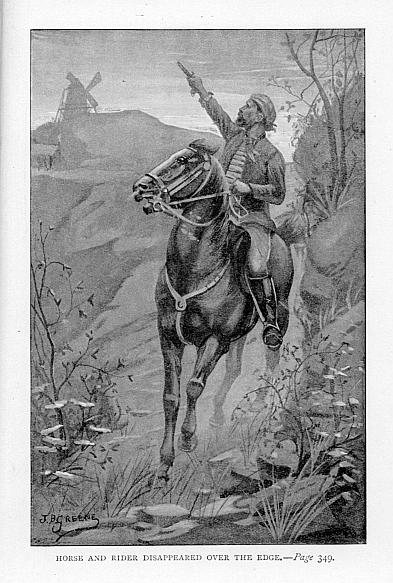
The thickening gloom of evening rendered all objects indistinct. The sergeant and his men, however, kept the smuggler in sight till they saw him reach the downs on which the mill stood, where his figure was distinctly visible against the sky. It was but for a moment, for at the same instant, a party of the sea-fencibles who had been concealed behind the mill, started up, and several shots were fired at him. It was not seen whether any had taken effect; the horse and rider disappeared, at it seemed, over the edge of the cliff. The troopers expected as they reached the spot to see him dashed to pieces on the sands, but he had reached the bottom in safety by a pathway which a desperate man alone would have ventured to take. They caught a glimpse of him as he galloped along the sands towards the south.
“We must follow him, my lads, or he will escape after all,” said the sergeant, though, as no one dared descend the path Gaffin had taken, the troopers were compelled to take their way round by a circuitous road till they could gain the level of the beach. By that time the daring smuggler was lost to sight.
In the meantime, the foot soldiers hurried along the top of the downs to stop him should he desert his horse and attempt to escape by climbing up the cliffs and make his way across the country.
The sergeant and his men made comparatively slow progress over the sands. They discovered too that the tide was rising, and had good reason to fear that they might be caught under the cliffs, and be carried off by the sea which was rolling in with a sullen roar.
The sergeant at the same moment fancied he could discern the figure of a horseman at some distance ahead, close under the cliffs, and already surrounded by water. The steed was plunging and rearing, while the rider in vain endeavoured to urge him forward. Presently, both together disappeared, overwhelmed by a sea which rolled in, and broke in masses of spray against the foot of the cliff. Not far off a dark object, which might have been a boat, was seen.
However, the advancing sea warned the sergeant that he and his men must beat a rapid retreat, or run the risk of losing their horses, if not their lives. They had, indeed, to plunge through the sea up to their horses’ girths before they regained the end of the cliff, where they were once more in safety.
Chapter Fifty Four.
Surprises.
Since we last met Adam Halliburt the Nancy had shared the fate of other craft; her stout planks and timbers gradually yielding to age, she had become too leaky to put to sea, and had been broken up for firewood. Adam having no sons to help him, had taken to inshore fishing in a small boat which he and a lad could manage. The dame’s baskets were, however, still well supplied with fish.
Honest Jacob, to his parents’ joy, had arrived at home. Adam was about to set out on his daily fishing.
“I will go with you, father,” he said; “maybe with my help you will sooner be able to get back.”
The dame, glad that Adam should enjoy his son’s company, was willing to wait till their return, to hear all Jacob had to tell them.
They stood away under sail to the south, where the best fishing ground lay.
Seldom had Adam been so happy as he was listening to Jacob’s account of his adventures, and not often had he been more successful in making a good catch of fish.
The evening was drawing on, and it was time to return, when the wind shifting, headed them, and they were compelled to take to their oars, Jacob and the boy pulling, while Adam steered. They kept close in shore to avoid the tide, which was running to the southward. The wind increased too, and they made but slow progress, so that night overtook them before they had proceeded half the distance.
There was still light sufficient to enable Adam to see a man on horseback galloping along the beach under the cliff, the water already reaching up to the animal’s knees.
“What can he be about?” exclaimed Adam. “He must be mad to try and pass along there; he will be lost to a certainty if he moves a few fathoms further on.”
Adam shouted at the top of his voice, and waved his hat, but the horseman neither saw nor heard him.
Presently, as Adam had anticipated, the horse began to struggle violently in a vain effort to escape from a soft quicksand which prevented it either from swimming or wading. The next instant a sea rolling in washed the rider from its back. He struck out boldly, making a desperate effort for life. Jacob and the boy pulled with all their might towards him, but before they could reach him a sea had dashed him against the cliff. By a mighty effort he got clear of it, when a receding wave carried him towards them. Before the boat reached him, however, he had ceased to struggle, and was sinking for the last time when Adam caught him by the collar, and with Jacob’s assistance hauled him into the boat. Jacob had at once to resume his oar, for they were so near the cliff that the boat might, in another instant, have been dashed against it. They got clear, however, but the tide had drifted them to the south.
“He is still alive,” said Adam, “but seems much hurt, and I fear will die if we don’t soon get him before a warm fire. We are just under Mad Sal’s hut, and the best thing we can do will be to carry him up there.”
“It will be a hard matter to land though, father, won’t it?” said Jacob, “and we may risk the loss of the boat.”
“Worth risking it for the sake of a human life, even if the man was our greatest enemy. There is a little creek in there, and if I can hit it, the boat will be safe enough. Stand by to jump out when I tell you.”
Jacob and the boy pulled on, and in another minute a sea lifted the boat, and though the surf broke on board she floated on, and dropped down safely into a pool, where there was no danger of her being carried away. Adam and his companions jumping out, hauled the boat up on the beach. Leaving the boy in charge of her, he and Jacob then carried the man they had rescued, and who was still insensible, towards Mad Sal’s hut, which could just be distinguished on the side of the ravine by the glare of light coming through the chinks in the window and door.
Adam knocked loudly.
“Who comes to disturb me now?” exclaimed the old woman from within. “Is my solitude constantly to be broken in upon by strangers?”
“We bring you a well-nigh drowned man, who will die if you refuse him your aid, good dame,” said Adam. “In mercy do not keep us outside.”
The door was opened.
“What! another victim murdered by the cruel salt sea,” exclaimed old Sal, as she saw the burden Adam and Jacob carried.
“We must have off his wet clothes, and warm his hands and feet, or he soon will be dead,” said Adam, as they carried the man into the room.
The sight seemed to calm instead of agitating the old woman, for she set about attending to the man in a more sensible way than might have been expected. While Adam and Jacob took off the man’s wet clothes, she brought a blanket that they might wrap it round his body. She then, kneeling down, assisted them in chafing his hands and feet. A deep groan showed that their efforts were successful, and the man soon opened his eyes, and gazed wildly at them. The old woman threw some sticks on the fire, which blazing up now for the first time, revealed his features more clearly than before.
“Why, father, he is Miles Gaffin,” exclaimed Jacob.
“I knew that,” answered Adam, “when we hauled him into the boat.”
“Miles Gaffin,” cried Mad Sal, “the bloodthirsty and wretched man shall not live out half his days; yet, as the sea refused to keep him, we must not be more cruel.”
Gaffin made no answer, but continued to glare wildly at the faces bent over him. He occasionally groaned and muttered a few unintelligible words.
“He seems to have lost his senses,” whispered Adam to Jacob.
Such, indeed, was evidently the case. Several times he tried to sit up, but he had received some severe injuries, and each movement made him shriek with pain.
What now to do was the question. Adam was unwilling to leave him alone with the poor mad woman, yet he was naturally anxious to return home. The sound of the wind, which howled and whistled up the glen, warned him that he could scarcely hope to continue his voyage.
Telling old Sal that they would speedily return, Adam and Jacob went down to the beach, and made safe their boat and fish. Then they sent the boy quickly to Hurlston, with instructions to tell the dame that they hoped to be home in the morning. The lad being warned to keep away from the edge of the cliff, set off without fear. Adam and Jacob, carrying up a few fish and some bread, returned to the hut.
As they entered they heard Gaffin’s voice raving incoherently. Mad Sal stood like a statue, the light of the fire falling on her pale features, gazing at him with a look of mingled astonishment and dread. They stopped to listen to what Gaffin was saying.
“Who are you?” she exclaimed at last, gasping for breath, and advancing towards the unhappy man.
“Who has a right to ask me that?” he shrieked out. “Martin Goul I was once called. They tell me I broke my father’s heart, that my mother threw herself from the cliffs, and that the only being I ever loved was laid in the cold grave. So I went forth to do battle with the hard world, to live in hopes of revenging myself on those who had scorned and wronged me. Each time, though I missed my aim, I thought the day of vengeance would come at last, but again and again have I been mocked by the cunning devil who deceived me.”
“Martin Goul! who speaks of him,” exclaimed the old woman, moving a step nearer the man.
“Let me be at peace, old hag; why torment me with questions?” shrieked out Gaffin.
“Young Martin Goul has long been fathoms deep beneath the ocean wave; and you tell me that you bear that name,” said Mad Sal, in a hollow frightened voice.
“No one else would dare to claim it,” cried Gaffin. “When my son marries the heiress of Texford, I will shout it out to all the world. She will be his bride before many hours are over, and then those who have scorned me will have to ask favours at my hand. They did not know that I possessed the secret of her birth, that it still lies locked up in the chest guarded safely in the vault beneath the mill, and that it will be beyond their reach before to-morrow. Ah! ah! ah!” and he broke out into a cry of maniac laughter.
The old woman passed her hand across her brow, and took another stride which brought her close to where Gaffin lay.
“Answer me, I adjure you; again I ask you, are you the Martin Goul who years gone by was pressed and carried off to sea?”
“Yes, I am that Martin Goul, the pirate, smuggler, spy, murderer,” he shrieked, out raising himself. “There are no deeds I have not dared to do. I, by forged letters, kept Ranald Castleton from his home, and willingly would I have allowed his innocent child to perish. Now I have answered you, what more would you learn from me? Ah! ah! ah!” he shouted out, as if impelled by an uncontrollable impulse to utter the very things he would have desired to keep secret.
“It’s false, it’s false,” cried the unhappy woman. “My son was wild and extravagant, but he could not have been guilty of the crimes you name. I was the mother of young Martin Goul; he was the only being on earth I loved. Oh the salt, salt sea.”
“You my mother, you,” shrieked out the wretched man, and he again burst forth into a fit of hideous laughter, which froze the hearts of Adam and his son. “Begone, old hag, begone, begone,” he shouted, and endeavoured to raise himself up, but his strength, from some internal injury, was fast giving way. The effort produced a paroxysm of pain. He shrieked out, and sinking back on the bed no longer moved.
The old woman gazed at him like one transfixed. Suddenly the fire sent up a bright flame, which fell on his face.
“Yes, yes,” cried the unhappy creature, “I know you now, you are my son, my boy Martin.” But the person she addressed no longer heard her. His spirit had fled to stand before the Judge of all men. She waited as if expecting him to reply, then suddenly she became aware of what had happened, and lifting up her hands fell forward over his body.
Adam and Jacob sprang to assist her, for they feared from the force with which she fell that she must have injured herself. She neither moved nor groaned. They endeavoured to lift her up.
“Poor creature, she is dead!” said Adam. She had survived but a few moments her unhappy son.
Adam and Jacob placed her body by his side, and closed the eyes of both. As they could no longer be of assistance they would gladly have set off for their home at once, but the night had become very dark, the storm raged furiously, and as they had their fish to carry, they would have found it difficult to make their way over the downs. They therefore agreed to wait till daylight.
Adam had noted what the dying man said with regard to the chest and the little girl.
“Could he have been speaking of our Maiden May, and how came he to call her the heiress of Texford?”
“He did call her so, there is no doubt about that,” observed Jacob. “He cannot tell us now, though, what he meant.”
“But the chest may. I was always sure that Gaffin had visited the wreck, and carried off something of value, but little did I think all the time that he knew who our Maiden May was,” said Adam.
“If we can get the chest we shall soon know all about that father; and it will be the thing of all others that Lieutenant Castleton will like to know, and I shall be glad to help him find it out.”
As neither Adam nor Jacob felt disposed to go to sleep after the scene they had witnessed, they sat up discussing the subject till dawn. The wind having shifted, and the sea gone down, they launched their boat and sailed before the wind for Hurlston. As they passed close under the mill they saw a vessel cast on the beach, which they recognised as Gaffin’s lugger. They afterwards discovered that having been left with only two or three hands on board she had been driven on shore, and, like the Nancy, having seen her best days, had been quickly knocked to pieces by the heavy sea which had for a short time broken on the coast.
Young Jack had arrived safely, and delivered the message Adam had sent the dame, so that she had not been anxious about them. But she had a terrible account to give of the events which, according to report, had taken place at Texford and Downside, and which had caused her the greatest alarm, and she was only waiting their arrival to set off to ascertain the truth.
Adam agreed to accompany her, as he wished to give Lieutenant Castleton the information he had obtained, and thought it probable that he might be at Downside. He had besides to give notice of the deaths of Martin Goul and his mother.
Chapter Fifty Five.
On the Defence.
Harry and the dragoons after Gaffin’s escape galloped rapidly to Downside. He would soon have distanced them had he not feared that they might lose their way. He kept urging them to spur on with greater speed. The gate was opened, and as they approached the house a thundering sound was heard, and he caught sight of several men endeavouring to burst in the front door. The noise they were making prevented them from hearing the approach of the horses. One of them turning, however, caught sight of the dragoons, when, he shouting to his companions, they let the log fall and rushed down the steps, two or three of them as they did so firing the pieces they carried. The soldiers fired in return, when two or more of the gang were wounded. Their companions, however, dragged them off, and scrambling over the hedges, they made their escape before the dragoons could overtake them.
Harry announced his arrival.
“Stay, it may only be a trick,” he heard Miss Jane observe.
“Oh, I am sure it is Harry. I know his voice. I am not afraid of opening the door,” exclaimed May.
The bars and bolts were quickly withdrawn, and the next instant Harry pressed May to his heart. He quickly narrated all that had happened, and Miss Jane and Miss Mary were very grateful for his coming so opportunely to their rescue.
“And I, too, am glad to greet you, Mr Castleton,” said Mr Shallard, stepping forward. “It is far more satisfactory than having had to act as your executor; indeed, this young lady most obstinately, as I thought, refused to allow me to do so.”
Much more to the same effect was said, when the lawyer remarked that he must go and look after the dragoons.
“You maybe surprised at our calmness,” he observed, “but the truth is, I expected every moment the arrival of a party of the sea-fencibles, and fully believed that they would come in time to stop the ruffians in their attempt to break into the house, and to capture the whole of them into the bargain. Till they appear, it may be prudent to retain the dragoons.”
Harry willingly allowed Mr Shallard to do as he proposed.
Shortly afterwards a party of the fencibles arrived, who by some mistake had been sent to the mill instead of coming first, as was intended, to Downside. The dragoons were then sent down to the Texford Arms.
Though Harry felt that he ought to return home, he could not leave the cottage while there was a possibility of the smugglers rallying. He was not sorry at having a good excuse for remaining.
Miss Jane, on hospitable thoughts intent, was much troubled at being unable to offer beds to her guests, but they both assured her that they should prefer sitting up, that they might be ready for any emergency.
Susan having recovered from her alarm, set to work to get supper ready, and, in the meantime, Miss Jane declaring that she and her sister had business to settle with Mr Shallard, left May and Harry in the drawing-room.
Those were joyous moments to the young lovers. The clouds had not entirely cleared away, but they both saw, they believed, the dawn of a brighter day.
Harry and Mr Shallard sat up as they had proposed, though the lawyer very soon fell asleep, with outstretched legs, long before the young sailor closed his eyes.
Nothing occurred during the night to disturb the household.
The dragoons had started at daybreak to scour the country, but did not succeed in capturing a single smuggler. They had discovered, however, in a cottage, a man dying from a gun-shot wound, and from the description given of him, Harry had little doubt that he was young Gaffin.
May appeared at breakfast, looking as bright and fresh as ever. As soon as the meal was over, Harry and Mr Shallard, assured that the ladies were in no further danger, were on the point of setting out for Texford, when Adam and Dame Halliburt arrived.
After the dame had expressed her joy at seeing May and the ladies safe, Adam described to Harry and Mr Shallard the events which had occurred on the previous evening, and gave them the information he had obtained from the dying man. May listened with breathless eagerness. Was indeed the secret of her birth to be at length disclosed? The heiress of Texford! That seemed impossible. It must have been a fancy of the dying smuggler. She might, indeed, be proved to belong to a noble family, and Sir Ralph’s objections to her might be removed; or, on the other hand, her birth might be such, that still greater obstacles might arise, or the proofs, had they existed, might have been removed. Fears and hopes alternately gaining the mastery, she in vain endeavoured to calm her agitation. Miss Mary stood holding her hand, her sightless eyes turned towards the speakers, listening to all that was said; while Miss Jane every now and then threw in a word, gave her advice, or cross-questioned Adam with an acuteness which won the lawyer’s admiration.
As they were still speaking, a dense wreath of smoke, with flickering points of flame rising beneath it, was seen in the direction of the cliff.
“The mill has been set on fire,” exclaimed Mr Shallard. “Men ought to have been stationed to guard it. We may yet be in time to save the chest. Not a moment, however, must be lost.”
The gardener having been despatched with an order to the fencibles to hasten to the mill, the lawyer, with Harry and Adam, set out in the same direction.
“Oh, Harry, do not run any risk in searching for the chest; far rather would I let the secret be lost,” exclaimed May, as Harry sprang down the steps to overtake Mr Shallard and the fisherman.
They met the fencibles on their way to the mill. As they reached the neighbourhood, they found a number of fishermen and others collected round the burning building. There appeared, however, but little prospect of saving it. The flames had got possession of the interior woodwork, and the long arms of the sails were already on fire.
“Never mind the mill,” cried a voice from the crowd. “It is the house we must look after,” and Jacob appeared with several young men carrying a heavy piece of timber.
A few blows burst open the door, and, in spite of the clouds of smoke rushing out, and the masses of burning wood which came crashing down, breaking through the roof already in flames, Jacob and his party boldly dashed in, still carrying their battering-ram. Harry with others followed. They were attacking an interior door. That quickly gave way.
Then suddenly, in the midst of the confusion, several men were seen emerging with a heavy chest, which they carried between them.
“We have got it, Mr Castleton, we have got it,” cried Jacob, as several of the bystanders sprang forward to his assistance.
In another minute the whole house was in a blaze, and the rafters which supported the vault catching fire, the tall mill fell with a loud crash, and a huge fiery mass alone marked the spot where it had stood.
Enquiries were made for Dusty Dick. No one had seen him issue from the mill, and it was generally supposed that, following his master’s orders, he had set fire to it, and perished in his attempt to escape.
“If you will restrain your curiosity for a short time, Mr Castleton, we will have the chest carried up to Downside, and examine it there,” said Mr Shallard. “It will be a fitter spot than the open Downs.”
Plenty of bearers were found, and the old lawyer had some difficulty in keeping pace with them, as, followed by half the population of Hurlston, they bore it up to the Miss Pembertons’ cottage.
Chapter Fifty Six.
Sir Ranald Castleton.
Harry, as he galloped off from Texford with the dragoons, had left the party in the house in a state of considerable anxiety.
Several of the other gentlemen had hurried out on foot towards the park-gates, near which they found General Sampson dismounted, and bending over the steward.
“He is alive, I am thankful to say,” said the general; “and as I shall have no chance of overtaking Castleton and the dragoons, I shall be of more service in looking after this worthy man.”
Mr Groocock was accordingly carried to the Hall by the general, the two noblemen, and Sir John, a footman who had followed them leading the former’s horse.
“Oh, is it Harry?” cried Julia.
No sooner had she uttered the words than Lady Castleton started forward, and would have fallen fainting to the ground had not her husband and Mr Hastings supported her.
Julia’s alarm for her brother’s safety was soon set at rest by the arrival of the party, but it was long before Lady Castleton recovered.
A groom was in the meantime sent off for the surgeon. The general having examined the steward’s wounds, pronounced them not likely to prove serious.
The attack of the smugglers, and the pursuit, had aroused Sir Ralph Castleton’s keenest interest, but the presence of Mr Hastings still more disquieted him. There was something in his presence which made a more intimate conversation imperative, and now the baronet, who was unusually pale and agitated, had invited his guest to meet him in his study.
What transpired during the conversation was not known.
The surgeon arrived sooner than expected, the groom having fortunately met him on the road. He corroborated the general’s favourable opinion of Mr Groocock’s wounds.
“The old man seems highly flattered at the way he was brought back to the house by the general and his friends, and I believe it will contribute greatly to his recovery,” he observed, smiling.
Lady Castleton appeared, however, much to require the surgeon’s attention. She had remarked the agitation Mr Hastings’ appearance had caused her husband, and dreaded the effect it might produce on him. She frequently inquired whether he had yet come out of the study, and Julia could with difficulty prevent her from attempting to get up, and join him there.
The general, who had been bustling about the house, giving directions to the servants, and trying to entertain the other guests, at length entered the drawing-room to which Lady Castleton had been conveyed. There she lay, still unable to move, on a sofa.
“Oh, General Sampson, who is that terrible man?” she exclaimed, catching a glimpse of the general, who, not aware that she was there, was about to retire.
“They tell me that he is a ruffian called Gaffin, but my friend Harry and the dragoons will soon give a good account of him, I suspect,” answered the general, not understanding her question.
“The person who is now with Sir Ralph,” cried Lady Castleton; “he called himself Mr Hastings.”
“I beg your ladyship ten thousand pardons,” answered the general. “I had no idea of whom you were speaking. There is nothing terrible about him; he is a most gentlemanly refined person, has evidently mixed in good society all his life. He tells me that I knew him in our younger days, and he is certainly an old acquaintance of Sir Ralph’s.”
Julia was perfectly ready to believe the general’s account, and assisted him at length in sufficiently calming her mother’s fears to induce her to retire to her chamber.
At last the hungry guests, whose dinner had been so long postponed, assembled in the dining-room, where they were joined by the master of the house and Mr Hastings. Sir Ralph still looked nervous, and instead of exhibiting his usual self-possession, his manner was subdued, and his mind evidently distracted, as he appeared frequently not to have heard the remarks made to him. He treated Mr Hastings with the most marked attention, while he seemed almost at times to forget the presence of the marquis and his other titled guests. Julia excused herself from coming downstairs on the plea of having to attend to her mother.
The general tried to make amends for Sir Ralph’s want of attention to his guests, and talked away for the whole party.
“I hope, Mr Hastings,” said the general, drawing him aside after dinner, “you have convinced my friend Sir Ralph that your gallant son is a fit match for his fair daughter, Miss Julia. I should like to be able to give the young lady a hint to calm her anxiety on the subject.”
“I think, my dear general, that her father will no longer object to the match; but I have agreed to retain my incognito till the arrival of my son, whose ship was announced as having reached Spithead yesterday evening, and as I obtained leave for him at the Admiralty, he will come on here at once.”
The general, who was as much at home at Texford as at his own house, found means to communicate with Julia, and to give her the satisfactory intelligence.
He was too good a soldier to neglect placing sentinels on the watch during the night, which, however, passed without any appearance of the enemy in the neighbourhood of the Hall.
Next morning the marquis and Lord Frederick, who had not been unobservant of what was taking place, though somewhat puzzled, were prepared for the hint which the general conveyed to them, that the heart and hand of Miss Julia Castleton were engaged. Regretting that their stay should have been so short, they paid their respects to the master and mistress of the house, and took their departure, much to Sir Ralph’s satisfaction.
Julia, who had become somewhat alarmed at not hearing of Harry, was much relieved during the course of the morning by receiving a message from him, saying that he was at Downside, and hoped shortly to return to Texford. She hurried to Lady Castleton to inform her, and then went to Sir Ralph, who was alone in his study, engaged in writing. He was so absorbed that he scarcely noticed her entrance. She had to repeat what she had said.
“Foolish boy!” he exclaimed, without expressing any satisfaction. “If he knew the position in which I am placed, he would see that I have greater reason than ever for objecting to his making that match. If a proper pride, and a sense of what is due to his family no longer restrains him, let him understand that his father is a mere beggar, dependent on the will of another, though you have nothing to fear, as I may tell you that he acknowledges your lover as his son, and insists on my sanction to your marriage.”
“My dear father,” exclaimed Julia, “I had hoped, indeed, that all impediments to my happiness would be removed, but how can that affect you or Harry?”
“You shall know all in time,” answered Sir Ralph, gloomily. “Till the arrival of Captain Headland, I am prohibited from saying more. Leave me now, only if you have any feelings of affection and duty you will use your influence with Harry. I do not wish to make an enemy of my only son, but tell him while I live I will never be a party to his committing the rash act he contemplates. Go, girl, go,” and Sir Ralph waved his daughter from the room.
She returned to her mother, who had sufficiently recovered to come downstairs. The guests had gone into the grounds with the exception of Mr Hastings and General Sampson. The general came hurrying into the drawing-room from the hall, exclaiming—
“A post-chaise is driving up the avenue,” and taking Mr Hastings by the arm, he added, “I do not know whether you or Miss Castleton should be the first to greet the occupant; I must leave you to decide.”
“Let my future daughter have that happiness,” answered Mr Hastings, by a violent effort calming his evident agitation.
He imprinted a kiss as he spoke on the young lady’s brow.
“Go and bring my son to me when you have exchanged greetings. Do not detain him long.”
Julia hastened to the ante-room, scarcely daring to hope that the general was not mistaken. From the window she saw the carriage approaching. She had not long to wait. Captain Headland sprang from it, followed by another person whom her eyes, from the mist which stole over them, failed to recognise. She heard his step in the hall. In another minute he was supporting her and listening to the account she had to give. She led him into the drawing-room, where Mr Hastings was seated alone.
“I require no one to tell me you are my son,” he said, embracing them both.
They spoke for some time. Julia would have retired to leave the father and his son alone, but the former detained her.
“For your sakes alone should I desire to resume my name, and take the title which is lawfully mine,” he continued. “I am your father’s elder brother, my dear Julia, but I know that when you become my son Ranald’s wife, you will endeavour to console him and your brother Harry for the loss of an empty title of which I may be compelled to deprive him. But I am happily able to leave him in possession of a fortune equal to that which he at present enjoys.”
“Believing that you did not desire to hold the baronetcy, I would gladly have resigned my future right to it in favour of Harry,” said Headland. “As, however, you gave me leave to consult any friend in whom I had confidence, I at once went to my old captain, Admiral Fancourt, who, of all people, as my uncle’s brother-in-law, was the most capable of giving me advice. I placed the whole matter before him, and he assures me that should my uncle desire a baronetcy, Government will readily grant him one for his political services, so that he will consequently not be deprived of the rank he prizes. Having known me from my early days, and being convinced of the truth of the account I gave him, he accompanied me here that he might satisfy my uncle’s mind, and assist in arranging matters.”
As Headland, or rather Captain Castleton, ceased speaking, the door opened, and Admiral Fancourt entered the room. He at once recognised Sir Ranald Castleton, as Mr Hastings was henceforth to be called, and expressed his satisfaction at his return, assuring him that he would have no difficulty in establishing his claims.
Lady Castleton shortly afterwards joined the party, and having been introduced to her brother-in-law, warmly welcomed her nephew.
Headland received a still more enthusiastic welcome from the old general, who quickly made his appearance.
“And here comes Harry and another gentleman galloping along the avenue as if the fate of the kingdom depended on their speed,” he exclaimed.
Julia and the captain went out to meet them, and in another minute returned accompanied by Harry and the lawyer. Harry could scarcely speak. Julia knew by the way he embraced her and his mother, that his heart was bounding with joy.
“She can no longer be looked upon as unworthy of marrying a Castleton, for she is a Castleton herself, though all my May desires is to bear my name,” he exclaimed at length; “but Mr Shallard will explain the discovery we have made more clearly than I can. Our good cousins promise to bring her here as soon as a carriage can be obtained.”
Sir Ranald, as may be supposed, listened to this announcement with the deepest interest, as he did to the account given by the lawyer.
Mr Shallard, after briefly describing the discovery of the chest which had been so long hid by Martin Goul in the old mill, then went on to state that, having examined the documents in it, he had no doubt whatever that the little girl who had been rescued from the wreck on board which the chest had been found, was the child of the long lost Ranald Castleton. This was corroborated by the locket with the initials of M.C. which she had on, and with the dress which had been carefully preserved by Dame Halliburt, while several of the articles in the chest had the Castleton arms and crest.