HER SEX AND LOVE LIFE (continued 2)
Reading edition
Pregnancy is a normal physiological process; but every active physiological process is apt to be accompanied by disturbances, and there is certainly no process in the animal body in which greater activity, greater changes, go on than during the process of pregnancy. Just see what occurs in nine months. The uterus, at first the size of a small pear, reaches a size larger than that of the head of a big man; it does not merely stretch, as some think, but it actually grows enormously in size, the muscular walls of a pregnant uterus being many times thicker than those of a non-pregnant one. They have to be or they would not have the strength to expel the child, when the proper time comes. It is to be borne in mind that the child does not slip out by itself; it is the powerful muscular contractions of the uterus that push it out. If the uterus should refuse to work, if its walls were too thin or too weak, the child could not come out, but would have to be taken out with forceps. Still greater changes than in the uterus take place in the child itself. At the moment of conception it is the size of the head of a pin; at the moment of birth it weighs from seven to ten pounds; at the moment of conception it is a minute, undifferentiated mass of protoplasm, just a single fertilized cell; at the moment of birth it consists of millions and millions of cells, which have become differentiated into numerous harmoniously working organs, and different tissues, such as brain and nerve tissue, muscular tissue, connective tissue, bone, cartilage, etc., etc. A truly wonderful process. And in the meantime this child, which is biologically a parasite (though it is not a nice name to call it by) draws its sustenance from the mother's blood, and the mother has to provide nourishment for two. And, besides providing nourishment, her excreting organs, her kidneys, must work for two, because her system has also to get rid of the child's excretions. No wonder that the pregnant woman, particularly under an artificial unhealthy mode of living, is subject to many troubles and disturbances.
DR. ELY'S TABLE FOR CALCULATING THE DATE OF CONFINEMENT
January 1 2 3 4 5 6 7 8 9 10 11 12 13 14 15 16 17 18 19 20 21 22 23 24 25 26 27 28 29 30 31
October 8 9 10 11 12 13 14 15 16 17 18 19 20 21 22 23 24 25 26 27 28 29 30 31 1 2 3 4 5 6 7 Nov.
February 1 2 3 4 5 6 7 8 9 10 11 12 13 14 15 16 17 18 19 20 21 22 23 24 25 26 27 28
November 8 9 10 11 12 13 14 15 16 17 18 19 20 21 22 23 24 25 26 27 28 29 30 1 2 3 4 5 Dec.
March 1 2 3 4 5 6 7 8 9 10 11 12 13 14 15 16 17 18 19 20 21 22 23 24 25 26 27 28 29 30 31
December 6 7 8 9 10 11 12 13 14 15 16 17 18 19 20 21 22 23 24 25 26 27 28 29 30 31 1 2 3 4 5 Jan.
April 1 2 3 4 5 6 7 8 9 10 11 12 13 14 15 16 17 18 19 20 21 22 23 24 25 26 27 28 29 30
January 6 7 8 9 10 11 12 13 14 15 16 17 18 19 20 21 22 23 24 25 26 27 28 29 30 31 1 2 3 4 Feb.
May 1 2 3 4 5 6 7 8 9 10 11 12 13 14 15 16 17 18 19 20 21 22 23 24 25 26 27 28 29 30 31
February 5 6 7 8 9 10 11 12 13 14 15 16 17 18 19 20 21 22 23 24 25 26 27 28 1 2 3 4 5 6 7 Mar.
June 1 2 3 4 5 6 7 8 9 10 11 12 13 14 15 16 17 18 19 20 21 22 23 24 25 26 27 28 29 30
March 8 9 10 11 12 13 14 15 16 17 18 19 20 21 22 23 24 25 26 27 28 29 30 31 1 2 3 4 5 6 April
July 1 2 3 4 5 6 7 8 9 10 11 12 13 14 15 16 17 18 19 20 21 22 23 24 25 26 27 28 29 30 31
April 7 8 9 10 11 12 13 14 15 16 17 18 19 20 21 22 23 24 25 26 27 28 29 30 1 2 3 4 5 6 7 May
August 1 2 3 4 5 6 7 8 9 10 11 12 13 14 15 16 17 18 19 20 21 22 23 24 25 26 27 28 29 30 31
May 8 9 10 11 12 13 14 15 16 17 18 19 20 21 22 23 24 25 26 27 28 29 30 31 1 2 3 4 5 6 7 June
September 1 2 3 4 5 6 7 8 9 10 11 12 13 14 15 16 17 18 19 20 21 22 23 24 25 26 27 28 29 30
June 8 9 10 11 12 13 14 15 16 17 18 19 20 21 22 23 24 25 26 27 28 29 30 1 2 3 4 5 6 7 8 July
October 1 2 3 4 5 6 7 8 9 10 11 12 13 14 15 16 17 18 19 20 21 22 23 24 25 26 27 28 29 30 31
July 8 9 10 11 12 13 14 15 16 17 18 19 20 21 22 23 24 25 26 27 28 29 30 31 1 2 3 4 5 6 7 Aug.
November 1 2 3 4 5 6 7 8 9 10 11 12 13 14 15 16 17 18 19 20 21 22 23 24 25 26 27 28 29 30
August 8 9 10 11 12 13 14 15 16 17 18 19 20 21 22 23 24 25 26 27 28 29 30 31 1 2 3 4 5 6 Sept.
December 1 2 3 4 5 6 7 8 9 10 11 12 13 14 15 16 17 18 19 20 21 22 23 24 25 26 27 28 29 30 31
September 7 8 9 10 11 12 13 14 15 16 17 18 19 20 21 22 23 24 25 26 27 28 29 30 1 2 3 4 5 6 7 Oct.
Explanation.—Find in top line the date of menstruation, the figure below will indicate the date when confinement may be expected, i.e., if date of menstruation is June 1st, confinement may be expected on March 8th, or one day earlier if leap year.
FOOTNOTES:
Chapter ElevenToC
THE DISORDERS OF PREGNANCY
Smooth Course of Pregnancy in Some Women—Pregnancy and Parturition May be Made Normal Processes Through Education in True Hygiene—Morning Sickness and Its Treatment—Necessity for Medical Advice in Pernicious Vomiting—Anorexia—Bulimia—Aversion Towards Certain Foods—Peculiar Cravings—Tendency to Constipation Aggravated by Pregnancy—Dietary Measures in Constipation—Rectal Injections in Constipation—Laxatives—Cause of Frequent Desire to Urinate During First Two or Three and Last Months of Pregnancy—Treatment of Frequent Urination—Cause of Piles During Pregnancy and Their Treatment—Cause of Itching of External Genitals During Pregnancy and Treatment—Cause of Varicose Veins and Treatment—Liver Spots.
We saw that in some women menstruation runs a perfectly smooth course, free from any disagreeable symptoms. The same is true of pregnancy. It is remarkable how smooth and easy the entire course is with some women. Many women know that they are pregnant only because of the non-appearance of the monthly periods; and even in the later months they feel no discomfort, attending to all their work and pleasures as usual; and even childbirth is a trifling matter with them. Unfortunately the number of such women is not very large, and, because of our confined, unnatural, often exhausting way of living, is becoming smaller and smaller. There is no question that the civilized, refined woman has a harder ordeal in pregnancy and childbirth than has her primitive sister. We confidently hope that this will not be so in the future; we expect the time to come when true hygiene will be an integral part of the education and the life of every girl, and then pregnancy and parturition may become even easier processes than they are in the primitive races. But the time is not yet; and in the meantime our young women have a good deal to go through.
Morning Sickness. One of the commonest disorders of pregnancy is the so-called morning sickness. This consists in a feeling of nausea and vomiting, which comes on soon after getting up. The morning sickness makes its first appearance in the third, fourth or fifth week of pregnancy and lasts usually until the end of the third or fourth month. In some women, however, the morning sickness comes on in a few days after impregnation has taken place, and those women diagnose their condition unmistakably by the feeling of slight nausea which they experience on getting up. Medicines are as a rule of little use in treating morning sickness. The "disease" can be relieved but not cured. The patient should stay in bed later than usual, should have her breakfast in bed, and then not get up for about half an hour afterward. If the patient is anemic, a good iron preparation may prove useful.
Pernicious Vomiting. The vomiting of pregnancy sometimes becomes so severe and uncontrollable that it has been given the name pernicious. The patient is unable to retain any kind of food, not even liquids, vomits almost incessantly, and may become very much run down and exhausted. The vomited matter may contain blood. For this condition a competent physician must be consulted, for in some cases the patient's life may be in danger and an abortion has to be performed.
Capricious Appetite. A capricious appetite is very common in pregnancy. The capriciousness may express itself in four different directions: (1) The patient may lose her appetite, almost altogether, partaking only of very little food, and that with effort. This condition of loss of appetite is called anorexia. (2) The patient may develop an enormous appetite—what we call bulimia—eating several times as much as she does ordinarily. (3) She may develop an aversion towards certain articles of food. Thus many women develop an aversion towards meat, the mere sight of or talk about meat causing in them a sensation of nausea. (4) She may show a craving for the most peculiar articles of food and for articles which are not food at all. The craving for sour pickles or sour cabbage is well-known; but some women will eat chalk, sand, and even more peculiar things (for the chalk there may be a reason: the system needs an extra amount of lime and chalk is carbonate of lime).
Constipation. Constipation is very common among women in the non-pregnant condition; but in the pregnant it is much more common and much more aggravated. Constipation must be guarded against, but the measures must be of a mild nature. If we can relieve the constipation by dietary measures alone, so much the better. The dietary measures should consist in eating plenty of fruit—prunes, apples, figs, dates, etc., and coarse bread and bran. Constipating articles, such as cheese or coffee, should be eliminated. Where dietary measures alone are insufficient, the patient should take an enema—a rectal injection—twice or three times a week. The enema should consist of about 8 ounces (half a pint) of cold or lukewarm water containing a pinch of salt, and should be retained about ten minutes. Instead of water, we may advise an occasional enema of two to four drams of glycerin. Or instead of a glycerin enema, a glycerin suppository may be used. If internal laxatives are to be used, only the mildest and non-griping preparations should be employed The best are: a good mineral oil—one or two tablespoonfuls on going to bed, or fluid extract of cascara sagrada, one-half to one teaspoonful on going to bed. It is very important, whatever we use, not to use the same thing for a long time. If the same drug or measure is used without any change, the bowels get used to it and cease to respond and we have to use larger and larger doses. In fighting constipation we must therefore constantly change our weapons: one night we use mineral oil, the next night cascara sagrada, the third night an enema, the fourth night a glycerin injection or suppository, the fifth night perhaps nothing at all, the sixth night a blue mass pill, the seventh morning a Seidlitz powder, then a rest for a day or two, then a repetition of the same measures. But always remember: first try to get along without any drugs at all. Many cases can get relieved of their constipation by a proper change in diet alone. And where this is impossible, then use mild laxatives and use them interchangeably.
Toothache is not uncommon in pregnancy, and a pregnant woman should have her teeth put in first-class condition.
Difficulty in Urination. Pregnant women often suffer with frequency and urgency of urination. Some have to urinate, while they are on their feet, every few minutes. This is due to the fact that during the first two or three months of pregnancy the uterus is not only enlarged but is also anteverted, that is turned forward and presses down upon the bladder. When the woman is lying down the pressure on the bladder is relieved, and she does not have to urinate frequently. This pressure lasts only the first two or three months, because after that the growing womb lifts itself out of the pelvis, rising into the abdominal cavity; it is no longer anteverted and the pressure on the bladder is relieved. During the last months of the pregnancy there is again frequent urination, because then the heavy uterus sinks again into the pelvic cavity and presses upon the bladder. The treatment for this frequent urination consists in wearing a well fitting abdominal belt or corset, which raises the uterus and prevents pressure on the bladder. Sometimes a pessary which prevents the anteversion is efficient. In all cases lying down and resting is useful. In short, keeping off one's feet is the most efficient remedy for the treatment of frequent urination in pregnant women.
Hemorrhoids (Piles). On account of the pressure of the womb on the rectum, and also on account of the constipation which is so frequent during pregnancy, hemorrhoids or piles are quite frequent among pregnant women. The treatment of hemorrhoids consists in removing the cause: wearing a well-fitting abdominal belt, and relieving the constipation. Injecting into the rectum about half a pint of cold water three times a day is very useful. For the intolerable itching sometimes present in hemorrhoids the following ointment will be found very grateful: menthol, 5 grains; calomel, 10 grains; bismuth subnitrate, 30 grains; resorcin, 10 grains; oil of cade, 15 grains; cold cream, one ounce. The piles (the hemorrhoids) are to be well cleansed with hot water, and this ointment is to be well smeared over; a little is pushed into the rectum, and a piece of cotton is put over the anus. This protects the clothes from soiling and keeps the medicine in place for a longer time. Instead of ointment a cocoa butter suppository may be used. A suppository of the following composition is good: powdered nutgalls, 3 grains; oil of cade, 3 drops; resorcin, 1 grain; bismuth subnitrate, 5 grains; cocoa butter, 20 grains. One such suppository to be inserted three times a day. The ointment and the suppository given above, if used in conjunction with the proper regulation of the bowels, will not only relieve but will cure most cases of hemorrhoids caused by pregnancy.
Itching of the Vulva. Pruritus Vulvæ. Itching of the external genitals during pregnancy is not uncommon. This may be due to the fact that the vulva is generally congested and swollen during pregnancy or it may be caused by an increased leucorrheal discharge. The itching is sometimes very severe, and if the patient scratches with her nails and produces bleeding, she may cause an infection of the parts. The patient should be cautioned against scratching; she should try simple measures to relieve the itching. A small towel or gauze compress wrung out of boiling water and applied to the vulva several times a day, followed by a free application of stearate of zinc powder is often efficient. If it is not, the following salve may be tried: carbolic acid, 10 grains; menthol, 5 grains; resorcin, 15 grains; zinc oxide, 1 dram; and white vaseline, one ounce. In very severe cases the vulva should be painted with a solution of silver nitrate, 25 grains to 1 ounce of distilled water.
Varicose Veins. In most women during pregnancy the veins in the legs become somewhat enlarged. This is due to the pressure of the womb, which interferes with the circulation. If the veins become very prominent, swollen and tortuous, they are called varicose. This condition should be prevented, because it often and to some degree always persists permanently even after the pregnancy is over. The best precautionary measure is for the woman to wear a well-fitting abdominal belt or maternity corset, which supports the womb and does not permit it to sink too low into the pelvis. If varicose veins have been permitted to develop, the woman should wear well-fitting rubber stockings, or at least have the legs bandaged with woven elastic bandages. The bandage must be applied by a competent person, uniformly and not too tightly. Constipation has also a bad effect in making varicose veins worse; the bowels should therefore also be looked after. In some severe cases all measures are of little value unless the patient at the same time stays in bed or on a couch for a few days, with the legs elevated.
Swelling of the feet should be at once attended to. It may be a trifling matter due only to pressure of the womb; then again it may be due to some kidney trouble. The physician will determine the true cause and prescribe the appropriate treatment.
Liver Spots. Chloasma. In some cases irregular brownish patches or splotches develop on the skin around the breasts, on the sides, or on the face. These patches are known popularly as liver spots or in medical language as chloasma. Nothing can be done for them, but they generally disappear after the pregnancy is over. A few patches here and there may remain permanently.
Chapter TwelveToC
WHEN TO ENGAGE A PHYSICIAN
Necessity for the Pregnant Woman Immediately Placing Herself Under Care of Physician and Remaining Under His Care During Entire Period.
The disorders and disturbances described above are, with the exception of pernicious vomiting, of a minor nature. They are annoying, may cause considerable discomfort and suffering, but they do not endanger the life of the woman or of the child. Occasionally, however, fortunately not very often, the kidneys become affected, and for this condition treatment by a physician is absolutely necessary. In fact, the correct and safe thing for a woman to do is to consult a physician as soon as she knows she is pregnant, and have him take care of her during the entire pregnancy. Some women engage a physician during the eighth or ninth month and this is decidedly wrong, because it may then be too late to correct certain troubles which if taken at the outset could have been easily cured; while many troubles in the hands of a competent physician can be prevented altogether. I must therefore reiterate: every woman should engage a physician from the beginning of her pregnancy, or at least during the third or fourth and certainly not later than the fifth month. He will examine the urine every month and make sure that the kidneys are in order, he will make sure that the child is in a normal position, and will prevent a host of other ills.

Position of the Child in the Womb.
This is not a special treatise on the management of pregnancy, and therefore minute details are out of place. Besides, to the details the physician will attend. But some hints regarding diet and general hygiene will prove useful.
If everything is satisfactory, if there is no severe vomiting, kidney trouble, etc., the usual mixed diet may continue. The only changes I would make are the following: Drink plenty of hot water during entire course of pregnancy: a glass or two in the morning, two or three glasses in the afternoon, the same at night. From six to twelve glasses may be consumed. Also plenty of milk, buttermilk and fermented milk. Plenty of fruit and vegetables. Meat only once a day. For the tendency to constipation, whole wheat bread, rye bread, bread baked of bran or bran with cream.
As to exercise, either extreme must be avoided. Some women think that as soon as they become pregnant, they must not move a muscle; they are to be put in a glass case, and kept there to the day of delivery. Other women, on the other hand, of the ultramodern type, indulge in strenuous exercise and go out on long fatiguing walks up to the last day. Either extreme is injurious. The right way is moderate exercise, and short, non-fatiguing walks.
Bathing may be kept up to the day of delivery. But warm baths, particularly during the last two or three months, are preferable to cold baths.
Chapter ThirteenToC
THE SIZE OF THE FETUS
Approximately Correct Measurements and Weight of Fetus at End of Each Month of Pregnancy.
Men and women are always interested to know how large the fetus is and how far it is developed during the various months of pregnancy. Absolutely exact measurements cannot be given, but the following approximate measurements are correct:
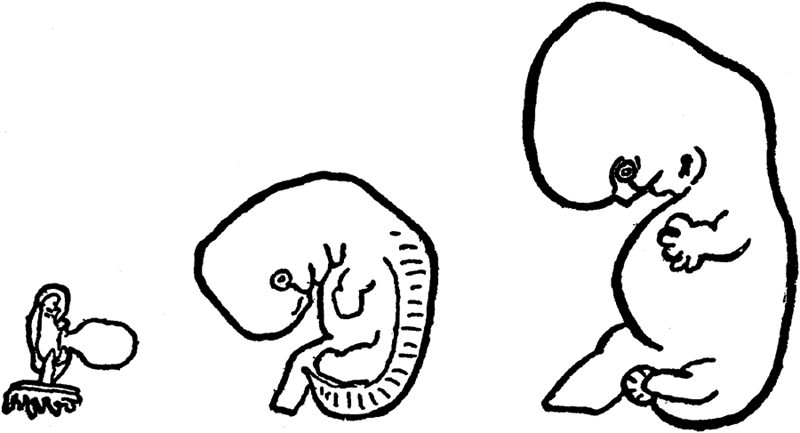
1. Embryo Between One and Two Weeks Old. 2. Embryo About Four Weeks Old. 3. Embryo About Six Weeks Old.
At the end of the first month (lunar) it is about the size of a hazelnut. Weighs about 15 grains.
At the end of the second month it is the size of a small hen's egg. The internal organs are partially formed, it begins to assume a human shape, but the sex cannot yet be differentiated. Up to the fifth or sixth week it does not differ much in appearance from the embryos of other animals.
At the end of the third month it is the size of a large goose egg; it is about two to three and a half inches long. Weighs about one ounce.
At the end of the fourth month the fetus is between six and seven inches long and weighs about five ounces.
At the end of the fifth month the fetus is between seven and eleven inches long, and weighs eight to ten ounces.
At the end of the sixth month it is eleven to thirteen inches long and weighs one and one-half to two pounds. If born, is capable of living a few minutes, and it is reported that some six months' children have been incubated.
At the end of the seventh month the fetus is from thirteen to fifteen or sixteen inches long and weighs about three pounds. Is capable of independent life, but must be brought up with great care, usually in an incubator.
At the end of the eighth month the length is from fifteen to seventeen inches, and weight from three to five pounds.
At the end of the ninth month the length of the fetus is from sixteen to seventeen and one-half inches, and weight from five to seven pounds.
At the end of the tenth lunar month (at birth) the length of the child is from seventeen to nineteen inches and the weight from six to twelve pounds; the average is seven and a quarter, but there are full term children weighing less than six pounds and more than twelve; but these are exceptions.
Chapter FourteenToC
THE AFTERBIRTH (PLACENTA) AND CORD
How the Afterbirth Develops—Bag of Waters—Umbilical Cord—The Navel—Fetus Nourished by Absorption—Fetus Breathes by Aid of Placenta—No Nervous Connection Between Mother and Child.
Whatever part of the womb the ovum attaches itself to is stimulated to intense activity, to growth. Numerous bloodvessels begin to grow and that part of the lining membrane with its numerous bloodvessels constitute the placenta, or as it is commonly called afterbirth, because it comes out after the birth of the child. From the placenta there is also reflected a membrane over the ovum, so as to give it additional protection. That membrane forms a complete bag over the fetus; this bag becomes filled with liquid, so that the fetus floats freely in a bag of waters; this bag bursts only during childbirth. The fetus is not attached close to the placenta, but is, so to say, suspended from it by a cord, which is called the umbilical cord. When the child is born, the umbilical cord is cut, and the scar or depression in the abdomen where the umbilical cord was attached constitutes the navel or umbilicus (in slang language—button or belly button). The umbilical cord consists of two arteries and one vein embedded in a gelatin like substance and enveloped by a membrane, and it is through the umbilical cord that the blood from the placenta is brought to and carried from the fetus. The blood of the fetus and the blood of the mother do not mix; the bloodvessels are separated by thin walls, and it is through these thin walls that the fetal blood receives the ingredients it needs from the mother's blood. In other words, it receives its nourishment from the mother by absorption or osmosis. The blood from the placenta also furnishes the fetal blood with oxygen, so that the fetus breathes by the aid of the placenta, and not through its own lungs.
It is well to remember that there is absolutely no nervous connection between mother and child. There are no nerves whatever in the umbilical cord, so that the nervous systems of the fetus and of the mother are entirely distinct and separate. And this will explain why certain nervous impressions and shocks received by the mother are not readily transmitted to the child. It is only through changes in the mother's blood that the fetus can be influenced. As will be seen in a later chapter we are skeptical about "maternal impressions."
Chapter FifteenToC
LACTATION OR NURSING
No Perfect Substitute for Mother's Milk—When Nursing is Injurious to Mother and Child—Modified Milk—Artificial Foods—Care Essential in Selecting Wet Nurse—Suckling Child Benefits Mother—Reciprocal Affection Strengthened by Nursing—Sexual Feelings While Nursing—Alcoholics are Injurious—Attention to Condition of Nipples During Pregnancy Essential—Treatment of Sunken Nipples—Treatment of Tender Nipples—Treatment of Cracked Nipples—How to Stop the Secretion of Milk When Necessary—Menstruation While Nursing—Pregnancy in the Nursing Woman.
Every mother should nurse her child—if she can. There is no perfect substitute for mother's milk. There is only one excuse for a mother not nursing—that is when she has no milk, or when the quality of the milk is so poor that the child does not thrive on it, or when the mother is run down, is threatened with or is suffering with tuberculosis, etc. In such cases the nursing would prove injurious to both mother and child.
When the mother cannot nurse the child, it should be brought up artificially on modified cow's milk. Formulas for modified milk have been worked out for every month of the child's life, and if the formulas are carefully followed, and the bottle and nipples are properly sterilized, the child should have no trouble, but should thrive and grow like on good mother's milk. If the child is sickly or delicate and does not thrive on modified cow's milk or on the other artificial foods, such as Horlick's malted milk, or Nestlé's food, then a wet nurse may become necessary. But before engaging a wet nurse great care should be taken to make sure that she is healthy, that the age of her child is approximately the same as the age of the child which she is about to nurse, and particularly that she is free from any syphilitic taint. One, two or more Wassermann tests should be made to settle the question definitely.
Mothers should bear in mind that suckling the child is good not only for the child, but for the mother as well. Lactation helps the involution of the uterus: the uterus of a nursing mother returns more quickly and more perfectly to its normal ante-pregnant condition than the uterus of the mother who cannot or will not nurse her child.
It is asserted that the reciprocal affection between mother and child is greater in cases in which the child suckled its mother's breast. This is quite likely. It is also asserted that the nursing mother transmits certain traits to its child, which the non-nursing mother cannot. This is merely a hypothesis without any scientific proof.
On the other hand, the statement that many women experience decidedly pleasurable sexual feelings while nursing seems to be well substantiated.
That the mother who nurses her child should partake of sufficient nourishment goes without saying. But the advice often given to nursing mothers to partake of beer, ale or wine is a bad one. It is a question if a mother partaking of considerable quantities of alcoholic beverages may not transmit the taste for alcohol to her children. No, alcoholics should be left alone, but milk, eggs, meat, fruit and vegetables should be partaken of in abundance.
Preparing the Nipples. For the infant to be able to nurse properly the nipples of the breast must be in good condition. If the nipples are sunken, depressed, it is torture for the child to nurse. It uses up a lot of energy uselessly, becomes exhausted, and gets very little milk; while if the nipples be tender or cracked the process of nursing is a torture for the mother.
It is therefore necessary to attend to the nipples in due time—to begin at the fifth or sixth month is not too early. If the nipples are sufficiently prominent, little need be done for them except to wash them with a little boric acid solution (one teaspoonful of boric acid to a glass of water) occasionally, and now and then to rub in a little petrolatum, plain or borated. But if the nipples are sunken so that they are below the surface of the breast, or if they are only slightly above the surface of the breast, they must be treated. Gentle traction must be made on them with the fingers three or four times a day. There are only a few cases where persistent manipulation will not develop the nipple and make it stand out prominently.
If the nipple is tender it should be washed two or three times a day with a mixture of alcohol and water; one part of alcohol to three parts of water is sufficient. In washing the nipple with this diluted alcohol it should be dried and a little petrolatum or vaseline rubbed in. This done two or three times a day during the last month or two of the pregnancy will generally produce a good healthy nipple.
The Treatment of Cracked Nipples. If the care of the nipple has been neglected, and it develops cracks or fissures so that the nursing of the child causes the mother severe pain, the nursing should be done through a nipple shield, and in the meantime between the nursings the nipple should be rubbed with the following preparation, which is excellent and which I can fully recommend: thymol iodide, ½ dram; olive oil, ½ ounce. This should be applied every hour to the nipple and covered with a little cotton; before each nursing, however, it must be well washed off with warm water or warm boric acid solution. When the nipples are cracked, the infant's lips should also before nursing be carefully wiped out with boric acid solution. For the baby's mouth contains bacteria which while harmless in themselves may if they get into the cracks of the nipple set up an inflammation of the breast or "mastitis" and cause an abscess. If the cracks are excruciatingly painful, as they sometimes are, it is necessary to give the one breast a rest for twenty-four hours and have the child nurse at the other until the cracks have partially healed.
When It Is Necessary to Dry Up the Breasts. In case of the death of the child, or if the mother for some other reason finds herself unable to nurse, such as in cases where there is absolutely no nipple, instead of the prominence of the nipple there being a deep depression, it becomes necessary to stop the secretion of the milk, or as it is said in common parlance, "to dry up the breasts." In former days, not so very long ago, and the practice is still common enough to call attention to it and to condemn it, the breasts used to be tightly bandaged, or they used to be pumped every few hours. The first causes unnecessary pain and trouble, while the second procedure, the pumping, does exactly the reverse to what it is intended to do. Instead of drying up the breasts it keeps up the secretion. The best thing to do in a case like that is to leave the breasts alone, not to pump them, but just gently support them with a bandage and then in three or four days the secretion of the milk will gradually disappear. There is some discomfort the first twenty-four or forty-eight hours, but if left alone the discomfort is less than if the breasts are manipulated, bandaged or pumped.
Menstruation or Pregnancy While Nursing. Many women do not menstruate and do not become pregnant while they are nursing. Some women will not conceive, no matter how long they may nurse the child—a year or two or longer. And some women take advantage of this fact, and in order to avoid another child they will keep up the nursing as long as possible. In Egypt and other Oriental countries where our means for the prevention of conception are unknown, it is no rare sight to see a child three or four years old interrupting his work or his play and running up to suckle his mother's breast. But not all women have this good luck. Some women (about fifty per cent.) begin to menstruate in the sixth month of lactation, while some become pregnant even before they begin to menstruate. It only too often happens that a woman considering lactation her safeguard omits to use any precautions and finds herself, to her great discomfiture, in a pregnant condition.
When a nursing woman discovers that she is pregnant she should give up nursing at once. The milk is apt to become of poor quality, but even where this is not the case, it is too much for a woman to feed one child in the uterus and one at the breast.
Chapter SixteenToC
ABORTION AND MISCARRIAGE
Definition of Word Abortion—Definition of Word Miscarriage—Spontaneous Abortion—Induced Abortion—Therapeutic Abortion—Criminal Abortion—Missed Abortion—Habitual Abortion—Syphilis as Cause of Abortion and Miscarriage—Dangers of Abortion—Abortion an Evil.
The word abortion, used somewhat loosely, signifies the premature expulsion of the fetus; the expulsion of the fetus from the womb before it is viable, i.e., before it is capable of living independently. Used in a stricter sense, the word abortion is applied to the expulsion of the fetus up to the end of the 16th week; to the expulsion of the fetus between the 16th and the 28th week the term miscarriage is applied; and when the expulsion of the fetus takes place after the 28th week, but before full term, we use the term premature labor. The laity does not like the term abortion, as it is under the impression that the term always signifies criminal abortion; it therefore prefers to use the term miscarriage ("miss"), regardless of the time at which the expulsion of the fetus takes place.
When an abortion (or miscarriage) takes place by itself, without any outside aid, we call it spontaneous abortion. When it is brought on by artificial means, whether by the woman herself or by somebody else, we call it induced abortion. When an abortion is induced for the purpose of saving the woman's life, we call it therapeutic abortion; this is considered perfectly legal and proper. But where an abortion is induced merely to save an unmarried mother's reputation, or because the married mother is too poor or too weak to have any more children, or is reluctant to have any (or any more) for any other reason, it is called criminal or illegal abortion, and, if discovered, subjects the mother and the person who produced the abortion to severe punishment.
When the fetus for some reason dies in its mother's womb, it is generally expelled within a few hours or days. Sometimes this is not the case, and the dead fetus is retained for several weeks, or months or even years; to such a phenomenon we apply the term missed abortion. Some women suffer from what might be called the abortion habit; they can hardly ever carry a child to full term, but lose it in the same month or even in the same week of gestation during each pregnancy; we call this habitual abortion. And this habitual abortion may be independent of disease, such, for instance, as syphilis. The terms threatened, imminent and inevitable abortion require no further explanation.
The Causes of Abortion. Outside of the abortion habit, which may be due partly to heredity or be caused by a diseased condition of the lining membrane of the uterus, the principal cause of abortion and miscarriage is syphilis. And when a woman has had two or three or four or more miscarriages in succession we generally assume the cause to be syphilis, and in most cases the assumption will be correct.
When an abortion is performed by an experienced physician, with the observance of the utmost cleanliness (asepsis and antisepsis), then the abortion is accompanied with very little or no danger; but when performed carelessly, by incompetent, non-conscientious physicians and midwives, the operation is fraught with great danger to the patient's health or to her very life. And abortion is a great cause of premature death and chronic invalidism among women. And as long as the people will remain ignorant of the proper means of regulating their offspring, so long will abortion thrive.
While I recognize that there are cases in which the performance of an abortion is perfectly justifiable from a moral standpoint, for instance in cases of rape or where the mother is unmarried, nevertheless abortion must be recognized as an evil, a necessary evil now and then, but an evil, nevertheless. It is never to be undertaken lightly, or to be considered in a frivolous spirit; and it is the duty of all serious-minded and humanitarian men and women to do everything in their power to remove those conditions which make abortion necessary and unavoidable.
Chapter SeventeenToC
PRENATAL CARE
Meaning of the Term—Misleading Information by Quasi-Scientists—Exaggerated Ideas Regarding Prenatal Care—Nervous Connection Between Mother and Child—Cases Under Author's Observation—Effects on Offspring—Advice to Pregnant Women—Germ-plasm of Chronic Alcoholic—A Glass of Wine and the Spermatozoa—False Statements—Cases of Violence and Accidents During Pregnancy.
By prenatal care we understand the care taken during pregnancy before the child is born. Used in a wider sense the term includes the care which both parents should take of themselves even before the child is conceived.
Of course the father and the mother should be in the best possible physical and mental condition during the time of conception and even before conception, and the mother should take the very best care of herself—she should be in good health and as calm a spirit as possible during the entire period of gestation. For the general health and condition of the mother does influence the child.
And still I feel impelled to say something which may meet with violent opposition in some quarters. The trouble is, there are too many half-baked scientists in our midst. They spread misleading information and the public at large is too apt to take every statement that has a quasi-scientific seal for something absolute, for something positive, for something that admits of no exceptions.
I have seen so much misery caused by wrong prenatal care teaching and by the foolish, exaggerated ideas on the subject, that I consider it my duty to say something in order to counteract those erroneous notions. I consider it my special mission to destroy error, mysticism and superstition. And the prenatal care teaching as imparted by some unfortunately partakes of all three of the above.
Of course, I repeat, the mother should try to be in the best possible condition while she is carrying the child. Nevertheless, it is foolish to imagine if the mother is not quite well, or is worried about something, or has a fit of anger, that it is invariably going to be reflected on the child. The child, as we know, has no nervous connection whatever with the mother, and it is only very violent or prolonged shocks that are apt to have an injurious influence.
I know of children that were carried by their mothers in anger and in anguish from the day of conception to the day of delivery. And still they were born perfectly normal. I know of a child whose mother was suffering the most hellish tortures of jealousy during the entire period of pregnancy, and still the child was born perfectly healthy, perfectly normal, and is now a splendid specimen of manhood. I know children whose mothers went through severe attacks of pneumonia, typhoid fever, etc., and still they were born perfectly healthy and perfectly normal. I know children whose mothers were using every means to abort them, took all kinds of internal medicines until they were deathly sick, and still they were born perfectly healthy and normal. I know children whose mothers tried to abort them by mechanical means, who went to abortionists who made one or more attempts to induce the abortion—I know even cases where the mothers bled as a result of such attempts—and nevertheless, the children were born perfectly healthy, developed normally physically and mentally.
Of course these are not things that I would advise women to do or to undergo. I would not advise pregnant women to worry, to be sick, to take poisonous medicines or to make attempts at abortion, but I merely bring up these points to emphasize to my readers not to take the necessity of prenatal care in too absolute a sense, and not to worry themselves unnecessarily if the conditions during their pregnancy are not all that could be desired. The child is not necessarily going to be affected. The condition of the germ-plasms, i.e., the condition of the ovum and the spermatozoa at the time of conception is more important than all subsequent care during gestation.
As there are foolish people who possess a peculiar knack of misinterpreting and misunderstanding everything, I wish to emphasize that hygiene during pregnancy should not be neglected. Everything possible should be done to put the mother in the best possible physical and mental condition. All I want to say is that it is bad to be insane on the subject, that it is bad to take things in an absolute sense, and that it is bad to exaggerate.
You will often hear it said that a child that was conceived when the father was in an exhilarated condition is apt to be epileptic, or nervous, or insane, and what not. This is also to be taken with a grain of salt. A chronic alcoholic has a defective germ-plasm, and his children are apt to be defective. But a glass of wine at a wedding banquet cannot affect the previously formed spermatozoa. And the statements about children being born defective or developing defectively because their fathers took an occasional glass of wine are unworthy of serious consideration; are unworthy of any consideration.
In connection with the above the reports of some cases of violence and accidents during pregnancy which, in spite of their severity, did not affect the children, will prove of interest.
A delicate little woman missed her periods. She was sure she couldn't be more than two weeks over-due. And this is what she did. For five nights in succession she took hot mustard baths and she took them so hot that each time she nearly fainted and came out from them like a broiled lobster. No effect. She then took a box of pills which cost her two dollars. No effect except causing diarrhea. She then took two boxes of capsules which upset her stomach and made her fearfully nauseous. No other effect. She then ate one-half a colocynth, which made her terribly sick, causing a bloody diarrhea. She had to stay in bed for three or four days. She then took burning vaginal injections with some ipecac in them. No effect except making her feel raw so that she needed large amounts of cold cream. She then took secale cornutum and radix gossypii. No effect except giving her a headache, making her sick to her stomach and completely destroying her appetite, so that within a very short time she lost nearly ten pounds. She was then told that long walks might be efficient. She took walks of six and seven miles at a time, coming home more dead than alive. No effect. She then heard that jumping off a table is a very efficient means. She did it a dozen times in succession so that she was completely fagged out and out of breath. Eight and a half months later she gave birth to a perfectly healthy, well-formed boy weighing eight pounds.
The following case was reported by Brillaud-Laujardiere. A farmer who was responsible for the condition of a servant of his household conceived the idea of riding horseback with her in order to bring about an abortion, and pushing her off when the horse was running at great speed. This he repeated several times. The woman gave birth to a perfectly normal infant at full term.
Hofmann reports that another farmer, under similar circumstances, brutally kicked the woman in the abdomen repeatedly until she lost consciousness. The pregnancy continued to full term notwithstanding. In another case of Hofmann's, a woman allowed a heavy door to fall upon her, but the pregnancy was not affected.
Dr. Guibout relates that a German woman, living with her husband in California, being pregnant, wished to return to Munich, her home-town, to be delivered. The train in which she travelled through Panama collided with another train. Threatened abortion required her to take a rest. She took a steamer and after a very rough passage reached Portsmouth. From there she went to Paris. Here she fell down a flight of stairs in the hotel where she was stopping. Again she was threatened with abortion, but after a rest was in good condition and continued her journey. She finally reached home, and was delivered at full term of a normal infant.
Vibert reports the case of a woman who was in a train accident which injured her severely, killed two of her children, but did not affect her pregnancy. She was delivered at the proper time of a normal baby.
Chapter EighteenToC
THE MENOPAUSE OR CHANGE OF LIFE
Time of Menopause—Cause of Suffering During Menopause—Reproductive Function and Sexual Function Not Synonymous—Increased Libido During Menopause—Change of Life in Men.
In the chapter on menstruation I referred briefly to the menopause. I will consider it here somewhat more in detail.
The menopause, also called the climacteric, and in common language "change of life," is the period at which woman ceases to menstruate. The average age at which this occurs is about forty-eight. But while some women continue to menstruate up to the age of fifty, fifty-two, and even fifty-five, others cease to menstruate at the age of forty-five or even forty-two. Between forty-four and fifty-two are the normal limits. Anything before or beyond that is exceptional.
Just as the beginning of menstruation may set in without any trouble of any kind, and just as some women have not the slightest unpleasant symptoms during the entire period of their menstrual life, so the menopause occurs in some women without any trouble, physical or psychic. The periods between the menses become perhaps a little longer, or a little irregular, the menstrual flow becomes more and more scanty, then one or several periods may be skipped altogether, and the menopause is permanently established. Many women, however, the majority probably, suffer considerably during the transitional year or years of the menopause. Symptoms are both of a physical and of a psychic character, but the psychic symptoms predominate. There may be headache, capricious appetite, or complete loss of appetite, considerable loss of flesh, or on the contrary very sudden and rapid putting on of fat, great irritability, insomnia, profuse perspiration; hot flashes throughout the body, and particularly in the face, which make the face "blushing" and congested, are particularly frequent. Then the woman's character may be completely changed. From gentle and submissive she may become pugnacious and quarrelsome. Jealousy without any grounds for it may be one of the disagreeable symptoms, making both the wife and the husband very unhappy. In some exceptional cases a genuine neurosis or psychosis may develop.
Cause of Suffering During Menopause. It is my conviction, and I have had this conviction for many years, that many, if not most, of the distressing symptoms of the menopause are due, not to the menopause itself, but to the wrong ideas about this period that have prevailed for so many centuries. We know the influence of the mind over the body, and the pernicious effect which wrong ideas may exercise over our feelings. The generally prevalent opinion among women, and men for that matter, and not only of the laity but unfortunately of the medical profession as well, is that the menopause is the end of woman's sexual life. Every woman is laboring under the erroneous impression that with the establishment of the menopause, with the cessation of the menses, she ceases to be a woman, and as she does not become a man, she becomes something of a neuter being, neither woman nor man. And she has the idea that after the menopause she can have no further attraction for her husband or for other men. Naturally such an idea has a very depressing effect on any human being. Any human being fights to the last to retain all its human functions, especially the function which is considered as important as is the sexual function.
Reproductive Function and Sexual Function Not Synonymous. Of course with the permanent cessation of the menses the woman's reproductive function is at an end. But the reproductive function is not synonymous with the sexual function, I must insist again and again, and naturally until this erroneous idea is dispelled much unnecessary misery will be the lot of our women. If women in general will learn that with the establishment of the menopause they do not cease to be women, if they will learn that the sexual desire in women lasts long beyond the cessation of the menopause, many women being as passionate at sixty as at thirty, if they will learn that their attractiveness or non-attractiveness to the male sex does not depend upon the menopause, but upon their general condition, if they will learn that many women at fifty and sixty are much more attractive than some women at half that age, they will not take the onset of the menopause so tragically and they will thereby avoid the greater part of their mental and emotional suffering.
The actual atrophy of the ovaries, uterus, external genitals and the breasts can, of course, not be prevented, but that atrophy is a slow and gradual process, and is not in itself the cause of the various distressing symptoms that we have enumerated.
The treatment of the menopause, if the symptoms are at all disagreeable, or distressing, should be in the hands of a competent physician. A little wholesome advice may be more efficient than gallons of medicine and bushels of pills. In general the woman should try to lead as calm and peaceful a life as possible. Warm baths daily are beneficial, constipation should be guarded against, hot vaginal douches are often efficient against the disagreeable flushes, and last, but not least, the husband should during this critical period be doubly kind and doubly considerate of his wife. It is during the years between forty-five and fifty-five that the wife is most in need of her husband's sympathy and support.
Increased Libido During Menopause. There is one rather delicate symptom which I must not pass unmentioned. Some women during the years while the menopause is being established, and for some years after the menopause, experience a greatly heightened sexual desire. In some cases this increased libido is normal, that is, no other pathologic symptoms or local conditions can be discovered. In some cases the increased libido is distinctly due to local congestion, congestion of the ovaries, the uterus, etc. In some cases, I can distinctly testify, it is psychic or autosuggestive. Because the woman thinks, and believes that other people think, that she is soon going to lose all her sexuality, she unconsciously works herself up into a sexual passion which sometimes may be of long duration and may even lead to disastrous results.
What to do in such cases? Where the woman's libido is normal or near normal, then naturally it should be normally gratified. But if the libido seems to be abnormally strong and the demands for sexual gratification are too frequent, then the woman should be treated and sexual gratification should not be indulged in, because in such cases, as a rule, sexual gratification only adds fuel to the fire, and the woman's demands may become more and more frequent, more and more insistent. In exceptional cases it may even reach the intensity of nymphomania. In such cases the aid of a tactful physician is indispensable.
Change of Life in Men
To people not familiar with the subject it sounds rather strange to speak of "change of life" in men.
Man, possessing no menstrual function, cannot have any menopause, but still sexologists and psychologists who have studied the subject carefully are convinced that between the ages of forty-five and fifty-five men also undergo a certain change which may be spoken of as the change of life or the male climacteric.
They become irritable, capricious, very susceptible to feminine charms, are apt to fall in love, and in many the sexual instinct is greatly increased. As in women, this increase of the sexual desire is sometimes due to pathologic causes, such as an inflamed prostate gland—in other cases it is of psychic origin.
Just as a man should be particularly kind and considerate to his wife during her menopause, so the wife, understanding that her husband is going through a critical period, will also increase her tact, patience and consideration.
Chapter NineteenToC
THE HABIT OF MASTURBATION
Definition of Masturbation—Its Injurious Effects in Girls as Compared with Boys—Married Life of the Girl Masturbator—Necessity for Change in Injurious Attitude of Parents who Discover the Habit—Common-sense Treatment of the Habit—How to Prevent Formation of Habit—Parents' Advice to Children—Hot Baths as Factor in Masturbation—Other Physical Factors—Mental Masturbation and Its Effects.
Masturbation or self-abuse is a term applied to a bad habit which consists in handling and rubbing the genitals. It is a bad habit because it is apt to injure the health and future development of the girl. The more frequently it is practiced, the more injurious it is. It is more injurious than when practiced by boys, because the effects are usually more permanent. Girls who indulge in the habit of masturbation to excess not only weaken themselves, become anemic and get a dingy, pimply complexion, but they lose their desire for normal sexual relations when they grow up, and are unable to derive any pleasure from the sexual act when they get married. In fact, many girls who masturbated excessively get a strong aversion to the normal sexual act, and their married life is an unhappy one. Their husbands often have to ask for a divorce. Fortunately, the habit is much less widespread among girls than it is among boys. While about ninety per cent. of all boys—nine out of every ten—masturbate more or less, only about ten or at most twenty per cent. of girls are addicted to this habit. But whatever the percentage may be, the habit is an injurious one, and if you value your health, your beauty and proper growth and mental development, you should not indulge in it. If you are already indulging, if you are used to handling your genitals, if a bad companion has initiated you into the habit, you should give it up. And mothers should watch their children, guard them against developing the habit, and do everything possible to cure them of it, if prevention comes too late.
But while as you see I do not deny the evil effects of masturbation, it is necessary to state that a great change has taken place in our opinions on the subject, and it is but right that parents should know of this change of opinion among the medical profession, particularly among those who specialize in sexology.
Wrong Behavior of Parents. When parents make the "awful" discovery that their child is fondling its genitals or is indulging in masturbation, they feel as if a great calamity had befallen them. They could not feel worse if they learned that the child was a thief or a pyromaniac. Imbued with the medieval idea of the "sinfulness" of the habit, as well as its injuriousness, they begin to scold the child, to frighten it, to make it believe that it is doing something terrible, that it has disgraced them and itself; and they try to persuade it that, unless it stops immediately, the most direful consequences are awaiting it. The results of this mode of procedure are disastrous—much more so than is the masturbation itself.
Often the scolding and the exposure of the child are done in the presence of others. This implants in the poor girl a sullen resentment that only makes it more difficult for it to break the habit. When the child is brought to the physician, you can see by its behavior, by its downcast looks, by its sulkiness, by its attempt to refrain from tears, and other signs, that it regards the physician in exactly the same light as a youthful criminal regards the judge before whom he has been brought for trial.
It is time, high time, that this silly and injurious attitude toward a practice, which is very common, be radically changed. It is time that parents and physicians learn that the injuriousness of the habit has been greatly, grossly exaggerated. It is time that they know that the vast majority of boys and girls get over the habit without being much, or any, the worse for it. The knowledge of this fact will not only save them and the children much needless anguish and suffering, but will make it much easier to deal with the latter, make it much easier to get them divorced from the habit.
If we look at the matter in a sensible, common-sense way, and do not tell the child caught in the practice that it has done something disgracefully vicious and criminal, but speak to it kindly and tell it that it is doing something that may injure it greatly, that may interfere with its future mental and physical health and development, then we shall have far greater success in our endeavors to break the boy or the girl of the habit of masturbation. As I have said in another place:
"In my opinion, stigmatizing even the most moderate indulgence in masturbation as a vice has a deleterious effect upon the people who so indulge and makes it harder for them to break off the habit. Every thinking physician and sexologist can tell you that picturing the masturbatory habit in too lurid colors and stigmatizing it with too strong epithets has, as a rule, the contrary effect to the one expected. The victims of the habit consider themselves degraded, irretrievably lost. They lose their self-respect, and it is, on account of that, harder for them to break themselves of the habit."
We shall accomplish a good deal more with our youthful and older patients if we leave alone, altogether, the moral side of the question—if there be any moral side to it—and emphasize the physical injuriousness of the habit. We do not want to diminish the self-respect of our boys and girls, we want to increase it; and we can not do this if we make them believe that a masturbator is a vicious criminal. Inspire your patients with confidence, tell them that indulgence in the habit jeopardizes their future growth, both physical and mental, their health and happiness, and you will find them easier to control.
I am not trying to minimize the danger of masturbation, for, if indulged in from an early age and to great excess, the results may be disastrous. But, even if I were to minimize the evil consequences, that would be less of a sin than to exaggerate them the way it has been done for so many years, by so many people in the profession and out of it. The evil results of exaggerating the influence of masturbation have been so great in the past that, if now the pendulum were to swing to the other extreme, I am sure it would not be a bad thing at all.
To deal with the subject of the treatment of masturbation belongs to a medical treatise. But, a few remarks on how to prevent children from acquiring the habit of masturbation will not be out of place.
Prevention of the Habit of Masturbation. The keynote of preventing the habit is, carefully to watch the child from its earliest infancy. We know that not infrequently stupid or vicious nursemaids, wet-nurses, and even governesses ignorantly or deliberately induce the habit in children under their charge. This, of course, must be prevented. Even children of the age of nine, ten, eleven years should not be left alone, but always be under supervision. Too close friendship between boys or girls, particularly of different ages, should be looked upon with suspicion.
A number of girls never should sleep in the same room without supervision by an older person.
The sleeping together of two in the same bed, whether it be two children or a grown person and a child, should not be permitted under any circumstances. I admit of no exceptions to this demand. It makes no difference whether the other person is a mother, a father, a brother or a sister. Leaving out of the question any deliberate element, the thing is dangerous; for, very often, unintentionally, unwittingly, masturbation is initiated by this intimate contact.
The child—boy or girl—should sleep alone, on a rather hard mattress. The covering should be light. A coverlet may be put over the feet. The child always should sleep with the arms out upon the cover or blanket, never under the same. If this is done from childhood on, it is very easy to get used to this way of sleeping, and many a case of masturbation will thus be obviated. The child should not be permitted to loll in bed: it must be taught to get up as soon as it awakes in the morning. The general bringing-up must be of a strengthening, hardening character; and this applies both to the body and the will. When the children reach the age of nine, ten, eleven, twelve or thirteen years (we must use discrimination and judgment, for, some children of nine are as developed as are others of thirteen), we must tell them that it is bad and injurious to handle one's genitals, and we must warn them to shun any companions who wish to initiate them into any manipulations of these parts or who show an inclination to talk about the sexual organs and sex matters.
Hot baths are very injurious for young children in their influence in this direction. There is no question that a hot bath has a very decided stimulating effect upon the sexual desire of adults as well as of children, both male and female; in fact, I have had several patients of either sex tell me that their first masturbatory act was committed while they were in a hot bath. Of course, the sensation having been pleasurable, they kept on repeating the experience.
Every factor liable to give rise to the habit should be removed. Thus, for instance, eczema about the genitals, strongly acid urine, seatworms, and the like, should be treated until cured. That anything having a tendency prematurely to awaken the sexual instinct should be rigorously avoided, goes without saying.
Mental or Psychic Masturbation. Some girls and women will abstain from handling themselves with their hands (manual masturbation), but will practice what we call mental masturbation. That is, they will concentrate their minds on the opposite sex, will picture to themselves various lascivious scenes, until they feel "satisfied." This method is extremely injurious and exhausting and is very likely to lead to neurasthenia and a nervous breakdown. You should break yourself of it, by all means, if you can. For it is even more injurious than the regular habit.
Chapter TwentyToC
LEUCORRHEA—THE WHITES
Misconception Regarding the Meaning of the Term "Leucorrhea"—A Common Complaint—Severe Cases—Reasons for Resistance to Treatment—Proper Local Treatment of the Disorder—Sterility Due to Leucorrhea—Causes of Leucorrhea—Tonic Medicines—Local Treatment—Formulæ for Douching.
Leucorrhea means literally a "white running," and is applied by the laity to any whitish discharge coming from the vagina. This is wrong, because some white discharges may be of little importance; others may be of a serious character, and not be leucorrhea at all.
Leucorrhea is one of the banes of the modern girl and woman. It is very frequent. Probably at least twenty-five per cent, (some say fifty or seventy-five per cent.) of all women suffer with it in a greater or lesser degree. In some cases it is only an annoyance, necessitating the frequent changing of napkins, but in others it causes a great deal of weakness, backache, erosions, itching and burning. It is very resistant to treatment, particularly in girls. The reason it is so resistant to treatment is because the discharge, while coming from the vagina, does not usually originate in the vagina; it originates in the neck of the womb, and the hundreds and hundreds of injections that women take for their leucorrhea only reach the vagina; they cannot penetrate into the womb. And it is only by treating the cavity of the cervix, which can only be done by a physician, through a speculum, that the root of the trouble can be reached. And, if any erosion or ulcer is noticed, it can be directly touched up with the necessary application. And it is for this reason that in girls leucorrhea is so much more difficult to treat. For fear of having the hymen ruptured the girl objects to a thorough examination and to local treatment, and the leucorrhea is permitted to proceed until perhaps a chronic inflammation of the womb and the Fallopian tubes is established. There is no doubt that many cases of sterility or childlessness in women are due to long-neglected leucorrhea in girlhood.
What Is the Cause of Leucorrhea? We can answer simply: the cause of leucorrhea is catarrh in any part of the female genital tract. But this is no real answer. What are the causes of the catarrh? The causes of catarrh are many: the most common cause is a cold. Wetting the feet and getting chilled, particularly during the menses, may set up a catarrh in the cervix. Long standing on one's feet, lifting and carrying heavy bundles, dancing in overheated rooms and then going out scantily clad in the chill night air, prolonged ungratified sexual excitement, lack of cleanliness in the external genitals—all these are factors in setting up a catarrh of the cervix with a resultant leucorrhea. A general rundown condition, worry, overwork, too hard study, lack of fresh air, and a general scrofulous condition also favor the development of catarrh of the womb and leucorrhea. It will therefore be seen that the treatment of leucorrhea to be successful must be general and local.
General Treatment. The general treatment consists in general hygienic measures and in common sense. The patient should not be on her feet more than she can help, and she should not walk until exhausted or fatigued. It is better to take several short walks than one long one. The corset she wears, if she wears any at all, should be of the modern kind: not one that presses the womb and the other abdominal organs down, but one that supports the abdominal walls, and rather raises the abdominal organs up. The lacing or buttoning must be from below up, and not from above down. That it should not in any way interfere with the freedom of respiration goes without saying. Constipation if any, to be treated, must be treated intelligently, by mild measures (see Constipation, in the chapter on pregnancy), and care must be taken that the bowels move at regular hours. Where the leucorrhea is due to or is aggravated by anemia and general weakness, a good iron preparation, such as one Blaud's five-grain pill three times a day, or a tonic of iron, quinine and strychnine, will do good. A daily cold bath or cold sponge, followed by a brisk dry rubbing with a rough towel, is also useful.
Local Treatment. Local measures consist of painting or swabbing the vagina and cervix with various solutions, of tampons, suppositories and douches. Local application to the vagina and uterus can be done satisfactorily by the physician or nurse only. The insertion of a suppository or douching can be easily done by the patient herself.
While it is always best and safest to consult a physician, and, while self-medication is generally inadvisable, there are occasions when a physician is not available; in some small places a woman may, for various reasons, have a strong objection to gynecological examination and treatment; and some women may be too poor to pay the doctor. In such circumstances self-treatment is justified and there can be no objection to it if the remedies are harmless and are sure to do some good; that is, to improve the condition where they do not effect a complete cure.
One of the simplest things is an alum tampon. You take a piece of absorbent cotton, about the size of a fist, spread it out, put about a tablespoonful of powdered alum on it, fold it up, tie a string around the center, insert it in the vagina as far as it will go, and leave it in for twenty-four hours. Then pull it gently by the string and syringe yourself with a quart or two quarts of warm water. Such a tampon may be inserted every other day or every third day, and I have known many cases where this simple treatment alone produced a cure. In some cases, however, douches work better and the two best things for douching are: tincture of iodine and lactic acid. Buy, say, four ounces of tincture of iodine, and use two teaspoonfuls in two quarts of hot water in a douche bag. This injection should be used twice a day, morning and night. Of the lactic acid you buy, say, a pint, and use two tablespoonfuls to two quarts of water. The lactic acid has the advantage over the tincture of iodine that it is colorless, while the iodine is dark and stains whatever it comes in contact with. Sometimes I order the use of the tincture of iodine and the lactic acid alternately: for one douche the tincture of iodine, for the next the lactic acid, and so on. When the condition improves, it is sufficient to use one teaspoonful of the tincture of iodine and one tablespoonful of the lactic acid to two quarts of water. These injections are quite efficient and have the advantage of being perfectly harmless. One point about the injections: they should be taken not in the standing or squatting position (in which position the fluid comes right out), but while lying down, over a douche pan. The douche bag should be only about a foot above the bed, so that the irrigating fluid may come out slowly; the patient, after each injection taken in the daytime, should remain at least half an hour in bed (in the night time she stays all night in bed). This gives the injection a better chance to come in contact with all the parts of the vagina, and a portion of it comes in contact with the cervix, where it exerts a healing effect. Avoid the use of patent medicines.
Chapter Twenty-oneToC
THE VENEREAL DISEASES
Derivation of Word "Venereal"—Three Venereal Diseases—Innocent Contraction of Syphilis Through Various Objects—The Hygienic Elimination of Common Sources of Venereal Infection—Measures for Prevention After Sexual Relations.
The word "venereal" means pertaining to sexual intercourse: venereal excess—excess in sexual intercourse; venereal disease—a disease acquired from sexual intercourse with an infected person. The word is derived from Venus (genitive—veneris), the Roman goddess of spring, flowers and Love.
There are three venereal diseases: gonorrhea, syphilis and chancroid. Of these, gonorrhea is the most widespread, syphilis the most serious. Chancroid is of comparatively little importance.
While by far the greatest amount of venereal diseases—probably ninety per cent, of the total—is contracted from illicit[7] intercourse, it is well to bear in mind that some of it is contracted innocently, either from a kiss, or from using a sponge or a towel which has been used by an infected person, etc. While the gonorrheal germ is generally transmitted directly, the syphilitic poison may be transmitted through various objects. Syphilis contracted not during intercourse, but in an innocent manner, from a kiss, a towel, a toothbrush, a razor, etc., is called syphilis of the innocent, or syphilis insontium. In former years doctors would not very rarely contract syphilis from examining syphilitic women with their bare fingers. Now since gloves have come into use for examining purposes, the number of infections has considerably diminished. And no doubt that as the people become more familiar with the danger of venereal infection from non-venereal sources, the number of innocent infections will greatly diminish. The dangerous roller towel and the no less dangerous common drinking cup are being gradually eliminated as factors of non-venereal infection; and we may confidently expect that in a decade or two the amount of venereal disease from venereal infection will be greatly lessened in all civilized countries. The general increase in cleanliness in all strata of society and the universal use of antiseptics after suspicious sexual relations will constitute the chief factors in this diminution of venereal disease.
FOOTNOTES:
Chapter Twenty-twoToC
THE EXTENT OF VENEREAL DISEASE
Former Ban on Discussion of Venereal Disease and Its Evil Results—Present Reprehensible Exaggerations of Extent of Venereal Disease—Erroneous and Ridiculous Statements of "Reformers"—Senseless Fear of Marriage in Girls Due to Lurid Exaggerations—Study by Woman Psychologist Reveals Harmful Results of Exaggerated Statements—Truth in Regard to Percentage of Men Afflicted with Venereal Disease.
Former Silence. Only a very few years ago respectable women, by which I mean all women outside of the women called "fallen," did not know of the existence of venereal disease. It was considered a prohibited, disgraceful subject, not to be mentioned or even hinted at in conversation, in books or magazines, in lectures, or on the stage. When I say that they did not know of the existence of such a thing as venereal disease, that the very words gonorrhea and syphilis were unknown to them, I use these expressions not as figures of speech, but in their literal meaning. All avenues of acquiring such knowledge being closed to them—lay people don't usually now and they surely didn't then purchase and read strictly medical works—where could they obtain the information? The result was that when a woman was so unfortunate as to contract a venereal disease from her husband, she did not understand its character and did not suspect its source. Which was a rather good thing—for the husband. Family peace was more secure.
Present Exaggerations. Now a change has taken place in this respect, and, as is often the case with recent changes, the pendulum has swung to the other extreme. The silence of former days has given place to shouting from the housetops. The last phrase is also used almost in its literal sense. Many men and women, deeply stirred by the venereal peril, and sincerely anxious to guard boys and girls from venereal infection, have been indulging in very reprehensible exaggerations. Particularly lurid have been the exaggerations as to the prevalence of the disease in the male sex, with its consequent disastrous effects on married women. A statement made by a Dr. Noeggerath (a German physician who practiced at the time in New York), nearly half a century ago, to the effect that 80 per cent, of all men have gonorrhea and that 90 per cent. of these remain uncured and infect or are apt to infect their wives, has been shown to be a ridiculously absurd exaggeration. If it had been true, the race would now be at the point of dying out. Nevertheless, this statement is copied from book to book, as if it were gospel truth, as if it were a scientifically and statistically established fact instead of a wild, sensational guess. An esteemed New York physician, Dr. Prince A. Morrow, did excellent pioneer work in calling attention to the dangers of venereal disease. But, as is the case with so many "reformers," he permitted his zeal to run away with him occasionally, and he made statements which caused and are still causing the judicious to grieve. The statement, for instance, that there is more venereal disease among innocent, virtuous wives than among prostitutes is one to cause the real honest investigator to weep (over the human tendency to exaggeration), or to burst out in uproarious laughter. The ridiculousness of this statement becomes especially evident when we recollect that the same gentleman made the statement that every prostitute, without exception, was diseased at one time or another. If venereal disease exists among prostitutes to the extent of 100 per cent., then how can it exist to a greater extent among innocent, virtuous wives? And to still further emphasize the absurdity of the above statement, I will tell you that the extent of venereal disease among married women is believed by careful non-sensational venereologists not to exceed five per cent.!
Yes, the silence of former years has given place to the lurid exaggeration of the present day. While on the whole the former was worse than the latter, the latter is bad enough, because it makes many girls unhappy, sowing in them the seeds of suspicion and cynicism, tends to make them antagonistic to the entire male sex, and inoculates them with a senseless fear of marriage. A study made by Miriam C. Gould, of the department of psychology and philosophy in the University of Pittsburg (Social Hygiene, April, 1916), corroborates our remarks in a striking manner.
She has had confidential chats with 50 young girls, with whom she has had some acquaintance; of these 50, 25 were college students and 25 were not. She asked them a number of questions, the purpose of which was to find out what psychologic effect, if any, their knowledge of prostitution and of venereal disease has had on them. She states in her conclusions that "the histories reveal a large percentage of harmful results, such as conditions bordering upon neurasthenia, melancholia, pessimism and sex antagonism (italics mine), directly traceable to this knowledge. Eleven of the girls interviewed developed a pronounced repulsion for men, although prior to their 'knowledge' they had enjoyed men's company. They now avoid association with them, and six have declared that they have totally lost faith in the moral cleanness of men. Eight have already refused to marry, or intend to do so, because of their belief that the risk of infection was too great. If it were not for the existence of these diseases, they say they would be glad to marry. All of these say their decision has rendered them more or less unhappy."
In the laudable desire to keep our young women pure and to protect them from infection, in the endeavor to make them demand one moral standard for both sexes, our exaggerating reformers are condemning them to lifelong celibacy, which in the case of women often means lifelong neurasthenia and hypochondria.
The Truth of the Matter. Here is the Truth about venereal disease—the truth as I know it, without concealment on the one hand and without exaggeration on the other. Exact figures are, of course, unobtainable anywhere; but results obtained from unbiased investigations of different classes of society, from hospital reports, from questionnaires among students, etc., tell us that probably about twenty per cent. of the adult male population are the victims of gonorrhea at one time or another; that probably eight or ten per cent. are not entirely cured when they enter matrimony; and four or five per cent. (some would say two per cent.) of wives become infected with gonorrhea. This, I say, is terrible enough, and makes the greatest care and caution imperative; for, if you should be one of the victims of the two or five per cent., it would be little consolation to you that the other ninety-eight or ninety-five per cent. of wives have escaped.
Of course the percentage of venereal disease among young men, and afterwards among their wives, will vary greatly with the stratum of society. Among the "lower" strata you may find fifty per cent. of infection, with a very large percentage of those uncured. Not because they are of a lower morality than the higher classes, but because the cheap class of prostitutes that they are obliged to patronize are frequently diseased and because they cannot afford expert treatment, or any treatment at all. Among these classes you will naturally find a much larger percentage of diseased wives. But then to counteract this we must bear in mind that there are large classes of men in whom gonorrhea exists only to the extent of five or ten per cent., and we have large classes of wives among whom the victims of gonorrhea will come up only to a fraction of one per cent.
The above figures, you see, differ materially from the statements found in so many sex books that "80 per cent. of all married men in New York have gonorrhea," and that "at least three out of every five [60 per cent.!] married women in New York have gonorrhea." Whenever you read or hear such a statement treat it with a smile—or with contempt, as all false statements should be treated.
As to syphilis, the extent of the prevalence may be given as between two and five per cent. Which percentage differs considerable from the 75, 50 or 25 per cent. given us by some sex lecturers, but which is terrible enough as it is, without any exaggerations.
Chapter Twenty-threeToC
GONORRHEA
Source of Gonorrhea—Mucous Membrane of Genital Organs and of Eye Principal Seats of Disease—Symptoms in Men and in Women—Vagina Seldom Attacked in Adults—Nobody Inherits Gonorrhea—Ophthalmia Neonatorum—Differences of Course of Disease in Men and Women—Gonorrhea Less Painful in Women—Symptoms not Suspected by Woman—Necessity for the Woman Consulting a Physician—Self-treatment When Woman Cannot Consult Physician—Formulæ for Injections.
The subject of gonorrhea and syphilis is treated pretty fully, from a layman's point of view, in the author's Sex Knowledge for Men. I do not intend to devote much space to a discussion of the details of these two diseases here, because the subject is not of such direct interest to women. Respectable girls and women do not indulge in illicit relations the same as respectable men and boys do, and their danger of contracting a venereal disease is insignificant as compared with men's liability. I will, therefore, touch upon only a few points, particularly insofar as the diseases differ in their course from the course pursued in men. Those, however, who are interested may read the chapters on the subject in the author's Sex Knowledge for Men, and if they want still fuller details, they may study the author's Treatment of Gonorrhea and Its Complications in Men and Women.
Gonorrheal Germs.
Gonorrhea is an inflammation caused by a germ called the gonococcus, discovered by Dr. A. Neisser, of Breslau, Germany, in 1879. Any mucous membrane may be the seat of gonorrhea, but it attacks by preference the mucous membrane of the genital organs, and of one other organ—the eye. Its principal symptoms are: inflammation, pain, burning and discharge. In men, it attacks the urethra; in women it attacks the cervix—the neck of the womb—the urethra, and the vulva. The vagina is seldom attacked in adult women, because the mucous membrane of the adult vagina is rather tough and does not offer a good soil for the development of the gonococcus germ. The discharge that a woman has when she has gonorrhea comes principally or exclusively from the neck of the womb. In little girls, however, in whom the lining of the vagina is tender, gonorrhea of the vagina and the vulva is common. (See chapter Vulvovaginitis in Little Girls.) Gonorrhea is a local disease. While in some cases, after the disease has lasted for some time, a certain poison is generated by the germs which circulates in the blood, and while the germs may occasionally wander into distant organs, still in 98 per cent. of all cases gonorrhea is a local disease, and if taken in time is cured without leaving any traces on the general organism.
Gonorrhea Not Hereditary. Then, gonorrhea is not a hereditary disease. Nobody ever inherits gonorrhea. A child may be born with a gonorrheal inflammation of the eyes (ophthalmia neonatorum), but this inflammation is not inherited; it can only be acquired if the mother is suffering with gonorrhea while the child is being born: some of the pus in the mother's birth canal gets into the child's eyes while it passes through the uterus and vagina. This is not heredity; this is simple infection, and can be avoided by keeping the mother's birth canal clean by antiseptic douches before childbirth. In short, I repeat gonorrhea is essentially a local and not a constitutional disease, and is not hereditary. In which two respects it differs from syphilis, which is the most constitutional and most hereditary of all diseases.
Course of Gonorrhea in Men and Women. Gonorrhea runs an entirely different course in women than it does in men. When a man has gonorrhea he knows it immediately; first, because the discharge tells him that there is something the matter with him, for a man is not used to having any discharge from the urethra unless there is something the matter with him. Second, the urine becomes at once burning and painful. In women the urethra is a separate canal from the vagina, and the urethra is very frequently not affected in gonorrhea. The infection generally starts in the cervix, and the disease may last for considerable time before the woman becomes aware of it. In general, gonorrhea is a less painful disease in woman, and this is a bad thing, because she thus neglects treatment and loses valuable time, permitting the disease to develop. Even when the urethra is affected in women, it does not give as severe symptoms as inflammation of the urethra in men. If the woman does have pains she often pays no attention to them, because woman is used to pains; as we have seen before, fifty per cent. of all women suffer more or less with dysmenorrhea. Many of them have a leucorrheal discharge of greater or lesser degree, and therefore if there is an increase in the pains, or an increase in the discharge, little attention is paid to the matter. In fact, a woman may have a chronic gonorrhea for months or years without being aware that there is anything the matter with her. It is important to teach women to seek medical aid as soon as they notice any increase in the amount of the discharge, or change in color, particularly if it becomes greenish, or if the odor becomes offensive, or if there is chafing, burning, or irritation around the genitals, and particularly if there is an increase in the frequency or urgency of urination, or if there is a burning, scalding, or cutting sensation during the act of urination. Also whenever the sexual act becomes painful. If women consulted a physician as soon as they noticed any of the symptoms referred to above, they would save months and years of suffering and expense, because the disease would often be taken in hand while still limited to the cervix, and not, as is now often the case, after the inflammation has extended into the uterus and Fallopian tubes.
Self-treatment. I do not believe in self-treatment because it is generally unsatisfactory and may often even become dangerous, and I decidedly advise every woman who suspects that she has contracted gonorrhea to apply at once to a competent physician. But it happens not infrequently that a woman is so situated that she cannot consult a physician. And in the meantime there is danger of the gonorrhea spreading further and further. In such cases it is advisable for the woman to use an injection until such time when she can consult a physician. The injection I am going to advise may in itself produce a cure; and, if it does not produce a complete cure, it at any rate improves the condition, prevents the extension of the disease, makes subsequent treatment easier, and besides is perfectly harmless. The best injection for self use in gonorrhea is tincture of iodine; the proportion is two teaspoonfuls to a quart or two quarts of water. If the case is very bad, such an injection may be taken twice a day. If the case is not very bad, once a day is sufficient. After using the tincture of iodine for five days to a week, it is good to change off to lactic acid. Buy a pint or so of lactic acid in a drug store, and use one tablespoonful to a quart of water. It is preferable to have the water hot, about 100 deg., but where this is inconvenient it may be used lukewarm. The lactic acid injection is used for three days, then the iodine injection is resumed, then again the lactic acid, and so on. I know of many cases that were cured by this treatment alone. And I might mention that these injections are generally also very efficient in leucorrhea, as stated in the chapter on Leucorrhea.
Chapter Twenty-fourToC
VULVOVAGINITIS IN LITTLE GIRLS
Former Causes of Vulvovaginitis in Little Girls—Discharge Chief Symptom—Evil Results of Vulvovaginitis—Psychic Results of Treatment—Effects in Hastening Sexual Maturity—Vulvovaginitis a Cause of Permanent Sterility—Measures to Prevent the Disease—Toilet Seats and Vulvovaginitis.
The mucous membrane, or the lining of the vulva and vagina, in little girls is very tender, and therefore very readily subject to infection. An infection of the vulva and vagina due to the gonococcus or to some other germ is very common in little girls. At least it used to be, particularly among children of the poor, in institutions and hospitals. The very dangerous infective character of vulvovaginitis was not known, and the infection was therefore easily transferred by towels, linen, toilet seats, bedpans, syringe nozzles, thermometers, the nurses' hands, and in various other ways. Now great care is being taken and in most hospitals no children are admitted in the general wards unless it is determined that they are free from vulvovaginitis.
Generally speaking, vulvovaginitis in children is a mild infection. A child may have it for several weeks or months without being aware of it, without saying anything about it, the diagnosis often being made by the mother, who begins to notice the creamy discharge on the girl's linen or underwear. And this is the principal symptom in little girls thus afflicted—the discharge. This discharge may be very profuse, covering the vulva, vagina, and cervix.
In severe cases, there is also an infection of the urethra, and the child may complain of burning at urination, itching and pain around the vulva and anus, and slight pain in the abdomen. There may be a moderate rise in temperature, up to 101 deg. F., and in some instances the attack is sufficiently acute to give rise to a chill and fever. A mild inflammation of the joints may set in within the first weeks of the infection, although as a usual thing it comes later on.
Evil Sequelæ of Vulvovaginitis. While, as stated, vulvovaginitis is a comparatively mild infection as far as its symptoms are concerned, it nevertheless has a very bad effect on the child who is unfortunate enough to become a victim of the disease. First of all, it is an extremely long drawn, persistent disease. It usually takes months, and these months may run into years, before a complete cure, is effected. Second, relapses are quite common. Third, the treatment is a disagreeable one for the child, and is occasionally painful. Fourth, it has a disastrous effect on the child's morale; most parents, though they may love the child most affectionately, look somewhat askance at it; and continuous vaginal treatment somehow or other has a humiliating effect on the child, which begins to consider itself as an outcast, as something apart from other children. Fifth, the child's education is very frequently seriously and permanently interfered with, because it must often be taken out of school, whether public or private, and private tutoring is of course feasible only for the few. Sixth, and this is a point not sufficiently appreciated by the profession and the laity, but it is an important point, nevertheless: vulvovaginitis in children has unfortunately a disastrous effect in hastening the sexual maturity of the child. Whether this is due to the congestion of the organs produced by the inflammation, or to the speculum examinations, paintings, douches, applications, tampons, suppositories, etc., the fact remains that girls who suffer from vulvovaginitis in childhood become sexually mature considerably earlier than normal girls of the same class, stratum and climate, and their demand for sexual satisfaction is much more insistent. Seventh, a mild vulvovaginitis may be the cause of permanent sterility.
It will therefore be seen that vulvovaginitis is a calamity, and everything possible should be done to guard female children from contracting it. All children should always sleep alone. Under no circumstances should a child sleep with anybody else, be it a sister, a mother, a friend, a governess, or a servant girl. People should be very careful in sending their children to spend a night or two with some friends. The friends may be all right, but still a friend of the friends or a relative of the friends may not be. I have known several cases where the origin of the vulvovaginitis could be traced to little girls spending a week at the house of some friends where a boarder or relative was infected with gonorrhea. That children should be kept away from associating or playing with adults or other children who are known to have gonorrheal infection goes without saying. The child's genitals should be frequently inspected by the mother, and scrupulous cleanliness by frequent bathing, sponging with warm solutions and powdering, should be maintained. The toilet seats in school should receive special attention. The wooden seat is a menace because it often harbors gonorrheal pus from either the female or male genitals, while the only proper seat is one of the so-called U-shaped style, that is, one in which the front is entirely open, like the letter U.