Chapter XXVIII
Reading edition
WOMAN COSTUMED FOR HER WAR JOB
VERY now and then a sex war is predicted, and sometimes started, usually by woman, though some predicted that when the present European war is over and the men come home to their civilian tasks, now being carried on by women, man is going to take the initiative, in the sex conflict. We doubt it. Without deliberate design to prove this point,—that a complete collaboration of the sexes has always made the wheels of the universe revolve, many of the illustrations studied showed woman with man as decoration, in Ancient Egypt, Greece, and during later periods.

The Legend of Life tells us that man can not live alone, hence woman; and the Pageant of Life shows that she has played opposite with consistency and success throughout the ages.
The Sunday issue of the Philadelphia Public Ledger for March 25, 1917, has a headline, "Trousers vs. Skirts," and, continues Margaret Davies, the author of the article:
"This war will change all things for European women. Military service, of a sort, has come for them in both France and England, where they are replacing men employed in clerical and other non-combatant departments, including motor driving. The moment this was decided upon in England, it was found that 30,000 men would be released for actual fighting, with prospects of the release of more than 200,000 more. What the French demand will be is not known as I write, but it will equal that of England.
"How will these women dress? Will they be given military uniforms short of skirt or even skirtless? Of course they won't; but the world on this side of the ocean would not gasp should this be done. War industry already has worked a revolution.
"Study the pictures which accompany this article. They are a new kind of women's 'fashion pictures'; they are photographs of women dressed as European circumstances now compel them to dress. Note the trousers, like a Turkish woman's, of the French girl munitions workers. Thousands of girls here in France are working in such trousers. Note the smart liveries of the girls who have taken the places of male carriage starters, mechanics and elevator operators, at a great London shop. They are very natty, aren't they? Almost like costumes from a comic opera. Well, they are not operatic costumes. They are every-day working liveries. Girls wear them in the most mixed London crowds—wear them because the man-shortage makes it necessary for these girls to do work which skirts do not fit. All French trams and buses have 'conductresses.'
"The coming of women cabmen in London is inevitable—indeed, it already has begun. In Paris they have been established sparsely for some time and have done well, but they have not been used on taxis, only on the horse cabs.
"I have spent most of my time in Paris for some months now, and have ridden behind women drivers frequently. They drive carefully and well and are much kinder to their horses than the old, red-faced, brutal French cochérs are. I like them. They have a wonderful command of language, not always entirely or even partially polite, but they are accommodating and less greedy for tips than male drivers.
"At Selfridge's great store—the largest and most progressive in London, operated on Chicago lines—skirtless maidens are not rare enough to attract undue attention. The first to be seen there, indeed, is not in the store at all, but on the sidewalk, outside of it, engaged in the gentle art of directing customers to and from their cars and cabs and incidentally keeping the chauffeurs in order.
"An extremely pretty girl she is, too, with her frock-coat coming to her knees, her top-boots coming to the coat, and now and then, when the wind blows, a glimpse of loose knickers. She tells me that she's never had a man stare at her since she appeared in the new livery, although women have been curious about it and even critical of it. Women have done all the staring to which she has been subjected.
"Within the store, many girls engaged in various special employments, are dressed conveniently for their work, in perfectly frank trousers. Among these are the girls who operate the elevators. There is no compromise about it. These girls wear absolutely trousers every working hour of every working day in a great public store, in a great crowded city, rubbing elbows (even touching trousered knees, inevitably) with hundreds of men daily.
PLATE XXXIII
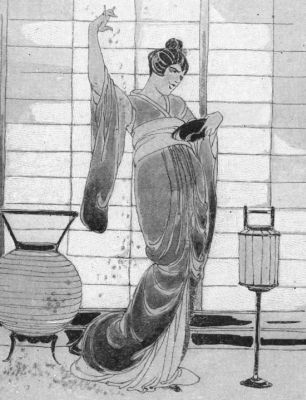
Madame Geraldine Farrar. The value of line was admirably illustrated in the opera "Madame Butterfly" as seen this winter at the Metropolitan Opera House. Have you chanced to ask yourself why the outline of the individual members of the chorus was so lacking in charm, and Madame Farrar's so delightful? The great point is that in putting on her kimono, Madame Farrar kept in mind the characteristic silhouette of the Japanese woman as shown in Japanese art; then she made a picture of herself, and one in harmony with her Japanese setting. Which brings us back to the keynote of our book—Woman as Decoration—beautiful Line.
Sketched for "Woman as Decoration" by Thelma Cudlipp Mme. Geraldine Farrar in Japanese Costume as Madame Butterfly
"And they like it. They work better in the new uniforms than they used to in skirts and are less weary at each day's end. And nobody worries them at all. There has not been the faintest suspicion of an insult or an advance from any one of the thousands of men and boys of all classes whom they have ridden with upon their 'lifts,' sometimes in dense crowds, sometimes in an involuntary tête-à-tête.
"Other employments which girls follow and dress for bifurcatedly in this great and progressive store are more astonishing than the operation of elevators. A charming young plumber had made no compromise whatever with tradition. She was in overalls like boy plumbers wear, except that her trousers were not tight, but they were well fitted. A little cap of the same material as the suit, completed her jaunty and attractive costume. And cap and suit were professionally stained, too, with oil and things like that, while her small hands showed the grime of an honest day's competent, hard work.
"The coming summer will see an immense amount of England's farming done by women and, I think, well done. Organisations already are under way whereby women propose to help decrease the food shortage by intelligent increase of the chicken and egg supply, and this is being so well planned that undoubtedly it will succeed. Eggs and chickens will be cheap in England ere the summer ends.
"I have met three ex-stenographers who now are at hard work, two of them in munition factories (making military engines of death) and one of them on a farm. I asked them how they liked the change.
"'I should hate to have to go back to work in the old long skirts,' one replied. 'I should hate to go back to the old days of relying upon some one else for everything that really matters. But—well, I wish the war would end and I hope the casualty lists of fine young men will not grow longer, day by day, as Spring approaches, although everybody says they will.'
"Mrs. John Bull takes girls in pantaloons quite calmly and approvingly, now that she has learned that if there are enough of them, dad and the boys will pay no more attention to them in trousers than they would pay to them in skirts."
We have preferred to quote the exact wording of the original article, for the reason that while the facts are familiar to most of us, the manner of putting them could not, to our mind, be more graphic. Some day, when the Wateaus of the future are painting the court ladies who again dance pavanes in sunlit glades, wearing wigs and crinoline, such data will amuse.
That the women of Finland make worthy members of their parliament does not prove anything outside of Finland. That the exigencies of the present hour in England have made women equal to every task of men so far entrusted to them, proves much for England. Women, like men, have untold, untried abilities within them, women and men alike are marvellous under fire—capable of development in every direction. What human nature has done it can do again, and infinitely more under the pressure of necessity which opens up brain cells, steels the heart, hardens the muscles, and like magic fire, licks up the dross of humanity, aimlessly floating on the surface of life, awaiting a leader to melt and mould it at Fate's will into clearly defined personalities, ready to serve. This point has been magnificently proved by the war now waging in Europe.
Let us repeat; that from the beginning the story of woman's costuming proves her many-sidedness, the inexhaustible stock of her latent qualities which, like man's, await the call of the hour.