Front matter (continued 2)
Reading edition
The answer to the unanswerable question was coming clearer and softer to him. And then, all at once, but not suddenly, for there was no time, it was not close—it was.
The answer was his, was him. The arc of sky was the answer, and the answer belonged to sky—to warmth, to all warmths that there are, and to all waters, and—and the answer was—was—
Tropile vanished. The mild thunderclap that followed made the flames dance and the column of steam fray; and then the fire was steady again, and so was the rising steam. But Tropile was gone.
VIII
Haendl plodded angrily through the high grass toward the dull throb of the diesel.
Maybe it had been a mistake to take this Glenn Tropile into the colony. He was more Citizen than Wolf—no, cancel that, Haendl thought; he was more Wolf than Citizen. But the Wolf in him was tainted with sheep's blood. He competed like a Wolf, but in spite of everything, he refused to give up some of his sheep's ways. Meditation. He had been cautioned against that. But had he given it up?
He had not.
If it had been entirely up to Haendl, Glenn Tropile would have found himself back among the sheep or dead. Fortunately for Tropile, it was not entirely up to Haendl. The community of Wolves was by no means a democracy, but the leader had a certain responsibility to his constituents, and the responsibility was this: He couldn't afford to be wrong. Like the Old Gray Wolf who protected Mowgli, he had to defend his actions against attack; if he failed to defend, the pack would pull him down.
And Innison thought they needed Tropile—not in spite of the taint of the Citizen that he bore, but because of it.
Haendl bawled: "Tropile! Tropile, where are you?" There was only the wind and the thrum of the diesel. It was enormously irritating. Haendl had other things to do than to chase after Glenn Tropile. And where was he? There was the diesel, idling wastefully; there the end of the patterned furrows Tropile had plowed. There a small fire, burning—
And there was Tropile.
Haendl stopped, frozen, his mouth opened, about to yell Tropile's name.
It was Tropile, all right, staring with concentrated, oyster-eyed gaze at the fire and the little pot of water it boiled. Staring. Meditating. And over his head, like flawed glass in a pane, was the thing Haendl feared most of all things on Earth. It was an Eye.
Tropile was on the very verge of being Translated ... whatever that was.
Time, maybe, to find out what that was! Haendl ducked back into the shelter of the high grass, knelt, plucked his radio communicator from his pocket, urgently called.
"Innison! Innison, will somebody, for God's sake, put Innison on!"
Seconds passed. Voices answered. Then there was Innison.
"Innison, listen! You wanted to catch Tropile in the act of Meditation? All right, you've got him. The old wheat field, south end, under the elms around the creek. Get here fast, Innison—there's an Eye forming above him!"
Luck! Lucky that they were ready for this, and only by luck, because it was the helicopter that Innison had patiently assembled for the attack on Everest that was ready now, loaded with instruments, planned to weigh and measure the aura around the Pyramid—now at hand when they needed it.
That was luck, but there was driving hurry involved, too; it was only a matter of minutes before Haendl heard the wobbling drone of the copter, saw the vanes fluttering low over the hedges, dropping to earth behind the elms.
Haendl raised himself cautiously and peered. Yes, Tropile was still there, and the Eye still above him! But the noise of the helicopter had frayed the spell. Tropile stirred. The Eye wavered and shook—
But did not vanish.
Thanking what passed for his God, Haendl scuttled circuitously around the elms and joined Innison at the copter. Innison was furiously closing switches and pointing lenses.
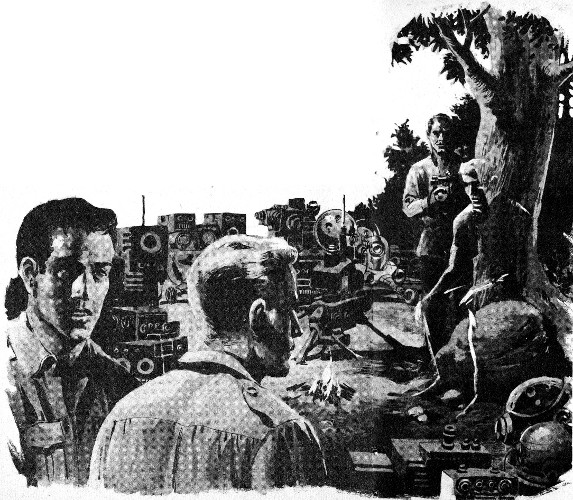
They saw Tropile sitting there, the Eye growing larger and closer over his head. They had time—plenty of time; oh, nearly a minute of time. They brought to bear on the silent and unknowing form of Glenn Tropile every instrument that the copter carried. They were waiting for Tropile to disappear—
He did.
Innison and Haendl hunched at the thunderclap as air rushed in to replace him.
"We've got what you wanted," Haendl said harshly. "Let's read some instruments."
Throughout the Translation, high-tensile magnetic tape on a madly spinning drum had been hurtling under twenty-four recording heads at a hundred feet a second. Output to the recording heads had been from every kind of measuring device they had been able to conceive and build, all loaded on the helicopter for use on Mount Everest—all now pointed directly at Glenn Tropile.
They had, for the instant of Translation, readings from one microsecond to the next on the varying electric, gravitational, magnetic, radiant and molecular-state conditions in his vicinity.
They got back to Innison's workshop, and the laboratory inside it, in less than a minute; but it took hours of playing back the magnetic pulses into machines that turned them into scribed curves on coordinate paper before Innison had anything resembling an answer.
He said: "No mystery. I mean no mystery except the speed. Want to know what happened to Tropile?"
"I do," said Haendl.
"A pencil of electrostatic force maintained by a pinch effect bounced down the approximate azimuth of Everest—God knows how they handled the elevation—and charged him and the area positive. A big charge, clear off the scale. They parted company. He was bounced straight up. A meter off the ground, a correcting vector was applied. When last seen, he was headed fast in the direction of the Pyramids' binary—fast! So fast that I would guess he'll get there alive. It takes an appreciable time, a good part of a second, for his protein to coagulate enough to make him sick and then kill him. If the Pyramids strip the charges off him immediately on arrival, as I should think they will, he'll live."
"Friction—"
"Be damned to friction," Innison said calmly. "He carried a packet of air with him and there was no friction. How? I don't know. How are they going to keep him alive in space, without the charges that hold air? I don't know. If they don't maintain the charges, can they beat the speed of light? I don't know. I can tell you what happened. I can't tell you how."
Haendl stood up thoughtfully. "It's something," he said grudgingly.
"It's more than we've ever had—a complete reading at the instant of Translation!"
"We'll get more," Haendl promised. "Innison, now that you know what to look for, go on looking for it. Keep every possible detection device monitored twenty-four hours a day. Turn on everything you've got that'll find a sign of imposed modulation. At any sign—or at anybody's hunch that there might be a sign—I'm to be called. If I'm eating. If I'm sleeping. If I'm enjoying with a woman. Call me, you hear? Maybe you were right about Tropile; maybe he did have some use. He might give the Pyramids a bellyache."
Innison, flipping the magnetic tape drum to rewind, said thoughtfully: "It's too bad they've got him. We could have used some more readings."
"Too bad?" Haendl laughed sharply. "This time they've got themselves a Wolf."
The Pyramids did have a Wolf—a fact which did not matter in the least to them.
It is not possible to know what "mattered" to a Pyramid except by inference. But it is possible to know that they had no way of telling Wolf from Citizen.
The planet which was their home—Earth's old Moon—was small, dark, atmosphereless and waterless. It was completely built over, much of it with its propulsion devices.
In the old days, when technology had followed war, luxury, government and leisure, the Pyramids' sun had run out of steam; and at about the same time, they had run out of the Components they imported from a neighboring planet. They used the last of their Components to implement their stolid metaphysic of hauling and pushing. They pushed their planet.
They knew where to push it.
Each Pyramid as it stood was a radio-astronomy observatory, powerful and accurate beyond the wildest dreams of Earthly radio-astronomers. From this start, they built instruments to aid their naked senses. They went into a kind of hibernation, reducing their activity to a bare trickle except for a small "crew" and headed for Earth. They had every reason to believe they would find more Components there, and they did.
Tropile was one of them. The only thing which set him apart from the others was that he was the most recent to be stockpiled.
The religion, or vice, or philosophy he practiced made it possible for him to be a Component. Meditation derived from Zen Buddhism was a windfall for the Pyramids, though, of course, they had no idea at all of what lay behind it and did not "care." They knew only that, at certain times, certain potential Components became Components which were no longer merely potential—which were, in fact, ripe for harvesting.
It was useful to them that the minds they cropped were utterly blank. It saved the trouble of blanking them.
Tropile had been harvested at the moment his inhibiting conscious mind had been cleared, for the Pyramids were not interested in him as an entity capable of will and conception. They used only the raw capacity of the human brain and its perceptors.
They used Rashevsky's Number, the gigantic, far more than astronomical expression that denoted the number of switching operations performable within the human brain. They used "subception," the phenomenon by which the reasoning mind, uninhibited by consciousness, reacts directly to stimuli—shortcutting the cerebral censor, avoiding the weighing of shall-I-or-shan't-I that precedes every conscious act.
The harvested minds were—Components.
It is not desirable that your bedroom wall switch have a mind of its own; if you turn the lights on, you want them on. So it was with the Pyramids.
A Component was needed in the industrial complex which transformed catabolism products into anabolism products.
With long experience gained since their planetfall, Pyramids received the tabula rasa that was Glenn Tropile. He arrived in one piece, wearing a blanket of air. Quick-frozen mentally at the moment of inert blankness his Meditation had granted him—the psychic drunkard's coma—he was cushioned on repellent charges as he plummeted down, and instantly stripped of surplus electrostatic charge.
At this point, he was still human; only asleep.
He remained "asleep." Annular fields they used for lifting and lowering seized him and moved him into a snug tank of nutrient fluid. There were many such tanks, ready and waiting.
The tanks themselves could be moved, and the one containing Glenn Tropile did move, to a metabolism complex where there were many other tanks, all occupied. This was a warm room—the Pyramids had wasted no energy on such foppish comforts in the first "room." In this room, Glenn Tropile gradually resumed the appearance of life. His heart once again began to beat. Faint stirrings were visible in his chest as his habit-numbed lungs attempted to breathe. Gradually the stirrings slowed and stopped. There was no need for that foppish comfort, either; the nutrient fluid supplied all.
Tropile was "wired into circuit."
The only literal wiring, at first, was a temporary one—a fine electrode aseptically introduced into the great nerve that leads to the rhinencephalon—the "small brain," the area of the brain which contains the pleasure centers that motivate human behavior.
More than a thousand Components had been spoiled and discarded before the Pyramids had located the pleasure centers so exactly.
While the Component, Tropile, was being "programmed," the wire rewarded him with minute pulses that made his body glow with animal satisfaction when he functioned correctly. That was all there was to it. After a time, the wire was withdrawn, but by then Tropile had "learned" his entire task. Conditioned reflexes had been established. They could be counted on for the long and useful life of the Component.
That life might be very long indeed; in the nutrient tank beside Tropile's, as it happened, lay a Component with eight legs and a chitinous fringe around its eyes. It had lain in such a tank for more than a hundred and twenty-five thousand Terrestrial years.
The Component was placed in operation. It opened its eyes and saw things. The sensory nerves of its limbs felt things. The muscles of its hands and toes operated things.
Where was Glenn Tropile?
He was there, all of him, but a zombie-Tropile. Bereft of will, emptied of memories. He was a machine and part of a huger machine. His sex was the sex of a photoelectric cell; his politics were those of a transistor; his ambition that of a mercury switch. He didn't know anything about sex, or fear, or hope. He only knew two things: Input and Output.
Input to him was a display of small lights on a board before his vacant face; and also the modulation of a loudspeaker's liquid-borne hum in each ear.
Output from him was the dancing manipulation of certain buttons and keys, prompted by changes in Input and by nothing else.
Between Input and Output, he lay in the tank, a human Black Box which was capable of Rashevsky's Number of switchings, and of nothing else.
He had been programmed to accomplish a specific task—to shepherd a chemical called 3, 7, 12-trihydroxycholanic acid, present in the catabolic product of the Pyramids, through a succession of more than five hundred separate operations until it emerged as the chemical, which the Pyramids were able to metabolize, called Protoporphin IX.
He was not the only Component operating in this task; there were several, each with its own program.
The acid accumulated in great tanks a mile from him. He knew its concentration, heat and pressure; he knew of all the impurities which would affect subsequent reactions. His fingers tapped, giving binary-coded signals to sluice gates to open for so many seconds and then to close; for such an amount of solvent at such a temperature to flow in; for the agitators to agitate for just so long at just such a force. And if a trouble signal disturbed any one of the 517 major and minor operations, he—it?—was set to decide among alternatives:
—scrap the batch in view of flow conditions along the line?
—isolate and bypass the batch through a standby loop?
—immediate action to correct the malfunction?
Without inhibiting intelligence, without the trammels of humanity on him, the intricate display board and the complex modulations of the two sound signals could be instantly taken in, evaluated and given their share in the decision.
Was it—he?—still alive?
The question has no meaning. It was working. It was an excellent machine, in fact, and the Pyramids cared for it well. Its only consciousness, apart from the reflexive responses that were its program, was—well, call it "the sound of one hand alone." Which is to say zero, mindlessness, Samadhi, stupor.
It continued to function for some time—until the required supply of Protoporphin IX had been exceeded by a sufficient factor of safety to make further processing unnecessary—that is, for some minutes or months. During that time, it was Happy. (It had been programmed to be Happy when there were no uncorrected malfunctions of the process.) At the end of that time, it shut itself off, sent out a signal that the task was completed, then it was laid aside in the analogue of a deep-freeze, to be reprogrammed when another Component was needed.
It was totally immaterial to the Pyramids that this particular Component had not been stamped from Citizen but from Wolf.
IX
Roget Germyn, of Wheeling a Citizen, contemplated his wife with growing concern.
Possibly the events of the past few days had unhinged her reason, but he was nearly sure that she had eaten a portion of the evening meal secretly, in the serving room, before calling him to the table.
He felt positive that it was only a temporary aberration; she was, after all, a Citizeness, with all that that implied. A—a creature—like that Gala Tropile, for example—someone like that might steal extra portions with craft and guile. You couldn't live with a Wolf for years and not have some of it rub off on you. But not Citizeness Germyn.
There was a light, thrice-repeated tap on the door.
Speak of the devil, thought Roget Germyn most appropriately; for it was that same Gala Tropile. She entered, her head downcast, looking worn and—well, pretty.
He began formally: "I give you greeting, Citi—"
"They're here!" she interrupted in desperate haste. Germyn blinked. "Please," she begged, "can't you do something? They're Wolves!"
Citizeness Germyn emitted a muted shriek.
"You may leave, Citizeness," Germyn told her shortly, already forming in his mind the words of gentle reproof he would later use. "Now what is all this talk of Wolves?"
Gala Tropile distractedly sat in the chair her hostess had vacated. "We were running away," she babbled. "Glenn—he was Wolf, you see, and he made me leave with him, after the House of the Five Regulations. We were a day's long march from Wheeling and we stopped to rest. And there was an aircraft, Citizen!"
"An aircraft!" Citizen Germyn allowed himself a frown. "Citizeness, it is not well to invent things which are not so."
"I saw it, Citizen! There were men in it. One of them is here again! He came looking for me with another man and I barely escaped him. I'm afraid!"
"There is no cause for fear, only an opportunity to appreciate," Citizen Germyn said mechanically—it was what one told one's children.
But within himself, he was finding it very hard to remain calm. That word Wolf—it was a destroyer of calm, an incitement to panic and hatred! He remembered Tropile well, and there was Wolf, to be sure. The mere fact that Citizen Germyn had doubted his Wolfishness at first was powerful cause to be doubly convinced of it now; he had postponed the day of reckoning for an enemy of all the world, and there was enough secret guilt in his recollection to set his own heart thumping.
"Tell me exactly what happened," said Citizen Germyn, in words that the stress of emotion had already made far less than graceful.
Obediently, Gala Tropile said: "I was returning to my home after the evening meal and Citizeness Puffin—she took me in after Citizen Tropile—after my husband was—"
"I understand. You made your home with her."
"Yes. She told me that two men had come to see me. They spoke badly, she said, and I was alarmed. I peered through a window of my home and they were there. One had been in the aircraft I saw! And they flew away with my husband."
"It is a matter of seriousness," Citizen Germyn admitted doubtfully. "So then you came here to me?"
"Yes, but they saw me, Citizen! And I think they followed. You must protect me—I have no one else!"
"If they be Wolf," Germyn said calmly, "we will raise hue and cry against them. Now will the Citizeness remain here? I go forth to see these men."
There was a graceless hammering on the door.
"Too late!" cried Gala Tropile in panic. "They are here!"
Citizen Germyn went through the ritual of greeting, of deprecating the ugliness and poverty of his home, of offering everything he owned to his visitors; it was the way to greet a stranger.
The two men lacked both courtesy and wit, but they did make an attempt to comply with the minimal formal customs of introduction. He had to give them credit for that; and yet it was almost more alarming than if they had blustered and yelled.
For he knew one of these men.
He dredged the name out of his memory. It was Haendl. The same man had appeared in Wheeling the day Glenn Tropile had been scheduled to make the Donation of the Spinal Tap—and had broken free and escaped. He had inquired about Tropile of a good many people, Citizen Germyn included, and even at that time, in the excitement of an Amok, a Wolf-finding and a Translation in a single day, Germyn had wondered at Haendl's lack of breeding and airs.
Now he wondered no longer.
But the man made no overt act and Citizen Germyn postponed the raising of the hue and cry. It was not a thing to be done lightly.
"Gala Tropile is in this house," the man with Haendl said bluntly.
Citizen Germyn managed a Quirked Smile.
"We want to see her, Germyn. It's about her husband. He—uh—he was with us for a while and something happened."
"Ah, yes. The Wolf."
The man flushed and looked at Haendl. Haendl said loudly: "The Wolf. Sure he's a Wolf. But he's gone now, so you don't have to worry about that."
"Gone?"
"Not just him, but four or five of us. There was a man named Innison and he's gone, too. We need help, Germyn. Something about Tropile—God knows how it is, but he started something. We want to talk to his wife and find out what we can about him. So will you get her out of the back room where she's hiding and bring her here, please?"
Citizen Germyn quivered. He bent over the ID bracelet that once had belonged to the one PFC Joe Hartman, fingering it to hide his thoughts.
He said at last: "Perhaps you are right. Perhaps the Citizeness is with my wife. If this be so, would it not be possible that she is fearful of those who once were with her husband?"
Haendl laughed sourly. "She isn't any more fearful than we are, Germyn. I told you about this man Innison who disappeared. He was a Son of the Wolf, you understand me? For that matter—" He glanced at his companion, licked his lips and changed his mind about what he had been going to say next. "He was a Wolf. Do you ever remember hearing of a Wolf being Translated before?"
"Translated?" Germyn dropped the ID bracelet. "But that's impossible!" he cried, forgetting his manners completely. "Oh, no! Translation comes only to those who attain the moment of supreme detachment, you can be sure of that. I know! I've seen it with my own eyes. No Wolf could possibly—"
"At least five Wolves did," Haendl said grimly. "Now you see what the trouble is? Tropile was Translated—I saw that with my own eyes. The next day, Innison. Within a week, two or three others. So we came down here, Germyn, not because we like you people, not because we enjoy it, but because we're scared.
"What we want is to talk to Tropile's wife—you, too, I guess; we want to talk to anybody who ever knew him. We want to find out everything there is to find out about Tropile and see if we can make any sense of the answers. Because maybe Translation is the supreme objective of life to you people, Germyn, but to us it's just one more way of dying. And we don't want to die."
Citizen Germyn bent to pick up his cherished identification bracelet and dropped it absently on a table. There was very much on his mind.
He said at last: "That is strange. Shall I tell you another strange thing?"
Haendl, looking angry and baffled, nodded.
Germyn said: "There has been no Translation here since the day the Wolf, Tropile, escaped. But there have been Eyes. I have seen them myself. It—" He hesitated, shrugged. "It has been disturbing. Some of our finest Citizens have ceased to Meditate; they have been worrying. So many Eyes and nobody taken! It is outside of all of our experience, and our customs have suffered. Politeness is dwindling among us. Even in my own household—"
He coughed and went on: "No matter. But these Eyes have come into every home; they have peered about, peered about, and no one has been taken. Why? Is it something to do with the Translation of Wolves?" He stared hopelessly at his visitors. "All I know is that it is very strange and therefore I am worried."
"Then take us to Gala Tropile," said Haendl. "Let's see what we can find out!"
Citizen Germyn bowed. He cleared his throat and raised his voice just sufficiently to carry from one room to another. "Citizeness!" he called.
There was a pause and then his wife appeared in the doorway, looking ruffled and ill at ease with her guest.
"Will you ask if Citizeness Tropile will join us here?" he requested.
His wife nodded. "She is resting. I will call her."
They called her and questioned her for some time.
She told them nothing.
She had nothing to tell.
X
On Earth's binary, Glenn Tropile had been reprogrammed for a new task.
The problem was navigation. Earth had been a disappointment to the Pyramids; it was necessary to move rapidly to a more rewarding planet.
The Pyramids had taken Earth out past Pluto's orbit with a simple shove, slow and massive. It had been enough merely to approximate the direction in which they would want to go. There would be plenty of time for refinements of course later.
But now the time for refinements had come, earlier than they might have expected. They had now time to travel, they knew where to—a star cluster reasonably sure to be rich in Componentiferous planets. It was inherent in the nature of Component mines that eventually they always played out.
There were always more mines, though. If that had not been so, it would have been necessary, perhaps, to stock-breed Components against future needs. But it was easier to work the vein out and move on.
Now the course had to be computed. There were such variables to be considered as: motion of the star cluster; acceleration of the binary-planet system; gravitational influence of every astronomical object in the island universe, without exception.
Precise computation on this basis was obviously not practical. That was not an answer to the problem, since the time required would approach eternity as one of its parameters.
It was possible to simplify the problem. Only the astronomical bodies which were relatively nearby need be treated as individuals. Farther away, the Pyramids began to group them in small bunches, still farther in large bunches, on to the point where the farthest—and the most numerous—bodies were lumped together as a vague gravitational "noise" whose average intensity alone it was required to know and to enter as a datum.
And still no single Component could handle even its own share of the problem, were the "computer" they formed to be kept within the range of permissible size.
It was for this that the Component which had once been Tropile was taken out of storage.
This was all old stuff to the Pyramids; they knew how to handle it. They broke the problem down to its essentials, separated even those into many parts. There was, for example, the subsection of one certain aspect of the logistical problem which involved locating and procuring additional Components to handle the load.
Even that tiny specialization was too much for a single Component, but fortunately the Pyramids had resources to bring to bear. The procedure in such cases was to hitch several Components together.
This was done.
When the Pyramids finished their neuro-surgery, there floated in an oversized nutrient tank a thing like a great sea-anemone. It was composed of eight Components—all human, as it happened—arranged in a circle, facing inward, joined temple to temple, brain to brain.
At their feet, where sixteen eyes could see it, was the display board to feed them their Input. Sixteen hands each grasped a molded switch to handle their binary-coded Output. There would be no storage of the Output outside of the eight-Component complex itself; it went as control signals to the electrostatic generators, funneled through the single Pyramid on Mount Everest, which handled the task of Component-procurement.
That is, of Translation.
The programming was slow and thorough. Perhaps the Pyramid which finally activated the octuple unit and went away was pleased with itself, not knowing that one of its Components was Glenn Tropile.
Nirvana. (It pervaded all; there was nothing outside of it.)
Nirvana. (Glenn Tropile floated in it as in the amniotic fluid around him.)
Nirvana. (The sound of one hand.... Floating oneness.)
There was an intrusion.
Perfection is completed; by adding to it, it is destroyed. Duality struck like a thunderbolt. Oneness shattered.
For Glenn Tropile, it seemed as though his wife were screaming at him to wake up. He tried to.
It was curiously difficult and painful. Timeless poignant sadness, five years of sorrow over a lost love compressed into a microsecond. It was always so, Tropile thought drowsily, awakening. It never lasts. What's the use of worrying over what always happens....
Sudden shock and horror rocked him.
This was no ordinary awakening—no ordinary thing at all—nothing was as it ever had been before!
Tropile opened his mouth and screamed—or thought he did. But there was only a hoarse, faint flutter in his eardrums.
It was a moment when sanity might have gone. But there was one curious, mundane fact that saved him. He was holding something in his hands. He found that he could look at it, and it was a switch. A molded switch, mounted on a board, and he was holding one in each hand.
It was little to cling to, but it at least was real. If his hands could be holding something, then there must be some reality somewhere.
Tropile closed his eyes and managed to open them again. Yes, there was reality, too. He closed his eyes and light stopped. He opened them and light returned.
Then perhaps he was not dead, as he had thought.
Carefully, stumbling—his mind his only usable tool—he tried to make an estimate of his surroundings.
He could hardly believe what he found.
Item: he could scarcely move. Somehow he was bound by his feet and his head. How? He couldn't tell.
Item: he was bent over and he couldn't straighten. Why? Again he couldn't tell, but it was a fact. The great erecting muscles of his back answered his command, but his body would not move.
Item: his eyes saw, but only in a small area.
He couldn't move his head, either. Still, he could see a few things. The switch in his hand, his feet, a sort of display of lights on a strangely circular board.
The lights flickered and changed their pattern.
Without thinking, he moved a switch. Why? Because it was right to move that switch. When a certain light flared green, a certain switch had to be thrown. Why? Well, when a certain light flared green, a certain switch—
He abandoned that problem. Never mind why; what the devil was going on?
Glenn Tropile squinted about him like a mollusc peering out of its shell. There was another fact, the oddness of the seeing. What makes it look so queer, he asked himself.
He found an answer, but it required some time to take it in. He was seeing in a strange perspective. One looks out of two eyes. Close one eye and the world is flat. Open it again and there is a stereoscopic double; the saliencies of the picture leap forward, the background retreats.
So with the lights on the board—no, not exactly; but something like that, he thought. It was as though—he squinted and strained—well, as though he had never really seen before. As though for all his life he had had only one eye, and now he had strangely been given two.
His visual perception of the board was total. He could see all of it at once. It had no "front" or "back." It was in the round. The natural thinking of it was without orientation. He engulfed and comprehended it as a unit. It had no secrets of shadow or silhouette.
I think, Tropile mouthed slowly to himself, that I'm going crazy.
But that was no explanation, either. Mere insanity didn't account for what he saw.
Then, he asked himself, was he in a state that was beyond Nirvana? He remembered, with an odd flash of guilt, that he had been Meditating, watching the stages of boiling water. All right, perhaps he had been Translated. But what was this, then? Were the Meditators wrong in teaching that Nirvana was the end—and yet righter than the Wolves, who dismissed Meditation as a phenomenon wholly inside the skull and refused to discuss Translation at all?
That was a question for which he could find nothing approaching an answer. He turned away from it and looked at his hands.
He could see them, too, in the round, he noted. He could see every wrinkle and pore in all sixteen of them....
Sixteen hands!
That was the other moment when sanity might have gone. He closed his eyes. (Sixteen eyes! No wonder the total perception!) And, after a while, he opened them again.
The hands were there. All sixteen of them.
Cautiously, Tropile selected a finger that seemed familiar in his memory. After a moment's thought, he flexed it. It bent. He selected another. Another—on a different hand this time.
He could use any or all of the sixteen hands. They were all his, all sixteen of them.
I appear, thought Tropile crazily, to be a sort of eight-branched snowflake. Each of my branches is a human body.
He stirred, and added another datum: I appear also to be in a tank of fluid and yet I do not drown.
There were certain deductions to be made from that. Either someone—the Pyramids?—had done something to his lungs, or else the fluid was as good an oxygenating medium as air. Or both.
Suddenly a burst of data-lights twinkled on the board below him. Instantly and involuntarily, his sixteen hands began working the switches, transmitting complex directions in a lightninglike stream of on-off clicks.
Tropile relaxed and let it happen. He had no choice; the power that made it right to respond to the board made it impossible for his brain to concentrate while the response was going on. Perhaps, he thought drowsily, he would never have awakened at all if it had not been for the long period with no lights....
But he was awake. And his consciousness began to explore as the task ended.
He had had an opportunity to understand something of what was happening. He understood that he was now a part of something larger than himself, beyond doubt something which served and belonged to the Pyramids. His single brain not being large enough for the job, seven others had been hooked in with it.
But where were their personalities?
Gone, he supposed; presumably they had been Citizens. Sons of the Wolf did not Meditate and therefore were not Translated—except for himself, he corrected wryly, remembering the Meditation on Rainclouds that had led him to—
No, wait!
Not Rainclouds but Water!
Tropile caught hold of himself and forced his mind to retrace that thought. He remembered the Raincloud Meditation. It had been prompted by a particularly noble cumulus of the Ancient Ship type.
And this was odd. Tropile had never been deeply interested in Rainclouds, had never known even the secondary classifications of Raincloud types. And he knew that the Ancient Ship was of the fourth order of categories.
It was a false memory.
It was not his.
Therefore, logically, it was someone else's memory; and being available to his own mind, as the fourteen other hands and eyes were available, it must belong to—another branch of the snowflake.
He turned his eyes down and tried to see which of the branches was his old body. He found it quickly, with growing excitement. There was the left great toe of his body. He had injured it in boyhood and there was no mistaking the way it was bent. Good! It was reassuring.
He tried to feel the one particular body that led to that familiar toe.
He succeeded, though not easily. After a time, he became more aware of that body—somewhat as a neurotic may become "stomach conscious" or "heart conscious." But this was no neurosis; it was an intentional exploration.
Since that worked, with some uneasiness he transferred his attention to another pair of feet and "thought" his way up from them.
It was embarrassing.
For the first time in his life, he knew what it felt like to have breasts. For the first time in his life, he knew what it was like to have one's internal organs quite differently shaped and arranged, buttressed and stressed by different muscles. The very faint background feel of man's internal arrangements, never questioned unless something goes wrong with them and they start to hurt, was not at all like the faint background feel that a woman has inside her.
And when he concentrated on that feel, it was no faint background to him. It was surprising and upsetting.
He withdrew his attention—hoping that he would be able to. Gratefully, he became conscious of his own body again. He was still himself if he chose to be.
Were the other seven still themselves?
He reached into his mind—all of it, all eight separate intelligences that were combined within him.
"Is anybody there?" he demanded.
No answer—or nothing he could recognize as an answer. He drove harder and there still was none. It was annoying. He resented it as bitterly, he remembered, as in the old days when he had first been learning the subtleties of Ruin Appreciation. There had been a Ruin Master, his name forgotten, who had been sometimes less than courteous, had driven hard—
Another false memory!
He withdrew and weighed it. Perhaps, he thought, that was a part of the answer. These people, these other seven, would not be driven. The attempt to call them back to consciousness would have to be delicate. When he drove hard, it was painful—he remembered the instant violent agony of his own awakening—and they reacted with anguish.
More gently, alert for vagrant "memories," he combed the depths of the eightfold mind within him, reaching into the sleeping portions, touching, handling, sifting and associating, sorting. This memory of an old knife wound from an Amok—that was not the Raincloud woman; it was a man, very aged. This faint recollection of a childhood fear of drowning—was that she? It was; it fitted with this other recollection, the long detour on the road south toward the sun, around a river.
The Raincloud woman was the first to round out in his mind, and the first he communicated with. He was not surprised to find that, early in her life, she had feared that she might be Wolf.
He reached out for her. It was almost magic—knowing the "secret name" of a person, so that then he was yours to command. But the "secret name" was more than that. It was the gestalt of the person. It was the sum of all data and experience, never available to another person—until now.
With her memories arranged at last in his own mind, he thought persuasively: "Citizeness Alla Narova, will you awaken and speak with me?"
No answer—only a vague, troubled stirring.
Gently he persisted: "I know you well, Alla Narova. You sometimes thought you might be a Daughter of the Wolf, but never really believed it because you knew you loved your husband—and thought Wolves did not love. You loved Rainclouds, too. It was when you stood at Beachy Head and saw a great cumulus that you went into Meditation—"
And on and on, many times, coaxingly. Even so, it was not easy; but at last he began to reach her. Slowly she began to surface. Thoughts faintly sounded in his mind, like echoes at first, his own thoughts bouncing back at him, a sort of mental nod of agreement: "Yes, that is so." Then—terror. With a shaking fear, a hysterical rush, Citizeness Alla Narova came violently up to full consciousness and to panic.
She was soundlessly screaming. The whole eight-branched figure quivered and twisted in its nutrient bath.
The terrible storm raged in Tropile's own mind as fully as in hers—but he had the advantage of knowing what it was. He helped her. He fought it for the two of them ... soothing, explaining, calming.
At last her branch of the snowflake-body retreated, sobbing for a spell. The storm was over.
He talked to her in his mind and she "listened." She was incredulous, but there was no choice for her; she had to believe.
Exhausted and passive, she asked finally: "What can we do? I wish I were dead!"
He told her: "You were never a coward before. Remember, Alla Narova, I know you as nobody has ever known another human being before. That's the way you will know me. As for what we can do—we must begin by waking the others, if we can."
"If not?"
"If not," Tropile replied grimly, "then we will think of something else."
She was of tough stuff, he thought admiringly. When she had rested and absorbed things, her spirit was almost that of a Wolf; she had very nearly been right about herself.
Together they explored their twinned members. They found through them exactly what task was theirs to do. They found how the electrostatic harvesting scythe of the Pyramids was controlled, by and through them. They found what limitations there were and what freedoms they owned. They reached into the other petals of the snowflake, reached past the linked Components into the whole complex of electrostatic field generators and propulsion machinery, reached even past that into—
Into the great single function of the Pyramids that lay beyond.
XI
Haendl was on the ragged edge of breakdown, which was something new in his life.
It was full hot summer and the hidden colony of Wolves in Princeton should have been full of energy and life. The crops were growing on all the fields nearby; the drained storehouses were being replenished.
The aircraft that had been so painfully rebuilt and fitted for the assault on Mount Everest were standing by, ready to be manned and to take off.
And nothing, absolutely nothing, was going right.
It looked as though there would be no expedition to Everest. Four times now, Haendl had gathered his forces and been all ready. Four times, a key man of the expedition had—vanished.
Wolves didn't vanish!
And yet more than a score of them had. First Tropile—then Innison—then two dozen more, by ones and twos. No one was immune. Take Innison, for example. There was a man who was Wolf through and through. He was a doer, not a thinker; his skills were the skills of an artisan, a tinkerer, a jackleg mechanic. How could a man like that succumb to the pallid lure of Meditation?
But undeniably he had.
It had reached a point where Haendl himself was red-eyed and jumpy. He had set curious alarms for himself—had enlisted the help of others of the colony to avert the danger of Translation from himself.
When he went to bed at night, a lieutenant sat next to his bed, watchfully alert lest Haendl, in that moment of reverie before sleep, fell into Meditation and himself be Translated. There was no hour of the day when Haendl permitted himself to be alone; and his companions, or guards, were ordered to shake him awake, as violently as need be, at the first hint of an abstracted look in the eyes or a reflective cast of the features.
As time went on, Haendl's self-imposed regime of constant alertness began to cost him heavily in lost rest and sleep. And the consequences of that were—more and more occasions when the bodyguards shook him awake; less and less rest.
He was very close to breakdown indeed.
On a hot, wet morning a few days after his useless expedition to see Citizen Germyn in Wheeling, Haendl ate a tasteless breakfast and, reeling with fatigue, set out on a tour of inspection of Princeton. Warm rain dripped from low clouds, but that was merely one more annoyance to Haendl. He hardly noticed it.
There were upward of a thousand Wolves in the Community and there were signs of worry on the face of every one of them. Haendl was not the only man in Princeton who had begun laying traps for himself as a result of the unprecedented disappearances; he was not the only one who was short of sleep. When one member in forty disappears, the morale of the whole community receives a shattering blow.
To Haendl, it was clear, looking into the faces of his compatriots, that not only was it going to be nearly impossible to mount the planned assault on the Pyramid on Everest this year, it was going to be unbearably difficult merely to keep the community going.
The whole Wolf pack was on the verge of panic.
There was a confused shouting behind Haendl. Groggily he turned and looked; half a dozen Wolves were yelling and pointing at something in the wet, muggy air.
It was an Eye, hanging silent and featureless over the center of the street.
Haendl took a deep breath and mustered command of himself. "Frampton!" he ordered one of his lieutenants. "Get the helicopter with the instruments here. We'll take some more readings."
Frampton opened his mouth, then looked more closely at Haendl and, instead, began to talk on his pocket radio. Haendl knew what was in the man's mind—it was in his own, too.
What was the use of more readings? From the time of Tropile's Translation on, they had had a superfluity of instrument readings on the forces and auras that surrounded the Eyes—yes, and on Translations themselves, too. Before Tropile, there had never been an Eye seen in Princeton, much less an actual Translation. But things were different now. Everything was different. Eyes roamed restlessly around day and night.
Some of the men nearest the Eye were picking up rocks and throwing them at the bobbing vortex in the air. Haendl started to yell at them to stop, then changed his mind. The Eye didn't seem to be affected—as he watched, one of the men scored a direct hit with a cobblestone. The stone went right through the Eye, without sound or effect; why not let them work off some of their fears in direct action?
There was a fluttering of vanes and the copter with the instruments mounted on it came down in the middle of the street, between Haendl and the Eye.
It was all very rapid from then on.
The Eye swooped toward Haendl. He couldn't help it; he ducked. That was useless, but it was also unnecessary, for he saw in a second that it was only partly the motion of the Eye toward him that made it loom larger; it was also that the Eye itself was growing.
An Eye was perhaps the size of a football, as near as anyone could judge. This one got bigger, bigger. It was the size of a roc's egg, the size of a whale's blunt head. It stopped and hovered over the helicopter, while the man inside frantically pointed lenses and meters—
Thundercrash.
Not a man this time—Translation had gone beyond men. The whole helicopter vanished, man, instruments, spinning vanes and all.
Haendl picked himself up, sweating, shocked beyond sleepiness.
The young man named Frampton said fearfully: "Haendl, what do we do now?"
"Do?" Haendl stared at him absently. "Why, kill ourselves, I guess."
He nodded soberly, as though he had at last attained the solution of a difficult problem. Then he sighed.
"Well, one thing before that," he said. "I'm going to Wheeling. We Wolves are licked; maybe the Citizens can help us now."
Roget Germyn, of Wheeling, a Citizen, received the message in the chambers that served him as a place of business. He had a visitor waiting for him at home.
Germyn was still Citizen and he could not quickly break off the pleasant and interminable discussion he was having with a prospective client over a potential business arrangement. He apologized for the interruption caused by the message the conventional five times, listened while his guest explained once more the plan he had come to propose in full, then turned his cupped hands toward himself in the gesture of Denial of Adequacy. It was the closest he could come to saying no.
On the other side of the desk, the Citizen who had come to propose an investment scheme immediately changed the subject by inviting Germyn and his Citizeness to a Sirius Viewing, the invitation in the form of rhymed couplets. He had wanted to transact his business very much, but he couldn't insist.
Germyn got out of the invitation by a Conditional Acceptance in proper form, and the man left, delayed only slightly by the Four Urgings to Stay. Almost immediately, Germyn dismissed his clerk and closed his office for the day by tying a triple knot in a length of red cord across the open door.
When he got to his home, he found, as he had suspected, that the visitor was Haendl.
There was much doubt in Citizen Germyn's mind about Haendl. The man had nearly admitted to being Wolf, and how could a citizen overlook that? But in the excitement of Gala Tropile's Translation, there had been no hue and cry. Germyn had permitted the man to leave. And now?
He reserved judgment. He found Haendl distastefully sipping tea in the living room and attempting to keep up a formal conversation with Citizeness Germyn. He rescued him, took him aside, closed a door—and waited.
He was astonished at the change in the man. Before, Haendl had been bouncy, aggressive, quick-moving—the very qualities least desired in a Citizen, the mark of the Son of the Wolf. Now he was none of these things, but he looked no more like a Citizen for all that; he was haggard, tense.
He said, with an absolute minimum of protocol: "Germyn, the last time I saw you, there was a Translation. Gala Tropile, remember?"
"I remember," Citizen Germyn said. Remember! It had hardly left his thoughts.
"And you told me there had been others. Are they still going on?"
Germyn said: "There have been others." He was trying to speak directly, to match this man Haendl's speed and forcefulness. It was hardly good manners, but it had occurred to Citizen Germyn that there were times when manners, after all, were not the most important thing in the world. "There were two in the past few days. One was a woman—Citizeness Baird; her husband's a teacher. She was Viewing Through Glass with four or five other women at the time. She just—disappeared. She was looking through a green prism at the time, if that helps."
"I don't know if it helps or not. Who was the other one?"
Germyn shrugged. "A man named Harmane. No one saw it. But they heard the thunderclap, or something like a thunderclap, and he was missing." He thought for a moment. "It is a little unusual, I suppose. Two in a week—"
Haendl said roughly: "Listen, Germyn. It isn't just two. In the past thirty days, within the area around here and in one other place, there have been at least fifty. In two places, do you understand? Here and in Princeton. The rest of the world—nothing much; a few Translations here and there. But just in these two communities, fifty. Does that make sense?"
Citizen Germyn thought. "—No."
"No. And I'll tell you something else. Three of the—well, victims have been children under the age of five. One was too young to walk. And the most recent Translation wasn't a person at all. It was a helicopter. Now figure that out, Germyn. What's the explanation for Translations?"
Germyn was gaping. "Why—you Meditate, you know. On Connectivity. The idea is that once you've grasped the Essential Connectivity of All Things, you become One with the Cosmic Whole. But I don't see how a baby or a machine—"
"No, of course you don't. Remember Glenn Tropile?"
"Naturally."
"He's the link," Haendl said grimly. "When he got Translated, we thought it was a big help, because he had the consideration to do it right under our eyes. We got enough readings to give us a clue as to what, physically speaking, Translation is all about. That was the first real clue and we thought he'd done us a favor. Now I'm not so sure."
He leaned forward. "Every person I know of who was Translated was someone Tropile knew. The three kids were in his class at the nursery school—we put him there for a while to keep him busy, when he first came to us. Two of the men he bunked with are gone; the mess boy who served him is gone; his wife is gone. Meditation? No, Germyn. I know most of those people. Not a damned one of them would have spent a moment Meditating on Connectivity to save his life. And what do you make of that?"
Swallowing hard, Germyn said: "I just remembered. That man Harmane—"
"What about him?"
"The one who was Translated last week. He also knew Tropile. He was the Keeper of the House of the Five Regulations when Tropile was there."
"You see? And I'll bet the woman knew Tropile, too." Haendl got up fretfully, pacing around. "Here's the thing, Germyn. I'm licked. You know what I am, don't you?"
Germyn said levelly: "I believe you to be Wolf."
"You believe right. That doesn't matter any more. You don't like Wolves. Well, I don't like you. But this thing is too big for me to care about that any more. Tropile has started something happening, and what the end of it is going to be, I can't tell. But I know this: We're not safe, either of us. Maybe you still think Translation is a fulfillment. I don't; it scares me. But it's going to happen to me—and to you. It's going to happen to everybody who ever had anything to do with Glenn Tropile, unless we can somehow stop it—and I don't know how. Will you help me?"
Germyn, trying not to tremble when all his buried fears screamed Wolf!, said honestly: "I'll have to sleep on it."
Haendl looked at him for a moment. Then he shrugged. Almost to himself, he said: "Maybe it doesn't matter. Maybe we can't do anything about it anyhow. All right. I'll come back in the morning, and if you've made up your mind to help, we'll start trying to make plans. And if you've made up your mind the other way—well, I guess I'll have to fight off a few Citizens. Not that I mind that."
Germyn stood up and bowed. He began the ritual Four Urgings.
"Spare me that," Haendl growled. "Meanwhile, Germyn, if I were you, I wouldn't make any long-range plans. You may not be here to carry them out."
Germyn asked thoughtfully: "And if you were you?"
"I'm not making any," Haendl said grimly.
Citizen Germyn, feeling utterly tainted with the scent of the Wolf in his home, tossed in his bed, sleepless. His eyes were wide open, staring at the dark ceiling. He could hear his wife's decorous breathing from the foot of the bed—soft and regular, it should have been lulling him to sleep.
It was not. Sleep was very far away.
Germyn was a brave enough man, as courage is measured among Citizens. That is to say, he had never been afraid, though it was true that there had been very little occasion. But he was afraid now. He didn't want to be Translated.
The Wolf, Haendl, had put his finger on it: Perhaps you still think Translation is a fulfillment. Translation—the reward of Meditation, the gift bestowed on only a handful of gloriously transfigured persons. That was one thing. But the sort of Translation that was now involved was nothing like that—not if it happened to children; not if it happened to Gala Tropile; not if it happened to a machine.
And Glenn Tropile was involved in it.
Germyn turned restlessly.
If people who knew Glenn Tropile were likely to be Translated, and people who Meditated on Connectivity were likely to be Translated, then people who knew Glenn Tropile and didn't want to be Translated had better not Meditate on Connectivity.
It was very difficult to not think of Connectivity.
Endlessly he calculated sums in arithmetic in his mind, recited the Five Regulations, composed Greeting Poems and Verses on Viewing. And endlessly he kept coming back to Tropile, to Translation, to Connectivity. He didn't want to be Translated. But still the thought had a certain lure. What was it like? Did it hurt?
Well, probably not, he speculated. It was very fast, according to Haendl's report—if you could believe what an admitted Son of the Wolf reported. But Germyn had to.
Well, if it was fast—at that kind of speed, he thought, perhaps you would die instantly. Maybe Tropile was dead. Was that possible? No, it didn't seem so; after all, there was the fact of the connection between Tropile and so many of the recently Translated. What was the connection there? Or, generalizing, what connections were involved in—
He rescued himself from the dread word and summoned up the first image that came to mind. It happened to be Tropile's wife—Gala Tropile, who had disappeared herself, in this very room.
Gala Tropile. He stuck close to the thought of her, a little pleased with himself. That was the trick of not thinking of Connectivity—to think so hard and fully of something else as to leave no room in the mind for the unwanted thought. He pictured every line of her face, every wave of her stringy hair....
It was very easy that way. He was pleased.
XII
On Mount Everest, the sullen stream of off-and-on responses that was "mind" to the Pyramid had taken note of a new input signal.
It was not a critical mind. Its only curiosity was a restless urge to shove-and-haul, and there was no shove-and-haul about what to it was perhaps the analogue of a man's hunger pang. The input signal said: Do thus. It obeyed.
Call it craving for a new flavor. Where once it had patiently waited for the state that Citizens knew as Meditation on Connectivity, and the Pyramid itself perhaps knew as a stage of ripeness in the fruits of its wristwatch mine, now it wanted a different taste. Unripe? Overripe? At any rate, different.
Accordingly, the high-frequency wheep, wheep changed in tempo and in key, and the bouncing echoes changed and ... there was a ripe one to be plucked. (Its name was Innison.) And there another. (Gala Tropile.) And another, another—oh, many others—a babe from Tropile's nursery school and the Wheeling jailer and a woman Tropile once had coveted on the street.
Once the ruddy starch-to-sugar mark of ripeness had been what human beings called Meditation on Connectivity and the Pyramids knew as a convenient blankness. Now the sign was a sort of empathy with the Component named Tropile. It didn't matter to the Pyramid on Mount Everest. It swung its electrostatic scythe and the—call them Tropiletropes—were harvested.
It did not occur to the Pyramid on Mount Everest that a Component might be directing its actions. How could it?
Perhaps the Pyramid on Mount Everest wondered, if it knew how to wonder, when it noticed that different criteria were involved in selecting components these days. If it knew how to "notice." Surely even a Pyramid might wonder when, without warning or explanation, its orders were changed—not merely to harvest a different sort of Component, but to drag along with the flesh-and-blood needful parts a clanking assortment of machinery and metal, as began to happen. Machines? Why would the Pyramids need to Translate machines?
But why, on the other hand, would a Pyramid bother to question a directive, even if it were able to?
In any case, it didn't. It swung its scythe and gathered in what it was caused to gather in.
Men sometimes eat green fruit and come to regret it. Was it the same with Pyramids?
And Citizen Germyn fell into the unsuspected trap. Avoiding Connectivity, he thought of Glenn Tropile—and the unfelt h-f pulses found him out.
He didn't see the Eye that formed above him. He didn't feel the gathering of forces that formed his trap. He didn't know that he was seized, charged, catapulted through space, caught, halted and drained. It happened too fast.
One moment he was in his bed; the next moment he was—elsewhere. There wasn't anything in between.
It had happened to hundreds of thousands of Components before him, but, for Citizen Germyn, what happened was in some ways different. He was not embalmed in nutrient fluid, formed and programmed to take his part in the Pyramid-structure, for he had not been selected by the Pyramid but by that single wild Component, Tropile. He arrived conscious, awake and able to move.
He stood up in a red-lit chamber. Vast thundering crashes of metal buffeted his ears. Heat sprang little founts of perspiration on his skin.
It was too much, too much to take in at once. Oily-skinned madmen, naked, were capering and shouting at him. It took him a moment to realize that they were not devils; this was not Hell; he was not dead.
"This way!" they were bawling at him. "Come on, hurry it up!"
He reeled, following their directions, across an unpleasantly warm floor, staggering and falling—the binary planet was a quarter denser than Earth—until he got his balance.
The capering madmen led him through a door—or sphincter or trap; it was not like anything he had ever seen. But it was a portal of a sort, and on the other side of it was something closer to sanity. It was another room, and though the light was still red, it was a paler, calmer red and the thundering ironmongery was a wall away. The madmen were naked, yes, but they were not mad. The oil on their skins was only the sheen of sweat.
"Where—where am I?" he gasped.
Two voices, perhaps three or four, were all talking at once. He could make no sense of it. Citizen Germyn looked about him. He was in a sort of chamber that formed a part of a machine that existed for the unknown purposes of the Pyramids on the binary planet. And he was alive—and not even alone.
He had crossed more than a million miles of space without feeling a thing. But when what the naked men were saying began to penetrate, the walls lurched around him.
It was true; he had been Translated.
He looked dazedly down at his own bare body, and around at the room, and then he realized they were still talking: "—when you get your bearings. Feel all right now? Come on, Citizen, snap out of it!"
Germyn blinked.
Another voice said peevishly: "Tropile's got to find some other place to bring them in. That foundry isn't meant for human beings. Look at the shape this one is in! Some time somebody's going to come in and we won't spot him in time and—pfut!"
The first voice said: "Can't be helped. Hey! Are you all right?"
Citizen Germyn looked at the naked man in front of him and took a deep breath of hot, sour air. "Of course I'm all right," he said.
The naked man was Haendl.
The Tropile-petal "said" to the Alla Narova-petal: "Got another one! It's Citizen Germyn!" The petal fluttered feebly in soundless laughter.
The Alla Narova-petal "said": "Glenn, come back! The whole propulsion-pneuma just went out of circuit!"
Tropile pulled his attention away from his human acquisitions in the chamber off the foundry and allowed himself to fuse with the woman-personality. Together they reached out and explored along the pathways they had laboriously traced. The propulsion-pneuma was the complex of navigation-computers, drive generators, course-vectoring units that their own unit had been originally part of—until Glenn Tropile, by waking its Components, had managed to divert it for purposes of his own. The two of them reached out into it—
Dead end.
It was out of circuit, as Alla Narova had said. One whole limb of their body—their new, jointly tenanted body, that spanned a whole planet and reached across space to Earth—had been lopped off. Quick, quick, they separated, traced separate paths. They came together again: Still dead end.
The dyad that was Tropile and the woman reached out to touch the others in the snowflake and communicated—not in words, not in anything as slow and as opaque as words: The Pyramids have lopped off another circuit. The compound personality of the snowflake considered its course of action, reached its decision, acted. Quick, quick, three of the other members of the snowflake darted out of the collective unit and went about isolating and tracing the exact area that had been affected.
Tropile: "We expected this. They couldn't help noticing sooner or later that something was going wrong."
Alla Narova: "But, Glenn, suppose they cut us out of circuit? We're stuck here. We can't move. We can't get out of the tanks. If they know that we are the source of their trouble—"
Tropile: "Let them know! That's what we've got the others here for!" He was cocky now, self-assured, fighting. For the first time in his life, he was free to fight—to let his Wolf blood strive to the utmost—and he knew what he was fighting for. This wasn't a matter of Haendl's pitiful tanks and carbines against the invulnerable Pyramids; this was the invulnerability of the whole Pyramid system turned against the Pyramids!
It was a warning, the fact that the Pyramids had become alert to danger, had begun cutting sections of their planetary communications system out of the main circuit. But as a warning, it didn't frighten Tropile; it only spurred him to action.
Quick, quick, he and the woman-personality dissolved, sped away. Figuratively they sought out the most restive Components they could find, shook them by the shoulder, tried to wake them. Actually—well, what is "actually?" The physical fact was surely that they didn't move at all, for they were bound to their tank and to the surgical joinings, each to each, at their temples. No crawling child in a playpen was more helplessly confined than Tropile and Alla Narova and the others.
And yet no human being had ever been more free.
Regard that imbecile servant of Everyman, the thermostat.
He runs the furnace in Everyman's house, he measures the doneness of Everyman's breakfast toast, he valves the cooling fluid through the radiator of Everyman's car. If Everyman's house stays too hot or too cold, the man swears at the lackwit switch and maybe buys a new one to plug in. But he never, never thinks that his thermostat might be plotting against him.
Thermostat : Man = Man : Pyramid. Only that and nothing more. It was not in the nature of a Pyramid to think that its Components, once installed, could reprogram themselves. No Component ever had. (But before Glenn Tropile, no Component had been Wolf.)
When Tropile found himself, he found others. They were men and women, real persons with gonads and dreams. They had been caught at the moment of blankness—yes; and frozen into that shape, true. But they were palimpsest personalities on which the Pyramids had programmed their duties. Underneath the Pyramids' cabalistic scrawl, the men and women still remained. They had only to be reached.
Tropile and Alla Narova reached them—one at a time, then by scores. The Pyramids made that possible. The network of communication that they had created for their own purposes encompassed every cell of the race and all its works. Tropile reached out from his floating snowflake and went where he wished—anywhere within the binary planet; to the brooding Pyramid on Earth; through the Eyes, wherever he chose on Earth's surface.
Physically, he was scarcely able to move a muscle. But, oh, the soaring range of his mind and vision!
Citizen Germyn was past shock, but just the same it was uncomfortable to be in a room with several dozen other persons, all of them naked. Uncomfortable. Once it would have been brain-shattering. For a Citizen to see his own Citizeness unclothed was gross lechery. To be part of a mixed and bare-skinned group was unthinkable. Or had been. Now it only made him uneasy.
He said numbly to Haendl: "Citizen, I pray you tell me what sort of place this is."
"Later," said Haendl gruffly, and led him out of the way. "Stay put," he advised. "We're busy."
And that was true. Something was going on, but Citizen Germyn couldn't make out exactly what it was. The naked people were worrying out a distribution of some sort of supplies. There were tools and there were also what looked to Citizen Germyn's unsophisticated eyes very much like guns. Guns? It was foolishness to think they were guns, Citizen Germyn told himself strongly. Nobody had guns. He touched the floor with an exploratory hand. It was warm and it shook with a nameless distant vibration. He shuddered.
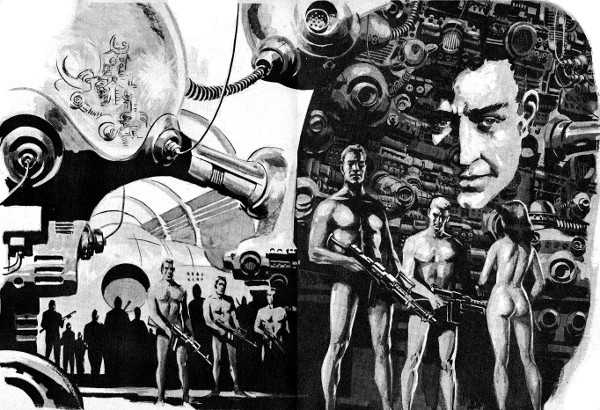
Haendl came back; yes, they were guns. Haendl was carrying one.
"Ours!" he crowed. "That Tropile must've looted our armory at Princeton. By the looks of what's here, I doubt if he left a single round of ammunition. What the hell, they're more use here!"
"But what are we going to do with guns?"
Haendl looked at him with savage amusement. "Shoot."
Citizen Germyn said: "Please, Citizen. Tell me what this is all about."
Haendl sat down next to him on the warm, quivering floor and began fitting cartridges into a clip.
"We're fighting," he explained gleefully. "Tropile did it all. You've been shanghaied and so have all the rest of us. Tropile's alive! He's part of the Pyramid communications network—don't ask me how. But he's there and he has been hauling men and weapons and God knows what all up from Earth—you're on the binary planet now, you know—and we're going to bust things up so the Pyramids will never be able to put them back together again. Understand? Well, it doesn't matter if you don't. All you have to understand is that when I tell you to shoot this gun, you shoot."
Numbly, Citizen Germyn took the unfamiliar stock and barrel into his hands. Muscles he had forgotten he owned straightened the limp curve of his back, squared his shoulders and thrust out his chest.
It had been many generations since any of Citizen Germyn's people had known the feeling of being an Armed Man.
A naked woman with wild hair and a full, soft figure came toward them, jiggling in a way that agonized Citizen Germyn. He dropped his eyes to his gun and kept them there.
She cried: "Orders from Tropile! We've got to form a party and blow something up."
Haendl demanded: "Such as what?"
"I don't know what. I only know where. We've got a guide. And Tropile particularly asked for you, Haendl. He said you'd enjoy it."
And enjoy it Haendl did—anticipation was all over his face.
They formed a party of a dozen. They armed themselves with the guns Tropile had levitated from the bulging warehouse at Princeton. They supplied themselves with gray metal cans of something that Haendl said were explosives, and with fuses and detonators to match, and they set off—with their guide.
A guide! It was a shambling, fearsome monster!
When Citizen Germyn saw it, he had to fight an almost irresistible temptation to be ill. Even the bare skins about him no longer mattered; this new horror canceled them out.
"What—What—" he strangled, pointing.
Haendl laughed raucously. "That's Joey."
"What's Joey?"
"He works for us," said Haendl, grinning.
Joey was neither human nor beast; it was not Pyramid; it was nothing Citizen Germyn had ever seen or imagined before. It crouched on many-jointed limbs, and even so was twice the height of a man. Its ropy arms and legs were covered with fine chitinous spines, laid on as close as hairs in a pelt, and sharp as thorns. There was a layer of chitin around its reddish eyes. What was more horrible than all, it spoke.
It said squeakily: "You all ready? Come on, snap it up! The Pyramids have got something big building up and we've got to squash it."
Citizen Germyn whispered feverishly to Haendl: "That voice! It sounds odd, yes—but isn't it Tropile's voice?"
"Sure it is! That's what old Joey is good for," said Haendl. "Tropile says he's telepathic, whatever that is. Makes it handy for us."
And it did. Telepathy was the alien's very special use to Glenn Tropile, for what Joey was in fact was another Component, from a previous wristwatch mine. Joey's planet had once circled a star never visible from Earth; his home air was thin and his home sunlight was weak, and in consequence his race had developed a species of telepathy for communicating at long range. This was handy for the Pyramids, because it simplified the wiring. And it was equally handy for Glenn Tropile, once he managed to wake the creature—with its permission, he could use its body as a sort of walkie-talkie in directing the tactics of his shanghaied army.
That permission was very readily given. Joey remembered what the Pyramids had done to its own planet.
"Come on!" ordered Joey in Tropile's filtered voice, and they hastened through a straight and achingly cramped tunnel in single file, toward what Tropile had said was their target.
They had nearly reached it when, abruptly, there was a thundering of explosions ahead.
The party stopped, looked at each other, and got ready to move on more slowly.
At last it had started. The Pyramids were beginning to fight back.
XIII
Citizeness Roget Germyn, widow, woke from sleep like a well-mannered cat on the narrow lower third of the bed that her training had taught her to occupy, though it had been some days since her husband's Translation had emptied the Citizen's two-thirds permanently.
Someone had tapped gently on her door.
"I am awake," she called, in a voice just sufficient to carry.
A quiet voice said: "Citizeness, there is exceptional opportunity to Appreciate this morning. Come see, if you will. And I ask forgiveness for waking you."
She recognized the voice; it was the wife of one of her neighbors. The Citizeness made the appropriate reply, combining forgiveness and gratitude.
She dressed rapidly, but with appropriate pauses for reflection and calm, and stepped out into the street.
It was not yet daylight. Overhead, great sheets of soundless lightnings flared.
Inside Citizeness Germyn long-unfelt emotions stirred. There was something that was very like terror, and something that was akin to love. This was a generation that had never seen the aurora, for the ricocheting electron beams that cause it could not span the increasing distance between the orphaned Earth and its primary, Old Sol, and the small rekindled suns the Pyramids made were far too puny.
Under the sleeting aurora, small knots of Citizens stood about the streets, their faces turned up to the sky and illuminated by the distant light. It was truly an exceptional opportunity to Appreciate and they were all making the most of it.
Conscientiously, Citizeness Germyn sought out another viewer with whom to exchange comments on the spectacle above. "It is more bright than meteors," she said judiciously, "and lovelier than the freshly kindled Sun."
"Sure," said the woman. Citizeness Germyn, jolted, looked more closely. It was the Tropile woman—Gala? Was that her name? And what sort of name was that? But it fitted her well; she was the one who had been wife to Wolf and, more likely than not, part Wolf herself.
Still, the case was not proved. Citizeness Germyn said honestly: "I have never seen a sight to compare with this in all my life."
Gala Tropile said indifferently: "Yeah. Funny things are happening all the time these days, have you noticed? Ever since Glenn turned out to be—" She stopped.
Citizeness Germyn rapidly diagnosed her embarrassment and acted to cover it up. "That is so. I have seen Eyes a hundred times and yet has there been a Translation with the Eyes? No. But there have been Translations. It is queer."
"I suppose so," Gala Tropile said, looking upward at the display. She sighed.
Over their heads, a formed Eye was drifting slowly about, but neither of the women noticed it. The shifting lights in the sky obscured it.
"I wonder what causes that stuff," Gala Tropile said idly.
Citizeness Germyn made no attempt to answer. It was not the sort of question that would normally have occurred to her and therefore not a sort to which she could reply.
Moreover, it was not the question closest to Gala Tropile's heart at that moment—nor, for that matter, the question closest to Citizeness Germyn's. The question that underlay the thoughts of both was: I wonder what happened to my husband.
It was strange, but true, that the answers to all their questions were very nearly the same.
The Alla-Narova mind said sharply: "Glenn, come back!"
Tropile withdrew from scanning the distant dark street. He laughed soundlessly. "I was watching my wife. God, we're giving them fits down there! The Pyramids must be churning things up, too—the sky is full of auroral displays. Looks like there's plenty of h-f bouncing around the atmosphere."
"Pay attention!" the Alla-Narova mind commanded.
"All right." Obediently, Tropile returned to the war he was waging.
It was a strange conflict, strangely fought. Tropile's mind searched the abysses and tunnels of the Pyramid planet, and what he sensed or saw was immediately communicated to all of the awakened Components who were his allies.
It was a godlike position. Was he sane? There was no knowing. Sanity no longer meant anything to Tropile. He was beyond such human affairs as lunacy or its reverse. An insane man is one who is out of joint with his environment. Tropile was himself his environment. His mind encompassed two planets and the space between. He saw with a thousand eyes. He worked with a thousand hands.
And he struck mighty blows.
The weakness of a network that reaches everywhere is that it is everywhere vulnerable. If a teletype repeater in Omaha garbles a single digit, printing units in Atlanta and Bangor will type out errors. Tropile, by striking at the Pyramids' net at a thousand points, garbled their communications and made them nearly useless. More, he took the Pyramid network for his own. The Tropile-pulse sped through the neurone guides of the Pyramid net, and what it encountered it mastered, and what it mastered it changed.
The Pyramids discovered that they had been attacked.
Frantically (if they felt frenzy), the Pyramids replaced Components; the Tropile-pulse woke the new ones. Unbelievingly (did they know how to "believe"?), the Pyramids isolated contaminated circuits; the Tropile-pulse bypassed them.
Desperately (or joyously or uffishly—one term fits exactly as well as another), the Pyramids returned to shove-and-haul, and there was much destruction, and some Components died.
But by then, the Components had reprogrammed themselves.
The first job had been the matter of finding hands for the Tropile-brain to work with. Bring hands in, then! Tropile commanded the Pyramids' network and obediently it was done. The Translation mechanism, the electrostatic scythe that had harvested so many crops from the wristwatch mines, suffered a change and went to work not for the pickers but for the fruit.
The essential change in the operation of that particular pneuma had been simple; first, to "harvest" or "Translate" the men and women Tropile wanted as fighters instead of the meditative Citizen kind. Second, to divert the new arrivals to where they would not go straight to deep-freeze. It happened that the only alternate space Tropile could find was a sort of foundry that was nearly Hell, but that was only a detail. The important thing was that new helpers were arriving, with minds of their own and the capacity to move and act.
Then Tropile needed to communicate with them. He found the alien, ropy-limbed Component whose name vaguely approached "Joey." Joey's limited sense of telepathy was needed and so, with enormous difficulty, Tropile and Alla Narova, combined, managed to reach and wake it.
And so he had an army, captured humans for troops, an awakened Joey for liaison.
Tropile was lord of two worlds. Not only the Pyramids were under his thumb, but his own fellow humans whom he had drafted into his service. They ate when a captured circuit he controlled fed synthetic mush into troughs for them. They breathed because a captured circuit he directed created air. They would return to Earth when—and only when—a captured circuit he operated sent them home.
Sane?
By what standards?
And what difference did it make?
XIV
With a series of grinding shocks, like an enormous earthquake-fault relieving a strain, the Pyramids began to fight back.
"Tropile!" the Alla-Narova mind called urgently.
Tropile flashed to the trouble spot. Through eyes that were not his own, Tropile scanned the honeycombed world of the Pyramids. There was an area where huge and ancient vehicles lay covered with the slow dust of centuries, and the vehicles were beginning to move.
Caterpillar-treaded hauling machines were loading themselves with what Tropile judged were quickly synthesized explosives. Almost forgotten wheeled vehicles were creeping mindlessly out of nearly abandoned storage sections and lumbering painfully along the tunnels of the planet.
"Coming toward us," Tropile diagnosed dispassionately.
Alla Narova queried: "They mean to fight?"
"Of course. You see if you can penetrate the circuit that controls them. I—" already he was flashing away—"I'll get to the boys through Joey."
It was queer, looking through the eyes of the alien they called Joey; colors were all wrong, perspective was flat. But he could see, though cloudily. He saw Haendl joyously fitting a bayonet—a bayonet!—to a rifle; he saw Citizen Germyn, naked but square-shouldered, puffing valiantly along in the rear.
Tropile said through the strange vocal cords that belonged to the alien: "You'll have to hurry." (Strange to speak in words again!) "The Pyramids are heading toward the chambers where the Components are kept. I think they mean to kill us."
He flashed away, located the area, flashed back. "You'll have to go without me—I mean without Joey-me. The only way I see to get there is through a narrow little ventilation tunnel—I guess ventilation is what it was for."
Quickly (but against the familiar race of thought, it seemed agonizingly slow) he laid out the route for them and left; it was up to them. Watching from a dozen viewpoints at once, he saw the slow creep of the Pyramids' machines and the slower intersecting march of his little army. He studied the alternate cross routes and contrived to block some of them by interfering with the control-circuits of the emergency doors and portals.
But there were some circuits he could not control. The Pyramids had withdrawn whole sections of their net and areas of the planet were now hidden from him entirely. Sections of the vast maintenance-propulsion-manufacturing complex were no longer subject to his interference or control.
It would be, Tropile thought dispassionately, a rather close thing. The chances were perhaps six out of ten that his hastily assembled task force would be able to intercept the convoy of automatic machines before it could reach the racks of nutrient tanks.
And if they were not in time?
Tropile almost laughed out loud, if that had been possible. Why, then, his body would be destroyed! How trivial a thing to worry about! He began to forget he owned a body; surely it was someone else's bone and tissue that lay floating in the eight-branched snowflake. He knew that this was not so. He knew that if his body were killed, he would die. And yet there was no sense of fear, no personal involvement. It was an interesting problem in scheduling and nothing more.
Would the human fighters get there in time?
Perhaps the automatic machines had senses, for as the first of the humans burst into the tunnel they were using, a few hundred yards ahead of the lead load-carrier, the machines shuddered to a stop. Pause for a second; then, laboriously, they began to back toward the nearest of the side passages that Tropile had been unable to block. He scanned it hurriedly. Good, good! The circuits surrounding the passage proper were out of his reach, but it led to another passage, an abandoned pipeline of sorts, it seemed to be. And that he could reach....
Patiently (how slowly the machines crept along!) he waited until one of the Pyramids' machines bearing explosives passed through an enormous valve in the line—and then the valve was thrown.
The explosion triggered every vehicle in the line. The damage was complete.
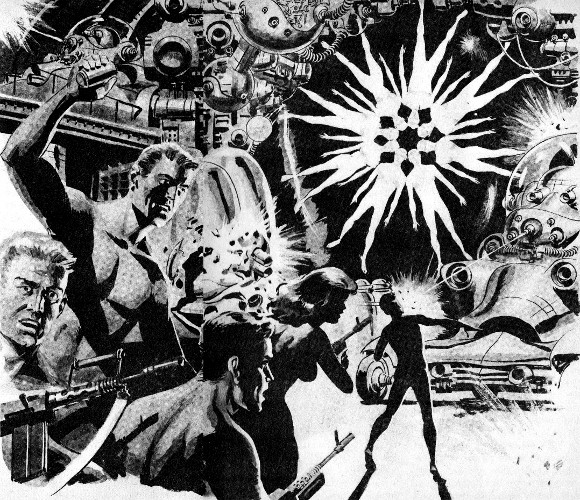
Scratch one threat from the Pyramids—
And almost at once, there was another urgent call from Alia Narova: "Tropile, quickly!"
The Pyramids were the mightiest race of warriors the Universe had ever known. They were invulnerable and unconquerable, except from within. Like Alexander the Great, they had met every enemy and whipped them all. And, like dying Alexander, they writhed and raged against the tiny, unseen bacillus within themselves.
Blindly, almost suicidally, the Pyramids returned to their ancient principle of shove-and-haul.
The geography of the binary planet was like a hive of bees, nearly featureless on the surface, but internally a congeries of tunnels, chambers, warrens, rooms, tubes and amphitheaters. Machinery and metal Components were everywhere thick under the planet's crust. The more delicate and more useful Components of flesh and blood were, to a degree, concentrated in a few areas....
And one of those areas had disappeared.
Tropile, battering futilely with his mind at the periphery of the vanished area, cried sharply to Alla Narova and the others: "It looks as though they've broken a piece right out of the planet! Everything stops here—there's a physical gap which I can't cross. Hurry, one of you—what was this section for?"
"Propulsion."
"I see." Tropile hesitated, confused for the first time since his awakening. "Wait."
He retreated to the snowflake and communed with the other eight-branched members, now become something that resembled his general staff. He told them—most of them already knew, but the telling took so little time that it was simpler to go through it from beginning to end:
"The Pyramids attempted to cut the propulsion-pneuma out of circuit some seconds or days ago and were unsuccessful; we awakened additional Components and were able to maintain contact with it. They have now apparently cut it loose from the planet itself. I do not think it is far, but there is a physical space between."
"The importance of the propulsion-pneuma is this: It controls the master generators of electrostatic force, which are used both to move this planet and ours, and to perform the act of Translation. If the Pyramids control it, they may be able to take us out of circuit, perhaps back to Earth, perhaps throwing us into space, where we will die. The question for decision: How can we counteract this move?"
A rush of voices all spoke at once; it was no trick for Tropile and the others to sort them out and follow the arguments of each, but it cannot be reproduced.
At last, one said: "There is a way. I will do it."
It was Alla Narova.
"What is the way?" Tropile demanded, curiously alarmed.
"I shall go with them, trace the areas the Pyramids are attempting to isolate, place my entire self—" by this she meant her "concentration," her "psyche," that part of all of them which flashed along the neurone guides unhampered by flesh or distance—"in the most likely point they will next cut loose. And then I shall cause the propulsion units on the severed sections to force them back into circuit."
Tropile objected: "But you don't know what will happen! We have never been cut off from our physical bodies, Alla Narova. It may be death. It may not be possible at all. You don't know!"
Alla Narova thought a smile and a farewell. She said: "No, I do not." And then, "Good-by, Tropile."
She had gone.
Furiously, Tropile hurled himself after her, but she was quick as he, too quick to catch; she was gone. Foolishness, foolishness! he shouted silently. How could she do an insane, chancy thing like this?
And yet what else was there to do? They were all ignorant babes, temporarily successful because there had been no defense against them, for who expects babes to rise up in rebellion? They didn't know. For all they could guess or imagine, the Pyramids had an effective counter for any move they might make. Temporary success meant nothing. It was the final decision that counted, when either the Pyramids were vanquished or the men, and what steps were needed to make that decision favor the men were anyone's guess—Alla Narova's was as good as his.
Tropile could only watch and wait.
Through a great many viewpoints and observers, he was able to see roughly what happened.
There was a section of the planet next the severed chunk where the mind and senses of Alla Narova lay coiled for a moment—and were gone. For what it had accomplished, her purpose succeeded. She had been taken. She was out of circuit.
The overwhelming consciousness of loss that flooded through Glenn Tropile was something outside of all his experience.
Next to him in the snowflake, the body which he had learned to think of as the body of Alla Narova twisted sharply as though waking from a dream—and lay flaccid, floating in the fluid.
"Alla Narova! Alla Narova!"
There was no answer.
A voice came piercingly: "Tropile! Here now, quickly!"
Good-by, Alla Narova! He flashed away to see what the other voice had found. Great mindless boulders were chipping away from the crust of the binary planet and whirling like midges in the void around it.
"What is it?" cried one of the others.
Tropile had no answer. It was the Pyramids, clearly. Were they attempting to demolish their own planet? Were they digging away at the crust to uncover the maggot's-nest of awakened Components beneath?
"The air!" cried Tropile sharply, and knew it was true. What the Pyramids were up to was a simple delousing operation. If you could destroy their own machinery for maintaining air and pressure and temperature, they would destroy all living things within—including Haendl and Citizen Germyn and thus, in the final analysis, including the bodies of Tropile and his awakened fellows. For without the mobile troops to defend their helpless cocoons against the machines of the Pyramids, the limp bodies could be destroyed as easily as a larva under a farmer's heel.
So Alla Narova had failed.
Alone against the Pyramids, she had been unable to bring the recaptured sections back into the circuit that Tropile's Components now dominated. It was the end of hope; but it was not the fear of defeat and damnation for the Earth that paralyzed Tropile. It was Alla Narova, gone from him forever.
The Pyramids were too strong.
And yet, he thought, quickening, they had been too strong before and still a weak spot had been found!
"Think," he ordered himself desperately.
And then again: "Think!" Components stirred restlessly around him, questioning. "Think!" he cried mightily. "All of you, think! Think of your lives and hopes!
"Think!
"Hope!
"Worry!
"Dream!"
The Components were reaching toward him now, wonderingly. He commanded them violently: "Do it—concentrate, wish, think! Let your minds run free and think of Earth, pleasant grass and warm sun! Think of loving and sweat and heartbreak! Think of death and birth! Think, for the love of heaven, think!"
And the answer was not in sound, but it was deafening.
In the cut-off sections, Alla Narova's soaring mind lay trapped. It had not been enough; she could not force her will against the dull inflexibility of the Pyramids....
Until that inflexible will began to waver.
There was a leakage of thought.
It maddened and baffled the Pyramids. The whole neuronic network was resounding to a babble of thoughts and emotions that, to a Pyramid, were utterly demented! The rousing Component minds throbbed with urge and emotion that were new to Pyramid experience. What could a Pyramid make of a human's sex drive? Or of the ropy-armed aliens' passionate deification of the Egg? What of hunger and thirst and the blazing Wolf-need for odds and advantage that streamed out of such as Tropile?
They wavered, unsure. Their reactions were slow and very confused.
For Alla Narova succeeded in her purpose. She was able to reach out across the space and barrier to Tropile and the propulsion-pneuma was back in circuit. The section that controlled the master generators of the electronic scythe lay under his hands.
"Now!" he cried, and all of the Components reached out to grasp and move.
"Now!" And the central control was theirs; the full flood of power from the generators was at their command.
"Now! Now! Now!" And they reached out, with a fat pencil of electrostatic force and caught the sluggish, brooding Pyramid on Mount Everest.
It had squatted there without motion for more than two centuries. Now it quivered and seemed to draw back, but the probing pencil caught it, and whirled it, and hurled it up and out of Earth, into the tiny artificial sun.
It struck with a flare of blue-white light.
"One gone!" gloated Tropile. "Alla Narova, are you there?"
"Still here," she called from a great distance. "Again?"
"Again!"
They reached for the Pyramids and found them, wherever they were. Some lay close to the surface of the binary planet, and some were hundreds of miles within, and a few, more desperate than the others or merely assigned to the task, they discovered at the very portal of the single spaceship of the Pyramids.
But wherever they were and whatever they chose to do, each one of them was found and seized. They came wriggling and shaking, like trout on an angler's line. They came bursting through layer on layer of impenetrable metal that, nevertheless, they penetrated. They came by the dozens and scores, and at last by the thousands; but they came.
There were more and more flares of blue-white light on the tiny sun—so many that Tropile found himself scouring the planet in a desperate search for one surviving Pyramid—not to destroy as an enemy, but to keep for a specimen.
But he searched in vain.
The Pyramids were destroyed, gone. There was not one left. The Earth lay open and free under its tiny sun for the first time in centuries.
It had been a strange war, but a short one.
And it was over.
XIV
Tropile swam up out of hammering blackness into daylight and pain.
It hurt. He was being born again—coming back to life—and it had all the agonies of parturition, except that they were visited upon the creature being born, himself. There were crushing blows at his temples that pounded and pained like no other ache he had ever felt. He moaned raspingly.