WITTY PIECES BY WITTY PEOPLE. (continued 2)
Reading edition
"And about the book shelves; will you——"
"Oh, shoot the book shelves; put the books in the boys' rooms; they're going to school; I don't want books stuck under my nose when I'm busy enjoying myself."
—Brooklyn Eagle.
MAKING A HIT.
1.
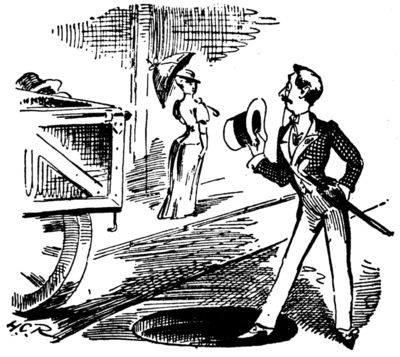
2.
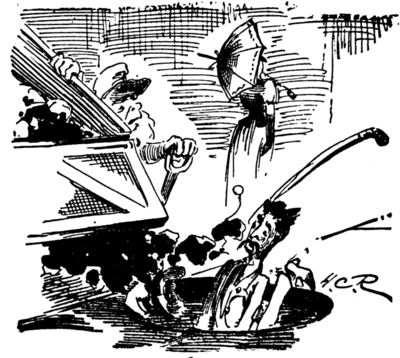
3.
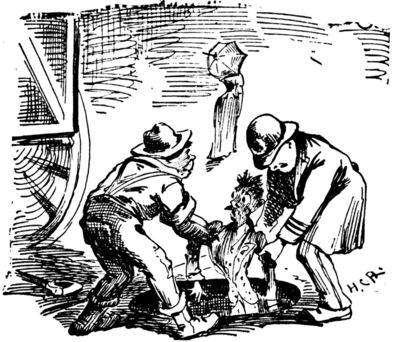
A Consolation.
Smiley Basker—Yes, I'm going to get married at last, but it's mighty risky, mighty risky.
Van Riper—Well, don't worry; you can't do worse than your wife, anyway. Who is she?
—Munsey's Weekly.
It Was Perfumed.
First Cadet—Did you ever smell powder?
Second Cadet—Yes?
"Where?"
"On a Vassar girl."
—San Francisco Argus.
Quite Sure.
Stranger—Did a pedestrian pass this way a few minutes ago? Granger—No, sor. I've been right outer this tater patch more'n a nower, and notter blamed thing has passed 'cept one solitary man, an' he was tramping 'erlong on foot.
—Time.
Only a Matter of Form.
"Mr. Kajones," said young Springbyle, clearing his throat, "I have called to ask permission to pay my addresses to your daughter."
"Which one, Julius?" inquired Mr. Kajones.
"Miss Maria, sir."
The father looked fixedly at the young man. "What are your prospects in life, Julius?" he said.
"To tell you the truth, sir," acknowledged young Springbyle, "I have no prospects worth mentioning. I am in moderate circumstances and have no resources except a knowledge of my business, good health and steady habits."
"Just so, Julius," mused the father. "Your income, I dare say, is——"
"About $1,200 a year."
"And on this, my young friend, you would expect to support yourself and a young woman who has lived in a home where she has never been used to anything like privation, or even judicious economy?"
"It does seem presumptuous for me to think of it," faltered the youth, "and as I see it does not meet with your approval I will say no more about it and ask your pardon for——"
"Stay, Julius!" exclaimed Mr. Kajones, somewhat hastily. "I only asked you those questions as a matter of form. If you want Maria, my boy, you can have her!" And he shook the young man warmly by the hand.
Mr. Kajones, it may be proper to state, has eight unmarried daughters besides Maria.
—Chicago Tribune.
Weighed Down.
Joe—Gus looks crushed, as if he had something heavy on his mind.
Jack—A thought, perchance.
—Time.
Quite a Different Thing.
Old Gent—Little boy, I am sorry to see you smoking a cigarette.
Little Boy—I ain't smoking it. I'm keeping it alight for another feller what's gone on an errand.
—Boston Courier.
A Negro Who Doesn't Like Chicago Manners.
ATES, an old negro, sought the Mayor of Chicago. "What can I do for you?" the mayor asked.
"Wall, sah, I doan' know 'bout dat, but I come yere to see ef I kain't git jestice somehow."
"What's the matter?"
"'Nuff de matter ter make er man pizen, dat's whut. I moved up yere from the South 'caze I didn't think I wuz enjoyin' all my rights down dar——"
"I see. They interfered with your right to vote."
"Oh, no, sah; da let me vote all I wanted ter. Nices' people 'bout dat I eber seed. Jes' let me stan' up an' vote right erlong, but den da didn't count my vote."
"And you wanted to come to a place where your vote counted?"
"Yes, sah."
"Well, what is the trouble?"
"'Leckshun troubles."
"Don't you believe your vote was counted?"
"Oh, yes, I know it was."
"Then what have you to complain of."
"W'y, sah, I hadn't mo'n voted 'fo' er blame p'liceman came up, he did, an' lammed me ober de head."
"What were you doing?"
"Nothin' er tall; jes' standin' dar."
"Didn't he tell you to move on?"
"Yes, sah, but whut bizness was it o' his'n? I wan't foolin' wid him."
"What did you say when he told you to move on?"
"Didn't say nothin'. Jis' sorter shuck my head, an' den he come er hittin' me wid dat stick. Dat ain't no way ter ack—no way ter do w'en er man is 'habin' hisse'f."
"I'm very sorry——"
"You ain't ha'f as sorry ez I is, sah. Jis' look at dis yer lump on my head. I'd ruther not hab my vote counted den ter pay so dear fur it. Ef da hatter hit me to make my vote count w'y, den, I'd ruther they would fling it outen de box. Dat's er mighty cuis way ter do business. Crack er man's skull ter make his vote count. Doan't want no more votes counted in dis town."
—Arkansaw Traveler.
A Pittsburgh doctor says he can diagnose ailments by examining a single hair of the patient. Two young men, as a joke, took him a hair from a bay horse. The doctor gravely wrote a prescription, and said his fee was $25, as the case was precarious. They were staggered, but paid the fee, and after they got out laughed all the way to the apothecary's. The latter took the prescription and read in amazement: "One bushel of oats, four quarts of water, stir well, and give three times a day, and turn the animal out to grass!" Then the jokers stopped laughing.
—Denver News.
Undertakers are gravely opposed to cremation.—Boston Gazette. Are they in urn est?
C. A. M.
Too Late Even for Lecocq.
A gentleman here who was "burglarized" about two years ago, reported his loss to the detectives and offered naturally to assist them in every way. At first he called frequently to ascertain if any news of the thieves had been obtained, but being met always with a negative his visits became infrequent and finally ceased. He had forgotten the matter altogether until recently, when he was called upon by one of the detectives, who stated:
"We have got a clew."
"That is good. Is it a promising one?"
"Certainly. We have discovered the thief."
"Better still. You have him arrested?"
"We can't do that. It's too late."
"How is that?"
"He died last week, confessing to the robbery."
It's a grand thing to get a clew.
—Denver News.
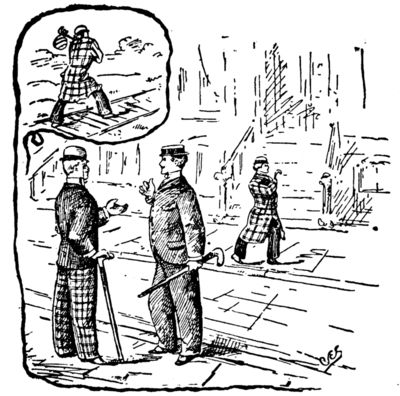
Cholly—I say, Fweddie, what makes J. Wilkes Brutus take such long stweps? Do all actahs walk that way?
Fweddie—Yes. They acquiah that twagic stwide while traveling. They take two ties at one step, ye know.
—Chicago Liar.
MR. BOWSER AS A WHITEWASHER.
He Is Not a Howling Success at Inside Decorating.
There were several little things I wanted done about the house this fall, and so the other week I engaged a colored man to come and work for a couple of days. It so happened that he came one morning before Mr. Bowser had left the house, and was greeted with:
"Well, what's up now?"
"I'ze dun bin hired to work, sah."
"Who hired you?"
"De lady, sah."
"What to do?"
"Jobbin', sah."
"Well, the lady has changed her mind and doesn't want you."
After the man had gone, Mr. Bowser came into the house and asked:
"Did you hire a colored man?"
"Why, yes."
"What for?"
"I was going to have him whitewash the vegetable cellar, take down and clean the laundry stovepipe and do some other jobs."
"H'm! Mrs. Bowser, I don't believe in encouraging such people. He'd have done about one hour's work and charged you for a whole day. I don't believe he knows any more about whitewashing than I do about playing the harp."
"But he said he did."
"Certainly. Did you ever see a negro who wouldn't say anything to fit the occasion?"
"Well, but—-"
"There is no 'but' about it. If there are any little jobs about the house I've got plenty of time to do them. In fact, I need just such exercise. Such work is a diversion to me, and the doctor recommends it."
"Do you mean to say you will do the whitewashing?"
"I do. I don't do it to save a dollar, but for my own benefit. I always like the smell of lime."
"I wish you wouldn't do it. You will get lime in your eyes, and you will blame me for it, and—-"
"There you go! Blame you! What would I blame you about? If I get lime in my eyes it's my own fault. Mrs. Bowser, you are getting to be a good deal of a crank lately."
"Well, if you are determined on it, don't say that I asked you or encouraged you."
"That's a funny way to talk to me, Mrs. Bowser! Are you getting ready for the insane asylum? I think I run my own house yet. If I'm willing to peel off and do these odd jobs, I ought to be encouraged instead of insulted."
I was quite sure how it would end, but I said nothing more, and in the course of half an hour he got into his old clothes and went down cellar. I followed him down to give him a few last words of advice, but he didn't need them.
"You go right upstairs and sit down and enjoy yourself," he said. "Here's the brush and here's a pail of lime, and if I don't white-wash more cellar in ten minutes than Moses could in all day, I'll never try it again. Besides, Mrs. Bowser, whitewashing is not the slouch work you imagine it to be. It has got to be done by a person of taste and intelligence or it won't stand. I want a little blueing to give it a tinge."
"You understand," I said, as I got what he wanted, "that I did not ask you to do this work."
"Ask me! What on earth ails you, Mrs. Bowser? You are making fuss enough over ten minutes' work to warrant a year's job."
"It must be well done."
"Certainly."
"Two coats all around."
"Just so."
"Even if it takes you all day?"
"Even if it takes me over half an hour, which it won't. I'll show you a job here that will make a black man turn green with envy. Just run upstairs and make yourself comfortable."
I retreated up the stairs to the kitchen door and waited for results, which I knew were sure to come. Mr. Bowser dipped and dished and sozzled and stirred until he had the liquid to his liking, and as he began on the stone wall I heard him chuckling:
"I said fifteen minutes, but I'll go slow and take twenty. The idea of a colored man sloshing around here all day to do this work. Let's see. I believe I'll take the overhead first."
I held my breath in suspense for a long minute. Then a yell arose from that cellar which jumped the cook out of her old slippers and made her cry out:
"For heaven's sake, Mrs. Bowser, have we been struck by another cyclone?"
There was a second and a third yell, and as I hurried downstairs Mr. Bowser stood in the middle of the cellar, hands out-stretched and jumping up and down as if he had fire under his feet.
"For heaven's sake, what is it, Mr. Bowser?" I asked.
"Whitewash—lime—fire!"
"Where?"
"In my eyes! I'm blind! I've burned them out!"
I got hold of him and led him out to the laundry tubs and set the water to running. He had indeed got a dose in his eyes, but it was more painful than dangerous. He could hardly see daylight after we had washed out all the lime, and as I led him upstairs he said:
"I shall never see again!"
I washed his eyes with milk and got him to lie down on the lounge, and in a couple of hours he was pretty near all right. His eyes were sore, but no great damage had been done. He was very gentle until he discovered this. Then he suddenly turned on me with:
"Mrs. Bowser, what possible excuse can you urge in extenuation of your conduct?"
"What do you mean?"
"What do I mean? That's a cool question to ask me! In view of what has transpired what have you to say?"
"I say that you were foolish to undertake the job. I warned you how it would turn out."
"Mrs. Bowser!" he shouted, squirting tears of lime water out of his eyes, "do you pretend to deny that you didn't encourage me to undertake a task which you knew would put my whole future happiness, if not my life, in peril?"
"I do, sir. I did all I possibly could to dissuade you."
"And you are not to blame?"
"Not in the least."
"Mrs. Bowser, this is too much—too much! I could forgive one who had wronged me, if penitent, but when they attempt to brazen it out it is time for action. We will settle on the amount of alimony right here and now."
But we didn't. After blinking around for half a day he went down town, and when he came home to supper he was as good-natured as pie. I got a colored man to come and do the work, and two or three days later, when Mr. Bowser happened down cellar, I heard him saying to himself:
"Yes, it's a mighty slick job I did on this, and I'll tackle that stovepipe to-morrow morning."
—Detroit Free Press.
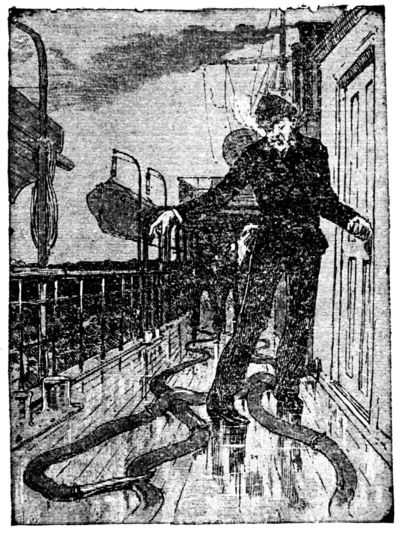
Mr. de Teeze (returning late from the smoking room, and seeing for the first time the hose stretched)—Wha-wha-whash thish mean? Awful bad, thish time! Oh, I shee. I unishtan. 'Sh all ri. No worsh'n ush'l. Shnakes on shore, shea sherp'ns on ships. Or ri'. Qui' proper too.
—Ocean.
New York can't decide upon a site for the world's fair. An excellent place to hold the fair, after the old folks have retired, is on your lap. P. S.—So we've been told.
—Norristown Herald.
The Latest About Kissing.
Men have often remarked on the fertility of woman's mind. Physiologists declare she never reasons, but as an instinctive creature she often reaches a correct conclusion much quicker than a man. If they lack the intricate process of ratiocination they have the happy faculty of walking straight through mental difficulties like a somnambulist in sleep.
The fellows who discuss "Is Marriage a Failure?" or "Why I am a Bachelor," have wondered lately how women reach their cute noses with a handkerchief since the advent of the new fangled veil. It covers the greater part of the face, and is as ornamental possibly as protective.
Two women veiled alike met yesterday. It was evident that they hadn't seen each other for some time, and they rushed together in a long embrace. The inevitable kiss came next. Both essayed the attempt, but the veils rendered this impossible. Quick as a flash one of the ladies turned the side of her face to her companion and the latter smacked a spot on her cheek somewhere below the ear. This was satisfactory and then followed the usual storm of quick womanly ejaculations.
"Is kissing on the lips no longer fashionable?" queried a reporter of a lady he met after this event.
"No, not since the introduction of the new veil," she answered sweetly. "You see the lips are completely covered, and it has become the fashion to press the lips against the cheek. This thing of kissing is a nuisance anyhow, and I wish the ladies would all stop it."
—Pittsburgh Dispatch.
Conclusive.
Careful Papa—But which loves Clara most—Brown, Jones or Smith?
Observant Mamma—Why, Mr. Smith, to be sure.
Papa—How can you make that out? Last night Brown asked and plead with her to sing; when she finished, Jones was enthusiastic in praise; but Smith didn't say a word!
Mamma—No, but to-night he asked her to sing again——
Papa—Poor Smith, he must, indeed, love her!
—Light.
THE HONEYMOON.
START.
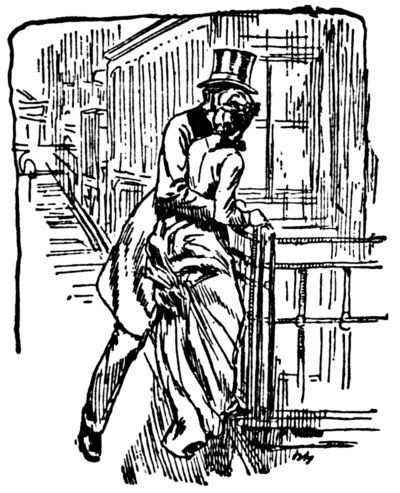
He—O, my darling, you are so much better than I am, and I am so unworthy of you!
She—Love, I don't see what you can find about me to love!
FINISH.
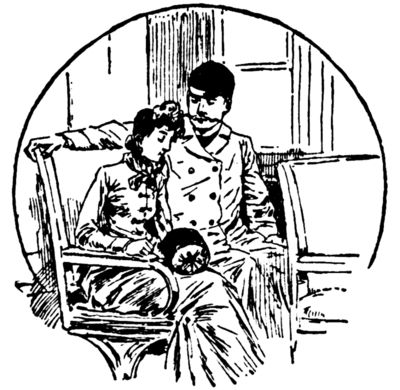
She—I don't see why I ever married such a brute. I am going straight home to mother.
He—Brute, eh? I want you to understand, young woman, that I only married you out of pity.
—Lawrence American.
The Sly Way in Which Prohibition Works.
A week or two ago a well-known dealer in live stock of this city went over to Washington County to make a deal with a big stock raiser, who is also prominent as a strict Prohibitionist. The cattle having been inspected and the price agreed upon, the Washington County man retired to the house to make out a receipt and so on, leaving the Pittsburgher in his son's hands. As soon as the old man had disappeared indoors his son, a bright lad, nearing his majority, said to the Pittsburgher:
"This is rather dry work talking all day, ain't it?"
The Pittsburgher vehemently assented.
"Well," continued the young man, "I've a bottle out in the haymow, and we might as well get a taste of the stuff while dad's not by."
The Pittsburgher said "yes" again, and the two repaired to the haymow and looked upon the contents of the black bottle. Then the young Washingtonian hid the bottle in the haymow, saying as he did so: "Don't tell the old man anything about this—he's awful down on drinking."
Of course the Pittsburgher vowed silence as he smacked his lips and left the barn. Two minutes later he was in the house paying over the money to the old stock raiser. After the business in hand had been dispatched and the bargain had been closed the Pittsburgher was about to take his leave, when the old man said, rather awkwardly: "Say, are you feelin' dry? I've a jug down in the cellar, and the liquor's fine."
It is hardly necessary to say they were soon in the cellar. As the old Prohibitionist drained his glass he said to his guest: "Don't say nothing 'bout this to them boys o' mine—they don't know about the jug!"
—Pittsburgh Dispatch.
His Last Resort.
Mrs. Smalltalk (two minutes later)—Well, doctor, why in the world don't you look at my tongue, if you want to, instead of writing away like a newspaper editor? How long do you expect I am going to sit here with my mouth wide open?
Physician—Just one moment more, please, madame; I only wanted you to keep still long enough so that I could write this prescription.
—Somerville Journal.
How She Told the Latest Joke.
Mrs. Jason came home the other evening with her face "wreathed in smiles," as the novelists have it.
"Well, what are you grinning at?" was the cordial greeting of her lord and master.
"I heard something funny down town," she answered.
"Well, what was it?"
"Oh, nothing much. I happened to meet little Johnny Figg, who used to keep the apple stand across the way, you know, and he's got a better one down town now. I asked him how he was getting along and he says to me, 'Oh, I'm still keeping a stand, you see.' I thought it was the cutest thing I had heard for a good while."
"Oh, you did, did you, Maria? If I ever see where the laugh comes in I'll try and smile, even if I have to get up in the middle of the night to do so," was his crushing reply, to which she deigned no answer.
About two o'clock in the morning Mr. Jason was awakened from a dream of being stabbed by a masked assassin, to find his wife energetically nudging him below the fifth rib.
"Oh, Jehiel, I had that wrong," she twittered, in a tone of one who has made a great discovery. "Johnny said his business was at a stand still. You see the point now, don't you?"
"Yes, I reckon so," said the old man in no gracious tones, "and if I feel the point of your infernal elbow jabbing me in the ribs any more to-night I'll go to sleep in the barn. Do you hear?"
"And he didn't laugh either as he promised to," was her reflection as she settled down to sleep again with the sweet consciousness of duty performed.
—Terre Haute Express.
On General Principles.
Weather Bureau Chief (to assistant)—Well, what's the forecast for Pennsylvania?
First Assistant (looking perplexed)—Very confusing. There's a falling barometer in Lehigh, a rising one in Lancaster, easterly winds in Berks and——
Chief (pettishly)—Oh, well! make it "showery," then.
—Philadelphia Inquirer.
His First Shave.
This is a momentous event in a boy's life, as it is to him the line of demarcation between boyhood and manhood.
The microscopic indications under his chin are becoming annoying to him, and he considers it a duty to society to have them removed without delay.
He has already made several surreptitious attempts with his father's razor, to the great detriment of both the razor and his face, and although he succeeded, in a measure, in removing the obnoxious down, yet it was with the unpleasant accompaniment of some of his chin. Therefore he determines to do the thing in a manly way, and resolves to submit to the barber's delicate manipulations without delay.
It takes him some time to muster up the requisite courage to enter the barber's shop, as he has certain misgivings that the barber might indulge in facetious and satirical remarks concerning his beard.
He passes the shop many times and looks in; but his heart sinks within him. There is always some drawback—either too many people inside or too few; in either case of which he thinks he will be noticed. Once he does enter; and one of the barbers venturing the inquiry, "Hair cut, sir?" involves him in delightful confusion, and to avoid further embarrassment, he submits to having his hair cut, and still remains unshaved.
At last, in sheer desperation, he makes a very firm resolve either to get shaved that day or never. With this heroic resolve, and twopence in his hand, he sallies forth to the barber's, and at a favorable moment walks in and tremblingly awaits his turn.
The sharp, short "Next!" sends the blood thrilling up his backbone, and he feebly climbs into the chair, and hurriedly says, "Shave me, please," and shuts his eyes.
The barber, with an eye to the twopence, says nothing, and proceeds to shave him, figuratively speaking. There is only one drawback to the boy's cup of happiness, and that is the entire absence of that peculiarly pleasant rasping sound which comes only from a long experience.
—Liverpool Post.
The season has come again when a fine string of fish in the hand is worth two dollars out of pocket to the man who didn't catch the fish.
—Albany Express.
Considering how little the bell knows it is wonderful how much it has tolled.
—Merchant Traveler.
HE DID NOT GET THE ORDER THOUGH.
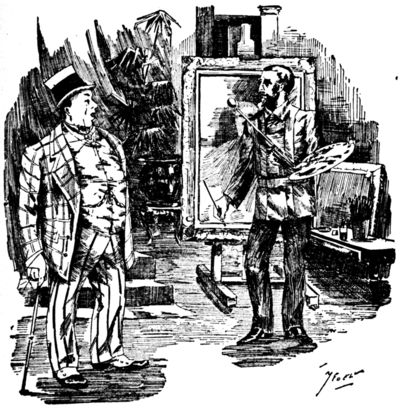
Mr. Retired Politician (to Society Artist)—Now you are sure you can make a good likeness of me?
Society Artist—Oh, yes; you see yours is a very simple face—er, er, I mean to draw, you know.
A great deal of fault can be found with a defaulter.
—Pittsburgh Chronicle.
Two Kinds of Accompaniment.
Policeman (to street musician)—Have you a permit to play on the streets?
Itinerant Musician—No.
Policeman (making him a prisoner)—Then accompany me.
Itinerant Musician—With the greatest pleasure. What do you wish to sing?
—Fliegende Blätter.
A Sure Sign.
Husband—I guess Sarah and that young man that calls on her are engaged by this time.
Wife—Why do you think so?
Husband—The gas bills aren't as large as they used to be.
—Yankee Blade.
A Fair Estimate.
"Have you ever tried, Lawrence, to estimate the height of my father's regard for you?"
"No, but it occurred to me last night that it was about a foot."
—Glens Falls Republican.
Didn't Intend to Hit Him.
"Did you intend to hit this man when you shot at him?" asked the Judge.
"Did I ten' to hit 'im?"
"Yes."
"No, sah; if I had 'tended to hit 'im I would 'er tuck a club."
—Merchant Traveler.
Eager for Absorption.
Citizen (to tramp)—Poor fellow! You look as if you had been in the soup.
Tramp (half famished)—For heaven's sake, tell me on which side to open my mouth.
—Burlington Free Press.
There is nothing novel in the announcement that Mrs. Chamer has abandoned literature. Amelie's literature has always been more or less abandoned.
—Omaha Bee.
A FOOLISH QUESTION.
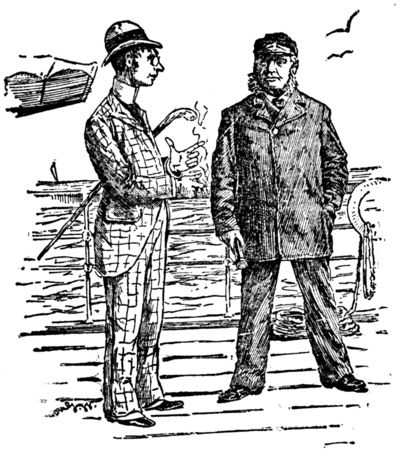
Le Sawft—Why, captain, what in the world is that flat boat for?
Captain—That is for use in landing dudes.
—Ocean.
Claus Spreckels wants to build houses of sugar. If an apartment building of this material is erected we are willing to take a sweet of rooms.
—Lawrence American.
MR. BOWSER IN THE COUNTRY.
He Enjoys Fresh Air and Mosquitoes to His Heart's Content—His Original Method of Milking Not Indorsed by the Cow.
"Well, what do you think!" exclaimed Mr. Bowser as he came hurrying home from the office the other afternoon.
"Have you gone and got some more hens or bought another horse?"
"Mrs. Bowser, the event of our life is about to happen."
"What is it?"
"You know Gregg? Well, Gregg owns a little farm out here about twelve miles. There's a good house on it, and he says we can occupy it for the summer. We will have a cow and a horse, pigs, poultry and other stock, and we'll go out there and tan up and get fat and have the best time in the world."
"I don't think much of the idea, Mr. Bowser."
"You don't. You don't want cool breezes—fresh eggs—fresh berries—rich milk—songs of birds—lowing of the kine and rest from care!"
"You will be disappointed if you expect any such thing."
"I will, eh? Perhaps I don't know what the country is. You are always ready to throw cold water on any of my plans. I shall go, anyhow."
That was the beginning, and at the end of three days I yielded, womanlike.
One Monday morning we took the train and started, having engaged a farmer's daughter to take charge of the kitchen, and at the nearest railroad station we were met by a farmer and his lumber wagon. The sun poured down its hottest, the dust had covered grass and bushes, and as we jogged and jolted along the farmer queried of Mr. Bowser:
"Come out for your health, I suppose?"
"We did. Ah! this country air has already refreshed me."
"Has, eh? Well, there's heaps of it, and I'm thinking you'll get all you want in about a week. I think a city chap is a blamed fool to come out here."
"Do you? Why, the doctors recommended it. That boy ought to gain a pound a day, and I am sure my wife will brace right up with these pastoral scenes before her eyes."
"The doctors and pastoral scenes be darned!" growled the farmer, as he turned to his horses, and those were the last words he uttered until he landed us at the gate.
It was a comfortable frame house, and I did not observe the surroundings until after dinner. The barn had partly fallen in, giving it a weird and lonely look; most of the fencing was down, a gust of wind had laid the smoke-house on its back, and nearly every tree and bush about the house was dead or dying.
"Is this one of the pastoral scenes you referred to?" I asked Mr. Bowser.
"There you go!" he snapped. "You can't expect things to look as nice out here as in Central Park. We come for the balmy breezes and the rest."
"You spoke of hunting hens' eggs in the meadow grass."
"So we will—come on."
He made a dash for a big patch of burdocks near the back door, got tangled up in the ruins of a barrel, and when he got up he had a cut on his chin and his nose was bleeding. He tried to make light of the affair, but it was hard work.
When I asked after the horse and vehicle in which we were to take our morning jaunts he walked down to the barnyard and pointed out a raw-boned old yellow horse, so weak that he could not brush the flies away, and a one-horse wagon, quaint enough to have taken its place in a museum.
"You'll have our photographs taken after we all get seated in that rig, won't you?" I asked.
"That's it; just as I expected. Mrs. Bowser, what did you come out here for?"
"Because you obliged me to."
"I did, eh! Not by a long shot! You came to restore your health and to give our child a chance for his life. It will be the making of him. No more doctor's bills for us."
In the afternoon Mr. Bowser swung his hammock in the orchard. This was something he had doted on for a week. He had scarcely dropped into it when three or four caterpillars dropped on to him, and he put in the rest of the afternoon on the hard boards of the veranda. The cow came sauntering up about 5 o'clock, covered with flies and mosquitoes, and the girl hinted to Mr. Bowser that he was expected to milk.
"Oh, certainly," he replied. "I wouldn't give a cent for farm life unless I could milk a cow or two. I used to sing a ballad while I was milking."
The girl and I watched him as he took the pail and stool and approached the cow. The cow also watched him. Folks generally sit down on the right-hand side of the cow to milk. Mr. Bowser took the other side.
"What are you trying to do?" I called to him from the gate.
"Mrs. Bowser, when I want to learn anything about a cow I'll ask you for the information. I think I know my business."
So did the cow. She had been fooled with long enough, and she suddenly planted a hoof against Mr. Bowser with such vigor that he tumbled over in a confused heap. Between us we got him into the house, and the girl finished the milking. Mr. Bowser recovered from the shock after a while, and I felt it my duty to inquire:
"Mr. Bowser, don't you think a week of these pastoral scenes will be enough for us?"
"No, nor six weeks!" he growled. "Nothing would do but you must go into the country, and now I'll give you enough of it."
"Why, Mr. Bowser?"
"You needn't why Mr. Bowser me! You gave me no peace until I agreed to come, and now I'll remain here five straight years."
When the summer sun went down and the stars came out we were not as happy as we might have been. Mr. Bowser still held his hand on his stomach, the baby cried because the milk tasted of wild onions, and the girl lost the old oaken bucket in the thirty-foot well while getting a pail of fresh water. I asked Mr. Bowser when the kine would begin to low and the whippoorwills to sing, and he was so mad he wouldn't speak. However, if the kine didn't low, the pinchbugs and mosquitoes did. There wasn't a screen at door or window, and soon after sundown we were besieged.
That night seemed never ending. No one of us three slept a wink. The room was invaded with every insect known to country life, from a bat to a gnat.
When we got up in the morning the girl didn't know us. We were blotched and bitten until one would have suspected us of suffering with smallpox. Mr. Bowser knew himself, however, and before noon we were back in the city. He scarcely spoke to me all the way home, but once in the house he burst out with:
"Now, old lady, prepare for a settlement! You've nosed me round all you ever will. This has broken the camel's back. Which of us applies for a divorce?"
—Detroit Free Press.
A "TOUGH" CASE.
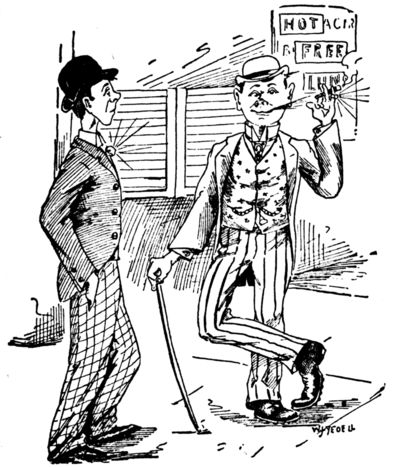
James—Hello, Gus, where have you been? Never see you at the old place.
Gus (swell about town)—No, de fact is, James, me boy, dey has got chicken for de free lunch dere.
The Hard Luck of Some People.
"Tell yo' w'at, Mars' Parson," remarked Uncle Cocklesole, as he sat on the sill of a second-story window and looked down on the mounted missionary and the receding waters, "tell yo' wat it ar', ef hard luck don't jus' play leap frawg wid some sinners an' lan' wid fo' feet on udders, den I'm squinch-eyed in mer judgmen'. Dere's Jim Rasselbait! What de flood do for him? Swup his leaben chillen off de carf an' tu'ned de stove ober in de cabin so dat hit b'un up an he git a hun'ered dollars inshu'ance, an' dar he am, jus' scused ob car and 'sponsibility, goin' eround town rich as Crusoe an' no one ter lay claim ter one single per centum ob de money. An' der's merse'f. Blame ef de waters didn't jus' do nuffin to mer cabin but ransack all de furnicher, an' after hustlin' mer wife and chillens off in a way ter make a feller 'spicion dey's gone fo' good, blame ef they didn't leggo ob 'em jus' roun' de ben', an yer dey is all back ergin an' me wid no inshuance, and no provenger in de house ter s'ply 'em wid. Talk erbout ekal rights! Hit's only fellers like Jim Rasselbait, w'at's bo'n wid a coil, dat gits 'em all."
—Yonkers Gazette.
A Disastrous Clerical Error.
Government Clerk (to friend)—I'm in a frightful hole. I went to see two doctors yesterday and got a medical certificate from each. One was a certificate of health for a life insurance company, and the other was a certificate of illness to send to the chief with my petition for a week's leave of absence.
Friend—I've done that myself. What's the matter?
G. C.—Matter? Great Scott! I mixed the certificates in mailing them. The insurance company has my certificate of ill-health, and the chief has my certificate of good health.
—Boston Beacon.
The Johnstown sufferer is the latest variety of tramp in Kansas. He bears a close resemblance to all the rest in the particular that he looks as if he had never seen water.
—Kansas City Star.
A ballet-girl syndicate is the latest development of the Trust business. But in the nature of things it will not be much of a clothes corporation.
—Richmond Dispatch.
His Complexion Was Against Him.
Hadji Hassein Ghooly Khan, envoy extraordinary and minister plenipotentiary from Persia, was one of the favorites in Washington society while there. He was very fond of going out and calling on the ladies, and was always most hospitably received wherever he went. That is, almost always, for an experience he had one Sunday afternoon proved that he was not as cordially received at one house as had been his wont. Ghooly Khan started out with the purpose of making a round of calls. It is his custom to pay his respects to the ladies of the fashionable world on Sunday the same as on the week days. The day being an extremely pleasant one, his landau was not brought into use. He walked from his residence on M street, to Massachusetts avenue, in the neighborhood of Fourteenth street, where the subjects of his first call resided. Walking up the stone steps in an indolent fashion, he reached the door and rather timidly touched the electric bell. After lingering some moments the servant appeared, and before Ghooly Khan could utter a word she shouted out: "The ladies are all busy and cannot be bothered with you now."
"Well," said the minister, completely nonplussed, "there must be a mistake; take in my card."
"Oh! don't worry them now," answered the servant, not allowing him to finish his sentence. "They are all about going to dinner and don't care for any one to see them at this time—you'd better come again in the morning; and the side door is always the handiest place for such as yez to call."
The minister waited for no more. The rebuff he had received at the hands of the unruly servant completely paralyzed him. He concluded that he had a sufficient dose of American society.
The ladies of the house soon learned of the "horrible" manner in which their distinguished caller had been received, and they at once made heroic and happily successful efforts to have the affair settled on a basis satisfactory not only to themselves but to the distinguished envoy from Teheran.
—New York Tribune.
"I want the library," said Mr. Gaswell to the architect, "to be the largest and airiest room in the house." "I don't see what you want with a library," interposed Mrs. Gaswell, "you know very well you don't smoke."
—Boston Transcript.
The Difference.
The following anecdote, which we have received as authentic from the lips of a clergyman, sets forth in a very pleasant way the folly of reproaching preachers as hirelings, merely because they receive temporal support from their congregations.
At the meeting of a presbytery in an eastern state, it fell to the lot of one of the ministers to be quartered with a man belonging to a denomination which does not allow of salaried preachers. He was accosted by his host as follows:
"What is thy name, friend? I mean the name thy parents gave thee."
"John."
"Has thee any objections that I should call thee by that name?"
"Certainly not; my mother always calls me John."
"Well, John, I understand thee belongs to the class of hireling preachers."
"You are greatly mistaken, sir; I do not belong to that class."
"I mean thee is one of those preachers who receive pay for preaching."
"No, sir; I receive nothing for preaching to my people."
"How then," said the interrogator, evidently surprised and disconcerted, "does thee manage to live?"
"Why, I work for my people six days, and then I preach for them on Sundays for nothing."
—Yankee Blade.
Sir Wilfred Lawson's Story.
Sir Wilfred Lawson told the following story the other evening: A student at college was sent for by the Don, who said—"Sir, I am told you have a barrel of beer in your room, which is contrary to all orders." And the young man said: "Well, sir, that is true; but the fact is the doctors told me that if I drank this beer I should get stronger." The Don said: "Are you stronger?" "Yes, sir, indeed I am," was the reply, "for when the barrel came in I could scarcely move it, and now I can roll it round the room."
—Glasgow Weekly Mail.
Expected It.
"I'm in a pickle," remarked a young employe at the store.
"I've been expecting for some time that you'd get into a pickle," was the rather forbidding reply.
"Why, sir?"
"Because you are so confoundedly fresh."
—Albany Argus.
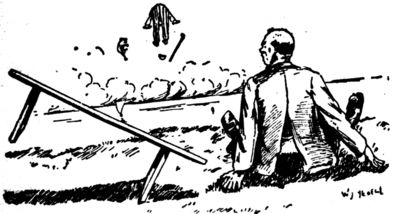
Ancient Mariner—Holy smoke, where's that young feller gone to? Didn't 'pear quite natral like anyhow.
Truth in Absence.
"Charlotte, my dear, how is it I find you weeping? Have you bad news from your husband?"
"Oh! worse than that! Arthur writes me from Carlsbad that he would die with grief at being absent from me, were it not that he gazes at my picture and covers it with a thousand kisses every day."
"That is very nice of him; but surely you are not crying about that? Most woman would give anything to have such a poetic and devoted husband."
"Oh, yes, Arthur is very poetical; but you don't know. Just to try him, I put mother's photo into his traveling bag instead of my own, and the wretch has never found it out. Boo-hoo-hoo!"
—Pick-Me Up.
Another Kind of Habit.
Old Grinder (to seedy applicant for job)—I hope that no bad habits have brought you to this poverty?
Borrowit—One, sir.
"Ah, I am glad you are frank about it. What was it?"
"This played-out old suit of mine. It has ruined my chances everywhere."
—Texas Siftings.
Family Loyalty.
A Stevens avenue young lady was much pained and shocked as she walked down the street yesterday to see her young brother sitting astride the prostrate body of another boy and raining down blows upon his struggling victim.
"Johnny!" she almost screamed, "what are you doing? Come here this minute. Aren't you ashamed of yourself, fighting this way in the street?"
The boy reluctantly arose from his vanquished antagonist and faced his indignant sister. Then he explained:
"Well, I don't care. He said you wasn't good looking. I don't think you are either; but it ain't none o' his funeral. So I licked him."
—Minneapolis Journal.
Not Related.
Magistrate—O'Rally, you are charged with assaulting and brutally beating Michael McDooly at the reunion of the O'Rally family yesterday. Have you anything to say?
O'Rally—Yes, yer Honor. The bloke's an imposthor, sorr, and hasn't wan dhrop of the O'Rally blood in his skin, begorra, an' he dhrank oop all av the beer.
Magistrate—How is this, McDooly? Are you a kinsman of the prisoner?
McDooly—Faix, an' sure it is that I am, yer Honor; his grandfather wor Pathrick O'Rally av Belfast, an'——
O'Rally—An' bedad, phwat do that prove, yer Worship?
McDooly—An' Pathrick O'Rally's dochter marrit me own——
O'Rally—He's lyin', yer Honor; he's lyin'. Me grandfather never had any cheeldren at all, at all, sorr.
—Life.
One of Chauncey's Latest.
Chauncey M. Depew tells the following story of another of the many interesting characters he encountered last Fall while addressing his fellow citizens on the vital issues of the campaign. It doesn't sound so much like a true story as some that are extant, but it is getting pretty late in the day to doubt his word:
One night, after the meeting was over and while the hall was clearing, a weather-beaten man buttonholed me and said:
"I'm postmaster out here at Shingle Corners. Blaze away and elect your man if you want to."
"You don't care for the office, then?" I said.
"No, that ain't it," he replied. "It don't pay but $14 a year, or mebbe good years, when I boom 'er a little, $15, but it's powerful handy to have in the house. No, my idee is that we can keep it in the fam'ly anyhow."
"How's that?"
"The old woman, you see, she's a rip-snortin' Republican, powerful so, reg'lar uncompromisin'. If Cleveland gets it I stay; if Harrison slides in the old woman comes to the front for her reward. Nobody else wants it, so there we be."
"Well, you're all right then."
"You bet we are. If we get tired of it or too old for it, or anything ever, there's my boy, a red-hot Republican, and my oldest gal, Democrat from 'way back. Oh, we're hustlers in our fam'ly when it comes to politics."
"But suppose the Mugwumps should develop power some day and carry things?" I asked.
"Well," he replied, "we will soon be fixed for that, too. The baby is a Mugwump—I know it 'cause he howls all the time. If you see anybody lookin' for p'ints on keepin' a good thing in the family jess send him out to Shingle Corners."
—Wasp.
But They Read of It.
Mr. Porker (of Chicago)—Talk about enthusiasm in your city over the fair! Why, I'll venture to say that there are some people in New York who haven't even heard of it.
Mr. Gotham—Well, if there are, they must be the inmates of the deaf and dumb asylum.
V.S.
Oklahoma Hotel Rules
1. If the bugs are troublesome you'll find the kloroform in a bottle on the shelf.
2. Gents goin' to bed with their boots on will be charged extra.
3. Three raps at the door means that there is a murder in the house, and you must get up.
4. Please rite your name on the wall paper so that we know you've been here.
5. The other leg of the chair is in the closet if you need it.
6. If that hole where that pane of glass is out is too much for you, you'll find a pair of pants behind the door to stuff in it.
7. The shooting of a pistol is no cause for any alarm.
8. If you're too cold, put the oilcloth over your bed.
9. Caroseen lamps extra; candles free, but they mustn't burn all night.
10. Don't tare off the wall paper to lite your pipe with. Nuff of that already.
11. Guests will not take out them bricks in the mattress.
12. If it rains through that hole overhead, you'll find an umbrella under the bed.
13. The rats won't hurt you if they do chase each other across your face.
14. Two men in one room must put up with one chair.
15. Please don't empty the sawdust out of the pillers.
16. Don't kick about the roches. We don't charge extra.
—Spokane Globe.
Electricity Will Do Away With All This.
"I suppose this is my noose suit," laughed the condemned criminal when the jail warden brought him his clothes on the morning of the execution.
"Why," replied the warden, "you are as jolly as if you had been taking a drop."
"I'm going to take one by and by."
"Come, come," said the warden, seriously, "this is no time for joking."
"Why not?" asked the culprit, "ain't the whole thing going to end in a choke?"
—Boston Courier.
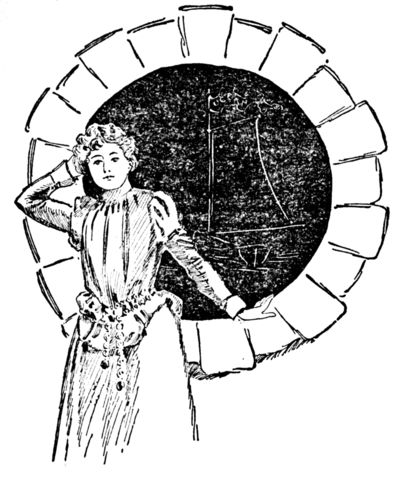
A Bitter Reflection.
Oh why so sad, my lady fair? What pales thy cheek and dims thy eye? Thy drooping face is mark'd with care, Thy heaving breast betrays a sigh. What lacks thy lot to make it sweet? What joy is there that is not thine? What makes that heart in sorrow beat And gives of happiness no sign? "Ah, woe is me! I loved a youth, Handsome in face, and brave and strong. The paths of honor and of truth Were his, for he could do no wrong. Two years ago he sailed away To seek his fortune o'er the seas, And I've been yearning every day That he'd return his love to please. "But ah! I've waited long in vain For my old sweetheart to return; No message came across the main From him for whom my soul did yearn. Until to-day, when I am told His ship is due to come in port; He comes back worth a pile of gold, At least, so says the last report." Then why repine, sweet maid? You should Be overjoyed to hear the news; You soon will wed a husband good, How can you, then, this grief excuse? The lady answer'd. "Would you know Why tear drops from my eyes now fall? To tell the true cause of my woe, I—married—some—one—else—last—Fall."
John S. Grey.
The buckwheat crop this year takes the cake over all former seasons. It wins by a mere scratch, however.—Philadelphia Press. Some door jambs look as though there had been a good deal of scratching in former years.
C. A. M.
The man who is given to sober reflection seldom gets into a tight place.
—Boston Courier.
The owner first breaks the race-horse; then the race-horse proceeds to break the owner.
—Washington Capital.
Dr. Brown-Sequard's new elixir of life is made from dogs, probably some infusion of bark.
—Toronto Globe.
A Mistake at Table.
"Will you pass me the butter, please?" asked a stranger of a snob at a restaurant table.
"That's the waiter over there, sir," was the supercilious reply.
"I beg your pardon," remarked the stranger. "I did make a mistake."
"You're only adding insult, sir," broke in the snob; "nothing could induce me to believe that you mistook me for a waiter!"
"Certainly not," returned the stranger. "I mistook you for a gentleman."
—Detroit Free Press.
Answering the Question.
Hotel Clerk—Is there anything that I can do for you?
Seedy Man—Yes, sir, you can loan me five dollars.
"But I'm not going to do it."
"No! I didn't think you would. I merely wanted to answer your question."
—Merchant Traveler.
How Appearances Deceive.
A portly citizen left a Woodward avenue car at High street between showers yesterday, but was hardly on the sidewalk before he began yelling and beckoning at the car.
"It's agin orders to stop except at crossings," observed a passenger on the rear platform, as the conductor reached up to the bell-rope.
"Yes, but he has probably forgotten something."
"Well, let him get it when the car comes down. I have no patience with forgetful men."
"I guess I'll stop, anyhow."
"It's a shame to do it."
The car was stopped and the man came running and puffing to call out:
"Left my five dollar silk umbrella in the car."
"Yes, and here it is. I was keeping it for you!" replied the individual who had opposed a stop.
"Thanks. You are an honest man. If there were more men like you this would be a better world to live in. Here—have a cigar."
—Detroit Free Press.
One Idea of It.
Farmer Railfence—Just think, Maria! Squire Hawkins has built himself a thirty-thousand-dollar house, and I'll be blamed if he's got any decent glass in the whole of it.
Maria—What's he got, Ephraim?
Farmer Railfence—Paper says stained glass from cellar to garret. Nice glass, Maria, wouldn't have cost but little more than a lot of worthless stained stuff.
—Rochester Budget.
WEIGHT WILL TELL.
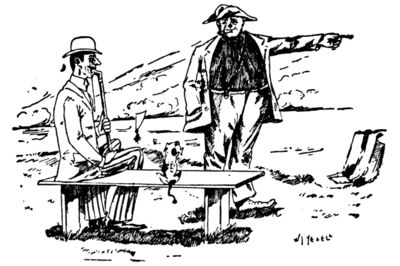
Ancient Mariner—Yes, mister, it was just down there the Mary Ann wrecked.
Doodle—Aw' me boy; sit down and tell me about it.
A Truthful Statement.
Yank Yahoo (to jeweler from whom he has just purchased a rolled plate engagement ring)—Naow, Mr. Jewelryman, what had I orter say when I put this 'ere ring on Mandy's finger? Dew I say "I ring yer," "I rang yer," or "I rung yer?"
Jeweler (repressing a smile)—You should say "I wrong you."
—Jeweler's Weekly.
A Controlling Feature.
Brown—The facial features plainly indicate character and disposition. In selecting your wife were you governed by her chin?
Jones—No, but I have been ever since we married.
—Omaha World.
A Jersey Idyl.
Night after night a witching sprite, Outside among the roses, Sings lullabies; but to my eyes Her form she ne'er discloses. She hides away the livelong day, And keeps herself secluded; To reach her side in vain I've tried; My efforts she's eluded. She seemed so coy; but to my joy, At last, by chance, I met her. The fair unknown is now my own, And soon I'll not forget her. Last evening she encouraged me— My triumph is complete, oh; I own 'twas rash—I made a mash Of pretty, young Miss Quito.
—Wasp.
A Point Usually Overlooked.
The youthful heir to a Walnut Hills ancestral establishment is of an inquiring turn of mind and directs his attention especially to the elucidation of religious problems. Last week he heard a Sunday school address on "The Prodigal Son." Just what the small boy thought of the address his father was curious to learn, and so he said to him that night at supper: "My son, tell me which of the characters in the parable of the prodigal son you sympathized with?" "Well, papa," replied the cherub with perfect nonchalance, "I think I'd feel disposed to sympathize most with the calf."
—Cincinnati Commercial Gazette.
Still Alive.
He—Then this is your final answer, Miss Jones?
She—It is.
"You won't have me?"
"I am sorry, but I must decline."
"Then I will do something desperate."
"What will you do?"
"I will make away with myself."
"Oh! don't."
"I will. I'm determined to do it."
"Well, if you are determined, give a proof that you truly love me by insuring your life in my favor for $20,000 or so before you commit the desperate deed. I will get money from papa to pay the premium."
He left indignantly and at last accounts was still alive.
—Sunday Mercury.
Devoted Admirers, Both.
He (of Boston)—I am so fond of Bacon! Aren't you?
She (of New Orleans)—Oh, yes; I don't think I could ever get tired of bacon, especially with eggs!
—Lowell Citizen.
A New Definition of a Bobtail Flush.
Mr. Gunsaulus was telling a group of the bibliomaniacs yesterday that there was nothing so beautiful in a house as a bevy of bright children. "I have a very lovely family," said he. "I hold, as the sinful world would say, a bobtail flush."
"What's that?" asked Hon. Charles B. Farwell, the well-known collector of Bibles and psalm books.
"We were talking about children," exclaimed Mr. Gunsaulus, "and I was saying that in our family we had a bobtail flush—four girls and a boy."
"No," said Mr. Farwell, smiling sadly; "it is evident that you have had no experience in the ways of the world, otherwise you would not make so erroneous an application of terms. You do not hold a bobtail flush; you hold four of a kind—four queens and a jack—a powerful good hand, sir, and I should advise you to stand pat."
—Chicago News.
She Wasn't Posted.
Grocer (who has lately joined the militia, practising in his shop)—Right, left, right, left. Four paces to the rear; march! (Falls down trapdoor into the cellar.)
Grocer's wife (anxiously)—Oh, Jim, are you hurt?
Grocer (savagely, but with dignity)—Go away, woman; what do you know about war?
—Liverpool Post.
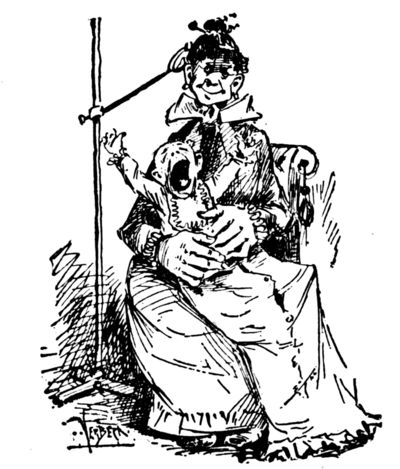
MRS. O'FLAHERTY HAS THE BABY'S PICTURE TAKEN.
Very Necessary.
Minister (to Johnny, who is digging worms for bait)—Johnny, don't you know that it is wrong for you to do any work except work of necessity on the Sabbath?
Johnny—Necessity? Ain't this necessity? How's a feller to do any fishin' if he don't have bait?
—Lawrence American.
A Righteous Judge.
Judge—You say the prisoner threw you out of the door. Had you provoked him?
Plaintiff—Not at all. He advertised an unusually fine bargain sale of laces, and I went in and asked him for the lowest figure on a pair of shoe laces.
Judge—Prisoner is discharged. Mr. Clerk, swear out a warrant against plaintiff and have him arrested for criminal assault.
—Harper's Bazar.
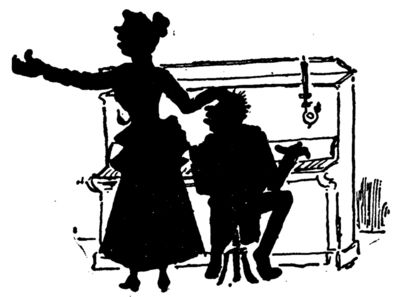
"HEART BOWED DOWN!"
A Family Peculiarity.
One of the officers of the Nypano, who is a great talker, received a rebuke from his little three-year-old girl on Memorial Day that was worse than he ever received from his older friends. He stayed at home that day to amuse his little girl who inherited the "gift of gab." She nearly wore him out asking questions until finally he said, "Amy, Amy, Amy. Do keep still; it's nothing but talk, talk, talk all the time." The little one didn't seem to care a bit, for she looked up innocently and said, "Talk, talk, talk. Jess 'ike papa."
—Cleveland Plain Dealer.
Taking One Too Literally.
Old Friend—Well, Browne! what are you sending to the exhibition this year?
Our Artist (who really thinks he's done a good thing at last and longs for a little praise)—Oh—same old rot, as you see!
Old Friend—Ah—well—anyhow it brings grist to the mill, I suppose.
—Punch.
A HEAVY LOAD.
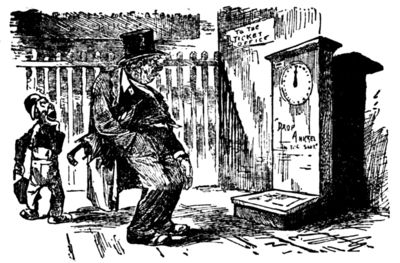
Lush—Gosh—hic—12 o'clock. Guess'll g'ome.
Young America (in the background)—Say, boss, drop in a nickel and weigh your load.
—Judge.
Had No Regrets.
"Johnnie, my boy, wouldn't you have liked to have been George Washington?"
"Naw."
"No? And why?"
"He never seed a baseball game in his life."
—Nebraska State Journal.
About to Strike Dead Luck.
A small manufacturer, who had engaged in many local speculations, which had always turned out well, had become a person of some wealth thereby. He was rather past the middle age when he bethought himself of insuring his life, and he had only just taken out his policy when he fell ill of an acute disease, which was certain to end fatally in a very few days. The doctor, half hesitatingly, revealed to him his hopeless state. "By jingo!" he exclaimed, rousing up at once into the old energy, "I shall do the insurance company! I was always a lucky fellow!"
—N. Y. Press.
March Winds.
The devil makes the strong March wind That lifts the skirts too high; But angels send the whirling dust That blows in the bad man's eye.
—Life.
Reconciliation.
"Say, old man, why continue this coldness any longer? We haven't spoken to each other for two years, and because of a trivial quarrel."
"There is no reason why we shouldn't be friends. Of course, you were the aggressor in the quarrel, but I ask no apology."
"Oh, you're wrong. You started the row, you remember."
"No, I didn't. You killed my dog first——"
"Yes, but the hanged brute had been killing my chickens."
"It never killed one of them."
"It killed at least a dozen, and I'd shoot your other dog if it did that."
"And I'd pound the top of your head off for doing it."
"You couldn't pound one side of it."
"You're a liar."
"You're another."
"Come into the alley here and we'll have it out, you hound."
"I'll go you, you blear-eyed monkey."
—Lincoln Journal.
Confiding.
A Chicago gambler, whose first name was George, used to visit a Chinaman's establishment and smoke opium almost daily. One day he rushed into the place and said, excitedly: "Hip, loan me $10. Thanks. I'll come in and pay you to-morrow noon, if I'm alive," and out he went with the money. About three o'clock the next afternoon a friend of the gambler dropped in on the Chinaman and said: "Hip, where is George to-day?" and the confiding Celestial wiped his eyes with the corner of his blouse and replied: "George, him dead."
—Boston Globe.
A Nun-Like Girl and Her Mischievous Friend.
It was on the St. Jose train and two young ladies—one as serious and good as a little nun, the other with a black eye with the devil's own glint in it—sat behind the youngest minister in town. The quiet one held in her hand a purple pansy so large that it attracted the attention of the young minister. While he was still looking at it the train rushed into a tunnel. The black-eyed young woman grabbed the pansy in the darkness from her companion, and leaning over, dropped it into the lap of the godly man. When the train reached daylight again the young minister had turned, and with the pansy in his hand was glaring reprovingly at the nun-like girl between whose fingers he had seen the flower. Her face was blazing and her downcast eyes seemed to confess her guilt. The whole car snickered and the malicious black-eyed girl read her book unconsciously.
This is why the young minister preached on the iniquity of flirting, yesterday.
—San Francisco Examiner.
Very Serious.
"Husband, I've got a very serious thing to tell you."
"What is it, Laura?"
"Oh, it's dreadful, it's about Johnny."
"What has he been doing?"
"Well, he came into the house this morning, and what do you think—he was chewing tobacco."
"Pshaw! Don't give me such a turn again, Laura. I didn't know but he had been chewing gum."
—N. Y. News.
A WOMAN AT BANK.
The Trouble she gives the Receiving Teller.
"I've got $10," says she, "and I want to open an account."
"With pleasure, madam. What is your name?"
"Simpkins."
"Christian name, please."
"Sophronisba."
"Any middle name?"
"Katherine."
"What is your age, please?"
"That's none of your business."
"Pardon me, madame, it is the rule of the bank to make these inquiries. I cannot go on without these inquiries. It is as necessary for your own protection as ours."
"Thirty-five, then."
"Are you married or single?"
"Now, look here, mister, you are impertinent. Do I look married? I'd like to see the man who'd marry me if he dared."
"Shall I write married or single? Be as quick as you can, please."
"Single, then. And, as I said, if you think——"
"Residence?"
"Right here in the city."
"Quite so, but the street and number, please."
"That's nothing to do with it. I don't want you to call, and if you dare to send a police to see——"
"What is the place and number?"
"Thirteen —— place. But I never saw anything like this in all my born——"
"Where were you born——"
"Same place, if you want to know."
"Have you an occupation?"
"Now see here. I suppose you want to know where I got this money. But I didn't steal it, if that's any satisfaction to you. Of course I——"
"What did you say your occupation is?"
"I didn't say; you didn't give me a chance. I keep the best boarding house in the town; meats three times day, and——"
"Please sign your name on this line."
"Sign my name? Don't you believe me? I never sign anything, only——"
"Very well, if you can't write, make your cross."
"Make me cross? That's just it, you make me so cross I can't. Sophronisba Katherine Simpkins. There."
"That will do. Kindly make way for the next person."
"Oh, but mister, look here. What have you got it?"
"Got what?"
"The age."
"Thirty-five."
"Does it make any difference if it ain't right?"
"It might make a serious difference."
"Oh, dear! Oh, dear, I've gone and perjured myself. But it's all your fault, you horrid man, you flustered me so. Did I say thirty-five? I didn't mean it. It's forty-five, so there."
And away she goes in a state of great indignation and perplexity.
—Burlington Hawkeye.
An Effective Mule Invigorator.
While traveling in Virginia some time ago with a doctor we came upon an old colored man who was standing by a mule hitched to an old two-wheel vehicle. "Dis mule am balked, boss," said the old man; "an' I'll jis gib a dollah to de man what can start 'im."
"I will do it for less than that, uncle," said the doctor. He took his case from the carriage and selected a small syringe, which he filled with morphin. He went to the side of the mule and quickly inserting the syringe in his side pushed the contents into the animal. The mule reared upon his hind legs and giving an astonishing bray started down the road at a break neck speed. The aged colored man gave a look of astonishment at the doctor, and with a loud "Whoa!" started down the road after the mule. In the course of ten minutes we came up to the old man standing in the road waiting for us. The mule was nowhere in sight.
"Say, boss," said the darky, "how much you charge for dat stuff you put in dat mule?"
"Oh, ten cents will do," laughingly replied the doctor.
"Well, boss, heah is twenty cents. Squirt some of dat stuff in me. I must ketch dat ar mule."
—Philadelphia Press.
The racy flavor of much of the recent news from the New England States shows that the cider of the vintage of 1889, which lurks in the gallon jug behind the door, is beginning to get a head on it.
—Chicago News.
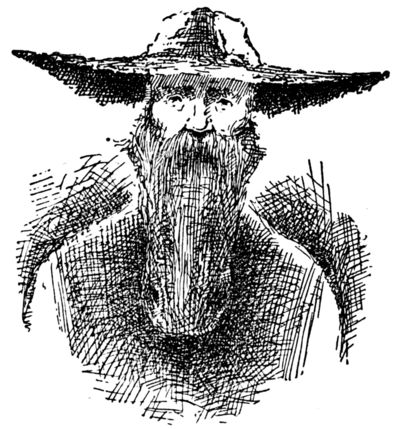
This is a photo of a gentleman employed by Chief Hubbard as a Chicago detective.
That man's policy was wiser who catching his son taking a whiff or two from a cigar, merely insisted on his finishing it, standing by him until he had done so. The succeeding two hours were never forgotten.
—Tobacco Leaf.
That the moral nature of the pig is essentially mean and selfish is proven by the fact that he is always willing and ready to "squeal" when he gets into a tight place.
—Baltimore American.
After six months' service he looks just like the rest of 'em.
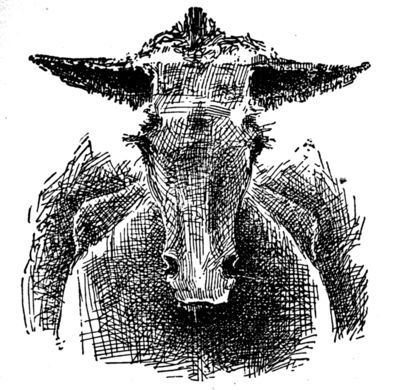
—Chicago Liar.
The New York Prohibitionists have formally condemned recklessness in the conduct of the Pension Bureau. It is a good place to introduce a little temperance.
—Boston Herald.
He Got the Trousers.
Husband—You want a bonnet and I want a pair of trousers, and I have only got ten dollars.
Wife (sobbing)—You don't suppose I can get a bonnet for ten dollars, do you?
—Clothier and Furnisher.
A Curiosity.
Heard in an elevated car: "That man must be a saint."
"What makes you think so?"
"Because he almost broke his fingers trying to raise that window and he didn't swear at all."
—N. Y. Morning Journal.
Clean in the Faith.
"Yas, sah, Mr. George," said an old negro, "we got ter keep clean; we got ter keep clean, sah, or dar ain't no hope o' de salwation."
"Why, then, don't you go and wash yourself?"
"Whar—whar—what, sah? W'y doan I go wash merse'f?"
"Yes, and put on a clean shirt. You are as dirty as you can be."
"Oh, now, yere, I ain't talkin' 'bout dat sorter keepin' clean. I waz talkin' 'bout keepin' clean in the faif, sah, in de faif. I ain't got no time ter fool erlong wid de waters o' dis yere life. Whut I means is ter keep yer speret clean, washed in the dewdraps o' de New Jerusalem; means, as I tells you, dat we mus' keep clean in de faif, sah—keep clean in de faif."
—Arkansaw Traveler.
A Large Party.
Crimsonbeak—I expect a large party here to-day.
Yeast—Indeed! Who's coming?
"My uncle."
"Who else?"
"No one else."
"But you said a large party."
"Well, my uncle weighs 350 pounds."
—Yonkers Statesman.
MRS. FLYNN AND THE GOAT.
The Lady's Stirring Narrative, with Spring Lamb Trimmings.
Mrs. Flynn relates with much pathos an incident in her life, that graphically illustrates woman's trustfulness and man's perfidy.
"Oi waz in the market wan mornin' lookin' fer some mate, an' a Dootch butcher axed me how an illegant bit av Spring lamb wad soot. Oi sed it wad do af it waz good, an he sed it waz the best in the market or he wudn't be offerin' it to a lady loike meself. Oi'm fond av Spring lamb, an so Oi took a hunk av it home an' cooked it fer me ould mon an' meself.
"May the divil take me av it tasted roight. It had a sort av a rank an romantic flavor thet Oi niver kem across afore, an' heaven help me, may Oi niver come across it again.
"Oi kept me jaw to meself, and said nathin'. After dinner the ould mon said the Spring lamb tasted kin o' quare an' he wondered had Oi cooked the baste enough. Oi said Oi had cooked the baste joost roight, an' Oi saw nathin wrong wid the taste av it.
"Whin the ould mon had gone out to wurruk, Oi tuk a luck at the chunk av mate that was left, an' phat do you tink Oi saw? A bit av the skin av the varmint, an' it had hair on it instead of wool, begorra. The thavin' Dootchman hed sold me goat instead av lamb! Bad luk to him!
"Oi coodn't affoord to lose the mate, d'ye see, an' so Oi kept me jaw to meself an' said nothin agin. Oi stewed it up wid spices and tings to disguoise the taste, an' we had it agin fer supper. Oi told the ould mon Oi didn't care fer enny Spring lamb fer supper, but it wuz very beautiful cooked up wid spices, an he needed plenty av mate now that he wuz wurkin' wid the Park Commishioners. He ate awhoile, an' thin he said the Spring lamb tasted kind o' quare, an' he thought it wuz too high-toned fer us.
"'Now, me darlint,' Oi said, 'the Spring lamb is a little high-toned, but it is none too good fer the loikes av us, an' ye moost ate hearty so ye can do good wurruk fer the Park Commishioners.'
"He said the Park Commishioners be blowed, an' he cood do good enough wurruk fer them on roast bafe, an' wad Oi git roast bafe the nixt toime?
"Oi said, 'My darlint, av coorse Oi'll git roast bafe the nixt toime, but we moost ate all the Spring lamb foorst.'
"Well, ye see it took me hoosband several days to git away wid the Spring lamb, but he foinly got trough wid the job, an' thin Oi took the bit av skin wid the hair on, phat Oi had saved as a guarantay av good faith, an' Oi wint down to the market. Oi hoonted up the beautiful Dootchman, an' sez Oi:
"'Have you enny noice mate this mornin', Dootchy?'
"'Phat koind wad you loike this mornin', Mrs. Flynn?' sez he.
"'Oi ate nothin' but the best,' sez Oi.
"'How wad a noice bit av Spring lamb soot?' sez he.
"'Tanks,' sez Oi. 'Spring lamb is a bit high-toned fer me. Oi'll take a foine large steak av ye plaze.'
"'About how large?' sez he.
"'About tin pounds,' sez Oi, 'an' a foine juicy wan, av ye plaze.'
"So Oi tuk the steak an' takin' a good grip av it, Oi slammed it around his big Dootch ears till he yelled bloody murther in fourteen languages. 'The nixt toime ye sell me goat fer Spring lamb, ye thavin' Dootchman'—an' Oi kept bastin' him around the ugly lugs—'the nixt toime ye sell me goat, Oi say, Oi'll make ye ate his whuskers.'"
—N. Y. World.
Sam Wellerisms.
"It is a paneful sight," as the man said when his host took him out to inspect his new conservatory.
"You are a counter attraction," as the masher whispered to the pretty girl in the confectioner's shop.
"Teeth inserted without gas," as the fellow who owned a savage dog inscribed on a board outside his garden gate.
"He is suffering from organic diseases," as the doctor observed when he was called in to prescribe for a man who had been driven wild by a peripatetic piano-organ.
"She is painted by Heaven," as the enthusiastic young man exclaimed when he beheld a girl with a beautiful complexion.
"This is a sloe meeting," as one husband remarked to another at the tea fight which their wives had compelled them to attend.
—Judy.
Accounting for the Edition.
Enthusiastic Friend—Ah, how d'do, Charlie? Gone into literature, I see. Quite a book of yours. I bought a copy yesterday.
Author (thoughtfully)—Now, if I could only find out who bought the other copy!
—N. Y. Evening Sun.
Twenty-five Cents Ahead.
A story is told about a Kingston minister's marriage fee that causes amusement among the clergy. He was paid $1 for marrying a couple. After they departed he was about to hand the money to his wife, when the door bell was rung. The newly-married wife said she wanted a certificate. No marriage was good without one. It cost twenty-five cents for a blank that would suit her. The reverend gentleman filled the blank out in the usual form and she went away seemingly satisfied. A few days later she again appeared at the door. "Mister," said the woman in an aggrieved tone, "I looked through the papers and can't find a notice of our wedding. You ought not to treat us different from other folks." So the dominie went to a newspaper office and paid fifty cents to have a notice inserted. When he reached home he handed the remaining twenty-five cents to his wife with the remark: "Here, my dear, hurry and take this before that woman makes another call."
—Kingston Freeman.
Not Very Flattering.
"Mighty fine woman I saw you lifting your hat to back there, old boy."
"Yes, rather."
"Some mash of yours?"
"Yes."
"Couldn't introduce a fellow, eh?"
"Might, if you'll come up to the house some evening."
"Oh! your wife?"
"Yes."
"Pshaw! I supposed it was your cook."
—Detroit Free Press.
Two Kinds of Bands.
"Pap, did you ever hear music from a rubber band?" said Johnnie.
"No, my son, never. What in the world do you mean. Is it a lot of rubber figures that you blow up and then do they play music?"
"Naw, pap. Come out in the next room and I'll let you hear some music from a rubber band."
The old gentleman becoming interested, laid down his paper, wiped his glasses, and followed his son into the next room, where Johnnie had a rubber band stretched from one side of the wood box to the other, which he began to pick with his finger. "Now, pap, you can say that you have heard music from a rubber band."
"Yes," said the old man, "and I will be able to add that I have caused music by a leather band," and suiting the action to the word, he reached around for a strap, and before John knew it he felt as if eight million rubber bands were snapping him where his pants fit the tightest.
—Liverpool Post.
It Hurt His Feelings.
Kansas Tramp—Mister, could you do a little something to assist a poor man?
Stranger—You don't look as though you were unable to work. You ought to be ashamed of yourself to go around this way. You are a disgrace to humanity. Why don't you go down to the river and take a bath and try to earn a living?
K. T. (pathetically)—Take a bath. Ain't it enough to have to drink the stuff?
—Merchant Traveler.
The young ladies at the Delaware Water Gap had a "paint and powder party," one night recently, each maid appearing painted and powdered. There doesn't seem to have been any thing save the name to distinguish it from any other party attended by young ladies.
—Norristown Herald.
Young Man of Killarney.
There was a young man of Killarney, Who was chock full of what is called blarney. He would sit on a stile, And tell lies by the mile, Would this dreadful young man of Killarney.
—Pick-Me-Up.
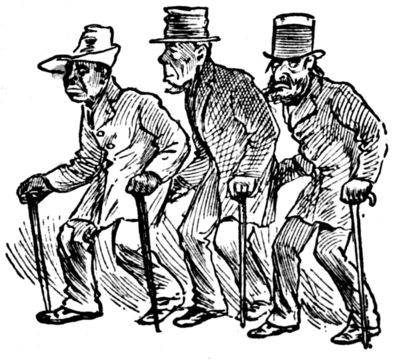
THE ELIXIR OF LIFE.—By H. C. R.
1.—On the way to be infused.
Just Discovered.
Assistant (to magazine editor)—I see this young Miss —— is making herself famous through the medium of the newspapers.
Magazine Editor—Yes—um—haven't we got a story of hers sent in four or five years ago?
Assistant—Yes, sir.
M. E.—Run it in this month and give a page editorial to "A Newly Discovered Genius."
—St. Paul Pioneer Press.
A Blush Absorber.
Housewife—Your impudence amazes me. I infer by your nose that——
Tramp—Ah, madam, you do me great wrong. I do not drink. My nose is simply a blush absorber.
—Detroit Free Press.
2.—TWENTY-FOUR HOURS LATER.
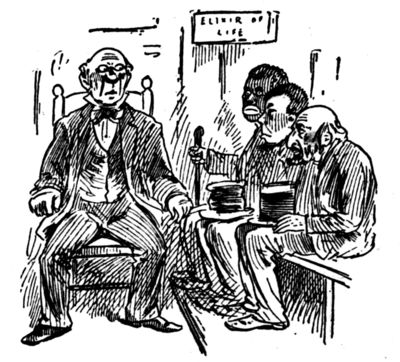
Doctor—Now, gentlemen, how do you feel, one at a time, please?
Darky—I feels gay, boss. Chickens better roost high to-night.
Hebrew—So help me, Abraham, I vould give a quarter for a job lot of dat stuff.
Irishman—I fale loike kicking the stoofin out of Branigan's bull pup.
An Unpardonable Error.
Father—Mr. Sand, the grocer, tells me he discharged you for swindling him. This is a terrible disgrace to the family.
Son—I couldn't help it, father. He gave me some lead to put under the scales, and I made a mistake and put it on the wrong side.
—Life.
Too Dangerous.
Uncle—Bobby, don't you hear your mother calling you?
Bobby—Yes'r.
"Well, why don't you hasten to her?"
"Why, ma has heart disease and she'd be surprised most to death if I answered the first time she called me. Besides, this game of marbles must be finished."
—Omaha World.
3.—LATER ON.
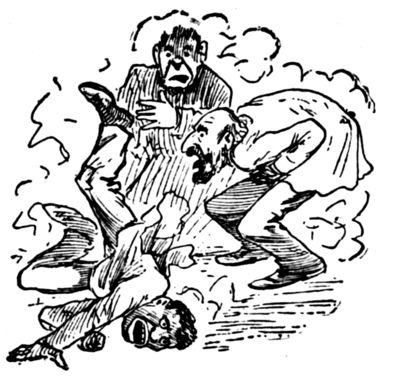
Three new recruits for the golden shore.
Times Have Changed.
Long ago there was a time when Sir Walter Raleigh laid his cloak over a puddle, so that the royal Elizabeth might go on her way dry-shod.
In similar circumstances, Queen Victoria would be lucky if she could elicit from the gilded youth of the present day the languid cry of "Skip the gutter, old lady!"
—Harvard Lampoon.
From the Oklahoma "Snorter."
The Oklahoma Snorter, in its last issue, contained the following breezy locals:
Jim Highbee has secured the beautiful lot at the corner of Bullwhacker avenue and Kill'emquick street, and has begun the erection of a tent thereon. This lot formerly belonged to Dick Skinner, but he gave it up at the same time he give up his life. Col. Jim is a good shot.
We are glad to learn that our friend Dan Bunker has at last come into possession of a choice lot. Dan killed the former claimant with his first shot. Dan is a rustler, and never does things by halves.
The report that the ten men found dead last night on Goosebristle Creek had been shot, proves a fabrication. They were the victims of congestive chills.
Wanted—Ten first-class grave diggers. Also, four or five more coffin makers. Must be willing to work twelve hours a day, but pay is large. Cophin & Son.
Subscribers must pay for this paper in advance. Life is too uncertain to take any chances.
Major Burdock, one of our gentlemanly undertakers, came up yesterday to see us. The Major is smiling, and says he never had more flattering business prospects. He is running a large corps of men day and night in order to keep up with his orders. He says he is prepared to make liberal terms with those who contemplate taking claims, if they wish to arrange in advance for burial.
There was quite a lot of freight received at the depot yesterday, consisting chiefly of coffins and guns.
Notice—We are prepared to bury boomers quicker and cheaper than any other house in the city. Send in your friends. We will take pleasure in burying them. Plantum & Co.
Real estate has changed hands rapidly the last few days. The new owners usually show their liberality by burying the former claimants.
Several Texans came in yesterday to locate claims. Our undertakers are watching the corners for a good harvest.
Food and ammunition are becoming scarce. We learn, however, that a carload of shot and powder is expected to-day.
First-class meals at all hours at Tremont hotel. Bean soup, fifty cents a dish; eggs, ten cents each (when we have them); water, five cents a glass. Call in second tent above the Snorter office.
We learn that our genial friend Dick Tucker has given up his claim and returned home. We are sorry to lose Dick, as he was one of the most cheerful and whole-hearted men among us. If he had known the claim was so worthless it is doubtful if he would have shot the man who held it down before him.
Bill Swanson was in to-day and reported that he had secured a fine claim just east of town. Of course he had to remove the man who was on it, but Bill did it neatly, and then paid the funeral expenses. There is nothing small about Bill.
—Time.
Herr Yager on the Marriage Question.
"Good evening, Neighbor Yager. What's your opinion about marriage being a failure?"
"Vell, I dinks it vas vone dem dings und it don'd vas vone dem dings. Vhen a man got him marriedt he got him marriedt; dat vas somedings sure; der don'd vhas some vailures about dot. Aber ouf him got a frau vhat vhas some dem Arisdodle's preed, vhat neffer done got dalkin', den dem marridges vas so pig failures as you marry some vomans vhat peen a brudder mit der teifel. Dot marridges vas some loddery dickets—dot vhas all luck vhat kind a frau youm gatch; shoost like dis: ouf dem vomans vas some fishes der sea in, und der vas one vone den-times goot vomans fishes derein, vhen youm a frau fishin' gone meppy youm vone dimes in a hunnert gatch vone dem goot fishes, aber not more as dot."
"Did you catch one of the good fishes, Herr Yager?"
Then Herr Yager looked back at the front windows of his residence and remarked in a kind of graveyard tone:
"I seen you lader."
—Kentucky State Journal.
Attached.
"I love you well," the stamp exclaimed, "Dear envelope so true, In fact it's evident to all. That I am stuck on you."
—Minneapolis Tribune.
Not Saving His Bacon.
It is related that Sir Nicholas Bacon was about to pass judgment upon a man who had been guilty of robbery, at that time punishable by death; but the culprit pleaded for mercy on the ground that he was related to the judge.
"How is that?" he was asked.
"My Lord," was the reply, "your name is Bacon, mine is Hogg, and hog and bacon have always been considered akin."
"That is true," answered Sir Nicholas; "but as hog is not bacon until it has hung, until you are hanged you are no relation of mine."
—Chiel.
Her Attraction.
There's something attractive about her: It isn't her beauty of face, It isn't her ribbons of lace, But there's something attractive about her, And I swear that I can't live without her, And that is the state of the case. There's something attractive about her, It isn't her glance or her smile, It isn't her elegant style; But I'm poor and I can't live without her, For that something attractive about her, You know, is the size of her pile.
—Boston Courier.
Deaf But Sensible.
Traveler (in buggy)—This is a hot day.
Old Farmer (in a potato patch)—Speakin' to me?
Traveler—This is a hot day.
Old Farmer (coming to the fence)—What did you say, mister?
Traveler—I said this is a hot day!
Old Farmer (climbing the fence and approaching the buggy)—Beg pardon, I'm a little hard o' hearin'. What is it?
Traveler—I merely said that this is a hot day.
Old Farmer—Oh, go to thunder!
—Owl.