Part 3 — CHAPTER IV HEALING BY FAITH
Reading edition
Two things play an important part in the family life of Persia. The first of these, the yearly almanac or taghvím is studied with a pathetic trust by all. In a day that has been marked unlucky they see the frustration of their hopes and prayers, however perseveringly they may strive, by earnest effort, to elude the working of the fateful stars and to bring about the consummation of their wishes. “The most blessed hour for prayer,” I was told by one of them, “is when the planet Jupiter is in conjunction with the culminating point of the firmament.” And when I began to argue with him, he said in astonishment: “Have you no faith in estakhhareh either?” I replied: “If you can prove to me by any passage in the Kurán that God will lend his advice to the Muslim who shall consult Him through the beads of a rosary, I will believe in the taghvím, the estakhhareh, or any fáll or omen you care to mention. But, first, let me be sure that I understand the method of making an estakhhareh. Having read a verse of the Holy Scriptures, you place the finger on a bead, then, counting the beads from that point to the nearer end of the thread, you believe that God will grant you your heart’s desire provided the number be odd, but that He will refuse your request if it be even. Am I right?” “Certainly,” he replied; “for if my prayer be reasonable and I deserving in the sight of God, He will assuredly guide my hand.” “It is obvious,” I retorted, “that God can and does guide His slaves; but I deny that He shares your belief in the luck of odd numbers. Let the Prophet be my intercessor. This is what he says:
“‘Do ye acquire knowledge, for he who acquireth knowledge in God’s service performeth an act of piety; he who giveth utterance to it praiseth the Lord; he who is diligent in search of it worshipeth God; and he who imparteth it offereth sacrifice to Him.’ Now, your faith is rooted not in knowledge, but in superstition. Look around you, and you will see the wonders of God in the working of laws immutably just, eternally the same. I tell you that action and reaction are equal and opposite, that the ordered weal and woe are the results of our own actions good and evil, and I advise you to put on the armour of knowledge in the desert less you fall a victim to the superstitious of whom you now are one. ‘The ink of the scholar,’ the Prophet tells us, ‘is more holy than the blood of the martyr.’”
My opponent, however, remained unconvinced. He assured me that his spiritual director would not dream of wearing a new ’abá without first consulting the taghvím, nor would he take it on himself to administer a dose of medicine to a sick child without asking God, through the beads of his rosary or the pages of the Kurán, whether the remedy would be efficacious or not. Of the progress of medical science the Shi’ah pilgrims knew nothing.
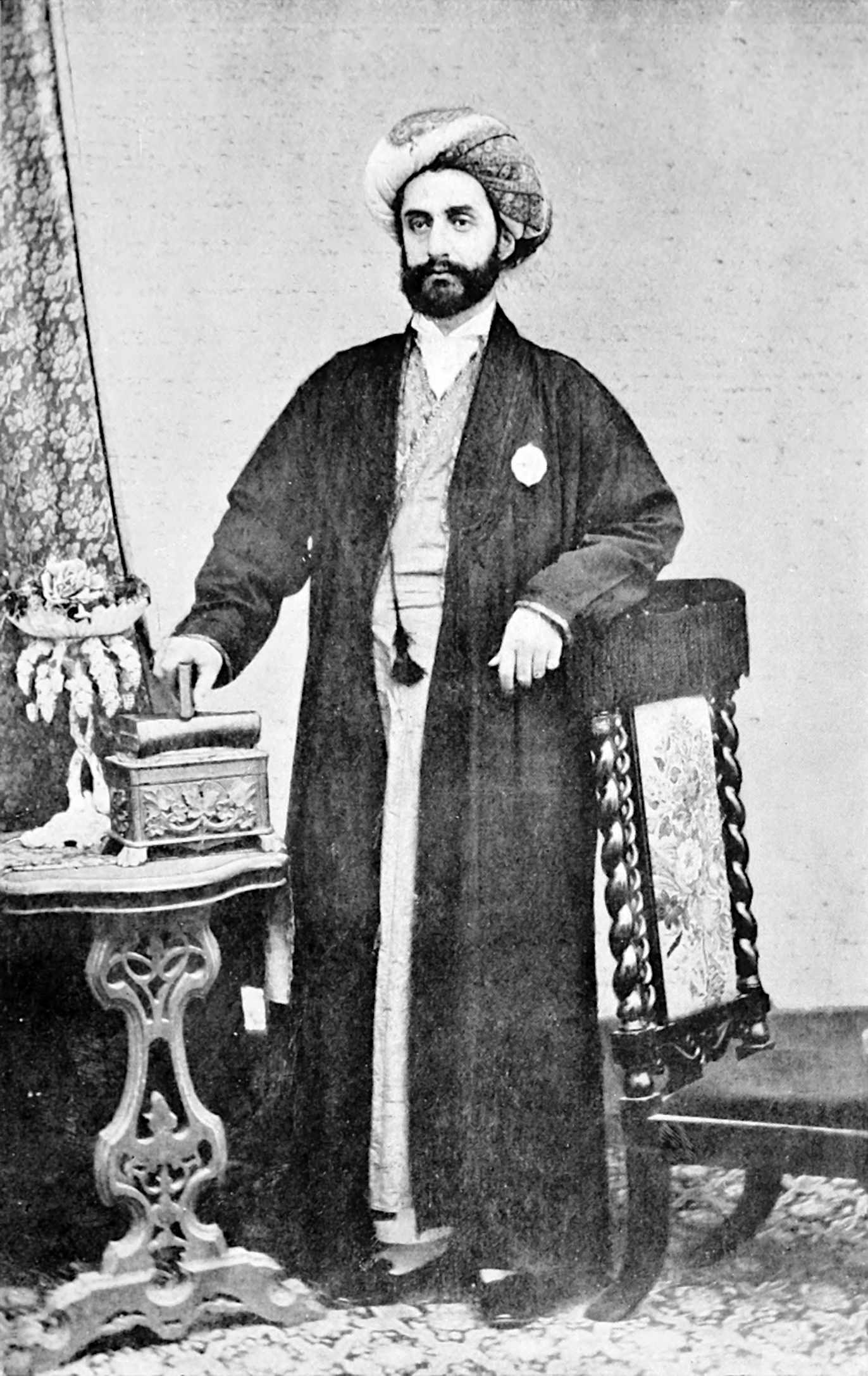
A PERSIAN PROFESSOR OF THEOLOGY.
Galen and Avicenna are still regarded as the leading masters of the profession, and their treatises are the only ones that are studied. Diseases are divided into hot and cold. A cold remedy is applied to a hot disease, and a hot remedy to a cold one. The doctors bleed patients suffering from malarial fever. They keep small-pox endemic by their curious remedies. Silver armlets containing texts out of the Kurán are worn as preservatives of health. The saints and estakhharehs are sometimes the only doctors. “The One who sends fever takes it away ... Khodá rahím ast (God is merciful).... If He wants me to remain here He will cure me.... He is the best doctor.” Offerings in money or in sweet-meats are given to the poor for the patient’s recovery. The money is placed under the pillow every night, and is distributed every morning among the needy. The patient, despite the stifling atmosphere, is persuaded to believe in a speedy recovery, everybody telling him that he will soon be quite kushdell or cheerful. But when the end draws near a priest is summoned in haste, and the dying man, if he has no just cause of complaint against a child or against his wife, says not a word as to the distribution of his property, having full confidence that the divine law will be religiously followed. He instructs the priest as to the rites to be observed at his funeral and the offerings to be paid for the peace of his soul. He may command his sons to obey their mother and to respect their sisters. If he has no issue he may settle his property on a school, a mosque, a saint, or a water cistern.
The corpse must not remain more than twenty-four hours in the house. The hammámí, or bath-keeper, now enters the house in the capacity of an undertaker. He places the body on a korsi, that is, on a raised wooden platform in the middle of the room; a copy of the Kurán and a decanter of rose-water are set down near the head; and a cashmere shawl is laid over the remains. For a month or forty days after burial a ghari or hired priest keeps watch over the grave, praying for the soul’s peace of the newly-departed, and reading the Kurán aloud. On the night of the interment the percussion of the grave, the fesharé-ghabre, is supposed to take place. The priest must keep on reciting a certain passage of the Kurán, called Ayatu’l-Kúrsí or the Verse of the Throne, in order to extend the space and prevent the pressure. Then come Monker and Nakír—those livid-faced angels of death—and question the deceased concerning his faith. If his answers be satisfactory, ’Alí will cause him to be refreshed by the air of Paradise; if not, he will be beaten on the temples with iron maces.
The evening before I left Mecca for Jiddah I was suffering from a racking headache, and my friends advised me to consult a certain Arab physician. The curiosity to have an interview with this leech overcame my scepticism concerning his health-giving touch, so off I went to the east of the town where he dwelt, taking my guide with me; and there, in a winding lane some three feet wide, we found his house. My guide summoned the servant by banging at the outer door with his club. In about ten minutes what we judged to be a small urchin appeared behind the door and asked us in a piping treble what we wanted. Having assured himself that we were not Bedouin Arabs bent on pillaging the sacred house, he drew back the bars, bidding us enter in the name of God the Merciful and Clement.
The courtyard through which we passed was unpaved and not more than five yards square. The apartments—six fetid cells—ranged round three sides of it. The hakím’s room faced the door. We walked in with the greeting “Salám ’aleykum! Peace be unto you!” The faith-healer was seated cross-legged on a mat in a corner of the cell. He rose to receive us, saying “Bismillah! in the name of God!” the Eastern equivalent of “Please come in.” He was of middle height, lean, of a pleasing countenance; his eyes were deep-set, brilliant, smiling; his beard measured the span of a man’s hand; and his teeth flashed between lips framed for laughter. He wore a white handkerchief round his head, and a long blue gown reached to his ankles. Nothing could exceed the courtesy of our host. As a mark of respect, he insisted on my taking his place; my guide, heaving a “Yá-Allah!” and a sigh of relief, sank to my side on the left; while the sunny-faced saint, squatting at my right hand, turned a beaming eye on his trusty henchboy, who was standing in the doorway, waiting for the orders of his lord and master.
In the East they never break the ice of silence with a remark on the weather. The customary opening is to inquire if you are in health. I told the doctor, in answer to his question, that I had a bad headache, and had come to him to be cured. When he had raised his hands and cried out “Yá-Muhammad!” thereby invoking the Prophet to lend him the assistance he required, it was to ask me on which side the head ached. I touched the spot, whereon he fell to rubbing it vigorously with the palm of his right hand, calling out the while to the urchin to fetch the necessary apparatus for the forthcoming operation. The boy disappeared. In a few minutes he came back, bearing in both his hands a round hollow plate of clay in which were a few lumps of burning charcoal.
The next things he brought in were a couple of round iron rods about twice the length of an ordinary pencil, together with a cup filled with a black fluid used as ink and composed, if I mistake not, of a mixture of starch and the soot of an oil lamp. The doctor thrust the rods in the glowing charcoal. The fear of being branded bathed my brow in sweat. The doctor, assuring me that I had no cause to be afraid, cried out: “If we lose heart at the sight of these little rods, how much the more shall we suffer when we feel the weight of the maces of the angels of punishment. May God protect you from the fire of hell!”
The tips of the rods by this time were red-hot. Having dipped them in the cup of ink, he closed his eyes, and then raised his voice in an incantation that lasted several minutes. Not a single word could I understand. When it was over he opened his eyes, and, saying the word “Bismillah,” proceeded to draw with one of the rods on my right temple five perpendicular lines crossed by five horizontal ones, thus forming sixteen tiny squares. The same pattern was traced on the left temple with the second rod. Several magic hieroglyphics besides were inscribed in the same manner behind my ears and on the nape of my neck.
After every operation the good doctor would pause to ask me: “Is the pain gone now?” Four times did I tell him the truth; then, fearing that he would begin to tattoo my body, I assured the persevering little man that I never felt better in my life. His joy knew no bounds. Raising his hands to heaven, he cried, “Praise be to God Almighty, who hath sent to this poor family a power so miraculous. The secret was bequeathed to my father by the Lord God, and when my father died he left it to me as an inheritance. On no account must you wash off the signs until to-morrow morning; for if you do the pain will return to punish you. The blight of the Evil Eye was the cause of your headache. Go in peace. You are welcome.”
The following day I set out on my homeward journey, taking Seyyid ’Alí with me as far as Jiddah; and when I said good-bye to him I felt that I was losing an entertaining companion. That the reader may experience the same feeling of loss in parting from me is my dearest hope on bidding him farewell.
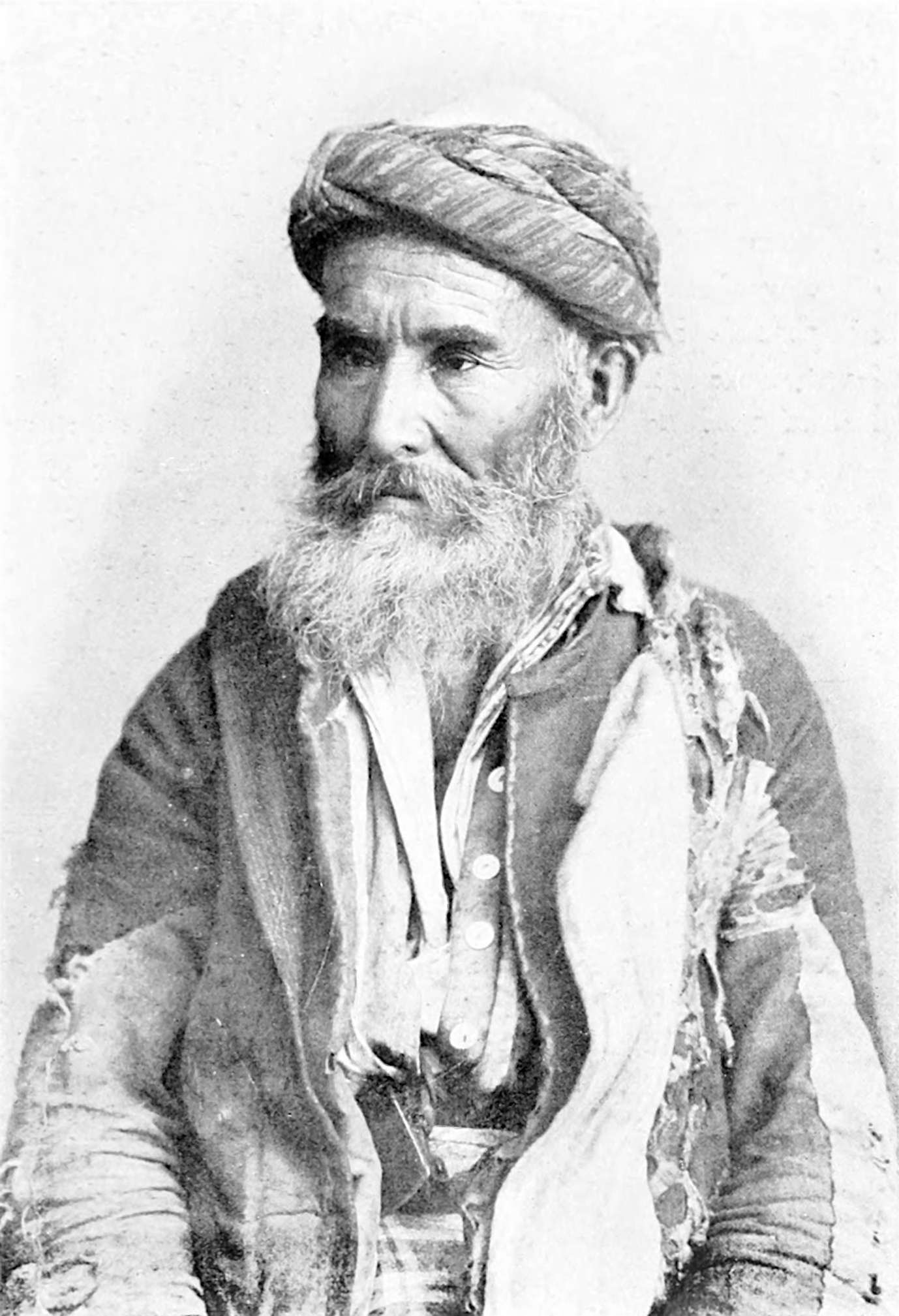
AN ARAB SHEYKH OF THE TOWN.
APPENDIX By WILFRID SPARROY
SOME REFLECTIONS ON THE EXISTENCE OF A SLAVE MARKET IN MECCA
I brought the notes of “Hájí Ráz” to a conclusion in the last chapter; and he himself has bidden the reader farewell. It now remains for me to say a few words on what I conceive to be the greatest weakness in the Mussulman faith as interpreted by the Mullahs; and in so doing I wish it to be understood, particularly by my Eastern readers, that I am solely responsible for the opinions I am about to express on the subject of the Mussulman’s attitude to slavery, the existence of which, in the fourteenth century of the Hegira, must be a source of some misgiving on the part of those who sympathise with so much in the Muslim creed. And I appeal throughout to the enlightened laymen of our Indian Empire, on whose interpretations of the Prophet’s message the welfare of Islám will, in the future, depend in an ever-increasing degree.
Now, the British are the champions of freedom: under their flag every man is born free. Nothing is more hateful, to their way of thinking, than that one human being should be the slave of another. In their opinion the quality of slavery is to brutalise both the slave and his master—the slave by depriving him of the self-respect which is the heritage of every man who is free to choose his own career and to rule, within the limits of humanity, his own destiny; and the master, by making him the owner of a human soul—a responsibility so awful that it is far more likely to lower him to the level of a beast than it is to raise him to the height of a god. If this, in brief, be a fair statement of the British attitude towards slavery, it will be interesting and, in a measure, enlightening to the reader to follow, by way of contrast, the argument supported by the ordinary Mussulman.
To be frank, the present-day followers of the Prophet—those who have not been brought under the influence of European civilisation—have far less sympathy with the opinions expressed in the opening paragraph, than had Muhammad himself. Humanly speaking, the British crusade against slavery is not only beyond their comprehension—it is also above it. Their outlook on life, with its rights, its limitations, and its responsibilities, differs fundamentally from that of the followers of the Founder of Christianity. The Christian, who speaks of himself as “a child of God and an inheritor of the Kingdom of Heaven,” believes, if we misinterpret him not, that the first step is with him, and the road with God. In other words, he holds the inspiriting belief, which is, indeed, the source of all his worldly progress and his prosperity, that God has given him the right to act of his own initiative, but not the power—or only a circumscribed power—to foresee whither his actions will lead him. Therefore, in calling himself “a child of God,” he has chosen the title that would best express his independence and his limitations. The Muhammadan, on the other hand, cannot admit that he has the power to move of his own free will, much less the right to do so. He holds that every true Muslim is, and must be, “the slave of God,” the theory of free-will being to the Muslim trend of thought so antagonistic that it has come to bear much the same meaning as lawlessness. Hence his aversion from Europe and all its ways. “How,” he asks, “can morality and law flourish in a continent, in which thought is free, in which women are free, in which God’s will is superseded by the will of man? Freedom? I say we are all the slaves of God, even when we are the slaves of other men. There is not one creature who is free to act. Only the Creator is free. It is our predestined lot to be submissive to His will.”
I hope the reader is following the thread of my argument. It is the feeling of the East which I would attempt to lay bare. The existence of slavery in these days is the natural outcome of that feeling. Many a child is kept illiterate for no other reason than because its father is illiterate. If the father is a pea-parcher or a bean-roaster, the son must be a pea-parcher or a bean-roaster; for a son is nothing more than a child of its father. This thraldom, to a lad of originality and spirit, is unbearable, but he must either endure it, or else run the risk of being an outcast. Thus the son is the slave of his father. In his turn the father is under the bondage of his spiritual director, who too often serves no other God than Mammon. The tendency of the Muslim, however, is to accept the guidance of his “master” with unquestioning humility. All might go well with him if his “master”—we mean his priest—were always a man to be trusted, and the right man to lead. Unfortunately the Muslim priest more often than not is more unenlightened, more selfish, more avaricious, more unscrupulous than most of his flock, and thus there is a danger of his enslaving the whole fold. Poor sheep, they, believing him to be the shepherd of God, are accustomed to follow him whithersoever he may ensnare them. They are doomed to perish together on the rock of Predestination, unless these “masters” can be brought to revise the interpretation they have put on their Prophet’s teaching. Muhammad, as a matter of fact, was careful not to draw a too narrow line between the scope and the limitations of the human will. There is nothing in his message which need deter a progressive Muslim from accepting the belief that the first step is with him always, and there is no doubt that the acceptance of such a belief by the whole Muslim world would go far to breathe new life into the body politic. For it would give to the imagination an ever-widening vision of human responsibility, of human knowledge, and of human destiny. It would emancipate every race that is proud to pay allegiance to the Prophet, and would make slavery, in its widest as well as in its literal sense, a curse of the unredeemed past.
“We know,” says Mr. J. H. Shorthouse, speaking in the words of an oracular voice, addressing the King of Diamonds in a pack of cards, “that we possess a power by which the fall of the cards is systematised and controlled. To a higher intelligence than ours, doubtless, combinations which seem to us inscrutable are as easily analysed and controlled. In proportion as intellect advances we know this to be the case, and these two would seem to run side by side into the infinite—law, and intellect, which perceives law, until we arrive at the insoluble problem whether law is the result of intellect or intellect of law.”
Now, the Mussulman, in trying to solve this problem, seems to me to have chosen the solution which is more likely than not to paralyse the intellect and clog the wheels of progress. For if he is oppressed or poor or ignorant or unhappy, he may say it is God’s will that he should be so; and thus he may remain stationary, making no effort to keep abreast with the march of civilisation. In other words, he may come to be a slave to his god. And so, to make an end of this preamble, it is not surprising that in countries where most men are to some extent slaves, socially and politically speaking, there should be men and women who belong, as purchasable and saleable chattels, to such families as can afford to buy them. But—and this is an all-important point—the Prophet wrought his manly utmost to mitigate the ill-effects of slavery: it flourished exceedingly, as every schoolboy knows, long before his time, and in other countries besides his own; but, thanks to Muhammad’s laws, the lot of the slaves of Islám was, and is still, immensely happier than was ever that of the slaves of pagan Rome or of Christian North America. It is related that Abdullah Ansari went one day to visit the Prophet, and received from him the following instructions; “On this the last Friday of Ramazán, you must devote yourself ‘to taking leave’ of the month, and to redeeming as many slaves as you can: and these things you must do in order that God may be gracious unto you.” The “leave-taking,” be it known to the reader, is practised every year, but the old custom of setting one’s slaves free on the last day of the congregation of the Muslim Lent has completely died out. However, though it was not possible for Muhammad to abolish slavery in a lifetime, the system being far too deeply rooted in the customs of the country, he fully realised the oppression to which the slaves had been subjected, and left nothing undone which would ameliorate their fate.
Thus, in Súra xxiv. of the Kurán, entitled “Light,” it is written: “And unto such of your slaves as desire a written instrument allowing them to redeem themselves on the payment of a certain sum, write one, if ye know good in them: that is, if ye have found them faithful, and have reason to believe they will fulfil their engagement; and give them likewise of the riches of God which He hath given you, either by bestowing on them of your own substance or by abating them a part of their ransom.” Some commentators believe the last admonition to be addressed not only to the masters but to Muslims in general, making it an obligation on them all to assist those who have obtained their liberty and paid their ransom, either by giving the ransomed slaves of their own stock, or by admitting them to have a share in the public alms. One of the Imáms, as we read in a Shi’ah book of traditions, put a very generous interpretation on the Prophet’s words; for on the approach of the Hájj Day he would buy as many slaves as he could afford to set free—a signal and heartening proof that Muhammad had not preached in vain. But, alas! in these modern days a slave is rarely allowed to buy his freedom—unless, indeed, he be utterly worthless as a servant—until such time as his master is dead. A good Muslim either releases his slaves on his death-bed, having no further use of their services, or makes provision for their redemption in his will. The money and the belongings which they may have amassed, as well as they themselves, are during his lifetime his inalienable property, and, therefore, on the first day of the moon of Shavvál he must, on paying his Zikkát (that is, one-tenth of his gross estate), include therein the purchase-price of his slaves and the value of their hoards.
Another instance of the Prophet’s solicitude for the best welfare of the slaves must not be omitted here. In his reverence for virtue he took such steps as would, to a certain extent, guard the female slaves from the indelicacy of their masters. If the masters have deteriorated morally, less than one might expect from the burden of their responsibility and the force of their temptation, dealing as far as in them lies with kindness by their slaves, what can be said in respect of morality of the unfortunate slaves themselves? In a play modelled on the European drama, an Oriental writer has chosen for his hero a Negro slave by name Pistachio, to whom he attributes the lowest traits of ignorance and cunning. Pistachio is the evil genius of the family. He turns the house into a secret gambling hell. He brings about a liaison between his master’s daughter and a suitor rejected by her parents; and, by winning his mistress’s favour, excites the apprehension and jealousy of her husband. Every act of treachery is committed under the cloak of folly. His perversity has no limit, and his ingratitude no end. Making every allowance for reasonable exaggeration, we have in Pistachio a type of what an Oriental slave too often is. For there is no manner of doubt that a man, born and bred in slavery, knowing next to nothing of the refining influence of education, is more apt to represent rather the worse, than the better, side of human character. Some slaves there are, doubtless, who, like Arab horses, are surpassingly faithful to their masters, but there are others—perhaps more numerous—who, in the effrontery of deceit and moral degradation could hardly be matched by the most thankless rascal in the sink of hypocrisy. Of the majority connecting the extreme types whose portraits I have sketched, two things may be said with almost unquestionable certainty. They are self-willed and effeminate when young, and indolent and self-willed when old. In their youth, provided they be good-looking, they are regarded with suspicion by their masters, if they are male, and with jealousy by their mistresses if they are female. They live, whether they be men or women, in the strength-sapping seclusion of the harems, and hence, for one reason, their lack of such qualities as go to the making of healthy manhood. For intellect they must be placed not much above the level of the dog—in fact, if the dog could speak, he would put in his claim to the higher rank.
I have hardly heard of a single slave in an Oriental house who deserves to be noted for his intellectual power. Since he is so cunning and can set the whole family by the ears, how comes it that he is so dull of understanding? Does the cause lie solely in the neglect of education? Surely not, for if it did his master’s case would often be no better than his own. Is the reason, then, to be sought beneath the surface of his skin? Scarcely, I think, since, under the British flag in South Africa, his brother blacks are gaining fast in intellectual strength. No; set your slave free; let him have a body he can call his own. Educate him that he may develop a mind to rule himself. Give him light, and room, and liberty. Do this, you master of Islám’s slave, and your jesters shall have no cause in the future to satirise the wretched victim who, bought in chains and reared in sloth, is nothing less than a living stigma cast on your manhood. If anything could emancipate your sense of justice, it would be a visit to the Slave Market of Mecca. Go there, see for yourself the condition of the human chattels you purchase. You will find them, thanks to the vigilance of the British cruisers, less numerous, and consequently more expensive, than they were in former years; but there they are, flung pell-mell in the open square—in crowds that clamour for a recrudescence of Muhammad’s attitude towards slavery.
One group, that of a mother and daughter, excited the sympathy of many pilgrims. The girl, unthinking, giddy, broke every now and then into shrill laughter. In her mirth, more terrible to witness than grief, it seemed as though she would while away the hours of exciting expectation. For the girl was bent on winning a master; slavery had for her no terror, a mother no reclaiming tie. Every time the daughter laughed her mother’s face twitched all over, and then grew rigid. It was plain, to the sympathetic eye, that she had forced herself to rejoice in her own anguish—her daughter’s unconcern, telling herself, it may be, that, though her own pain would soon be the greater, her daughter’s would be so much the less. The one, dreading the parting, disguised her secret anguish, or found her consolation in her child’s heartlessness; the other, who could not conceal her anxiety lest she should be overlooked, was innocent of a qualm. The dealer, standing by, cried out: “Come and buy, the first fruits of the season, delicate, fresh, and green; come and buy, strong and useful, faithful and honest. Come and buy.” The day of sacrifice was past, and the richer pilgrims in their brightest robes gathered round. One among them singled out the girl. They entered a booth together. The mother was left behind. One word she uttered, or was it a moan of inarticulate grief? Soon after, the girl came back. And the dealer, when the bargaining was over, said to the purchaser: “I sell to you this property of mine, the female slave Narcissus, for the sum of £40.” “And I,” replied the pilgrim, “agree to pay you £40 for your property, Narcissus.” Thus the bargain was clinched. This time the mother’s despair was voiceless; for it meant to stay with her always.
Most of the slaves, male and female, came from Nubia and from Abyssinia, and these are said to be the most faithful. “Hájí Ráz” tried his best to determine the extent of the traffic at Mecca, but in a country where the census is unknown, where every nobleman is an independent ruler, and where the revenue cannot be calculated with any degree of accuracy, he found it impossible to form even a working hypothesis as to the number of human beings that are sold yearly in the city of God. That the trade by sea is on the decrease is certain; but many a slaver escapes from the clutch of the British cruisers owing to the shallow waters of the Red Sea and to the fact that the pursuer cannot go ashore. Moreover, the overland route is always open. Thus he was told that the generality of the richer pilgrims commemorated the sacramental journey by buying at least one slave, and often two. The price varied. A woman-slave, if she were good to behold, fetched by far the higher price—from £20 to £80. Men slaves could be bought for sums varying from £15 to £40. The children-in-arms were sold with their mothers, an act of mercy; but those that could feed themselves had to take their chance. More often than not they were separated from their mothers, which gave rise to scenes which many a sympathetic pilgrim would willingly forget if he could.
It is the custom among the Muhammadans to change the names of their newly-acquired property. Thus the slaves that go to Persia and to Central Asia are called by the names of the flowers if they are women, and by those of the precious stones if they are men. Of the precious stones Turquoise and Cornelian are the most common. Flowers and precious stones! Are they not men and women, O children of Islám, and if they are, why do you not restore to them, in accordance with the express commands of Muhammad, the Prophet, the breath that would reanimate and the light that would redeem them?... “But zeal outruns discretion. Here I end.”