Chapter VII · (continued 2)
Reading edition
"Such were the scenes and conditions that greeted us in Epinonville. There was work a-plenty awaiting us, and we lost no time in taking possession of a shack for our outpost of the American Red Cross. We quickly unpacked our supplies and moved into it. McGinnis had a rather formidable job of making some twenty gallons of cocoa, while I, equipped with cookies, cigarettes, and canteens filled with water, did what I could for the wounded in and around the dressing station.
"Late in the afternoon it became necessary for me to return to our dugout in the woods for supplies which we had been unable to bring in on the first trip. So, leaving McGinnis to take care of the dressing stations, I started back, taking with me a load of wounded men for whom no ambulance was available. Our route took us over a dilapidated plank road through the narrow valley between Epinonville and Véry. We had covered perhaps half of this road when Fritz began a bombardment of the valley which lasted fully fifteen minutes. A French artillery outfit was moving ahead of us at a snail's pace and we could not pass it because of the narrowness of the road. Some of the shells were breaking close at hand, showering the car with shrapnel and fragments, but there was no way I could remove the wounded to a place of safety. There was nothing to do but pray for luck and keep going as fast as the slow-moving artillery ahead would permit. Several men within our sight were hit during those fifteen minutes, but fortune favored us. Not one of our men was even scratched and I delivered my load safely at the triage at Véry.
"Arriving at Epinonville late that evening I worked at the dressing station most of the night, serving hot cocoa, cookies, and cigarettes to the wounded and the men who were working for their comfort. During these first days there was hardly any food, and the doctors worked continuously day and night with only such sleep as they could snatch for a few minutes at a time.
"During the sixteen days that the Division was in the front line after we went into Epinonville, our first attention was given to the dressing stations and the wounded. As fast as new stations were opened at farther advanced points, we reached them with our cocoa and cookies. The ordinarily simple task of making cocoa became, under the conditions which we faced, a huge job. We usually made enough at a time to fill our four five-gallon thermos containers and almost always we had to do the work ourselves. Water was always scarce and to get enough of it was a problem. Wood had to be cut and fires made and handled with the utmost caution so that no smoke would show.
"Other conditions aside from the danger that constantly threatened were equally difficult. The weather was awful—cold and rainy, with deep mud everywhere. Eating was an uncertain and precarious proposition. The shack that we called home was—well, you would hesitate to put a dog in it in normal times.
"Our most interesting work generally was done under the cover of darkness. For instance, there came a night when we particularly wanted to reach Company K of our 128th Infantry. One of its cooks offered to go with us as guide, and so, with our car loaded with hot cocoa, cookies, cigarettes, sweet chocolate, and chewing tobacco, we left Epinonville shortly after dusk. A mile or so out we diverged from the road, our route then taking us across the shell-torn fields, with only a faint footpath to follow. Of course no light was possible and a blacker night there never was. Tommy—the company cook—and McGinnis walked immediately in front of the car indicating the course I should take. We continued thus until we had penetrated beyond some of our machine-gun positions. Ahead of us and back of us and all around us shells were bursting. The sing of machine-gun bullets was in the air. Our mission seemed hopeless, but we knew that those boys of Company K had been lying in the shell holes and the shallow dugouts for two long days with little to eat, drink, or smoke. We determined to reach them. Star shells were lighting the fields ahead of us, and finally we dared not proceed farther with the car for fear it would be seen and draw fire. Figuring that we could get a detail of boys to come back for the cans of cocoa and other things, we left the car in the lee of a hill and went ahead on foot, taking with us what we could carry in our pockets and sacks. K Company had shifted its position, however, and we could not locate it. We distributed the stuff we had with us to the soldiers we passed and then returned to the car. Here we sought out the officers of the outfits lying nearest us and gained their permission to let the men—a few at a time—come to the car, where we served them until our stock was exhausted. Most of these men were from the 127th. Some were from a machine-gun battalion. These boys for several days had been dependent upon their 'iron rations.' Mere words cannot express their appreciation of our hot cocoa and other things. I recall that our chewing tobacco made a great hit with them. They could not smoke after dark and welcomed something that would take the place of smoking."
Enough of the incidental detail of the Red Cross worker. I think that you have now gained a fair idea of what his job really was; of not alone the danger that it held for him at all times, but the manifold discomforts, the exposure, the almost unending hours of hard, hard work. Multiply Red Cross Kellogg by Red Cross Jones and Smith and Brown and Robinson—to the extent of several hundreds—and you will begin to have only a faint impression of the magnitude of concerted work done by the men of our American Red Cross in the battlefields of France in those fall and summer months of 1918. A good deal has been written about the Red Cross woman—before you are done with this book I shall have some more things to say about them, myself. A word of praise at least is the due of the Red Cross man. They are not the shirkers or the slackers that some thoughtless folk imagined them—decidedly not. They were men—generally well above the army age of acceptance, even as volunteers—who found that they could not keep out of the immortal fight for the freeing of the liberty of the world.
Take the case of Lieutenant Kellogg's right-hand man—now Captain McGinnis. He was a Coloradian and nearly fifty years of age when the United States entered the World War. He is not a particularly robust man, and yet when we finally did slip into the great conflict, it was this Red Cross McGinnis who recruited an entire company of infantry for the Colorado National Guard and was commissioned a first lieutenant in it. When the National Guard was made a part of the Federal Army, McGinnis was discharged. He was too old, they said.
The man was nearly broken-hearted; but his determination never wavered. He was bound to get into the big fight. If the army would not have him there might perhaps be some other militant organization that would. There was. It was the Red Cross—our own American Red Cross if you please. And what McGinnis, of Colorado, meant to our Red Cross you already have seen.
Multiply the McGinnises as well as the Kelloggs and you begin once again to get the great spirit and power of the Red Cross man. Danger, personal danger? What mattered that to these? They consecrated soul and spirit, and faced danger with a smile or a jest, and forever with the sublime optimism of a youth that will not die, even though hair becomes gray and thin lines seam the countenance. And now and then and again they, too, made the supreme sacrifice. The American Red Cross has its own high-set honor roll.
After the signing of the armistice, Kellogg's beloved Thirty-second Division was one of those chosen for the advance into the Rhineland countries. It had fairly earned this honor. For in those not-to-be-forgotten twenty days of October that it had held a front-line sector, it had gained every objective set for it. Therefore it was relieved from active duty on the twentieth and sent back to the Véry Woods in reserve. But Kellogg and his fellows were not placed "in reserve"—not at that moment, at any rate.
They found "their boys" tired and miserable, living in the mud in "pup tents" and greatly in need of Red Cross attention and assistance. Finally, on the twenty-eighth and under the insistence of their commanding officers, Kellogg and McGinnis went back to Bar-le-Duc for five days of rest. They needed it. There was a Red Cross bathing outfit at Bar-le-Duc, and the two men needed that also. It had been more than six weeks since they had even had an opportunity to bathe.
Armistice Day found the Thirty-second in actual fighting once again and Kellogg and McGinnis with it—by this time one might almost say "of course." It was located in and about Ecurey and kept up the fighting until the fateful eleven o'clock in the morning set for the cessation of hostilities. The Division remained at Ecurey for just a week after the signing of the armistice. Then it began its long hike toward the east, passing through Luxembourg and down to the Moselle at the little village of Wasserbillig, where it arrived on the twenty-ninth day of November.
Kellogg, McGinnis, and some other of our Red Cross men—to say nothing of a big Red Cross truck—kept with it. While it had been assumed by the Paris headquarters of the American Red Cross that it would be impossible to serve the boys on their long march into the occupied area and so no provision was made for the forwarding of comfort supplies, as a matter of actual fact there was a good deal that could be done—and was done.
In such a situation was Red Cross opportunity, time and time and time again. And if Paris for a little was neglectful of the fullness of all of it, our Red Cross men who were at the Rhine were not—not for one single moment. They were on the job, and, with the limited facilities at hand, more than made good with it. One single final incident will show:
On the morning that the Thirty-second swung down into Wasserbillig from the pleasant, war-spared Luxembourg country and first entered Prussian Germany, the Red Cross men with it found that two of their fellows—Lieutenants R. S. Gillespie and Robert Wildes—were already handling the situation. These men had previously been engaged in similar work at Longwy, and had been sent forward with a five-ton truck, loaded with foodstuffs, for such returning prisoners—and there were many of them—as the Thirty-second might encounter on its eastward march. Under Lieutenant Gillespie's direction a canteen already was in operation at the railroad station there in Wasserbillig. Equipped with a small supply of tin cups, plates, and the like—to say nothing of several stoves—it was serving soup, bread, jam, beans, bacon, corned beef, and coffee. The prisoners (soldiers and civilians—men, women, and children, and many of them in a pitiable condition) came through from Germany on the trains up the valley of the Moselle. They had a long wait, generally overnight, in Wasserbillig. And there the American Red Cross fed them by the hundreds, and in every possible way ministered to their comfort.
It saw opportunity, and reached to it. It saw a chance of service, and welcomed it. The record of its welcome is written in the hearts and minds and memories of the boys who marched down the valley of the Moselle, through Treves and Cochem, to Coblenz. From those hearts and minds and memories they cannot easily be erased.
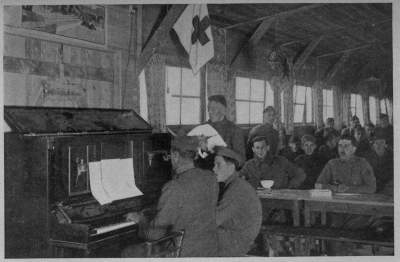
TICKLING THE OLD IVORIES Many an ancient piano did herculean service in the A. R. C. recreation huts throughout France