Front matter (continued 3)
Reading edition
So completely was the wind knocked out of him that he could not even swear at his assailant, who had disposed of him in such unlooked-for fashion; and Seth, not waiting to do him any more harm, dashed on to the fort, where the commander was anxiously awaiting his return.
"They're more than a thousand strong," he panted, "and they're coming up on the ice right away. They'll be here soon."
"Well, we're ready for them," replied the commander resolutely; "and though they are four times as strong as we are, they'll find they have no easy task to get the best of us."
Half an hour after Seth's return the sound of many men marching rapidly over the smooth ice reached the ears of those at the fort, and the commander gave orders for the gunners to be ready to fire the cannon the instant he gave the word.
He rightly judged that the best way of showing the enemy that their hope of surprising the fort was not to be realized was by receiving them with the heaviest broadside he could manage to bestow upon them, and so he waited for them to approach near enough to render his method of greeting most effective.
The tense expectancy of the little garrison may be imagined, as listening in breathless silence they heard the steady approach of their assailants; and their commander seemed to wait so long before giving the order to the gunners that they grew impatient and restless.
But at last clear and firm the command:
"Make ready. Fire!"
rang out upon the stillness of the night, and was instantly followed by a sudden burst of flame and a tremendous explosion that sent the startled echoes flying far over the bosom of the frozen lake, to reverberate from the snow-clad hills on the opposite shore.
CHAPTER XVI
THE FOILING OF THE FRENCH
Without waiting to ascertain the effect of the first broadside of grape and round-shot, Major Eyre, the commander of the fort, gave orders to reload the cannon for a second discharge.
But this was not required. From the cries and shouts that were heard in the direction of the enemy it was evident that there had been deadly work done in their ranks, and that they were thrown into confusion and panic.
"I should not wonder if we've stopped them for the present," said Major Eyre cheerily, "and that we'll have no more trouble from them to-night."
In which surmise he proved to be correct, for the French were so smitten with consternation by the utterly unexpected storm of shot and shell that they incontinently turned about and retreated to their encampment pell-mell, to the vast rage and disgust of Rigaud, their commander, who stormed and swore at them in a vain effort to stay their flight.
Highly gratified as they in the fort felt at the foiling of this attempted surprise, they knew very well that another attack would certainly be made; and Major Eyre, as soon as it was daylight, despatched two of the fleetest-footed rangers on snow shoes to Fort Edward to obtain reinforcements if possible, he being resolved to hold out until the very last moment.
Not long after daybreak the French reappeared in full force, filing off to surround the fort upon which they kept up a brisk fire of musketry, although they had better have spared their ammunition, as the garrison took good care not to expose themselves, and the bullets buried themselves harmlessly in the stout ramparts.
"If it amuses them it does not hurt us," remarked Major Eyre with a satirical smile; "and we need not complain so long as they keep so respectful a distance."
On their part the garrison were by no means idle, Seth and his Rangers in particular seizing every chance for a shot; and the excellence of their guns, combined with the accuracy of their aim, enabled them to make many of their shots tell.
Once when the commander was standing by him he said to Seth:
"Do you see that officer over there on the right, who seems to be urging his men to advance closer?"
"Yes, sir," replied Seth. "I know the one you mean."
"Well, do you think you can pick him off for me? He evidently thinks he is out of range, but perhaps you can show him he's mistaken."
Seth measured the distance carefully with his eye. It was a very long shot, and the officer being in almost constant motion rendered it still more difficult, but he considered it worth trying, and said so to Major Eyre.
"Let me see then what you can do," was the response.
Seth loaded his gun with nicest care, and took aim with much deliberation, waiting until the officer should be still for a moment before he fired.
At last he pulled trigger; and as the report rang out the Frenchman staggered, threw up his arms, and then pitched forward upon the snow.
"Capital! capital!" exclaimed the commander enthusiastically. "I never saw a better shot in my life. Where did you learn to shoot like that, Ensign?"
Seth blushed with pleasure at this praise of his marksmanship, and answered modestly:
"At home on the farm, sir. I've been used to handling a gun ever since I was a little chap."
"Aha, that accounts for it," said Major Eyre. "Such skill is not to be acquired in the army. If all our men could take lessons from you, they'd be much the better for it. Well, you've given that poor chap his quietus. We'll see no more of him."
The loss of their leader so startled the soldiers that they scuttled off out of range in a way which highly amused those who were watching them from the fort.
"They know how to take care of themselves," was Seth's smiling comment as he reloaded his gun. "But we'll have more trouble from them yet."
They made no further demonstrations during that day, however, but in the course of the night they again attempted to approach on the ice, and were again repelled by a broadside from the cannon which the watchful garrison let fly at them so soon as they were heard advancing.
Being thus once more balked of their intention they sought to vent their rage by burning two sloops that were ice-bound on the lake before the fort, and a large number of bateaux drawn up on the shore.
So soon as he realized their purpose Major Eyre himself sallied out at the head of a party to endeavor to protect the craft, but they were too late. The flames quickly took possession, and could not be controlled, and ere morning both sloops and bateaux were completely consumed.
The next day was the Sabbath, and it seemed at first as if the French were going to respect the day by remaining quietly in camp; but at noon they filed out of the woods, and marched across the ice, ostentatiously parading their scaling-ladders, and making as imposing a demonstration of their strength as possible.
"They're surely in earnest this time," said Seth as he watched their martial movements, which were so carefully studied to inspire the little garrison with apprehension. "We're not to spend our Sunday in peace after all."
"There's no telling," responded Major Eyre. "They may be only making a feint in the hope of scaring us into surrender."
Coming to a halt while still at a safe distance, the French sent forward a small party whose officer bore a red flag; and rightly judging that this was the signal for a parley, Major Eyre bid Seth take a handful of his Rangers and go out to meet them.
He gladly obeyed the order, and presently returned with the chief of the Canadian artillery, Le Mercier, who on being led blindfold into the fort, announced himself as the bearer of a message from his commander.
He was conducted to the room of Major Eyre, where the other English officers were assembled, and courteously invited to deliver his message.
"I am sent by my commander, General Rigaud," he said in a suave yet dignified tone, "to present his most respectful compliments, and to say on his behalf that he invites you to surrender the fort without further fighting, and in event of your doing so, assuring you of his protection; but if you refuse, he will without delay make a general assault, and when the fort is taken, put the whole garrison to death or deliver them to the Indians to be tortured."
Having thus spoken with impressive emphasis, Le Mercier swept the group of officers with a penetrating glance from his dark eyes, and then assumed an attitude of respectful attention as he awaited the English commander's reply.
Major Eyre hesitated only long enough to look into the faces of his subordinates for an instant, and, being satisfied with what he read there, proceeded with his response.
"Convey to your commander my compliments and inform him how deeply I appreciate his kind consideration in thus giving me the opportunity of surrendering without the loss of my garrison; but at the same time assure him of my regret that I cannot accede to his proposition, as I and these with me are fully determined to defend the fort to the very last."
There was no mistaking the decision with which he spoke, and Le Mercier, suppressing a pitying smile at the folly of the English in imagining they could withstand so superior a force as he represented, bowed gracefully and withdrew, being blindfolded again until he had been conducted outside the fort.
On his return to them the whole French force advanced as if to storm the ramparts, and the little garrison prepared for a desperate defence; but to their mingled amazement and relief the enemy contented themselves with another fusillade that did no more harm than the first and then wheeled about and returned to camp.
"Well, upon my honor, that's the queerest proceeding I've ever seen," exclaimed Major Eyre laughingly. "What can have frightened them this time that they retreat before we've fired a shot at them?"
There was something the matter, although he did not know it; and that was the material out of which the French force was chiefly composed, namely, Canadians and Indians, who were not at all suited for the work at hand. Useful as they undoubtedly were for scouting, and for fighting in the forest with plenty of cover, they had no stomach for such service as was now required; and in reality out of his sixteen hundred men the only ones upon which Rigaud could rely were the comparatively few regular soldiers he had with him, who, however brave and willing they might be, were not by themselves equal to the taking of the fort.
This was the explanation of what seemed like ludicrous vacillation on his part, and for which he was not so much to blame as his opponents imagined.
Well pleased at the retirement of the French, but still puzzled to guess what they would do next, the English spent the rest of the day in strengthening the defences of the fort, and making every preparation against a night attack.
When night did come the French were heard advancing again, and those in the fort nerved themselves for what they took for granted would be a supreme effort on the part of their foes.
Yet once more were they misled, as the real object of the assault proved not to be the fort itself, but the buildings outside of it, which consisted of several storehouses, a hospital, a sawmill, and the huts of the Rangers, besides a sloop on the stocks, and a number of scows and whale-boats.
Under cover of the night the French crept up carrying fagots of pine, and placing them against the farther side of the buildings, set them on fire, taking care to escape before the flames broke out sufficiently to make them visible to the watching English who, straining their eyes to penetrate the darkness, fired wherever they thought there was a chance of hitting them.
If they were not particularly successful as besiegers, however, they certainly were as incendiaries, for in the course of the night they had every building ablaze, and the burning cinders fell inside the fort in such showers that it required hard work on the part of the garrison to save the barracks and other buildings from being set on fire.
Happily the elements came to their aid in the very crisis of their danger, for a thick fall of snow began filling the air with large moist flakes which soon covered the roofs, and effectually protected them against the danger of ignition.
This snow-fall continued all that day and all the next night, not stopping until the ground was covered to a depth of quite three feet; and while it lasted the French lay quiet in their camp, so that their opponents were enabled to gain some respite from the strain they had been enduring.
A little before dawn on Tuesday twenty of the regulars, inspired no doubt by the desire to do all the damage to the enemy that they possibly could, made a bold attempt to burn the sloop on the stocks, and the several hundred scows and whale-boats which had thus far escaped.
Their design was not discovered until the sloop was in flames, and then Major Eyre hurriedly despatched Seth with his Rangers to save the other craft if possible.
They dashed off in high spirits, and got near enough to the soldiers to give them a volley which accounted for five of them, whereat the remainder, without even waiting to return the compliment, retreated hastily to camp, where the Rangers did not venture to follow them.
The burning sloop, amid the expanse of spotless snow, made a splendid spectacle, which gave no pleasure to the defenders of Fort William Henry; but it was the last blow struck by their foes, and when on the following morning the sun rose bright and strong, flooding the wintry scene with radiance, the snow-covered surface of the lake was seen to be dotted with the dark forms of Rigaud's retreating force toiling back to Canada on snow-shoes, a foiled and humiliated band of men.
CHAPTER XVII
THE SIEGE OF FORT WILLIAM HENRY
The failure of Rigaud's expedition against Fort William Henry was followed by a period of peace, during which Seth was occupied for the most part in leading scouting parties northward to spy upon the doings of the French at Ticonderoga and Crown Point.
He had many an adventure in this service, and more than once escaped capture by what was almost a miracle, yet his ardor was not in the least damped by any of these thrilling experiences, and he had no sooner got safely back from one outing than he began to plan for another.
Major Rogers meanwhile had been despatched to Nova Scotia on a special mission, and consequently was far away when the French resolved to wipe out the disgrace of the defeats of Dieskau and Rigaud by sending such a force against the obstinate defenders of the English fort as would render complete victory an absolute certainty.
To this undertaking Montcalm himself gave his personal attention, and got together at Montreal an army of regulars, Canadians, and Indians that, so far as numbers went, certainly seemed to assure success.
By the end of July he had all transported to Ticonderoga, where Bourlamaque, with the battalion of Bearn and Royal Rousillon had been since May, finishing the fort and sending out scouting parties to discover the strength and designs of the English at Fort William Henry.
Ticonderoga, which by being made the base of the projected attack upon the English stronghold had become a point of great importance, is a high rocky promontory between Lake Champlain on the north and the mouth of the outlet of Lake George on the south. Near its extremity and close to the fort were encamped the battalions of Bourlamaque.
Two miles farther south a wide space had been cleared which was covered by the tents of the regiments of La Reine, Languedoc, and Guienne, all commanded by Levis.
From this camp a road a mile and a half long had been cut through the forest to the navigable waters, and at the end of this road was another fortified camp formed of colony regulars, Canadians, and Indians, under command of Rigaud.
Beyond this at the edge of Lake George, and at Rogers' Rock, were stationed advance parties whose business it was to watch the movements of the English.
There were thus gathered within a range of four miles fully eight thousand fighting men, representing the brightest civilization and the darkest barbarism of the day, from the scholarly Montcalm and the accomplished Levis with their suite of courtly young officers, to the foulest man-eating savages of the uttermost northwest.
The Indian allies numbered nearly two thousand. They were exceedingly difficult to manage and cost their employers infinite trouble, besides being a tremendous expense. There was no keeping them fed. Rations would be served to them for a week, and they would consume them in a couple of days and demand more. Once when refused they took the matter into their own hands, and butchered and devoured a drove of cattle intended for the troops.
Their supreme delight was to get drunk; and sometimes when crazed with brandy they fought like wolves, grappling and tearing each other with their teeth.
Some of them were cannibals, and actually dared to indulge in their abominable appetite while in camp, the unfortunate victim being an English prisoner taken by one of their war parties.
Such were the fiends in human form whose aid the French had enlisted, and who subsequently were to cast so dark a stain upon the record of this enterprise.
It was the 1st of August when, having got everything arranged to his satisfaction, Montcalm set his whole force in motion toward the object of his undertaking. The spectacle presented was a brilliant and imposing one, and well calculated to strike terror into the hearts of those against whom it was prepared.
Seth and a little band of his Rangers, who had ventured out from Fort William Henry on a scouting expedition, beheld it from the summit of a lofty hill, and their spirits sank at the sight.
"Heaven help us! There's no counting them!" exclaimed Seth in a tone of consternation. "We can't possibly hold the fort against them. They've five times as many men as we have, at least."
"Let us hurry back to the fort then and tell Colonel Monro," Reuben Thayer made haste to suggest. "Perhaps he'll think it best not to attempt to defend our fort, but to retreat to Fort Edward."
"We can't tell him too soon what we've seen," returned Seth. "But I'm sure he won't give up the fort without a fight. He's too brave to do that."
In this opinion of Lieutenant-Colonel Monro, who then was in command at Fort William, Seth showed how well he knew the man, for the sturdy Scotch veteran certainly was not of the kind to beat a retreat or to surrender at discretion. On the contrary, he could be relied upon to fight to the very last; and, if need be, to die rather than give up his sword.
What the Rangers saw was the French flotilla moving up the lake in the full blaze of the afternoon sun.
First a great swarm of birch canoes crowded with naked savages in war paint and feathers, and gliding swiftly over the smooth water in no particular order. Next came two hundred and fifty bateaux, moved by sail and oar, some bearing the Canadian militia and some the battalion of old France in handsome uniform. Then followed the cannon and mortars, each one placed on a platform, sustained by two bateaux lashed side by side, and rowed by the militia of Saint Ours. The battalions of Bearn and Rousillon, the Canadians of Gaspe with the provision boats and the field hospital continued the procession, and lastly a rear-guard of regulars closed the long line.
No wonder that while the watching scouts could not help being filled with admiration at the spectacle, they also were depressed by the conviction that to repel the attack of such a force was hopeless, and that the fate of their beloved fort was sealed.
With utmost speed they made their way back through the woods, and told Commander Monro what they had seen.
As Seth rightly judged, the brave old man, while fully realizing the seriousness of the situation, did not for a moment contemplate the evacuation of the fort, or the anticipating of the attack by sending a message of surrender to Montcalm.
What he did do was at once to despatch a note to General Webb, who was at Fort Edward, fourteen miles distant, with nearly two thousand men, informing him of the advance of the French and asking for reinforcements, a request which he repeated again and again during the siege, without evoking any response from Webb, who seemed to have been too timid to do as he should have done, namely, hasten forward with his troops to the support of his imperilled brethren in arms.
All told, including sailors and mechanics, Monro had a bare two thousand men wherewith to oppose the eight thousand of the French commander. Yet when Montcalm, having arrived within striking distance of the fort, and completed his preparations for the siege, sent an aide-de-camp to him with the following letter:
"I owe it to humanity to summon you to surrender. At present I can restrain the savages, as I might not have power to do under other circumstances, and an obstinate defence on your part can only retard the capture of the place a few days, and endanger an unfortunate garrison which cannot be relieved. I demand a decisive answer in an hour;" the doughty Scotchman gave his answer at once, and it was that he and his soldiers would defend themselves to the last, emphasizing his refusal by a broadside from his cannon so soon as the truce was ended.
While the white flags were flying the Indians swarmed over the fields before the fort; and when they learned the result of the parley, an Abenakis chief shouted exultantly in broken French:
"You won't surrender, eh! Fire away then, and fight your best, for if I catch you, you shall get no quarter"—a threat that was only too awfully fulfilled in the sequel.
At this time Fort William Henry was an irregular bastioned square, formed by embankments of gravel, surmounted by a rampart of heavy logs laid in tiers crossed one upon another, the interstices being filled with earth. The lake protected it on the north, the marsh on the east, and ditches with chevaux-de-frise on the south and west. Seventeen cannons, great and small, besides mortars and swivels were mounted upon the ramparts.
Montcalm's first proceeding was to open trenches for the protection of his soldiers—a task of extreme difficulty, as the ground was covered with half burned stumps, roots, and fallen trunks. All night of the 4th of August eight hundred men toiled with pick and spade and axe, while the cannon from the fort flashed through the darkness, and grape and round shot whistled and screamed over their heads.
Before daybreak the first parallel was completed, and a battery nearly finished on the left, while another was well started on the right. The men now worked under cover, safe in their burrows, one gang relieving another, as the operations went steadily on all day.
So soon as these forts were in readiness, Montcalm mounted his cannon upon them, eight at the left and eleven at the right, and proceeded to bombard Fort William Henry vigorously. The fort replied with spirit, and for several days ensuing the heavy guns thundered from dawn until dark, while from a hundred peaks and crags the astonished wilderness roared back the sound.
The Indians enjoyed this artillery performance greatly. They had been of no use whatever thus far, as instead of devoting themselves to scouting, they loitered about the camp and trenches, or amused themselves by firing at the fort from behind stumps and logs.
Some, in imitation of the French, dug little trenches for themselves in which they wormed their way toward the ramparts, and now and then picked off an artilleryman, although not without loss on their own side.
Seth, whose heart was hot against the redskins, not only because they were of the enemy, but because of what he had himself suffered at their merciless hands, made a point of watching for them; and not a day passed without his having the satisfaction of putting an end to the career of one or more of them.
By the end of the week the French had pushed their trenches so far forward that a battery was begun not two hundred and fifty yards from the fort, and the Indians lay so thick among the beans, maize, and cabbages that none of the garrison dared show themselves for an instant, as that meant certain death.
The position of the besieged had now become deplorable. More than three hundred of them had been either killed or wounded; the dread disease of smallpox was raging in their midst and the casemates were crowded with the sick. All the large cannon were burst or dismounted, the ramparts were already breached in several places, and a general assault might be looked for at any time, while there was evidently no hope of assistance from Fort Edward where General Webb still stayed inert.
After consultation with his officers Monro determined upon attempting a sortie in force, and among those selected to share in it were the Rangers, the majority of whom had so far escaped both shot and sickness.
"We have about reached the end of our tether," the sturdy old Scotchman said sadly to the council. "A sortie seems to be the only thing left for us to try. I confess I am not at all sanguine myself of it doing us any good, but there's no telling. It may gain us some respite even though it does not effect our deliverance."
There was no dissenting voice, but on the contrary a hearty support of the veteran's project; and when volunteers for the forlorn hope were invited by him, not one of the officers held back.
Seth felt highly gratified when to the Rangers was assigned the perilous honor of taking the lead.
"There is only one chance in ten of our getting back alive, Reuben," he said to his friend, as, with countenance whose gravity showed how fully they realized what was before them, they talked together after the council of officers had dispersed, "but we can only do our best. If we have to surrender, I pray God we may not fall into the hands of those red devils the French have with them. I'd rather be shot at once than be taken prisoner by them and tortured to death."
"And so would I," answered Reuben. "They're perfect fiends, not human beings, and the French ought to be ashamed of themselves for having such allies."
It was at the dead of night when the majority of the effective men in the garrison silently moved out of the fort and across the fields in the direction of Montcalm's encampment.
They were favored in their enterprise by the intense darkness of the night, and by the fact that the bombardment had been so heavy all day that the French were persuaded they had practically cannonaded their antagonists into helplessness, and consequently took no special precautions against a night attack.
Led by the Rangers, who seemed to possess the faculty of seeing in the dark, the gallant band made its way resolutely toward the enemy's position, and had got so near that they could hear the sentries exchanging the watchword on their rounds, when the challenge "Qui va la?" rang sharply out on the still night air, and they came to a sudden halt.
CHAPTER XVIII
THE MASSACRE OF THE ENGLISH
Seth was so close to the sentry who had discovered their approach, that with a single bound forward he was able to cut him down and silence him forever.
But his warning challenge had been heard by others of the guard, and they hurried out to investigate. Realizing that further concealment of their design was not possible, Colonel Frye, who was in command, called upon his men to fire, and they poured a volley into the French encampment that wakened every sleeper, and for the moment created lively confusion.
The well-disciplined soldiers soon regained order, however, and rushed to repel the attack in such numbers that Colonel Frye at once saw the hopelessness of withstanding them, and gave the command to retreat.
Reluctantly enough his men obeyed, for, although they could see for themselves how they were outnumbered, they did want to inflict some loss upon the enemy before retreating to the fort.
They accordingly gave back as slowly as possible, firing and reloading their muskets with such celerity that the French conceived their numbers to be much greater than they really were, and were more cautious in their pursuit than they would have been if they had known the truth.
Seth was one of the last to retreat, and his slowness nearly cost him his life, as an Iroquois scout, creeping serpent-like through the long grass, got near enough to hurl his tomahawk at him with deadly aim. But by a happy chance Seth at that moment threw up his gun, and the hatchet struck it instead of his head, glancing harmlessly off to one side.
In his rage at having missed, the Iroquois sprang upon Seth, and throwing his arms about him, strove to fasten his teeth in the Ranger's throat as though he were a wolf.
Now did Seth's skill in wrestling serve him in good stead. The redskin's onset was so sudden and unexpected that he had almost succeeded in his brutal purpose ere his intended victim could defend himself; but the next instant by a dexterous movement he evaded the cruel teeth, and then, dropping his gun, gripped his assailant around the neck, and flung him backward with such force that the savage's senses were knocked out of him, and he lay limp and harmless.
"It would serve you right if I put my knife into you," growled Seth, as he groped about for his gun. But he forebore to do it, and having picked up the gun, hurried after the others, who of course had not waited for him, and with them regained the protection of the fort.
The sortie having accomplished nothing, the situation seemed hopeless; and after again consulting with his subordinates, Colonel Monro with a heavy heart came to the conclusion that there was no alternative but to capitulate on the best terms obtainable.
Accordingly on the 9th of August a white flag was raised, a drum was beat, and Lieutenant-Colonel Young, mounted upon horseback, accompanied by a few soldiers, went to the tent of Montcalm.
As the result of his negotiations with the French commander it was agreed that the English troops should march out with the honors of war, and be escorted to Fort Edward by a detachment of French troops; all French prisoners captured in America since the war began should be given up within three months; and that all the stores, munitions, and artillery were to be the prize of the victors, with the exception of one field-piece which the garrison were to be permitted to retain in recognition of their brave defence.
These terms were fair and honorable to both parties; and if only Montcalm had taken such measures as would have insured their being carried out, the horrible proceedings of the following days, whereby what might otherwise have been considered a creditable achievement was turned into an appalling scandal, might have been prevented.
It is true that before signing the capitulation Montcalm held a council with the Indian chiefs and asked them to consent to the conditions and to promise to restrain their warriors from disorder, and that the chiefs approved of everything and promised everything.
But he should not have been content with this. Knowing the nature of his allies as he did, he ought to have used his regular troops upon whom he could depend as a guard for the English, who were in no position to defend themselves.
When the garrison evacuated Fort William Henry they marched over to join their comrades in the entrenched camp which was included in the surrender; and no sooner had they gone than a horde of yelling savages climbed through the enclosures in search of rum and plunder.
They found very little of either, and at once proceeded to vent their disappointment upon the unfortunate men, who, having been too sick to leave their beds, were awaiting removal later on.
These they butchered without remorse, and even cut off their heads, which they paraded proudly from the casements. It was a terrible scene, yet no attempt to check the fiends was made by the French, who seemed afraid to interfere with their savage allies.
Having looted the fort of what little there was in it, the Indians then turned their attention to the entrenched camp, where all the English were now collected. The French guard stationed there either could not or would not keep out the bloodthirsty rabble, and they roamed among the tents intrusive and insolent, their painted visages marked with sinister grins as they twitched the long hair of the terrified women in anticipation of the scalping knife.
Seth saw it all, and the witnessing of such indignities so filled him with fury that again and again he could scarce restrain himself from striking down one of the dusky demons. But of course any such act would have been utter folly, as it would certainly have precipitated the general massacre for which the Indians hankered.
At length through the earnest efforts of Montcalm and his officers something like order was obtained and the most of the Indians were persuaded to return to their own encampment for the night.
But there was little rest in the English camp, and as soon as day broke they made haste to set out for Fort Edward. They had their muskets, but they were without ammunition; and no sooner had they begun to move than the Indians, in spite of the presence of the French escort, began to plunder them of their little baggage, demanding rum, of which there was only a little in the soldiers' canteen.
When after much difficulty the column at last got started along the road, the redskins crowded in upon them, impeding their progress, snatching caps, coats, and weapons from the men, tomahawking those that resisted, and seizing upon women and children, dragged them shrieking away, or murdered them on the spot.
Suddenly arose the awful sound of the war-whoop, and at this signal for butchery the whole mob of savages rushed upon the rear of the columns where the New Hampshire men were, and proceeded to slaughter them wholesale.
A frightful tumult ensued. Montcalm, Levis, Bourlamaque, and other French officers who had hastened to the scene, threw themselves among the Indians, and by promises and threats sought to stop their murderous frenzy.
"Kill me, but spare the English who are under my protection!" exclaimed Montcalm in the dramatic fashion characteristic of his race, and he himself tore a young officer from the grasp of a Huron who was about to tomahawk him.
Yet the dreadful work went on until many hundreds of the unfortunate English had been either killed or carried off by the ruthless savages, before at last the survivors were got back to the entrenched camp, and there protected from further massacre by an adequate guard of French regulars.
Seth had a marvellous escape, or rather series of escapes. His chivalrous instinct had impelled him to keep near the women and children in the hope of in some manner being helpful to them; but, although he had possessed the strength of Samson, he could not have accomplished anything, for the Indians crowded in upon them from all sides, and it was impossible to ward off their assaults.
Yet he kept his place until at the raising of the war-whoop the general attack was made; and then in the wild confusion that followed he was jostled and hustled this way and that until he found himself separated from the main body and with the way clear to the forest.
"I can do nothing for the others," he muttered. "I may as well try and save myself." And after a quick glance to right and left to make sure there were no Indians near, he started to run for the shelter of the trees.
He had not gone many yards when the cry of a child fell on his ears. He checked himself for an instant, and looking in the direction from which the cry came, saw a little boy half hidden in the grass, who was calling to him:
"Take me with you, oh, take me with you too!"
At first Seth hesitated. Where delay probably meant death, to attempt to save the boy might merely imperil himself without benefiting the boy.
But the hesitation was only for an instant, and then, carried away by a generous impulse, Seth changed his course so as to take hold of the little fellow's hand, and together they fled toward the forest.
Half way thither they were met by an Indian who barred the way with a bloody tomahawk, and yelled at them in a frenzied fashion. He was a giant in size, and at sight of him the boy shrieked and cowered close to Seth, who came to a full stop as though he had no thought of resistance.
Misled by this apparent submission, the Indian, his eyes gleaming with the lust of blood, made a grab at the boy's hair with the intention of scalping him. Seth then saw his opportunity, and with a quick spring threw himself upon the wretch, who, not expecting this sudden onset, went down headlong, while the boy dodged out of his reach unhurt.
Holding him fast despite his violent struggles to get free, Seth tore the tomahawk from his grasp, and despatched him with the weapon already stained with the blood of his victims.
Then exclaiming: "One more devil done for!" he caught the boy by the hand, and resumed the race for the forest, which they reached, all spent but scathless.
Knowing his way thoroughly, he pushed on as rapidly as the strength of his little companion permitted, keeping a sharp lookout lest there should be any scouts hunting for fugitives.
By the end of an hour the poor boy was so exhausted that Seth had either to let him have a rest, or desert him. He of course chose the first alternative, and they hid in a hollow where no one could have found them save by coming right upon them.
The boy was full of gratitude to his preserver, and as the little chap curled up beside him, seeming to feel quite secure, Seth took some comfort from having been the means of saving his young life.
All that night and the following day they were in the woods with nothing to stay their hunger save the few berries they could find, but ere the return of night they reached Fort Edward, being the first of the fugitives to do so.
Seth's account of the atrocities perpetrated by the enemy filled those at Fort Edward with horror and indignation; and if the men had been left to themselves, they would have rushed to the scene to avenge their brethren.
But the saner councils of their officers prevailed. They were not in sufficient force to cope with the French and their allies, and, however daring and impetuous their attack might be, it could only result in their own discomfiture. There was nothing to be done but to keep within the fort until the invaders had finished their work of destruction.
During the days that followed cannon were fired at intervals from the fort to guide those who had fled to the woods, whence they came dropping in half dead with hunger; but it was not until more than a week after the surrender that the main body of the garrison appeared under the escort of a strong French guard.
Meanwhile the victors were busy demolishing the English stronghold. First the barracks were torn down, and then the huge pine logs of the ramparts were got together in a heap, upon which were thrown the bodies of the butchered men and women, and the whole was set on fire. "The mighty funereal pyre blazed all night. On the following day the army re-embarked for Canada. The din of ten thousand combatants, the rage, the terror, the agony were gone; and no living thing was left but the wolves that gathered from the mountains to feast upon the dead."
CHAPTER XIX
AN ADVENTURE IN NEW YORK
The fall of Fort William Henry, and the horrors that followed it, especially as his friend Reuben Thayer was among the victims, threw Seth into a state of deep depression. His life seemed to have lost its spring, and the impulse was strong upon him to obtain his release from the Rangers, and make his way down to Boston in the hope of securing a berth on an ocean-going ship, where he might forget his grief in the novel experience of a sailor's life.
He did yield to it so far as to go to Albany, where Major Rogers was at the time, and to open his heart to him in the matter, although he much feared that he would get only a good rating from him.
But the veteran warrior showed a side of his nature he had never before revealed. Instead of meeting Seth with harshness or ridicule he showed him surprising sympathy.
"I know just how you feel, my boy," he said kindly. "It is hard to be patient and to keep up one's heart when everything seems going wrong, although some of us may be trying to do our best. If the English generals would only take the advice that is given them, these disasters need never have happened, and not only would Fort William Henry still be ours, but we would have had Ticonderoga and maybe Crown Point too. But it's no use crying over spilt milk, Seth. We must only cheer up and try again. The generals will be wiser next time, and we'll drive the French back to Canada before you're much older."
Touched and brightened by the Major's words which went right to his heart, Seth actually smiled as he responded:
"Of course, that's the right way to look at it, sir. It's no good getting into the dumps and staying there. We'll beat the French yet, and teach those devilish Indians a lesson that they will not soon forget."
"Spoken like a man, Seth!" exclaimed the Major, giving him a hearty clap on the back. "You're got the right stuff in you, and you'll live to see the English masters of the whole continent, take my word for it. And now I've got a bit of good news for you. How would you like to take a trip to New York by way of a little change?"
What was left of the gloom that darkened Seth's countenance vanished in an instant and he answered eagerly:
"How would I like it? Why, I'd be delighted to go. Are you going, sir?"
"No, I'm not going, Seth, but I have an important despatch to send, and I dare say I could arrange for you to carry it if you will promise me to come back, and not go off on one of the ships, of which there are a good many more there than at Boston."
"Oh, I'll promise to come back if you'll only let me go," said Seth earnestly. "But I hope I can stay a little while so as to see the great city."
"That will be all right, my boy," and the Major smiled indulgently. "I will tell you more about it in the morning, and now you may as well have a look around Albany and perhaps you will come across some of your friends."
So in a very lightened frame of mind Seth left his chief, and spent the rest of the day seeing the sights of the growing town, whose most important citizens at that time were the Dutch traders who knew so well how to get the better of the Iroquois and other friendly Indians that brought them furs in barter for goods.
The peaceful bustle of business was a wonderfully pleasant change after the bloody strife through which he had so lately passed, and it served to restore the tone of his spirits so that he lay down that night quite a different man from what he had begun the day.
He saw Major Rogers the next morning, and learned that he was to start for New York that afternoon. He found so much to interest him in Albany that he would have been glad to prolong his stay a little, but of course kept this to himself, and was at the place appointed ahead of time, all in readiness for the journey.
To his great satisfaction he found that his trip down the river was to be made in a large canoe with four Indian paddlers, and as his travelling companion an English officer, Captain Lindsay, who also carried despatches.
Captain Lindsay was a fine, frank, hearty fellow, only a few years older than Seth, whose genial manner won Seth's heart at once, and he on his part was attracted by the handsome, stalwart youth who had already distinguished himself in active service.
The prospects for a pleasant journey were therefore altogether bright, and Seth bade good-bye to Major Rogers in the best of spirits.
The passage down the noble Hudson in the beautiful autumn weather in such congenial company was a delightful experience to Seth. Captain Lindsay was a capital talker, and held Seth's attention for hours while he told of what he had seen and learned in other parts of the world, for he had been an extensive traveller; and then he drew Seth out as to what he had been through, and evinced keen interest in his descriptions of forest life and adventure.
"I should like to join your Rangers for a while," he said. "I wonder would Major Rogers have me?"
"Oh, I'm sure he would," responded Seth emphatically. "But," he added in a quieter tone, "it's a very hard life as well as a dangerous one. When we're out on a scouting party we sometimes come very near starving, and we always have to sleep on the ground, for we never take tents with us."
"Oh, I imagine I could stand that as well as the others," returned the Captain, smiling. "If I get the opportunity I must have a talk with your commander about it."
"If you do I will say all I can in your favor," said Seth, rather bashfully, whereat Captain Lindsay thanked him, and they both felt that they were better friends than ever.
Their Indians paddled steadily and well and the lovely landscape slipped smoothly by as they glided seaward until at last the clustered roofs of the city came into view, and Seth's heart beat high with expectation.
"Is New York much bigger than Boston?" he asked of his companion.
"Why no," was the answer. "If anything, Boston is bigger than New York just now, although, if I'm not much mistaken, New York will in time become the larger city. But they are so different, as you will soon see for yourself, and I hardly know which you will like better, although for my own part I prefer New York, probably because I have many more friends there. By the way, have you any friend in the city?"
"Not one. I don't know a single person there," replied Seth, rather ruefully.
"Then I shall have the pleasure of introducing you to my friends," said the Captain, beaming upon him. "I'll see to it that you are not lonely."
And he was as good as his word. Knowing the city well, he went at once to where comfortable quarters could be had, and after they had secured their rooms he guided Seth to the proper place to deliver his documents before attending to his own business.
Seth was very well pleased to find that he would not have to return to Albany for a week, and under the kind direction of his accomplished friend he gave himself up to the enjoyment of his new surroundings.
The prosperous city, already beginning to outgrow its Dutch quaintness, was full of interest for him, and when Captain Lindsay was otherwise engaged he found it easy to pass the time roaming around, and making acquaintance with the citizens, for he never hesitated about asking questions, and there was something so frank and boyish in his manner that he rarely failed to elicit courteous replies.
Once he went with the Captain to a military dinner at the headquarters, and was greatly impressed by the elegance and splendor of the entertainment, which he could not help comparing in his mind with the bravest show they had ever been able to make at the forts.
As was the custom of the time, the guests stayed long at table and drank deeply of the many varieties of wine so plentifully provided; but Seth, to whom wine-drinking was an unacquired habit, did not follow their example, confining his potations to cold water, and as it turned out, this was very fortunate, for he needed all his wits before the night ended.
Captain Lindsay was enjoying himself too much to take measure of the wine he drank. As a natural consequence he rather overdid it, and when at last the convivial gathering broke up he was not just in the state to see himself home.
This duty of course Seth undertook, but with some misgiving, for his friend was in a very boisterous humor, and not at all disposed to take the most direct route to their lodgings. In fact he wanted to finish the night by kicking up all the rumpus he could.
Nevertheless by dexterous management Seth had got him more than half the distance, when on turning a corner they almost ran into a knot of men who were engaged in a war of words that evidently precluded a resort to fists.
Captain Lindsay unintentionally lurched against one of the men, who turned upon him and demanded with a foul oath what he meant by striking him.
Seth, realizing the danger of the situation, hastened to apologize for his companion and to explain that no offence was intended.
Had the Captain only been sober he too would have perceived the need of diplomacy, since the men were manifestly roughs of the worst type; but the wine had stolen his wits, and, incensed at the man's insulting language, he retorted, as he laid his hand upon his sword:
"How dare you speak to me like that? Do you want me to run you through?"
At the sound of his voice the other men forgot their quarrel, and turned to see what was the matter. Instantly they scented the prospect of a row, and drew themselves together in front of Captain Lindsay and Seth in a manner that boded no good to either.
With a quick movement Seth pulled his friend back against the wall of the house so that they could not be attacked in the rear, and then whispering to him urgently, "Let me have it, please," he drew his sword from the scabbard and put himself in an attitude of defence.
It was deftly done, and just in time, for the ruffian whom Captain Lindsay had jolted was just about to aim a blow at him with his clenched fist, which would certainly have felled him to the ground.
Foiled for the moment he quickly pulled himself together for another attempt, but Seth met this with the point of the sword, giving him a slash across the knuckles that made him retreat instantly, and set up a furious howl of pain as he frantically waved his bleeding hand.
The sight of the flashing steel, and its effective use upon one of their members, disconcerted the roughs, and they gave back before Seth as he swung his sword menacingly in their faces.
This advantage, however, could be only temporary. Although happily their assailants had no fire-arms, some carried bludgeons, and the rest could quickly pick up brick-bats from the street with which they could bombard and batter the two officers out of their senses, if not to death.
All this time Seth's keen glances had been darting to this side and that in quest of some haven where they might take refuge; and just as the rowdies hesitated before his circling blade, he caught sight of a doorway a few yards distant which seemed to offer what he sought.
"Now then, captain," he cried in his ear, grasping his arm firmly with his left hand, "This way for our lives."
Captain Lindsay was already sufficiently sobered by their perilous situation to take in Seth's meaning, and to obey him. Together they darted to the doorway, their action being so sudden that they had safely gained it ere the others realized what they were about.
CHAPTER XX
SCOUTING IN A NEW FIELD
With a chorus of horrid oaths the ruffians rushed after them; but Seth, thrusting Captain Lindsay into the doorway ahead of him, swung around and pinked the foremost fellow on the shoulder, causing him to fall back with a roar of pain, and ere the next one could come on, he had the heavy door closed in his face and his foot braced against it.
The men on the outside were striving furiously to force the door in when a window above them was flung up and a night-capped head appeared with the muzzle of a big blunderbuss in close proximity.
The worthy Dutch burgher, whose dwelling had been thus rudely invaded, aroused from his slumbers demanded the meaning of the uproar; and getting no answer, either in his anger or in nervousness pulled the trigger of his clumsy firearm, whose charge of small shot showered upon the backs of the men below, inflicted many a painful, if not dangerous wound.
The effect of this utterly unexpected broadside certainly left nothing to be desired, for the startled and smitten roughs, fearing, no doubt, lest something worse should follow, incontinently took to their heels, and a moment later the street was vacant and silent save for the echoes of their heavy footfalls as they fled.
Having thus disposed of the disturbers of his peace who were outside the door, the master of the house now turned his attention to those who were inside; and presently appearing at the top of the stairs with a light in one hand and the blunderbuss in the other, he roared out:
"What do you do there? Speak or I shoot!" whereupon Seth stepped forward, and bowing low, said in a most respectful tone:
"We are two of the King's officers, sir, who were set upon by the ruffians outside, and took refuge in your doorway, which was fortunately open to us."
The good man was mollified at once. Indeed, the idea of affording protection to two officers evidently pleased him, and he responded with a gratified chuckle:
"You are most welcome to my house, gentlemen. As for those scoundrels who set upon you, they've got a lesson from my old friend here," and he patted his big firing-piece, "that they will not soon forget, and have gone to think it over."
"Did you shoot them, sir?" asked Seth eagerly.
"That I did. They got the whole charge among them," laughed the burgher as he began to descend the stairs. "It won't kill any of them, but they'll feel sore over it for a while."
By this time Captain Lindsay had quite recovered his self-control, and when the burgher reached the bottom of the stairs he advanced and with a sweeping bow said:
"We thank you, worthy sir, from our hearts, for the timely shelter your house afforded us, and regret having thus disturbed your rest. If the rascals have gone we need not trespass upon your kindness any longer, but will at once take our departure."
The good man made light of the matter, and would fain have persuaded them to remain under his roof until morning; but to this they would not consent, and so after the exchange of further courtesies they took their leave, and had no further difficulty in reaching their lodgings.
On the following day Seth reluctantly bade good-bye to New York and to his friend who was to remain there, and started on the return trip to Albany, which was made in good time and without special incident.
At Albany he found that Major Rogers had gone to Fort Edward, leaving instructions for him to join him there, as that point would be their centre of operations for the present.
His pleasant holiday had done him a world of good, and he went back to duty with renewed vigor and determination to fulfil his part to the best of his ability in the work of not only recovering what had been lost, but of making such gains in the struggle with the French as would result in their ultimate abandonment of the whole field.
During the autumn and the early part of the winter he was not long at a time idle, for General Loudon had in contemplation a winter attack upon Ticonderoga, whereby the loss of Fort William Henry was to be avenged, and there was a demand for all possible information concerning the condition of the French fortress and the strength of its garrison.
Poor Captain Habecourt, who was in command at Ticonderoga, found the Rangers very troublesome. They seemed to have no fear of him whatever, and sometimes were audacious enough to come up to the very ramparts.
One mid-winter day they captured two soldiers within sight of the fort, and killed a number of cattle, leaving tied to the horns of one of them a note addressed to the commandant in these saucy terms:
"I am obliged to you, sir, for the rest you have allowed me to take and the fresh meat you have sent me. I shall take good care of my prisoners. My compliments to the Marquis of Montcalm.
Rogers."
Seth took a particular interest in the winter's work because of the understanding that it was by way of preparation for the attack which would be made ere spring; and consequently he felt greatly disappointed when the design was abandoned, and the information gathered at the cost of so much danger and hardship not put to any account.
In the course of a talk with Major Rogers he opened his mind freely, and expressed in pretty strong terms his opinion of the authorities who were so liable to change their plans, and so slow to carry out anything they did decide upon.
"Perhaps you should like to try another field," remarked the Major, giving him a shrewd look, while the suspicion of a smile curved the corners of his strong mouth.
There was a significance in his tone that Seth did not miss, and he bent his eyes earnestly upon the veteran as he exclaimed:
"In another field? How do you mean? What chance have I to be anywhere else?"
"Well, that depends," responded the Major, the enigmatical smile becoming more pronounced. "Have you ever heard of Fort Duquesne?"
"Of course I have," answered Seth. "It's over there in the West, and it's doing an immense amount of harm."
"Right you are, my son; and what would you think of joining an expedition to attack it?"
"Nothing would suit me better," cried Seth, springing to his feet, and standing before the Major with his face all in a glow. "Are you going, sir? And can I go with you?"
"No, Seth, I am not going myself," was the reply, uttered in a grave tone as of regret. "I am needed too much here; but there's nothing to prevent you going if you want to do so, although I confess I shall be sorry to lose you."
He then went on to explain that at last it had been determined to attack Fort Duquesne, the French stronghold in the West, which was a veritable hornet's nest; that a strong force was shortly to be sent against it, starting from Philadelphia, and that a request had been made for a detachment of Rangers to act as scouts in advance of the main body.
"It is likely that a score of my men will go in answer to this request," he continued; "and if you would like to go in command of them, Seth, you have only to say the word."
"Then I say it," responded Seth promptly. "It doesn't look as if there was going to be much done here for some time; and I'd rather be on active service than idling about."
"You may consider the matter settled, then," said the Major. "I will tell you more definitely about the arrangements in a day or two."
Seth went back to his room that night highly elated at the prospect before him, and full of gratitude to his good friend, Major Rogers, who had thus given him the first chance of accepting the commission.
"He seems to have no lack of faith in me," he mused. "I shall do my best not to disappoint him."
A few days later he set out for Philadelphia with his company of twenty men, carefully chosen by Major Rogers, who considered that they had the reputation of the Rangers in their keeping, and gave them many a sage injunction as he parted from them.
Naturally enough Seth felt very proud of his responsibility, for, although he would of course be under the command of others, still the very nature of the service he had to render was such as to leave him much freedom of judgment and action, and the rest of the Rangers would take all their orders from him as their supreme officer.
On reaching Philadelphia, and reporting to Brigadier Forbes, who was charged with the command of the expedition, he was ordered to go on to Raystown in the Alleghany mountains, whither the advance guard had already proceeded.
Here he found several thousand men hard at work digging entrenchments, and setting up palisades as though they meant to remain permanently. There were Virginians in hunting-shirts, Highlanders in kilt and plaid, and Royal Americans in the regulation scarlet, and they were all of one mind in grumbling at their General for keeping them toiling with pick and spade instead of hurrying them on to attack the fort.
The truth was, a difficulty had arisen about the route to be taken, some being of opinion that they should proceed in a direct course to Fort Duquesne, hewing a new road through the forest; and others, that the best way was to march to Fort Cumberland, and thence follow the road made by the ill-fated Braddock.
Lieutenant-Colonel Bouguet was in command at Raystown, and under instructions from him Seth went on to Fort Cumberland with a message for its commandant, who was no other than George Washington, already risen to the rank of colonel, although but twenty-six years of age.
Little did Seth imagine when he presented himself to the tall, sinewy officer with the strong, serene countenance, that he was talking with the man destined in the course of years to be called "The Father of his Country," and to win an unquestioned place among the heroes of the world.
He found him very gracious in his manner; and, after the message had been duly delivered and acknowledged, much interested in the operations at Lake George and Lake Champlain, concerning which he asked him many questions.
"The fame of Rogers' Rangers has reached us in Virginia," he said, "and I am very glad we are to have the help of a few of you in our present campaign. There will be plenty for you to do, I am sure, before our work is finished."
He then went on to speak about the route which should be followed.
"I am quite clear in my own mind that the right thing in every respect will be to take the same way as Braddock did. It will save a great deal of time and labor, and having been taught wisdom by the awful fate of Braddock's expedition, we are not likely to fall into the same trap."
Seth was a good listener, and the respectful attention paid by him to Colonel Washington made a most favorable impression upon the latter, who said to him on parting as he warmly shook his hand:
"I hope to meet you again, Ensign Allen; it is plain to me that you can render us very valuable service, and I trust that you will have the good fortune to get through this campaign unharmed."
Seth thanked him heartily for his courtesy and good wishes, and left him with the feeling that this was the sort of leader under whom he would like to serve. He accordingly felt very much disappointed when, in spite of Washington's earnest protests and plea for the other route, it was decided to cut a new road through the forest, because it would be shorter, and when once made would form a readier line of communication, although to make it would consume a vast amount of time and labor.
Brigadier Forbes being in total ignorance of the strength of the enemy, and what they were doing, Seth received instructions to go forward with a scouting party and gain all the information possible. In addition to his own men he was given a number of Indians, principally Cherokees and Catawbas, whom he would have been just as well pleased to do without, but his opinion was not asked in the matter.
The country through which he had to make his way was one vast wilderness of trees and brushwood without a trace of human habitation, as trackless as the ocean itself, so that Seth, who instinctively distrusted the Indians, and relied upon them as little as possible, found he needed all his knowledge of wood-craft and experience in pathfinding to prevent his going astray.
It was also necessary to take the utmost precaution against being ambushed by the French or their Indian allies, the Hurons, Miamis and Pottawatomis, who might get knowledge of their movements and manage to waylay them.
Nevertheless the scouting party made good progress through the stern and silent maze, and without being discovered reached the neighborhood of Fort Duquesne.
Here the Indians declared that they would go no farther until they had duly performed certain mystic ceremonies which would protect the whole party against mishap.
Seth was inclined at first to make light of their request, but on second thoughts considered it best to humor them, and so the Rangers gravely joined in the proceedings.
Having painted themselves in startling style and practised certain incantations, the meaning of which was lost upon their white brethren, the Indians then gathered close about their chief, who held an otter-skin bag from which he took various charms, and tied them about the necks of the others.
The bag itself, much to Seth's surprise, he hung upon his neck, saying with utmost solemnity:
"Now the pale-faced chieftain cannot be killed. The bullets of the enemy will be turned away by the medicine at his neck. He will be safe no matter how many shoot at him."
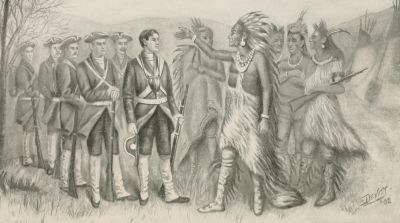
"NOW THE PALE-FACED CHIEFTAIN CANNOT BE KILLED."
It was said with such entire sincerity that in spite of himself Seth could not help feeling impressed, and he thanked the chief warmly, saying as he shook his hand:
"You are very kind to give me this medicine. I will take good care of it, and I hope it will take good care of me."
Thus armed against fate the party then resumed its cautious advance toward the fort.
CHAPTER XXI
AN EASY TRIUMPH
Had the neighborhood of Fort Duquesne been overrun with scouts as was that of Ticonderoga, the presence of Seth's party could hardly have remained unknown, but there was not at all the same vigilance exercised, and consequently the venturesome intruders upon hostile ground were able to make their way unchallenged to an eminence afterward called Grant's Hill, where, well hidden by trees and bushes, they could look right down upon the fort.
Now the Indians had been reporting to the English commander that the French were very strong, in fact that their numbers quite equalled if they did not surpass his, but after Seth had scrutinized the place he exclaimed:
"Those rascally Indians have been lying, as usual. The French are nothing like as strong as we are. If our men were only here now we could take the fort easily. What a pity they're not! And at the rate they're getting ahead they won't be here for months. If only Colonel Washington had his way things would be different. But it's the old story. I'm sick of the slow way they have of doing things."
He had good reason to feel impatient. The work of road-making through the dense forest was exceedingly heavy and tedious. Over the main range of the Alleganies, hewing, digging, blasting, laying fascines and gabions to support the track along the sides of steep declivities, or worming their way like moles through the jungle of swamp and forest, the soldiers toiled at their tremendous task while the weeks went by, whereas if the Braddock route had been followed their progress would have been comparatively rapid.
Not satisfied with having got a very good idea of the French fortress and of the strength of its garrison, Seth had it in mind to take back with him a prisoner or two, as Major Rogers was wont to do whenever possible, and so, instead of setting out at once on the return journey, he moved from the hill and lay in ambush by the road leading northward from the fort.
"We mustn't be in a hurry to let our presence be known," he told his men. "If the French get the alarm we may be cut off and captured. So we'll keep as quiet as possible until we see a good chance of taking a prisoner."
They had not long to wait, for that same afternoon appeared a small party of soldiers sent out by the Commandant de Leignerie to see if there were any signs of the approach of the reinforcements and provisions which he expected from Canada, and which were now overdue.
They were in a gay mood, joking and laughing with each other, being evidently well pleased at getting away from the confinement of the fort for a little outing.
"Let them go on a bit," whispered Seth to his men waiting for the signal to rush upon the unsuspecting soldiers. "The farther they are from the fort the better. We'll follow them close."
Not until they had gone another mile was the command given, and then the Rangers dashed out of the woods upon the startled Frenchmen with such suddenness that they had not time to lift their guns to their shoulders, and were easily made prisoners, with one exception.
This was the officer in charge of them, a stalwart youth with a sinister countenance, who whipped out his sword at the first alarm, and made a slash at Seth that would have cleft his skull, had he not cleverly parried it with the barrel of his musket.
Before the Frenchman could recover himself for another stroke Seth drove the muzzle of his musket into his ribs, knocking the wind out of him so that he went down in a heap on the road, groaning with pain.
If Seth's object had been to kill, the whole party might have been despatched without difficulty, but it was not in his heart to take their lives when they were at his mercy. Even the officer who had come pretty near putting an end to him he had no thought of doing away with.
Yet now that he had the prisoners he was in a considerable quandary as to their disposition, for they were too many to take them all back with him, while if he set some of them free they would of course make all haste back to the fort and rouse the garrison to pursuit.
After puzzling over the problem for some minutes he saw no other way out of the difficulty than to adopt the expedient of releasing all but two of the soldiers, on their taking oath not to return to the fort for twenty-four hours, which would allow the Rangers ample time to get beyond all possibility of pursuit.
The two prisoners he retained were the officer and one of the soldiers, with whom he now hastened back, feeling, as he well might, well satisfied with the success of his enterprise.
The officer proved sulkily silent, and no information could be extracted from him, but the soldier made amends by being very communicative, and freely answering Seth's questions, whereby it was made clear that Fort Duquesne would prove an easy conquest if the attack upon it could only be made promptly.
When Colonel Washington heard this, he was all the more put out that his advice in regard to the route had not been adopted.
"It is really too bad," he said, his troubled countenance showing how deep was his concern, "that Brigadier Forbes should have been persuaded to take the longest way to the fort. But it is too late now to change the plan. We must only carry it out as best we can. I am sure that when he hears your report he will feel bound to admit that my counsel should have been followed."
Seth had by this time come to have such an admiration for Washington that he was ready to accept unquestioningly any opinion he might hold, and it made him quite wrathy to think that the views of so able a leader should not prevail.
He showed this spirit so plainly in presenting his report as to bring upon himself a sharp rebuke from the commander-in-chief, who, being a somewhat testy Scotchman with a good opinion of himself, did not take kindly to having his wisdom questioned by a mere youth.
"You presume too much, young sir," he said, in a tone of manifest irritation. "Your business is simply to give an accurate report of what you had ascertained. You have nothing to do with what we may see fit to determine upon."
Seth flushed deeply, and was tempted to retort that when what he had learned went to show so plainly that no time should be lost he felt bound to say so, but his better sense prevailed, and he accepted the reproof in silence.
Thenceforward the tedious work of piercing the wilderness went steadily on, but it was well into November ere the English force had got near enough to Fort Duquesne to prepare for striking the first blow.
Washington had opened the way by cutting a road to within a day's march of the fort, and in order that the advance might be as rapid as possible, no artillery save a few light pieces was taken.
On the evening of the twenty-fourth of November the English force, which consisted of twenty-five hundred picked men without tents or baggage, and carrying only knapsacks and blankets, encamped by Turkey Creek in readiness to attempt the attack on the following day.
Brigadier Forbes, although suffering so from sickness that he had to be carried on a litter, was in command, and with him were Colonels Washington, Bouquet, and Montgomery, while the detachment was made up of Royal Americans, Highlanders, and Provincial troops.
Their progress had hitherto been unopposed, but this was no guarantee that they might not find the French blocking their way.
About midnight the camp was aroused by the sound of a heavy explosion that came booming over the western woods.
What could it mean? Had a magazine exploded by accident at the fort, or was it possible that the French were blowing up their works in despair of being able to defend them?
Seth determined that he would lose no time in finding out, and by break of day he was off with his Rangers at a pace they only could maintain through the leafless forest until they came out upon the open plain in which stood Fort Duquesne.
"Deserted and destroyed, as I live!" Seth cried as with one swift glance he took in the state of affairs. "Not a Frenchman left and the whole place in ruins. Well, I declare, and what will our folks think of it? I shouldn't wonder if they'll be not a little disappointed."
There was not a sign of life about the place, and after a hasty examination of the premises Seth, leaving most of his men on guard in case some of the Indians should attempt to loot the place, made all haste back to the main body.
Half way thither he met Colonel Washington at the head of his regiment of Provincials, and told him what had taken place.
"I am not at all surprised," he said in his calm way. "In fact I should have been more surprised had the French made any defence, but I am sorry that they have destroyed the fort, as it would have been useful to us in the future. However, there's no helping it now. You again have the pleasure to be the bearer of good news, Ensign Allen. I trust it may always be your fortune."
Seth thanked him for his kind words, and continued on his way until he came to the litter of the suffering General, to whom he reported what he had seen.
"Ah, ha!" he exclaimed, "and so they have run off like curs after first blowing up the fort. Drat them, I wish they had stayed long enough to let us have a crack at them. They owe us a long score which now we'll have no chance to make them pay. Tut, tut, it's very provoking," and so he went on, fully confirming Seth's shrewd anticipation.
The work of destruction was so complete, the barracks and storehouses being burned to the ground, and the fortifications blown up, that the victors could make no use of what was left, and to provide defence and shelter for those of their number on whom the dangerous task was to fall of keeping what had been won, were compelled to plant a stockade around a cluster of traders' cabins and soldiers' huts which had been left intact.
This temporary apology for a fort Forbes called Pittsburg, in honor of the Prime Minister, William Pitt, and it was the germ of the great city of the present day.
A small garrison of Provincial troops having been left to hold Pittsburg for the winter, the remainder of the force returned to Philadelphia, having achieved a solid, if not brilliant, success, for the conquest of Fort Duquesne opened the Great West to English enterprise, took from France one-half of her savage allies, and relieved the western borders of the provinces from the awful scourge of Indian war, so that from Southern New York to North Carolina the frontier people had good reason to bless the names of the steadfast and much enduring soldier, Brigadier Forbes, and his loyal assistants, Colonels Washington and Bouquet.
Seeing no prospect of further service there in the near future, Seth with his Rangers went back to Fort Edward, where they found Major Rogers and the rest of the men at their old work, but impatiently looking forward to an active and eventful campaign when the winter had passed away.
Seth's greeting from his chief could not have been more cordial.
"I am right glad to see you back, my boy," he exclaimed as he gave a warm grasp of the hand, "and I'm curious to hear all about your doings down South. I hope you kept up the credit of the Rangers."
"I'll leave you to judge of that after you've heard what I have to tell," Seth responded archly, and then he proceeded to give an account of his experiences.
The Major listened with lively interest, asking many a question, and making frequent comments. He evidently enjoyed the recital until Seth came to speak about Colonel Washington, and then his ardent admiration for the Virginia officer seemed to displease him, and he broke in with:
"What makes you think so much of that man? What great things has he done, any way?"
Seth, not perceiving that the question was prompted by a spirit of jealousy which he had roused, for Major Rogers was one who could not brook a divided allegiance, made haste to take Washington's part, and before he realized it found himself involved in a controversy that threatened to grow uncomfortably warm, so for fear of giving offence to his friend he ceased arguing the matter, and started off on another track.
But his eyes were opened, and he took care not to mention the name of Washington to the Major again.
A few days after his return he received the gratifying news of his promotion to the rank of lieutenant, which made him very happy, and all the more eager for the renewal of active hostilities in order that he might have the opportunity of achieving further advance, for it was the ambition of his heart to become a captain, and have command of a troop of Rangers.
While he was away on the Fort Duquesne expedition General Abercrombie had made a futile attempt to take Ticonderoga, and had then withdrawn his forces and gone into winter quarters. The French at the other end of the lake had done the same, and only an occasional scouting party kept alive the embers of war.
Montcalm, who commanded the French, from time to time sent out war parties to harass his opponents, and one of them under La Carne succeeded in surprising and destroying a large wagon train.
When General Abercrombie heard of it he ordered Major Rogers to take a strong party of Rangers and Provincials, and to go in pursuit of the enemy. As a matter of course Seth went with him.
CHAPTER XXII
AT CLOSE GRIPS WITH DEATH
Major Rogers' force on this occasion was the largest he had thus far commanded, comprising as it did a big body of Connecticut men, and a small detachment of regulars, chiefly light infantry, bringing the total up to seven hundred in all.
They marched through the forest to where Whitehall now stands, and thence made their way up Wood Creek to old Fort Anne, long abandoned and falling into decay. Here in the already overgrown clearing that surrounded the ruin they encamped.
Up to this time Rogers had observed his usual caution, commanding silence on the march, and forbidding fires at night, but having discovered no signs of the enemy, and led into over-confidence, perhaps, by the unusual strength of his party, he was rash enough to accept a wager with one of the officers of the light infantry as to which was the best marksman, and the following morning was set for the trial of skill.
When Seth learned of this he was much troubled, for although he had not come upon any trace of the enemy, he somehow had a conviction that they were not far away, and he ventured to suggest to his chief that it might not be wise to have musket firing until the neighborhood had been more thoroughly examined.
But the Major took his remonstrance amiss.
"When I wish your advice I will ask you for it, young man," he said, with an asperity of tone that made Seth's countenance redden. "I am quite sure there are no French or Indians within cannon sound of us, so you need give yourself no concern about what I propose to do."
Seth knew that it was vain to argue the matter, and said no more, although the foreboding of approaching disaster grew stronger through the night.
Soon after daylight the shooting match took place, and Major Rogers proved an easy victor, but the triumph, which evidently gave him great satisfaction, was obtained at a fearful cost, for the sound of the shots reached the ears of a large band of French and Indians under command of the famous partisan Marin, who at once took steps to reconnoitre and ambuscade his reckless enemy.
All around the old fort the forest had formerly been cut down and burned, but during the long years of neglect the opening thus made became overgrown with bushes and saplings so densely as to be impassable save where a narrow Indian path traversed it.
Along this path Major Rogers and his men were forced to march in single file, and so soon as the shooting contest was settled they slung their packs and set out.
The Connecticut men were in the lead, then came the regulars, and the Rangers brought up the rear.
Never in his life before had Seth felt so depressed in spirits, although he could in no wise account to himself for it.
"I'm sure there's trouble coming," he said to the Ranger who walked next him. "I do wish they hadn't been firing at the mark. The sound of their guns will go far this still morning."
The words had hardly left his lips when the noise of rapid firing came over the tops of the bushes, and he exclaimed excitedly:
"I knew it! I knew it! The French have ambushed us. Quick now to the front!"
And he dashed off through the brushwood, followed by his men. They had, of course, great difficulty in making their way, although the yells of Indians mingling with the reports of the muskets made clear to them that Seth's surmise as to what had taken place was correct, and they were wild to get to the assistance of their imperilled comrades.
What had happened was this: When the head of the line emerged from the tangled shrubbery, and was about to enter the forest there broke forth a horrid chorus of savage yells, and suddenly the place became alive with Indians.
One of them, a huge Caughnawaga chief, with uplifted hatchet sprang at the foremost of the English, who threw up his gun, and pulled trigger. But unhappily it missed fire, and the next moment he fell with cloven skull.
Then the firing began. The French and the Indians, lying across the path in a semicircle, had the double advantage of surprise and of position, and the Connecticut men at first fell back among the bushes in disorder, but presently rallied, and held their opponents in check until the regulars and Rangers could force their way through the thickets to their support.
So dense was the brushwood that it was only after much loss of time and with great difficulty that the English were able to assume some kind of order in front of the enemy, and even then each man was forced to fight for himself as best he could.
The fulfilment of his foreboding cast no spell over Seth's courage. He plunged into the conflict as though he bore a charmed life, and many an Indian fell at the crack of his gun.
Yet with the wisdom of the true woodsman he did not expose himself unnecessarily, but took advantage to the utmost of such cover as their position afforded.
The fusillade continued for nearly two hours with heavy loss on both sides, but without the combatants coming to close quarters, as the French evidently feared a hand-to-hand struggle, and the English leaders, having no idea of the actual strength of their assailants, did not deem it prudent to attempt to charge upon them.
The fierce and bloody conflict was at its height when Seth, moving forward to get a better position for shooting, suddenly found himself face to face with three Indians, who had crept upon him through the underbrush.
His gun was empty, and he had no time to reload it, but he felled one of the savages with the butt, and was about to treat another in the same fashion when the third sprang at him and tripping him cleverly, flung him heavily to the ground, where both threw themselves on him, and pinned him fast.
They were powerful braves, and, although Seth struggled frantically to free himself, they soon had his hands bound with thongs which hurt cruelly, and rendered him helpless.
Then, each seizing an arm, they rushed him to the rear of their own line, where they lashed him to a tree so that he could not move a limb.
All this time Seth had not spoken. He knew how vain was any appeal for mercy, and steeled his heart for the torture that was sure to be his fate.
Having secured him to the tree, his captors, letting the battle take care of itself, proceeded to amuse themselves in characteristic fashion by throwing their tomahawks at Seth's head with the idea of seeing which could come closest to without actually striking their living target.
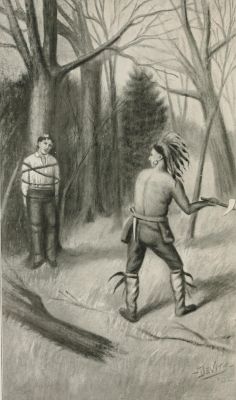
IT WAS A TERRIBLE ORDEAL FOR SETH.
It was fine fun for the dusky fiends no doubt, but it was a terrible ordeal for Seth, and yet the brave fellow hardly blinked as the cruel steel flashed past his eyes, and buried itself in the tree with a vicious thud, sometimes severing a stray lock of his hair in its flight.
Nor were the redskins the only ones to act thus inhumanly, for when they had wearied of their amusement, a French officer came up, who after assailing the helpless captive with vigorous abuse, thrust the muzzle of his gun violently against his body, pretending to fire it, and then struck him in the face with the butt, inflicting a painful bruise.
Still Seth maintained his stoical silence, for he had determined that although they should tear him to pieces, or burn him with slow fire, they should not extort from him any sign or sound of weakness.
When the retreat began the Indians unloosed Seth from the tree, stripped him of nearly all his clothing, bound his wrists together so tightly that the pain was intense, and then placing upon his bare back as many of the packs of their wounded as could be piled up, they hurried him along until at last in sheer exhaustion he fell to the ground, and could not move despite the blows showered upon him.
He might have been despatched there and then had not a French officer, moved to compassion by his desperate plight, persuaded the Indians to untie his hands, and lighten his crushing burden. They also gave him a pair of moccasins to protect his lacerated feet, from which they had taken his shoes and stockings.
His misery being thus somewhat mitigated, Seth was able to go on and to stagger under his load until his captors encamped for the night.
But cruelly as he had suffered already there was worse yet to come, for, having removed the last vestige of clothing, they tied him to a tree, and set to work to surround him with brushwood.
"Merciful Heaven, they are going to burn me!" he groaned. "If they would only kill me first! How can I stand the terrible torture?"
Nevertheless he nerved himself to bear the awful ordeal, not deigning to utter a cry for mercy.
The savages were evidently impressed by his heroic bearing, and delayed lighting the wood, while they danced about him, brandishing their tomahawks in his face, and trying to make him flinch from their pretended blows.
In the midst of their fiendish frolicking there fell a sudden shower of rain which soaked the wood so that it would not light, and this seemed to offer some hope of a respite for their victim. But no sooner had the rain ceased than the merciless wretches resumed their horrid preparations, and this time succeeded in surrounding him with a circle of brushwood which they set on fire, and then yelled and danced before him in delight at his vain endeavors to avoid the rising flames.
His case certainly seemed desperate to the last degree. Thus far he had held the hope that his tormentors might stop short of taking his life in order to carry him back to Canada as a trophy of their prowess, but when the fire began to scorch his naked limbs he gave himself up to despair.
The flames were climbing to his waist. A few more minutes and it would have been all over with him, when into the midst of the dancing, yelling crowd there burst a stalwart figure shouting in French:
"You red devils, what are you about? How dare you torture one of our prisoners like that and disgrace us all? If I had known what you were about I would have put a stop to it before this."
It was Marin, the Canadian leader of the war party, who, on hearing what was taking place, had with courageous humanity rushed to the scene, determined to interpose at all hazards.
Nor was he content with upbraiding the Indians for their cruelty, but dashed at the blazing brushwood, tore it away from Seth, cut his bonds with a slash of his knife, and dragged him out of danger.
The whole thing was done so quickly and in so dauntless a fashion that the savages were completely taken back, and when Marin, having berated them further, placed Seth under the protection of a Caughnawaga chief, who promised to be responsible for him, they acquiesced in the arrangement without a murmur.
The Caughnawaga accepted the trust reposed in him, and at first seemed disposed to treat Seth kindly, but the means he took to insure the prisoner not attempting his escape, while certainly effective, were by no means considerate of his comfort, seeing that he stretched him on the ground in the form of a St. Andrew's cross with his wrists and ankles fastened to the stems of young trees.
Nor was he satisfied with this, but must needs place brushwood upon his body, and across it long slender saplings on the ends of which several warriors lay down to sleep, so that Seth could not make the slightest movement without rousing them.
The misery of that night may hardly be conceived, since in addition to all the physical suffering, the proud, sensitive nature of the New Englander writhed as he realized what an utterly ludicrous figure he presented.
Next day after a painful march he reached Fort Ticonderoga, and was taken before Montcalm, who asked him a number of questions about the strength of the English forces, and their plans for the future.