Part 2 — Part II
Reading edition
To pass in this part, a candidate may select not more than one figure in each group, and must score forty-five marks at least. A selection once made by a candidate must not be altered.
No marks shall be scored in respect of any one-footed figure unless it is skated on each foot, and the number set against each figure represents the maximum that can be scored for that figure.
A candidate shall not score for any figure on which he shall not have obtained at least half marks.
Eights.—In marking these figures, the judges will take into consideration the general symmetry of the figure, and the approximate equality of corresponding curves.
In each figure the complete 8 is to be skated three times without pause.
The figures need not be commenced from rest.
In groups D and E the turns and choctaws respectively are to be made on the near side of the centre.
The following eights are to be skated to a centre on alternate feet:—
Group A
Max. Marks
Outside back two threes4
Inside back two threes13
Outside forward bracket6
Inside forward bracket4
Group B
Outside forward two brackets6
Inside forward two brackets10
Outside forward bracket, three9
Inside forward bracket, three5
Outside forward three, bracket4
Inside forward three, bracket12
Group C
Outside back two brackets14
Inside back two brackets11
Outside back bracket, three16
Inside back bracket, three8
Outside back three, bracket5
Inside back three, bracket14
Group D
Outside forward rocker8
Inside forward rocker4
Outside forward counter8
Inside forward counter4
Outside forward centre choctaw and inside forward centre choctaw, beginning on each foot4
Outside forward mohawk and inside forward mohawk to a centre, beginning on each foot4
Reverse Q’s
The turns and changes are to be made on the near side of fixed points determined by the candidate; the distance between these, and the lengths of the first and last curves, are to be each not less than 50 feet beginning on forward edges, 35 feet beginning on back edges.
Group E
Max. Marks.
Outside forward three, change2
Inside forward three, change3
Outside forward rocker, change3
Inside forward rocker, change3
Outside forward bracket, change5
Inside forward bracket, change4
Outside forward counter, change5
Inside forward counter, change3
Group F
Outside back three, change5
Inside back three, change8
Outside back rocker, change6
Inside back rocker, change8
Group G
Outside back bracket, change16
Inside back bracket, change8
Outside back counter, change16
Inside back counter, change8
Group H
Grape Vines
Single, each foot leading2
Double forward3
Double backward3
Pennsylvania5
Philadelphia6
Now, again omitting for the moment the subject of combined skating, we see that in Part II the rest of the groundwork of English skating is very thoroughly traversed. To pass this final test the skater has to be able to execute all the threes (the two simple ones are omitted, as they have already been required in the second test), rockers, brackets, counters, mohawks, and choctaws at fair speed and on large edges at a given point on the ice. Having done that to the satisfaction of the judges, he has then to make his selection from a large number of 8’s, which include practically most possible 8’s comprising one or two turns, excepting these simple ones with regard to which he has already satisfied the judges in his second test. Here he has to score marks, selecting not more than one 8 of each group, and by the devilish ingenuity of those who drew up this test, it is impossible for him to get through unless the majority of the 8’s he selects to skate are really difficult. He may then add to his marks by executing what are called reverse Q’s at two given points on the ice. At the first of these he has to make his turn, whatever it is, and at the second to change his edge. This requires a considerable degree of accuracy, for in order to arrive smoothly and still at a fair travelling pace at the second point, he will find that he has to have a practically perfect control of the edge, which has not been disturbed by executing a difficult back turn, let us say, at the first given point. Finally, if he is still in want of marks, he may earn a few more by a grape-vine. This latter does not properly belong to English skating, since it is a two-footed figure, and those responsible for the test might have omitted this group with advantage.
The Combined Figure.—Probably no branch of sport—except, perhaps, flying—has undergone such improvement and revolution within the last fifteen years as this art of combined skating. Not only are there a vastly multiplied number of competent and even first-rate combined skaters, but the skill demanded of a first-rate combined skater, and the variety of the manœuvres he may be called upon to execute, is immeasurably greater than a decade and a half ago. I do not mean that there were not in 1897 a certain number of skaters who might have been able to execute a difficult set as directed by a caller of to-day, but these were, in golfing parlance, “plus players,” and the ordinary “scratch” skater—one, that is, who had passed his First Class N.S.A.—would have had no more chance of getting through such a set without throwing everybody out, and himself down, than he would have of flying. Both the speed and the size of these combined figures has greatly increased, and the whole of the material of English skating is employed. And the main reason for this improvement and revolution is due to the greatly augmented number of English skaters who now go to Switzerland in the winter, and the multiplication there of really large rinks.
That this immense improvement has taken place in combined skating is proved, luckily, not only by the fallacious memory of individuals, but by printed records. I have before me the Badminton volume on skating (edition 1902), in which, for instance, we find the following figure (among many others like it).
“Forward two turns. This movement skated to a centre is very difficult, and is a great test of good skating, and many men make a practice of devoting five or ten minutes to skating it every day when they come on the ice, feeling that if they can skate it, making the curves between the turns of equal length and making the turns clean without any scrape and yet coming true to the centre, they are in good form and equal to skate anything that may be required of them.”
Now no doubt two turns to a centre, as required in the second-class test, is a very good elementary figure, but it no longer has anything whatever to do with combined skating, whether it is skated with a partner or with a second pair, or simultaneously with other skaters. Speed and size and difficulty (as demanded by the scale on which combined skaters now move) are necessarily absent from it, and from a hundred others of these calls which then were the last word in combined skating. A man who had passed his second-class test would be capable of doing this, which was then considered a criterion of good combined skating, whereas the same man could not live for two calls in a combined figure of moderate difficulty to-day. The whole nature of the business has changed: turns have to be executed at high speed far away from the centre, and the curliness and smallness of such skating as is here implied and necessitated has vanished altogether, giving place to a far more difficult style and speed.
Nor, again, in this respect, is Part I, in the first-class English test, up-to-date in requirements of size. Here we read that on a “twice back” the candidate must recede at least 35 feet from the centre. That no doubt was laid down because on the artificial rinks available in England, such a distance took the skaters nearly to the bounds of the space at his disposal. But any candidate who, on the Swiss rinks, where nowadays almost all first-class tests are passed, receded but 35 feet from the centre would have, practically speaking, no chance of getting through. His lawless judges would inevitably tell him to skate larger. Still less would he be able to take part in any combined figure-skating for amusement by skaters who had any pretension to be of the first-class. With these big surfaces of rink, the whole style and method has become larger and faster, and therefore more difficult.
A third instance, to prove how greatly the art of combined skating has progressed, has the ring of pathos about it, and, though only oral, is trustworthy. A friend of mine, who resides at that excellent English skating centre, Oxford, told me that in old days he could scarcely get a combined figure, since the most elementary calls were sufficient to floor his partners. But not so long ago he told me he could scarcely get a combined figure, since nobody cared to skate such elementary calls as he was capable of. But he assures me that he skates just as well now as he did in the days when there was nobody up to his standard. Perhaps in twenty years more, no first-class skater will care to engage in such simple stuff as we now think rather advanced. And dearly will such present-day skaters who are fortunate enough to be alive then, love to see the newer and more arduous manœuvres! But since it is impossible to prophesy about the things we cannot imagine, it must be sufficient to give the outlines of combined skating as practised by fairly expert gentlemen to-day.
There are two manners of combined skating, called respectively pair-skating and simultaneous skating. The first of these (which we will first consider) is the more difficult, and, so to speak, the more classical. Theoretically it can be skated by two, four, six, or eight persons: practically it is skated by four persons, grouped, at the beginning of things, at right angles to their neighbours, and at a few yards distant from their centre. One of these, who skates in the first pair, is known as the caller, and he announces (in a loud mellifluous voice) what he is about to skate, and what the trembling gentleman opposite, who is his partner, must also skate. They advance to the centre, from opposite sides, and begin skating whatever is ordered. The moment after they have left their centre, speeding out to the circumference of the huge imaginary circle, of which their orange or india-rubber ball, from which they have started, is the centre, the second pair (at right angles to them) proceed to do exactly the same. The size and pace of the figure, as well as its details, depend entirely on the caller: as he skates, so must his partner skate, putting down his edges and turns simultaneously and at like speed to him, and as the first pair skate, so (with certain modifications) must the second pair skate.
Now, the whole material of skating is at the caller’s command. He can (and does) order threes, brackets, rockers, counters, mohawks, choctaws and changes of edge to be skated when and how he wishes them. He can (and does) couple any pair or any three of these movements, to be skated on one foot or on both, one after the other. He directs, with a word of power, from the elaborate vocabulary of combined skating, the length of an edge, and can command it to be held so long that the direction of progress is reversed, or to be further continued till a complete circle is made and the original direction of progress resumed again. Then, with another word, he brings himself and his partner (followed closely by the second pair) back to their centre again, on the off side or the near side of it, and orders that they shall start a fresh figure there, or that they shall make a turn there, or scud by it like four express trains which just, and only just, arriving from the four parts of the compass, do not collide with each other, and scatter again to east and west and north and south. Sometimes he brings them in simultaneously, so that they converge till they almost touch, and then spread out again. And if the figure is going decently well, there is no pause, no foot without its edge and turn assigned to it. This mystic, swift, interweaving dance lasts perhaps a quarter of an hour of hard, enraptured skating.
Simultaneous combined has this advantage, that an uneven number of skaters can take part in it. The caller’s duties are the same, but there are no pairs of partners. All leave the centre simultaneously, all (it is hoped) arrive back at it simultaneously. Since there is no crossing of pairs at the centre, a far larger number of skaters can take part in it, as they have not to wait for a prior pair to clear, and if elementary calls only are ordered, upwards of ten or twelve skaters can join the dance with effect. No one of them, as in pair skating, crosses the path of another skater: they leave and arrive at the centre on converging not crossing lines. Thus it is an easier sport than is crossing pairs, since in the latter case the edges that leave and approach the centre intersect each other. Vastly enjoyable as it is, it lacks to the present writer that classical distinction that characterises pair-skating.
The final item in English skating is hand-in-hand skating in the combined figure. Here, instead of single skaters combining to perform in unison, pairs take the place of units. Necessarily the figures compassable by a man and woman hand in hand are fewer in number, as at present worked out, than those which can be skated by single skaters, and the speed at which such figures are skated is less than in the combined skating of single skaters. Hand-holds have to be changed, and partners brought into the new position required by turns, &c., by pulls, or by what in the nomenclature is called “steps”—i.e. single strokes and edges. Already this style has taken the place in the annual championship of English skating, and without doubt it will grow both in the number of its practitioners, and in the force and speed of their movements. It is scientifically based, being evolved from the charming movements that are possible to hand-in-hand skaters when going free on the ice, and not bound to consider their opposing partner, or to arrive in a given manner at a given point. But it resembles, at present, in the opinion of the writer, the performance of a yearling. It requires the devotion of a dozen first-class skaters of both sexes to determine its possibilities. His wish is, that it will get them. His fear is that the necessarily cramping influence of conjoined hands will prove to debar it from the speed and largeness of other branches of English skating. He sincerely hopes that his fears are quite unfounded.
International Style
It has been already remarked that the two styles, English and International, have nothing to do with each other, and that the practitioner of one who is so imbecile as to belittle the other, is no less crack-brained and idiotic than a Rugby football player who calls Association a “rotten game.” Personally, I do not skate in the International style, but to attempt to depreciate the beauties of it would be to me as unthinkable as it would be to run down polo. To the spectator, whether of polo or of International skating, the skill and the splendour of these sports are, unless he is entirely lunatic, beyond any question at all. But it is as an admirer, pure and simple, that I venture to embark on a subject with which I have no practical acquaintance.
Spectacularly there is no doubt that to the ignorant the International style rightly makes the most powerful appeal. A simple manœuvre, as for instance a forward three to a centre, looks far more difficult and hazardous when executed even only moderately well in the International style than when executed almost perfectly in the English style. In the one case, to the ignorant, arms and legs are flying: it seems impossible to maintain a balance, and the attitude itself is charmingly graceful: whereas in the English style the whole difficulty of the manœuvre, such as it is, lies in the necessity of making it look easy, and standing quite still and at rest.
But the difficulty of doing it perfectly in the English style is, as a matter of fact, far greater than that of doing it properly in the International style. Of that there is no question whatever. A good English skater will put down his turns and edges one over the other, in the accurate fashion so rightly demanded by the International style, without producing half the effect that a good International skater will produce. But the English skater has done the more difficult feat. On the other hand, I do not think that the skater in the English style is ever called upon to do anything so difficult in his highest test as the back-loop 8, or perhaps the rocker 8, as required by the first-class International test. And then I think of a back bracket, executed at good speed at a certain point, in the correct style. Really I do not know.... Also I do not care. The back-loop 8 of the International skater is altogether lovely, which is all that matters.
But, as I have said, the two styles have nothing to do with each other, either as regards tests or as regards the general sport of them. I can imagine no more glorious athletic feat than that of four first-class English skaters performing a really difficult combined set properly, a set that is as far away from the compulsory set of the first-class test as is the first-class test from the second; nor, on the other hand, can I imagine a more glorious athletic feat than the free skating of some champion of the International school. But when Mr. Grenander or Herr Salchow are so kind as to show me the Hugel star, I no more think of comparing that with the combined skating of fine performers in the English style, and others, than I compare it with Mr. Baerlein in the tennis court or Mr. Jessop slogging his sixes. They have nothing to do with each other.
As in English skating, I propose to lay before the reader the tests of the International school, and in contrast to the rule of English form, I subpend the essential requirements of International excellence, as laid down by the collective experience of its senators. Proper form is no less essential in one than in the other, and the same sternness of requirement is insisted on in both. But the effect is poles apart: in the International style a fixed freedom of the unemployed limbs is necessary, in the English a fixed quietness and immobility. Neither is laid down in an arbitrary manner: it is impossible to perform the necessary evolutions in first-class skating otherwise than is provided by the rules. No English skater could, in his prescribed form, execute the International figures: no International skater in his could do what is required of his English brother. Here, then, are the essentials of good form as demanded by the International school:
“Carriage upright but not stiff; the body not bent forwards or sideways at the waist; all raising or lowering of the body being effected by bending the knee of the tracing leg with upright back; the body and limbs generally held sideways to the direction of progress. The head always upright. Tracing leg flexible with bent knee. The eyes looking downwards as little as possible. The knee and toe of the free leg turned outwards as far as possible, the toe always downwards; the knee only slightly bent. The free leg swinging freely from the hip and assisting the movement. The arms held easily, and assisting the movement; the hands neither spread nor clenched. All action of the body and limbs must be easy and swinging with the direct object of assisting the movement of the moment; violent or stiff motions are to be avoided, the figure should seem to be executed without difficulty.
“The figures must be begun from rest—that is, by a single stroke with the other foot; and at the intersecting point of two circles. Every figure must be repeated three times consecutively. No impetus may be taken from the ice by the foot which is about to become the tracing foot; and every stroke should be taken from the edge of the blade, not from the point.”
There are also the following directions for correct tracing, i.e. the marks left by the skate on the ice.
“The essentials of correct tracing are:
“Maintenance of the long and transverse axes (as the long axis of the figure a line is to be conceived which divides each circle into two equal parts; a transverse axis cuts the long axis at right angles between two circles); approximately equal size of all circles, and of all curves before and after all turns; symmetrical grouping of the individual parts of the figure about the axes; curves without wobbles, skated out—that is, returning nearly to the starting-point. Threes with the turns lying in the long axis; changes of edge with an easy transition, the change falling in the long axis.”
In this form, then, and with this accuracy of tracing, the following figures must be skated for the third test:—
Eight Rfo—Lfo
Eight Rfi—Lfi
Eight Rbo—Lbo
Change {(a) Rfoi—Lfio {(b) Lfoi—Rfio
Threes RfoTbi—LfoTbi
R = Right. L = Left. T = Three. f = Forwards. b = Backwards. o = Outside. i = Inside.
Into the system of marking—candidates have to get a certain proportion of marks in each figure—we need not go. It will be sufficient to say that it is necessary to skate each figure passably, and to earn more than half marks on the whole.
Second-class Test
This has to be passed before three judges, and is divided into two parts—(1) Compulsory Figures; (2) Free Skating. The regulations for them are as follow:—
(1) Compulsory Figures.—Each figure may be marked up to a maximum of 6 points. The marks given for each figure are multiplied by the factor of value for that figure. In order to pass, a candidate must obtain a minimum of 2 marks out of 6 in each figure, and an aggregate of 130 out of the maximum of 234 marks.
(2) Free Skating.—The candidate will be required to skate a free programme of three minutes’ duration.
This will be marked:
(a) For the contents of the programme (difficulty and variety) up to a maximum of 6 marks.
(b) For the manner of performance up to a maximum of 6 marks. In order to pass, a candidate must obtain 7 marks for (a) and (b) together.
The marks for compulsory figures and for free skating must be obtained from each judge. Judges may use half marks and quarter marks.
Compulsory Figures
Marks.Factor.Total
Eight Rbi—Lbi 2
Change{(a) Rboi—Lbio 2
{(b) Lboi—Rbio 2
Three{(a) RfoTbi—LbiTfo 2
{(b) LfoTbi—RbiTfo 2
Double ThreeRboTfiT—LboTfiT 1
Change Three{(a) RfoiT—LboiT 2
{(b) LfoiT—RboiT 2
Change Three{(a) RfioT—LbioT 3
{(b) LfioT—RbioT 3
Loop RfoLP—LfoLP 2
Loop RfiLP—LfiLP 2
Loop RboLP—LboLP 2
Loop RbiLP—LbiLP 2
Bracket{(a) RfoB—LbiB 3
{(b) LfoB—RbiB 3
One-foot Eight {(a) Rfoi—Lfio 2
{(b) Lfoi—Rfio 2
R = Right. L = Left. T = Three. LP = Loop. B = Bracket. f = Forwards. b = Backwards. o = Outside. i = Inside.
Here is a remarkably varied programme, and one that will obviously give a good spell of regular work to a candidate who intends to grapple with it. It contains more of the material for skating than does the corresponding English second test, in which only the four edges, the four simple turns, and the four changes of edge are introduced, since this International second test comprises as well as those, the four loops, and two out of the four brackets. These loops, which are most charming and effective figures, have nowadays no place in English skating, since it is quite impossible to execute any of them, as far as is at present known, without breaking the rules for English skating, since the unemployed leg (i.e. the one not tracing the figure) must be used to get the necessary balance and swing. They belong to a great class of figures like cross-cuts in all their varieties, beaks, pigs-ears, &c., in which the skater nearly, or actually, stops still for a moment, and then, by a swing of the body or leg, resumes or reverses his movement. By this momentary loss and recovery of balance there is opened out to the skater whole new fields of intricate and delightful movements, and the patterns that can be traced on the ice are of endless variety. And here in this second International test the confines of this territory are entered on by the four loops, which are the simplest of the “check and recovery” figures. In the loops (the shape of which is accurately expressed by their names) the skater does not come absolutely to a standstill, though very nearly, and the swing of the body and leg is then thrown forward in front of the skate, and this restores to it its velocity, and pulls it, so to speak, out of its loop. A further extension of this check and resumption of speed occurs in cross-cuts, which do not enter into the International tests, but which figure largely in the performance of good skaters. Here the forward movement of the skate (or backward movement, if back cross-cuts are being skated) is entirely checked, the skater comes to a momentary standstill and moves backwards for a second. Then the forward swing of the body and unemployed leg gives him back his checked and reversed movement.
Similarly, the bracket 8 is fresh material in this set of compulsory figures. The shape and nature of the bracket is the same as that in English skating.
The candidate for the second International test has also to skate a free programme of three minutes’ duration. This takes the place, so to speak, of the section in the English test devoted to combined skating, which is not practised in the International style. This free skating is spoken of in its place under the first-class test.
First-class Test
This has to be passed before three judges, and is divided into two parts—(1) Compulsory Figures; (2) Free Skating. The regulations for them are as follow:—
(1) Compulsory Figures.—Each figure may be marked up to a maximum of 6 points. The marks given for each figure are multiplied by the factor of value for that figure. In order to pass, a candidate must obtain a minimum of 2 marks out of 6 in each figure, and an aggregate of 190 out of the maximum of 336 marks.
(2) Free Skating.—The candidate will be required to skate a free programme of three minutes’ duration.
This will be marked:
(a) For the contents of the programme (difficulty and variety) up to a maximum of 6 marks.
(b) For the manner of performance up to a maximum of 6 marks.
In order to pass, a candidate must obtain 7 marks for (a) and (b) together.
The marks for the compulsory figures and the free skating are arrived at by taking the total marks of the three judges and dividing by three. Judges may use half marks.
This free skating is a charming item in the system of International skating, and might, with great advantage, be introduced into the English branch. It is in itself perfectly fascinating to look at, and from the technical point of view it is quite admirable as a test of knowledge. A good programme will contain dozens of turns and changes of edge, all melting into each other without break or pause. None who have seen the free skating of a fine performer can ever forget or question the brilliance and variety of this three-minute free skating. As likely as not, he will make his entry on to the rink in a spiral edge, and before it has come to rest at the centre, start off on his coruscating performance. Rockers, brackets, counters, and turns succeed each other with bewildering rapidity; and all are performed with the utmost ease and grace. It seems impossible to tell where the motive-power comes from, so smooth and effortless is the travelling; you would have said the skater was wafted by some localised wind, or impelled by some invisible mechanism. But before he arrives at this part of his test, he has to skate his compulsory figures, the list of which is subjoined.
Compulsory Figures
Marks.Factor. Total.
Rockers {(a) RfoRK—LboRK3
{(b) LfoRK—RboRK3
{(a) RfiRK—LbiRK4
{(b) LfiRK—RbiRK4
Counters {(a) RfoC—LboC2
{(b) LfoC—RboC2
{(a) RfiC—LbiC3
{(b) Lfic—RbiC3
Three, {(a) RboTfioT—LbiTfoiT3
Change Three {(b) LboTfioT—RbiTfoiT3
Loop, {(a) RfoLPfoiLP—LfiLPfioLP4
{(b) LfoLPfoiLP—RfiLPfioLP4
Change Loop {(a) RboLPboiLP—LbiLPbioLP5
{(b) LboLPboiLP—RbiLPbioLP5
Bracket, {(a) RfoBbioB—LfiBboiB4
Change Bracket {(b) LfoBbioB—RfiBboiB4
R = Right. L = Left. RK = Rocker. C = Counter. LP = Loop. B = Bracket. f = Forwards. b = Backwards. o = Outside. i = Inside.
Now, here is a list of requirements which, when we think of the accuracy demanded by the International style in the matter of tracing, will clearly be too much for any but the very elect. Not only has a figure as difficult as the back-loop 8 to be skated, but it has to be skated with accuracy: the loops must lie approximately one on the top of the other, and the edges that lead into and out of them must be symmetrically laid down. It is this accuracy which makes the International style so hard of achievement in its higher branches; to hope to get through this list of searching figures, it is clear that the balance, the pace, and the power of the skater must be in perfect control. And all the time the appearance of insouciant freedom is there, though all the time that freedom is bound by laws as relentless as those which regulate the tranquillity of the English style. The feats are so difficult that they cannot be executed except in a certain way, just as the ball that spins so carelessly over the tennis net cannot win a short chase off the back wall unless it has been hit in one way and no other.
A further important branch of International skating is the pair-skating, which ranges from the simple waltz-step to the most intricate evolutions. The rhythm and grace of this delightful exhibition is beyond all words; beyond all words, too, is the training and skill which it implies. Every bar of the music which accompanies it has its appropriate movement: it is a perfect song of motion set to the band. But the beauty and swing of it are things quite indescribable; one might as well hope to reproduce the dancing of Pavlova in pen and ink as to convey any sense of it to those who have not seen it. And those who have seen it would very wisely yawn and pass on if they observed a purple paragraph on the subject looming ahead. But thistledown is not so light in a warm west breeze, nor the curves of a swallow’s flight more deliciously unconjecturable than a well-matched pair in this pastime so perfectly preconcerted that it looks entirely unrehearsed. On they drift, gliding, turning, parting to come together again.... Mrs. Gummidge, for the moment, would cease to think of the old ’un, and inquire the price of skates—and knee-pads.
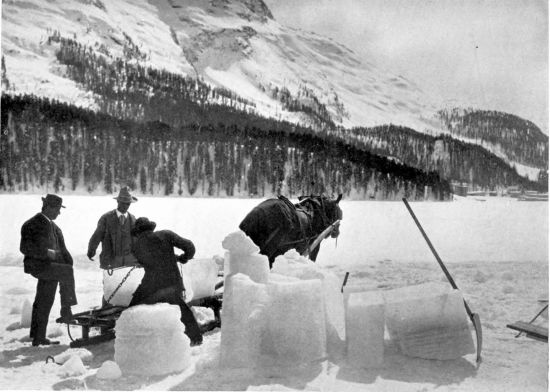
Plate XI
A WINTER HARVEST
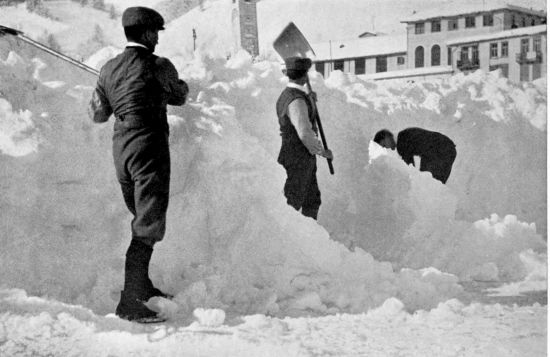
Plate XII
CLEARING THE SNOW FROM THE RINK
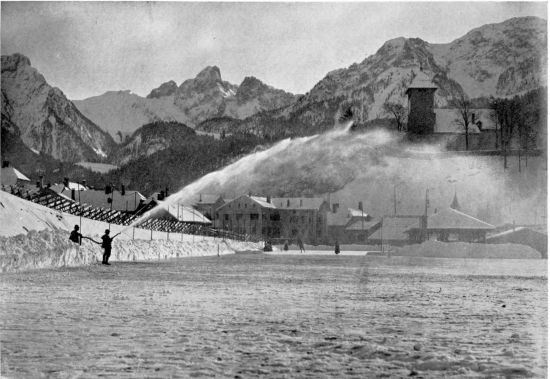
Plate XIII
SPRINKLING THE RINK, CHÂTEAU D’OEX
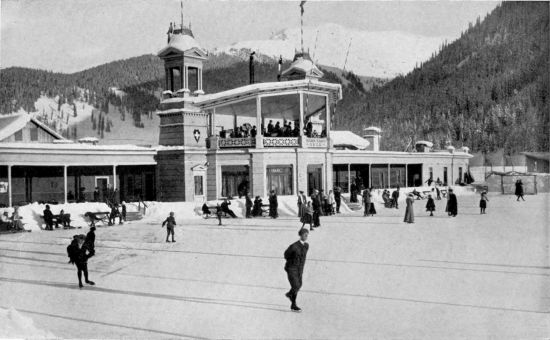
Plate XIV
PUBLIC RINK, DAVOS
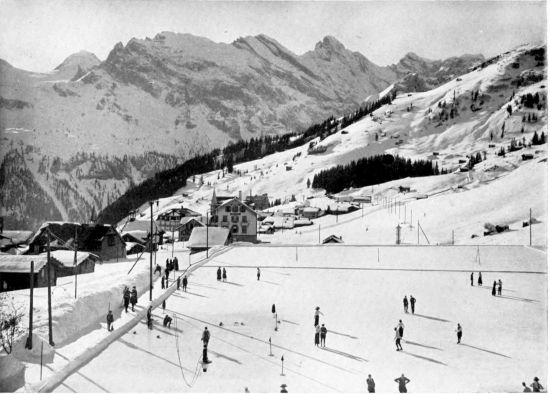
Plate XV
SKATING-RINK AT MÜRREN
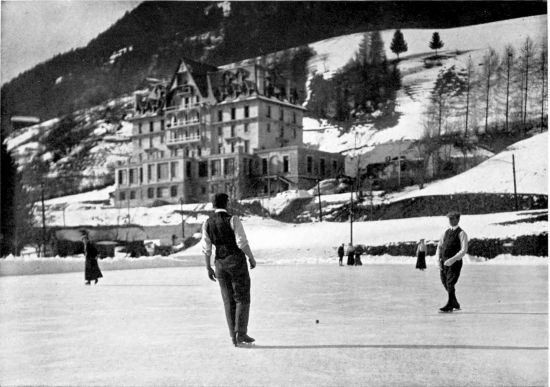
Plate XVI
SKATING-RINK AT CHÂTEAU D’OEX