WINNING A CAUSE (continued 6)
Reading edition
Our aviators have no equals in daring or in fighting ability, and have left a record of courageous deeds that will ever remain a brilliant page in the annals of our army. While the Tank Corps has had limited opportunities, its personnel has responded gallantly on every possible occasion, and has shown courage of the highest order.
The Adjutant General's Department has been directed with a systematic thoroughness and excellence that surpassed any previous work of its kind. The Inspector General's Department has risen to the highest standards, and throughout has ably assisted commanders in the enforcement of discipline. The able personnel of the Judge Advocate General's Department has solved with judgment and wisdom the multitude of difficult legal problems, many of them involving questions of great international importance.
It would be impossible in this brief preliminary report to do justice to the personnel of all the different branches of this organization, which I shall cover in detail in a later report.
The navy in European waters has at all times most cordially aided the army, and it is most gratifying to report that there has never before been such perfect co-operation between these two branches of the service.
As to the Americans in Europe not in the military service, it is the greatest pleasure to say that, both in official and in private life, they are intensely patriotic and loyal, and have been invariably sympathetic and helpful to the army.
Finally, I pay the supreme tribute to our officers and soldiers of the line. When I think of their heroism, their patience under hardships, their unflinching spirit of offensive action, I am filled with emotion which I am unable to express. Their deeds are immortal, and they have earned the eternal gratitude of our country.
JOHN J. PERSHING. General, Commander-in-Chief, American Expeditionary Forces.
THE UNITED STATES AT WAR—AT HOME
When any nation declares war, it immediately brings upon itself unusual problems and difficulties, but probably no other nation ever had such problems to solve and such difficulties to overcome as the United States, immediately after Congress declared a state of war existed with Germany. The United States was not ready for war. She had been a peace loving nation, and although possessed of great natural resources, she had never developed them, to any extent, for the purpose of carrying on war. The cosmopolitan people of the United States had never been put to the severe test of war conditions, and whether or not they would stand together as one great nation was yet to be proved. This meant that when war was declared the United States had to start right at the bottom and build up a mighty fighting nation. This had to be done as quickly as possible, for Germany's plan was to crush her enemies before the United States could bring any help.
The first thing that the country was called upon to do was to raise an army. Under ordinary circumstances, the government would call for volunteers. In this way an army could be provided which would be sufficient for usual conditions. The war with Germany, however, was by no means a war in any way like that Americans had taken part in before. The government knew this and realized that the United States would have to raise an army that numbered in the millions. To do this, the volunteer system was found entirely inadequate. So a system of drafting men was worked out for which the government passed the draft law, compelling all men between the ages of 21 and 31 to register for military service. This plan was accepted with great favor by the people, and consequently, the day after registration the government had ten million men in the prime of life from which to pick her army. The draft system was in charge of General Crowder who, as a result of long study on the subject, had devised a system which was not in any way influenced by political pull and was equally fair to both the rich and the poor. Local boards were established for examining the drafted men, and those selected were soon on their way to training camps.
To house this great army, the government had to build a great system of army camps. Contracts were given out soon after war was declared and the camps began to spring up almost overnight. The government built 16 draft army camps and 16 national guard camps. There were also numerous other military zones where smaller bodies of troops were trained. The draft army camps were located so as to house the men from different sections of the country, as a glance at the list of camps will show:—
Camp Devens, Massachusetts; Camp Upton, New York; Camp Dix, New Jersey; Camp Meade, Maryland; Camp Lee, Virginia; Camp Jackson, South Carolina; Camp Gordon, Georgia; Camp Sherman, Ohio; Camp Taylor, Kentucky; Camp Custer, Michigan; Camp Grant, Illinois; Camp Pike, Arkansas; Camp Dodge, Iowa; Camp Funston, Kansas; Camp Travis, Texas; Camp Lewis, Washington.
These great cities were built in less than four months. If all the buildings of the sixteen cantonments were placed end to end, they would make a continuous structure reaching from Washington to Detroit. Each one of these camps housed between 35,000 and 47,000 men. The sixteen cantonments were capable of providing for a number equal to the combined population of Arizona and New Mexico. The hospitals of these camps were able to take care of as many sick and wounded as are to be found in all the hospitals west of the Mississippi in normal times. Each camp covered many square miles of land which had to be cleared of trees and brush before buildings and roads were completed.
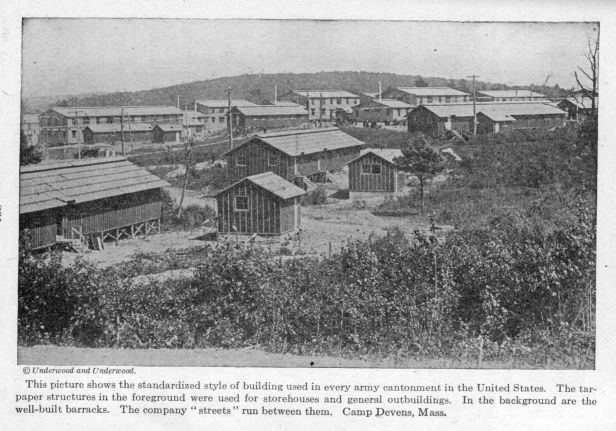
[Illustration: This picture shows the standardized style of building used in every army cantonment in the United States. The tar-paper structures in the foreground were used for storehouses and general out-buildings. In the background are the well-built barracks. The company "streets" run between them. Camp Devens, Mass.]
To keep these cantonments clean and fit to live in, large numbers of sanitary engineers, medical officers, and scientific experts were kept busy planning and installing the most modern sanitation systems. To command this great army, the government built officers' camps where men best fitted were trained to be officers, and were then sent to the cantonments to help in changing the American citizen into a soldier. War was declared in April, and by the hot weather of summer America was sending troops by the tens of thousands to Europe. The wonderful way in which American shipbuilders had made it possible to transport these soldiers is told later. But before leaving the subject of raising an army, let us first see by means of figures just what the United States had accomplished in this work. In August, 1918, the overseas force alone was seven times as large as the entire United States army sixteen months before, at the declaration of war. In this time she had transported a million and a half troops overseas and had the same number on this side, with the numbers always increasing. In September, 1918, she had another draft and registration, calling men between the ages of 18 and 45. This gave thirteen million more men.
The colleges of the country had suffered a great deal because of the two draft laws, as practically all men of college age were liable to military service. To overcome this difficulty, the government established in the fall of 1918, the Student Army Training Corps. This plan allowed all students of military age, who were physically fit, to enlist in the army and receive military training, and at the same time obtain a college education. From these men the government planned to choose future officer material. Although the war came to a close before the plan could be fully carried out, it gave every promise of being a success.
It must be evident that perhaps even a greater problem than raising the army was how it was to be transported to Europe. At the beginning of the war, the United States had no ships to use for her necessary task of transporting men and supplies. The ships that were sailing from her ports were all doing their capacity work and could not be used for the new demands. The Shipping Board immediately looked around for yards to place orders for new ships; but there were no yards to fill the orders, as the few the United States had were all overburdened with work. The only remaining solution of the problem was to build new yards. America did it.
The United States went into the war with something like thirty steel and twenty-four wood shipyards, employing less than eighty thousand men. In a little over a year's time, there were one hundred and fifty-five yards turning out ships and employing over three hundred and eighty-six thousand men. These men turned out more tonnage every month than the United States had ever turned out in any entire year before the war. Of the new yards, the greatest was the famous Hog Island yard. On what was once a swamp on the Delaware River, just below Philadelphia, the United States built this yard which is the largest in the world. The demand for speed in building resulted in the plan of fabricating the steel before sending it to the yards. By this method the steel is cut and punched before going to the yard where it is then assembled. Thus steel mills at long distances from the shipyards could be doing a very considerable part of building the ships. Perhaps the great increase in shipping can be best stated by a few figures. In the month of January, 1918, America produced 88,507 tons. Six months later in July she produced 631,944 tons. Before the war the official estimate of America's annual shipping production was 200,000 tons. The estimated production for 1919 was 7,500,000 tons.
The United States navy at the time of the declaration of war was unprepared for the task ahead of it. It was efficient but not nearly large enough for the tremendous amount of work it was called upon to perform. The troop and supply transports needed convoys. There were hundreds of miles of coast to be patrolled. Merchant ships must be armed with men and guns. All this had to be done, besides the work of aiding the Allied fleets in European waters. The government was not long in seeing the need of a great increase in the naval force and was soon making plans to bring this about. New yards were constructed immediately for the building of warships, and the capacity of the old yards was increased. These yards were soon busy turning out destroyers and battleships at a remarkable speed. The special work of patrolling the coasts for submarines called for a great many small and speedy submarine chasers. Motor boat manufacturers all over the country immediately began to make these swift little craft which were popularly called the "mosquito fleet." Even the great factories of Henry Ford, although already busy turning out thousands of motor cars, found room to build these chasers at their inland factories. They were built on specially constructed flat cars, which were then drawn to the coast, where the ships were launched.
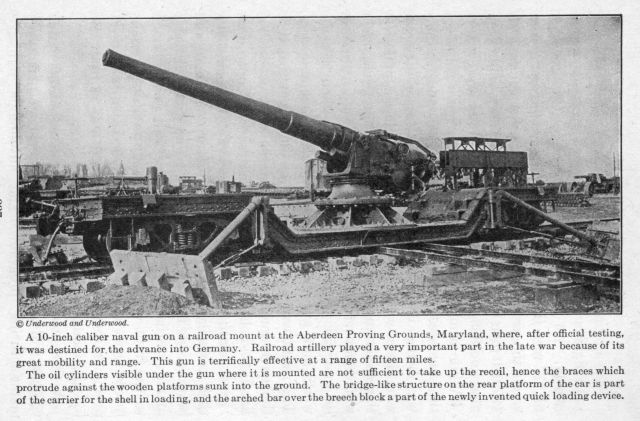
As the number of ships increased, the man power was accordingly increased. The navy established a new record by placing a unit of five 14-inch naval guns mounted on specially built railway cars for land duty in France. These guns were the longest range guns in France and were out-distanced only by the great German super guns, the destroying of which was one of their objects. The German super gun fired a small shell for a distance of from sixty to seventy miles. The naval 14-inch guns fired a 1400 lb. shell about twenty-five miles. Although this was a new departure for the navy, it met with the same success which had crowned all of the other war work of this branch of the service.