Front matter (continued 3)
Reading edition
CHAPTER VI.
JUDGE JAY CONTINUES TO SUPPORT THE ANTISLAVERY CAUSE BY HIS ADVICE AND WRITINGS.—IN CONSEQUENCE OF HIS OPINIONS HE IS DEPRIVED OF HIS SEAT ON THE BENCH.—HIS VISIT TO EUROPE.—HIS VIEWS ON THE LIBERTY PARTY.—ON THE ANNEXATION OF TEXAS.—HIS "REVIEW OF THE MEXICAN WAR."—HIS ADVOCACY OF INTERNATIONAL ARBITRATION AS A REMEDY FOR WAR.—HIS WORK IN THE EPISCOPAL CHURCH.
After the division in the ranks of the antislavery societies in 1840, Judge Jay ceased to take an active part in their proceedings, preferring to support the cause independently by his writings. But he was continually applied to by the societies to assist them by his advice, to give legal opinions on the positions which they wished to take, and to prepare documents which required special judgment and ability.
In April, 1842, Jay prepared an address to the British Antislavery Society, at the request of Mrs. Lydia Maria Child, who wrote on behalf of the American Antislavery Society. A little later, again by request of Mrs. Child, he gave a legal opinion on the advisability of carrying to the Supreme Court the cases of three men who had been condemned in Missouri to twelve years' imprisonment for aiding slaves to escape.
He continued his membership in the American and Foreign Antislavery Society in New York. Here he laboured unceasingly to keep the society fast to its declared purpose, and to prevent it from adding new doctrines and objects which he believed must result in further divisions injurious to the cause.
In April, 1841, he wrote on this subject to Lewis Tappan:
"I am glad the society will not be concerned in establishing a missionary station in Africa. The great vice of our antislavery societies has been, and is, meddling with things they have no right to meddle with, and this they have done on a most vicious principle, that the end sanctifies the means. In general, abolitionists mean well; but they grievously mistake when they think themselves authorized to pursue, in their associated capacity, whatever benevolent or religious plan they individually approve. They unite for certain specified purposes, and receive money expressly to forward those purposes; and to employ their associated influence or their common funds for other distinct purposes is not, in my opinion, consistent with strict morality."
In August, 1841, Judge Jay was requested by the Executive Committee of the American and Foreign Antislavery Society to allow his name to be announced as a regular contributor to the society's organ, the Reporter. He took this opportunity to repeat his warnings against the departure of the abolitionists from the line of action which they had marked out for themselves in the early days of the agitation.
"As an abolitionist I have deeply deplored the dissensions which have marred our harmony and almost annihilated our moral influence; and I have constantly and resolutely abstained, as far as my sense of duty would permit me, from aggravating those dissensions by partaking in them. The obvious tendency of the announcement contemplated by your resolution is to impress the public with the belief that the gentlemen who are held forth as the future contributors to the Reporter maintain the principles and approve the course of that paper. Such an impression, so far as regards myself, would be most strictly accurate were the principles and course of the paper to continue such as they have hitherto been. To the American and Foreign Antislavery Society I did fondly look as a refuge for such abolitionists as had been expelled from the old society by the faithlessness of those who converted it into an instrument for spreading other than antislavery doctrines. I did, notwithstanding past experience, regard the constitution of the new society as affording a guarantee that its members would not be required to support any other principles and measures than such as were indicated in that instrument. In consequence of this belief I did not decline office in the society, and I aided in defraying the expenses and in filling the columns of the Reporter. The paper was conducted with ability and honesty, promised to exert a happy influence in restoring peace and harmony to our ranks. The society was pledged by its constitution 'carefully to abstain from all the machinery of party political arrangements in effecting the objects,' and the Reporter faithfully conformed itself to this pledge. But in the very last number we are informed that at the last meeting a vote of the society, 'nearly unanimous,' was taken in favour of striking this pledge from the constitution, but that inasmuch as the notice required by Article X. had not been given, the amendment was not constitutionally adopted. The pledge is therefore virtually, although not formally, withdrawn; and we have every reason to believe that at the next meeting it will be expunged from the constitution. It is therefore obvious that the society, instead of being a rallying point for abolitionists, is henceforth to be a mere partisan organization, excluding from its fellowship multitudes of honest, zealous, and consistent abolitionists because they cannot adopt the maxim now promulgated in certain quarters, that the friends of immediate emancipation should labour to secure for themselves all the loaves and fishes in the gift of the republic—the power and emoluments of every office, from that of President of the United States to that of Path Master of a ward district. The vote of the society just mentioned is tantamount to a declaration that it will as soon as possible employ all the machinery of party political arrangement for the exclusive elevation of abolitionists to political power. This is not an object for which I have associated with abolitionists, nor is it one in which I intend to co-operate with them. But the Reporter, I am bound to believe, will be used as an instrument to effect this object, because I am bound to believe that the official organ of the society will not fail to advocate and pursue its avowed policy. Hence I cannot and ought not to give it in advance my confidence and countenance by complying with the request with which you have honoured me.
"I have thus frankly stated my sentiments without intending to impeach the motives of others, and without meaning to assume a hostile attitude towards the friends and supporters of what is denominated the Third party. With that party I cannot conscientiously and consistently unite, but I have purposely abstained from publicly mingling in the controversies to which it has given rise, and I have now expressed my dissent from it only because I could not otherwise explain my refusal of your polite invitation.
"In justice to myself, permit me to remark that my opinions on slavery and abolition have undergone no change, and that every principle I have ever avowed as an abolitionist is still cherished by me with no other difference than possibly a stronger conviction than formerly of its truth and importance.
"That we may all be guided by wisdom from above and be enabled not merely to break the bonds of the slaves, but in our conduct to adorn our Christian profession, is my fervent wish."
The antislavery societies, by the admission into their proceedings of projected reforms having no connection with their ostensible object, had gradually become divided and weakened. Jay had protested unceasingly against this course, but the tendency had been irresistible. "Our antislavery societies," he wrote in 1846, "are, for the most part, virtually defunct. Antislavery conventions are whatever the leaders present happen to be; sometimes disgustingly irreligious, and very often Jacobinical and disorganizing; and frequently proscriptive of such of their brethren who will not consent to render abolition a mere instrument for effecting certain political changes having no relation whatever to slavery."
The antislavery societies had accomplished the noble and seemingly hopeless task of arousing the national conscience from its lethargy. Their labours had started and given irresistible impulse to a movement on behalf of the slave which was not to rest until emancipation was attained. But the active conduct of this movement was now passing from their hands into the domain of politics. The contest had become a national issue, to be fought out in legislative halls and to be determined at the polls.
In August, 1843, the national convention of the Liberty party was held at Buffalo. This convention was more largely attended than the first, every free State excepting New Hampshire having sent delegates. James G. Birney was again nominated for President, and Thomas Morris, of Ohio, for Vice-President. The canvass was carried on with great vigour and spirit. The Birney vote in 1843 showed a large increase, amounting to 60,000. It caused the election of Polk and gave to the abolitionists the balance of power in New York and Michigan.
Judge Jay had never considered himself as belonging to either the Whig or the Democratic party. He believed that his judicial position should debar him from active partisanship. Above all, his disapproval of the policy adopted by both political parties towards the slavery question disinclined him to be a member of either. His attitude towards the Liberty party, on its formation in 1840, was set forth in the letter written to Gerrit Smith declining the nomination for governor, which was quoted at length in the last chapter. Judge Jay then doubted the expediency of a separate political party making abolition its article of faith and test of membership. But as events proceeded, as both the great parties seemed irrevocably pledged to the support of slavery, above all, as both favoured the annexation of Texas, Jay became a pronounced and active member of the Liberty party.
He viewed the annexation proceedings with horror, as the death-knell of emancipation and as a scheme of wicked injustice which must react injuriously upon the whole nation. In March, 1843, he wrote to Dr. H. J. Bowditch, of Boston: "The full and entire triumph of the antislavery cause is near and certain, provided that Texas is kept out of the Union. On this point are centred all my fears. I am not disheartened by the corruption of politicians, nor the deathlike apathy of the community, so long as we remain independent of the renegade republic. Give us time and we can arouse the community from its stupor, we can change public opinion, and politicians will bellow aloud for abolition the moment they find it popular. The danger is that before this change is effected the slaveholders will demand the annexation of Texas as the price of the presidency and that one or more of the candidates will consent to pay it."
When Birney was nominated in 1843, Jay wrote to Gerrit Smith: "I congratulate you upon this result. Birney is a man for whom Christians and patriots can consistently vote. He shall have my cordial support. In my opinion, the selection is creditable to the Liberty party, and if it continues to give us candidates of this character, it will be a blessing to our country.... To that party I shall be true so far, and so far only, as it shall be true to itself. May God direct its measures for the protection of our own rights and for the ultimate liberation of the slave."
Judge Jay was as anxious that the Liberty party should keep faithfully to its antislavery purpose as he had been in the case of the antislavery societies. He believed that the party must end in failure if it allowed extraneous and dividing policies to be admitted to its platform. On this subject he wrote in September, 1845, to Henry B. Stanton, who had invited him to a convention in Boston:
"Notwithstanding the annexation of Texas, great good may result from the Liberty party, provided it be faithful to itself, and be wisely conducted. Hence I am distressed by whatever threatens to impair its integrity and usefulness. You are not ignorant, I presume, of the strenuous efforts now making to change its character and to convert it from an antislavery party into one for matters and things in general.
"It is proposed by men of talents, energy, and influence that the party shall in future maintain:
"That the Federal Government has the Constitutional power to abolish slavery in the States.
"That the clergy shall be subject to all the burdens and enjoy all the privileges of other citizens. This is aimed at the clergy of New York who are not eligible to office, but exempted, to a great extent, from taxation. No man is hereafter to be acknowledged to belong to the Liberty party unless he objects to the State showing any indulgence to the ministers of religion. They must be enrolled in the militia, and, like others, called out to work on the highway.
"That custom-houses be abolished, and with them all protective duties.
"That the salaries of the President and Congressmen be reduced.
"That the legal profession is a privileged caste and should be abolished.
"That the public lands be given away.
"That all monopolies, by which I understand incorporated companies, banks, railroads, etc., be abolished.
"That women should exercise the right of suffrage and be eligible to office, etc., etc., etc.
"It is needless to say that if these tests of membership of the Liberty party be adopted, we shall drive from us all whose judgment or whose consciences revolt at them, while those who remain in the party will regard the removal of slavery as a very subordinate object of their labours. My purpose of troubling you with this letter is to suggest to you the expediency of the convention adopting a resolution in which, without alluding to the efforts making to change the character of the party, it shall declare that the sole objects of the party are the abolition of slavery, the deliverance of the Federal Government from its influence, and the elevation of the coloured race to equal rights with the whites; and inviting all who approve of those objects to co-operate with us, whatever may be their opinion on questions of State or national policy."
At the Liberty party convention held at Newburg in October, 1845, Judge Jay was unanimously nominated as a candidate for Senator. In his letter accepting the nomination, he took occasion again to urge the exclusion of irrelevant subjects from the platform of the party.
"Recent circumstances induce me to accompany my acceptance of this nomination with some remarks. Attempts are making to render the Liberty party subservient to other objects than the overthrow of slavery and the elevation of the coloured people. To these attempts I can lend no aid. While I most explicitly accord to every abolitionist the right of expressing his own opinions on every political and religious subject, I as explicitly deny the right, and shall strenuously resist the attempt, to make me and other members responsible for opinions not necessarily involved in the great objects for the attainment of which the party was formed. In the pursuit of those objects I will cordially and honestly co-operate with others from whose sentiments I dissent; but I cannot co-operate with them in promoting religious and political changes which I believe to be wrong, in order to increase the influence and hasten the triumph of the Liberty party. To do so would be to act upon the principle, as wicked and detestable as slavery itself, that the end justifies the means. The fact that many good men who unite in abhorrence of slavery entertain conflicting views of the expediency and morality of various proposed reforms seems to me a sufficient reason why the Liberty party should not permit itself to be distracted by the other questions which agitate the community, and which in truth are of but little moment compared with the great evil with which we are struggling."
In 1846 Jay wrote again on this subject: "I shall leave the Liberty party whenever it makes abolition a pack-horse to carry favourite measures unconnected with slavery, whether those measures are of whig or democratic origin."
Early in the year 1843 the antislavery opinions and labours of Judge Jay caused the loss of his seat on the bench of Westchester County, which he had occupied for more than twenty-five years with such general approval as to cause his steady reappointment term after term by governors of the State who were his political opponents. The circumstances of his removal are described in a letter which he wrote to Mr. Minot Mitchell, in May, 1843:
"I thank you for your friendly letter in relation to my removal from the bench. The loss of an office which I had held for about a quarter of a century (and which I had contemplated resigning in the course of the present year) is not a matter of personal regret. My motive in holding for so long a time a situation which subjected me to no little inconvenience and yielded no emolument was a desire to be useful, and a belief that I could exert on the bench a wholesome moral influence. How far that belief was well founded is for others to decide. To myself, it is grateful to know that my official conduct, whatever mistakes I may have made, has been pure, unbiased by personal partialities, and uninfluenced by any fear except that of my Maker.
"To the gentlemen of the Westchester bar generally, as well as to yourself in particular, I am deeply indebted for the uniform kindness and courtesy with which I have been treated; and had I known at the December term that we were not to meet again, I would have embraced the opportunity of publicly acknowledging my obligations to them, and of bidding them an affectionate farewell.
"Under the circumstances of the case, it would be an affectation of humility to ascribe my loss of office to any dissatisfaction with my official conduct on the part of the bar or the public. The New York Plebeian, amid all its vituperative clamour for my dismissal, does not even hint a charge against me as a judge, and the editor of the Westchester Herald, notwithstanding his blind devotion to his party, bears a flattering testimony to my ability as a 'jurist,' and admits that my 'moral worth' is not questioned, as he believes, 'by any man in the country.'
"Nor have I been proscribed on account of my political opinions. Those opinions belong to the old Washington school—I have never concealed them; and they are the same now as they were when I received office from Governors Tompkins, Clinton, Throop, and Marcy, and when President Jackson tendered to me an important and lucrative appointment.
"For twenty years or more I have had no connection with party politics, and have attended no party meeting. It appeared to me unbecoming a judge to be a political partisan; and I, moreover, observed so much profligacy, venality, and hypocritical profession in both parties, that I could not conscientiously identify myself with either. I have for years voted for those I believed to be the most honest of the candidates offered for my suffrage, without regard to the party dogmas they professed.
"That the people of Westchester had lost their confidence in me and wished me to descend from the bench is not pretended. On the contrary, I have the most abundant and gratifying proofs of the correctness of your remark, that my removal has occasioned in the county, with all political parties, unusual dissatisfaction and complaint.
"If, then, my removal has been effected contrary to the wishes of the county, and not because I lacked in ability or integrity, nor even on account of my politics, it becomes a matter of public interest to inquire with what motives and with what views the chief magistrate of New York dispenses the patronage intrusted to him by the constitution for the good of the State.
"Governor Bouck has, in this instance, as in another far more important, only acted as the instrument of a faction which, while prating about equal rights, is ever ready and eager to barter the welfare, honour, and freedom of the North for Southern votes.
"You may recollect that previous to my last appointment I was permitted to hold over for a year after my term of office had expired. This extraordinary delay in filling a vacancy on the bench was not the result of accident or inadvertency. It arose from doubts entertained by the leaders at Albany whether the party would gain more at the South than it would lose in Westchester by my removal. Mr. Van Buren was then a candidate for the presidency, and I was shown a confidential letter from one of his particular friends at Albany to an influential democrat of this county, discussing the expediency of my removal. The letter was put into my hands by the gentleman to whom it was addressed. It was admitted by the writer that my conduct as a judge was irreproachable, and that there were no other objections to my reappointment than my antislavery sentiments. My only fault in the eyes of this champion of equal rights was that I was opposed to converting men and women into beasts of burden. Still, he was apprehensive that my removal for such a cause might savour of persecution for abstract opinions; in other words, might be unpopular; and he wished to know what the party in Westchester deemed most expedient. After a year's deliberation and hesitation, I was reappointed. Mr. Van Buren is again a candidate, but now he has a Southern democrat for a competitor; and his party in the State being so strong that he can well afford to risk a little dissatisfaction in Westchester, it is deemed prudent to propitiate the demon of slavery by offering a victim, however humble, on his altar. The Plebeian, devoted to Mr. Van Buren's election, avowed with unblushing frankness that my reappointment would be calculated to prejudice the Democratic party 'in the eyes of our Southern brethren.'
"Thus, it seems that in order to elevate Mr. Van Buren to the presidency the magistrates of the free, sovereign, and independent State of New York are to be selected with reference to the good pleasure of Southern slaveholders.
"Pardon, my dear sir, the egotism of this letter. I have been compelled to speak of myself in order to expose the canting profligacy of our demagogues, and to illustrate one of the numberless accursed influences of slavery. This abhorred system, which in the South makes merchandise of the souls and bodies of men, is at the same time trafficking in the politics, the religion, and the liberties of the North, and putrefying whatever it touches. Against this system I have contended, as did my father before me, and the leisure Governor Bouck has given me shall be faithfully devoted to a continuance of the warfare."
The "leisure" given to him by Governor Bouck had first to be used by Jay in an attempt to restore his health, which for several years had been failing. In the autumn of 1843 he determined upon a visit to Egypt, and on the 1st of November he sailed from New York in the "Victoria," of 1100 tons, accompanied by his wife and his daughters Maria and Augusta. After a short visit to London, the party sailed from Southampton for Malta in the "Great Liverpool" of the Oriental Line, with passengers and mail bound to India. At Malta Jay was interested in meeting the famous wit, scholar, and diplomatist, John Hookham Frere, who entertained him at his house outside the walls of the city.
While in England, Jay had been requested by John Beaumont, on behalf of the British and Foreign Antislavery Society, to take charge of a quantity of antislavery tracts printed in the Arabic language, and to insure their distribution. After his arrival in Cairo, Jay gave packages of the tracts to several persons whose facilities for distributing them in Egypt were greater than his own. Others he disposed of himself. "During the short time I was in Egypt," he said in a letter, "I distributed tracts in the slave market, in the bazaars, in a public coffee-house, in the hotels, and to persons in the streets." And he was much struck with the fact that what he could do peacefully in Egypt, in a portion of his own country would have endangered his life.
On his return home, Jay visited Paris, and while there communicated to the Duc de Broglie the motives of the Southern statesmen in seeking the annexation of Texas, and made no secret of his hope that France would oppose the proceedings.[C]
The events leading up to the annexation of Texas and the Mexican War were followed by Jay with the closest attention. The injustice and cruelty with which Mexico was treated throughout these proceedings by the United States Government excited his warmest indignation. He was deeply grieved at events which seemed to postpone indefinitely the emancipation of the slaves; his fears were aroused for the security of free institutions in the North by the great impetus given to the Southern spirit of domination. But above all he felt the disgrace incurred by his own country in forcing upon a weak and friendly power a desolating war for the sole object of wresting from it a territory to be peopled by slaves. The result of Jay's minute knowledge of this dark page in American history was embodied in a volume entitled "A Review of the Causes and Consequences of the Mexican War," which was published in 1849. In this searching "Review" Jay exposed the parentage of the movement for the acquisition of Texas in the desire of the South to extend the territory devoted to slavery, with the twofold object of creating a new market for slave-breeders and of giving to the slave States an overwhelming control of Congress. He traced the devious paths of intrigue by which a rebellion was fomented in Texas by Americans settled there for that express purpose; the encouragement and aid given secretly to the rebels by the United States; the recognition of their independence; and finally the subterfuges adopted to achieve the annexation in violation of international rights and the Constitution itself. Jay set forth plainly the fact that hostilities were begun by the United States troops; he described the military operations by which a weak and defenceless people were reduced to consent to a dismemberment of their country; he showed the enormous cost in life and money involved in this war undertaken to furnish a new market for slaves and new power to slaveholders. Jay's "Review of the Mexican War" is a contribution to the history of the country which students cannot afford to pass unread. The views expressed in it are painful to patriotism for the reason that they are dictated by the pure patriotism which would make known the whole truth as a warning to posterity.
The book on the Mexican War was written originally for the American Peace Society, which had offered a prize for the best work on the subject. The committee appointed to pass judgment on the dissertations presented in competition awarded the prize to Jay's book on condition that he should expunge from it all "general censures on the Whig party." Jay refused to comply with this condition and the prize went to another. But the Peace Society recognized that the value of Jay's book lay in its impartial character and caused it to be published as the exposition of the society's views.
As nearly all the newspapers of both parties had supported the war, they were loth to notice a book which placed the object of their encomiums in so unpleasant a light. But many private letters were received by Jay which showed him that he had the approval of the best minds. Joshua R. Giddings wrote: "Thanks be to Him who rules the destiny of nations that we have among us competent and faithful men who possess the moral courage to stand forth and chronicle, in the language of truth, the barbarities of which the nation is guilty. The history of this age will speak to those who come after facts which will cause our descendants to blush. Your 'Review of the Mexican War' is faithful and just.... In writing it you have performed a service to your country and to mankind infinitely greater than was ever performed by any military officer."
"Every portion of it," wrote Charles Francis Adams, "commands my unqualified assent. That in the course of God's providence good may be ultimately educed out of evil is the only compensating reflection which we can draw from the observation of so much wrong. It may be that out of the very measures so wickedly devised to sustain a system of crime may come the means by which it will be overthrown. That your book will do great service in combining and perpetuating the evidence bearing upon this portion of American history, I do not for a moment doubt. It is my profound conviction that there never was a more wicked and unjustifiable war, promoted by one party and connived at by the other, than the late war with Mexico."
The prevention of war was a subject which had occupied the mind of Judge Jay for a number of years. The result of his reflections was that system of international arbitration which has become since his death so efficacious a method of settling international disputes. A pamphlet entitled "War and Peace: the Evils of the First and a Plan for Preserving the Last" was still in manuscript in his desk when, in 1841, Joseph Sturge, the celebrated English philanthropist, visited Bedford. Jay read the pamphlet to Sturge, who was so much struck by the work that he embodied a portion of it in a book which he published on his return to England. The views of Jay attracted the attention of the English Peace Society, who published the whole pamphlet in London in 1842. Jay's plan for the prevention of war was exceedingly simple. It provided that a stipulation should be made in every treaty that future international differences should be referred first to arbitration, to attempt a peaceful settlement. The idea was heartily approved by Cobden, who wrote to Judge Jay: "If your government is prepared to insert an arbitration clause in the pending treaties I am persuaded that it will be accepted by our government." The scheme of arbitration thus proposed by Jay, and supported by Joseph Sturge and his friends of the English Peace Society, was approved by peace congresses held in Brussels in 1848, in Paris in 1849, and in London in 1851. Having thus attracted general attention, it was recommended by protocol No. 23 of the Congress of Paris held in 1856 after the Crimean War, which protocol was unanimously adopted by the plenipotentiaries of France, Austria, Great Britain, Prussia, Russia, Sardinia, and Turkey. These governments declared their wish that the States between which any serious misunderstanding might arise should, before appealing to arms, have recourse, as far as circumstances might allow, to the good offices of a friendly power. The honour of the introduction of this measure in the first Congress belongs to Lord Clarendon, whose services had been solicited by Joseph Sturge and Henry Richard. It was subsequently referred to by Lord Derby as worthy of immortal honour. Lord Malmsbury pronounced it an act "important to civilization and to the security of the peace of Europe." The protocol was afterwards approved by all the other powers to which it was referred, more than forty in number. The plan thus suggested by Judge Jay for the prevention of war bore fruit during his life, and was destined in after-years to become established in the mind of the civilized world as the true remedy for the greatest scourge of nations.[D]
Judge Jay was an earnest and active member of the Episcopal Church, but he was never blind to its imperfections. He deplored as much as any man the countenance given by the church to slavery, but he believed that reformation must and would come from within. He had no sympathy with the "come-outers." Concerning them he wrote in 1846: "Infidelity is now vigorously availing itself of the conduct of the clergy in relation to this subject to assail the blessed religion of which they are the ministers. A sect is forming who profess to believe that the church is so corrupted by slavery that good men are required to separate from her. These people call themselves 'come-outers.' Lecturers are enlisted in their service, and the clergy, as identified with the cause of human bondage, are daily held up to public detestation as heartless hypocrites." Jay would not deny the justice with which the attacks on the clergy were made, and he laboured to place the church where it belonged, in the front rank of the great humanitarian movement. To his efforts were largely due the admission of coloured clergy to the conventions of the church, and the gradual abolition of that spirit of caste which prevented a white clergyman from recognizing a black one as fit to deliberate with him on matters relating to their common religion. To destroy this race hatred, so contrary to the spirit of Christianity, and to arouse the church to its duty of active opposition to slavery, were Jay's constant endeavours in the conventions of the church. His pen also was frequently occupied with the same subject. His "Letter to Bishop Ives" of North Carolina was a severe yet just arraignment of clergymen who justified slavery from the Scriptures, and it exposed the wickedness of their course in language and with arguments to which they and their sympathizers were unable to reply.
When a "History of the American Church," by Samuel Wilberforce, was published in England, there was naturally in America much curiosity to see the work. Two American publishers announced their intention of reprinting it. But time passed and no reprint appeared. The explanation is given in the words of Jay: "The author of the 'History' in the course of his work advances certain doctrines on the subject of 'slavery' and of 'caste in the church' which it is thought inconvenient to discuss, and which cannot be admitted in this republic without sealing the condemnation of almost every Christian sect among us and overwhelming our own church with shame and confusion. There are, it is to be feared, but few among our twelve hundred clergymen who, on reading the 'History,' would not find their consciences whispering, 'Thou art the man,' and who would not be anxious to conceal the volume from their parishioners. Hence its suppression." Jay was determined that the truths regarding the Episcopal Church in America set forth by the celebrated Dr. Wilberforce should not be quite unattainable by the clergy and laity especially concerned. In 1846 he caused those passages of the "History" relating to slavery to be printed, and introduced them with forcible remarks of his own in the pamphlet entitled "A Reproof of the American Church by the Bishop of Oxford."
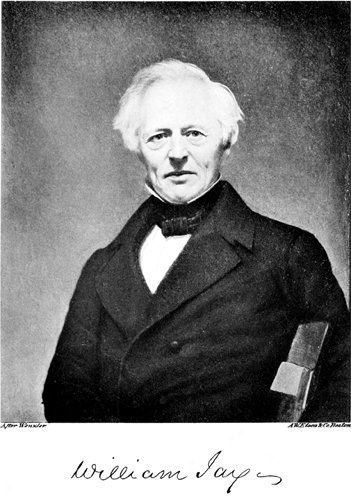
William Jay
CHAPTER VII.
UNPOPULARITY OF THE ABOLITIONISTS.—THE COMPROMISES OF 1850 AND THE FUGITIVE-SLAVE LAW.—JAY'S REPLY TO WEBSTER'S 7th OF MARCH SPEECH.—THE ATTITUDE OF THE EPISCOPAL CHURCH.—THE ABROGATION OF THE MISSOURI COMPROMISE.—DISUNION.
The prospect was dark for the antislavery cause in 1850. Its friends had increased steadily in numbers and in earnestness. But the Slave Power had mustered all its forces in an aggressive campaign which aimed to make slavery a national instead of a local institution, to introduce it into territory hitherto free, and to browbeat the North into submission to every demand of the slaveholder. The compromise measures adopted this year in Congress—above all, the Fugitive-Slave Law—marked the successful advance of arrogant Southern dictation. In the North, the dislike of antislavery men and the willingness to satisfy the South at the expense of conscience was expressed in such scenes as the attack of the Rynders mob on the meeting of the American Antislavery Society in New York and the passive attitude towards it adopted by the authorities. Although the plan of putting down the abolitionists by force had proved impracticable, no efforts were spared to make their lives uncomfortable by the attacks of the press and by the pressure of social disapproval. "Our politicians," wrote Jay to Charles Sumner, "may pride themselves on their adroitness in pandering to popular prejudices, and in acquiring power and influence by seasonable changes of opinion and conduct. But a day is coming when their motives and actions will be judged by a very different tribunal than public opinion, and when a single act of benevolence, a single sacrifice of personal consideration to the cause of truth, will outweigh a whole life of obsequiousness and political trickery.
"The truths we advocate are unpalatable to the two extremes of society. We shock the coarse, vulgar prejudices of the rabble, while the disinterested benevolence we profess is to them an enigma to be solved only by the imputation of fanaticism. At the same time we disturb the tranquil consciences of the rich, thwart the calculations of politicans, and interrupt the harmony subsisting between our merchants and their Southern customers. Hence the upper classes look upon us as impertinent and exceedingly ungenteel, and unfit to move in the higher circles. I cannot tell how far your personal experience coincides with mine, but I know whereof I affirm. I have advanced no ultra-fanatical doctrines in politics or religion. On the subject of slavery I have but reiterated the opinions of many of the best and greatest men in England and in our own country. I have advocated no congressional action except such as Mr. Webster, in his better days, pronounced constitutional, and I have condemned all forcible resistance to the Fugitive-Slave Law. Yet solely on account of my antislavery efforts, I find myself nearly insulated in society."
The Compromise measures of 1850 were repulsive and disheartening to the antislavery men in the North. And no circumstance connected with them was more discouraging than the change of front made by Daniel Webster—his abandonment of the Wilmot Proviso and his concession to the Southern demand for the extension of slavery into the new territory acquired by the Mexican War. Webster's speech of the 7th of March was answered by Judge Jay in a letter to the Evening Post of March 20th, and was afterwards published as a pamphlet and widely circulated. In this letter Jay recalled the eloquent and positive declaration of Webster made in the Senate on August 10, 1848, after New Mexico and California had been acquired:
"My opposition to the increase of slavery in this country, or to the increase of slave representation, is general and universal. It has no reference to the lines of latitude or points of the compass. I shall oppose all such extension at all times and under all circumstances, even against all inducements, against all supposed limitation of great interests, against all combinations, against all compromises."
These words were contrasted by Jay with Webster's present excuse for abandoning opposition to the extension of slavery on the ground that the laws of "physical geography" made slavery impossible in the new territory and to forbid its existence there was merely "to re-enact the will of God."
"To what," asked Jay, "did this solemn, emphatic, unqualified asservation refer? Did he then know that there was a foot of territory in the United States over which it was morally and physically impossible to extend slavery? Was he promising in these impressive terms to oppose what he was conscious would never be attempted? Did he make this pledge before his country with a mental reservation to unite hereafter with General Cass and the slaveholders in denouncing and scorning the Proviso? Did he mean to deceive his own party? Did he desire to keep up an angry agitation throughout the nation for electioneering purposes, and did he thus intimate his belief in the danger of the extension of slavery and slave representation, when he well knew that the fiat of the Almighty had rendered such extension impossible? Was he then acquainted with the law of physical geography which would render the Proviso 'a re-enactment of the will of God?' And did he purposely conceal the secret of this law in his own breast, when by revealing it he might have stilled the raging billows of popular passion which threatened to ingulf the Union? To suppose all this would be to impute to Mr. Webster a degree of trickery and turpitude rarely paralleled even among politicians. Hence we are bound to assume that the law of nature on which he now relies is a recent discovery, subsequent at least to the 10th August, 1848. It is, however, extraordinary that a gentleman of his acquirements did not sooner become acquainted with 'this law of physical geography—the law of the formation of the earth, that settles forever, beyond all terms of human enactment, that slavery cannot exist in California or New Mexico.' It is to be regretted that Mr. Webster did not condescend to demonstrate the existence of this law and to explain the mode of its operation. He indeed tells us that our new territories are 'Asiatic in their formation and scenery'; but this fact does not prove his law, since slavery has existed for ages amid the scenery of Asia; it exists in the deserts of Africa, has existed in every country of Europe, and now exists in the frozen regions of Russia. This law, moreover, must have been enacted by the Creator since 1824, or its operation must have been suspended in deference to the Spanish government; for under that government negro slavery did exist in California and New Mexico, and it ceased in 1824, not by the 'law of physical geography,' but by a Mexican edict. Thousands of slaves are employed in the mines of Brazil, and Mr. Webster does not explain how his law forbids their employment in the mines of California....
"He pays a sorry compliment to the common sense of the people in offering to them at the eleventh hour a new and unheard-of law of 'physical geography,' together with the 'Asiatic scenery and formation' of the conquered territories, as an excuse for violating the faith he had plighted in behalf of the Proviso. He has shocked the moral sense of a large portion of the community by giving in advance his sanction to the Fugitive-Slave Law, which makes the liberty or bondage of a citizen depend on the affidavit of a slaveholder and the judgment of a post-master—a law which converts sympathy for guiltless misery into crime, and threatens to tenant our jails with our most estimable men and women. But Mr. Webster underrates the intelligence and sensibilities of the masses. Relying on the Southern affinities of our commercial cities, on the subserviency of politicians, on the discipline of party, and on his own great influence, Mr. Webster looks down upon the people; but the time is probably not far distant when the people will cease to look up to him. Parties will accept of any leaders who can acquire for them the spoils of the day, but in the political history of our country the people have never placed their affections upon any man in whose stability and consistency they did not confide."
To give such assistance as he could to a fugitive slave had always been regarded by Judge Jay as a duty. "The slaveholders," he had written, "with their accustomed impudence and mendacity, apply the term theft to the humane and Christian efforts to assist a slave in escaping from his home of bondage. In their sense of the expression, I glory in being a slave-stealer, and I inculcate upon my children the duty, the Christian duty, of this kind of theft." He had sheltered and aided many runaways at his home at Bedford, and his will contained a bequest of a thousand dollars to be used for this purpose. His son John gave his services as a lawyer constantly and successfully to prevent the return of fugitive slaves.
When the Fugitive-Slave Bill became a law Judge Jay was applied to by many individuals, societies, and periodicals to give his views concerning it. "The law," he said in a private letter, "is an outrage upon the Constitution of our country and the precepts of our religion. It is a burlesque on justice and on all the acknowledged rules of evidence in the trial of issues. The demand it makes upon individual citizens to aid in hunting and enslaving their fellow-men is diabolical. I have made up my mind to suffer imprisonment and the spoiling of my goods rather than hazard my soul by rendering any active obedience to this sinful law. It is horrible that so many of our fashionable cotton divines are now preaching up the supremacy of human law and virtually dethroning Him whose ambassadors they profess to be."
"In my opinion, every Northern slave-catcher is a base man, and every lawyer who takes reward against the innocent is a disgrace to a noble profession. I myself shall offer no forcible resistance against the execution of this most wicked law, but I trust that, through the grace of God, I would go to the scaffold sooner than obey it."
Concerning the constitutionality of the law, Judge Jay wrote to Josiah Quincy: "The fugitive-slave clause in the Constitution is of course obligatory, but there is a wide distinction between the fugitive-slave clause and the fugitive-slave law. The Constitution gives no power to Congress to legislate on the subject, but imposes on the States the obligation of rendition. Chief-Justice Hornblower, of New York, and Chancellor Walworth, of New York, long since pronounced the fugitive law of '93 unconstitutional on this very ground."
The demoralization caused by the execution of the law was described by Jay in a letter to Gerrit Smith: "It is scoundrelizing our people. Cruelty and injustice are cultivated as virtues, Christian love and sympathy with human suffering are treated as prejudices to be conquered, and zeal in hunting slaves is made the test of patriotism and of fitness for office. But the most diabolical effect of the law is the competition it has excited among our politicians to offer the blood of their fellow-citizens in exchange for Southern votes."
To a committee of free coloured men who asked Judge Jay's advice regarding the propriety of arming themselves to prevent being kidnapped under the law, he said: "Most deeply do I sympathize with you in your unhappy state. With your wives and children, you are now placed at the disposal of any villain who is ready to perjure himself for the price you will bring in the human shambles of the South. With less ceremony and trouble than a man can impound his neighbour's ox, you may be metamorphosed from a citizen of the State of New York into a beast of burden on a Southern plantation. On leaving your house in the morning you may be enticed into another, where one of the newly appointed commissioners, after reading one affidavit, made a thousand miles off, and another that you are the person named in the first, or on the bare oath of the kidnapper himself, may inform you, to your amazement and horror, that you are a slave. The fetters previously prepared are placed on your limbs, and in a few minutes you are travelling with railroad velocity to a Southern market. Never again will you behold your wife and children, nor will any tidings from them ever reach your ear. The remainder of your life is to be one of toil and stripes.... Yet," he continued, "leave, I beseech you, the pistol and the bowie-knife to Southern ruffians and their Northern mercenaries. That this law will lead to bloodshed I take for granted, but let it be the blood of the innocent, not of the guilty. If anything can arouse the torpid conscience of the North, it will be our streets stained with human blood shed by the slave-catchers."
The Fugitive-Slave Law, in Jay's opinion, was the natural sequence to the attempt to put down the antislavery movement by force: "For years, most strenuous efforts, prompted by commercial and political views, were made to deprive the opponents of slavery of their constitutional privileges by lawless violence. The right of petition was suspended, the freedom of debate interrupted, the sanctity of the post-office violated, public meetings dispersed, printing-presses destroyed, furious mobs excited, churches sacked, private houses gutted, and even murder perpetrated. All this violation of rights was regarded with complacency by many who had much at stake, so long as abolitionists alone were the victims. But the spirit of aggression thus raised and fostered is seeking new subjects on which to exercise its power. 'Gentlemen of property and standing' are now beginning to feel alarmed about socialism, anti-rentism, agrarianism, etc. Hence, of late we hear much of the importance of conservatism, as it is called. The political movements of the last few months seem to indicate that our landlords and cotton lords and merchant princes regard an alliance with the aristocracy of the South as at least in some degree a security against the violation of vested rights, sequestration of rents, oppressive taxation, unequal laws, etc. To the influence of gentlemen of this class the late slave law owes its passage.
"And is it indeed believed that the rights of the rich will be protected by familiarizing the populace with the practice of injustice and cruelty towards the poor? Will the sight of innocent men seized in our streets and sent in fetters to till the broad fields of great landowners increase the reverence felt for land titles? Is it wise to give the people practical lessons in the demolition of all the barriers raised by the common law for the protection of the weak against the strong? Is it true conservatism to obliterate in the masses the sense of justice, the feelings of humanity, the distinction between right and wrong?"
The tacit support given to slavery by the Episcopal Church at large and the active support given to it by many individual clergymen was a source of constant grief to Judge Jay and a frequent subject of his thoughts. "You well know," he wrote to Joseph Sturge, "what a mighty effort has been made by our Northern traders in Southern votes and merchandise, under the leadership of Daniel Webster, to roll back the antislavery tide. To a certain extent they have succeeded. The commercial interest in the great towns, through a rivalry for the Southern trade, has professed great alacrity in slave-catching, and political aspirants for office under the Federal Government find it expedient to make slave-hunting the test of patriotism. But the religious feeling of the commonalty—that is, of those who are not pre-eminently gentlemen of property and standing—is shocked by the enormous cruelty and injustice of the fugitive law. To overcome this feeling, which in its demonstrations is exceedingly inconvenient to our merchants and office-seekers, the clergy have been urged by the press and other agencies to come out in support of the law—in other words, to give the sanction of the gospel of Christ to the enslavement of innocent men. Some pastors who preach in fine churches to rich and fashionable city congregations have complied. You must understand that many of our brokers, merchants, lawyers, and editors were exceedingly scandalized by the opposition of religious people to this vile law, and they have trembled for the honour of our holy religion when some of its professors contended that an impious law was not binding on the conscience."
The position of the church was strongly stated by Jay in a letter to Rev. Hiram Jelliff: "It is one of the most melancholy circumstances of the condition of the coloured people that so many of the ministers of the Lord Jesus Christ are among their most influential enemies. The church of the living God is the great buttress of slavery and caste in the United States. If any plea can be urged in behalf of infidelity, it is that Christianity as represented by multitudes of its official teachers authorizes the abrogation of all its precepts of humility, justice, and benevolence in the treatment of persons to whom God has given a coloured skin. Look at the conventions of New York and Pennsylvania excluding ministers and disciples of the crucified Redeemer merely because they are poor and despised! I confess, my dear sir, that were I a young man, with no early religious impressions and about to decide on the truth or falsehood of revelation, I fear I should be strongly tempted to believe that a religion such as it is practically exhibited by your cotton-parsons could not and did not proceed from a just and benevolent being. I have had great opportunities of knowing the effect produced by the countenance given to slavery and caste by the church on the faith of many kind-hearted and conscientious people, and in all sincerity I declare that our pro-slavery clergy, our negro-hating clergy, our slave-catching clergy, are the most successful apostles of infidelity in the country. I write thus freely to you because your course is in direct opposition to those I condemn. The Saviour eat, drank, and lodged with the Samaritans, who were the negroes of Judea, a despised, degraded caste, from whom a Jew disdained to receive even a cup of water.... May God bless and reward your labours."
Occupying, as Judge Jay did, a position of leadership in both the Episcopal Church and the antislavery movement, it was to him that men most frequently turned for advice on subjects relating to the connection between the church and slavery. From mature minds, such as that of Senator Salmon P. Chase, from divinity students and young men contemplating connection with a religious body, came inquiries regarding the duty of joining the church or of remaining a member. To a young man Jay wrote in 1854: "I shall say nothing of the claims of the Episcopal Church as arising from her doctrines, forms, and government, except that I know of no church which, judged by its authorized standards, is more scriptural and more conducive to holiness in this life and to salvation in the next. You desire to enter this church but have not been able to overcome the objection arising from its connection with slavery, and would like to know, for your information, how I reconcile my continuance in this church with my antislavery opinions. Assuredly I could not belong to a church which exacted of its members an admission of the lawfulness of human bondage. Of such a sin and folly the Episcopal Church is guiltless. No sanction of slavery can be found in any of her standards, and hence I can very consistently hold the doctrines of the church and join in its prayers and rites and at the same time regard American slavery as the sum of all villainies. There are in the church slaveholding bishops, clergymen, and communicants, plenty of them. But I am not responsible for their presence.... There never has been, and I suppose there never will be, a widely extended church without unworthy pastors and members. A pure church composed of fallible and sinful men is a figment of the imagination.... Many popish doctrines and practices are occasionally advocated by our Puseyites. But I, as a private member of the church, am in no degree responsible for the heresies of Puseyism nor the more disgusting heresies of cotton-divinity.... In my opinion, in nine cases out of ten an antislavery Christian can do more good to his own soul, to the cause of Christ, and to the interests of the slave by remaining in his church and there battling for truth and justice, than by going in search of a pure church. It often happens when an abolitionist abandons an alleged pro-slavery church he finds no other that suits him. Hence the public worship of God and the Sacraments are neglected. Gradually he and his family learn to live without God in the world, and finally enter upon that broad road which leads to destruction."
The position assumed by the Episcopal Church towards the rights and elevation of the blacks was indicated by the refusal of the Diocesan Council of New York to admit the coloured church of St. Philip, although the parish was constitutionally entitled to be represented and her minister and delegates were entitled to seats and votes. Judge Jay opposed earnestly a majority report from a committee on the question of their admission, which contended that the applicants belonged to a race "socially degraded, and improper associates for the class of persons who attend our conventions." Such an apology for the violation of the constitutional rights ordained by the State, and such a presentation of the theological views entertained by the committee on the unity of the church and the catholic brotherhood of its members, was not calculated to strengthen the opposition to St. Philip's; and the Christian world breathed more freely when, after a nine years' struggle to obtain a vote on the question maintained by Judge Jay and his son, the coloured parish was admitted by a large majority of both orders.
In 1854 Southern aggression had nearly reached its culminating point. The Missouri Compromise was abrogated; the Kansas-Nebraska Bill threw open to slavery an immense territory hitherto free, under the subterfuge invented by General Cass and Senator Douglas of "popular sovereignty." Slavery was thus to extend over the vast regions in the centre of the continent. An indefinite number of new slave States were to be admitted into the Union, which would give the control of the Senate, and consequently of all legislation, forever to the Slave Power.
In February, 1854, Judge Jay received an invitation to address the Anti-Nebraska Convention of the Free Democracy of Massachusetts. His age and health prevented a journey to Boston, but he wrote to the committee of invitation as follows:
"It is meet and right that the stupendous iniquity now about to be perpetrated should be resisted by the true-hearted citizens of that State which, more than any other in the confederacy, has debauched the moral sentiment of the nation and prepared the community for submission to the most insolent usurpation yet attempted by the Slave Power. The present effort to extend the dominion of the whip to the northern limits of the United States is the legitimate consequence of the disastrous and disgraceful concessions of 1850. Those concessions were effected more through the ability and labours of the late distinguished senator from Massachusetts than of any of his coadjutors. Mr. Webster, avowing the entire constitutionality of the Wilmot Proviso and having voted for it in relation to Oregon, objected to its application to the newly conquered territories on the ground that their Asiatic scenery and geographical conformation rendered it physically impossible for negro slavery ever to exist in them. Unhappily for his novel and extraordinary theory, numerous slaves were at the time he spoke held in California.... Slaves are at this day held in New Mexico.
"Mr. Webster, in giving his earnest and cordial support to the atrocious Fugitive-Slave Act, candidly acknowledged on the floor of the Senate that in 'his judgment' Congress had no constitutional power to legislate on the subject, the obligation of surrendering fugitives resting on the States. Yet he scrupled not in his subsequent addresses to speak in terms of unmeasured obloquy of every lawyer who presumed to deny the constitutionality of that horrible law. He admitted the right of Congress to grant the fugitive a trial by jury, yet was unwearied in his advocacy of a law denying to the most helpless of mortals that important safeguard of personal liberty....
"The course of this gentleman at a moment when the dearest principles of liberty, justice, and humanity were vehemently assailed was rapturously applauded by the monied, the literary, and the ecclesiastical aristocracy of Massachusetts, and the New England Church has to a great extent canonized his memory.
"The ardour evinced by the city of Boston in the surrender of Simms, and the intense servility and degradation accompanying that surrender, together with the emphatic endorsement of Mr. Webster's conduct, have exerted an influence in behalf of human bondage and in derogation of Christian obligation far beyond the bounds of Massachusetts. The moral bulwark raised at the North against slavery in times past by the religious sentiment and the respect for the rights of man is nearly demolished.
"The Slave Power, taking advantage of the present paralysis of the Northern conscience and the frantic cupidity of our demagogues and merchants for Southern votes and Southern trade, is about placing its yoke on willing and bending necks.
"Think not that Nebraska is to be the terminus of slaveholding encroachments. New slave States are from time to time to be carved out of Mexico. Cuba is to be wrested from Spain and St. Domingo re-enslaved and annexed. As the field for slave labour widens and widens, the supply will be found inadequate to the demand. The discovery will then be made that both religion and policy require the repeal of the prohibition of the African slave-trade. We shall be told of the Christian duty of bringing the pagans of Africa to our own civilized shores and of preparing them for heaven by the discipline of the whip and the teachings of slave-drivers, while politicans and political economists will insist on the removal of the restriction as essential to the development of our national wealth and enterprise. In vain will Virginia and the other breeding States strive to retain their present lucrative monopoly of the human shambles. The cotton and sugar States, together with the newly acquired slave States, aided by Northern politicians, will establish free trade in the bodies and souls of men.
"The Southern Church is almost without exception the unblushing champion of slavery, while the Northern Church, adopting a time-serving, heartless, and often hypocritical neutrality, and holding in its fraternal embrace slave-breeders and slave-traders, has virtually taught that the vilest outrages on both the civil and religious rights of the black man are perfectly compatible with the highest sanctity in his white oppressor. Some of our religious journals are sadly grieved and scandalized by the alleged discovery that certain opponents of slavery are infidels. For my own part, I know of no form of infidelity so hideous as that which impiously claims the authority of Almighty God for abrogating all His laws in behalf of justice and mercy in reference to our conduct towards millions of our countrymen not of the same colour as ourselves. This cutaneous Christianity, so insulting to the Deity, so disastrous to man, is fast becoming the national religion.
"The present crisis is indeed an awful one. While various causes have aided in producing it, its immediate origin is to be traced to the lamentable defection, in 1850, of so many of the rich and influential from truth and justice, liberty and humanity, under the fallacious plea of saving the Union. Well may the Free Democracy of Massachusetts, with their hands and consciences undefiled by oblations on the altar of the American Moloch, now strive to avert the calamity impending over the country. May a long-suffering God bless their efforts and rescue a guilty nation from the punishment it seems anxious to inflict upon itself."
"As to the wickedness of the whole Kansas business," Jay wrote to Charles Sumner, in March, 1856, "I most fully agree with you, and I do not wonder that amid such abounding iniquity you are at a loss what atrocity to assail first. I am very much inclined to look upon every Northern member of Congress who voted for the repeal of the Missouri Compromise as a rascal. This may seem harsh—it is certainly not polite—and yet I am utterly unable to assign a good, honest, religious motive for the vote, or to reconcile it with the fear of God or with love to man.... Let us fight on, with all our heart and mind and soul. God is with us, approves our efforts, and whether He shall crown them with success or not, He will not forget our work of faith and labour of love. I have full faith in an ultimate triumph, although you and I may not live to enjoy it. My belief is, that as soon as the North ceases to tremble before the slave-drivers, the non-slaveholders of the South will proclaim their independence and insist upon free speech and a free press, and as soon as these are obtained the doom of slavery is sealed."
The repeal of the Missouri Compromise was the beginning of the end, the fatal step of the South on its road to destruction. Throughout the North the conviction grew that Union and slavery could not exist much longer together. On the 4th of July, 1854, Garrison publicly burned a copy of the Constitution of the United States with the words, "The Union must be dissolved!" He represented only an extreme sentiment. But the people at large began to calculate the value of this Union for which so many sacrifices had been made. Slavery became odious to many persons hitherto indifferent to the subject, on the ground that it persistently and selfishly placed the Union in peril.
In the summer of 1857 Judge Jay received a circular calling for a National Disunion Convention, to be held at Worcester, signed by T. W. Higginson, Wendell Phillips, Daniel Mann, and W. L. Garrison. To this circular he replied at length, giving his views on the question of separation as it then appeared to him.
"The subject you propose for consideration," he said, "has long been to me one of deep and painful interest. Although fully conscious of the many social, commercial, and political advantages derived from the Federal Union, I am nevertheless convinced that it is at present a most grievous moral curse to the American people. To the people of the South it is a curse by fostering and strengthening and perpetuating an iniquitous, corrupting institution. To the millions of African descent among us it is a curse by riveting the chains of the bondman and deepening the degradation of the free man. To the people of the free States it is a curse by tempting them to trample under foot the obligations of truth, justice, and humanity for the wages of iniquity with which the Federal Government has so abundantly rewarded apostates from liberty and righteousness.
"In my opinion, while the Union continues to be thus a curse it will be indissoluble; if it ever ceases to be a curse, it will be converted into a blessing.
· · · · ·
"What possible reason have you to expect that those in church and state who have surrendered their consciences to the seductions of the Union will listen to your call and aid you in breaking a power which they glory in saving? While I believe you are doomed to disappointment, I nevertheless rejoice in every exposure of the demoralizing influence of the Union. I rejoice in such exposure, not as tending to bring about dissolution, but to render it unnecessary. When the people of the North cease to idolize the Union, they will cease to offer on its altar their rights and their duties. When released from their thraldom to the Slave Power, they will cease to place its minions in office. When no longer covetous of the votes and the trade of the South, they will no longer be bullied into all manner of wretchedness and all manner of insult by the idea and ever-repeated threats of dissolution. But when this happy time arrives, the Union will be converted from a curse into a blessing. Our divines, instead of vindicating cruelty and oppression, and denouncing as fanatics those who consider the will of God a higher law than an accursed act of Congress, will become preachers of righteousness. Democrats, seeing the Federal patronage wielded by the opponents of slavery, will, in the rapidity and extent of their conversion to truth and justice, eclipse all the marvels of New England revivals; and men who for years have been bowed to the earth by spinal weakness will as by miracle stand erect. When all this happens, the North will continue its Union with the South; and you yourselves will have no wish to see that Union severed.
"At the close of the war, Washington, solicitous that the divine favour might rest on the new-born nation, publicly offered the prayer that God would dispose us all to do justice and love mercy. May the Union, when exerting an influence in accordance with this prayer, be indissoluble; but may God forbid that it may ever be saved by promoting, extending, and perpetuating injustice and cruelty, by invoking the wrath of Heaven, and becoming a proverb and a reproach among the nations of the earth."
CHAPTER VIII.
DEATH OF JUDGE JAY.—HIS POSITION AMONG ANTISLAVERY MEN.—HIS OTHER PUBLIC AND PHILANTHROPIC INTERESTS.—HIS PRIVATE LIFE.—HIS CHARACTER.
Judge Jay was not destined to live to see the triumph of the antislavery cause and of the constitutional principles to which he had devoted his life. Several years of failing health preceded his death, which took place at Bedford, October the 14th, 1858.
His career in the antislavery cause, dating from the Missouri Compromise in 1821, was in several respects unique, and among the leaders of the movement his position continued to be distinctive.
His first active efforts in favour of the slave, the presentation to Congress in 1826 of petitions for the abolition of slavery in the District of Columbia, were marked by a careful regard to the provisions of the United States Constitution. At the first formation of antislavery societies he feared that philanthropic enthusiasm might place the movement in a wrong position by a failure to recognize those provisions. His advice was asked by the men who organized the American Society in Philadelphia, and it was carried into effect by the insertion into the constitution of the society of a complete recognition of the supreme national law, in strict accordance with which, only, the objects of the society should be sought. To maintain the abolitionists in the impregnable position thus adopted was the constant and characteristic labour of Jay's life. This position, consistently held by him against unconstitutional doctrines advanced by both abolitionists and slaveholders, was the position adopted by the Republican party in 1854, and maintained until real union and real liberty were won together.
The antislavery movement was begun and supported by those whom Lincoln called "the plain people." Men of "property and standing" were generally passively if not actively hostile. It received little help from the churches, from the learned professions or the wealthy mercantile classes. It was a very unpopular cause, denounced by politicians, merchants, and lawyers, despised by many of the clergy, certain to bring social and business injury, if not active persecution, to whomsoever adopted it. Hence the championship of William Jay derived a special importance. His judicial and social position, his independent means, his active membership in the most aristocratic of churches, made him a leader of peculiar value. His advocacy of the cause could be attributed neither to ignorant fanaticism nor to disorganizing tendencies. He set an example to the class most able and least willing to oppose the curse of slavery.
A third peculiarity of Jay's position among antislavery men was the nature of the work which he performed. Without health sufficient to make long journeys at a time when travelling was difficult, seldom leaving his country home, he was rarely seen at the meetings and conventions of the abolitionists. He was a voice, speaking words of reason, moderation and authority in times of blind excitement; a voice which spoke at the right moment and was always heard with respect. Jay's activity lay in his pen. In a crisis when the judicious course of action or the accurate view of events was obscured by doubt and passion, a pamphlet or a public letter from Judge Jay cast a clear and steady light. His writings were consulted by the most eminent men when considering subjects connected with slavery. Of this a notable instance was the use made of Jay's argument on the "Amistad" case by John Quincy Adams when addressing the House of Representatives in that celebrated cause. These writings form a continuous and lucid commentary on the history of the long and varied struggle between the forces of slavery and of freedom.
The published works of Judge Jay present but a part of the fruits and the influence of his pen. His correspondence was voluminous and extended to the rank and file as well as to the leaders of the antislavery movement. Constant resort was made to him for information and advice, which was always given with frankness and care.[E]
We may close appropriately our review of Jay's antislavery work with remarks made after his death to the coloured people of New York by Frederick Douglass, who escaped from the slave-driver to urge with native eloquence the emancipation of his race: "In common with you, my friends, I wear the hated complexion which William Jay never hated. I have worn the galling chain which William Jay earnestly endeavoured to break. I have felt the heavy lash, and have experienced in my own person the cruel wrongs which caused his manly heart to melt in pity for the slave.... In view of the mighty struggle for freedom in which we are now engaged, and the tremendous odds arrayed against us, every coloured man and every friend of the coloured man in this country must deeply feel the great loss we have sustained in this death, and look around with anxious solicitude for the man who shall rise to fill the place now made vacant. With emphasis it may be said of him, he was our wise counsellor, our firm friend, and our liberal benefactor. Against the fierce onsets of popular abuse he was our shield; against governmental intrigue and oppression he was our learned, able, and faithful defender; against the crafty counsels of wickedness in high places, where mischief is framed by law and sin is sanctioned and supported by religion, he was a perpetual and burning rebuke."
Besides his work for the negro race, William Jay had various public and philanthropic interests. Prominent among these were the duties of judge of Westchester County, which he exercised for more than twenty-five years. Jay revised the rules of the court, which had been handed down almost unchanged since 1728; and he introduced a strict observance of forms, which, combined with his prompt and explicit decisions, made the Westchester court one of the most dignified in the country. The sittings were held alternately at White Plains and at Bedford, the half-shire towns of the county. Jay also attended to chamber business in other towns. At that period the Westchester bar embraced many lawyers of marked ability, such as R. R. Voorhis, Aaron Ward, William Nelson, Peter Jay Munro, J. W. Strong, Minot Mitchell, and James Smith; and from New York, Alexander McDonald, William M. Price, and Peter Augustus Jay frequently appeared among them. It has been said of Judge Jay's charges to grand juries that "they commanded attention, from their clear exposition of the law without the slightest concession to the popular currents of the day and with careful regard to constitutional rights, morality, and justice." These charges were frequently requested for publication as timely reminders of legal and moral truths, the relation of which to current events was being overlooked. Judge Jay's conduct on the bench caused his reappointment term after term by governors of opposing political parties; and after his death, when a pro-slavery faction endeavoured to remove his portrait from the court-house at White Plains, members of the bar who disagreed with Jay's abolition opinions were foremost in preventing any act of disrespect to his memory.
Jay's philanthropy was religious in its motive and practical in its activity. A life-long worker in the cause of temperance, his efforts produced substantial results, as in the legislation proposed by him which forbade the sale of intoxicating liquors on credit.
For many years a member and president of the Peace Society, he was not satisfied with exposing the evils of war. His mind sought and found a remedy for it in the system of international arbitration, of which the practicability was immediately acknowledged, and towards which the civilized world has since turned with constantly growing confidence.
The organization of the American Bible Society in the face of the opposition of the authorities in his own church displayed in Jay's early life the self-reliance and independence of character which gave so much strength to his later career. Always true to his church, he never compromised his convictions to fit a position in which that church was untrue to itself. During the antislavery movement the churches were hostile. Fearful of alienating their Southern members and the Northern men whose business interests demanded subserviency to the Slave Power, hardly any ecclesiastical organization was guiltless of lending a passive support to slavery. Theological students, on leaving their seminary, were cautioned by their instructors to avoid the troublesome topic if they would be successful ministers of Christ. Clergymen who preached that property in man was sinful were disciplined by ecclesiastical superiors or cast off by outraged Christian congregations. An orthodox religious newspaper was the safest printed matter for a Northern man to have in his possession when travelling in the South. The Episcopal Church had its slaveholding bishops and ministers, not a few of whom justified slavery from the Scriptures. It had in the North its "cotton divines," who enjoined from the pulpit obedience to the odious law which sought to make slave-catchers of Christian men and women. It went so far as persistently to infringe its own laws by shutting the doors of its conventions upon legally chosen delegates of congregations composed of free coloured men. The church of Christ was turned into a social club which did not hesitate to exclude a black man as an "unfit associate." Shocked at this attitude, many conscientious men withdrew from the communion. But such a course was inconsistent with Jay's character. False and repulsive as was to him such a conception of the Christian religion, he refused, as a churchman, to accept it. He remained in the ranks, striving by his own conduct to show that a man could be a good churchman and hate slavery at the same time. Fearless in his expression of Christian truth, he was for twenty years a thorn in the side of pro-slavery churchmen, and a rallying-point for those who understood better the spirit of Christianity and recognized the brotherhood of man before God.
Jay's private life was happy and peaceful. The library at Bedford, with its book-shelves crowded to the ceiling and its windows looking out over the hills of Westchester to the blue outlines of the Catskills, claimed a considerable portion of every day. The hours there passed in reflection and in literary labour were hours of pleasure, enhanced by the desire and the hope of usefulness.
Out-of-doors were the avocations of a country life, which Jay was well constituted to enjoy: the farm, with its interesting record of crops and growing livestock; the garden, where a great variety of flowers and vegetables flourished within hedges of old box; the lawn, with its trees planted by his father and himself—all these gave occupation in pleasing contrast to that of the library. The public roads in the neighbourhood of the Jay farm are now adorned and shaded by noble trees planted by the Judge. Along these roads and over the Westchester hills he loved to ride on horseback, an exercise and pleasure which he enjoyed until the last year of his life. Judge Jay preferred to consider Bedford as a farm rather than as a country seat, and he observed to Bishop Coxe in this regard that a farm without a gate or a fence out of repair was more to his taste than an ornamental estate. The weak eyesight and somewhat delicate health which in his youth seemed a misfortune as debarring him from a career of activity in the city turned in the end to his advantage. A happier life than that at Bedford could hardly have been devised for him; and it is probable that the studious retirement of his country library gave to his views on public questions a thoroughness and moderation greater than could have been attained amidst the hurry and distraction of a great city.
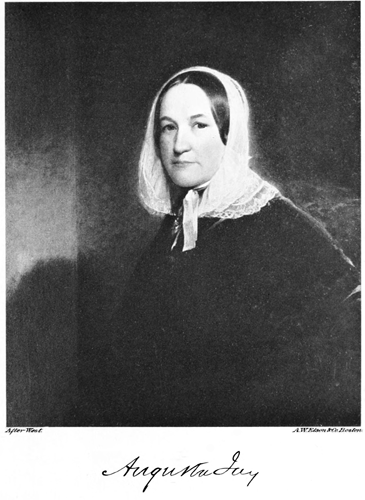
Augusta Jay
In his family relations, Jay was still more fortunate. His wife lived to be his sympathetic companion until 1856, when he himself was near his end. Her accomplishments, especially in reading and drawing, her grace, gentleness, and goodness, her natural charity, added immeasurably to the happiness of Jay's life. "I have always regarded her," said the late Rev. J. W. Alexander, "as one of the happiest specimens of a Christian lady that it has been my lot to meet. Intelligent, graceful, pious, gentle, sportive in the right place, generous and catholic, she awakened a sincere respect and attachment, and our memory of her is blessed." The late Bishop Horatio Potter of New York, speaking of her later life, said: "The serene composure, the sweet simplicity and dignity, bespoke a peaceful and elevated spirit, and made an impression on the most transient visitor never to be effaced." Dr. John Henry Hobart, son of the Bishop, wrote to John Jay: "Your mother, always gentle, placid, and cheerful, with an unfailing smile and pleasant words for her young guests, sympathizing with their boyish enthusiasm for poetry and romance, and tempering their ardour with counsel and caution, which her own sensitive spirit conveyed in the most delicate forms—of her I must speak thus feelingly; it only indicates the debt of gratitude I owe to her memory."
Judge Jay had one brother, Peter Augustus Jay, who was thirteen years his senior. Between the brothers there continued through life an uninterrupted affection and confidence. Peter Augustus led an active professional and social life in New York City, holding office as judge, as recorder, and as a member of the State Assembly. On his death, in 1843, high tributes to his ability as a jurist and to his character as a public-spirited citizen were paid by Chancellor Kent, Chief-Justice Samuel Jones, and David B. Ogden. As a member of the Assembly, he was conspicuous in the advocacy of various important measures, among which may be mentioned his efforts to extend the right of suffrage to black citizens of the State. Peter Augustus Jay was not himself prominent in the antislavery cause, but he was generally in sympathy with his brother's work.
The Right Reverend A. Cleveland Coxe, Bishop of Western New York, was a frequent visitor in his youth at Bedford. Some extracts from a letter written by him to John Jay afford an interesting view of the domestic life of the Judge's home:
"William Jay was one of those true sons of the Republic who inherited sound views of its constitutional system from your illustrious grandfather, and from personal acquaintance with some other fathers of the nation who were high in the confidence of Washington and shared his just and lofty ideas of national policy. Your father was one of those born statesmen who breathed under the inspiration of such ideas, and was animated by them to efforts for the preservation of the Constitution itself in degenerate days. Those were the days when the 'spoils-system' had begun to act with corrosive effect on public affairs and public men. The science of true statesmanship seemed ready to perish. The country fell into the hands of mere politicians, with whom legislation was a trade and a struggle for personal aggrandizement. The epoch had little use for men of pure patriotism, but your father, incapable of ambition or the pursuit of personal ends, stood aside and devoted himself with intrepidity to unpopular principles, of which he foresaw the utility, while he was hardly less prophetic of the cruel war which must be the consequence of popular indifference and blindness to the national perils. He was little seen, but greatly felt, and has left a mark on the diplomacy of his time which is a gain to humanity and to civilization.
"I cannot forget the charms of that domestic life which he made so attractive to his children and to the large circle of kindred and friends who were admitted to its enjoyments. It was in 1836 that, with our beloved friend Hobart, I was invited to spend the Christmas holidays at Bedford. We were boys together at that time, and I remember to what hours we prolonged our recreations, with no other restriction than your father's cheerful injunction, as he bade us good-night: 'Young gentlemen, please remember not to laugh too loudly; it might deprive some of us of the sleep which you seem not to require for yourselves.' How merrily we 'saw the old year out and the new year in,' that Christmas-tide! I often thought of Irving's 'Bracebridge Hall' as realized in America, in the home of your happy boyhood. Year after year, winter and summer, through college life, you led me to renew my holidays in Bedford. How much I learned from your father's condescension to boyhood in conversing with his boy-visitors as if they were men! He drew out our opinions and encouraged us to state them frankly when he suspected that we had the boldness to prefer our crude ideas to his own judicial and grave conceptions of fact and principle. He played chess with his youthful guests, but never permitted them to beat him, as that would have been no compliment to lads who worked hard and wished to win in a fair game.
"I have rarely seen a household in which family life was ordered more particularly with reference to religion. There was much of the Huguenot in the piety of the Judge, but nothing of the Puritan. Family prayers were observed twice a day, the servants attending and sharing in the responses. After-evening prayers in those early days, we enjoyed a few cotillons and contra-dances, Mrs. Jay presiding at the piano. And when the ladies had withdrawn, chess-playing and other games occupied us, not infrequently until after midnight. Sundays in the old homestead, after church-going, were like other days, save in the chastened cheerfulness of conversation and employment. A feature of Sunday evenings was the custom for every member of the family to recite something in prose or poetry, and the Judge often closed such recitals by reading selections from Bishop Heber, Mr. Milman, and other favourites of those times. In the third decade of this century, the daughters of 'the governor,' Mrs. Banyer and Miss Jay, were often the guests of their brother. They would have been interesting figures in any society, and were eminent in New York for their Christian virtues and devotion to every good work. The elder sister, born in Spain, seemed to preserve in her face and carriage something borrowed from her native climate, while Mrs. Banyer, born in France, was not less conspicuously marked by characteristics of her French ancestry. While the only son of Judge Jay is a recognized type of his father's principles and character, his daughters not less resembled their mother—a lady whose memory I hold in very great respect, with an affectionate estimate of her worth as a beautiful example of her gracious sex, in all characteristics 'wherein there is virtue and wherein there is praise.'
"I feel, at this distance of time, that I owe much to the friendship of Judge Jay, apart from the pleasures it conferred upon me. How much he taught me! How often his maxims led me to correct my faults, though he never seemed to instruct, much less to rebuke! Even in his decline, and when he was nearing the end, he favoured me with an occasional letter. Need I say that, while entirely free from cant and pharisaic professions, such letters were models of Christian submission, and not less of 'faith, hope, and charity'? I have frequently reflected upon them as I find myself approaching the end. His lofty example leads me to say with the inspired moralist: 'Mark the perfect man and behold the upright, for the end of that man is peace.'"
BIBLIOGRAPHY.
The Life of John Jay. With Selections from his Correspondence and Miscellaneous Papers. In two volumes, 1833.
War and Peace. The Evils of the First and a Plan for Preserving the Last. London, 1842.
A Review of the Causes and Consequences of the Mexican War, 1849.
Miscellaneous Writings on Slavery, 1853. In which are collected:
Inquiry into the Character and Tendency of the American Colonization, and American Antislavery Societies.
A View of the Action of the Federal Government in Behalf of Slavery.
On the Condition of the Free People of Colour in the United States.
Address to the Friends of Constitutional Liberty, on the Violation by the United States House of Representatives of the Right of Petition.
Introductory Remarks to the Reproof of the American Church contained in the recent "History of the Protestant Episcopal Church in America" by the Bishop of Oxford.
A Letter to the Right Reverend L. Silliman Ives, Bishop of the Protestant Church in the State of North Carolina.
Address to the Inhabitants of New Mexico and California, on the Omission by Congress to provide them with Territorial Governments, and on the Social and Political Evils of Slavery.
Letter to Hon. William Nelson, M. C., on Mr. Clay's Compromise.
A Letter to the Hon. Samuel A. Eliot, Representative in Congress from the City of Boston, in Reply to his Apology for voting for the Fugitive-Slave Bill.
An Address to the Antislavery Christians of the United States. Signed by a number of clergymen and others.
Letter to Rev. R. S. Cook, Corresponding Secretary of the American Tract Society.
Letter to Lewis Tappan, Esq., Treasurer of the American Missionary Society.
PAMPHLETS.
Report of the Bedford Society for the Suppression of Vice, 1815.
Letter to Venders of Ardent Spirits, 1815.
Answer to Bishop Hobart's Pastoral Letter on the Subject of Bible Societies, by an Episcopalian, 1815.
Memoir on the Subject of a General Bible Society, by a Citizen of New York, 1816.
Appeal in Behalf of the American Bible Society, by a Lay Member of the Convention, 1816.
Dialogue between a Clergyman and a Layman on the Subject of Bible Societies, by a Churchman, 1817.
Remarks on a Petition to the Legislature praying for the Repeal of the Acts for Improving the Agriculture of this State, by a Westchester Farmer, 1821.
Letter to Bishop Hobart occasioned by the Strictures on Bible Societies contained in his late Charge to the Convention of New York, by a Churchman, 1823.
Letter to Bishop Hobart in Reply to the Pamphlet addressed by him to the Author under the Signature of "Corrector," by William Jay, 1823.
Reply to a Second Letter to the Author from Bishop Hobart, with Remarks on his Hostility to Bible Societies, by William Jay, 1823.
Essay on the Importance of the Sabbath considered merely as a Civil Institution, 1826.
Essay on the Perpetuity and Divine Authority of the Sabbath. Published by the Synod of Albany, 1827.
Remarks on the Proposed Changes in the Liturgy and Confirmation Service, 1827.
The Office of Assistant Bishop inconsistent with the Constitution of the Protestant Episcopal Church, 1829.
Essay on Duelling, 1830.
Address to the Inhabitants of Westchester County on Temperance, 1834.
Addresses to the Westchester County Auxiliary Bible Society, 1836, 1839, 1841, 1845, and other years.
Address before the New York Female Bible Society, 1840.
Letter of Hon. William Jay to Hon. Theodore Frelinghuysen on Slavery, 1844.
Address before the American Peace Society, 1845.
Trial by Jury in New York, 1846.
Address to the Non-Slaveholders of the South, on the Social and Political Evils of Slavery, 1849.
The Calvary Pastoral, with Comments, a Tract for the Times, 1849.
Reply to Mr. Webster's 7th of March Speech, 1850.
Reply to Remarks of the Rev. Moses Stuart in his pamphlet entitled "Conscience and the Constitution." J. A. Gray, New York, 1850.
The Kossuth Excitement, 1852.
The Bible against Slavery. J. K. Wellman, Adrian, Michigan, 1852.
Petition of the American Peace Society to the United States Senate in behalf of Stipulated Arbitration, 1853.
An Examination of the Mosaic Law of Servitude, "The Statutes of the Lord are right—Psalm xix. 8." M. W. Dodd, New York, 1854.
"The Eastern War," an Argument for the Cause of Peace. Address before the American Peace Society, 1855.
A Letter to the Rev. Wm. Berrian, D.D., on the Resources, Present Position, and Duties, of Trinity Church, occasioned by his late Pamphlet, "Facts against Fancy." A. D. Randolph & Co., New York.
Judge Jay left in Manuscript an elaborate Commentary, the work of many years, on the Old and New Testaments.
INDEX.
Abolition Intelligencer, the, 28. Abolition movement, its early history, 18 et seq. Abolition societies, early, 23, 27. Abolitionists, hatred of, 41, 42, 56, 67, 135, 136. ——, differences among, 83, 103. Adams, Charles Francis, 129. ——, John Quincy, 25, 31, 158, 159. Alexander, George W., 159. ——, J. W., 164. American and Foreign Antislavery Society, formation of, 103. American Antislavery Society, formation of, 49, 50; division in, 103. Anderson, W. W., 159. Anti-Annexation Meeting, in New York, 126. Antislavery movement, development of, 39 et seq. Antislavery societies, formation of, 45. Antislavery Society of New York City, 46, 47. Aspinwall, John, 12. Bailey, G., Jr., xvii, 159. Banyer, Mrs., 125, 167. Bedford, 8, 9, 163. Benezet, Anthony, 19. Benson, Judge, 38. Bible Society, iii, 10, 11, 12. Birney, James G., xvi, 63, 103, 107, 117, 118, 159. Bogardus, General, 46. Bolton, John, 12. Bouck, Gov., 14, 124, 125. Boudinot, Elias, iii, 11, 12, 28. Bourgueny, Baron, vi. Bradish, Luther, 110. Brent, W. L., 35. Broglie, Duc de, 63, 126. Brown, David P., 54. Brownson, Dr. Orestes A., xix. Brune, Baron, vi. Buol-Schauenstein, Count, vi. Buren, Van, Martin, 107, 124. Burling, William, 18. Calhoun, John C., xii, 4. Canterbury, persecution at, 42. Cass, Lewis, 149. Cavour, Count, vi, xviii. Chambers, John, 9. Channing, W. E., 56. Chapman, Mrs., xvi, 91. Chase, Salmon P., 146, 159. Chatham Street Chapel, 47, 53. Child, Mrs. Lydia Maria, xvii, 40, 67, 112, 159. Circourt, M. de, v. Clarendon, Lord, vi, 131. Clarkson, Matthew, 12. Clarkson, Thomas, 159. Clay, Henry, 24, 32. Cleveland, C. D., 159. Clinton, De Witt, 12, 14, 31, 32. Clinton Hall, 46. Cobden, R., vi. Colebrook, Sir W., 159. Colonization Society, 26. Commercial Advertiser, 55. Compromise of 1850, 137. Constitutional questions, xi, 86, 87, 89, 91, 99. Cooper, J. Fenimore, 2, 3, 5, 9, 14. Cornish, Samuel E., 73. Cortlandt, Van, Eve, 9. ——, Jacobus, 9. ——, Mary, 9. ——, Pierre, 9. Cotton-gin, the, 23. Courier and Inquirer, 47, 55. Cowley, Lord, vi. Cox, Abraham L., 55, 73. Cox, Samuel H., 64. Coxe, A. Cleveland, 165. Crandall, Miss, 42. ——, Reuben, 41, 159. Cummings, John, 13. Dane, Nathan, 20. Davis, Henry, 3. ——, Jefferson, xii. Delavan, Edward, 61. Denison, Charles W., 103. Derby, Lord, vii. Disunion, 153, 154, 155. Douglas, Senator, 149. Douglass, Frederick, 159. Duelling, essay on, 13. Dwight, Timothy, 7. Earle, Thomas, 107. Edwards, Jonathan, 23. Ellison, Thomas, 1. Emancipation, gradual, 41. ——, immediate, 23, 40, 41, 43. ——, in West Indies, 45. Emancipator, the, 28, 75. Episcopal Church, its attitude towards slavery, 132, 133, 144, 145, 147. Evarts, Jeremiah, 12. Everett, Alexander H., 82. Fitzmaurice, Lord Edmond, v. Forsythe, John, 35. Franklin, Benjamin, iv, 23. Frelinghuysen, Theodore, 48. Frere, John Hookham, 126. Fugitive-Slave Law, 140, 141, 142, 143, 144. Gadsden, Christopher Edward, 4. Gallatin, Albert, 127. Gallaudet, Thomas H., 4. Garrison, William L., xvii, 40, 51, 53, 63, 64, 77, 84, 86, 89, 102, 153, 154. Gay, S. H., xvii. Gayle, Gov., 74. Genius of Universal Emancipation, 28. Gibbons, James S., xvii. Giddings, Joshua R., 129. Gladstone, W. E., vi. Goodell, William, xvii, 27, 40, 107, 159. Gouverneur, Samuel L., 65. Gray, William, 12. Grayson, William, 20. Green, Rev. Beriah, 60, 159. Green, Oliver, 30. Griffin, George, 12. Grimké, Misses, xvii, 91, 159. ——, Thomas Smith, 4. Grundy, Felix, 12. Habersham, R. W., 13, 159. Hale, John P., 159. Hamilton, Alexander, 23. ——, James, 35. Hammond, J. D., 159. Harrison, W. H., 107. Henry, John B., 8. ——, Patrick, 20, 21. Hicks, Elias, 27. Higginson, T. W., 154. Hillhouse, James A., 4. Hobart, Bishop, iv, 11, 13. ——, John Henry, 164. Holley, Myron, 107. Holly, Horace, 6. Hopkins, Samuel, 19, 23. Hopper, Isaac T., xvii. Hornblower, Chief-Justice, 159. Horton, Gilbert, case of, 29, 30, 31. Hubner, Baron, vi. Huntington, William, 4. Immediate Emancipation, first proclaimed as a duty, 23. International arbitration, v, 130, 131. Ives, Bishop, x. Jackson, Andrew, 77. ——, Francis, 102. ——, J. C., 103. Jarvis, Samuel F., 4. Jay, John, iv, 1, 5, 9, 12, 20, 23, 38, 39, 127. ——, John, 2d, 55. ——, Miss, 125, 167. ——, Peter Augustus, 160, 165. —— Treaty, iv. ——, William, his birth, 1; education, 2; at Yale College, 4, 6; studies law, 8; marriage, 8; begins life at Bedford, 8, 9; begins philanthropic work, 10; advocates Bible Societies, 10; conflict with Bishop Hobart and High-Church party, 10, 11, 13; organizes American Bible Society, 11, 12; takes prize for essay on the Sabbath, 13; for essay on duelling, 13; appointed judge, 14; early adoption of antislavery cause, 28; espouses cause of Gilbert Horton, 29; begins movement for abolition of slavery in District of Columbia, 29, 32, 34, 36, 37; writes "Life of John Jay," 39; his view of slavery problem in 1833, 43, 44; consulted regarding formation of American Antislavery Society, 45; advises acknowledgment of constitutional provisions, 45, 46; invited to join in organizing the American Antislavery Society, 49; his views on such an organization, 50; suggests a definite avowal of constitutional principles, 50, 51; becomes a member of Executive Committee of American Antislavery Society, 57; publishes his "Inquiry," 58; its influence, 60, 61; appointed foreign corresponding secretary, 63; gives advice on right to use the mails, 65; his "Address to the Public," 69; elected president of New York State Antislavery Society, 77; his reply to President Jackson's message, 78; protests against the introduction of irrelevant doctrines into antislavery societies, 84, 86, 100; protests against unconstitutional doctrines, 87, 90; defeats Alvan Stewart's resolution, 93; his opinion of the danger of unconstitutional doctrines, 90, 94; his opinion of Stewart's position, 95; his loss of faith in the usefulness of antislavery societies, 97, 100; placed on Executive Committee of American and Foreign Antislavery Society, 103; resigns membership in American Antislavery Society, 103; views on the woman question, 103, 104; his "View of the Action of the Federal Government," 105; his "Condition of the Free People of Colour," 106; his "Violation of the Right of Petition," 106; his attitude towards Liberty party in 1840, 107, 108, 109; his attitude towards antislavery societies after the schism, 112, 113, 114, 115, 116; his attitude towards Liberty party in 1843, 117, 118, 119, 120, 121; his views on the annexation of Texas, 118, 127, 128; nominated for Senator by the Liberty party, 120; deprived of his seat on the bench, 122; his visit to Europe, 125; his "Review of the Mexican War," 127, 128; his "War and Peace," and plan for International arbitration, 130, 131; his attitude towards the "come-outers," 132; his work in the Episcopal Church in favour of the slave, 132, 133, 144, 145, 147, 162; "Letter to Bishop Ives," 133; reply to Webster, 137, 138; attitude towards the Fugitive-Slave Law, 140, 141, 142, 143; views on the Kansas-Nebraska Bill, 149, 150, 152; views on disunion, 153, 154, 155; his death, 156; his distinctive position among antislavery men, 156, 157, 158; his writings, 158; his conduct as judge, 160; other philanthropic work, 161; his position as a churchman, 161, 162; his life at Bedford, 163, 164; his family life, 164, 165, 166. ——, William, 2d, 5, 8. ——, Mrs. William, 8, 164. Jefferson, Thomas, 20, 24. Jelliff, Hiram, 145. Jocelyn, Simeon S., xvii, 73, 158. Johnston, Oliver, xvii. Jones, Samuel, 165. Katonah, 9. Keith, George, 18. Kelley, Miss Abby, 102. Kendall, Amos, 64, 65. Kent, James, 53, 61, 127, 165. King, Rufus, 20. Langdon, John, 12. Law, William, 13. Lay, Benjamin, 18. Leavitt, Joshua, xvi, 49, 73, 103, 107, 159. Lee, Richard H., 20. Leggett, William, 56. Liberalist, the, 28. Liberator, the, 40. Liberty party, 107, 117, 118, 119. Lincoln, Abraham, xiii, xviii, 157. Loring, Ellis Gray, xvii, 87, 90, 91. Lovejoy, Elijah P., 82. Ludlow, Henry G., 53. Lundy, Benjamin, 27, 40. Lyons, Lord, xiv. McAllister, Matthew H., 13. McDonald, Alexander, 160. McDuffie, George, 35. McVickar, John, 8. Mails, destruction of, 64. Malmsbury, Lord, vii, 131. Mann, Daniel, 154. Marcy, Governor, 76, 110. May, Samuel J., 50, 51, 86, 91, 159. Miner, Charles, 32, 37. Missouri Compromise, 24. Mitchell, Minot, 122, 160. Mobs, 56, 82, 135. Morris, Thomas, 117. Morrison, Dr., 159. Mott, Lucretia, xvii. Munro, Peter Jay, 160. Nelson, William, 160. Noyes Academy, 42. Ogden, David B., 48, 165. Orloff Count, vi. Owen, John, 29. Palfrey, J. G., 159. Peyster, de, Frederic, 12. Phelps, Amos A., 53, 86, 103, 159. Phillips, Wendell, xvii, 154. Pickering, Thomas, 20. Pierpont, John, 4. Pinckney, Charles C., 12. Pintard, John, 12. Playfair, Sir Lyon, viii, 132. Potter, Alonzo, 61. ——, Horatio, 164. Purvis, Robert, 53. Quincy, Edmund, xvii. Quincy, Josiah, 141. Rankin, John, 27, 73. Rensselaer, Van, Stephen, 12. Reporter, the, 113. Republican party, 52. "Review of the Mexican War," ix. Richard, Henry, vi, 131. Riots, pro-slavery, 46, 54. Romeyne, John B., 12. Rush, Benjamin, 19. Rutgers, Henry, 12. St. Clair, Alanson, 91. St. Philip's Church, 148. Sandiford, Ralph, 18. Sandwich, Lord, 19. Scoble, John, 159. Sedgwick, Henry D., 37. ——, Susan, 3. ——, Theodore, 127, 159. ——, Mrs. Theodore, 61. Sewall, Samuel, 18. Seward, W. H., xiv, 110, 159. Simms, 150. Slade, William, 159. Slave Power, growth of, 135. Smith, Gerrit, xvi, 77, 83, 103, 107, 118, 141, 159. ——, Goldwin, xviii. ——, James, 160. ——, John Cotton, 12. Spring, Gardiner, 4. Stanton, Henry B., 103, 119. Stephens, A. H., xv. Stevens, Alexander H., 4. Stewart, Alvan, 52, 76, 92, 95, 96, 99, 107. ——, Charles, 53. Stone, James A., 53. Storrs, Henry R., 4. Stowe, Harriet B., xvii. Strong, J. W., 160. Sturge, Joseph, v, 130, 131, 144, 159. Stuyvesant, Peter G., 61. Sumner, Charles, 136, 152, 159. Tabernacle, the Broadway, 92. Tappan, Arthur, xvi, 40, 45, 49, 53, 55, 64, 67, 68, 73, 102, 103, 158. ——, Lewis, xvi, 40, 47, 54, 73, 75, 103, 113, 158. Taylor, Nathaniel W., 4. Thompson, George, 63, 67. Tighlman, William, 12. Tocqueville, de, A., 15. Tompkins, Daniel D., 12. Torrey, Charles T., 101. Tucker, Beverly, xiii. Utica Convention, 76. Varick, Richard, 12. Vaux, Robert, 159. Vergennes, Count de, v. Villamarina, Marquis de, vi. Voorhis, R. R., 160. Walewski, Count, vi. Walworth, Chancellor, 48. "War and Peace," v, 130, 131. Ward, Aaron, 34, 160. ——, Samuel R., xvii. Washington, Bushrod, 12. ——, George, 155. Wayne, James M., 13. Webster, Daniel, 137, 139, 144, 150. Weekly Emancipator, 40. Weld, Theodore D., xvii. Whittier, John G., xvii, 40, 51, 103. Wickliffe, Charles A., 35. Wilberforce, Samuel, 133, 134. Williams, Ransom G., 74, 75. Wilson, Henry, 58. Wirt, William, 12. Woman question, the, 103, 104, 105. Woolman, John, 19. Worthington, Governor, 12. Wright, Elizur, Jr,, xvii, 40, 49, 53, 65, 67, 73, 107, 159. ——, Theodore S., 73.