Front matter
Reading edition
The Publication Committee of the Caxton Club certifies that this is one of an edition of two hundred and fifty-two copies printed on American hand-made paper, of which two hundred and forty are for sale, and three copies printed on Japanese vellum. The printing was done from type which has been distributed.
This is also one of one hundred and forty-eight copies into which has been incorporated a leaf from an imperfect copy of the first edition of Chaucer's "Canterbury Tales," printed by William Caxton, and formerly in Lord Ashburnham's library, having been purchased for this purpose by the Caxton Club. The copies so treated comprise the three Japanese vellum copies and one hundred and forty-five of the American hand-made paper copies; all of the latter are for sale.
WILLIAM CAXTON
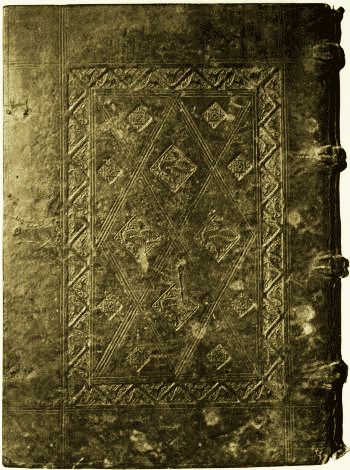
BINDING WITH CAXTON'S DIES
(Frontispiece, and see page 85)]
WILLIAM CAXTON
BY
E. GORDON DUFF, M. A. OXON. SANDARS READER IN BIBLIOGRAPHY IN THE UNIVERSITY OF CAMBRIDGE

CHICAGO THE CAXTON CLUB MCMV
COPYRIGHT BY THE CAXTON CLUB NINETEEN HUNDRED AND FIVE
TABLE OF CONTENTS.
chapter page
Preface 11
I. Caxton's Early Life 13
II. Caxton's Press at Bruges 22
III. The Early Westminster Press 33
IV. 1480-1483 47
V. 1483-1487 56
VI. 1487-1491 70
VII. Caxton's Death 86
Appendix 91
Index 99
LIST OF ILLUSTRATIONS.
plate page
Binding with Caxton's Dies [From the cover of a book in the library of Corpus Christi College, Oxford.] Frontispiece
I. Prologue from the Bartholomaeus This contains the verse relating to Caxton's first learning to print. [From the copy in the Bodleian Library, Oxford.] (Erratum: Read Prologue for Epilogue on Plate I.) 22
II. The Recuyell of the Historyes of Troye Printed in Caxton's Type 1. Leaf 253, the first of the third book. [From the copy in the Bodleian Library, Oxford.] 28
III. Epilogue to Boethius Printed in Caxton's Type 3. [From the copy in the Bodleian Library, Oxford.] 36
IV. The Dictes or Sayengis of the Philosophres Printed in Caxton's Type 2. [From the copy in the Bodleian Library, Oxford.] 38
V. Caxton's Advertisement Printed in Caxton's Type 3. Intended as an advertisement for the Pica or Directorium ad usum Sarum. [From the copy in the Bodleian Library, Oxford.] 42
VI. The Mirrour of the World Printed in Caxton's Type 2*. The woodcuts in this book are the first used in England. [From the copy in the Bodleian Library, Oxford.] 50
VII. The Mirrour of the World Printed in Caxton's Type 2*. This shows a diagram with the explanations filled in in MS. [From the copy in the Bodleian Library, Oxford.] 50
VIII. The Game and Playe of the Chesse Printed in Caxton's Type 2*. The wood-cut represents the philosopher who invented the game. [From the copy in the Bodleian Library, Oxford.] 52
IX. Liber Festivalis Printed in Caxton's Type 4*. The colophon to the second part of the book entitled "Quattuor Sermones." [From the copy in the Bodleian Library, Oxford.] 56
X. Chaucer's Canterbury Tales Printed in Caxton's Type 4*. This is the second edition printed by Caxton, but the first with illustrations. [From the copy in the British Museum.] 58
XI. The Fables of Esope Printed in Caxton's Type 4*. These two cuts show the ordinary type of work throughout the book. [From the copy in the Bodleian Library, Oxford.] 60
XII. The Fables of Esope The wood-cut here shewn is engraved in an entirely different manner from the rest. [From the copy in the Bodleian Library, Oxford.] 60
XIII. The Fables of Esope Shewing the only ornamental initial letter used by Caxton. [From the copy in the Bodleian Library, Oxford.] 62
XIV. The Image of Pity [From the unique wood-cut in the British Museum.] 66
XV. Speculum Vitæ Christi Printed in Caxton's Type 5. The wood-cut depicts the visit of Christ to Mary and Martha. [From the copy in the Bodleian Library, Oxford.] 66
XVI. Caxton's Device [From an example in the Bodleian Library, Oxford.] 70
XVII. Legenda ad usum Sarum Printed at Paris by W. Maynyal, probably for Caxton. The book is known only from fragments. [From a leaf in the University Library, Cambridge.] 70
XVIII. The Indulgence of 1489 Printed in Caxton's Type 7. This type is not mentioned by Blades in his Life of Caxton. [From a copy in the British Museum.] 72
XIX. The Boke of Eneydos Printed in Caxton's Type 6. This page gives Caxton's curious story about the variations in the English language. [From the copy in the British Museum.] 76
XX. Ars Moriendi Printed in Caxton's Type 6 [text] and 8 [heading]. [From the unique copy in the Bodleian Library, Oxford.] 76
XXI. Servitium de Transfiguratione Jesu Christi Printed in Caxton's Type 5. [From the unique copy in the British Museum.] 78
XXII. The Crucifixion Used by Caxton in the Fifteen Oes, and frequently afterwards by Wynkyn de Worde. [From an example in the Bodleian Library, Oxford.] 78
XXIII. The Lyf of Saint Katherin Printed by W. de Worde with a modification of Caxton's Type 4*. The large initials serve to distinguish de Worde's work from Caxton's. [From the copy in the British Museum.] 80
XXIV. and XXV. The Metamorphoses of Ovid Two leaves, one with the colophon, from a manuscript prepared by Caxton for the press, and perhaps in his own hand. [From the MS. in the Pepysian Library, Magdalene College, Cambridge.] 82