PART II - RECORDS FROM CONTEMPORARY SOURCES (continued 2)
Reading edition
How sweet I roamed from field to field, And tasted all the summer's pride, Till I the prince of love beheld, Who in the sunny beams did glide! He showed me lilies for my hair, And blushing roses for my brow; He led me through his gardens fair, Where all his golden pleasures grow. With sweet May dews my wings were wet, And Phoebus fired my vocal rage; He caught me in his silken net, And shut me in his golden cage. He loves to sit and hear me sing, Then, laughing, sports and plays with me; Then stretches out my golden wing, And mocks my loss of liberty.
The playful character ascribed to the prince of love, especially his wanton and fantastic action while sporting with his captive, in the two last stanzas, render it probable that the author had read the Hue and Cry after Cupid. If so, it had made its impression; but the lines could scarcely have been remembered at the time of writing, or the resemblance would have been closer. The stanzas to which I especially allude, are these.
Wings he hath, which though ye clip, He will leap from lip to lip, Over liver, lights, and heart, But not stay in any part; And, if chance his arrow misses, He will shoot himself, in kisses. Idle minutes are his reign; Then the straggler makes his gain, By presenting maids with toys, And would have ye think'em joys: 'Tis th' ambition of the elf, To have all childish as himself.
The two following little pieces are added, as well by way of contrast, as for the sake of their respective merits. In the first, there is a simple and pastoral gaiety, which the poets of a refined age have generally found much more difficult of attainment, than the glitter of wit, or the affectation of antithesis. The second rises with the subject. It wears that garb of grandeur, which the idea of creation communicates to a mind of the higher order. Our bard, having brought the topic he descants on from warmer latitudes than his own, is justified in adopting an imagery, of almost oriental feature and complexion.
SONG
I love the jocund dance, The softly breathing song, Where innocent eyes do glance, And where lisps the maiden's tongue. I love the laughing gale, I love the echoing hill, Where mirth does never fail, And the jolly swain laughs his fill. I love the pleasant cot, I love the innocent bower, Where white and brown is our lot, Or fruit in the midday hour. I love the oaken seat, Beneath the oaken tree, Where all the old villagers meet, And laugh our sports to see. I love our neighbors all, But, Kitty, I better love thee; And love them I ever shall; But thou art all to me.
THE TIGER
Tiger, Tiger, burning bright, In the forest of the right! What immortal hand or eye Could frame thy fearful symmetry? In what distant deeps or skies, Burnt the fire of thine eyes? On what wings dare he aspire? What the hand dare seize the fire? And what shoulder, and what art, Could twist the sinews of thy heart? When thy heart began to beat, What dread hand forged thy dread feet? What the hammer? What the chain? In what furnace was thy brain? What the anvil? What dread grasp Dared its deadly terrors clasp? When the stars threw down their spears, And watered heaven with their tears, Did he smile his work to see? Did he, who made the lamb, make thee? Tiger, tiger, burning bright, In the forest of the night; What immortal hand or eye Dare frame thy fearful symmetry?
Besides these lyric compositions, Mr. Blake has given several specimens of blank verse. Here, as might be expected, his personifications are bold, his thoughts original, and his style of writing altogether epic in its structure. The unrestrained measure, however, which should warn the poet to restrain himself, has not infrequently betrayed him into so wild a pursuit of fancy, as to leave harmony unregarded, and to pass the line prescribed by criticism to the career of imagination.
But I have been leading you beside our subject, into a labyrinth of poetical comment, with as little method or ceremony, as if we were to have no witness of our correspondence. It is time we should return from the masking regions of poetry, to the business with which we set out. Donne, in his Anatomy of the World, remarks the Egyptians to have acted wisely, in bestowing more cost upon their tombs than on their houses. This example he adduces, to justify his own Funeral Elegies: and I may perhaps be allowed to adopt it, as an additional plea, should my former be of no avail, for coming forward with this piece of almost infantine biography...
I regret, my dear friend, that it was not in my power to furnish you and my readers with a portrait of a later date. We had often talked of allowing ourselves that indulgence; but we were not privy to the event, which was to have communicated to it an incalculable value. The engraving here given, though it might well be taken to represent a much older child, is from a very beautiful miniature, painted by Paye, when Thomas was not quite two years old. He then was only beginning to speak; but there was even at that early period an intelligence in his eye, and an expression about his mouth, which are, I hope, sufficiently characterized in the delineation to afford no inadequate idea of his physiognomy....
At all events, this work, though it should escape censure, can rank no higher than a trifle. What apology must I make for addressing it to a fellow-laborer, who has accomplished the serious and difficult task of giving an English dress to Froissart? I think it was Gray who denominated your venerable original the Herodotus of a barbarous age; But surely that age is entitled to a more respectful epithet, when France could boast its Froissart, Italy its Petrarch, England its Wickliffe, the father of our reformation, and Chaucer, the father of our poetry. If I might slightly alter the designation of so complete a critic, I would prefer calling this simple and genuine historian, the Herodotus of chivalry. But by whatever title we are to greet him, the interesting minuteness of his recital, affording a strong pledge of its fidelity, the lively delineation of manners, and the charm of unadulterated language, all conspire to place him in the first rank of early writers. The public began to revolt from that spirit of philosophizing on the most common occasions, in consequence of which our modern historians seem to be more ingenious in assigning causes and motives, than assiduous to ascertain facts. We are returning home to plain tales and first-hand authorities; and you will share the honor of pointing out the way. Froissart, hitherto inaccessible to English readers in general, from the obsolete garb both of the French and of Lord Berners's translation, may now be read in such a form, as to unite a peculiar thought and turn of the ancient with the intelligible phraseology of modern times. With my best congratulations on your success, and my earnest request to be forgiven for thus intruding on your leisure, believe me to be, my dear friend, faithfully yours,
B. H. MALKIN.
HACKNEY, January 4, 1806.
(III.) FROM LADY CHARLOTTE BURY'S DIARY (1820)
[This extract from the Diary illustrative of the Times of George the Fourth, by Lady Charlotte Bury, afterwards Lady Charlotte Campbell, published anonymously, and edited by John Galt, in four volumes, in 1839, was first noticed by Mr. W. M. Rossetti, who printed it in the Athenaeum. It is from vol. iii. pp. 345-318.]
FROM LADY CHARLOTTE BURY'S DIARY (1820)
Tuesday, the 20th of January [1820].—I dined at Lady C. L——'s. She had collected a strange party of artists and literati and one or two fine folks, who were very ill assorted with the rest of the company, and appeared neither to give nor receive pleasure from the society among whom they were mingled. Sir T. Lawrence, next whom I sat at dinner, is as courtly as ever. His conversation is agreeable, but I never feel as if he was saying what he really thought....
Besides Sir T., there was also present of this profession Mrs. M., the miniature painter, a modest, pleasing person; like the pictures she executes, soft and sweet. Then there was another eccentric little artist, by name Blake; not a regular professional painter, but one of those persons who follow the art for its own sweet sake, and derive their happiness from its pursuit. He appeared to me to be full of beautiful imaginations and genius; but how far the execution of his designs is equal to the conceptions of his mental vision, I know not, never having seen them. Main-d'oeuvre is frequently wanting where the mind is most powerful Mr. Blake appears unlearned in all that concerns this world, and, from what he said, I should fear he is one of those whose feelings are far superior to his situation in life. He looks care-worn and subdued; but his countenance radiated as he spoke of his favorite pursuit, and he appeared gratified by talking to a person who comprehended his feelings. I can easily imagine that he seldom meets with any one who enters into his views; for they are peculiar, and exalted above the common level of received opinions. I could not help contrasting this humble artist with the great and powerful Sir Thomas Lawrence, and thinking that the one was fully if not more worthy of the distinction and the fame to which the other has attained, but from which he is far removed. Mr. Blake, however, though he may have as much right, from talent and merit, to the advantages of which Sir Thomas is possessed, evidently lacks that worldly wisdom and that grace of manner which make a man gain an eminence in his profession, and succeed in society. Every word he uttered spoke the perfect simplicity of his mind, and his total ignorance of all worldly matters. He told me that Lady C—— L—— had been very kind to him. 'Ah!' said he, 'there is a deal of kindness in that lady.' I agreed with him, and though it was impossible not to laugh at the strange manner in which she had arranged this party, I could not help admiring the goodness of heart and discrimination of talent which had made her patronize this unknown artist. Sir T. Lawrence looked at me several times whilst I was talking with Mr. B., and I saw his lips curl with a sneer, as if he despised me for conversing with so insignificant a person.[1] It was very evident Sir Thomas did not like the company he found himself in, though he was too well-bred and too prudent to hazard a remark upon the subject.
The literati were also of various degrees of eminence, beginning with Lord B——, and ending with——. The grandees were Lord L——, who appreciates talent, and therefore not so ill assorted with the party as was Mrs. G——and Lady C——, who did nothing but yawn the whole evening, and Mrs A——, who all looked with evident contempt upon the surrounding company.
(IV.) BLAKE'S HOROSCOPE (1825)
[Blake's horoscope was cast during his lifetime in Urania, or, the Astrologer's Chronicle, and Mystical Magazine; edited by Merlinus Anglicanus, jun., the Astrologer of the Nineteenth Century, assisted by the Metropolitan Society of Occult Philosophers (No. I, London, 1825), the first and only number of an astrological magazine, published under the pseudonym of Merlinus Anglicanus by R. C. Smith, an astrologer of the period, and it is highly probable, as Dr. Garnett suggests, that the date (confirmed by the birth register at St. James's, Westminster) was derived from Varley, who would have had it from Blake himself. I give the map, not as it is printed in the book, but in the clearer and simpler form in which it was copied and given to me by Dr. Garnett. I am told that the most striking thing in the map, from an astrological point of view, is the position and aspect of Uranus, the occult planet, which indicate in the highest degree 'an inborn and supreme instinct for things occult,' without showing the least tendency towards madness. The 'Nativity of Mr. Blake' is the last entry, Footnote [2] in "William Blake, chapter II."]
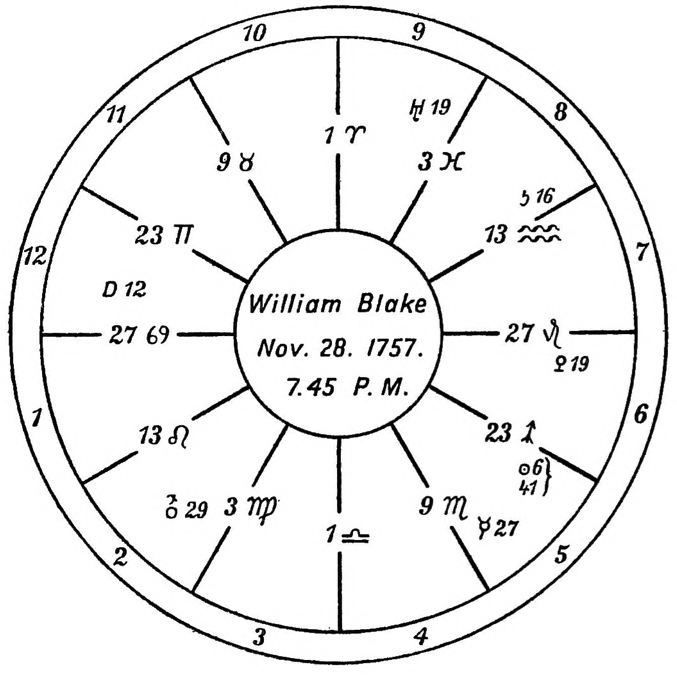
NATIVITY OF MR. BLAKE,
THE MYSTICAL ARTIST
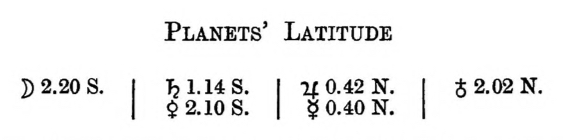
The above horoscope is calculated for the estimate time of birth, and Mr. Blake, the subject thereof, is well known amongst scientific characters, as having a most peculiar and extraordinary turn of genius and vivid imagination. His illustrations of the Book of Job have met with much and deserved praise; indeed, in the line which this artist has adopted, he is perhaps equalled by none of the present day. Mr. Blake is no less peculiar and outré in his ideas, as he seems to have some curious intercourse with the invisible world; and, according to his own account (in which he is certainly, to all appearance, perfectly sincere), he is continually surrounded by the spirits of the deceased of all ages, nations, and countries. He has, so he affirms, held actual conversations with Michael Angelo, Raphael, Milton, Dryden, and the worthies of antiquity. He has now by him a long poem nearly finished, which he affirms was recited to him by the spirit of Milton; and the mystical drawings of this gentleman are no less curious and worthy of notice, by all those whose minds soar above the cloggings of this terrestrial element, to which we are most of us too fastly chained to comprehend the nature and operations of the world of spirits.
Mr. Blake's pictures of the last judgment, his profiles of Wallace, Edward the Sixth, Harold, Cleopatra, and numerous others which we have seen, are really wonderful for the spirit in which they are delineated. We have been in company with this gentleman several times, and have frequently been not only delighted with his conversation, but also filled with feelings of wonder at his extraordinary faculties; which, whatever some may say to the contrary, are by no means tinctured with superstition, as he certainly believes what he promulgates. Our limits will not permit us to enlarge upon this geniture, which we merely give as an example worthy to be noticed by the astrological student in his list of remarkable nativities. But it is probable that the extraordinary faculties and eccentricities of idea which this gentleman possesses, are the effects of the Moon in Cancer in the twelfth house (both sign and house being mystical), in trine to Herschell from the mystical sign Pisces, from the house of science, and from the mundane trine to Saturn in the scientific sign Aquarius, which latter planet is in square to Mercury in Scorpio, and in quintile to the Sun and Jupiter, in the mystical sign Sagittarius. The square of Mars and Mercury, from fixed signs, also, has a remarkable tendency to sharpen the intellects, and lay the foundation of extraordinary ideas. There are also many other reasons for the strange peculiarities above noticed, but these the student will no doubt readily discover.
(V.) OBITUARY NOTICES IN THE LITERARY GAZETTE' AND 'GENTLEMAN'S MAGAZINE,' 1827.
[Obituary Notices of Blake appeared in the Literary Gazette of August 18, 1827 (pp. 540-41), the Gentleman's Magazine of October 1827 (pp. 377-8), and the Annual Register of 1827, in its Appendix of Deaths (pp. 253-4). The notice in the Gentleman's Magazine is largely condensed from that in the Literary Gazette, but with a different opening, which I have given after the notice in the Literary Gazette. The notice in the Annual Register is merely condensed from the Gentleman's Magazine.]
I
WILLIAM BLAKE
The Illustrator of the Grave, etc.
To those few who have sympathies for the ideal and (comparatively speaking) the intellectual in art, the following notice is addressed. Few persons of taste are unacquainted with the designs by Blake, appended as illustrations to a 4to edition of Blair's Grave. It was borne forth into the world on the warmest praises of all our prominent artists, Hoppner, Phillips, Stothard, Flaxman, Opie, Tresham, Westmacott, Beechey, Lawrence, West, Nollekins, Shee, Owen, Rossi, Thomson, Cosway, and Soane; and doubly assured with a preface by the learned and severe Fuseli, the latter part of which we transcribe—'The author of the moral series before us has endeavored to wake sensibility by touching our sympathies with nearer, less ambiguous, and less ludicrous imagery, than what mythology, Gothic superstition, or symbols as far-fetched as inadequate could supply. His invention has been chiefly employed to spread a familiar and domestic atmosphere round the most important of all subjects—to connect the visible and the invisible world, without provoking probability—and to lead the eye from the milder light of time to the radiations of eternity. Such is the plan and the moral part of the author's invention; the technic part, and the execution of the artist, though to be examined by other principles, and addressed to a narrower circle, equally claim approbation, sometimes excite our wonder, and not seldom our fears, when we see him play on the very verge of legitimate invention; but wildness so picturesque in itself, so often redeemed by taste, simplicity, and elegance—what child of fancy, what artist, would wish to discharge? The groups and single figures, on their own basis, abstracted from the general composition, and considered without attention to the plan, frequently exhibit those genuine and unaffected attitudes, those simple graces, which nature and the heart alone can dictate, and only an eye inspired by both discover. Every class of artists, in every stage of their progress and attainments, from the student to the finished master, and from the contriver of ornament to the painter of history, will here find materials of art, and hints of improvement!'
When it is stated, that the pure-minded Flaxman pointed out to an eminent literary man the obscurity of Blake as a melancholy proof of English apathy towards the grand, the philosophic, or the enthusiastically devotional painter; and that he (Blake) has been several times employed for that truly admirable judge of art, Sir T. Lawrence, any further testimony to his extraordinary powers is unnecessary. Yet has Blake been allowed to exist in a penury which most artists[1]—beings necessarily of a sensitive temperament—would deem intolerable. Pent, with his affectionate wife, in a close back-room in one of the Strand courts, his bed in one corner, his meagre dinner in another, a rickety table holding his copper-plates in progress, his colors, books (among which his Bible, a Sessi Velutello's Dante, and Mr. Carey's translation, were at the top), his large drawings, sketches, and MSS.;—his ankles frightfully swelled, his chest disordered, old age striding on, his wants increased, but not his miserable means and appliances: even yet was his eye undimmed, the fire of his imagination unquenched, and the preternatural, never-resting activity of his mind unflagging. He had not merely a calmly resigned, but a cheerful and mirthful countenance; in short, he was a living commentary on Jeremy Taylor's beautiful chapter on Contentedness. He took no thought for his life, what he should eat, or what he should drink; nor yet for his body, what he should put on; but had a fearless confidence in that Providence which had given him the vast range of the world for his recreation and delight.
Blake died last Monday! Died as he lived! piously cheerful, talking calmly, and finally resigning himself to his eternal rest, like an infant to its sleep. He has left nothing except some pictures, copper-plates, and his principal work of a series of a hundred large designs from Dante.
William Blake was brought up under Basire, the eminent engraver. He was active in mind and body, passing from one occupation to another, without an intervening minute of repose. Of an ardent, affectionate, and grateful temper, he was simple in manner and address, and displayed an inbred courteousness, of the most agreeable character. Next November he would have been sixty-nine. At the age of sixty-six he commenced the study of Italian, for the sake of reading Dante in the original, which he accomplished!
His widow is left (we fear, from the accounts which have reached us) in a very forlorn condition, Mr. Blake having latterly been much indebted for succor and consolation to his friend Mr. Linnell, the painter. We have no doubt but her cause will be taken up by the distributors of those funds which are raised for the relief of distressed artists, and also by the benevolence of private individuals.
When further time has been allowed us for inquiry, we shall probably resume this matter; at present (owing the above information to the kindness of a correspondent) we can only record the death of a singular and very able man.
II
MR. WILLIAM BLAKE
Aug. 13, aged 68, Mr. William Blake, an excellent, but eccentric, artist.
He was a pupil of the engraver Basire; and among his earliest productions were eight beautiful plates in the Novelist's Magazine. In 1793 he published in 12mo, 'The Gates of Paradise,' a very small book for children, containing fifteen plates of emblems; and 'published by W. B., 13 Hercules Buildings, Lambeth'; also about the same time, 'Songs of Experience, with plates'; 'America; a Prophecy,' folio, and 'Europe, a Prophecy,' 1794, folio. These are now become very scarce. In 1797 he commenced, in large folio, an edition of Young's Night Thoughts, of which every page was a design, but only one number was published. In 1805 were produced in 8vo numbers, containing five engravings by Blake, some ballads by Mr. Hayley, but which also were abruptly discontinued. Few persons of taste are unacquainted with the designs by Blake, engraved by Schiavonetti, as illustrations to a 4to edition of Blair's Grave. They are twelve in number, and an excellent portrait of Blake, from a picture by T. Phillips, R.A., is prefixed. It was borne forth ... [Here follows the third sentence, p. 345 above, to the end of the paragraph.]
In 1809 was published in 12mo, 'A Descriptive Catalogue of [sixteen] pictures, poetical and historical inventions, painted by William Blake in watercolors, being the ancient method of fresco painting restored, and drawings, for public inspection, and for sale by private contract.' Among these was a design of Chaucer's Pilgrimage to Canterbury, from which an etching has been published. Mr. Blake's last publication is a set of engravings to illustrate the Book of Job. To Fuseli's testimony of his merit above quoted, it is sufficient to add, that he has been employed by that truly admirable judge of art, Sir Thomas Lawrence; and that the pure-minded Flaxman....
[The remainder is condensed from the Literary Gazette, in "The Illustrator of the Grave," above, with the occasional change of a word, or the order of a sentence.]
(VI.) EXTRACT FROM VARLEY'S ZODIACAL PHYSIOGNOMY (1828)
[John Varley, astrologer and water-color painter, was introduced to Blake by Linnell, and it was for him that Blake did the 'visionary heads' described by Allan Cunningham. (see "VIII Life of Blake by Allan Cunningham.") 'The Ghost of a Flea' exists in both forms described by Varley, in a sketch of the head (which he reproduces, engraved by Linnell, in a plate at the end of his book, together with two other heads in outline), and in a full-length picture in tempera. The passage which follows is taken from pp. 54, 55 of 'A Treatise on Zodiacal Physiognomy; illustrated with engravings of heads and features: accompanied by tables of the times of rising of the twelve signs of the Zodiac; and containing also new and astrological explanation of some remarkable portions of Ancient Mythological History.' By John Varley. London: Printed for the Author, 1828.]
EXTRACT FROM VARLEY'S ZODIACAL PHYSIOGNOMY
With respect to the vision of the Ghost of the Flea, seen by Blake, it agrees in countenance with one class of people under Gemini, which sign is the significator of the Flea; whose brown color is appropriate to the color of the eyes in some full-toned Gemini persons. And the neatness, elasticity, and tenseness of the Flea are significant of the elegant dancing and fencing sign Gemini. This spirit visited his imagination in such a figure as he never anticipated in an insect. As I was anxious to make the most correct investigation in my power, of the truth of these visions, on hearing of this spiritual apparition of a Flea, I asked him if he could draw for me the resemblance of what he saw: he instantly said, 'I see him now before me.' I therefore gave him paper and a pencil, with which he drew the portrait, of which a facsimile is given in this number. I felt convinced by his mode of proceeding that he had a real image before him, for he left off, and began on another part of the paper to make a separate drawing of the mouth of the Flea, which the spirit having opened, he was prevented from proceeding with the first sketch, till he had closed it. During the time occupied in completing the drawing, the Flea told him that all fleas were inhabited by the souls of such men as were by nature blood-thirsty to excess, and were therefore providentially confined to the size and form of insects; otherwise, were he himself, for instance, the size of a horse, he would depopulate a great portion of the country. He added, that if in attempting to leap from one island to another, he should fall into the sea, he could swim, and should not be lost. This spirit afterwards appeared to Blake, and afforded him a view of his whole figure; an engraving of which I shall give in this work.
(VII.) BIOGRAPHICAL SKETCH OF BLAKE BY J. T. SMITH (1828)
[The Memoir of Blake by John Thomas Smith, Keeper of the Prints and Drawings in the British Museum, is the last of the 'Biographical Sketches and Anecdotes of several Artists and others contemporary with Nollekens,' contained in the second volume of 'Nollekens and his Times: comprehending a Life of that celebrated Sculptor; and Memoirs of several contemporary Artists, from the' time of Roubiliac, Hogarth, and Reynolds, to that of Fuseli, Flaxman, and Blake.' (London: Henry Colburn, New Burlington Street, 1828.) It contains more facts at first hand than any other account of Blake, and is really the foundation of all subsequent biographies. I have added a page, which is not without its significance, from a later book by Smith, 'A Book for a Rainy Day; or, Recollections of the Events of the last Sixty-five Years' (1845), where it occurs under date 1784, on pp. 81, 82.]
BIOGRAPHICAL SKETCH OF BLAKE
I believe it has been invariably the custom of every age, whenever a man has been found to depart from the usual mode of thinking, to consider him of deranged intellect, and not infrequently stark staring mad; which judgment his calumniators would pronounce with as little hesitation, as some of the uncharitable part of mankind would pass sentence of death upon a poor half-drowned cur who had lost his master, or one who had escaped hanging with a rope about his neck. Cowper, in a letter to Lady Hesketh, dated June 3, 1788, speaking of a dancing-master's advertisement, says, 'The author of it had the good hap to be crazed, or he had never produced anything half so clever; for you will ever observe, that they who are said to have lost their wits, have more than other people.'
Bearing this stigma of eccentricity, William Blake, with most extraordinary zeal, commenced his efforts in Art under the roof of No. 28 Broad Street, Carnaby Market; in which house he was born, and where his father carried on the business of a hosier. William, the subject of the following pages, who was his second son, showing an early stretch of mind, and a strong talent for drawing, being totally destitute of the dexterity of a London shopman, so well described by Dr. Johnson, was sent away from the counter as a booby, and placed under the late Mr. James Basire, an artist well known for many years as engraver to the Society of Antiquaries. From him he learned the mechanical part of his art, and as he drew carefully, and copied faithfully, his master frequently and confidently employed him to make drawings from monuments to be engraved.
After leaving his instructor, in whose house he had conducted himself with the strictest propriety, he became acquainted with Flaxman, the sculptor, through his friend Stothard, and was also honored by an introduction to the accomplished Mrs. Mathew, whose house, No. 27, in Rathbone Place, was then frequented by most of the literary and talented people of the day. This lady—to whom I also had the honor of being known, and whose door and purse were constantly open and ready to cherish persons of genius who stood in need of assistance in their learned and arduous pursuits, worldly concerns, or inconveniences—was so extremely zealous in promoting the celebrity of Blake, that upon hearing him read some of his early efforts in poetry, she thought so well of them, as to request the Bev. Henry Mathew, her husband, to join Mr. Flaxman in his truly kind offer of defraying the expense of printing them; in which he not only acquiesced, but, with his usual urbanity, wrote the following advertisement, which precedes the poems:
'The following sketches were the production of an untutored youth, commenced in his twelfth, and occasionally resumed by the author till his twentieth year; since which time, his talents having been wholly directed to the attainment of excellence in his profession, he has been deprived of the leisure requisite to such a revisal of these sheets, as might have rendered them less unfit to meet the public eye.
'Conscious of the irregularities and defects to be found in almost every page, his friends have still believed that they possessed a poetical originality, which merited some respite from oblivion. These, their opinions, remain, however, to be now reproved or confirmed by a less partial public.'
The annexed Song is a specimen of the juvenile playfulness of Blake's muse, copied from page 10 of these Poems.[1]
SONG
'How sweet I roam'd from field to field, And tasted all the Summer's pride, Till I the Prince of Love beheld, Who in the sunny beams did glide! 'He show'd me lilies for my hair, And blushing roses for my brow; He led me through his gardens fair, Where all his golden pleasures grow. 'With sweet May-dews my wings were wet, And Phoebus fired my vocal rage; He caught me in his silken net, And shut me in his golden cage. 'He loves to sit and hear me sing, Then, laughing, sports and plays with me; Then stretches out my golden wing, And mocks my loss of liberty.'
But it happened, unfortunately, soon after this period, that in consequence of his unbending deportment, or what his adherents are pleased to call his manly firmness of opinion, which certainly was not at all times considered pleasing by every one, his visits were not so frequent. He, however, continued to benefit by Mrs. Mathew's liberality, and was enabled to continue in partnership, as a print-seller, with his fellow-pupil, Parker, in a shop, No. 27, next door to his father's, in Broad Street; and being extremely partial to Robert, his youngest brother, considered him as his pupil. Bob, as he was familiarly called, was one of my playfellows, and much beloved by all his companions.
Much about this time, Blake wrote many other songs, to which he also composed tunes. These he would occasionally sing to his friends; and though, according to his confession, he was entirely unacquainted with the science of music, his ear was so good, that his tunes were sometimes most singularly beautiful, and were noted down by musical professors. As for his later poetry, if it may be so called, attached to his plates, though it was certainly in some parts enigmatically curious as to its application, yet it was not always wholly uninteresting; and I have unspeakable pleasure in being able to state, that though I admit he did not for the last forty years attend any place of Divine worship, yet he was not a Freethinker, as some invidious detractors have thought proper to assert, nor was he ever in any degree irreligious. Through life, his Bible was everything with him; and as a convincing proof how highly he reverenced the Almighty, I shall introduce the following lines with which he concludes his address to the Deists:
'For a tear is an intellectual thing; And a sigh is the sword of an Angel-King; And the bitter groan of a Martyr's woe Is an arrow from the Almighty's bow.'
Again, at page 77, in his address to the Christians:
'I give you the end of a golden string; Only wind it into a ball, It will lead you in at Heaven's gate, Built in Jerusalem's wall.'
In his choice of subjects, and in his designs in Art, perhaps no man had higher claim to originality, nor ever drew with a closer adherence to his own conception; and from what I knew of him, and have heard related by his friends, I most firmly believe few artists have been guilty of less plagiarisms than he. It is true, I have seen him admire and heard him expatiate upon the beauties of Marc Antonio and of Albert Dürer; but I verily believe not with any view of borrowing an idea; neither do I consider him at any time dependent in his mode of working, which was generally with the graver only; and as to printing, he mostly took off his own impressions.
After his marriage, which took place at Battersea, and which proved a mutually happy one, he instructed his beloved, for so he most frequently called his Kate,[2] and allowed her, till the last moment of his practice, to take off his proof impressions and print his works, which she did most carefully, and ever delighted in the task: nay, she became a draughts-woman; and as a convincing proof that she and her husband were born for each others comfort, she not only entered cheerfully into his views, but, what is curious, possessed a similar power of imbibing ideas, and has produced drawings equally original and, in some respects, interesting.
Blake's peace of mind, as well as that of his Catherine, was much broken by the death of their brother Robert, who was a most amicable link in their happiness; and, as a proof how much Blake respected him, whenever he beheld him in his visions, he implicitly attended to his opinion and advice as to his future projected works. I should have stated, that Blake was supereminently endowed with the power of disuniting all other thoughts from his mind, whenever he wished to indulge in thinking of any particular subject; and so firmly did he believe, by this abstracting power, that the objects of his compositions were before him in his mind's eye, that he frequently believed them to be speaking to him. This I shall now illustrate by the following narrative.
Blake, after deeply perplexing himself as to the mode of accomplishing the publication of his illustrated songs, without their being subject to the expense of letterpress, his brother Robert stood before him in one of his visionary imaginations, and so decidedly directed him in the way in which he ought to proceed, that he immediately followed his advice, by writing his poetry, and drawing his marginal subjects of embellishments in outline upon the copper-plate with an impervious liquid, and then eating the plain parts or lights away with aqua-fortis considerably below them, so that the outlines were left as a stereotype. The plates in this state were then printed in any tint that he wished, to enable him or Mrs. Blake to color the marginal figures up by hand in imitation of drawings.
The following are some of his works produced in this manner, viz.; 'Songs of Innocence and Songs of Experience, The Book of Jerusalem,' consisting of an hundred plates, 'The Marriage of Heaven and Hell,' 'Europe and America'; and another work, which is now very uncommon, a pretty little series of plates, entitled 'Gate of Paradise.'
Blake, like those artists absorbed in a beloved study, cared not for money beyond its use for the ensuing day; and indeed he and his 'beloved' were so reciprocally frugal in their expenses, that, never sighing for either gilded vessels, silver-laced attendants, or turtle's livers, they were contented with the simplest repast, and a little answered their purpose. Yet, notwithstanding all their economy, Dame Fortune being, as it is pretty well known to the world, sometimes a fickle jade, they, as well as thousands more, have had their intercepting clouds.
As it is not my intention to follow them through their lives, I shall confine myself to a relation of a few other anecdotes of this happy pair; and as they are connected with the Arts, in my opinion they ought not to be lost, as they may be considered worthy the attention of future biographers.
For his marginal illustrations of 'Young's Night Thoughts,' which possess a great power of imagination, he received so despicably low a price, that Flaxman, whose heart was ever warm, was determined to serve him whenever an opportunity offered itself; and with his usual voice of sympathy, introduced him to his friend Hayley, with whom it was no new thing to give pleasure, capricious as he was. This gentleman immediately engaged him to engrave the plates for his quarto edition of 'The Life of Cowper,' published in 1803-4; and for this purpose he went down to Felpham, in order to be near that highly respected Hermit.
Here he took a cottage, for which he paid twenty pounds a year, and was not, as has been reported, entertained in a house belonging to Mr. Hayley rent-free. During his stay he drew several portraits, and could have had full employment in that department of the Art; but he was born to follow his own inclinations, and was willing to rely upon a reward for the labours of the day.
Mr. Flaxman, knowing me to be a collector of autographs, among many others, gave me the following letter, which he received from Blake immediately after his arrival at Felpham, in which he styles him.
'DEAR SCULPTOR OF ETERNITY,
'We are safe arrived at our cottage, which is more beautiful than I thought it, and more convenient. It is a perfect model for cottages, and, I think, for palaces of magnificence; only enlarging, not altering, its proportions, and adding ornaments and not principals. Nothing can be more grand than its simplicity and usefulness. Simple without intricacy, it seems to be the spontaneous effusion of humanity, congenial to the wants of man. No other-formed house can ever please me so well; nor shall I ever be persuaded, I believe, that it can be improved either in beauty or use.
'Mr. Hayley received us with his usual brotherly affection. I have begun to work. Felpham is a sweet place for study, because it is more spiritual than London. Heaven opens here on all sides her golden gates; her windows are not obstructed by vapors; voices of celestial inhabitants are more distinctly heard, and their forms more distinctly seen, and my cottage is also a shadow of their houses. My wife and sister are both well, courting Neptune for an embrace.
'Our journey was very pleasant; and though we had a great deal of luggage, no grumbling. All was cheerfulness and good-humour on the road, and yet we could not arrive at our cottage before half-past eleven at night, owing to the necessary shifting of our luggage from one chaise to another; for we had seven different chaises, and as many different drivers. We set out between six and seven in the morning of Thursday, with sixteen heavy boxes, and portfolios full of prints.
'And now begins a new life, because another covering of earth is shaken off. I am more famed in Heaven for my works than I could well conceive. In my brain are studies and chambers filled with books and pictures of old, which I wrote and painted in ages of eternity, before my mortal life; and those works are the delight and study of archangels. Why then should I be anxious about the riches or fame of mortality? The Lord, our father, will do for us and with us according to his Divine will for our good.
'You, O dear Flaxman! are a sublime Archangel, my friend and companion from eternity. In the Divine bosom is our dwelling-place. I look back into the regions of reminiscence, and behold our ancient days before this earth appeared in its vegetated mortality to my mortal-vegetated eyes. I see our houses of eternity which can never be separated, though our mortal vehicles should stand at the remotest corners of Heaven from each other.
'Farewell, my best friend! Remember me and my wife in love and friendship to our dear Mrs. Flaxman, whom we ardently desire to entertain beneath our thatched roof of rusted gold; and believe me for ever to remain,
'Your grateful and affectionate,
'WILLIAM BLAKE.
'Felpham, Sept. 21, 1800.
'Sunday morning.'
In a copy of Hayley's 'Triumphs of Temper,' illustrated by Stothard, which had been the one belonging to the Author's son, and which he gave after his death to Blake, are these verses in MS. by the hand of the donor:
'Accept, my gentle visionary, Blake, Whose thoughts are fanciful and kindly mild; Accept, and fondly keep for friendship's sake, This favor'd vision, my poetic child. 'Rich in more grace than fancy ever won, To thy most tender mind this book will be, For it belong'd to my departed son; So from an angel it descends to thee.
W. H.
July, 1800.'[3]
Upon his return from Felpham, he addressed the public, in page 3 of his Book of Jerusalem, in these words, 'After my three years' slumber on the banks of the ocean, I again display my giant-forms to the public,' etc.
Some of the 'giant-forms,' as he calls them, are mighty and grand, and if I were to compare them to the style of any preceding artist, Michel Angelo, Sir Joshua's favorite, would be the one; and were I to select a specimen as a corroboration of this opinion, I should instance the figure personifying the 'Ancient of Days,' the frontispiece to his 'Europe, a Prophecy.' In my mind, his knowledge of drawing, as well as design, displayed in this figure, must at once convince the informed reader of his extraordinary abilities.
I am now under the painful necessity of relating an event promulgated in two different ways by two different parties; and as I entertain a high respect for the talents of both persons concerned, I shall, in order to steer clear of giving umbrage to the supporters of either, leave the reader to draw his own conclusions, unbiassed by any insinuation whatever of mine.
An engraver of the name of Cromek, a man who endeavored to live by speculating upon the talents of others, purchased a series of drawings of Blake, illustrative of Blair's 'Grave,' which he had begun with a view of engraving and publishing. These were sold to Mr. Cromek for the insignificant sum of one guinea each, with the promise, and indeed under the express agreement, that Blake should be employed to engrave them; a task to which he looked forward with anxious delight. Instead of this negotiation being carried into effect, the drawings, to his great mortification, were put into the hands of Schiavonetti. During the time this artist was thus employed, Cromek had asked Blake—what work he had in mind to execute next. The unsuspecting artist not only told him, but without the least reserve showed him the designs sketched out for a fresco picture; the subject Chaucer's 'Pilgrimage to Canterbury'; with which Mr. Cromek appeared highly delighted. Shortly after this, Blake discovered that Stothard, a brother-artist to whom he had been extremely kind in early days, had been employed to paint a picture, not only of the same subject, but in some instances similar to the fresco sketch which he had shown to Mr. Cromek. The picture painted by Stothard became the property of Mr. Cromek, who published proposals for an engraving from it, naming Bromley as the engraver to be employed. However, in a short time, that artist's name was withdrawn, and Schiavonetti's substituted, who lived only to complete the etching; the plate being finished afterwards by at least three different hands. Blake, highly indignant at this treatment, immediately set to work, and proposed an engraving from his fresco picture, which he publicly exhibited in his brother James's shop-window, at the corner of Broad Street, accompanied with an address to the public, stating what he considered to be improper conduct.
So much on the side of Blake.[4] On the part of Stothard, the story runs thus. Mr. Cromek had agreed with that artist to employ him upon a picture of the Procession of Chaucer's Pilgrimage to Canterbury, for which he first agreed to pay him sixty guineas, but in order to enable him to finish it in a more exquisite manner, promised him forty more, with an intention of engaging Bromley to engrave it; but in consequence of some occurrence, his name was withdrawn, and Schiavonetti was employed. During the time Stothard was painting the picture, Blake called to see it, and appeared so delighted with it, that Stothard, sincerely wishing to please an old friend with whom he had lived so cordially for many years, and from whose works he always most liberally declared he had received much pleasure and edification, expressed a wish to introduce his portrait as one of the party, as a mark of esteem.
Mr. Hoppner, in a letter to a friend, dated May 30, 1807, says of it:
'This intelligent group is rendered still more interesting by the charm of coloring, which though simple is strong, and most harmoniously distributed throughout the picture. The landscape has a deep-toned brightness that accords most admirably with the figures; and the painter has ingeniously contrived to give a value to a common scene and very ordinary forms, that would hardly be found, by unlearned eyes, in the natural objects. He has expressed too, with great vivacity and truth, the freshness of morning, at that season when Nature herself is most fresh and blooming—the Spring; and it requires no great stretch of fancy to imagine we perceive the influence of it on the cheeks of the Fair Wife of Bath, and her rosy companions, the Monk and Friar.
'In respect of the execution of the various parts of this pleasing design, it is not too much praise to say, that it is wholly free from that vice which painters term manner; and it has this peculiarity beside, which I do not remember to have seen in any picture, ancient or modern, namely, that it bears no mark of the period in which it was painted, but might very well pass for the work of some able artist of the time of Chaucer. This effect is not, I believe, the result of any association of ideas connected with the costume, but appears in primitive simplicity, and the total absence of all affectation, either of coloring or pencilling.
'Having attempted to describe a few of the beauties of this captivating performance, it remains only for me to mention one great defect. The picture is, notwithstanding appearances, a modern one. But if you can divest yourself of the general prejudice that exists against contemporary talents, you will see a work that would have done honor to any school, at any period.'[5]
In 1810, Stothard, to his great surprise, found that Blake had engraved and published a plate of the same size, in some respects bearing a similarity to his own.[6] Such are the outlines of this controversy.
Blake's ideas were often truly entertaining, and after he had conveyed them to paper, his whimsical and novel descriptions frequently surpassed his delineations; for instance, that of his picture of the Transformation of the Flea to the form of a Man, is extremely curious. This personification, which he denominated a Cupper, or Blood-sucker, is covered with coat of armor, similar to the case of the flea, and is represented slowly pacing in the night, with a thorn attached to his right hand, and a cup in the other, as if ready to puncture the first person whose blood he might fancy, like Satan prowling about to seek whom he could devour. Blake said of the flea, that were that lively little fellow the size of an elephant, he was quite sure, from the calculations he had made of his wonderful strength, that he could bound from Dover to Calais in one leap.[7] Whatever may be the public opinion hereafter of Blake's talents, when his enemies are dead, I will not presume to predict;[8] but this I am certain of, that on the score of industry at least, many artists must strike to him. Application was a faculty so engendered in him that he took little bodily exercise to keep up his health: he had few evening walks and little rest from labour, for his mind was ever fixed upon his art, nor did he at any time indulge in a game of chess, draughts, or backgammon; such amusements, considered as relaxations by artists in general, being to him distractions. His greatest pleasure was derived from the Bible—a work ever at his hand, and which he often assiduously consulted in several languages. Had he fortunately lived till the next year's exhibition at Somerset House, the public would then have been astonished at his exquisite finishing of a Fresco picture of the Last Judgment, containing upwards of one thousand figures, many of them wonderfully conceived and grandly drawn. The lights of this extraordinary performance have the appearance of silver and gold; but upon Mrs. Blake's assuring me that there was no silver used, I found, upon a closer examination, that a blue wash had been passed over those parts of the gilding which receded, and the lights of the forward objects, which were also of gold, were heightened with a warm color, to give the appearance of the two metals.
It is most certain, that the uninitiated eye was incapable of selecting the beauties of Blake; his effusions were not generally felt; and in this opinion I am borne out in the frequent assertions of Fuseli and Flaxman. It would, therefore, be unreasonable to expect the booksellers to embark in publications, not likely to meet remuneration. Circumstanced, then, as Blake was, approaching to threescore years and ten, in what way was he to persevere in his labours? Alas, he knew not! until the liberality of Mr. Linnell, a brother-artist of eminence, whose discernment could well appreciate those parts of his designs which deserved perpetuity, enabled him to proceed and execute in comfort a series of twenty-one plates, illustrative of the Book of Job. This was the last work he completed, upon the merits of which he received the highest congratulations from the following Royal Academicians: Sir Thomas Lawrence, Mr. Baily, Mr. Philips, Mr. Chantrey, Mr. James Ward, Mr. Arnald, Mr. Collins, Mr. Westmacott, and many other artists of eminence.
As to Blake's system of coloring, which I have not hitherto noticed, it was in many instances most beautifully prismatic. In this branch of the art he often acknowledged Apelles to have been his tutor, who was, he said, so much pleased with his style, that once when he appeared before him, among many of his observations, he delivered the following:—'You certainly possess my system of coloring; and I now wish you to draw my person, which has hitherto been untruly delineated.'
I must own that until I was favoured by Mr. Upcott with a sight of some of Blake's works, several of which I had never seen, I was not so fully aware of his great depth of knowledge in coloring. Of these most interesting specimens of his art, which are now extremely rare, and rendered invaluable by his death, as it is impossible for any one to color them with his mind, should the plates remain, Mr. Richard Thomson, another truly kind friend, has favoured me with the following descriptive lists.
SONGS OF EXPERIENCE. The author and printer, W. Blake. Small octavo; seventeen plates, including the title-page. Frontispiece, a winged infant mounted on the shoulders of a youth. On the title-page, two figures weeping over two crosses.
Introduction. Four Stanzas on a cloud, with a night-sky behind, and beneath, a figure of Earth stretched on a mantle.
Earths Answer. Five Stanzas; a serpent on the ground beneath.
The Clod, and the Pebble. Three Stanzas; above, a headpiece of four sheep and two oxen; beneath, a duck and reptiles.
A Poison Tree. Four Stanzas: The tree stretches up the right side of the page; and beneath, a dead body killed by its influence.
The Fly. Five Stanzas. Beneath, a female figure with two children.
Holy Thursday. Four Stanzas. Head-piece, a female figure discovering a dead child. On the right-hand margin a mother and two children lamenting the loss of an infant which lies beneath. Perhaps this is one of the most tasteful of the set.
The Chimney-Sweeper. Three Stanzas. Beneath, a figure of one walking in snow towards an open door.
London. Four Stanzas. Above, a child leading an old man through the street; on the right hand, a figure warming itself at a fire. If in any instance Mr. Blake has copied himself, it is in the figure of the old man upon this plate, whose position appears to have been a favorite one with him.
The Tiger. Six Stanzas. On the right-hand margin, the trunk of a tree; and beneath, a tiger walking.
A Little Boy Lost. Six Stanzas. Ivy-leaves on the right hand, and beneath, weeping figure before a fire, in which the verses state that the child had been burned by a Saint.
The Human Abstract. Six Stanzas. The trunk of a tree on the right-hand margin, and beneath, an old man in white drawing a veil over his head.
The Angel. Four Stanzas. Head-piece, a female figure lying beneath a tree, and pushing from her a winged boy.
My Pretty Rose-Tree. Two Stanzas: succeeded by a small vignette, of a figure weeping, and another lying reclined at the foot of a tree. Beneath, are two verses more, entitled, Ah! Sun-Flower; and a single stanza, headed The Lily.
Nurse's Song. Two Stanzas. Beneath, a girl with a youth and a female child at a door surrounded by vine-leaves.
A Little Girl Lost. Seven Stanzas; interspersed with birds and leaves, the trunk of a tree on the right-hand margin.
The whole of these plates are colored in imitation of fresco. The poetry of these songs is wild, irregular, and highly mystical, but of no great degree of elegance or excellence, and their prevailing feature is a tone of complaint of the misery of mankind.
AMERICA: a Prophecy. Lambeth: Printed by William Blake, in the year 1793; folio; eighteen plates or twenty pages, including the frontispiece and title-page. After a Preludium of thirty-seven lines commences the Prophecy of 226, which are interspersed with numerous headpieces, vignettes, and tail-pieces, usually stretching along the left-hand margin and enclosing the text; which sometimes appears written on a cloud, and at others environed by flames and water. Of the latter subject a very fine specimen is shown upon page 13, where the tail-piece represents the bottom of the sea, with various fishes coming together to prey upon a dead body. The head-piece is another dead body lying on the surface of the waters, with an eagle feeding upon it with outstretched wings. Another instance of Mr. Blake's favorite figure of the old man entering at Death's door, is contained on page 12 of this poem. The subject of the text is a conversation between the Angel of Albion, the Angels of the Thirteen States, Washington, and some others of the American generals, and 'Red Ore,' the spirit of war and evil. The verses are without rhyme, and most resemble hexameters, though they are by no means exact; and the expressions are mystical in a very high degree.
EUROPE: a Prophecy. Lambeth: Printed by William Blake, 1794; folio; seventeen plates on the leaves, inclusive of the frontispiece and title-page. Colored to imitate the ancient fresco painting. The Preludium consists of thirty-three lines, in stanzas without rhyme, and the Prophecy of two hundred and tight; the decorations to which are larger than most of those in the former book, and approach nearest to the character of paintings, since, in several instances, they occupy the whole page. The frontispiece is an uncommonly fine specimen of art, and approaches almost to the sublimity of Raffaelle or Michel Angelo. It represents 'The Ancient of Days,' in an orb of light surrounded by dark clouds, as referred to in Proverbs VIII. 27, stooping down with an enormous pair of compasses to describe the destined orb of the world,[9] 'when he set a compass upon the face of the earth.'
'In His hand He took the golden compasses, prepar'd In God's eternal store, to circumscribe This universe, and all created things: One foot he centred, and the other turn'd Round through the vast profundity obscure; And said, "Thus far extend, thus far thy bounds, This be thy just circumference, O World!"'
Paradise Lost, book VII. line 236.
Another splendid composition in this work are the two angels pouring out the black-spotted plague upon England, on page 9; in which the fore-shortening of the legs, the grandeur of their positions, and the harmony with which they are adapted to each other and to their curved trumpets, are perfectly admirable. The subject-matter of the work is written in the same wild and singular measures as the preceding, and describes, in mystical language, the terrors of plague and anarchy which overspread England during the slumbers of Enitharmon for eighteen hundred years; upon whose awaking, the ferocious spirit Ore burst into flames 'in the vineyards of red France.' At the end of this poem are seven separate engravings on folio pages, without letterpress, which are colored like the former part of the work, with a degree of splendor and force, as almost to resemble sketches in oil-colors. The finest of these are a figure of an angel standing in the sun, a group of three furies surrounded by clouds and fire, and a figure of a man sitting beneath a tree in the deepest dejection; all of which are peculiarly remarkable for their strength and splendor of coloring. Another publication by Mr. Blake consisted only of a small quarto volume of twenty-three engravings of various shapes and sizes, colored as before, some of which are of extraordinary effect and beauty. The best plates in this series are—the first of an aged man, with a white heard sweeping the ground, and writing in a book with each hand, naked; a human figure pressing out his brain through his ears; and the great sea-serpent; but perhaps the best is a figure sinking in a stormy sea at sunset, the splendid light of which, and the foam upon the black waves, are almost magical effects of coloring. Beneath the first design is engraved 'Lambeth, printed by W. Blake, 1794.'
Blake's modes of preparing his ground, and laying them over his panels for painting, mixing his colors, and manner of working, were those which he considered to have been practized by the earliest fresco painters, whose productions still remain, in numerous instances, vivid and permanently fresh. His ground was a mixture of whiting and carpenter's glue, which he passed over several times in thin coatings: his colors he ground himself, and also united them with the same sort of glue, but in a much weaker state. He would, in the course of painting a picture, pass a very thin transparent wash of glue-water over the whole of the parts he had worked upon, and then proceed with his finishing.[10]
This process I have tried, and find, by using my mixture warm, that I can produce the same texture as possessed in Blake's pictures of the Last Judgment, and others of his productions, particularly in Varley's curious picture of the personified Flea. Blake preferred mixing his colors with carpenter's glue, to gum, on account of the latter cracking in the sun, and becoming humid in moist weather. The glue-mixture stands the sun, and change of atmosphere has no effect upon it. Every carpenter knows that if a broken piece of stick be joined with good glue, the stick will seldom break again in the glued parts.
That Blake had many secret modes of working, both as a colorist and an engraver, I have no doubt. His method of eating away the plain copper, and leaving his drawn lines of his subjects and his words as stereotype, is, in my mind, perfectly original. Mrs. Blake is in possession of the secret, and she ought to receive something considerable for its communication, as I am quite certain it may be used to the greatest advantage both to artists and literary characters in general.
That Blake's colored plates have more effect than others where gum has been used, is, in my opinion, the fact, and I shall rest my assertion upon those beautiful specimens in the possession of Mr. Upcott, colored purposely for that gentleman's godfather, Ozias Humphrey, Esq., to whom Blake wrote the following interesting letter.
TO OZIAS HUMPHREY, ESQ.
'The design of The Last Judgment, which I have completed by your recommendation for the Countess of Egremont, it is necessary to give some account of; and its various parts ought to be described, for the accommodation of those who give it the honor of their attention.
'Christ seated on the Throne of Judgment: the Heavens in clouds rolling before him and around him, like a scroll ready to be consumed in the fires of the Angels; who descend before his feet, with their four trumpets sounding to the four winds.
'Beneath, the Earth is convulsed with the labours of the Resurrection. In the caverns of the earth is the Dragon with seven heads and ten horns, chained by two Angels; and above his cavern, on the earth's surface, is the Harlot, also seized and bound by two Angels with chains, while her palaces are falling into ruins, and her counsellors and warriors are descending into the abyss, in wailing and despair.
'Hell opens beneath the harlot's seat on the left hand, into which the wicked are descending.
'The right hand of the design is appropriated to the Resurrection of the Just: the left hand of the design is appropriated to the Resurrection and Fall of the Wicked.
'Immediately before the Throne of Christ are Adam and Eve, kneeling in humiliation, as representatives of the whole human race; Abraham and Moses kneel on each side beneath them; from the cloud on which Eve kneels, and beneath Moses, and from the tables of stone which utter lightning, is seen Satan wound round by the Serpent, and falling headlong; the Pharisees appear on the left hand pleading their own righteousness before the Throne of Christ: The Book of Death is opened on clouds by two Angels; many groups of figures are falling from before the throne, and from the sea of fire, which flows before the steps of the throne; on which are seen the seven Lamps of the Almighty, burning before the throne. Many figures chained and bound together fall through the air, and some are scourged by Spirits with flames of fire into the abyss of Hell, which opens to receive them beneath, on the left hand of the harlot's seat; where others are howling and descending into the flames, and in the act of dragging each other into Hell, and of contending in fighting with each other on the brink of perdition.
'Before the Throne of Christ on the right hand, the Just, in humiliation and in exultation, rise through the air, with their Children and Families; some of whom are bowing before the Book of Life, which is opened by two Angels on clouds: many groups arise with exultation; among them is a figure crowned with stars, and the moon beneath her feet, with six infants around her, she represents the Christian Church. The green hills appear beneath; with the graves of the blessed, which are seen bursting with their births of immortality; parents and children embrace and arise together, and in exulting attitudes tell each other that the New Jerusalem is ready to descend upon earth; they arise upon the air rejoicing; others newly awaked from the graves, stand upon the earth embracing and shouting to the Lamb, who cometh in the clouds with power and great glory.
'The whole upper part of the design is a view of Heaven opened; around the Throne of Christ, four living creatures filled with eyes, attended by seven angels with seven vials of the wrath of God, and above these seven Angels with the seven trumpets compose the cloud, which by its rolling away displays the opening seats of the Blessed, on the right and the left of which are seen the four-and-twenty Elders seated on thrones to judge the dead.
'Behind the seat and Throne of Christ appears the Tabernacle with its veil opened, the Candlestick on the right, the Table with Show-bread on the left, and in the midst, the Cross in place of the Ark, with the two Cherubim bowing over it.
'On the right hand of the Throne of Christ is Baptism, on his left is the Lord's Supper—the two introducers into Eternal Life. Women with infants approach the figure of an aged Apostle, which represents Baptism; and on the left hand the Lord's Supper is administered by Angels, from the hands of another aged Apostle; these kneel on each side of the Throne, which is surrounded by a glory: in the glory many infants appear, representing Eternal Creation flowing from the Divine Humanity in Jesus; who opens the Scroll of Judgment upon his knees before the living and the dead.
'Such is the design which you, my dear Sir, have been the cause of my producing, and which, but for you, might have slept till the Last Judgment.
'WILLIAM BLAKE.
'January 18, 1808.'
Blake and his wife were known to have lived so happily together, that they might unquestionably have been registered at Dunmow. 'Their hopes and fears were to each other known,' and their days and nights were passed in each other's company, for he always painted, drew, engraved, and studied, in the same room where they grilled, boiled, stewed, and slept; and so steadfastly attentive was he to his beloved tasks, that for the space of two years he had never once been out of his house; and his application was often so incessant, that in the middle of the night, he would, after thinking deeply upon a particular subject, leap from his bed and write for two hours or more; and for many years he made a constant practice of lighting the fire, and putting on the kettle for breakfast before his Kate awoke.
During his last illness, which was occasioned by the gall mixing with his blood, he was frequently bolstered-up in his bed to complete his drawings, for his intended illustration of Dante; an author so great a favorite with him, that though he agreed with Fuseli and Flaxman, in thinking Carey's translation superior to all others, yet, at the age of sixty-three years, he learned the Italian language purposely to enjoy Dante in the highest possible way. For this intended work, he produced seven engraved plates of an imperial quarto size, and nearly one hundred finished drawings of a size considerably larger; which will do equal justice to his wonderful mind, and the liberal heart of their possessor, who engaged him upon so delightful a task at a time when few persons would venture to give him employment, and whose kindness softened, for the remainder of his life, his lingering bodily sufferings, which he was seen to support with the most Christian fortitude.
On the day of his death, August 12,[11] 1827, he composed and uttered songs to his Maker so sweetly to the ear of his Catherine, that when she stood to hear him, he, looking upon her most affectionately, said, 'My beloved, they are not mine—no—they are not mine.' He expired at six in the evening, with the most cheerful serenity. Some short time before his death, Mrs. Blake asked him where he should like to be buried, and whether he would have the Dissenting Minister, or the Clergyman of the Church of England, to read the service: his answers were, that as far as his own feelings were concerned, they might bury him where she pleased, adding, that as his father, mother, aunt, and brother were buried in Bunhill Bow, perhaps it would be better to lie there, but as to service, he should wish for that of the Church of England.
His hearse was followed by two mourning-coaches, attended by private friends: Calvert, Richmond, Tatham, and his brother, promising young artists, to whom he had given instructions in the Arts, were of the number. Tatham, ill as he was, travelled ninety miles to attend the funeral of one for whom, next to his own family, he held the highest esteem. Blake died in his sixty-ninth year, in the back-room of the first-floor of No. 3 Fountain Court, Strand, and was buried in Bunhill Fields, on the 17th of August, at the distance of about twenty-five feet from the north wall, numbered eighty.
Limited as Blake was in his pecuniary circumstances, his beloved Kate survives him clear of even a sixpenny debt; and in the fullest belief that the remainder of her days will be rendered tolerable by the sale of the few copies of her husband's works, which she will dispose of at the original price of publication; in order to enable the collector to add to the weight of his bookshelves, without being solicited to purchase, out of compassion, those specimens of her husband's talents which they ought to possess.
EXTRACT FROM 'A BOOK FOR A RAINY DAY'
[1784].—This year Mr. Flaxman, who then lived in Wardour Street, introduced me to one of his early patrons, the Rev. Henry Mathew, of Percy Chapel, Charlotte Street, which was built for him; he was also afternoon preacher at Saint Martin's-in-the-Fields. At that gentleman's house, in Rathbone Place, I became acquainted with Mrs. Mathew and her son. At that lady's most agreeable conversaziones I first met the late William Blake, the artist, to whom she and Mr. Flaxman had been truly kind. There I have often heard him read and sing several of his poems. He was listened to by the company with profound silence, and allowed by most of the visitors to possess original and extraordinary merit.'[12]
(VIII.) LIFE OF BLAKE BY ALLAN CUNNINGHAM (1830)
[Allan Cunningham's Life of Blake occupies pp. 142-179 of the second volume of his Lives of the most eminent British Painters, Sculptors, and Architects. (London: John Murray, Albemarle Street, MDCCCXXX.) It is largely indebted to Smith, but contains a few anecdotes not found elsewhere, and probably derived from Varley and Linnell. In a letter to Linnell, printed in Mr. Story's Life, Cunningham says that 'much valuable information' has been received from Varley, and asks for more, adding, with characteristic impertinence: 'I know Blake's character, for I knew the man. I shall make a judicious use of my materials, and be merciful where sympathy is needed.' He reproduces the Phillips portrait of Blake, which had been engraved by Schiavonetti for Blair's Grave, in a less showy and more lifelike engraving by W. C. Edwards.]
Painting, like poetry, has followers, the body of whose genius is light compared to the length of its wings, and who, rising above the ordinary sympathies of our nature, are, like Napoleon, betrayed by a star which no eye can see save their own. To this rare class belonged William Blake.
He was the second son of James Blake and Catherine his wife, and born on the 28th of November, 1757, in 28 Broad Street, Carnaby Market, London. His father, a respectable hosier, caused him to be educated for his own business, but the love of art came early upon the boy; he neglected the figures of arithmetic for those of Raphael and Reynolds; and his worthy parents often wondered how a child of theirs should have conceived a love for such unsubstantial vanities. The boy, it seems, was privately encouraged by his mother. The love of designing and sketching grew upon him, and he desired anxiously to be an artist. His father began to be pleased with the notice which his son obtained—and to fancy that a painter's study might after all be a fitter place than a hosier's shop for one who drew designs on the backs of all the shop bills, and made sketches on the counter. He consulted an eminent artist, who asked so large a sum for instruction, that the prudent shopkeeper hesitated, and young Blake declared he would prefer being an engraver—a profession which would bring bread at least, and through which he would be connected with painting. It was indeed time to dispose of him. In addition to his attachment to art, he had displayed poetic symptoms—scraps of paper and the blank leaves of books were found covered with groups and stanzas. When his father saw sketches at the top of the sheet and verses at the bottom, he took him away to Basire, the engraver, in Green Street, Lincoln's Inn Fields, and bound him apprentice for seven years. He was then fourteen years old.
It is told of Blake that at ten years of age he became an artist, and at twelve a poet. Of his boyish pencillings I can find no traces—but of his early intercourse with the Muse the proof lies before me in seventy pages of verse, written, he says, between his twelfth and his twentieth year, and published, by the advice of friends, when he was thirty. There are songs, ballads, and a dramatic poem; rude sometimes and melodious, but full of fine thought and deep and peculiar feeling. To those who love poetry for the music of its bells, these seventy pages will sound harsh and dissonant; but by others they will be more kindly looked upon. John Flaxman, a judge in all things of a poetic nature, was so touched with many passages, that he not only counseled their publication, but joined with a gentleman of the name of Matthews in the expense, and presented the printed sheets to the artist to dispose of for his own advantage. One of these productions is an address to the Muses—a common theme, but sung in no common manner.
'Whether on Ida's shady brow, Or in the chambers of the east, The chambers of the sun, that now From ancient melody have ceas'd; Whether in heaven ye wander fair, Or the green corners of the earth, Or the blue regions of the air, Where the melodious winds have birth; Whether on crystal rocks ye rove, Beneath the bosom of the sea, Wandering in many a coral grove, Fair Nine! forsaking poesie; How have ye left the ancient love, That Bards of old enjoyed in you;— The languid strings now scarcely move, The sound is forced—the notes are few.'
The little poem called 'The Tiger' has been admired for the force and vigour of its thoughts by poets of high name. Many could weave smoother lines—few could stamp such living images.
'Tiger! Tiger! burning bright In the forest of the night, What immortal hand or eye Framed thy fearful symmetry? In what distant deeps or skies Burned the fervour of thine eyes? On what wings dare he aspire— What the hand dare seize the fire? And what shoulder and what art Could twist the sinews of thy heart? When thy heart began to beat, What dread hand formed thy dread feet? What the hammer! what the chain! Formed thy strength and forged thy brain? What the anvil! What dread grasp Dared thy deadly terrors clasp? When the stars threw down their spheres, And sprinkled heaven with shining tears, Did he smile, his work to see? Did he who made the lamb make thee?'
In the dramatic poem of King Edward the Third there are many nervous lines, and even whole passages of high merit. The structure of the verse is often defective, and the arrangement inharmonious; but before the ear is thoroughly offended, it is soothed by some touch of deep melody and poetic thought. The princes and earls of England are conferring together on the eve of the battle of Cressy—the Black Prince takes Chandos aside, and says—
'Now we're alone, John Chandos, I'll unburthen And breathe my hopes into the burning air— Where thousand Deaths are posting up and down, Commissioned to this fatal field of Cressy: Methinks I see them arm my gallant soldiers, And gird the sword upon each thigh, and fit The shining helm, and string each stubborn bow, And dancing to the neighing of the steeds;—Methinks the shout begins—the battle burns;—Methinks I see them perch on English crests, And breathe the wild flame of fierce war upon The thronged enemy.'
In the same high poetic spirit Sir Walter Manny converses with a genuine old English warrior, Sir Thomas Dagworth.
'O, Dagworth!—France is sick!—the very sky, Though sunshine light, it seems to me as pale As is the fainting man on his death-bed, Whose face is shown by light of one weak taper— It makes me sad and sick unto the heart; Thousands must fall to-day.'
Sir Thomas answers.
'Thousands of souls must leave this prison-house To be exalted to those heavenly fields Where songs of triumph, psalms of victory, Where peace, and joy, and love, and calm content Sit singing on the azure clouds, and strew The flowers of heaven upon the banquet table. Bind ardent hope upon your feet, like shoes, And put the robe of preparation on. The table, it is spread in shining heaven. Let those who fight, fight in good steadfastness; And those who fall shall rise in victory.'
I might transcribe from these modest and unnoticed pages many such passages. It would be unfair not to mention that the same volume contains some wild and incoherent prose, in which we may trace more than the dawning of those strange, mystical, and mysterious fancies on which he subsequently misemployed his pencil. There is much that is weak, and something that is strong, and a great deal that is wild and mad, and all so strangely mingled, that no meaning can be assigned to it; it seems like a lamentation over the disasters which came on England during the reign of King John.
Though Blake lost himself a little in the enchanted region of song, he seems not to have neglected to make himself master of the graver, or to have forgotten his love of designs and sketches. He was a dutiful servant to Basire, and he studied occasionally under Flaxman and Fuseli; but it was his chief delight to retire to the solitude of his chamber, and there make drawings, and illustrate these with verses, to be hung up together in his mother's chamber. He was always at work; he called amusement idleness, sight-seeing vanity, and money-making the ruin of all high aspirations. 'Were I to love money,' he said, 'I should lose all power of thought! desire of gain deadens the genius of man. I might roll in wealth and ride in a golden chariot, were I to listen to the voice of parsimony. My business is not to gather gold, but to make glorious shapes, expressing godlike sentiments.' The day was given to the graver, by which he earned enough to maintain himself respectably; and he bestowed his evenings upon painting and poetry, and intertwined these so closely in his compositions, that they cannot well be separated.
When he was six-and-twenty years old, he married Katharine Boutcher, a young woman of humble connections—the dark-eyed Kate of several of his lyric poems. She lived near his father's house and was noticed by Blake for the whiteness of her hand, the brightness of her eyes, and a slim and handsome shape, corresponding with his own notions of sylphs and naiads. As he was an original in all things, it would have been out of character to fall in love like an ordinary mortal; he was describing one evening in company the pains he had suffered from some capricious lady or another, when Katharine Boutcher said, 'I pity you from my heart.' 'Do you pity me?' said Blake, 'then I love you for that.' 'And I love you,' said the frank-hearted lass, and so the courtship began. He tried how well she looked in a drawing, then how her charms became verse; and finding moreover that she had good domestic qualities, he married her. They lived together long and happily.
She seemed to have been created on purpose for Blake:—she believed him to be the finest genius on earth; she believed in his verse—she believed in his designs; and to the wildest flights of his imagination she bowed the knee, and was a worshipper. She set his house in good order, prepared his frugal meal, learned to think as he thought, and, indulging him in his harmless absurdities, became, as it were, bone of his bone, and flesh of his flesh. She learned—what a young and handsome woman is seldom apt to learn—to despise gaudy dresses, costly meals, pleasant company, and agreeable invitations—she found out the way of being happy at home, living on the simplest of food, and contented in the homeliest of clothing. It was no ordinary mind which could do all this; and she whom Blake emphatically called his beloved,' was no ordinary woman. She wrought off in the press the impressions of his plates—she colored them with a light and neat hand—made drawings much in the spirit of her husband's compositions, and almost rivaled him in all things save in the power which he possessed of seeing visions of any individual living or dead, whenever he chose to see them.
His marriage, I have heard, was not agreeable to his father; and he then left his roof and resided with his wife in Green Street, Leicester Fields. He returned to Broad Street, on the death of his father, a devout man, and an honest shopkeeper, of fifty years' standing, took a first-floor and a shop, and in company with one Parker, who had been his fellow-apprentice, commenced print-seller. His wife attended to the business, and Blake continued to engrave, and took Robert, his favorite brother, for a pupil. This speculation did not succeed—his brother too sickened and died; he had a dispute with Parker—the shop was extinguished, and he removed to 28 Poland Street. Here he commenced that series of works which give him a right to be numbered among the men of genius of his country. In sketching designs, engraving plates, writing songs, and composing music, he employed his time, with his wife sitting at his side, encouraging him in all his undertakings. As he drew the figure he meditated the song which was to accompany it, and the music to which the verse was to be sung, was the offspring too of the same moment. Of his music there are no specimens—he wanted the art of noting it down—if it equalled many of his drawings, and some of his songs, we have lost melodies of real value.
The first fruits were the 'Songs of Innocence and Experience,' a work original and natural, and of high merit, both in poetry and in painting. It consists of some sixty-five or seventy scenes, presenting images of youth and manhood—of domestic sadness, and fireside joy—of the gaiety and innocence, and happiness of childhood. Every scene has its poetical accompaniment, curiously interwoven with the group or the landscape, and forming, from the beauty of the color and the prettiness of the pencilling, a very fair picture of itself. Those designs are in general highly poetical; more allied, however, to heaven than to earth,—a kind of spiritual abstractions, and indicating a better world and fuller happiness than mortals enjoy. The picture of Innocence is introduced with the following sweet verses.
'Piping down the valleys wild, Piping songs of pleasant glee, On a cloud I saw a child, And he laughing said to me— Pipe a song about a lamb; So I piped with merry cheer. Piper, pipe that song again— So I piped—he wept to hear. Drop thy pipe, thy happy pipe, Sing thy songs of happy cheer— So I sung the same again, While he wept with joy to hear. Piper, sit thee down and write In a book that all may read— So he vanished from my sight: And I plucked a hollow reed, And I made a rural pen, And I stained the water clear, And I wrote my happy songs, Every child may joy to hear.'
In a higher and better spirit he wrought with his pencil. But then he imagined himself under spiritual influences; he saw the forms and listened to the voices of the worthies of other days; the past and the future were before him, and he heard, in imagination, even that awful voice which called on Adam amongst the trees of the garden. In this kind of dreaming abstraction, he lived much of his life; all his works are stamped with it; and though they owe much of their mysticism and obscurity to the circumstance, there can be no doubt that they also owe to it much of their singular loveliness and beauty. It was wonderful that he could thus, month after month, and year after year, lay down his graver after it had won him his daily wages, and retire from the battle for bread, to disport his fancy amid scenes of more than earthly splendor, and creatures pure as unfalled dew.
In this lay the weakness and the strength of Blake, and those who desire to feel the character of his compositions, must be familiar with his history and the peculiarities of his mind. He was by nature a poet, a dreamer, and an enthusiast. The eminence which it had been the first ambition of his youth to climb, was visible before him, and he saw on its ascent or on its summit those who had started earlier in the race of fame. He felt conscious of his own merit, but w as not aware of the thousand obstacles which were ready to interpose.' He thought that he had but to sing songs and draw designs, and become great and famous. The crosses which genius is heir to had been wholly unforeseen—and they befell him early; he wanted the skill of hand, and fine tact of fancy and taste, to impress upon the offspring of his thoughts that popular shape, which gives such productions immediate circulation. His works were looked coldly on by the world, and were only esteemed by men of poetic minds, or those who were fond of things out of the common way. He earned a little fame, but no money by these speculations, and had to depend for bread on the labours of the graver.
All this neither crushed his spirit, nor induced him to work more in the way of the world; but it had a visible influence upon his mind. He became more seriously thoughtful, avoided the company of men, and lived in the manner of a hermit, in that vast wilderness, London. Necessity made him frugal, and honesty and independence prescribed plain clothes, homely fare, and a cheap habitation. He was thus compelled more than ever to retire to worlds of his own creating, and seek solace in visions of paradise for the joys which the earth denied him. By frequent indulgence in these imaginings, he gradually began to believe in the reality of what dreaming fancy painted—the pictured forms which swarmed before his eyes, assumed, in his apprehension, the stability of positive revelations, and he mistook the vivid figures, which his professional imagination shaped, for the poets, and heroes, and princes of old. Amongst his friends, he at length ventured to intimate that the designs on which he was engaged were not from his own mind, but copied from grand works revealed to him in visions; and those who believed that, would readily lend an ear to the assurance that he was commanded to execute his performances by a celestial tongue!
Of these imaginary visitations he made good use, when he invented his truly original and beautiful mode of engraving and tinting his plates. He had made the sixty-five designs of his Days of Innocence, and was meditating, he said, on the best means of multiplying their resemblance in form and in hue; he felt sorely perplexed. At last he was made aware that the spirit of his favorite brother Robert was in the room, and to this celestial visitor he applied for counsel. The spirit advised him at once: 'write,' he said, 'the poetry, and draw the designs upon the copper with a certain liquid (which he named, and which Blake ever kept a secret); then cut the plain parts of the plate down with aqua-fortis, and this will give the whole, both poetry and figures, in the manner of a stereotype.' The plan recommended by this gracious spirit was adopted; the plates were engraved, and the work printed off. The artist then added a peculiar beauty of his own. He tinted both the figures and the verse with a variety of colors, amongst which, while yellow prevails, the whole has a rich and lustrous beauty, to which I know little that can be compared. The size of these prints is four inches and a half high by three inches wide. The original genius of Blake was always confined, through poverty, to small dimensions. Sixty-five plates of copper were an object to him who had little money. The Gates of Paradise, a work of sixteen designs, and those exceedingly small, was his next undertaking. The meaning of the artist is not a little obscure; it seems to have been his object to represent the innocence, the happiness, and the upward aspirations of man. They bespeak one intimately acquainted with the looks and the feelings of children. Over them there is shed a kind of mysterious halo which raises feelings of devotion. The Songs of Innocence, and the Gates of Paradise, became popular among the collectors of prints. To the sketch book and the cabinet the works of Blake are unfortunately confined.
If there be mystery in the meaning of the Gates of Paradise, his succeeding performance, by name Urizen, has the merit or the fault of surpassing all human comprehension. The spirit which dictated this strange work was undoubtedly a dark one; nor does the strange kind of prose which is intermingled with the figures serve to enlighten us. There are in all twenty-seven designs representing beings human, demoniac, and divine, in situations of pain and sorrow and suffering. One character—evidently an evil spirit—appears in most of the plates; the horrors of hell, and the terrors of darkness and divine wrath, seem his sole portion. He swims in gulps of fire—descends in cataracts of flame—holds combats with scaly serpents, or writhes in anguish without any visible cause. One of his exploits is to chase a female soul through 'a narrow gate and hurl her headlong down into a darksome pit. The wild verses which are scattered here and there, talk of the sons and the daughters of Urizen. He seems to have extracted these twenty-seven scenes out of many visions—what he meant by them even his wife declared she could not tell, though she was sure they had a meaning and a fine one. Something like the fall of Lucifer and the creation of Man is dimly visible in this extravagant work; it is not a little fearful to look upon; a powerful, dark, terrible though undefined and indescribable impression is left on the mind—and it is in no haste to be gone. The size of the designs is four inches by six; they bear date, 'Lambeth, 1794.' He had left Poland Street and was residing in Hercules Buildings.
The name of Blake began now to be known a little, and Edwards, the bookseller, employed him to illustrate Young's Night Thoughts. The reward in money was small, but the temptation in fame was great: the work was performed something in the manner of old books with illuminated margins. Along the ample margins which the poetry left on the page the artist sketched his fanciful creations; contracting or expanding them according to the space. Some of those designs were in keeping with the poems, but there were others which alarmed fastidious people: the serious and the pious were not prepared to admire shapes trembling in nudity round the verses of a grave divine. In the exuberance of Young there are many fine figures; but they are figures of speech only, on which art should waste none of its skill. This work was so much, in many parts, to the satisfaction of Flaxman, that he introduced Blake to Hayley the poet, who, in 1800, persuaded him to remove to Felpham in Sussex, to make engravings for the Life of Cowper. To that place he accordingly went with his wife and sister, and was welcomed by Hayley with much affection. Of his journey and his feelings he gives the following account to Flaxman, whom he usually addressed thus, 'Dear Sculptor of Eternity.'
'We are arrived safe at our cottage, which is more beautiful than I thought it, and more convenient. It is a perfect model for cottages, and I think for palaces of magnificence, only enlarging and not altering its proportions, and adding ornaments and not principals. Nothing can be more grand than its simplicity and usefulness. Felpham is a sweet place for study, because it is more spiritual than London. Heaven opens here on all sides her golden, gates; her windows are not obstructed by vapors; voices of celestial inhabitants are more distinctly heard, and their forms more distinctly seen, and my cottage is also a shadow of their houses. My wife and sister are both well, and are courting Neptune for an embrace.'
Thus far had he written in the language and feelings of a person of upper air; though some of the expressions are tinctured with the peculiar enthusiasm of the man, they might find shelter under the licence of figurative speech, and pass muster as the poetic language of new-found happiness. Blake thus continues:—
'And now begins a new life, because another covering of earth is shaken off. I am more famed in heaven for my works than I could well conceive. In my brain are studies and chambers filled with books and pictures of old, which I wrote and painted in ages of eternity before my mortal life, and those works are the delight and study of archangels. Why then should I be anxious about the riches or fame of mortality? You, O dear Flaxman, are a sublime archangel, my friend and companion from eternity. Farewell, my dear friend, remember me and my wife in love and friendship to Mrs. Flaxman, whom we ardently desire to entertain beneath our thatched roof of russet gold.'