III.—THE PROPHETIC BOOKS. (continued 2)
Reading edition
Throughout the Prophecy of Europe the fervent and intricate splendours of text and decoration are whirled as it were and woven into spreading webs or twining wheels of luminous confusion. The Museum copy, not equal in nobility of colour to some others, is crowded with MS. notes and mottos of some interest and significance. To the frontispiece a passage of Milton is appended; to the first page is prefixed a transcript of some verses by Mrs. Radcliffe concerning a murdered pilgrim, sufficiently execrable and explanatory; and so throughout. These notes will help us at least to measure the amount of connexion between the text and the designs; an amount easily measurable, being in effect about the smallest possible. Fierce fluctuating wind and the shaken light of meteors flutter or glitter upon the stormy ways of vision; serving rather for raiment than for symbol. The outcast gods of star and comet are driven through tempestuous air: “forms without body” leap or lurk under cloud or water; War, a man coated with scales of defiled and blackening bronze, handling a heavy sword-hilt, averts his face from appealing angels; Famine slays and eats her children; fire curls about the caldron in which their limbs are to be sodden for food; starved plague-stricken shapes of women and men fall shrieking or silent as the bell-ringer, a white-haired man with slouched hat drawn down and long straight cassock, passes them bell in hand; a daughter clings to her father in the dumb pain of fear, while he with arms thrust out in repulsion seems to plead against the gathering deluges that “sweep o’er the yellow year;” mildews are seen incarnate as foul flushed women with strenuous limbs contorted, blighting ears of corn with the violent breath of their inflated mouths; “Papal Superstition,” with the triple crown on a head broader across cheek and jowl than across the forehead, with bat’s wings and bloodlike garments dripping and rent, leers across the open book on his knees; behind his reptile face a decoration as of a cleft mitre, wrought in the shape of Gothic windows that straiten as it ascends, shows grey upon the dead black air; this is “Urizen seen on the Atlantic; and his brazen book that kings and priests had copied on earth, expanded from north to south;” all the creeping things of the prison-house, bloated leaf and dropping spider, crawl or curl above a writhing figure overgrown with horrible scurf of corruption as with network; the gaoler leaves his prisoner fast bound by the ankles, with limbs stained and discoloured; (the motto to this is from “The Two Noble Kinsmen,” Act ii., Sc. 1., “The vine shall grow, but we shall never see it,” &c.); snakes and caterpillars, birds and gnats, each after their own kind take their pleasure and their prey among the leaves and grasses they defile and devour; flames chase the naked or swooning fugitives from a blazing ruin. The prelude is set in the frame of two large designs; one of the assassin waiting for the pilgrim as he turns round a sharp corner of rock; one of hurricane and storm in which “Horror, Amazement and Despair” appear abroad upon the winds. A sketch of these violent and hideously impossible figures is pasted into the note-book on a stray slip of paper. The MS. mottos are mostly from Milton and Dryden; Shakespeare and Fletcher, Rowe and Mason, are also dragged into service. The prophecy itself is full of melody and mist; of music not wholly unrecognisable and vapour not wholly impermeable. In a lull of intermittent war, the gods of time and space awake with all their children; Time bids them “seize all the spirits of life and bind their warbling joys to our loud strings, bind all the nourishing sweets of earth to give us bliss.” Orc, the fiery spirit of revolution, first-born of Space, his father summons to arise; “and we will crown thy head with garlands of the ruddy vine; for now thou art bound; and I may see thee in the hour of bliss, my eldest born.” Allegory, here as always, is interfused with myth in a manner at once violent and intricate; but in this book the mere mythologic fancy of Blake labours for the most part without curb or guide. Enitharmon, the universal or typical woman, desires that “woman may have dominion” for a space over all the souls upon earth; she descends and becomes visible in the red light of Orc; and she charges other spirits born of her and Los to “tell the human race that woman’s love is sin,” for thus the woman will have power to refuse or accede, to starve or satiate the perverted loves and lives of man; “that an eternal life awaits the worms of sixty winters, in an allegorical abode where existence hath never come; forbid all joy, and from her childhood shall the little female spread nets in every secret path.” To this end the goddess of Space calls forth her chosen children, the “horned priest” of animal nature, the “silver-bowed queen” of desolate places, the “prince of the sun” with his innumerable race “thick as the summer stars; each one, ramping, his golden mane shakes, and thine eyes rejoice because of strength, O Rintrah, furious King.” Moon and sun, spirit and flesh, all lovely jealous forces and mysteries of the natural world are gathered together under her law, that throughout the eighteen Christian centuries she may have her will of the world. For so long nature has sat silent, her harps out of tune; the goddess herself has slept out all those years, a dream among dreams, the ghostly regent of a ghostly generation. The angels of Albion, satellites once of the ancient Titan, are smitten now with their own plagues, crushed in their own council-house, and rise again but to follow after Rintrah, the fiery minister of his mother’s triumph. Him the chief “Angel” follows to “his ancient temple serpent-formed,” ringed round with Druid oaks, massive with pillar and porch built of precious stones; “such eternal in the heavens, of colours twelve, few known on earth, give light in the opaque.”
“Placed in the order of the stars, when the five senses whelmed In deluge o’er the earth-born man: then bound the flexile eyes Into two stationary orbs concentrating all things: The ever-varying spiral ascents to the heaven of heavens Were bended downward, and the nostril’s golden gates shut, Turned outward, barred and petrified against the infinite. Thought changed the infinite to a serpent; that which pitieth To a devouring flame; and man fled from its face and hid In forests[54] of night; then all the eternal forests were divided Into earths rolling in circles of space, that like an ocean rushed And overwhelmed all except this finite wall of flesh. Then was the serpent temple formed, image of (the) infinite Shut up in finite revolutions,[55] and man became an Angel; Heaven a mighty circle turning; God a tyrant crowned.”
Thus again recurs the doctrine that the one inlet left us for spiritual perception—that namely of the senses—is but one and the least of many inlets and channels of communication now destroyed or perverted by the creative demon; a tenet which once well grasped and digested by the disciple will further his understanding of Blake more than anything else can: will indeed, pushed to the full extreme of its logical results, elucidate and justify much that seems merely condemnable and chaotic. To resume our somewhat halting and bewildered fable: the southern porch of this temple, “planted thick with trees of blackest leaf, and in a vale obscure, enclosed the stone of night; oblique it stood, o’erhung with purple flowers and berries red;” image of the human intellect “once open to the heavens” as the south to the sun; now, as the head of fallen man, “overgrown with hair and covered with a stony roof;” sunk deep “beneath the attractive north,” where evil spirits are strongest, where the whirlpool of speculation sucks in the soul and entombs it. Standing on this, as on a watch-tower, the “Angel” beholds Religion enthroned over Europe, and the pale revolution of cloud and fire through the night of space and time; beholds “Albion,” the home once of ancient freedom and faith, trodden underfoot by laws and churches, that the God of religion may have wherewithal to “feed his soul with pity.” At last begins the era of rebellion and change; the fires of Orc lay hold upon law[56] and gospel; yet for a little while the ministers of his mother have power to fight against him, and she, allied now and making common cause with the God alien to her children, “laughs in her sleep,” seeing through the veil and vapour of dreams the subjection of male to female, the false attribute of unnatural power given to women by faith and fear. Not as yet can the Promethean fire utterly dissolve the clouds of Urizen, though the flesh of the ministering angel of religion is already consumed or consuming; nor as yet can the trumpet of revolution summon the dead to judgment. That first blast of summons must be blown by material science, which destroys the letter of the law and the text of the covenant. When the “mighty spirit” of Newton had seized the trumpet and blown it,
“Yellow as leaves of Autumn the myriads of Angelic hosts Fell thro’ the wintry skies seeking their graves, Rattling their hollow bones in howling and lamentation;”
as to this day they do, and did in Blake’s time, throughout whole barrowfuls of controversial “apologies” and “evidences.” Then the mother-goddess awoke from her eighteen centuries of sleep, the “Christian era” being now wellnigh consummated, and all those years “fled as if they had not been;” she called her children around her, by many monstrous names and phrases of chaotic invocation; comfort and happiness here, there sweet pestilence and soft delusion; the “seven churches of Leutha” seek the love of “Antamon,” symbolic of Christian faith reconciled to “pagan” indulgence and divorced from Jewish prohibition; even as we find in the prophet himself equal faith in sensual innocence and spiritual truth. Of “the soft Oothoon” the great goddess asks now “Why wilt thou give up woman’s secrecy, my melancholy child? Between two moments bliss is ripe.” Last she calls upon Orc; “Smile, son of my afflictions; arise and give our mountains joy of thy red light.”
“She ceased; for all were forth at sport beneath the solemn moon, Waking the stars of Urizen with their immortal songs, That nature felt thro’ all her pores the enormous revelry. Till morning oped her eastern gate; Then every one fled to his station; and Enitharmon wept.”
But with the dawn of that morning Orc descended in fire, “and in the vineyards of red France appeared the light of his fury.” The revolution begins; all space groans; and lion and tiger are gathered together after their prey: the god of time arises as one out of a trance,
“And with a cry that shook all nature to the utmost pole Called all his sons to the strife of blood.”
Our study of the Europe might bring more profit if we could have genuine notes appended to the text as well as to the designs. Such worth or beauty as the poem has burns dim and looms distant by comparison; but there is in it more of either than we have here time or means to indicate. At least the prelude so strangely selected for citation and thrown loose upon the pages of the biography in so crude and inexplicable a manner, may now be seen to have some tangible or presumable sense. The spirit of Europe rises revealed in the advent of revolution, sick of time and travail; pleading with the mother-goddess, Cybele of this mythology; wrapping about her veils of water and garments of cloud, in vain; “the red sun and moon and all the overflowing stars rain down prolific pains.” Out of her overlaboured womb arise forms and forces of change, fugitive fires of wrath, sonorous shapes of fear; and they take substance in space, but bring to their mother no help or profit, no comfort or light; to the virgin daughter of America freedom has come and fruitful violence of love, but not to the European mother. She has no hope in all the infinity of space and time; “who shall bind the infinite with an eternal band, to compass it with swaddling bands?” By comparison of the two preludes the relations of the two kindred poems may be better understood: the one is plaintive as the voice of a world in pain, and decaying kingdom by kingdom; the other fierce and hopeful as the cry of a nation in travail, whose agony is not that of death, but rather that of birth.
The First Book of Urizen is perhaps more shapeless and chaotic at a first glimpse than any other of these prose poems. Clouds of blood, shadows of horror, worlds without form and void, rise and mingle and wane in indefinite ways, with no special purpose or appreciable result. The myth here is of an active but unprolific God, warring with shapes of the wilderness, and at variance with the eternals: beaten upon by Time, who figures always in all his various shapes and actions as the saviour and friend of man. “Earth was not, nor globes of attraction; the will of the Immortal expanded or contracted at will his all-flexible senses. Death was not; but eternal life sprang.” (1. Urizen, ii. 1.) Urizen, the God of restraint, creator of prohibition, whose laws are forbearance and abstinence, is for ages divided from Eternity and at war with Time; “long periods in burning fires labouring, till hoary, and age-broken, and aged, in despair and the shadows of death.” (1. Urizen, iii. 6.) In time the formless God takes form, creating and assuming feature by feature; bones, heart, eyes, ears, nostrils, throat with tongue, hands with feet; an age of agony being allotted to each of the seven created features; still toiling in fire and beset by snares, which the Time-Spirit kindles and weaves to avert and destroy in its birth the desolate influence of the Deity who forbids and restrains. These transformations of Urizen make up some of Blake’s grandest and strangest prophetic studies. First the spinal skeleton, with branchwork of rib and savage nudity of joint and clavicle, shaped mammoth-wise, in grovelling involution of limb. In one copy at least these bones are touched with dim green and gold colour; such a faint fierce tint as one might look for on the cast scales or flakes of dragons left astrand in the ebb of a deluge. Next a huge fettered figure with blind shut eyes overflowing into tears, with convulsed mouth and sodden stream of beard: then bones painfully gathering flesh, twisted forms round which flames break out fourfold, tortured elemental shapes that plunge and writhe and moan. Until Time, divided against himself, brings forth Space, the universal eternal female element, called Pity among the gods, who recoil in fear from the dawn of human creation and division. Of these two divinities, called in the mythology Los and Enitharmon, is born the man-child Orc. “The dead heard the voice of the child and began to awake from sleep; all things heard the voice of the child and began to awake to life.” (vii. 5.) Here again we may spare a word or two for that splendid figure (p. 20) of the new-born child falling aslant through cloven fire that curls and trembles into spiral blossoms of colour and petals of feverish light. And the children of Urizen were Thiriel, born from cloud; Utha, from water; Grodna, from earth; Fuzon, “first-begotten, last-born,” from fire—“and his daughters from green herbs and cattle, from monsters and worms of the pit. He cursed both sons and daughters; for he saw that no flesh nor spirit could keep his iron laws one moment.” (viii. 3, 4.) Then from his sorrows for these his children begotten on the material body of nature, the web of religion begins to unwind and expand, “throwing out from his sorrowing soul, the dungeon-like heaven dividing” (viii. 6)—and the knotted meshes of the web to involve all races and cities. “The Senses inward rushed shrinking beneath the dark net of infection: till the shrunken eyes, clouded over, discerned not the woven hypocrisy; but the streaky slime in their heavens, brought together by narrowing perceptions, appeared transparent air; for their eyes grew small like the eyes of a man. Six days they shrank up from existence, and the seventh day they rested, and they blessed the seventh day, in sick hope; and forgot their eternal life.” (1. Urizen, ix. 1, 2, 3.) Hence grows the animal tyranny of gravitation, and hence also the spiritual tyranny of law; “they lived a period of years, then left a noisome body to the jaws of devouring darkness; and their children wept, and built tombs in the desolate places; and formed laws of prudence and called them the eternal laws of God.” (ix. 4, 5.) Seeing these his brethren degraded into life and debased into flesh, the son of the fire, Fuzon, called together “the remaining children of Urizen; and they left the pendulous earth: they called it Egypt, and left it. And the salt ocean rolled englobed.” (ix. 8, 9.) The freer and stronger spirits left the world of men to the dominion of earth and water; air and fire were withdrawn from them, and there were left only the heaviness of imprisoning clay and the bitterness of violent sea.
This is a hurried and blotted sketch of the main myth, which is worth following up by those who would enter on any serious study of Blake’s work; all that is here indicated in dim hints being afterwards assumed as the admitted groundwork of later and larger myths. In this present book (and in it only) the illustrative work may be said almost to overweigh and stifle the idea illustrated. Strange semi-human figures, clad in sombre or in fiery flesh, racing through fire or sinking through water, allure and confuse the fancy of the student. Every page vibrates with light and colour; on none of his books has the artist lavished more noble profusion of decorative work. It is worth observing that while some copies are carefully numbered throughout “First Book,” in others the word “First” is erased from every leaf: as in effect the Second Book never was put forth under that title. Next year however the Book of Ahania came out—if one may say as much of a quarto of six leaves which has hardly yet emerged into sight of two or three readers. This we may take—or those may who please—to be the Second Book of Urizen. It is among the choicer spoils of Blake, not as yet cast into the public treasury; for the Museum has no copy, though possessing (in its blind confused way) duplicates of America, Albion, and Los. Some day, one must hope, there will at least be a complete accessible collection of Blake’s written works arranged in rational order for reference. Till the dawn of that day people must make what shift they can in chaos.
In Ahania, though a fine and sonorous piece of wind-music, we have not found many separate notes worth striking. Formless as these poems may seem, it is often the floating final impression of power which makes them memorable and valuable, rather than any stray gleam of purple or glitter of pearl on the skirt. Thus the myth runs—to the best of its power; but the tether of it is but short.
Fuzon, born of the fiery part of the God of nature, in revolt against his father, divides him in twain as with a beam of fire; the desire of Urizen is separated from him; this divided soul, “his invisible lust,” he sees now as she is apart from himself, and calls Sin; seizes her on his mountains of jealousy; kisses and weeps over her, then casts her forth and hides her in cloud, in dumb distance of mysterious space; “jealous though she was invisible.” Divided from him, she turns to mere shadow “unseen, unbodied, unknown, the mother of Pestilence.” But the beam cast by Fuzon was light upon earth—light to “Egypt,” the house of bondage and place of captivity for the outcast human children of Urizen. Thus far the book floats between mere allegory and creative myth; not difficult however to trace to the root of its purport. From this point it grows, if not wilder in words, still mistier in build of limb and shape of feature. Fuzon, smitten by the bow of Urizen, seems to typify dimly the Christian or Promethean sacrifice; the revolted God or son of God, who giving to men some help or hope to enlighten them, is slain for an atonement to the wrath of his father: though except for the mythical sonship Prometheus would be much the nearer parallel. The bow, formed in secresy of the nerves of a slain dragon “scaled and poisonous-horned,” begotten of the contemplations of Urizen and destroyed by him in combat, must be another type, half conceived and hardly at all wrought out, of the secret and jealous law of introspective faith divided against itself and the god of its worship, but strong enough to smite the over-confident champion of men even in his time of triumph, when he “thought Urizen slain by his wrath: I am God, said he, eldest of things.” (II. 8.) Suddenly the judgment of the jealous wrath of God falls upon him; the rock hurled as an arrow “enters his bosom; his beautiful visage, his tresses that gave light to the mornings of heaven, were smitten with darkness.—But the rock fell upon the earth, Mount Sinai, in Arabia:” being indeed a type of the moral law of Moses, sent to destroy and suppress the native rebellious energies and active sins of men. Here one may catch fast hold of one thing—the identity of Blake’s “Urizen,” at least for this time, with the Deity of the earlier Hebrews; the God of the Law and Decalogue rather than of Job or the Prophets. “On the accursed tree of mystery” that shoots up under his heel from “tears and sparks of vegetation” fallen on the barren rock of separation, where “shrunk away from Eternals,” alienated from the ancient freedom of the first Gods or Titans, averse to their large and liberal laws of life, the jealous God sat secret—on the topmost stem of this tree Urizen “nailed the corpse of his first-begotten.” Thenceforward there fell upon the half-formed races of men sorrow only and pestilence, barren pain of unprofitable fruit and timeless burden of desire and disease. One need not sift the myth too closely; it would be like winnowing water and weighing cloud with scale or sieve. The two illustrations, it may here be said, are very slight—mere hints of a design, and merely touched with colour. In the frontispiece Ahania, divided from Urizen, floats upon a stream of wind between hill and cloud, with haggard limbs and straightened spectral hair; on the last leaf a dim Titan, wounded and bruised, lies among rocks flaked with leprous lichen and shaggy with bloodlike growths of weed and moss. One final glimpse we may take of Ahania after her division—the love of God, as it were, parted from God, impotent therefore and a shadow, if not rather a plague and blight; mercy severed from justice, and thus made a worse thing than useless. Such may be the hinted meaning, or at least some part of it; but the work, it must be said, holds by implication dim and great suggestions of something more than our analytic ingenuities can well unravel by this slow process of suggestion. Properly too Ahania seems rather to represent the divine generative desire or love, translated on earth into sexual expression; the female side of the creative power—mother of all things made.
“The lamenting voice of Ahania weeping upon the void and round the Tree of Fuzon. Distant in solitary night her voice was heard, but no form had she; but her tears from clouds eternal fell round the Tree. And the voice cried ‘Ah Urizen! Love! Flower of morning! I weep on the verge of non-entity: how wide the abyss between Ahania and thee! I lie on the verge of the deep, I see thy dark clouds ascend; I see thy black forests and floods, a horrible waste to my eyes. Weeping I walk over the rocks, over dens, and through valleys of death. Why dost thou despise Ahania, to cast me from thy bright presence into the world of loneness? I cannot touch his hand; nor weep on his knees; nor hear his voice and bow; nor see his eyes and joy; nor hear his footsteps, and my heart leap at the lovely sound; I cannot kiss the place where his bright feet have trod: but I wander on the rocks with hard necessity. Where is my golden palace? where my ivory bed? where the joy of my morning hour? where the sons of eternity singing to awake bright Urizen my king to arise to the mountain sport, to the bliss of eternal valleys, to awake my king in the morn, to embrace Ahania’s joy on the breath of his open bosom; from my soft cloud of dew to fall in showers of life on his harvest? When he gave my happy soul to the sons of eternal joy; when he took the daughters of life into my chambers of love; when I found babes of bliss on my beds and bosoms of milk in my chambers, filled with eternal seed. O! eternal births sung round Ahania in interchange sweet of their joys; swelled with ripeness and fat with fatness, bursting in clouds my odours, my ripe figs and rich pomegranates, in infant joy at thy feet, O Urizen, sported and sang: then thou with thy lap full of seed, with thy hand full of generous fire, walkedst forth from the clouds of morning, on the virgins of springing joy, on the human soul, to cast the seed of eternal science. The sweat poured down thy temples, to Ahania returned in evening; the moisture awoke to birth my mother’s joys sleeping in bliss. But now alone over rocks, mountains—cast out from thy lovely bosom—cruel jealousy! selfish fear! self-destroying! how can delight renew in these chains of darkness, where bones of beasts are strewn on the bleak and snowy mountains, where bones from the birth are buried before they see the light?’”—Ahania, ch. v., v. 1-14.
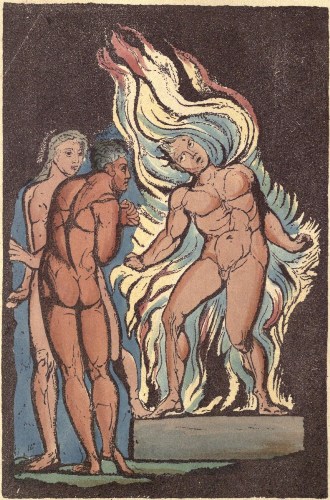
With the prolonged melody of this lament the Book of Ahania winds itself up; one of the most musical among this crowd of singing shadows. In the same year the last and briefest of this first prophetic series was engraved. The Song of Los, broken into two divisions headed Africa and Asia, has more affinity to Urizen and Ahania than to Europe and America. The old themes of delusion and perversion are once again rehandled; not without vigorous harmonies of choral expression. The illustrations are of special splendour, as though designed to atone for the lean and denuded form in which Ahania had been sent forth. In the frontispiece a grey old giant, clothed from the waist only with heavy raiment of livid and lurid white, bows down upon a Druid altar before the likeness of a darkened sun low-hung in heaven, filled with sombre and fiery forms of things, and shooting out upon each quarter a broad reflected ray like the reflection struck by sunlight from a broad bare sword-blade, but touched also, as with strange infection, with flakes of deadly colour that vibrate upon the starless solid ground of an intolerable night. Less of menace with more of sadness is in the landscape and sky on the title-page: a Titan, with one weighty hand lying on a gigantic skull, rests at the edge of a green sloping moor, himself seeming a grey fragment of moorland rock; brown fire of waste grass or rusted flower stains crag and bent all round him; the sky is all night and fire, bitter red and black. On the first page a serpent, splendid with blood-red specks and scales of greenish blue, darts the cloven flame of its tongue against a brilliant swarm of flies; and again throughout the divided lines a network of fair tortuous things, of flickering leaf and sinuous tendril and strenuous root, flashes and curls from margin to margin.
This song is the song of Time, sung to the four harps of the world, each continent a harp struck by Time as by a harper. In brief dim words it celebrates the end of the world of the patriarchs where faith and freedom were one, the advent of the iron laws and ages, when God the Accuser gave his laws to the nations by the hands of the children of time: when to the extreme east was given mere abstract philosophy for faith instead of clear pure belief, and man became slave to the elements, the slave and not the lord of the nature of things; but not yet was philosophy a mere matter of the five senses. Thus they fared in the east; meantime the spirits of the patriarchal world shrank beneath waters or fled in fires, Adam from Eden, Noah from Ararat; and “Moses beheld upon Mount Sinai forms of dark delusion.” Over each religion, Indian and Jewish and Grecian, some special demon or god of the mythology is bidden preside; Christianity, the expression of human sorrow, human indulgence and forgiveness, was given as gospel to “a man of sorrows” by the two afflicted spirits who typify man and woman, in whom the bitter errors and the sore needs of either several sex upon earth are reproduced in vast vague reflection; to them therefore the gentler gospel belongs as of right. Next comes Mahometanism, to give some freedom and fair play to the controlled and abused senses; but northwards other spirits set on foot a code of war to satiate their violent delight. So on all sides is the world overgrown with kingdoms and churches, codes and creeds; inspiration is crushed and erased; the sons of Time and Space reign alone; Har and Heva, the spirits of loftier and purer kind who were not as the rest of the Titan brood that “lived in war and lust,” are fled and fallen, become as mere creeping things; and the world is ripe to bring forth for its cruel and mournful God the final fruit of reason debased and faith distorted.
“Thus the terrible race of Los and Enitharmon gave Laws and Religions to the sons of Har, binding them more And more to Earth, closing and restraining; Till a Philosophy of Five Senses was complete; Urizen wept, and gave it into the hands of Newton and Locke.”
These “terrible sons” of time and space are the presiding demons of each creed or code; the sons of men are in their hands now, for the father and mother of men are fallen gods, oblivious and transformed: and these minor demons are all subservient to the Creator, whose soul, sorrowful but not merciful, animates the whole pained world. So, with cloud of menace and fire of wrath shed out about the deceased gods and the new philosophies, the first part ends. In the second part the clouds have broken and the fire has come forth; revolution has begun in Europe; the ancient lords of Asia are startled from their dens and cry in bitterness of soul for help of the old oppressions; for councillors and for taxes, for plagues and for priests, “to turn man from his path; to restrain the child from the womb; to cut off the bread from the city, that the remnant may learn to obey: that the pride of the heart may fail; that the lust of the eye may be quenched; that the delicate ear in its infancy may be dulled, and the nostrils closed up; to teach mortal worms the path that leads from the gates of the grave.” At their cry Urizen arose, the lord of Asia from of old, ever since he cast down the patriarchal law and set up the Mosaic code; “his shuddering waving wings went enormous above the red flames,” to contend with the rekindled revolution, “the thick-flaming thought-creating fires of Orc;”
“His books of brass, iron, and gold Melted over the land as he flew, Heavy-waving, howling, weeping. And he stood over Judea, And stayed in his ancient places, And stretched his clouds over Jerusalem. For Adam, a mouldering skeleton, Lay bleached on the garden of Eden; And Noah, as white as snow, On the mountains of Ararat.”
Thus, with thunder from eastward and fire from westward, the God of jealousy and the Spirit of freedom met together; earth shrank at the meeting of them.
“Forth from the dead dust rattling bones to bones Came; shaking, convulsed, the shivering clay breathes; And all flesh naked stands; Fathers and Friends; Mothers and Infants; Kings and Warriors; The Grave shrieks with delight, and shakes Her hollow womb, and clasps the solid stem; Her bosom swells with wild desire; And milk and blood and glandous wine In rivers rush and shout and dance On mountain, dale and plain. The Song of Los is ended. Urizen wept.”
So much for the text; which has throughout a contagious power of excitement in the musical passion of its speech. For these books, above all, it is impossible to read continuously and not imbibe a certain half-nervous enjoyment from their long cadences and tempestuous undulations of melody. Such passion went to the writing of them that some savour of that strong emotion infects us also in reading pages which seem still hot from the violent touch of the poet. The design of Har and Heva flying from their lustful and warlike brethren across green waste land before a late and thunder-coloured sky, he grasping her with convulsive fear, she looking back as she runs with lifted arm and flame-like hair and fiery flow of raiment; and that succeeding where they reappear fallen to mere king and queen of the vegetable world, themselves half things of vegetable life; are both noble if somewhat vehement and reckless. In this latter, the deep green-blue heaven full of stars like flowers is set with sweet and deep effect against the darkening green of the vast lily-leaves supporting the fiery pallor of those shapely chalices which enclose as the heart of either blossom the queen lying at her length, and the king sitting with bright plucked-out pistil in hand by way of sceptre or sword; and below them the dim walls of the world alone are wholly black: his robes of soft shot purple and red, her long chrysalid shell or husk of tarnished gold, are but signs of their bondage and fall from deity; they are fallen to be mere flowers. More might be said of the remaining designs; the fierce glory of sweeping branches and driven leaves in a strong wind, the fervent sky and glimmering hill, the crouching figures above and under, the divine insane luxuriance of cloudy and flowery colour which makes twice luminous the last page of the poem; the strange final design where a spirit with huge childlike limbs and lifted hair seems to smite with glittering mallet the outer rim of a huger blood-red sun; but for this book we have no more space; and much laborious travel lies ahead of us yet.
Larger Image
With the Song of Los the first or London series of prophecies came to a close not unfit or unmelodious. As their first word had been Revelation, their last was Revolution. We have now to deal with the two later and larger books written at Felpham, but not put forth till 1804. To one of these at least we must allow some tolerably full notice. The Milton shall here take precedence. This poem, though sufficiently vexatious to the human sense at first sight, is worth some care and some admiration. Its preface must here be read in full.
“The stolen and perverted writings of Homer and Ovid, of Plato and Cicero, which all men ought to contemn, are set up by artifice against the sublime of the Bible; but when the New Age is at leisure to pronounce, all will be set right, and those grand works of the more ancient and consciously and professedly inspired men, will hold their proper rank; and the daughters of memory shall become the daughters of inspiration. Shakespeare and Milton were both curbed by the general malady and infection from the silly Greek and Latin slaves of the sword. Rouse up, O young men of the New Age! set your foreheads against the ignorant hirelings! For we have hirelings in the camp, the court, and the university; who would, if they could, for ever depress mental and prolong corporeal war. Painters! on you I call! Sculptors! Architects! suffer not the fashionable fools to depress your powers by the prices they pretend to give for contemptible works or the expensive advertising boasts that they make of such works: believe Christ and his Apostles, that there is a class of men whose whole delight is in destroying. We do not want either Greek or Roman models if we are but just and true to our own imaginations, those worlds of eternity in which we shall live for ever, in Jesus our Lord.
And did those feet in ancient time Walk over England’s mountains green? And was the holy Lamb of God On England’s pleasant pastures seen? And did the Countenance Divine Shine forth upon our clouded hills? And was Jerusalem builded here, Among these dark Satanic mills? Bring me my bow of burning gold; Bring me my arrows of desire; Bring me my spear: O clouds, unfold; Bring me my chariot of fire. I will not cease from mental fight, Nor shall my sword sleep in my hand, Till we have built Jerusalem In England’s green and pleasant land.
‘Would to God that all the Lord’s people were prophets.’—Numbers xi. 29.”
After this strange and grand prelude, which, though taken in the letter it may read like foolishness, is in the spirit of it certainty and truth for all time, we pass again under the shadow and into the land that shifts and slips under our feet. Something however out of the chaos of fire and wind and stormy colour may be caught at by fits and stored up for such as can like it. Thus the poem opens, with not less fervour and splendour of sound than usual.
“Daughters of Beulah! Muses who inspire the Poet’s Song! Record the journey of immortal Milton thro’ your realms Of terror and mild moony lustre, in soft sexual delusions Of varied beauty, to delight the wanderer and repose His burning thirst and freezing hunger! Come into my hand, By your mild power descending down the Nerves of my right arm From out the Portals of my Brain, where by your ministry The Eternal Great Humanity Divine planted his Paradise And in it caused the Spectres of the Dead to take sweet forms In likeness of himself.”
(Observe here the answer by anticipation to the old foolish charge of madness and belief in mere material visions; a charge indeed refuted and confuted at every turn we take. Thus, and no otherwise, did Blake believe in his dead visitors and models: as spectres formed into new and significant shape by God, after his own likeness; not called up as by some witch of Endor and reclothed with the rags and rottenness of their dead old bodies; creatures existing within the brain and imagination of the workman, not as they were once externally and by accident, but as they will be for ever by the essence and substance of their nature. For the “vegetated shadow” or “human vegetable” no mystic ever had deeper or subtler contempt than Blake; nor was ever a man less likely to care about raising or laying it after death.)
“Tell also of the False Tongue! vegetated Beneath your land of shadows; of its sacrifices, and Its offerings: even till Jesus, the image of the Invisible God, Became its prey; a curse, an offering, and an atonement For Death Eternal, in the heavens of Albion, and before the gates Of Jerusalem his Emanation, in the heavens beneath Beulah.”
Let the Súfis of the West make what construction they can of that doctrine. We will help them, before passing on, with another view of the Atonement, taken from The Everlasting Gospel.
“But when Jesus was crucified, Then was perfected his galling pride. In three days he devoured his prey, And still he devours the body of clay; For dust and clay is the serpent’s meat, Which never was meant for man to eat.”
That is, the spirit must be eternally at work consuming and destroying the likeness of things material and the religions made out of them. This over-fervent prophet of freedom for the senses as well as the soul would have them free, one may say, only for the soul’s sake: talking as we see he did of redemption from the body and salvation by the spirit at war with it, in words which literally taken would hardly have misbecome a monk of Nitria.
Returning to the Milton, we are caught again in the mythologic whirlpools and cross-currents of symbol and doctrine; our ears rung deaf and dazed by the hammers of Los (Time) and our eyes bewildered by the wheels and woofs of Enitharmon (Space): “her looms vibrate with soft affections, weaving the Web of Life out from the ashes of the Dead.” This is a fragment of the main myth, whose details Los and Enitharmon themselves for the present forbid our following out.
“The Three Classes of men regulated by Los’s hammer, and woven By Enitharmon’s Looms, and spun beneath the Spindle of Tirzah: The first: The Elect from before the foundation of the World; The second: The Redeemed. The Third: the Reprobate and formed To destruction from the mother’s womb.”
Into the myth of the harrow and horses of Palamabron, more Asiatic in tone than any other of Blake’s, and full of the vast proportion and formless fervour of Hindoo legends, we will not haul any reluctant reader. Let him only take enough by way of extract to understand how thoroughly one vein of fiery faith runs through all the prophetic books, and one passionate form of doctrine is enforced and beaten in upon the disciple again and again; not hitherto with much material effect.
“And in the midst of the Great Assembly Palamabron prayed; O God, protect me from my friends that they have not power over me; Thou hast given me power to protect myself from my bitterest enemies.”
Then the wrath of Rintrah, the most fiery of the spirits who are children of Time, having entered by lot into Satan, who was of the Elect from the first, “seeming a brother, being a tyrant, even thinking himself a brother while he is murdering the just,” “with incomparable mildness,” believing “that he had not oppressed”—a symbolic point much insisted on—
“He created Seven deadly Sins, drawing out his infernal scroll Of moral laws and cruel punishments upon the clouds of Jehovah, To pervert the divine voice in its entrance to the earth With thunders of war and trumpet’s sound, with armies of disease; Punishments and deaths mustered and numbered; saying, I am God alone, There is no other; let all obey my principles of moral individuality I have brought them from the uppermost innermost recesses Of my Eternal Mind; transgressors I will rend off for ever; As now I rend this accursed Family from my covering.”
This is the Satan of Blake, sufficiently unlike the Miltonic. Of himself he cannot conceive evil and bring forth destruction; the absolute Spirit of Evil is alien from this mythology; he must enter into the body of a law or system and put on the qualities of spirits strange to himself (Rintrah); he is divided, inconsistent, a mystery and error to himself; he represents Monotheism with its stringent law and sacerdotal creed, Jewish or Christian, as opposed to Pantheism whereby man and God are one, and by culture and perfection of humanity man makes himself God. The point of difference here between Blake and many other western Pantheists is that in his creed self-abnegation (in the mystic sense, not the ascetic—the Oriental, not the Catholic) is the highest and only perfect form of self-culture: and as Satan (under “names divine”—see the Epilogue to the Gates of Paradise) is the incarnate type of Monotheism, so is Jesus the incarnate type of Pantheism. To return to our myth; the stronger spirit rears walls of rocks and forms rivers of fire round them;
“And Satan, not having the Science of Wrath but only of Pity,[57] Rent them asunder; and Wrath was left to Wrath, and Pity to Pity.”
This is Blake’s ultimate conception of active evil; not wilful wrong-doing by force of arm or of spirit; but mild error, tender falsehood innocent of a purpose, embodied in an external law of moral action and restrictive faith, and clothed with a covering of cruelty which adheres to and grows into it (Decalogue and Law). A subtle and rather noble conception, developing easily and rapidly into what was once called the Manichean doctrine as to the Old Testament.
“If the guilty should be condemned, he must be an Eternal Death, And one must die for another throughout all Eternity; Satan is fallen from his station and can never be redeemed, But must be new-created continually moment by moment, And therefore the class of Satan shall be called the Elect, and those Of Rintrah the Reprobate, and those of Palamabron the Redeemed; For he is redeemed from Satan’s law, the wrath falling on Rintrah. And therefore Palamabron cared not to call a solemn Assembly Till Satan had assumed Rintrah’s wrath in the day of mourning, In a feminine delusion[58] of false pride self-deceived.”
The words of the text recur not unfrequently in the prophetic books. A single final act of redemption by sacrifice and oblation of one for another is not admitted as sufficient, or even possible. The favourite dogma is this, of the eternity of sacrifice; endless redemption to be bought at no less a price than endless self-devotion. To this plea of “an Eternal” before the assembly succeeds the myth of Leutha “offering herself a ransom for Satan:”[59] a myth, not an allegory; for of allegory pure and simple there is scarcely a trace in Blake.
“I formed the Serpent Of precious stones and gold turned poison on the sultry waste. To do unkind things with kindness; with power armed, to say The most irritating things in the midst of tears and love; These are the stings of the Serpent.”
This whole myth of Leutha is splendid for colour, and not too subtle to be thought out: the imaginative action of the poem plays like fire and palpitates like blood upon every line, as the lips of caressing flame and the tongues of cleaving light in which the text is set fold and flash about the margins.
“The Elect shall meet the Redeemed, on Albion’s rocks they shall meet, Astonished at the Transgressor, in him beholding the Saviour. And the Elect shall say to the Redeemed; We behold it is of Divine Mercy alone, of free gift and Election, that we live; Our Virtues and cruel Goodnesses have deserved Eternal Death.”
Forgiveness of sin and indulgence, the disciple perceives, is not enough for this mythology; it must include forgiveness of virtue and abstinence, the hypocritic holiness made perfect in the body of death for six thousand years under the repressive and restrictive law called after the name of the God of the Jews, who “was leprous.” Thus prophesies Blake, in a fury of supra-Christian dogmatism.
Here ends the “Song of the Bard” in the First Book. “Many condemned the high-toned song, saying, Pity and Love are too venerable for the imputation of guilt. Others said, If it is true!” Let us say the same, and pass on: listening only to the Bard’s answer:—
“I am inspired! I know it is Truth! for I sing According to the Inspiration of the Poetic Genius Who is the Eternal all-protecting divine Humanity To whom be Glory and Power and Dominion evermore. Amen.”
Then follows the incarnation and descent into earth and hell of Milton, who represents here the redemption by inspiration, working in pain and difficulty before the expiration of the six thousand Satanic years. His words are worth quoting:—
“When will the Resurrection come, to deliver the sleeping body From corruptibility? O when, Lord Jesus, wilt thou come? Tarry no longer; for my soul lies at the gates of death: I will arise and look forth for the morning of the grave: I will go down to the sepulchre and see if morning breaks. I will go down to self-annihilation and eternal death Lest the Last Judgment come and find me unannihilate And I be seized and given into the hands of my own selfhood.”
This grand dogma, that personal love and selfishness make up the sin which defies redemption, is in a manner involved in that former one of the necessary “eternity of sacrifice,” for
“I in my selfhood am that Satan; I am that Evil One; He is my Spectre.”
Now by the light of these extracts let any student examine the great figure at p. 13, where “he beheld his own Shadow—and entered into it.” Clothed in the colours of pain, crowned with the rays of suffering, it stands between world and world in a great anguish of transformation and change: Passion included by Incarnation. Erect on a globe of opaque shadow, backed by a sphere of aching light that opens flower-wise into beams of shifting colour and bitter radiance as of fire, it appeals with a doubtful tortured face and straining limbs to the flat black wall and roof of heaven. All over the head is a darkness not of transitory cloud or night that will some time melt into day; recalling that great verse: “Neither could the bright flames of the stars endure to lighten that horrible night.”
“As when a man dreams he reflects not that his body sleeps, Else he would wake; so seemed he entering his Shadow; but With him the Spirits of the Seven Angels of the Presence Entering, they gave him still perceptions of his Sleeping Body Which now arose and walked with them in Eden, as an Eighth Image, Divine tho’ darkened, and tho’ walking as one walks In Sleep; and the Seven comforted and supported him.”
The whole passage is full of a deep and dim beauty which grows clearer and takes form of feature to those only who bring with them eyes to see and patience to desire it. Take next this piece of cosmography, worth comparing with Dante’s vision of the worlds:—
“The nature of infinity is this; That everything has its Own vortex: and when once a traveller thro’ Eternity Has passed that vortex, he perceives it roll backward behind His path into a globe itself enfolding, like a sun Or like a moon or like a universe of starry majesty, While he keeps onward in his wondrous journey thro’ the earth, Or like a human form, a friend with whom he lived benevolent: As the eye of man views both the east and west encompassing Its vortex, and the north and south, with all their starry host; Also the rising and setting moon he views surrounding His cornfields and his valleys of five hundred acres square; Thus is the earth one infinite plane, and not as apparent To the weak traveller confined beneath the moony shade; Thus is the heaven a vortex passed already, and the earth A vortex not yet passed by the traveller thro’ Eternity.”
One curious piece of symbolism may be extracted from the myth, as the one reference to anything actual:—
“Then Milton knew that the Three Heavens of Beulah were beheld By him on earth in his bright pilgrimage of sixty years In those three Females whom his Wives, and those three whom his Daughters Had represented and contained, that they might be resumed By giving up of Selfhood.”
But of Milton’s flight, of the cruelties of Ulro, of his journey above the Mundane Shell, which “is a vast concave earth, an immense hardened shadow of all things upon our vegetated earth, enlarged into dimension and deformed into indefinite space,” we will take no more account here; nor of the strife with Urizen, “one giving life, the other giving death, to his adversary;” hardly even of the temptation by the sons and daughters of Rahab and Tirzah, when
“The twofold Form Hermaphroditic, and the Double-sexed, The Female-male and the Male-female, self-dividing stood Before him in their beauty and in cruelties of holiness.”
(Compare the beautiful song “To Tirzah,” in the Songs of Experience.) This Tirzah, daughter of Rahab the holy, is “Natural Religion” (Theism as opposed to Pantheism), which would fain have the spiritual Jerusalem offered in sacrifice to it.
“Let her be offered up to holiness: Tirzah numbers her: She numbers with her fingers every fibre ere it grow: Where is the Lamb of God? where is the promise of his coming? Her shadowy sisters form the bones, even the bones of Horeb Around the marrow; and the orbed scull around the brain; She ties the knot of nervous fibres into a white brain; She ties the knot of bloody veins into a red-hot heart; She ties the knot of milky seed into two lovely heavens, Two yet but one; each in the other sweet reflected; these Are our Three Heavens beneath the shades of Beulah, land of rest.”
Here and henceforward the clamour and glitter of the poem become more and more confused; nevertheless every page is set about with jewels; as here, in a more comprehensible form than usual:—
“God sent his two servants Whitfield and Wesley; were they prophets? Or were they idiots and madmen? ‘Show us Miracles’? Can you have greater Miracles than these? Men who devote Their life’s whole comfort to entire scorn, injury, and death?”
Take also these scraps of explanation mercifully vouchsafed us:—
“Bowlahoola is named Law by Mortals: Tharmas founded it Because of Satan: * * * * But Golgonooza is named Art and Manufacture by mortal men. In Bowlahoola Los’s Anvils stand and his Furnaces rage. Bowlahoola thro’ all its porches feels, tho’ too fast founded Its pillars and porticoes to tremble at the force Of mortal or immortal arm; * * * The Bellows are the Animal Lungs; the Hammers the Animal Heart; The Furnaces the Stomach for digestion;”
(Here we must condense instead of transcribing. While thousands labour at this work of the Senses in the halls of Time, thousands “play on instruments stringed or fluted” to lull the labourers and drown the painful sound of the toiling members, and bring forgetfulness of this slavery to the flesh: a myth of animal life not without beauty, and to Blake one of great attraction.)
“Los is by mortals named Time, Enitharmon is named Space; But they depict him bald and aged who is in eternal youth All-powerful, and his locks flourish like the brows of morning; He is the Spirit of Prophecy, the ever-apparent Elias. Time is the mercy of Eternity; without Time’s swiftness Which is the swiftest of all things, all were eternal torment.”
At least this last magnificent passage should in common charity and sense have been cited in the biography, if only to explain the often-quoted words Los and Enitharmon. Neither blindness to such splendour of symbol, nor deafness to such music of thought, can excuse the omission of what is so wholly necessary for the comprehension of extracts already given, and given (as far as one can see) with no available purpose whatever.
The remainder of the first book of the Milton is a vision of Nature and prophecy of the gathering of the harvest of Time and treading of the winepress of War; in which harvest and vintage work all living things have their share for good or evil.
“How red the sons and daughters of Luvah! here they tread the grapes, Laughing and shouting, drunk with odours; many fall o’erwearied, Drowned in the wine is many a youth and maiden; those around Lay them on skins of Tigers and of the spotted Leopard and the wild Ass Till they revive, or bury them in cool grots, making lamentation. This Winepress is called War on Earth; it is the printing-press Of Los, there he lays his words in order above the mortal brain As cogs are formed in a wheel to turn the cogs of the adverse wheel.”
All kind of insects, of roots and seeds and creeping things—“all the armies of disease visible or invisible”—are there;
“The slow slug; the grasshopper that sings and laughs and drinks (Winter comes, he folds his slender bones without a murmur);”
wasp and hornet, toad and newt, spider and snake,
“They throw off their gorgeous raiment; they rejoice with loud jubilee Around the winepresses of Luvah, naked and drunk with wine. There is the nettle that stings with soft down; and there The indignant thistle whose bitterness is bred in his milk; Who feeds on contempt of his neighbour; there all the idle weeds That creep around the obscure places show their various limbs Naked in all their beauty, dancing round the winepresses. But in the winepresses the human grapes sing not nor dance, They howl and writhe in shoals of torment, in fierce flames consuming;”
tortured for the cruel joy and deadly sport of Luvah’s sons and daughters;
“They dance around the dying and they drink the howl and groan; They catch the shrieks in cups of gold, they hand them one to another; These are the sports of love, and these the sweet delights of amorous play; Tears of the grape, the death-sweat of the cluster; the last sigh Of the mild youth who listens to the luring songs of Luvah.”
Take also this from the speech of Time to his reapers.
“You must bind the sheaves not by nations or families, You shall bind them in three classes; according to their classes So shall you bind them, separating what has been mixed Since men began to be woven into nations. * * * * * The Elect is one class; you Shall bind them separate; they cannot believe in eternal life Except by miracle and a new birth. The other two classes, The Reprobate[60] who never cease to believe, and the Redeemed Who live in doubts and fears, perpetually tormented by the Elect, These you shall bind in a twin bundle for the consummation.”
The constellations that rise in immortal order, that keep their course upon mountain and valley, with sound of harp and song, “with cups and measures filled with foaming wine;” that fill the streams with light of many visions and leave in luminous traces upon the extreme sea the peace of their passage; these too are sons of Los, and labour in the vintage. The gorgeous flies on meadow or brook, that weave in mazes of music and motion the delight of artful dances, and sound instruments of song as they touch and cross and recede; the trees shaken by the wind into sound of heavy thunder till they become preachers and prophets to men; these are the sons of Los, these the visions of eternity; and we see but as it were the hem of their garments.
A noble passage follows, in which are resumed the labours of the sons of time in fashioning men and the stations of men. They make for doubts and fears cabinets of ivory and gold; when two spectres “like lamps quivering” between life and death stand ready for the blind malignity of combat, they are taken and moulded instead into shapes fit for love, clothed with soft raiment by softer hands, drawn after lines of sweet and perfect form. Some “in the optic nerve” give to the poor infinite wealth of insight, power to know and enjoy the invisible heaven, and to the rich scorn and ignorance and thick darkness. Others build minutes and hours and days;
“And every moment has a couch of gold for soft repose (A moment equals a pulsation of the artery) And every minute has an azure tent with silken veils, And every hour has a bright golden gate carved with skill, And every day and night has walls of brass and gates of adamant Shining like precious stones and ornamented with appropriate signs, And every month a silver-paved terrace builded high, And every year invulnerable barriers with high towers, And every age is moated deep, with bridges of silver and gold, And every Seven Ages are encircled with a flaming fire.”
There is much more of the same mythic sort concerning the duration of time, the offices of the nerves (e.g., in the optic nerve sleep was transformed to death by Satan the father of sin and death, even as we have seen sensual death re-transformed by Mercy into sleep), and such-like huge matters; full, one need not now repeat, of subtle splendour and fanciful intensity. But enough now of this over-careful dredging in such weedy waters; where nevertheless, at risk of breaking our net, we may at every dip fish up some pearl.
At the opening of the second book the pearls lie close and pure. From this (without explanation or reference) has been taken the lovely and mutilated extract at p. 197 of the Life. Thus it stands in Blake’s text:—
“Thou hearest the nightingale begin the song of spring; The lark, sitting upon his earthy bed, just as the morn Appears, listens silent; then, springing from the waving corn-field, loud He leads the choir of day: trill—trill—trill—trill— Mounting upon the wings of light into the great expanse, Re-echoing against the lovely blue and shining heavenly shell His little throat labours with inspiration; every feather On throat, and breast, and wing, vibrate with the effluence divine. All nature listens to him silent; and the awful Sun Stands still upon the mountains, looking on this little bird With eyes of soft humility, and wonder, love, and awe. Then loud, from their green covert, all the birds began their song,— The thrush, the linnet and the goldfinch, robin and the wren, Awake the Sun from his sweet reverie upon the mountains; The nightingale again essays his song, and through the day And through the night warbles luxuriant; every bird of song Attending his loud harmony with admiration and love.
(This is a vision of the lamentation of Beulah over Ololon.)
Thou perceivest the flowers put forth their precious odours, And none can tell how from so small a centre come such sweets, Forgetting that within that centre eternity expands Its ever-during doors that Og and Anak fiercely guard.[61] First ere the morning breaks joy opens in the flowery bosoms, Joy even to tears, which the sun rising dries; first the wild thyme And meadow-sweet downy and soft waving among the reeds, Light springing on the air, lead the sweet dance; they wake The honeysuckle sleeping on the oak, the flaunting beauty Revels along upon the wind; the white-thorn, lovely May, Opens her many lovely eyes; listening, the rose still sleeps, None dare to wake her: soon she bursts her crimson-curtained bed And comes forth in the majesty of beauty; every flower, The pink, the jessamine, the wallflower, the carnation, The jonquil, the mild lily, opes her heavens; every tree And flower and herb soon fill the air with an innumerable dance, Yet all in order sweet and lovely; men are sick with love.
Such is a vision of the lamentation of Beulah over Ololon.”
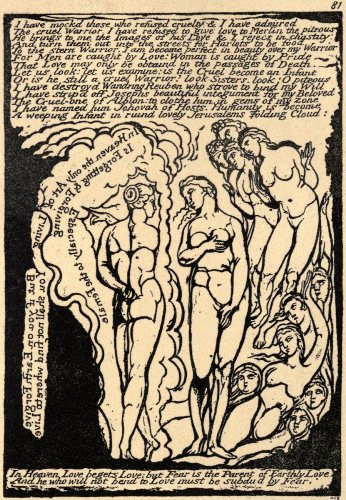
This Beulah is “a place where contrarieties are equally true;” “it is a pleasant lovely shadow where no dispute can come because of those who sleep:” made to shelter, before they “pass away in winter,” the temporary emanations “which trembled exceedingly neither could they live, because the life of man was too exceeding unbounded.” Of the incarnation and descent of Ololon, of the wars and prophecies of Milton, and of all the other Felpham visions here put on record, we shall say no more in this place; but all these things are written in the Second Book. The illustrative work is also noble and worth study in all ways. One page for example is covered by a design among the grandest of Blake’s. Two figures lie half embraced, as in a deadly sleep without dawn of dream or shadow of rest, along a bare slant ledge of rock washed against by wintry water. Over these two stoops an eagle balanced on the heavy-laden air, with stretching throat and sharpened wings, opening beak, and eyes full of a fierce perplexity of pity. All round the greenish and black slope of moist sea-cliff the weary tidal ripple plashes and laps, thrusting up as it were faint tongues and listless fingers tipped with foam. On an earlier page, part of the text of which we have given, crowd and glitter all shapes and images of insect or reptile life, sprinkling between line and margin keen points of jewel-coloured light and soft flashes as of starry or scaly brilliance.
The same year 1804 saw the huge advent of Jerusalem. Of that terrible “emanation,” hitherto the main cornerstone of offence to all students of Blake, what can be said within any decent limit? or where shall any traveller find a rest for feet or eyes in that noisy and misty land? It were a mere frenzy of discipleship that would undertake by force of words to make straight these crooked ways or compel things incoherent to cohere. Supra hanc petram—and such a rock it is to begin any church-building upon! Many of the unwary have stumbled over it and broken their wits. Seriously, one cannot imagine that people will ever read through this vast poem with pleasure enough to warrant them in having patience with it.
Larger Image
Several things, true in the main of all the prophetic books, are especially true and memorable with regard to those written or designed during the “three years’ slumber” at Felpham. They are the results of intense and active solitude working upon the capricious nerves and tremulous brain of a man naturally the most excitable and receptive of men. They are to be read by the light of his earlier work in the same line; still more perhaps by the light of those invaluable ten letters printed in Vol. II. of the Life, for which one can hardly give thanks enough. The incredible fever of spirit under the sting and stress of which he thought and laboured all his life through, has left marks of its hot and restless presence as clearly on this short correspondence as on the voluminous rolls of prophecy. The merit or demerit of the work done is never in any degree the conscious or deliberate result of a purpose. Possessed to the inmost nerve and core by a certain faith, consumed by the desire to obey his instinct of right by preaching that faith, utterly regardless of all matters lying outside of his own inspiration, he wrote and engraved as it was given him to do, and no otherwise. As to matter and argument, the enormous Jerusalem is simply a fervent apocalyptic discourse on the old subjects—love without law and against law, virtue that stagnates into poisonous dead matter by moral isolation, sin that must exist for the sake of being forgiven, forgiveness that must always keep up with sin—must even maintain sin that it may have something to keep up with and to live for. Without forgiveness of sins, the one thing necessary, we lapse each man into separate self-righteousness and a cruel worship of natural morality and religious law. For nature, oddly enough as it seems at first sight, is assumed by this mystical code to be the cruellest and narrowest of absolute moralists. Only by worship of imaginative impulse, the grace of the Lamb of God, which admits infinite indulgence in sin and infinite forgiveness of sin—only by some such faith as this shall the world be renewed and redeemed. This may be taken as the rough result, broadly set down, of the portentous book of revelation. Never, one may suppose, did any Oriental heretic drive his deductions further or set forth his conclusions in obscurer form. Never certainly did a man fall to his work with keener faith and devotion. Sin itself is not so evil—but the remembrance and punishment of sin! “Injury the Lord heals; but vengeance cannot be healed.” Next or equal in hatefulness to the division of qualities into evil and good (see above, Marriage of Heaven and Hell) is the separation of sexes into male and female: hence jealous love and personal desire, that set itself against the mystical frankness of fraternity: hence too (contradictory as it may seem till one thinks it out) the hermaphroditic emblem is always used as a symbol seemingly of duplicity and division, perplexity and restraint. The two sexes should not combine and contend; they must finally amalgamate and be annihilated.[62] All this is of course more or less symbolic, and not to be taken in literal coarseness or folly of meaning. The whole stage is elemental, the scheme one of patriarchal vapour, and the mythologic actors mere Titans outlined in cloud. Reserving this always, we shall not be far out in interpreting Blake’s dim creed somewhat as above. One distinction it is here possible to make, and desirable to keep in mind: Blake at one time speaks of Nature as the source of moral law, “the harlot virgin-mother,” “Rahab,” “the daughter of Babylon,” origin of religious restrictions and the worship of abstinence; mother of “the harlot modesty,” and spring of all hypocrisies and prohibitions; to whom the religious and moral of this world would fain offer up in sacrifice the spiritual Jerusalem, the virgin espoused, named among men Liberty, forbidding nothing and enjoying all, but therefore clean and not unclean: by whom comes indulgence, after whom follows redemption. At another time this same prophet will plead for freedom on behalf of “natural” energies, and set up the claims of nature to energetic enjoyment and gratification of all desires, against the moral law and government of the creative and restrictive Deity—“Urizen, mistaken Demon of Heaven.” With a like looseness of phrase he uses and transposes the words “God” and “Satan,” even to an excess of laxity and consequent perplexity; not, it may be suspected, without a grain of innocent if malign pleasure at the chance of inflicting on men of conventional tempers bewilderment and offence. But as to this question of the term “Nature” the case seems to lie thus: when, as throughout the Marriage of Heaven and Hell, he uses it in the simple sense of human or physical condition as opposed to some artificial state of soul or belief, he takes it as the contrary of conventional ideas and habits (of religion and morality as vulgarly conceived or practised); but when, as throughout the Milton and Jerusalem, he speaks of nature as opposed to inspiration, it must be taken as the contrary of that higher and subtler religious faith which he is bent on inculcating, and which itself is the only perfect opposite and efficient antagonist to the conventional faith and (to use another of his quasi-technical terms) the “deistical virtue” which he is bent on denying. Blake, one should always remember, was not infidel but heretic; his belief was peculiar enough, but it was not unbelief; it was farther from that than most men’s. To him, though for quite personal reasons and in a quite especial sense, much of what is called inspired writing was as sacred and infallible as to any priest of any church. Only before reading he inverted the book.
“Both read the Bible day and night, But thou read’st black where I read white.” (Everlasting Gospel, MS.)
Thus, by his own showing, in the recorded words of Christ he found authority for his vision and sympathy with his faith; in the published creed of reason or rationalism, he found negation of his belief and antipathy to his aims. Hence in his later denunciation he brackets together the Churches of Rome and England with the Churches of Ferney and Lausanne; it was all uninspired—all “nature’s cruel holiness—the deceits of natural religion”; all irremediably involved, all inextricably interwoven with the old fallacies and the old prohibitions.
Larger Image
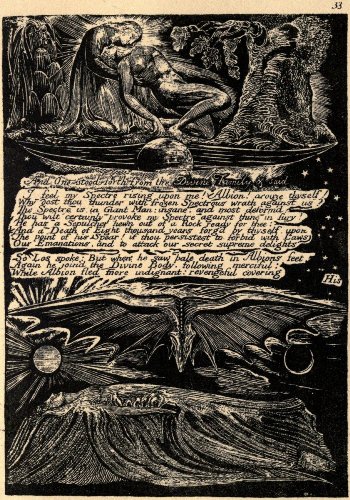
Such points as these do, above most others, deserve, demand, and reward the trouble of clearing up; and these once understood, much that seemed the aimless unreflecting jargon of crude or accidental rhetoric assumes a distinct if unacceptable meaning. It is much otherwise with the external scheme or literal shell of the Jerusalem. Let no man attempt to define the post or expound the office of the “terrible sons and daughters.” These, with all their flock of emanations and spectrous or vegetating shadows, let us leave to the discretion of Los; who has enough on his hands among them all. Neither let any attempt to plant a human foot upon the soil of the newly-divided shires and counties, partitioned though they be into the mystic likeness of the twelve tribes of Israel. Nor let any questioner of arithmetical mind apply his skill in numbers to the finding of flaws or products in the twelves, twenty-fours, and twenty-sevens which make up the sum of their male and female emanations. In earnest, the externals of this poem are too incredibly grotesque—the mythologic plan too incomparably tortuous—to be fit for any detailed coherence of remark. Nor indeed were they meant to endure it. Such things, and the expression of such things, as are here treated of, are not to be reasoned out; the matter one may say is above reasoning; the manner (taken apart from the matter) is below it: the spirit of the work is too strong and its form too faulty for any rule or line. It will upon the whole suffice if this be kept in mind; that to Blake, in a literal perhaps as well as a mystical sense, Albion was as it were the cradle and centre of all created existence; he even calls on the Jews to recognize it as the parent land of their history and their faith. Its incarnate spirit is chief among the ancient giant-gods, Titans of his mythology, who were lords of the old simple world and its good things, its wise delights and strong sweet instincts, full of the vigorous impulse of innocence; lords of an extinct kingdom, superseded now and transformed by the advent of moral fear and religious jealousy, of pallid faith and artificial abstinence. In this manner Albion is changed and overthrown; hence at length he dies, stifled and slain by his children under the new law. His one friend, not misled or converted to the dispensations of bodily virtue and spiritual restraint, but faithful from of old and even after his change and conversion to moral law, is Time; whose Spectre, or mere outside husk and likeness, is indeed (as it must needs be) fain to range itself on the transitory side of things, fain to follow after the fugitive Emanation embodied in these new forms of life and allied to the faith and habit of the day against the old liberty;[63] but for all the desire of his despair and fierce entreaties to be let go, he is yet kept to work, however afflicted and rebellious, and compelled to labour with Time’s self at the building up within every man of that spiritual city which is redemption and freedom for all men (ch. i.). All the myth of this building of “Golgonooza,” (that is, we know, inspired art by which salvation must come) is noticeable for sweet intricacy of beauty; only after a little some maddening memory (surely not pure inspiration this time, but rather memory?) of the latter chapters of Ezekiel, with their interminable inexplicable structures and plans, seizes on Blake’s passionate fancy and sets him at work measuring and dividing walls and gates in a style calculated to wear out a hecatomb of scholiasts, for whole pages in which no subtilized mediæval intellect, though trained under seraphic or cherubic doctors, could possibly find one satisfactory hair to split. For it merely trebles the roaring and rolling confusion when some weak grain of symbolism is turned up for a glimpse of time in the thick of a mass of choral prose consisting of absolute fancy and mere naked sound.
Not that there is here less than elsewhere of the passion and beauty which redeem so much of these confused and clamorous poems. The merits and attractions of this book are not such as can be minced small and served up in fragments. To do justice to its melodious eloquence and tender subtlety, we should have to analyze or transcribe whole sections: to give any fair notion of the grandeur and variety of its decorations would take up twice the space we can allow to it. Let this brief prologue stand as a sample of the former qualities.
“Reader! lover of books! lover of heaven And of that God from whom all things are given; Who in mysterious Sinai’s awful cave To Man the wondrous art of writing gave; Again he speaks in thunder and in fire, Thunder of thought and flames of fierce desire; Even from the depths of Hell his voice I hear Within the unfathomed caverns of my ear; Therefore I print; nor vain my types shall be; Heaven, Earth, and Hell henceforth shall live in harmony.”
“We who dwell on earth,” adds the prophet, speaking of the measure and outward fashion of his poem, “can do nothing of ourselves; everything is conducted by Spirits no less than digestion or sleep.” It is to be wished then that the spirits had on this occasion spoken less like somnambulists and uttered less indigested verse. For metrical oratory the plea that follows against ordinary metre may be allowed to have some effective significance; however futile if applied to purer and more essential forms of poetry.
It will be enough to understand well and bear well in mind once for all that the gist of this poem, regarded either as a scheme of ethics or as a mythological evangel, is simply this: to preach, as in the Saviour’s opening invocation, the union of man with God:—(“I am not a God afar off;—Lo! we are One; forgiving all evil; not seeking recompense”): to confute the dull mournful insanity of disbelief which compels “the perturbed man” to avert his ear and reject the divine counsellor as a “Phantom of the over-heated brain.” This perverted humanity is incarnate in Albion, the fallen Titan, imprisoned by his children; the “sons of Albion” are dæmonic qualities of force and faith, the “daughters” are reflex qualities or conditions which emanate from these. As thus; reason supplants faith, and law, moral or religious, grows out of reason; Jerusalem, symbol of imaginative liberty, emanation of his unfallen days, is the faith cast out by the “sons” or spirits who substitute reason for faith, the freedom trodden under by the “daughters” who substitute moral law for moral impulse: “Vala,” her Spectre, called “Tirzah” among men, is the personified form in which “Jerusalem” becomes revealed, the perverted incarnation, the wrested medium or condition in which she exists among men. Thus much for the scheme of allegory with which the prophet sets out; but when once he has got his theogony well under way and thrown it well into types, the antitypes all but vanish: every condition or quality has a god or goddess of its own; every obscure state and allegorical gradation becomes a personal agent: and all these fierce dim figures threaten and complain, mingle and divide, struggle and embrace as human friends or foes. The main symbols are even of a monotonous consistency; but no accurate sequence of symbolic detail is to be looked for in the doings and sayings of these contending giants and gods. To those who will remember this distinction and will make allowance for the peculiar dialect and manner of which some account has already been taken, this poem will not seem so wholly devoid of reason or of charm.
For its great qualities are much the same in text as in design: plenteous, delicate, vigorous. There is a certain real if rough and lax power of dramatic insight and invention shown even in the singular divisions of adverse symbol against symbol; in such allegories as that which opposes the “human imagination in which all things exist”—do actually exist to all eternity—and the reflex fancy or belief which men confound with this; nay, which they prefer to dwell in and ask comfort from. These two the poet calls the “states” of Beulah and Jerusalem. As the souls of men are attracted towards that “mild heaven” of dreams and shadows where only the reflected image of their own hopes and errors can abide, the imagination, most divine and human, most actual and absolute, of all things, recedes ever further and further among the clouds of smoke, vapours of “abstract philosophy,” and is caught among the “starry wheels” of religion and law, whose restless and magnetic revolution attracts and absorbs her.
“O what avail the loves and tears of Beulah’s lovely daughters? They hold the immortal form in gentle bands and tender tears, But all within is opened into the deeps”—
the deeps of “a dark and unknown night” in which “philosophy wars against imagination.” Here also the main myth of the Europe is once more rehandled; to “create a female will,” jealous, curious, cunning, full of tender tyranny and confusion, this is “to hide the most evident God in a hidden covert, even in the shadows of a woman and a secluded holy place, that we may pry after him as after a stolen treasure, hidden among the dead and mured up from the paths of life.” Thus is it with the Titan Albion and all his race of mythologic men, when for them “Vala supplants Jerusalem,” the husk replaces the fruit, the mutable form eclipses the immutable substance.
But into these darker parts of the book we will not go too deep. Time, patience, and insight on the part of writer and reader might perhaps clear up all details and lay bare much worth sight and study; but only at the expense of much labour and space. It is feasible, and would be worth doing; but not here. If the singular amalgam called Blake’s works should ever get published, and edited to any purpose, this will have to be done by an energetic editor with time enough on his hands and wits enough for the work. We meantime will gather up a few strays that even under these circumstances appear worth hiving. In the address (p. 27) to the Jews, &c., Blake affirms that “Britain was the primitive seat of the patriarchal religion”: therefore, in a literal as well as in a mystical sense, Jerusalem was the emanation of the giant Albion. (This it should seem was, according to the mythology, before the visible world was created; in the time when all things were in the divine undivided world of the gods.) “Ye are united, O ye inhabitants of Earth, in one Religion: the most Ancient, the Eternal, and the Everlasting Gospel. The Wicked will turn it to Wickedness; the Righteous, to Righteousness.” If there be truth in the Jewish tradition, he adds further on, that man anciently contained in his mighty limbs all things in heaven and earth, “and they were separated from him by cruel sacrifices; and when compulsory cruel sacrifices had brought Humanity into a feminine tabernacle in the loins of Abraham and David, the Lamb of God, the Saviour, became apparent on earth as the prophets had foretold: the return of Israel is a return to mental sacrifice and war,” to noble spiritual freedom and labour, which alone can supplant “corporeal war” and violence of error.
The second address (p. 52) “to the Deists” is more singular and more eloquent. Take a few extracts given not quite at random. “He,” says Blake, “who preaches natural religion or morality is a flatterer who means to betray, and to perpetuate tyrant pride and the laws of that Babylon which he foresees shall shortly be destroyed with the spiritual and not the natural sword; he is in the state named Rahab.” The prophet then enforces his law that “man is born a spectre or Satan and is altogether an Evil,” and “must continually be changed into his direct contrary.” Those who persuade him otherwise are his enemies. For “man must and will have some religion; if he has not the religion of Jesus he will have the religion of Satan.” Again, “Will any one say, Where are those who worship Satan under the name of God?—where are they? Listen. Every religion that preaches vengeance for sin is the religion of the enemy and avenger, and not of the forgiver of sin: and their God is Satan named by the Divine Name.” This, he says, must be at root the religion of all who deny revelation and adore nature;[64] for mere nature is Satanic. Adam the first man was created at the same time with Satan, when the earth-giant Albion was cast into a trance of sleep: the first man was a part of the universal fluent nature made opaque; the first fiend, a part contracted; and only by these qualities of opacity and contraction can man or devil have separate natural existence. Those, the prophet adds in his perverse manner, who profess belief in natural virtue are hypocrites; which those cannot be who “pretend to be holier than others, but confess their sins before all the world.” Therefore there was never a religious hypocrite! “Rousseau thought men good by nature; he found them evil, and found no friend. Friendship cannot exist without forgiveness of sins continually.” And so forth.
At p. 66 is a passage recalling the myth of the “Mental Traveller,” and which seems to bear out the interpretation we gave to that misty and tempestuous poem. This part of the prophecy, describing the blind pitiful cruelty of divided qualities set against each other, is full of brilliant and noble passages. Even the faint symbolic shapes of Tirzah and all her kind assume now and then a splendour of pathos, utter words of stately sound, complain and appeal even to some recognizable purpose. So much might here be cited that we will prefer to cite nothing but this slight touch of myth. In the world of time “they refuse liberty to the male: not like Beulah,
Where every female delights to give her maiden to her husband.”
The female searches sea and land for gratification to the male genius, who in return clothes her in gems and gold and feeds her with the food of Eden: hence all her beauty beams. But this is only in the “land of dreams,” where dwell things “stolen from the human imagination by secret amorous theft:” and when the spectres of the dead awake in that land, “all the jealousies become murderous:—forming a commerce to sell loves with moral law; an equal balance, not going down with decision: therefore—mutual hate returns and mutual deceit and mutual fear.” In fact, the divorce batteries are here open again.
The third address “to the Christians” is too long to transcribe here; and should in fairness have been given in the biography. Its devout passion and beauty of words might have won notice, and earned tolerance for the more erratic matter in which it lies embedded. “What is the joy of heaven but improvement in the things of the spirit? What are the pains of hell but ignorance, bodily lust, idleness, and devastation of the things of the spirit?” Mental gifts, given of Christ, “always appear to the ignorance-loving hypocrite as sins; but that which is a sin in the sight of cruel man is not so in the sight of our kind God.” Every Christian after his ability should openly engage in some mental pursuit; for “to labour in knowledge is to build up Jerusalem; and to despise knowledge is to despise Jerusalem and her builders.” A little before he has said: “I know of no other Christianity and no other Gospel than the liberty both of body and mind to exercise the divine arts of imagination.” God being a spirit, and to be worshipped in spirit and in truth, are not all his gifts spiritual gifts? “The Christians then must give up the religion of Caiaphas, the dark preacher of death, of sin, of sorrow, and of punishment, typified as a revolving wheel, a devouring sword; and recognize that the labours of Art and Science alone are the labours of the Gospel.” As to religion, “Jesus died because he strove against the current of this wheel—opposing nature; it is natural religion. But Jesus is the bright preacher of life, creating nature from this fiery law, by self-denial and forgiveness of sin.” So speaks to the prophet “a Watcher and a Holy One;” bidding him
“Go therefore, cast out devils in Christ’s name, Heal thou the sick of spiritual disease; Pity the evil; for thou art not sent To smite with terror and with punishments Those that are sick. * * * * But to the publicans and harlots go: Teach them true happiness; but let no curse Go forth out of thy mouth to blight their peace. For hell is opened to heaven; thine eyes behold The dungeons burst, the prisoners set free. England, awake! awake! awake! Jerusalem thy sister calls; Why wilt thou sleep the sleep of death And chase her from thy ancient walls? Thy hills and valleys felt her feet Gently upon their bosoms move; Thy gates beheld sweet Zion’s ways; Then was a time of joy and love. And now the time returns again; Our souls exult; and London’s towers Receive the Lamb of God to dwell In England’s green and pleasant bowers.”
Much might also be said, had one leave of time, of the last chapter; of the death of the earth-giant through jealousy, and his resurrection when the Saviour appeared to him revealed in the likeness and similitude of Time: of the ultimate deliverance of all things, chanted in a psalm of high and tidal melody; a resurrection wherein all things, even “Tree, Metal, Earth and Stone,” become all
“Human forms identified; living, going forth, and returning wearied Into the planetary lives of years, months, days, and hours: reposing And then awaking into his bosom in the life of immortality. And I heard the name of their emanations: they are named Jerusalem.”
We will add one reference, to pp. 61-62, where God shows to Jerusalem in a vision “Joseph the carpenter in Nazareth, and Mary his espoused wife.” Through the vision of their story the forgiveness of Jerusalem also, when she has gone astray from her Lord, is made manifest to her.
“And I heard a voice among the reapers saying, ‘Am I Jerusalem the lost adulteress? or am I Babylon come up to Jerusalem?’ And another voice answered saying, ‘Does the voice of my Lord call me again? am I pure through his mercy and pity? am I become lovely as a virgin in his sight, who am indeed a harlot drunken with the sacrifice of idols?—O mercy, O divine humanity, O forgiveness and pity and compassion, if I were pure I should never have known thee: if I were unpolluted I should never have glorified thy holiness, or rejoiced in thy great salvation.’” The whole passage—and such are not so unfrequent as at first glimpse they seem—is, if seen with equal eyes, whether its purport be right or wrong, “full of wisdom and perfect in beauty.” But we will dive after no more pearls at present in this huge oyster-bed; and of the illustrations we can but speak in a rough swift way. These are all generally noble: that at p. 70 is great among the greatest of Blake’s. Spires of serpentine cloud are seen before a strong wind below a crescent moon; Druid pillars enclose as with a frame this stormy division of sky; outside them again the vapour twists and thickens; and men standing on desolate broken ground look heavenward or earthward between the pillars. Of others a brief and admirable account is given in the Life, more final and sufficient than we can again give; but all in fact should be well seen into by those who would judge fitly of Blake’s singular and supreme gift for purely imaginative work. Flowers sprung of earth and lit from heaven, with chalices of floral fire and with flower-like women or men growing up out of their centre; fair large forms full of labour or of rest; sudden starry strands and reaches of breathless heaven washed by drifts of rapid wind and cloud; serrated array of iron rocks and glorious growth of weedy lands or flowering fields; reflected light of bows bent and arrows drawn in heaven, dividing cloud from starlit cloud; stately shapes of infinite sorrow or exuberant joy; all beautiful things and all things terrible, all changes of shadow and of light, all mysteries of the darkness and the day, find place and likeness here: deep waters made glad and sad with heavy light that comes and goes; vast expansion of star-shaped blossom and swift aspiration of laborious flame; strong and sweet figures made subject to strange torture in dim lands of bondage; mystic emblems of plumeless bird and semi-human beast; women like the daughters of giants, with immense shapeliness and vigour of lithe large limbs, clothed about with anguish and crowned upon with triumph; their deep bosoms pressed against the scales of strong dragons, their bodies and faces strained together in the delight of monstrous caresses; similitudes of all between angel and reptile that divide illimitable spaces of air or defile the overlaboured furrows upon earth.
It is easier to do complete justice to the minor prophecies than to give any not inadequate conception of this great book, so vast in reach, so repellent in style, so rich, vehement, and subtle beyond all other works of Blake; the chosen crown and treasured fruit of his strange labours. Extracts of admirable beauty might be gathered up on all hands, more eligible it may be than any here given; none I think more serviceable by way of sample and exposition, as far as such can at all be attained. That the book contains much of a personal kind referring in a wild dim manner to his own spiritual actions and passions, is evident: but even by the new light of the Felpham correspondence one can hardly see where to lay finger on these passages and separate them decisively from the loose floating context. Not without regret, yet not with any sense of wilful or scornful oversight, we must be content now to pass on, and put up with this insufficient notice.
The only other engraved work of a prophetic kind did not appear for eighteen years more. This last and least in size, but not in worth, of the whole set is so brief that it may here be read in full.