Introductory material (continued 2)
Reading edition
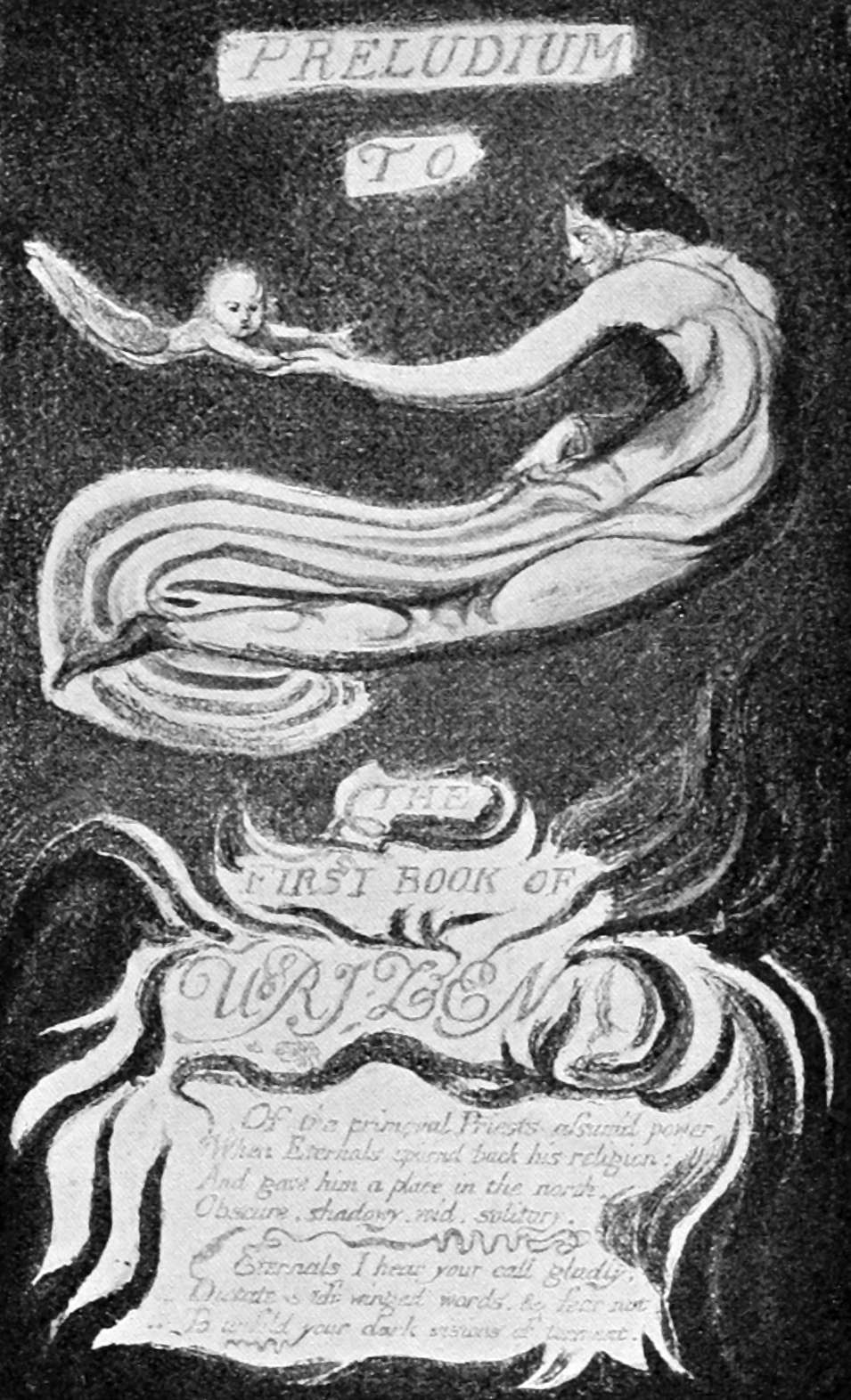
PRELUDIUM TO URIZEN (1794)
The eighteenth century, then, ended in revolution because it began in law. It was the age of reason, and therefore the age of revolt. It is needless to say how systematically it revived all the marks and motives of that ancient pagan society in which Christianity first arose. Its greatest art was oratory, its favourite affectation was severity. Its pet virtue was public spirit, its pet sin political assassination. It endured the pompous, but hated the fantastic; it had pure contempt for anything that could be called obscure. To a virile mind of that epoch, such as Dr Johnson or Fox, a poem or picture that did not at once explain itself was simply like a gun that did not go off or a clock that stopped suddenly: it was simply a failure, fit for indifference or for a fleeting satire. In spite of their solid convictions (for which they died) the men of that time always used the word “enthusiast” as a term of scorn. All that we call mysticism they called madness. Such was the eighteenth century civilisation; such was the strict and undecorated frame from which look at us the blazing eyes of William Blake.
So far Blake and his century are a mere contrast. But here we must remember that the three elements of Europe are not the strata of a rock, but the strands of a rope; since all three have existed not one of them has ever appeared entirely unmixed. You may call the Renascence pagan, but Michael Angelo cannot be imagined as anything but a Christian. You may call Thomas Aquinas Christian, but you cannot say exactly what he would have been without Aristotle the pagan. You may, even in calling Virgil the poet of Roman dignity and good sense, still ask whether he did not remember something older than Rome when he spoke of the good luck of him who knew the field gods and the old man of the forest. In the same way there was even in the eighteenth century an element of the purely Christian and an element of the purely primitive. And, as it happens, both these non-rational (or non-Roman) strains in the eighteenth century are particularly important in considering the mental make-up of William Blake. For the first alien strain in this century practically represents all that is effective and fine in this great genius, the second strain represents without question all that is doubtful, all that is irritating, and all that is ineffective in him.
In the eighteenth century there were two elements not taken from the Roman stoic or the Roman citizen. The first was what our century calls humanitarianism—what that century called “the tear of sensibility.” The old pagan commonwealths were democratic, but they were not in the least humanitarian. They had no tears to spare for a man at the mercy of the community; they reserved all their anger and sympathy for the community at the mercy of a man. That individual compassion for an individual case was a pure product of Christianity; and when Voltaire flung himself with fury into the special case of Calas, he was drawing all his energies from the religion that he denied. A Roman would have rebelled for Rome, but not for Calas. This personal humanitarianism is the relic of Christianity—perhaps (if I may say so) the dregs of Christianity. Of this humanitarianism or sentimentalism, or whatever it can best be called, Blake was the enthusiastic inheritor. Being the great man that he was, he naturally anticipated lesser men than himself; and among the men less than himself I should count Shelley, for instance, and Tolstoy. He carried his instinct of personal kindness to the point of denouncing war as such—
“Naught can deform the human race Like the Armourer’s iron brace.”
Or, again—
“The strongest poison ever known Came from Cæsar’s iron crown.”
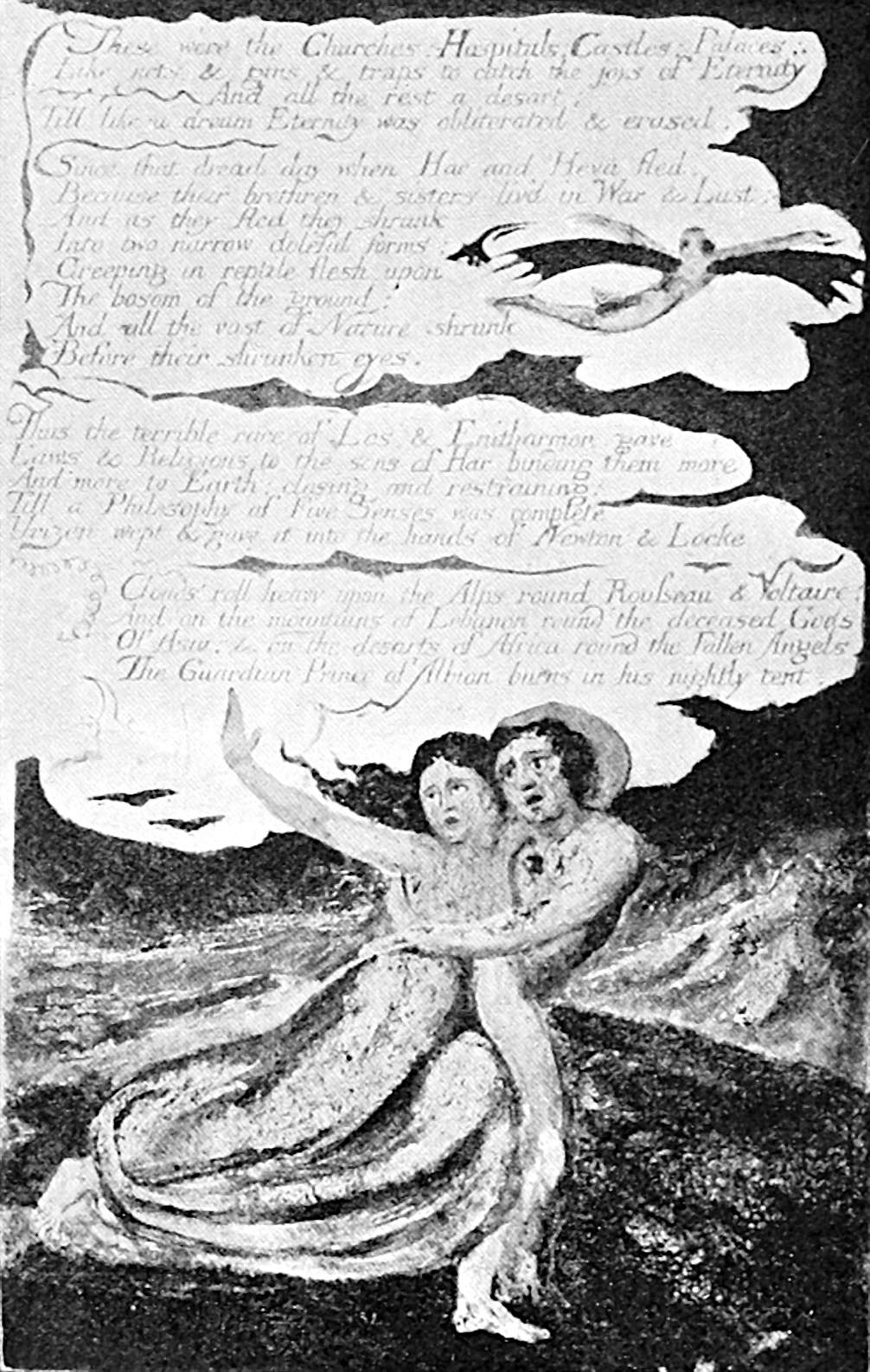
HAR AND HEVA (1795)
No pagan republican, such as those on whom the eighteenth century ethic was founded, could have made head or tail of this mere humanitarian horror. He could not even have comprehended this idea—that war is immoral when it is not unjust. You cannot find this sentiment in the pagans of antiquity, but you can find it in the pagans of the eighteenth century; you can find it in the speeches of Fox, the soliloquies of Rousseau and even in the sniggering of Gibbon. Here is an element of the eighteenth century which is derived darkly but indubitably from Christianity, and in which Blake strongly shares. Regulus has returned to be tortured and pagan Rome is saved; but Christianity thinks a little of Regulus. A man must be pitied even when he must be killed. That individual compassion provoked Blake to violent and splendid lines—
“And the slaughtered soldier’s cry Runs in blood down palace walls.”
The eighteenth century did not find that pity where it found its pagan liberty and its pagan law. It took this out of the very churches that it violated and from the desperate faith that it denied. This irrational individual pity is the purely Christian element in the eighteenth century. This irrational individual pity is the purely Christian element in William Blake.
And second, there was another eighteenth century element that was neither of Christian nor of pagan Rome. It was from the origins; it had been in the world through the whole history of paganism and Christianity; it had been in the world, but not of it. This element appeared popularly in the eighteenth century in an extravagant but unmistakable shape; the element can be summed up in one word—Cagliostro. No other name is quite so adequate; but if anyone desires a nobler name (a very noble one), we may say—Swedenborg. There was in the eighteenth century, despite its obvious good sense, this strain of a somewhat theatrical thaumaturgy. The history of that element is, in the most literal sense of the word, horribly interesting. For it all works back to the mere bogey feeling of the beginnings. It is amusing to remark that in the eighteenth century for the first time start up a number of societies which calmly announce that they have existed almost from the beginning of the world. Of these, of course, the best known instance is the Freemasons; according to their own account they began with the Pyramids; but according to everyone else’s account that can be effectively collected, they began with the eighteenth century. Nevertheless the Freemasons are right in the spirit even if they are wrong in the letter. There is a tradition of things analogous to mystical masonry throughout all the historic generations of Paganism and Christianity. There is a definite tradition outside Christianity, not of rationalism, but of paganism, paganism in the original and frightful forest sense—pagan magic. Christianity, rightly or wrongly, always discouraged it on the ground that it was, or tended to be, black magic. That is not here our concern. The point is that this non-Christian supernaturalism, whether it was good or bad, was continuous in spite of Christianity. Its signs and traces can be seen in every age: it hung like a huge fume, in many monstrous forms, over the dying Roman Empire: it was the energy in the Gnostics who so nearly captured Christianity, and who were persecuted for their pessimism; in the full sunlight of the living Church it dared to carve its symbols upon the tombs of the Templars; and when the first sects raised their heads at the Reformation, its ancient and awful voice was heard.
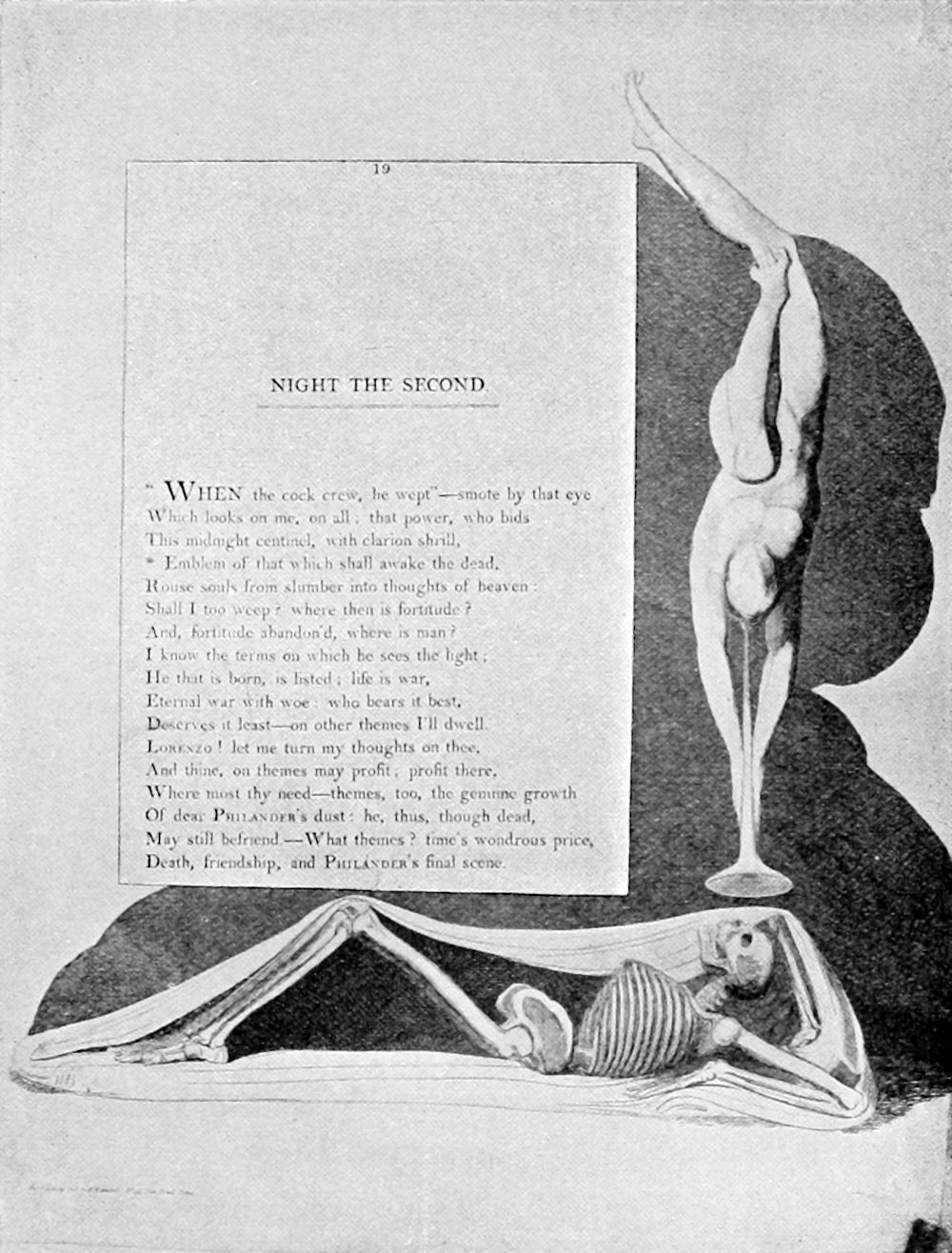
PHILANDER’S DUST (1796)
Now the eighteenth century was primarily the release (as its leaders held) of reason and nature from the control of the Church. But when the Church was once really weakened, it was the release of many other things. It was not the release of reason only, but of a more ancient unreason. It was not the release of the natural, but also of the supernatural, and also, alas! of the unnatural. The heathen mystics hidden for two thousand years came out of their caverns—and Freemasonry was founded. It was entirely innocent in the manner of its foundation; but so were all the other resurrections of this ancestral occultism. I give but one obvious instance out of many. The idea of enslaving another human soul, without lifting a finger or making a gesture of force, of enslaving a soul simply by willing its slavery, is an idea which all healthy human societies would regard and did regard as hideous and detestable, if true. Throughout all the Christian ages the witches and warlocks claimed this abominable power and boasted of it. They were (somewhat excusably) killed for their boasting. The eighteenth century rationalist movement came, intent, thank God, upon much cleaner things, upon common justice and right reason in the state. Nevertheless it did weaken Christianity, and in weakening Christianity it uplifted and protected the wizard. Mesmer stepped forward, and for the first time safely affirmed this infamous power to exist: for the first time a warlock could threaten spiritual tyranny and not be lynched. Nevertheless, if a mesmerist really had the powers which some mesmerists have claimed, and which most novels give to him, there is (I hope) no doubt at all that any decent mob would drown him like a witch.
The revolt of the eighteenth century, then, did not merely release naturalism, but a certain kind of supernaturalism also. And of this particular kind of supernaturalism, Blake is particularly the heir. Its coarse embodiment is Cagliostro. Its noble embodiment is Swedenborg. But in both cases it can be remarked that the mysticism marks an effort to escape from or even to forget the historic Christian, and especially the Catholic Church. Cagliostro, being a man of mean spirituality, separated himself from Catholicism by rearing against it a blazing pageant of mystical paganism, of triangles, secret seals, Eleusinian initiation, and all the vulgar refinements of a secret society. Swedenborg, being a man of large and noble spirituality, marked his separation from Catholicism by inventing out of his own innocence and genius nearly all the old Catholic doctrines, sincerely believing them to be his own discoveries. It is startling to note how near Swedenborg was to Catholicism—in his insistence on free will, for instance, on the humanity of the incarnate God, and on the relative and mystical view of the Old Testament. There was in Blake a great deal of Swedenborg (as he would have been the first to admit), and there was, occasionally, a little of Cagliostro. Blake did not belong to a secret society: for, to tell the truth, he had some difficulty in belonging to any society. But Blake did talk a secret language. He had something of that haughty and oligarchic element in his mysticism which marked the old pagan secret societies and which marks the Theosophists and oriental initiates to this day. There was in him, besides the beneficent wealth of Swedenborg, some touch of Cagliostro and the Freemasons. These things Blake did inherit from that break up of belief that can be called the eighteenth century: we will debit him with these as an inheritance. And when we have said this we have said everything that can be said of any debt he owed. His debts are cleared here. His estate is cleared with this payment. All that follows is himself.
If a man has some fierce or unfamiliar point of view, he must, even when he is talking about his cat, begin with the origin of the cosmos; for his cosmos is as private as his cat. Horace could tell his pupils to plunge into the middle of the thing, because he and they were agreed about the particular kind of thing; the author and his readers substantially sympathised about the beauty of Helen or the duties of Hector. But Blake really had to begin at the beginning, because it was a different beginning. This explains the extraordinary air of digression and irrelevancy which can be observed in some of the most direct and sincere minds. It explains the bewildering allusiveness of Dante; the galloping parentheses of Rabelais; the gigantic prefaces of Mr Bernard Shaw. The brilliant man seems more lumbering and elaborate than anyone else, because he has something to say about everything. The very quickness of his mind makes the slowness of his narrative. For he finds sermons in stones, in all the paving-stones of the street he plods along. Every fact or phrase that occurs in the immediate question carries back his mind to the ages and the initial power. Because he is original he is always going back to the origins.
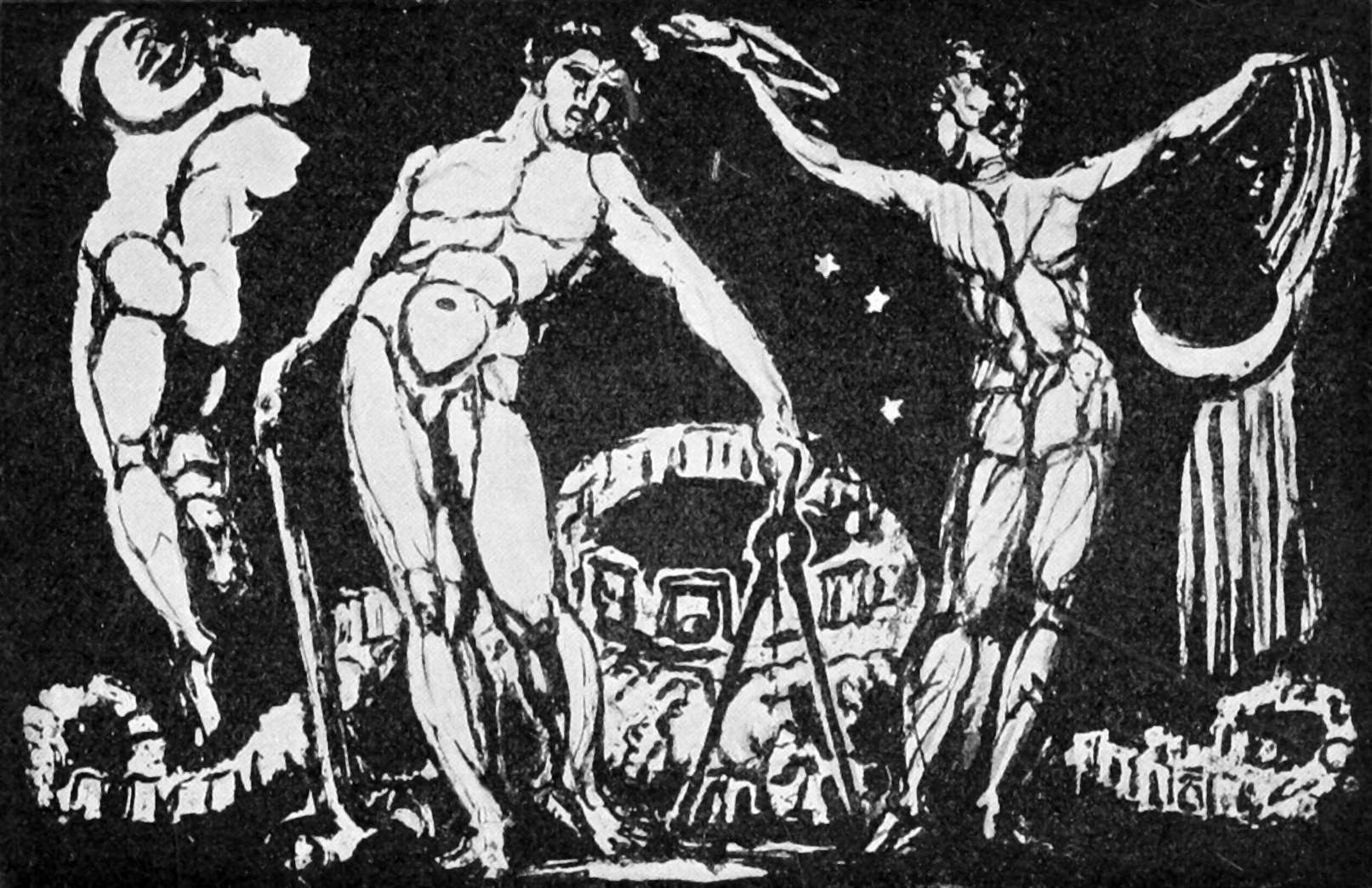
A GROUP (1804)
Take, for instance, Blake’s verse rather than his pictorial art. When the average sensible person reads Blake’s verse, he simply comes to the conclusion that he cannot understand it. But in truth he has a much better right to offer this objection to Blake than to most of the slightly elusive or eccentric writers to whom he also offers it. Blake is obscure in a much more positive and practical sense than Browning is obscure—or, in another manner, Mr Henry James is obscure. Browning is generally obscure through an almost brutal eagerness to get to big truths, which leads him to smash a sentence and leave only bits of it. Mr Henry James is obscure because he wishes to trace tiny truths by a dissection for which human language (even in his exquisite hands) is hardly equal. In short, Browning wishes almost unscrupulously to get to the point. Mr James refuses to admit (on the mere authority of Euclid) that the point is indivisible. But Blake’s obscurity is startlingly different to both, it is at once more simple and more impenetrable. It is not a different diction but a different language. It is not that we cannot understand the sentences; it is that we often misunderstand the words. The obscurity of Blake commonly consists in the fact that the actual words used mean one thing in Blake and quite another thing in the dictionary. Mr Henry James wants to split hairs; Browning wants to tear them up by the roots. But in Blake the enigma is at once plainer and more perplexing; it is simply this, that if Blake says “hairs” he may not mean hairs, but something else—perhaps peacocks’ feathers. To quote but one example out of a thousand; when Blake uses the word “devils” he generally means some particularly exalted order of angels such as preside over energy and imagination.
A VERBAL accident has confused the mystical with the mysterious. Mysticism is generally felt vaguely to be itself vague—a thing of clouds and curtains, of darkness or concealing vapours, of bewildering conspiracies or impenetrable symbols. Some quacks have indeed dealt in such things: but no true mystic ever loved darkness rather than light. No pure mystic ever loved mere mystery. The mystic does not bring doubts or riddles: the doubts and riddles exist already. We all feel the riddle of the earth without anyone to point it out. The mystery of life is the plainest part of it. The clouds and curtains of darkness, the confounding vapours, these are the daily weather of this world. Whatever else we have grown accustomed to, we have grown accustomed to the unaccountable. Every stone or flower is a hieroglyphic of which we have lost the key; with every step of our lives we enter into the middle of some story which we are certain to misunderstand. The mystic is not the man who makes mysteries but the man who destroys them. The mystic is one who offers an explanation which may be true or false, but which is always comprehensible—by which I mean, not that it is always comprehended, but that it always can be comprehended, because there is always something to comprehend. The man whose meaning remains mysterious fails, I think, as a mystic: and Blake, as we shall see, did, for certain peculiar reasons of his own, often fail in this way. But even when he was himself hard to be understood, it was never through himself not understanding: it was never because he was vague or mystified or groping, that he was unintelligible. While his utterance was not only dim but dense, his opinion was not only clear, but even cocksure. You and I may be a little vague about the relations of Albion to Jerusalem, but Blake is as certain about them as Mr Chamberlain about the relations of Birmingham to the British Empire. And this can be said for his singular literary style even at his worst, that we always feel that he is saying something very plain and emphatic, even when we have not the wildest notion of what it is.
There is one element always to be remarked in the true mystic, however disputed his symbolism, and that is its brightness of colour and clearness of shape. I mean that we may be doubtful about the significance of a triangle or the precise lesson conveyed by a crimson cow. But in the work of a real mystic the triangle is a hard mathematical triangle not to be mistaken for a cone or a polygon. The cow is in colour a rich incurable crimson, and in shape unquestionably a cow, not to be mistaken for any of its evolutionary relatives, such as the buffalo or the bison. This can be seen very clearly, for instance, in the Christian art of illumination as practised at its best in the thirteenth and fourteenth centuries. The Christian decorators, being true mystics, were chiefly concerned to maintain the reality of objects. For the highest dogma of the spiritual is to affirm the material. By plain outline and positive colour those pious artists strove chiefly to assert that a cat was truly in the eyes of God a cat and that a dog was preeminently doggish. This decision of tint and outline belongs not only to Blake’s pictures, but even to his poetry. Even in his descriptions there is no darkness, and practically, in the modern sense, no distance. All his animals are as absolute as the animals on a shield of heraldry. His lambs are of unsullied silver, his lions are of flaming gold. His lion may lie down with his lamb, but he will never really mix with him.
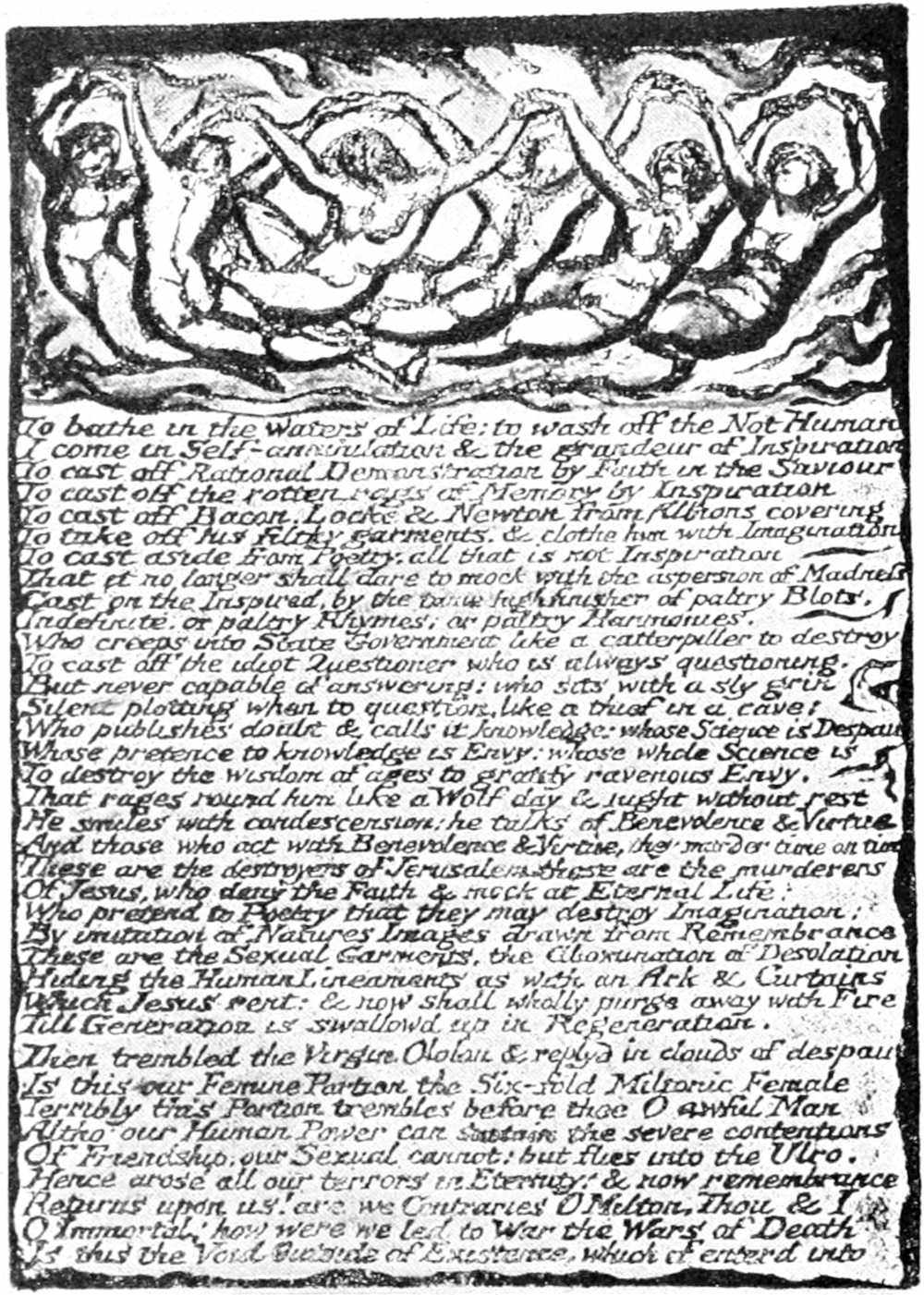
THE WATERS OF LIFE (1804)
Really to make this point clear one would have to go back to the twelfth century, or perhaps to Plato. Metaphysics must be avoided; they are too exciting. But the root of the matter can be pretty well made plain by one word. The whole difference is between the old meaning and the new meaning of the word “Realist.” In modern fiction and science a Realist means a man who begins at the outside of a thing: sometimes merely at the end of a thing, knowing the monkey only by its tail or the motor by its smell. In the twelfth century a Realist meant exactly the opposite; it meant a man who began at the inside of a thing. The mediæval philosopher would only have been interested in a motor because it moved. He would have been interested (that is) only in the central and original idea of a motor—in its ultimate motorishness. He would have been concerned with a monkey only because of its monkeyhood; not because it was like man but because it was unlike. If he saw an elephant he would not say in the modern style, “I see before me a combination of the tusks of a wild boar in unnatural development, of the long nose of the tapir needlessly elongated, of the tail of the cow unusually insufficient,” and so on. He would merely see an essence of elephant. He would believe that this light and fugitive elephant of an instant, as dancing and fleeting as the May-fly in May, was nevertheless the shadow of an eternal elephant, conceived and created by God. When you have quite realised this ancient sense in the reality of an elephant, go back and read William Blake’s poems about animals, as, for instance, about the lamb and about the tiger. You will see quite clearly that he is talking of an eternal tiger, who rages and rejoices for ever in the sight of God. You will see that he is talking of an eternal and supernatural lamb, who can only feed happily in the fields of Heaven.
It is exactly here that we find the full opposition to that modern tendency that can fairly be called “Impressionism.” Impressionism is scepticism. It means believing one’s immediate impressions at the expense of one’s more permanent and positive generalisations. It puts what one notices above what one knows. It means the monstrous heresy that seeing is believing. A white cow at one particular instant of the evening light may be gold on one side and violet on the other. The whole point of Impressionism is to say that she really is a gold and violet cow. The whole point of Impressionism is to say that there is no white cow at all. What can we tell, it cries, beyond what we can see? But the essence of Mysticism is to insist that there is a white cow, however veiled with shadow or painted with sunset gold. Blessed are they who have seen the violet cow and who yet believe in the white one. To the mystic a white cow has a sort of solid whiteness, as if the cow were made out of frozen milk. To him a white horse has a solid whiteness as if he were cut out of the firm English chalk, like the White Horse in the valley of King Alfred. The cow’s whiteness is more important than anything except her cowishness. If Blake had ever introduced a white cow into one of his pictures, there would at least have been no doubt about either of those two elements. Similarly there would have been no doubt about them in any old Christian illumination. On this point he is at one with all the mystics and with all the saints.
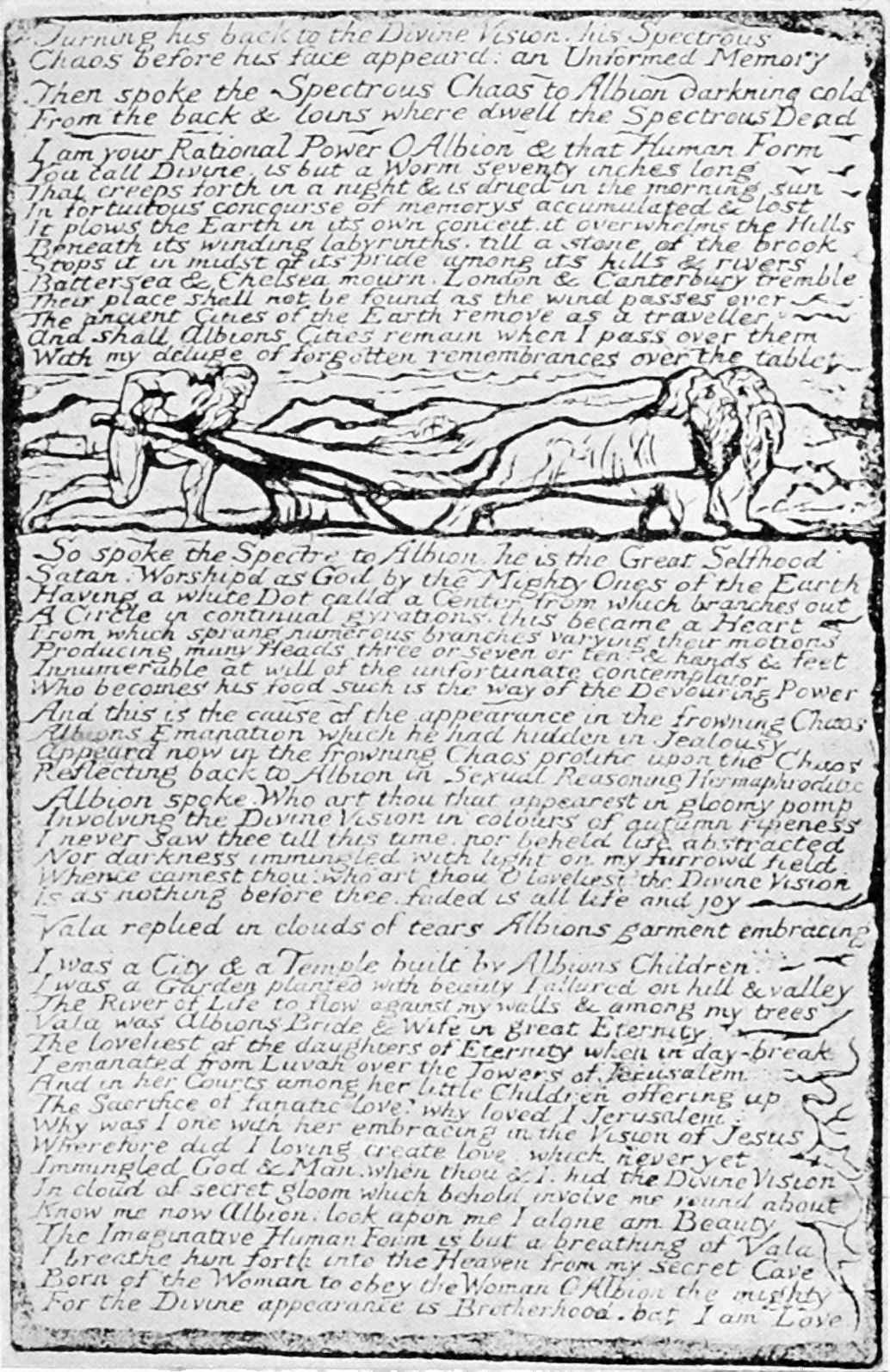
PLOUGHING THE EARTH (1804)
This explanation is really essential to the understanding of Blake, because to the modern mind it is so easy to understand him in the opposite sense. In the ordinary modern meaning Blake’s symbols are not symbols at all. They are not allegories. An allegory nowadays means taking something that does not exist as a symbol of something that does exist. We believe, at least most of us do, that sin does exist. We believe (on highly insufficient grounds) that a dragon does not exist. So we make the unreal dragon an allegory of the real sin. But that is not what Blake meant when he made the lamb the symbol of innocence. He meant that there really is behind the universe an eternal image called the Lamb, of which all living lambs are merely the copies or the approximation. He held that eternal innocence to be an actual and even an awful thing. He would not have seen anything comic, any more than the Christian Evangelist saw anything comic, in talking about the Wrath of the Lamb. If there were a lamb in one of Æsop’s fables, Æsop would never be so silly as to represent him as angry. But Christianity is more daring than Æsop, and the wrath of the Lamb is its great paradox. If there is an immortal lamb, a being whose simplicity and freshness are for ever renewed, then it is truly and really a more creepy idea to horrify that being into hostility than to defy the flaming dragon or challenge darkness or the sea. No old wolf or world-worn lion is so awful as a creature that is always young—a creature that is always newly born. But the main point here is simpler. It is merely that Blake did not mean that meekness was true and the lamb only a pretty fable. If anything he meant that meekness was a mere shadow of the everlasting lamb. The distinction is essential to anyone at all concerned for this rooted spirituality which is the only enduring sanity of mankind. The personal is not a mere figure for the impersonal; rather the impersonal is a clumsy term for something more personal than common personality. God is not a symbol of goodness. Goodness is a symbol of God.
Some very odd passages in Blake become clear if we keep this in mind. I do not wish in this book to dwell unduly on the other side of Blake, the literary side. But there are queer facts worth remarking, and this is one of them. Blake was sincere; if he was insane he was insane with the very solidity and completeness of his sincerity. And the quaintest mark of his sincerity is this, that in his poetry he constantly writes things that look like mere mistakes. He writes one of his most colossal convictions and the average reader thinks it is a misprint. To give only one example not connected with the matter in hand, the fine though somewhat frantic poem called “The Everlasting Gospel” begins exactly as the modern humanitarian and essential Christian would like it to begin—
“The vision of Christ that thou dost see Is my vision’s greatest enemy.”
It goes on (to the modern Christian’s complete satisfaction) with denunciations of priests and praise of the pure Gospel Jesus; and then comes a couplet like this—
“Thine is the friend of all mankind, Mine speaks in parables to the blind.”
And the modern humanitarian Christian finds the orthodox Christ calmly rebuked because he is the friend of all mankind. The modern Christian simply blames the printer. He can only suppose that the words “Thine” and “Mine” have been put in each other’s places by accident. Blake, however, as it happens, meant exactly what he said. His private vision of Christ was the vision of a violent and mysterious being, often indignant and occasionally disdainful.
“He acts with honest disdainful pride, And that is the cause that Jesus died; Had he been Antichrist, creeping Jesus, He would have done anything to please us, Gone sneaking into their synagogues, And not use the elders and priests like dogs.”
When the reader has fully realised this idea of a fierce and mysterious Jesus, he may then see the sense in the statement that this Jesus speaks in parables to the blind while the lower and meaner Jesus pretends to be the friend of all men. But you have to know Blake’s doctrine before you can understand two lines of his poetry.
Now in the point which is here prominently before us there is a quotation (indeed there is more than one) which follows this same fantastic line. Let the ordinary modern man, who is, generally speaking, not a materialist and not a mystic, read first these two lines from the poem falsely called “The Auguries of Innocence”—
“God appears and God is light To those poor souls that dwell in night.”
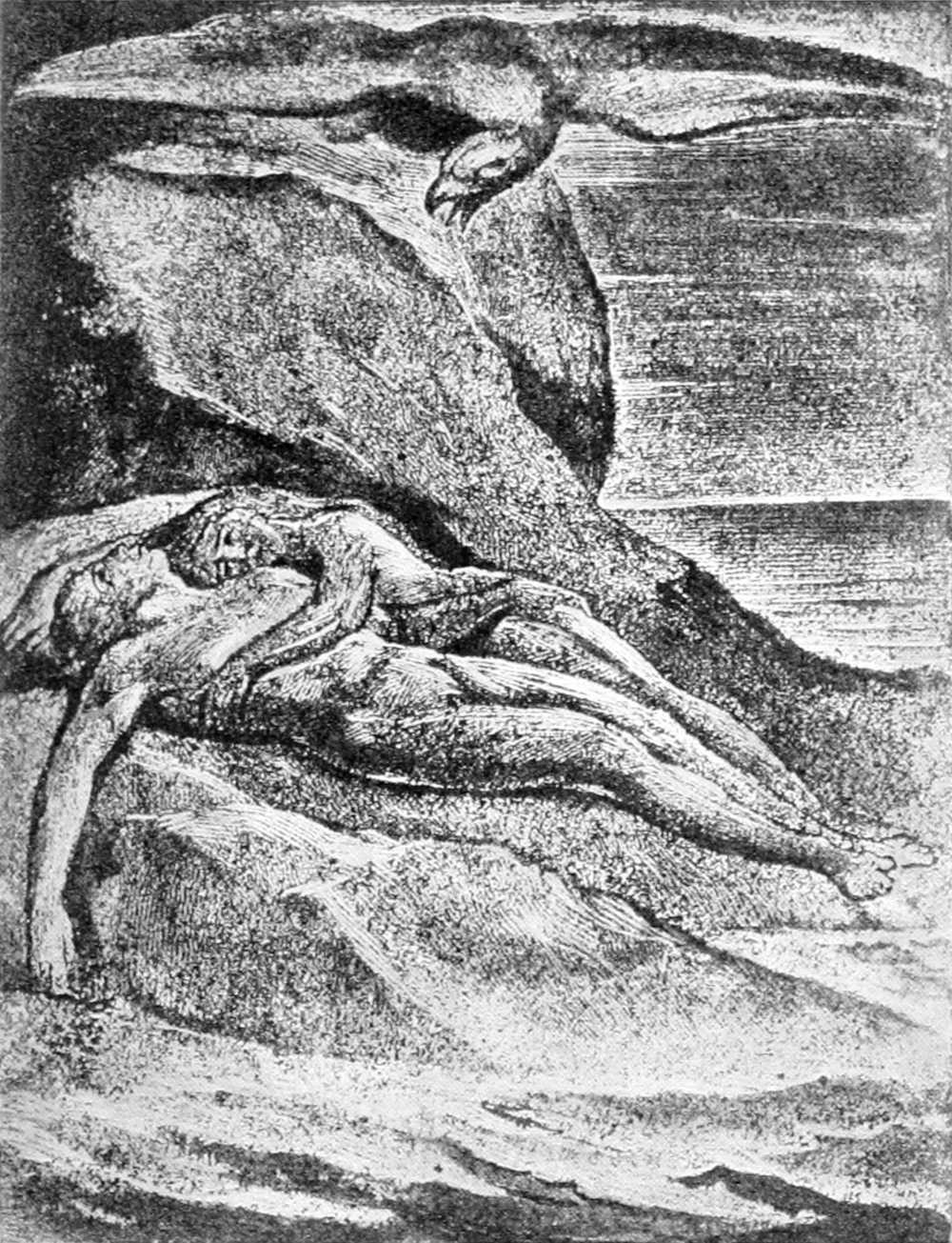
THE EAGLE (1804)
He will not find anything objectionable in that, at any rate; probably he will bow his head slightly to a truism, as if he were in church. Then he will read the next two lines—
“But does a human form display To those that dwell in realms of day.”
And there the modern man will sit down suddenly on the sofa and come finally to the conclusion that William Blake was mad and nothing else.
But those last two lines express all that is best in Blake and all that is best in all the tradition of the mystics. Those two lines explain perfectly all that I have just pointed out concerning the palpable visions and the ponderous cherubim. This is the point about Blake that must be understood if nothing else is understood. God for him was not more and more vague and diaphanous as one came near to Him. God was more and more solid as one came near. When one was far off one might fancy Him to be impersonal. When one came into personal relation one knew that He was a person. The personal God was the fact. The impersonal God of the Pantheists was a kind of condescending symbol. According to Blake (and there is more in the mental attitude than most modern people will willingly admit) this vague cosmic view is a mere merciful preparation for the old practical and personal view. God is merely light to the merely unenlightened. God is a man to the enlightened. We are permitted to remain for a time evolutionary or pantheist until the time comes when we are worthy to be anthropomorphic.
Understand this Blake conception that the Divine is most bodily and definite when we really know it, and the severe lines and sensational literalism of his other and more pictorial work will be easily understood. Naturally his divinities are definite, because he thought that the more they were definite, the more they were divine. Naturally God was not to him a hazy light breaking through the tangle of the evolutionary undergrowth, nor a blinding brilliancy in the highest place of the heavens. God was to him the magnificent old man depicted in his dark and extraordinary illustrations of “Job,” the old man with the monstrous muscles, the mild stern eyebrows, the long smooth silver hair and beard. In the dialogues between Jehovah and Job there is little difference between the two ponderous and palpable old men, except that the vision of Deity is a little more solid than the human being. But then Blake held that Deity is more solid than humanity. He held that what we call the ideal is not only more beautiful but more actual than the real. The ordinary educated modern person staring at these “Job” designs can only say that God is a mere elderly twin brother of Job. Blake would have at once retorted that Job was an image of God.
On consideration I incline to think that the best way to summarise the art of Blake from its most superficial to its most subtle phase would be simply to take one quick characteristic picture and discuss it fully; first its title and subject, then its look and shape, then its main principles and implications. Let us take as a good working example the weird picture which is reproduced on one of the pages of Gilchrist’s “Life of Blake.”
Now the obvious, prompt, and popular view of Blake is very well represented by the mere title of the picture. The first thing any ordinary person will notice about it is that it is called “The Ghost of a Flea”; and the ordinary person will be very justifiably amused. This is the first fact about William Blake—that he is a joke; and it is a fact by no means to be despised. Simply considered as a puzzle or parlour game, Blake is extraordinarily entertaining. I have known many cultivated families made happy on winter evenings by trying to understand the poem called “The Mental Traveller,” or wondering what can be the significance of the stanza that runs:
“Little Mary Bell had a fairy in a nut, Long John Brown had the devil in his gut; Long John Brown loved little Mary Bell, And the fairy drew the devil into the nutshell.”
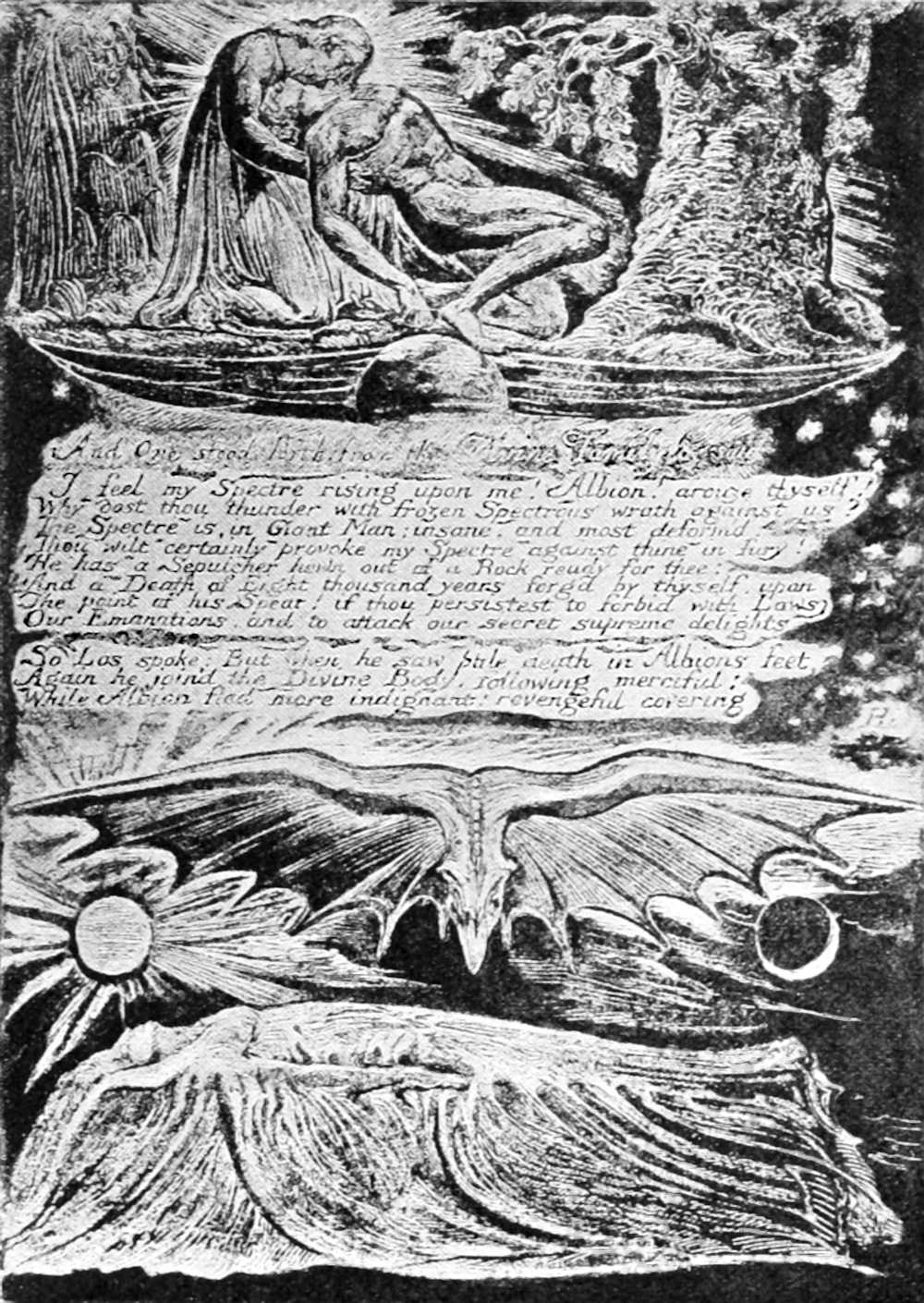
“ALBION! AROUSE THYSELF!” (1804)
The first fact is that we are puzzled and also honestly amused. It is as if we had a highly eccentric neighbour in the next garden. Long before we like him we like gossiping about him. And the mere title, “The Ghost of a Flea,” represents all that makes Blake a centre of literary gossip.
And now, having enjoyed the oddity of the title, let us look at the picture. Let us attempt to describe, so far as it can be done in words instead of lines, what Blake thought that the ghost of a flea would be like. The scene suggests a high and cheerless corridor, as in some silent castle of giants. Through this a figure, naked and gigantic, is walking with a high-shouldered and somewhat stealthy stride. In one hand the creature has a peculiar curved knife of a cruel shape; in the other he has a sort of stone basin. The most striking line in the composition is the hard long curve of the spine, which goes up without a single flicker to the back of the brutal head, as if the whole back view were built like a tower of stone. The face is in no sense human. It has something that is aquiline and also something that is swinish; its eyes are alive with a moony glitter that is entirely akin to madness. The thing seems to be passing a curtain and entering a room.
With this we may mark the second fact about Blake—that if his only object is to make our flesh creep, he does it well. His bogeys are good reliable bogeys. There is really something that appeals to the imagination about this notion of the ghost of a flea being a tall vampire stalking through tall corridors at night. We have found Blake an amusing madman and now an interesting madman; let us go on with the process.
The third thing to note about this picture is that for Blake the ghost of a flea means the idea or principle of a flea. The principle of a flea (so far as we can see it) is bloodthirstiness, the feeding on the life of another, the fury of the parasite. Fleas may have other nobler sentiments and meditations, but we know nothing about them. The vision of a flea is a vision of blood; and that is what Blake has made of it. This is the next point, then, to be remarked in his make-up as a mystic; he is interested in the ideas for which such things stand. For him the tiger means an awful elegance; for him the tree means a silent strength.
If it be granted that Blake was interested, not in the flea, but in the idea of the flea, we can proceed to the next step, which is a particularly important one. Every great mystic goes about with a magnifying glass. He sees every flea as a giant—perhaps rather as an ogre. I have spoken of the tall castle in which these giants dwell; but, indeed, that tall tower is the microscope. It will not be denied that Blake shows the best part of a mystic’s attitude in seeing that the soul of a flea is ten thousand times larger than a flea. But the really interesting point is much more striking. It is the essential point upon which all primary understanding of the art of Blake really turns. The point is this: that the ghost of a flea is not only larger than a flea, the ghost of a flea is actually more solid than a flea. The flea himself is hazy and fantastic compared to the hard and massive actuality of his ghost. When we have understood this, we have understood the second of the great ideas in Blake—the idea of ideas.
To sum up Blake’s philosophy in any phrase sufficiently simple and popular for our purpose is not at all easy. For Blake’s philosophy was not simple. Those who imagine that because he was always talking about lambs and daisies, about Jesus and little children, that therefore he held a simple gospel of goodwill, entirely misunderstand the whole nature of his mind. No man had harder dogmas; no one insisted more that religion must have theology. The Everlasting Gospel was far from being a simple gospel. Blake had succeeded in inventing in the course of about ten years as tangled and interdependent a system of theology as the Catholic Church has accumulated in two thousand. Much of it, indeed, he inherited from ancient heretics who were much more doctrinal than the orthodoxy which they opposed. Notable among these were the Gnostics, and in some degree the mad Franciscans who followed Joachim de Flor. Very few modern people would know an Akamoth or an Æon if they saw him. Yet one would really have to be on rather intimate terms with these old mystical gods and demons before one could move quite easily in the Cosmos which was familiar to Blake.
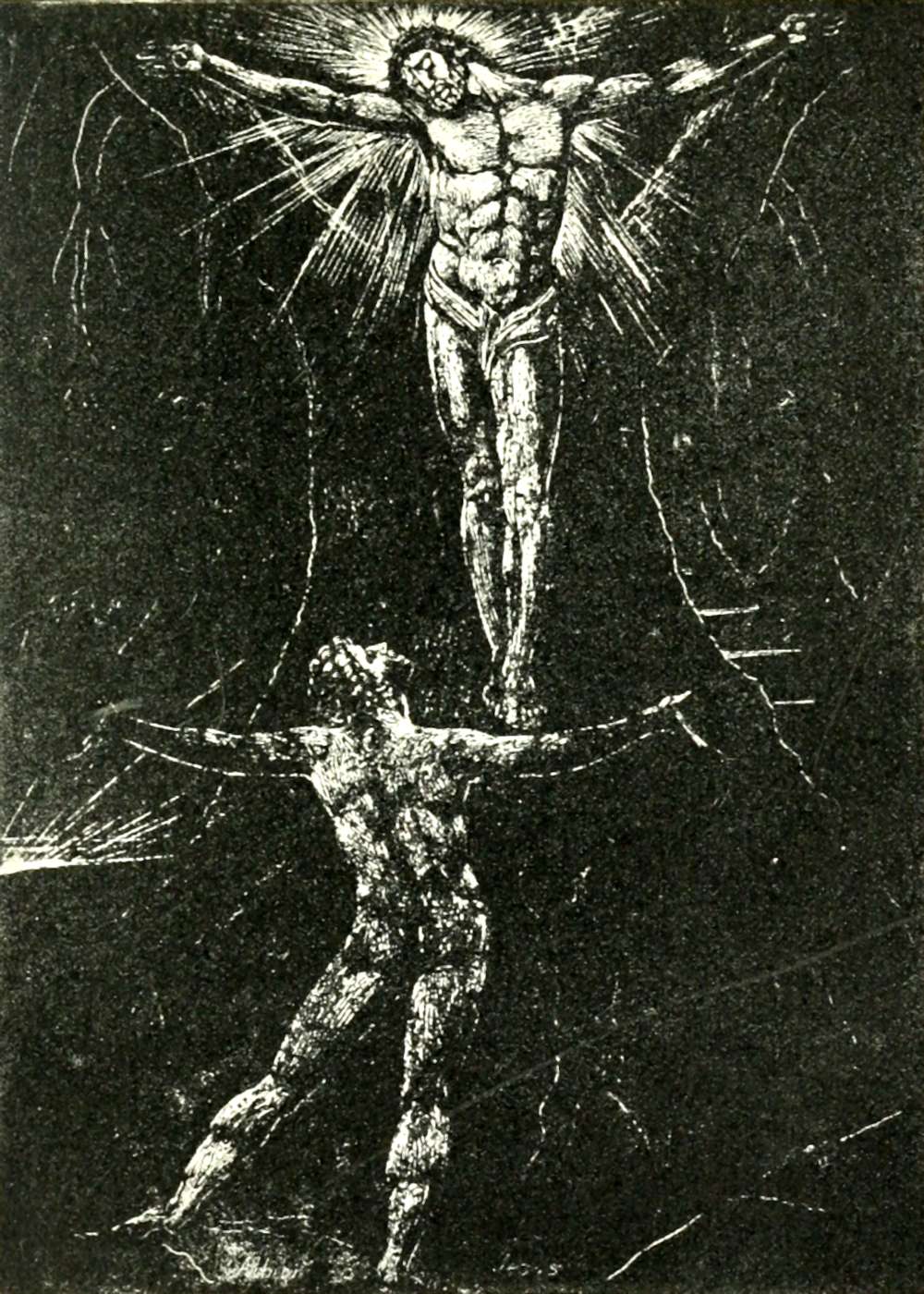
THE CRUCIFIXION (1804)
Let us, however, attempt to find a short and popular statement of the position of Blake and all such mystics. The plainest way of putting it, I think, is this: this school especially denied the authority of Nature. Some went the extreme length of the mad Manichæans, and declared the material universe evil in itself. Some, like Blake, and most of the poets considered it as a shadow or illusion, a sort of joke of the Almighty. But whatever else Nature was, Nature was not our mother. Blake applies to her the strange words used by Christ to Mary, and says to Mother-Earth in many poems: “What have I to do with thee?” It is common to connect Blake and Wordsworth because of their ballads about babies and sheep. They were utterly opposite. If Wordsworth was the Poet of Nature, Blake was specially the Poet of Anti-Nature. Against Nature he set a certain entity which he called Imagination; but the word as commonly used conveys very little of what he meant by it. He did not mean something shadowy or fantastic, but rather something clear-cut, definite, and unalterable. By Imagination, that is, he meant images; the eternal images of things. You might shoot all the lions on the earth; but you could not destroy the Lion of Judah, the Lion of the Imagination. You might kill all the lambs of the world and eat them; but you could not kill the Lamb of the Imagination, which was the Lamb of God, that taketh away the sins of the world. Blake’s philosophy, in brief, was primarily the assertion that the ideal is more actual than the real: just as in Euclid the good triangle in the mind is a more actual (and more practical) than the bad triangle on the blackboard.
Many of Blake’s pictures become intelligible (or as intelligible as they can become) if we keep this principle in mind. For instance, there is a fine design representing a naked and heroic youth of great beauty tracing something on the sand. The reader, when he looks at the title of it, is interested to discover that this is a portrait of Sir Isaac Newton. It was not so much of an affectation as it seems. Blake from his own point of view really did think that the Eternal Isaac Newton as God beheld him was more of an actuality than the terrestrial gentleman who happened to be elderly or happened by some sublunary accident to wear clothes. Therefore, when he calls it a “portrait” he is not, from his own point of view, talking nonsense. It is the form and feature of someone who exists and who is different from everyone else, just as if it were the ordinary oil-painting of an alderman.
The most important conception can be found in one sentence which he let fall as if by accident, “Nature has no outline, but imagination has.” If a clear black line when looked at through a microscope was seen to be a ragged and confused edge like a mop or a doormat, then Blake would say, “So much the worse for the microscope.” If pure lines existed only in the human mind, then Blake would say, “So much the better for the human mind.” If the real earth grew damp and dubious when it met and mixed itself with the sea, so much the worse for the real earth. If the idea of clean-cut truth existed only in the intellect, that was the most actual place in which anything could exist. In short, Blake really insisted that man as the image of God had a right to impose form upon nature. He would have laughed to scorn the notion of the modern evolutionist—that Nature is to be permitted to impose formlessness upon man. For him the lines in a landscape were boundaries which he drew like frontiers, by his authority as the plenipotentiary ambassador of heaven. When he drew his line round Leviathan he was drawing the divine net around him; he tamed his bulls and lions even by creating them. And when he made in some picture a line between sea and land that does not exist in Nature, he was saying by supernatural right, “Thus far shalt thou come, and no farther, and here shall thy proud waves be stayed.”
I select the symbol of the sea partly because Blake was himself fond of such elemental images, and partly because it is an image especially appropriate to Blake’s great conception of the outline in the eternal imagination. Nearly all phrases about the sea are specially and spiritually false. People talk of the sea as vast and vague, drifting and indefinite; as if the magic of it lay in having no lines or boundaries. But the spell of the sea upon the eye and the soul is exactly this: that it is the one straight line in nature. They talk of the infinite sea. Artistically it would be far truer to talk of an infinite haystalk; for the haystalk does slightly fade into a kind of fringe against the sky. But the horizon line is not only hard but tight, like a fiddle-string. I have always a nervous fear that the sea-line will snap suddenly. And it is exactly this mathematical decision in the sea that makes it so romantic a background for fighting and human figures. England was called in Catholic days the garden of Mary. The garden is all the more beautiful because it is enclosed in four hard angular walls of sapphire or emerald. Any mere tuft or twig can curve with a curve that is incalculable. Any scrap of moss can contain in itself an irregularity that is infinite. The sea is the one thing that is really exciting because the sea is the one thing that is flat.
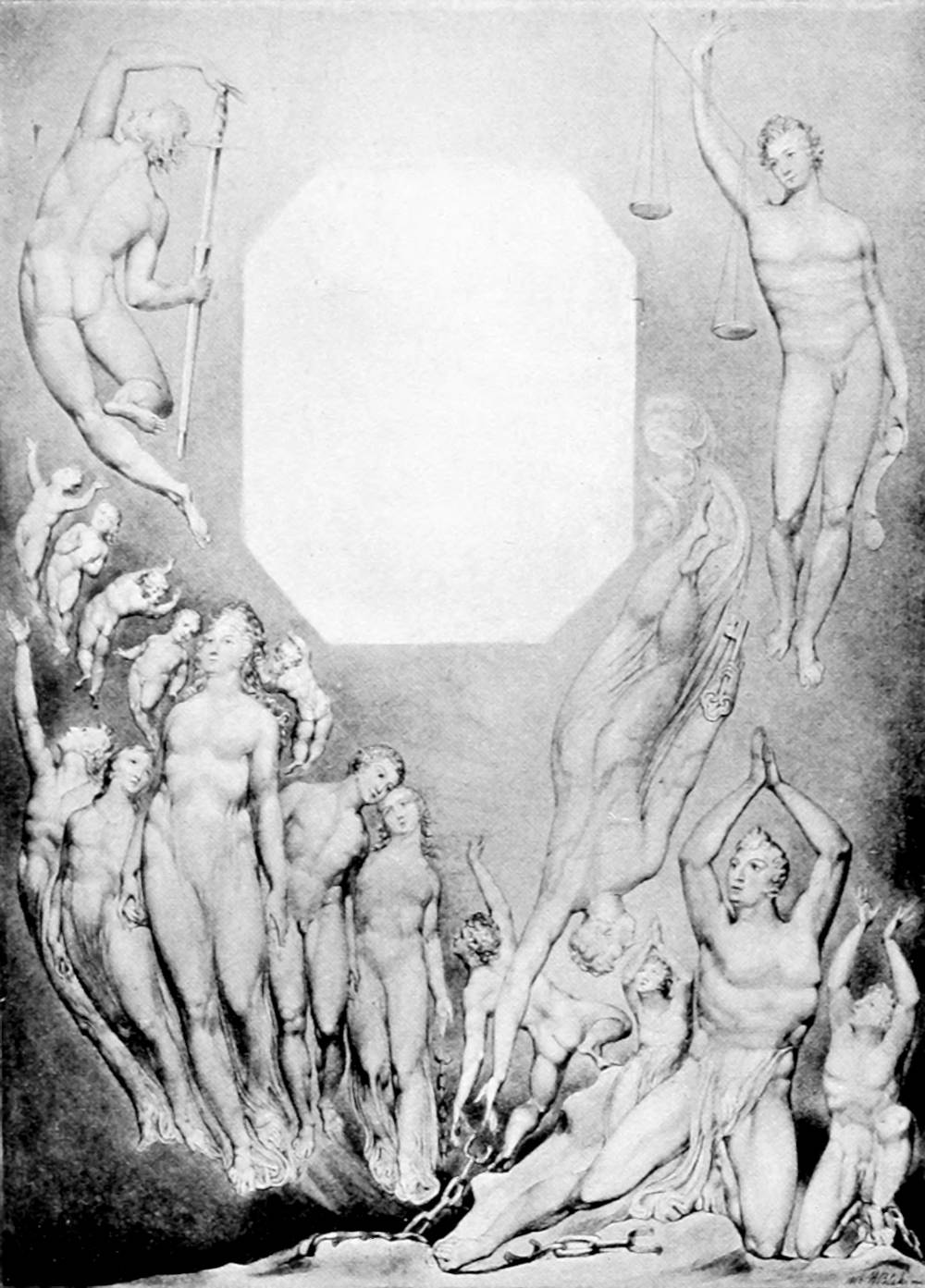
THE JUDGMENT DAY (1806)
Whether, however, these conclusions can be accepted by the reader as true, they can at least be accepted as typifying the kind of thing which William Blake believed to be true. He would have felt the sea not as a waste but as a wall. Nature had no outline, but imagination had. And it was imagination that was trustworthy.
This definition explains other things. Blake was enthusiastically in favour of the French Revolution; yet he enthusiastically hated that school of sceptics which, in the opinion of many, made the Revolution possible. He did not mind Marat; but he detested Voltaire. The reason is obvious in the light of his views on Nature and Imagination. The Republican Idealists he liked because they were Idealists, because their abstract doctrines about justice and human equality were abstract doctrines. But the school of Voltaire was naturalistic; it loved to remind man of his earthly origin and even of his earthly degradation. The war, which Blake loved, was a war of the invisible against the visible. Valmy and Arcola were part of such a war; it was a war between the visible kings and the invisible Republic. But Voltaire’s war was exactly the opposite; it was a discrediting of the invisible Church by the indecent exhibition of the real Church, with its fat friars or its foolish old women. Blake had no sympathy with this mere flinging of facts at a great conception. In a really powerful and exact metaphor he describes the powerlessness of this earthly and fragmentary sceptical attack.
Mock on, mock on, Voltaire, Rousseau, Mock on, mock on, ’tis all in vain, You throw the sand against the wind And the wind blows it back again.
An excellent image for a mere attack by masses of detail.
There were some of Blake’s intellectual conceptions which I have not professed either to admire or to defend. Some of his views were really what the old mediæval world called heresies and what the modern world (with an equally healthy instinct but with less scientific clarity) calls fads. In either case the definition of the fad or heresy is not so very difficult. A fad or heresy is the exaltation of something which, even if true, is secondary or temporary in its nature against those things which are essential and eternal, those things which always prove themselves true in the long run. In short, it is the setting up of the mood against the mind. For instance: it is a mood, a beautiful and lawful mood, to wonder how oysters really feel. But it is a fad, an ugly and unlawful fad, to starve human beings because you will not let them eat oysters. It is a beautiful mood to feel impelled to assassinate Mr Carnegie; but it is a fad to maintain seriously that any private person has a right to do it. We all have emotional moments in which we should like to be indecent in a drawing-room; but it is faddist to turn all drawing-rooms into places in which one is indecent. We all have at times an almost holy temptation suddenly to scream out very loud; but it is heretical and pedantic really to go on screaming for the remainder of your natural life. If you throw one bomb you are only a murderer; but if you keep on persistently throwing bombs you are in awful danger of at last becoming a prig. It has been this trouble that has partly poisoned the people from which William Blake inherited, if not his blood, at least his civilization. The real trouble with Puritanism was not that it was a senseless prejudice nor yet altogether (as would seem superficially obvious) that it was a mere form of devil-worship. It was none of these things in its first and freshest motive.
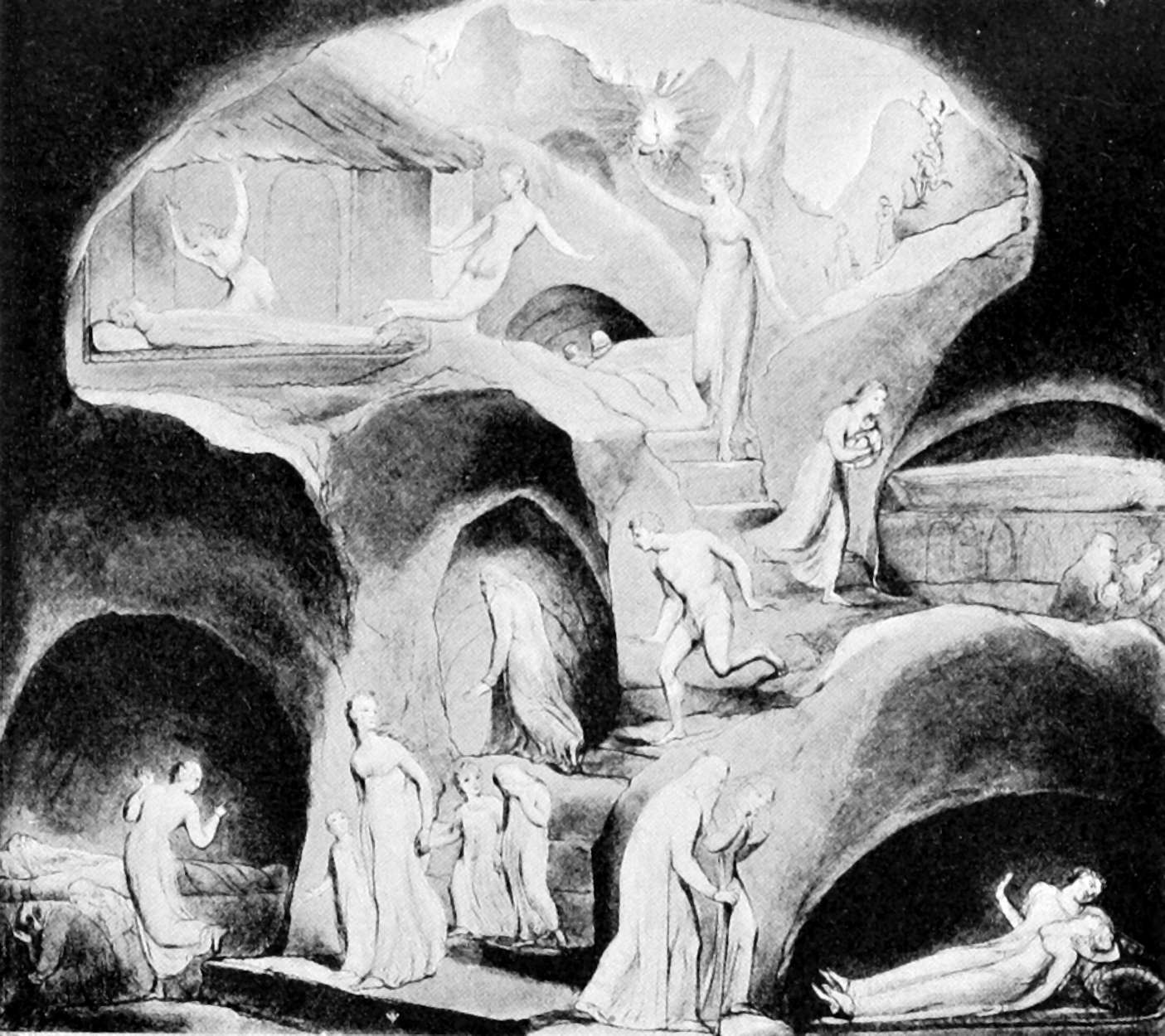
THE TOMB (1806)
Puritanism was an honourable mood; it was a noble fad. In other words, it was a highly creditable mistake. We have all felt the frame of mind in which one wishes to smash golden croziers and mitres merely because they are golden. We all know how natural it is at certain moments to feel a profound thirst to kick clergymen simply because they are clergymen. But if we seriously ask ourselves whether in the long run humanity is not happier with gold in its religion rather than mere drab, then we come to the conclusion that the gold on cross or cope does give more pleasure to most men than it gives pain, for a moment, to us. If we really ask ourselves if religions do not work better with a definite priesthood to do the drudgery of religion, we come to the conclusion that they do work better. Anti-clericalism is a generous and ideal mood; clericalism is a permanent and practical necessity. To put the matter in an easier and more everyday metaphor, it is natural for any poor Londoner to feel at times an abstract aspiration to beat the Lord Mayor of London. But it does not follow that it would really have been a kindness to poor Londoners to abolish the Lord Mayor’s Show.
Now it is in this sense that we may truly say that Blake (upon one side of his mind) was something worse than a maniac—he was a faddist. He did permit aspirations or prejudices which are accidental or one-sided to capture and control him at the expense of things really more human and enduring: things which he shared with all the children of men. I do not allude to his supernaturalism; for on that he is in no sense alone, nor even specially eccentric. I do not refer to his love of the gorgeous, the terrible or even the secretive of temples, initiations, and hieroglyphic religion. For that sort of mystery is really quite popular and even democratic. That sort of secrecy is a very open secret.
It is usual to hear a man say in modern England that he has too much common sense to believe in ghosts. But common sense is in favour of a belief in ghosts, the common sense of mankind. It is usual to hear a man say that he likes common sense and does not like the mummeries and flummeries of church ritual. But common sense is in favour of mummery and ritualism, the common sense of mankind. The man who attempts to do without symbols is a prophet so austere and isolated as to be dangerously near to a madman. The man who does not believe in ghosts is a solitary fanatic and lonely dreamer among the sons of men. Therefore I do not in any sense count even his craziest visions or wildest symbols among the real fads or eccentricities of Blake. But he had mental attitudes which were really fads and eccentricities, in this essential sense, that they were not exaggerations of a general human feeling but definite denials of it. He did not lead humanity, but attacked or even obstructed it. Many instances might be given of the kind of thing I mean; there was something of it in Blake’s persistent and even pedantic insistence that war as war is evil. There was something of Tolstoy in Blake; and that means something that is inhuman as well as something that is heroic. But his allusions to this were occasional and perhaps even accidental, and better cases could certainly be found. The essential of all the cases is, however, that when he went wrong it was as an intellectual and not as a poet.
Take, for example, his notion of going naked. Here I think Blake is merely a sort of hard theorist. Here, in spite of his imagination and his laughter, there was even a touch of the prig about him. He was obscene on principle. So to a great extent was Walt Whitman. A dictionary is supposed to contain all words, so it has to contain coarse words. “Leaves of Grass” was planned to praise all things, so it had to praise gross things. There was something of this pedantic perfection in Blake’s escapades. As the hygienist insists on wearing Jäger clothes, he insisted on wearing no clothes. As the æsthete must wear sandals, he must wear nothing. He is not really lawless at all; he is bowing to the law of his own outlawed logic.
There is nothing at all poetical in this revolt. William Blake was a great and real poet; but in this point he was simply unpoetical. Walt Whitman was a great and real poet; but on this point he was prosaic and priggish. Two extraordinary men are not poets because they tear away the veil from sex. On the contrary it is because all men are poets that they all hang a veil over sex. The ploughman does not plough by night, because he does not feel specially romantic about ploughing. He does love by night, because he does feel specially romantic about sex. In this matter Blake was not only unpoetical, but far less poetical than the mass of ordinary men. Decorum is not an over-civilised convention. Decorum is not tame, decorum is wild, as wild as the wind at night.
“Mysterious as the moons that rise At midnight in the pines of Var.”
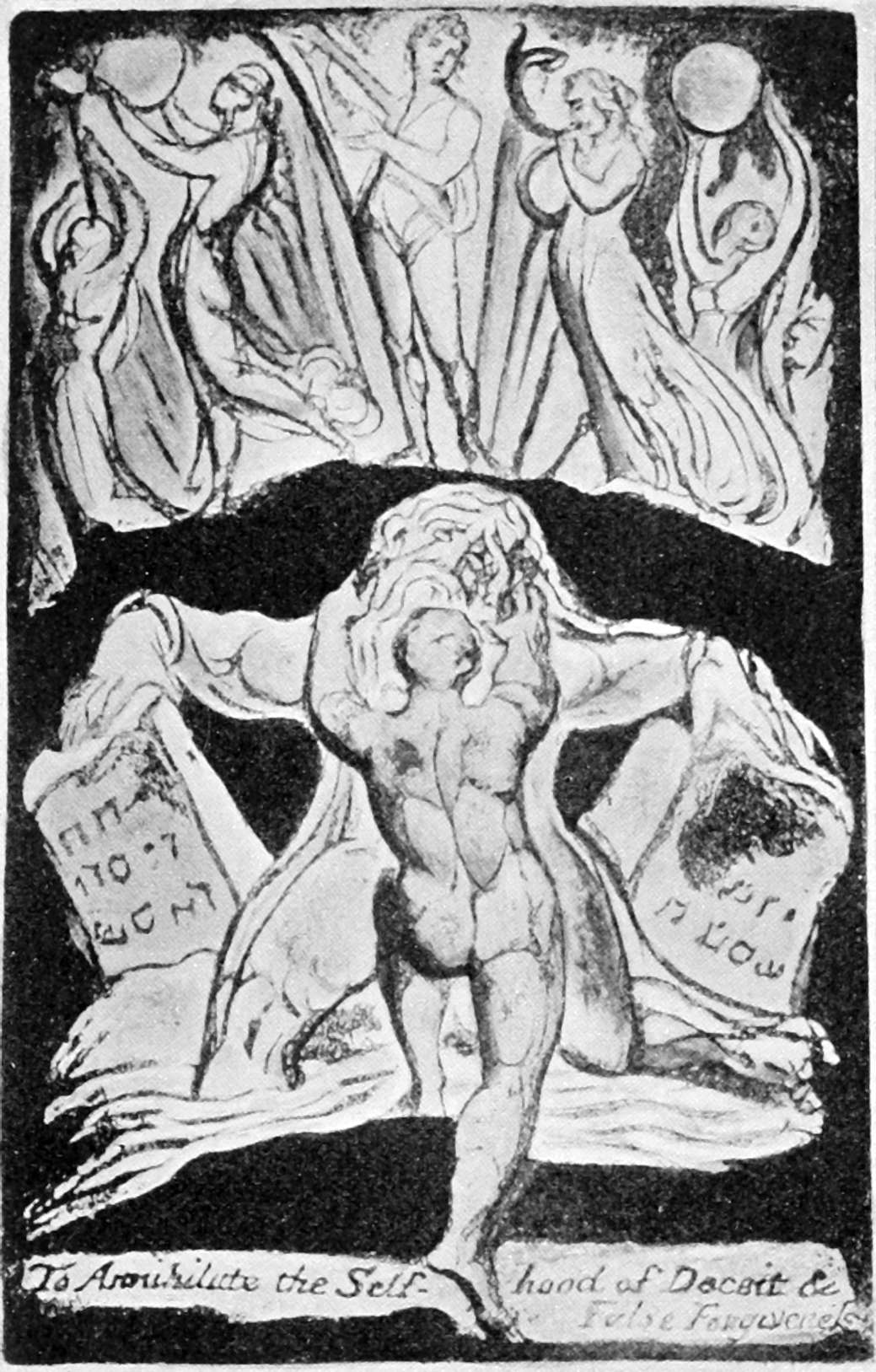
THE SELFHOOD OF DECEIT (1807)
Modesty is too fierce and elemental a thing for the modern pedants to understand; I had almost said too savage a thing. It has in it the joy of escape and the ancient shyness of freedom. In this matter Blake and Whitman are merely among the modern pedants. In not admiring sexual reticence these two great poets simply did not understand one of the greatest poems of humanity.
I have given as an instance his disregard of the idea of mystery and modesty as involved in dress; it was an unpoetical thought that there should be no curtains of gold or scarlet round the shrine of the Holy Spirit. But there is stronger instances in his theology and philosophy. Thus he imbibed the idea common among early Gnostics and not unknown to Christian Science speculators of our day, that it was a confession of weakness in Christ to be crucified at all. If he had really attained divine life (so ran the argument) he ought to have attained immortal life; he ought to have lived for ever upon the earth. With an excess of what can only be called impudence, he even turned Gethsemane into a sort of moral breakdown; the sudden weakness which accepted death. The general claim that vices are poetical is largely unfounded; and this is an excellent example of how unpoetical is the vice of profanity. Blasphemy is not wild; blasphemy is in its nature prosaic. It consists in regarding in a commonplace manner something which other and happier people regard in a rapturous and imaginative manner. This is well exemplified in poor Blake and his Gnostic heresy about Jesus. In holding that Christ was weakened by being crucified he is certainly a pedant, and certainly not a poet. If there is one point on which the spirit of the poets and the poetic soul in all peoples is on the side of Christianity, it is exactly this one point on which Blake is against Christianity—“was crucified, dead and buried.” The spectacle of a God dying is much more grandiose than the spectacle of a man living for ever. The former suggests that awful changes have really entered the alchemy of the universe; the latter is only vaguely reminiscent of hygienic octogenarians and Eno’s Fruit Salts. Moreover, to the poet as to the child, death must be dreadful even if it is desirable. To talk (as some modern theosophists do) about death being nothing, the mere walking into another room, to talk like this is not only prosaic and profoundly un-Christian; it is decidedly vulgar. It is against the whole trend of the secret emotions of humanity. It is indecent, like persuading a decent peasant to go without clothes. There is more of the song and music of mankind in a clerk putting on his Sunday clothes than in a fanatic running naked down Cheapside. And there is more real mysticism in nailing down a coffin lid than in pretending, in mere rhetoric, to throw open the doors of death.
I have given two cases of the presence in Blake of these anti-human creeds which I call fads—the case of clothes and the case of the crucifixion. I could give a much larger number of them, but I think their nature is here sufficiently indicated. They are all cases in which Blake ceased to be a poet, through becoming entirely, instead of only partially, separated from the people. And this, I think, is certainly connected with that quality in him to which I referred in analysing the eighteenth century; I mean the element of oligarchy and fastidiousness in the mystics and masonries of that epoch. They were all founded in an atmosphere of degrees and initiations. The chief difference between Christianity and the thousand transcendental schools of to-day is substantially the same as the difference nearly two thousand years ago between Christianity and the thousand sacred rites and secret societies of the Pagan Empire. The deepest difference is this: that all the heathen mysteries are so far aristocratic, that they are understood by some, and not understood by others. The Christian mysteries are so far democratic that nobody understands them at all.
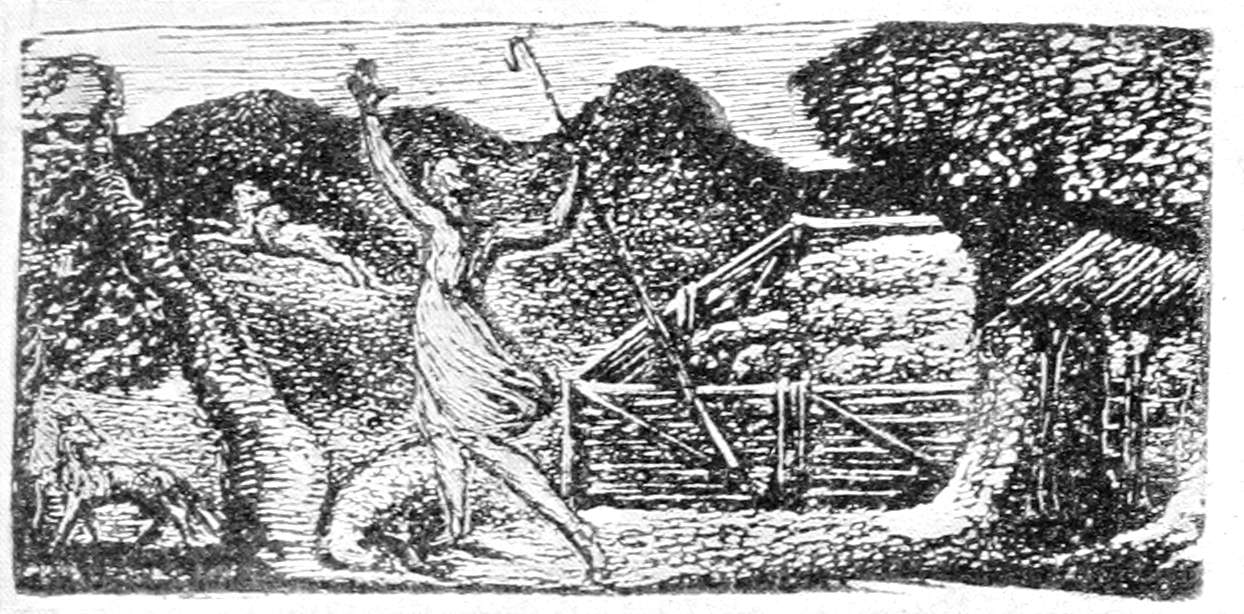
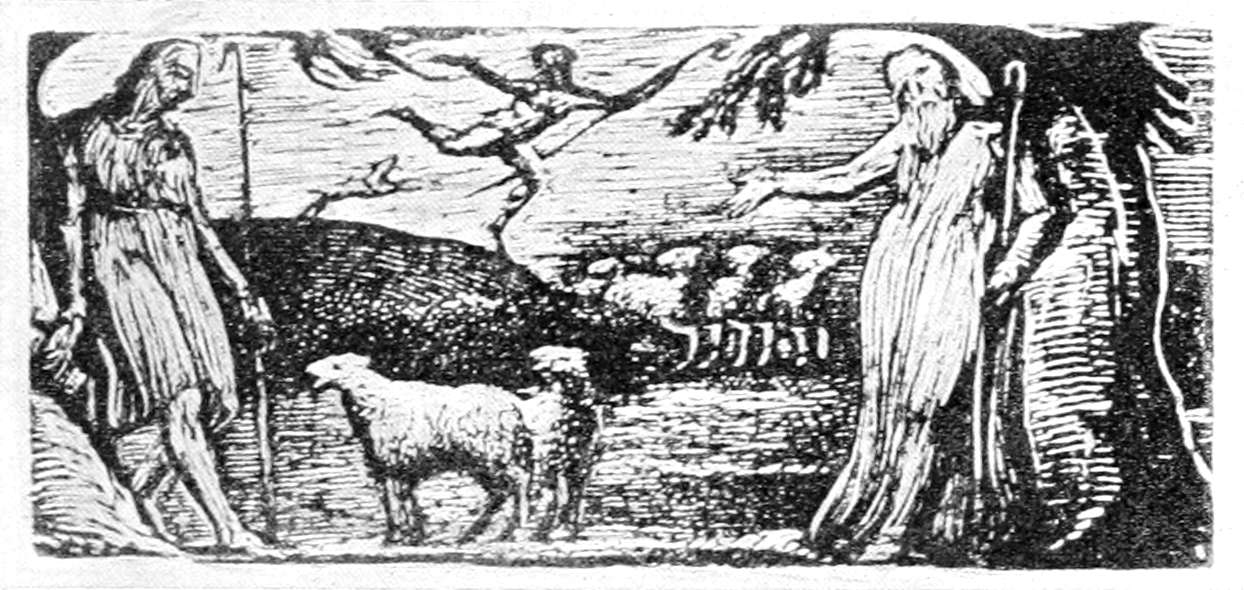
THE SHEPHERDS (1821)
When we have fairly stated this doubtful and even false element in Blake’s philosophy, we can go on with greater ease and thoroughness to state where the solid and genuine value of that philosophy lay. It consisted in its placid and positive defiance of materialism, a work upon which all the mystics, Pagan and Christian, have been employed from the beginning. It is not unnatural that they should have fallen into many errors, employed dangerous fallacies, and even ruined the earth for the sake of the cloudland. But the war in which they were engaged has been none the less the noblest and most important effort of human history, and in their whole army there was no greater warrior than Blake.
One of the strange and rooted contradictions of the eighteenth century is a combination between profound revolution and superficial conventionality. It might almost be said that the men of that time had altered morals long before they thought of altering manners. The French Revolution was especially French in this respect, that it was above all things a respectable revolution. Violence was excused; madness was excused; but eccentricity was inexcusable. These men had taken a king’s head off his shoulders long before they had thought of taking the powder off their own heads. Danton could understand the Massacres of September, but he could not understand the worship of the Goddess of Reason or all the antics of the German madman Clootz. Robespierre grew tired of the Terror, but he never grew tired of shaving every morning. It is impossible to avoid the impression that this is rather a characteristic of the revolutions which really make a difference and defy the world. The same is true of that fallacious but most powerful and genuine English monument which was covered by the words Darwin and Evolution. If there was one striking thing about the fine old English agnostics, it was that they were entirely indifferent to alterations in the externals of pose or fashion, that they seem to have supposed that the huge intellectual overturn of agnosticism would leave the obvious respectability of life exactly as it was. They thought that one might entirely alter a man’s head without in the least altering his hat. They thought that one might shatter the twin wings of an archangel without throwing the least doubt upon the twin whiskers of a mid-Victorian professor. And though there was undoubtedly a certain solemn humour about such a position, yet, on the whole, I think the mid-Victorian agnostics were employing the right kind of revolution. It is broadly a characteristic of all valuable new-fashioned opinions that they are brought in by old-fashioned men. For the sincerity of such men is proved by both facts—the fact that they do care about their new truth and the fact that they do not care about their old clothes. Herbert Spencer’s philosophy is all the more serious because his appearance (to judge by his photographs) was quite startlingly absurd. And while the Tory caricatures were deriding Gladstone because he introduced very new-fangled legislation, they were also deriding him because he wore very antiquated collars.
But though this strange combination of convention in small things with revolt in big ones is not uncommon in hearty and human reformers, there is a quite special emphasis on this combination in the case of the eighteenth century. The very men who did deeds which were more dreadful and daring than we can dream to achieve, were the very men who spoke and wrote with a mincing propriety and almost effeminate fastidious distinction such as we should scarcely condescend to employ. The eighteenth century man called the eighteenth century woman “an elegant female”; but he was quite capable of saving her from a mad bull. He described his ideal republic as a place containing all the refined sensibilities of virtue with all the voluptuous seductions of pleasure. But he would be hacked with an axe and blown out of a gun to get it. He could pursue new notions with a certain solid and virile constancy, as if they were old ones. And the explanation is partly this: that however revolutionary, they were old ones—in this sense at least, that they involved the pursuit of some primary human hope to its original home. They powdered their hair because they really thought that a civilized man should be civilized—or, if you will, artificial. They spoke of “an elegant female” because they really thought, with their whole souls, that a female ought to be elegant. The old rebels preserved the old fashions—and among others the old fashion of rebelling. The new rebels, the revolutionists of our time, are intent upon introducing new fashions in boots, beds, food or furniture; so they have no time to rebel. But if we have once grasped this eighteenth century element of the insistence upon the elegant female because she is elegant, we have got hold of a fundamental fact in the relation of that century to Blake.
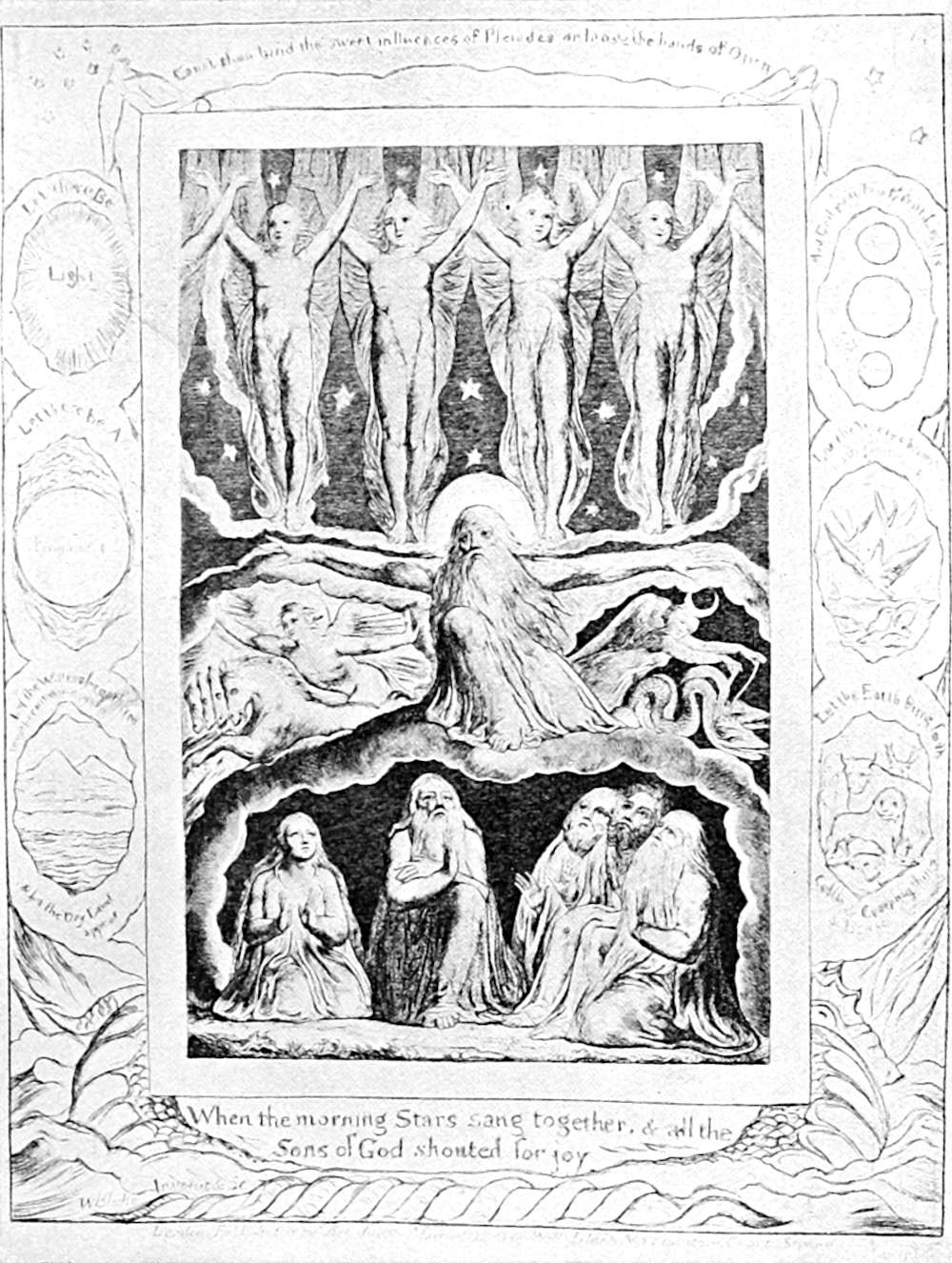
THE MORNING STARS (1821)
It is instinctive to describe Blake as a fantastic artist; and yet there is a very real sense in which Blake is conventional. If any reader thinks the phrase paradoxical, he can easily discover that it is true; he can discover it simply by comparing Blake even in his most wild and arbitrary work with any merely modern artist who has the name of being wild; with Aubrey Beardsley or even with Rossetti. All Blake’s heroes are conventional heroes made unconventionally heroic. All Blake’s heroines are elegant females without their clothes. But in both cases they exaggerate and insist upon the traditional ideal of the sexes—the broad shoulders of the god and the broad hips of the goddess. Blake detested the sensuality of Rubens. But if he had been obliged to choose between the women of Rubens and the women of Rossetti, he would have flung himself on the neck of Rubens. For we have a false conception of what constitutes exaggeration. The end of the eighteenth century (being a dogmatic period) believed in certain things and exaggerated them. The end of the nineteenth century simply did not know what things to exaggerate; so it fell back upon merely underrating them. Blake tried to make Wallace look even bolder and fiercer than Wallace can possibly have looked. That was his exaggeration of Wallace. But Burne-Jones’ exaggeration of Perseus is not an exaggeration at all. It is an under-statement; for the whole fascination of Burne-Jones’ Perseus is that he looks frightened. Blake’s figure of a woman is aggressively and monstrously womanly. That is its fascination, if it has any. But the fascination of a Beardsley woman (if she has any) is exactly that she is not quite a woman. So much of what we have meant by exaggeration is really diminution; so much of what we have meant by fancy is simply falling short of fact. The Burne-Jones’ man is interesting because he is not quite brave enough to be a man. The Beardsley woman is interesting because she is not quite pretty enough to be a woman. But Blake’s men are brave beyond all decency: and Blake’s women are so swaggeringly bent on being beautiful that they become quite ugly in the process. If anyone wishes to know exactly what I mean, I recommend him to look at one of those extraordinary designs of nymphs in which a woman (or, as Blake loved to call it, the Female Form) is made to perform an impossible feat of acrobatics. It is impossible, but it is quite female; perhaps the words are not wholly inconsistent. A living serpent might perform such a piece of athletics; but even then only a female living serpent. But nobody would ask a Burne-Jones or Beardsley female to perform any athletics at all.
Blake in pictorial art was not a mere master of the moonstruck or the grotesque. On the contrary, he was, as artists go, exceptionally a champion of the smooth and sensible. In so far as being “modern” means being against the great conventions of mankind, indifferent to the difference of the sexes, or inclined to despise doctrinal outline, then there was never any man who was so little of a modern as Blake. He may have been mad; but there are varieties even in madness. There are madmen, like Blake, who go mad on health, and there are madmen who go mad on sickness.
The distinction is a solid one. You may think the queerly and partially clothed women of Aubrey Beardsley ugly. You may think the naked women of William Blake ugly. But you must perceive this peculiar and extraordinary effect about the women of William Blake, that they are women. They are exaggerated in the direction of the female form; they swing upon big hips; they let out and loosen long and luxuriant hair. Now the queer females of Aubrey Beardsley are queerest of all in this, that they are not even female. They are narrow where women have a curve and cropped where women have a head of hair. Blake’s women are often anatomically impossible. But they are so far women that they could not possibly be anything else.
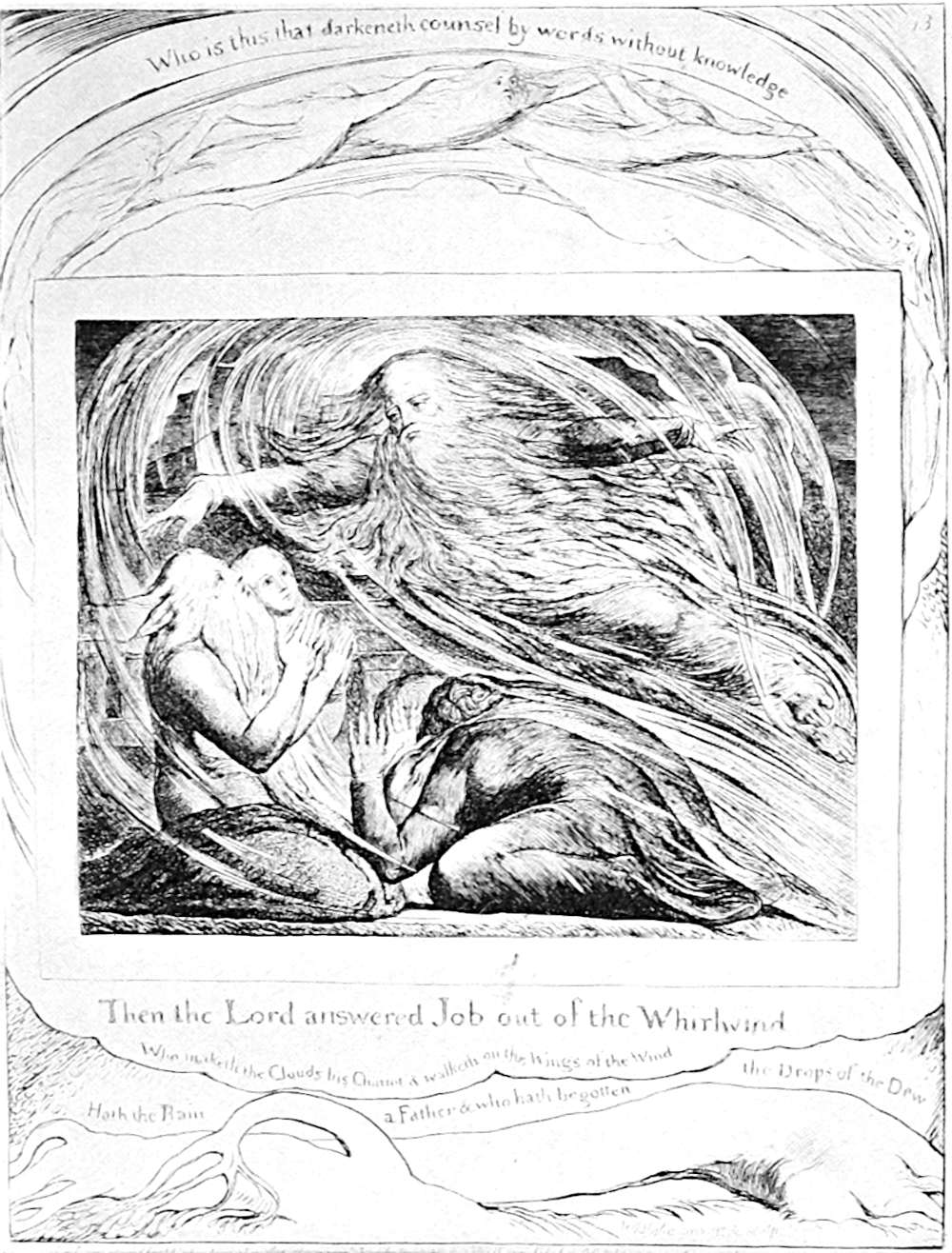
THE WHIRLWIND (1825)
This comparison between Blake’s art and such art as Aubrey Beardsley’s is not an invidious impertinence, it is really an important distinction. Blake’s work may be fantastic; but it is a fantasia on an old and recognisable air. It exaggerates characteristics. Blake’s women are too womanish, his young men are too athletic, his old men are too preposterously old. But Aubrey Beardsley does not really exaggerate; he understates. His young men have less than the energy of youth. His women fascinate by the weakness of sex rather than by its strength. In short, if one is really to exaggerate the truth, one must have some truth to exaggerate. The decadent mystic produces an effect not by exaggerating but by distorting. True exaggeration is a thing both subtle and austere. Caricature is a serious thing; it is almost blasphemously serious. Caricature really means making a pig more like a pig than even God has made him. But anyone can make him not like a pig at all; anyone can create a weird impression by giving him the beard of a goat. In Aubrey Beardsley the artistic thrill (and there is an artistic thrill) consists in the fact that the women are not quite women nor the men quite men. Blake had absolutely no trace of this morbidity of deficiency. He never asks us to consider a tree magical because it is a stunted tree; or a man a magician merely because he has one eye. His form of fantasy would rather be to give a tree more branches than it could carry and to give a man bigger eyes than he could keep in his head. There is really a great deal of difference between the fantastic and the exaggerative. One may be fantastic by merely leaving something out. One might call it a fantasy if the official portrait of Wellington represented him without a nose. But one could hardly call it an exaggeration.
There is an everlasting battle in which Blake is on the side of the angels, and what is much more difficult and dangerous, on the side of all the sensible men. The question is so enormous and so important, that it is difficult to state even by reason of its reality. For in this world of ours we do not so much go on and discover small things; rather we go on and discover big things. It is the details that we see first; it is the design that we only see very slowly; and some men die never having seen it at all. We all wake up on a battle-field. We see certain squadrons in certain uniforms gallop past; we take an arbitrary fancy to this or that colour, to this or that plume. But it often takes us a long time to realise what the fight is about or even who is fighting whom. One may say, to keep up the metaphor, that many a man has joined the French army from love of the Horse Guards Blue; many an old-fashioned eighteenth century sailor has gone over to the Chinese merely because they wore pigtails. It is so easy to turn against what is really yourself for the sake of some accidental resemblance to yourself. You may envy the curled hair of Hercules; but do not envy curly hair until you wish that you were a nigger. You may regret that you have a short nose; but do not dream of its growing longer and longer till it is like the trunk of an elephant. Wait until you know what the battle is broadly about before you rush roaring after any advancing regiment. For a battle is a complicated thing; each army contains coats of different colour; each section of each army advances at a different angle. You may fancy that the Greens are charging the Blues exactly at the moment when both are combining to effect a fine military manœuvre. You may conceive that two similar-looking columns are supporting each other at the very instant when they are about to blaze at each other with cannon, rifle, and revolver. So in the modern intellectual world we can see flags of many colours, deeds of manifold interest; the one thing we cannot see is the map. We cannot see the simplified statement which tells us what is the origin of all the trouble. How shall we manage to state in an obvious and alphabetical manner the ultimate query, the primordial pivot on which the whole modern problem turns? It cannot be done in long rationalistic words; they convey by their very sound the suggestion of something subtle. One must try to think of something in the way of a plain street metaphor or an obvious analogy. For the thing is not too hard for human speech; it is actually too obvious for human speech.
The fundamental fight in which, despite all this heat and headlong misunderstanding, William Blake is on the right side, is one which would require a book about the battle and not about William Blake. By an accident at once convenient and deceptive, it can largely be described as geographical as well as philosophical. It is crudely true that there are two types of mysticism, that of Christendom and that of Orientalism. Now this scheme of east and west is inadequate; but it does happen to fit in with the working facts. For the odd thing is this, not only are most of the merely modern movements of idealism Oriental, but their Orientalism is all that they have in common. They all come together, and yet their only apparent point of union is that they all come from the East. Thus a modern vegetarian is generally also a teetotaller, yet there is certainly no obvious intellectual connection between consuming vegetables and not consuming fermented vegetables. A drunkard, when lifted laboriously out of the gutter, might well be heard huskily to plead that he had fallen there through excessive devotion to a vegetable diet. On the other hand, a man might well be a practised and polished cannibal and still be a strict teetotaller. A subtle parallelism might doubtless be found; but the only quite obvious parallelism is that vegetarianism is Buddhist and teetotalism is Mahometan. In the same way, it is the cold truth that there is no kind of logical connection between being an Agnostic and being a Socialist. But it is the fact that the Chinese are as agnostic as oxen; and it is the fact that the Japanese are as socialistic as rats. These appalling ideas, that a man has no divine individual destiny, that making a minute item in the tribe or hive, is his only earthly destiny, these ideas do come all together out of the same quarter; they do in practise blow upon us out of the East, as cold and inhuman as the east wind.
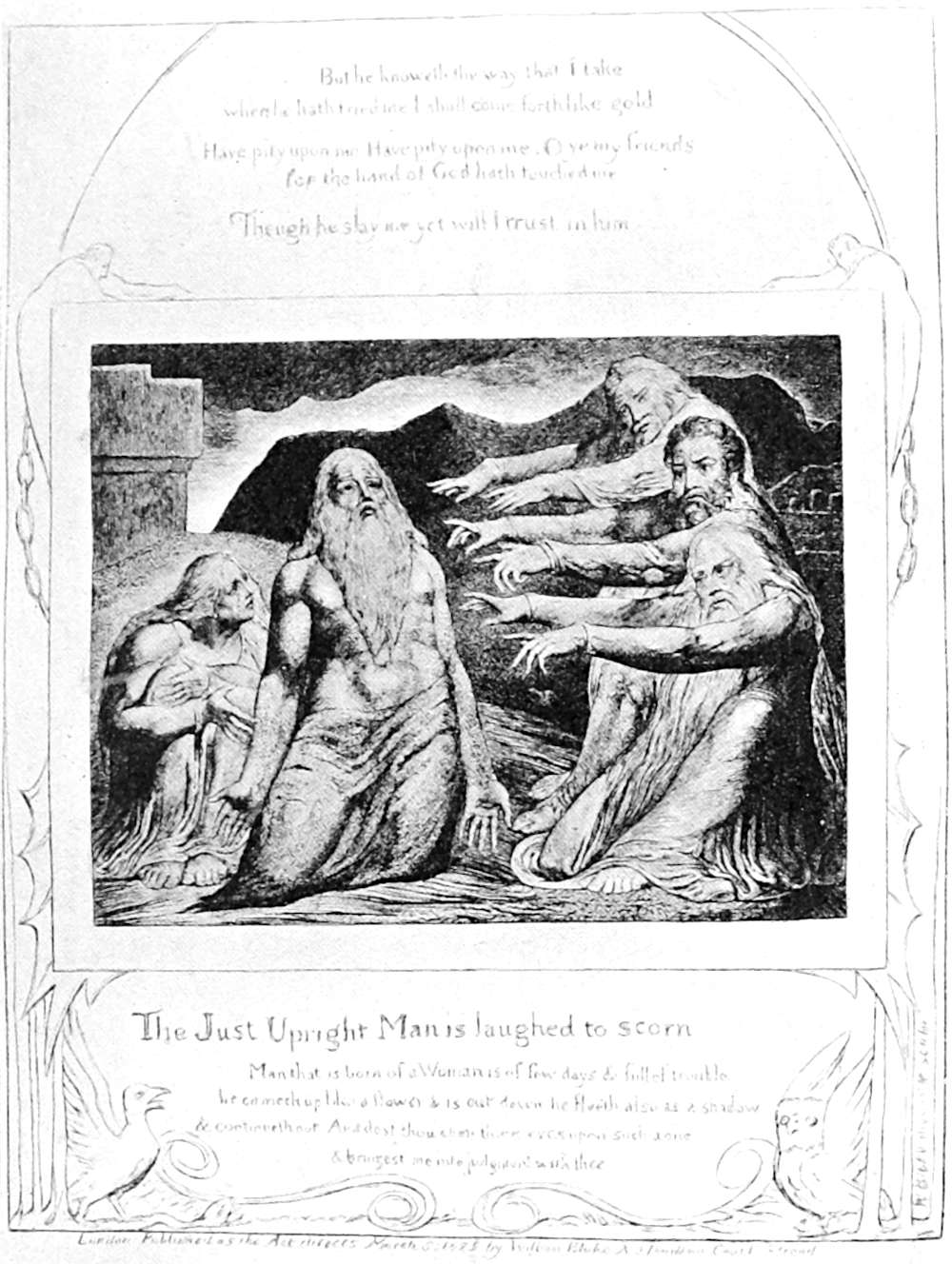
THE JUST UPRIGHT MAN (1825)
Nevertheless, I do not accept this dull definition by locality; I think it is a spirit in Asia, and even a spirit that can be named. It is approximately described as an insane simplicity. In all these cases we find people attempting to perfect a thing solely by simplification; by obliterating special features: this cosmos is full of wingless birds, of hornless cattle, of hairless women, and colourless wine, all fading into a formless background. There is a Christian simplicity, of course, opposed to this pessimist simplicity. Both the western and eastern mystic may be called children; but the eastern child treads the sand-castle back into sand, and enjoys seeing the silver snow man melt back into muddy water. This return to chaos and a comfortless simplicity is the only intelligent meaning of the words reaction and reactionary. In this sense much of modern science is reaction, and most modern scientists are reactionaries. But where this reversion to the void can be seen most clearly is in all the semi-oriental sects to which I have referred. Teetotalism is a simplification; its objection to beer is not really that beer makes a man like a beast. On the contrary, its real objection is that beer most unmistakably separates a man from a beast. Vegetarianism is a simplification; the herb-eating Hindoo saint does not really dislike the carnivorous habit because it destroys an animal. Rather, he dislikes it because it creates an animal; renews the special aims and appetites of the separate animal, man. Agnosticism, the ancient creed of Confucius, is a simplification; it is a shutting out of all the shadowy splendours and terrors; an Arcadian exclusiveness; il faut cultiver son jardin. Japanese patriotism, the blind collectivism of the tribe, is a simplification; it is an attempt to turn our turbulent and varied humanity into one enormous animal, with twenty million legs, but only one head. There is an utterly opposite kind of simplicity that springs from joy; but this kind of simplicity certainly is rooted in despair.
Now, for practical purposes, there is an antagonistic order of mysticism; that which celebrates personality, positive variety, and special emphasis: just as in broad fact the mystery of dissolution is emphasized and typified in the East, so in practice the mystery of concentration and identity is manifest in the historic churches of Christendom. Even the foes of Christianity would readily agree that Christianity is “personal” in the sense that a vulgar joke is “personal”: that is corporeal, vivid, perhaps ugly. This being so, it has been broadly true that any mystic who broke with the Christian tradition tended to drift towards the eastern and pessimist tradition. In the Albigensian and other heresies the East crawled in with its serpentine combination of glitter and abasement, of pessimism and pleasure. Every dreamer who strayed outside the Christian order strayed towards the Hindu order, and every such dreamer found his dream turning to a nightmare. If a man wandered far from Christ he was drawn into the orbit of Buddha, the other great magnet of mankind—the negative magnet. The thing is true down to the latest and the most lovable visionaries of our own time; if they do not climb up into Christendom, they slide down into Thibet. The greatest poet now writing in the English language (and it is surely unnecessary to say that I mean Mr Yeats) has written a whole play round the statement, “Where there is nothing there is God.” In this he sharply and purposely cuts himself off from the real Christian position, that where there is anything there is God.
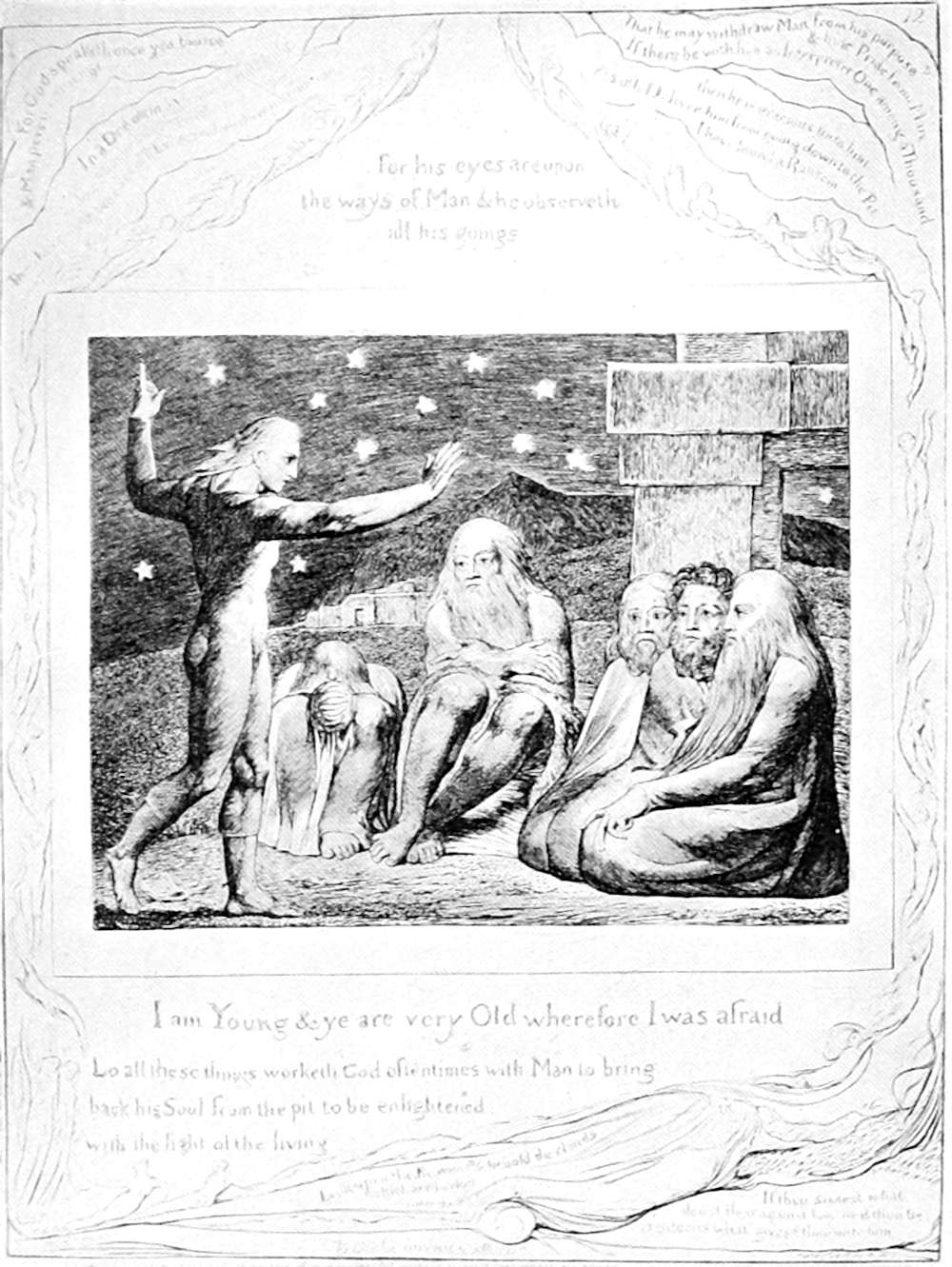
FOR HIS EYES ARE UPON THE WAYS OF MAN (1825)
But though, by an almost political accident, Oriental pessimism has been the practical alternative to the Christian type of transcendentalism, there is, and always has been, a third thing that was neither Christian in an orthodox sense nor Buddhistic in any sense. Before Christianity existed there was a European school of optimist mystics; among whom the great name is Plato. And ever since there have been movements and appearances in Europe of this healthier heathen mysticism, which did not shrink from the shapes of things or the emphatic colours of existence. Something of the sort was in the Nature worship of Renaissance philosophers; something of the sort may even have been behind the strange mixture of ecstacy and animality in the isolated episode of Luther. This solid and joyful occultism appears at its best in Swedenborg; but perhaps at its boldest and most brilliant in William Blake.
The present writer will not, in so important a matter, pretend to the absurd thing called impartiality; he is personally quite convinced that if every human being lived a thousand years, every human being would end up either in utter pessimistic scepticism or in the Catholic creed. William Blake, in his rationalist and highly Protestant age, was frequently reproached for his tenderness towards Catholicism; but it would have surprised him very much to be told that he would join it. But he would have joined it—if he had lived a thousand years, or even perhaps a hundred. He was on the side of historic Christianity on the fundamental question on which it confronts the East; the idea that personality is the glory of the universe and not its shame; that creation is higher than evolution, because it is more personal; that pardon is higher than Nemesis, because it is more personal; that the forgiveness of sins is essential to the communion of saints; and the resurrection of the body to the life everlasting. It was a mark of the old eastern initiations, it is still a mark of the grades and planes of our theosophical thinkers, that as a man climbs higher and higher, God becomes to him more and more formless, ethereal, and even thin. And in many of these temples, both ancient and modern, the final reward of serving the god through vigils and purifications, is that one is at last worthy to be told that the god doesn’t exist.
Against all this emasculate mysticism Blake like a Titan rears his colossal figure and his earthquake voice. Through all the cloud and chaos of his stubborn symbolism and his perverse theories, through the tempest of exaggeration and the full midnight of madness, he reiterates with passionate precision that only that which is lovable can be adorable, that deity is either a person or a puff of wind, that the more we know of higher things the more palpable and incarnate we shall find them; that the form filling the heavens is the likeness of the appearance of a man. Much of what Blake thus wildly thundered has been put quietly and quaintly by Coventry Patmore, especially in that delicate and daring passage in which he speaks of the bonds, the simpleness and even the narrowness of God. The wise man will follow a star, low and large and fierce in the heavens; but the nearer he comes to it the smaller and smaller it will grow, till he finds it the humble lantern over some little inn or stable. Not till we know the high things shall we know how lowly they are. Meanwhile, the modern superior transcendentalist will find the facts of eternity incredible because they are so solid; he will not recognise heaven because it is so like the earth.