"Will Weatherhelm" (continued 9)
Reading edition
Three or four of the more desperate of the ringleaders sprang to the guns, with the intention of firing them; but before they had time to do so, the marines, forcing their way over the barricade, seized every man they could find, I being among the number.
As two of them got hold of me, I assured them that I had been prevented from the first by force from going on deck, and that I had not joined the mutineers. They laughed at my assertion, and I was dragged along the deck and brought before Captain Pakenham.
Though he had spoken mildly enough to the other men, he was stern when addressing us, and being speedily handcuffed, we were committed to the charge of the lieutenant-at-arms, and placed under a guard of marines.
I begged Captain Pakenham to listen to me, asserting as before that I had never joined the mutineers, and called upon Hagger and the others to bear witness to the truth of what I said, Hagger, stepping out from among the men drawn up on either side of the deck, declared that what I said was the truth; that we had both tried to escape from the first, but had been prevented; and that, as the officers knew, I was among the best-conducted men in the ship.
“All you have to say will be heard at the trial, which will, depend upon it, be held in a few days,” answered Captain Pakenham. “You were found among the ringleaders, who refused, when summoned at the last, to come up and return to their duty; you must therefore, meantime, abide by the consequences.”
No words can describe the grief and dismay I felt, not on my own account, but lest my wife and uncle and aunt should hear what, had happened. They would be confident that I was innocent, but at the same time they would know the risk I ran of being inculpated with the guilty. How could I prove that I had taken no part in the mutiny? I had been below all the time, and except on the evidence of Hagger, I could not prove that I had made any attempt to escape. His evidence, indeed, might not be of any value, as he had been with me, and had himself remained below. I had been found with the ringleaders, and very probably two such utter scoundrels as were Berkeley and Pratt would not, unless it could benefit themselves, be induced to confess that they had kept me back by force.
I entreated to be supplied with paper and pen and ink, that I might write to Uncle Kelson to tell him what had happened, and beg him to break the news to Margaret, as also to ask him if he could procure legal advice; but the boon was refused me, and I was told that before the trial I should not be allowed to hold communication with anybody.
The prisoners in vain tried to keep up their spirits. Most of them soon broke down altogether, and sat with their heads bent, resting on their manacled hands, except two desperate fellows who had long faced death in every form, and were not afraid of him now, though they well knew what the punishment of their crime must be. Men were hung for lesser crimes than theirs, and the maintenance of discipline being the great object of the authorities, they were not likely to be let off.
So great was the agony of my mind that I thought I should go mad. At last I dropped into a dreamy state, my great wish being that the day of the trial should come on. Had I been called to suffer alone I should not have complained, but it was the thought of the trouble, the distress and sorrow it would be to Margaret and my uncle and aunt, to hear that I had died an ignominious death at the yard-arm, assured though they might be of my innocence, which caused me the greatest grief.
At last, on the 15th of December, several admirals and captains assembled to hold a court-martial on board the Culloden, and we ten men, accused of mutiny, were brought up for trial. It was quickly proved that four of our number had been captured while attempting to fire the guns behind the barricade, and that the whole of us had been found below when the rest of the ship’s company had returned to their duty. We were asked singly what we could say for ourselves.
Trickett was the first who spoke. He pleaded that he had been led away by others, that he did not know their object, and had no idea that matters would have proceeded to extremities. “I wished to see my shipmates righted, but I should have advised them, had they allowed me, to employ only legal means. As a proof that I was not one of the ringleaders, permit me to present this paper which came into my possession, and which, as you will see, does not contain my name.”
As he spoke, he produced a paper, and presented it to the President, who, after glancing over it, read it aloud. It began, I remember, “We, the undersigned, bind ourselves to hold fast to each other, and to take all the means in our power to obtain our rights, and have our grievances redressed; we resolve that no consideration shall hinder us, and that if our petition is not listened to, we will take possession of the ship, and carry her over to the French.” The paper wound up with terrible oaths, calling God to witness that nothing should make them give up their object.
“I see by the names attached to this precious document,” said the President, “that they are all those of the prisoners on trial, with the exception of that of the man who handed it in, which doesn’t appear,” and he slowly read out the names. Among the last was that of Pratt, then came that of Reginald Berkeley, and lastly, to my horror and dismay, was my own.
“I never signed that paper!” I exclaimed; “nothing should have induced me to put my hand to it.”
“Can you swear that your name is not Willand Wetherholm, and that this is not your signature?” asked the President, and the paper was shown me, “That is my name, and that is my signature, but I didn’t put it to any document of that sort. I was writing a letter to my wife, just before the mutiny broke out, when the man whose name appears above mine, came and asked me to put my name as a witness to his signature, stating that it was required for legal purposes, in order to enable him to obtain a property to which he was entitled.”
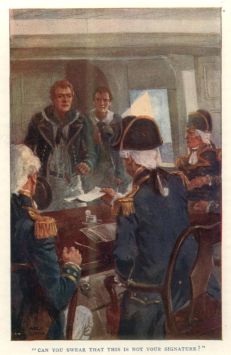
“A likely story,” observed one of the members of the court. “Reginald Berkeley, as you call yourself, is this man’s story correct? Did you ask him to witness your signature for such a purpose as he states?”
I saw Iffley and Berkeley exchange glances.
“I don’t remember the circumstance, my lord,” he answered with the greatest effrontery. “I know that the paper was passed round for signature, and that I put my name to it; and I suppose Wetherholm put his, knowing what was written above it.”
When again allowed to speak, I once more acknowledged that the signature was mine, but that through carelessness, not having looked at the document, which was doubled back, I had simply acceded to Berkeley’s request to sign as a witness.
“The word ‘witness’ was written in pencil at the time, and I was about to write over it in ink when I was interrupted,” I said.
The President examined the paper through his spectacles, but declared that he could see no traces of any pencil marks. It was passed round to two or three other officers, who agreed with his lordship.
At last it was handed to Captain Pakenham, who, holding it up against the light, produced a magnifying glass from his pocket, through which he examined the paper.
“I see traces of pencil marks. Yes; and the letters ‘w-i-t,’ then there is a blank, and ‘e-s,’ though an attempt has been made to rub it out, and probably the person who tried to do so fancied that he had succeeded. Sergeant, examine that man’s pockets,” and he pointed to Iffley.
The sergeant, after fumbling about, produced a piece of india-rubber.
“I thought so,” observed the Captain. “There has been some knavery at work. This is greatly in the man’s favour.”
I breathed more freely at this than I had for many a day. He then turned to Dick Hagger, and told him to make his statement.
Dick, pulling his hair, at once stepped forward, and in a clear voice began: “My lords, and cap’ens, and gentlemen, I’ll speak the truth and nothing but the truth. I hated the notion of this here mutiny directly I got an inkling of it, and so did my messmate Will Weatherhelm, and we had made up our minds, if it was likely to come to anything, to get away aft and tell the commander or first lieutenant; but when we was agoing, quite unbeknown to us, before we had time to get on deck, the mutiny broke out, the ladders were unshipped, an’ we was kept prisoners. We were both of us marked men, and when we again tried to join the officers we was held back. Every one who has ever served with Weatherhelm knows him to be a good seaman, and an orderly, well-conducted chap, who wouldn’t, for to get a pocketful of gold, have become a rascally mutineer.” The warrant and petty officers who were called, gave both Hagger and me good characters, and his evidence appeared to weigh greatly in my favour; still I could see that most of the members of the court-martial considered it necessary to make an example of the whole of those who had been captured, and one after the other the ringleaders were condemned to death. Berkeley and Pratt fell on their knees on hearing their sentence, and implored for mercy.
“It was through the treachery of that man that Wetherholm’s signature was obtained,” said Captain Pakenham, pointing to the former; “I am not inclined to grant him it.”
The other members of the court were of his opinion.
Charles Iffley, though he had been the chief instigator of the mutiny, was pardoned, in consequence of his having produced the paper with the signature of the ringleaders. My fate still hung in the balance, for Captain Pakenham alone seemed to consider me innocent. I saw my judges conferring together. How my heart bounded with joy when the President at length acquitted me!
Iffley cast a glance of disappointed spite towards me as he heard this, and walked away. I was again a free man. My first act, after returning thanks to Heaven from the bottom of my heart for my merciful deliverance, was to obtain a sheet of paper, and write an account of what had happened and my happy acquittal to Uncle Kelson, and beg him to break the matter to my wife, for I was afraid that she would be overmuch agitated should I address her directly.
Several boats were returning to the shore, and I, without difficulty, got a man I knew to take it. The first to come up and congratulate me was Dick Hagger.
“I was sure, Will, that they couldn’t bring you in guilty. It would have been against all right and reason; and if they had, why, I would have gone up and axed to be hung too, and told them you was no more a mutineer than I was!”
Many other shipmates came up, and expressed themselves much in the same way. No one, however, spoke to Iffley, for they well knew that he was at the bottom of the whole affair, and deserved hanging more than any of the rest. He was from that day forward shunned by all in the ship, for even the men who had mutinied would not trust him.
This made him more morose and ill-tempered than ever, and I could not help suspecting that if he had an opportunity, he would still try to do me an injury. Discipline was now perfectly restored, but the ship was still not a happy one. No liberty was allowed, and we were kept hard at work exercising the guns and reefing sails. When I asked for leave to go on shore, I was refused.
“If we grant it to one, we must to another,” was the answer.
So I had to stop on board, and as Dick observed, “grin and bear it.”
Thus nearly a month went by. The condemned men had been sent on board various ships for safe keeping, there to remain until the day they were doomed to die. On the 13th of January, early in the morning, they were brought on board the Culloden, heavily handcuffed, and looking the picture of misery and despair. At the same time boats from every ship in the fleet came alongside to witness the execution.
The wretched men, still with their irons on, were now conducted to the upper deck. Ropes were rove through the main, fore, and mizzen-yard-arms. The whole eight were thus standing, with the chaplains by their sides, giving them the last consolations of religion, when our captain appeared with a paper in his hand. It was a pardon for the three youngest. The other five looked up with imploring glances, and an expression of hope lighted up their countenances, but there was no pardon for them. The three having been led on one side by the marines who had them in charge, the preparations for the execution of the other five were continued. They were shortly finished. The gun, the signal for their execution, was fired, and in another instant they were all run up in sight of the whole fleet, and of the crews of the boats who were compelled to witness their punishment. It was an awful sight. I felt that but for God’s great mercy I might have been among the hapless men who were struggling now in mid air. I sickened as I gazed at them, and hid my eyes with my hands, as did many another stout-hearted fellow.
After a time they were lowered down. The doctor pronounced them dead, and they were placed in shells and taken on shore to be buried. The ropes were unrove, the hands were piped down, and the boats returned to their respective ships. The fearful drama was over.
Chapter Twenty One.
The crew of the Culloden distributed—Dick and I have to go on board the Mars—Cruise off Ushant—Fall in with the enemy—A narrow escape—Masterly retreat of Admiral Cornwallis—A ruse de guerre—A severe struggle—The Mars rescued by the Queen Charlotte—Return to England—State of the ships—My expectations of leave disappointed—We are drafted on board the Galatea.
The Culloden having gained a bad name for herself, in consequence of the late event and her behaviour on the 1st of June, her officers and crew were distributed among several ships; I, with Dick Hagger and other men, being sent on board the Mars, seventy-four, one of the squadron under Vice-Admiral the Honourable William Cornwallis, whose flag was flying on board the Royal Sovereign, of one hundred guns. The other ships were the Triumph, Sir Erasmus Gower, the Brunswick, and Bellerophon, seventy-fours, the Phaeton and Pallas frigates, and the Kingfisher, an eighteen gun brig.
We sailed at the end of May from Spithead, for a cruise off Ushant. On the 8th of June we made the land about the Penmarcks on the French coast, and soon after the Triumph threw out the signal of six sail east by north.
We immediately gave chase. After some time, one of the frigates, with the little Kingfisher and the Triumph, being considerably ahead, commenced firing at the enemy, while we were crowding all sail to get up with them, the admiral having made the signal to close.
Before we had done so, however, the admiral ordered us and the Bellerophon to chase two French frigates to the south-west, one of which had a large ship in tow. This, after a short time, they abandoned to us, and we took possession of her. We stood so close in that the batteries at Belle Isle opened upon us, and shoaling our water, the signal for danger was made.
Thereupon Admiral Cornwallis recalled us, and we stood off the land with the prizes we had taken, and eight others, captured by the frigates, laden with wine and brandy. A good many small vessels, however, escaped us by plying to windward under the land, to gain the anchorage in Palais Roads.
The next day it was calm, so that the enemy could not, even if they had had a mind to do so, come out and attack us, and in the evening a breeze springing up, we took the prizes in tow, and stood away for the Channel.
Sighting Scilly, Admiral Cornwallis ordered the Kingfisher to convoy the prizes into port, while we stood back to the southward and eastward to look after the French squadron. Several days had passed when the Phaeton, our look-out frigate, made the signal of a French fleet in sight; but as nothing was said about the enemy being of superior force, and as she did not haul her wind and return to us, Admiral Cornwallis must have concluded, as did our captain, that the signal had reference to the number rather than to the apparent strength of the French ships, and we accordingly stood on nearer than we should otherwise have done. It was not indeed until an hour afterwards that we got a sufficiently clear sight of the French fleet to make out that it consisted of one very large one-hundred-and-twenty gun ship, eleven seventy-fours, and the same number of frigates, besides smaller craft. Dick Hagger, who had been sent aloft, told me that he had counted thirty at least.
“Never mind! If we can’t out-sail them, we’ll fight them, and show the mounseers that ‘hearts of oak are our ships, British tars are our men,’” he exclaimed with a gay laugh, humming the tune.
All hands on board our ship were in the same humour, and so were the crews of the rest of the squadron. We knew that we could trust our stout old admiral, for if he was at times somewhat grumpy, he was as gallant a man and as good an officer as any in the service. I heard it said, many years after, that when some of the Government gentlemen offered to make a lord of him, he declined, saying, “It won’t cure the gout.”
The admiral now threw out the signal to the squadron to haul to the wind on the starboard tack under all sail, and form in line ahead, the Brunswick leading, and we in the Mars being last. Thus we stood on for about three hours, when we saw the French fleet on the same tack separate into two divisions, one of which tacked and stood to the northward, evidently to take advantage of the land wind, while the other continued its course to the southward. Of course it was the object of our admiral to escape if possible; for, fire-eater as he was, he had no wish to expose his ships to the risk of being surrounded and sunk, as he knew, well enough might be the case should the French get up with us.
After this we twice tacked, and then we saw the French north division tack to the southward, when the wind shifted to the northward, and this enabled that division to weather on us, and the south division to lie well up for our squadron.
The first division now bore east by north about eight or nine miles, and the south division south-east, distant about ten miles on our larboard quarter. Night soon came on, and we could not tell but that before it was over we might have the French ships close aboard, and thundering away at us, “Well, if they do come,” cried Dick, “we’ll give them as good as we take, although we may have three to fight; but what’s the odds if we work our guns three times as fast as they do?”
To our surprise the watch was piped down as usual, for the admiral knew better than we did, that the enemy could not be up with us until the morning while the wind held as it then did.
We slept like tops, not troubling our heads much about the battle we might have to fight before another day was over, but I doubt whether many of the officers turned in.
The middle watch got their sleep like the first. After that the hammocks were piped up, and every preparation made for battle. Two of our ships, the Bellerophon and Brunswick, which were always looked upon as fast sailers, had, somehow or other, got out of trim, and during the night had to cut away their anchors and launches, and to start a portion of their water and provisions. The old “Billy Ruffian,” however, do all they could, would not move along, and they were compelled to heave overboard her four poop carronades with their carriages, and a large quantity of shot. Notwithstanding this, and that they were carrying every stitch of canvas they could set, we and the other ships had to shorten sail occasionally to keep in line with them. It may be supposed that we had been keeping a bright look-out for the French fleet, and when daylight broke we saw it coming up very fast, formed in three divisions.
The weather division, consisting of three ships of the line, and five frigates, was nearly abreast of our ships. In the centre division we counted five ships of the line and four frigates, and in the lee division four sail of the line, five frigates, two brigs, and two cutters. These were somewhat fearful odds, but notwithstanding, as far as I could judge, the hearts of none on board our ship, and we were the most exposed, quailed for a moment. We had made up our minds to a desperate fight, but we had confidence in our old admiral, and we knew that if any man could rescue us, he would do it.
Stripped to the waist, we stood at our quarters, waiting the order to fire, and resolved to fight to the last. At that moment I did not think of my wife, or home, or anything else, but just the work we had in hand. At such times it does not do to think. We all knew that it was our business to run our guns in as fast as possible and fire when ordered. We watched the approach of the French ships, eager for the moment when we should begin the fight.
A seventy-four was the van ship of the weather division, and a frigate led the centre division. We had had our breakfast and returned to our guns, when the seventy-four opened her fire upon our ship, the Mars. We immediately hoisted our colours, as did the rest of our squadron, and returned it with our stern-chasers. Directly afterwards the French frigate ran up on our larboard and lee quarter, and yawing rapidly, fired into us. This sort of work continued for nearly half an hour. Several of our men by that time had been struck down, though none that I could see were killed, while our standing and running rigging was already a good deal cut up. We had been blazing away for some time, and the enemy’s shot were coming pretty quickly aboard, when I heard a crash, and looking up saw that our main-yard was badly wounded. Now for the first time I began to fear that we should get crippled, and, being surrounded by the enemy, should be unable to fight our way out from among them.
Two other ships, the Triumph and Bellerophon, were now warmly engaged, and soon afterwards the remainder of the squadron began firing their stern or quarter guns as they could bring them to bear on the enemy. The Brunswick, it should be understood, was leading, then came the Royal Sovereign, next the Bellerophon and Triumph, we being, as I before said, the sternmost. We now saw the Royal Sovereign making signals to the two ships to go ahead, while she, shortening sail, took her station next in line to the Brunswick.
We had kept up so hot a fire on the first ship which had attacked us, that we had at length knocked away her main-topgallant mast and had done considerable damage to her rigging. To our great satisfaction we saw her sheer off and drop astern.
“Hurrah! there’s one done for,” cried Dick Hagger.
“So there is, my boy, but one down another came on,” remarked a wag among the crew of our gun, pointing as he spoke to a French seventy-four, which, crowding all sail, was approaching to open directly afterwards a brisk cannonade on our larboard quarter.
“Never mind, lads, we will treat her as we did t’other, and maybe we’ll capture both of them,” cried Dick.
I did not see there was much chance of that, considering that the whole French fleet was at hand to support the crippled ships. Had we been more nearly matched we might have done it.
We were now getting pretty severely mauled. First one and then another got up under our quarter, and blazed away at us. More men were wounded, and our fore-topsail yard was badly damaged, in addition to our main-topsail yard, while we had to cut away the stern galleries the better to train our guns, run through the after ports. The other ships—especially the Triumph, Sir Erasmus Gower—were keeping up a tremendous fire from their stern-ports. Notwithstanding this, the French were getting closer and closer.
Four hours thus passed away. While we were thus engaged, it must be remembered we were pressing on with all sail, so that we kept ahead of the enemy. While our sticks stood we had no fear of making our escape, but we well knew that at any moment a shot might carry away one of our masts, and then, too probably, our brave chief would have to leave us to our fate for the sake of the safety of the rest of the squadron, not that we supposed for an instant that he would do so until compelled by the most dire necessity. Strange to say, I had not the slightest fear of being shot, but I did dread the thought of being captured and shut up in a French prison, to be treated as we heard that English prisoners were treated by the French Republicans. The wretches who had cut off the heads of their king and beautiful queen, and had guillotined thousands of innocent persons, until the very streets of Paris ran with blood, were not very likely to be over kind to the English they got into their power. As yet, to be sure, they had not made many prisoners, but those they had made we heard were treated barbarously.
The expectation of what we should receive should we be defeated did not make us fight with the less determination. Still, as day wore on, the French ships in greater numbers crowded up astern, and the chances that we should escape seemed to diminish. Not a man, however, quitted his gun. We should have a tremendously hard fight before we were taken—of that we were certain; and many said, and believed it too, that Sir Charles would let the ship sink under his feet rather than strike our flag. Matters seemed getting worse and worse. We saw the Royal Sovereign throw out signals to us to alter our course to starboard, and get away from the ships most annoying us.
Immediately afterwards we saw her keep away in our direction, accompanied by the Triumph. We cheered lustily as she opened her powerful broadside upon the enemy, when we running down were brought into close order of battle, thus being saved from the mauling we were getting.
Our two friends did not arrive a moment too soon; for just then four of the French van ships had borne up, hoping to secure us. On seeing the approach of a three-decker, they again hauled their wind.
While this work had been going on, the Phaeton frigate, which had been sent by the admiral in the morning to a distance of some miles, was seen approaching, making the signal of a strange sail west-north-west, soon afterwards for four sail, and finally she let fly her topgallant-sheets, and fired two guns in quick succession, which we all well knew was the signal for fleet, probably that of Lord Bridport. This cheered up our hearts, as may be supposed, for we fancied that the tables would soon be turned, and that instead of being chased, we should be chasing the Frenchmen, with the prospect of a stand-up fight, ending in the capture of a part, if not the whole of their fleet.
No one thought at the time that the Phaeton was carrying out a ruse de guerre, which had shortly before been arranged by Admiral Cornwallis.
In the afternoon, about three o’clock, we saw the Phaeton making private signals to the supposed fleet; and then using the tabular signals with which the French were well acquainted, she communicated to our admiral the fact that the fleet seen were friends.
About an hour and a half afterwards, she signalled that they were ships of the line. She then hoisted the Dutch ensign, as if replying to a signal made by the admiral in the distance to Admiral Cornwallis, ordering him to join company.
Shortly afterwards she shortened sail, then wore, and stood back towards us. We had been all day retreating, most of the time warmly engaged with our overpowering enemy, when soon after 6 p.m. the French ships suddenly ceased firing; and shortly afterwards, their admirals making signals to them, they shortened sail and stood to the eastward. By sunset they were nearly hull down in the north-east, while we sailed on, rejoicing in having escaped from as dangerous a position as squadron was ever placed in. I don’t know if I have succeeded in explaining the position of our ships sufficiently well to be understood by shore-going persons. So close were the French ships upon us, that had they not given up the chase when they did, it would have been scarcely possible for us and the Triumph, which, if she had not suffered as much as we had, was too much cut up to have afforded us any assistance, to have effected our escape. I am very certain that our old admiral would not have deserted us, nor was it likely that the other two ships would have done so. We should all, therefore, after a desperate fight, either have gone down, been blown up, or captured. As it was, our brave admiral’s masterly retreat excited general admiration. Every seaman on board was well able to judge of our danger, and of the way in which we had been rescued. Had he not so gallantly bore up to save us in the Mars, our ship must inevitably have been taken. He might, as some officers would have done, have left us to our fate, for the sake of preserving the rest of the squadron; but he had no notion of doing anything of the sort, and gallantly determined that if he could help it, not a single one of his squadron should fall into the hands of the enemy. In his despatch, giving an account of the transaction, he spoke in the handsomest way of the behaviour of the officers and ships’ companies engaged, saying very little of the manner in which he had come to our rescue. He and all of us got the thanks of both Houses of Parliament for what had been done, and all will acknowledge that he richly deserved them. As soon as we lost sight of the French fleet, we steered a course for Plymouth, to carry the intelligence that it was at sea. From the way the stern of our ship had been knocked about, we were compelled to remain for some time at Hamoaze to refit, and were therefore unable to sail with the fleet under Lord Bridport, which went out to look for the French fleet from which we had effected our escape. He came up with the enemy off Isle-groix; and after a tough fight, in which a good many officers and men were killed and wounded, three French ships were captured. One of them was the Alexander, but she was so knocked about by the Queen Charlotte, that she was worth little. The two others, the Tigre and Formidable, were fine new seventy-fours. The former was allowed to retain her name, but we already having a Formidable in the service, her name was changed to the Belle Isle, near which the action was fought.
We and the Triumph were at once ordered up to Hamoaze to get our damages repaired. We were much injured aloft, and when I looked at the stern of our ship, she had the appearance of having received a dreadful pounding. The Triumph had suffered still more, as from her position in the line she had to keep up the heaviest stern fire. In order to train her guns, the stern galleries, bulk-heads, and every part of the stern of the ward-room, except the timbers, had been cut away, and it was said that from her three stern batteries—namely, her first deck, her second deck, and quarter-deck—she had expended in single shots five thousand pounds of powder.
I now hoped that I might be able to get leave in sufficient time to reach Southsea, and spend a few days with my wife, and I resolved to make bold and ask for it as soon as I could see the commander. Meantime, the moment I was off duty I hurried below and began a letter to my wife. While thus engaged, all hands were piped on deck.
“What can it be for?” exclaimed Dick. “We are not going to sea, I suppose, in this state?”
On reaching the deck, we found numerous boats alongside, and besides them also several lieutenants not belonging to our ship. As soon as we were mustered, our commander addressed us. He said that as the Mars would be some time refitting, the Admiralty had ordered part of our crew to be drafted on board a line-of-battle ship and two frigates requiring hands, the Thunderer, Arethusa, and Galatea. He did not ask for volunteers, but said that those whose names were called over must get their bags at once and go off in the boats waiting alongside to receive them. I don’t know what my shipmates felt, but I hoped earnestly that I should not be among those selected. I listened almost breathlessly as the names were called over, and as they did so, the men were sent down for their bags. A hundred and fifty or more had been chosen, about two hundred were wanted. At last, what was my dismay on hearing my own name called! It was vain, I knew, to expostulate; I had to submit. Before going below, I stopped to speak to Hagger. Taking out the almost finished letter, I begged him to add a postscript, saying how I had been sent off, but that I trusted I might return before long. Scarcely were the words out of my mouth when his name was called.
“It can’t be helped, Will,” he said; “bear up, lad, I’m thankful I’m going with you. You must try and finish your letter, and send it off when we get aboard the ship we’re ordered to join.”
I made no reply, my heart was too full to speak. I wanted to do my duty, but this disappointment was almost more than I could bear.
“Move on, be smart now, lads!” I heard one of the officers sing out, “there’s not a moment to lose.”
Dick and I hurried below, shouldered our bags and returned on deck, when we found that we were both to go on board the Galatea frigate, commanded by Captain Keats. The boats immediately shoved off, and away we pulled down the Sound.
Chapter Twenty Two.
I fail to send a letter to my wife—We sail with transports and emigrants for Quiberon—Early success of the expedition—Action between the Royalists and Republicans—I accompany a midshipman to Fort Penthièvre with an important message—I witness some strange scenes—A rough night—Surprised by the Republicans—Attack and capture of the fort—We escape—Conduct of the Royalists—Steadiness of the British marines—Advance of the army under General Hoche—The fleet rescue the party—Return of the expedition.
The Galatea, we found, formed one of a squadron under the command of Commodore Sir John Warren. It consisted of the Robust, Thunderer, and Standard, seventy-fours; the frigates Pomone, on board which the commodore’s flag was flying, the Anson, Artois, Arethusa, Concorde, and our frigate the Galatea, convoying fifty sail of transports with about two thousand five hundred French Royalists. The expedition was bound for Quiberon, the inhabitants of which district had remained faithful to their king, and it was hoped that from thence the Republicans could be attacked, and a large part of the country gained over to the royal cause.
The Galatea was a smart frigate, and now that she was well manned was likely to make a name for herself. On being sent below to stow away my bag, I managed to sign my name in pencil to my letter, by placing it on a gun, and to add a few lines describing what had happened, and then I hurried on deck, but the boatswain’s pipe was already shrilly sounding, and his voice shouting, “All hands up anchor!”
The commodore’s frigate was letting fall her topsails, and the other ships were following her example. The capstan went merrily round, the anchor was away, the sails were sheeted home, and we stood out of Plymouth Sound, steering for the southward.
My poor wife would have to wait some time now before she could hear from me, or know indeed where I was. There was nobody on board the Mars to whom I could have entrusted the duty of writing to her. I had to bear it, therefore, as I had to bear many another trial. Hope still supported me. As far as we could learn, we were not likely to be long away. Lord Bridport had driven the French fleet into harbour and was watching them, although we, of course, might on our return fall in with an enemy and have a fight.
The weather was fine and the wind fair, but we had plenty to do in keeping the transports together. There were many of them very slow sailers, merchant vessels hired for the purpose, some of them brigs of a hundred and fifty to two hundred tons, which must have afforded very miserable accommodation to the unfortunate emigrants. The troops were under the command of a royalist officer, the Comte de Puisaye, who had as his lieutenants the Comtes d’Hervilly and de Sombreuil.
On the 25th of June we entered the capacious bay of Quiberon, which affords one of the most secure anchorages on the French coast. On one side is the Peninsula of Quiberon, which extends out some way from the mainland, and seaward are two small, well-cultivated islands, so that it is completely protected from westerly and south-westerly gales. The next day was spent in preparations for landing, and to allow the laggards to come up; and on the 27th, at daybreak, the troops, conveyed in a large flotilla of boats, escorted by six of the squadron, pulled for the village of Carmac, where they landed. A small body of about two hundred Republicans attempted to oppose them, but were quickly driven back, leaving several dead on the field, while the Royalists did not lose a man.
This slight success encouraged the royalist inhabitants, who came down to the number of sixteen thousand, eager to receive the arms and ammunition which we landed from the ships for their use.
The troops were at once cantoned among the inhabitants, who gladly supplied them with everything they required. The French officers and soldiers we put on shore were in high spirits, laughing and joking, and seemed confident of success, and the people who came down to help to unload the boats were equally merry, declaring that they had only to attack the Republicans to compel them to lay down their arms.
Some days passed by, daring which the Royalists on shore were drilling and preparing for action. At length an expedition was planned to attack the Peninsula of Quiberon. Two thousand Royalists, and five hundred emigrants, supported by three hundred British marines, were disembarked. They at once marched towards the Port of Penthièvre, situated on a commanding eminence on the northern extremity of the peninsula, which was invested at the same time on the other side by the Comte d’Hervilly.
Without much fighting, its garrison of six hundred men soon surrendered. We immediately set to work to land stores and provisions for the supply of the royalist troops.
A day or two after this, the Comte led a body of five thousand men, including two hundred British marines, against the right flank of the army of General Hoche, which was strongly posted on the heights of Saint Barbe. At the same time, for their support, five launches, each armed with a twenty-four pounder carronade, manned from the ships of war, were sent in and stationed close to the beach. I was in one of them, and could see what was going forward.
We watched the small body of red-coats and the motley dressed Royalists marching on to the attack. At first they advanced with considerable firmness, but being met by a withering fire from the heights, and being ill-disciplined, they began to beat a hasty retreat. The marines were compelled, of course, to retire too, but they did so with their faces to the foe, defending the fugitives as well as they could.
On this, Captain Keats, who commanded the boats, ordered us to open fire, and we began to blaze away at the Republicans in a fashion which considerably retarded them in their pursuit of the retreating force. So well-directed were our shot on their flanks, that beyond a certain line they were unable to advance.
Both the marines and Royalists got back to the beach, though not without considerable loss. Among the badly wounded was their brave leader, who was conveyed on board our frigate, and placed under the care of our surgeon. Though he suffered much from his wound, his thoughts were still with his friends ashore.
It was, I think, about two days afterwards, being anxious to communicate with his friend the Comte de Sombreuil, at Fort Penthièvre, which was under the command of the Comte de Puisaye, he requested that a messenger might be sent on shore with a letter. Captain Keats accordingly ordered Mr Harvey, one of the senior midshipmen, to take the letter, and allowed him to select a man to accompany him. He chose me, I having served with him already in two ships, and being well-known to him.
We at once, shoving off in the second gig under charge of another midshipman, pulled for the beach nearest the fort, towards which, as soon as we landed, we made our way. We remarked six transports, laden, as we were told, with provisions and stores of all sorts, come to an anchor as close to the fort as they could bring up.
As we stepped on shore, Mr Harvey directed the gig to return without delay to the frigate. “I don’t like the look of the weather,” he observed, “and depend upon it, before nightfall, it will come on to blow hard.”
We were to remain at the fort until the following morning, when the boat was to come in again and take us off.
Mr Harvey delivered his despatch to the young Comte, who received him very graciously, and gave him the best accommodation he could for the night, while I, that I might be ready to attend to his wants, was allowed to sleep on a sofa in a little ante-room outside of the one he occupied.
Mr Harvey told me that the Count was greatly out of spirits in consequence of the numerous desertions which had taken place from the fort. Various causes were at work. Some of the garrison were Republicans at heart, and others, hopeless of the success of the Royalists, were afraid of the consequences should they remain. One or two plots had been discovered, but the conspirators had been seized, and it was hoped that those who had been won over would be deterred from carrying out their plans.
Notwithstanding these forebodings of evil, the officers met, as I suppose was their custom, at an early supper. I looked in with some of the attendants to see what was going forward. The table was covered with all sorts of good things, such as French cooks know well how to prepare. Wine flowed freely, and conversation seemed to be carried on with great animation. Speeches were made, and compliments paid to Mr Harvey, who spoke very good French, for which reason he had been selected to convey the letter to the Count. The major commanding the marines, a captain, and two lieutenants, were also present, but as none of them spoke French, Mr Harvey had to reply for the whole party.
After supper the marine officers went to their quarters, which happened to be on the side of the fort nearest the sea, in rooms prepared for them.
I remember we had to run across an open space, and were nearly wetted through by the tremendous rain which poured down upon us. It was blowing very hard too, the wind howled and shrieked among the buildings of the fort, while the windows and doors rattled till I thought that they would be forced in.
“I was afraid, Wetherholm, that we were going to have a dirty night of it,” observed Mr Harvey. “I hope the gig got back safely, but I doubt very much whether she will be able to return for us to-morrow if this weather continues. However, it may only be a summer gale, though from the appearance of things it might be mid-winter.”
I looked out; the sky seemed as black as ink, and the night was so dark that had it not been for the light in the window above the door we had to make for, we could not have found our way.
Mr Harvey, of course, wore his sword, and, as was customary for the men sent on shore, I had my cutlass slung to my side and a brace of pistols; for, as we were before the enemy, we might at any moment be called upon to fight.
I having hung up Mr Harvey’s coat to dry, and his sword against the wall, went to the ante-room, and taking off my wet jacket lay down on the sofa, all standing. At sea, I should not have been two minutes in my hammock before I had fallen asleep, but the howling and shrieking wind sounded very different on shore, and seemed to make its way through every chink and crevice, producing all sorts of strange sounds, a mingling of moanings, shriekings, whistlings, and howlings. Frequently the building itself would shake, until I fancied that it was about to come down upon our heads. Notwithstanding this, I was just dozing off, when I was aroused by still stranger sounds. I listened; I felt sure they could not be caused by the wind. They were human voices. I could distinguish shrieks and shouts and cries. Almost at the same instant there came the sharp report of pistols.
I sprang into Mr Harvey’s room to awaken him. Fortunately he had a light burning on the table.
“There’s something fearful happening, sir,” I said, as he started up, looking very much astonished. I got down his coat and sword, which I helped him to put on.
“The treachery the Count spoke of is at work, I fear, but I hope the conspirators will quickly be put down. We must go to the help of our friends if we can manage to find them,” he said, while he was quickly slipping into his clothes.
We hurried down stairs; the rest of the people in the house were rushing out, but, as far as I could discover, they were hurrying off, away from the direction of the firing and shouts.
Presently I could hear the cry of “Vive la République,” then came a sharp rattle of musketry, some of the bullets pinging against the walls above our heads.
“Come on, Wetherholm, I think I can find out where the Count is quartered; we may be in time to help him.”
As we were about to leave the house, the cry of “Vive la République” again echoed from all parts of the fort in front of us, the shouting and shrieking continuing, mingled with cries and groans and fierce exclamations, with the constant report of pistols. Still Mr Harvey was pushing on, when through the darkness we could distinguish a number of persons flying towards the rear of the fort.
At length we made out others following them, the flash from their pistols showing that they had swords in their hands. They fortunately turned away from where we were standing.
“There can be no doubt that the fort has been surprised, and that it will go hard with the Count and his soldiers,” said Mr Harvey. “I should like to have assisted him in defending his post, but perhaps the best thing I can do is to bring up the marines to his support. I think we may find their quarters, though I am not very certain about the direction.”
I agreed with Mr Harvey, for I saw that it would be madness to rush among a number of people fighting, when we could not distinguish between friends and foes.
We accordingly made our way across the fort to where we believed we should find the major of marines. Mr Harvey thought we ought to keep more to the left, but I felt certain that if we turned to the right we should reach the building.
“Who goes there?” I heard a voice shout out.
It was that of the sentry stationed in front of the building used for the marine barracks, and finding who we were, he told us that the men were mustering in the court-yard. Hurrying forward, we there found the major ready to lead them out.
On Mr Harvey telling him the state of things in front, he directed us to proceed to the quarters of the Comte de Puisaye, to say that he would endeavour to drive back the Republicans and to hold the fort until the Count should come up with all the troops he could collect.
Mr Harvey and I accordingly hastened forward on the errand. As we went on, we heard several of the fugitives passing us. One, from the clatter of his scabbard, was evidently an officer. Mr Harvey stopped him, and told him that the English marines were ready to hold their ground, and that we were going to the General’s quarters, begging him, if he knew the way, to conduct us.
This information seemed somewhat to restore his confidence; but he expressed his fears that unless assistance could be brought immediately to the Comte de Sombreuil, he would be overwhelmed. He was, he believed, defending the building in which he was quartered with several of the leading officers, but that many who were in their houses, as well as all those on guard, had been shot by traitorous soldiers who had revolted. He himself had had a narrow escape from a party of assassins, among whom he distinguished the voices of some of his own men; but he had cut down several of them, and then, favoured by the darkness, had effected his escape. We owed our safety to the brave defence made at this time by the Comte de Sombreuil, who was thus preventing the Republicans from advancing farther across the fort.
Conducted by the officer, whose name I forget, we at length reached the quarters of the Comte de Puisaye. He was issuing orders to the officers who were coming and going, to collect the troops under his immediate command.
As they came in they were formed up into various companies. Being imperfectly disciplined, they were much longer assembling than they ought to have been, and I greatly feared that the fort would be lost. Before the troops were ready to march.
Mr Harvey waited until he believed that they would follow in another minute or two, and then set off with me, intending to return to where we had left the marines.
As we got near his quarters, we heard a rapid firing, returned evidently by a large number of men, for, as they fired their pieces, they shouted again and again, “Vive la République!” When, however, they discovered that these were English troops in their front, they did not venture to rush upon the bayonets they would have had to encounter.
Mr Harvey, after some difficulty, found Major Stubbs, who commanded the marines, and told him what the General proposed doing.
“He must come pretty quickly, or we shall be overpowered,” he answered. “If it was daylight we should know what we were about, but in this pitchy darkness, with the rain clattering down upon us, the wind howling in our ears, and hosts of enemies pouring in on the other side of the fort, we may get separated and cut to pieces, and I will not sacrifice my men if I can help it.”
The bullets came whistling past our heads, and it seemed to me that the men were dropping fast, but as one marine fell the others closed up their ranks and bravely held their ground. What would become of them and us I did not know; but at last the officer to whom Mr Harvey had spoken, found us, and informed him that the Comte de Puisaye, seeing the hopelessness of endeavouring to regain the fort, had determined to retreat with his troops, and to save the lives of as many of the Royalist inhabitants as he could collect, advising Major Stubbs to draw off his men, and at the same time saying he should be obliged to him if he would cover his retreat.
The darkness and the howling of the storm prevented the movements of the marines being discovered. The stout old major passed the order along the line, and his men, facing about, made their retreat towards the rear of the fort, which was gained before the enemy attempted to pursue them.
I don’t know what the major said, but I suspect it was not complimentary to the Comte de Puisaye.
We remained with the marines, who had, as far as I could make out, lost a large number of men. What had become of the young Comte de Sombreuil and the other French officers, we could not tell; but probably, as the firing had ceased from the building in which they had been defending themselves, they had all been put to death.
Major Stubbs halted for some time, during which a number of inhabitants of the houses and cottages in the neighbourhood came in entreating his protection.
At length, escorting them, we again advanced towards the south-east point of the peninsula, which afforded the easiest landing-place, and which, from the nature of the ground, could be defended should the Republicans advance in force to attack us. We found that the Comte de Puisaye, with upwards of a thousand of his troops, and more than double that number of Royalists, had arrived there before us. The Comte had received intelligence of the attack on the fort and its capture, and believing that de Sombreuil and his companions inside had at once been cut to pieces, had considered it useless to go to his assistance.
He had, therefore, mustering his troops, formed an escort to the fugitive Royalists, and immediately commenced his march to the point.
Mr Harvey expressed his fear that, in consequence of the gale, the ships would be unable to get up to embark the people, and advised him to make preparation foe a determined resistance should the Republicans follow and attack him.
Scarcely had the troops been drawn up in position, to make the best defence possible, and to protect the landing-place, than several terror-stricken fugitives arrived, bringing the alarming intelligence that the Republicans, in great force, under Hoche, were advancing. The darkness, increased by the gloomy state of the weather, continued much longer than usual, and prevented us from ascertaining the truth of these statements. The unfortunate people were in the greatest alarm, for they well knew the barbarous treatment the Royalists had received throughout the country from the Republicans. As their comparatively small force could not hope to hold out long should they be attacked by the overwhelming army of General Hoche, they fully expected to be massacred to a man. In vain they turned their eyes seaward; no ships could be seen through the gloom coming to their relief, nor were there any boats on the shore. The wind, however, was falling, and daybreak was close at hand. I felt sure, also, that the marines, who were posted in a position which would certainly first be attacked, would hold their ground. This gave confidence to the Royalist troops.
I was standing near Mr Harvey, who was looking seaward. One after another, the fugitives who had escaped from the massacre came in, bringing further intelligence of the nearer approach of the Republicans. One of them, an officer, told Mr Harvey that the Comte de Sombreuil, the Bishop of Doll, and other emigrants of distinction, after holding out in their quarters until all their ammunition had been expended, and many of them killed, had capitulated to the Republicans on the condition that they should be allowed to retire on board the English ships.
“This is better news than I expected,” observed Mr Harvey; “I feared that the Count and all his companions had been killed. I wish I could believe that the Republicans are likely to keep their word.” A short time after this, while I was standing close to Mr Harvey on an elevated spot overlooking the bay, the dawn broke. He gave a shout of satisfaction as we saw dimly through the gloom, or rather the grey light of early morning, the whole squadron beating up. On they came.
As the wind fell they shook out the reefs in their topsails. There was no time to spare if they were to save the lives of the unfortunate people gathered on the shore.
The Galatea was leading. In fine style she came on and dropped her anchor with a spring on her cable, so as to bring her broadside to bear in the direction by which the Republicans would approach.
The other ships of the squadron brought up in succession, and directly afterwards a large flotilla of boats was seen approaching the beach.
To account for the opportune arrival of the squadron at this moment, I may state what I afterwards heard, that directly the fort was captured, the Comte de Puisaye had sent off a boat, though she ran a great risk of being swamped, to the commodore, who had, immediately the gale abated, got under weigh.
The leading columns of the Republicans appeared in the distance, just as the Galatea’s guns had been brought to bear on the shore.
A few shots made the enemy beat a hasty retreat, and allowed us to embark the troops and fugitive Royalists without molestation.
The boats were under the command of Captain Keats, and by his good management nearly four thousand people were embarked without a casualty, leaving behind, however, for the benefit of the Republicans, ten thousand stand of arms, ammunition of all sorts, and clothing for an army of forty thousand men.
Chapter Twenty Three.
A few particulars of the expedition—I learn to be patient—A strange sail—Cheated of a prize—We destroy a French frigate—Chase a brig—Becalmed at an awkward time—Our captain plans a cutting-out expedition—Success of our efforts—Dick Hagger and I with others are put on board a prize under Mr Harvey—Sail for England.
We were now kept actively engaged, but my readers would not be interested were I to give a detailed account of the various incidents of the unfortunate expedition to Quiberon. After taking possession of two islands commanding the bay, we were despatched, in company with the Standard, sixty-four, to summon the Governor of Belle Isle to deliver up the island for the use of the French king.
The boat proceeded to the shore with a flag of truce, carrying a long letter from the captain of the Standard. A very short reply was received, we heard, from the Republican general, who declared that, as he was well supplied with provisions and artillery, we might come when we liked, and he should be ready for us.
I know that we sailed away and left him alone. Soon after this we were joined by the Jason frigate, escorting a fleet of transports, containing four thousand British troops, under command of Major-General Doyle, who was accompanied by the Comte d’Artois and several other French noblemen. The troops were landed on the Isle d’Yeu with provisions, stores, and clothing, and there they remained doing nothing, for nothing could be done. The Republicans, under their clever, daring chiefs, had completely gained the upper hand, and the Royalist cause was lost. We meantime had to enjoy the luxuries of salt pork and mouldy biscuit, either blockading the enemy’s ports or looking out for their cruisers or merchantmen.
Thus we continued week after week, month after month, until my heart grew sick at the long delay. We had occasional opportunities of writing home, and I always availed myself of them, but I got very few letters in return, though my wife wrote frequently. The packet was often carried on to the Mediterranean, or to other more distant parts of the world.
At last, while cruising with three other frigates and an eighteen gun brig, the Sylph, off the mouth of the river Gironde, we one morning made out a French frigate in the south-south-west, standing in towards the entrance of the river, the wind being at the time north-north-west. Our frigate and the Sylph were close in with the land, while our consorts were considerably astern of us. We immediately crowded all sail to cut off the French frigate from the mouth of the river, while our captain ordered several signals to be made, intended to deceive her and induce her to suppose that we were also French. Dick Hagger and I were on the forecastle.
“She’ll take the bait, I hope,” he observed, glancing up at the strange bunting which was being run up at the fore royal masthead and quickly lowered. “See, she’s answering. Well, it may be all ship-shape, but I don’t like telling lies, even to an enemy. Hurrah! I suppose the signals were to tell her to come to an anchor, for see, she is shortening sail.”
Presently the French frigate rounded to and brought up. It was just what we wanted, for if she had stood on, she might have run up the river and escaped us. All we now had to do was to get up alongside her, and we trusted to our guns to make her ours. We carried on, therefore, as we had been doing to reach her.
This probably made her suspect that all was not right, for in a few minutes, letting fall her topsails, she stood away to the southward.
“She has cut her cable, and is off again,” cried Dick; “however, she can’t get up the river, that’s one comfort, and we shall have her before long.”
The French ship was now under all the canvas she could spread, standing to the southward. We had the lead going, for we were running through a narrow channel, with a lighthouse on one side on some rocks, and a sandbank on the other. We had a pilot on board, however, who knew the coast, and our captain was a man of firm nerve. The men in the chains were singing out all the time. For my part, I know I was very glad when we cleared the danger, and once more ran off before the wind, followed by the commodore in the Pomone and the Anson frigate. Meanwhile the commodore sent off the Artois frigate and Sylph brig to examine two suspicious ships seen away to the south-west. Night was approaching, and just before darkness came down on the ocean, we were not more than two miles astern of the chase. We could still see her dimly through the gloom ahead, and we hoped to keep sight of her during the night. Suddenly, however, about nine o’clock, a heavy squall struck us, accompanied by thunder and lightning, with tremendous showers of rain. The order was given to shorten sail. We flew aloft; there was no time to be lost. The thunder rattled, almost deafening us, and the lightning flashed in our eyes. Between the flashes it was so dark that we had to feel our way on the yards, for as to seeing six inches from our noses, that was out of the question. For nearly an hour it blew fearfully hard, and when we came down from aloft and looked ahead, we could nowhere see the chase, nor were either of our consorts visible astern. We, however, continued standing to the southward as before. What had become of the other ships we could not tell.
“The weather seems to be clearing,” observed Dick; “if we keep a sharp look-out, the chances are we catch sight of the chase again.”
The third lieutenant, who was forward peering out with his hands on either side of his eyes, asked if any of us could see her.
“Yes, there she is!” cried Dick immediately afterwards, “away a little on the starboard bow.”
The lieutenant, looking again to assure himself that Dick was right, sung out to the captain. Immediately the order was given to make all sail. We were, during this time, scarcely more than a mile from the shore, but the wind held fair, and there were no rocks to bring us up. Thus we stood on until daybreak, when we found that we were about the same distance from the chase as we had been at sunset, while, looking round, we discovered the frigate and brig, hull down, in the north-west.
As the other vessels were so far off, we now fully expected that the Frenchman would make a stand-up fight of it, and that before many minutes were over we should be blazing away at her, for, as far as we could judge, she was as big if not bigger than our ship. All this time, however, she had neither hoisted ensign nor pennant. This seemed strange, as there was no doubt about her being a Government ship. For some time she stood on, edging away towards the land. “Perhaps there is danger ahead, and the Frenchmen hope to lead us upon it,” I observed to Dick.
“We are all right as to that,” he answered. “Our master knows the coast too well to run the ship ashore. I only wish we could see the enemy haul her wind to, and wait for us.”
“She is going to haul her wind, see!” I exclaimed, as I saw the French frigate brace up her yards.
“Yes, she is, but she’s putting her head towards the land; I do think she’s going to run ashore!”
That such was the case there appeared every probability; still there was room enough for her to come about, and as we eagerly watched her, I hoped she would do so.
She stood on and on, and presently what was my amazement to see her mizzen-mast go by the board!
“The Frenchman must have cut it away,” cried Dick. “I was right, then.”
So he was; of that there could be no doubt. Soon afterwards down came her mainmast. On she went, however, until we saw that she was ashore, and then her foremast followed the other masts, and the sea catching her, drove her broadside on to the beach, where she heeled over away from us, so that it was difficult to see what her crew were about. As the seas kept striking her, it seemed that her people must be in considerable danger.
Our men bestowed no small amount of abuse on the French for trying to deprive us of the frigate, when they could not keep her for themselves.
Our captain ordered three guns to be fired at her as we passed within a quarter of a mile of the shore; but though some of hers might have been brought to bear on us, not one was discharged. We then stood off and hove-to. The boats were lowered and manned, our first lieutenant going in command of them, with directions to effect the destruction of the frigate. The heavy surf breaking against her bottom, and sweeping round towards the side turned to the shore, made it difficult and dangerous work to attempt boarding her.
The tide was now falling, and a considerable number of the French crew seeing us coming, in spite of the risk of being swept away, plunged into the water, and partly by swimming and partly by wading, managed to reach the beach. None of them made any attempt to defend the ship, nor did we molest the poor fellows who were making for the land.
At length we managed to get up to the ship, when the captain and several of his officers surrendered themselves as prisoners. We also took off a few Portuguese seamen, who had been taken out of two captured Brazil ships. We were soon joined by the boats of the Artois and the Sylph, which had in the meantime approached. The former was now standing off the shore, while the Sylph came close in to protect the boats should the French seamen venture to attack us.
Having put the prisoners on board the Artois and Galatea, we returned once more to effect the destruction of the frigate. The rollers, however, went tumbling in on shore with so much fury that the boats would probably have been lost had we made the attempt. We therefore had to wait patiently until the rising tide should enable us with less hazard to get up to the ship. Meantime we took the Sylph in tow, and carried her to within seven hundred yards of the shore, where, dropping her anchor, she got a spring on it, and began firing away at the frigate, so as to riddle her bottom and prevent the possibility of her floating off at high water. At last we once more pulled in, the tide allowing us to approach close to the beach, when Mr Harvey, in whose boat I was, went on shore with a flag of truce to tell the French seamen, who were gathering in considerable numbers on the sand-hills, that we were about to destroy their ship, and to advise them to keep out of the way. I was very glad when my young officer came back to the boat.
They did not attend to the warning they received, but as soon as we pulled for the ship they came down, threatening us in considerable numbers. On this the Sylph opened her fire, and soon sent them to the right about. We now boarded the ship, which I should have said was the Andromaque, and having searched every part of her to ascertain that none of her crew or any prisoners she might have taken remained on board, we set her on fire fore and aft, so effectually that even had the Frenchmen returned and attempted to put out the flames they would have found it impossible to do so. She burned rapidly, and as we pulled away towards the Sylph the flames were bursting out through all the ports. The Sylph then got under weigh, and, taking the boats in tow, stood off the land and rejoined the frigates.
We had not got far when a tremendous roar was heard, and we could see the whole after-part of the ship blown into fragments, some flying seawards, others towards the land, many rising high into the air.
We gave a cheer of satisfaction, for since we could not carry off the frigate as a prize, the next best thing was to prevent her doing any farther harm to our commerce.
This exploit performed, we separated from our consorts, and after cruising about for some time, we one morning, when about twenty miles off the land, just at daybreak, saw, inside of us, a large brig, which, from the squareness of her yards, we knew to be a vessel of war. The wind was from the southward, and she was close-hauled. We instantly made all sail, and stood after her, hoping to get her within range of our guns before she could run on shore, or seek for safety in port. She at once kept way, and was evidently steering for a harbour, though I forget its name, which lay some short distance to the northward. She soon showed that she was a fast craft, for though the Galatea sailed well, she maintained her distance. At length, getting her within range of our long guns, we made sure of capturing her. Two shots struck her, but did not produce any serious damage.
“Never mind, she’ll be ours in a few minutes,” observed Dick, as he stood near me at our gun. We expected in a few minutes to send a broadside into her.
Just then our topsails flapped loudly against the masts, and we lay becalmed. The brig almost immediately got out some long sweeps, and with her boats towing ahead, quickly crept away from us. I thought our captain would have ordered out the boats to attack her, but I suppose that he thought it was not worth risking the lives of the men by boarding a vessel with a crew so strong as she probably possessed. Thus we lay for some hours, rolling our sides into the smooth, shining waters. I heard some of the officers say that they could see through their glasses several other craft at anchor in a small bay protected by a fort. As evening approached a breeze sprang up, and making sail, we stood off the land. As soon as it was dark, however, the ship was put about, and we stood back again for some distance, when we hove-to, and the boats were lowered. The captain then announced that he intended to send four boats in, under the command of the first lieutenant; the third lieutenant taking charge of one, Mr Harvey of another, and the boatswain of a fourth. Dick and I were in Mr Harvey’s boat. The object was to cut out the brig we had chased into port, as well as any other vessels we could get hold of. It was just the sort of work sailors are fond of, though at the same time often as dangerous as any they can engage in. They like it all the better, however, for the danger.
The brig was to be the first attacked, and we hoped to surprise her, as probably some of her officers and crew were ashore. If we could take her, we had little doubt about cutting-out one or two of the others which had been seen at anchor.
The night was very dark, and just suited for our purpose. The first lieutenant took the lead in one of the gigs. The two cutters and pinnace followed close astern, to prevent the risk of separating. In perfect silence we pulled away from the frigate with muffled oars. As yet we could see no light to guide us, but we expected to catch sight of some of those on shore as we drew nearer. To get up to the anchorage we had a point to round. There was the risk, should any sentry be posted there, that we should be discovered. The lieutenant accordingly gave it as wide a berth as he could. Once round it, we could see the masts of the brig against the sky, but there was no light visible, nor was any movement perceptible on board her. We pulled on steadily, hoping to get up to her without being discovered. We fancied that the Frenchmen must be keeping a bad look-out. On and on we glided, like spirits of evil bent on mischief, when, as we were within a cable’s length of the brig, suddenly a flame of fire burst from her ports, with the loud reports of six heavy guns, followed by the rattle of musketry.
“On, lads, on!” cried our commanding officer; and the boats casting off from each other, we pulled away as hard as we could.
The first lieutenant and Mr Harvey in our boat, pulled for her bows, one on either side, while the other boats were to board on her quarters. Our boat was to go round to the starboard side, which was the inner one. The instant we hooked on, we clambered up, Mr Harvey gallantly leading, Dick and I being close to him. We reached the deck without opposition, for the Frenchmen were all over on the other bow, attempting to beat back the lieutenant and his people, so that we took them completely by surprise, and were cutting and slashing at them before they knew we were on deck. They quickly turned, however, to defend themselves, and this allowed the lieutenant and the gig’s crew to clamber on board. United, we drove them back from the forecastle. Some, to save themselves, tumbled down the fore-hatchway, but others, unable to get down, retreated aft. Here they joined the rest of the crew, who were fighting desperately with the third lieutenant and boatswain’s party, but were being driven slowly back.
The uproar we made, the flash of the pistols, the clash of our cutlasses, the shouts and shrieks of the combatants, served to arouse the garrison in the fort and the crews of the other vessels. The guns in the fort had not opened upon us, probably because the Frenchmen were afraid of hitting their friends, not knowing whether we had captured the brig or been driven back.
The Frenchmen, as they generally do, fought bravely, but they could not withstand the desperate onslaught we made. Attacked as they were on both sides, they were unable to retreat, and those who had been aft leapt down the hatchways, crying out for quarter. Mr Harvey told them that if they made further resistance they would be shot. He then called his boat’s crew away, as had been arranged, to cut the cable, and began to tow the brig out of harbour, while the crew of another boat flew aloft to loose the sails. The canvas was let fall and rapidly sheeted home. The moment we began to move the fort opened fire. One of the first shot struck our boat, which at once commenced to fill. Strange to say, not a man among us was hit. We on this dropped alongside the brig and scrambled on board, just as the boat sank beneath our feet. On this the lieutenant, seeing that the brig had got good way on her, calling his own boat’s crew and that of the pinnace, shoved off, with the intention of taking one of the other vessels, leaving the third lieutenant and Mr Harvey to carry out the brig. The shot from the fort came pitching about us, and we were hulled several times. One shot struck the taffrail, and as the splinters flew inboard, the third lieutenant, who was at the helm, fell. I at once ran to help him, while Mr Harvey took his place. He was badly wounded, I feared; but on recovering he desired to be left on deck, observing that should he be taken below, the French prisoners might, he feared, get hold of him, and hold him as a hostage, until we promised to liberate them, or restore the brig.
Soon after this we got out of range of the guns from the fort. Looking astern, we could see the flashes of pistols, and could hear the rattle of musketry, as if a sharp fight were going on. It was very evident that the first lieutenant was engaged in warm work. Possibly we thought he might have caught a tartar and been getting the worst of it. Mr Harvey proposed going back to his assistance, but the lieutenant feared that if we did so, we should run a great risk of getting the brig ashore, and might probably be captured. We therefore stood on until we were clear of the harbour. Just as we were rounding the point, and looking aft, I made out a vessel under weigh.
“Hurrah, Mr Lloyd has made a prize of another vessel,” I shouted.
Some of the men doubted this, and declared that she was coming in chase of us. I could not deny that such might possibly be the case, but presently the fort opened upon her, which proved, as we supposed, that she was another prize. We accordingly hove-to, out of range of the guns of the fort, to wait for her; still some of the men fancied that she might be after all, as they had at first supposed, an armed vessel coming out to try and retake us. To guard against this, Mr Harvey ordered us to load the guns. We found plenty of powder and shot, so that we felt sure, if she was an enemy, of beating her off. The breeze freshened as she got clear of the harbour and stood towards us. We were at our guns, ready to fire should she prove an enemy. All doubt was banished when, on approaching, a British cheer was raised from her deck, to which we replied, and making sail, we stood on together.
In about half an hour we were up to the frigate, when both prizes hove-to to windward of her, that we might send our prisoners as well as our wounded men on board. Besides the third lieutenant, we had had only two hurt in capturing our prize, the Aimable; but the first lieutenant, in capturing the other, the Flore, had had two men killed and three wounded, besides the boatswain and himself slightly. Not only had the crew of the Flore resisted toughly, but boats had come off from the shore and attempted to retake her, after her cable had been cut. The Flore had, however, escaped with fewer shot in her hull than we had received.
During the night we ran off shore, and as soon as it was daylight the carpenters came on board to repair our damages. The captain had meantime directed Mr Harvey to take charge of the Aimable, and to carry her into Plymouth.
“I have applied for you, Wetherholm and Hagger, to form part of my crew,” he said, on returning on board. “I know you are anxious to get home, as it will be some time probably before the frigate herself returns to port.”
I thanked him heartily, and Hagger, I, and the other men, sent for our bags. As soon as all the arrangements had been completed, we made sail and stood for the British Channel. The Flore, which sailed in our company, had been placed under charge of the second master. We had been directed to keep close together so that we might afford each other support. The wind being light, we did not lose sight of the frigate until just at sundown, when we saw her making sail, apparently in chase of some vessel, to the southward. Our brig was a letter of marque, and had a valuable cargo on board, so that she was worth preserving, and would give us, we hoped, a nice little sum of prize-money.
For long I had not been in such good spirits, as I hoped soon to be able to get home and to see my beloved wife, even if I could not manage to obtain my discharge, for which I intended to try. When it was my watch below, I could scarcely sleep for thinking of the happiness which I believed was in store for me.
We had kept two Frenchmen, one to act as cook, the other, who spoke a little English,—having been for some time a prisoner in England,—as steward. They were both good-natured, merry fellows. The cook’s name was Pierre le Grande, the other we called Jacques Little. He was a small, dapper little Frenchman, and played the violin. He would have fiddled all day long, for he preferred it to anything else; but he could not get any one to dance to him except Le Grande, who, as soon as he had washed up his pots and kettles, came on deck, and began capering about to Jacques’ tunes in the most curious fashion possible.
The rest of us had plenty to do in getting the brig into order, and occasionally taking a spell at the pumps, for she leaked more than was pleasant. We tried to discover where the water came in, but could not succeed. However, as the leak was not serious it did not trouble us much.
As we were so small a crew, we were divided into only two watches. Mr Harvey had one and gave me charge of the other, at which I felt pleased, for it showed that he placed confidence in me. I understood navigation, which none of the other men did, and I had a right to consider myself a good seaman.
Chapter Twenty Four.
We are chased by a large vessel—Overtaken by a storm—A stern chase—The stranger is dismasted—We are in a dangerous position—Loss of our crew—The gale moderates—The brig gives signs of sinking—We set about building a raft—An unexpected appearance—Jacques and his fiddle—The raft completed and launched—The first night—Dick and I compare notes—Troubled sleep—A dreadful reality—My companions swept overboard—Clinging on for life.
Two days had passed by since we left the frigate. It was my middle watch below, and I fancied that the greater part of it had passed by when I heard Mr Harvey’s voice shouting, “All hands on deck, and make sail.”
I was on my feet in a moment, and looking astern as I came up, I saw through the gloom of night a large vessel to the southward, apparently standing to the eastward, while a smaller one, which I took to be the Flore, had hauled her wind, and was steering west.
“She is taking care of number one,” observed Dick to me, as we together went aloft to loose the topgallant sails, for, like a careful officer, being short-handed, Mr Harvey had furled them at sundown. We then rigged out studden sail booms, hoping, should the stranger not have perceived us, to get a good distance before daylight. Soon after the first streaks of dawn appeared in the eastern sky, we saw her alter her course in pursuit of us. We had, however, got a good start, and, unless the wind fell, we might still hope to escape her.
At first it was doubtful whether she would follow us or the Flore. If she should follow her, we should be safe, as she would have little chance of capturing us both. As the day drew on the wind increased, and at length it became evident that the stranger intended to try and take us.
“She may, after all, be an English frigate,” said Dick to me.
“Mr Harvey doesn’t suppose so, or he wouldn’t be so anxious to escape her,” I answered. “He thinks it best to be on the safe side and run no risk in the matter.”
We were all at our stations, including the cook and steward, who were told to stand by and pull and haul as they might be ordered.
I asked the latter whether he thought the ship in chase of us was English or French.
He shrugged his shoulders, observing that he was not much of a sailor, and could not tell one ship from another unless he saw her flag.
Mr Harvey stood with his glass in his hand, every now and then giving a look through it astern. Then he glanced up at the sails. The topgallant masts were bending like willow wands. Every instant the wind was increasing, and the sea was getting up; still he was unwilling to shorten sail while there was a possibility of escaping.
At last, after taking another look through his telescope, he shut it up, observing to me, “She’s French! there’s no doubt about it. We’ll hold on as long as we can, she hasn’t caught us yet.”
Scarcely two minutes after this there came a crash. Away went both our topgallant masts, and as I looked aloft, I was afraid that the top masts would follow. Still the wreck must be cleared. Dick and I sprang up the main rigging, and I hurried aloft to clear the main-topgallant mast, while two others, imitating our example, ascended the fore rigging. The brig was now plunging her bows into the fast-rising seas. It was a difficult and dangerous work we had undertaken, but getting out our knives, we succeeded in cutting away the rigging, and the masts and yards with their canvas fell overboard.
“That’s one way of shortening sail,” said Dick as we came on deck. “To my mind, the sooner we get a couple of reefs in the topsails, the better.”
This was indeed very evident. Mr Harvey taking the helm, the rest of us went aloft and performed the operation. We were too much occupied to look at the frigate. When we came down off the yards, we saw that she had shortened sail, but not before she also had carried away her fore-topgallant mast. We were still going as rapidly as before through the water, but the increase of wind gave the advantage to the larger ship, which kept drawing closer.
I have not spoken of time. The day was passing, and Mr Harvey ordered the steward and cook to bring us some food on deck, for no one could be spared below to obtain it. Already it was some hours past noon. If we could keep ahead until darkness came down, we might still manage to escape by altering our course, as soon as we had lost sight of the frigate. At length, however, we saw her yaw. She had got us within range of her guns. She fired, and two shot came whizzing past us. On this Mr Harvey ordered us to run out two long guns, brass six-pounders, through the stern-ports, and to fire in return.
We blazed away as fast as we could run them in and load, but it was a difficult matter to take aim with the heavy sea on through which we were plunging. We managed, however, to pitch two or three of our shot on board, but what damage we caused we could not tell.
Again the frigate yawed and fired all her foremost guns. One of the shot came crashing into the mainmast, and two others hulled us. I sprang towards the mast to ascertain the extent of damage it had received. It seemed a wonder, with so large a piece cut out of it, that it could stand, and I expected every moment to see it go. Still, should the wind not increase, I thought it might be preserved, and Mr Harvey calling all the hands not engaged at the guns to bring as many spars as could be collected, we began fishing it. We were thus engaged when two more shot pitched on board, carrying away part of the bulwarks and capsizing one of the guns.
Another followed, bringing one of our men to the deck with his head shattered to pieces. Our position was becoming desperate. Presently two more shot struck us between wind and water. Several of the men, who had before shown no lack of courage, cried out that we had better strike before we were sent to the bottom.
“Not while our masts stand,” answered Mr Harvey firmly.
We had had but slight experience in fishing masts, so I had little confidence in its strength. Mr Harvey then called me aft to work one of the guns.
I again pitched a shot into the frigate. My great hope was that I might knock away one of her spars, and give us a better chance of escaping. The wind had been drawing round to the westward of south. We still kept before it. Presently the frigate braced up her yards, intending apparently to fire her whole broadside at us. As she did so, the wind suddenly increased. Over she heeled. She was almost concealed from sight by the clouds of spray and dense masses of rain which came suddenly down like a sheet from the sky.
Even before Mr Harvey could give the word we were letting fly everything. The brig rushed on through the foaming seas. When I looked aft, I could just distinguish the dark hull of the frigate rolling helplessly from side to side, her masts gone by the board.
On we flew, soon losing sight of her altogether. Though our masts were standing, our canvas, except the fore-topsail, was blown to ribbons. The storm showed no signs of abating, for although there was a short lull, the wind again blew as hard as ever. The thunder roared, the lightning flashed from the clouds, and the night became pitchy dark. The seas increased, and, as they came rolling up, threatened to poop us.
How long the gale might last it was impossible to say. Before it had abated we might have run on the Irish coast. It would be wiser to heave the brig to while there was time; but the question wag whether the mainmast would stand. The fore-topsail was closely reefed, the helm was put down; but as the vessel was coming up to the wind, a sea struck us, a tremendous crash followed, the mainmast, as we had feared, went at the place where it had been wounded, and, falling overboard, was dashed with violence against the side, which it threatened every moment to stave in.
Mr Harvey, seizing an axe and calling on us to follow and assist in clearing away the wreck before more damage was done, sprang forward. At any moment the sea, striking the vessel, might sweep us off the deck. With the energy almost of despair, we worked away with axes and knives, and at length saw the mast drop clear of the side. While we were still endeavouring to clear away the wreck of the mast, Mr Harvey had sent one of the crew below to search for some more axes, as we had only three among us. Just at this juncture he came on deck, exclaiming, in a voice of alarm, “The water is rushing in like a mill sluice!”