White Slavery In The Barbary States. BY CHARLES SUMNER. (continued 2)
Reading edition
Most certainly we shall be aided, at least in our appreciation of American slavery, when we know that it was likened, by characters like Wesley, Jay, and Franklin, to the abomination of slavery in Algiers. But whatever may have been the influence of this parallel on the condition of the black slaves, it did not check the rising sentiments of the people against White Slavery.
The country was now aroused. A general contribution was proposed for the emancipation of our brethren. Their cause was pleaded in churches, and not forgotten at the festive board. At all public celebrations, the toasts, "Happiness for all," and "Universal Liberty," were proposed, not less in sympathy with the efforts for freedom in France than with those for our own wretched white fellow-countrymen in bonds. On at least one occasion,103 they were distinctly remembered in the following toast: "Our brethren in slavery at Algiers. May the measures adopted for their redemption be successful, and may they live to rejoice with their friends in the blessings of liberty."
Meanwhile, the earnest efforts of our government were continued. In his message to Congress, bearing date December 8, 1795, President Washington said, "With peculiar satisfaction I add, that information has been received from an agent deputed on our part to Algiers, importing that the terms of the treaty with the Dey and regency of that country have been adjusted in such a manner as to authorize the expectation of a speedy peace, and the restoration of our unfortunate fellow-citizens from a grievous captivity." This, indeed, had been already effected on the 5th of September, 1795.104 It was a treaty full of humiliation for the chivalry of our country. Besides securing to the Algerine government a large sum, in consideration of present peace and the liberation of the captives, it stipulated for an annual tribute from the United States of twenty-one thousand dollars. But feelings of pride disappeared in heartfelt satisfaction. It is recorded that a thrill of joy went through the land when it was announced that a vessel had left Algiers, having on board all the Americans who had been in captivity there. Their emancipation was purchased at the cost of upwards of seven hundred thousand dollars. But the largess of money, and even the indignity of tribute, were forgotten in gratulations on their new-found happiness. The President, in a message to Congress, December 7, 1796, presented their "actual liberation" as a special subject of joy "to every feeling heart." Thus did our government construct a Bridge of Gold for freedom.
This act of national generosity was followed by peace with Tripoli, purchased November 4, 1796, for the sum of fifty thousand dollars, under the guaranty of the Dey of Algiers, who was declared to be "the mutual friend of the parties." By an article in this treaty, negotiated by Joel Barlow,—out of tenderness, perhaps, to Mohammedanism, and to save our citizens from the slavery which was regarded as the just doom of "Christian dogs,"—it was expressly declared that "the government of the United States of America is not in any sense founded on the Christian religion."105 At a later day, by a treaty with Tunis, purchased after some delay, but at a smaller price than that with Tripoli, all danger to our citizens seemed to be averted. In this treaty it was ignominiously provided, that fugitive slaves, taking refuge on board American merchant vessels, and even vessels of war, should be restored to their owners.106
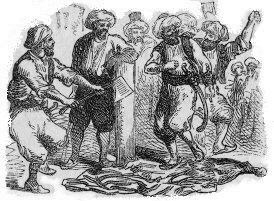
As early as 1787, a treaty of a more liberal character had been entered into with Morocco, which was confirmed in 1795,107 at the price of twenty thousand dollars; while, by a treaty with Spain, in 1799, this slave-trading empire expressly declared its desire that the name of slavery might be effaced from the memory of man.108
But these governments were barbarous, faithless, and regardless of the duties of humanity and justice. Treaties with them were evanescent. As in the days of Charles the Second, they seemed made merely to be broken. They were observed only so long as money was derived under their stipulations. Our growing commerce was soon again fatally vexed by the Barbary corsairs, who now compelled even the ships of our navy to submit to peculiar indignities. In 1801, the Bey of Tripoli formally declared war against the United States, and in token thereof "our flagstaff [before the consulate] was chopped down six feet from the ground, and left reclining on the terrace."109 Our citizens once more became the prize of man-stealers. Colonel Humphreys, now at home in retirement, was aroused. In an address to the public, he called again for united action, saying, "Americans of the United States, your fellow-citizens are in fetters! Can there be but one feeling? Where are the gallant remains of the race who fought for freedom? Where the glorious heirs of their patriotism? Will there never be a truce between political parties? Or must it forever be the fate of Free States, that the soft voice of union should be drowned in the hoarse clamors of discord? No! Let every friend of blessed humanity and sacred freedom entertain a better hope and confidence."110 Colonel Humphreys was not a statesman only; he was known as a poet also. And in this character he made another appeal to his country. In a poem on "The Future Glory of the United States," he breaks forth into an indignant condemnation of slavery, which, whatever may be the merits of its verse, should not be omitted here.
Teach me curst slavery's cruel woes to paint, Beneath whose weight our captured freemen faint! — — — — — — — — — — — — Where am I! Heavens! what mean these dolorous cries? And what these horrid scenes that round me rise? Heard ye the groans, those messengers of pain? Heard ye the clanking of the captive's chain? Heard ye your free-born sons their fate deplore, Pale in their chains and laboring at the oar? Saw ye the dungeon, in whose blackest cell, That house of woe, your friends, your children, dwell?— Or saw ye those who dread the torturing hour, Crushed by the rigors of a tyrant's power? Saw ye the shrinking slave, th' uplifted lash, The frowning butcher, and the reddening gash? Saw ye the fresh blood where it bubbling broke From purple scars, beneath the grinding stroke? Saw ye the naked limbs writhed to and fro, In wild contortions of convulsing woe? Felt ye the blood, with pangs alternate rolled, Thrill through your veins and freeze with deathlike cold, Or fire, as down the tear of pity stole, Your manly breasts, and harrow up the soul?111
The people and government responded to this voice. And here commenced those early deeds by which our navy became known in Europe. The frigate Philadelphia, through a reverse of shipwreck rather than war, falling into the hands of the Tripolitans, was, by a daring act of Decatur, burned under the guns of the enemy. Other feats of hardihood ensued. A romantic expedition by General Eaton, from Alexandria, in Egypt, across the desert of Libya, captured Derne. Three several times Tripoli was attacked, and, at last, on the 3d of June, 1805, entered into a treaty, by which it was stipulated that the United States should pay sixty thousand dollars for the freedom of two hundred American slaves; and that, in the event of future war between the two countries, prisoners should not be reduced to slavery, but should be exchanged rank for rank; and if there were any deficiency on either side, it should be made up by the payment of five hundred Spanish dollars for each captain, three hundred dollars for each mate and supercargo, and one hundred dollars for each seaman.112 Thus did our country, after successes not without what is called the glory of arms, again purchase by money the emancipation of her white citizens.
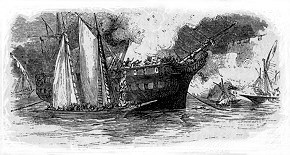
The power of Tripoli was, however, inconsiderable. That of Algiers was more formidable. It is not a little curious that the largest ship of this slave-trading state was the Crescent, of thirty-four guns, built in New Hampshire;113 though it is hardly to the credit of our sister State that the Algerine power derived such important support from her. The lawlessness of the corsair again broke forth by the seizure, in 1812, of the brig Edwin, of Salem, and the enslavement of her crew. All the energies of the country were at this time enlisted in war with Great Britain; but, even amidst the anxieties of this gigantic contest, the voice of these captives was heard, awakening a corresponding sentiment throughout the land, until the government was prompted to seek their release. Through Mr. Noah, recently appointed consul at Tunis, it offered to purchase their freedom at three thousand dollars a head.114 The answer of the Dey, repeated on several occasions, was, that "not for two millions of dollars would he sell his American slaves."115 The timely treaty of Ghent, in 1815, establishing peace with Great Britain, left us at liberty to deal with this enslaver of our countrymen. A naval force was promptly despatched to the Mediterranean, under Commodore Bainbridge and Commodore Decatur. The rapidity of their movements and their striking success had the desired effect. In June, 1815, a treaty was extorted from the Dey of Algiers, by which, after abandoning all claim to tribute in any form, he delivered his American captives, ten in number, without any ransom; and stipulated, that hereafter no Americans should be made slaves or forced to hard labor, and still further, that "any Christians whatever, captives in Algiers," making their escape and taking refuge on board an American ship of war, should be safe from all requisition or reclamation.116
It is related of Decatur, that he walked his deck with impatient earnestness, awaiting the promised signature of the treaty. "Is the treaty signed?" he cried to the captain of the port and the Swedish consul, as they reached the Guerriere with a white flag of truce. "It is," replied the Swede; and the treaty was placed in Decatur's hands. "Are the prisoners in the boat?" "They are." "Every one of them?" "Every one, sir." The captive Americans now came forward to greet and bless their deliverer.117 Surely this moment—when he looked upon his emancipated fellow-countrymen, and thought how much he had contributed to overthrow the relentless system of bondage under which they had groaned—must have been one of the sweetest in the life of that hardy son of the sea. But should I not say, even here, that there is now a citizen of Massachusetts, who, without army or navy, by a simple act of self-renunciation, has given freedom to a larger number of Christian American slaves than was done by the sword of Decatur?
Thus, not by money, but by arms, was emancipation this time secured. The country was grateful for the result; though the poor freedmen, ingulfed in the unknown wastes of ocean, on their glad passage home, were never able to mingle joys with their fellow-citizens. They were lost in the Epervier, of which no trace has ever appeared. Nor did the people feel the melancholy mockery in the conduct of the government, which, having weakly declared that it "was not in any sense founded on the Christian religion," now expressly confined the protecting power of its flag to fugitive "Christians, captives in Algiers," leaving slaves of another faith to be snatched as between the horns of the altar, and returned to the continued horrors of their lot.
The success of the American arms was followed speedily by a more signal triumph of Great Britain, acting generously in behalf of all the Christian powers. Her expedition was debated, perhaps prompted, in the Congress of Vienna, where, after the overthrow of Napoleon, the brilliant representatives of the different states of Europe, in the presence of the monarchs of Austria, Prussia, and Russia, were assembled to consider the evils proper to be remedied by joint action, and to adjust the disordered balance of empire. Among many high concerns, here entertained, was the project of a crusade against the Barbary States, in order to accomplish the complete abolition of Christian slavery there practised. For this purpose, it was proposed to form "a holy league." This was earnestly enforced by a memoir from Sir Sidney Smith, the same who foiled Napoleon at Acre, and who at this time was president of an association called the "Knights Liberators of the White Slaves in Africa,"—in our day it might be called an Abolition Society,—thus adding to the doubtful laurels of war the true glory of striving for the freedom of his fellow-men.118
This project, though not adopted by the Congress, awakened a generous echo in the public mind. Various advocates appeared in its behalf; and what the Congress failed to undertake was now especially urged upon Great Britain, by the agents of Spain and Portugal, who insisted, that, because this nation had abolished the negro slave trade, it was her duty to put an end to the slavery of the whites.119
A disgraceful impediment seemed at first to interfere. There was a common belief that the obstructions of the Barbary States, in the navigation of the Mediterranean, were advantageous to British commerce, by thwarting and strangling that of other countries; and that therefore Great Britain, ever anxious for commercial supremacy, would rather encourage them than seek their overthrow—the love of trade prevailing over the love of man.120 This suggestion of a sordid selfishness, which was willing to coin money out of the lives and liberties of fellow-Christians, was soon answered.
At the beginning of the year 1816, Lord Exmouth, who, as Sir Edward Pellew, had already acquired distinction in the British navy, was despatched with a squadron to Algiers. By his general orders, bearing date, Boyne, Port Mahon, March 21, 1816, he announced the object of his expedition as follows:—
"He has been instructed and directed by his Royal Highness, the Prince Regent, to proceed with the fleet to Algiers, and there make certain arrangements for diminishing, at least, the piratical excursions of the Barbary States, by which thousands of our fellow-creatures, innocently following their commercial pursuits, have been dragged into the most wretched and revolting state of slavery.
"The commander-in-chief is confident that this outrageous system of piracy and slavery rouses in common the same spirit of indignation which he himself feels; and should the government of Algiers refuse the reasonable demands he bears from the Prince Regent, he doubts not but the flag will be honorably and zealously supported by every officer and man under his command, in his endeavors to procure the acceptation of them by force; and if force must be resorted to, we have the consolation of knowing that we fight in the sacred cause of humanity, and cannot fail of success."121
The moderate object of his mission was readily obtained. "Arrangements for diminishing the piratical excursions of the Barbary States" were established. Certain Ionian slaves, claimed as British subjects, were released, and peace was secured for Naples and Sardinia—the former paying a ransom of five hundred dollars, and the latter of three hundred dollars, a head, for their subjects liberated from bondage. This was at Algiers. Lord Exmouth next proceeded to Tunis and Tripoli, where, acting beyond his instructions, he obtained from both these piratical governments a promise to abolish Christian slavery within their dominions. In one of his letters on this event, he says that, in pressing these concessions, he "acted solely on his own responsibility and without orders, the causes and reasoning on which, upon general principles, may be defensible; but, as applying to our own country, may not be borne out, the old mercantile interest being against it."122 A similar distrust had been excited in another age by a similar achievement. Admiral Blake, in the time of Cromwell, after his attack upon Tunis, writing to his government at home, said, "And now, seeing it hath pleased God soe signally to justify us herein, I hope his highness will not be offended at it, nor any who regard duly the honor of our nation, although I expect to have the clamors of interested men."123 Thus, more than once in the history of these efforts to abolish White Slavery, did commerce, the daughter of freedom, fall under the foul suspicion of disloyalty to her parent!
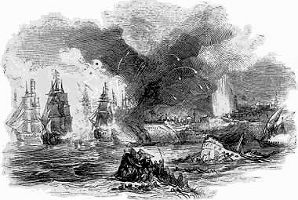
Lord Exmouth did injustice to the moral sense of England. His conduct was sustained and applauded, not only in the House of Commons, but by the public at large. He was soon directed to return to Algiers,—which had failed to make any general renunciation of the custom of enslaving Christians,—to extort by force such a stipulation. This expedition is regarded by British historians with peculiar pride. In all the annals of their triumphant navy, there is none in which the barbarism of war seems so much "to smooth its wrinkled front." With a fleet complete at all points, the Admiral set sail July 25, 1816, on what was deemed a holy war. With five line-of-battle ships, five heavy frigates, four bomb vessels, and five gun brigs, besides a Dutch fleet of five frigates and a corvette, under Admiral Van de Capellan,—who, on learning the object of the expedition, solicited and obtained leave to coöperate,—on the 27th of August he anchored before the formidable fortifications of Algiers. It would not be agreeable or instructive to dwell on the scene of desolation and blood which ensued. Before night the fleet fired, besides shells and rockets, one hundred and eighteen tons of powder, and fifty thousand shot, weighing more than five hundred tons. The citadel and massive batteries of Algiers were shattered and crumbled to ruins. The storehouses, ships, and gun boats were in flames, while the blazing lightnings of battle were answered, in a storm of signal fury, by the lightnings of heaven. The power of the Great Slave Dealer was humbled.
The terms of submission were announced to his fleet by the Admiral in an order, dated, Queen Charlotte, Algiers Bay, August 30, 1816, which may be read with truer pleasure than any in military or naval history.
"The commander-in-chief," he said, "is happy to inform the fleet of the final termination of their strenuous exertions, by the signature of peace, confirmed under a salute of twenty-one guns, on the following conditions, dictated by his Royal Highness, the Prince Regent of England.
"First. THE ABOLITION OF CHRISTIAN SLAVERY FOREVER.
"Second. The delivery to my flag of all slaves in the dominions of the Dey, to whatever nation they may belong, at noon to-morrow.
"Third. To deliver also to my flag all money received by him for the redemption of slaves since the commencement of this year, at noon also to-morrow."
On the next day, twelve hundred slaves were emancipated, making, with those liberated in his earlier expedition, more than three thousand, whom, by address or force, Lord Exmouth had delivered from bondage.124
Thus ended White Slavery in the Barbary States. It had already died out in Morocco. It had been quietly renounced by Tripoli and Tunis. Its last retreat was Algiers, whence it was driven amidst the thunder of the British cannon.
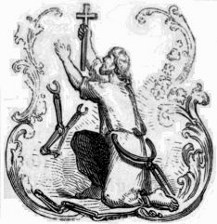
Signal honors now awaited the Admiral. He was elevated to a new rank in the peerage, and on his coat of arms was emblazoned a figure never before known in heraldry—a Christian slave holding aloft the cross and dropping his broken fetters.125 From the officers of the squadron he received a costly service of plate, with an inscription, in testimony of "the memorable victory gained at Algiers, where the great cause of Christian freedom was bravely fought and nobly accomplished."126 But higher far than honor were the rich personal satisfactions which he derived from contemplating the nature of the cause in which he had been enlisted. In his despatch to the government, describing the battle, and written at the time, he says, in words which may be felt by others, engaged, like him, against slavery, "In all the vicissitudes of a long life of public service, no circumstance has ever produced on my mind such impressions of gratitude as the event of yesterday. To have been one of the humble instruments in the hands of divine Providence for bringing to reason a ferocious government, and destroying forever the insufferable and horrid system of Christian slavery, can never cease to be a source of delight and heartfelt comfort to every individual happy enough to be employed in it."127
The reverses of Algiers did not end here. Christian slavery was abolished; but, in 1830, the insolence of this barbarian government aroused the vengeance of France to take military possession of the whole country. Algiers capitulated, the Dey abdicated, and this considerable state became a French colony.
Thus I have endeavored to present what I could glean in various fields on the history of Christian Slavery in the Barbary States. I have often employed the words of others, as they seemed best calculated to convey the exact idea of the scene, incident, or sentiment which I wished to preserve. So doing, I have occupied much time; but I may find my apology in the words of an English chronicler.128 "Algier," he says, "were altogether unworthy so long a discourse, were not the unworthinesse worthy our consideration. I meane the cruell abuse of the Christian name, which let us for inciting our zeale and exciting our charitie and thankfulness more deeply weigh, to releeve those in miseries, as we may, with our paynes, prayers, purses, and all the best meditations."
III.
It is by a natural transition that I am now conducted to the inquiry into the true character of the evil whose history has been traced. And here I shall be brief.
The slavery of Christians by the Barbary States is regarded as an unquestionable outrage upon humanity and justice. Nobody hesitates in this judgment. Our liveliest sympathies attend these white brethren—torn from their homes, the ties of family and friendship rudely severed, parent separated from child and husband from wife, exposed at public sale like cattle, and dependent, like cattle, upon the uncertain will of an arbitrary taskmaster. We read of a "gentleman" who was compelled to be the valet of the barbarian Emperor of Morocco;129 and Calderon, the pride of the Spanish stage, has depicted the miserable fate of a Portuguese prince, condemned by infidel Moors to carry water in a garden. But the lowly in condition had their unrecorded sorrows also, whose sum total must swell to a fearful amount. Who can tell how many hearts have been wrung by the pangs of separation, how many crushed by the comfortless despair of interminable bondage? "Speaking as a Christian," says the good Catholic father who has chronicled much of this misery, "if on the earth there can be any condition which, in its character and evils, may represent in any manner the dolorous passion of the Son of God, (which exceeded all evils and torments, because by it the Lord suffered every kind of evil and affliction,) it is, beyond question and doubt, none other than slavery and captivity in Algiers and Barbary, whose infinite evils, terrible torments, miseries without number, afflictions without mitigation, it is impossible to comprehend in a brief span of time."130 When we consider the author's character, as a father of the Catholic Church, it will be felt that language can no further go.
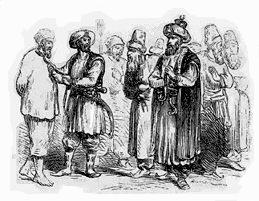
In nothing are the impiety and blasphemy of this custom more apparent than in the auctions of human beings, where men were sold to the highest bidder. Through the personal experience of a young English merchant, Abraham Brown, afterwards a settler in Massachusetts, we may learn how these were conducted. In 1655, before the liberating power of Cromwell had been acknowledged, he was captured, together with a whole crew, and carried into Sallee. His own words, in his memoirs still preserved, will best tell his story.131 "On landing," he says, "an exceeding great company of most dismal spectators were led to behold us in our captivated condition. There was liberty for all sorts to come and look on us, that whosoever had a mind to buy any of us on the day appointed for our sale together in the market, might see, as I may say, what they would like to have for their money; whereby we had too many comfortless visitors, both from the town and country, one saying he would buy this man, and the other that. To comfort us, we were told by the Christian slaves already there, if we met with such and such patrons, our usage would not be so bad as we supposed; though, indeed, our men found the usage of the best bad enough. Fresh victuals and bread were supplied, I suppose to feed us up for the market, that we might be in some good plight against the day we were to be sold. And now I come to speak of our being sold into this doleful slavery. It was doleful in respect to the time and manner. As to the time, it was on our Sabbath day, in the morning, about the time the people of God were about to enjoy the liberty of God's house; this was the time our bondage was confirmed. Again, it was sad in respect to the manner of our selling. Being all of us brought into the market-place, we were led about, two or three at a time, in the midst of a great concourse of people, both from the town and country, who had a full sight of us, and if that did not satisfy, they would come and feel of your hand, and look into your mouth to see whether you are sound in health, or to see, by the hardness of your hand, whether you have been a laborer or not. The manner of buying is this: He that bids the greatest price hath you; they bidding one upon another until the highest has you for a slave, whoever he is, or wherever he dwells. As concerning myself, being brought to the market in the weakest condition of any of our men, I was led forth among the cruel multitude to be sold. As yet being undiscovered what I was, I was like to have been sold at a very low rate, not above £15 sterling, whereas our ordinary seamen were sold for £30 and £35 sterling, and two boys were sold for £40 apiece; and being in this sad posture led up and down at least one hour and a half, during which time a Dutchman, that was our carpenter, discovered me to some Jews, they increased from £15 to £75, which was the price my patron gave for me, being 300 ducats; and had I not been so weakened, and in these rags, (indeed, I made myself more so than I was, for sometimes, as they led me, I pretended I could not go, and did often sit down;) I say, had not these things been, in all likelihood I had been sold for as much again in the market, and thus I had been dearer, and the difficulty greater to be redeemed. During the time of my being led up and down the market, I was possessed with the greatest fears, not knowing who my patron might be. I feared it might be one from the country, who would carry me where I could not return, or it might be one in and about Sallee, of which we had sad accounts; and many other distracting thoughts I had. And though I was like to have been sold unto the most cruel man in Sallee, there being but one piece of eight between him and my patron, yet the Lord was pleased to cause him to buy me, of whom I may speak, to the glory of God, as the kindest man in the place."
This is the story of a respectable person, little distinguished in the world. But the slave dealer applied his inexorable system without distinction of persons. The experiences of St. Vincent de Paul did not differ from those of Abraham Brown. That eminent character, admired, beloved and worshipped by large circles of mankind, has also left a record of his sale as a slave.132 "Their proceedings," he says, "at our sale were as follows: After we had been stripped, they gave to each one of us a pair of drawers, a linen coat, with a cap, and paraded us through the city of Tunis, where they had come expressly to sell us. Having made us make five or six turns through the city, with the chain at our necks, they conducted us back to the boat, that the merchants might come to see who could eat well, and who not; and to show that our wounds were not mortal. This done, they took us to the public square, where the merchants came to visit us, precisely as they do at the purchase of a horse or of cattle, making us open the mouth to see our teeth, feeling our sides, searching our wounds, and making us move our steps, trot and run, then lift burdens, and then wrestle, in order to see the strength of each, and a thousand other sorts of brutalities."
And here we may refer again to Cervantes, whose pen was dipped in his own dark experience. In his Life in Algiers, he has displayed the horrors of the white slave market. The public crier exposes for sale a father and mother with their two children. They are to be sold separately, or, according to the language of our day, "in lots to suit purchasers." The father is resigned, confiding in God; the mother sobs; while the children, ignorant of the inhumanity of men, show an instinctive trust in the constant and wakeful protection of their parents—now, alas! impotent to shield them from dire calamity. A merchant, inclining to purchase one of the "little ones," and wishing to ascertain his bodily condition, causes him to open his mouth. The child, still ignorant of the doom which awaits him, imagines that the inquirer is about to extract a tooth, and, assuring him that it does not ache, begs him to desist. The merchant, in other respects an estimable man, pays one hundred and thirty dollars for the youngest child, and the sale is completed. Thus a human being—one of those children of whom it has been said, "Of such is the kingdom of heaven"—is profanely treated as an article of merchandise, and torn far away from a mother's arms and a father's support. The hardening influence of custom has steeled the merchant into insensibility to this violation of humanity and justice, this laceration of sacred ties, this degradation of the image of God. The unconscious heartlessness of the slave dealer, and the anguish of his victims, are depicted in the dialogue which ensues after the sale.133
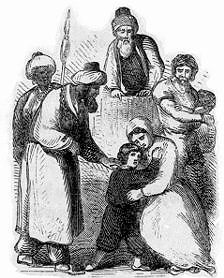
MERCHANT. Come hither, child; 'tis time to go to rest. JUAN. Signor, I will not leave my mother here, To go with any one. MOTHER. Alas! my child, thou art no longer mine, But his who bought thee. JUAN. What! then, have you, mother, Forsaken me? MOTHER. O Heavens! how cruel are ye! MERCHANT. Come, hasten, boy. JUAN. Will you go with me, brother? FRANCISCO. I cannot, Juan, 'tis not in my power;— May Heaven protect you, Juan! MOTHER. O my child, My joy and my delight, God won't forget thee! JUAN. O father! mother! whither will they bear me Away from you? MOTHER. Permit me, worthy Signor, To speak a moment in my infant's ear. Grant me this small contentment; very soon I shall know nought but grief. MERCHANT. What you would say, Say now; to-night is the last time. MOTHER. To-night Is the first time my heart e'er felt such grief. JUAN. Pray keep me with you, mother, for I know not Whither he'd carry me. MOTHER. Alas, poor child! Fortune forsook thee even at thy birth. The heavens are overcast, the elements Are turbid, and the very sea and winds Are all combined against me. Thou, my child, Know'st not the dark misfortunes into which Thou art so early plunged, but happily Lackest the power to comprehend thy fate. What I would crave of thee, my life, since I Must never more be blessed with seeing thee, Is that thou never, never wilt forget To say, as thou wert wont, thy Ave Mary; For that bright queen of goodness, grace, and virtue Can loosen all thy bonds and give thee freedom. AYDAR. Behold the wicked Christian, how she counsels Her innocent child! You wish, then, that your child Should, like yourself, continue still in error. JUAN. O mother, mother, may I not remain? And must these Moors, then, carry me away? MOTHER. With thee, my child, they rob me of my treasures. JUAN. O, I am much afraid! MOTHER. 'Tis I, my child, Who ought to fear at seeing thee depart. Thou wilt forget thy God, me, and thyself. What else can I expect from thee, abandoned At such a tender age, amongst a people Full of deceit and all iniquity? CRIER. Silence, you villainous woman! if you would not Have your head pay for what your tongue has done.
From this scene we gladly avert the countenance, while, from the bottom of our hearts, we send our sympathies to the unhappy sufferers. Fain would we avert their fate; fain would we destroy the system of slavery, that has made them wretched and their masters cruel. And yet we would not judge with harshness an Algerine slave owner. He has been reared in a religion of slavery; he has learned to regard Christians, "guilty of a skin not colored like his own," as lawful prey; and has found sanctions for his conduct in the injunctions of the Koran, in the custom of his country, and in the instinctive dictates of an imagined self-interest. It is, then, the "peculiar institution" which we are aroused to execrate, rather than the Algerine slave masters, who glory in its influence, and,
so perfect is their misery, Not once perceive their foul disfigurement, But boast themselves more comely than before.
But there is reason to believe that the sufferings of the white slaves were not often greater than is the natural incident of slavery. There is an important authority which presents this point in an interesting light. It is that of General Eaton, for some time consul of the United States at Tunis, and whose name is not without note in the painful annals of war. In a letter to his wife, dated at Tunis, April 6, 1799, and written amidst opportunities of observation such as few have enjoyed, he briefly describes the condition of this unhappy class, illustrating it by a comparison less flattering to our country than to Barbary. "Many of the Christian slaves," he says, "have died of grief, and the others linger out a life less tolerable than death. Alas! remorse seizes my whole soul, when I reflect that this is, indeed, a copy of the very barbarity which my eyes have seen in my own native country. And yet we boast of liberty and national justice. How frequently have I seen in the Southern States of our own country weeping mothers leading guiltless infants to the sales with as deep anguish as if they led them to the slaughter, and yet felt my bosom tranquil in the view of these aggressions upon defenceless humanity! But when I see the same enormities practised upon beings whose complexion and blood claim kindred with my own, I curse the perpetrators, and weep over the wretched victims of their rapacity. Indeed, truth and justice demand from me the confession that the Christian slaves among the barbarians of Africa are treated with more humanity than the African slaves among the professing Christians of civilized America; and yet here sensibility bleeds at every pore for the wretches whom fate has doomed to slavery."134
Such testimony would seem to furnish a decisive standard or measure of comparison by which to determine the character of White Slavery in the Barbary States. But there are other considerations and authorities. One of these is the influence of the religion of these barbarians. Travellers remark the generally kind treatment bestowed by Mohammedans upon slaves.135 The lash rarely, if ever, lacerates the back of the female; the knife or branding iron is not employed upon any human being to mark him as the property of his fellow-man. Nor is the slave doomed, as in other countries, where the Christian religion is professed, to unconditional and perpetual service, without prospect of redemption. Hope, the last friend of misfortune, may brighten his captivity. He is not so walled around by inhuman institutions as to be inaccessible to freedom. "And unto such of your slaves," says the Koran, in words worthy of adoption in the legislation of Christian countries, "as desire a written instrument, allowing them to redeem themselves on paying a certain sum, write one, if ye know good in them, and give them of the riches of God, which he hath given you."136 Thus from the Koran, which ordains slavery, come lessons of benignity to the slave; and one of the most touching stories in Mohammedanism is of the generosity of Ali, the companion of the Prophet, who, after fasting for three days, gave his whole provision to a captive not more famished than himself.137
Such precepts and examples doubtless had their influence in Algiers. It is evident, from the history of the country, that the prejudice of race did not so far prevail as to stamp upon the slaves and their descendants any indelible mark of exclusion from power and influence. It often happened that they arrived at eminent posts in the state. The seat of the Deys, more than once, was filled by humble Christian captives, who had tugged for years at the oar.138
Nor do we feel, from the narratives of captives and of travellers, that the condition of the Christian slave was rigorous beyond the ordinary lot of slavery. "The Captive's Story" in Don Quixote fails to impress the reader with any peculiar horror of the life from which he had escaped. It is often said that the sufferings of Cervantes were among the most severe which even Algiers could inflict.139 But they did not repress the gayety of his temper; and we learn that in the building where he was confined there was a chapel or oratory, in which mass was celebrated, the sacrament administered, and sermons regularly preached by captive priests.140 Nor was this all. The pleasures of the theatre were enjoyed by these slaves; and the farces of Lopé de Rueda, a favorite Spanish dramatist of the time, served, in actual representation, to cheer this house of bondage.141
The experience of the devoted Portuguese ecclesiastic, Father Thomas, illustrates this lot. A slave in Morocco, he was able to minister to his fellow-slaves, and to compose a work on the Passion of Jesus Christ, which has been admired for its unction, and translated into various tongues. At last liberated through the intervention of the Portuguese ambassador, he chose to remain behind, notwithstanding the solicitations of relatives at home, that he might continue to instruct and console the unhappy men, his late companions in bonds.142
Even the story of St. Vincent de Paul, so brutally sold in the public square, is not without its gleams of light. He was bought by a fisherman, who was soon constrained to get rid of him, "having nothing so contrary except the sea." He then passed into the hands of an old man, whom he pleasantly describes as a chemical doctor, a sovereign maker of quintessences, very humane and kind, who had labored for the space of fifty years in search of the philosopher's stone. "He loved me much," says the fugitive slave, "and pleased himself by discoursing to me of alchemy, and then of his religion, to which he made every effort to draw me, promising me riches and all his wisdom." On the death of this master, he passed to a nephew, by whom he was sold to still another person, a renegade from Nice, who took him to the mountains, where the country was extremely hot and desert. A Turkish wife of the renegade becoming interested in him, and curious to know his manner of life at home, visited him daily at his work in the fields, and listened with delight to the slave, away from his country and the churches of his religion, as he sang the psalm of the children of Israel in a foreign land: "By the rivers of Babylon there we sat down; yea, we wept when we remembered Zion."143
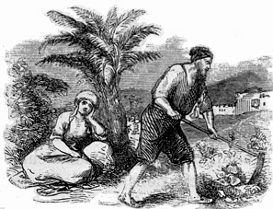
The kindness of the slave master often appears. The English merchant Abraham Brown, whose sale at Sallee has been already described, makes known, in his memoirs, that, after he had been carried to the house of his master, his wounds were tenderly washed and dressed by his master's wife, and "indeed the whole family gave him comfortable words." He was furnished with a mat to lie on, "and some three or four days after provided with a shirt, such a one as it was, a pair of shoes, and an old doublet." His servile toils troubled him less than "being commanded by a negro man, who had been a long time in his patron's house a freeman, at whose beck and command he was obliged to be obedient for the doing of the least about the house or mill;" and he concludes his lament on this degradation as follows: "Thus I, who had commanded many men in several parts of the world, must now be commanded by a negro, who, with his two countrywomen in the house, scorned to drink out of the water pot I drank of, whereby I was despised of the despised people of the world."144
At a later day we are furnished with another authentic picture. Captain Braithwaite, who accompanied the British minister to Morocco in 1727, in order to procure the liberation of the British captives, after describing their comfortable condition, adds, "I am sure we saw several captives who lived much better in Barbary than ever they did in their own country. Whatever money in charity was sent them by their friends in Europe was their own, unless they defrauded one another, which has happened much oftener than by the Moors. Several of them are rich, and many have carried considerable sums out of the country, to the truth of which we are all witnesses. Several captives keep their mules, and some their servants; and yet this is called insupportable slavery among Turks and Moors. But we found this, as well as many other things in this country, strangely misrepresented."145
These statements—which, to those who do not place freedom above all price, may seem, at first view, to take the sting even from slavery—are not without support from other sources. Colonel Keatinge, who, as a member of a diplomatic mission from England, visited Morocco in 1785, says of this evil there, that "it is very slightly inflicted, and as to any labor undergone, it does not deserve the name;"146 while Mr. Lemprière, who was in the same country not long afterwards, adds, "To the disgrace of Europe, the Moors treat their slaves with humanity."147 In Tripoli, we are told, by a person for ten years a resident, that the same gentleness prevailed. "It is a great alleviation to our feelings," says the writer, speaking of the slaves, "to see them easy and well dressed, and, so far from wearing chains, as captives do in most other places, they are perfectly at liberty."148 We have already seen the testimony of General Eaton with regard to slavery in Tunis; while Mr. Noah, one of his successors in the consulate of the United States at that place, says, "In Tunis, from my observation, the slaves are not severely treated; they are very useful, and many of them have made money."149 And Mr. Shaler, describing the chief seat of Christian slavery, says, "In short, there were slaves who left Algiers with regret."150
A French writer of more recent date asserts with some vehemence, and with the authority of an eye witness, that the Christian slaves at Algiers were not exposed to the miseries which they represented. I do not know that he vindicates their slavery, but, like Captain Braithwaite, he evidently regards many of them as better off than they would be at home. According to him, they were well clad and well fed, much better than the free Christians there. The youngest and most comely were taken as pages by the Dey. Others were employed in the barracks; others in the galleys; but even here there was a chapel, as in the time of Cervantes, for the free exercise of the Christian religion. Those who happened to be artisans, as carpenters, locksmiths, and calkers, were let to the owners of vessels. Others were employed on the public works; while others still were allowed the privilege of keeping a shop, in which their profits were sometimes so large as to enable them at the end of a year to purchase their ransom. But these were often known to become indifferent to freedom, and to prefer Algiers to their own country. The slaves of private persons were sometimes employed in the family of their master, where their treatment necessarily depended much upon his character. If he were gentle and humane, their lot was fortunate; they were regarded as children of the house. If he were harsh and selfish, then the iron of slavery did, indeed, enter their souls. Many were bought to be sold again for profit into distant parts of the country, where they were doomed to exhausting labor; in which event their condition was most grievous. But special care was bestowed upon all who became ill—not so much, it is admitted, from humanity as through fear of losing them.151
But, whatever deductions may be made from the familiar stories of White Slavery in the Barbary States,—admitting that it was mitigated by the genial influence of Mohammedanism,—that the captives were well clad and well fed, much better than the free Christians there,—that they were allowed opportunities of Christian worship,—that they were often treated with lenity and affectionate care,—that they were sometimes advanced to posts of responsibility and honor,—and that they were known, in their contentment or stolidity, to become indifferent to freedom,—still the institution or custom is hardly less hateful in our eyes. Slavery in all its forms, even under the mildest influences, is a wrong and a curse. No accidental gentleness of the master can make it otherwise. Against it reason, experience, the heart of man, all cry out. "Disguise thyself as thou wilt, still, Slavery! thou art a bitter draught! and though thousands in all ages have been made to drink of thee, thou art no less bitter on that account." Algerine Slavery was a violation of the law of nature and of God. It was a usurpation of rights not granted to man.
O execrable son, so to aspire Above his brethren, to himself assuming Authority usurped, from God not given! He gave us only over beast, fish, fowl, Dominion absolute; that right we hold By his donation; but man over men He made not lord, such title to himself Reserving, human left from human free.152
Such a relation, in defiance of God, could not fail to accumulate disastrous consequences upon all in any way parties to it; for injustice and wrong are fatal alike to the doer and the sufferer. It is notorious that, in Algiers, it exerted a most pernicious influence on master as well as slave. The slave was crushed and degraded, his intelligence abased, even his love of freedom extinguished. The master, accustomed from childhood to revolting inequalities of condition, was exalted into a mood of unconscious arrogance and self-confidence, inconsistent with the virtues of a pure and upright character. Unlimited power is apt to stretch towards license; and the wives and daughters of Christian slaves were often pressed to be the concubines of their Algerine masters.153
It is well, then, that it has passed away! The Barbary States seem less barbarous, when we no longer discern this cruel oppression!
But the story of slavery there is not yet all told. While the Barbary States received white slaves by sea, stolen by corsairs, they also, from time immemorial, imported black slaves from the south. Over the vast, illimitable sea of sand, in which is absorbed their southern border,—traversed by camels, those "ships of the desert,"—were brought those unfortunate beings, as merchandise, with gold dust and ivory, doomed often to insufferable torments, while cruel thirst parched the lips, and tears vainly moistened the eyes. They also were ravished from their homes, and, like their white brethren from the north, compelled to taste of slavery. In numbers they have far surpassed their Christian peers. But for long years no pen or voice pleaded their cause; nor did the Christian nations—professing a religion which teaches universal humanity, without respect of persons, and sends the precious sympathies of neighborhood to all who suffer, even at the farthest pole—ever interfere in any way in their behalf. The navy of Great Britain, by the throats of their artillery, argued the freedom of all fellow-Christians, without distinction of nation; but they heeded not the slavery of other brethren in bonds—Mohammedans or idolaters, children of the same Father in heaven. Lord Exmouth did but half his work. In confining the stipulation to the abolition of Christian slavery only, this Abolitionist made a discrimination, which, whether founded on religion or color, was selfish and unchristian. Here, again, was the same inconsistency which darkened the conduct of Charles the Fifth, and has constantly recurred throughout the history of this outrage. Forgetful of the Brotherhood of the Race, Christian powers have deemed the slavery of blacks just and proper, while the slavery of whites has been branded as unjust and sinful.
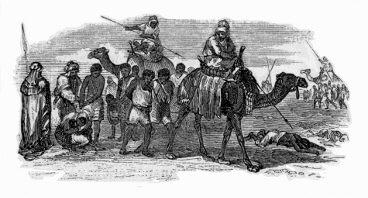
As the British fleet sailed proudly from the harbor of Algiers, bearing its emancipated white slaves, and the express stipulation, that Christian slavery was abolished there forever, it left behind in bondage large numbers of blacks, distributed throughout all the Barbary States. Neglected thus by exclusive and unchristian Christendom, it is pleasant to know that their lot is not always unhappy. In Morocco, negroes are still detained as slaves; but the prejudice of color seems not to prevail there. They have been called "the grand cavaliers of this part of Barbary."154 They often become the chief magistrates and rulers of cities.155 They constituted the body guard of several of the emperors, and, on one occasion at least, exercised the prerogative of the Prætorian cohorts, in dethroning their master.156 If negro slavery still exists in this state, it has little of the degradation connected with it elsewhere. Into Algiers France has already carried the benign principle of law—earlier recognized by her than by the English courts157—which secures freedom to all beneath its influence. And now we are cheered anew by the glad tidings recently received, that the Bey of Tunis, "for the glory of God, and to distinguish man from the brute creation," has decreed the total abolition of human slavery throughout his dominions.
Let us, then, with hope and confidence, turn to the Barbary States! The virtues and charities do not come singly. Among them is a common bond, stronger than that of science or knowledge. Let one find admission, and a goodly troop will follow. Nor is it unreasonable to anticipate other improvements in states which have renounced a long-cherished system of White Slavery, while they have done much to abolish or mitigate the slavery of others not white, and to overcome the inhuman prejudice of color. The Christian nations of Europe first declared, and practically enforced, within their own European dominions, the vital truth of freedom, that man cannot hold property in his brother man. Algiers and Tunis, like Saul of Tarsus, have been turned from the path of persecution, and now receive the same faith. Algiers and Tunis now help to plead the cause of Freedom. Such a cause is in sacred fellowship with all those principles which promote the Progress of Man. And who can tell that this despised portion of the globe is not destined to yet another restoration? It was here in Northern Africa that civilization was first nursed, that commerce early spread her white wings, that Christianity was taught by the honeyed lips of Augustine. All these are again returning to their ancient home. Civilization, commerce, and Christianity once more shed their benignant influences upon the land to which they have long been strangers. A new health and vigor now animate its exertions. Like its own giant Antæus,—whose tomb is placed by tradition among the hillsides of Algiers,—it has been often felled to the earth, but it now rises with renewed strength, to gain yet higher victories.
Transcriber's Note: Delivered as a Lecture before the Boston Mercantile Library Association, February 17, 1847; this illustrated version published in 1853. Spelling varieties as in "stanch" (staunch) have been maintained.