WHITE HEATHER (VOL. III) (continued 2)
Reading edition
'Ronald!'
She seized his hand and held it.
'Ronald, you will not do that!'
Well, he was startled by the sudden pallor of her face; and bewildered by the entreaty so plainly visible in the beautiful eyes; and perhaps he did not quite know how he answered. But he spoke quickly.
'Oh, of course I will not do that,' he said, 'of course I will not do that, Miss Douglas, so long as you are in Glasgow. How could I? Why, the chance of seeing you, even at a distance—for a moment even—I would wait days for that. When I made up my mind to enlist, I had no thought that I might ever have the chance of seeing you. Oh no; I will wait until you have gone back to the Highlands—how could I go away from Glasgow and miss any single chance of seeing you, if only for a moment?'
'Yes, yes,' she said eagerly, 'you will do nothing until then, anyway; and in the meantime I shall see you often——'
His face lighted up with surprise.
'Will you be so kind as that?' he said quickly. And then he dropped her hand. 'No, no. I am so bewildered by the gladness of seeing you that—that I forgot. Let me go my own way. You were always so generous in your good nature that you spoiled us all at Inver-Mudal; here—here it is different. You are living with your sister, I suppose? and of course you have many friends, and many things to do and places to visit. You must not trouble about me; but as long as you are in Glasgow—well, there will always be the chance of my catching a glimpse of you—and if you knew what it was—to me——'
But here he paused abruptly, fearful of offending by confessing too much; and now they had resumed their leisurely walking along the half-dried pavements; and Meenie was revolving certain little schemes and artifices in her brain—with a view to their future meeting. And the morning had grown so much brighter; and there was a pleasant warmth of sunlight in the air; and she was glad to know that at least for a time Ronald would not be leaving the country. She turned to him with a smile.
'I shall have to be going back home now,' she said, 'but you will not forget, Ronald, that you have made me two promises this morning.'
'It's little you know, Miss Douglas,' said he, 'what I would do for you, if I but knew what ye wished. I mean for you yourself. For my own self, I care but little what happens to me. I have made a mistake in my life somehow. I——'
'Then will you promise me more, Ronald?' said she quickly; for she would not have him talk in that strain.
'What?'
'Will you make me a promise that you will not enlist at all?'
'I will, if it is worth heeding one way or the other.'
'But make me the promise,' said she, and she regarded him with no unfriendly eyes.
'There's my hand on't.'
'And another—that you will work hard and try and get the forestry certificate?'
'What's the use of that, lass?' said he, forgetting his respect for her. 'I have put all that away now. That's all away beyond me now.'
'No,' she said proudly. 'No. It is not. Oh, do you think that the people who know you do not know what your ability is? Do you think they have lost their faith in you? Do you think they are not still looking forward and hoping the time may come that they may be proud of your success, and—and—come and shake hands with you, Ronald—and say how glad they are? And have you no regard for them, or heed for their—their affection towards you?'
Her cheeks were burning red, but she was far too much in earnest to measure her phrases; and she held his hand in an imploring kind of way; and surely, if ever a brave and unselfish devotion and love looked out from a woman's eyes, that was the message that Meenie's eyes had for him then.
'I had a kind of fancy,' he said, 'that if I could get abroad—with one o' those Highland regiments—there might come a time when I could have the chance of winning the V.C.—the Victoria Cross, I mean; ay, and it would have been a proud day for me the day that I was able to send that home to you.'
'To me, Ronald?' she said, rather faintly.
'Yes, yes,'said he. 'Whatever happened to me after that day would not matter much.'
'But you have promised——'
'And I will keep that promise, and any others you may ask of me, Miss Douglas.'
'That you will call me Meenie, for one?' she said, quite simply and frankly.
'No, no; I could not do that,' he answered—and yet the permission sounded pleasant to the ear.
'We are old friends, Ronald,' she said. 'But that is a small matter. Well, now, I must be getting back home; and yet I should like to see you again soon, Ronald, for there are so many things I have to talk over with you. Will you come and see my sister?'
His hesitation and embarrassment were so obvious that she instantly repented her of having thrown out this invitation; moreover, it occurred to herself that there would be little chance of her having any private speech of Ronald (which was of such paramount importance at this moment) if he called at Queen's Crescent.
'No, not yet,' she said, rather shamefacedly and with downcast eyes; 'perhaps, since—since there are one or two private matters to talk over, we—we could meet just as now? It is not—taking up too much of your time, Ronald?'
'Why,' said he, 'if I could see you for a moment, any day—merely to say "good morning"—that would be a well-spent day for me; no more than that used to make many a long day quite happy for me at Inver-Mudal.'
'Could you be here to-morrow at eleven, Ronald?' she asked, looking up shyly.
'Yes, yes, and gladly!' he answered; and presently they had said good-bye to each other; and she had set out for Queen's Crescent by herself; while he turned towards the east.
And now all his being seemed transfused with joy and deep gratitude; and the day around him was clear and sweet and full of light; and all the world seemed swinging onward in an ether of happiness and hope. The dreaded interview!—where was the reproach and scorn of it? Instead of that it had been all radiant with trust and courage and true affection; and never had Meenie's eyes been so beautiful and solicitous with all good wishes; never had her voice been so strangely tender, every tone of it seeming to reach the very core of his heart. And how was he to requite her for this bountiful care and sympathy—that overawed him almost when he came to think of it? Nay, repayment of any kind was all impossible: where was the equivalent of such generous regard? But at least he could faithfully observe the promises he had made—yes, these and a hundred more; and perhaps this broken life of his might still be of some small service, if in any way it could win for him a word of Meenie's approval.
And then, the better to get away from temptation, and to cut himself wholly adrift from his late companions, he walked home to his lodgings and packed up his few things and paid his landlady a fortnight's rent in lieu of notice, as had been agreed upon. That same night he was established in new quarters, in the Garscube Road; and he had left no address behind him; so that if Kate Menzies, or the skipper, or any of his cronies of the Harmony Club were to wonder at his absence and seek to hunt him out, they would seek and hunt in vain.
CHAPTER VI.
CONFESSION.
That night he slept long and soundly, and his dreams were all about Inver-Mudal and the quiet life among the hills; and, strangely enough, he fancied himself there, and Meenie absent; and always he was wondering when she was coming back from Glasgow town, and always he kept looking for her as each successive mail-cart came through from the south. And then in the morning, when he awoke, and found himself in the great city itself, and knew that Meenie was there too, and that in a few hours they were to meet, his heart was filled with joy, and the day seemed rich and full of promise, and the pale and sickly sunlight that struggled in through the window panes and lit up the dusty little room seemed a glorious thing, bringing with it all glad tidings. 'You, fortunate Glasgow town!' he had rhymed in the olden days; and this was the welcome that Glasgow town had for Meenie—sunlight, and perhaps a glimpse of blue here and there, and a light west wind blowing in from the heights of Dowanhill and Hillhead.
He dressed with particular care; and if his garments were not of the newest fashionable cut, at least they clung with sufficient grace and simplicity of outline to the manly and well-set figure. And he knew himself that he was looking less haggard than on the previous day. He was feeling altogether better; the long and sound sleep had proved a powerful restorative; and his heart was light with hope. The happy sunlight shining out there on the gray pavements and the gray fronts of the houses!—was there ever in all the world a fairer and joyfuller city than this same Glasgow town?
He was in Blythswood Square long before the appointed hour; and she also was a little early. But this, time it was Meenie who was shy and embarrassed; she was not so earnest and anxious as she had been the day before, for much of her errand was now satisfactorily accomplished; and when, after a moment's hesitation, he asked her whether she would not go and have a look at the terraces and trees in the West End Park, it seemed so like two lovers setting out for a walk together that the conscious blood mantled in her cheeks, and her eyes were averted. But she strove to be very business-like; and asked him a number of questions about Mr. Weems; and wondered that the Americans had said nothing further about the purchase of an estate in the Highlands, of which there had been some little talk. In this way—and with chance remarks and inquiries about Maggie, and the Reverend Andrew, and Mr. Murray, and Harry the terrier, and what not—they made their way through various thoroughfares until they reached the tall gates of the West End Park.
Here there was much more quietude than in those noisy streets; and when they had walked along one of the wide terraces, until they came to a seat partly surrounded by shrubs, Meenie suggested that they might sit down there, for she wished to reason seriously with him. He smiled a little; but he was very plastic in her hands. Nay, was it not enough merely to hear Meenie speak—no matter what the subject might be? And then he was sitting by her side, with all that wide prospect stretched out before them—the spacious terraces, the groups of trees, the curving river, and the undulating hills beyond. It was a weird kind of a morning, moreover; for the confused and wan sunlight kept struggling through the ever-changing mist, sometimes throwing a coppery radiance on the late autumn foliage, or again shining pale and silver-like as the fantastic cloud-wreaths slowly floated onward. The view before them was mysterious and vast because of its very vagueness; and even the new University buildings—over there on the heights above the river—looked quite imposing and picturesque, for they loomed large and dusky and remote through the bewildering sunlit haze.
'Now, Ronald,' she said, 'I want you to tell me how it was you came to lose heart so, and to give up what you undertook to do when you left Inver-Mudal. Why, when you left you were full of such high hopes; and every one was sure of your success; and you were all anxiety to begin.'
'That's true, Miss Douglas,' he answered, rather absently. 'I think my head must have been in a kind of a whirl at that time. It seemed so fine and easy a thing to strive for; and I did not stop to ask what use it would be to me, supposing I got it.'
'The use?' she said. 'A better position for yourself—isn't it natural to strive for that? And perhaps, if you did not care much to have more money for yourself—for you have very strange notions, Ronald, about some things—you must see how much kindness can be done to others by people who are well off. I don't understand you at all——'
'Well, then,' said he, shifting his ground, 'I grew sick and tired of the town life. I was never meant for that. Every day——'
'But, Ronald,' she said, interrupting him in a very definite tone of remonstrance, 'you knew that your town life was only a matter of months! And the harder you worked the sooner it would be over! What reason was that?'
'There may have been other reasons,' he said, but rather unwillingly.
'What were they?'
'I cannot tell you.'
'Ronald,' she said, and the touch of wounded pride in her voice thrilled him strangely, 'I have come all the way from the Highlands—and—and done what few girls would have done—for your sake; and yet you will not be frank with me—when all that I want is to see you going straight towards a happier future.'
'I dare not tell you, you would be angry.'
'I am not given to anger,' she answered, calmly, and yet with a little surprised resentment. For she could but imagine that this was some entanglement of debt, or something of the kind, of which he was ashamed to speak; and yet, unless she knew clearly the reasons that had induced him to abandon the project that he had undertaken so eagerly, how was she to argue with him and urge him to resume it?
'Well, then, we'll put it this way,' said he, after a second or two of hesitation—and his face was a little pale, and his eyes were fixed on her with an anxious nervousness, so that, at the first sign of displeasure, he could instantly stop. 'There was a young lass that I knew there—in the Highlands—and she was, oh yes, she was out of my station altogether, and away from me—and yet the seeing her from time to time, and a word now and again, was a pleasure to me, greater maybe than I confessed to myself—the greatest that I had in life, indeed.'
She made no sign, and he continued, slowly and watchfully, and still with that pale earnestness in his face.
'And then I wrote things about her—and amused myself with fancies—well, what harm could that do to her?—so long as she knew nothing about it. And I thought I was doing no harm to myself either, for I knew it was impossible there could be anything between us, and that she would be going away sooner or later, and I too. Yes, and I did go away, and in high feather, to be sure, and everything was to be for the best, and I was to have a fight for money like the rest of them. God help me, lassie, before I was a fortnight in the town, my heart was like to break.'
She sate quite still and silent, trembling a little, perhaps, her eyes downcast, her fingers working nervously with the edge of the small shawl she wore.
'I had cut myself away from the only thing I craved for in the world—just the seeing and speaking to her from time to time, for I had no right to think of more than that; and I was alone and down-hearted; and I began to ask myself what was the use of this slavery. Ay, there might have been a use in it—if I could have said to myself, "Well, now, fight as hard as ye can, and if ye win, who knows but that ye might go back to the north, and claim her as the prize?" But that was not to be thought of. She had never hinted anything of the kind to me, nor I to her; but when I found myself cut away from her like that, the days were terrible, and my heart was like lead, and I knew that I had cast away just everything that I cared to live for. Then I fell in with some companions—a woman cousin o' mine and some friends of hers—and they helped to make me forget what I didna wish to think of, and so the time passed. Well, now, that is the truth; and ye can understand, Miss Douglas, that I have no heart to begin again, and the soldiering seemed the best thing for me, and a rifle-bullet my best friend. But—but I will keep the promise I made to ye—that is enough on that score; oh yes, I will keep that promise, and any others ye may care to ask; only I cannot bide in Glasgow.'
He heard a faint sob; he could see that tears were gliding stealthily down her half-hidden face; and his heart was hot with anger against himself that he had caused her this pain. But how could he go away? A timid hand sought his, and held it for a brief moment with a tremulous clasp.
'I am very sorry, Ronald,' she managed to say, in a broken voice. 'I suppose it could not have been otherwise—I suppose it could not have been otherwise.'
For some time they sate in silence—though he could hear an occasional half-stifled sob. He could not pretend to think that Meenie did not understand; and this was her great pity for him; she did not drive him away in anger—her heart was too gentle for that.
'Miss Douglas,' said he at length, 'I'm afraid I've spoiled your walk for you wi' my idle story. Maybe the best thing I can do now is just to leave you.'
'No—stay,' she said, under her breath; and she was evidently trying to regain her composure. 'You spoke—you spoke of that girl—O Ronald, I wish I had never come to Glasgow!—I wish I had never heard what you told me just now!'
And then, after a second—
'But how could I help it—when I heard what was happening to you, and all the wish in the world I had was to know that you were brave and well and successful and happy? I could not help it! ... And now—and now—Ronald,' she said, as if with a struggle against that choking weight of sobs; for much was demanded of her at this moment; and her voice seemed powerless to utter all that her heart prompted her to say, 'if—if that girl you spoke of—if she was to see clearly what is best for her life and for yours—if she was to tell you to take up your work again, and work hard, and hard, and hard—and then, some day, it might be years after this, when you came back again to the north, you would find her still waiting?——'
'Meenie!'
He grasped her hand: his face was full of a bewilderment of hope—not joy, not triumph, but as if he hardly dared to believe what he had heard.
'O Ronald,' she said, in a kind of wild way,—and she turned her wet eyes towards him in full, unhesitating abandonment of affection and trust, nor could she withdraw the hand that he clasped so firmly,—'what will you think of me?—what will you think of me?—but surely there should be no hiding or false shame, and surely there is for you and for me in the world but the one end to hope for; and if not that—why, then, nothing. If you go away, if you have nothing to hope for, it will be the old misery back again, the old despair; and as for me—well, that is not of much matter. But, Ronald—Ronald—whatever happens—don't think too hardly of me—I know I should not have said so much—but it would just break my heart to think you were left to yourself in Glasgow—with nothing to care for or hope for——'
'Think of you!' he cried, and in a kind of wonder of rapture he was regarding Meenie's tear-filled eyes, that made no shame of meeting his look. 'I think of you—and ever will—as the tenderest and kindest and truest-hearted of women.' He had both her hands now; and he held them close and warm. 'Even now—at this minute—when you have given yourself to me—you have no thought of yourself at all—it is all about me, that am not worth it, and never was. Is there any other woman in the world so brave and unselfish! Meenie, lass—no, for this once—and no one will ever be able to take the memory away from me—for this once let me call you my love and my darling—my true-hearted love and darling!—well, now, that's said and done with; and many a day to come I will think over these few minutes, and think of sitting here with you in this West End Park on the bench here, and the trees around, and I will say to myself that I called Meenie my love and my darling, and she was not angry—not angry.'
'No, not angry, Ronald,' and there was a bit of a strange and tender smile shining through the tears in the blue-gray eyes.
'Ay, indeed,' said he, more gravely, 'that will be something for me; maybe, everything. I can scarcely believe that this has just happened—my heart's in a flame, and my head's gone daft, I think; and it seems as if there was nothing for me but to thank God for having sent you into the world and made you as unselfish and generous as you are. But that's not the way of looking at it, my—my good lass. You have too little thought for yourself. Why, what a coward I should be if I did not ask you to think of the sacrifice you are making!'
'I am making no sacrifice, Ronald,' she said, simply and calmly. 'I spoke what my heart felt; and perhaps too readily. But I am going back to the Highlands. I shall stay there till you come for me, if ever you come for me. They spoke of my going for a while to my mother's cousins; but I shall not do that; no, I shall be at Inver-Mudal, or wherever my father is, and you will easily get to know that, Ronald. But if things go ill, and you do not come for me—or—or, if ye do not care to come for me—well, that is as the world goes, and no one can tell before-hand. Or many years may go by, and when you do come for me, Ronald, you may find me a gray-haired woman—but you will find me a single woman.'
She spoke quite calmly; this was no new resolve; it was his lips, not hers, that were tremulous, for a second or so. But only for a second; for now he was all anxiety to cheer her and comfort her as regards the future. He could not bring himself to ask her to consider again; the prize was too precious; rather he spoke of all the chances and hopes of life, and of the splendid future that she had placed before him. Now there was something worth striving for—something worth the winning. And already, with the wild audacity that was now pulsating in his veins, he saw the way clear—a long way, perhaps, and tedious, but all filled with light and strewn with blossoms here or there (these were messages, or a look, or a smile, from Meenie), and at the end of it, waiting to welcome him, Love-Meenie, Rose-Meenie, with love-radiance shining in her eyes.
He almost talked her into cheerfulness (for she had grown a little despondent after that first devotion of self-surrender); and by and by she rose from the bench. She was a little pale.
'I don't know whether I have done well or ill, Ronald,' she said, in a low voice, 'but I do not think I could have done otherwise. It is for you to show hereafter that I have done right.'
'But do you regret?' he said quickly.
She turned to him with a strange smile on her face.
'Regret? No. I do not think I could have done otherwise. But it is for you to show to all of them that I have done right.'
'And if it could only be done all at once, Meenie; that's where the soldier has his chance——'
'No, it is not to be done all at once,' she said; 'it will be a hard and difficult waiting for you, and a slow waiting for me——'
'Do you think I care for any hardness or difficulty now?' he said. 'Dear Meenie, you little know what a prize you have set before me. Why, now, here, every moment that I pass with you seems worth a year; and yet I grudge every one——'
'But why?' she said, looking up.
'I am going over to Pollokshaws the instant I leave you to try to pick up the threads of everything I had let slip. Dear lass, you have made every quarter of an hour in the day far too short; I want twelve hours in the day to be with you, and other twelve to be at my work.'
'We must see each other very little, Ronald,' she said, as they set out to leave the Park. 'People would only talk——'
'But to-morrow——'
'No. My sister is going down to Dunoon to-morrow to see about the shutting up of the house for the winter, and I am going with her. But on Friday—if you were in the Botanic Gardens—early in the forenoon—perhaps I could see you then?'
'Yes, yes,' said he eagerly; and as they went down towards the Woodland Road he strove to talk to her very cheerfully and brightly indeed, for he could not but see that she was a little troubled.
Then, when they were about to part, she seemed to try to rouse herself a little, and to banish whatever doubts and hesitations may have been harassing her mind.
'Ronald,' she said, with a bit of a smile, 'when you told me of that girl in the Highlands that you knew, you said you—you had never said anything to her that would lead her to imagine you were thinking of her. But you wrote her a letter.'
'What?'
'Yes; and she saw it,' Meenie continued; but with downcast eyes. 'It was not meant for her to see; but she saw it. It was some verses—very pretty they were—but—but rather daring—considering that——'
'Bless me,' he exclaimed, 'did you see that?'
She nodded. And then his mind went swiftly back to that period.
'Meenie, that was the time you were angry with me.'
She looked up.
'And yet not so very angry, Ronald.'
'But Love from Love towards school with hoary looks.' Not always. Five miles an hour or so was the pace at which Ronald sped over to Pollokshaws: and very much astonished was the nervous little Mr. Weems over the new-found and anxious energy of his quondam pupil. Ronald remained all day there, and, indeed, did not leave the cottage until it was very late. As he walked back into the town all the world around him lay black and silent; no stars were visible; no crescent moon; nor any dim outline of cloud; but the dusky heavens were flushed with the red fires of the ironworks, as the flames shot fiercely up, and sent their sullen splendour across the startled night. And that, it may have occurred to him, was as the lurid glare that had lit up his own life for a while, until the fires had gone down, and the world grown sombre and dead; but surely there was a clear dawn about to break by and by in the east—clear and silvery and luminous—like the first glow of the morn along the Clebrig slopes.
CHAPTER VII.
AT THE PEAR-TREE WELL.
He was almost glad that Meenie was going away for these two days, for he was desperately anxious to make up for the time he had lost; and the good-natured little Mr. Weems, instead of showing any annoyance or resentment, rather aided and abetted this furious zeal on the part of his pupil. All the same, Ronald found occasion to be within easy distance of the railway station on the morning of Meenie's departure and about a few minutes to eight he saw herself and her sister step out of one of the cabs that were being driven up. If only he could have signalled a good-bye to her! But he kept discreetly in the background; glad enough to see that she was looking so fresh and bright and cheerful—even laughing she was, over some little mishap, as he imagined. And then so trim and neat she was in her travelling attire; and so daintily she walked—the graceful figure moving (as he thought) as if to a kind of music. The elder sister took the tickets; then they entered one of the carriages; and presently the train had slowly rolled away from the platform and was gone.
That glimpse of Meenie had filled his heart with unutterable delight; he scarcely knew what he was doing when he got out into the open air again. The day seemed a festal day; there was gladness abroad in the very atmosphere; it was a day for good-companionship, and the drinking of healths, and the wishing of good wishes to all the world. His thoughts were all with Meenie—in that railway carriage flying away down to Greenock; and yet here, around him, there was gladness and happiness that seemed to demand some actual expression and recognition! Almost unconsciously—and with his brain busy with very distant matters—he walked into a public-house.
'Give me a glass of Highland whisky, my lad,' said he to the young man standing behind the counter: 'Talisker, if ye have it.'
The whisky was measured out and placed before him. He did not look at it. He was standing a little apart. And now Meenie would be out by Pollokshields, in the whiter air; by and by she would pass through Paisley's smoke; then through the placid pastoral country until she would come in sight of Dumbarton's castled crags and the long wide valley of the Clyde. And then the breezy waters of the Firth; and the big steamboat; and Meenie walking up and down the white deck, and drawing the sealskin coat a little tighter round the slight and graceful figure. There would be sunlight there; and fresh sea-winds blowing up from Arran and Bute, from Cumbrae and Cantire. And Meenie—
But at this moment his attention was somehow drawn to the counter, and he was startled into a consciousness of where he was and what he was doing. He glanced at the whisky—with a kind of shiver of fright.
'God forgive me—I did not want it,' he said to the astonished youth who was looking at him, 'but here's the money for 't.'
He put down the few coppers on the counter and hurriedly left the place. But the sudden fright was all. As he sped away out to Pollokshaws he was not haunted by any consciousness of having escaped from danger. He was sure enough of himself in that direction. If a mortal craving for drink had seized him, he would almost have been glad of the fight; it would be something to slay the dragon, for Meenie's sake. But he had naturally a sound and firm constitution; his dissipation had not lasted long enough to destroy his strength of will; and indeed this incident of the public-house, so far from terrifying him with any doubts as to the future, only served to remind him that dreams and visions—and brains gone 'daft' with access of joy—are not appropriate to the thoroughfares of a business city.
No; as he walked rapidly away from the town, by way of Strathbungo and Crossmyloof and Shawlands, what he was chiefly busy with was the hammering out of some tune that would fit the winter song he had chanced upon a few days before. And now he did not regard those gay and galloping verses with a stupefied wonder as to how he ever came to write them; rather he tried to reach again to that same pitch of light-heartedness; and of course it was for Meenie's delight, and for hers only, that this tune had to be got at somehow. It was a laughing, glad kind of a tune that he wanted:
O then the warm west winds will blow,
And all in the sunny weather
It's over the moorlands we will go,
You and I, my love, together.
Chorus: And then the birds will begin to sing,
And we will sing too, my dear,
To give good welcoming to the spring,
In the primrose-time o' the year—
In the primrose-time,
In the primrose-time,
In the primrose-time o' the year—
To give good welcoming to the spring.
In the primrose-time o' the year.
Yes; and it was in the coming spring-time that he was to try for the certificate in forestry; and thereafter—if he were so fortunate as to get that—he might set forth on the path that the Americans had so confidently sketched out for him—the path that was now to lead him to Meenie, as the final crown and prize. 'You may find me a gray-haired woman, Ronald,' she had said, 'but you will find me a single woman.' But still he was young in years; and there was hope and courage in his veins; and what if he were to win to her, after all, before there was a single streak of middle age in the beautiful and abundant brown tresses?
Then, again, on the evening before the morning on which he was to meet her in the Botanic Gardens, he undid the package containing that anthology of verse devoted to Meenie; and began to turn the pieces over, wondering which, or if any of them, would please her, if he took them to her. But this was rather a visionary Meenie he found in these verses; not the real and actual Meenie who had sate beside him on a bench in the West End Park, and placed her hand in his, and pledged her life to him, while the beautiful, tear-filled eyes sought his so bravely. And could he not write something about this actual Meenie; and about Glasgow; and the wonder she had brought into the great, prosaic city? He tried his hand at it, anyway, for a little while:
The dim red fires of yonder gleaming forge
Now dwell triumphant on the brow of night;
A thousand chimneys blackest smoke disgorge,
Repelling from the world the stars' pale light:
A little taper shines adown the street,
From out her casement where she lingers still
To listen to the sound of passing feet,
That all the night with leaden echoes fill——
But he soon stopped. This was not like Meenie at all—Meenie, who was ever associated in his mind with flowers and birds and fair sunlight and the joy of the summer hills. He threw that spoiled sheet into the fire; and sought among the old pieces for one that he might copy out fairly for her; and this is what he eventually chose:
All on a fair May morning
The roses began to blow;
Some of them tipped with crimson,
Some of them tipped with snow.
But they looked the one to the other,
And they looked adown the glen;
They looked the one to the other,
And they rubbed their eyes again,
'O there is the lark in the heavens,
And the mavis sings in the tree;
And surely this is the summer,
But Meenie we cannot see.
'Surely there must be summer
Coming to this far clime;
And has Meenie, Love Meenie, forgotten,
Or have we mistaken the time?'
Then a foxglove spake to the roses:
'O hush you and cease your din;
For I'm going back to my sleeping,
Till Meenie brings summer in.'
Well, it was but a trifle; but trifles are sometimes important things when seen through lovers' eyes.
Next morning he went along to the Botanic Gardens; paid his sixpence with equanimity (for he had dispensed with the ceremony of dining the previous day) and entered. It was rather a pleasant morning; and at first sight he was rather shocked by the number of people—nursemaids and children, most of them—who were idly strolling along the trimly-kept walks or seated in front of the wide open parterres. How was he to find Meenie in such a great place; and, if he did find her, were they to walk up and down before so many eyes? For he had guessed that Meenie would be in no hurry to tell her sister of what had happened—until the future seemed a little more clear and secure; it would be time enough to publish the news when that had assumed a more definite character.
But on and on he went—with glances that were keen and sharp enough—until suddenly, just as he had passed the greenhouses, he came almost face to face with Meenie, who was seated on a bench, all by herself, with a book before her. But she was not reading. 'O and proudly rose she up'; and yet shyly, too; and as he took her hand in his, the joy with which she regarded him needed no confession in words—it was written there in the clear tender eyes.
'Indeed I am so glad to see you, Ronald!' she said. 'I have been so miserable these two days—
'But why?' he asked.
'I don't know, hardly. I have been wondering whether I had done right; and then to go about with my sister, keeping this secret from her; and then I was thinking of the going away back to Inver-Mudal, and never seeing you, and not knowing how you were getting on. But now—now that you are here, it seems all quite right and safe. You look as if you brought good news. What does he think, Ronald?'
'He?' he repeated. 'Who?'
'The old man out there at Pollokshaws, is it?'
Ronald laughed.
'Oh, the old gentleman seems pretty confident; but for very shame's sake I had to let him have a holiday to-day. I am not going over till to-morrow.'
'And he thinks you will pass?'
'He seems to think so.'
'I wish the time were here now, and that it was all well over,' she said. 'Oh, I should be so proud, Ronald; and it will be something to speak of to every one; and then—then that will be but the beginning; and day by day I shall be expecting to hear the news. But what a long, long time it seems to look forward to.'
'Ay, lass; and it will be worse for you than for me; for there will be the continual trying and hoping for me, and for you nothing but the weary waiting. Well——'
'Oh, but do you think I am afraid?' she said bravely. 'No. I have faith in you, Ronald. I know you will do your best.'
'I should deserve to be hanged and buried in a ditch if I did not,' said he. 'But we will leave all that for a while, Meenie; I want you to come for a stroll along the banks over the Kelvin. Would ye wonder to find some sea-gulls flying about?—they're there, though; or they were there a week or two ago. And do you know that I got a glimpse of you at the railway station on Wednesday morning?——'
'I did not see you, Ronald,' she said, with some surprise.
'No, no; I kept out o' the way. It's not for me, lass, it's for you to say when any of your folk are to be told what we are looking forward to; and for my part I would as lief wait till I could put a clearer plan before them—something definite.'
'And that is my opinion too, Ronald,' she answered, in rather a low voice. 'Let it be merely an understanding between you and me. I am content to wait.'
'Well, then,' said he, as they reached the top of the high bank overhanging the river, and began to make their way down the narrow little pathways cut through the trees and shrubs, 'here is a confession: I was so glad to see you on that morning—and so glad to see you looking so well—that I half lost my senses, I think; I went away through the streets in a kind o' dream; and, sure as I'm here, I walked into a public-house and ordered a glass of whisky——'
She looked up in sudden alarm.
'No, no, no,' said he contentedly, 'you need not fear that, my good lassie; it was just that I was bewildered with having seen ye, and thinking of where ye were going. I walked out o' the place without touching it. Ay, and what think ye o' Dunoon? And what kind of a day was it when ye got out on the Firth?'
So she began to tell him of all her adventures and experiences; and by this time they had got down near to the water's edge; and here—of what value would his knowledge of forestry have been otherwise?—he managed to find a seat for her. They were quite alone here—the brown river before them; several sea-gulls placidly paddling on its surface, others flying and dipping overhead; and if this bank of the stream was in shadow, the other—with some small green meadows backed by clumps of elms and maples—was bright and fair enough in the yellow autumn sunshine. They were in absolute silence, too, save for the continual soft murmur of the water, and the occasional whirring by of a blackbird seeking safety underneath a laurel bush.
'Meenie,' said he, putting one hand on her shoulder, 'here are some verses I copied out for ye last night—they're not much worth—but they were written a long time ago, when little did I think I should ever dare to put them into your hand.'
She read them; and there was a rose colour in her face as she did so: not that she was proud of their merit, but because of the revelation they contained.
'A long time ago?' she said, with averted eyes—but her heart was beating warmly.
'Oh,' he said, 'there are dozens and dozens of similar things, if ever ye care to look at them. It was many a happy morning on the hill, and many a quiet night at home, they gave me; but somehow, lass, now that I look at them, they hardly seem to grip ye fast enough. I want something that will bind ye closer to myself—something that ye can read when you are back in the Highlands—something that is known only to our two selves. Well, now, these things that I have written from time to time—you're a long way off in them somehow—the Meenie that's in them is not this actual Meenie, warm and kind and generous and breathing——'
'And a little bit happy, Ronald, just at present,' she said, and she took his hand.
'And some day, when I get through with busier work, I must try to write you something for yourself——'
'But, Ronald, all these pieces you speak of belong to me,' she said promptly, 'and I want them, every one—every, every one. Yes, and I specially want that letter—if you have not kept it, then you must remember it, and write it out for me again——'
'I came across it last night,' said he, with an embarrassed laugh. 'Indeed I don't wonder you were angry.'
'I have told you before, Ronald, that I was not angry,' she said, with a touch of vexation. 'Perhaps I was a little—a little frightened—and scarcely knowing how much you meant——'
'Well, you know now, Meenie dear; but last night, when I was going over those scraps of things, I can tell you I was inclined to draw back. I kept saying to myself—"What! is she really going to see herself talked about in this way?" For there's a good deal of love-making in them, Meenie, and that's a fact; I knew I could say what I liked, since no one would be any the wiser, but, last night, when I looked at some of them, I said—"No; I'm not going to provoke a quarrel with Meenie. She would fling things about, as the American used to say, if she saw all this audacious song-writing about her."'
'I'll chance that quarrel, Ronald,' she answered to this, 'for I want every, every, every one of them; and you must copy them all, for I am going to take them with me when I leave Glasgow.'
'And, indeed,' said he, 'you'll understand them better in the Highlands; for they're all about Ben Loyal, and the Mudal, and Loch Naver, and Clebrig.'
'And to think you hid them from me all that time!'
'Why, Meenie darling, you would have called on the whole population to drive me out of the place if I had shown them to you. Think of the effect produced by a single glance at one of them!—you tortured me for weeks wondering how I had offended you.'
'Well, you can't offend me now, Ronald, that way,' said she, very prettily.
And so their lovers' talk went on, until it was time for Meenie to think of returning home. But just beyond these Botanic Gardens, and down in a secluded nook by the side of the river, there is a little spring that is variously known as the Three-Tree Well and the Pear-Tree Well. It is a limpid little stream, running into the Kelvin; it rises in a tiny cavern and flows for a few yards through a cleft in the rocks. Now these rocks, underneath the overarching trees, have been worn quite smooth (except where they are scored with names) by the footsteps of generation after generation of lovers who, in obedience to an old and fond custom, have come hither to plight their troth while joining hands over the brooklet. Properly the two sweethearts, each standing on one side, ought to join their hands on a Bible as they vow their vows, and thereafter should break a sixpence in twain, each carrying away the half; but these minor points are not necessary to the efficacy of this probably pagan rite. And so—supposing that Ronald had heard of this place of sacred pilgrimage, and had indeed discovered its whereabouts in his rambles around Glasgow—and supposing him to have got a friendly under-gardener to unlock a gate in the western palisades of the Gardens—and then, if he were to ask Meenie to step down to the river-side and walk along to the hallowed well? And yet he made of it no solemn ceremony; the morning was bright and clear around them; and Meenie was rather inclined to smile at the curious old custom. But she went through it nevertheless; and then he slept across the rill again; and said he—
'There's but this remaining now, Meenie darling—"Ae fond kiss and then we sever."'
She stepped back in affright.
'Ronald, not with that song on your lips! Don't you remember what it goes on to say?'
'Well, I don't,' he answered good-naturedly; for he had quoted the phrase at random.
'Why, don't you remember?—
"Had we never loved sae kindly,
Had we never loved sae blindly,
Never met—or never parted,
We had ne'er been broken-hearted."
'My good-hearted lass,' said he, interlinking his arm with hers, 'ye must not be superstitious. What's in a song? There'll be no severance betwixt you and me—the Pear-Tree Well has settled that.'
'And that is not at all superstition?' said she, looking up with a smile—until she suddenly found her blushing face overshadowed.
CHAPTER VIII.
THE COMING OF TROUBLES.
These were halcyon days. Those two had arrived at a pretty accurate understanding of the times of each other's comings and goings; and if they could snatch but five minutes together, as he was on his way over to the south, well, that was something; and not unfrequently the lingering good-bye was lengthened out to a quarter of an hour; and then again when high fortune was in the ascendant, a whole golden hour was theirs—that was as precious as a year of life. For their hastily-snatched interviews the most convenient and secret rendezvous was Hill Street, Garnet Hill; a quiet little thoroughfare, too steep for cabs or carriages to ascend. And very cheerful and bright and pleasant this still neighbourhood looked on those October mornings; for there was yet some crisp and yellow foliage on the trees; and the little patches of green within the railings lay warm in the light; and on the northern side of the street the house-fronts were of a comfortable sunny gray. Ordinarily there were so few people about that these two could walk hand in hand, if they chose; or they could stand still, and converse face to face, when some more than usually interesting talk was going forward. And it was quite astonishing what a lot of things they had to say to each other, and the importance that attached to the very least of them.
But one piece of news that Meenie brought to these stolen interviews was by no means insignificant: she was now receiving marked attentions from a young Glasgow gentleman—attentions that her sister had perceived at a very early period, though Meenie had striven to remain blind to them. Nor was there anything very singular in this. Mr. Gemmill was exceedingly proud of his pretty sister-in-law; he had asked lots of people to the house for the very purpose of meeting her; she was the centre of interest and attraction at these numerous gatherings; and what more natural than that some susceptible youth should have his mind disturbed by an unwitting glance or two from those clear Highland eyes? And what rendered this prospect so pleasing to the Gemmills was this: the young man who had been stricken by these unintentional darts was no other than the only son of the founder of the firm in which Mr. Gemmill was a junior partner—the old gentleman having retired from the business some dozen years before, carrying with him a very substantial fortune indeed, to which this son was sole heir. In more ways than one this match, if it were to be a match, would be highly advantageous; and Mrs. Gemmill, while saying little, was secretly rejoiced to see everything going on so well. If Meenie chanced to ask what such and such a piece was (Mr. Frank Lauder played a little), even that slight expression of interest was inevitably followed by her receiving the sheet of music by post next morning. Flowers, again: one cannot very well refuse to accept flowers; they are not like other gifts; they may mean nothing. Then, it was quite remarkable how often he found himself going to the very same theatre or the very same concert that the Gemmills had arranged to take Meenie to; and naturally—as it chanced he had no one going with him—he asked to be allowed to go with them. He even talked of taking a seat in Maple Street Church (this was the church that the Gemmills attended), for he said that he was tired to death of the preaching of that old fogey, Dr. Teith, and that Mr. Smilie's last volume of poems (Mr. Smilie was the Maple Street Church minister) had aroused in him a great curiosity to hear his sermons.
And as for Mr. Frank Lauder himself—well, he was pretty much as other young Glasgow men of fashion; though, to be sure, these form a race by themselves, and a very curious race too. They are for the most part a good-natured set of lads; free and generous in their ways; not anything like the wild Lotharios which, amongst themselves, they profess to be; well dressed; a little lacking in repose of manner; many of them given to boating and yachting—and some of them even expert seamen; nearly all of them fond of airing a bit of Cockney slang picked up in a London music hall during a fortnight's visit to town. But their most odd characteristic is an affectation of knowingness—as if they had read the book of nature and human nature through to the last chapter; whereas these well-dressed, good-natured, but rather brainless young men are as innocently ignorant of that book as of most other books. Knowing but one language—and that imperfectly—is no doubt a bar to travel; but surely nowhere else on the face of the globe could one find a set of young fellows—with similar opportunities set before them—content to remain so thoroughly untutored and untravelled; and nowhere else a set of youths who, while professing to be men of the world, could show themselves so absolutely unversed in the world's ways. But they (or some of them) understand the lines of a yacht; and they don't drink champagne as sweet as they used to do; and no doubt, as they grow into middle age, they will throw aside the crude affectations of youth, and assume a respectable gravity of manner, and eventually become solid and substantial pillars of the Free, U.P., and Established Churches.
This Frank Lauder was rather a favourable specimen of his class; perhaps, in his extreme desire to ingratiate himself with Meenie, he assumed a modesty of demeanour that was not quite natural to him. But his self-satisfied jocosity, his mean interpretation of human motives, his familiarly conventional opinions in all matters connected with the arts, could not always be hidden beneath this mask of meekness; and Meenie's shrewd eyes had discerned clearly of what kind he was at a very early period of their acquaintance. For one thing, her solitary life in the Highlands had made of her a diligent and extensive reader; while her association with Ronald had taught her keen independence of judgment; and she was almost ashamed to find how absolutely unlettered this youth was, and how he would feebly try to discover what her opinion was, in order to express agreement with it. That was not Ronald's way. Ronald took her sharply to task when she fell away from his standard—or rather their conjoint standard—in some of her small preferences. Even in music, of which this young gentleman knew a little, his tastes were the tastes of the mob.
'Why do you always get away from the room when Mr. Lauder sits down to the piano?' her sister said, with some touch of resentment.
'I can endure a little Offenbach,' she answered saucily, 'when I'm strong and in good health. But we get a little too much of it when he comes here.'
Of course Ronald was given to know of these visits and of their obvious aim; but he did not seem very deeply concerned.
'You know I can't help it, Ronald,' she said, one morning, as they were slowly climbing the steep little Randolph Terrace together, her hand resting on his arm. 'I can't tell him to go away while my sister keeps asking him to the house. They say that a girl can always show by her manner when any attention is displeasing to her. Well, that depends. I can't be downright rude—I am staying in my sister's house. And then, I wouldn't say he was conceited—I wouldn't say that, Ronald—but—but he is pretty well satisfied with himself; and perhaps not so sensitive about one's manner towards him as some might be. As for you, Ronald,' she said, with a laugh, 'I could send you flying, like a bolt from a bow, with a single look.'
'Could you, lass?' said he. 'I doubt it. Perhaps I would refuse to budge. I have got charge of you now.'
'Ah, well, I am not likely to try, I think,' she continued. 'But about this Mr. Lauder, Ronald—you see, he is a very important person in Mr. Gemmill's eyes; for he and his father have still some interest in the warehouse, I suppose; and I know he thinks it is time that Mr. Gemmill's name should be mentioned in the firm—not mere "Co." And that would please Agatha too; and so they're very polite to him; and they expect me to be very polite to him too. You see, Ronald, I can't tell him to go away until he says something—either to me or to Agatha; and he won't take a hint, though he must see that I would rather not have him send flowers and music and that; and then, again, I sometimes think it is not fair to you, Ronald, that I should allow anything of the kind to go on—merely through the difficulty of speaking——'
He stopped, and put his hand over the hand that lay on his arm: there was not a human being in sight.
'Tell me this, Meenie darling: does his coming to the house vex you and trouble you?'
'Oh no—not in the least,' said she, blithely and yet seriously. 'I am rather pleased when he comes to the house. When he is there of an evening, and I have the chance of sitting and looking at him, it makes me quite happy.'
This was rather a startling statement, and instantly she saw a quick, strange look in his eyes.
'But you don't understand, Ronald,' she said placidly, and without taking away her eyes from his. 'Every time I look at him I think of you, and it's the difference that makes me glad.'
Halcyon days indeed; and Glasgow became a radiant golden city in this happy autumn time; and each meeting was sweeter and dearer than its predecessor; and their twin lives seemed to be floating along together on a river of joy. With what a covetous care she treasured up each fragment of verse he brought her, and hid it away in a little thin leathern case she had herself made, so that she could wear it next her heart. He purchased for her little presents—such as he could afford—to show her that he was thinking of her on the days when they could not meet; and when she took these, and kissed them, it was not of their pecuniary value she was thinking. As for her, she had vast schemes as to what she was going to make for him when she got back to the Highlands. Here, in Glasgow, nothing of the kind was possible. Her sister's eyes were too sharp, and her own time too much occupied. Indeed, what between the real lover, who was greedy of every moment she could spare for these secret interviews, and the pseudo lover, who kept the Queen's Crescent household in a constant turmoil of engagements and entertainments and visits, Rose Meenie found the hours sufficiently full; and the days of her stay in Glasgow were going by rapidly.
'But Scripture saith, an ending to all fine things must be;' and the ending, in this case, was the work of the widow Menzies. Kate felt herself at once aggrieved and perplexed by Ronald's continued absence; but she was even more astonished when, on sending to make inquiries, she found he had left his lodgings and gone elsewhere, leaving no address. She saw a purpose in this; she leapt to the conclusion that a woman had something to do with it; and in her jealous anger and mortification she determined on leaving no stone unturned to discover his whereabouts. But her two cronies, Laidlaw and old Jaap (the skipper was away at sea again), seemed quite powerless to aid her. They knew that Ronald occasionally used to go over to Pollokshaws; but further than that, nothing. He never came to the Harmony Club now; and not one of his former companions knew anything about him. Old Mr. Jaap hoped that no harm had come to the lad, whom he liked; but Jimmy Laidlaw was none so sorry over this disappearance: he might himself have a better chance with the widow, now that Kate's handsome cousin was out of the way.
It was Kate herself who made the discovery, ami that in the simplest manner possible. She and mother Paterson had been away somewhere outside the town for a drive: and they were returning by the Great Western Road, one evening towards dusk, when all at once the widow caught sight of Ronald, at some distance off, and just as he was in the act of saying good-bye to a woman—to a young girl apparently. Kate pulled up the cob so suddenly that she nearly pitched her companion headlong into the street.
'What is it, Katie dear?'
She did not answer; she let the cob move forward a yard or two, so as to get the dog-cart close in by the pavement; and then she waited—watching with an eager scrutiny this figure that was now coming along. Meenie did not notice her; probably the girl was too busy with her own thoughts; but these could not have been sad ones, for the bright young face, with its tender colour rather heightened by the sharpness of the evening air, seemed happy enough.
'Flying high, he is,' was Kate Menzies's inward comment as she marked the smart costume and the well-bred air and carriage of this young lady.
And then, the moment she had passed, Kate said quickly—
'Here, auntie, take the reins, and wait here. Never mind how long. He'll no stir; if you're feared, bid a laddie stand by his head.'
'But what is't, Katie dear?'
She did not answer; she got down from the trap; and then, at first quickly, and afterwards more cautiously, she proceeded to follow the girl whom she had seen parting from Ronald. Nor had she far to go, as it turned out. Meenie left the main thoroughfare at Melrose Street—Kate Menzies keeping fairly close up to her now; and almost directly after was standing at the door of her sister's house in Queen's Crescent, waiting for the ringing of the bell to be answered. It needed no profound detective skill on the part of Mrs. Menzies to ascertain the number of the house, so soon as the girl had gone inside; and thereafter she hurried back to the dog-cart, and got up, and continued her driving.
'Well, that bangs Banagher!' she said, with a loud laugh, as she smartly touched the cob with the whip. 'The Great Western Road, of a' places in the world! The Great Western Road—and he goes off by the New City Road—there's a place for twa lovers to forgather!
"We'll meet beside the dusky glen, on yon burn side,
Where the bushes form a cosie den, on yon burn side."
But the Great Western Road—bless us a', and the laddie used to write poetry!'
'But what is it, Katie?'
'Why, it's Ronald and his lass, woman: didna ye see them? Oh ay, he's carried his good looks to a braw market—set her up wi' her velvet hat and her sealskin coat, and living in Queen's Crescent forbye. Ay, ay, he's ta'en his pigs to a braw market——'
'It's no possible, Katie dear!' exclaimed mother Paterson, who affected to be very much shocked. 'Your cousin Ronald wi' a sweetheart?—and him so much indebted to you——'
'The twa canary birds!' she continued, with mirth that sounded not quite real. 'But never a kiss at parting, wi' a' they folk about. And that's why ye've been hiding yourself away, my lad? But I jalouse that that braw young leddy o' yours would laugh the other side of her mouth if her friends were to find out her pranks.'
And indeed that was the thought that chiefly occupied her mind during the rest of the drive home. Arrived there, she called for the Post-Office Directory, and found that the name of the people living in that house in Queen's Crescent was Gemmill. She asked her cronies, when they turned up in the evening, who this Gemmill was; but neither of them knew. Accordingly, being left to her own resources, and without letting even mother Paterson know, she took a sheet of paper and wrote as follows—
'SIR—Who is the young lady in your house who keeps appointments with Ronald Strang, formerly of Inver-Mudal? Keep a better look-out. Yours, A Friend.'
And this she enclosed in an envelope, and directed it to Mr. Gemmill of such and such a number, Queen's Crescent, and herself took it to the post. It was a mere random shot, for she had nothing to go upon but her own sudden suspicions; but she was angry and hot-headed; and in no case, she considered, would this do any harm.
She succeeded far better than she could have expected. Mr. Gemmill handed the anonymous note to his wife with a brief laugh of derision. But Agatha (who knew more about Ronald Strang than he) looked startled. She would not say anything. She would not admit to her husband that this was anything but an idle piece of malice. Nevertheless, when Mr. Gemmill left for the city, she began to consider what she should do.
Unfortunately, as it happened that morning, Meenie just played into her sister's hand.
'Aggie dear, I am going along to Sauchiehall Street for some more of that crimson wool: can I bring you anything?'
'No, thank you,' she said; and then instantly it occurred to her that she would go out and follow her sister, just to see whether there might be any ground for this anonymous warning. It certainly was a strange thing that any one should know that Meenie and Ronald Strang were even acquainted.
And at first—as she kept a shrewd eye on the girl, whom she allowed to precede her by some distance—all seemed to go well. Meenie looked neither to the right nor to the left as she walked, with some quickness, along St. George's Road towards Sauchiehall Street. When she reached the wool shop and entered, Mrs. Gemmill's conscience smote her—why should she have been so quick to harbour suspicions of her own sister? But she would still watch her on the homeward way—just to make sure.
When Meenie came out again from the shop she looked at her watch; and it was clear that she was now quickening her pace as she set forth. Why this hurry, Mrs. Gemmill asked herself?—the girl was not so busy at home. But the solution of the mystery was soon apparent. Meenie arrived at the corner of Hill Street; gave one quick glance up the quiet little thoroughfare; the next moment Mrs. Gemmill recognised well enough—for she had seen him once or twice in the Highlands—who this well-built, straight-limbed young fellow was who was now coming down the steep little street at such a swinging pace. And Meenie went forward to meet him, with her face upturned to his; and she put her hand on his arm quite as if that were her familiar custom; and away these two went—slowly, it is true, for the ascent was steep—and clearly they were heeding not anything and not anybody around.
Agatha turned away and went home; she had seen enough. To say that she was deeply shocked would hardly be true; for there are very few young women who have not, at some time or other in their lives, made an innocent little arrangement by which they might enjoy an unobserved interview with the object of their choice; and, if there are any such extremely proper young persons, Agatha Gemmill knew that she had not been in the category herself. But she was resolved upon being both indignant and angry. It was her duty. There was this girl wilfully throwing away all the chances of her life. A gamekeeper!—that her sister should be for marrying a gamekeeper just at the time that Mr. Gemmill expected to have his name announced as a partner in the great firm! Nay, she made no doubt that Meenie had come to Glasgow for the very purpose of seeking him out. And what was to become of young Frank Lauder? Indeed, by the time Meenie returned home, her sister had succeeded in nursing up a considerable volume of wrath; for she considered she was doing well to be angry.
But when the battle-royal did begin, it was at first all on one side. Meenie did not seek to deny anything. She quite calmly admitted that she meant to marry Ronald, if ever their circumstances should be so favourable. She even confessed that she had come to Glasgow in the hope of seeing him. Had she no shame in making such an avowal?—no, she said, she had none; none at all. And what had she meant by encouraging Mr. Lauder?—she had not encouraged him in any way, she answered; she would rather have had none of his attentions.
But it was when the elder sister began to speak angrily and contemptuously of Ronald that the younger sister's eyes flashed fire and her lips grew pale.
'A gentleman?' she retorted. 'I might marry a gentleman? I tell you there is no such gentleman—in manner, in disposition, in education—I say there is no such gentleman as he is comes to this house!'
'Deary me!' said Agatha sarcastically, but she was rather frightened by this unwonted vehemence. 'To think that a gamekeeper——'
'He is not a gamekeeper! He will never be a gamekeeper again. But if he were, what should I care? It was as a gamekeeper that I learnt to know him. It was as a gamekeeper that I gave him my love. Do you think I care what occupation he follows when I know what he is himself?'
'Hoity-toity! Here's romance in the nineteenth century!—and from you, Meenie, that were always such a sensible girl! But I'll have nothing to do with it. Back you pack to the Highlands, and at once; that's what I have got to say.'
'I am quite willing to go back,' the girl said proudly.
'Ah, because you think you will be allowed to write to him; and that all the fine courting will go on that way; and I've no doubt you're thinking he's going to make money in Glasgow—for a girl as mad as you seem to be will believe anything. Well, don't believe that. Don't believe you will have any fine love-making in absence, and all that kind of stuff. Mother will take good care. I should not wonder if she sent you to a school in Germany, if the expense were not too great—how would you like that?'
'But she will not.'
'Why, then?'
'Because I will not go.'
'Here's bravery! I suppose you want something more heroic—drowning yourself because of your lost love—or locking yourself up in a convent to escape from your cruel parents—something that will make the papers write things about you? But I think you will find a difference after you have been two or three months at Inver-Mudal. Perhaps you will have come to your senses then. Perhaps you will have learnt what it was to have had a good prospect of settling yourself in life—with a respectable well-conducted young man—of good family—the Lauders of Craig themselves are not in the least ashamed that some of the family have been in business—yes, you will think of that, and that you threw the chance away because of an infatuation about a drunken ne'er-do-weel——'
'He is not—he is not!' she said passionately; and her cheeks were white; but there was something grasping her heart, and like to suffocate her, so that she could not protest more.
'Anyway, I will take care that I shall have nothing to do with it,' the elder sister continued; 'and if you should see him again before you go, I would advise you to bid him good-bye, for it will be the last time. Mother will take care of that, or I am mistaken.'
She left the room; and the girl remained alone—proud and pale and rebellious; but still with this dreadful weight upon her heart, of despair and fear that she would not acknowledge. If only she could see Ronald! One word from him—one look—would be enough. But if this were true?—if she were never to be allowed to hear from him again?—they might even appeal to himself, and who could say what promise they might not extract from him, if they were sufficiently cunning of approach? They might say it was for her welfare—they might appeal to his honour—they might win some pledge from him—and she knowing nothing of it all! If only she could see him for one moment! The very pulses of her blood seemed to keep repeating his name at every throb—yearning towards him, as it were; and at last she threw herself down on the sofa and buried her head in the cushion, and burst into a wild and long-continued fit of weeping and sobbing. But this in time lightened the weight at her heart, at any rate; and when at length she rose—with tear-stained cheeks and tremulous lips and dishevelled hair—there was still something in her look that showed that the courage with which she had faced her sister was not altogether gone; and soon the lips had less of tremulousness about them than of a proud decision; and there was that in the very calmness of her demeanour that would have warned all whom it might concern that the days of her placid and obedient girlhood were over.
CHAPTER IX.
IN OTHER CLIMES.
Never was there a gayer party than this that was walking from the hotel towards the shores of Lake George, on a brilliant and blue-skied October morning. Perhaps the most demure—or the most professedly demure—was Miss Carry Hodson herself, who affected to walk apart a little; and swung carelessly the fur cape she carried in her hand; and refused all kinds of attentions from a tall, lank, long-haired young man who humbly followed her; and pretended that she was wholly engrossed with the air of
'I'm in love, sweet Mistress Prue,
Sooth I can't conceal it;
My poor heart is broke in two—-
You alone can heal it.'
As for the others of this light-hearted and laughing group of young folk, they were these: Miss Kerfoot, a fresh-coloured, plump, pleasant-looking girl, wearing much elaborate head-gear rather out of proportion to her stature; her married sister, Mrs. Lalor, a grass-widow who was kind enough to play chaperon to the young people, but whose effective black eyes had a little trick of roving on their own account—perhaps merely in quest of a joke; Dr. Thomas P. Tilley, an adolescent practitioner, who might have inspired a little more confidence in his patients had he condescended to powder his profuse chestnut-brown hair; and, finally, the long and lank gentleman who waited so humbly on Miss Hodson, and who was Mr. J. C. Huysen, of the Chicago Citizen. Miss Carry had at length—and after abundant meek intercession and explanations and expressions of remorse—pardoned the repentant editor for his treatment of Ronald. It was none of his doing, he vowed and declared. It was some young jackass whom the proprietors of the paper had introduced to him. The article had slipped in without his having seen it first. If only her Scotch friend would write something more, he would undertake that the Chicago Citizen would treat it with the greatest respect. And so forth. Miss Carry was for a long time obdurate, and affected to think that it was poetical jealousy on his part (for the lank-haired editor had himself in former days written and published sentimental verse—a fact which was not forgotten by one or two of the wicked young men on the staff of the N. Y. Sun when Mr. Huysen adventured into the stormy arena of politics); but in the end she restored him to favour, and found him more submissive than ever. And in truth there was substantial reason for his submission. The Chicago Citizen paid well enough, no doubt; but the editor of that journal had large views; and Miss Hodson's husband—if all stories were true—would find himself in a very enviable position indeed.
'Mayn't I carry your cape for you, Miss Hodson?' the tall editor said, in the most pleading way in the world.
'No, I thank you,' she answered, civilly enough; but she did not turn her head; and she made believe that her mind was wholly set on
'I'm in love, sweet Mistress Prue,
Sooth I can't conceal it.'
This timid prayer and its repulse had not escaped the sharp observation of Miss Kerfoot.
'Oh,' said she, 'there's no doing anything with Carry, ever since we came to Fort George. Nothing's good enough for her; the hills are not high enough; and the place is not wild enough; and there's no catching of salmon in drenching rain—so there's no amusement for her. Amusement? I know where the trouble is; I know what amusement she wants; I know what makes her grumble at the big hotels, and the decent clothes that people prefer to wear, and the rattlesnakes, and all the rest. Of course this lake can't be like the Scotch lake; there isn't a handsome young gamekeeper here for her to flirt with. Flirtation, was it? Well, I suppose it was, and no more. I don't understand the manners and customs of savage nations. Look at her now. Look at that thing on her head. I've heard of girls wearing true-love knots, and rings, and things of that kind, to remind them of their sweethearts; but I never heard of their going about wearing a yellow Tam-o'-Shanter.'
Miss Carry smiled a superior smile; she would pay no heed to these ribald remarks; apparently she was wholly engrossed with
'I'm in love, sweet Mistress Prue.'
'It isn't fair of you to tell tales out of school, Em,' the young matron said.
'But I wasn't there. If I had been, there would have been a little better behaviour. Why, I never! Do you know how they teach girls to use a salmon-rod in that country?'
The question was addressed to Mr. Huysen; but Miss Kerfoot's eyes were fixed on Miss Carry.
'No, I don't,' he answered.
'Oh, you don't know,' she said. 'You don't know. Really. Well, I'll tell you. The gamekeeper—and the handsomer the better—stands overlooking the girl's shoulder; and she holds the rod; and he grips her hand and the rod at the same time.'
'But I know how,' the young Doctor interposed. 'See here—give me your hand—I'll show you in a minute.'
'Oh no, you shan't,' said she, instantly disengaging herself; 'this is a respectable country. We don't do such things in New York State. Of course, over there it's different. Oh yes; if I were there myself—and—and if the gamekeeper was handsome enough—and if he asked me to have a lesson in salmon-fishing—don't you think I would go? Why, I should smile!'
But here Miss Carry burst out laughing; for her friend had been caught. These two girls were in the habit of talking the direst slang between themselves (and occasionally Miss Carry practised a little of it on her papa), but this wickedness they did in secret; outsiders were not supposed to know anything of that. And now Dr. Tilley did not seem very much pleased at hearing Miss Kerfoot say 'I should smile'; and Miss Kerfoot looked self-conscious and amused and a little embarrassed; and Carry kept on laughing. However, it all blew over; for now they were down at the landing stage; and presently the Doctor was handing them into the spick and span new cat-boat that he had just had sent through from New York that autumn.
Indeed it was a right joyous party that now went sailing out on the clear lapping waters; for there was a brisk breeze blowing; and two pairs of sweethearts in one small boat's cargo make a fair proportion; and Lake George, in October, before the leaves are beginning to fall, is just about as beautiful a place as any one can want. The far low hills were all red and brown and yellow with maple and scrub oak, except where the pines and the hemlocks interposed a dark blue-green; and nearer at hand, on the silvery surface of the lake, were innumerable small wooded islands, with a line of white foam along the windward shores; and overhead a perfectly cloudless sky of intense and brilliant blue. And if these were not enough for the gay voyagers, then there were other things—laughter, sarcasm, subtle compliments, daring or stolen glances; until at last the full tide of joy burst into song. Who can tell which of them it was that started
'I'se gwine back to Dixie, no more I'se gwine to wander,
My heart's turned back to Dixie, I can't stay here no longer'?
No matter; nor was it of much consequence whether the words of the song were of a highly intellectual cast, nor whether the music was of the most distinguished character, so long as there was a chorus admirably adapted for soprano, alto, tenor, and bass. It was very speedily clear that this was not the first time these four had practised the chorus (Mrs. Lalor was allowed to come in just where she pleased), nor was there any great sadness in their interpretation of the words—
I'se gwine back to Dix-ie, I'se gwine back to
Dix-ie, I's gwine where to or-ange blos-soms grow, ...
... For I hear the chil-dren call-ing, I see their sad tears
fall-ing, My heart's turn'd back to Dix-ie, And I must go.
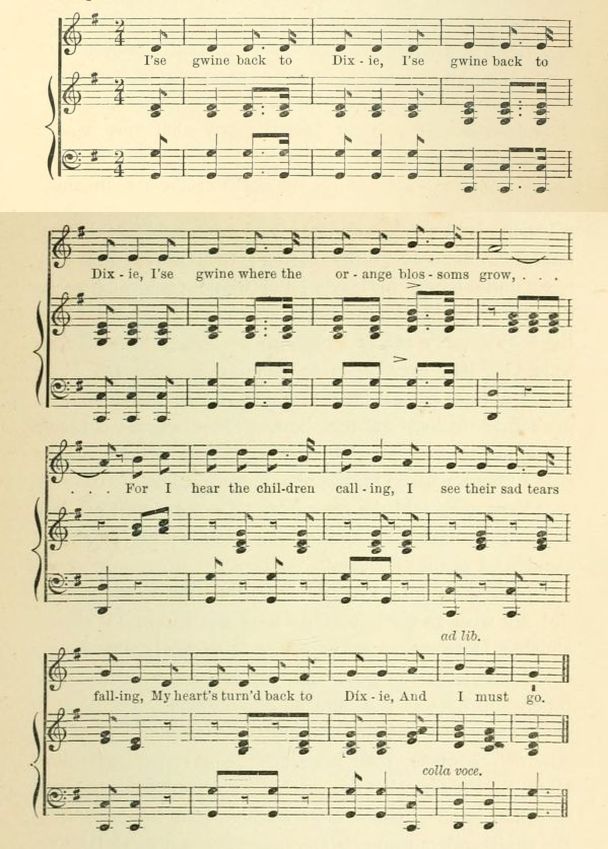
Music fragment
It is impossible to say how often they repeated the chorus; until Mrs. Lalor asked the girls why they were so fond of singing about orange blossoms, and then presently they turned to something else.
All this time they were beating up against a stiff but steady head-wind; the Doctor at the tiller; the lank editor standing by the mast at the bow; the girls and their chaperon snugly ensconced in the capacious cockpit, but still having to dodge the enormously long boom when the boat was put about. The women-folk, of course, paid no attention to the sailing; they never do; they were quite happy in leaving the whole responsibility on the owner of the craft; and were entirely wrapped up in their own petty affairs. Nay, so recklessly inconsiderate were they that they began to be angry because Dr. Tilley would not get out his banjo—which was in the tiny cabin, or rather locker, at the bow. They wanted to sing 'Dancing in the Barn,' they said. What was the use of that without a banjo to play the dance music?
'Very well,' said the complaisant Doctor, 'we'll run into some quiet creek in one of the islands; and then I'll see what I can do for you.'
No, no, they said; they wanted to sing sailing; they did not wish to go ashore, or near the shore. Well, the amiable Doctor scarce knew how to please them, for he could not steer the boat and play the banjo at the same time; and he was not sure about entrusting the safety of so precious a cargo to the uncertain seamanship of the editor. However, they were now a long way from Fort George; they might as well take a run back in that direction; and so—the boat having been let away from the wind and put on a fair course for the distant landing-stage—Mr. Huysen was called down from the bow and directed as to how he should steer; and then the Doctor went forward and got out the banjo.
Now this 'Dancing in the Barn' (the words are idiotic enough) has a very catching air; and no sooner had the Doctor—who was standing up on the bit of a deck forward, where Jack Huysen had been—begun the tinkling prelude than the girls showed little movements of hands and feet, as if they were performing an imaginary 'cake-walk.'
'Oh, we'll meet at the ball in the evening,
Kase I love to pass the time away'
—they were all singing at it now; they did not wait for any chorus; and Miss Carry had caught Miss Em's hand, and was holding it on high, and keeping time to the music, as if she were in reality leading her down the barn.
As we move so grace-ful-ly
We're as hap-py as can be
Den swing you partners all to-
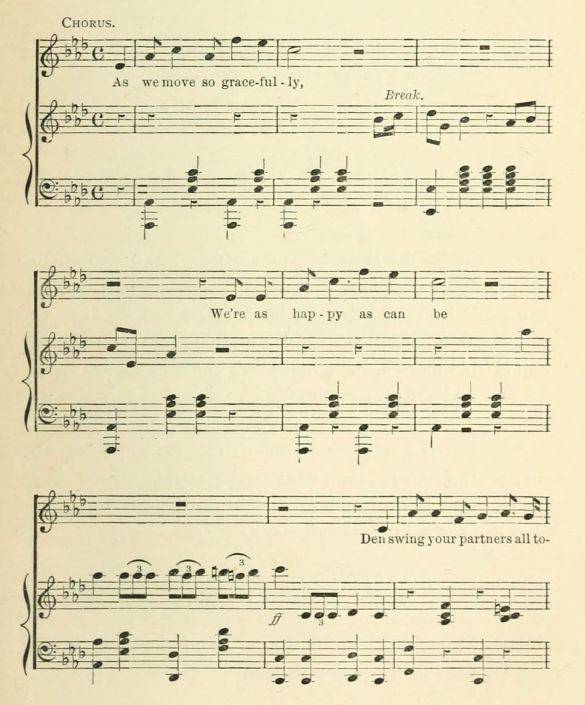
Music fragment
ge-ther, Kase now's the time for you to larn, Ban-jos
ring-ing, Nig-gers sing-ing, And danc-ing in the barn.
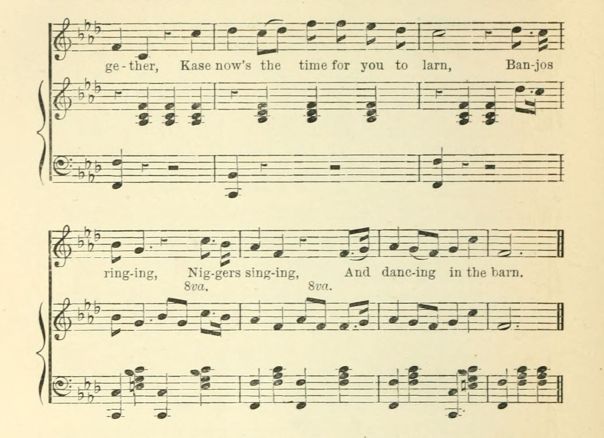
music fragment
Then came in the rippling dance—played as a solo on the banjo; and so catching was it that the two girls stood up, and made believe to dance a little. You see, the boat was running free before the wind, and there was scarcely any appreciable motion, though she was going at a good speed, for her mainsail was enormously large and the breeze was brisk.
'I say, Huysen,' the Doctor called, while he was playing the dance, 'look what you're about. Never mind the singing. Keep her bow straight for the landing-stage.'
Then the next verse began—
'Den we's off to work in de morning,
Singing as we go out to de field,'
and they all went at it with a will. And then the chorus; and then the light rippling dance—
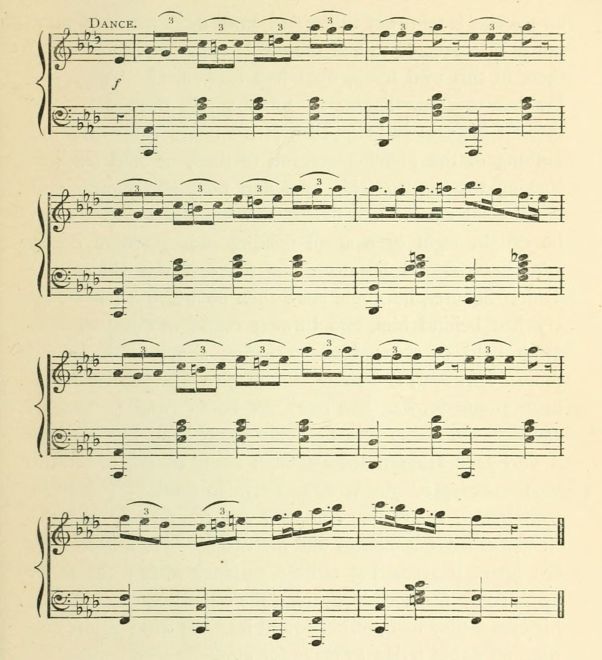
music fragment
and the two girls were on their feet again, making believe to posture a little, while the sharp clear notes of the banjo tinkled and tinkled, amid the steady swishing noise of the water along the side of the boat. But all of a sudden there was a startled cry of warning—the banjo was dropped on the deck, and the Doctor sprung aft in a vain effort to check what he had seen was coming; the next moment the great boom came heavily swinging along, accelerating its pace as it went out to leeward, until there was a frightful crash that seemed to tear the whole craft to pieces. And then, in this wild lurch, what had happened? Tilley was the first to see. There was something in the water. He tore off his coat and slipped over the boat's side—heeding nothing of the piercing screams of those he had left, but shaking the wet from his eyes and nose and mouth, and looking all around him like a Newfoundland dog. Then he caught sight of a small floating object—some dozen yards away—and he made for that: it was the yellow Tam-o'-Shanter, he could see; then he heard a half-stifled cry just behind him, and turning round was just able to catch hold of Carry Hodson before she sank a second time. However, she was quite passive—perhaps she had been stunned by a blow from the boom; and he was an excellent swimmer; and he could easily keep her afloat—if only Jack Huysen knew enough about sailing to get the boat back speedily. It was in vain to think of swimming with her to the shore; the land was too far off; and the weight of her wet clothes was increasing. He looked after the boat; it seemed a terrible distance away; but as far as he could make out—through the water that was blinding his eyes—they had got her round into the wind again and were no doubt trying to make for him.
Meanwhile, Jack Huysen had been so thunderstruck by what had occurred; when his own carelessness or an awkward gust of wind had caused the great boom to gybe, that for some seconds he seemed quite paralysed, and of course all this time the little craft was swinging along before the breeze. The shrieks of the women bewildered him, moreover. And then it occurred to him that he must get back—somehow, anyhow; and more by instinct than of knowledge he jammed down the helm, and rounded the boat into the wind, where the big sail began to flop about with the loose mainsheet dragging this way and that. And then he set about trying little experiments—and in a frantic nervousness all the same; he knew, or he discovered, that he must needs get in the mainsheet; and eventually the boat began to make uncertain progress—uncertain, because he had been terrified, and was afraid to keep proper way on her, so that she staggered up into the wind incessantly. But this at all events kept them near the course they had come; and from time to time she got ahead a bit; and the women had ceased their shrieking, and had subsided, the one into a terrified silence, the other into frantic weeping and clasping of her hands.
'Can't you—can't you look out? Why don't you look out for them?' he cried, though he scarce knew what he said, so anxious was he about the tiller and those puffs of wind that made the boat heel over whenever he allowed the sail to fill.
And then there was a cry—from Mrs. Lalor.
'Look—look—this way—you're going away from them.'
He could only judge by the direction of her gaze; he put the boat about. She began to laugh, in a hysterical fashion.
'Oh yes, yes, we are getting nearer—we are getting nearer—he sees us—Em, Em, look!—poor Carry!—Oh, quick, quick with the boat—quick, quick, quick!'
But the wringing of her hands was of little avail; and indeed when they did eventually draw cautiously close to the two people in the water, the business of getting them dragged on board proved a difficult and anxious matter, for the girl was quite unconscious and lay in their hands like a corpse. The young Doctor was very much exhausted too; but at least he preserved his senses. He sat down for a minute to recover his breath.
'Jack,' he gasped, 'put my coat round her—wrap her warm—Mrs. Lalor, get off her boots and stockings—chafe her feet and hands—quick.'
And then he rose and went to where she was lying and stooped over her.
'Yes, yes, her heart is beating—come away with that coat, man.'
But it was his own coat that Jack Huysen had quickly taken off; and when Carry Hodson was wrapped in it, and when the women were doing what they could to restore her circulation, he fetched the other coat for the young Doctor, and made him put that on, though the latter declared he was all right now. And then the Doctor took the tiller, slacked out the mainsheet, and once more they were running before the wind towards Fort George. Not a word had been said about the cause of the mishap or its possible consequences.
These at first—and to Jack Huysen's inexpressible joy—seemed to be trivial enough. Immediately she had recovered consciousness she sate up, and began to say a few words—though with some difficulty; and indeed, so brave was she, and so determined to do something to relieve the obvious anxiety of these good friends of hers, that when at length they reached the landing-stage and got ashore she declared that she was quite recovered, that she could walk to the hotel as well as any of them, that she had never felt better in her born days. Nay, she made a joke of the whole matter, and of her heavy skirts, and of the possible contents of Jack Huysen's coat-pockets; and when they did reach the hotel, and when she had changed her wet garments, she came down again looking perfectly well—if a little bit tired.
It was not until the afternoon that she began to complain of shiverings; and then again, when dinner time arrived, Mrs. Lalor came down with the message that Carry had a slight headache, and would rather remain in her room. Next morning, too, she thought she would rather not get up; she had a slight cough, and her breathing was difficult; she had most relief when she lay quite still.
'What does this mean, Tom?' Jack Huysen said—and as if he feared the answer.
'I hope it means nothing at all,' was the reply; but the young Doctor looked grave, and moved away, as if he did not wish to have any further talking.
However, there was no perceptible change for the worse that day; and Miss Carry, when she could speak at all, said that she was doing very well, and implored them to go away on their usual excursions, and leave her to herself. A servant might sit outside in the passage, she said; if she wanted her, she could ring. Of course, this only sufficed to set Emma Kerfoot into a fit of weeping and sobbing—that Carry should think them capable of any such heartlessness.
But on the following morning matters were much more serious. She could hardly speak at all; and when she did manage to utter a few panting words she said it was a pain in her chest that was troubling her—not much; no, no, not much, she said; she wished they would all go away and amuse themselves; the pain would leave; she would be all right by and by.
'Jack, look here,' said the young Doctor, when they were together; 'I'm afraid this is pneumonia—and a sharp attack too.'
'Is it dangerous?' Huysen said quickly, and with rather a pale face.
The answer to this was another question;
'She left her mother at home, didn't she?'
'Yes,' said he breathlessly. 'Do you want to send for her? But that would be no use. Her mother could not travel just now; she's too much of an invalid; why, it was she who sent Carry away on this holiday.'
'Her father, then?'
'Why, yes, he's at home just now. Shall I telegraph for him?'
'No—not yet—I don't want to frighten her. We'll see in the morning.'
But long before the morning came they discovered how things were going with her. Late that night Mrs. Lalor, who had undertaken to sit up till her sister should come to relieve her, stole noiselessly along to the room of the latter and woke her.
'Em, darling, who is Ronald?' she whispered.
'Ronald? I don't know,' was the answer—for she was still somewhat confused.
'Carry is asking that one Ronald should be sent for—do come and see her, Em—I think she's wandering a little—she says there's never any luck in the boat except when Ronald is in it—I don't understand it at all——'
'But I do—I do now,' said the girl, as she hastily got up and put a dressing-gown and some wraps around her.
'And you'll have to send for the Doctor at once, Mary—he said he would not be in bed till two. She must be in a fever—that's delirium—if she thinks she is in the Highlands again.'