WHITE HEATHER (VOL. II) (continued 2)
Reading edition
'What for?' said he impassively. 'He had no luggage, I suppose, but a bag and a waterproof. It's different in the autumn, of course, when all the gentlemen come up, and there's luggage and the rifles and the cartridge-boxes—then they have to have a brake or a waggonette.'
'And that was Lord Ailine,' she said, half to herself; and there was no further speaking between them until they had gone past the Doctor's cottage and over the bridge and were some distance up 'the strath that Mudal laves'—to quote her companion's own words.
'Now,' said he, as he stooped and began to put together the slender grilse-rod, 'we'll just let ye try a cast or two on this bit of open grass—and we'll no trouble with a fly as yet.'
He fastened on the reel, got the line through the rings, and drew out a few yards' length. Then he gave her the rod; showed her how to hold it; and then stood just behind her, with his right hand covering hers.
'Now,' said he, 'keep your left hand just about as steady as ye can—and don't jerk—this way—
Of course it was really he who was making these few preliminary casts, and each time the line ran out and fell straight and trembling on the grass.
'Now try it yourself.'
At first she made a very bad job of it—especially when she tried to do it by main force; the line came curling down not much more than the rod's length in front of her, and the more she whipped the closer became the curls.
'I'm afraid I don't catch on quite,' she said, unconsciously adopting one of her father's phrases.
'Patience—patience,' said he; and again he gripped her hand in his and the line seemed to run out clear with the gentlest possible forward movement.
And then he put out more line—and still more and more—until every backward and upward swoop of the rod, and every forward cast, was accompanied by a 'swish' through the air. This was all very well; and she was throwing a beautiful, clean line; but she began to wonder when the bones in her right hand would suddenly succumb and be crunched into a jelly. The weight of the rod—which seemed a mighty engine to her—did not tell on her, for his one hand did the whole thing; but his grip was terrible; and yet she did not like to speak.
'Now try for yourself,' said he, and he stepped aside.
'Wait a minute,' she said—and she shook her hand, to get the life back into it.
'I did not hurt you?' said he, in great concern.
'We learn in suffering what we teach in song,' she said lightly. 'If I am to catch a salmon with a fly-rod, I suppose I have got to go through something.'
She set to work again; and, curiously enough, she seemed to succeed better with the longer line than with the short one. There was less jerking; the forward movement was more even; and though she was far indeed from throwing a good line, it was very passable for a beginner.
'You know,' said she, giving him a good-humoured hint, 'I don't feel like doing this all day.'
'Well, then, we'll go down to the water now,' said he, and he took the rod from her.
They walked down through the swampy grass and heather to the banks of the stream; and here he got out his fly-book—a bulged and baggy volume much the worse for wear. And then it instantly occurred to her that this was something she could get for him—the most splendid fly-book and assortment of salmon flies to be procured in London—until it just as suddenly occurred to her that he would have little use for these in Glasgow. She saw him select a smallish black and gold and crimson-tipped object from that bulky volume; and a few minutes thereafter she was armed for the fray, and he was standing by watching.
Now the Mudal, though an exceedingly 'dour' salmon-river, is at least easy for a beginner to fish, for there is scarcely anywhere a bush along its level banks. And there were the pools—some of them deep and drumly enough in all conscience; and no doubt there were salmon in them, if only they could be seduced from their lair. For one thing, Ronald had taken her to a part of the stream where she could not, in any case, do much harm by her preliminary whippings of the water.
She began—not without some little excitement, and awful visions of triumph and glory if she should really be able to capture a salmon by her own unaided skill. Of course she caught in the heather behind her sometimes; and occasionally the line would come down in a ghastly heap on the water; but then again it would go fairly out and over to the other bank, and the letting it down with the current and drawing it across—as he had shown her in one or two casts—was a comparatively easy matter. She worked hard, at all events, and obeyed implicitly—until alas! there came a catastrophe.
'A little bit nearer the bank if you can,' said he; 'just a foot nearer.'
She clenched her teeth. Back went the rod with all her might—and forward again with all her might—but midway and overhead there was a mighty crack like that of a horse-whip; and calmly he regarded the line as it fell on the water.
'The fly's gone,' said he—but with not a trace of vexation.
'Oh, Ronald, I'm so sorry!' she cried, for she knew that these things were expensive, even where they did not involve a considerable outlay of personal skill and trouble.
'Not at all,' said he, as he quietly sate down on a dry bunch of heather and got out his book again. 'All beginners do that. I'll just show ye in a minute or two how to avoid it. And we'll try a change now.'
Indeed she was in no way loth to sit down on the heather too; and even after he had selected the particular Childers he wanted, she took the book, and would have him tell her the names of all the various flies, which, quite apart from their killing merits, seemed to her beautiful and interesting objects. And finally she said—
'Ronald, my arms are a little tired. Won't you try a cast or two? I am sure I should learn as much by looking on.'
He did as he was bid; and she went with him; but he could not stir anything. The river was low; the day was clear; there was no wind. But at last they came to a part of the stream where there was a dark and deep pool, and below that a wide bed of shingle, while between the shingle and the bank was a narrow channel where the water tossed and raced before breaking out into the shallows. He drew her a little bit back from the bank and made her take the rod again.
'If there's a chance at all, it's there,' he said. 'Do ye see that stone over there?—well, just try to drop the fly a foot above the stone, and let it get into the swirl.'
She made her first cast—the line fell in a tangled heap about three yards short.
'Ye've got out of the way of it,' said he, and he took the rod from her, let out a little more line, and then gave it to her again, standing behind her, with his hand over-gripping hers.
'Now!'
The fly fell a foot short—but clean. The next cast it fell at the precise spot indicated, and was swept into the current, and dragged slowly and jerkily across. Again he made the cast for her, with the same negative result; and then he withdrew his hand.
'That's right—very well done!' he said, as she continued.
'Yes, but what's the use when you have tried——'
She had scarcely got the words out when she suddenly found the line held tight—and tighter—she saw it cut its way through the water, up and towards the bank of the pool above—and down and down was the point of the rod pulled until it almost touched the stream. All this had happened in one wild second.
'Let the line go!—what are ye doing, lassie?' he cried. The fact was that in her sudden alarm she had grasped both line and rod more firmly than ever; and in another half second the fish must inevitably have broken something. But this exclamation of his recalled her to her senses—she let the line go free—got up the rod—and then waited events—with her heart in her mouth. She had not long to wait. It very soon appeared to her as if she had hooked an incarnate flash of lightning; for there was nothing this beast did not attempt to do; now rushing down the narrow channel so close to the bank that a single out-jutting twig must have cut the line; now lashing on the edge of the shallows; twice jerking himself into the air; and then settling down in the deep pool, not to sulk, but to twist and tug at the line in a series of angry snaps. And always it was 'Oh, Ronald, what shall I do now?' or 'Ronald, what will he do next?'
'You're doing well enough,' said he placidly. 'But it will be a long fight; and ye must not let him too far down the stream, or he'll take ye below the foot bridge. And don't give him much line; follow him, rather.'
She was immediately called on to act on this advice; for with one determined, vicious rush, away went the salmon down the stream—she after him as well as her woman's skirts would allow, and always and valorously she was keeping a tight strain on the pliant rod. Alas! all of a sudden her foot caught in a tuft of heather—down she went, prone, her arms thrown forward so that nothing could save her. But did she let go the rod? Not a bit! She clung to it with the one hand; and when Ronald helped her to her feet again, she had no thought of herself at all—all her breathless interest was centred on the salmon. Fortunately that creature had now taken to sulking, in a pool farther down; and she followed him, getting in the line the while.
'But I'm afraid you're hurt,' said he.
'No, no.'
Something was tickling the side of her face. She shifted the grip of the rod, and passed the back of her right hand across her ear; a brief glance showed her that her knuckles were stained with blood. But she took no further heed; for she had to get both hands on the rod again.
'She has pluck, that one,' Ronald said to himself; but he said nothing aloud, he wanted her to remain as self-possessed as possible.
'And what if he goes down to the footbridge, Ronald?' she said presently.
'But ye must not let him.'
'But if he will go?'
'Then ye'll give me the rod and I'll take it under the bridge.'
The fish lay there as heavy and dead as a stone; nothing they could do could stir him an inch.
'The beast has been at this work before,' Ronald said. 'That jagging to get the hook out is the trick of an old hand. But this sulking will never do at all.'
He left her and went farther up the stream to the place where the river ran over the wide bed of shingle. There he deliberately walked into the water—picking up a few pebbles as he went—and, with a running leap, crossed the channel and gained the opposite bank. Then he quickly walked down to within a yard or two of the spot where the 'dour' salmon lay.
She thought this was very foolish child's play that he should go and fling little stones at a fish he could not see. But presently she perceived that he was trying all he could to get the pebbles to drop vertically and parallel with the line. And then the object of this device was apparent. The salmon moved heavily forward, some few inches only. Another pebble was dropped. This time the fish made a violent rush up stream that caused Miss Carry's reel to shriek; and off she set after him (but with more circumspection this time as regards her footing), getting in the line as rapidly as possible as she went. Ronald now came over and joined her, and this was comforting to her nerves.
Well, long before she had killed that fish she had discovered the difference between loch-fishing and river-fishing; but she did kill him in the end; and mightily pleased she was when she saw him lying on the sere wintry grass. Ronald would have had her try again; but she had had enough; it was past lunch time, and she was hungry; moreover, she was tired; and then again she did not wish that he should waste the whole day. So, when she had sate down for a while, and watched him tie the salmon head and tail, they set out for the village again, very well content; while as for the slight wound she had received by her ear catching on a twig of heather when she fell, that was quite forgotten now.
'And ye are to have the fish,' said he. 'I told his lordship this morning you were going to try your hand at the casting; and he said if you got one you would be proud of it, no doubt, and ye were to keep it, of course.'
'Well, that is very kind; I suppose I must thank him if I see him?'
And she was very curious to know all about Lord Ailine; and why he should come to Inver-Mudal merely for these few hours; and what kind of people he brought with him in the autumn. He answered her as well as he could; and then they went on to other things—all in a very gay and merry mood, for he was as proud as she was over this achievement.
At the same moment Meenie Douglas was in her own little room, engaged on a work of art of a not very ambitious kind. She had lying before her on the table a pencil-sketch in outline of such features of the landscape as could be seen from the window—the loch, the wooded promontories, Ben Clebrig, and the little clump of trees that sheltered the inn; and she was engaged in making a smaller copy of this drawing, in pen and ink, on a paper-cutter of brown wood. She was not much of an artist, perhaps; but surely these simple outlines were recognisable; and if they were to be entitled 'A Souvenir,' and carried away to the south as a little parting present, might they not in some idle moment of the future recall some brief memory of these northern wilds? So she was at work on this task—and very careful that the lines should be clear and precise—when she heard the sound of voices without—or rather one voice, which presently she recognised to be Ronald's: she could not easily mistake it. And if she were to go to the window and get him to stop for a minute, at the gate, and show him the sketch that she had just about finished—perhaps he would be pleased?
She went to the window—but instantly drew back. She had just caught a glimpse: it was the American young lady he was walking with—at a time when he was supposed to be so busy; and he was carrying her rod for her and her ulster as well as the salmon; and they were laughing and gaily talking together, like a pair of lovers almost on this clear spring day. Meenie went slowly back to the table—her face perhaps a trifle paler than usual; and she sate down, and began to look at the little drawing that she had been rather proud of. But her lips were proud and firm. Why should she give a drawing to any one—more especially to one who was so ready with his friendship and so quick to consort with strangers? The lines on the brown wood seemed cold and uninteresting; she was no longer anxious that they should suggest an accurate picture; nay, she pushed the thing away from her, and rose, and went back to the window, and stood idly gazing out there, her lips still proud, her mien defiant.
And then—well, Ronald was going away. Was it worth while to let pride or self-love come between them and becloud these last few days, when perhaps they might never see each other again? For well she knew of her mother's aims and hopes with regard to herself; and well she knew that—whatever she may have guessed from the verses of Ronald's which assuredly had never been meant for her to see—it was neither for him nor for her to expect that the harsh facts and necessities of the world should give place and yield to a passing fancy, a dream, a kind of wistful, half-poetic shadow of what otherwise might have been. But at least Ronald and she might part friends; nay, they should part friends. And so she returned to the table—overmastering her momentary pride; and she took up the discarded little drawing and regarded it with gentler eyes. For, after all (as she could not forget) Ronald was going away.
CHAPTER VI.
POETA ... NON FIT.
It soon became obvious that the salmon-fishers from the other side of the Atlantic had got into a long spell of deplorably fine weather; and a gentle melancholy settled down upon the souls of the gillies. In vain, morning after morning, the men searched every quarter of the heavens for any sign of even a couple of days' deluge to flood the rivers and send the kelts down and bring the clean salmon up from the sea. This wild and bleak region grew to be like some soft summer fairyland; the blue loch and the yellow headlands, and the far treeless stretches of moor lay basking in the sunlight; Ben Loyal's purples and browns were clear to the summit; Ben Clebrig's snows had nearly all melted away. Nor could the discontented boatmen understand how the two strangers should accept this state of affairs with apparent equanimity. Both were now provided with a book; and when the rods had been properly set so as to be ready for any emergency, they could pass the time pleasantly enough in this perfect stillness, gliding over the smooth waters, and drinking in the sweet mountain air. As for Miss Carry, she had again attacked the first volume of Gibbon—for she would hot be beaten; and very startling indeed it was when a fish did happen to strike the minnow, to be so suddenly summoned back from Palmyra to this Highland loch. In perfect silence, with eyes and attention all absented, she would be reading thus—
'When the Syrian queen was brought into the presence of Aurelian, he sternly asked her, how she had presumed to rise in arms against the Emperor of Rome? The answer of Zenobia was a prudent mixture of respect and firmness'—when sharp would come the warning cry of Malcolm—'There he is, Miss!—there he is!'—and she would dash down the historian to find the rod being violently shaken and the reel screaming out its joyous note. Moreover, in this still weather, the unusual visitor not unfrequently brought some other element of surprise with him. She acquired a considerable experience of the different forms of foul-hooking and of the odd manoeuvres of the fish in such circumstances. On one occasion the salmon caught himself on the minnow by his dorsal fin; and for over an hour contented himself with rolling about under water without once showing himself, and with such a strain that she thought he must be the champion fish of the lake: when at last they did get him into the boat he was found to be a trifle under ten pounds. But, taken altogether, this cultivation of literature, varied by an occasional 'fluke' of a capture, and these placid and dreamlike mornings and afternoons, were far from being as satisfactory as the former and wilder days when Ronald was in the boat, even with all their discomforts of wind and rain and snow.
By this time she had acquired another grievance.
'Why did you let him go, pappa, without a single word?' she would say, as they sate over their books or newspapers in the evening. 'It was my only chance. You could easily have introduced yourself to him by speaking of the shooting——'
'You know very well, Carry,' he would answer—trying to draw her into the fields of common sense—'I can say nothing about that till I see how mother's health is.'
'I am sure she would say yes if she saw what the place has done for you, pappa; salmon-fishing has proved better for you than bromide of potassium. But that's not the trouble at all. Why did you let him go? Why did you let him spend the evening at the Doctor's?—and the next morning he went about the whole time with Ronald! My only chance of spurning a lord, too. Do they kneel in this country, pappa, when they make their declaration; or is that only in plays? Never mind; it would be all the same. "No, my lord; the daughter of a free Republic cannot wed a relic of feudalism; farewell, my lord, farewell! I know that you are heart-broken for life; but the daughter of a free Republic must be true to her manifest destiny."'
'Oh, be quiet!'
'And then the girls at home, when I got back, they would all have come crowding around: "Do tell, now, did you get a British nobleman to propose, Carry?" "What do you imagine I went to Europe for?" "And you rejected him?" "You bet your pile on that. Why, you should have seen him writhe on the floor when I spurned him! I spurned him, I tell you I did—the daughter of a free Republic"——'
'Will you be quiet!'
'But it was really too bad, pappa!' she protested. 'There he was lounging around all the morning. And all I heard him say was when he was just going—when he was on the mail-car, "Ronald," he called out, "have you got a match about you?"—and he had a wooden pipe in his hand. And that's all I know about the manners and conversation of the British nobility; and what will they say of me at home?'
'When does Ronald go?' he would ask; and this, at least, was one sure way of bringing her back to the paths of sanity and soberness; for the nearer that this departure came, the more concerned she was about it, having some faint consciousness that she herself had a share of the responsibility.
And in another direction, moreover, she was becoming a little anxious. No message of any kind had arrived from the Chicago Citizen. Now she had written to Miss Kerfoot before she left for Paris; her stay in the French capital had extended to nearly three weeks; there was the space occupied in going and returning; so that if Jack Huysen meant to do anything with the verses it was about time that that should appear. And the more she thought of it the more she set her heart on it, and hoped that Ronald's introduction to the reading public would be a flattering one and one of which he could reasonably be proud. Her father had it in his power to secure his material advancement; and that was well enough; but what if it were reserved for her to confer a far greater service on him? For if this first modest effort were welcomed in a friendly way, might he not be induced to put forth a volume, and claim a wider recognition? It need not interfere with his more practical work; and then, supposing it were successful? Look at the status it would win for him—a thing of far more value in the old country, where society is gradated into ranks, than in her country, where every one (except hotel clerks, as she insisted) was on the same plane. He would then be the equal of anybody—even in this old England; she had at least acquired so far a knowledge of English society. And if he owed the first suggestion and impulse to her?—if she were to be the means, in however small and tentative a fashion, of his ultimately establishing his fame? That he could do so if he tried, she never thought of doubting. She saw him every day, and the longer she knew him the more she was certain that the obvious mental force that seemed to radiate from him in the ordinary conversation and discussion of everyday life only wanted to be put into a definite literary channel to make its mark. And was not the time ripe for a poet? And it was not Edinburgh, or Glasgow, or London that had nowadays to decide on his merits, but two great continents of English-speaking people.
At length came the answer to her urgent prayer—a letter from Miss Kerfoot and a copy of the Chicago Citizen. The newspaper she opened first; saw with delight that a long notice—a very long notice indeed—had been accorded to the verses she had sent; and with a proud heart she put the paper in her pocket, for careful reading when she should get down to the lake. Miss Kerfoot's letter she glanced over; but it did not say much; the writer observed that Mr. Jack Huysen had only seemed half pleased when informed of Carry's extraordinary interest in the phenomenal Scotch gamekeeper; and, referring to the article in the Citizen, she said Jack Huysen had entrusted the writing of it to Mr. G. Quincy Regan, who was, she understood, one of the most cultured young men in Chicago, and likely to make quite a reputation for himself ere long. There were some other matters mentioned in this letter; but they need not detain us here.
Miss Carry was in very high spirits as she set forth from the inn with her father to walk down to the boats. They met Ronald, too, on their way; he was accompanied by the man who was to take his place after his leaving; and Miss Carry could not help comparing the two of them as they came along the road. But, after all, it was not outward appearance that made the real difference between men; it was mental stature; she had that in her pocket which could show to everybody how Ronald was a head and shoulders over any of his peers. And she took but little interest in the setting up of the rods or the selection of the minnows; she wanted to be out on the lake, alone, in the silence, to read line by line and word by word this introduction of her hero to the public.
The following is the article:
'A REMARKABLE LITERARY DISCOVERY—OUR FELLOW-CITIZENS ABROAD—ANOTHER RUSTIC POET—CHICAGO CLAIMS HIM. It may be in the recollection of some of our readers that a few years ago a small party of American tourists, consisting of Curtis H. Mack, who was one of our most distinguished major-generals in the rebellion, and is now serving on the Indian frontier; his niece, Miss Hettie F. Doig, a very talented lady and contributor to several of our best periodicals; and John Grimsby Patterson, editor of the Baltimore Evening News, were travelling in Europe, when they had the good fortune to discover an Irish poet, Patrick Milligan, who had long languished in obscurity, no doubt the victim of British jealousy as well as of misrule. Major-General Mack interested himself in this poor man, and, in conjunction with William B. Stevens, of Cleveland, Ohio, had him brought over to this country, where they were eventually successful in obtaining for him a postmastership in New Petersburg, Conn., leaving him to devote such time as he pleased to the service of the tuneful nine. Mr. Milligan's Doric reed has not piped to us much of late years; but we must all remember the stirring verses which he wrote on the occasion of Colonel George W. Will's nomination for Governor of Connecticut. It has now been reserved for another party of American travellers, still better known to us than the above, for they are no other than our esteemed fellow-citizen, Mr. Josiah Hodson and his brilliant and accomplished daughter, Miss Caroline Hodson, to make a similar discovery in the Highlands of Scotland; and in view of such recurring instances, we may well ask whether there be not in the mental alertness of our newer civilisation a capacity for the detection and recognition of intellectual merit which exists not among the deadening influences of an older and exhausted civilisation. It has sometimes been charged against this country that we do not excel in arts and letters; that we are in a measure careless of them; that political problems and material interests occupy our mind. The present writer, at least, is in no hurry to repel that charge, odious as it may seem to some. We, as Americans, should remember that the Athenian Republic, with which our western Republic has nothing to fear in the way of comparison, when it boasted its most lavish display of artistic and literary culture, was no less conspicuous for its moral degeneracy and political corruption. It was in the age of Pericles and of Phidias, of Socrates and Sophocles, of Euripides and Aristophanes and Thucydides, that Athens showed herself most profligate; private licence was unbridled; justice was bought and sold; generals incited to war that they might fill their pockets out of the public purse; and all this spectacle in striking contrast with the manly virtues of the rude and unlettered kingdom of Sparta, whose envoys were laughed at because they had not the trick of Athenian oratory and casuistry. We say, then, that we are not anxious to repel this charge brought against our great western Republic, that we assign to arts and letters a secondary place; on the contrary, we are content that the over-cultivation of these should fatten on the decaying and effete nations of Europe, as phosphorus shines in rotten wood.'
Now she had determined to read every sentence of this article conscientiously, as something more than a mere intellectual treat; but, as she went on, joy did not seem to be the result. The reference to Patrick Milligan and the postmastership in Connecticut she considered to be distinctly impertinent; but perhaps Jack Huysen had not explained clearly to the young gentleman all that she had written to Emma Kerfoot? Anyhow, she thought, when he came to Ronald's little Highland poem, he would perhaps drop his Athenians, and talk more like a reasonable human being.
'That the first strain from the new singer's lyre should be placed at the services of the readers of the Citizen, we owe to the patriotism of the well-known and charming lady whose name we have given above; nor could the verses have fallen into better hands. In this case there is no need that Horace should cry to Tyndaris—
O matre pulchrâ filia pulchrior,
Quem criminosis cunque voles modum
Pones iambis, sive flammâ
Sive mari libet Hadriano.
Moreover, we have received a hint that this may not be the last piece of the kind with which we may be favoured; so that we have again to thank our fair fellow-townswoman for her kindly attention. But lest our readers may be growing weary of this prolegomenon, we will at once quote this latest utterance of the Scottish muse which has come to us under such favourable auspices:'
Here followed Ronald's poor verses, that perhaps looked insignificant enough, after this sonorous trumpet-blaring. The writer proceeded:
'Now certain qualities in this composition are so obvious that we need hardly specify them; we give the writer credit for simplicity, pathos, and a hearty sympathy with the victims of the tyrannical greed of the chase-loving British landlord. But it is with no intent of looking a gift-horse in the mouth (which would be a poor return for the courtesy of the lady who has interested herself in the rustic bard) if we proceed to resolve this piece into its elements, that we may the more accurately cast the horoscope of this new applicant for the public applause. To begin with, the sentiment of nostalgia is but a slender backbone for any work of literary art. In almost every case it is itself a fallacy. What were the conditions under which these people—arbitrarily and tyrannically, it may have been—were forced away from their homes? Either they were bad agriculturists or the land was too poor to support them; and in either case their transference to a more generous soil could be nothing but a benefit to them. Their life must have been full of privations and cares. Forsan et haec olim meminisse juvabit; but the pleasure ought to lie in thinking of the escape; so that we maintain that to base any piece of literary work on such a false sentiment as nostalgia is seen to be, leads us to suspect the veracity of the writer and calls upon us to be on our guard. Moreover, we maintain that it is of the essence of pastoral and idyllic poetry to be cheerful and jocund; and it is to be observed that sadness prevails in poetry only when a nation has passed its youth and becomes saturated with the regret of old age. We prefer the stories told
Where Corydon and Thyrsis met
Are at their savoury dinner set;
and the lyrist when he sings
Dulce ridentem Lalagen amabo,
Dulce loquentem;
and we hold that when the poets of a nation are permeated by a lackadaisical sentiment—when they have the candour to style themselves the idle singers of an empty day—when the burden of their song is regret and weariness and a lamentation over former joys—then it is time for such poets and the nation they represent to take a back seat in the lecture halls of literature, and give way to the newer and stronger race that is bound to dominate the future.'
She read no farther; and it is a great pity that she did not; for the writer by and by went on to say some very nice things about these unlucky verses; and even hinted that here was a man who might be benefited by coming to stay in Chicago,—'the future capital of the future empire of the world,'—and by having his eyes opened as to the rate of progress possible in these modern days; and wound up with a most elaborate compliment to the intellectual perspicacity and judgment of Miss Carry herself. She did not read beyond what is quoted above for the simple reason that she was in a most violent rage, and also extremely mortified with herself for being so vexed. She tore the newspaper into shreds, and crushed these together, and flung them into the bottom of the boat. Her cheeks were quite pale; her eyes burning; and through all the anger of her disappointment ran the shame of the consciousness that it was she who had exposed Ronald to this insult. What though he should never know anything about it? Her friends in Chicago would know. And it was the man whom she wanted to glorify and make a hero of who had, through her instrumentality, been subjected to the pedantic criticism, the pretentious analyses, and, worst of all, the insulting patronage of this unspeakable ass. Suddenly she regretted the destruction of the newspaper; she would like to have looked at it again, to justify her wrath. No matter; she could remember enough; and she would not forget Jack Huysen's share in this transaction.
She was very silent and reserved at lunch time; and her father began to believe that, after all, in spite of her repeated assurances, their ill-luck with the fishing was weighing on her spirits.
'You know, Carry,' said he, 'it is not in the nature of things that weather like this can last in the Highlands of Scotland. It is notoriously one of the wettest places in the world. There must be rain coming soon; and then think of all the fish that will be rushing up in shoals, and what a time we shall have.'
'I am not disappointed with the fishing at all, pappa,' she said. 'I think we have done very well.'
'What is the matter, then?'
'Oh, nothing.'
And then she said—
'Well, I will tell you, pappa. I asked Jack Huysen to do me a very particular favour; and he did not do it; and when I next see Jack Huysen, I think he will find it a very cold day.'
The words were mysterious; but the tone was enough.
And all the afternoon she sate in the stern of the coble and brooded, composing imaginary letters to the editor of the New York Herald, to the editor of the Nation, to the editor of the Chicago Tribune, to the editor of Puck, and a great many other journals, all of these phantom epistles beginning 'As an American girl I appeal to you,' and proceeding to beg of the editor to hold up to merciless scorn a certain feeble, shallow, and impertinent article (herewith enclosed) which had appeared in the Chicago Citizen. And on the way home, too, in the evening, she began to question her father as to his personal acquaintance with editors and journalists, which seemed to be of the slightest; and she at length admitted that she wanted some one to reply—and sharply—to an article that had been written about a friend of hers.
'You let that alone,' her father said. 'It's not very easy for any one to meddle in the politics of our country without coming out more or less tattooed; for they don't mind what they say about you; and you are very well to be out of it.'
'It isn't politics at all,' she said. 'And—and—the article is written about a friend of mine—and—I want to have the writer told what a fool he is.'
'But probably he would not believe it,' her father said quietly.
'He would see that some one else believed it.'
'I am not sure that that would hurt him much,' was the unsatisfactory answer.
When they drew near to Inver-Mudal she found herself quite afraid and ashamed at the thought of their possibly meeting Ronald. Had she not betrayed him? He had sought for no recognition; probably he was too proud or too manly and careless about what any one might write of him; it was she who had put him into that suppliant attitude, and brought upon him the insolent encouragement of a microcephalous fool. This was the return she had made him for all his kindness to her father and to herself. Why, he had told her to burn the verses! And to think that she should have been the means of submitting them to the scrutiny and patronage of this jackanapes—and that Mr. J. C. Huysen should as good as say 'Well, this is what we think of your prodigy'—all this was near bringing tears of rage to her eyes. For Miss Carry, it must be repeated, was 'a real good fellow,' and very loyal to her friends, and impatient of injustice done them; and perhaps, unconsciously to herself, she may have felt some of the consternation of the wild animal whose duty it is to protect her mate with her superior feminine watchfulness, and who, through neglect or carelessness, allows the destroyer to come in and slay. In any case, it certainly promised to be 'a very cold day' for Mr. Jack Huysen when these two should meet in Chicago.
That night, after dinner, father and daughter went out for a stroll; for by this time the moon was drawing to its full again; and all the world lay peaceful and silent in the wan clear light. They had not emerged from the trees in front of the inn on to the white pathway of the road when a sound in the distance caught Miss Carry's ears, and instantly she touched her father's arm and drew him back into the shadow. She wanted to hear what song this was that Ronald was singing on his homeward way.
At first she could make out nothing but fragments of the air—clear and soft and distant—
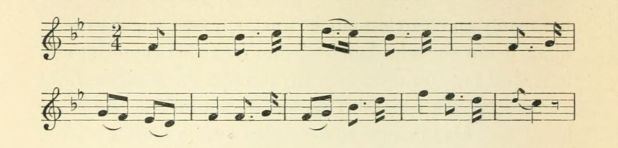
Music fragment
but as he drew nearer the words become more distinct:
And kiss'd her ripe ros-es, and blest her black e'e;
And aye since whene'er we meet, sing, for the sound is sweet,
"I was a-sleep but ye've wak-en'd me.'
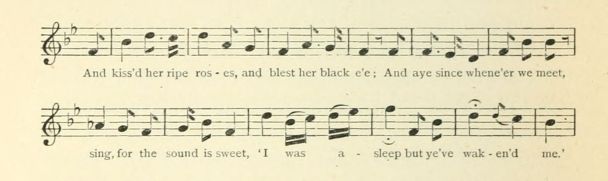
Music fragment
So clear and penetrating and careless and joyous was this singing!—her heart was stirred with pride as she listened; this was not the voice of a man who would trouble himself with any whipper-snapper criticism;—nay, she began to wonder that she had wasted so much indignation on so trivial a thing. Then there was a sudden silence, except for his footfall; and presently the dark figure appeared out there on the white road—his shadow a sharp black in front of him, the little terrier trotting behind him—and in a minute or so the long swinging stride had carried him past their ambush on his homeward way to the cottage.
'What a splendid voice that fellow has got!' her father said, as they also now went out on to the white highway, and took the opposite direction.
'He seems to be very well contented with himself,' she said, rather absently.
CHAPTER VII.
A LAST DAY ON THE LOCH.
Ronald came down to the loch-side the next morning just as she was about to get into the coble—her father having started a few minutes before.
'I hear you have not been doing very well with the fishing,' said he, in that brisk, business-like fashion of his.
'The salmon appear to have gone away somewhere,' she replied.
'Oh, but that will never do,' said he cheerfully. 'We must try and make some alteration.'
He took the key of the kennels from his pocket.
'Here, Johnnie lad, ye may go and take the dogs out for a run.'
Was Ronald, then, coming with her? Her eyes brightened with anticipation; there was a welcome in the look of her face that ought to have been sufficient reward for him. Nor had she the courage to protest—though she knew that his time was drawing short now. As for the salmon—well, it was not about salmon she was thinking exclusively.
'They say a change of gillie sometimes brings a change of luck,' said he good-naturedly; and he began to overhaul the tackle, substituting smaller minnows for those already on. 'And I think we will try down at the other end of the loch this time. We will make sure of some trout in any case.'
'But it is so far away, Ronald; are you certain you can afford the time?' she was bound, in common fairness, to ask.
'Oh yes, I can afford the time,' said he, 'even if this should have to be my last day on the loch. Besides, if we do not treat you well, maybe you'll never come back.'
'And what is the use of our coming back, when you won't be here?' she was on the point of saying, but she did not say it, fortunately.
Then they set forth, on this still summer-like day; and they hailed the other boat in passing, and told them of their intended voyage of exploration. Indeed their prospects of sport at the setting out were anything but promising; the long levels of the lake were mostly of a pale glassy blue and white; and the little puffs of wind that stirred the surface here and there into a shimmer of silver invariably died down again, leaving the water to become a mirror once more of rock and tree and hill. But she was well content. This was an unknown world into which they were now penetrating; and it was a good deal more beautiful than the upper end of the lake (where the best fishing ground was) with which they had grown so familiar. Here were hanging woods coming right down to the water's edge; and lofty and precipitous crags stretching away into the pale blue sky; and winding bays and picturesque shores where the huge boulders, green and white and yellow with lichen, and the rich velvet moss, and the withered bracken, and the silver-clear stems of the birch trees were all brilliant in the sun. The only living creatures that seemed to inhabit this strange silent region were the birds. A pair of eagles slowly circled round and round, but at so great a height that they were but a couple of specks which the eye was apt to lose; black-throated divers and golden-eyed divers, disturbed by these unusual visitors, rose from the water and went whirring by to the upper stretches of the lake; a hen-harrier hovered in mid-air, causing a frantic commotion among the smaller birds beneath; the curlews, now wheeling about in pairs, uttered their long warning whistle; the peewits called angrily, flying zig-zag, with audible whuffing of their soft broad wings; the brilliant little redshanks flew like a flash along the shore, just skimming the water; and two great wild-geese went by overhead, with loud, harsh croak. And ever it was Ronald's keen eye that first caught sight of them; and he would draw her attention to them; and tell her the names of them all. And at last—as they were coming out of one of the small glassy bays, and as he was idly regarding the tall and rocky crags that rose above the birchwoods—he laughed lightly.
'Ye glaiket things,' said he, as if he were recognising some old friends, 'what brings ye in among the sheep?'
'What is it, Ronald?' she asked—and she followed the direction of his look towards those lofty crags, but could make out nothing unusual.
'Dinna ye see the hinds?' he said quietly.
'Where—where?' she cried, in great excitement; for she had not seen a single deer all the time of her stay.
'At the edge of the brown corrie—near the sky-line. There are three of them—dinna ye see them?'
'No, I don't!' she said impatiently.
'Do ye see the two sheep?'
'I see two white specks—I suppose they're sheep.'
'Well—just above them.'
But the boat was slowly moving all this time; and presently the gradual change in their position brought one of the hinds clear into view on the sky-line. The beautiful creature, with its graceful neck, small head, and upraised ears, was evidently watching them, but with no apparent intention of making off; and presently Miss Carry, whose eyes were becoming better accustomed to the place, could make out the other two hinds, one of them lying on the grass, the other contentedly feeding, and paying no heed whatever to the passing boat.
'I thought you said the sheep drove them away,' she said to him.
'It's the men and the dogs mostly,' he answered. 'Sometimes they will come in among the sheep like that, if the feeding tempts them. My word, that would be an easy stalk now—if it was the season.'
Very soon they found that the three hinds were no longer in view; but there were plenty of other things to claim their attention on this solitary voyage. What, for example, was this great circular mass of stones standing on a projecting promontory? These were the remains, he explained to her, of a Pictish fort. Another, in better preservation, was on the opposite shore; and, if she cared to visit it, she might make her way into the hollow passages constructed between the double line of wall, if she were not afraid of adders, nor yet of some of the uncemented stones falling upon her.
'And what are these?' she said, indicating the ruins of certain circles formed on the hill-plateaux just above the loch.
'They're down in the Ordnance Survey as "hut-circles,"' he said, 'but that is all I know about them.'
'At all events, there must have been plenty of people living here at one time?'
'I suppose so.'
'Well, I don't think I ever saw any place in our country looking quite so lonely as that,' she said, regarding the voiceless solitudes of wood and hill and crag. 'Seems as if with us there was always some one around—camping out, or something—but I dare say in Dacotah or Idaho you would get lonelier places than this even. Well, now, what do they call it?' she asked, as an afterthought.
'What?—the strath here?'
'Yes.'
'I suppose they would call it part of Strath-Naver.'
The mere mention of Strath-Naver struck a chill to her heart. It recalled to her how she had betrayed him by sending those harmless verses across the Atlantic, and subjecting them to the insolence of a nincompoop's patronage. And if Ronald should ever get to know? Might not some busybody send him a copy of the paper? These Scotch people had so many relatives and friends all through the States. Or perhaps his brother in Glasgow might have some correspondent over there? She dared not look him in the face, she felt so guilty; and once or twice she was almost on the point of confessing everything, and begging for his forgiveness, and getting him to promise that he would not read the article should it ever be sent to him.
And then it occurred to her as a very strange thing that from the moment of Ronald's appearance that morning at the loch-side until now she had never even given a thought to what had caused her so much annoyance the day before. His very presence seemed to bring with it an atmosphere of repose and safety and self-confidence. When she had seen him go stalking by on the previous night, she had instantly said to herself—'Oh, that is not the kind of man to worry about what is said of him.' And this morning, when he came down to the boat, she had never thought of him as a criticised and suffering poet, but as—well, as the Ronald that all of them knew and were familiar with—self-reliant, good-natured, masterful in his way, and ever ready with a laugh and a song and a jest, save when there was any young lady there, to make him a little more demure and respectful in his manner. Ronald a disappointed poet?—Ronald suffering agony because a two-for-a-quarter kind of a creature out there in Chicago did not think well of him? She ventured to lift her eyes a little. He was not looking her way at all. He was regarding the shore intently; and there was a quiet and humorous smile on the hard-set, sun-tanned face.
'There are six—seven—blackcocks; do ye see them?'
'Oh yes; what handsome birds they are!' she said, with a curious sense of relief.
'Ay,' said he, 'the lads are very friendly amongst themselves just now; but soon there will be wars and rumours of wars when they begin to set up house each for himself. There will be many a pitched battle on those knolls there. Handsome? Ay, they're handsome enough; but handsome is as handsome does. The blackcock is not nearly as good a fellow as the grousecock, that stays with his family, and protects them, and gives them the first warning cry if there's danger. These rascals there wander off by themselves, and leave their wives and children to get on as they can. They're handsome—but they're ne'er-do-weels. There's one thing: the villain has a price put on his head; for a man would rather bring down one old cock thumping on the grass than fill his bag with gray hens.'
A disappointed poet indeed! And she was so glad to find him talking in his usual half-bantering careless fashion (that he should talk in any other way was only a wild suggestion of her own conscience, struck with a qualm on the mention of Strath-Naver) that she made many inquiries about the habits of black game and similar creatures; and was apparently much interested; and all the while was vowing within herself that she would think no more of the mortifying disappointment she had met with, but would give up this last day on the loch wholly to such fancies and quiet amusements as she would like to look back upon in after hours.
And a very pleasant day they spent in this still, silent, beautiful region, cut off from all of the world, as it were. There were plenty of trout, and therefore there was plenty of occupation; moreover, one or two good-sized sea-trout added to the value of the basket. Nor was this solitary district quite so untenanted as she had supposed. About mid-day it occurred to her that she was becoming hungry and then the wild reflection flashed on her that the lunch was in the other boat—some eight miles away. She confided her perplexity—her despair—to Ronald.
'It is my fault,' he said, with vexation very visible in his face. 'I should have remembered. But—but—' he added timidly—for he was not accustomed to ministering to the wants of young ladies—'I could get ye some bread and a drink of milk, if that would do.'
'What, right here?'
'Yes.'
'Why, nothing could be better!'
They were rowing the boat ashore by this time; and when they had got to land, he leaped on to the beach, and presently disappeared. In little more than a quarter of an hour he was back again, bringing with him a substantial loaf of home-made bread and a large jug of milk.
'Well done!' she said. 'There's plenty for all of us. Lend me your knife, Ronald.'
'Oh no,' said he, 'it's for you.'
And a hard fight she had of it ere she could get the two men to accept a fair division; but she had her way in the end; and Ronald, seeing that she was determined they should share the milk also (she drank first, and handed the jug to him quite as a matter of course), swiftly and stealthily pulled off the cup from his whisky-flask, and old Malcolm and he drank from that, pouring the milk into it from the jug. It was a frugal picnic; but she was very happy; and she was telling him that when he came to Chicago, and they were showing him the beauties of Lake Michigan, they might give him a grander luncheon than this, but none more comfortable.
In the afternoon they set out for home, picking up a few more trout by the way; and when they at length drew near to the upper waters of the lake they found the other boat still pursuing its unwearied round. Moreover Mr. Hodson's strict attention to business had been rewarded by the capture of a handsome fish of sixteen pounds; whereas they had nothing but a miscellaneous collection of brown and white trout. But, just as they were thinking of going ashore, for the dusk was now coming on, a most extraordinary piece of luck befell them. Miss Carry was scarcely thinking of the rods when the sudden shriek of one of the reels startled her out of her idle contemplation.
'Surely that is a salmon, Ronald!' she cried, as she instantly grasped the rod and got it up.
He did not stay to answer, for his business was to get in the other line as fast as possible. But he had just got this second rod into his hand when lo! there was a tugging and another scream of a reel—there was now a salmon at each of the lines! It was a position of the direst danger—for a single cross rush of either of the fish must inevitably break both off—and how were they to be kept separate, with both rods confined to one boat? Ronald did not lose his head.
'Row ashore, Malcolm—row ashore, man!' he shouted—'fast as ever ye can, man!'
Nor did he wait until the bow had touched land; he slipped over the edge of the boat while as yet the water was deep enough to take him up to the waist; and away he waded, taking the one rod with him, and slowly increasing the distance between the two fish. By the time he got ashore there was a hundred yards or so between them, and he did not attempt to play this salmon at all; he gave it plenty of law; and merely waited to see the end of Miss Carry's struggle.
She hardly knew what had happened, except that Ronald's going away had left her very nervous and excited and helpless. How was she ever to land a fish unless he was at her shoulder directing her? But by this time old Malcolm had jammed the bow of the boat on to the beach, had got in the oars, and now sate patiently waiting, clip in hand.
The fish was not a very game one, though he was no kelt.
'Put a good strain on him, Miss,' said old Malcolm—who had been taking a sly look round. 'Ronald's keeping the other one for ye.'
'What do you say?' she called to him—rather breathlessly.
'Ronald will be wanting ye to play the other fish too,' said the old man. 'And a wonderful fine thing, if we can get them both—oh yes, indeed. It is not an ordinary thing to hook two salmon at once and land them both—I wass neffer seeing that done except once before.'
'Beast!' she said, between her teeth—for the fish made a desperate rush away out into the loch, with a magnificent flourish in the air as a finish. But no harm was done; indeed, it was about his last strong effort to free himself. Yard after yard of the line was got in again; his struggles to get away grew less and less vigorous; at last the old Highlander made an adventurous swoop with the clip, and was successful in landing the brilliant creature in the bottom of the boat.
'Now, Miss,' he cried, 'leave him to me—leave him to me. Quick, get ashore, and try for the other one. And will you take the clip?'
He was greatly excited by this unusual adventure; and so was she—and breathless, moreover; but she managed to do as she was bid. She got rather wet in getting ashore; for Ronald was not there to help her; but she had no time to mind that; she made her way as rapidly as she could along the bank, and there was Ronald awaiting her, with a quiet smile on his face.
'This is better work,' said he placidly, as he gave her the rod.
She was anxious no longer; she was triumphant. Ronald was with her; of course she would get this one also. And who but Ronald would have brought such a stroke of luck to the boat?
'I would get in some of the line now,' said he calmly. 'I have been letting him do as he liked; and he is a long way out. And mind, you'll have to watch him; he is quite fresh; there has been no fighting at all yet.'
'Oh, Ronald,' she said, with the pretty pale face grown quite rosy with the excitement and the hard work, 'won't it be just too splendid for anything if we can get them both!'
'I hope ye may,' he said, 'for it's not likely to happen again in your lifetime.'
The fish now began to rebel against the new strain that was being put on him, and indulged in a variety of audacious cantrips—apparently at a considerable distance out. By this time the other boat was also ashore, and Miss Carry's father came along to see how Ronald's pupil could play a salmon. Just as he drew near, there was a pretty lively scrimmage going on.
'Why, you want to have them all,' he complained. 'It is not fair sport to bag a brace of salmon right and left.'
She did not answer—in fact, she could not; she had enough to do. For now the salmon seemed wanting to get right out to the middle of the lake; and the length of line that lay between her and her enemy dragged heavily on her arms. And then he altered his tactics—coming rapidly to the surface and trying to break the suddenly slackened line by furious lashings of his tail. But all this was in vain; and now, as he seemed yielding a little, she put a heavier strain on him, and began to reel up. It was very well done, and without a word of admonition; for Ronald was proud of his pupil, and wished to show that he could leave her to herself.
By and by the fish began to show himself a little more amenable, and preparations were made for receiving him on shore. Miss Carry stepped back a few yards; her father got out of the way altogether; Ronald crouched down, clip in hand. Of course, when the salmon found himself being guided into the shallows, he was off like a bolt; and again and again he repeated these sullen rushes; but each time they were growing weaker; and at last, as the gleam of something white showed in the water, Ronald made a sudden plunge with the clip—and the salmon was ashore.
He laughed.
'I suppose this will be my last day on the loch, and a very good finish it is.'
The men brought along the other fish, and these were all laid out on the grass side by side, though it was now too dark to see much of them. As regards the three salmon, Mr. Hodson's, on being accurately weighed, was found to be sixteen and a half pounds, Miss Carry's two respectively fourteen pounds and eleven pounds. She was a very happy young woman as she walked home with her father and Ronald through the now rapidly gathering dusk.
His last day on the lake:—well, it would be something pleasant to look back upon in after times—the summer-like weather, the still water, the silent and sunlit crags and woods and bays. And perhaps, too, he would remember something of her bright society, her friendly disposition, and the frank good-comradeship with which she shared her meal of milk and bread with two common boatmen. Nay, he could not well help remembering that—and with a touch of gratitude and kindness, too—even though they should never meet again through the long years of life.
CHAPTER VIII.
THE PARTING.
Now amid all his preparations for departure nothing distressed him so much as the difficulty he found in trying to write something worthy of being placed in Meenie's book. It was to be his last gift to her; she herself had asked for it; surely he ought to do his best? And perhaps it was this very anxiety that baffled him. Even of such small lyrical faculty as he possessed, he was in no sense the master. He could write easily enough at the instigation of some passing fancy; but the fancy had to come uncalled-for; it was not of his summoning. And now, in this hour of direst need, no kindly Ariel would come to help him. Walking across the lonely moors, with the dogs for his sole companions, or lying on a far hillside, and tearing twigs of heather with his teeth, he worried his brain for a subject, and all to no purpose. Perhaps, if praise of Meenie had been permissible—if he could have dared to write anything about herself in her own book—he might have found the task more easy; for that was the one direction in which his imagination was always facile enough. One morning, indeed, when he was coming down the Clebrig slopes, he saw Miss Carry and Meenie walking together along the road; and he had not much difficulty in shaping out some such verses as these—jingling the rhymes together without much concern about the sense, and then scribbling the result on the back of an envelope to see how it looked:
By Mudal's river she idly strayed,
And drank afresh the morning breeze:
Tell me, you beautiful dark-eyed maid,
That's come across the Atlantic seas—
See you our winsome Sutherland flower,
Her cheek the tint of the summer rose,
Her gold-brown hair her only dower,
Her soul as white as Ben Clebrig's snows;
Blue as the ruffled loch her eyes,
Sweet her breath as the blossoming heather:
O do you think the whole world's skies
Can see aught fairer than you together?
Sisters twain—one slender and dark,
Her cheek faint-tanned by the tropic south;
One northern bred, her voice like a lark,
The joy of the hills in her gladsome youth.
Ben Clebrig shall judge—nay, shall keep the two,
And bind them in chains of love for ever;
Look to it, Clebrig; guard them true:
Sisters twain—and why should they sever?
But even here there was a false note; and he knew it. Perhaps he was vaguely jealous of any alien interference: was not Meenie the sole and only care of the giant mountain? Anyhow, the verses were of no avail for Meenie's book; and otherwise he did not care for them; so the envelope was crumpled up and thrown away.
On the evening before the brother and sister were to leave for the south, Meenie came along to see them. Ronald had got quite accustomed to find Miss Douglas in the house of late; for Maggie needed a good deal of direction and help—the tearful little lass being sorely distraught at the thought of going away. But on this occasion it was himself she had come to seek.
'I have made a little drawing for you, Ronald,' said she—and the beautiful Highland eyes were downcast a little—'as well as I could, of the loch and the hills and the river; and I want you to take it to Glasgow with you, and put it on the mantelpiece of your room, and then sometimes it will make you think of the old place and of us all.'
'I'm sure, it will not need a picture to make me do that,' said he, 'but all the same I am obliged to ye, and it will be the chief treasure in the house——'
'Oh no, oh no,' she said, with a rueful smile—and she ventured to raise her eyes. 'You must not think it a picture at all—but only a few lines scribbled on a paper-knife to make you remember the place when you happen to find it lying about. And you must not look at it until I have gone, because you would feel bound to praise it; and that would be as awkward for you as for me—for indeed it is nothing at all. And here,' she added, producing a small slip of paper, 'is my sister's address in Glasgow; and I have written to her; and she will be very glad if you will call on them when you have the time.'
'I don't know how to thank ye,' said he. 'It's when people are going away that they find out how many friends they are leaving behind.'
'In your case' said she, very modestly and prettily, 'it is not difficult to count—you have only to say the whole country-side.' And then she added: 'I heard of the lads that came all the way from Tongue.'
'The wild fellows!—they had a long tramp here and back home again.'
She looked at him rather hesitatingly.
'There will be a great many coming to see you off to-morrow morning, Ronald,' she said.
'I should think not—I should think not,' he said.
'Oh, but I know there will be. Every one is talking of it. And I was thinking—if it was not too much trouble—if you were not too busy—I was wondering if you would come along and say good-bye to my father and mother this evening—I would rather have that than—than—with a crowd of people standing by——'
'Oh yes, certainly,' he said, at once. 'When will I come? Now, if ye like.'
'And Maggie too?'
'Yes, yes, why not?'
'And about my album, Ronald?'
'Well,' said he, with not a little embarrassment, 'I have not written anything in it yet; but I will give it to you in the morning; and—and if there's nothing in it, then ye must just understand that I could not get anything good enough, and I will send something from Glasgow——'
'Indeed no,' said she promptly. 'Why should you trouble about a thing like that? Write your name in the book, Ronald, and that will be enough.'
The three of them now went outside, and the door was shut behind them. It was a beautiful night; the moon was slowly rising over the solitudes of Strath-Terry; and the lake was like a sheet of silver. They were rather silent as they walked along the gray highway; to-morrow was to make a difference to all of their lives.
When they reached the Doctor's cottage, and when Ronald and Maggie were ushered into the parlour, it was clear that the visit had been expected; for there was cake on the table, and there were plates and knives, and a decanter of sherry, and a number of wine-glasses. And not only was the big good-humoured Doctor as friendly as ever, but even the awe-inspiring little Dresden-china lady condescended, in these unusual circumstances, to be gracious. Of course the talk was all about Ronald's going away, and his prospects in Glasgow, and so forth; and Mrs. Douglas took care to impress him with the fact that, on the occasion of Lord Ailine having recently spent an evening with them, his lordship had distinctly approved of the step Ronald had taken, and hoped it might turn out well in every way.
'Will there be any office work, Ronald?' the Doctor asked.
'I suppose so, for a time.'
'You'll not like that, my lad.'
'I'll have to take what comes, like other folk,' was the simple answer.
How pretty Meenie was on this last evening! She did not say much; and she hardly ever looked at him; but her presence, then as ever, seemed to bring with it an atmosphere of gentleness and sweetness; and when, by chance, she did happen to regard him, there was a kind of magic wonder in her eyes that for the moment rather bedazzled him and made his answers to these good people's inquiries somewhat inconsecutive. For they were curious to know about his plans and schemes; and showed much interest in his welfare; while all the time he sate thinking of how strange Glasgow would be without the chance of catching a glimpse of Meenie anywhere; and wondering whether his dream-sweetheart—the imaginary Meenie whom he courted and wooed and won in these idle verses of his—would be nearer to him there, or would fade gradually away and finally disappear.
'In any case, Ronald,' said Mrs. Douglas—and she thus addressed him for the first time, 'you have a good friend in his lordship.'
'I know that.'
'I suppose I am breaking no confidence,' continued the little dame, in her grand way, 'in saying that he plainly intimated to us his willingness, supposing that you were not as successful as we all hope you may be—I say, his lordship plainly intimated to us that he would always have a place open for you somewhere.'
'Yes, I think he would do that,' Ronald said; 'but when a man has once put his hand to the plough he must not go back.'
And perhaps, for one feeble moment of indecision, he asked himself what had ever tempted him to put his hand to the plough, and to go away from this quiet security and friendliness and peace. But it was only for a moment. Of course, all that had been argued out before. The step had been taken; forwards, and not backwards, he must go. Still, to be sitting in this quiet little room—with the strange consciousness that Meenie was so near—watching the nimble, small fingers busy with her knitting—and wondering when she would raise those beautiful, deep, tender, clear eyes; and to think that on the morrow hour after hour would be placing a greater and greater distance between him and the possibility of any such another evening—nay, that it was not only miles but years, and perhaps a whole lifetime, that he was placing between her and him—that was no joyful kind of a fancy. If it had been Meenie who was going away, that would have been easier to bear.
'Call her back, Clebrig; Mudal, call;
Ere all of the young springtime be flown'
he would have cried to hill and river and loch and glen, knowing that sooner or later Love Meenie would come back from Glasgow Town. But his own going away was very different—and perhaps a final thing.
By and by he rose, and begged to be excused. Maggie might stay for a while longer with Miss Douglas, if she liked; as for him, he had some matters to attend to. And so they bade him good-bye, and wished him well, and hoped to hear all good things of him. Thus they parted; and he went out by himself into the clear moonlight night.
But he did not go home. A strange unrest and longing had seized him; a desire to be alone with the silence of the night; perhaps some angry impatience that he could not make out so much as a few trivial verses for this beautiful girl-friend whom he might never see again. He could write about his dream-sweetheart easily enough; and was there to be never a word for Meenie herself? So he walked down to the river; and wandered along the winding and marshy banks—startling many wildfowl the while—until he reached the lake. There he launched one of the cobles, and pulled out to the middle of the still sheet of water; and took the oars in again. By this time the redshank and curlews and plover had quieted down once more; there was a deadly stillness all around; and he had persuaded himself that he had only come to have a last look at the hills and the loch and the moorland wastes that Meenie had made magical for him in the years now left behind; and to bid farewell to these; and carry away in his memory a beautiful picture of them.
It was a lonely and a silent world. There was not a sound save the distant murmur of a stream; no breath of wind came down from the Clebrig slopes to ruffle the broad silver sweeps of moonlight on the water; the tiny hamlet half hidden among the trees gave no sign of life. The cottage he had left—the white front of it now palely clear in the distance—seemed a ghostly thing: a small, solitary, forsaken thing, in the midst of this vast amphitheatre of hills that stood in awful commune with the stars. On such a night the wide and vacant spaces can readily become peopled; phantoms issue from the shadows of the woods and grow white in the open; an unknown wind may arise, bringing with it strange singing from the northern seas. And if he forgot the immediate purpose of the verses that he wanted; if he forgot that he must not mention the name of Meenie; if he saw only the little cottage, and the moonlit loch, and the giant bulk of Clebrig that was keeping guard over the sleeping hamlet, and watching that no sprites or spectres should work their evil charms within reach of Meenie's half-listening ear—well, it was all a fire in his blood and his brain, and he could not stay to consider. The phantom-world was revealed; the silence now was filled as with a cry from the lone seas of the far north; and, all impatient and eager and half bewildered, he seemed to press forward to seize those visions and that weird music ere both should vanish and be mute:—
The moonlight lies on Loch Naver,
And the night is strange and still;
And the stars are twinkling coldly
Above the Clebrig hill.
And there by the side of the water,
O what strange shapes are these!
O these are the wild witch-maidens
Down from the northern seas.
And they stand in a magic circle,
Pale in the moonlight sheen;
And each has over her forehead
A star of golden green.
O what is their song?—of sailors
That never again shall sail;
And the music sounds like the sobbing
And sighing that brings a gale.
But who is she who comes yonder?—
And all in white is she;
And her eyes are open, but nothing
Of the outward world can she see.
O haste you back, Meenie, haste you,
And haste to your bed again;
For these are the wild witch-maidens
Down from the northern main.
They open the magic circle;
They draw her into the ring;
They kneel before her, and slowly
A strange, sad song they sing—
A strange, sad song—as of sailors
That never again shall sail;
And the music sounds like the sobbing
And sighing that brings a gale.
O haste you back, Meenie, haste you,
And haste to your bed again;
For these are the wild witch-maidens
Down from the northern main.
'O come with us, rose-white Meenie,
To our sea-halls draped with green:
O come with us, rose-white Meenie,
And be our rose-white queen!
'And you shall have robes of splendour,
With shells and pearls bestrewn;
And a sceptre olden and golden,
And a rose-white coral throne.
'And by day you will hear the music
Of the ocean come nigher and nigher:
And by night you will see your palace
Ablaze with phosphor fire.
'O come with us, rose-white Meenie,
To our sea-halls draped with green;
O come with us, rose-white Meenie,
And be our rose-white queen!'
But Clebrig heard; and the thunder
Down from his iron hand sped;
And the band of the wild witch-maidens
One swift shriek uttered, and fled.
And Meenie awoke, and terror
And wonder were in her eyes;
And she looked at the moon-white valley,
And she looked to the starlit skies.
O haste you back, Meenie, haste you,
And haste to your bed again;
For these are the wild witch-maidens
Down from the northern main.
O hear you not yet their singing
Come faintly back on the breeze?—
The song of the wild witch-sisters
As they fly to the Iceland seas.
O hark—'tis a sound like the sobbing
And sighing that brings a gale:
A low, sad song—as of sailors
That never again shall sail!
Slowly he pulled in to the shore again, and fastened up the boat; and slowly he walked away through the silent and moonlit landscape, revolving these verses in his mind, but not trying in the least to estimate their value, supposing them to have any at all. Even when he had got home, and in the stillness of his own room—for by this time Maggie had gone to bed—was writing out the lines, with apparent ease enough, on a large sheet of paper, it was with no kind of critical doubt or anxiety. He could not have written them otherwise; probably he knew he was not likely to make them any better by over-refining them. And the reason why he put them down on the large sheet of paper was that Meenie's name occurred in them; and she might not like that familiarity to appear in her album; he would fold the sheet of paper and place it in the book, and she could let it remain there or burn it as she chose. And then he went and had his supper, which Maggie had left warm by the fire, and thereafter lit a pipe—or rather two or three pipes, as it befel, for this was the last night before his leaving Inver-Mudal, and there were many dreams and reveries (and even fantastic possibilities) to be dismissed for ever.
The next morning, of course, there was no time or room for poetic fancies. When he had got Maggie to take along the little book to the Doctor's cottage, he set about making his final preparations, and here he was assisted by his successor, one Peter Munro. Finally he went to say good-bye to the dogs.
'Good-bye, doggies, good-bye,' said he, as they came bounding to the front of the kennel, pawing at him through the wooden bars, and barking and whining, and trying to lick his hand. 'Good-bye, Bess! Good-bye, Lugar—lad, lad, we've had many a day on the hill together.'
And then he turned sharply to his companion.
'Ye'll not forget what I told you about that dog, Peter?'
'I will not,' said the other.
'If I thought that dog was not to be looked after, I would get out my rifle this very minute and put a bullet through his head—though it would cost me £7. Mind what I've told ye now; if he's not fed separate, he'll starve; he's that gentle and shy that he'll not go near the trough when the others are feeding. And a single cross word on the hill will spoil him for the day—mind you tell any strange gentlemen that come up with his lordship—some o' them keep roaring at dogs as if they were bull-calves. There's not a better setter in the county of Sutherland than that old Lugar—but he wants civil treatment.'
'I'll look after him, never fear, Ronald,' his companion said. 'And now come away, man. Ye've seen to everything; and the mail-gig will be here in half an hour.'
Ronald was still patting the dogs' heads, and talking to them—he seemed loth to leave them.
'Come away, man,' his companion urged. 'All the lads are at the inn, and they want to have a parting glass with you. Your sister and every one is there, and everything is ready.'
'Very well,' said he, and he turned away rather moodily.
But when they were descended from the little plateau into the highway he saw that Meenie Douglas was coming along the road—and rather quickly; and for a minute he hesitated, lest she should have some message for him.
'Oh, Ronald,' she said, and he hardly noticed that her face was rather pale and anxious, 'I wanted to thank you—I could not let you go away without thanking you—it—it is so beautiful——'
'I should beg your pardon,' said he, with his eyes cast down, 'for making use of your short name——'
'But, Ronald,' she said very bravely (though after a moment's hesitation, as if she had to nerve herself), 'whenever you think of any of us here, I hope you will think of me by that name always—and now, good-bye!'
He lifted his eyes to hers for but a second—for but a second only, and yet, perhaps, with some sudden and unforeseen and farewell message on his part, and on hers some swift and not overglad guessing.
'Good-bye!'
They shook hands in silence, and then she turned and went away; and he rejoined his companion and then they went on together. But Meenie did not re-enter the cottage. She stole away down to the river, and lingered by the bridge, listening. For there were faint sounds audible in the still morning air.
The mail-cart from the north came rattling along, and crossed the bridge, and went on towards the inn, and again there was silence, but for these faint sounds. And now she could make out the thin echoes of the pipes—no doubt one of the young lads was playing—Lochiel's away to France, perhaps, or A Thousand Blessings, for surely no one, on such an occasion, would think of Macrimmon's Lament—
'Macrimmon shall no more return
Oh! never, never more return!'
It would be something joyous they were playing there to speed him on his way; and the 'drink at the door'—the Deoch an Dhoruis—would be going the round; and many would be the hand-shaking and farewell. And then, by and by, as she sate there all alone and listening, she heard a faint sound of cheering—and that was repeated, in a straggling sort of fashion; and thereafter there was silence. The mail-cart had driven away for the south.
Nor even now did she go back to the cottage. She wandered away through the wild moorland wastes—hour after hour, and aimlessly; and when, by chance, a shepherd or crofter came along the road, she left the highway and went aside among the heather, pretending to seek for wild-flowers or the like: for sometimes, if not always, there was that in the beautiful, tender Highland eyes which she would have no stranger see.
CHAPTER IX.
SOUTHWARDS.
As for him, it was a sufficiently joyous departure; for some of the lads about were bent on accompanying him on the mail-car as far as Lairg; and they took with them John Macalpine and his weather-worn pipes to cheer them by the way; and at Crask they each and all of them had a glass of whisky; and on the platform at Lairg railway-station the clamour of farewell was great. And even when he had got quit of that noisy crew, and was in the third-class compartment, and thundering away to the south, his thoughts and fancies were eager and ardent and glad enough; and his brain was busy with pictures; and these were altogether of a joyful and hopeful kind. Already he saw himself on that wide estate—somewhere or other in the Highlands he fondly trusted; draining and planting and enclosing here; there pruning and thinning and felling; manufacturing charcoal and tar; planning temporary roads and bridges; stacking bark and faggots; or discussing with the head-keeper as to the desirability or non-desirability of reintroducing capercailzie. And if the young American lady and her father should chance to come that way, would he not have pleasure and pride in showing them over the place?—nay, his thoughts went farther afield, and he saw before him Chicago, with its masts and its mighty lake, and himself not without a friendly grip of welcome on getting there. As for Meenie, where would she be in those coming and golden and as yet distant days? Far away from him, no doubt; and what else could he expect?—for now he saw her among the fine folk assembled at the shooting-lodge in Glengask—and charming all of them with her sweet and serious beauty and her gentle ways—and again he pictured her seated on the white deck of Sir Alexander's yacht, a soft south wind filling the sails, and the happy gray-blue Highland eyes looking forward contentedly enough to the yellow line of the Orosay shore. That was to be her future—fair and shining; for always he had associated Meenie with beautiful things—roses, the clear tints of the dawn, the singing of a lark in the blue; and who could doubt that her life would continue so, through these bright and freshly-coming years?
Yes, it was a glad enough departure for him; for he was busy and eager, and only anxious to set to work at once. But by and by, when the first novelty and excitement of the travelling was beginning to wear off, he suddenly discovered that the little Maggie, seated in the corner there, was stealthily crying.
'What, what, lass?' said he cheerfully. 'What is it now?'
She did not answer; and so he had to set to work to comfort her; making light of the change; painting in glowing colours all that lay before them; and promising that she should write to Miss Douglas a complete account of all her adventures in the great city. He was not very successful, for the little lass was sorely grieved over the parting from the few friends she had in the world; but at least it was an occupation; and perhaps in convincing her he was likewise convincing himself that all was for the best, and proving that people should be well content to leave the monotony and dulness of a Highland village for the wide opportunities of Glasgow.
But even he, with all his eager hopes and ambitions, was chilled to the heart when at last they drew near to the giant town. They had spent the night in Inverness, for he had some business to transact there on behalf of Lord Ailine; and now it was afternoon—an afternoon dull and dismal, with an east wind blowing that made even the outlying landscape they had come through dreary and hopeless. Then, as they got nearer to the city, such suggestions of the country as still remained grew more and more grim; there were patches of sour-looking grass surrounded by damp stone walls; gaunt buildings soot-begrimed and gloomy; and an ever-increasing blue-gray mist pierced by tall chimneys that were almost spectral in the dulled light. He had been to Glasgow before, but chiefly on one or two swift errands connected with guns and game and fishing-rods; and he did not remember having found it so very melancholy-looking a place as this was. He was rather silent as he got ready for leaving the train.
He found his brother Andrew awaiting them; and he had engaged a cab, for a slight drizzle had begun. Moreover, he said he had secured for Ronald a lodging right opposite the station; and thither the younger brother forthwith transferred his things; then he came down the hollow-resounding stone stair again, and got into the cab, and set out for the Reverend Andrew's house, which was on the south side of the city.
And what a fierce and roaring Maelstrom was this into which they now were plunged! The dusky crowds of people, the melancholy masses of dark-hued buildings, the grimy flagstones, all seemed more or less phantasmal through the gray veil of mist and smoke; but always there arose the harsh and strident rattle of the tram-cars and the waggons and carts—a confused, commingled, unending din that seemed to fill the brain somehow and bewilder one. It appeared a terrible place this, with its cold gray streets and hazy skies, and its drizzle of rain; when, in course of time, they crossed a wide bridge, and caught a glimpse of the river and the masts and funnels of some ships and steamers, these were all ghost-like in the thin, ubiquitous fog. Ronald did not talk much, for the unceasing turmoil perplexed and confused him; and so the stout, phlegmatic minister, whose bilious-hued face and gray eyes were far from being unkindly in their expression, addressed himself mostly to the little Maggie, and said that Rosina and Alexandra and Esther and their brother James were all highly pleased that she was coming to stay with them, and also assured her that Glasgow did not always look so dull and miserable as it did then.
At length they stopped in front of a house in a long, unlovely, neutral-tinted street; and presently two rather weedy-looking girls, who turned out to be Rosina and Alexandra, were at the door, ready to receive the new-comers. Of course it was Maggie who claimed their first attention; and she was carried off to her own quarters to remove the stains of travel (and of tears) from her face; as for Ronald, he was ushered at once into the parlour, where his sister-in-law—a tall, thin woman, with a lachrymose face, but with sufficiently watchful eyes—greeted him in a melancholy way, and sighed, and introduced him to the company. That consisted of a Mr. M'Lachlan—a large, pompous-looking person, with a gray face and short-cropped white hair, whose cool stare of observation and lofty smile of patronage instantly made Ronald say to himself, 'My good friend, we shall have to put you into your proper place;' Mrs. M'Lachlan, an insignificant woman, dowdily dressed; and finally, Mr. Weems, a little, old, withered man, with a timid and appealing look coming from under bushy black eyebrows—though the rest of his hair was gray. This Mr. Weems, as Ronald knew, was in a kind of fashion to become his coach. The poor old man had been half-killed in a railway-accident; had thus been driven from active duty; and now, with a shattered constitution and a nervous system all gone to bits, managed to live somehow on the interest of the compensation-sum awarded him by the railway-company. He did not look much of a hardy forester; but if his knowledge of land and timber measuring and surveying, and of book-keeping and accounts, was such as to enable him to give this stalwart pupil a few practical lessons, so far well; and even the moderate recompense would doubtless be a welcome addition to his income.
And now this high occasion was to be celebrated by a 'meat-tea,' for the Reverend Andrew was no stingy person, though his wife had sighed and sighed again over the bringing into the house of a new mouth to feed. Maggie came downstairs, accompanied by the other members of the family; Mr. M'Lachlan was invited to sit at his hostess's right hand; the others of them took their seats in due course; and the minister pronounced a long and formal blessing, which was not without a reference or two to the special circumstances of their being thus brought together. And if the good man spoke apparently under the assumption that the Deity had a particular interest in this tea-meeting in Abbotsford Place, it was assuredly without a thought of irreverence; to himself the occasion was one of importance; and the way of his life led him to have continual—and even familiar—communion with the unseen Powers.
But it was not Ronald's affairs that were to be the staple of conversation at this somewhat melancholy banquet. It very soon appeared that Mr. M'Lachlan was an elder—and a ruling elder, unmistakably—of Andrew Strang's church, and he had come prepared with a notable proposal for wiping off the debt of the same.
'Ah'm not wan that'll gang back from his word,' he said, in his pompous and raucous voice, and he leaned back in his chair, and crossed his hands over his capacious black satin waistcoat, and gazed loftily on his audience. 'Wan hundred pounds—there it is, as sure as if it was in my pocket this meenit—and there it'll be when ye get fower ither members o' the congregation to pit doon their fifty pounds apiece. Not but that there's several in the church abler than me to pit doon as much; but ye ken how it is, Mr. Strang, the man makes the money and the woman spends it; and there's mair than one family we ken o' that should come forrit on an occasion like this, but that the money rins through the fingers o' a feckless wife. What think ye, noo, o' Mrs. Nicol setting up her powny-carriage, and it's no nine years since Geordie had to make a composition? And they tell me that Mrs. Paton's lasses, when they gang doon the waiter—and not for one month in the year will they let that house o' theirs at Dunoon—they tell me that the pairties and dances they have is jist extraordinar' and the wastry beyond a' things. Ay, it's them that save and scrimp and deny themselves that's expected to do everything in a case like this—notwithstanding it's a public debt—mind, it's a public debt, binding on the whole congregation; but what ah say ah'll stand to—there's wan hundred pounds ready, when there's fower ithers wi' fifty pounds apiece—that's three hundred pounds—and wi' such an example before them, surely the rest o' the members will make up the remaining two hundred and fifty—surely, surely.'