Introductory material
Reading edition
PAGE
Banking65
Bookkeeping76
Business Points for Young Business Men213
Character in Hands140
Civil Service Examinations177
Commercial Arithmetic37
Common Blunders Corrected11
Compendium of Facts and Figures228
Correct Thing in Dress and Manners215
Correspondence95
Curiosities85
Easy Lessons in Astronomy24
Every-day Geography17
Famous Autographs124, 191
Famous Rulers144
Figure Shorthand163
Games, Puzzles, Conundrums, Kinks and Wrinkles166
Good Openings in New Trades155
Good Readings and Recitations229
Handy Bible Notes217
Handy Helps for Bookkeepers183
Handy Helps for Corresponding Clerks184
Hints on Public Speaking15
How to Apply for a Situation115
How to Buy and Sell Stocks122
How to Conduct a Home Reading Club51
How to do Business99
How to Educate Yourself7
How to Form a Stock Company106
How to get a Start187
How to get out a Patent207
How to Mark the Price of Goods190
How to Read Character from Chins and Noses145
How to Write for the Press120
How we are Governed47
Interesting Geographical Comparisons72
Law Lessons for the People147
Languages142
Lessons in Electricity157
Lessons in French Conversation209
Lessons in German Conversation211
Lessons in Spelling33
Literature, Authors, and Books107
"Mayflower" Passenger List118
Mechanic's Arithmetic101
Mechanical Drawing192
Opinions of Successful Men9
Penmanship199
Physical Culture152
Practical Lessons in Drawing172
Proof Reading154
Reporting93
Rules of Order for Business Meetings161
Science Lessons204
Secret Cipher117
Shorthand Multiplication87
Short Cuts in Figures53
Success on the Road49
Telegraphy201
These Bodies of Ours134
United States History, Leading Facts126
"It is Worth its Weight in Gold to any Man," is the criticism made about this book by one of the smartest and most intelligent business men of New England.

This is a new book by Prof. Seymour Eaton, just issued.
It is now five years since Mr. Eaton published his One Hundred Lessons in Business of which more than 100,000 copies have been sold.
Not more than one book in every 5000 published, reaches these figures.
But a book on business written five years ago cannot help but be a little behind the times to-day.
This new book is new from cover to cover, and we have no hesitation in saying that every subject treated (and there are sixty different departments) is up to date.
Many of its best "points" have been gathered from successful business men. A man who draws $8000 a year as manager of a corporation must have a business experience, some "points" of which should be worth money to others who are farther down on the ladder.
Mr. Eaton has studied carefully the needs of men in the leading departments of commercial life, and from the successful men in these departments he has learned what has lifted them from ordinary wage earners to be managers of capital and labor.
This book is not large. There are thousands of larger books sold for less money. The intelligent book-buyer, however, doesn't buy books by the pound. How Mr. Eaton got so many business helps and so much practical common-sense within the compass of 240 pages is an unanswered query. The type is good too, and the illustrations are abundant.
It is cheaper to mould the experience of others into our own lives than to learn severe lessons by our own experience. Business will not run itself, neither will it run by simply turning a crank. If you want to keep up with the procession you must keep abreast with the times, and study carefully modern business methods.
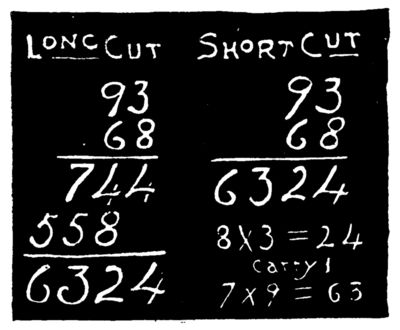
The department of How to do Business devoted to short-cuts in figures is very complete, and contains a large number of short methods of arithmetic, which, all who are anxious to become quick at figures will thoroughly appreciate. Many of the best rules have never before appeared in print. Perhaps the best rule is that entitled
SHORTHAND MULTIPLICATION.
96 42 63
38 29 29
3648 1218 1827
This rule was accidentally discovered about four years ago. Since that time Mr. Eaton has given the subject very careful study, and from expert mathematicians, both here and in Europe, he has received some very valuable contributions bearing upon the principles involved. The whole subject is thoroughly explained in How to do Business, and the explanations are so simple that the smallest child who knows how to multiply should be able to understand the rule thoroughly and apply it constantly. It is really one of the best things ever published. For instance, take the example given in the illustration: Say 8 times 3 are 24, and put down both figures. Carry one and say 7 times 9 are 63, and put down both figures. Always carry one. Note that this rule does not apply to all numbers, but it applies to a great many. In five minutes study of the rule, anyone should be able to tell at a glance which numbers will work, and which of the two to write as multiplicand. Don't try to find out the rule by any process of guessing, for there is no guess work about it. It is as exact as the sun and as simple as A B C. Apply it to these examples:
88 × 73 43 × 84 39 × 24
62 × 97 88 × 55 62 × 68
77 × 37 68 × 29 32 × 94
86 × 47 64 × 38 43 × 84
63 × 48 23 × 27 88 × 73
46 × 27 63 × 48 99 × 82
82 × 49 48 × 34 85 × 85
96 × 38 48 × 26 23 × 44
49
17-3/4
869-3/4
One of the best things about this rule is the fact that it applies to fractional numbers. Try this example the old way and then apply this new rule: 7 times 9 plus 3/4 of 9 equals 69-3/4; carry one, and twice 4 is 8, giving the answer 869-3/4. If you want to try a few examples take 65 by 37-1/2, or 42 by 38-1/2, or 93 by 48-2/3. The rule applies also to numbers of three figures each. It is fully explained in How to do Business.
1. Are you a good salesman?
2. Why do some men succeed in almost any kind of drumming, while others fail?
Almost all business men are salesmen in some form or other. There is an old maxim: "When you buy keep one eye on the goods and the other on the seller; when you sell keep both eyes on the buyer." If you would learn the whole secret read this department of The Every-Day Educator.
1. Do you know the law regulating contracts?
2. Are you familiar with the law methods regarding suits, mortgages, attachments, liens, notes, endorsers, judgments, executions, the trustee process, etc.?
There is nothing more expensive than lawsuits. An ounce of prevention is often equivalent to a pound of cure. If you are in doubt about your rights and duties, you will find that the author has explained in this new book the very points which most business men need to know.
Do you know the newest New York method?
You will find a full explanation, with photo-reproductions of actual markings, in this book. The improved methods of "A 1" houses are worthy of your attention. It doesn't take many such "new points" to make a dollar's worth.
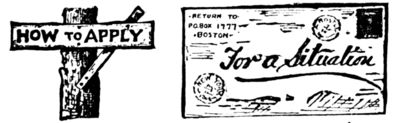
There is no use applying for a situation if you cannot do anything. Encourage and develop some one talent for the use of which the world offers a money value. The man who can do anything fairly well isn't drawing half the salary of the man who can do one thing better than other people. Do not be afraid of pounding persistently at one thing, even if people do call you a crank. If nothing turns up, turn something up. Don't quit a good position until you are sure of a better one. Remember that the very best positions are secured through promotion and not by answering advertisements. It may be worth your while to study carefully the pages devoted to this subject in The Every-Day Educator. You will find a model application (an answer to advertisement) on page 116 of this book.
1. Are you a mechanic?
2. Do you do your own figuring?
3. Would you like to know a few improved methods originated by master mechanics?
4. The foreman draws bigger pay than you do simply because he knows more.
5. This new book (The Every-Day Educator) may add something to your income.
Reprinted complete from the English edition. This newly invented system is called figure-shorthand because considerable use is made of the nine digits in writing it.