THE HANDS AND THE FINGERS
Reading edition
According to d’Arpentigny and the other French palmists, there are seven sorts of hands. These are called elementary, spatulate or active, conic or artistic, square or useful, knotty or philosophical, pointed or psychic, and mixed. As a matter of fact most hands are somewhat “mixed,” for they do not correspond exactly to any of the types.
The elementary, simple, or ordinary hand has short fingers. The longest finger is usually shorter than the length of the palm. The palm is thick and somewhat rounded. The skin is inclined to be rough. It is supposed to be so naturally, that is, not merely as the result of hard work. Therefore the calloused palm is taken to be less important as an indication of the simple hand than the hard, rough skin of the fingers. This type is supposed to show a lack of educability, and to be found chiefly in unskilled laborers. People with elementary hands are said to be passionate but mentally sluggish.
The spatulate or active hand suggests the spatula, the broad and knifelike instrument used by druggists and painters. The thumb is large and the fingers are usually sensitive, well-developed at the tips. The palm is wide, but often it narrows near the fingers. The hand is seldom flabby, for it indicates the worker, and it is most frequently rather flat. People with spatulate hands are just and orderly, we are told. According to Edward Heron-Allen, “The great pronounced characteristics of this type are: action, movement, energy; and, of course the harder or firmer the hand, the more pronounced will these characteristics be. A man of this type is resolute, self-confident, and desirous of abundance rather than of sufficiency.”
The sort of hand which the palmists call conic or artistic is often full and soft. The fingers taper and their points are long. The skin is, in most cases, smooth and without blemishes or callouses. This is the hand of luxury, even voluptuousness, and of weak will. The conic hand indicates artistic power, we are told, especially if the ring finger is long. But, so the tale is told, people with such hands may fail because of lack of application and effort. They are quick-tempered and changeable.
The square or useful hand has flat fingertips. The corners are somewhat angular. The nails are said to be square at the end. The hand is broad and the joints are large. The whole hand is usually of greater than average size. This is frequently found in artisans, it is said, especially in those who have to do with construction. People with useful hands have little interest in the merely artistic things. They want to know, “What’s it good for?” Cheiro says that “they are sincere and true in promise, staunch in friendship, strong in principle, and honest in business. Their greatest fault is that they are inclined to reason by a twelve-inch rule, and disbelieve all they cannot understand.”
The knotty or philosophical hand is an exaggerated conic. The joints of the fingers are knotted, the fingers are unusually long and tapered. Idealists have the joints next to the finger tips well-developed. Materialists have greater knots at the second points. This is the wisdom of M. d’Arpentigny. Scientists, professors, and theologians have frequently knotty hands. People with philosophical hands are secretive and thoughtful and often vain. They are inclined to be patient and thorough.
The psychic hand is still more definitely pointed and conical, and it is without the conspicuous knots of the philosophical hand. It is smooth and the muscles are soft. Among those with psychic hands are mystics, dreamers, visionaries, and believers in palmistry. Some of them are poets. They are seldom capable of making material progress, and the world considers them failures. Thus the tale is told.
The mixed hand is judged by the type which it most nearly approaches and by the other types which it resembles in some particular. Of the mixed hand in general, Cheiro says, “It is the hand of ideals, of versatility, and generally of changeability of purpose. A man with such a hand is adaptable to both people and circumstances, clever, but erratic in the application of his talents. He will be brilliant in conversation, be the subject science, art, or gossip. Such hands find their greatest scope in work requiring diplomacy and tact.”
The square hand with long, square fingers is said to indicate the development of intellect and will. With knotty points, it points to a capacity for detail. With pointed fingers, it shows a lack of determination and persistence. The square hand with spatulate fingers often characterizes inventors, according to Holmes Whittier Merton.
We are told that large hands are frequently found in people who enjoy detailed and delicate work. Watchmakers and other artisans who deal with very small objects, we are assured by Oxenford and Alpheus, have always huge palms. As for the men and women with tiny hands, they like to work on skyscrapers and pyramids. People with small hands have a large handwriting, while this is naturally small with people whose hands are large.
Men and women with long fingers are curious, restless, and likely to worry about trifles. Short fingers indicate a tendency to understand objects as a whole rather than as groups of details. People with stubby fingers are supposed to act on impulse, while longer digits show a more reflective nature.
Fingers are measured from the tip to the center of the knuckle at the back of the hand. The palm is measured from the beginning of the second finger to the wrist. A good and well-balanced character is supposed to be shown by the approximate equality of the longest finger and the palm. When the palm is longer than this finger, a lack of interest in the particular and the concrete is indicated.
A good finger, according to the palmists, is one of attractive appearance. It is straight, well-formed, and proportionate to the others in length, width, and thickness. A bad finger is too thick or too thin, too long or too short, twisted or bent. It is sometimes said to indicate nervous disease.
The index finger is supposed to stand under the rule of the planet Jupiter noble and magnanimous. Jupiter confers honor and dignity. A good index finger means a love of rule or of admiration. Too long an index finger shows an inclination to be tyrannical or perhaps too eager for titles and medals. If the finger of Jupiter is too short, it shows an unwillingness to assume responsibility. If it is crooked, it indicates a lack of honor. Other interpretations will suggest themselves to the person familiar with the pseudo-science of astrology.
The middle finger is dominated by Saturn, the planet which is supposed to make people steady and thoughtful when its aspects are good. A well-balanced middle or second finger is taken by palmists to show prudence. Too long, it indicates an undue absorption in self. Too short, it indicates giddiness and lack of moral stability. Crooked, the second finger shows hysteria.
The third or ring finger is ruled by Apollo. This is the planet which confers a love of beauty and nobility upon the men and women it favors. A good ring finger is said to be indicative of artistic appreciation. A disproportionally long third finger may show a fondness for gambling and speculation, or it may be a sign of an overvaluation of art. It may possibly show a dislike for German brass bands. This is a discovery of my own, which I willingly transmit to posterity. If the ring finger is too short, a lack of interest in art may be read by the examiner. It was a woman with an exceedingly stubby third finger, you know, who found her husband reading “Snappy Stories” and made the classic speech, “My God, have I married a literary man!” A crooked ring finger is said to be indicative of wrong ideas about art. I suppose this is characteristic of censors, bowdlerizers, and followers of the late Mr. Comstock.
The little finger belongs to Mercury, the planet concerned with speed, business success, thievery, and clubs dedicated to service. If it is straight and well-proportioned, it indicates general capacity, which may lead to success if the other signs are right and the subject happens to be lucky. If the little finger is unusually long, its possessor is sly and cunning, we are told. Too short a fourth finger points to a lack of executive ability. The man whose little finger is crooked is lacking in business tact.
D’Arpentigny insists that the thumb is an important index to individuality. A thumb that appears to bend backward is alleged to show extravagance, love of luxury, and sometimes a lack of honor. The backward-bent thumb often goes with generosity. A short, heavy, blunt thumb is supposed to indicate grossness and sensuality. On the other hand, it may—but “on the other hand” is a phrase which should be used only literally in a learned treatise on palmistry. Well, a thick thumb may show that the possessor is not a magician. Or it may indicate that he is not fond of mixed pickles. It may make it plain that he belongs to the Ancient and Honorable Order of Sons of the Big Stick, especially if he wears the pin of the order on his waistcoat.
The points of the fingers divide them into phalanges. The first phalanx is the one out of which the nail grows. According to M. Desbarrolles, the first phalanx expresses ideality, the second has to do with intellectuality, and the third is connected with the material world. The first phalanx demands special study. If it is pointed, the possessor is better at imagining things than at carrying them out. If it is shaped like a spatula, he is the he-man (or she is the she-woman) who gets things done, who shoots the villain and brings the money just in time to keep the old homestead from being foreclosed. If the first phalanx is square, the subject is a good reasoner, and knows that palmistry is not the most exact of sciences.
“Long fingers,” I have on the authority of Prof. and Mme. Zancig, “with spatulate tips and long joints, show a love of detail centering in human interest, such as knitting socks for soldiers on foreign service, and teaching in a night-school if the Mercury finger is long as well.” And of reciting Mr. Guest’s poetry, if the Saturn finger is unusually long, I might add.
In the index finger, a long first phalanx is supposed to indicate superstition and an interest in ghosts. If the second phalanx is unusually long, desire for wealth and fame is extreme. If it is the third phalanx which seems to be conspicuously long, the subject is ambitious for power.
In the middle finger, the excessive length of the first phalanx is supposed to show a melancholy temperament. The second phalanx, if it stands out, indicates a love of farming. But if it is evident that the subject has no agricultural tendencies, this may mean that he likes a poached egg on his hash or that he is fond of riding on a merry-go-round. If the third phalanx is unusually long, he is economical, especially toward the end of the week.
A long first phalanx in the ring finger indicates a love of beautiful objects, especially a fondness for comely members of the opposite sex. An unusually long second phalanx goes with an interest in philosophy, above all, epistemology and ontology. But in exceptional cases it may accompany a liking for dancing or automobile polo. A long third phalanx sometimes is indicative of miserliness.
In the little finger, a fairly long first phalanx shows fluency of language. If the phalanx is conspicuously lengthy, the subject may sometimes fail to tell the truth. If we could measure the length in George Washington’s hand, perhaps we should be able to judge the accuracy of the cherry tree story. The second phalanx, if especially long, shows the ability to do well in business. The great length of the third phalanx is supposed to show a certain amount of exhibitionism, made manifest in the display of jewelry and finery.
The palmists, chirologists, or chirosophists have proved to their own complete satisfaction that the first phalanx of the thumb is indicative of the faculty of will, whereas the faculty of logic is located in the second phalanx and constancy is indicated by the third phalanx, also known as the thumb metacarpal. But some of the authorities tell us that the third phalanx rules the affections and the second governs reason. Well, one system is as good or as bad as the other. The reader may take his choice.
A well-shaped thumb which is rather long shows a good character. The subject does not often get drunk, beats his wife not over fifty times a year, and never drives his automobile at a higher rate than sixty-five miles an hour in any crowded city. But if the first phalanx is unusually thick, he may go up to a hundred miles an hour, especially if the lines of the hand and the motor in his car permit this.
The middle phalanx is normally a third of the total measurement of the finger in length, or a little less. The first phalanx is somewhat shorter, and the third phalanx is about half again as long as the second one. The phalanges are considered long when they occupy considerably more than these proportions.
If the index finger is inclined toward the thumb, there is considerable desire for independence. If it leans toward Saturn’s middle finger, morbid pride results. If the second finger is bent in the direction of the index finger, it betokens a fear of portents and a tendency to be gloomily superstitious. If it is pointed in the other direction, there is more imagination and less sickly brooding, if the ring finger is inclined toward the middle finger, the subject is excessively vain and egotistical. If it leans toward the little finger, there is a tendency toward commercialism in art. Thus the palmists tell their tale. If the little finger is bent in the direction of the ring finger, there is a union of scientific or philosophical and artistic thinking.
A large stretch between the index finger and the thumb indicates or gives generosity. It is not entirely clear whether the gap between the fingers makes money slip out or the generosity somehow widens the space. Between the index and the middle fingers, a large stretch shows independence of thought. A gap between the middle and the ring fingers is indicative of indifference to circumstances. Vagabonds are supposed to show this clearly. Between the ring and the fourth finger, a stretch shows independence of action and indifference to convention. If the fingers stretch apart naturally, there is a strong love of freedom. But the man or woman whose fingers tend to remain close together is bound by custom and conventionality. This is the story that the wise palmists tell us.
Straight lines on the phalanges are supposed to indicate success, while transverse lines presage obstacles. A deep line running up the second and third phalanges of the first finger are taken to signify a special ambition or hobby. Transverse lines on the phalanx next to the palm show money by inheritance, we are told.
In the middle finger, a straight line running all the way up shows military glory. If the subject never enters the navy, the army, or the Prohibition forces, such a line may show an important office in a lodge or it may be indicative of a spot on the clothing from eating a sardine sandwich without due precautions. Two parallel lines indicate mining success or the ability to open a bottle of stuffed olives.
A straight line up the ring finger indicates marked success of some sort. Just what the nature of the victory will be must be determined from other considerations. It may be learning to skate, receiving an invitation to a party, finding that the home-made beer has not yet exploded, discovering gold, or being able to get a seat in the subway during the rush hour. A semicircle on the third phalanx is a certain indication of misfortune. Unwelcome guests, a funeral, a hole in the table caused by Junior’s playful use of his Christmas box of tools, and a run in one’s best pair of chiffon stockings are some of the possibilities. On the little finger, irregular lines on the third phalanx show deception. A husband with such lines should have his trousers carefully searched after he returns from a poker game. He has won at least $5.67—or, if these lines are nearly parallel, $1.76—more than he admits. A circle or semicircle on the third phalanx points out a thief. It is too bad that our police officers have such a superficial knowledge of chirognomy. It would do away with the “third degree” and eliminate all possibilities of the miscarriage of justice. Three lines running straight up the finger show an interest in astrology, phrenology, palmistry, crystal-gazing, spiritualism, Christian Science, the electronic reactions of Abrams, physiognomy, and New Thought. A single line shows success in science or mechanics. I have heard of a man with such a line who succeeded in opening a pound tin can of tobacco without cutting his fingers. A crooked line running across the third phalanx with the shape of a furrow shows a willingness to run away from superior force. Many small lines on the phalanges show delicate health, unless the subject happens to be vigorous, sturdy, and free of all disease.
When the joints bulge perceptibly, the person studied is something of a philosopher. On very hot days, he remarks wisely that it will presently be too cold for comfort. Or if the subject is a woman, she may find the clouds that are attached to all silver linings. Many people with knotty hands are pessimists, although it is true that some, who enter the undertaking business and become presidents of Rotary Clubs, are able to see the sunny side of things. The development of the first joint (the one between the first and second phalanges) indicates a rationalizing mind. The subject knows that it is unlucky for thirteen people to dine together, and can give six or seven good reasons why this is so. However, some people with this knot—like some whose fingers are smooth at this point—are skeptical about accepted doctrines in science, philosophy, history, cookery, and the fine arts. A few of them have been known to say that there may not be so much in palmistry as the chirosophists claim. The upper joints, when well-developed, show a large amount of talent. But what sort of special skill this may be and how well it is employed depend upon some other factors. People whose fingers are knotty at these joints are fond of neatness, cleanliness, and order. If their palms are soft, they make other people do the cleaning and the arranging. If their palms are hard—here the chirognomists seem not to be utterly unreasonable—it is possible that they make use of broom and brush themselves. People whose second joints bulge out are likely to bathe at least once a week, especially if they have suitable hygienic facilities at home. Some of them go to church regularly, but others do not, because of indifference or laziness.
The members of the Chirological Society of London once called a special meeting to find out why no special qualities had ever been attributed to knottiness of the knuckles. They decided, after a hot discussion, that the bulge of the knuckle is the “knot of domestic order.” Housewives with well-developed joints here do not permit their husbands to come in until after they have wiped the mud off their boots.
Men and women with smooth fingers are not likely to be guided by reason, we are told. Passion, intuition, and impulse rule them. Some of them are poets, many of them are ministers of religion, and some are stenographers. People with such hands should be warned to look up hard words in the dictionary and not to trust to their own memory.
Even the shape of the nails has a meaning for the palmist. A normal nail occupies about half of the first phalanx. Nails which are short or small are said to indicate a tendency to diseases of the heart. Personally I should prefer to have a physician examine the organ in question if there were any question of an organic disease, but I suppose this is merely an idiosyncrasy on my part. It is so much less trouble to look at the finger-nails. Short nails which are curved and fluted are indicative of throat-trouble. Exceedingly long and curved nails show a tendency to bronchitis, pneumonia, pleurisy, consumption, halitosis, and diphtheria. “Large nails feel more lasting anger than small ones,” is the wisdom which Ina Oxenford and A. Alpheus collaborated to enunciate. I suppose it is angry nails which scratch women’s faces when they have made other members of their sex jealous. I should say that large nails are more dangerous than small ones, at any rate.
Bright red nails are supposed to indicate a hot temper and a lack of self-control. But men and women with pink nails are often more hasty. When the nails are white, selfishness, sullenness, a calm temper, or a dislike for kippered herring may be inferred. A bluish tint may be the means of diagnosing heart trouble, and a yellow shade may point to jaundice. I am not a physician, but I suspect that the last two indications may actually be of some slight diagnostic value. It is just the tiny touches of truth, though, which are dangerous in the pseudo-sciences, for they make uncritical people take the systems at their face value.
Thick fingers are believed by the palmists—or perhaps we had better say, are claimed by the palmists—to show a liking for ease and luxury. No doubt it is important to distinguish between those which are thick-boned and those which are soft and flabby. Hands which open and close stiffly and with seeming reluctance are said to show determination or even stubbornness.
If the first phalanx of the thumb is long, firm, and spatulate, the will is strong and independent. But if it tapers to a soft point, the subject is easily influenced by others. So the chirognomists tell their story. If this first phalanx is weak and short, it shows feebleness of will and inability to decide upon an action. A heavy, blunt tip is said to be indicative of great obstinacy. A flexible thumb which bends back is supposed to show extravagance.
The second phalanx is the seat of logic. Long, firm, and well-developed, it indicates the ability to see all sides of a question, to consider matters in their logical relations. Why it should, I do not know, but this is the tale that the chirosophists tell. A large second phalanx in conjunction with a small phalanx of will makes the Hamlets, the people who consider their problems so long that it is too late to solve them when they have finally decided upon courses of action. If the thumb rounds away and narrows at the middle, the subject is somewhat narrow-minded. But Cheiro says that it indicates tact, and it is barely possible that it points to a fondness for green hosiery. This has not been fully proved, to be sure.
The third phalanx, according to some writers, has to do with love. This is really part of the palm of the hand, and we shall deal later with the Mount of Venus, which includes part of the region. If the phalanx is long, the passions are likely to be spiritualized, idealized, sublimated, freed of their earthliness, and made ethereal. If they are short, they are sensual, sensuous, fleshly, and genuine.
The first or index finger is sometimes stated to be that which controls and makes manifest the intellectual powers. If it is long and well-shaped, we are told that it shows a longing for power. The ability to realize the ambition depends upon other signs. If it is longer than the second finger, the subject is selfish and arrogant.
The first phalanx is indicative of the senses or of intuition or of a willingness to wear a brown derby hat. With very smooth fingers, a long first phalanx means mysticism, poetry, drunkenness, or the making of speeches at public dinners. The first knot points out religious skeptics. The second phalanx is related to the phrenological faculties of eventuality and educability.
The second or middle finger has been connected with association, affection, and circumstances. If it is unusually firm, long, and thick, the subject may feel himself to be in the clutch of the Fates, unable to rule his own destiny. A typical instance is that of the husband whose wife tells him at what hour he must go to bed, what sort of umbrella he is to carry, how much he is to eat, and what company he is to keep. A strong middle finger is indicative of weakness, then, and its possessor is almost certain to be a very morose person. If he happens to be gay and lively, even successful, this is because he has counteracting signs elsewhere on his hand, or perhaps on his face or his cranium.
If the first phalanx is long, the individual submits to the fell grip of circumstance. He lets the tides and the winds draw them whither they will. If he must wear a pink cravat with purple polka dots, it is the will of the gods. He does not venture to protest. The second phalanx, when it rules, makes, according to one authority, for an interest in the occult sciences. According to another, it shows mechanical or agricultural ability. Perhaps it indicates a natural capacity for solving cross-word puzzles. A long third phalanx is the sign of acquisitiveness or social organization, as the reader may prefer to believe. A strong second finger sometimes shows a tendency to rheumatism or pyorrhea. Some people with large middle fingers get cavities in their teeth, in which case they may experience pain.
If the third finger is long and the first phalanx happens to be prominent and spatulate, artistry is indicated. The subject may be a painter, a poet, an expert at coming home after three in the morning without waking up his wife, a good cook, an actor, a sculptor, or a bootblack. But if the finger is long and the second phalanx is well-developed, the individual is supposed to be fond of gambling. As Merton says, this is the phalanx of industry. I suppose it shows the man who gets rich by speculating in Wall Street or by cornering the wheat market, especially if this happens to be the case.
The little finger is that of expression, action, or of the use of kiss-proof lipstick. When it is very large, it makes for an excessive use of cosmetics or for various forms of dishonesty. If it is unusually small, the subject finds it hard to get ahead in the world. But we must keep in mind the fact that there are many other signs for the chirognomist to consider, and he can always explain why a man is successful or unsuccessful, interested in law or in plumbing.
The pointed formation of the tip is supposed to show tact and diplomacy or sometimes cunning and a disregard for fair play. Fluency goes with the good development of the first phalanx. A square tip shows the ability to teach or a tendency to meddle with other people’s affairs. Whereas the first phalanx offers an indication of the capacity for oral language, the second phalanx is long in writers. The third section rules worldly wisdom, adventure, and movement. So tell the palmists their tale.
People whose hands have narrow palms are supposed to be conventional, cheerful, plucky, and imaginative. They like to see photoplays with happy endings, and they are fond of vaudeville and burlesque shows. Unless they are musical, they very seldom attend recitals and concerts. A square palm shows a love of fresh air, unless perhaps the line of carbon dioxide gas is well-developed. When the palm is hard, square, and flat, the subject enjoys playing golf or watching baseball games. In some cases, the hardness of the palm shows that an individual is accustomed to taking care of a furnace.
The hollow palm, alas, indicates a weak will, a lack of power to take advantage of opportunities, sometimes listlessness and undue sensitivity. But dogs and even cats have been known to exhibit a liking for hollow-palmed people, especially when they are generous with bones and cream and catnip. As everybody knows, a man of whom animals are fond must possess some of the virtues. Perhaps such a man has never poisoned his mother or taken the Lord’s name in vain. But, if he has a hollow palm, this may be because of lack of energy. He must have a strong leader—one with a flat palm and preferably with red hair.
The palm which is hard, flat, and without flabbiness is characteristic of the man of action. The subject may not act wisely, but he will do something. It is women with such palms who discourage the flirt by slapping his face or pulling him to the police station. It is obvious that amorous young men should examine the hands of all the young women upon whom they have designs before they proceed farther.
Ernest Dowson expresses his interest in feminine palms, although he does not directly proclaim himself a palmist:
I was always a lover of ladies’ hands! Or ever mine heart came here to tryst, For the sake of your carved white hands’ commands; The tapering fingers, the dainty wrist; The hands of a girl were what I kissed.
Kissing the hands, it is evident, shows plainly if they are dry or moist, warm or cold. It is important for the lover to know if the palms are soft and flabby. A woman with such hands is not likely to take in washing to support her husband. Rather she will expect him to earn enough to provide her with three meals a day, including fried chicken or roast lamb every Sunday. Thick hands and fingers with a firm palm are especially important indications of interest in food.
According to Edward Heron-Allen, “The soft hand has more poetry in its composition than the hard. Thus, the artist with hard hands will paint things real and actual rather than ideal, and his pictures will be more active and manly than those of a softer-handed artist, who will paint the images of his fancy, and whose work will show greater soul, greater diversity, and more fantasy.”
Certain deductions may validly be made from the hardness of the hand. The man who is not clothed like a laborer, but who has a calloused palm may possibly have risen from the ranks. The palmist watches his manner and takes note of his taste in dress for indications of the “self-made man.” Or the hands may be horny from rubbing against golf clubs or tennis rackets. The chirosopher, if he understands human nature, is often capable of shrewd and accurate guesses.
Soft wrinkles on the hand are supposed to show impressionability and uprightness of soul. Of course it is difficult to tell just what is meant by an upright soul—I really was unaware, until I took up the study of palmistry, that the soul has dimensions—and perhaps this is not incompatible with impressionability. As for wrinkles on a hard hand, they are indicative of pugnacity. The subject is likely to be irritating and a little cruel, we are told, especially if the nails are cut short. What wonders science has presented! And what greater wonders we can find in pseudo-science!
Lines and wrinkles on the back of the hand show sensitivity, benevolence, and possibly a fondness for dill pickles. Men with firm, strong hands sometimes amuse others by dropping from flying machines, going over Niagara Falls in a barrel, playing the clown, dancing a jig, or presenting charades.
A hairy hand in a man is an infallible indication of inconstancy. In a woman, it is a token of cruelty. The man who has just a little hair on the back of his hand is desirous of luxury, but inclined to be prudent. Only rarely does such a person commit burglary or run away with the funds of the bank where he is employed. All men whose hands are slightly hairy and who have been convicted of grand larceny or of other high crimes and misdemeanors have signs of criminality somewhere on their hands. On the thumb, hair shows ingenuity. On the third phalanges of the fingers, it indicates affection. On all the phalanges of the fingers, it is indicative of a hot temper. Hairlessness on the masculine hand is said to be a bad sign. It betrays effeminacy and cowardice. As a matter of fact, many men who are comparatively hairless and who are without the strong physical traits of their sex are especially belligerent and daring. This is a common reaction to a feeling of inferiority begotten by the effeminate appearance.
White hands which remain colorless in spite of changes in temperature show an intense interest in self, we are told. A red hand is indicative of a sanguine nature. This notion is of medieval origin, going back to the physiology of the four temperaments. The sanguine nature (from the French word sang and the Latin sanguis, meaning blood) is hopeful, according to the old writers, because blood is the dominant humor. Yellow hands betoken a bilious temperament, and blackness shows a melancholy disposition, because of the importance of black bile. This system was worked out before the people of Europe were familiar with the usual cheerfulness of the negro. Pallor shows a phlegmatic spirit, as the palmists tell their story. A wholesome pinkness is the best color, for it indicates cheerfulness, love of justice, and a willingness to be converted by every evangelist who comes to town.
Women with large thumbs are sensible in matters of the affections. They do not fall in love readily, and they prefer millionaires to poor philosophers. They are usually willing to accept any ardent lover who is handsome, young, cheerful, clever, audacious, and well supplied with worldly goods, however. Such women are seldom flirtatious or jealous, we are told. These facts are remarkable if true.
Women with small thumbs are romantic, passionate, coquettish, easily made jealous. They make good wives if they are physically attractive, constant, economical, cheerful, and intelligent. They like to be kissed and embraced by their husbands; also, if they are unchaste, they are willing to be hugged by others.
“A little, rosy, soft, smooth hand,” say Oxenford and Alpheus, “thin but not bony, and with little joints slightly developed, indicates a vivacious and sparkling little woman. To win her you must be bright, clever, witty, spontaneous, amusing in affairs of the grand passion; you must be quick and sparkling, rather than romantic and sentimental, as you must be with the conic-fingered woman.”
Women with square fingers and small thumbs are said to be fond of order and conventionality. They serve their meals at regular hours, they always provide knives and forks, and they wash the dishes or have them washed immediately after the table is cleared. They wear evening gowns when they go to elaborate dinners or weddings, and they make their husbands put on dinner coats if they can. Such women, if their hands are decidedly square, prefer to be married rather than to have unconventional love affairs. They expect their husbands to be courteous and to walk on the side next to the curb. Great squareness sometimes goes with fussiness and overemphasis upon punctilio.
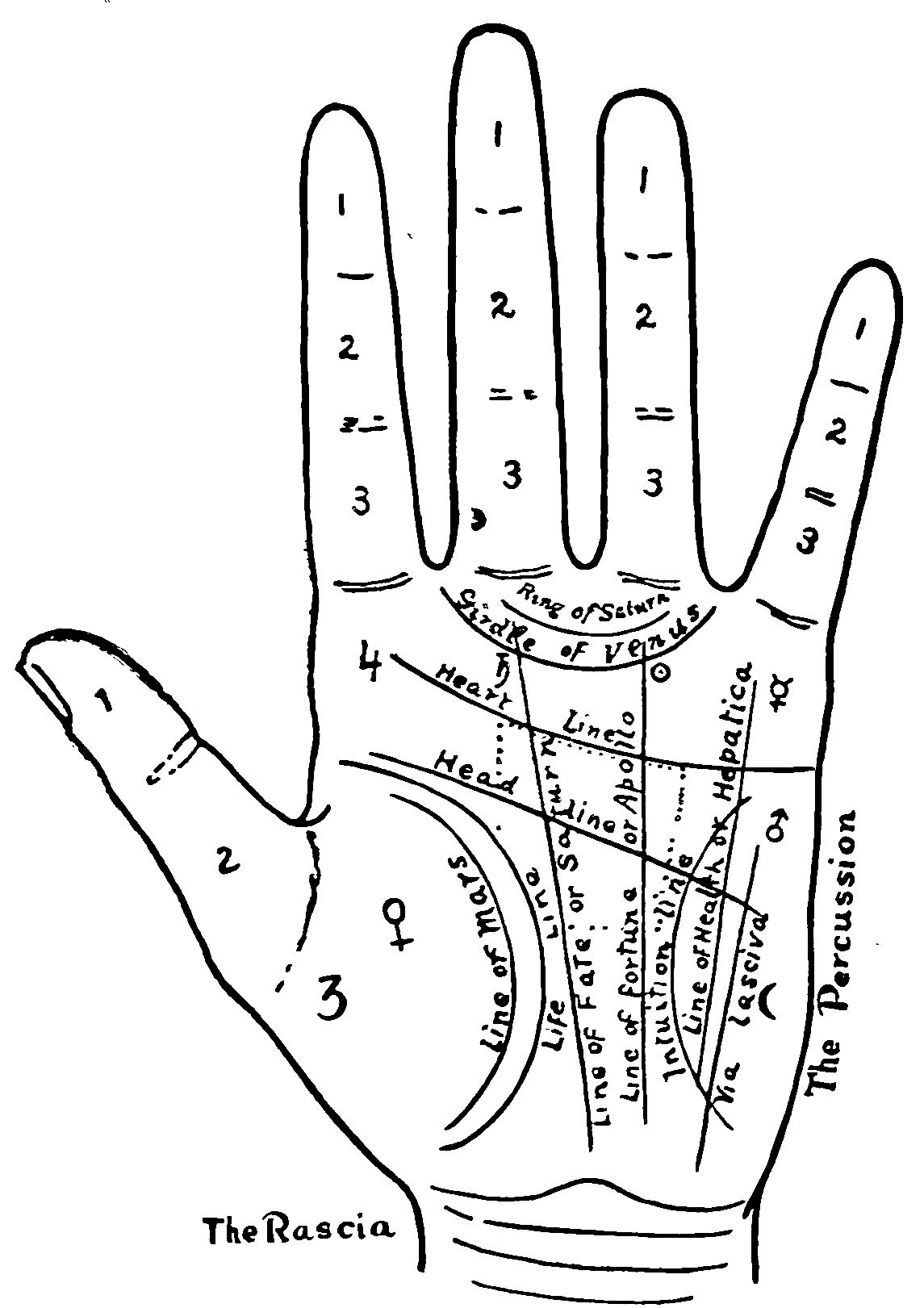
MAP OF THE HAND
1 The First Phalanges. ☿ The Mount of Mercury.
2 The Second Phalanges. ♂ The Mount of Mars.
3 The Third Phalanges. ☾ The Mount of Luna (the Moon).
4 The Mount of Jupiter. ♀ The Mount of Venus.
♄ The Mount of Saturn. The Plain of Mars is Within Dotted Lines.
☉ The Mount of Apollo.